Hubbry Logo
Dressing (medicine)Dressing (medicine)Main
Open search
Dressing (medicine)
Community hub
Dressing (medicine)
logo
8 pages, 0 posts
0 subscribers
Be the first to start a discussion here.
Dressing (medicine)
Dressing (medicine)
from Wikipedia
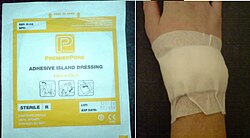
An adhesive island dressing, in its original packaging (left) and on a person's wrist (right)

A dressing or compress[1] is a piece of material such as a pad applied to a wound to promote healing and protect the wound from further harm. A dressing is designed to be in direct contact with the wound, as distinguished from a bandage, which is most often used to hold a dressing in place. Most modern dressings are sterile.

Medical uses

[edit]

A dressing can have a number of purposes, depending on the type, severity and position of the wound, although all purposes are focused on promoting recovery and protecting from further harm. Key purposes of a dressing are:

  • Stop bleeding – to help to seal the wound to expedite the clotting process;
  • Protection from infection – to defend the wound against germs and mechanical damage;
  • Absorb exudate – to soak up blood, plasma, and other fluids exuded from the wound, containing it/them in one place and preventing maceration;
  • Ease pain – either by a medicated analgesic effect, compression or simply preventing pain from further trauma;
  • Debride the wound – to remove slough and foreign objects from the wound to expedite healing;
  • Reduce psychological stress – to obscure a healing wound from the view of the patient and others.

Ultimately, the aim of a dressing is to promote healing of the wound by providing a sterile, breathable and moist environment that facilitates granulation and epithelialization. This will then reduce the risk of infection, help the wound heal more quickly, and reduce scarring.[2]

Types

[edit]
Two packages of gauze; the left package contains gauze compresses in 5cm × 5cm (25cm²), and the other, right package contains a 2 ply all cotton gauze bandage in 10cm × 4.1m (stretched)
The unpackaged gauzes from the picture above; the 2 gauzes on the left are gauze compresses in different sizes and the gauze on the right is a cotton gauze bandage.
Depiction of a dressing on a face from a painting from 1490

Modern dressings[3] include dry or impregnated gauze, plastic films, gels, foams, hydrocolloids, hydrogels, and alginates. They provide different physical environments suited to different wounds:

  • Absorption of exudate, to regulate the moisture level surrounding the wound- for example, dry gauzes absorb exudate strongly, drying the wound, hydrocolloids maintain a moist environment and film dressings do not absorb exudate;
  • Gas permeability and exchange, especially with regard to oxygen and water vapour;
  • Maintaining the optimum temperature to encourage healing;
  • Mechanically debriding a wound to remove slough.
  • Pressure dressings are commonly used to treat burns and after skin grafts. They apply pressure and prevent fluids from collecting in the tissue.[4]

Dressings can also regulate the chemical environment of a wound, usually with the aim of preventing infection by the impregnation of topical antiseptic chemicals. Commonly used antiseptics include povidone-iodine, boracic lint dressings or historically castor oil.[5] Antibiotics are also often used with dressings to prevent bacterial infection. Medical grade honey is another antiseptic option, and there is moderate evidence that honey dressings are more effective than common antiseptic and gauze for healing infected post-operative wounds.[6] Bioelectric dressings can be effective in attacking certain antibiotic-resistant bacteria[7] and speeding up the healing process.[8]

Dressings are also often impregnated with analgesics to reduce pain.

The physical features of a dressing can impact the efficacy of such topical medications. Occlusive dressings, made from substances impervious to moisture such as plastic or latex, can be used to increase their rate of absorption into the skin.

Dressings are usually secured with adhesive tape and/or a bandage. Many dressings today are produced as an "island" surrounded by an adhesive backing, ready for immediate application – these are known as island dressings.

Passive products

[edit]

Generally, these products are indicated for only superficial, clean, and dry wounds with minimal exudates. They can also be used as secondary dressings (additional dressings to secure the primary dressing in place or to absorb additional discharge from the wound). Examples are: Gauze, lint, adhesive bandage (plasters), and cotton wool. The main aim is to protect the wound from bacterial contamination. They are also used for secondary dressing. Gauze dressing is made up of woven or non-woven fibres of cotton, rayon, and polyester. Gauze dressing are capable of absorbing discharge from wound but requires frequent changing. Excessive wound discharge would cause the gauze to adhere to the wound, thus causes pain when trying to remove the gauze from the wound. Bandages are made up of cotton wool, cellulose, or polyamide materials. Cotton bandages can act as a secondary dressing while compression bandages provides good compressions for venous ulcers. On the other hand, tulle gras dressing which is impregnated with paraffin oil is indicated for superficial clean wound.[9]

Interactive products

[edit]
Alginate dressing
Hydrofiber forming gel

Several types of interactive products are: semi-permeable film dressings, semi-permeable foam dressings, hydrogel dressings, hydrocolloid dressings, hydrofiber and alginate dressings. Apart from preventing bacteria contamination of the wound, they keep the wound environment moist in order to promote healing.[9]

Semi-permeable film dressing: This dressing is a transparent film made up of polyurethane. It allows the movement of water vapor, oxygen, and carbon dioxide into and out of the dressing. It also plays an additional role in autolytic debridement (removal of dead tissue) which is less painful when compared to manual wound debridement inside the operating theater. It is highly elastic and flexible, thus is closely adhered to the skin. As the dressing is transparent, wound inspection is possible without removing the dressing. Due to the limited absorption capacity, such dressing is only used in superficial wounds with low amount of discharge.[9]

Semi-permeable foam dressing: This dressing is made up of foam with hydrophilic (attracted to water) properties and outer layer of hydrophobic (repelled from water) properties with adhesive borders. The hydrophobic layer protects the wound from the outside fluid contamination. Meanwhile, the inner hydrophilic layer is able to absorb moderate amount of discharge from the wound. Therefore, this type of dressing is useful for wound with high amount of discharge and for wound with granulation tissue. Secondary dressings are not required. However, it requires frequent changing and is not suitable for dry wounds. Silicone is a common material that make up the foam. The foam is able to mold according to the shape of the wound.[9]

Hydrogel dressing: This dressing is made up of synthetic polymers such as methacrylate and polyvinyl pyrrolidine. It has high water content, thus provides moisture and cooling effect for the wound. The dressing is easy to remove from the wound without causing any damage. The dressing is also non-irritant. Therefore, it is used for dry necrotic wound, necrotic wound, pressure ulcers, and burn wound. It is not suitable for wounds with heavy discharge and infected wounds.[9]

Hydrocolloid dressing: This type of dressing contains two layers: inner colloidal layer and outer waterproof layer. It contains gel forming agents such as carboxymethylcellulose, gelatin and pectin. When the dressing is in contact with the wound, the wound discharge are retained to form gel which provides moist environment for wound healing. It protects the wound from bacterial contamination, absorbs wound discharge, and digests necrotic tissues. It is mostly use as secondary dressing. However, it is not used in wound with high discharge and neuropathic ulcers.[9]

Alginate dressing: This type of dressing is made up of either sodium or calcium salt of alginic acid. This dressing can absorb high amount of discharge from a wound. Ions present in the dressing can interact with blood to produce a film that protects the wound from bacterial contamination. However, this dressing is not suitable for dry wounds, third degree burn wound, and deep wounds with exposed bone. It also requires secondary dressing because wounds can quickly dry up with alginate dressing.[9]

Hydrofiber dressing: Made up of sodium carboxymethyl cellulose, hydrofibers can absorb high amounts of wound discharge, forming a gel and preventing skin maceration.[10]

Bioactive products

[edit]

Advancements in understanding of wounds have commanded biomedical innovations in the treatment of acute, chronic, and other types of wounds. Many biologics, skin substitutes, biomembranes and scaffolds have been developed to facilitate wound healing through various mechanisms.[11]

Usage

[edit]
Application of paraffin gauze on a with cellulitis infected wound

Applying, or changing a dressing is a first aid skill, although many people undertake the practice with no training – especially on minor wounds, which ultimately increases the likelihood of infection. Modern dressings will almost all come in a prepackaged sterile wrapping, date coded to ensure sterility. Sterility is necessary to prevent infection from pathogens resident within the dressing.

Historically, and still the case in many less developed areas and in an emergency, dressings are often improvised as needed. This can consist of anything, including clothing or spare material, which will fulfill some of the basic tenets of a dressing – usually stemming bleeding and absorbing exudate, though, such improvised dressings often need to be used in combination with antiseptic solutions like povidone-iodine to reduce the chances of infection due to the improvisation of dressings including a unsterile technique most of the time.

See also

[edit]

References

[edit]
Revisions and contributorsEdit on WikipediaRead on Wikipedia
from Grokipedia
In , a dressing is a sterile applied directly to a to cover and protect the injury site, absorb , maintain a moist environment, and promote tissue repair. These dressings play a critical role in managing various types of wounds, including acute injuries like surgical incisions and chronic conditions such as pressure ulcers, by facilitating autolytic , minimizing , and reducing the risk of . Proper selection of a dressing based on characteristics—such as depth, level, and status—is essential to accelerate , lower treatment costs, and enhance outcomes. The use of wound dressings dates back to ancient civilizations, with early examples including Sumerian clay applications around 2500 BCE for cleaning and bandaging s, and linen strips soaked in or grease documented in 1600 BCE Egyptian texts. By the time of (460–370 BCE), wool bandages combined with , , or wine were employed to halt and prevent , reflecting an intuitive understanding of moisture's role in healing. The 19th and 20th centuries marked significant advancements, including the introduction of antibiotics and a shift from dry —once standard but now recognized as potentially delaying healing—to moisture-retentive modern dressings developed in the mid-1980s. Today, over 3,000 dressing products exist, driven by emphasizing moist environments that enhance epidermal migration, , and while protecting against bacterial invasion. Wound dressings are broadly classified into passive, interactive, and bioactive categories based on their functionality and interaction with the bed. Passive dressings, such as traditional made from or synthetic fibers, primarily provide a physical barrier and are suitable for clean, dry with minimal , though they may adhere and cause trauma upon removal. Interactive dressings, including transparent films (e.g., ), foams for moderate-to-heavy absorption, hydrogels for hydrating dry , hydrocolloids that form a seal, and alginates derived from for highly absorbent needs, actively manage moisture and support without sticking to tissue. Bioactive and advanced options, such as collagen-based or chitosan-impregnated dressings, incorporate antimicrobials or growth factors to combat in contaminated or stimulate regeneration in chronic cases, with emerging innovations like 3D-printed and tissue-engineered substitutes offering customized solutions. Selection guidelines emphasize matching the dressing to the 's phase—proliferative or remodeling—and monitoring for changes in or signs of complications.

Fundamentals

Definition and Purpose

A medical dressing, commonly referred to as a dressing, is a sterile applied directly to a surface to facilitate by creating an optimal environment, absorbing excess , and shielding the wound from external contaminants such as and mechanical trauma. Unlike bandages, which serve mainly to secure dressings or provide compression, wound dressings are designed for intimate contact with the wound bed to support physiological repair processes. The primary purposes of wound dressings encompass several key functions essential to effective wound management. These include achieving by applying direct pressure or incorporating hemostatic agents to promote clotting and minimize loss; preventing through physical barriers and properties that inhibit ingress; managing by either absorbing fluids to prevent maceration or maintaining a balanced moist environment to avoid ; reducing via cushioning that stabilizes the wound and specialized materials providing cooling or non-adherent interfaces; facilitating , either mechanically by removing during changes or autolytically by softening necrotic tissue in a moist setting; and offering psychological benefits by concealing the wound, which can alleviate anxiety and enhance emotional well-being during recovery. Over time, the purpose of wound dressings has evolved from simple dry coverage intended to promote scab formation to emphasizing moist principles, which accelerate epithelialization and tissue regeneration. This paradigm shift was pioneered by George D. Winter's 1962 study demonstrating that occlusive dressings maintaining moisture in superficial porcine nearly doubled the rate of epithelial migration compared to air-exposed controls, underscoring the role of hydration in optimizing cellular processes like migration and proliferation.

Historical Development

The use of medical dressings traces back to ancient civilizations, where natural materials were employed for their absorbent, , and protective properties. In around 1500 BCE, the documented treatments involving lint as a base material, combined with for its antibacterial effects and animal grease to create occlusive barriers that promoted and prevented infection. Similarly, Greek physician (c. 460–377 BCE) advocated irrigating wounds with wine or for cleansing, followed by dressings made from leaves or boiled to absorb and facilitate recovery. Roman practices, influenced by (c. 129–216 CE), continued these approaches, incorporating lint pads soaked in herbal infusions and emphasizing the role of suppuration as a sign, though without modern sterility concepts. During the medieval period through the , wound care relied on improvised materials due to limited scientific understanding, often incorporating clean cloth rags, spider webs for their natural hemostatic qualities, and animal fats as emollients to soothe and protect injuries. A pivotal advancement came in 1867 when introduced carbolic acid (phenol) as an agent, applying it to dressings and surgical sites to drastically reduce postoperative infection rates from over 50% to below 15% in his trials, marking the shift toward antisepsis in wound management. The 20th century saw the standardization of sterile products, beginning with the late 1800s development of purified, bleached dressings sterilized via heat or chemicals, which became essential for aseptic techniques popularized after . In 1920, invented the () at , combining pads with for convenient, self-application to minor wounds, revolutionizing everyday care. By the , research by George Winter demonstrated that occlusive films maintaining moist environments accelerated epithelialization twice as fast in porcine models compared to air-exposed wounds, a finding corroborated in human studies by Hinman and Maibach, fundamentally altering paradigms from dry to moist . Post-1960s innovations expanded into interactive and bioactive categories, with alginate dressings derived from introduced in the —such as Sorbsan in 1983—for their high absorbency in exuding wounds, forming gels that minimize trauma upon removal. The brought tissue-engineered skins, like Apligraf (approved 1998), comprising cultured and fibroblasts on scaffolds to treat chronic ulcers by mimicking natural dermal layers and promoting regeneration.

Classification

Passive Dressings

Passive dressings are non-occlusive coverings designed to provide a basic physical barrier over the surface, protecting it from external contaminants while allowing minimal interaction with the bed. These dressings function primarily as absorbents and mechanical protectors without altering the wound's biochemical environment or promoting active processes; they typically require a secondary dressing, such as tape or bandages, for secure fixation. Common examples include , composed of woven or non-woven or synthetic fibers like and , which absorbs through ; lint pads, made from low-lint absorbent materials for superficial coverage; tulle gras, a fine mesh impregnated with soft paraffin to reduce adherence; and simple island dressings, featuring a central absorbent pad (often or non-woven fabric) surrounded by an border, such as those used for minor cuts like Band-Aids. These dressings are advantageous for their low cost, widespread availability, and ease of application, making them suitable for superficial wounds with low , clean dry sites, or necrotic tissue where primary absorption is needed without complicating factors. They are particularly indicated for minor abrasions, early-stage pressure ulcers, or as packing for shallow cavities in low-moisture environments. However, passive dressings have notable limitations, including the potential for adherence to the bed—especially with plain —leading to trauma, , and upon removal; they may also desiccate the wound if not changed frequently, impeding optimal . Additionally, they are ineffective for high-exudate or infected wounds due to inadequate absorption capacity and lack of moisture retention, unlike interactive dressings that manage more dynamically.

Interactive Dressings

Interactive dressings are specialized wound coverings designed to actively influence the wound microenvironment through physical mechanisms, such as regulating moisture levels and facilitating , thereby promoting autolytic and healing without relying on biological components. These dressings maintain an optimal moist environment that supports epidermal , , and the prevention of tissue or maceration, while conforming closely to the bed to minimize dead space and enhance contact. By allowing controlled transmission of and oxygen while blocking bacterial ingress, they create conditions conducive to formation and epithelialization. Key subtypes of interactive dressings include several materials tailored to specific wound needs. Semi-permeable films, typically made from thin sheets, serve as transparent, waterproof barriers that permit transmission rates of approximately 500 to 1500 g/m²/24 hours, enabling monitoring of the while supporting autolytic processes in low-exudate areas. foams provide high absorbency for moderate to heavy , drawing fluid away from the to prevent pooling and maintaining a balanced level through their hydrophilic or hydrophobic structures. Hydrogels, composed of 70-90% in a matrix, hydrate dry or necrotic , cool inflamed tissue, and facilitate by softening . Hydrocolloids, formed from gel-forming colloids like carboxymethylcellulose, create an occlusive seal that absorbs light to moderate , forming a that promotes a moist interface and autolysis. dressings, derived from fibers, react with to form a hydrophilic , offering high absorption capacity—up to 20 times their own weight—and are particularly effective for or cavity . Hydrofiber dressings, consisting of non-woven carboxymethylcellulose fibers, are designed for packing irregular or deep , where they swell into a cohesive upon fluid contact to manage and conform to complex shapes. These dressings are indicated primarily for wounds with moderate to high levels of , including ulcers, partial-thickness burns, and chronic ulcers, where they help prevent formation and accelerate and epithelialization by sustaining a dynamic moist environment. For instance, foams and alginates excel in managing exuding ulcers by reducing the risk of periwound maceration, while films and hydrogels suit superficial burns or dry necrotic wounds to promote rehydration and . In contrast to passive dressings used for simple protection of dry wounds, interactive types adapt to the wound's evolving needs through their interactive physical properties.

Bioactive Dressings

Bioactive dressings represent a class of advanced wound care products designed to actively influence the process by incorporating biological agents that interact with the environment at the cellular level. These dressings release bioactive components, such as growth factors, antimicrobials, or elements, to modulate key physiological responses including , deposition, and control, thereby accelerating tissue regeneration and reducing risk. Unlike passive or interactive dressings, which primarily manage or provide barriers, bioactive variants directly stimulate reparative mechanisms to address stalled or chronic . Prominent examples include collagen-based dressings, which serve as scaffolds mimicking the to promote proliferation and new synthesis essential for wound matrix remodeling. These dressings enhance cellular migration and attachment, facilitating faster formation in chronic wounds. Silver-impregnated dressings, particularly those with nanocrystalline silver, deliver sustained ions that effectively reduce bacterial by disrupting microbial cell walls and enzymes, often achieving over 99% reduction in vitro against common pathogens like . Medical-grade Manuka honey dressings leverage as a key antibacterial agent, which inhibits bacterial replication through protein modification and osmotic stress while also supporting autolytic and reducing . Growth factor-incorporated matrices, such as those releasing (PDGF) or (EGF), target epithelial and endothelial to boost re-epithelialization and vascularization. Additionally, biomembranes like amniotic dressings provide a natural source of EGF and other cytokines, suppressing excessive and promoting rapid re-epithelialization via anti-scarring properties. These dressings are particularly indicated for chronic wounds, such as ulcers, venous leg ulcers, and pressure injuries, as well as infected or inflamed sites where is stalled due to high or impaired cellular activity. By enhancing through vascular endothelial growth factor signaling, stimulating synthesis via activation, and reducing pro-inflammatory cytokines, bioactive dressings address underlying pathophysiological barriers to closure. Clinical trials have demonstrated their efficacy; for instance, dressings in a of 11 RCTs showed complete rates of 53.4% in the collagen group versus 34.5% in controls overall, with higher rates at 12 weeks (RR=1.48). Silver dressings have evidenced faster progression to and reduced infection in diabetic wounds, with a porcine model indicating wounds approximately 10 days quicker than controls. EGF-releasing therapies in diabetic ulcers achieved 95% complete closure with high-dose treatment versus 42% in controls at 12 weeks, underscoring a 20-40% acceleration in timelines across various bioactive modalities.

Materials and Design

Common Materials

Common materials in medical dressings primarily consist of natural fibers and synthetic polymers, selected for their ability to provide basic protection, absorption, and comfort, such as in or simple coverings. Natural fibers form the foundation of many traditional dressings due to their availability and inherent properties. , derived from the bolls of the plant, is highly absorbent and breathable, making it ideal for wound contact layers in dressings where it wicks away while allowing air circulation. Historically, and lint—scraps of scraped or fibers—were used for their hygroscopic nature to absorb fluids, though modern usage is rare due to the prevalence of more sterile alternatives. Synthetic polymers enhance durability and functionality in contemporary dressings. Rayon, also known as viscose, is a regenerated produced from wood pulp, providing softness and moderate absorbency similar to but with improved uniformity in nonwoven forms for contact layers. serves as a robust, non-absorbent backing material in composite dressings, offering structural support and resistance to tearing while preventing strike-through of fluids. , a versatile , is commonly used in flexible films or open-cell foams that conform to contours and maintain a moist environment without excessive absorption. Additional basic components include and adhesives for practical enhancements. impregnates dressings—fine mesh fabrics—to create a that minimizes trauma during removal while permitting passage. acrylic adhesives secure dressings to surrounding , formulated to reduce and ensure reliable fixation without compromising . Key properties of these materials ensure safe clinical use. Absorbency varies, with capable of holding 7 to 15 times its weight in fluid, facilitating effective management in passive dressings. Sterility is maintained through gamma-irradiation processing, which penetrates to eliminate microorganisms without altering material integrity. is prioritized, with low allergenicity minimizing inflammatory responses in most patients.

Advanced Technologies

Nanotechnology has revolutionized wound dressings by enabling controlled delivery of antimicrobial agents and biomimetic structures that support tissue repair. Silver nanoparticles incorporated into dressings provide sustained antimicrobial activity through gradual ion release, typically over 7-14 days, effectively combating bacterial colonization without frequent changes. Electrospun nanofibers, produced via electrospinning techniques, mimic the extracellular matrix (ECM) with their high surface area and porosity, promoting cell adhesion, migration, and proliferation essential for regeneration. Smart materials integrate responsive mechanisms to adapt to conditions dynamically. pH-sensitive hydrogels detect alkaline environments indicative of (pH around 7.5-8) and trigger the release of antimicrobials, such as antibiotics or nanoparticles, to target pathogens precisely while minimizing systemic exposure. Shape-memory polymers, often based on or composites, can be compressed for application and then expand to conform closely to irregular wound beds, enhancing contact and reducing dead space that harbors . Tissue engineering integrations advance dressings toward regenerative capabilities. 3D-printed scaffolds, fabricated using bioinks like alginate or , can incorporate stem cells to accelerate healing by secreting growth factors that stimulate tissue formation and vascularization. , derived from shells, serves as a versatile base in these scaffolds, promoting through platelet activation and enhancing via upregulation of . Recent advancements as of 2025 include mechanically active dressings (MADs) that apply biomechanical stimuli to the wound bed, promoting and faster rates compared to passive or static options. Additionally, graphene oxide-integrated polymeric dressings offer enhanced electrical conductivity for electrostimulation and superior effects. Sustainability advances address environmental concerns in disposable medical products. Biodegradable polymers such as (PLA) degrade into non-toxic byproducts like , reducing medical waste accumulation and eliminating the need for removal surgeries. Sensor-embedded dressings, often integrated into PLA or matrices, incorporate indicators like that change color (e.g., from yellow to blue) in response to markers such as elevated or bacterial metabolites, enabling non-invasive monitoring. Regulatory milestones underscore the clinical translation of these technologies. The U.S. (FDA) has approved numerous smart dressings featuring nanocrystalline silver since the late and early 2000s, including products like Acticoat variants, validating their safety and efficacy for infection control in chronic wounds. These approvals often build on common materials like films enhanced with nanosilver for broad coverage.

Clinical Application

Application Techniques

Before applying a medical dressing, thorough assessment is essential to ensure safe and effective initial use. The should first be cleansed by irrigating copiously with normal saline or sterile water, using 50-100 mL per centimeter of length to remove and necrotic tissue. levels and type (e.g., serous, sanguineous, or purulent) must be evaluated to guide dressing selection, alongside assessing depth to determine if packing is needed and checking for signs of such as increased redness, warmth, or odor. General application begins with strict hand hygiene, performed using alcohol-based hand rub or and water for at least 20 seconds to reduce microbial contamination. Nonsterile gloves are donned to remove any existing dressing and protect the , followed by removal of those gloves and application of sterile gloves using a no-touch technique to maintain . The dressing should be selected to overlap the edges by 1-2 cm (or 2-3 cm for optimal coverage), ensuring it is the smallest appropriate size to avoid excess material that could harbor . Application must be non-traumatic: for example, alginates intended for packing deep or tunneled s are fluffed loosely to fill space without pressure, and any adherent material is gently soaked with saline prior to placement to prevent tissue damage. The dressing is then secured with hypoallergenic tape, roller bandage, or adhesive border, positioned to cover the fully while allowing one-third above and two-thirds below for stability. Techniques vary by dressing type to optimize function. For passive dressings like , multiple layers are applied to absorb , starting with a nonadherent contact layer directly on the bed to minimize trauma upon removal. Interactive dressings, such as transparent films, are peeled from their backing and stretched gently over shallow wounds or graft sites to create a semi-occlusive seal that permits moisture vapor transmission while protecting against external contaminants. Bioactive dressings, including sheets or growth factor-impregnated materials, are positioned to maximize direct contact with the wound surface, often cut to fit precisely and layered without overlapping to promote cellular interaction and healing. Dressing change frequency is determined primarily by exudate volume to prevent maceration or leakage, typically ranging from every 1-7 days; for instance, highly absorbent foams on high-drainage wounds may require daily changes, while low-exudate sites using films can extend to weekly intervals. Sterility protocols are paramount throughout, utilizing single-use, pre-packaged dressings opened just prior to application to avoid contamination, and employing no-touch methods where or gloved hands contact only the outer dressing edges, ensuring the wound-contacting surface remains sterile.

Monitoring and Changing

Monitoring wound dressings involves regular assessment to ensure optimal healing conditions and early detection of complications. Clinicians should evaluate dressings regularly during changes or at least every 7 days for signs such as strike-through ( leakage beyond the dressing edges), foul odor indicating possible , increased at the site, or periwound maceration (softening of surrounding due to excess moisture). These indicators prompt immediate action to prevent further tissue damage or progression. The dressing change procedure begins with gentle removal to minimize trauma; if the dressing is adherent, soaking with saline or water can facilitate lifting without disrupting the bed. Following removal, reassess the by measuring its dimensions (length, width, depth) and documenting characteristics like tissue type, volume, and progress. Cleanse the using with normal saline (50-100 mL per centimeter of length) to remove debris, then reapply an appropriate dressing based on the updated assessment, such as switching to a bioactive type if healing has stalled. Tools for monitoring and documentation include wound measurement grids for precise sizing and standardized photography to track visual changes over time, ensuring consistent records that support clinical decisions. Electronic health records or wound care apps can facilitate this by allowing timestamped entries of assessments during each change. As of 2025, emerging digital tools, such as remote monitoring apps, are increasingly used for outpatient follow-up. Patient education emphasizes self-monitoring for home care, instructing individuals to report signs of potential such as fever exceeding 38°C, increased redness or swelling around the , purulent discharge, or worsening pain. This empowers patients to seek timely medical attention and adhere to care protocols. Evidence-based guidelines recommend against routine dressing changes solely based on fixed schedules, instead advocating changes only when dressings are saturated or indicators are present to minimize disruption to the healing process; for example, the Wound, Ostomy, and Continence Nurses Society (WOCN) advises assessment at every dressing change for lower-extremity , with intervals tailored to levels (e.g., 1-3 days for alginates or hydrogels).

Complications and Management

Potential Risks

One of the primary risks associated with wound dressings is , particularly from bacterial ingress when dressings are non-sterile or left in place for prolonged periods. In chronic wounds, methicillin-resistant Staphylococcus aureus (MRSA) colonization can occur at rates up to 50% in certain cases such as ulcers, exacerbating healing delays and potentially leading to systemic if not detected early through signs like increased , odor, or . Trauma and pain are common complications during dressing removal, often due to adherence of the material to the wound bed or periwound skin, which can cause tissue tearing and bleeding. For instance, removal of dry gauze dressings frequently results in such damage, with clinical surveys indicating that 81% of nurses identify dressing changes as the most painful procedure for patients. Allergic reactions to adhesives, such as those containing , affect 1-6% of the general population and may manifest as or more severe in wound care settings. Healing delays can arise from imbalances in wound moisture management provided by dressings. Over-hydration from excessive absorption failure leads to periwound maceration, where softens and breaks down, increasing susceptibility and prolonging recovery. Conversely, occurs with inadequate moisture retention, halting epithelial cell migration and formation. Toxicity from leaching agents in dressings is rare. Other complications include foreign body reactions to synthetic fibers in dressings, triggering chronic inflammation via macrophage activation and granuloma formation around retained fragments. Frequent dressing changes impose an economic burden, with costs escalating due to labor, materials, and extended care episodes—estimated at $28-31 billion annually in the U.S. for management as of 2024. In pediatric patients, repeated procedures can lead to psychological impacts, such as heightened anxiety, fear, and avoidance behaviors that complicate compliance. Overall incidence of complications from wound dressings varies by wound type, with higher risks in chronic wounds than acute settings, underscoring the need for vigilant monitoring of early indicators like escalation or changes. Passive dressings, for example, carry a higher risk of adherence-related trauma compared to advanced types. Emerging advanced dressings, such as those with silver nanoparticles or smart sensors, may introduce new risks like or device malfunction, though these are under ongoing evaluation as of 2025.

Prevention and Best Practices

Effective prevention of complications in wound dressing management begins with appropriate selection criteria tailored to the wound's and individual patient factors. Dressings should be matched to the specific type, such as using alginates for highly exuding or bleeding sites to promote and absorb excess fluid, while considering patient-specific elements like mobility, which may necessitate secure, non-adherent options to avoid shear forces, or allergies that contraindicate materials like or certain adhesives. Comprehensive assessment ensures compatibility, reducing the risk of adverse reactions or suboptimal healing. Hygiene protocols are essential to minimize contamination during handling and application. The aseptic non-touch technique (ANTT) is recommended for dressing changes, involving sterile gloves and avoidance of direct contact with key parts like the wound bed or dressing interior to prevent microbial introduction. Proper storage of dressings in a cool, dry environment away from moisture and direct sunlight maintains product integrity and efficacy, as exposure can compromise sterility or adhesive properties. Staff training programs on these protocols have been shown to significantly enhance compliance and reduce procedural errors, with interventions like just-in-time improving application accuracy. Multidisciplinary approaches optimize outcomes through collaborative care involving wound care specialists, nurses, and physicians, fostering integrated decision-making to address complex environments. The TIME framework—encompassing Tissue management (debridement of non-viable tissue), /inflammation control, balance (to prevent issues like maceration), and Edge advancement (advancing epithelialization)—serves as a structured for systematic assessment and intervention, promoting consistent best practices across teams. This holistic strategy ensures proactive adjustments to dressing regimens based on evolving status. Innovations in prevention emphasize antimicrobial stewardship to curb resistance, advocating for judicious use of antimicrobial dressings only in confirmed s rather than prophylactically, alongside for local resistance patterns. Patient-centered care incorporates education on personal , such as handwashing before touching dressings and recognizing signs of deterioration, which improves adherence and reduces rates by empowering self-management. As of 2025, emerging technologies like AI-powered smart dressings enable real-time monitoring of complications such as or moisture imbalance, potentially reducing risks through early alerts. Guidelines from authoritative bodies like and EWMA reinforce these practices, recommending against routine prophylactic use of silver-impregnated dressings due to limited evidence of benefit and potential for resistance, while advising dressing changes only when clinically indicated—such as or —to minimize disruption and support natural healing. These evidence-based recommendations, when followed, enhance safety and efficiency in clinical settings.

References

Add your contribution
Related Hubs
User Avatar
No comments yet.