


Community hub
Recent from talks
Contribute something
Nothing was collected or created yet.
Reaction Motors XLR99
View on Wikipedia| LR99 | |
|---|---|
 An XLR-99 rocket engine. | |
| Type | Liquid-propellant rocket engine |
| National origin | United States |
| Manufacturer | Reaction Motors |
| Major applications | North American X-15 |
The Reaction Motors LR99 engine was the first large, throttleable, restartable liquid-propellant rocket engine. Development began in the 1950s by the Reaction Motors Division of Thiokol Chemical Company to power the North American X-15 hypersonic research aircraft. It could deliver up to 57,000 lbf (250 kN) of thrust with a specific impulse of 279 s (2.74 km/s) or 239 s (2.34 km/s) at sea level. Thrust was variable from 50 to 100 percent, and the restart capability allowed it to be shut down and restarted during flight when necessary.
Design and development
[edit]The engine is propelled by liquid oxygen and anhydrous ammonia, pumped into the engine by turbopumps at a mass flow rate of over 10,000 lb (4,500 kg) per minute.
After one hour of operation, the XLR99 required an overhaul. Operating times nearly twice that were recorded in tests, but declared largely unsafe. The basic X-15 aircraft carried fuel for about 83 seconds of full-powered flight, while the X-15A-2 carried fuel for just over 150 seconds. Therefore, each XLR99 was capable, in theory, of between 20 and 40 flights before an overhaul.
Like many other liquid-fuel rocket engines, the XLR99s used regenerative cooling, in that the thrust chamber and nozzle had tubing surrounding it, through which the propellant and oxidizer passed before being burned. This kept the engine cool, and preheated the fuel. The basic engine has a mass of 910 lb (410 kg).
Operational history
[edit]The LR-99 was used exclusively to power the X-15 research aircraft after initial trials that used a pair of Reaction Motors XLR11s.
Applications
[edit]Variants
[edit]- XLR99-RM-1
- prototype engines for initial testing and flight trials.
- YLR99-RM-1
- Service test engines fitted to X-15s for later flights.[1]
Specifications (YLR-99-RM-1)
[edit]Data from Aircraft engines of the World 1964/65[1]
General characteristics
- Type: liquid-fuelled rocket engine
- Length: 82 in (2,083 mm)
- Diameter: 39.3 in (998 mm) at the nozzle
- Dry weight: 910 lb (412.8 kg)
- Fuel: liquid ammonia (LNH3)
- Oxidiser: liquid oxygen (LO2 / LOX)
Components
- Pumps: turbopumps 200 lb/s (90.7 kg/s) driven by High-test peroxide (H2O2) decomposed by a catalyst
Performance
- Thrust: 15,000 lbf (66.72 kN) to 57,000 lbf (253.55 kN)
- Combustion chamber temperature: 4,982 °F (3,023 K; 2,750 °C)
- Combustion chamber pressure: 600 psi (4,137 kPa)
- Specific impulse: 239 seconds
- Propellant consumption:0.0035 lb/lbf/s (0.36 kg/kN/s)
- Burn time:
- Thrust-to-weight ratio: 62:1
See also
[edit]References
[edit]External links
[edit]
- Reaction Motors XLR99 Rocket – National Museum of the United States Air Force
- XLR-99
Non-military suborbital rocket engines and motors that have flown | ||
|---|---|---|
| Liquid fuel engines | 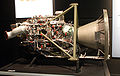 | |
| Hybrid propellant engines | ||
| Solid propellant motors | ||
| Related articles | ||
Reaction Motors XLR99
View on GrokipediaDesign and Development
Origins and Selection
In the mid-1950s, the National Advisory Committee for Aeronautics (NACA) recognized the need for advanced propulsion systems to support hypersonic research aircraft capable of exploring speeds beyond Mach 6 and altitudes approaching space. A NACA Research Airplane Projects Panel meeting in July 1954 initiated discussions on a new research airplane for hypersonic and spaceflight studies, emphasizing the limitations of existing rocket engines like the XLR11 clusters used in earlier X-planes, which provided insufficient thrust for the ambitious performance goals of the proposed X-15 program.[5][6] By 1956, detailed propulsion requirements had crystallized, calling for a man-rated engine that could deliver nominal thrust of 50,000 lbf (later increased to 57,000 lbf), operate throttleably from 50% to 100% of maximum thrust, and support multiple restarts to enable controlled, piloted flights under varying aerodynamic conditions.[7][8] The XLR11 engines, while reliable for subsonic-to-supersonic transitions in prior programs, fell short for the X-15's objectives, necessitating a more powerful, versatile successor to achieve sustained hypersonic velocities and high-altitude trajectories without compromising pilot safety.[9] To meet these demands, the U.S. Air Force, in coordination with NACA and the Navy, issued separate invitations for bids to potential engine contractors on February 4, 1955, soliciting proposals for a restartable, throttleable rocket engine suitable for manned hypersonic flight.[10] Competing designs included the Bell XLR81-BA-1, which proposed a high-thrust configuration using hypergolic propellants; the Aerojet XLR73-AJ-1, a single-chamber engine employing white fuming nitric acid and jet fuel for variable thrust; and the Reaction Motors XLR30-RM-2, an evolution of prior ammonia/LOX designs aimed at scalability for the X-15 airframe.[7][8][11] After rigorous evaluation of technical feasibility, performance projections, and alignment with the X-15 timeline, the development contract for the XLR99 rocket engine was awarded to the Reaction Motors Division of Thiokol Chemical Corporation on February 24, 1956, valued at approximately $10.7 million.[10][12] This selection prioritized Reaction Motors' proven experience with throttleable liquid-propellant systems, ultimately leading to an engine using liquid oxygen and anhydrous ammonia as propellants to balance energy density and operational safety for manned missions.[8] The choice marked a pivotal step in transitioning from interim XLR11 propulsion—used for the X-15's initial captive-carry and low-thrust flights—to a dedicated powerplant capable of powering the aircraft to its design limits.[9]Key Design Features
The Reaction Motors XLR99 rocket engine featured a sophisticated propellant system utilizing liquid oxygen as the oxidizer and anhydrous ammonia as the fuel, which were pumped at rates exceeding 10,000 pounds per minute through dual turbopumps driven by a gas generator cycle.[1][8] This combination provided a balance of high energy density and manageable handling properties for high-altitude operations, with the turbopumps ensuring precise delivery to the combustion chamber.[2] A hallmark of the XLR99's design was its throttling capability, allowing the pilot to vary thrust continuously from 50% to 100% of maximum via a dedicated actuator that adjusted chamber pressure with a response lag of 0.2 to 0.6 seconds. This pilot-controlled mechanism, integrated into the gas generator cycle, enabled real-time adjustments during flight to optimize vehicle control and trajectory, marking a significant advancement in throttleable rocket technology for manned vehicles.[1][2] The engine's restartability was achieved through a two-stage igniter system that supported multiple in-flight startups, with the design meeting a requirement for up to 100 starts or one hour of total operation before overhaul.[3][2] This feature allowed the engine to be shut down and reignited as needed, enhancing operational flexibility for the X-15's research missions.[8] To withstand the extreme combustion temperatures approaching 5,000°F, the XLR99 employed regenerative cooling by routing the ammonia fuel through an intricate network of hollow tubing embedded in the thrust chamber walls before injection into the combustion zone.[1][8] This method effectively dissipated heat, preventing structural failure while maintaining efficiency.[3] At its core, the XLR99 adopted a streamlined architecture with a single thrust chamber and an integrated turbopump assembly, resulting in a compact dry weight of 910 pounds (413 kg).[2][8] This configuration minimized complexity and mass, facilitating reliable integration into the X-15 airframe while supporting the engine's advanced control features.[1]Testing and Production
Ground Testing Program
The ground testing program for the Reaction Motors XLR99 rocket engine was conducted at three dedicated test stands located at the company's facilities in New Jersey, enabling isolated validation of the engine's performance under controlled conditions.[3] Across 14 engines, these tests accumulated more than 500 minutes of total operation and over 640 individual starts, providing extensive data on durability and operational reliability.[3] Key milestones included demonstrations of the engine's ability to exceed its rated one-hour operational life, achieving up to two hours of operation while incorporating throttling from 50% to 100% of rated thrust and multiple restarts—more than five per test sequence—to simulate mission profiles.[3][1] These extended runs highlighted the effectiveness of design features such as regenerative cooling in managing thermal loads during prolonged operation.[3] Development of the XLR99 faced significant delays in the late 1950s, primarily due to challenges in achieving reliable high-thrust performance, which postponed full qualification and necessitated the continued use of interim XLR11 engines for the initial X-15 flights from 1959 to 1961.[14][12] Qualification efforts emphasized crew safety for manned applications, with rigorous simulations of vibration environments and thermal stresses to ensure the engine's fail-safe design prevented hazards to the aircraft under single-point malfunctions.[3][9] This focus on reliability was critical, as the XLR99 was engineered to maintain structural integrity and controlled shutdowns even during off-nominal conditions, supporting its integration into piloted hypersonic research.[3]Manufacturing and Reliability
The XLR99 rocket engines were manufactured on an assembly line at the Reaction Motors Division plant in Denville, New Jersey, under the oversight of Thiokol Chemical Corporation.[15] A total of 339 units were produced between the late 1950s and early 1960s to support the X-15 program.[8] Development of the engine began in February 1956, with the first flight-ready units delivered by 1961 after extensive ground testing and design refinements.[8][3] The XLR99 was designed for high reliability in a demanding hypersonic environment, with a rated operational life of one hour of total burn time or up to 100 starts before requiring overhaul.[3] It was also specified to support 20 to 40 flights per engine under typical X-15 mission profiles, where each flight involved approximately 80 to 150 seconds of powered operation.[8][1] Ground and flight testing demonstrated that engines could achieve nearly double these durations—up to 120 to 130 minutes and over 100 starts—without failure, validating the design's robustness.[3][1] Overhaul was mandated after cumulative operation reached the rated limits to ensure safety and performance, involving detailed disassembly for inspection and replacement of key components.[3] The process focused on the turbopumps, where seals and bearings were examined and often replaced through extensive teardown requiring multiple work shifts, and the thrust chamber, where the injector assembly was removed to check for cooling tube erosion or failures.[3] No significant design modifications were implemented during the production run, allowing for consistent manufacturing and straightforward maintenance protocols.[8]Operational History
Integration with X-15
The XLR99 rocket engine was physically integrated into the aft lower fuselage of the X-15 aircraft, positioned behind the ventral fin to optimize thrust alignment and structural load distribution during high-speed flight.[16] The engine's dry weight of 910 pounds was secured using vibration isolators to dampen high-frequency oscillations up to 1,600 cycles per second, ensuring compatibility with the aircraft's aluminum semi-monocoque structure.[3] Internal propellant tanks held approximately 1,000 gallons of liquid oxygen and 1,400 gallons of anhydrous ammonia, providing capacity for about 83 seconds of full-power burn time in the standard configuration.[1] Control of the XLR99 was designed for direct pilot operation, with throttle capability ranging from 50% to 100% thrust managed through cockpit levers interfaced with the aircraft's avionics system.[3] This setup allowed for in-flight restarts, supporting more than five cycles per mission, facilitated by a hydraulic governor and prelaunch idle mode for system verification exceeding 90% of components.[3] The integration included safeguards like metering valve adjustments to prevent binding, achieved through epoxy impregnation of porous elements.[3] Due to developmental delays with the XLR99, early X-15 flights from 1959 to 1960 relied on interim XLR11 engines, typically configured as two vertically stacked units delivering 16,000 pounds of thrust each.[17] The first powered flight using the XLR99 occurred on November 15, 1960, during X-15 Flight 26, marking the transition to operational use by February 1961.[5][18] The XLR99 design proved compatible across X-15 variants, including the baseline X-15-1 (later designated A-1), X-15-2 (A-2), X-15-3 (A-3), and the proposed two-seat X-15B, without major modifications to the core engine installation.[3] For the X-15A-2, adaptations supported the addition of twin external propellant tanks, extending burn time beyond 150 seconds by increasing fuel capacity while maintaining the ventral fuselage mounting.[1] Ground handling procedures for the XLR99 at Edwards Air Force Base emphasized safety during fueling and ignition, conducted at the Propulsion System Test Stand since June 1959 with over 300 firings for qualification.[3] Specialized protocols included cryogenic fueling of liquid oxygen and ammonia under controlled conditions to avoid seal leaks, which initially required 2-3 maintenance shifts to resolve, and ignition sequencing starting with gaseous propellants mixed and sparked in the first-stage igniter before full liquid flow.[3] Vibration monitoring cutoff systems activated at accelerations exceeding 120g with a 50-millisecond delay to protect the installation during static runs.[3]Flight Performance and Incidents
Out of the X-15 program's 199 research flights conducted between 1960 and 1968, 175 used the XLR99 engine, enabling unprecedented hypersonic velocities and altitudes that advanced understanding of high-speed aerodynamics and atmospheric reentry. Typical mission profiles involved a single burn lasting 80 to 90 seconds, during which the engine delivered up to 57,000 pounds of thrust using anhydrous ammonia and liquid oxygen propellants, propelling the aircraft from launch altitudes of around 45,000 feet to peak speeds averaging Mach 5 and beyond. Notable achievements included reaching a maximum speed of Mach 6.7 (approximately 4,520 mph) on October 3, 1967, piloted by William J. Knight, and an altitude of 354,200 feet on August 22, 1963, flown by Joseph A. Walker, demonstrating the engine's capability to sustain controlled flight in the edge of space.[10][19][20] Despite its operational demands, the XLR99 exhibited exceptional reliability, with successful starts on the first attempt 98% of the time across its flights and a small number of propulsion system failures, including three in-flight malfunction shutdowns that were followed by successful restarts.[21][3] These incidents were rare and typically involved component malfunctions rather than systemic design flaws; none led to loss of the aircraft during the powered phase, underscoring the engine's robustness in a man-rated environment.[1] The XLR99's throttleable design, allowing output variation from 50% to 100% thrust, and its restart capability were validated through in-flight demonstrations on select missions, confirming the engine's potential for extended or segmented burns in future applications. Successful multiple restarts were achieved during test flights, such as those evaluating propellant management under varying acceleration profiles, which affirmed the bipropellant system's stability and the turbopump's responsiveness without compromising pilot control.[3][1] Operations concluded with the 199th and final X-15 flight on October 24, 1968, piloted by William H. Dana, after which the program was formally terminated in December 1968 due to shifting priorities toward orbital spaceflight. The three operational XLR99 engines were subsequently preserved, with examples now displayed at institutions like the National Air and Space Museum, serving as artifacts of early hypersonic propulsion technology.[22][10][2]Applications and Legacy
Role in X-15 Program
The Reaction Motors XLR99 served as the sole powerplant for all three production X-15 aircraft—serial numbers 56-6670, 56-6671, and 56-6672—powering the joint NASA and U.S. Air Force hypersonic research program that conducted 199 flights between 1959 and 1968.[22][23] Developed exclusively for the X-15, the engine replaced earlier interim XLR11 configurations and enabled the aircraft to achieve speeds up to Mach 6.7 and altitudes exceeding 350,000 feet, facilitating pioneering experiments in hypersonic flight under extreme aerodynamic and thermal conditions.[1][3] The XLR99's throttlable thrust, ranging from 50% to 100% of its maximum 57,000 pounds, was critical for mission profiles involving reentry simulations, where pilots managed high deceleration loads up to 5 g while evaluating heat transfer and aerodynamic heating; boundary layer studies to understand transition from laminar to turbulent flow at hypersonic speeds; and stability tests assessing control effectiveness during maneuvers at altitudes above 45,000 feet and attitudes from vertical climbs to 30-degree dives.[3][24][25] These capabilities supported the program's core objectives, with the engine operational in X-15 flights from its first powered use on November 15, 1960, through the final mission on October 24, 1968, enabling eight pilots—including five from the U.S. Air Force—to qualify for astronaut wings by exceeding 50 miles altitude.[5][26][27] For each flight, the X-15's internal tanks carried approximately 1,400 gallons (about 8,000 pounds) of anhydrous ammonia as fuel and 1,000 gallons (about 9,500 pounds) of liquid oxygen as oxidizer, providing roughly 80 seconds of powered flight at full throttle, with propellants supplied directly from the aircraft's ventral and dorsal tanks.[28] The XLR99 had no applications beyond the X-15 program, marking it as a purpose-built component for this singular hypersonic research effort.[1]Technological Influence
The Reaction Motors XLR99 represented a pioneering achievement as the first large-scale, man-rated throttleable and restartable liquid-propellant rocket engine, delivering up to 57,000 pounds of thrust while enabling precise control essential for piloted hypersonic flight.[24] Its variable thrust capability, ranging from 50% to 100% of maximum output via a pilot-controlled lever, addressed the need for maneuverability in dynamic atmospheric conditions, a feature that contributed to broader advancements in controllable propulsion for manned spacecraft.[24] The XLR99's reliability and throttling techniques informed general concepts for variable-thrust operations in subsequent programs, including those for the Apollo and Space Shuttle eras.[24] The engine's throttling legacy extended to subsequent propulsion systems, where its methods for maintaining stable combustion across thrust levels advanced the understanding of variable-thrust requirements in upper-stage engines.[29] In materials and thermal management, the XLR99 advanced regenerative cooling techniques by circulating anhydrous ammonia through the thrust chamber walls to handle extreme temperatures during sustained burns, a method that improved high-temperature propellant handling and influenced durable designs in later bipropellant engines.[24] Post-program, the XLR99's artifacts have been preserved for educational and research purposes, with engines displayed at institutions like the National Air and Space Museum, underscoring their historical significance.[2] The extensive flight data from the XLR99-powered X-15 missions provided foundational hypersonic aerodynamics and propulsion insights that aided the revival of hypersonic research, including the X-43 scramjet program, where early atmospheric heating and control data informed scramjet integration and vehicle stability.[24] These contributions also supported studies for reusable launch vehicles and hypersonic programs like the National Aero-Space Plane in the 1980s and 1990s.[24] However, documentation on direct technological transfers to 1970s aerospace programs remains limited, highlighting gaps in tracing specific lineage beyond the immediate Apollo and Shuttle eras.[30]Specifications
General Characteristics
The Reaction Motors XLR99 is a bipropellant liquid rocket engine utilizing a gas generator cycle, designed specifically for the X-15 hypersonic research aircraft. It incorporates a single thrust chamber fed by turbopumps driven by a separate gas generator that decomposes 90% hydrogen peroxide to produce the necessary turbine power.[16][31] Physically, the engine has a length of 82 inches (2.08 m) and a diameter of 39.3 inches (1.00 m) at the nozzle.[9] Its dry weight is 910 lb (413 kg).[3] The propellants consist of liquid oxygen as the oxidizer and anhydrous ammonia as the fuel, delivered at a maximum combined flow rate of approximately 210 lb/s (95 kg/s).[16] Development of the XLR99 commenced in February 1956 when Reaction Motors, Inc. (later the Reaction Motors Division of Thiokol Chemical Corporation) received the contract from the U.S. Air Force and NACA.[9] The design was frozen in September 1958 amid program delays, with preliminary flight rating tests completed by January 1960; the first operational flight occurred on November 15, 1960.[3] Production ceased in the 1960s after the X-15 program concluded in 1968, with no further units manufactured.[9] The engine's design emphasized reliability for manned flight, including throttleability across a range of 50 to 100 percent to enable precise control during X-15 missions.[3]Components
The XLR99 rocket engine featured a modular assembly of key subsystems designed for high-performance operation in the X-15 research aircraft, emphasizing reliability, throttlability, and restart capability. These components worked in concert to deliver liquid oxygen (LOX) and anhydrous ammonia propellants, generate thrust, and maintain thermal stability during short-duration burns.[16] The thrust chamber served as the core combustion unit, consisting of a single chamber constructed from an assembly of small, welded, wire-wound tubes to withstand extreme temperatures. It incorporated a dedicated injector at the forward end to facilitate precise mixing of the LOX oxidizer and ammonia fuel, ensuring efficient combustion and stable operation at a nominal chamber pressure of 600 psia. This design allowed for the generation of up to 57,000 pounds of thrust at altitude while minimizing combustion instabilities.[3][16] The turbopump assembly provided the high-pressure delivery of propellants to the thrust chamber, integrating two centrifugal pumps—one for ammonia and one for LOX—mounted on a common shaft. Driven by a turbine powered by high-pressure gas from a separate gas generator fueled by 90% hydrogen peroxide, the assembly achieved propellant flow rates exceeding 10,000 pounds per minute, enabling rapid engine response and sustained performance. This integrated setup contributed to the engine's overall dry weight of approximately 910 pounds.[3][16][1] Ignition was handled by a two-stage continuous igniter system, which ensured reliable starts and restarts without external assistance. The first stage utilized spark plugs to ignite a small propellant flow in a precombustor, establishing initial combustion, while the second stage directed the ignited mixture into the main chamber to build pressure gradually and prevent hard starts. This configuration supported multiple restarts—over five per mission—and operated continuously in an idle mode prior to full ignition for enhanced readiness.[3][16][2] Control systems enabled precise management of engine output, featuring a hydraulic governor and electrically actuated valves for variable thrust ranging from 50% to 100% of rated power, allowing pilots to throttle the engine during flight. Additional safeguards included automatic shutdown circuits responsive to anomalies such as turbine overspeed, excessive vibration, or low propellant pressure, prioritizing safety in manned operations. These systems facilitated smooth startups, throttling, and controlled shutdowns via propellant valve modulation.[3][16][2] The cooling system employed regenerative cooling exclusively through the ammonia fuel, which circulated through the thrust chamber's tube walls to absorb heat before entering the injector, thereby protecting the structure from the high combustion temperatures exceeding 5,000°F. No dedicated oxidizer cooling was implemented, relying instead on the fuel's high heat capacity and flow to maintain wall temperatures within safe limits during burns up to 80 seconds. This approach simplified the design while effectively managing thermal loads.[3][16][1]Performance
The Reaction Motors XLR99-RM-1 rocket engine produced a maximum thrust of 57,000 lbf (253 kN) at 100% throttle under operational altitudes approximating vacuum conditions.[9] Throttling capability allowed reduction to a minimum of 28,500 lbf (127 kN) at 50% power, providing pilot control during X-15 flights.[3] At sea level, thrust was rated at 50,000 lbf (222 kN), rising to 57,850 lbf (257 kN) at 100,000 feet altitude due to reduced atmospheric back pressure.[1] Specific impulse, a measure of propulsion efficiency, reached 276 seconds at maximum thrust in low-pressure environments, reflecting the engine's optimized performance for high-altitude operation with anhydrous ammonia fuel and liquid oxygen oxidizer.[32] Sea-level specific impulse was lower at 230 seconds, limited by ambient pressure effects on exhaust expansion.[3] Operational burn time per flight was nominally 85–90 seconds at full power, exhausting the X-15's propellant load while enabling controlled acceleration to hypersonic speeds.[9] The engine's total rated life was 1 hour of cumulative operation across multiple starts, after which overhaul was required to maintain reliability.[3] Propellant flow rates peaked at approximately 13,000 lb/min (98 kg/s) total during maximum thrust.[9] The mixture ratio was maintained at 0.81 (oxidizer to fuel by mass) for balanced combustion and cooling. With a dry weight of 910 lb (413 kg), the engine achieved a thrust-to-weight ratio of approximately 62:1 at full power, contributing to the X-15's agile maneuvering.[9]References
- https://ntrs.[nasa](/page/NASA).gov/api/citations/19710070145/downloads/19710070145.pdf