Hubbry Logo
BE-3BE-3Main
Open search
BE-3
Community hub
BE-3
logo
8 pages, 0 posts
0 subscribers
Be the first to start a discussion here.
Contribute something
BE-3
BE-3
from Wikipedia

BE-3PM
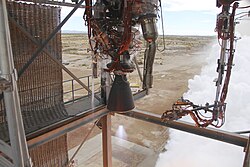
A BE-3PM engine undergoing testing
Country of originUnited States
First flightApril 29, 2015 (2015-04-29)
DesignerBlue Origin
ManufacturerBlue Origin
Associated LVNew Shepard
StatusActive
Liquid-fuel engine
PropellantLOX / LH2
CyclePump‑fed combustion tap‑off
Performance
Thrust, sea-level490 kN (110,156 lbf)[1]
Throttle range18–100%[1]
BE-3U
Country of originUnited States
ManufacturerBlue Origin
Associated LVNew Glenn
StatusIn production
Liquid-fuel engine
PropellantLOX / LH2
CycleExpander
Configuration
Chamber1
Performance
Thrust, vacuum
  • Original: 711.5 kN (159,952 lbf)
  • Improved: 889.5 kN (199,968 lbf)
  • Demonstrated: 941.5 kN (211,658 lbf)[2]
Throttle range75–100%[3]
Thrust-to-weight ratio90:1
Specific impulse, vacuum445 s (4.36 km/s)

BE-3 (Blue Engine 3) is a cryogenic rocket engine using liquid hydrogen and liquid oxygen as propellants. Blue Origin began BE-3 development in the early 2010s and the engine completed acceptance testing in early 2015. The BE-3PM variant is used on the New Shepard suborbital rocket, which made its first test flight on April 29, 2015, and had its first crewed flight on July 20, 2021. The BE-3U variant is used on the second stage of the New Glenn orbital rocket, which made its inaugural flight on January 16, 2025.

History

[edit]

Following Aerojet’s acquisition of Pratt & Whitney Rocketdyne in 2012, Blue Origin president Rob Meyerson saw an opportunity to fill a gap in the defense industrial base.[4] Blue Origin publicly entered the liquid rocket engine business by partnering with ULA on the development of the BE-4, and working with other companies.[4] Meyerson announced the selection of Huntsville, AL as the location of Blue Origin’s rocket production factory in June 2017.[4]

The BE-3 follows the earliest rocket engine development efforts at Blue Origin in the 2000s. Blue Origin's first engine was a "simple, single-propellant engine" called the BE-1 (Blue Engine 1) which used peroxide propellant and generated only 8.9 kN (2,000 lbf) of thrust, and their second, the BE-2 (Blue Engine 2) which was a bipropellant engine using kerosene and peroxide, producing 140 kN (31,000 lbf) thrust.[5]

In January 2013, the company announced the development of the BE-3 (Blue Engine 3), a new liquid hydrogen/liquid oxygen (LH2/LOX) cryogenic engine. The engine was originally announced to produce 440 kN (100,000 lbf) thrust, with initial thrust chamber tests planned for mid-February 2013 at NASA Stennis.[6] The thrust chamber tests were run sometime in 2013.[7]

The BE-3 was successfully tested in late 2013 on a full-duration simulated suborbital burn, with coast phases and engine relights, "demonstrating deep throttle, full power, long-duration and reliable restart all in a single-test sequence."[8] NASA has released a video of the test.[7]

By December 2013, Blue Origin updated engine specifications following engine tests conducted on test stands at ground level, near sea level. This demonstrated that the engine could produce 490 kilonewtons (110,000 lbf) of thrust at full power, and could successfully throttle down to as low as 110 kilonewtons (25,000 lbf) for use in controlled vertical landings if needed for that purpose on particular launch vehicles.[8] The final engine specifications, released in April 2015 following the full test phase, included a minimum thrust of 89 kilonewtons (20,000 lbf), an even wider throttling capability by 20 percent than the preliminary numbers, while maintaining the previously released full power thrust spec.[9]

As of December 2013, the engine had "demonstrated more than 160 starts and 9,100 seconds (152 min) of operation at Blue Origin's test facility near Van Horn, Texas."[8][10] Additional testing of the BE-3 was completed in 2014, with the engine "simulating a sub-scale booster suborbital mission duty cycle."[11] Test stand testing of the engine was completed by April 2015, with over 450 engine firings and a cumulative engine test time of over 500 minutes. Blue Origin stated it would make the first test flight of its New Shepard vehicle later in 2015,[9] with the BE-3PM engine.[12][13]

In the event, Blue Origin made the first flight test of the BE-3PM[13][12] engine on the New Shepard suborbital vehicle before the month was out, flying a boost profile to 93,500 meters (307,000 ft) altitude on April 29, 2015.[14]

In April 2015, United Launch Alliance (ULA) was considering the BE-3 for use in a new second stage, the Advanced Cryogenic Evolved Stage (ACES), which was planned to become the primary upper stage for ULA's Vulcan orbital launch vehicle in the 2020s. The Vulcan was planned to begin orbital flights in 2019 with an existing Centaur upper stage, and was considering three engines from various manufacturers for the ACES stage which would putatively begin flight in 2023, with selection expected before 2019.[15]

While development of a sea-level version of the engine, BE-3PM,[13] was completed and fully qualified by early 2015, Blue Origin said then that they intend to develop a vacuum version of the engine to operate in space.[16]

In January 2016, the US Air Force provided partial development funding to Orbital ATK to develop an extendable nozzle for the Blue Origin BE-3U.[17][18]

On July 20, 2021, the engine design was used in its first crewed flight of the New Shepard.[19]

On September 12, 2022, New Shepard 3 with RSS H.G. Wells capsule suffered an un-contained engine failure that resulted in the triggering of a launch abort and the loss of the vehicle.

On January 16, 2025, a variant of the engine was used in its inaugural orbital flight of the New Glenn.

Engine design

[edit]

BE-3PM

[edit]

The first stage variant of the BE-3, the BE-3PM,[13] uses a pump-fed engine design, with a combustion tap-off cycle to take a small amount of combustion gases from the main combustion chamber in order to power the engine turbopumps.[11][10]

BE-3U

[edit]

Blue Origin has developed an open expander cycle variant of the BE-3, the BE-3U. Two of these engines are used to power the New Glenn second stage.[20]

In November 2015, the engine was projected to have a vacuum thrust of 670 kN (150,000 lbf).[21] Development had begun on the extendable nozzle for BE-3U by early 2016.[17] By August 2018, BE-3U engine development had proceeded, test engines built, and had accumulated over 700 seconds of test time, confirming performance assumptions in the design.[20] In February 2019, Blue Origin updated the thrust of BE-3U as used on New Glenn to 712 kN (160,000 lbf).[22]

In February 2020, Blue Origin opened up a factory in Huntsville, Alabama, to produce BE-3U and BE-4 engines.[23]

In August 2024 Jeff Bezos stated that the BE-3U's thrust had been uprated to 765 kN (172,000 lbf) and that its specific impulse is 445s.[24] The reported thrust was later revised to 770 kN (173,000 lbf) in a press release.[25] In April 2025, Dave Limp announced a static fire had been conducted on the New Glenn second stage which increased the maximum thrust of the BE-3U to 778 kN (175,000 lbf).[26]

In November 2025, Dave Limp announced another demonstrated performance increase for BE-3U, this time increasing maximum thrust to 941 kN (211,500 lbf).[27]

Technical specifications

[edit]

The performance of the sea-level version of the BE-3, the BE-3PM,[13] include:

See also

[edit]

References

[edit]
[edit]
Revisions and contributorsEdit on WikipediaRead on Wikipedia
from Grokipedia
The BE-3 is a family of liquid-propellant rocket engines developed by Blue Origin, utilizing liquid oxygen (LOX) and liquid hydrogen (LH2) as propellants in a hydrolox configuration, designed for high-performance reusability in both suborbital and orbital launch vehicles. The BE-3 family includes the BE-3PM variant, which powers the propulsion module of Blue Origin's New Shepard suborbital rocket and marked the first new LH2-fueled engine developed for production in the United States in over a decade when it debuted in 2015. The BE-3PM delivers up to 110,000 lbf (490 kN) of thrust at sea level, with deep throttleability down to 20,000 lbf (90 kN) to enable precise soft landings and operational reusability with minimal maintenance. The initial BE-3PM powered New Shepard's first five flights, including reaching above the Kármán line and demonstrating vertical landings, after which that propulsion module was retired; BE-3PM engines continue to power New Shepard's ongoing missions, with over 36 flights completed as of October 2025. A related upper-stage variant, the BE-3U, is optimized for vacuum operations and powers the second stage of Blue Origin's heavy-lift orbital rocket, with two restartable engines per stage providing 175,000 lbf (778 kN) of vacuum thrust, throttleable to 140,000 lbf (623 kN); BE-3U debuted operationally on 's first launch in January 2025. This design leverages the core BE-3 architecture to achieve enhanced efficiency, a high , and reliability for missions such as direct insertions. Overall, the BE-3 engines emphasize advanced reusability, cost reduction, and performance in LH2/ propulsion, supporting Blue Origin's goals for sustainable space access.

Development

Origins

The development of the BE-3 engine began in the early as part of Blue Origin's strategy to vertically integrate key components for reusable launch vehicles, aiming to reduce costs and enhance reliability in suborbital and eventual orbital missions. This initiative aligned with the company's broader goal of building in-house propulsion systems to support fully reusable architectures, starting with the suborbital vehicle. Central to the BE-3's conception was ' longstanding vision for hydrogen-fueled propulsion to enable efficient, high-performance space access for both suborbital and orbital operations. , Blue Origin's founder, emphasized liquid hydrogen's superior and clean combustion as ideal for reusable systems that could democratize space travel. The engine's design incorporated cryogenic handling of (LH2) and (LOX) propellants from the outset, prioritizing safe and efficient management of these challenging fluids to support vertical takeoff and landing profiles. Initial funding for the BE-3 program came entirely from Blue Origin's private investments, primarily sourced from Bezos' personal resources, without reliance on major government contracts during the inception phase. Early engineering decisions focused on reusability, with the engine targeted for multiple flights after minimal refurbishment, and deep throttlability ranging from 20% to 100% of nominal thrust to enable precise control during ascent, hover, and landing maneuvers. To achieve simplicity and reliability for suborbital applications, engineers selected a pressure-fed cycle using a tap-off architecture, which avoids the complexity of turbopumps while providing sufficient performance for the New Shepard's requirements.

Testing milestones

The development of the BE-3 engine began with its first hot-fire test on November 20, 2013, at Blue Origin's test facility near Van Horn, , where the engine demonstrated full thrust for over two minutes before throttling down to simulate a landing burn. This milestone marked the debut of the American-made liquid hydrogen-fueled engine, achieving deep throttling from 100% to 18% thrust and a full-duration burn exceeding four minutes total. By early 2015, completed acceptance testing of the BE-3, validating its sea-level thrust of 110,000 lbf (490 kN) across multiple mission duty cycles, including deep throttling and off-nominal conditions. The testing campaign amassed over 30,000 seconds of hot-fire time through 450 firings, confirming the engine's reliability for reusability and handling, which Bezos described as inherently challenging due to its cryogenic properties. Following acceptance, the BE-3 underwent with the New Shepard booster, culminating in the vehicle's first uncrewed suborbital flight on April 29, 2015, where the engine performed flawlessly, propelling the stack to Mach 3 and an apogee of 307,000 feet (93.5 km). For the BE-3U vacuum-optimized variant intended for New Glenn's second stage, testing advanced in 2024 with a risk-reduction hot-fire of the upper stage on September 23, firing two engines for 15 seconds to verify integrated operations. In 2025, further milestones included an April static-fire of an enhanced second-stage configuration with BE-3U engines at up to 778 kN (175,000 lbf) thrust each. These tests addressed development hurdles such as , building on earlier BE-3 experience.

Qualification and production

The BE-3PM variant underwent at Blue Origin's facilities, culminating in qualification for flight operations by early 2015, which supported its integration into the vehicle for suborbital missions, including eventual human-rated flights under FAA oversight. This testing phase, conducted in collaboration with NASA's , verified the engine's performance for safe applications, with the BE-3PM's design emphasizing throttleability and graceful shutdown capabilities essential for crewed operations. Production of the BE-3 family transitioned to full-scale manufacturing at Blue Origin's facility starting in 2015, where the first flight-qualified units were completed and delivered for integration. The facility's design, development, and production capabilities enabled rapid iteration from prototype to operational engines, leveraging in-house expertise for cryogenic components handling and oxygen propellants. To support , scaled BE-3U production at its manufacturing sites, including and , achieving full-rate output by 2025 to equip the vehicle's second stage with restartable vacuum-optimized engines. These efforts included building multiple units for the program's initial flights, with the BE-3U demonstrating reliability during 's inaugural orbital launch in January 2025 and the NG-2 mission on November 13, 2025, which deployed NASA's ESCAPADE spacecraft to Mars. Advancements in additive manufacturing have been integral to BE-3 production, allowing to fabricate complex components such as injectors and elements with reduced lead times and material waste, contributing to overall cost efficiencies in engine assembly. By 2025, these techniques supported the final qualification of the BE-3U for , including certifications for multiple restarts that enable mission flexibility and potential future upper-stage recovery concepts. Supply chain integrations for handling have been enhanced through partnerships and infrastructure upgrades at Blue Origin's sites, ensuring reliable delivery for BE-3 testing and production amid growing demand for hydrogen-fueled engines.

Design

Cycle and architecture

The baseline BE-3PM variant utilizes a , a pump-fed design that taps a small portion of hot gases directly from the main to drive the twin turbopumps, enhancing simplicity and reliability for suborbital flights by minimizing the complexity of additional components compared to full staged combustion systems. This approach reduces the number of engine parts and supports rapid startup sequences, making it suitable for reusable operations with minimal maintenance. In contrast, the BE-3U variant employs an open expander cycle optimized for vacuum performance, where vaporized hydrogen from the regenerative cooling circuit—rich in hydrogen—drives the turbopumps before being injected into the combustion chamber, achieving higher specific impulse through efficient use of propellant heat without dedicated gas generators. The expander cycle leverages the low molecular weight of hydrogen for greater expansion efficiency in space environments. This design relies on regenerative heat transfer for turbopump power without sacrificing exhaust mass. The engine's overall architecture incorporates a mount for vector control, enabling precise steering during ascent and descent. For the BE-3U, this includes a single-shaft configuration integrating both fuel and oxidizer turbopumps on one rotating assembly to streamline the design and improve balance under operation. Throttling across both variants is managed via variable orifice valves that modulate flow rates, supporting throttling from full of 110,000 lbf (490 kN) down to 20,000 lbf (89 kN), equivalent to approximately 5.5:1 or 18% of maximum , for the baseline BE-3PM—critical for controlled vertical landings. circulates through integral channels in the and nozzle walls, absorbing heat to protect structural integrity while preheating the . Following the successful maiden flight of on January 16, 2025, the BE-3U design has been validated in operational vacuum conditions.

Propellant feed system

The BE-3 engine uses (LH2) and (LOX) as propellants, stored in separate cryogenic tanks within the vehicle to maintain their low temperatures and prevent boil-off. These tanks are pressurized using gas to supply the propellants at sufficient inlet pressure to the turbopumps, ensuring reliable operation across suborbital and orbital missions. The overall feed system is pump-fed, with turbopumps boosting the low-pressure propellants to the high chamber pressures required for efficient . In the BE-3PM variant for the booster, the propellant feed system incorporates a . A small portion of the hot gases generated in the main is diverted through a tap-off manifold to drive the engine's turbopumps, powering both the and oxygen pumps on separate shafts. This approach eliminates the need for a dedicated preburner, simplifying the while providing the necessary power for propellant delivery. The system supports deep throttling from full down to 18% for landing maneuvers, with the turbopumps adjusting flow accordingly. The BE-3U variant, optimized for the vacuum environment of New Glenn's upper stage, employs an for its feed system. Hydrogen vapor, generated by absorbing heat from the engine's channels, expands through a to drive a single integrated assembly that handles both LH2 and . This cycle leverages the cryogenic nature of LH2 for power without exhausting additional mass, enhancing efficiency in space. The operates at high speeds to deliver the required flows for sustained orbital insertion burns. Cryogenic handling in the BE-3 feed system includes (MLI) on the tanks to reduce thermal ingress and maintain density, critical for the high of LH2/ combustion. Subcooling of LH2 further optimizes density and performance, though specific temperatures vary by mission profile. is incorporated through dual shutoff and control valves on lines, along with integrated health monitoring sensors to detect anomalies in flow and pressure during operation.

Thrust chamber assembly

The thrust chamber assembly of the BE-3 engine integrates the , , and to facilitate efficient combustion of (LH2) and (LOX). The assembly was successfully hot-fired during early development testing at NASA's in 2012, demonstrating reliable operation at the target 100,000 lbf thrust level for the sea-level optimized baseline configuration. The injector employs a coaxial swirl design, which promotes uniform mixing of the LH2 and propellants through swirling flows from concentric annuli, enabling high efficiency approaching 99% by enhancing atomization and vaporization in the combustion zone. This design draws inputs from the engine's turbopump-fed system to ensure stable delivery at the required mass flow rates. The operates at a baseline pressure of 1,200 psi and is constructed from alloy for its high-temperature strength and oxidation resistance, with film cooling augmentation using LH2 to protect the walls from thermal loads exceeding 3,000 K. Over 200 axial cooling channels are integrated into the chamber structure, circulating LH2 at approximately 10 g/s to provide while minimizing and gradients. The features a contoured bell shape with an of 20:1 optimized for sea-level performance, reducing the risk of and side loads during atmospheric operation by matching exit pressure to ambient conditions. Ignition of the assembly is achieved via a torch igniter that utilizes hypergolic startup propellants to generate a hot gas pilot flame, ensuring reliable light-off without reliance on spark or systems. Additionally, the design incorporates acoustic damping features, such as Helmholtz resonators or baffles, to suppress high-frequency instabilities that could arise from resonant between the chamber acoustics and heat release oscillations. These elements collectively enable the BE-3's thrust chamber to support deep throttling and reusability in suborbital applications.

Variants

BE-3PM

The BE-3PM is the sea-level variant of Blue Origin's BE-3 engine family, optimized for suborbital applications on the booster with a focus on short-duration burns under 150 seconds. It delivers 490 kN (110,000 lbf) of thrust at , enabling the vehicle's ascent to above the . The engine operates on a , where a portion of the hot gases from the main powers twin turbopumps to feed and propellants. This design enhances reliability by simplifying the turbomachinery drive system compared to full staged-combustion cycles, while maintaining high performance for human-rated operations. Engineered for reusability, the BE-3PM supports rapid turnaround with minimal maintenance between flights, contributing to lower operational costs and . As of October 2025, it has powered the booster in 36 missions, including ongoing crewed flights that carry passengers beyond 100 km altitude. Distinct from the baseline expander-cycle elements in vacuum-optimized variants, the BE-3PM incorporates simplified plumbing tailored to its tap-off operation and suborbital burn profile.

BE-3U

The BE-3U is a vacuum-optimized variant of Blue Origin's BE-3 engine family, designed for upper-stage propulsion in orbital launch vehicles. It utilizes an powered by and propellants, enabling restart capability for multiple burns during missions. Optimized for operation in space, the BE-3U powers the second stage of the rocket with two engines per stage, providing the necessary efficiency for orbital insertion and beyond. The engine delivers 778 kN (175,000 lbf) of in at full power, with continuous throttling down to 80% or 623 kN (140,000 lbf) to support precise adjustments. Its features a higher compared to the baseline BE-3, enhancing in environments for improved during upper-stage operations. This design leverages heritage from the BE-3 while incorporating modifications such as an extended assembly to optimize performance at altitude. Key upgrades in the BE-3U include a configuration with back-to-back turbines to achieve higher power output, supporting the increased demands of applications. The engine demonstrates robust burn time capability, with testing accumulating over 700 seconds and mission profiles enabling burns exceeding 600 seconds across multiple restarts for tasks like insertions. In 2025, the BE-3U achieved its first flight during New Glenn's inaugural mission on January 16, successfully performing multiple burns to reach orbit after liftoff from . The BE-3U engines flew again on November 13, 2025, during New Glenn's NG-2 mission, successfully deploying NASA's ESCAPADE twin spacecraft toward Mars after multiple restarts. This milestone validated the engine's enhancements over the pressure-fed BE-3PM, including the addition of a vacuum-optimized skirt and elevated chamber pressure to 1,500 psi for greater overall performance in orbital roles. The two BE-3U engines on the second stage demonstrated precise control, placing the payload into a targeted with minimal deviation.

Applications

New Shepard integration

The BE-3PM engine is integrated as the single main propulsion unit mounted at the base of the reusable booster, delivering vertical thrust to propel the vehicle and its crew capsule to an apogee exceeding 100 kilometers above . This configuration enables the suborbital system to achieve the Kármán line, providing passengers with several minutes of while supporting the booster's reusability for rapid turnaround. The engine's and propellants contribute to a clean process, producing as the primary exhaust byproduct during ascent. Integration of the BE-3PM presented challenges related to managing boil-off during extended ground holds prior to launch, as the cryogenic can vaporize due to ambient heat ingress. addressed this through venting systems that release excess gaseous and allow for replenishment up to engine start, ensuring stable tank pressures and vehicle readiness without significant mass loss. By November 2025, the BE-3PM had powered all 38 successful flights, including the program's first crewed mission, NS-16, on July 20, 2021, which carried founder and three others across the . These missions demonstrated the engine's reliability in suborbital profiles, with no propulsion-related failures among the successful launches following initial testing in 2015. In a typical flight sequence, the BE-3PM ignites at liftoff and runs for approximately 2.5 minutes until main engine cutoff () near 60-70 kilometers altitude, after which the booster separates from the capsule and begins a ballistic descent. The engine then restarts for a brief propulsive landing burn lasting 3-5 seconds, decelerating the booster from to a gentle at about 6 mph (9.7 km/h) on the pad, enabling refurbishment for reuse. This restart capability has been executed flawlessly across all successful booster recoveries, contributing to New Shepard's high reusability rate. During ascent, the BE-3PM achieves peak accelerations of around 3 g, with the engine throttling down near maximum (Max-Q) at about 128 seconds to manage aerodynamic loads. In operational flights, the engine's performance has consistently met mission requirements, supporting apogees of 100-107 km and precise landings within meters of the target. By 2025, had implemented upgrades to the BE-3PM, including enhanced sensors and control systems to further improve autonomous operations, reducing ground processing time and enabling higher flight cadences. These modifications build on the engine's established reusability, with minimal maintenance required between flights to support the program's expansion.

New Glenn integration

The second stage of , known as Glenn Stage 2 (GS2), is powered by two BE-3U engines mounted in a gimbaled configuration to enable vector control for precise orbital maneuvers, including circularization burns and payload deployment. These engines, optimized for operations with expanded nozzles for higher , provide a combined of approximately 350,000 lbf (1,556 kN). Integration of the BE-3U engines occurs post-separation from the first stage, with ignition of the pair following main engine cutoff of the engines around three minutes after liftoff. An interstage structure connects the stages and includes protective elements, such as fairings and shielding, to safeguard the second stage and its engines during ascent through the atmosphere. The engines feature in-space restart capability, allowing multiple burns for mission flexibility, with the thrust vector control demonstrated during ground testing to ensure adequate steering authority. New Glenn's debut flight on January 16, 2025, from Space Force Station's Launch Complex 36 successfully demonstrated the second stage's performance, carrying a Blue Ring pathfinder to and executing burns exceeding 500 seconds to validate long-duration operation. On November 13, 2025, the second flight (NG-2) successfully launched NASA's ESCAPADE twin spacecraft toward Mars, with the BE-3U engines performing multiple burns totaling over 600 seconds for trans-Mars injection, further confirming their reliability in extended vacuum operations. This mission profile highlighted the BE-3U's ability to perform insertion and deorbit maneuvers, with the stage capable of up to 644 seconds of total burn time across multiple ignitions. For initial flights, the second stage is expendable, but the BE-3U design incorporates elements for potential downmass recovery in future variants, such as controlled deorbit capabilities to enable retrieval or repurposing. integration ties engine health monitoring to the stage's guidance systems through built-in diagnostic software that assesses performance parameters in real time, supporting precise orbit insertion and anomaly detection during burns. The BE-3U configuration contributes to New Glenn's payload compatibility, enabling up to 45 metric tons to (LEO) through efficient hydrogen-oxygen propulsion that maximizes velocity increments for diverse missions.

Specifications

Performance metrics

The BE-3 engine family demonstrates robust performance tailored for reusable launch vehicles, with key metrics centered on output, throttling capability, and efficiency. The BE-3PM variant, optimized for sea-level operations in the booster, generates 490 kN (110,000 lbf) of at full power and 485 kN (109,000 lbf) specifically at . It supports a range down to 89 kN (20,000 lbf), providing operational flexibility for powered landings with a practical of approximately 5.5:1. The BE-3U variant, intended for vacuum conditions on New Glenn's upper stage, produces 778 kN (175,000 lbf) of thrust and throttles to a minimum of 80% capacity at 623 kN (140,000 lbf), enabling precise orbital insertion maneuvers. Both variants operate in a / cycle. Operational reliability is a hallmark of the BE-3 family, with the BE-3PM powering through 36 flights as of November 2025, achieving a success rate of approximately 94% across these missions (accounting for two major booster failures in 2015 and 2022). Specific impulse (ISP), a measure of efficiency, is given by the equation ISP=Fm˙g0,I_{SP} = \frac{F}{\dot{m} g_0}, where FF is thrust, m˙\dot{m} is propellant mass flow rate, and g0=9.81g_0 = 9.81 m/s² is standard gravity. Vacuum ISP values for the BE-3 family are reported as relatively high due to the combustion tap-off cycle, though exact figures are not publicly detailed by Blue Origin.

Physical characteristics

Key materials in the engine construction include copper alloy for the combustion chamber liner, which provides high thermal conductivity to manage extreme temperatures during operation. These dimensions ensure compatibility with vehicle integration requirements, such as fitting within the approximately 3.7 m diameter envelope of the New Shepard booster. The BE-3PM is rated for over 20 ignitions, supporting reusable flight profiles with minimal refurbishment between missions. In contrast, the BE-3U in expendable mode achieves at least 5 ignitions, optimized for orbital insertion tasks.

References

Add your contribution
Related Hubs
Contribute something
User Avatar
No comments yet.