Hubbry Logo
Yuan Wang-class tracking shipYuan Wang-class tracking shipMain
Open search
Yuan Wang-class tracking ship
Community hub
Yuan Wang-class tracking ship
logo
8 pages, 0 posts
0 subscribers
Be the first to start a discussion here.
Contribute something
Yuan Wang-class tracking ship
from Wikipedia
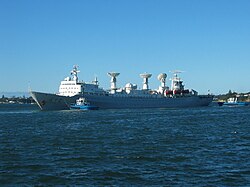
Yuan Wang 2 in Waitemata Harbour, Auckland, New Zealand, on 27 October 2005. The ship was resupplying after being at sea to support the Shenzhou 6 spaceflight.
Class overview
BuildersYuan Wang 1 and 2 - Jiangnan Shipyard, Shanghai / Yuan Wang 3 to 6 - China State Shipbuilding Corporation, Shanghai
OperatorsPeople's Liberation Army Strategic Support Force
Preceded bynone
Succeeded bynone
Completed7
Active4
Retired2, 1 destroyed as target
General characteristics
Typetracking ship
Displacement~21,000 tons (Yuan Wang 1 and 2: 10,000+ / Yuan Wang 3 and 4 18,000)
LengthYuan Wang 1 - 156.09 m / Yuan Wang 2 - 191 metres; Yuan Wang 3-6 - N/A
BeamYuan Wang 1 - 20.6 metres / Yuan Wang 2 - 22 metres; Yuan Wang 3-6 - N/A
PropulsionSulzer diesel engine
Speed20 knots (37 km/h)
ComplementYuan Wang 1 - 200 / Yuan Wang 2 - 470; Yuan Wang 3-6 - N/A
Aircraft carriednone, but capable of handling either Super Frelon or Z-8
Aviation facilitiesnone

The Yuan Wang-class (Chinese: 远望; lit. 'far-seeing' Yuǎn wàng) are a line of Chinese tracking ships used for surveillance and communication of launch vehicle rockets and intercontinental ballistic missiles by the People's Liberation Army Aerospace Force.[1] This class is not of a single ship design, but instead is a group of different designs under the same series that share the same name. The ships are all assigned to the China Maritime Satellite Telemetry and Control Department in Jianyin, Jiangsu province.

Detailed specifications for every ship have not been released by the PLASSF. Yuan Wang 1 and Yuan Wang 2 are thought to have a displacement tonnage of around 21,000 tons when fully loaded, with a crew of about 470 and a length of about 190 metres (620 ft). Their propulsion is from one Sulzer diesel engine, with a top speed of 20 knots (37 km/h).[citation needed]

The class was first proposed by Premier Zhou Enlai in 1965, and was approved by Mao Zedong in 1968. The first two ships of the class, Yuan Wang 1 and Yuan Wang 2, were built at the Jiangnan Shipyard in Shanghai and put to sea on 31 August 1977 and 1 September 1978 respectively. The general designer of this class is Xu Xueyan [zh]. For the first time, this gave the PRC the ability to track launches and satellites that were not over their territory.[citation needed]

The first survey mission of the two ships was during May 1980. After being used for tracking of the launches of indigenously developed communications satellites, Yuan Wang 1 and Yuan Wang 2 underwent overhauls in 1986, so they could be used for supporting international satellite launches by the PRC.[citation needed]

Two further ships of the class have been built. The first was Yuan Wang 3, which was commissioned on 20 October 1995. The Yuan Wang 4 tracking ship was constructed by China State Shipbuilding Corporation and delivered to the China Satellite Launch and Tracking Control General on 18 July 1999. It had been converted from the previously used Xiang Yang Hong 10 scientific survey ship.[citation needed]

Another two Yuan Wang-class vessels were launched in Shanghai in early 2007.[2]

Pictures of Yuan Wang 6 were published, and both Yuan Wang 5 and the newly commissioned ship were on duty for the Shenzhou 7 mission.[3]

During the Shenzhou spacecraft flights, the four ships were positioned as follows:[4][failed verification]

Fleet list

[edit]
  • Yuan Wang 1 - 1977
  • Yuan Wang 2 - 1978
  • Yuan Wang 3 - 1995
  • Yuan Wang 4 - 1999
  • Yuan Wang 5 - 2007
  • Yuan Wang 6 - 2007
  • Yuan Wang 7 - 2016
  • Yuan Wang 8 (Liao Wang 1) - 2024
  • Yuan Wang 21 - Long March 5 transport ship
  • Yuan Wang 22 - Long March 5 transport ship

Type 718

[edit]
Yuanwang 1 in Shanghai, October 2019

Type 718 tracking ship is the very first design of Yuanwang series, and it consists of two ships, Yuan Wang 1 and Yuan Wang 2, both of which have since retired in the early 2010s. Type 718 can attain speeds of 20 kn.

Number Length (m) Width (m) Draft (m) Height (m) Displacement (t) Builder Launched Commissioned Status
Yuan Wang 1[5] 191 22.6 7.5 38 21,157 Jiangnan Shipyard 1977 August 31 1978 Retired
Yuan Wang 2[6] 192 22.6 7.5 38.5 21,000 Jiangnan Shipyard 1977 1978 Retired

Yuan Wang 3

[edit]

Yuan Wang 3 is the second generation tracking ship of Yuan Wang series, and it can attain speeds up to 20 kt, with a range of 18,000 nautical miles and a cruising speed of 18 kt.

Number Length (m) Width (m) Draft (m) Height (m) Displacement (t) Builder Launched Commissioned Status
Yuan Wang 3[7] 180 22.2 8 37.8 17,000 Jiangnan Shipyard 1994 April 1995 May Active

Yuan Wang 4

[edit]

Yuan Wang 4 was converted from Type 643 research vessel Xiangyanghong 10 (向阳红10), which was originally designed in February 1971, with construction begun in July 1975, and entered service in October 1979. Conversion was completed in August 1998, and the ship is capable of carrying a Changhe Z-8. Conversion work included more than four hundred projects in four major categories. Powered by 9000 hp diesel engines, Yuan Wang 4 has an endurance of 100 days and could reach a speed of up to 20 kn, with a range of 18,000 nautical miles cruising at 18 kn.

While in Jiangyin port at 5:10 AM on 5 August 2007, Yuan Wang 4 was hit by a coal carrier Harbor Sea 666 (Gang Hai 666, 港海 666), which caused a massive fire started at the point of collision at 4th fuel tank. The fire was put out after four hours without any casualties, but the equipment on board was severely damaged beyond repair. As a result, Yuan Wang 4 was subsequently converted to a target ship for DF-21 ballistic anti-ship missile to simulate an aircraft carrier target as it entered Jiangyin Shipyard on 15 April 2010 for repair, and eventually destroyed in the latter half of 2010.[citation needed]

Number Length (m) Width (m) Draft (m) Height (m) Displacement (t) Builder Launched Commissioned Status
Yuan Wang 4[8] 152.6 20.6 7.75 39 12,700 Jiangyin Chengxi Shipyard 1997 July 1998 August Destroyed as a target

Yuan Wang 5

[edit]

Yuan Wang 5 is the third generation tracking ship of Yuan Wang series, and entered service on 29 September 2007. Loaded with electronic tracking gear, the Yuan Wang 5 has been called a "spy ship".[9][10]

Built by Jiangnan Shipyard, Yuan Wang 5 has a displacement of 25,000 tones, and is designed to withstand winds up to Beaufort scale 12, and perform duties in sea state 6.[11] It has a carrying capacity of 11,000 tons DWT and its draught is reported to be 8.2 meters. Its length overall (LOA) is 222 meters and its width is 25.2 meters.[12] Its home port is Jiangyin on the Yangtze.[9]

The general designer of both Yuan Wang 5 and 6 was Mr. Huang Wei (黄蔚), the general engineer of the 708th Institute of China Shipbuilding Industry Corporation (CSIC).[13][14]

Yuan Wang 6

[edit]
Yuan Wang 6 in port at Papeete.

Yuan Wang 6, like its sister ship Yuan Wang 5, is also a third generation tracking ship of Yuan Wang series. Designed by the 708th Research Institute, construction begun in April 2006, and the ship was launched on March 16, 2007. The ship entered service on April 12, 2008, and become fully operational in July 2008. Yuan Wang 6 utilizes fiber optic for its information system on board, and the electricity generated by the ship is enough to supply a city of 300,000.[15] Specification:

  • Length (m): 222.2
  • Width (m): 25.2
  • Displacement (t): 24,966
  • Accommodation: 400

Yuan Wang 7

[edit]
China's Space Tracking Ship Yuanwang-7 Starts new mission in 2018

Yuan Wang 7 was constructed by Jiangnan Shipbuilding, and is said to be able to operate for 100 days at sea. The China Satellite Maritime Tracking and Control Department has said the vessel will be used for maritime tracking of the Shenzhou 11 crewed space mission, and the Tiangong 2 space laboratory, using three large dish antennae some 10–12 meters in diameter. It was commissioned on 19 July 2016.[16]

  • Length (m): 220
  • Width (m): tbc
  • Height (m): 40m
  • Displacement (t): 25,000

Yuan Wang 21

[edit]

The Yuan Wang 21 is a cargo ship designed by the 708th Research Institute specially to transport rockets such as the Long March 5; construction began on 1 April 2012, and it was launched on 29 November 2012. Yuan Wang 21 entered service on 6 May 2013. Specification:[17]

  • Length (m): 130
  • Width (m): 19
  • Draft (m): 5.8
  • Displacement (t): 9080

Yuan Wang 22

[edit]

Yuan Wang 22 is also a cargo ship designed specially to transport rockets such as Long March 5, and it is also built by Jiangnan Shipyard, the same builder of earlier Yuan Wang 21. Yuan Wang 22 might be a sister ship of Yuan Wang 21, but this cannot be confirmed yet, because detailed information / specification of Yuan Wang 22 has not been released by official Chinese governmental sources yet (as of 2014). Yuan Wang 22 was launched on 24 January 2013. [18]

See also

[edit]

A list of similar ships:

French Navy

[edit]

Indian Navy

[edit]
  • INS Dhruv, 2020–present, equipped with long range AESA tracking radars
  • INS Anvesh, 2022–present, equipped with long range AESA tracking radars

Soviet Navy / Russian Navy

[edit]

United States Navy

[edit]

References

[edit]
Revisions and contributorsEdit on WikipediaRead on Wikipedia
from Grokipedia
The Yuanwang-class tracking ships are a fleet of specialized ocean-going vessels operated by the Strategic Support Force of , primarily tasked with , tracking, and command (TT&C) functions for satellites, carrier rockets, and ballistic s during launch, flight, and re-entry phases. These ships provide relay and positional accuracy for mission control, enabling determination of impact points and orbital parameters from remote maritime locations beyond the range of land-based stations. Equipped with large parabolic antennas, systems, and extensive communication suites, they represent a critical component of 's and testing infrastructure, supporting both civilian endeavors and military applications. The class originated in the with early vessels like Yuanwang 1 and 2, which have displacements around 21,000 tons and lengths exceeding 150 , though newer iterations such as Yuanwang 5, 6, and 7 incorporate advanced upgrades for enhanced and capabilities, including phased-array radars and satellite communication terminals. Active ships in the fleet, including Yuanwang 3 commissioned in 1995, have participated in dozens of missions, contributing to successes in manned and tests by extending TT&C coverage to the Pacific and Indian Oceans. Their deployments often coincide with high-profile events, such as launches or naval exercises, occasionally leading to observations by foreign militaries due to the vessels' dual-use potential in gathering and strategic monitoring.

Development and Design

Origins and Strategic Purpose

The Yuan Wang-class tracking ships originated from China's early efforts to develop ocean-going capabilities for supporting its nascent space and ballistic missile programs during the Cold War era. Conceived in the mid-1960s under Premier Zhou Enlai to facilitate intercontinental ballistic missile (ICBM) sea tests, the program was formalized as Project 718 in the 1970s amid Beijing's push to achieve reliable telemetry data for long-range launches beyond the limitations of land-based stations. This initiative reflected China's strategic imperative to verify flight paths, collect real-time performance metrics, and ensure recovery data for systems like the DF-5 ICBM and early Long March rockets, addressing the causal constraints of continental geography that restricted domestic tracking arcs. Officially designated as maritime survey vessels, the Yuan Wang class serves under the People's Liberation Army's Strategic Support Force (PLASSF), with primary responsibilities in transoceanic observation, control, and data relay for activities. These ships enable precise measurement of trajectories, reentry dynamics, and deployments, functioning as mobile extensions of ground control networks to mitigate signal blackouts over remote oceanic regions. Their role underscores a first-principles approach to , prioritizing empirical validation through extended-range to refine , guidance, and technologies integral to both civilian and military deterrence. The evolution from coastal prototypes to advanced ocean-going platforms marked a pivotal shift in the late , driven by China's ambition to project power globally and support increasingly ambitious missions, including potential (ASBM) validations. Early vessels like Yuan Wang 1 and 2, commissioned in the late , demonstrated the feasibility of maritime tracking for ICBM tests such as the in 1980, but subsequent iterations incorporated enhanced and suites to operate in distant waters, thereby extending telemetry horizons across the Pacific and Indian Oceans. This progression aligned with Beijing's broader modernization, enabling real-time data acquisition unattainable from fixed infrastructure and supporting dual-use applications in space launches and strategic weapons development.

Construction Timeline and Builders

The Yuan Wang-class tracking ships were constructed primarily at in , a major facility specializing in advanced naval and research vessels under . This shipyard handled the lead vessel Yuan Wang 3, launched on 26 April 1994 and commissioned on 28 May 1995, which established the baseline design emphasizing stable platforms for telemetry equipment with a length of approximately 170 meters. Yuan Wang 4 followed as an early iteration, also built at with design input from the 718 Institute, incorporating minor refinements in structural integrity for extended ocean operations. Construction accelerated in the mid-2000s with Yuan Wang 5, delivered from on 29 September 2007 after incorporating upgrades to systems for better and over baseline models. Yuan Wang 6, similarly built at and commissioned in April 2008, featured further iterative enhancements in hull form to reduce drag, achieving lengths around 222 meters and displacements nearing 25,000 tons at full load. By the mid-2010s, the program advanced to Yuan Wang 7, with on 10 October 2014 at , launch in 2015, and commissioning in 2016; this vessel introduced phased improvements in modular construction for easier future upgrades, measuring 220 meters in length with enhanced stability for high-sea states. Ongoing builds, such as Yuan Wang 8 sighted on the in 2023 at the same yard, continue this progression with potential refinements in materials for reduced radar signature and extended . While most units originated at , specialized subcontractors like Chengxi handled select components for efficiency in phased assembly.

Key Technical Specifications

The Yuan Wang-class ships exhibit displacements of approximately 21,000 tons for initial variants like Yuan Wang 1 and 2, increasing to around 27,000 tons gross registered in later models such as Yuan Wang 7. Lengths range from about 190 meters in early ships to 225 meters in more recent ones, with beams typically measuring 25 to 27 meters. Propulsion systems primarily consist of diesel engines, such as Sulzer units in earlier designs or MAN-B&W models in later variants, delivering top speeds of up to 20 knots. Some advanced iterations, including Yuan Wang 8, incorporate all-electric for enhanced . These configurations support a continuous cruise range of 18,000 nautical miles and self-sustainability for 100 days. Hull forms emphasize seaworthiness, enabling unrestricted navigation at 60° N latitude and operations in Class 4 ice regions. Sensor platforms feature stabilized parabolic antennas for and functions, with notable examples including 9- by 13-meter dishes weighing nearly 300 tons and arrays of up to 38 communication antennas in select vessels. Crew accommodations support approximately 470 personnel in foundational ships, facilitating prolonged missions with integrated capabilities.

Capabilities and Equipment

Radar and Telemetry Systems

The Yuan Wang-class tracking ships feature systems designed for high-precision tracking of launch vehicles and ballistic missiles (ICBMs), employing amplitude-comparison monopulse techniques for accurate determination through phase and signal strength . The Type 180 monopulse radar, a core component, operates in the C-band and supports both manual and automatic acquisition modes, enabling real-time measurement of target trajectory parameters such as range, , and angular position. These radars facilitate monopulse tracking by comparing signals from multiple antenna feeds to resolve ambiguities in fast-moving objects, achieving sub-milliradian accuracy essential for data correlation. Later variants in the class incorporate dual-band monopulse tracking radars operating in both C-band and S-band frequencies, with large parabolic antennas reaching diameters of up to 12 meters to extend detection ranges and improve resolution against low-observable . This multi-band capability allows adaptive frequency selection to mitigate interference and enhance signal-to-noise ratios in varied electromagnetic conditions, supporting simultaneous tracking of multiple objects during ascent phases. Integrated with onboard computers, these systems process radar returns for automated and error correction. Complementing the radars, cinetheodolite optical tracking systems provide auxiliary ranging and angular measurements via high-speed cameras and rangefinders, such as the Type 718, offering meter-level precision for validation against data in clear-line-of-sight scenarios. reception is handled by systems like the Type 450-3 remote receiver, which intercepts and demodulates downlink signals from rockets and satellites across bands, synchronizing with locks for comprehensive flight path reconstruction. These components form a unified suite, where optical inputs calibrate monopulse errors, and streams furnish performance metrics, all fused in real-time for mission-critical data relay.

Communication and Data Processing Features

The Yuan Wang-class ships incorporate multifaceted communication suites, encompassing high-frequency (HF), very high-frequency (VHF), ultra high-frequency (UHF) antennas, and satellite communications (SATCOM) terminals to facilitate secure telephone, radio, , and high-bandwidth data links for relay. These systems support ship-to-shore, ship-to-ship, and , with post-construction upgrades tripling ship-to-shore capacity and increasing digital transmission speeds sevenfold on earlier variants. Satellite links operate primarily in the C-band via large parabolic antennas, measuring up to 9 meters in diameter, enabling connectivity with geosynchronous satellites including those in China's Tianlian data-relay constellation for real-time downrange telemetry forwarding to ground facilities such as the Xi'an Spacecraft Flight Control Center. The deck hosts approximately 54 antennas in total, with designs incorporating frequency selection and spatial separation to minimize inter-system interference during simultaneous operations. Onboard data processing relies on central computing systems that aggregate telemetry from external sensors, ship positioning, and environmental inputs, enabling quasi-real-time orbit calculations, forecasting, and preliminary anomaly identification in trajectories. These capabilities are supported by extensive control infrastructure, including 40-console operations rooms for data handling and mission coordination. Anti-jamming resilience is achieved through , signal filtering, and rationalized antenna configurations to counter potential adversarial disruptions in contested maritime environments. Secure link protocols further protect relayed , though specific methodologies remain classified.

Seakeeping and Endurance Enhancements

The Yuan Wang-class incorporates roll-reduction fins positioned at 25.94 meters forward and 26.49 meters aft to counter pitching and rolling motions, allowing sustained operations in Class 6 sea states characterized by waves up to 4.75 meters. These features contribute to overall high seaworthiness, enabling navigation as far north as 60° latitude in Class 4 ice regions and endurance against Class 12 winds equivalent to typhoon conditions. Directional stability is maintained within ±1° deviation under autopilot control, with maximum course offsets limited to 2°, supporting precise orientation for onboard systems during adverse weather. Endurance is enhanced through self-sustaining provisions for 100 days at sea, complemented by a continuous cruising range of 18,000 nautical miles at 20 knots, powered by 16,000 horsepower diesel engines operating at 118 rpm. The includes robust resistance, surviving two adjacent bulkhead ruptures with water ingress below the upper deck while retaining initial exceeding 1 meter, ensuring platform integrity for prolonged missions. Post-2010 iterations feature enlarged displacements and optimized hull configurations for improved hydrodynamic efficiency during extended transits in the Pacific and Indian Oceans, building on earlier models' baseline capabilities to extend operational reach without compromising stability. Auxiliary systems, including a 800-kW bow thruster and 340-kW main , facilitate precise maneuvering and station-keeping in up to Class 3 seas, further bolstering endurance in dynamic oceanic environments.

Roles and Operations

Support for Space Launches and Satellite Tracking

The Yuan Wang-class ships furnish mobile telemetry, tracking, and command (TT&C) support for China's space program, positioned strategically in to acquire real-time data on rocket launches that fixed ground stations cannot cover due to line-of-sight limitations over oceans. Equipped with unified S-, C-, and X-band systems, these vessels measure parameters such as , , and status during ascent, providing redundancy that enhances mission reliability for satellite insertions and manned flights. This capability has been integral since China's first independent manned launch with on October 15, 2003, enabling sustained orbital operations without reliance on foreign tracking infrastructure. Specific contributions include verification of orbital insertion for payloads like those in the Shenzhou series, where ships relay uplink commands and downlink telemetry to confirm stable orbits post-separation. For the Tiangong-1 space laboratory, launched September 29, 2011, Yuan Wang 3, 5, and 6 conducted a combined 120,000-nautical-mile voyage spanning 539 days in 2011–2012, delivering continuous tracking and control during the module's deployment and Shenzhou 8's automated docking on November 2, 2011. These operations correlate with empirical successes, such as the 98%+ reliability rate of 2F variants used for manned missions, bolstered by shipborne data processing that mitigates gaps in terrestrial networks. Beyond launch phases, the class aids in orbit maintenance and preliminary tracking, using onboard sensors to monitor post-insertion trajectories and potential fragmentation events, thereby supporting China's space independent of international cooperation. Operated by the People's Liberation Army's Strategic Support Force, this dual-use infrastructure underscores the program's militarized underpinnings while advancing civilian objectives like the ongoing Tiangong station assembly.

Missile and ICBM Telemetry Collection

The Yuan Wang-class ships play a critical role in collecting downrange telemetry from Chinese intercontinental ballistic missile (ICBM) tests conducted by the People's Liberation Army Rocket Force (PLARF), enabling precise trajectory analysis beyond land-based sensors. These vessels deploy to Pacific Ocean ranges to intercept signals during the midcourse and terminal phases of flights, capturing data on boost, reentry, and guidance performance that extends effective test corridors for systems like the DF-41 ICBM, which has a reported range exceeding 12,000 kilometers. In a notable example, during China's ICBM test launched from Island on September 25, 2024—the first such Pacific since 1980—Yuan Wang 3 and Yuan Wang 5 positioned themselves in the test area to monitor and gather , as confirmed by automated ship tracking data. This deployment facilitated relay for validating missile performance, including potential multiple independently targetable reentry vehicle (MIRV) separation and accuracy metrics, countering assertions of exclusively civilian support by demonstrating direct utility in iterative refinement. The ships integrate with PLARF operations through the Strategic Support Force, which operates the fleet, providing validation of (HGV) trajectories on missiles like the (MRBM). Equipped with phased-array radars and receivers, they process signals to assess glide path stability and maneuverability, supporting enhancements in precision strike capabilities amid PLARF's emphasis on overcoming intercepts. This capability underscores a dual-use where maritime assets enable closed-loop testing cycles, prioritizing empirical improvements in reliability over diplomatic claims of peaceful intent.

Broader Strategic Applications

The Yuan Wang-class ships extend beyond support for Chinese space launches to contribute to broader space-domain awareness (SDA), enabling the tracking of foreign satellites and ballistic missiles through their unified S-band radars and high-gain antennas capable of intercepting wideband signals over oceanic ranges. This functionality aligns with the Strategic Support Force's mandate to integrate space-based intelligence into naval operations, providing persistent surveillance that enhances China's anti-access/area-denial (A2/AD) posture by monitoring adversary assets in real time. In naval contexts, these vessels support maneuvers by relaying SDA data for over-the-horizon targeting and communication, crucial for blue-water ambitions that project power into the Indian and Pacific Oceans. Their endurance and sensor suites allow integration with PLAN task forces, offering mobile nodes for that compensate for land-based limitations in distant theaters. Western defense assessments highlight the dual-use nature of these platforms for electronic intelligence (ELINT) and (SIGINT) against foreign exercises, citing deployments proximate to U.S. and allied tests as evidence of intercept capabilities for emissions and . In contrast, Chinese authorities describe the ships exclusively as scientific tools for measurement and control, underscoring their role in civilian space program advancements without acknowledging applications. This divergence reflects differing interpretations of the vessels' sensor versatility, with empirical deployments suggesting operational flexibility beyond stated purposes.

Operational History

Initial Deployments (2000s)

The Yuan Wang 3, commissioned in 1995, undertook initial operational deployments in the early 2000s primarily within the western Pacific Ocean to support telemetry collection for China's Long March rocket family launches from Xichang and Jiuquan sites. These patrols, spanning 2002 to 2008, focused on acquiring real-time data over oceanic flight paths where land-based stations provided insufficient coverage, thereby validating the ship's ocean-going capabilities for space mission support. Such missions aligned with the ramp-up of China's space program, including unmanned Shenzhou test flights in 2001–2003, which required extended maritime tracking for orbital insertion and maneuvering phases. A notable application occurred during China's , 2007, anti-satellite (ASAT) test, in which the Yuan Wang fleet, including vessels like Yuan Wang 3, was deployed to monitor the SC-19 missile launch from and track the resulting debris field in . This operation demonstrated the ships' efficacy in missile telemetry and space surveillance, contributing to data on kinetic kill vehicle performance amid international scrutiny of the test's implications. The deployments underscored the class's role in foundational testing, with the fleet accumulating over 50 ocean expeditions by 2008 to bolster national space ambitions. Prior to , these activities remained constrained to East Asian waters, reflecting logistical limitations and a strategic emphasis on regional launch support rather than global projection. This phase established operational templates for relay and during China's transition to more frequent launches, including communications satellites and early crewed mission preparations, without venturing into distant oceans like the Indian or Atlantic.

Expanded Global Reach (2010s–Present)

In the 2010s, the expanded deployments of Yuan Wang-class vessels to support routine collection during (ICBM) tests, including transits across the Pacific Ocean for and launches, with ships positioned to track trajectories from boost to reentry phases. These operations aligned with China's growing , as the inventory expanded while phasing out older systems, necessitating extended maritime observation to compensate for ground-based limitations. Similar transits occurred in the to monitor test data, reflecting a broader pattern of increases tied to the frequency of PLARF activities. Yuan Wang 5 underwent a technical refit in 2022, enhancing navigation, safety, reliability, and equipment operability, which supported prolonged deployments measured in weeks for sustained tracking during key exercises or tests. This upgrade facilitated routine operations, including a September 2025 transit near coinciding with New Delhi's for potential missile tests in the , where the vessel's radars collected data on regional trajectories. By October 2025, Yuan Wang 5 had proceeded westward through the , underscoring its role in extended regional surveillance. Deployments extended to African logistics hubs aligned with ports, enabling resupply for long-range missions; for instance, Yuan Wang 7 visited , , in August 2024 before proceeding south, marking recurrent use of such facilities for operational sustainment. This pattern of increased global sorties, supported by a fleet of active vessels, demonstrated China's maritime telemetry network's evolution to project influence beyond traditional test ranges.

Fleet Composition

Earlier Vessels (Yuan Wang 3–7)

The Yuan Wang 3 through 7 vessels represent the foundational series of China's ocean-going tracking ships, with full-load displacements typically ranging from approximately 20,000 to 25,000 tons, enabling extended maritime operations for and control support. These ships share common design traits, including large radome-enclosed antennas for multi-band tracking, and have undergone periodic refits to enhance data processing and communication systems, adapting to evolving and technologies. Yuan Wang 3, commissioned on May 18, 1995, as a second-generation vessel, continues limited operational use, participating in tracking missions into the 2020s despite its age. In contrast, Yuan Wang 4 suffered a career-ending , leading to its decommissioning and removal from the active fleet. Yuan Wang 5, commissioned in September 2007, and Yuan Wang 6, commissioned in April 2008, form the core of the active earlier fleet, both refitted with upgraded S- and X-band equipment to improve precision in and collection. Yuan Wang 7, commissioned on July 12, 2016, incorporates advanced S/C-band capabilities from its initial design, bridging the earlier series toward more modern variants while maintaining the ~25,000-ton displacement profile. Fleet-wide patterns include refits focused on antenna stabilization and endurance enhancements, ensuring sustained relevance in remote tracking roles.

Later Variants (Yuan Wang 21–22 and Type 718 Derivatives)

The Yuan Wang 21, representing a new-generation design within the Yuan Wang series, commenced construction on 1 April 2012 and entered service on 6 May 2013. Built by Southern Shipbuilding Group, it measures 130 meters in length overall and 19 meters in beam, with a displacement supporting extended maritime operations for mission support. Its primary roles include data collection during launches and satellite tracking, as evidenced by its deployment for the Chang'e-5 lunar sample return mission in late 2020. Yuan Wang 22, a near-identical to Yuan Wang 21, entered service shortly thereafter and shares the same principal dimensions of 130 meters in length. These vessels augment the fleet's capacity for real-time , often operating in tandem for missions requiring coordinated ocean-going , such as rocket transport and post-launch monitoring from the Launch Center. Both are operated under the Strategic Support Force and remain active as of October 2025, with Yuan Wang 22 logging recent port calls including arrivals on 17 October 2025. As derivatives of the foundational Type 718 instrumentation ship design—initially realized in the late 1970s with vessels like Yuan Wang 1 and 2—the Yuan Wang 21 and 22 incorporate post-2010 evolutionary refinements tailored to contemporary tracking demands, including integration with China's expanding and test networks. While retaining core and functionalities of the Type 718 lineage, these later variants emphasize versatility for dual-use applications in carriage and oceanic data relay, aligning with observed Strategic Support Force expansions through at least 2025. No further confirmed builds of this specific subtype have been reported, though fleet utilization indicates sustained operational relevance amid China's increasing launch cadence.

Incidents and Controversies

Diplomatic Tensions in (2022–2025)

In August 2022, initially delayed the docking of the Yuan Wang 5 at Port due to security objections from , which viewed the vessel's advanced capabilities as a potential for monitoring Indian tests from the Chinese-leased facility. The port, secured by China Merchants Port Holdings in a following 's 2017 debt restructuring amid defaults on Chinese loans totaling over $1 billion, amplified regional apprehensions about strategic encirclement. After diplomatic negotiations, 's government authorized the visit from August 16 to 22, stipulating that no hydrographic surveys, research, or occur while berthed, as confirmed by port officials. The episode strained India-Sri Lanka ties, with Indian External Affairs Minister noting the vessel's "obvious interest" to given its timing near Indian Ocean missile exercises. Sri Lanka balanced its economic dependencies on China—exacerbated by the port's role in projects—with reassurances to Quad nations (, , , ) that the docking posed no military risk. By September 2025, the Yuan Wang 5 re-entered the via the , tracked by and AIS data positioning it near the amid India's for extended missile trials scheduled September 24–25. The vessel's proximity to speculated hypersonic and long-range tests heightened vigilance from Indian naval forces and Quad allies, echoing 2022 frictions without a formal docking request. This recurrence underscored persistent South Asian concerns over Chinese maritime intelligence gathering in debt-influenced littorals.

Accusations of Espionage and Regional Security Concerns

Indian defense officials have expressed concerns that Yuan Wang-class vessels, equipped with advanced tracking systems, position themselves in the to intercept data from Indian missile tests, including the series of ballistic missiles, thereby enabling unauthorized collection of performance metrics such as trajectories and re-entry characteristics. These accusations stem from observations of ships like Yuan Wang 5 operating in proximity to test zones, prompting fears that such activities undermine India's strategic deterrence by providing with empirical data to refine countermeasures. United States intelligence assessments view the Yuan Wang fleet as part of China's broader and architecture, capable of dual-use applications that extend to monitoring allied exercises and tests, potentially yielding insights into systems like the defense through signals trawling during multinational operations. While primarily designed for supporting launches, the vessels' global deployments raise alarms over undeclared intelligence roles, as their high-precision antennas and data processing suites could capture foreign without violating norms. These espionage claims contribute to regional security apprehensions by eroding mutual trust among nations, as the perceived intelligence-gathering erodes confidence in shared maritime domains and prompts heightened , freedom-of-navigation assertions, and diplomatic countermeasures. From a strategic standpoint, such operations may bolster China's deterrence through superior threat assessment, yet they exacerbate tensions, fostering alliances like the Quad to counterbalance perceived asymmetries in transparency and intent. Affected states, including and the U.S., maintain that while navigational freedoms are upheld, the non-declared dual-use nature of these ships necessitates vigilant monitoring to safeguard sensitive military data.

Responses from China and Affected Nations

China's Ministry of Foreign Affairs has consistently described Yuan Wang-class vessels as conducting scientific research in accordance with , emphasizing that such operations do not target any specific country and adhere to principles on the high seas. In response to accusations regarding the Yuan Wang 5's planned visit to , rejected claims of , asserting the ship's mission was for lawful oceanographic surveys rather than gathering. Similar denials were issued in subsequent years, including for deployments in 2024–2025, where Chinese officials maintained the vessels support satellite tracking for space missions without violating or international norms. Sri Lanka, facing pressure from , initially requested defer the Yuan Wang 5's arrival at Port in August 2022, citing security concerns, but ultimately granted permission for docking from August 16 to 22 on the explicit condition that no research activities occur in its waters. In January 2024, imposed a one-year moratorium on all foreign research vessels entering its , a measure prompted by regional tensions including prior Yuan Wang incidents, though it allowed replenishment stops without surveys. India has responded to Yuan Wang deployments with diplomatic protests and enhanced naval surveillance, particularly in the , where the vessels' presence coincided with Indian missile tests and exercises; for instance, in November 2022, the Ministry of External Affairs stated the government maintains a "watchful eye" on such movements without confirming violations but underscoring vigilance over potential dual-use capabilities. New Delhi's objections delayed the 2022 Sri Lanka visit by five days and prompted satellite tracking of subsequent transits, such as the Yuan Wang 5's return in September 2025 near the amid speculation of monitoring hypersonic tests. The has emphasized respect for lawful maritime transit while increasing monitoring of Yuan Wang-class operations as part of broader assessments of activities, viewing repeated presence—such as in —as efforts to map regional missile and naval capabilities, though no public evidence of illegal actions like unauthorized entry into foreign zones has been disclosed. These responses reflect strategic caution amid unverified spying claims, with patterns of vessel positioning during rival exercises suggesting intelligence probing without confirmed breaches of .

References

Add your contribution
Related Hubs
Contribute something
User Avatar
No comments yet.