


Community hub
Recent from talks
Contribute something
Nothing was collected or created yet.
XVIII Airborne Corps
View on Wikipedia
| II Armored Corps XVIII Corps XVIII Airborne Corps | |
|---|---|
 The XVIII Army Airborne Corps shoulder sleeve insignia | |
| Active | 1942–1945 1951–present |
| Country |  United States United States |
| Branch |  United States Army United States Army |
| Type | Corps |
| Part of |  U.S. Army Forces Command U.S. Army Forces Command |
| Garrison/HQ | Fort Bragg, North Carolina, U.S. |
| Motto | Sky Dragons |
| Color of Beret | Maroon |
| Engagements | World War II |
| Website | home |
| Commanders | |
| Current commander | LTG Gregory K. Anderson |
| Notable commanders | Matthew Ridgway John W. Leonard James J. Lindsay Thomas J. H. Trapnell William C. Westmoreland John W. Bowen Henry E. Emerson Hugh Shelton Lloyd James Austin III Michael Kurilla |
| Insignia | |
| Combat service identification badge |  |
| Distinctive unit insignia |  |
| Flag |  |
| Beret flash |  |
| Background trimming |  |
| U.S. Corps (1939–present) | ||||
|
The XVIII Airborne Corps is a corps of the United States Army that has been in existence since 1942 and saw extensive service during World War II. The corps is designed for rapid deployment anywhere in the world and is referred to as "America's Contingency Corps." Its headquarters are at Fort Bragg, North Carolina.[1]
History
[edit]Earlier formations known as XVIII Corps
[edit]The modern XVIII Airborne Corps is not lineally related to two earlier U.S. Army formations known as "XVIII Corps." The first XVIII Corps was authorized by the National Defense Act of 1920 and constituted in the Regular Army on 29 July 1921. The headquarters and headquarters company were organized on 23 August 1922 with Organized Reserve personnel as "Regular Army Inactive" (RAI) units at Dallas, Texas. The headquarters company was withdrawn from the Eighth Corps Area on 11 January 1927, allotted to the Seventh Corps Area, and organized on 3 August 1927 at Kansas City, Missouri, and relocated on 12 October 1931 to Sioux City, Iowa. The corps headquarters was withdrawn from the Regular Army on 1 October 1933 and demobilized, while the headquarters company remained allotted to the Regular Army.
The second iteration of the XVIII Corps was constituted in the Organized Reserve on 1 October 1933, allotted to the Eighth Corps Area, and assigned to the Third Army. The headquarters was concurrently initiated at San Antonio, Texas, with Reserve personnel previously assigned to the demobilized XVIII Corps (RAI). Concurrently, the headquarters company, XVIII Corps was withdrawn from the Seventh Corps Area and reallotted to the Eighth Corps Area, and reorganized on 25 February 1935 at Fort Sam Houston, Texas. The corps headquarters was redesignated on 1 January 1941 as Headquarters, XVIII Army Corps. The XVIII Corps was not activated prior to World War II and was located in San Antonio as of 7 December 1941 in an inactive reserve status. It was disbanded on 5 September 1945.[2]
World War II
[edit]-
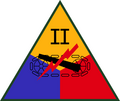 II Armored Corps
 -
 XVIII Corps
 -
 XVIII Airborne Corps


The present XVIII Airborne Corps was constituted in the Regular Army on 14 January 1942, five weeks after the entry of the United States into World War II, as the II Armored Corps, and was activated on 17 January 1942 at Camp Polk, Louisiana, under the command of Major General William Henry Harrison Morris, Jr. When the concept of armored corps proved unnecessary, II Armored Corps was re-designated as XVIII Corps on 9 October 1943 at the Presidio of Monterey, California.[3]
XVIII Corps deployed to Europe on 17 August 1944 and became the XVIII Airborne Corps on 25 August 1944 at Ogbourne St. George, England, assuming command of the 82nd and 101st Airborne Divisions, as part of the preparation for Operation Market Garden. Prior to this time, the two divisions were assigned to VII Corps and jumped into Normandy during Operation Overlord, the Allied invasion of Normandy, as part of VII Corps.[4]
Major General Matthew Bunker Ridgway, a highly experienced airborne commander who had led the 82nd Airborne Division in Sicily, Italy and Normandy, was chosen to command the corps, which then consisted of the 82nd and 101st Airborne Divisions and was part of the newly created First Allied Airborne Army.
The corps headquarters did not see service in Operation Market Garden, with the British I Airborne Corps being chosen instead to exercise operational command of all Allied airborne forces in the operation, including the 82nd and 101st Airborne Divisions.
Following the Battle of the Bulge, in which the corps played a significant part (and which, during the early stages of the battle, the corps was commanded by Major General James M. Gavin of the 82nd Airborne), all American airborne units on the Western Front fell under command of the corps. XVIII Airborne Corps planned and executed Operation Varsity, the airborne component of Operation Plunder, the crossing of the River Rhine into Germany. It was one of the largest airborne operations of the war, with the British 6th and U.S. 17th Airborne Divisions under command.[5]
| US World War II Armored Corps | ||||
|
After taking part in the Western Allied invasion of Germany, the XVIII Airborne Corps, still under Ridgway, returned to the United States in June 1945 and was initially to take part in the invasion of Japan, codenamed Operation Downfall. However, the Japanese surrendered just weeks later and XVIII Airborne Corps was inactivated on 15 October 1945 at Fort Campbell, Kentucky.[5]
World War II units
[edit]- 1st Infantry Division — 26 January 1945 – 12 February 1945.
- 4th Infantry Division
- 8th Infantry Division — 26 January 1945 – 10 July 1945.
- 17th Airborne Division — 12 August 1944 – 1 January 1945; 15 February 1945 – 24 March 1945.
- 29th Infantry Division
- 30th Infantry Division — 21 December 1944 – 3 February 1945.
- 34th Infantry Division
- 75th Infantry Division — 29 December 1944 – 2 January 1945; 7 January 1945.
- 78th Infantry Division — 3 February 1945 – 12 February 1945.
- 82nd Airborne Division — 12 August 1944 – 17 September 1944; 19 December 1944 – 14 February 1945; 30 April 1945 – 3 January 1946.
- 84th Infantry Division — 20 December 1944 – 21 December 1944.
- 86th Infantry Division — 5 April 1945 – 22 April 1945.
- 89th Infantry Division
- 97th Infantry Division — 10 April 1945 – 22 April 1945.
- 101st Airborne Division — 12 August 1944 – 21 September 1944; 28 February 1945 – 1 April 1945.
- 106th Infantry Division — 20 December 1944 – 6 February 1945.
- 3rd Armored Division — 19 December 1944 – 23 December 1944.
- 5th Armored Division — 4 May 1945 – 10 October 1945.
- 7th Armored Division — 20 December 1944 – 29 January 1945; 30 April 1945 – 9 October 1945.
- 13th Armored Division — 10 April 1945 – 22 April 1945.
Cold War
[edit]The Corps was reactivated at Fort Bragg on 21 May 1951 under the command of Major General John W. Leonard. Since then, the corps has been the primary strategic response force, with subordinate units participating in over a dozen major operations (listed below) in both combat and humanitarian roles, primarily in Central America and the CENTCOM area of responsibility.[6]
In 1958 the XVIII Airborne Corps was given the additional mission of becoming the Strategic Army Corps. The corps was now tasked, in addition, to provide a flexible strike capability that could deploy worldwide, on short notice, without a declaration of an emergency. The 4th Infantry Division at Fort Lewis, Washington, and the 101st Airborne Division at Fort Campbell, Kentucky, were designated as STRAC's first-line divisions, while the 1st Infantry Division at Fort Riley, Kansas, and the 82nd Airborne Division at Fort Bragg were to provide backup in the event of general war. The 5th Logistical Command (later inactivated), also at Fort Bragg, would provide the corps with logistics support, while Fort Bragg's XVIII Airborne Corps Artillery would control artillery units.[7]
The Corps deployed forces to the United States occupation of the Dominican Republic ('Operation Power Pack') in 1965.
The Corps deployed forces to the Vietnam War, including the entire 101st Airborne Division and the 3rd Brigade of the 82nd Airborne division.
In 1967 elements of the Corps were deployed to Detroit to suppress riots, and also to The Congo to support the government there and to rescue civilian hostages as part of Operation Dragon Rouge.
In 1982 the Corps first rotated elements to the Sinai Peninsula as part of the Multinational Force and Observers (UN) to guarantee the Camp David Peace Accords. [8]
In 1983 elements of the Corps were deployed to the island of Grenada as part of Operation Urgent Fury, with the stated goal of reestablishing the democratically elected government.
In 1989 XVIII Airborne Corps, commanded by then LTG Carl Stiner, participated in the invasion of Panama in Operation Just Cause. Stiner served concurrently as Commander of Joint Task Force South.
Structure in 1989
[edit]| NATO Symbol | ||||
|---|---|---|---|---|
|

-_Airborne_Forces_(NATO_APP-6).svg)
At the end of the Cold War in 1989 the corps consisted of the following formations and units:
- XVIII Airborne Corps, Fort Bragg, North Carolina[9]
- Headquarters & Headquarters Company
- 18th Personnel Group
- 18th Finance Group[10]
- 1st Battalion, 2nd Air Defense Artillery, Fort Stewart[11]
- 10th Mountain Division (Light), Fort Drum, New York[9]
- 24th Infantry Division (Mechanized), Fort Stewart, Georgia[9]
- 82nd Airborne Division, Fort Bragg, North Carolina[9]
- 101st Airborne Division (Air Assault), Fort Campbell, Kentucky[9]
- XVIII Airborne Corps Artillery, Fort Bragg
- 18th Field Artillery Brigade (Airborne), Fort Bragg[9][12][13][14][15]
- Headquarters & Headquarters Battery
- 3rd Battalion, 8th Field Artillery (24 × M198 155mm towed howitzer)[13][14][12][15]
- 5th Battalion, 8th Field Artillery (24 × M198 155mm towed howitzer)[13][14][12][15]
- 3rd Battalion, 27th Field Artillery (27 × M270 Multiple Launch Rocket System)[13][14][12][15][16][17]
- 1st Battalion, 39th Field Artillery (Airborne) (24 × M198 155mm towed howitzer)[13][14][12][18]
- 1st Field Artillery Detachment (Target Acquisition)[17]
- 18th Field Artillery Brigade (Airborne), Fort Bragg[9][12][13][14][15]
- 18th Aviation Brigade (Airborne), Fort Bragg
- Headquarters & Headquarters Company
- 1st Battalion, 58th Aviation (Air Traffic Control)[19]
- 1st Battalion, 159th Aviation (General Support)
- 2nd Battalion, 159th Aviation (Medium Lift)[20][21]
- 3rd Battalion, 159th Aviation (Attack)[22]
- 2nd Battalion, 229th Aviation (Attack) (former 2nd Battalion, 101st Aviation)[23]
- 20th Engineer Brigade (Airborne), Fort Bragg[9][24][25]
- 16th Military Police Brigade (Airborne), Fort Bragg
- 503rd Military Police Battalion (Airborne)[31]
- 35th Signal Brigade (Airborne), Fort Bragg[9][32][33]
- 25th Signal Battalion (Corps Area)[33][32][34]
- 50th Signal Battalion (Corps Command Operations) (Airborne)[33][32][35]
- 327th Signal Battalion (Corps Radio)[33][32][36]
- 426th Signal Battalion (Corps Area)[33][32]
- 525th Military Intelligence Brigade (Airborne), Fort Bragg
- 224th Military Intelligence Battalion (Aerial Exploitation), Hunter Army Airfield, Georgia[37][38]
- 319th Military Intelligence Battalion (Operations)[39]
- 519th Military Intelligence Battalion (Tactical Exploitation) (Airborne)[40]
- 1st Corps Support Command (Airborne), Fort Bragg[9]
- subordination formations and units
Desert Storm
[edit]In 1991, XVIII Airborne Corps participated in the Persian Gulf War. The corps was responsible for securing VII Corps' northern flank against a possible Iraqi counterattack. Along with the 82nd and 101st Airborne Divisions, 24th Infantry Division and 3rd Armored Cavalry Regiment, XVIII Airborne Corps also gained operational control of the French 6th Light Armor Division (LAD) (which also included units from the French Foreign Legion).
During Operations Desert Shield and Desert Storm, XVIII Airborne Corps Artillery consisted of the 3d Battalion, 8th Field Artillery; 5th Battalion, 8th Field Artillery; and the 1st Battalion (Airborne), 39th Field Artillery. The living quarters for these three units were situated between the 82d Airborne Division and the Special Forces at Fort Bragg. Of the three units, only 1–39th was airborne qualified and served as the only fully airborne deployable 155 mm Field Artillery unit in history.[citation needed] The 1–39th FA and 3–8th FA were key components of the thrust into Iraq in the first Gulf War, providing fire support for the French Foreign Legion and the 82nd Airborne Division.
The 5th Battalion, 8th Field Artillery also served in a major support role for 82d and French troops during the Gulf War. It consisted of three individual batteries. Batteries A and B were Airborne-qualified, while Battery C was air assault. Batteries A and B were assigned to Fort Bragg, North Carolina and Battery C was assigned to Fort Campbell, Kentucky. All of the battalions were subsequently re-flagged during the years following the Gulf War.
Task Force 118 had flown the OH-58D Kiowa Warrior off naval vessels during Operation Prime Chance in the 1980s, operating against Iran in the Persian Gulf. It was redesignated the 4th Squadron, 17th Cavalry on 15 January 1991.[41] During the Gulf War of 1991 it was part of the 18th Aviation Brigade.
Major formations, 1950–2006
[edit]The 82nd and 101st Airborne Divisions have served with the corps since the 1950s. The 24th Infantry Division (Mechanized) was 'reflagged' as the 3rd Infantry Division (Mechanized) in April 1996.[42]
- 7th Infantry Division (Light)
- 10th Mountain Division (Light Infantry)
- XVIII Airborne Corps Artillery
- 1st Sustainment Command (Theater)
- 35th Signal Brigade
- 18th Aviation Brigade (no longer active)
- 20th Engineer Brigade
- 525th Battlefield Surveillance Brigade
- 108th Air Defense Artillery Brigade
- 16th Military Police Brigade
- 44th Medical Command
- 163rd Ordnance
- additional smaller, National Guard, and Reserve units
21st century
[edit]
The Corps headquarters was deployed to Afghanistan from May 2002 – 2003, and became Combined Joint Task Force 180 for the deployment.
XVIII Airborne Corps was deployed from January 2005 to January 2006 to Baghdad, Iraq, where it served as the Multi-National Corps – Iraq. Following its return, XVIII Airborne Corps and its subordinate units began the process of modernization and reorganization.
Under the previous Army Chief of Staff's future restructure of the Army, the corps headquarters of the XVIII Airborne Corps will lose its airborne (specifically parachute) certification as a cost-cutting measure—the same will occur to the divisional headquarters of the 82nd Airborne Division. This plan is designed to follow the U.S. Army's restructuring plan to go from being division-based to brigade-based. This will mean that the largest units that will be airborne – specifically parachute certified – will be at the brigade level. Even so, for traditional and historical reasons, the formation will continue to be called the XVIII Airborne Corps.
The divisions that fall under the XVIII Airborne Corps (as well as the other two corps in the Army) are in a period of transition, shifting from corps control to fall directly under FORSCOM, eliminating the corps status as a middle man. This ties in with the Army's broad modularity plan, as a corps can deploy and support any unit, not just the units subordinate to the corps. The 3d Infantry Division, the 10th Mountain Division (Light Infantry), and the 101st Airborne Division (Air Assault) have already changed over to direct FORSCOM control. The 82nd Airborne Division will transfer after the division returns from Afghanistan.
In August 2006, XVIII Airborne Corps traveled to South Korea to participate in Ulchi Focus Lens, a joint training exercise between the Republic of Korea Army and coalition forces stationed there.[43]
In mid-April 2007, the Department of the Army confirmed the next OIF deployment schedule, with XVIII Airborne Corps deploying to relieve III Corps as the MNC-I at Camp Victory, Baghdad, Iraq. XVIII Airborne Corps is scheduled to replace III Corps in November 2007. The corps will deploy along with 1st Armored Division and 4th Infantry Division, as well as 1st Brigade Combat Team, 10th Mountain Division, and 1st BCT, 82nd Airborne Division.[44]
On 21 December 2016, Stars and Stripes reported that in August the XVIII Airborne Corps deployed to Iraq for Operation Inherent Resolve, in December this included the XVIII Airborne Corps headquarters and the 1st Special Forces Command, which is deployed as the Special Operations Joint Task Force – Operation Inherent Resolve. The 18th Field Artillery Brigade deployed into Iraq with High Mobility Artillery Rocket Systems.[45]
A Canadian Army General has served with the XVIII Corps since 2007.[46]
XVIII Airborne Corps returned to Fort Bragg (which was then-named Fort Liberty), in October 2022 after a nine-month deployment to Germany, in support of NATO and European Allies and partners.[47] The mission was to provide a joint task force-capable headquarters in light of the 2022 Russian invasion of Ukraine.[48]
Structure
[edit]
 XVIII Airborne Corps, Fort Bragg[49]
 3rd Infantry Division, Fort Stewart
 10th Mountain Division, Fort Drum
 82nd Airborne Division, Fort Bragg
 101st Airborne Division, Fort Campbell
 3rd Sustainment Command (Expeditionary), Fort Bragg
 7th Transportation Brigade, Fort Eustis
 16th Military Police Brigade, Fort Bragg
 18th Field Artillery Brigade, Fort Bragg
 20th Engineer Brigade, Fort Bragg
 35th Signal Brigade, Fort Bragg
 44th Medical Brigade, Fort Bragg
 525th Expeditionary Military Intelligence Brigade, Fort Bragg
- Fort Bragg Law Enforcement Company, Fort Bragg, NC (Military Police unit responsible for law enforcement on Fort Bragg, NC)


Other supporting units:
 52nd Ordnance Group (EOD), Fort Campbell and Fort Bragg, part of 20th CBRNE Command
 108th Air Defense Artillery Brigade, Fort Bragg, part of 32nd Army Air & Missile Defense Command
 18th Air Support Operations Group, Pope Field (United States Air Force unit responsible for coordinating corps tactical air support)


Operations
[edit]The corps has participated in a number of operations since then:
- Operation Power Pack – Dominican Republic, 1965
- Operation Urgent Fury – Grenada, 1983
- Operation Golden Pheasant – Honduras, 1988
- Operation Nimrod Dancer – Panama, 1989
- Operation Hawkeye – U.S. Virgin Islands, 1989
- Operation Just Cause – Panama, 1989
- Operation Desert Shield – Saudi Arabia, 1990–1991
- Operation Desert Storm – Saudi Arabia, Kuwait and Iraq, 1991
- Operation GTMO – Cuba, 1991
- Operation Hurricane Andrew – Florida, 1992
- Operation Restore Hope – Somalia, 1992
- Operation Uphold/Maintain Democracy – Haiti, 1994
- Operation Vigilant Warrior – Kuwait, 1994
- Operation Joint Forge – Bosnia, 1998
- Operation Enduring Freedom – Afghanistan, 2002, 2014
- Operation Iraqi Freedom – Iraq, 2003, 2005, 2008
- Operation Unified Response – Haiti, 2010
- Operation New Dawn – Iraq, 2011
- Operation Inherent Resolve – Iraq and Syria, 2015–2016
Commanders
[edit]Individuals who have commanded XVIII Airborne Corps include:[50][51][52][53][54]
- LTG Matthew B. Ridgway, 1944 – 1945
- Corps inactive, 1945 – 1952
- LTG John W. Leonard, 1952
- MG Thomas F. Hickey, 1952 – 1953
- MG Joseph P. Cleland, 1953 – 1955
- MG Ridgely Gaither, 1955
- LTG Paul D. Adams, 1955 – 1957
- LTG Robert F. Sink, 1957 – 1960
- MG Dwight E. Beach (acting), 1960
- LTG Thomas J. H. Trapnell, 1960 – 1961
- LTG Hamilton H. Howze, 1961 – 1962
- LTG William C. Westmoreland, 1963 – 1964
- MG Harry H. Critz (acting), 1964
- LTG John W. Bowen, 1964 – 1965
- BG John A. Seitz (acting), 1965
- BG Roderick Wetherill (acting), 1965
- MG Joe S. Lawrie (acting), 1965
- LTG Bruce Palmer Jr., 1965 – 1967
- MG Joe S. Lawrie (acting), 1967
- LTG John L. Throckmorton, 1967
- LTG Robert H. York, 1967 – 1968
- LTG John J. Tolson, 1968 – 1971
- LTG John H. Hay, 1971 – 1973
- LTG Richard J. Seitz, 1973 – 1975
- LTG Henry E. Emerson, 1975 – 1977
- LTG Volney F. Warner, 1977 – 1979
- LTG Thomas H. Tackaberry, 1979 – 1981
- LTG Jack V. Mackmull, 1981 – 1984
- LTG James J. Lindsay, 1984 – 1986
- LTG John W. Foss, 1986 – 1988
- LTG Carl W. Stiner, 1988 – 1990
- LTG Gary E. Luck, 1990
- MG William A. Roosma (acting), 1990
- LTG Gary E. Luck, 1990 – 1993
- LTG Henry H. Shelton, 1993 – 1996
- LTG John M. Keane, 1996 – 1998
- LTG William F. Kernan, 1998 – 2000
- LTG Dan K. McNeill, 2000 – 2003
- LTG John R. Vines, 2003 – 2006
- LTG Lloyd Austin III, 2006 – 2009
- LTG Frank Helmick, 2009 – 2012
- LTG Daniel B. Allyn, 2012 – 2013
- LTG Joseph Anderson, 2013 – 2015
- LTG Stephen J. Townsend, 2015 – 2018
- LTG Paul LaCamera, 2018 – 2019
- LTG Michael Kurilla, 2019 – 2022
- LTG Chris Donahue, 2022 – 2024
- LTG Gregory K. Anderson, 2024–present
Notable members
[edit]- John D. Altenburg, MG – Deputy Judge Advocate General of the U.S. Army.
- Ralph Eaton, BG – 82nd Airborne Division and XVIII Airborne Corps Chief of Staff.
- Michael C. Flowers, BG – Commander, Joint POW/MIA Accounting Command.
- Michael T. Flynn, LTG – 25th National Security Advisor, Director of the Defense Intelligence Agency
- Charles D. Gemar, LTC – US Astronaut.
- Teresa King, SGM – First female Commandant of the U.S. Army Drill Sergeant Academy.
- Stanley A. McChrystal, GEN – ISAF Commander.
- Raymond T. Odierno, GEN – 38th Army Chief of Staff.
- James Peake, LTG – Secretary of Veterans Affairs.
- David Petraeus, GEN – ISAF Commander and Director of the Central Intelligence Agency.
- David M. Rodriguez, GEN – Commander, U.S. Africa Command and FORSCOM.
- Arthur D. Simons, COL – Led the Son Tay raid during the Vietnam War.
- Michael Tomczyk, CPT – Computer entrepreneur and joint developer of the VIC-20.
- Thomas R. Turner II, LTG – Commanding General of United States Army North.
- James C. Yarbrough, BG – Commander, Joint Readiness Training Center at Fort Polk.
- Wayne Eyre, GEN – Commander of the Canadian Army and Chief of Defence Staff.[55]
References
[edit]- ^ "XVIII Airborne Corps :: Fort Bragg". United States Army. Retrieved 20 November 2021.
- ^ Clay, Steven E. (2010). U.S. Army Order of Battle, 1919–1941, Volume 1. The Arms: Major Commands and Infantry Organizations, 1919–41. Fort Leavenworth, KS: Combat Studies Institute Press. pp. 182–83.
 This article incorporates text from this source, which is in the public domain.
- ^ "History of the XVIII Airborne Corps | Sky Dragons". militaryvetshop.com. Archived from the original on 12 March 2011. Retrieved 22 May 2022.
- ^ "VII Corps in WWII". vii-corps.org. Archived from the original on 27 August 2008. Retrieved 22 May 2022.
- ^ a b "The XVIII Airborne Corps During WW II – Overview".
- ^ "XVIII Airborne Corps".
- ^ Olinger, Mark A. (May–June 2005). "Airlift Operations During the Lebanon Crisis". Army Logistician. 37 (3): 30. Archived from the original on 3 March 2012.
- ^ "Fort Bragg". Archived from the original on 16 March 2016. Retrieved 28 March 2016.
- ^ a b c d e f g h i Army – The Magazine of Landpower – October 1989 (1989). "Command and Staff". Association of the US Army. Retrieved 26 June 2020.
{{cite web}}: CS1 maint: numeric names: authors list (link) - ^ "18th Financial Management Support Center Lineage". US Army Center of Military History. Archived from the original on 30 June 2020. Retrieved 27 June 2020.
- ^ "1st Battalion, 2nd Air Defense Artillery Lineage". US Army Center of Military History. Archived from the original on 20 June 2008. Retrieved 27 June 2020.
- ^ a b c d e "Field Artillery – February 1990". US Army Field Artillery School. 1990. Retrieved 27 June 2020.
- ^ a b c d e "Field Artillery – February 1987". US Army Field Artillery School. 1987. Retrieved 27 June 2020.
- ^ a b c d e "Field Artillery – December 1989". US Army Field Artillery School. 1988. Retrieved 27 June 2020.
- ^ a b c d McKenney, Janice E. "Field Artillery – Army Lineage Series – Part 2" (PDF). US Army Center of Military History. Archived from the original (PDF) on 20 September 2015. Retrieved 27 June 2020.
- ^ "3rd Battalion, 27th Field Artillery Lineage". US Army Center of Military History. Archived from the original on 9 May 2010. Retrieved 26 June 2020.
- ^ a b "About 18th FA BDE". US Army. Retrieved 27 June 2020.
- ^ McKenney, Janice E. "Field Artillery – Army Lineage Series – Part 2" (PDF). US Army Center of Military History. Archived from the original (PDF) on 27 February 2012. Retrieved 27 June 2020.
- ^ "1st Battalion, 58th Aviation Lineage". US Army Center of Military History. Archived from the original on 5 September 2015. Retrieved 26 June 2020.
- ^ Organ, David (15 December 2009). "The Logistics of the 101st Airborne Division in the First Gulf War". Retrieved 17 June 2020.
- ^ "2nd Battalion, 159th Aviation Lineage". US Army Center of Military History. Archived from the original on 12 January 2010. Retrieved 26 June 2020.
- ^ "3rd Battalion, 159th Aviation Lineage". US Army Center of Military History. Archived from the original on 21 September 2012. Retrieved 26 June 2020.
- ^ "Fielding of the Apache". United States Army Aviation Digest – January 1988. 1988. Retrieved 27 June 2020.
- ^ "20th Engineer Brigade Lineage". US Army Center of Military History. Archived from the original on 20 June 2008. Retrieved 26 June 2020.
- ^ a b c d "20th Engineer Brigade History". 20th Engineer Brigade Staff. Archived from the original on 3 January 2008. Retrieved 27 June 2020.
- ^ "27th Engineer Battalion Lineage". US Army Center of Military History. Archived from the original on 20 June 2008. Retrieved 26 June 2020.
- ^ "37th Engineer Battalion Lineage". US Army Center of Military History. Archived from the original on 22 February 2014. Retrieved 26 June 2020.
- ^ "175th Engineer Company Lineage". US Army Center of Military History. Archived from the original on 19 June 2008. Retrieved 26 June 2020.
- ^ "264th Engineer Company Lineage". US Army Center of Military History. Archived from the original on 8 June 2010. Retrieved 26 June 2020.
- ^ "362nd Engineer Company Lineage". US Army Center of Military History. Archived from the original on 20 June 2008. Retrieved 26 June 2020.
- ^ "503rd Military Police Battalion Lineage". US Army Center of Military History. Archived from the original on 21 June 2008. Retrieved 27 June 2020.
- ^ a b c d e "35th Signal Brigade – Unit History". Army Communicator – Voice of the Signal Corps – Fall 1987. 1987. Retrieved 27 June 2020.
- ^ a b c d e Raines, Rebecca Robbins. "Signal Corps" (PDF). US Army Center of Military History. Archived from the original (PDF) on 13 May 2013. Retrieved 27 June 2020.
- ^ "25th Signal Battalion Lineage". US Army Center of Military History. Archived from the original on 13 January 2010. Retrieved 26 June 2020.
- ^ "50th Signal Battalion Lineage". US Army Center of Military History. Archived from the original on 21 June 2008. Retrieved 26 June 2020.
- ^ "327th Signal Battalion Lineage". US Army Center of Military History. Archived from the original on 21 June 2008. Retrieved 26 June 2020.
- ^ "224th Military Intelligence Battalion". US Army. Retrieved 27 June 2020.
- ^ "224th Military Intelligence Battalion Lineage". US Army Center of Military History. Archived from the original on 19 June 2008. Retrieved 26 June 2020.
- ^ "319th Military Intelligence Battalion Lineage". US Army Center of Military History. Archived from the original on 21 June 2008. Retrieved 26 June 2020.
- ^ "519th Military Intelligence Battalion Lineage". US Army Center of Military History. Archived from the original on 20 June 2008. Retrieved 26 June 2020.
- ^ Dinackus 2000, pp. 4–24.
- ^ Dinackus 2000, pp. 15–17.
- ^ "XVIII ABC participates in UFL". Archived from the original on 28 September 2007. Retrieved 20 April 2007.
- ^ "DA announces next OIF rotation". Archived from the original on 6 June 2008. Retrieved 19 April 2007.
- ^ "'We're a significant presence:' General updates Fort Bragg troops on Islamic State fight". military.com. 21 December 2016. Archived from the original on 28 December 2016.
- ^ Brooks, Drew. "Canadian general ending two-year tour at Fort Bragg". The Fayetteville Observer.
- ^ Sgt. Maj. Alex Licea (31 October 2022) XVIII Airborne Corps Headquarters returns from Europe
- ^ Sgt. Jameson Harris (1 November 2022) Secretary Austin welcomes XVIII Airborne Corps Soldiers home
- ^ XVIII AIRBORNE CORPS, U.S. ARMY FORT BRAGG, United States Army. Retrieved 31 December 2020
- ^ "XVIII Airborne Corps and Fort Bragg Commanders, 1944 – 2006". Fort Bragg, NC: United States Army. 6 December 2006. Archived from the original on 20 February 2010.
- ^ Rogers, Reginald (21 January 2011). "Helmick to Fort Bragg: 'Be proud of your community'". Washington, DC: United States Army.
- ^ Holston, Paul (2 July 2013). "Anderson takes over reins of 'America's Contingency Corps' (Image 2 of 2)". Defense Visual Information Distribution Service (DVIDS). Atlanta, GA.
- ^ Gordon, Michael R. (2022). Degrade and Destroy: The Inside Story of the War Against the Islamic State, From Barack Obama to Donald Trump. New York, NY: MacMillan Publishers. p. 200. ISBN 978-0-3747-1445-1 – via Google Books.
- ^ Dickstein, Corey (22 February 2022). "Senate confirms Kurilla to lead US Central Command". Stars and Stripes. Washington, DC.
- ^ From: Government of Canada (25 November 2021). "Prime Minister announces the appointment of the Chief of the Defence Staff". Government of Canada. Canada.ca. Retrieved 3 January 2022.

- Dinackus, Thomas D. (2000). Order of Battle: Allied Ground Forces of Operation Desert Storm. Central Point, Oregon: Hellgate Press. ISBN 1-55571-493-5.
External links
[edit]- Official website
- Global Security: XVIII Airborne Corps
- XVIII Airborne Corps Desert Storm/Desert Shield Photographs US Army Heritage and Education Center, Carlisle, Pennsylvania
| International | |
|---|---|
| National | |
| Other | |

XVIII Airborne Corps
View on GrokipediaOrigins and World War II Service
Activation and Early Operations
The XVIII Airborne Corps traces its lineage to the II Armored Corps, which was activated on January 17, 1942, at Camp Polk, Louisiana, shortly after the United States entered World War II.[12][3] This activation occurred amid rapid U.S. military expansion to counter Axis threats, with the corps initially focused on armored warfare training and organization rather than airborne capabilities.[3] On October 9, 1943, the unit was redesignated as the XVIII Corps at the Presidio of Monterey, California, shifting emphasis toward a more flexible infantry corps structure while retaining armored elements.[3] The corps remained stateside through early 1944, undergoing further reorganization to incorporate emerging airborne doctrine influenced by successful paratrooper operations in North Africa and Sicily.[3] The redesignation to XVIII Airborne Corps took place on August 25, 1944, at Ogbourne St. George, England, following the corps' deployment to Europe on August 17, 1944; this marked its formal transition to commanding airborne forces under Major General Matthew B. Ridgway, previously of the 82nd Airborne Division.[3][13] Upon activation, it assumed control of the 82nd and 101st Airborne Divisions, which had returned from Normandy operations, with the 17th Airborne Division arriving from the United States shortly thereafter to complete its core structure of three airborne divisions supported by corps artillery and aviation elements.[13] Early operations centered on preparations for large-scale airborne assaults in support of the Allied advance into Germany. The corps' first major combat role came during Operation Market Garden, launched on September 17, 1944, where it directed the airborne phases involving over 34,000 paratroopers and glidermen from the 82nd and 101st Divisions dropping into the Netherlands to seize key bridges along a 60-mile corridor from Eindhoven to Arnhem.[13] Ridgway's headquarters coordinated with the First Allied Airborne Army, emphasizing rapid seizure of objectives to enable ground forces of the British 30 Corps to advance; however, logistical challenges, German resistance, and adverse weather limited success, particularly at Arnhem, resulting in heavy casualties and failure to secure the Rhine crossing.[13] This operation tested the corps' command and control for multi-division airborne maneuvers, informing subsequent tactical refinements.[13]Key Campaigns and Units
The XVIII Airborne Corps was redesignated from the XVIII Corps as the U.S. XVIII Airborne Corps on August 27, 1944, at Ogbourne St. George, England, under the command of Major General Matthew B. Ridgway. Its core subordinate units included the 82nd Airborne Division and 101st Airborne Division at activation, with the 17th Airborne Division joining later in the European Theater. These divisions formed the corps' primary maneuver elements, supported by artillery, engineer, and logistical attachments as needed for airborne operations.[13] The corps' first major engagement was Operation Market Garden, commencing September 17, 1944, which aimed to seize a series of bridges in the Netherlands to enable a rapid Allied advance into Germany. Under Ridgway's oversight within the First Allied Airborne Army, the 82nd and 101st Airborne Divisions executed airborne drops to capture objectives along the route, securing initial bridges such as those at Eindhoven and Nijmegen but failing to link up fully due to fierce German counterattacks and supply line vulnerabilities, particularly at Arnhem.[13] In response to the German Ardennes Offensive, known as the Battle of the Bulge, which began on December 16, 1944, General Dwight D. Eisenhower directed the XVIII Airborne Corps to reinforce the northern sector without delay. The 82nd Airborne Division arrived swiftly, securing key terrain including Trois Ponts by December 20, 1944, and contributing to the containment of German spearheads. The 101st Airborne Division, operating in the southern bulge area, famously defended Bastogne against encirclement, enabling critical resupply and Allied counteroffensives, though initially under different corps command before broader airborne coordination. These actions helped stabilize the front and contributed to the eventual defeat of the offensive by January 1945.[13][14] The corps concluded its World War II airborne operations with Operation Varsity on March 24, 1945, the largest single-day airborne assault of the war, involving over 16,000 paratroopers and glider troops from the 17th Airborne Division and British 6th Airborne Division. Dropped across the Rhine River near Wesel, Germany, the operation captured bridgeheads, disrupted German defenses, and facilitated rapid ground advances, resulting in over 8,000 prisoners taken and significant territorial gains in the subsequent days leading to the Allied push into central Germany.[13]Cold War Developments
Reorganization and Structure
The XVIII Airborne Corps was reactivated on May 21, 1951, at Fort Bragg, North Carolina, amid the U.S. Army's expansion in response to the Korean War, serving as the primary command for airborne operations and rapid-response forces.[3] Its initial structure centered on the headquarters and headquarters company, with the 82nd Airborne Division as the core maneuver unit, supplemented by specialized support elements including the XVIII Airborne Corps Artillery, designated on May 1, 1951, and activated concurrently to provide organic fire support with field artillery battalions equipped for airborne assault.[15] This organization emphasized lightweight, deployable assets capable of parachute operations, with approximately 15,000 personnel under corps control in the early 1950s, focused on training and deterrence against Soviet threats in Europe.[3] In May 1958, the corps underwent a pivotal reorganization by being designated the Strategic Army Corps (STRAC), transforming it into the U.S. Army's premier strategic reserve for global emergencies and marking a shift toward institutionalized rapid deployment doctrine.[16] Under STRAC, the structure prioritized expeditionary readiness, with mandated timelines for airlifting forces—a battalion within 24 hours, a brigade within 48 hours, and a reinforced division within 96 hours—supported by dedicated aviation liaison and logistics units integrated at the corps level.[3] Key subordinate units included the 82nd Airborne Division at Fort Bragg, the 101st Airborne Division at Fort Campbell, Kentucky, and rotational attachments like the 187th Airborne Regimental Combat Team until its inactivation in 1957, alongside combat service support groups for sustainment in austere environments.[3] This framework enhanced causal effectiveness for power projection, drawing on empirical lessons from Korea to counter potential Warsaw Pact aggression through pre-positioned reserves and frequent airborne exercises. During the 1960s and 1970s, incremental structural adjustments adapted the corps to evolving threats, including the integration of helicopter assets as the 101st transitioned to airmobile configuration in 1968, expanding the corps' operational reach beyond pure parachute assaults while retaining airborne certification for all major units.[3] By the 1980s, amid heightened Reagan-era focus on conventional deterrence, the organization incorporated modular enhancements such as the 18th Aviation Brigade for rotary-wing support and dedicated military police and engineer battalions, enabling command of hybrid forces including light infantry divisions like the 10th Mountain Division during exercises.[3] The headquarters maintained oversight of roughly 70,000 troops across assigned divisions, with specialized cells for intelligence, fires, and protection, culminating in a 1989 configuration that featured the 18th Personnel Group, 18th Finance Group, and 1st Battalion, 2nd Air Defense Artillery for theater air defense, reflecting data-driven refinements for sustained contingency operations without compromising mobility.[17] These changes preserved the corps' role as a scalable headquarters, verifiable through participation in REFORGER exercises that validated deployment timelines against NATO contingencies.[3]Training and Readiness Exercises
The XVIII Airborne Corps maintained operational readiness during the Cold War through structured airborne training emphasizing parachute assaults, rapid force projection, and integration with allied forces to deter Soviet aggression in Europe. Post-World War II, Camp Mackall functioned as a primary airborne maneuver area for corps units, facilitating large-scale jumps and tactical exercises in realistic terrain.[18] In the 1950s, the facility supported specialized training for the newly formed 10th Special Forces Group, incorporating unconventional warfare drills alongside conventional airborne operations to build versatile contingency capabilities.[18] Corps-level exercises in the 1960s and 1970s focused on tiered progression from battalion-level proficiency to division-scale maneuvers, including annual parachute qualifications and airland operations at Fort Bragg to ensure swift response to NATO reinforcement needs.[3] By the 1980s, training incorporated emerging technologies, such as the corps' Tactical Information Control System tested in exercises like Solid Shield, Positive Leap, and local Bragg maneuvers, enhancing command and control for high-tempo airborne insertions.[19] These efforts culminated in demonstrations of mass airborne capability, including a 1980 exercise involving the 18th Airborne Corps in what was reported as the largest such operation since World War II, underscoring readiness for rapid global deployment.[20] The corps operated under continuous alert status to support the U.S. 7th Army and NATO contingencies, participating in broader readiness drills simulating Warsaw Pact incursions, though specific REFORGER involvement emphasized subordinate units like the 82nd Airborne Division's contributions to European reinforcement.[21] This regimen prioritized empirical validation of deployment timelines, with airlift coordination exercises validating the ability to project corps assets across the Atlantic within days, aligning with doctrinal requirements for crisis response.[22]Gulf War and Immediate Post-Cold War Era
Operation Desert Shield and Storm
In response to Iraq's invasion of Kuwait on August 2, 1990, the United States initiated Operation Desert Shield to deter further Iraqi aggression into Saudi Arabia, with the XVIII Airborne Corps designated as the primary rapid deployment force under Lieutenant General Gary E. Luck.[23] The corps' 82nd Airborne Division began deploying from Fort Bragg, North Carolina, to Dhahran, Saudi Arabia, on August 8, 1990, marking the first major U.S. ground combat units to arrive and establishing a defensive line along the Saudi-Kuwaiti border.[24] By late August, the corps had assembled approximately 45,000 troops, including elements of the 101st Airborne Division (Air Assault), which completed its deployment by early October, enabling the construction of fortified positions and logistical sustainment for over 500,000 coalition personnel by January 1991.[25] As Operation Desert Storm commenced with an air campaign on January 17, 1991, the XVIII Airborne Corps, now comprising the 82nd and 101st Airborne Divisions, the 24th Infantry Division (Mechanized), the 3rd Armored Cavalry Regiment, and attached units such as the French 6th Light Armored Division, positioned for the coalition's western envelopment maneuver. On February 24, 1991, the ground offensive began, with the corps advancing over 200 miles into Iraq within 72 hours, securing key objectives like the 73 Easting and Tallil airfields while employing deception operations to mask its flanking movement from Iraqi forces.[26] The 101st Airborne Division executed deep air assaults, including the seizure of Highway 8 on February 24 to interdict Iraqi supply lines, supported by the 18th Aviation Brigade's helicopters that airlifted the 1st Brigade Combat Team across the Tigris-Euphrates valley. By February 26, elements of the XVIII Airborne Corps linked with VII Corps in a pincer movement, trapping and destroying retreating Iraqi Republican Guard divisions near the Kuwaiti border, resulting in the capture of over 20,000 prisoners and the neutralization of more than 300 tanks with coalition losses limited to 35 killed in action for the corps.[25] The corps' rapid maneuver, leveraging airborne and air assault capabilities, contributed to the overall coalition victory by February 28, 1991, when a ceasefire was declared, demonstrating the effectiveness of maneuver warfare against a numerically superior but logistically strained adversary.[27] Post-ceasefire, the corps facilitated the withdrawal of forces, redeploying to the United States by May 1991 while handing off humanitarian and stability tasks.[24]Early 1990s Interventions
In December 1992, Lieutenant General Robert B. Johnston, commander of the XVIII Airborne Corps, assumed leadership of the Unified Task Force (UNITAF) for Operation Restore Hope in Somalia, directing a multinational force of approximately 37,000 personnel, including 21,000 U.S. troops, to secure humanitarian aid distribution amid famine and clan warfare.[28] Subordinate units, organized under Task Force Mountain from the 10th Mountain Division (Light Infantry), deployed starting late December 1992, with the 2nd Brigade securing key sectors such as Baidoa, Balli Doogle, Merca, and Kismaayo through air assaults and patrols; by late December, these efforts stabilized food deliveries, enabling the offloading of 40,000 tons of grain.[29] The 5th Special Forces Group (Airborne) provided initial reconnaissance and security from August 1992 under Operation Provide Relief, while the 4th Psychological Operations Group (Airborne) distributed over 7 million leaflets and conducted radio broadcasts to support relief efforts.[28] UNITAF transitioned to the United Nations Operation in Somalia II (UNOSOM II) in May 1993, with XVIII Airborne Corps elements retaining operational roles, including a Quick Reaction Force (QRF) from the 10th Mountain Division's 1st Brigade, comprising the 1-22 Infantry Battalion and Task Force 3-25 Aviation with AH-1 Cobras, UH-60 Black Hawks, and OH-58 scouts.[29] Major General Thomas M. Montgomery served as deputy UNOSOM II commander and U.S. Forces Somalia (USFORSOM) commander, overseeing the QRF's engagements in Mogadishu, Kismayo (May 9–20, 1993), and Bardera (May 29–June 3, 1993).[29] Task Force Ranger, deployed August 31, 1993, conducted raids against Somali National Alliance leader Mohamed Farrah Aidid, capturing associates like Osman Atto on September 21, 1993, but the October 3–4 Battle of Mogadishu resulted in 16 U.S. fatalities and 57 wounded after two Black Hawks were downed, prompting a QRF rescue involving armored reinforcements and leading to phased U.S. withdrawals by March 25, 1994.[29] The 82nd Medical Company (Air Ambulance) logged 622 medical evacuation missions, transporting 1,280 patients across 313 flight hours from August 27, 1993, to March 31, 1994.[28] Shifting to Haiti in 1994, the XVIII Airborne Corps formed Joint Task Force (JTF) 180 as the command headquarters for Operation Uphold Democracy, tasked with restoring President Jean-Bertrand Aristide after the 1991 coup by General Raoul Cédras; planning commenced January 9, 1994, developing multiple contingencies including OPLAN 2370 for forcible entry and OPLAN 2380 for permissive operations.[30] Lieutenant General Henry H. Shelton commanded JTF 180, coordinating with JTF 190 (10th Mountain Division under Major General David C. Meade) and integrating the 82nd Airborne Division, 3rd Special Forces Group, and 16th Military Police Brigade; an initial air assault by the 10th Mountain's 1st Brigade Combat Team secured Port-au-Prince International Airport on September 19, 1994, following last-minute negotiations by former President Jimmy Carter on September 17–18 that enabled a non-combat entry and Cedras's departure by October 13.[30] The 2nd Brigade Combat Team operated in Cap Haitien amid a brief firefight, while forces disarmed the Haitian Armed Forces, collecting 14,943 weapons and neutralizing opposition with minimal U.S. casualties.[30] Aristide returned to power on October 15, 1994, under Corps oversight from the USS Mount Whitney, with multinational partners like CARICOM and Bangladesh battalions contributing to stabilization; the 25th Infantry Division relieved the 10th Mountain in December 1994 to train the Haitian National Police and support elections in June and fall 1995, though voter turnout reached only 28 percent for the presidential contest.[30] JTF 180 transitioned authority to the United Nations Mission in Haiti (UNMIH) on March 31, 1995, after establishing basic security but facing persistent challenges from economic stagnation and low public engagement, highlighting limits in achieving enduring societal reform through military means alone.[30]Global War on Terror Engagements
Iraq and Afghanistan Deployments
The XVIII Airborne Corps headquarters deployed to Iraq from January 2005 to January 2006, forming the nucleus of Multi-National Corps-Iraq (MNC-I) and coordinating coalition forces during a period of intensified counterinsurgency operations following the January 2005 Iraqi elections.[31] Under Lieutenant General John R. Vines, the Corps oversaw approximately 150,000 U.S. and coalition troops, focusing on securing Baghdad and supporting the transition to Iraqi security forces amid sectarian violence.[31] The deployment emphasized rapid force projection, with the Corps integrating airborne and air assault capabilities to respond to urban threats and improvised explosive device networks.[31] In February 2008, the Corps redeployed to Iraq as MNC-I under Lieutenant General Lloyd J. Austin III, assuming command on February 10 amid the surge's drawdown phase and assuming responsibility for over 160,000 troops across 15 provinces.[32] [33] This 15-month rotation, the longest in the Corps' history, prioritized transitioning authority to Iraqi forces, conducting joint operations, and reducing U.S. combat exposure while maintaining stability during provincial elections.[33] Approximately 900 headquarters personnel returned to Fort Bragg by April 2009, having facilitated the handover of key sectors to Iraqi control.[34] The Corps headquarters deployed to Afghanistan from May 2002 to early 2003, establishing Combined Joint Task Force 180 (CJTF-180) to command U.S. and coalition operations in the eastern and southern regions following Operation Anaconda.[35] [36] Under Lieutenant General Dan K. McNeill, CJTF-180 integrated elements from the 10th Mountain Division and other units to conduct stability operations, dismantle al-Qaeda remnants, and build Afghan National Army capacity amid tribal insurgencies.[37] The effort marked an early shift toward nation-building, with the Corps staff merging temporarily with divisional elements until October 2003 to sustain command continuity.[36] In January 2014, the Corps headquarters returned to Afghanistan as the core staff for International Security Assistance Force Joint Command (ISAF JC), overseeing the final NATO combat mission and transitioning security responsibilities to Afghan forces by December 2014.[38] Led by Lieutenant General Joseph Anderson, the deployment supported Resolute Support Mission planning, coordinating with approximately 13,000 U.S. troops focused on training and advising amid persistent Taliban threats.[38] The Corps facilitated the drawdown of combat units, marking its role as the last major U.S. headquarters to depart the theater.[39]Command and Control Roles
The XVIII Airborne Corps provided expeditionary command and control (C2) for multinational operations during the Global War on Terror, deploying its headquarters as a scalable operational headquarters to synchronize joint, interagency, and coalition forces in theater-level counterinsurgency and stability missions.[31] In Iraq, it commanded Multi-National Corps-Iraq (MNC-I) from January 2005 to January 2006 under Lieutenant General John R. Vines, overseeing approximately 227,000 personnel at the time of handover and directing efforts to train Iraqi Security Forces, counter Al-Qaeda in Iraq, and support national elections.[31][40] A second rotation from February 2008 to March 2009, under Lieutenant General Lloyd J. Austin III, focused on transitioning security responsibilities to Iraqi forces while maintaining operational tempo across divided battlespaces.[41] As MNC-I, the Corps integrated disparate command structures, managing tactical control of divisions, brigades, and enablers through digital battlespace management tools including the Global Command and Control System (GCCS), Army Battle Command Systems (ABCS), Command Post of the Future (CPOF), and FusionNet for knowledge management and a unified common operational picture (COP).[31] Preparations emphasized interoperability across four networks (NIPRNet, SIPRNet, CENTRIXS, JWICS) via advance deployments, command post exercises like Ulchi Focus Lens, and Battle Command Training Program scenarios to address challenges such as 300+ fragmented databases and radio frequency spectrum congestion from 82,000 frequencies.[31] These efforts enabled real-time data fusion and reduced C2 friction in a joint environment, though training shortfalls in complex systems persisted.[31] In Afghanistan, the Corps headquarters augmented Combined Forces Command and later NATO structures, deploying in 2014 to lead advisory and transition operations under Resolute Support, providing C2 for train-advise-assist commands and coordinating with Afghan National Security Forces amid drawdown. This role leveraged the Corps' rapid deployment expertise to integrate special operations, conventional units, and coalition partners, returning in December 2014 after facilitating security handovers. Across both theaters, subordinate elements like the 44th Medical Brigade extended Corps C2 for specialized functions, such as overseeing Role 3 medical facilities and evacuation operations.[42]Contemporary Operations and Reforms
Post-2011 Missions
Following the conclusion of major combat operations in Iraq and Afghanistan, the XVIII Airborne Corps shifted emphasis toward rapid global response capabilities, including command of multinational task forces in emerging theaters. In July 2016, the corps headquarters deployed to Iraq, assuming responsibility for Combined Joint Task Force - Operation Inherent Resolve (CJTF-OIR), the U.S.-led coalition effort to defeat the Islamic State of Iraq and Syria (ISIS).[43] Under Lieutenant General Stephen J. Townsend, the corps oversaw coalition operations, including advisory support to Iraqi forces, airstrikes, and logistics coordination, contributing to the territorial defeat of ISIS caliphate by 2019. The headquarters remained in the region for over a year, managing daily operational tempo before redeploying elements in 2018-2019.[44] In February 2022, amid Russia's invasion of Ukraine, approximately 300 personnel from the corps headquarters rapidly deployed to Germany to establish a Joint Task Force-capable headquarters, enhancing command and control for U.S. Army Europe and Africa (USARAF) and supporting NATO allies through reinforced deterrence postures.[45] This nine-month rotation facilitated integration with European partners, logistics sustainment for additional U.S. forces, and operational planning under U.S. European Command, culminating in the headquarters' return to Fort Liberty in October 2022. Secretary of Defense Lloyd Austin visited the returning Soldiers to commend their role in bolstering alliance readiness. The corps also supported domestic contingency operations, including in October 2024, when it coordinated humanitarian aid delivery to western North Carolina communities devastated by Hurricane Helene, leveraging subordinate sustainment units for supply distribution and recovery efforts.[46] These missions underscored the corps' role as America's contingency force, prioritizing agile deployment and joint interoperability amid shifting global threats.Modernization Efforts and Recent Deployments (2020s)
In the early 2020s, the XVIII Airborne Corps advanced its modernization through participation in the U.S. Army's Project Convergence series, focusing on integrating emerging technologies for multi-domain operations. During Project Convergence Capstone 5 in March 2025, Corps elements collaborated with the 82nd Airborne Division and 1st Armored Division to test next-generation command and control (NGC2) systems, enabling rapid decision-making across joint forces.[47] These experiments emphasized cloud-to-edge computing architectures, with the Corps evaluating dual edge node variants to reduce deployment footprints and enhance data processing in contested environments.[48] Additionally, the Corps conducted Scarlet Dragon exercises, such as the August 2025 iteration spanning five states, to refine tools like the Maven Smart System for intelligence fusion and operational planning.[49] To foster bottom-up innovation, the Corps implemented programs like the Airborne Innovation Lab and Dragon's Lair pitch competitions, where soldiers prototyped solutions for battlefield challenges, including lightweight data transport and reduced logistical burdens via Dragon Cloud systems tested in 2022.[50] These efforts aligned with the Army's shift toward large-scale combat operations, emphasizing airborne proficiency, joint forcible entry, and scalable command structures for global response within 18 hours.[9] By 2025, such initiatives had equipped the Corps with updated tactics, including HIMARS integration demonstrations for NATO partners, enhancing deterrence capabilities.[1] Recent deployments centered on European deterrence amid Russian aggression. In February 2022, roughly 300 headquarters personnel deployed to Wiesbaden, Germany, to support NATO reinforcement following Russia's invasion of Ukraine, marking the Corps' role as America's contingency force.[51] The full headquarters element completed a nine-month rotation, providing operational command and control for U.S. and allied forces, before returning to Fort Liberty on October 28, 2022.[52] Post-return, the Corps emphasized rotational training and exercises over sustained deployments, conducting international operations from May 2023 to September 2024, including Ulchi Freedom Shield with allies.[53] In 2025, activities included a field training exercise in September and Scarlet Dragon, simulating multi-service responses to validate rapid global projection.[54] These honed readiness for hybrid threats, with no major combat commitments reported by October 2025, reflecting a pivot from counterinsurgency to peer competition.[9]Organizational Framework
Headquarters and Basing
The headquarters of the XVIII Airborne Corps is located at Fort Liberty, North Carolina, which functions as the central hub for the corps' command, control, and administrative operations.[2] This installation, renamed from Fort Bragg in June 2023 as part of a broader U.S. Army initiative to eliminate Confederate-associated names from bases, spans over 251 square miles and supports airborne and special operations training essential to the corps' mission.[2] The specific headquarters facility is situated at 2-1120 Macomb Street, facilitating rapid decision-making for global deployments.[2] The corps has maintained its primary basing at this location since 1951, following its redesignation as an airborne formation and relocation from earlier sites.[3] Originally activated as the II Armored Corps on January 17, 1942, at Camp Polk, Louisiana, the unit evolved through World War II designations before adopting its current airborne focus and permanent headquarters at what is now Fort Liberty to leverage proximity to key airborne assets like the 82nd Airborne Division.[3] This basing strategy emphasizes readiness for contingency operations, with the headquarters battalion and support elements co-located to enable swift mobilization of forces worldwide.[55] As "America's Contingency Corps," the XVIII Airborne Corps employs a distributed basing model for its headquarters to integrate with U.S. Army Forces Command at Fort Liberty, ensuring operational flexibility without concentrating all assets in one locale.[2] Subordinate headquarters elements, such as reception and training companies, operate from adjacent facilities like Building 4-1437 Normandy Drive, supporting incoming personnel and maintaining high operational tempo.[56] This configuration aligns with the corps' role in deterring adversaries and projecting power, drawing on Fort Liberty's infrastructure for airborne operations, logistics, and joint exercises.[1]Subordinate Formations and Capabilities
The XVIII Airborne Corps maintains a headquarters at Fort Liberty, North Carolina, with permanent subordinate formations consisting primarily of combat support and sustainment brigades that enable rapid power projection and operational sustainment. These include the 16th Military Police Brigade, responsible for law enforcement and security operations; the 18th Field Artillery Brigade, providing fires support with multiple launch rocket systems and howitzers; the 20th Engineer Brigade, focused on mobility, countermobility, and survivability tasks; the 35th Signal Brigade, delivering expeditionary communications; the 44th Medical Brigade, offering combat health support; and the 525th Expeditionary Military Intelligence Brigade, conducting intelligence, surveillance, and reconnaissance.[2] Additionally, the 3rd Expeditionary Sustainment Command supports logistics across theater operations.[1] For major combat operations, the corps exercises operational control over assigned divisions, typically including the 82nd Airborne Division for airborne assault capabilities, the 101st Airborne Division (Air Assault) for helicopter-borne mobility, the 10th Mountain Division for light infantry in austere environments, and the 3rd Infantry Division for mechanized rapid response.[57] These divisions, totaling over 100,000 soldiers when fully task-organized, allow the corps to form a scalable force package tailored to mission requirements.[55] The corps' core capabilities emphasize strategic responsiveness as America's Contingency Corps, enabling global deployment of headquarters and initial forces within 18 hours via strategic airlift, followed by sustained joint and multinational operations.[9] It integrates airborne insertions, air assault tactics, long-range fires, engineering obstacles, medical evacuation, and intelligence fusion to deter adversaries or conduct decisive maneuvers, with ongoing modernization incorporating edge computing and cloud-based command systems for contested environments.[48] This structure supports power projection from Fort Liberty, facilitating seamless integration with U.S. Transportation Command for forcible entry and theater opening.[1]Leadership and Command
List of Corps Commanders
The XVIII Airborne Corps has been commanded by 40 lieutenant generals since its airborne designation in 1944, with the role evolving from World War II operational leadership to contemporary global response force command under U.S. Army Forces Command.[58]| Name | Rank | Assumed Command | Relieved | Notes |
|---|---|---|---|---|
| Michael Erik Kurilla | Lt. Gen. | October 8, 2019 | March 2022 | Oversaw corps deployments to Europe amid Russia-Ukraine tensions; later nominated for Central Command.[59][60] |
| Christopher T. Donahue | Lt. Gen. | March 2022 | December 6, 2024 | Directed rapid response forces including elements deployed to Poland; previously commanded 82nd Airborne Division.[61][8] |
| Gregory K. Anderson | Lt. Gen. | December 6, 2024 | Incumbent | Former deputy commanding general, U.S. Army Forces Command; presides over corps at Fort Liberty.[8][58][2] |