


Community hub
Recent from talks
Contribute something
Nothing was collected or created yet.
44th (East Essex) Regiment of Foot
View on Wikipedia
| 44th Regiment of Foot | |
|---|---|
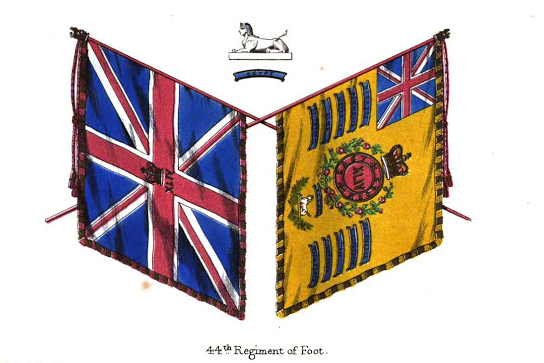
 Colours of the 44th Regiment of Foot | |
| Active | 1741–1881 |
| Country |  Kingdom of Great Britain (1741–1800) Kingdom of Great Britain (1741–1800) United Kingdom (1801–1881) United Kingdom (1801–1881) |
| Branch |  British Army British Army |
| Role | Infantry |
| Size | One battalion (two battalions 1803–1816) |
| Garrison/HQ | Warley Barracks, Brentwood |
| Nickname | The Fighting Fours |
| Colours | Old colours of the 44th are laid up at Essex Regiment Chapel. |
| Engagements | Jacobite rising French and Indian War American Revolutionary War French Revolutionary Wars Napoleonic Wars First Anglo-Burmese War First Anglo-Afghan War Crimean War Second Opium War |
| Commanders | |
| Notable commanders | James Long Charles Staveley |
The 44th Regiment of Foot was an infantry regiment in the British Army, raised in 1741. Under the Childers Reforms it amalgamated with the 56th (West Essex) Regiment of Foot to form the Essex Regiment in 1881.
History
[edit]
Early history
[edit]
The regiment was raised by Colonel James Long as James Long's Regiment of Foot in 1741.[1] The regiment saw active service at the Battle of Prestonpans in September 1745 during the Jacobite rising.[2] Ranked as the 55th Regiment of the Line in 1747, the regiment was renamed the 44th Regiment of Foot in 1751.[1] It embarked for North America in January 1755 for service in the French and Indian War[3] and took part in the Battle of the Monongahela[4] where Colonel Sir Peter Halkett was killed while commanding the regiment.[5] The regiment went on to fight at the Battle of Carillon in July 1758,[6] the Battle of Fort Niagara in July 1759 and finally the Montreal Campaign in July to September 1760[7] before returning home in 1765.[8]
The regiment returned to North America landing in Boston in 1775 for service in the American Revolutionary War.[9] It saw action at the Battle of Brooklyn in August 1776,[10] the Battle of Brandywine in September 1777[11] and the Battle of Germantown in October 1777[12] as well as the Battle of Monmouth in June 1778.[13] In May 1780 the regiment moved to Canada[14] returning home in September 1786.[15] In 1782, most British regiments of foot were given county designations, and the regiment became the 44th (the East Essex) Regiment of Foot.[1]
Napoleonic Wars
[edit]
The regiment was sent to the West Indies in 1795 for service in the French Revolutionary Wars and took part in the recapture of Martinique and Saint Lucia which, following the peace treaty of 1763, had been returned to France, and the attack on Guadeloupe.[16] After returning to England, it took part in the expedition to Egypt in 1800 and fought at the Battle of Alexandria in March 1801[17] the siege of Cairo in May 1801[17] and the siege of Alexandria in September 1801.[18] It returned home at the end of the year.[19] The regiment was increased in strength to two battalions in 1803.[1]
The 1st battalion embarked for North America in 1814 for service in the War of 1812[20] and saw action at the Battle of Bladensburg in August 1814,[21] the Battle of North Point in September 1814[22] and the Battle of New Orleans in January 1815.[23]
Meanwhile, the 2nd battalion landed in Portugal in September 1810[24] and took part in the Battle of Sabugal in April 1811,[25] the Battle of Fuentes de Oñoro in May 1811[26] and the siege of Ciudad Rodrigo in January 1812.[27] The battalion went on to fight at the siege of Badajoz in March 1812.[28] At the Battle of Salamanca in July 1812 Lieutenant William Pearce of the 2nd battalion captured the French Imperial Eagle of the French 62nd Regiment.[29] The battalion also took part in the siege of Burgos in September 1812 and then returned home in June 1813.[30] The battalion embarked for Holland later in the year and saw action at the Battle of Quatre Bras[31] and the Battle of Waterloo in June 1815.[32]
First Anglo-Burmese War
[edit]
The regiment embarked for India in 1822[33] and was deployed to Burma for service in the First Anglo-Burmese War in early 1825. It formed part of an army which advanced up the River Irrawaddy to the Kingdom of Ava[34] and then, under the command of Lieutenant Colonel John Shelton, captured the city of Arakan in March 1825.[35] After suffering many casualties from fever the regiment was withdrawn and returned to India in 1826.[36]
First Anglo-Afghan War
[edit].jpg)
The regiment was posted to Kabul in 1840 during the First Anglo-Afghan War and was part of the advance-guard during the January 1842 retreat.[37] Viewed as one of the worst British military disasters of the 19th century, by breaking the myth of the army's invincibility it also allegedly facilitated the 1857 Indian Rebellion.[38] The regiment was engaged in a continuous running battle in thick snow, suffering heavy casualties, among them Captain Thomas Leighton, killed on 10 January and commemorated in All Saints' Church, Northallerton.[39]
On the evening of the 12th, a small group on horseback broke out in an attempt to reach the British garrison at Jalalabad but only Surgeon William Brydon managed to do so, arriving late on the afternoon of the next day.[40] This left an estimated 20 officers and 45 other ranks surrounded by the Ghilji on a hill outside the village of Gandamak; they refused an offer to surrender and were over-run.[41] The only survivors were a few wounded privates and Captain Thomas Souter, who had wrapped the regimental colours around his waist; the attackers assumed this meant he was a high-ranking officer.[42] Traces of weapons and equipment from the battle could be seen in the 1970s and as late as 2010, the bones of the dead still covered the hillside.[43]
Crimean War
[edit]The 44th Foot was reconstituted and landed at Varna in summer 1854 for service in the Crimean War.[44] It served under General Sir Richard England in the 3rd Division and saw action at the Battle of the Alma in September 1854,[45] the Battle of Inkerman in November 1854[46] and the siege of Sevastopol in winter 1854. At Sevastopol it took part in the capture of the cemetery.[47][48]
Second Opium War
[edit]
The regiment embarked for China in 1860 for service in the Second Opium War.[49] It took in the capture of the Taku Forts on 21 August 1860 as part of the Anglo-French forces under command of General Sir James Hope Grant.[50] The regiment was in the vanguard of the assault on the North Taku entrenchments. The attacking force crossed a series of ditches and bamboo-stake palisades under heavy Chinese musketry, and tried to force entrance by the main gate. When this effort was unsuccessful, an assault party climbed the wall to an embrasure and forced entry to the fort. The first British officer to enter the fort was Lieutenant Robert Montresor Rogers who was awarded the Victoria Cross for his conspicuous bravery. He was closely followed by Private John McDougall who was also awarded the VC.[51] The regiment left China in October 1861 and returned to India.[52]
Amalgamation
[edit]As part of the Cardwell Reforms of the 1870s, where single-battalion regiments were linked together to share a single depot and recruiting district in the United Kingdom, the 44th was linked with the 56th (West Essex) Regiment of Foot, and assigned to district no. 44 at Warley Barracks near Brentwood.[53] On 1 July 1881 the Childers Reforms came into effect and the regiment amalgamated with the 56th (West Essex) Regiment of Foot to form the Essex Regiment.[1]
Following the release of the 1957 Defence White Paper which saw the British Army undergo restructuring yet again, the Essex Regiment was merged with Bedfordshire and Hertfordshire Regiment to form the 3rd East Anglian Regiment.[54] This regiment existed for only a small number of years as the 1966 Defence White Paper was released and saw the British Army undergo even more transitions, resulting in the 1st East Anglian Regiment, 2nd East Anglian Regiment, 3rd East Anglian Regiment and The Royal Leicestershire Regiment being merged to create one larger regiment - the Royal Anglian Regiment.[55] The Royal Anglian Regiment still exists now and is composed of three battalions - two regular and one reserve. The legacy of the 44th Regiment of Foot is upheld to this day as the 3rd East Anglian Regiment became the 3rd Battalion of the Royal Anglian Regiment.[56]
In fiction
[edit]The capture of a French Imperial Eagle by the fictional South Essex Regiment at the Battle of Talavera in Bernard Cornwell's novel Sharpe's Eagle is based upon the achievement of the 44th Regiment at the Battle of Salamanca. The primary historical difference, as admitted in Cornwell's historical postscript, is that no Eagle was captured at Talavera.[57]
Battle honours
[edit]The battle honours of the regiment were:[1]
- Egypt
- Peninsular War: Badajoz, Salamanca, Peninsula
- War of 1812: Bladensburg
- Napoleonic Wars: Waterloo
- Anglo-Burmese War: Ava
- Crimean War: Alma, Inkerman, Sevastopol
- Second Opium War: Taku Forts
Victoria Cross awards
[edit]The Victoria Cross were awarded to the following men of the regiment.
- Private John McDougall, Second Opium War (21 August 1860)
- Sergeant William McWheeney, Crimean War (20 October 1854)
- Lieutenant Robert Montresor Rogers, Second China War (21 August 1860)
Colonels of the Regiment
[edit]Colonels of the regiment were:[1]
- 1741–1743: Col. James Long
- 1743–1751: Col. John Lee
The 44th Regiment of Foot – (1751)
[edit]- 1751–1755: Col. Sir Peter Halkett, 2nd Baronet
- 1755–1756: Col. Robert Ellison
- 1756–1781: Gen. James Abercromby
- 1781–1809: Gen. Charles Rainsford
The 44th (East Essex) Regiment – (1782)
[edit]- 1809–1814: Gen. Sir Thomas Trigge, KB
- 1814–1820: Gen. John Howard, 15th Earl of Suffolk
- 1820–1843: Gen. Gore Browne
- 1843–1855: Gen. Hon. Sir Patrick Stuart, GCMG
- 1855–1858: Lt-Gen. Sir Frederick Ashworth
- 1858–1881: Gen. Sir Thomas Reed, GCB
References
[edit]- ^ a b c d e f g "44th (the East Essex) Regiment of Foot [UK]". Regiments.org. Archived from the original on 4 January 2006. Retrieved 25 December 2016.
- ^ Carter, p. 6
- ^ Carter, p. 9
- ^ Carter, p. 10
- ^ Carter, p. 12
- ^ Carter, p. 16
- ^ Carter, p. 20
- ^ Carter, p. 23
- ^ Carter, p. 24
- ^ Carter, p. 25
- ^ Carter, p. 27
- ^ Carter, p. 29
- ^ Carter, p. 30
- ^ Carter, p. 31
- ^ Carter, p. 32
- ^ Carter, p. 33
- ^ a b Carter, p. 43
- ^ Carter, p. 44
- ^ Carter, p. 45
- ^ Carter, p. 52
- ^ Carter, p. 54
- ^ Carter, p. 57
- ^ Carter, p. 60
- ^ Carter, p. 67
- ^ Carter, p. 68
- ^ Carter, p. 69
- ^ Carter, p. 71
- ^ Carter, p. 72
- ^ Carter, p. 77
- ^ Carter, p. 81
- ^ Carter, p. 93
- ^ Carter, p. 101
- ^ Carter, p. 114
- ^ Carter, p. 116
- ^ Carter, p. 120
- ^ Carter, p. 126
- ^ Sale, p. 244
- ^ Mason, Philip (1974). A Matter of Honour. Purnell. pp. 223-235. ISBN 978-0030129117.
- ^ Ingledew-Davison, James (1858). The history and antiquities of North Allerton, in the county of York. Bell & Daldy. p. 186.
- ^ Carter, p. 150
- ^ Carter, p. 151
- ^ Carter, p. 152
- ^ Dalrymple, William (8 May 2010). "The Ghosts of Gandamak". New York Times. Retrieved 19 February 2019.
- ^ Carter, p. 171
- ^ Carter, p. 173
- ^ Carter, p. 181
- ^ "The Siege of Sevastopol". British Battles. Retrieved 26 December 2016.
- ^ "Sir Charles William Dunbar Staveley". Staveley Genealogy. Retrieved 26 December 2016.
- ^ Carter, p. 205
- ^ Carter, p. 209
- ^ Carter, p. 210
- ^ Carter, p. 215
- ^ "Training Depots". Regiments.org. Archived from the original on 10 February 2006. Retrieved 16 October 2016.
- ^ Merged regiments and new brigading — many famous units to lose separate identity, The Times, July 25, 1957.
- ^ Swinson, Arthur (1972). A Register of the Regiments and Corps of the British Army. London: The Archive Press. p. 270. ISBN 0-85591-000-3.
- ^ "Royal Anglian Regiment". British Army units 1945 on. Retrieved 6 March 2017.
- ^ Cornwell, p. 327–8
Sources
[edit]- Carter, Thomas (1864). Historical Record of the Forty-Fourth, or the East Essex Regiment of Foot. London: W. O. Mitchell.
- Cornwell, Bernard (1994). Sharpe's Eagle. London: HarperCollins Publishers. ISBN 978-0-00-780509-9.
- Sale, Florentia (1864). A Journal of the Disasters in Affghanistan, 1841-2. London: J. Murray.
External links
[edit]- Personnel lists of the 44th Regiment of Foot
- 44th East Essex Regiment of Foot - Modern re-enactment group representing the 44th Foot in the Napoleonic Association
44th (East Essex) Regiment of Foot
View on GrokipediaFormation and Early Service
Raising and Initial Organization
The 44th (East Essex) Regiment of Foot traces its origins to the formation of James Long's Regiment of Foot on 7 January 1741, during preparations for the War of the Austrian Succession. Colonel James Long, a veteran officer from the 1st Foot Guards (Grenadier Guards), was commissioned by royal warrant to raise the new unit, initially ranked as the 55th Regiment of Foot in the British Army's line infantry order.[2][6] Recruitment drew from various parts of Great Britain, with the regiment assembling primarily in southern England.[7][8] As a standard line infantry regiment of the era, the unit was organized as a single battalion comprising 10 companies: typically one grenadier company and nine centre companies, though light infantry roles were not yet formalized. Establishment strength aimed for approximately 500 to 1,000 rank and file, supplemented by field officers including a colonel, lieutenant-colonel, major, adjutant, and quartermaster, though actual muster often fell short due to recruitment challenges. Lieutenant-Colonel Sir Peter Halkett was appointed to the regiment at its inception, providing early leadership under Long's command.[9][2] The regiment's initial equipage followed British Army norms, with red coats faced in yellow for the centre companies and blue for grenadiers, reflecting the period's uniform regulations.[2] In 1751, following army reforms, the regiment was renumbered as the 44th Regiment of Foot, solidifying its position in the line, though its early organization and command structure remained largely intact from the 1741 raising.[2][10]Jacobite Rising and European Commitments
The 44th Regiment of Foot, originally raised as James Long's Regiment in January 1741 and initially numbered the 55th, encountered its first combat during the Jacobite Rising of 1745.[7] Under Colonel Long, detachments from the regiment joined Sir John Cope's government army marching north to confront the Jacobite forces advancing under Charles Edward Stuart.[2] On 21 September 1745, at the Battle of Prestonpans near Edinburgh, the regiment formed part of the infantry line that faltered amid poor visibility from morning mist and fog, leading to a rapid Jacobite charge that shattered the government position.[2] Cope's forces, including the 44th/55th, suffered heavy casualties and routed, with the regiment's inexperience contributing to the collapse; government losses totaled around 300 killed and wounded, plus 1,500 captured, while Jacobites reported fewer than 150 casualties. The regiment did not participate in the decisive Battle of Culloden in April 1746, which ended the rising.[11] Following the pacification of the Highlands, the regiment reinforced Britain's continental obligations in the War of the Austrian Succession. In 1747, it deployed to Flanders as part of the Allied army under the Duke of Cumberland, engaging in operations against French forces amid the broader conflict over Habsburg succession.[2] The unit saw service in the grueling campaigns of that year, including defensive actions in the Low Countries, where attrition from disease and skirmishes depleted ranks before the Treaty of Aix-la-Chapelle concluded hostilities in 1748. By this time, the regiment had been renumbered the 44th in 1748, reflecting adjustments in the British establishment.[2] These early engagements tested the regiment's cohesion, with losses from combat and illness underscoring the challenges of rapid mobilization for a newly formed unit.[1]North American Campaigns
The 44th Regiment of Foot saw service in North America during the mid-18th century as part of Britain's efforts in the French and Indian War. The regiment arrived in 1755, forming a key component of Major General Edward Braddock's expedition aimed at capturing the French-held Fort Duquesne in the Ohio Valley. Comprising approximately 1,000 men from the 44th and 48th Regiments, alongside colonial forces and artillery, the column advanced through difficult terrain from Virginia.[7][12] On July 9, 1755, near the Monongahela River, Braddock's force of about 2,400 encountered an ambush by roughly 600 French regulars, Canadian militia, and Native American allies led by Captain Daniel Liénard de Beaujeu. The 44th, commanded by Colonel Sir Peter Halkett, bore the brunt of the initial attack, maintaining formation under devastating fire from concealed positions. Braddock was mortally wounded, Halkett killed along with his son Lieutenant James Halkett, and the regiment suffered over 500 casualties, more than half its effective strength, contributing to the rout of the column. Survivors under Colonel Thomas Dunbar retreated, abandoning artillery and supplies. This defeat highlighted tactical mismatches between European linear tactics and irregular woodland warfare.[12][13] Reconstituted, detachments of the 44th participated in subsequent operations, including the defense of Fort William Henry in March 1757, where Major William Eyre's force of 274 soldiers and 72 rangers repelled a Native American assault, inflicting significant losses on the attackers. The regiment's North American commitments during this period ended around 1763, with return to Britain.[14][7] The 44th returned to North America for the American Revolutionary War (1775–1783), serving under General William Howe in campaigns against colonial rebels. Integrated into the British order of battle, it fought in principal engagements of 1776–1778, including the New York and Philadelphia campaigns, before redeployment to Canada in 1779 and eventual repatriation. Specific actions underscored the regiment's role in conventional battles against Washington's Continental Army and militia.[7][15] In the War of 1812, the 1st Battalion sailed to North America in 1814, joining Major General Robert Ross's Chesapeake Campaign. On August 24, 1814, at the Battle of Bladensburg, Maryland, elements of the 44th engaged disorganized U.S. militia and sailors, helping secure a British victory that enabled the capture and burning of Washington, D.C. The regiment also saw action at the Battle of Baltimore in September 1814, though the overall campaign yielded limited strategic gains before peace negotiations.[7][16]Napoleonic Era Engagements
Peninsular War Operations
The Second Battalion of the 44th (East Essex) Regiment of Foot embarked for overseas service on 20 March 1810, arriving at Cádiz in April to reinforce the Allied garrison amid the French siege of that port.[17] By September 1810, the battalion transferred to Portugal, joining the Lines of Torres Vedras where British and Portuguese forces under Viscount Wellington prepared defenses against Masséna's invading army.[2] Under Lieutenant Colonel Sir Charles Bulkeley Egerton, the 2/44th participated in the subsequent pursuit of French forces following their retreat from Portugal, engaging in skirmishes and maneuvers through locations including Fort Concepcion, Barba del Puerco, Nava de Aver, Caya, Portalegre, Guarda, Villa de Rey, and Oliveira de Azemeis during 1811.[2] In May 1811, the battalion fought at the Battle of Fuentes de Oñoro, where it formed part of the Anglo-Portuguese center, helping to repel Masséna's attempts to relieve Almeida; the 2/44th, with approximately 210 men present, contributed to holding the village against repeated French assaults amid heavy fighting that cost Wellington's army around 1,270 casualties overall.[18] The regiment then advanced into Spain for the 1812 siege season, participating in the investment and capture of Ciudad Rodrigo in January, followed by the Siege of Badajoz starting in March. During the storming of Badajoz on 6 April 1812, elements of the 2/44th supported assaults on the breaches alongside the 38th Foot, suffering losses including the wounding of Lieutenant Colonel Hon. George Carleton, who had assumed command in December 1811; the battle resulted in over 5,000 British casualties but secured the fortress after intense hand-to-hand combat.[2][19] The 2/44th next engaged at the Battle of Salamanca on 22 July 1812, operating within Lieutenant General Rowland Hill's corps during Wellington's decisive defeat of Marmont's army; a notable action involved Lieutenant Harry Pearce of the battalion capturing the eagle standard of the French 62nd Line Regiment from General Thomières' brigade, contributing to the rout of the French right flank and earning the regiment the battle honour.[2] Following Salamanca, the battalion pursued retreating French forces toward Madrid and Burgos, participating in actions at Villa Muriel and Castallejos in August and December respectively, before shifting to Saint Marinha by year's end.[2] These operations culminated in the regiment receiving the collective "Peninsula" honour for sustained service from 1810 to 1813, though the 2/44th's primary contributions centered on the central Portuguese frontier and western Spanish sieges rather than the later Pyrenees campaigns.[2] The First Battalion arrived later, with five companies landing in Sicily in May 1813 before transferring to Spain at Tarragona in September; it saw limited action at Villafranca and Saragossa in March 1814, advancing into France by April, but these efforts were peripheral compared to the 2/44th's frontline role.[2] Throughout, the regiment's performance reflected the grueling attrition of the Peninsular campaigns, with battle honours formally awarded for Badajoz and Salamanca underscoring its role in Wellington's attritional strategy against French supply lines and fortifications.[2]Waterloo and Low Countries
The 2nd Battalion of the 44th (East Essex) Regiment of Foot deployed to the Low Countries in 1813 as part of British operations against French forces occupying the region. It took part in the assault on Bergen-op-Zoom on 8–9 September 1813, a failed attempt to capture the fortified town that resulted in heavy British casualties due to poor coordination and strong French defenses under General Jean-Baptiste Maison; the 44th suffered significant losses amid the chaos of the night attack.[7] The battalion's remnants were reinforced following these setbacks and rejoined the Anglo-Allied Army under the Duke of Wellington for the 1815 Waterloo Campaign. Assigned to Major-General Sir Denis Pack's 9th Brigade within Lieutenant-General Sir Thomas Picton's 5th Division, the 44th, commanded by Lieutenant-Colonel Alexander Hamerton, comprised approximately 400–500 rank and file at the outset of the campaign.[20] On 16 June 1815, at the Battle of Quatre Bras, Pack's Brigade—including the 44th, flanked by the 42nd (Royal Highland) and 92nd (Gordon Highlanders) Foot—faced repeated assaults from Marshal Ney's infantry and cavalry. Positioned to defend the crossroads against superior French numbers, the 44th endured intense musketry and artillery fire while supporting Nassau and Belgian troops; the brigade's stubborn resistance helped secure Wellington's right flank, though the 44th incurred heavy casualties from the prolonged close-quarters combat.[7][20] At the Battle of Waterloo on 18 June 1815, the 44th advanced in Pack's Brigade's famous uphill charge against the dense columns of Comte d'Erlon's I Corps, positioned on the brigade's right amid the 42nd Foot. Exposed to devastating French musket volleys at point-blank range and grapeshot from supporting artillery, the battalion pressed forward but suffered severe attrition; Hamerton fell wounded early in the action, with command devolving to Major Hugh O'Donnell. The 44th's role in shattering the French assault contributed to the Allied victory, despite the brigade's disproportionate losses relative to its strength.[20][7]Imperial Wars in Asia
First Anglo-Burmese War
The 44th (East Essex) Regiment of Foot, stationed as garrison troops in the Bengal Presidency of British India, participated in the First Anglo-Burmese War from 1824 to 1826 as part of the Bengal Army's expeditionary forces.[7][21] The conflict arose from Burmese encroachments on British-protected territories in Assam and Cachar, as well as disputes over Manipur and coastal raids, prompting the British declaration of war on 5 March 1824.[22] In the Arakan campaign, the opening phase of the war, the regiment formed a key component of the invasion column advancing from Chittagong into Burmese-held Arakan Province (modern Rakhine State) starting in late 1824.[22] Under Brigadier-General Archibald Campbell's overall command for the Burma operations, though the Arakan thrust was led by Brigadier-General Thomas Morrison, the 44th Foot—alongside elements of the 42nd and 62nd Bengal Native Infantry, artillery, and local levies—captured strategic islands like Ramree and Cheduba before pressing inland to seize the provincial capital of Arakan (Uritsing, near modern Sittwe) in April 1825.[22][23] The regiment then aided in clearing residual Burmese forces from the province, encountering guerrilla resistance but sustaining relatively low casualties due to disease and combat compared to later phases of the war elsewhere.[24] The Arakan successes secured a foothold for British logistics and contributed to the broader pressure on Burmese King Bagyidaw, though the 44th's direct role appears confined to this theater rather than the main Irrawaddy River advances toward Ava.[1] For its contributions, the regiment received the battle honour "Ava" inscribed on its colours, recognizing participation in the expedition that forced the Treaty of Yandabo on 24 February 1826, ceding Arakan, Assam, and other territories to British control while imposing a 1 million pound indemnity.[21][1] The campaign highlighted logistical challenges in tropical terrain, with malaria and fever claiming more lives than enemy action across British forces, though specific regimental losses for the 44th remain sparsely documented beyond general war estimates of over 15,000 British and Indian casualties from disease.[22]First Anglo-Afghan War Retreat and Analysis
The 44th (East Essex) Regiment of Foot formed part of the British garrison in Kabul during the First Anglo-Afghan War, which began with the invasion in 1839 to install Shah Shuja as emir amid fears of Russian influence.[4] Following an Afghan uprising on 2 November 1841 that besieged the garrison, Major-General William Elphinstone capitulated to Akbar Khan, son of Dost Mohammad, agreeing to an evacuation under safe passage guarantees on 1 January 1842.[5] The retreat commenced on 6 January amid heavy snow, involving approximately 4,500 British and Indian troops alongside 12,000 civilians and camp followers, stretching the column into a vulnerable line exposed to constant harassment by Afghan ghazis and tribesmen.[25] As the rearguard, the 44th Regiment bore the brunt of early assaults, suffering severe attrition during passes like Khurd Kabul where hundreds perished from cold, starvation, and ambush.[5] By 13 January, near Gandamak village, roughly 20 British officers and 45 other ranks of the 44th remained, alongside scattered survivors; they occupied a rocky knoll for a final defense against overwhelming Afghan forces estimated at 5,000-6,000.[5] Under Captain James Skinner Souter, the survivors repelled multiple charges with musketry until ammunition depleted, then fixed bayonets for a desperate counterattack, inflicting notable casualties before being overrun.[4] Most were killed outright, with about a dozen captured, including Souter who concealed fragments of the regimental colors in his uniform; no 44th personnel reached Jalalabad, though Assistant Surgeon William Brydon, detached earlier, arrived as the sole European military survivor of the column.[25] The annihilation at Gandamak epitomized systemic failures in British command and preparation. Elphinstone's advanced age, indecision, and reliance on untrustworthy Afghan intermediaries precluded effective organization, such as securing supplies or dispersing camp followers who encumbered mobility in sub-zero conditions.[26] Overconfidence from initial 1839 victories fostered underestimation of Afghan resilience, tribal cohesion under Akbar Khan, and guerrilla tactics leveraging terrain superiority, compounded by the unpopular Shah Shuja's regime eroding local alliances.[27] Logistical breakdowns—insufficient warm clothing, food shortages, and frozen rivers—exacerbated combat losses, with over 15,000 total dead from exposure and attack, highlighting the perils of expeditionary warfare in hostile, high-altitude environments without sustained supply lines.[28] This disaster prompted a British reevaluation of imperial overreach, leading to Pollock's 1842 relief expedition that recaptured Kabul and exacted vengeance, but ultimately withdrawal, affirming Afghanistan's intractability to direct control.[4] For the 44th, the stand burnished its reputation for tenacity despite near-total loss, influencing regimental lore and underscoring infantry valor amid strategic folly; captured colors were later recovered, symbolizing resilience.[5] The event exposed causal disconnects between geopolitical ambitions and operational realities, where ideological commitments to buffering India against phantom threats yielded to empirical limits of force projection.[29]Mid-19th Century Conflicts
Crimean War Battles
The 44th (East Essex) Regiment of Foot deployed to the Crimea in 1854 as part of the British Expeditionary Force, joining the 3rd Division under Major-General Sir Richard England following recovery from earlier service in India.[7] The regiment first engaged the Russian forces at the Battle of Alma on 20 September 1854, forming the 6th Brigade alongside the 17th, 20th, and 21st Regiments of Foot.[21] During the assault across the Alma River against entrenched Russian positions, the 44th advanced under heavy fire, sustaining casualties including Captain George Ingham and Lieutenant Robert Montressor Rogers severely wounded, 14 men killed, one sergeant and 62 rank and file wounded.[21] Their efforts contributed to the allied victory, which opened the path toward Sevastopol, earning the regiment the battle honour "Alma".[1] At the Battle of Inkerman on 5 November 1854, the 44th Regiment defended British positions in dense fog against a surprise Russian assault near Sevastopol, engaging in close-quarters combat as part of the 3rd Division's response to repeated enemy columns.[7] The fighting, characterized by brutal hand-to-hand encounters amid limited visibility, saw the regiment help repel the Russian advances, bolstering the thin allied lines until French reinforcements arrived.[30] This "soldiers' battle" resulted in the regiment earning the honour "Inkerman", reflecting its role in halting the Russian bid to lift the siege.[1] The 44th Regiment subsequently participated in the Siege of Sevastopol from October 1854 to September 1855, enduring trench warfare, artillery bombardments, and harsh winter conditions while manning forward positions and supporting assaults on Russian fortifications.[7] The unit contributed to the sustained pressure that forced the Russian surrender, including involvement in the capture of key defensive works such as the cemetery sector during the final assaults.[1] For its service throughout the siege, the regiment received the battle honour "Sevastopol".[7]Second Opium War Involvement
The 44th (East Essex) Regiment of Foot formed part of the Anglo-French expeditionary force dispatched to China in 1860 amid the Second Opium War (1856–1860), aimed at enforcing treaty obligations following Chinese violations of prior agreements. Assigned to Major-General Sir Robert Napier's 2nd Division, the regiment, under Lieutenant-Colonel Patrick William MacMahon, disembarked at Pei-tang on 30 July 1860, alongside elements of the French army.[7][31][32] On 1 August 1860, the 44th engaged Chinese imperial forces at the Sinho entrenchments, contributing to the allied victory that cleared the path to the Taku Forts. The regiment's primary action came during the assault on the Taku Forts on 21 August 1860, where detachments from the 44th and 67th Regiments of Foot targeted the North Fort. Lieutenant Robert Montresor Rogers led the storming party through a breach in the walls, becoming the first British officer to enter despite sustaining severe wounds; he was awarded the Victoria Cross for this act. Private John McDougall also received the VC for advancing with the regimental colours after the bearer was killed, planting them on the fort's ramparts amid heavy fire.[33][32] The 44th suffered approximately 60 casualties in the Taku assault, including 14 killed and over 40 wounded, from an effective strength of 22 officers and 996 other ranks. Following the forts' capture, the regiment advanced inland with the allied column toward Beijing, participating in the Battle of Palikao on 21 September 1860. There, soldiers of the 44th and 67th stormed fortified positions, bridges, and villages under intense artillery and musketry fire, aiding the decisive rout of a much larger Qing army estimated at 30,000 strong. The expedition culminated in the occupation of Beijing and the signing of the Convention of Peking on 24 October 1860, which legalized the opium trade, opened additional ports, and ceded Kowloon to Britain. The 44th returned to Britain in 1861, having earned battle honours for its China service.[32][34]Amalgamation and Lineage
Childers Reforms and Essex Regiment
The Childers Reforms, initiated by Secretary of State for War Hugh Childers in 1880 and implemented on 1 July 1881, restructured the British Army's infantry by abolishing regimental numbers, pairing existing foot regiments into territorial-based units with two regular battalions each, and establishing militia and volunteer affiliations to enhance recruitment and local ties.[35] These changes built on earlier Cardwell Reforms, aiming to foster regimental identity rooted in counties while standardizing administration through linked depots.[35] Under these reforms, the 44th (East Essex) Regiment of Foot, which had borne the county designation since 1782, amalgamated with the 56th (West Essex) Regiment of Foot to form the Essex Regiment, with the 44th designated as the 1st Battalion and the 56th as the 2nd Battalion.[7] The new regiment's depot was established at Warley Barracks in Essex, drawing on the historic associations of both predecessor units with the county to consolidate recruiting districts.[36] This linkage preserved the 44th's battle honours and traditions within the Essex Regiment's structure, marking the end of its independent numbered existence after 142 years of service.[7] The Essex Regiment retained the facing colors and elements of uniform from its forebears, such as the 44th's yellow facings, while adopting a unified regimental title that emphasized territorial loyalty over numerical lineage.[1] Subsequent expansions under the reforms incorporated Essex-based militia battalions as the 3rd and 4th, providing reserves that supported the regular battalions in imperial deployments.[37] This reorganization enhanced operational efficiency but required administrative adjustments, including the transfer of records and personnel to the new framework.[36]Modern Successor Units
In 1881, under the Childers Reforms, the 44th (East Essex) Regiment of Foot amalgamated with the 56th (West Essex) Regiment of Foot to form the Essex Regiment, with the 44th providing the 1st Battalion.[7][10] On 1 July 1958, the Essex Regiment merged with the Bedfordshire and Hertfordshire Regiment to create the 3rd East Anglian Regiment (16th/44th Foot), incorporating the lineage of both the 16th and 44th regiments of foot.[38][7] This unit became the 3rd Battalion, Royal Anglian Regiment, upon the formation of the Royal Anglian Regiment on 1 September 1964, through the amalgamation of the East Anglian Brigade's three regiments alongside the Royal Leicestershire Regiment.[39][10] The 3rd Battalion, nicknamed the Steelbacks, perpetuates the traditions and battle honours of the 44th Foot, including its East Essex heritage, within the regiment's structure.[40] The 3rd Battalion was disbanded as a regular unit in 1992 amid post-Cold War reductions but was re-established as an Army Reserve light infantry battalion, maintaining the lineage today alongside the regiment's two regular battalions (1st and 2nd).[10][41][42] The Royal Anglian Regiment, as the senior line infantry regiment formed in 1964, continues to uphold the 44th's legacy through preserved customs, such as the eagle trophy from Waterloo, and shared battle honours across its battalions.[43][42]Regimental Identity and Achievements
Uniform, Equipment, and Traditions
The uniform of the 44th (East Essex) Regiment of Foot followed the standard pattern for British line infantry regiments during the 18th and 19th centuries, featuring a scarlet wool coat as the primary garment. Distinctive yellow facings adorned the lapels, cuffs, collar, and turnbacks, with regimental lace incorporating a white background and yellow central line for officers and specific ranks. Lace patterns varied by rank, including single or double stripes for privates and corporals, while officers wore elaborate gold or silver lace. Headgear evolved from tricorne hats in the mid-18th century to cocked hats, then stovepipe shakos by the Napoleonic era, often topped with a black cockade and white plume for grenadier companies. Breeches were white or buff, paired with black gaiters and shoes, though field modifications included practical brown leggings for campaigning.[44] Equipment issued to the 44th mirrored that of contemporary British infantry, centered on the Long Land Pattern musket, commonly known as the Brown Bess, a smoothbore flintlock with a 42-inch barrel capable of firing .75-caliber lead balls up to 100 yards effectively. Each soldier carried 60 rounds of ammunition in a leather cartridge box, alongside a 16-inch socket bayonet for close-quarters combat, which transformed the musket into a pike-like weapon. Supporting gear included a knapsack for rations and personal items, a haversack, canteen, and entrenching tools such as a shovel or pickaxe for fortification duties. Officers and NCOs supplemented this with swords or half-baskets, while drummers bore side drums emblazoned with regimental motifs. By the mid-19th century, some units experimented with percussion cap conversions to the musket, though the 44th retained flintlocks in early Afghan campaigns until logistical upgrades.[45] Regimental traditions of the 44th emphasized its maritime service during the French Revolutionary Wars, adopting "Rule Britannia" as a quick march to commemorate amphibious operations, including the capture of Martinique in 1794. Nicknames such as the "Little Fighting Fours" arose from the regiment's numerical designation and reputation for tenacity in the Peninsular War, where it earned praise for enduring combat despite high casualties. The regiment's colours—comprising a Union Jack Queen's Colour and a yellow-faced Regimental Colour bearing the royal cipher and battle honours—served as rallying points, defended fiercely at engagements like Gandamak in 1842. No formal motto was uniquely adopted, but customs included annual commemorations of key victories, with drill and piping maintaining esprit de corps. These traditions influenced successor units post-1881 amalgamation, preserving the Essex lineage in marches and identity.[7][46][47]Battle Honours and Victoria Crosses
The 44th (East Essex) Regiment of Foot received battle honours for distinguished service in key engagements, reflecting its involvement in 19th-century imperial conflicts. For the First Anglo-Burmese War, the regiment was awarded "Ava" following its capture of the Burmese royal capital on 27 February 1826, where it played a pivotal role in overcoming entrenched defences amid tropical hardships.[24] In the Crimean War (1854–1856), honours were granted for Alma (20 September 1854), where the regiment helped repel Russian assaults on the Allied right flank; Inkerman (5 November 1854), for close-quarters fighting in fog-shrouded conditions; and Sevastopol, recognizing sustained siege operations including assaults on fortified positions.[1] These Crimean honours were emblazoned on the regimental colours, with the 44th suffering over 300 casualties across the campaign.[48] During the Second Opium War, the honour "Taku Forts" commemorated the storming of the North Taku Fort on 21 August 1860, where British and French forces breached water-filled ditches and walls under artillery fire, enabling advances toward Beijing.[21] Three members of the 44th Regiment received the Victoria Cross, the British Army's highest award for valour, all during mid-19th-century operations. Private John McDougall was awarded the VC for his actions at the Battle of Alma on 20 September 1854, advancing alone under musketry to spike a Russian field gun, preventing its use against British lines; he later died in Edinburgh in 1881.[49] Colour Sergeant William McWheeney earned the VC for gallantry at Sevastopol on 20 October 1854, where he led a party to capture an enemy rifle pit during the siege, exposing himself to heavy fire; he survived the war but died in 1866 from wounds sustained in China service.[50] [51] Lieutenant Robert Montresor Rogers (later Major General) received the VC for commanding the storming party at the North Taku Fort on 21 August 1860, personally leading the assault across a burning bridge and into the fort under point-blank cannonade, securing its capture; he retired in 1888 after further Indian service.[52] These awards underscore individual heroism amid the regiment's broader tactical contributions, with no VCs recorded for earlier campaigns like Burma or Afghanistan despite severe losses.[53]Leadership and Administration
Colonels of the Regiment
The colonelcy of the 44th (East Essex) Regiment of Foot was an honorary position typically granted to senior officers of proven merit, serving as the regiment's titular head without direct operational command. Appointments were made by royal warrant, often following the death or promotion of the incumbent, and continued from the regiment's raising in 1741—initially as the 55th Foot before renumbering as the 44th in 1748—until its amalgamation into the Essex Regiment in 1881 under the Childers Reforms.[11][7] The succession of colonels reflected the regiment's evolving status and the career trajectories of British Army leadership during the 18th and 19th centuries. Early holders included battlefield commanders, while later ones were often field marshals or governors with extensive service. The list below details appointments up to the amalgamation, drawn from regimental records.[11]
| Date Appointed | Colonel | Rank/Title at Appointment | Notes |
|---|---|---|---|
| 7 January 1741 | James Long | Colonel | Raised the regiment as the 55th Foot in southern England.[7][11] |
| 11 March 1743 | John Lee | Colonel | Succeeded Long; commanded during early deployments.[11] |
| 26 February 1751 | Sir Peter Halkett, Bt. | Colonel | Appointed after renumbering to 44th; killed at Battle of Fort Duquesne in 1755.[11] |
| 13 November 1755 | Robert Ellison | Colonel | Brief tenure; succeeded by Abercromby shortly after.[11] |
| 13 March 1756 | James Abercromby | General | Long-serving; held post until 1781, overseeing North American campaigns.[11] |
| 4 May 1781 | Charles Rainsford | General | Retained colonelcy until death in 1809; regiment gained "East Essex" title in 1782.[11][2] |
| 27 May 1809 | Sir Thomas Trigge | General, K.B. | Transferred from 68th Foot; died in 1814.[11][2] |
| 12 January 1814 | John Howard, Earl of Suffolk | General | From 70th Foot; died in 1820.[11][2] |
| 28 January 1820 | Gore Browne | Lieutenant-General | Served until death on 12 January 1843.[11] |
| 7 April 1843 | The Honourable Patrick Stuart | Lieutenant-General | Previously Colonel Commandant of 2nd Battalion, 60th Foot; died 7 February 1855.[11] |
| 8 February 1855 | Sir Frederick Ashworth | Lieutenant-General | Held until death; succeeded in 1858.[11] |
| 2 August 1858 | Thomas Reed | Major-General, C.B. | Final colonel before amalgamation; tenure extended into post-1881 lineage.[11] |