Hubbry Logo
9TP9TPMain
Open search
9TP
Community hub
9TP
logo
8 pages, 0 posts
0 subscribers
Be the first to start a discussion here.
9TP
9TP
from Wikipedia
9TP
Early modified 7TP (second from the right) during a May 3rd Constitution Day parade in 1939

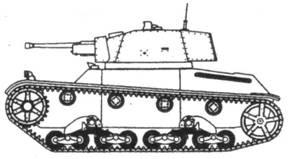
9TP (code for Polish: dziewięciotonowy polski - "9-tonne Polish") was a Polish light tank of early World War II era. A development of the earlier 7TP tank, it was to replace its predecessor in Polish service in 1940. Due to the outbreak of the war, only a limited number of early prototypes and development versions took part in battles of the Invasion of Poland.

The name of the tank was coined after World War II, technically the modified 7TP tanks were probably to retain the old designation regardless of the modifications. Alternative names include the "7TP wzmocniony", that is a "reinforced 7TP".

Development

[edit]

In the 1930s the Polish Army and the state-owned Państwowe Zakłady Inżynierii (PZInż) corporation worked on numerous modern medium tank designs that were to replace the 7TP as the main tank in Polish service, such as 10TP and 14TP. While 7TP was relatively modern and much superior to its German equivalents, the German Panzer I and Panzer II, it was based on the ageing Vickers 6-Ton and it was clear that it had limited potential for further improvements. However, as the 10TP and 14TP projects were running behind schedule, in 1938 it was decided to improve on the existing design.

The first modification was a new, more powerful powertrain. The new design could use either the Saurer CT1D diesel engine (license-produced in Poland as PZInż 155) or a modern gasoline engine PZInż 725. Both engines were lighter and smaller than the Saurer VBLDd engine used in 7TP. Because of that the armour could be extended and more space could be redirected to the battle compartment. An additional bonus was that both engines were water-cooled which allowed for the rear grille of 7TP to be replaced with solid armoured plates. Another modification planned for the 9TP was switching from bolted and screwed to welded armoured plates, which further strengthened the hull and allowed to save additional 210 kilograms, enough to further strengthen the armour and widen the tracks from 267 mm to 320 mm.

Two design teams were tasked to work on the upgrade package. A design team of the PZInż led by Edward Habich decided to use the Saurer CT1D engine and introduce the design improvements gradually at the production lines. In May 1938 the PZInż produced one of the 7TP tanks (hull number 1766) equipped with the new CT1D engine and rear armoured plates. In the autumn of the same year the new tank was tested by the Centre for Armoured Troops Training at Modlin Fortress.

Simultaneously a design team of the Technical Research Bureau of Armoured Forces (BBTBP) adopted the PZInż 725 engine and decided to further modify the tank, lowering its silhouette. While the BBTBP design was considered superior to the one proposed by PZInż, eventually the PZInż proposals were accepted as requiring less work and time to introduce in serial production.

Production and service

[edit]

On 29 June 1939 the Polish Army ordered 100 tanks of the new design to be delivered by June 1940. The following month the PZInż produced two additional prototypes to be extensively tested at tank proving grounds. While tests were generally favourable, it was noted that the new design had much lower speed than had been anticipated (26 km/h on paved roads and 11.5 km/h off-road).

It is unclear how many 9TP tanks were actually produced before the outbreak of World War II on 1 September 1939. It is assumed that the 11 tanks delivered to the Polish Army already after the start of hostilities were of 9TP rather than 7TP design. If this was the case, than the total number of 9TP tanks produced was 13 (two prototypes and 11 production models), with one 7TP with a new engine being an interim design.[1][2] No documentation has survived however and this is by no means certain. The 11 tanks could have been either standard 7TP or 7TP with some of the modifications included, but not all of them.[1] The tanks of this batch were incorporated in the 2nd Light Tank Company and took part in the battles during the Siege of Warsaw and served with distinction until the capitulation of the city on 27 September 1939.[1]

References

[edit]
Revisions and contributorsEdit on WikipediaRead on Wikipedia
from Grokipedia
The 9TP was a Polish developed in the late as an upgraded variant of the , featuring enhanced frontal armor up to 40 mm and design modifications for improved protection and mobility. Only 13 units, including two prototypes, were produced by the Państwowe Zakłady Inżynierii (PZInż) factory before the outbreak of , with delivery occurring in 1939 amid escalating tensions. The designation "9TP," meaning "9-ton Polish" (dziewięciotonowy polski), was coined postwar by historian Janusz Magnuski to distinguish these strengthened models from the standard , though contemporary documents referred to them as reinforced variants. Development of the 9TP began in 1938 as part of Poland's efforts to modernize its armored forces in response to growing threats from , building on the 's proven chassis but addressing its vulnerabilities in armor and powertrain. Engineers at PZInż proposed wider tracks for better ground pressure, a diesel or (around 95–100 hp), and a welded hull with enhanced frontal armor to increase weight to approximately 10.6 tons while maintaining a top speed of about 26 km/h on paved roads. Armament remained consistent with the 7TP, consisting of a single 37 mm wz.37 in a single turret, supplemented by a 7.92 mm wz.28 for the crew of three. An initial order for 100 tanks was placed in June 1939, with production slated for completion by mid-1940, but the German invasion on , disrupted manufacturing after the prototypes and initial batch. In combat, the 9TP saw its sole action during the Siege of as part of the 2nd Light Tank Company, where the 11 operational vehicles supported defenses starting September 7, 1939. These tanks engaged German Panzers in urban street fighting, but suffered heavy losses due to superior German numbers and air support; by the city's capitulation on , most 9TPs were destroyed, captured, or abandoned. No 9TPs survived the war intact, and postwar analysis by Polish historians like Janusz Magnuski helped clarify their role, confirming the type's brief but notable contribution to Poland's 1939 campaign despite its limited production.

Development

Background and requirements

In the late , the Polish Army faced the obsolescence of its primary , the , which suffered from inadequate armor protection and mechanical reliability amid escalating regional threats from and the . This urgency was compounded by significant delays in heavier tank projects, such as the Christie-suspension prototype, which reached testing in but was ultimately abandoned in favor of the uncompleted design due to technical challenges and resource constraints. As part of a broader five-year rearmament plan adopted in 1937, the Polish sought to modernize its support capabilities with a new generation of light tanks to bolster defensive readiness. The , serving as the direct predecessor to the 9TP, had originated as a Polish adaptation of the British tank, with acquiring 38 examples in 1931–1932 that influenced subsequent domestic designs for their balanced mobility and armament. In 1938, the Państwowe Zakłady Inżynierii (PZInż) initiated the 9TP project under the direction of engineer Edward Habich, aiming to produce a 9-tonne class optimized for accompaniment through incremental upgrades to existing production lines. The strategic imperatives driving the 9TP emphasized thicker armor for better survivability, increased speed for tactical flexibility, and enhanced engine reliability to support operations in a potential European war, with an initial order for 100 units targeted for delivery by mid-1940 to phase out the aging fleet.

Design process and prototyping

In 1938, the Polish Army initiated a competition for an improved based on the , involving two primary teams: the Państwowe Zakłady Inżynieryjne (PZInż) and the Biuro Badań Technicznych Broni Pancernych (BBTBP). The PZInż team, led by Edward Habich, proposed adapting the existing for faster implementation, emphasizing practicality and ease of manufacturing. In contrast, the BBTBP , overseen by Col. Patryk O’Brien de Lacy, featured a more innovative low-profile hull with slanted frontal armor. Although the BBTBP proposal was deemed technically superior in some aspects, such as its overall , the PZInż was selected in early due to its simpler adaptation from the , allowing for quicker prototyping and potential serial production. Key modifications in the PZInż 9TP focused on enhancing protection and mobility without drastically altering the base chassis. The team adopted welded armor construction, which reduced the overall weight by approximately 210 kg compared to riveted alternatives, enabling thicker plating—up to 40 mm on the frontal hull—while maintaining a combat weight around 9-10 tonnes. Track width was increased from 267 mm to 320 mm to improve ground pressure and stability, and solid rear idler plates were incorporated to bolster durability. These changes addressed the 7TP's vulnerabilities to contemporary anti-tank threats while preserving compatibility with existing logistics. The BBTBP variant, though not pursued, proposed up to 30 mm armor with a welded hull and slanted plates for better ballistic deflection. Engine options were evaluated to replace the 7TP's VBLDd, with the PZInż favoring the licensed CT1D (produced as PZInż 155), a 100 hp water-cooled diesel offering reliable power and a top speed of about 34 km/h. An alternative, the PZInż 725 95 hp water-cooled , was considered for the BBTBP design but deemed less suitable for the selected prototype due to logistics. Prototyping began with modifications to an existing hull (No. 1766) in May , fitted with the CT1D engine and ballast simulating added armor. The design was finalized by late , with initial tests conducted at in autumn of that year to assess mobility and reliability. By July 1939, two full prototypes were completed at the PZInż factory and underwent extensive trials in the Kampinos Forest, including evaluations of the C7P tractor transmission, which proved most effective; however, the outbreak of war in prevented further development.

Design

Chassis and protection

The 9TP tank's represented an evolutionary advancement over the preceding , incorporating a reinforced frame to accommodate the increased combat of approximately 9 to 10.6 tonnes while maintaining overall structural integrity under enhanced armor loads. This reinforcement addressed the 7TP's limitations in handling additional , with designers at PZInż and BBT Br.Panc. focusing on a more robust hull assembly to improve stability during maneuvers. One variant proposed by BBT Br.Panc. featured a lower chassis profile with a slanted front plate, which lowered the vehicle's for better tactical concealment and stability on uneven terrain. The armor system utilized welded construction from rolled steel plates, a shift from the 's predominantly riveted and bolted assembly, which allowed for greater structural strength and reduced vulnerability to spalling from impacts. Planned maximum thicknesses reached up to 30 mm on the hull front and rear, 25 mm on the slanted front, and 20 mm on sides and turret in the PZInż design, with the Br.Panc. targeting 40 mm on the hull front and turret front, 25 mm, 20 mm, and 13 mm on hull sides, and 20 mm on turret sides for improved ballistic resistance. However, due to material shortages and production constraints in 1939, the two completed prototypes likely retained armor thicknesses similar to the 's specifications (up to 17 mm), though exact details are scarce and some partial reinforcements may have been applied, falling short of the intended enhancements. Sloped side armor, at angles of approximately 30-45 degrees, was intended to enhance effective thickness against anti-tank rifles like the German , though the thinner realized plates limited this benefit. Historical records on the exact specifications of the completed prototypes are incomplete, with some sources suggesting partial reinforcements to the base. The suspension system retained the 7TP's modified paired design with leaf springs, featuring four bogies per side (each with two double road wheels) for a total of eight wheels, providing reliable cross-country performance without the complexity of Christie-type systems tested in parallel projects like the . To counter the increased weight, tracks were widened to 320 mm from the 7TP's 280 mm, reducing ground pressure to about 0.585 kg/cm² and improving traction on soft or muddy terrain common in Polish operational environments. This configuration offered superior flotation compared to narrower-tracked contemporaries. Overall, the 9TP's protection exceeded that of the German (13 mm maximum) and (14.5 mm front), providing reasonable immunity to small-arms fire and early anti-tank rifles at typical combat ranges, but it remained vulnerable to 37 mm anti-tank guns like the German Pak 35/36, which could penetrate 17 mm armor at over 500 meters. The welded construction and sloped elements marked a conceptual step toward modern armored design, though wartime exigencies prevented full realization of these defensive enhancements.

Armament and turret

The primary armament of the 9TP light tank was the 37 mm Bofors wz. 37 anti-tank gun, a semi-automatic weapon with a barrel length of L/45 (1,665 mm without muzzle brake), designed primarily for engaging armored vehicles. This gun fired armor-piercing high-explosive (APHE) rounds weighing 700 g at a muzzle velocity of approximately 800 m/s, achieving penetration of up to 32 mm of vertical armor at 500 meters, sufficient for contemporary light tanks like the German Panzer II. It also supported high-explosive fragmentation (HE-Frag) shells for anti-infantry use, with a practical rate of fire of 10 rounds per minute and telescopic/periscope sights for targeting. The secondary armament consisted of a single 7.92 mm Vickers wz. 30 (or alternatively BSA) machine gun mounted coaxially to the main gun, providing suppressive fire against infantry and unarmored targets. This water-cooled weapon had a cyclic rate of 450-500 rounds per minute and was protected by an armored sleeve within the turret. The turret, a single-man design adapted from the Bofors-pattern used on the 7TP, was manually traversed via a crank mechanism through a full 360 degrees and featured limited gun elevation from -10° to +20° for engaging low-profile or elevated threats. Mounted atop the chassis with ring support for stability during movement, it emphasized the tank's role in direct fire support against light vehicles and personnel. Ammunition storage accommodated 120 rounds for the main gun and 2,500 rounds for the , stored in the hull and turret to balance mobility with sustained in and anti-infantry operations.

Engine and mobility

The 9TP featured a designed for reliable performance in roles, centered on a 6-cylinder, water-cooled derived from the Swiss CT1D model, produced under license in as the PZInż 155. This engine delivered 100 hp at 1,800 rpm, prioritizing durability and fuel efficiency over high output, with a displacement of 7,980 cm³ and a of 16 for enhanced torque in varied conditions. An alternative configuration proposed the indigenous PZInż 725 inline 6-cylinder gasoline engine, weighing 345 kg and producing 95 hp at 2,800 rpm with a displacement of 5,180 cm³, intended to reduce overall vehicle mass while maintaining adequate power. Power from the was transferred via a mechanical gearbox offering 4 forward speeds and 1 reverse, coupled with a dry multi-disc main clutch and routed through the fighting compartment. relied on a conventional clutch-and-brake system, allowing precise control during turns by differentially braking one track, which suited the tank's light reconnaissance doctrine without requiring complex differentials. These components enabled the 9TP to achieve a maximum speed of approximately 29 km/h in the PZInż variant, dropping to 11.5 km/h off-road due to the engine's moderate power-to-weight balance and the terrain's demands. Operational range reached about 150 km on roads and 130 km cross-country, bolstered by a capacity of 170 liters to support extended patrols; wider tracks at 320 mm further mitigated ground pressure, enhancing traction and stability on soft or uneven surfaces compared to its predecessor. The suspension contributed to this mobility by absorbing shocks, ensuring consistent performance during rapid advances.

Production

Prototypes

No confirmed prototypes of the strengthened 9TP light tank were constructed by 1939, according to historical analyses. Instead, evaluations in 1938–1939 used an upgraded 7TP model (No. 1766) to test design refinements for enhanced armor and mechanical reliability, building on the core 7TP layout. This test vehicle incorporated the licensed Saurer CT1D diesel engine, produced domestically as the PZInż 155 delivering 100 hp, while plans considered the experimental Polish-designed PZInż 725 petrol engine rated at 95 hp for a second variant. Some accounts suggest two prototypes may have been built in July 1939, but this remains unconfirmed and debated among historians. The hull design transitioned toward full electric welding to reduce weight and improve ballistic resistance, with proposed armor thickness increased to up to 40 mm on the front plates, though initial assemblies retained riveted elements from the 7TP. Testing commenced in May–August 1939, including trials from July 3 at the and Kampinos Forest proving grounds near , where evaluators assessed armor integrity, Christie-type track performance under load, and engine integration with the upgraded transmission derived from the C7P . The trials revealed minor overheating during prolonged operations, addressed through cooling adjustments, and noted slightly reduced top speed; overall, results validated key design elements for potential production. Following evaluations, the test vehicle was assigned to the 2nd Company for crew training. The "9TP" designation itself is a term coined by postwar Janusz Magnuski to distinguish these proposed strengthened variants from standard s.

Planned serial production

In April 1939, proposals were made for strengthened variants, with the Polish Army planning a 50-tank batch of 9TP s starting June 29, 1939, and deliveries scheduled by mid-1940 to equip light tank battalions as successors to the . Some sources suggest an order for up to 100 tanks, but documentation is inconsistent. Production was to occur at PZInż factories in the area, including the former Ursus facility, with anticipated output of 12–15 units per month once assembly lines were tooled. It is unclear if any units beyond test vehicles were started or completed, with primary sources indicating none were produced due to the German on , which halted all manufacturing. Later accounts assume 11 tanks delivered to the 2nd Company in were 9TPs, but these may have been upgraded 7TPs; total output, if any, is estimated at 0–13, though unconfirmed by surviving records.

Operational history

Pre-war testing

The evaluation of 9TP prototypes took place primarily at the , serving as the Centre for Armoured Troops Training, during 1938 and 1939. These trials encompassed a range of methods, including mobility assessments across varied such as sandy and forested areas to simulate operational conditions, armor penetration simulations using period anti-tank weapons to verify protective capabilities, and assessments of crew within the confined interior. Testing results were generally positive regarding the tank's speed, reaching up to 26 km/h on roads, and the reliability of its wider tracks, which enhanced stability and reduced bogging in soft ground compared to the predecessor . However, evaluators noted significant drawbacks, including the high workload on the single-man turret for aiming, loading, and observing, as well as inadequate cooling during prolonged operations in hot weather, leading to overheating risks. From mid-1939, the limited number of available prototypes—two built by PZInż in 1938 and early 1939—were integrated into training exercises with the 2nd Light Tank Company for crew familiarization, where they simulated infantry support roles in maneuvers emphasizing close coordination with foot soldiers. These sessions highlighted the 9TP's superior cross-country performance over the but underscored the need for design refinements, such as improved ventilation and turret mechanisms, before any serial production could proceed.

Combat in 1939

The 9TP vehicles were deployed with the 2nd under the Command of the Defense of in the area during the German invasion in September . Formed hastily from available light tanks, the company fielded 11 upgraded single-turret vehicles (retrospectively designated 9TP) produced by PZInż in , featuring improved armor up to 40 mm capable of resisting 37 mm rounds at ranges beyond 500 meters. Including two prototypes, a total of 13 units were produced, with 11 operational by mid-September. During the Siege of Warsaw starting September 7, the 2nd Light Tank Company—later integrated into the 3rd Light Tank Battalion—provided critical fire support in the defense of the Wola district and surrounding suburbs against advancing German forces from the 4th Panzer Division. The tanks engaged elements of Panzer Regiment 35, effectively targeting German infantry advances and light armor including Panzer I and II vehicles using their 37 mm Bofors wz.37 guns, which proved superior in penetration against the thin-skinned Panzers at close ranges typical of urban fighting. Further counterattacks around Wawrzyszew demonstrated the 9TP's mobility and firepower in street-to-street combat, where the tanks' reinforced protection allowed them to withstand small-arms fire and shrapnel while suppressing enemy positions. The 9TP performed well in the confined urban environment of , where its 37 mm armament and improved armor gave it an edge over German light tanks and supported Polish in holding key defensive lines against probing assaults. However, the company's limited numbers—exacerbated by production shortfalls—restricted its impact, preventing broader maneuvers and leaving units vulnerable to concentrated German artillery barrages and air attacks, which accounted for most losses through rather than direct tank engagements. By mid-September, the company had suffered heavy attrition and merged remnants with the 1st Company to continue sporadic actions until the final days of . The 2nd Light Tank Company's 9TP-equipped elements fought until the capitulation of on September 27, 1939, after which surviving vehicles were either captured by German forces or destroyed to prevent use by the enemy; none saw post-war service due to the complete overrun of Polish territory.

Specifications

Dimensions and weight

The 9TP tank had overall dimensions of 4.6 meters in length, 2.4 meters in width, and 2.3 meters in height, making it a compact suitable for roles. Its combat weight was approximately 10.6 tonnes. The ground clearance measured 0.38 meters, complemented by a hull design optimized for a low silhouette to enhance tactical concealment on the battlefield. Crew accommodation was provided for three members—the driver, the commander who doubled as gunner, and the loader who operated the machine gun and radio—in a compact internal layout that maximized space efficiency within the vehicle's limited volume. Weight savings relative to potential riveted designs were achieved through the adoption of welded armor construction, allowing for thicker protection.

Performance and crew

The 9TP tank achieved a maximum road speed of approximately 30 km/h and 11.5 km/h off-road, reflecting its enhanced armor and weight compared to the predecessor. Its operational range was limited to 160 km on roads and 100 km off-road, constrained by the increased mass and fuel demands of the upgraded design. The vehicle was operated by a 3-man : a driver, a loader/machine gunner/, and the , who doubled as the gunner in the single-man turret, resulting in a high workload that compromised and targeting efficiency during combat. This arrangement, inherited from the 7TP's turret design, prioritized compactness but highlighted the limitations of early ergonomics. Operational limits included a fuel consumption rate of 200 liters per 100 km off-road, necessitating careful logistical planning for extended maneuvers, while the tank was rated for temperatures from -20°C to +40°C to suit Central European conditions. Maintenance was facilitated by a design allowing field repairs akin to the , with modular engine access for quicker swaps of the PZInż.155 diesel unit (approximately 100 hp) in zones. Armor protection included up to 40 mm on the frontal hull and turret, with 20-25 mm on sides.
Add your contribution
Related Hubs
User Avatar
No comments yet.