Hubbry Logo
Panzer IIPanzer IIMain
Open search
Panzer II
Community hub
Panzer II
logo
8 pages, 0 posts
0 subscribers
Be the first to start a discussion here.
Panzer II
Panzer II
from Wikipedia

The Panzer II is the common name used for a family of German tanks used in World War II.[2] The official German designation was Panzerkampfwagen II (abbreviated Pz.Kpfw. II).[2]

Key Information

Although the vehicle had originally been designed as a stopgap while larger, more advanced tanks were developed, it nonetheless went on to play an important role in the early years of World War II, during the Polish and French campaigns.[2] The Panzer II was the most numerous tank in the German Panzer divisions at the beginning of the war.[3] It was used both in North Africa against the Western Allies and on the Eastern Front against the Soviet Union.

The Panzer II was supplanted by the Panzer III and IV medium tanks by 1940/1941.[4] By the end of 1942, it had been largely removed from front line service and it was used for training and on secondary fronts.[4] The turrets of the then-obsolete Panzer Is and Panzer IIs were reused as gun turrets on specially built defensive bunkers,[5] particularly on the Atlantic Wall. Production of the tank itself ceased by January 1944, but its chassis remained in use as the basis of several other armoured vehicles, chiefly self-propelled artillery and tank destroyers such as the Wespe and Marder II respectively.[4]

Development

[edit]

In 1934, delays in the design and production of the Panzer III and Panzer IV medium tanks were becoming apparent.[6] The Panzer I had no weapons capable of defeating armor and thus no chance of success against enemy tanks so a stopgap tank was developed.[7] Designs for a stopgap tank were solicited from Krupp, MAN, Henschel, and Daimler-Benz. Design work on the Panzer II began on 27 January 1934.[8] The first experimental model was ready in February 1935.[8] The final design was based on the Panzer I, but larger, and with a turret mounting a 20 mm autocannon anti-tank gun and leaf spring suspension[6] Production began in 1935, but it took another eighteen months for the first combat-ready tank to be delivered.[6]

Design

[edit]

Armour

[edit]

The Panzer II was designed before the experience of the Spanish Civil War of 1936–39 showed that protection against armour-piercing shells was required for tanks to survive on a modern battlefield. Prior to that, armour was designed to stop machine gun fire and high-explosive shell fragments.

An uparmored Panzer II on the Western front with a Panzer I in the background, May 1940

The Panzer II Ausf. A to C had 14 mm of slightly sloped homogeneous steel armour on the sides, front, and back, with 10 mm of armour on the top and bottom.[6] Most of them were later given increased armour in the front of the vehicle, most noticeable by the changed appearance of the front hull from rounded to boxy shape.[6] Starting with the D model, the front armour was increased to 30 mm.[6] The Model F had 35 mm front armour and 20 mm side armour.[6] This level of protection was still only proof against small arms fire.[9] This amount of armour could be penetrated by towed anti-tank weapons, such as the Soviet 45mm, the British 2-pounder and the French canon de 47.

Armament

[edit]

Most tank versions of the Panzer II were armed with a 2 cm KwK 30 L/55 auto-cannon. Some later versions used the similar 2 cm KwK 38 L/55.[10] This auto-cannon was based on the 2 cm FlaK 30 anti-aircraft gun, and was capable of firing at a rate of 600 rounds per minute (280 rounds per minute sustained) from 10-round magazines. A total of 180 shells were carried.[4]

The Panzer II also had a 7.92 mm Maschinengewehr 34 machine gun mounted coaxially with the main gun.[6]

The 2 cm autocannon proved to be ineffective against many Allied tanks even at the start of the war, and experiments were conducted with a view to replacing it with a 37 mm cannon, but nothing came of this. Prototypes were built with a 50 mm tank gun, but by then the Panzer II had outlived its usefulness as a tank regardless of armament. Greater success was had by replacing the standard 2 cm armour-piercing explosive ammunition with tungsten cored solid ammunition, but due to shortages of tungsten this ammunition was in chronically short supply.

Mobility

[edit]
A Panzer II during Operation Barbarossa in 1941 moves along a road outside a village.

All production versions of the Panzer II were fitted with a 140 PS (138 HP), gasoline-fuelled six-cylinder Maybach HL62 TRM engine and ZF transmissions. Models A, B, and C had a top speed of 40 km/h (25 mph).[4] Models D and E had a torsion bar suspension[11] and a better transmission, giving a top road speed of 55 km/h (33 mph) but the cross country speed was much lower than previous models, so the Model F reverted to the previous leaf spring type suspension. All versions had a range of 200 km (120 mi).[12]

Crew

[edit]

The Panzer II had a crew of three men.[12] The driver sat in the forward left hull with the gearbox on the right. The commander sat in a seat in the turret, and was responsible for aiming and firing the cannon and co-axial machine gun, while a loader/radio operator sat on the floor of the tank behind the driver. He had a radio on the left and several 20mm ammunition storage bins.

Variants

[edit]

Development and limited production models

[edit]
Panzer II Ausf. c
Panzer II Ausf. a (Pz.Kpfw. IIa)

Not to be confused with the later Ausf. A (the sole difference being the capitalization of the letter A), the Ausf. a was the first version of the Panzer II to be built (albeit in limited numbers), and was subdivided into three sub-variants. The Ausf. a/1 was initially built with a cast idler wheel with rubber tire, but this was replaced after ten production examples with a welded part.[13] The Ausf. a/2 improved engine access problems.[13] The Ausf. a/3 included improved suspension and engine cooling.[13] In general, the specifications for the Ausf. a models was similar, and a total of 75 were produced from May 1936 to February 1937 by Daimler-Benz and MAN.[13] The Ausf. a was considered the 1 Serie under the LaS 100 name.

Panzer II Ausf. b (Pz.Kpfw. II b)

Again, not to be confused with the later Ausf. B, the Ausf. b was the second limited production series embodying further developments, primarily a heavy reworking of suspension components resulting in a wider track and a longer hull.[14] Length was increased to 4.76 metres but width and height were unchanged.[14] Additionally, a Maybach HL62 TR engine was used with new drivetrain components to match.[14] Deck armour for the superstructure and turret roof was increased to 10–12 mm.[14] Total weight increased to 7.9 tonnes.[14] Twenty-five were built by Daimler-Benz and MAN in February and March 1937.[14]

Panzer II Ausf. c (Pz.Kpfw. II c)

As the last of the developmental limited production series of Panzer IIs, the Ausf. c came very close to matching the mass production configuration with the replacement of the six small road wheels with five larger independently sprung road wheels and an additional return roller.[14] The tracks were further modified and the fenders widened.[14] Total length increased to 4.81 m (15 ft 9 in)and width to 2.22 m (7 ft 3 in),.[14] At least 25 of this model were produced from March through July 1937.[14]

Main production models

[edit]
Panzer II Ausf. A, B and C

The first true production model, the Ausf. A, included an armour upgrade to 14.5 mm (0.57 in) on all sides, as well as a 14.5 mm floor plate, and an improved transmission. It entered production in July 1937 and was superseded by the Ausf. B in December 1937, which introduced only minimal changes.[15]

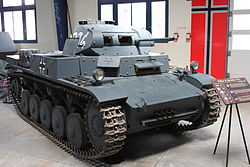
PzKpfw II Ausf. C at the Musée des Blindés

A few minor changes were made in the Ausf. C version, which became the standard production model from June 1938 through April 1940.[15] A total of 1,113 examples of Ausf. c, A, B, and C tanks were built from March 1937 through April 1940 by Alkett, FAMO, Daimler-Benz, Henschel, MAN, MIAG, and Wegmann.[15] These models were almost identical and were used in service interchangeably. This was the most widespread tank version of the Panzer II. Earlier versions of Ausf. C have a rounded hull front, but many had additional armour plates bolted on the turret and hull front.[15] Some were also retro-fitted with commander's cupolas.[15]

Panzer II Ausf. D and E

With a completely new torsion bar suspension[11] with four road wheels, the Ausf. D was developed as a tank for use in the light divisions.[16] After the invasion of Poland the light divisions were converted to Panzer divisions. Only the turret was the same as the Ausf. C model, with a new hull and superstructure design and the use of a Maybach HL62TRM engine driving a seven-gear transmission (plus reverse).[16] The design was shorter (4.65 m) but wider (2.3 m) and taller (2.06 m) than the Ausf. C. Speed was increased to 55 km/h.[16] A total of 43 Ausf. D tanks were built from October 1938 through March 1939 by MAN, and they served in Poland.[16] They were withdrawn in March 1940 for conversion to the flame tank Panzer II (Flamm).[16] The Ausf. E differed from the Ausf. D by having lubricated tracks; seven chassis were completed.

Panzer II Ausf. F

Continuing the conventional design of the Ausf. C, the Ausf. F superstructure front was made from a single piece of armour plate with a redesigned visor.[17] Also, a dummy visor was placed next to it to confuse enemy gunners.[17] The hull was redesigned with a flat 35 mm (1.4 in) plate on its front, and the armour of the superstructure and turret were built up to 30 mm (1.2 in) on the front with 15 mm (0.59 in) to the sides and rear.[17] There was some minor alteration of the suspension and a new commander's cupola as well. Weight increased to 9.5 tonnes.[17] From March 1941 to July 1942, 509 were built; this was the final major tank version of the Panzer II series.[17]

Panzer II (Flamm) known as the "Flamingo" in the West European campaign.
Panzer II (Flamm)

Based on the same suspension as the Ausf. D and Ausf. E tank versions, the Flamm (often wrongly referred to as "Flamingo"[18][failed verification]) used a new turret mounting a single MG34 machine gun, and two remotely controlled flamethrowers mounted in small turrets at each front corner of the vehicle.[19] Each flamethrower could cover the front 180° arc, while the turret traversed 360°.

The flamethrowers were supplied with 320 litres of fuel and four tanks of compressed nitrogen. The nitrogen tanks were built into armoured boxes along each side of the superstructure. Armour was 30 mm to the front and 14.5 mm to the side and rear, although the turret was increased to 20 mm at the sides and rear.[20]

Total weight was 12 tonnes and dimensions were increased to a length of 4.9 m and width of 2.4 m although it was a bit shorter at 1.85 m tall.[20] A FuG2 radio was carried.

One hundred and fifty-one Panzerkampfwagen II (F) (Flamm) vehicles were built from April 1940 through March 1942.[20] Initial production of Ausf. A vehicles was based on 46 Panzer II Ausf.[20] D/E chassis that were never completed as tanks, in March 1940 the 43 still existing Panzer II Ausf. D were recalled for conversion and from August 1941 until the cancellation in March 1942 a further 62 Ausf. B vehicles were made from new-production Ausf. D chassis (out of an order for 150 vehicles).[20] The Panzer II (F) was deployed in the USSR, but was not very successful due to its limited armor, and survivors were soon withdrawn for conversion to Marder II tank destroyers in December 1941.[20]

It is unknown when exactly the Flammpanzer II got the name "Flamingo", however it most likely originated some time after World War 2 and was never officially used for the vehicle.[citation needed]

Panzer II Ausf. L "Luchs"
Panzer II Ausf. L in the Musée des Blindés, Saumur

A light reconnaissance tank, the Ausf. L was the only Panzer II design with the Schachtellaufwerk overlapping/interleaved road wheels and "slack track" configuration to enter series production, with 100 being built from September 1943 to January 1944 in addition to the conversion of the four Ausf. M tanks.[21] Originally given the experimental designation VK 1303, it was adopted under the alternate name Panzerspähwagen II and given the popular name Luchs ("Lynx").[21] The Luchs was larger than the Ausf. G in most dimensions (length 4.63 m; height 2.21 m; width 2.48 m).[21] It was equipped with a six speed transmission (plus reverse), and could reach a speed of 60 km/h (37 mph) with a range of 290 km (180 mi).[21] The FuG12 and FuG Spr a radios were installed, while 330 rounds of 20 mm and 2,250 rounds of 7.92 mm ammunition were carried.[21] Total vehicle weight was 11.8 tonnes.[21] It had 30 mm of armour on the front of the hull and 20 mm of armour on the sides and back and the same on the turret.[21] It accommodated four crew members, the commander (gunner), driver, loader and the radio operator.[22]

Self-propelled guns on Panzer II chassis

[edit]
15 cm sIG 33 auf Fahrgestell Panzerkampfwagen II (Sf)

One of the first gun mount variants of the Panzer II design was to emplace a 15 cm sIG 33 heavy infantry gun on a turret-less Panzer II chassis.[23] The prototype utilized an Ausf. B tank chassis, but it was quickly realized that it was not sufficient for the mounting.[23] A new, longer chassis incorporating an extra road wheel was designed and built, named the Fahrgestell Panzerkampfwagen II.[23] An open-topped 15 mm thick armored superstructure sufficient against small arms and shrapnel was provided around the gun.[23] This was not high enough to give full protection for the crew while manning the gun, although they were still covered directly to the front by the tall gun shield. Only 12 were built in November and December 1941.[23] These served with the 707th and 708th Heavy Infantry Gun Companies in North Africa until their destruction in 1943.[23]

7.62 cm PaK 36(r) auf Fahrgestell Panzerkampfwagen II Ausf. D/E (Marder II) (Sd.Kfz. 132)

After a lack of success with conventional and flame tank variants on the Ausf. D/E chassis, it was decided to use the remaining chassis to mount captured Soviet antitank guns.[24] The hull and suspension was unmodified from the earlier models, but the superstructure was built up to provide a large, open-topped fighting compartment with a Soviet 76.2 mm antitank gun, which, while not turreted, did have significant traverse.[24] Only developed as an interim solution, the vehicle was clearly too tall and poorly protected, but had a powerful weapon.[24]

7.5 cm PaK 40 auf Fahrgestell Panzerkampfwagen II (Marder II) (Sd.Kfz. 131)

While the 7.62 cm PaK 36(r) was a good stopgap measure, the 7.5 cm PaK 40 mounted on the tank chassis of the Ausf. F resulted in a better overall fighting machine.[25] New production amounted to 576 examples from June 1942 to June 1943, as well as the conversion of 75 tanks after new production had stopped.[25] The work was done by Daimler-Benz, FAMO, and MAN.[25] A much improved superstructure for the 7.62 cm mounting was built giving a lower profile.[25] The Marder II served with the Germans on all fronts through the end of the war.[25]

5 cm PaK 38 auf Fahrgestell Panzerkampfwagen II

Conceived along the same lines as the Marder II, the 5 cm PaK 38 was an expedient solution to mount the 50 mm antitank gun on the Panzer II chassis. However, the much greater effectiveness of the 75 mm antitank gun made this option less desirable. Production quantity is unknown.

Leichte Feldhaubitze 18 auf Fahrgestell Panzerkampfwagen II (Wespe)
A Wespe at the Deutsches Panzermuseum in Munster, Germany

After the development of the Fahrgestell Panzerkampfwagen II for mounting the sIG 33, Alkett designed a version mounting a 10.5 cm leichte Feldhaubitze 18/2 field howitzer in an open-topped superstructure.[26] This was Germany's only widely produced self-propelled 105 mm howitzer.[26] Between February 1943 and June 1944, 676 were built by FAMO, and it served on all major fronts.[26]

Munitions Selbstfahrlafette auf Fahrgestell Panzerkampfwagen II

To support the Wespe in operation, 159 Wespe chassis were completed without installation of the howitzer, instead functioning as ammunition carriers.[26] They carried 90 rounds of 105 mm calibre.[26] These could be converted to normal Wespes by installation of the leFH 18 in the field if needed.[26]

Limited production, experiments and prototypes

[edit]
Panzerkampfwagen II mit Schwimmkörper

One of Germany's first attempts at developing an amphibious tank, the Schwimmkörper was a device built by Gebr Sachsenberg that consisted of two large pontoons, with one attached to each side of a Panzer II tank.[27] The tanks were specially sealed, some modifications to the engine exhaust and cooling were needed, as was an inflatable rubber ring used to seal the turret during amphibious operation.[27] A propeller; linked by a universal joint to an extension, was linked to the tank's engine to provide motive power, steering in water being effected by a rudder mounted behind the propeller. Speeds of up to 6 mph in dead calm were claimed, as was the ability to cope with conditions up to sea state 4.[19] Once ashore the pontoons were detachable.[27] The modified tanks were issued to the 18th Panzer Regiment, which was formed in 1940. However, with cancellation of Operation Sealion, the plan to invade England, the tanks were used in the conventional manner by the regiment on the Eastern Front.

Panzer II Ausf. G (PzKpfw II G)

The fourth and final suspension configuration used for the Panzer II tanks was the five overlapping road wheel configuration termed Schachtellaufwerk by the Germans.[6] This was used as the basis for the redesign of the Panzer II into a reconnaissance tank with high speed and good off-road performance.[6] The Ausf. G was the first Panzer II to use this configuration, and was developed under the experimental designation VK 9.01.[6] There is no record of the Ausf. G being issued to combat units, and only 12 full vehicles were built from April 1941 to February 1942 by MAN. The turrets were subsequently issued for use in fortifications. Two were converted to use the 50mm Pak 38 and troop-tested on the Eastern Front.

Panzer II Ausf. H (Pz.Kpfw. II H)

Given experimental designation VK 9.03, the Ausf. H was intended as the production model of the Ausf. G, with armor for the sides and rear increased to 20 mm and a new four speed transmission (plus reverse) similar to that of the PzKpfw 38(t) nA.[28] Only two prototypes were ever completed by the time of cancellation in September 1942.[28]

Brückenleger auf Panzerkampfwagen II

After failed attempts to use the Panzer I as a chassis for a bridge layer, work moved to the Panzer II, led by Magirus.[29] It is not known how many of these conversions were made, but four were known to have been in service with the 7th Panzer Division in May 1940.

Panzer II Ausf. J (Pz.Kpfw. II J)

Continued development of the reconnaissance tank concept led to the much up-armoured Ausf. J, which used the same concept as the Panzer I Ausf. F of the same period, under the experimental designation VK 16.01.[30] Heavier armour was added, bringing protection up to 80 mm on the front (similar to the maximum armour found on the KV-1 model 1941 Soviet heavy tank[31]) and 50 mm to the sides and rear, with 25 mm roof and floor plates, increasing total weight to 18 tonnes.[30] Equipped with the same Maybach HL45 P as the Pz.Kpfw. I F, top speed was reduced to 31 km/h (19 mph).[30] Primary armament was the 2 cm KwK 38 L/55 gun.[30] 22 were produced by MAN between April and December 1942, and seven were issued to the 12th Panzer Division on the Eastern Front.[30]

Bergepanzerwagen auf Panzerkampfwagen II Ausf. J

A single example of an Ausf. J with a jib in place of its turret was found operating as an armoured recovery vehicle.[30] There is no record of an official program for this vehicle.

Panzer II Ausf. M (Pz.Kpfw. II M)

Using the same chassis as the Ausf. H and the turret and superstructure of the Ausf. L "Luchs", the Ausf. M would have had four crew; however, no examples are known to have been constructed.[28]

Panzerkampfwagen II ohne Aufbau

One use for obsolete Panzer II tanks that had their turrets removed for use in fortifications was as utility carriers. A number of chassis not used for conversion to self-propelled guns were instead handed over to the Engineers for use as personnel and equipment carriers.[32]

Panzer Selbstfahrlafette 1c

Developed in prototype form only, this was one of three abortive attempts to use the Panzer II chassis for mounting a 5 cm PaK 38 gun, this time on the chassis of the Ausf. G.[33] Two examples were produced which had similar weight to the tank version, and both were put in front-line service, but production was not undertaken as priority was given to heavier armed models.[33]

A blueprint for the planned VK 16.02
VK 16.02 “Leopard”

The VK 16.02 was intended to be the 5 cm KwK 39-armed replacement for the Ausf. L, with a Maybach HL157 P engine driving an eight speed transmission (plus reverse).[34] While the hull was based on that of the Pz.Kpfw. II J, it was redesigned after the Panzer V Panther, most noticeably with the introduction of fully sloped frontal armour.[34] Was rejected after developers realized that Panzer IVs and Vs could do similar work without the need for a new vehicle.[34]

Users

[edit]

See also

[edit]

Footnotes

[edit]

References

[edit]
Revisions and contributorsEdit on WikipediaRead on Wikipedia
from Grokipedia
The Panzer II (officially designated Panzerkampfwagen II or Pz.Kpfw. II) was a German light tank developed in the mid-1930s as an interim design to bridge the gap between the Panzer I and more advanced medium tanks, entering production in 1935 and serving primarily in reconnaissance and command roles during the initial phases of World War II. Weighing approximately 9.5 tons, it featured a crew of three and was armed with a 20 mm KwK 30 L/55 autocannon as its main weapon, supplemented by a coaxial 7.92 mm MG 34 machine gun. Early models had thin armor ranging from 5 to 14.5 mm, which was later increased to 30 mm on the front hull and turret in variants like the Ausf. F, though it remained vulnerable to anti-tank weapons beyond 1939. Powered by a 140 PS Maybach HL 62 TRM six-cylinder gasoline engine, the Panzer II achieved a top road speed of about 40 km/h (25 mph) and a range of around 200 km, with dimensions of roughly 4.8 m long, 2.3 m wide, and 2 m high. Development of the Panzer II began in 1934 under the oversight of the , Germany's military ordnance bureau, in response to delays in heavier programs; prototypes were built by manufacturers like and , with the first production vehicles delivered in 1936 following trials of wooden mockups and soft-metal models. Over 1,100 main production chassis were manufactured between 1935 and 1943, primarily by firms such as , Daimler-Benz, and Famo, though the total including variants and conversions exceeded 4,000 units when accounting for self-propelled guns like the and . The design evolved through multiple variants, starting with the Ausf. A to C (1936–1937) which used a leaf-spring suspension, progressing to the Christie suspension-equipped Ausf. D (1938) for better mobility, and culminating in the Ausf. F (1941–1942) with enhanced armor; specialized reconnaissance models like the Ausf. L Luchs (1943–1944) featured interleaved road wheels and a top speed of 60 km/h but saw limited production of only 100 units. In combat, the Panzer II played a pivotal role in the Wehrmacht's tactics during the invasions of (1939), (1940), and the , where it comprised up to half of Germany's operational tank force and provided to the lighter while serving as platoon command vehicles. It also saw action in the against British forces and during (1941) on the Eastern Front, where its thin armor proved inadequate against Soviet and KV-1 tanks, leading to its withdrawal from frontline tank duties by mid-1942 in favor of reconnaissance and training roles. By 1943, surviving Panzer IIs were repurposed for second-line security duties, coastal defense, or as chassis for assault guns, with some amphibious modifications attempted for the aborted invasion of Britain; production ceased in 1943 as Germany shifted focus to heavier designs like the and IV. Despite its obsolescence, the Panzer II's reliability and ease of maintenance contributed significantly to the early successes of German panzer divisions, influencing subsequent armored .

Development and Production

Origins and Early Prototypes

Following the restrictions of the , which prohibited from developing or producing tanks after , the and later the Nazi regime pursued clandestine rearmament programs in the early 1930s. These efforts included the creation of light armored vehicles under the cover of agricultural equipment to train personnel and build industrial capacity for future mechanized forces. The emerged from this context as a intended initially for crew training and basic reconnaissance, supplementing the smaller and bridging the gap until heavier models like the and IV were ready. In January 1934, the Heereswaffenamt (Army Weapons Office) issued development contracts for a 10-tonne class vehicle codenamed Landwirtschaftlicher Schlepper 100 (La.S. 100), ostensibly a but designed as a to evade international scrutiny. Contracts were awarded to several firms, including (whose design was rejected), Maschinenfabrik Augsburg-Nürnberg (MAN) for the , and Daimler-Benz for the superstructure and turret, with prototypes to be produced by 1935. This project built on lessons from the earlier , aiming for improved mobility and a turret-mounted main gun while maintaining a lightweight profile suitable for rapid training exercises. The first prototypes were delivered in early , featuring leaf-spring suspension. By mid-, the design evolved into the Panzerkampfwagen II (Pz.Kpfw. II) series, with the Ausf. a/1 through a/3 variants produced between and 1936; these had flat armor plating ranging from 5 to 14.5 mm thick. Extensive trials of the early prototypes were conducted at the proving ground near , where the vehicles underwent rigorous cross-country and endurance tests. Common issues identified included track shedding on uneven terrain and inadequate suspension under load, which engineers mitigated through iterative modifications to the track tensioning and systems. These tests validated the La.S. 100's potential as a reliable platform, though further refinements were needed for operational deployment. By 1936, evaluations revealed the Panzer I's limitations in actual combat scenarios during secret maneuvers, prompting a doctrinal shift that repositioned the Panzer II from a primary training vehicle to a frontline asset capable of supporting and exploiting breakthroughs. This transition aligned with the expanding Panzer divisions' emphasis on speed and , solidifying the Panzer II's role in Germany's mechanized warfare strategy.

Production Timeline and Manufacturers

Production of the Panzer II commenced in 1936, with the initial variants Ausf. a, b, and c assembled primarily by Daimler-Benz at its facilities in Berlin-Marienfelde. Between 1935 and 1937, approximately 250 units of these early models (Ausf. a/1 to c) were manufactured, marking the initial ramp-up phase under Daimler-Benz's lead. Peak production spanned 1937 to 1940, during which manufacturers such as Famo, Henschel, MAN, and MIAG contributed, yielding around 1,250 units of the primary production models (Ausf. A to E). From 1941 to 1943, output declined amid wartime resource shortages, shifting toward self-propelled conversions and completing about 600 units of tank variants (Ausf. F and L), with additional chassis used for conversions. Overall, approximately 1,856 Panzer II tanks were produced by 1943, with over 2,000 additional chassis for self-propelled variants such as the and , totaling around 4,000 units; Daimler-Benz handled initial leadership, with Famo focusing on suspension components alongside full vehicle assembly by various firms. The unit cost stood at approximately 52,640 Reichsmarks for the Ausf. B, though post-1940 adaptations incorporated cheaper components to mitigate economic pressures.

Design Features

Chassis and Mobility

The Panzer II's chassis was a conventional layout derived from the La.S. 100 tractor design, featuring a hull with five large rubber-rimmed road wheels on each side arranged in a system, with the front two wheels paired, a central support wheel, and the rear two on independent arms. Tracks were typically 260 to 285 mm wide in early production models, providing a balance of mobility for roles while maintaining a low profile. Suspension evolved from leaf springs in the initial Ausf. a, b, and c variants to a Christie-type torsion bar system introduced in the Ausf. D in 1938, which replaced the problematic high-speed leaf spring setup that caused instability and excessive vibration during trials. Early Christie suspension experiments in prototypes suffered from durability issues under field conditions, including bar failures and poor ride quality, but these were addressed through reinforced components and design refinements by late 1937, enabling production rollout. The torsion bars improved cross-country performance over leaf springs, though the system retained five road wheels per side without interleaving, unlike heavier German tanks. Powering the vehicle was the HL 62 TRM, a water-cooled 6-cylinder producing 140 horsepower at 2,600 rpm, paired with a ZF 6-speed transmission for reliable operation in varied terrains. This setup allowed a top road speed km/h and approximately 25 km/h off-road, with an operational range of 200 km on roads and 120 km cross-country from its 170-liter . Ground pressure averaged around 0.98 kg/cm², facilitating moderate traversal over soft soil, while fording depth reached 0.8 to 0.9 meters without preparation. The chassis proved adaptable for conversions, as seen in the self-propelled howitzer and tank destroyer, both of which retained the original Ausf. F suspension, engine, and tracks to leverage proven mobility for artillery and anti-tank roles without major redesign. Despite these attributes, the Panzer II exhibited limitations in demanding environments, with fuel consumption reaching approximately 140 liters per 100 km off-road and higher in rough conditions, straining logistics during extended operations. On the Eastern Front, its relatively narrow tracks and light weight made it particularly vulnerable to bogging in mud during periods, often requiring towing or abandonment in marshy areas.

Armour and Protection

The Panzer II's armor evolved significantly during its development to address vulnerabilities identified in early testing and combat simulations. Initial production models, such as the Ausf. a through c, featured thin protection consisting of 14.5 mm thick hull front armor using riveted from high-nickel rolled homogeneous plates, which provided minimal resistance to anti-tank weaponry beyond small arms fire. This configuration was deemed insufficient following evaluations, prompting upgrades starting with the Ausf. D in 1938, which introduced angular 30 mm frontal hull armor. By the main production run of the Ausf. F, introduced in 1941, the armor had been further enhanced for better survivability against contemporary threats. The hull featured 30 mm thick face-hardened on the front (some with plates up to 35 mm), 15-20 mm on the sides, and 15-20 mm on the rear, while the turret incorporated 25–30 mm plating on the front and , tapering to 15 mm on the sides and rear. These improvements utilized welded construction for greater integrity compared to earlier riveted designs, though the overall scheme remained modest to preserve the tank's light weight of 9.5–10.2 tons, allowing a balance between protection and operational mobility. In terms of protective effectiveness, the Ausf. F's armor could reliably deflect impacts from 20 mm autocannons and 37 mm anti-tank guns at ranges of 100–500 meters, offering reasonable defense during the early war years against support weapons and lighter anti-tank rounds. However, it proved vulnerable to 50 mm or larger caliber anti-tank guns encountered after , such as the Soviet 45 mm or British 6-pounder, which could penetrate the frontal armor at combat distances. Standard designs lacked spaced armor or factory-installed plates, though some units received field modifications, including spare track links bolted to the hull sides for improvised additional protection against shaped-charge threats.

Armament and Firepower

The primary armament of the Panzer II consisted of the L/55 , introduced on Ausf. C models and later variants, which served as the main weapon for engaging light armor and targets. Derived from the 2 cm Flak 30 anti-aircraft gun, this automatic cannon fired 20 mm projectiles at a rate of up to 280 rounds per minute and was stored with 180 rounds of ammunition aboard the vehicle. The KwK 30 achieved a of approximately 900 m/s with standard armor-piercing (PzGr 39) rounds, enabling an effective anti-armor range of around 600 m. Penetration performance included roughly 26 mm of rolled homogeneous armor at 100 m and 0° obliquity with PzGr 39 ammunition, dropping to about 14 mm at 500 m; the tungsten-core Panzergranate 40 (APCR) variant improved this to 40 mm at 100 m. High-explosive (Sprenggranate 38) rounds were also carried for use against unarmored targets, providing with a bursting charge. Complementing the main gun was a coaxial 7.92 mm , supplied with 1,425 rounds of ammunition for anti-infantry and close-range defense; select configurations included an optional roof-mounted for anti-aircraft purposes. The turret ring permitted 360° manual traverse via handwheel, operated by the who doubled as gunner, while the gun's elevation ranged from -7° to +20°. Aiming relied on the TZF 4 , offering 2.5× magnification and a 22° for precise targeting. Despite its rapid fire and adequacy against early-war light tanks, the KwK 30 proved insufficient against the thicker armor of emerging medium tanks by 1941, prompting its phase-out in tank roles and repurposing in up-gunned self-propelled variants like the .

Crew Accommodations and Controls

The Panzer II was operated by a of three: the , who also served as the gunner; the loader, who doubled as the ; and the driver. This configuration allowed for efficient division of labor in the light tank's compact design, with the responsible for sighting , firing the main armament, and coordinating via radio, while the loader handled ammunition supply and communications support. Internally, the layout positioned the driver in the forward left of the hull, equipped with narrow vision slits for forward and limited side visibility, and a gearbox to his right. The turret housed the at the rear, elevated in a with five episcopes for all-around observation, while the loader occupied the left side adjacent to ready ammunition racks. This arrangement facilitated quick reloading but constrained movement due to the tight confines. Vehicle controls emphasized simplicity for rapid operation. Steering relied on a conventional clutch-and-brake system, where the driver engaged separate clutches for each track to turn, supplemented by a for finer adjustments. The turret traverse was entirely manual, achieved via a handwheel mechanism that required approximately 21 seconds for a full 360-degree , enabling the commander to track targets independently. Communication within platoons was managed through the standard FuG 5 medium-frequency radio set, installed in the hull and operated by the loader, which provided voice transmission up to 6.4 km in open terrain. Ergonomic challenges arose from the vehicle's light construction and small size, with the turret measuring roughly 2.4 meters in length by 2.1 meters in width, resulting in cramped conditions that restricted crew posture and access to equipment during prolonged engagements. Ventilation was inadequate, relying on basic louvered vents and a small extractor fan, which often failed to dispel fumes from firing or engine exhaust effectively. Additionally, the HL 62 TR generated significant noise levels, reaching up to 100 dB inside the crew compartment, necessitating use for internal coordination and contributing to fatigue on extended missions. The Panzer II's straightforward controls and layout made it ideal for new panzer crews, with many vehicles retained at instruction schools for hands-on familiarization; some were adapted as static simulators equipped with dummy guns to practice loading and aiming procedures without live ammunition.

Variants and Modifications

Pre-Production and Early Models

The pre-production phase of the Panzer II encompassed several initial variants developed from 1935 to 1937, serving as transitional designs to refine the concept before . The earliest models, designated Ausf. a/1 through a/3, were produced in limited numbers totaling 75 units (25 each) between 1935 and 1936. These vehicles utilized a straight leaf-spring suspension system for the five large road wheels on each side, thin 14.5 mm armor plating on the hull and turret, and an experimental cardan shaft drive to the engine, which aimed to improve but required further testing. Armed with a 2 cm KwK 30 L/55 cannon and a , these prototypes focused on validating basic mobility and firepower concepts rather than operational deployment. Building on these, the Ausf. b variant emerged in 1936 with a production run of 100 units. It incorporated improved interleaved road wheels to enhance ride quality and load distribution, yet retained persistent early flaws such as unreliable track tension mechanisms that caused frequent shedding during maneuvers. The armor remained at 14.5 mm, and the overall design closely mirrored the a-series but with minor adjustments to the engine mounting for the HL 62 TR, a 140 hp inline-six. These changes represented incremental progress in addressing vibration and stability issues identified in field trials. The Ausf. c, produced in 1937 across 75 units, introduced significant advancements that influenced subsequent models. It retained the suspension but featured five large road wheels per side on individual mounts, improving cross-country performance and reducing ground pressure to about 0.73 kg/cm². Armor thickness was 5-16 mm, while the armament standardized the gun with 180 rounds carried. Weighing approximately 8.9 tonnes, this variant resolved many suspension-related defects from prior models and marked the first series suitable for limited troop exercises. Collectively, these pre-production models—totaling around 250 units—were employed mainly for technical testing, driver training, and doctrinal development within the , exhibiting limited due to unresolved mechanical vulnerabilities like overheating engines and fragile tracks. Their short production runs reflected rapid iterations driven by evaluations at proving grounds such as , ensuring evolutionary improvements before scaling to full manufacture. In the broader production context, these early efforts laid the groundwork for over 4,000 Panzer IIs built overall, though the initial series remained distinct in their experimental nature.

Standard Production Models

The standard production models of the Panzer II began with the Ausf. A, B, and C, which formed the backbone of the early Panzer II fleet. The Ausf. A, produced from 1937 to 1938 in approximately 210 units, featured a suspension with six smaller road wheels on three bogies per side, armor increased to 14.5 mm on the front and sides, and other minor refinements like an improved driver's visor. The Ausf. B, built in 1938-1939 with around 300-600 units (sources vary), added deflectors and further suspension tweaks for better reliability. The Ausf. C, produced from 1938 to 1940 in about 350-400 units, introduced enhanced engine cooling, a new exhaust , and improved vision ports, maintaining the 14.5-20 mm armor and achieving a top speed of 40 km/h. These models shared the 2 cm KwK 30 L/55 main gun, 7.92 mm coaxial machine gun, and 140 hp HL 62 TRM engine, with a three-man crew. The later standard models, namely the Ausf. D, E, and F, represented refined iterations optimized for duties in German armored divisions. These variants shared core components, including the 2 cm KwK 30 L/55 main gun for anti-infantry and light vehicle engagements, a 7.92 mm coaxial , and the 140 hp HL 62 TRM inline-six gasoline engine, which provided reliable mobility on varied terrain. Their hulls maintained a three-man configuration—a commander, gunner, and driver—with interleaved road wheels and torsion bar or suspension for cross-country performance. The Ausf. D, entering production in 1938 with approximately 43 units built primarily by MAN (part of a combined D/E total of 140-200), introduced sloped 30 mm frontal armor on the hull and superstructure to deflect small-caliber projectiles, marking a step up from earlier models' thinner plating. It used a Christie-type torsion bar suspension with four large road wheels per side, enabling a higher top road speed of 55 km/h, though this system proved unreliable under stress. Weighing around 9.5 tonnes and measuring 4.8 m in length, it emphasized speed over heavy protection for its scouting role. The Ausf. E followed in 1939, with a small number (approximately 100 combined with D) produced by the same manufacturer, featuring only minor hull adjustments such as refined slits and internal layout tweaks for better crew , while retaining the Ausf. D's armor thickness, armament, and suspension setup. These changes aimed to address production bottlenecks without altering the core , resulting in a near-identical that weighed slightly more at 9.8 tonnes. Like its predecessor, it prioritized rapid deployment in panzer divisions for early-war operations, though the suspension issues persisted. The Ausf. F, produced from 1940 to 1941 in 524 units by FAMO and other firms, became the most numerous and finalized standard model, incorporating a simplified boxy hull for easier and increased turret frontal armor to 35 mm, with side armor at 20 mm for balanced protection against 20 mm autocannons. Due to the unreliability of the D/E suspension, it reverted to a system with six road wheels, limiting top road speed to 40 km/h, with a combat weight of 9.5 tonnes and dimensions of 4.3 m long by 2.1 m wide. This variant saw widespread issue to reconnaissance battalions during the invasions of and the [Soviet Union](/page/Soviet Union). By late 1941, Panzer II production ceased entirely to reallocate resources toward medium tanks like the and IV, as the light tank's role diminished against increasingly armored opponents; existing stocks were repurposed for training schools and rear-echelon reserves.

Self-Propelled and Specialized Variants

The Panzer II chassis was repurposed into several and support vehicles during , primarily due to the obsolescence of the tank itself after and the need to conserve resources amid wartime shortages. With over 1,000 surplus hulls available from retired production models, German engineers adapted these lightweight platforms for indirect fire support and anti-tank roles, removing the original turret and mounting fixed superstructures to accommodate weaponry while preserving the chassis's proven mobility. This approach allowed for rapid conversion of existing stocks, adding approximately 2 tons to the base weight of around 9.5 tons without significantly compromising speed or cross-country performance. An earlier Marder II variant (Sd.Kfz. 132), mounting a captured 7.62 cm PaK 36(r) anti-tank gun in an open-topped fighting compartment, was produced in 344 units from 1942 to 1943 on Ausf. F chassis for infantry support. The Marder II (Sd.Kfz. 131), introduced in 1942, represented one of the most numerous conversions, utilizing the Panzer II Ausf. F chassis to mount a 7.5 cm PaK 40 anti-tank gun in an open-topped fighting compartment for infantry and armored support. A total of 524 units were newly produced between June 1942 and June 1943 by FAMO in Wrocław, Poland, with the design emphasizing a low silhouette and rear-engine layout to maintain balance despite the gun's forward placement. The open-top configuration provided a wide field of fire but offered minimal crew protection beyond thin side armor plates, reflecting the vehicle's role as a mobile tank destroyer rather than a heavily defended platform. Additional conversions from older chassis brought the total to around 600, highlighting the efficiency of repurposing obsolete tanks during production constraints. The Sturmpanzer II (Bison, Sd.Kfz. 126), a self-propelled gun, mounted a in a on a lengthened and widened Panzer II Ausf. F . Only 12 units were produced in late 1941 to early 1942 by for use in , providing heavy indirect fire support. Complementing the Marder series, the (Sd.Kfz. 124) served as a light self-propelled for divisional artillery, featuring a 10.5 cm leFH 18/2 gun housed in a closed on a modified Panzer II Ausf. F . Production totaled 676 armed vehicles in 1943, manufactured by in Berlin-Spandau, with the design prioritizing rapid deployment and indirect fire support over direct combat durability. The provided better protection than the Marder's open top, though ventilation issues from the 's powder gases were noted in early models; capacity was limited to 32 rounds, necessitating dedicated resupply. An additional 159 unarmed Munitionspanzer variants, converted from similar hulls, accompanied the to carry 90 rounds of 105 mm each, enhancing battery sustainability in mobile operations. The Flamm-Panzer II (Sd.Kfz. 122), a variant, replaced the turret with two flamethrowers on Ausf. D/E , carrying 320 liters of fuel for up to 80 bursts at 35 m range. A total of 151 units (89 Ausf. A + 62 Ausf. B) were produced from 1940 to 1942, issued to battalions for assault roles, though vulnerabilities limited their use. Retired Panzer II hulls also saw limited conversion into Munitionspanzer ammunition carriers beyond the program, typically stripping armaments to create open-topped logistics platforms that supported units by transporting shells and supplies across front lines. These efforts underscored the versatility of the Panzer II in addressing acute shortages of heavier vehicle production.

Experimental Prototypes and Conversions

In , the VK 901 served as an early experimental prototype that significantly influenced the and suspension design of subsequent Panzer II development, though it remained unproduced beyond initial trials. Developed under the Versuchs-Kettenfahrzeug (experimental tracked vehicle) program, the VK 901 featured interleaved road wheels and a , elements later refined in the Panzer II Ausf. G, but production challenges and shifting priorities prevented its adoption. By 1942, engineers at constructed a single prototype designated Pz.Kpfw. II mit 10.5 cm lFH 18, which mounted a 10.5 cm leichte Feldhaubitze 18 in an enlarged turret on a standard Panzer II chassis to provide close support. This one-off conversion aimed to enhance capabilities for units but was not pursued further due to the howitzer's weight straining the chassis and the availability of more suitable platforms like the . Other experimental efforts included amphibious trials in 1936, which ultimately failed due to stability issues and propulsion inadequacies in water, leading to abandonment before the successful Schwimmkörper flotation kit was later adapted for operational use. In 1944, minimal trials mounted rocket launchers, such as frames, on captured or surplus for improvised area suppression, but these saw no adoption owing to reliability problems and resource shortages. Rebuilds of captured by occasionally incorporated experimental modifications, like enhanced tracks for rough terrain, though documentation remains sparse and none entered widespread service. The Panzer II's experimental legacy extended to influencing postwar light tank concepts, such as the unbuilt German E-10, which drew from its compact chassis and mobility principles for envisioned 10-tonne reconnaissance vehicles, though the war's end precluded realization.

Operational History

Initial Deployments (1939–1941)

The Panzer II entered combat for the first time during the German in , where approximately 1,127 units were deployed across the panzer divisions as part of the tactics. These s supported rapid advances by the armored spearheads, proving effective in engaging Polish infantry and lighter vehicles, though their thin armor and 20 mm made them vulnerable to anti-tank rifles and artillery. In key engagements, such as the on 1 September, Polish and infantry inflicted notable damage, destroying over 50 German tanks, many of which were Panzer IIs. Overall, German tank losses in the campaign totaled 236 destroyed, with the Panzer II bearing a significant portion due to its numerical prominence in the force. In the in May–June 1940, approximately 920 Panzer II tanks were committed to the Western Front, forming the bulk of the panzer divisions' components and leading breakthroughs through the Forest. Their mobility and integration with enabled swift encirclements, such as at Sedan, where they exploited gaps in Allied lines under the cover of air superiority, which minimized exposure to enemy anti-tank fire. Losses totaled approximately 800 tanks across all types, representing about 30% of the initial German armored force. The tanks' radio-equipped design facilitated platoon-level coordination, enhancing tactical flexibility in fluid maneuvers while avoiding prolonged duels with heavier French tanks like the Somua S35. The Panzer II also participated in the North African Campaign starting in early 1941, where units such as those from the 15th Panzer Division used it for reconnaissance against British forces. Its mobility suited desert conditions, though it suffered from sand-related mechanical issues and vulnerability to Allied anti-tank guns. By mid-1941, many had been withdrawn or converted due to obsolescence. Operation Barbarossa, the invasion of the Soviet Union launched on 22 June 1941, marked the Panzer II's most extensive early-war deployment, with about 890 units assigned to the 17 panzer divisions in Army Groups North, Center, and South. Primarily utilized for reconnaissance and screening ahead of Panzer III and IV main battle tanks, the Panzer II operated in small platoons to probe Soviet positions, relay intelligence via radio networks, and disrupt enemy flanks without engaging in direct tank-versus-tank combat. However, encounters with heavily armored Soviet KV-1 and T-34 tanks exposed the Panzer II's limitations, as its armament could not penetrate their sloped armor at combat ranges, leading to heavy attrition from flanking shots and ambushes. By December 1941, losses exceeded 50% of initial strength—around 458 irretrievable write-offs—compounded by mechanical breakdowns in harsh terrain and weather. Across all fronts from 1939 to 1941, the Panzer II sustained approximately 870 total losses, prompting its gradual reassignment to second-line security and training roles by early 1942.

Later Roles and Decline (1942–1945)

By 1942, the Panzer II had been largely withdrawn from primary frontline combat roles due to its against increasingly advanced Allied and Soviet armor, with surviving units reassigned to training duties within the Ersatzheer () and to coastal defense formations in divisions. These light tanks, once central to early Panzer divisions, now served in auxiliary capacities, such as and command vehicles, on secondary fronts where heavier threats were minimal. Self-propelled variants derived from the Panzer II chassis extended its utility into specialized roles. The tank destroyer, mounting a anti-tank gun, was deployed in during the Tunisia Campaign of 1943, providing mobile fire support against British and American forces despite its open-topped design exposing crews to shrapnel and small-arms fire. Similarly, the self-propelled , armed with a 10.5 cm leFH 18/2 gun, offered artillery support to Panzer divisions in the Italian Campaign and during the battles of 1944, valued for its mobility and reliability in mobile warfare but limited by its thin armor and low ammunition capacity. On the Eastern Front, the Panzer II's role as a tank diminished sharply by 1943, with most units repurposed or scrapped amid the escalating demands of confronting Soviet and KV-1 tanks; remaining were occasionally converted for local adaptations. Production of the base tank had ceased in mid-1942, shifting resources to more capable designs, though chassis output continued until early 1944 for variants. The Panzer II was fully phased out of service by 1944–1945, with isolated sightings during the Ardennes Offensive in late 1944 primarily as command or recovery vehicles in understrength units. Total wartime losses exceeded 4,000 units, reflecting heavy attrition from combat, mechanical failures, and abandonment in retreats. This decline stemmed from the superiority of opposing tanks like the Soviet and American , which outmatched the Panzer II's gun and 30 mm armor, compounded by Germany's industrial prioritization of Panthers and Tigers for frontline needs.

Operators and Legacy

Primary Operators

The Panzer II served primarily as the main light tank of the German during the early phases of , with approximately 4,000 units produced across its various Ausf. models and allocated almost exclusively to German forces. These tanks equipped the light panzer companies within the panzer regiments of the first 20 Panzer Divisions, forming the backbone of Germany's armored reconnaissance and initial assault capabilities from 1939 onward. In the standard organizational structure of , each Panzer Division typically included two to four panzer battalions organized under one or two panzer regiments, with light panzer companies featuring Panzer II alongside and other light types; platoons were generally structured with 5 tanks for tactical flexibility. Axis allies received limited numbers of Panzer II-derived vehicles through German aid, totaling under 100 units overall and representing less than 5% of total distribution. received at least 5 tank destroyers on Panzer II chassis in 1942 to bolster defensive capabilities. Captured Panzer II saw minimal operational use by opposing forces during the war. Overall, the accounted for over 95% of Panzer II operations, underscoring its role as a distinctly German asset despite sporadic foreign employment of conversions.

Post-War Use and Influence

Following the end of in 1945, a small number of intact Panzer II tanks fell into Allied hands and were subjected to technical evaluation to assess German design and performance. For instance, a Panzer II Ausf. A was captured and shipped to the U.S. Army's in for mobility, armor, and armament trials during 1945–1946, providing insights into its reconnaissance capabilities before being placed in the Ordnance Museum collection. Similar evaluations occurred in British and French facilities, where surviving examples were tested for potential adaptation or doctrinal lessons, though none saw active combat use post-war. Most surviving Panzer II vehicles met a fate of scrapping during the as part of Allied reparations programs and industrial recovery efforts in , with thousands of tons of German military hardware melted down for raw materials to aid reconstruction. Approximately 9 complete examples survive in museums worldwide as of November 2025, with additional partial hulls and components preserved through reconstruction using wartime parts. Notable examples include a fully restored Panzer II Ausf. F at in Bovington, , captured in in 1941 and repainted in its original markings for display and occasional demonstrations; another is an Ausf. c at the in , , representing early pre-production models. The Panzer II's emphasis on speed, reliability, and roles in tactics influenced post-war development during the early , particularly in emphasizing agile scouting vehicles over heavily armored mediums. Lessons from Panzer II operations informed West German training doctrines after 1955, with the incorporating blitzkrieg-era principles into its armored school curricula at , adapting them for exercises focused on rapid . In contemporary contexts, the Panzer II maintains a significant cultural and educational legacy through its depiction in military simulations and video games, such as , where it serves as an entry-level vehicle illustrating early tactics for millions of players. It also features prominently in academic studies of evolution, with analyses highlighting its role in fostering integrated infantry-tank operations that shaped modern theory.

References

Add your contribution
Related Hubs
User Avatar
No comments yet.