


Community hub
Recent from talks
Contribute something
Nothing was collected or created yet.
Academy of Motion Picture Arts and Sciences
View on Wikipedia
The Academy of Motion Picture Arts and Sciences (AMPAS, often pronounced /ˈæmpæs/ AM-pass; also known as simply the Academy or the Motion Picture Academy) is a professional honorary organization in Beverly Hills, California, U.S., with the stated goal of advancing the arts and sciences of motion pictures. The Academy's corporate management and general policies are overseen by a board of governors, which includes representatives from each of the craft branches.
Key Information


As of April 2020, the organization was estimated to consist of around 9,921 motion picture professionals. The Academy is an international organization and membership is open to qualified filmmakers around the world.
The Academy is known around the world for its annual Academy Awards, both officially and popularly known as "The Oscars".[4]
In addition, the Academy holds the Governors Awards annually for lifetime achievement in film; presents Scientific and Technical Awards annually; gives Student Academy Awards annually to filmmakers at the undergraduate and graduate level; awards up to five Nicholl Fellowships in Screenwriting annually; and operates the Margaret Herrick Library (at the Fairbanks Center for Motion Picture Study) in Beverly Hills, and the Pickford Center for Motion Picture Study in Hollywood, Los Angeles. The Academy opened the Academy Museum of Motion Pictures in Los Angeles in 2021.[5][6]
History
[edit]The notion of the Academy of Motion Picture Arts and Sciences (AMPAS) began with Louis B. Mayer, head of Metro-Goldwyn-Mayer (MGM). He said he wanted to create an organization that would mediate labor disputes without unions[7] and improve the film industry's image. In other words, the Academy was originally founded as a company union.[8] He met with actor Conrad Nagel, director Fred Niblo, and the head of the Association of Motion Picture Producers, Fred Beetson to discuss these matters. The idea of this elite club having an annual banquet was discussed, but no mention of awards at that time. They also established that membership into the organization would only be open to people involved in one of the five branches of the industry: actors, directors, writers, technicians, and producers.[9]
After their brief meeting, Mayer gathered up a group of thirty-six people involved in the film industry and invited them to a formal banquet at the Ambassador Hotel in Los Angeles on January 11, 1927.[10] That evening Mayer presented to those guests what he called the International Academy of Motion Picture Arts and Sciences. Everyone in the room that evening became a founder of the Academy.[9] Between that evening and when the official Articles of Incorporation for the organization were filed on May 4, 1927, the "International" was dropped from the name, becoming the "Academy of Motion Picture Arts and Sciences".[11][12]
Several organizational meetings were held prior to the first official meeting held on May 6, 1927. Their first organizational meeting was held on May 11 at the Biltmore Hotel. At that meeting Douglas Fairbanks, Sr. was elected as the first president of the Academy, while Fred Niblo was the first vice-president, and their first roster, composed of 230 members, was printed.[11] That night, the Academy also bestowed its first honorary membership, to Thomas Edison.[12] Initially, the Academy was broken down into five main groups, or branches, although this number of branches has grown over the years. The original five were: Producers, Actors, Directors, Writers and Technicians.[13]
The initial concerns of the group had to do with labor.[8][14] However, as time went on, the organization moved "further away from involvement in labor-management arbitrations and negotiations."[15] During the Great Depression, the Academy lost all credibility among studio employee members with respect to labor issues when it took the side of the major film studios in the latter's efforts to convince employees to agree to voluntary reductions in wages and salaries.[8] The Academy thus evolved into its modern role as an honorary organization.[8]
One of several committees formed in the Academy's initial days was for "Awards of Merit", but it was not until May 1928 that the committee began to have serious discussions about the structure of the awards and the presentation ceremony. By July 1928, the board of directors had approved a list of 12 awards to be presented.[16] During July the voting system for the Awards was established, and the nomination and selection process began.[17] This "award of merit for distinctive achievement" is what we know now as the Academy Awards.
The initial location of the organization was 6912 Hollywood Boulevard.[14][15] In November 1927, the Academy moved to the Roosevelt Hotel at 7010 Hollywood Boulevard, which was also the month the Academy's library began compiling a complete collection of books and periodicals dealing with the industry from around the world. In May 1928, the Academy authorized the construction of a state of the art screening room, to be located in the Club lounge of the hotel. The screening room was not completed until April 1929.[14]
With the publication of Academy Reports (No. 1): Incandescent Illumination in July 1928,[18] the Academy began a long history of publishing books to assist its members.[19][20][21] Research Council[22] of the Academy of Motion Picture Arts and Sciences trained Signal Corps officers, during World War II,[15][23] who later won two Oscars, for Seeds of Destiny and Toward Independence.[24][25]
In 1929, Academy members, in a joint venture with the University of Southern California, created America's first film school to further the art and science of moving pictures. The school's founding faculty included Fairbanks (President of the Academy), D. W. Griffith, William C. deMille, Ernst Lubitsch, Irving Thalberg, and Darryl F. Zanuck.[26]
1930 saw another move, to the Hollywood Professional Building, in order to accommodate the enlarging staff,[15] and by December of that year the library was acknowledged as "having one of the most complete collections of information on the motion picture industry anywhere in existence."[27] They remained at that location until 1935 when further growth caused them to move once again. This time, the administrative offices moved to one location, to the Taft Building at the corner of Hollywood and Vine, while the library moved to 1455 North Gordon Street.[15]
In 1934, the Academy began publication of the Screen Achievement Records Bulletin, which today is known as the Motion Picture Credits Database. This is a list of film credits up for an Academy Award, as well as other films released in Los Angeles County, using research materials from the Academy's Margaret Herrick Library.[28] Another publication of the 1930s was the first annual Academy Players Directory in 1937. The Directory was published by the Academy until 2006 when it was sold to a private concern. The Academy had been involved in the technical aspects of film making since its founding in 1927, and by 1938, the Science and Technology Council consisted of 36 technical committees addressing technical issues related to sound recording and reproduction, projection, lighting, film preservation, and cinematography.[15]
In 1946, the Academy found it necessary to move to a new headquarters, and it acquired the Marquis Theatre at 9038 Melrose Avenue in West Hollywood, which it renamed the Academy Awards Theatre, utilizing the building for both offices and an entertainment venue. The renaming turned out to be fortuitous, as the 21st Academy Awards, held March 24, 1949, were moved there at the last minute.[15]
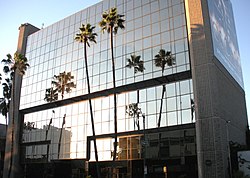
The Academy acquired property at 8949 Wilshire Boulevard in Beverly Hills in 1972, and built its current headquarters building on the site; the new facilities opened in 1975.[15]
In 2009, the inaugural Governors Awards were held, at which the Academy presents the Academy Honorary Award, the Jean Hersholt Humanitarian Award and the Irving G. Thalberg Memorial Award.
In 2016, the Academy became the target of criticism for its failure to recognize the achievements of minority professionals. For the second year in a row, all 20 nominees in the major acting categories were white. The president of the Academy, Cheryl Boone Isaacs,[29] the first African American and third woman to lead the Academy,[30] denied in 2015 that there was a problem. When asked if the Academy had difficulty with recognizing diversity, she replied "Not at all. Not at all."[31] When the nominations for acting were all white for a second year in a row Gil Robertson IV, president of the African American Film Critics Association called it "offensive."[citation needed] The actors' branch is "overwhelmingly white" and the question is raised whether conscious or unconscious racial biases played a role.[32]
Spike Lee, interviewed shortly after the all-white nominee list was published, pointed to Hollywood leadership as the root problem, "We may win an Oscar now and then, but an Oscar is not going to fundamentally change how Hollywood does business. I'm not talking about Hollywood stars. I'm talking about executives. We're not in the room."[33] Boone Isaacs also released a statement, in which she said "I am both heartbroken and frustrated about the lack of inclusion. This is a difficult but important conversation, and it's time for big changes."[34] After Boone Isaac's statement, prominent African-Americans such as director Spike Lee, actors Will Smith and Jada Pinkett Smith, and activist Rev. Al Sharpton called for a boycott of the 2016 Oscars for failing to recognize minority achievements, the board voted to make "historic" changes to its membership.[clarification needed] The Academy stated that by 2020 it would double its number of women and minority members.[35] While the Academy has addressed a higher profile for African-Americans, it has yet to raise the profile of other people of color artists, in front of and behind the camera.
In 2018, the Academy invited a record 928 new members.[36]
Casting director David Rubin was elected President of the Academy in August, 2019.[37]
In 2020, Parasite became the first non-English language film to win Best Picture.[38] In June 2022, Bill Kramer was named the CEO of the Academy.[39] Also in 2022, Janet Yang was elected as the first Asian American President of the Academy.[40]
Galleries and theaters
[edit]The Academy's numerous and diverse operations are housed in three facilities in the Los Angeles area: the headquarters building in Beverly Hills, which was constructed specifically for the Academy, and two Centers for Motion Picture Study – one in Beverly Hills, the other in Hollywood – which were existing structures restored and transformed to contain the Academy's Library, Film Archive and other departments and programs.
Current
[edit]Academy Headquarters
[edit]The Academy Headquarters Building in Beverly Hills once housed two galleries that were open free to the public. The Grand Lobby Gallery and the Fourth Floor Gallery offered changing exhibits related to films, film-making and film personalities. These galleries were closed in preparation for the construction of the Academy Museum of Motion Pictures, which opened in 2021.
The building includes the Samuel Goldwyn Theater, which seats 1,012, and was designed to present films at maximum technical accuracy, with state-of-the-art projection equipment and sound system. The theater is busy year-round with the Academy's public programming, members-only screenings, movie premieres and other special activities (including the live television broadcast of the Academy Awards nominations announcement every January). The building once housed the Academy Little Theater, a 67-seat screening facility, but this was converted to additional office space in a building remodel.
Pickford Center for Motion Picture Study
[edit]
The Pickford Center for Motion Picture Study, located at 1313 Vine Street in Hollywood and named for legendary actress and Academy co-founder Mary Pickford, houses several Academy departments, including the Academy Film Archive, the Science and Technology Council, Student Academy Awards and Grants, and the Nicholl Fellowships in Screenwriting. The building, originally dedicated on August 18, 1948, is the oldest surviving structure in Hollywood that was designed specifically with television in mind. Additionally, it is the location of the Linwood Dunn Theater, which seats 286 people.
Fairbanks Center for Motion Picture Study
[edit]
The Fairbanks Center for Motion Picture Study is located at 333 S. La Cienega Boulevard in Beverly Hills and is named for legendary actor and Academy co-founder Douglas Fairbanks. It is home to the Academy's Margaret Herrick Library, a world-renowned, non-circulating reference and research collection devoted to the history and development of the motion picture as an art form and an industry. Established in 1928, the library is open to the public and used year-round by students, scholars, historians and industry professionals. The library is named for Margaret Herrick, the Academy's first librarian who also played a major role in the Academy's first televised broadcast, helping to turn the Oscar ceremony into a major annual televised event.[41]
The building itself was built in 1928, where it was originally built to be a water treatment plant for Beverly Hills. Its "bell tower" held water-purifying hardware.[42]
The Academy Museum of Motion Pictures
[edit]
The Academy Museum of Motion Pictures, the newest facility associated with the Academy, is the United States' first large-scale museum dedicated to the film industry. It opened to the public on September 30, 2021,[43] and it contains over 290,000 square feet (27,000 m2) of galleries, exhibition spaces, movie theaters, educational areas, and special event spaces.[44] The museum is located at 6067 Wilshire Boulevard at Fairfax Avenue in Los Angeles, in the historic May Company Building, now named the Saban Building.
Former
[edit]Academy Theater in New York
[edit]The Academy also had a New York City-based East Coast showcase theater, the Academy Theater at Lighthouse International. The 220-seat venue was redesigned in 2011 by renowned theater designer Theo Kalomirakis, including an extensive installation of new audio and visual equipment. The theater was in the East 59th Street headquarters of Lighthouse International, a non-profit vision loss organization.[45] In July 2015, it was announced that the Academy was forced to move out, due to Lighthouse International selling the property the theater was in.[46]
Membership
[edit]Academy membership is divided into 19 branches which represent different disciplines in motion pictures in addition to a separate category for artist representatives.[47] Members may not belong to more than one branch. Members whose work does not fall within one of the branches may belong to a group known as "Members at Large". Members at Large have all the privileges of branch membership except for representation on the Board. Associate members are those closely allied to the industry but not actively engaged in motion picture production. They are not represented on the Board and do not vote on Academy Awards. As of 2024[update], the Academy's confirmed membership is 10,894, comprising 9,905 voting members, 949 non-voting emeritus members, and 40 associate members. The largest Academy branch is the actors branch, which in 2024 stood at 1,258 members, or 12.7% of the total membership.[48]
Membership in the Academy comes only through an invitation from the Board of Governors. An individual may be recommended to the board by two current members in the branch they would prospectively join, and anyone who is nominated for an Oscar is considered for membership by special committees of the various branches.[47] Each spring, the Board will meet to consider who to extend invitations to, and new invitees are announced in a press release.[47] Once accepted, membership does not expire.[49]
In 2012, the Los Angeles Times, sampling over 5,000 of the Academy's then-5,765 members, found that membership at the time was 94% white, 77% male, 86% age 50 or older, and had a median age of 62. A third of members were previous winners or nominees of Academy Awards themselves. On June 29, 2016, a paradigm shift began in the Academy's selection process, resulting in a new class comprising 46% women and 41% people of color.[50] The effort to diversify the Academy was led by social activist and Broadway Black managing-editor April Reign.[51] Reign created the Twitter hashtag #OscarsSoWhite as a means of criticizing the dearth of non-white nominees for the 2015 Academy Awards. Though the hashtag drew widespread media attention, the Academy remained obstinate on the matter of adopting a resolution that would make demonstrable its efforts to increase diversity. With the 2016 Academy Awards, many, including April Reign, were dismayed by the Academy's indifference about representation and inclusion, as the 2016 nominees were once again entirely white. April Reign revived #OscarsSoWhite, and renewed her campaign efforts, which included multiple media appearances and interviews with reputable news outlets. As a result of Reign's campaign, the discourse surrounding representation and recognition in film spread beyond the United States and became a global discussion [citation needed]. Faced with mounting pressure to expand the Academy membership, the Academy capitulated and instituted new policies to ensure that future Academy membership invitations would better represent the demographics of modern film-going audiences.[52] The A2020 initiative was announced in January 2016 to double the number of women and people of color in membership by 2020[citation needed]. As of 2020[update], 25 of the Academy's 54 members of the Board of Governors are female.[53]
The Samuel Goldwyn Theater in Beverly Hills, California, screens many new films for Academy members.[54] Since 2021, films in contention for awards are made available to members through a designated streaming app, replacing physical screeners.[55]
Expulsions
[edit]Five people are known to have been expelled from the Academy. Academy officials acknowledge that other members have been expelled in the past, most for selling their Oscar tickets, but no numbers are available.[56]
- February 3, 2004 – Actor Carmine Caridi was expelled for copyright infringement. He was accused of leaking screeners that had been sent to him.[57][58]
- October 13, 2017 – Producer Harvey Weinstein was expelled for "sexually predatory behavior and workplace harassment" after an emergency meeting held on October 13, 2017.[59][60]
- May 1, 2018 – Actor Bill Cosby and director Roman Polanski were expelled "in accordance with the organization's Standards of Conduct".[61] Cosby had been convicted of sexual assault one week earlier, while Polanski had been convicted in 1977 of unlawful sexual intercourse with a minor.
- March 17, 2021 – Cinematographer Adam Kimmel was expelled in 2021 after a Variety story exposed the fact that he is a registered sex offender.[62]
Resignations
[edit]The following members have voluntarily resigned from the organization:
- Sound engineer Tom Fleischman resigned from the Academy on March 5, 2022, citing changes to the broadcast of the 94th Academy Awards ceremony, during which eight award categories – including Best Sound – were not presented live, but rather during the commercial breaks.[63][64] Production sound mixer Peter Kurland also resigned his membership on March 23, 2022, citing the changes.[65]
- Actor Will Smith announced his resignation from the Academy on April 1, 2022, five days after his onstage slap of Chris Rock, one of the ceremony's presenters, during the 94th Academy Awards.[66]
Branches
[edit]The branches of the Academy are:
- Actors
- Animation (created from former Short Films and Feature Animation Branch)[67]
- Casting Directors[68]
- Cinematographers
- Costume Designers (created from former Art Directors Branch)[69]
- Directors
- Documentary
- Executives
- Film Editors
- Makeup Artists and Hairstylists
- Marketing and Public Relations
- Music
- Producers
- Production and Technology[70]
- Production Design (created from former Art Directors Branch)[69]
- Short Films (created from former Short Films and Feature Animation Branch)[67]
- Sound
- Visual Effects
- Writers
Board of governors
[edit]As of April 2020[update], the board of governors consists of 57 governors: three governors from each of the 19 Academy branches and three governors-at-large. The Makeup Artists and Hairstylists Branch, created in 2006, had only one governor until July 2013.[69] The Casting Directors Branch, created in 2013, elected its first three governors in Fall 2013.[68] The board of governors is responsible for corporate management, control, and general policies. The board of governors also appoints a CEO and a COO to supervise the administrative activities of the Academy.
Original 36 founders
[edit]From the original formal banquet, which was hosted by Louis B. Mayer in 1927, everyone invited became a founder of the Academy:[71]
|
|
|
Presidents
[edit]Presidents are elected for one-year terms and may not be elected for more than four consecutive terms.
| # | Name | Term |
|---|---|---|
| 1 | Douglas Fairbanks | 1927–1929 |
| 2 | William C. DeMille | 1929–1931 |
| 3 | M. C. Levee | 1931–1932 |
| 4 | Conrad Nagel | 1932–1933 |
| 5 | J. Theodore Reed | 1933–1934 |
| 6 | Frank Lloyd | 1934–1935 |
| 7 | Frank Capra | 1935–1939 |
| 8 | Walter Wanger (1st time) | 1939–1941 |
| 9 | Bette Davis | 1941 (resigned after two months) |
| 10 | Walter Wanger (2nd time) | 1941–1945 |
| 11 | Jean Hersholt | 1945–1949 |
| 12 | Charles Brackett | 1949–1955 |
| 13 | George Seaton | 1955–1958 |
| 14 | George Stevens | 1958–1959 |
| 15 | B. B. Kahane | 1959–1960 (died) |
| 16 | Valentine Davies | 1960–1961 (died) |
| 17 | Wendell Corey | 1961–1963 |
| 18 | Arthur Freed | 1963–1967 |
| 19 | Gregory Peck | 1967–1970 |
| 20 | Daniel Taradash | 1970–1973 |
| 21 | Walter Mirisch | 1973–1977 |
| 22 | Howard W. Koch | 1977–1979 |
| 23 | Fay Kanin | 1979–1983 |
| 24 | Gene Allen | 1983–1985 |
| 25 | Robert Wise | 1985–1988 |
| 26 | Richard Kahn | 1988–1989 |
| 27 | Karl Malden | 1989–1992 |
| 28 | Robert Rehme (1st time) | 1992–1993 |
| 29 | Arthur Hiller | 1993–1997 |
| 30 | Robert Rehme (2nd time) | 1997–2001 |
| 31 | Frank Pierson | 2001–2005 |
| 32 | Sid Ganis | 2005–2009 |
| 33 | Tom Sherak | 2009–2012 |
| 34 | Hawk Koch | 2012–2013 |
| 35 | Cheryl Boone Isaacs | 2013–2017 |
| 36 | John Bailey | 2017–2019 |
| 37 | David Rubin | 2019–2022 |
| 38 | Janet Yang | 2022–2025 |
| 39 | Lynette Howell Taylor | 2025–present |
Source: "Academy Story". Academy of Motion Picture Arts and Sciences. Archived from the original on April 1, 2015. Retrieved January 9, 2018.
Current administration
[edit]- Academy officers[72]
- President – Lynette Howell Taylor
- Vice President / Secretary – Howard A. Rodman
- Vice President / Treasurer – Simon Kilmurry
- Vice President – Lesley Barber
- Vice President – Jennifer Fox
- Vice President – Lou Diamond Phillips
- Chief Executive Officer – Bill Kramer
- Governors[72]
- Actors Branch – Marlee Matlin, Lou Diamond Phillips, Rita Wilson
- Animation Branch – Jinko Gotoh, Marlon West
- Casting Directors Branch – Richard Hicks, Kim Taylor-Coleman, Debra Zane
- Cinematographers Branch – Dion Beebe, Paul Cameron, Ellen Kuras
- Costume Designers Branch – Eduardo Castro, Isis Mussenden, Daniel Orlandi
- Directors Branch – Patricia Cardoso, Ava DuVernay, Jason Reitman
- Documentary Branch – Chris Hegedus, Simon Kilmurry, Jean Tsien
- Executives Branch – Pam Abdy, Peter Kujawski, Hannah Minghella
- Film Editors Branch – Nancy Richardson, Stephen E. Rivkin, Terilyn A. Shropshire
- Makeup Artists and Hairstylists Branch – Linda Flowers, Gerald Quist, Gigi Williams
- Marketing and Public Relations Branch – David Dinerstein, Laura C. Kim, Christina Kounelias
- Music Branch – Lesley Barber, Carter Burwell, Richard Gibbs
- Producers Branch – Jason Blum, Jennifer Fox, Lynette Howell Taylor
- Production and Technology Branch – Wendy Aylsworth
- Production Design Branch – K. K. Barrett, Kalina Ivanov, Missy Parker
- Short Films Branch – Chris Tashima
- Sound Branch – Peter J. Devlin, Andy Nelson, Mark Stoeckinger
- Visual Effects Branch – Rob Bredow, Brooke Breton, Andrew Roberts
- Writers Branch – Larry Karaszewski, Howard A. Rodman, Dana Stevens
- Governors-at-large (nominated by the President and elected by the board) – Haifaa al-Mansour, Effie T. Brown, Annie Chang
See also
[edit]

References
[edit]- ^ "Academy Of Motion Picture Arts And Sciences". Tax Exempt Organization Search. Internal Revenue Service. Retrieved March 30, 2022.
- ^ a b c d e f g "Form 990: Return of Organization Exempt from Income Tax". Archived March 31, 2022, at the Wayback Machine. Academy of Motion Picture Arts and Sciences. Internal Revenue Service. June 30, 2019.
- ^ "Academy Story, 2010–2019 Archived March 31, 2022, at the Wayback Machine". Academy of Motion Picture Arts and Sciences. Retrieved March 30, 2022.
- ^ ^ Pond, Steve (February 19, 2013). "AMPAS Drops '85th Academy Awards' – Now It's Just 'The Oscars'" Archived February 22, 2013, at the Wayback Machine. The Wrap. Retrieved February 22, 2013.
- ^ "Museum". oscars.org. June 15, 2020. Archived from the original on August 12, 2017. Retrieved August 12, 2017.
- ^ Cieply, Michael (February 15, 2017). "Delayed Again, The Academy Movie Museum Tip-Toes Into 2019". Deadline Hollywood. Archived from the original on July 9, 2020. Retrieved April 17, 2020.
- ^ It all started when the original Hollywood mogul wanted to build a beach house Archived May 3, 2020, at the Wayback Machine David Thomson, Vanity Fair, February 21, 2014
- ^ a b c d Scott, Allen J. (2005). On Hollywood: The Place, the Industry. Princeton: Princeton University Press. p. 119. ISBN 9780691116839. Retrieved October 8, 2023.
- ^ a b Wiley, Mason, and Damien Bona. Inside Oscar. New York: Ballantine Books, 1986 pg. 2
- ^ Levy, Emanuel. And The Winner Is.... New York: Ungar Publishing, 1987 pg. 1
- ^ a b Osborne, Robert. 60 Years of The Oscar. Abbeville Press, 1989. Page 8.
- ^ a b "History of the Academy: How It Began". Oscars.org. Archived from the original on June 5, 2011.
- ^ Osborne, Robert. 60 Years of The Oscar. Abbeville Press, 1989. Page 9.
- ^ a b c Osborne, Robert. 60 Years of The Oscar. Abbeville Press, 1989. Page 10.
- ^ a b c d e f g h "History of the Academy". Oscar.org. Archived from the original on June 5, 2011.
- ^ Osborne, Robert. 60 Years of The Oscar. Abbeville Press, 1989. Page 15.
- ^ Wiley, Mason, and Damien Bona. Inside Oscar. New York: Ballantine Books, 1986 pg. 3
- ^ Academy of Motion Picture Arts and Sciences; American Society of Cinematographers; Association of Motion Picture Producers (July 1928). "Incandescent Illumination". Academy Reports. 1 (1). Hollywood, CA: Academy of Motion Picture Arts and Sciences. Archived from the original on May 21, 2021. Retrieved May 21, 2021.
Transactions, enquiries, demonstrations, tests, etc., on the subject of incandescent illumination as applied to motion picture production / conducted by the Academy of Motion Picture Arts and Sciences, in co-operation with American Society of Cinematographers and Association of Motion Picture Producers, during the months of January, February, March and April, 1928.
- ^ Academy of Motion Picture Arts and Sciences (1931). Cowan, Lester (ed.). Recording Sound for Motion Pictures. New York: McGraw-Hill Book Company. Archived from the original on May 21, 2021. Retrieved May 21, 2021.
(free) A compilation of lectures on sound sponsored by the Academy of Motion Picture Arts and Sciences, held from September 17, 1929 through December 16, 1929.
- ^ Academy of Motion Picture Arts and Sciences Research Council (1938). Motion Picture Sound Engineering. New York: D. Van Nostrand Company, Incorporated. Archived from the original on May 21, 2021. Retrieved May 21, 2021.
(free) A Series of Lectures Presented to the Classes Enrolled in the Courses in Sound Engineering Given by the Research Council of the Academy of Motion Picture Arts and Sciences, Hollywood, California, in the fall of 1936 and spring of 1937.
- ^ "Technical Publications". Oscars.org. Academy of Motion Picture Arts and Sciences. June 23, 2015. Archived from the original on May 21, 2021. Retrieved May 21, 2021.
- ^ Cieply, Michael (March 30, 2020). "If History Asserts Itself, Hollywood And Its Film Academy Will Rise To The Coronavirus Fight". Deadline. Archived from the original on May 22, 2021. Retrieved May 22, 2021.
The organ through which the Academy mobilized was its Research Council, a collection of production executives chaired by Darryl F. Zanuck. Its main contribution was to offer Washington instant access to the studios' filmmaking apparatus. Zanuck explained in a note to the report: "Through the Research Council, the entire vast production facilities and creative talent of the American film industry has been made available to the War Department entirely on a non-profit basis." There were to be no charges for overhead, equipment, stage space or other facilities.
- ^ "Assignment schedule, advanced course in motion picture production for Signal Corps officers, United States Army". Academy History Archive. Academy of Motion Picture Arts and Sciences. 1940. Archived from the original on May 21, 2021. Retrieved May 21, 2021.
Syllabus for a 39-week course covering all aspects of filmmaking, including equipment operation and maintenance, laboratory work, story development, directing, sound recording and film editing; 9 pages.
- ^ Brackett, Charmain Z. (March 8, 2010). "Oscars at home in Signal Museum". army.mil. Archived from the original on May 21, 2021. Retrieved May 21, 2021.
Darryl Zanuck, who headed 20th Century Fox and received the Academy of Motion Picture Arts and Sciences Irving Thalberg Memorial Award, was a colonel in the Signal Corps during World War II. Also in the Signal Corps during World War II was Oscar winning director Frank Capra, and Theodor Seuss Geisel, better known as Dr. Seuss. The efforts of these and others who served in Astoria, N.Y. with the 834th Signal Service Photographic Detachment at the Signal Corps Photographic Center produced military training films as well as Academy Award winning documentaries after the war, according to Signal Corps Museum director Robert Anzuoni.
- ^ "Oscar Winners". Army Pictorial Center. June 10, 2019. Archived from the original on May 21, 2021. Retrieved May 21, 2021.
- ^ Staff. "USC School of Cinematic Arts: History". cinema.usc.edu. Archived from the original on October 22, 2009. Retrieved February 9, 2014.
- ^ Osborne, Robert. 60 Years of The Oscar. Abbeville Press, 1989. Page 12.
- ^ "Motion Picture Credits Database". Oscars.org. Archived from the original on October 1, 2014. Retrieved January 18, 2014.
- ^ "board of governors". Academy of Motion Picture Arts and Sciences. February 1, 2016. Archived from the original on February 1, 2016. Retrieved February 1, 2016.
- ^ "Cheryl Boone Isaacs elected first African-American head of Oscars". Goldderby.com. July 31, 2013. Archived from the original on August 4, 2013. Retrieved August 2, 2013.
- ^ Academy Awards President Cheryl Boone Isaacs Responds After 'Oscars So White' Snubs On Twitter Archived January 31, 2016, at the Wayback Machine Tyler McCarthy, international Business Times, January 17, 2015
- ^ Oscar nominations uproar raises the question: Did racial bias, conscious or not, come into play? Archived July 10, 2020, at the Wayback Machine The LA Times, January 23, 2016
- ^ Another Oscar Year, Another All-White Ballot Archived February 28, 2017, at the Wayback Machine Cara B Buckley, The New York Times, January 15, 2016
- ^ Boone, Cheryl; Isaacs (January 18, 2016). "STATEMENT FROM ACADEMY PRESIDENT CHERYL BOONE ISAACS". Oscars.org. Academy of Motion Picture Arts and Sciences. Archived from the original on January 26, 2016. Retrieved January 29, 2016.
- ^ Academy Promises 'Historic' Changes to Diversify Membership Archived February 26, 2016, at the Wayback Machine Daniel Kreps, RollingStone, Jan 23, 2016
- ^ Kilday, Gregg (June 25, 2018). "Academy Invites Record 928 New Members". The Hollywood Reporter. Archived from the original on August 31, 2021. Retrieved December 9, 2021.
- ^ Oldham, Stuart (August 6, 2019). "David Rubin Elected President of the Motion Picture Academy". Variety. Archived from the original on August 7, 2019. Retrieved August 7, 2019.
- ^ "'Parasite' Earns Best-Picture Oscar, First for a Movie Not in English". The New York Times. February 9, 2020. Archived from the original on March 17, 2020. Retrieved April 23, 2020.
- ^ "Oscars organization names Bill Kramer as new CEO". ABC News. Archived from the original on June 8, 2022. Retrieved June 8, 2022.
- ^ "Film Producer Janet Yang Elected First Asian American President Of The Academy". HuffPost. August 3, 2022. Archived from the original on August 3, 2022. Retrieved August 3, 2022.
- ^ "About the Library". Oscars.org. AMPAS. July 30, 2014. Archived from the original on February 1, 2016. Retrieved January 29, 2016.
- ^ "The Beverly Hills Waterworks Building, now known as the Fairbanks Center for Motion Picture Study". Los Angeles Times. Archived from the original on September 9, 2014. Retrieved January 29, 2016.
- ^ "Visit". www.academymuseum.org. Archived from the original on October 26, 2021. Retrieved April 22, 2020.
- ^ The Academy Museum Archived August 20, 2013, at the Wayback Machine. Oscars.org. Retrieved on May 22, 2014.
- ^ Lester, Ahren. "HARMAN's JBL loudspeakers installed at New York's Academy Theater". Audio Pro International. Archived from the original on June 26, 2013. Retrieved February 18, 2012.
- ^ Feinberg, Scott (July 10, 2015). "Academy Forced Out of Longtime Theater Venue in New York". The Hollywood Reporter. Archived from the original on February 7, 2016. Retrieved January 29, 2016.
- ^ a b c "Academy Membership". Retrieved February 13, 2025.
- ^ Pond, Steve (December 12, 2024). "How Many Votes Will It Take to Get an Oscar Nomination in 2025?". TheWrap. Retrieved December 17, 2024.
- ^ "Oscar voters aren't always who you might think". Los Angeles Times. February 19, 2012. Archived from the original on February 26, 2012. Retrieved February 26, 2012.
- ^ "Academy's diverse new class includes Idris Elba, America Ferrera". USA Today. June 29, 2016. Archived from the original on June 30, 2017. Retrieved August 23, 2017.
- ^ "Meet April Reign, the Activist Who Created OscarsSoWhite". HuffPost. February 27, 2016. Archived from the original on March 5, 2019. Retrieved April 17, 2020.
- ^ "Updates on the film academy's 2016 class: An exclusive club gets much bigger after OscarsSoWhite". L.A. Times. June 29, 2016. Archived from the original on July 8, 2020. Retrieved April 17, 2020.
- ^ "Board of Governors". oscars.org. September 2014. Archived from the original on April 23, 2020. Retrieved April 22, 2020.
- ^ Hammond, Pete (March 26, 2012). "Oscar Voters Last To See 'Hunger Games'?". Deadline Hollywood. Archived from the original on March 28, 2012. Retrieved March 26, 2012.
- ^ Hammond, Pete (April 28, 2020). "Oscars Keeping Show Date But Make Big News As Academy Lightens Eligibility Rules, Combines Sound Categories, Ends DVD Screeners and More". Deadline Hollywood. Retrieved December 16, 2024.
- ^ Day, Patrick (February 27, 2004). "The academy: Neither a secret, nor a society". chicagotribune.com. Chicago Tribune. Archived from the original on April 1, 2022. Retrieved March 31, 2022.
- ^ "The Godfather Actor Carmine Caridi Says He Was Thrown Out of the Academy for Sharing VHS Screeners". PEOPLE.com. February 22, 2017. Archived from the original on October 15, 2017. Retrieved October 15, 2017.
- ^ "An Actor's Personal Tale: I Was Thrown Out of the Academy for Sharing VHS Screeners". The Hollywood Reporter. Archived from the original on March 25, 2019. Retrieved October 15, 2017.
- ^ Barnes, Brooks (October 14, 2017). "Harvey Weinstein Ousted From Motion Picture Academy". The New York Times. ISSN 0362-4331. Archived from the original on October 15, 2017. Retrieved October 15, 2017.
- ^ Lartey, Jamiles; London, Edward Helmore David Batty in (October 14, 2017). "Harvey Weinstein expelled from Academy over sexual assault allegations". The Guardian. ISSN 0261-3077. Archived from the original on October 15, 2017. Retrieved October 15, 2017.
- ^ "Film Academy Expels Roman Polanski and Bill Cosby". May 3, 2018. Archived from the original on April 7, 2019. Retrieved February 25, 2019.
- ^ Aurthur, Kate (March 17, 2021). "Academy Expels Registered Sex Offender Adam Kimmel After Variety Investigation (EXCLUSIVE)". Archived from the original on March 17, 2021. Retrieved March 17, 2021.
- ^ Giardina, Carolyn (March 5, 2022). "Oscar Winner Tom Fleischman Resigns From Motion Picture Academy Over Controversial Telecast Plans (Exclusive)". The Hollywood Reporter. Archived from the original on April 3, 2022. Retrieved April 1, 2022.
- ^ Haring, Bruce (March 5, 2022). "Oscar-Winning Sound Mixer Tom Fleischman Resigns From AMPAS Over Its Televised Category Plans". Deadline. Archived from the original on March 26, 2022. Retrieved April 1, 2022.
- ^ Giardina, Carolyn (March 23, 2022). "Academy Member Peter Kurland to Resign Over Oscars Telecast Controversy (Exclusive)". The Hollywood Reporter. Archived from the original on April 4, 2022. Retrieved April 1, 2022.
- ^ Stelter, Brian (April 3, 2022). "Will Smith resigns from the Academy". CNN. Archived from the original on April 4, 2022. Retrieved April 5, 2022.
- ^ a b "Academy to Create Two Individual Branches From Short Films and Feature Animation Branch: Animation Branch and Short Films Branch". Academy of Motion Picture Arts and Sciences. February 26, 2024. Retrieved March 30, 2024.
- ^ a b "The Academy Creates Branch For Casting Directors". Academy of Motion Picture Arts and Sciences. July 31, 2013. Archived from the original on August 4, 2013. Retrieved August 2, 2013.
- ^ a b c "Oscars shockeroo: Alex Gibney beats incumbent Michael Moore for board seat". Goldderby.com. July 15, 2013. Archived from the original on August 21, 2013. Retrieved August 2, 2013.
- ^ "Academy Establishes New Production and Technology Branch". Academy of Motion Picture Arts and Sciences. Retrieved November 28, 2023.
- ^ "History of the Academy: Original 36 founders of the Academy Actors". Academy of Motion Picture Arts and Sciences website. 2008. Archived from the original on June 16, 2017. Retrieved July 20, 2013.
- ^ a b "Board of Governors". Oscars.org | Academy of Motion Picture Arts and Sciences. July 31, 2025. Retrieved July 31, 2025.
External links
[edit] Media related to Academy of Motion Picture Arts and Sciences at Wikimedia Commons
- Official website
- Academy of Motion Picture Arts and Sciences on Twitter
- Academy of Motion Picture Arts and Sciences's channel on YouTube
- Hollywood is a Union Town, The Nation (April 2, 1938) History of the Academy and Screen Actors Guild

Academy of Motion Picture Arts and Sciences
View on GrokipediaHistory
Founding and Original Purpose (1927)
The Academy of Motion Picture Arts and Sciences was established in 1927 as an honorary professional organization comprising 36 founding members from key sectors of the film industry, including producers, directors, actors, writers, and technicians. Louis B. Mayer, head of Metro-Goldwyn-Mayer, conceived the idea in response to rising labor tensions in Hollywood, aiming to create a centralized body that could address disputes internally without resorting to independent unions.[5][6][7] The initiative was announced on January 11, 1927, with articles of incorporation filed on May 4 and Douglas Fairbanks elected as the first president on May 6.[5][8] The original purpose centered on fostering cooperation and harmony across film industry branches to preempt external regulation and unionization efforts, which studio executives viewed as threats to production control and costs. Mayer explicitly sought an entity to mediate labor issues, negotiate with government authorities, and elevate the industry's public image amid scandals and strikes, such as the 1926 set builders' walkout.[4][9][10] This approach positioned the Academy as a company-aligned alternative to organized labor, enabling direct dialogue between management and workers while maintaining studio authority.[11] Beyond labor mediation, the Academy was tasked with advancing technical standards, recognizing artistic achievements, and representing the motion picture profession professionally, reflecting Mayer's vision of self-regulation to sustain industry growth during the silent film era's transition to sound. Founding members like Mary Pickford, Conrad Nagel, and Fred Niblo contributed to its early structure, emphasizing ethical practices and collaborative problem-solving.[7][12] Over time, these foundational goals evolved, but the initial emphasis on internal dispute resolution distinguished it from purely celebratory bodies.[4]Inception of the Academy Awards (1929)
The inaugural Academy Awards were conceived in the wake of the Academy's founding banquet on January 11, 1927, where Louis B. Mayer, vice president of Metro-Goldwyn-Mayer, proposed recognizing exemplary work across filmmaking disciplines to elevate the industry's standards and cohesion.[13] Mayer, a key architect of the Academy, envisioned the awards as a mechanism to honor artistic and technical merits while addressing labor frictions; historical analyses indicate his strategy included linking prestige to compensation models, aiming to forestall unionization by establishing industry self-regulation over salaries for actors, directors, producers, technicians, and writers.[14] [15] This dual purpose—public acclaim alongside private stabilization—reflected the era's tensions, as studios sought to counter rising actor demands amid rapid industry growth.[16] Eligibility covered motion pictures released from August 1, 1927, to July 31, 1928, with nominations solicited via telegrams sent in late 1928 and submissions due by August 1928.[17] The Academy's Central Board of Judges finalized winners on February 15, 1929, announcing results to the press immediately thereafter to generate publicity, though the formal ceremony occurred three months later on May 16, 1929.[18] Held as a private banquet dinner in the Blossom Room of the Hollywood Roosevelt Hotel in Los Angeles, the event drew approximately 270 attendees from the film community, hosted by Academy president Douglas Fairbanks.[19] Twelve statuettes, designed by MGM art director Cedric Gibbons as a knight standing on a reel of film, were presented across categories including Outstanding Picture, Best Director, and Best Writing, with Wings receiving the top production honor and additional certificates issued for honorable mentions.[20] The modest, untelevised affair lasted about 15 minutes for awards, emphasizing merit over spectacle and setting a precedent for annual recognition that bolstered Hollywood's self-image during the transition from silent films.[21]Expansion During the Golden Age of Hollywood (1930s–1940s)
During the 1930s, the Academy of Motion Picture Arts and Sciences shifted its focus amid Hollywood's studio-era expansion, moving away from direct involvement in labor disputes toward promoting the technical and artistic advancement of filmmaking. In 1937, the organization restructured by disbanding its Conciliations Committee, which had handled employee grievances against studios since 1927, and withdrew from industry-wide negotiations to avoid perceptions of bias in an increasingly unionized environment.[22][23] This pivot emphasized educational and cultural initiatives, including film conservation and appreciation programs, aligning with the Academy's original charter while the motion picture industry produced over 400 feature films annually by the decade's end.[22] Membership grew steadily as the Golden Age studio system flourished, drawing in producers, directors, actors, writers, and technicians from major studios like MGM, Warner Bros., and Paramount, which controlled production, distribution, and exhibition. By the mid-1930s, the Academy's branches—spanning actors, directors, executives, producers, technicians, and writers—facilitated technical standardization efforts, such as adopting a uniform camera synchronizing system effective January 1, 1937, to enhance sound-film quality amid the transition from silent era holdovers.[24] The organization's library, established in 1928, expanded under librarian Margaret Herrick starting in the early 1930s, amassing scripts, clippings, and production records to support research and preserve industry history as film output surged.[25][26] In the 1940s, wartime demands accelerated institutional development, with the Academy contributing to propaganda and training films while maintaining its core functions. Headquarters relocated multiple times to accommodate growth, culminating in the 1946 acquisition of the Marquis Theatre at 9038 Melrose Avenue in West Hollywood as a dedicated space for operations. The Academy Awards ceremonies, held annually since 1929, gained prominence, with the 1940 event becoming the first to be filmed live, reflecting the organization's rising cultural influence amid box-office records set by hits like Gone with the Wind (1939). Scientific and technical awards, ongoing since the 1920s, recognized innovations in color processes and special effects, underscoring the Academy's role in fostering technological progress during a period when U.S. theaters numbered over 20,000.[27]Post-War Challenges and Institutional Growth (1950s–1970s)
The post-World War II era brought significant challenges to the American film industry, including a sharp decline in theater attendance from its 1946 peak of 4 billion admissions annually, exacerbated by the rise of television ownership, which reached 9% of U.S. households by 1950 and 87% by 1960, drawing audiences away from cinemas.[28] The 1948 Paramount Decree further dismantled the studio system's vertical integration, fostering independent production but reducing overall output and box-office revenues, with Hollywood studios facing competition from televised content and suburban migration.[28] The Academy of Motion Picture Arts and Sciences (AMPAS), reflecting these pressures, adapted by televising the 25th Academy Awards ceremony on March 19, 1953, marking the first live broadcast on NBC, which reached an estimated 10.5 million viewers despite initial resistance from some members wary of the medium's novelty.[29] This shift not only preserved the Oscars' prestige amid industry contraction but also positioned AMPAS as a bridge between film and emerging media, with subsequent broadcasts expanding to include radio simulcasts and contributing to the event's evolution into a major television spectacle.[30] By the 1960s, AMPAS grappled with internal stagnation, as its membership—primarily composed of industry veterans from the studio era—faced criticism for inactivity and disconnection from contemporary filmmaking trends, amid broader cultural shifts like the New Hollywood movement emphasizing youth-oriented narratives.[31] Under President Gregory Peck (1967–1970), the Academy initiated reforms to revitalize governance and participation, including revisions to invitation criteria to prioritize active professionals and culminating in 1970 with the redesignation of 335 long-term but inactive members as non-voting "associates," reducing the voting body from approximately 3,000 to a more engaged core.[32] These measures, announced in a letter to members, aimed to align the Academy with evolving industry dynamics, such as the rise of directors like Francis Ford Coppola, while maintaining eligibility standards tied to peer-reviewed achievements in 17 branches.[31] Peck's tenure emphasized institutional self-preservation, avoiding external political entanglements like those from the earlier Hollywood blacklist era. Institutional growth during this period manifested in expanded administrative scope and awards infrastructure, with the Academy introducing categories like Best Costume Design in 1948 (fully implemented post-war) and refining rules for foreign-language films starting in 1956 to reflect global cinema's ascent.[33] Membership invitations grew selectively to incorporate technicians and emerging talents, supporting AMPAS's role in industry standardization, such as through technical research committees that influenced widescreen formats like CinemaScope amid 1950s technological pivots against TV.[28] By the 1970s, under successors like Daniel Taradash (1970–1973), the Academy solidified its influence via increased educational outreach and archival efforts, laying groundwork for preservation initiatives while the Oscars' television format innovations—such as longer runtime and celebrity hosting—boosted viewership to over 50 million by 1974, enhancing AMPAS's cultural authority despite ongoing box-office volatility.[34]Modernization and Global Reach (1980s–2000s)
In the 1980s, the Academy Awards achieved greater global reach through expanded international television distribution. By 1984, broadcast rights had been licensed to 76 countries, up from 50 in 1970, with ABC providing satellite feeds to support live and delayed viewings worldwide.[35] This dissemination elevated the Oscars as a universal benchmark for cinematic excellence, attracting audiences beyond North America and reinforcing Hollywood's cultural export. The Academy modernized its preservation infrastructure during the late 1990s and early 2000s to address deteriorating film stocks and advancing restoration technologies. The Pickford Center for Motion Picture Study opened in 2002 on Vine Street in Hollywood, relocating the Academy Film Archive from its prior location and enabling expanded efforts in photochemical preservation, digital scanning, and public exhibition of historical films.[36] This facility, named after co-founder Mary Pickford, centralized resources for the Margaret Herrick Library and archive collections, supporting systematic safeguarding of over 1,100 titles by the 2010s through ongoing projects.[37] Under presidents including Robert Rehme, who served from 1997 to 2001, the Academy adapted to industry shifts like the proliferation of digital tools and international co-productions.[38] Rehme's tenure emphasized financial stability and educational outreach via the Academy Foundation, which he later led, funding scholarships and programs to nurture global talent pipelines.[39] These initiatives complemented the Oscars' evolving recognition of foreign-language films, with submissions to the category rising amid heightened worldwide submissions, though voting remained dominated by U.S.-based members.[40]Recent Reforms and Developments (2010s–Present)
In response to the #OscarsSoWhite social media campaign launched in 2015, which criticized the lack of racial diversity in acting nominations—all 20 acting nominees that year were white for the second consecutive year—the Academy's Board of Governors approved membership reforms on January 22, 2016.[41] These included inviting more women and individuals from underrepresented racial or ethnic groups to double their representation within two years, imposing 10-year term limits on voting membership (renewable once for active members), and granting lifetime voting rights only after three terms or an Oscar win/nomination.[41] The reforms also required new invitees to have worked within the previous 10 years in film-related roles. By 2020, people of color comprised 16% of active members, up from 8% in 2015, while women reached 49% from 27%.[42] These changes expanded the total membership to over 10,000 by diversifying its 17 branches, though critics noted persistent underrepresentation in nominations relative to membership gains.[43] To address eligibility for awards, the Academy established representation and inclusion standards on September 8, 2020, requiring Best Picture contenders starting with the 96th Oscars (2024) to meet at least two of four criteria: on-screen representation of underrepresented groups; significant roles for underrepresented creative leadership and department heads; paid apprenticeships or internships for underrepresented talent; or industry access initiatives like paid training programs.[44] Underrepresented groups were defined to include women, racial/ethnic minorities, LGBTQ+ individuals, disabled persons, and those from low-income backgrounds, with films submitting a confidential form for verification.[45] Of 321 Oscar-qualifying films in 2023, 265 met the standards for Best Picture eligibility.[46] The policy, part of the broader Academy Aperture 2025 equity plan announced June 12, 2020, aimed to promote systemic change in industry hiring but drew debate over whether it prioritized demographics over artistic merit.[47] [48] Experiments with award categories included the August 8, 2018, announcement of a new "Outstanding Achievement in Popular Film" category, intended to recognize blockbusters and boost viewership amid declining ratings, alongside shortening the telecast to three hours.[49] Facing backlash from members over potential dilution of Best Picture prestige and logistical confusion—such as whether winners could compete in both—the Board voted on September 5, 2018, to suspend its introduction indefinitely.[50] Voting procedures evolved with ranked-choice voting for Best Picture nominations, implemented since 2009 and expanded post-reforms to enhance proportionality; by 2025 estimates, it ensured at least 85% of voters saw a preferred nominee in five-candidate fields.[51] Leadership transitioned with Dawn Hudson serving as CEO from June 2011 to July 2022, overseeing diversity initiatives and the Academy Museum's September 2021 opening.[52] Bill Kramer, previously the museum's director and president, succeeded her on July 18, 2022, focusing on global outreach and technological integration.[53] In April 2025, the Board approved rules mandating members view all nominated films in a category to vote in the final round, addressing concerns over uninformed ballots, alongside AI guidelines prohibiting deepfakes in submissions and expanded voting for animated shorts.[54] Other advancements included entrusting the Academy Color Encoding System to the Academy Software Foundation on August 6, 2025, and investigating pyrotechnics and other technologies for potential awards.[55][56]Core Mission and Activities
Academy Awards Administration and Evolution
The Academy Awards, formally known as the Oscars, are administered by the Academy of Motion Picture Arts and Sciences through its Board of Governors, which provides oversight for the annual ceremony, rule-making, and eligibility determinations.[57] The process involves two main phases: nominations and final voting, conducted via secret ballot among the Academy's approximately 10,000 active and life members, divided into 19 branches representing disciplines such as acting, directing, and cinematography.[58][59] For most categories, nominations are selected by members of the relevant branch—for instance, actors nominate performers—while all members nominate Best Picture candidates.[60] Final winners, except in certain technical categories, are determined by a preferential ballot system open to all eligible voters, with Best Picture using ranked-choice voting to ensure a majority preference.[61][62] The awards' administration has evolved significantly since their inception on May 16, 1929, when the first ceremony honored films from August 1927 to July 1928, with winners pre-selected by a committee rather than voted upon.[33] By 1933, the Academy shifted eligibility to a calendar-year basis to align with industry cycles, and voting expanded to include broader member input, replacing the earlier producer-dominated selections.[33] Category expansions marked further changes: honorary awards preceded formal ones initially, but dedicated categories like Best Animated Feature were added in 2001, and Best Animated Short evolved from earlier short film recognitions.[33] Technical and craft awards, such as those for visual effects, originated in the 1930s and have periodically incorporated scientific and engineering merits, with separate ceremonies for some until consolidated.[33] In response to criticisms of underrepresentation, particularly following the 2015 #OscarsSoWhite campaign highlighting consecutive years of all-white acting nominees, the Academy implemented membership diversification efforts starting in 2016, inviting more women and people of color to increase branch inclusivity.[63] This culminated in 2020 with the adoption of Representation and Inclusion Standards for Best Picture eligibility, effective for the 96th Oscars in 2024, requiring films to meet at least two of four criteria, such as employing underrepresented groups in key roles or ensuring diverse executive leadership and marketing teams.[44][64] Additional reforms include a 2025 rule mandating voters to view all shortlisted films in a category before final ballots, aimed at informed decision-making, and the introduction of a Best Casting award starting in 2026 to recognize that discipline.[65][66] These changes reflect ongoing adaptations to industry shifts, viewer expectations, and legal eligibility rules, such as theatrical release requirements adjusted during the COVID-19 pandemic in 2021 to include streaming qualifiers.[33]Film Preservation, Education, and Research Initiatives
The Academy Film Archive, a core component of the Academy's collections, is dedicated to the preservation, restoration, documentation, exhibition, and study of motion pictures, maintaining over 250,000 items including prints of all Best Picture Oscar-winning films.[67] Established in 1991 as part of the Center for Motion Picture Study, the archive collects a diverse range of materials such as Academy Award-nominated films, annual Oscar telecasts, documentaries, and silent-era works, ensuring their long-term accessibility for research and public viewing.[68] In addition to analog preservation, the Academy addresses digital challenges through initiatives like the Academy Digital Preservation Forum, launched on November 18, 2021, which facilitates global collaboration on digital archiving strategies, case studies, educational activities, and university partnerships to combat obsolescence in motion picture storage.[69] The Digital Motion Picture Archive Framework Project further supports these efforts with multi-year investigations into sustainable access and preservation of digital cinema assets.[70] In education, the Academy funds programs to cultivate film scholarship and practical skills, including the Academy Film Scholars grants awarded to both academic and independent researchers for original works advancing film history and analysis.[71] The Teachers Guide Series provides resources for middle and high school educators to integrate the art and science of filmmaking into curricula, covering topics from production techniques to cinematic storytelling.[72] Targeted outreach includes FilmCraft grants, which back high-quality training for emerging filmmakers from underrepresented communities, and partnerships like Spark @ the Academy, offering apprenticeships to middle school students from underserved areas since 2013.[73][74] Broader initiatives such as Gold Rising provide participants with mentorship from Academy members and industry professionals to build career networks in motion pictures.[75] The Student Academy Awards annually recognize exemplary student films, fostering early talent development across narrative, documentary, and animation categories.[76] Research activities are spearheaded by the Science and Technology Council, which promotes advancements in cinematic technologies through industry-wide projects on imaging, color science, and data storage, often involving external experts.[77][78] Key outputs include the Academy Color Encoding System (ACES), an open-standard framework for device-independent color management adopted in professional workflows since its development in the early 2000s.[79] The Council also evaluates scientific achievements for awards, as seen in the 2021 recognition of 17 innovations spanning optics, software, and preservation tools, reflecting ongoing empirical assessments of technologies' impact on filmmaking.[80] These efforts integrate with preservation by prioritizing research into archival stability, such as digital format longevity, to sustain the Academy's role as a steward of motion picture heritage.[81]Publications, Scholarships, and Industry Support
The Academy supports scholarly publications in film history and theory through the Academy Film Scholars program, which awards two $25,000 grants annually to academically affiliated or independent scholars for significant new works, often resulting in books or articles.[71] These grants prioritize original research over previously funded projects, with recipients selected by a committee of Academy members and historians.[71] The Academy Foundation, the organization's philanthropic arm, facilitates additional publications indirectly via grants to nonprofits and educational institutions for film-related research and archival projects, including digitization of historical materials like periodicals and pamphlets held in the Margaret Herrick Library.[82] The library's digital collections encompass over 3,000 periodical titles spanning filmmaking from the early 20th century onward, made accessible online to support academic and industry reference.[83] In scholarships and fellowships, the Nicholl Fellowships in Screenwriting provide up to five $35,000 awards each year to emerging amateur screenwriters, selected from submissions vetted through university programs, screenwriting labs, and platforms like the Black List, with mentorship from Academy members.[84] The program, established in 1986, has supported over 150 fellows, many of whom advanced to produced works.[85] The Student Academy Awards recognize student filmmakers globally across animation, documentary, live action narrative, and alternative/experimental categories, offering gold ($5,000), silver ($3,000), and bronze ($2,000) prizes, with winners honored at an annual ceremony; past recipients include directors like Pete Docter and Spike Lee, whose films garnered 69 Oscar nominations and 15 wins.[86] For industry support, the Academy Foundation distributes grants totaling millions annually to film schools, festivals, and organizations, funding educational initiatives, equipment, and screenings to promote access and diversity in filmmaking.[87] Examples include $5,000–$20,000 awards to film festivals for curated programs and FilmCraft grants—currently on hold—for hands-on training of filmmakers from nontraditional backgrounds.[88][73] Programs like Gold Rising provide emerging professionals with networking, internships, and access to Academy members and industry leaders to foster career development.[75] These efforts, administered since the Foundation's inception, aim to bridge opportunity gaps without restricting to specific demographics, though recent allocations have emphasized underrepresented groups.[89]Organizational Governance
Membership Eligibility, Branches, and Composition
Membership in the Academy of Motion Picture Arts and Sciences is restricted to individuals who have demonstrated exceptional achievements in the production of theatrically released motion pictures, excluding those primarily involved in television, streaming-only content, or non-film media.[90] Candidates for active membership must be sponsored by two current members of the relevant branch and undergo review by that branch's executive committee, which assesses eligibility based on specific criteria such as credited work, years of experience, and contributions to the field; approval then requires a vote by the Academy's Board of Governors.[91] Academy Award winners and nominees receive preferential consideration, often qualifying automatically for sponsorship review in their branch.[92] The process emphasizes professional accomplishments over self-nomination, with invitations extended annually in spring following a deadline for submissions, such as September 29, 2025, at 5:00 p.m. PT.[90] The Academy organizes its membership into 19 branches, each representing a distinct craft or discipline in filmmaking, alongside a separate category for artist representatives.[90] These branches include Actors, Animation, Casting Directors, Cinematographers, Costume Designers, Directors, Documentary, Executives, Film Editors, Makeup Artists and Hairstylists, Marketing and Public Relations, Music, Producers, Production and Technology, Production Design, Short Films, Sound, Visual Effects, and Writers; artist representatives encompass agents, managers, and entertainment lawyers supporting Academy members.[91] Eligibility varies by branch—for instance, the Directors branch requires at least two directorial credits on theatrical features, one within the past decade, while the Cinematographers branch demands two credits as director of photography on qualifying films.[91] Branches like Documentary and Animation tier contributions based on roles (e.g., director/producer vs. editor) and recency, ensuring focus on high-caliber theatrical output.[91] This structure maintains specialization, with members voting exclusively in their branch for most Academy Awards categories, except Best Picture, which involves all eligible voters.[90] As of September 2025, the Academy comprises approximately 11,104 members, including over 10,143 active voting members, following the invitation of 534 new members in June 2025 from 60 countries.[93][94] The Actors branch forms the largest contingent, exceeding 1,300 members, reflecting its prominence in the organization.[93] Membership includes active professionals who retain voting rights, emeritus members who transition to non-voting status upon retirement after age 80 or 30 years of service, and associate members without voting privileges.[90] The composition prioritizes expertise in theatrical cinema, with recent invitations targeting 41% women, 45% from underrepresented communities, and 55% international, though overall demographics remain dominated by established industry veterans.[95]Board of Governors and Decision-Making Processes
The Board of Governors of the Academy of Motion Picture Arts and Sciences comprises 55 members, with representatives elected from each of the organization's 17 branches to ensure coverage across disciplines such as acting, directing, production, and technical crafts. Most branches elect three governors, while exceptions include the Animation Branch (two governors) and the Short Films and Feature Animation Branch (one governor). In addition to branch-elected governors, the Board includes a small number of governors-at-large, nominated by the Academy President and approved by majority vote of the sitting Board.[57][96] Governors are elected through branch-specific voting processes, with elections typically held annually to fill expiring terms; each serves a three-year term and may be reelected for up to two additional consecutive terms before a mandatory hiatus. Board members convene for six to eight meetings per year, conducted in person or via video conference, and each governor is required to serve on at least one standing committee, such as those addressing awards, finance, membership, or preservation. These meetings facilitate deliberation on strategic matters, with decisions made by majority vote; proxy voting is prohibited under the Academy's bylaws, emphasizing direct participation.[97][98] The Board's primary responsibilities include corporate oversight, fiduciary stewardship of the Academy's finances, and alignment with its mission to advance motion picture arts. As a nonprofit, the Academy's funding derives primarily from membership dues (approximately $2 million annually), revenue from licensing the Academy Awards broadcast rights primarily to Disney/ABC (contributing about 70% of its operating budget of around $170 million), returns on investments from its endowment, and philanthropic donations, such as the $50 million gift from Haim and Cheryl Saban for the Academy Museum as part of broader global fundraising campaigns.[99][100][101] It approves the annual budget as proposed by the CEO, who manages over 700 staff members, and sets policies governing membership invitations, ethical standards, and operational protocols. The Board also appoints the CEO and Chief Operating Officer, while electing the President and other officers from its ranks to lead executive functions. In relation to the Academy Awards, the Board holds authority to revise rules on eligibility, nomination procedures, and final voting—such as restricting acting category ballots to active and lifetime members or implementing campaign regulations to curb promotional excesses—ensuring these align with artistic and technical merit criteria.[57][102][103] For disciplinary actions, the Board exercises sole power to suspend or expel members for violations of conduct standards, requiring an affirmative vote after due process review. This structure positions the Board as the apex decision-making body, balancing branch representation with centralized control to address evolving industry challenges, though critics have noted potential insularity in its predominantly industry-insider composition.[98][104]Presidents, Founders, and Leadership Transitions
The Academy of Motion Picture Arts and Sciences was established on May 11, 1927, primarily through the efforts of Metro-Goldwyn-Mayer studio head Louis B. Mayer, who conceived the organization as a means to mediate labor disputes in Hollywood and promote industry self-regulation via an awards system.[105] An initial banquet on January 11, 1927, selected the 36 founding members from various film crafts, including actors like Douglas Fairbanks and Mary Pickford, directors such as Cecil B. DeMille, producers like Mayer and Joseph M. Schenck, and technicians including Cedric Gibbons.[106] These founders represented the major branches—actors, directors, producers, technicians, and writers—aiming to create a professional body that elevated motion pictures as an art form while addressing practical guild tensions.[12] Douglas Fairbanks, a co-founder and prominent actor, was elected as the inaugural president, serving from 1927 to 1929 and overseeing the first Academy Awards ceremony on May 16, 1929.[107] Early leadership featured frequent transitions with short terms, often one to three years, reflecting the Academy's evolving governance amid rapid industry growth; successors included William C. deMille (1929–1931), M.C. Levee (1931–1932), Conrad Nagel (1932–1933), Theodore Reed (1933–1934), and Frank Lloyd (1934–1935).[107] Frank Capra's presidency from 1935 to 1938 marked a push for broader member involvement, while later figures like Walter Wanger (1939–1941) and Jean Hersholt (1945–1949) navigated World War II-era challenges, including wartime film production restrictions.[107]| President | Term |
|---|---|
| Douglas Fairbanks | 1927–1929 |
| William C. deMille | 1929–1931 |
| M.C. Levee | 1931–1932 |
| Conrad Nagel | 1932–1933 |
| Theodore Reed | 1933–1934 |
| Frank Lloyd | 1934–1935 |
| Frank Capra | 1935–1938 |
| Walter Wanger | 1939–1941 |
| Jean Hersholt | 1945–1949 |
| Charles Brackett | 1949–1957 |
| George Seaton | 1957–1958 |
| George Stevens | 1958–1959 |
| Arthur Freed | 1959–1960 |
| Valentine Davies | 1960–1961 |
| Wendell Corey | 1961–1963 |
| Jack L. Warner | 1963–1965 |
| Gregory Peck | 1967–1970 |
| Daniel Taradash | 1970–1971 |
| Richard D. Zanuck | 1971–1973 |
| Jack Valenti | 1973 (interim) |
| Howard W. Koch | 1977–1979 |
| Fay Kanin | 1979–1983 |
| Gene Allen | 1983–1985 |
| Robert Wise | 1985–1988 |
| Richard Kahn | 1988–1989 (interim) |
| Karl Malden | 1989–1992 |
| Robert Reisz | 1992–1993 (interim) |
| Arthur Hiller | 1993–1997 |
| Robert Rehme | 1997–2001 |
| Howard W. Koch Jr. | 2001 (interim) |
| Frank Pierson | 2001–2005 |
| Sid Ganis | 2005–2009 |
| Tom Sherak | 2009–2012 |
| Hawk Koch | 2012–2013 |
| Cheryl Boone Isaacs | 2013–2015 |
| John Bailey | 2015–2017; 2019–2020 |
| Bonnie Arnold | 2017–2019 (interim) |
| David Rubin | 2020–2022 |
| Janet Yang | 2022–2025 |
| Lynette Howell Taylor | 2025–present |
Facilities and Infrastructure
Current Headquarters, Libraries, and Theaters
The Academy of Motion Picture Arts and Sciences maintains its administrative headquarters at 8949 Wilshire Boulevard in Beverly Hills, California, a facility that serves as the central hub for governance, awards administration, and member services.[113] This location, operational since the organization's relocation in the mid-20th century, includes office spaces for over 400 staff members and supports key functions such as nominations processing and executive leadership.[114] The organization's primary research library, the Margaret Herrick Library, is housed at the Pickford Center for Motion Picture Study, located at 333 South La Cienega Boulevard in Beverly Hills, approximately one mile from the headquarters.[115] Established in 1928 as the Academy's foundational research resource, the library relocated to this dedicated facility in 1991 after prior temporary sites; it holds over 10 million items, including scripts, posters, clippings, and production records spanning film history, with core collections open to the public on a walk-in basis and no appointment required for general access.[115][25] The Pickford Center, named after co-founder Mary Pickford, also encompasses archives and preservation operations, emphasizing empirical documentation of cinematic artifacts over interpretive curation.[115] The Academy operates two principal theaters for screenings, premieres, and member events: the Samuel Goldwyn Theater at headquarters and the Linwood Dunn Theater at the Pickford Center. The Samuel Goldwyn Theater, a 1,000-seat venue completed in 1975 and renovated for advanced projection standards, is engineered for precise film reproduction with state-of-the-art equipment supporting 35mm, digital, and high-frame-rate formats, hosting Oscar nominee screenings and technical demonstrations.[116] Adjacent at the Pickford Center, the Linwood Dunn Theater opened in 2003 as a 286-seat facility honoring visual effects innovator Linwood G. Dunn; it accommodates 16mm, 35mm, and 70mm projections, serving preservation showings and specialized research viewings with capacity for analytical equipment integration.[117] These venues prioritize technical fidelity and archival integrity, distinct from commercial exhibition spaces.[118]Academy Museum of Motion Pictures
The Academy Museum of Motion Pictures, operated by the Academy of Motion Picture Arts and Sciences, is located in the Saban Building, a renovated 1939 Streamline Moderne structure originally designed as the May Company department store at the corner of Wilshire Boulevard and Fairfax Avenue in Los Angeles' Miracle Mile district.[119][120] The 300,000-square-foot facility spans seven stories and includes exhibition spaces, theaters, and educational areas dedicated to the art and science of filmmaking.[121] Renzo Piano Building Workshop led the architectural redesign, adding a prominent 288-foot-diameter spherical glass dome connected to the historic building via a bridge, which serves as an observation deck offering views of the Los Angeles skyline and Hollywood Hills.[119][120] Construction began in 2017, with the museum opening to the public on September 30, 2021, following pandemic-related delays.[121][122] The project, costing over $300 million, draws from the Academy's extensive collections, encompassing more than 12 million photographs, 190,000 film and video assets, 73,000 posters, and numerous artifacts such as costumes, props, and equipment.[123][124] The museum's core permanent exhibition, "Stories of Cinema," occupies the second and third floors, presenting a narrative of global filmmaking through immersive installations, including contributions from directors like Spike Lee and Pedro Almodóvar.[125][126] Temporary exhibitions rotate, featuring items like the shark model from Jaws (September 2025–July 2026) and in May 2024, the first dedicated permanent gallery on animation history.[127][128] Facilities include the David Geffen Theater for screenings and events, supporting the museum's role in film preservation and public education.[127] Curatorial decisions have drawn criticism, notably the 2024 "Hollywoodland" exhibit on the industry's Jewish founders, which faced accusations from Hollywood figures of employing antisemitic tropes by emphasizing exploitative practices and immigrant ambitions in a manner perceived as stereotypical and derogatory.[129][130] In response, the museum announced revisions in June 2024 to address these concerns, removing language deemed overly critical while retaining historical context on the founders' biographies.[131][132] Broader critiques highlight cost overruns exceeding initial budgets and a design that some argue prioritizes spectacle over functional exhibition flow, contributing to perceptions of operational shortcomings.[124]Former Properties and Relocations
From 1935 to 1946, the Academy's headquarters were situated in the Taft Building, Los Angeles' inaugural high-rise office tower located in Hollywood.[133] The organization subsequently operated from facilities in West Hollywood until 1975. In 1972, it purchased land on Wilshire Boulevard in Beverly Hills and completed a new seven-story headquarters building there, which opened that year and has remained its primary base since.[134][114] Among its former properties, the Douglas Fairbanks Center for Motion Picture Study utilized the Beverly Hills Waterworks Building, originally constructed in 1928 as the city's water treatment plant and operational in that capacity until the 1970s. The Academy adapted the structure for motion picture research and study after its municipal decommissioning, prior to shifting those activities to other sites.[135] The Margaret Herrick Library, a key repository of film history materials, was housed at the Wilshire Boulevard headquarters before relocation to the Pickford Center for Motion Picture Study in Hollywood.[114]Controversies and Criticisms
Ethical Lapses: Expulsions, Resignations, and Scandals
The Academy of Motion Picture Arts and Sciences maintains bylaws prohibiting members from engaging in conduct that undermines the organization's mission, including illegal activities and, since the adoption of a formal Standards of Conduct on December 8, 2017, violations involving sexual harassment, abuse, or assault. Prior to 2017, expulsions were exceedingly rare and unrelated to personal misconduct, reflecting a historical emphasis on professional rather than ethical accountability. The first expulsion occurred on February 3, 2004, when actor Carmine Caridi was removed for distributing non-commercial Academy screeners to unauthorized parties, enabling widespread piracy of unreleased films. Post-2017, amid heightened scrutiny from the #MeToo revelations, the board expelled producer Harvey Weinstein on October 14, 2017—only the second such action in the Academy's history—after over two-thirds of governors voted in favor, citing his alleged sexual harassment and assault of numerous women over decades, which had been an open industry secret.[136][137] On May 1, 2018, the board simultaneously expelled actor Bill Cosby, convicted that April of aggravated indecent assault, and director Roman Polanski, who in 1977 pleaded guilty to unlawful sexual intercourse with a 13-year-old but fled the U.S. before sentencing; Polanski's expulsion proceeded despite his non-resident status and subsequent legal challenge, which courts upheld in 2020.[138][139][140] Further expulsions followed for similar ethical breaches, including cinematographer Adam Kimmel in September 2021 for sexual misconduct allegations.[141] Resignations tied to scandals have also occurred, notably actor Will Smith's on April 1, 2022, preempting an expulsion vote after he slapped presenter Chris Rock onstage at the 94th Academy Awards on March 27, 2022, violating the Standards of Conduct; the Academy accepted the resignation and imposed a 10-year ban from all events and programs, while allowing him to retain his Best Actor Oscar.[142] These actions drew mixed reactions, with supporters praising the Academy's post-2017 firmness but critics, including legal observers, questioning selective enforcement—such as the retention of members like Woody Allen despite unproven allegations—as inconsistent with the conduct code's intent to uphold "respect for human dignity." The expulsions underscored causal links between prolonged tolerance of misconduct and institutional scandals, as evidenced by Weinstein's influence enabling his abuses, though the Academy's prior inaction stemmed from bylaws lacking explicit ethical teeth until public pressure forced reform.[143]| Member | Date | Reason for Expulsion or Resignation |
|---|---|---|
| Carmine Caridi | February 3, 2004 | Illegal distribution of screeners leading to piracy |
| Harvey Weinstein | October 14, 2017 | Sexual harassment and assault allegations[136] |
| Bill Cosby | May 1, 2018 | Sexual assault conviction[139] |
| Roman Polanski | May 1, 2018 | 1977 guilty plea to unlawful sexual intercourse with a minor[138] |
| Adam Kimmel | September 2021 | Sexual misconduct allegations[141] |
| Will Smith (resignation) | April 1, 2022 | Onstage assault of Chris Rock, preempting expulsion[142] |