Hubbry Logo
Pirkei AvotPirkei AvotMain
Open search
Pirkei Avot
Community hub
Pirkei Avot
logo
8 pages, 0 posts
0 subscribers
Be the first to start a discussion here.
Pirkei Avot
Pirkei Avot
from Wikipedia
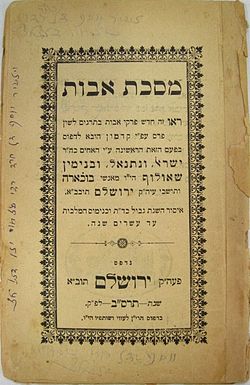
Pirkei Avot with Bukharian Judeo-Persian translation

Pirkei Avot (Hebrew: פִּרְקֵי אָבוֹת, romanizedpirqē aḇoṯ, lit.'Chapters of the [Fore]fathers'; also transliterated as Pirqei Avoth or Pirkei Avos or Pirke Aboth, also Abhoth),[1] is a compilation of the Jewish theological and ethical teachings and maxims from Rabbinic Jewish tradition. It is part of didactic Jewish ethical literature. Because of its contents, the name is sometimes given as Ethics of the Fathers. Pirkei Avot consists of the Mishnaic minor tractate of Avot, the second-to-last tractate in the order of Nezikin in the Mishnah, plus one additional chapter. Avot is unique in that it is the only tractate of the Mishnah dealing solely with ethical and moral principles; there is relatively little Halakha (Jewish law) in Pirkei Avot.

Translation of the title

[edit]

In the title Pirkei Avot, the word "pirkei" is Hebrew for "chapters of".

The word avot means "fathers", and thus Pirkei Avot is often rendered in English as "Chapters of the Fathers", or (more loosely) "Ethics of the Fathers". This translation engenders an appealing and not entirely mistaken image of "patriarchal teachings".

However, the term 'avot' is not usually used as an honorary designation for 'rabbis' or 'sages'; in rabbinical usage, it refers to the Patriarchs of the Bible. Rather, in the Mishnah, the word avot generally refers to fundamentals or principal categories. (Thus, the principal categories of creative work forbidden on Shabbat are called avot melacha, and the principal categories of ritual impurity are referred to as avot tum'ah.) Using this meaning, Pirkei Avot would translate to "Chapters of Fundamental Principles".[2][3] Additionally, the possibility that the title was intentionally worded to support multiple renderings—both "fathers" and "fundamental principles"—cannot be ruled out.

The recognition of ethical maxims as 'Fundamental Principles' may derive from the high regard in which the Torah, Mishnah, and Talmud hold such wisdom. "Love your neighbor as yourself," states the Bible (Leviticus 19:18), an injunction that Rabbi Akiva in Genesis Rabbah 24:7 famously calls a "great principle" of the Torah. In Shabbat 31a, Hillel, when challenged by a prospective convert to explain the entire Torah while the latter stood on one foot, answered: "That which is hateful to you, do not do to your fellow: This is the entire Torah, the rest is the explanation, go now and learn it." (This maxim is not included in Pirkei Avot.) The attribution of Biblical Wisdom books to King Solomon (e.g., Ecclesiastes, Proverbs, Book of Wisdom) attests also to the central importance that Jews of this period placed on transmitting the ethical way of life.

Structure of the work

[edit]

The Mishnaic tractate Avot consists of five chapters. It begins with an order of transmission of the Oral Tradition; Moses receives the Torah at Mount Sinai and then transmits it through various generations (including Joshua, the Elders, and the Neviim, but notably not the Kohanim), whence it finally arrives at the Great Assembly, i.e., the early generations of Sages (Avot 1:1). It contains sayings attributed to sages from Simon the Just (200 BCE) to shortly after Judah haNasi (200 CE), redactor of the Mishnah. These aphorisms concern proper ethical and social conduct, as well as the importance of Torah study.

The first two chapters proceed in a general chronological order, with the second focusing on the students of Yochanan Ben Zakkai. Chapters Three and Four are thematic and contain various attributed sayings in no explicit order. Chapter Five departs from the organization and content of the preceding four in that it consists mostly of anonymous sayings structured around numerical lists, several of which have no direct connection with ethics. The last four paragraphs of this chapter return to the format of moral aphorisms attributed to specific rabbis.

In liturgical use, and in most printed editions of Avot, a sixth chapter, Kinyan Torah ("Acquisition of Torah") is added; this is in fact the eighth (in the Vilna edition) chapter of tractate Kallah, one of the minor tractates. It is added because its content and style are somewhat similar to that of the original tractate Avot (although it focuses on Torah study more than ethics), and to allow for one chapter to be recited on each Shabbat of the Omer period, this chapter being seen well-suited to Shabbat Shavuot, when the giving of the Torah is celebrated. (See below.) The term Pirkei Avot refers to the composite six-chapter work (Avot plus Kinyan Torah).

Modern scholars[who?] suggest that Avot 5:21 ("He would say: A five-year-old proceeds to Bible [study], a ten-year-old to mishna [study]...") was not authored by Rabbi Yehudah ben Teimah (the author of 5:20, and seemingly the referent of "He would say" in 5:21) but rather by Shmuel ha-Katan, and was not part of the Mishna tractate of Avot, but rather added later to Pirkei Avot.[4] In Machzor Vitry, for example, this passage is printed after the words "Tractate Avot has ended".[5]

"The structure of the tractate differs greatly from the thematic structure of the other tractates and Avot sayings employ a highly stylized language instead of the clear and straightforward mishnaic prose. In addition, the anomalous character of Avot is heightened by the biblical influences on its linguistic expressions, grammatical forms, and vocabulary."[6]

Study of the work

[edit]

From at least the time of Saadia Gaon (10th century), it has been customary to study one chapter a week on each Shabbat between Passover and Shavuot; today, the tractate is generally studied on each Shabbat of the summer, from Passover to Rosh Hashanah, the entire cycle repeating a few times with doubling of chapters at the end if there are not a perfect multiple of six weeks.[7] The tractate is therefore included in many prayer books, following Shabbat afternoon prayers.

In the course of such study, it is common to preface each chapter with the Mishnaic saying, "All Israel has a share in the world to come" (Sanhedrin 10:1), and to conclude each chapter with the saying, "The Holy One, blessed be He, wished to bestow merit upon Israel; therefore he gave them Torah and mitzvot in abundance" (Makkoth 3:16).

Notable sayings

[edit]

The tractate includes several of the most frequently-quoted rabbinic sayings on a variety of topics, including:

Show kindness to others

[edit]
  • "The world stands on three things: On Torah, on works, and on kindness to others" (1:2; work here translates "avodah" in the Hebrew which can mean labor, service of God, prayer, or sacrificial offerings)
  • "Your house should be open wide, and you should treat the poor as members of your household." (1:5)
  • "Meet every person with graciousness." (1:15)
  • "He [Yohanan ben Zakkai] said to [his disciples]: 'Go and see what is the right way that a man should seek for himself.' Rabbi Eliezer said: 'A good eye'. Rabbi Yehoshua said: 'A good friend'. Rabbi Yose HaKohen said: 'A good neighbor'. Rabbi Shimon [ben Netanel] said: 'One who sees consequences.' Rabbi Elazar said: 'A good heart'. He [Yohanan] said to them, 'I prefer the words of Elazar ben Arach to yours, because his words include yours as well.'" (2:13)

Respect of other persons

[edit]
  • "What is the right path a man should choose? Whatever is honorable to himself, and honorable in the eyes of others." (2:1)
  • "Let your friend's honor be as dear to you as your own." (2:10)
  • "The evil eye, the evil inclination, and hatred of [God's] creatures drive a person out of the world." (2:16)
  • "Let your friend's money be as dear to you as your own." (2:17)

Strive for greatness

[edit]
  • "If I am not for myself, who will be for me? And being for myself, what am 'I'? And if not now, when?" (1:14) This saying is written in simple and terse Hebrew and is attributed to the sage Hillel, who was famous for succinct expression.
  • "What is the right path a man should choose? Whatever is honorable to himself, and honorable in the eyes of others." (2:1)
  • "In a place where there are no worthy men, strive to be worthy." (2:5)
  • "He who acquires a good name, has acquired himself something indeed." (2:8)
  • "Do not regard yourself as an evil person." (2:18)

Respect God

[edit]
  • "Do His will as if it were your own, so that He will do your will as if it were His. Nullify your own will before His so that He will nullify the will of others before you." (2:4)

Seek peace

[edit]
  • "Be amongst the students of Aaron: Love peace and pursue peace. Love people and bring them close to Torah." (1:12)
  • "The more charity, the more peace" (2:8)

Take precaution to avoid transgressions

[edit]
  • "Make a fence for the Torah" (1:1)
  • "Keep far from an evil neighbor, do not befriend a wicked person, and do not despair of divine retribution" (1:7)
  • "Evaluate the loss of fulfilling a commandment against its reward, and the reward of committing a transgression against its loss. Consider three things, and you will not come to sin: Know what is above you: a seeing eye, a hearing ear, and all of your deeds written down in a book." (2:1)

Be humble

[edit]
  • "Love work, and do not admire official positions, and do not become too acquainted with the governing power." (1:10)
  • "One who seeks to make his name great, destroys it" (1:13)
  • "Anyone who works for the community, let your work with them be for the sake of Heaven... And as for you all, I will make your reward great as though you had accomplished all the work." (2:2)
  • "Be wary regarding the ruling power, because they only befriend a person for their own purposes; they appear as friends when it suits them, but they do not stand by a man in his time of need." (2:3)
  • "Do not separate yourself from the community, and do not be sure of yourself until your day of death." (2:4)
  • "The more flesh, the more worms. The more possessions, the more worry. The more wives, the more witchcraft. The more maidservants, the more licentiousness. The more manservants, the more theft." (2:8)
  • "If you have learned much Torah, do not flatter yourself about it, because it was for this purpose you were created." (2:8)
  • "Let all your deeds be for the sake of Heaven." (2:12)

Be intent in prayer

[edit]
  • "Be careful when reciting the Shema and regarding prayer. Do not pray as though by rote, but plead for mercy and grace before God." (2:18)

Combine Torah learning with labor

[edit]
  • "Torah learning is best combined with an occupation, because the effort of both will keep one from sin. Torah study alone without work will in the end be nullified and lead to sin." (2:2) (See Torah im Derech Eretz.)
  • "Reduce your business activities and occupy yourself with the Torah instead, and be of a humble spirit before everyone." (4:10)
  • "If there is no Torah study, there is no worldly involvement (derech eretz); if there is no worldly involvement, there is no Torah study. ... If there is no flour, there is no Torah; if there is no Torah, there is no flour." (3:21)

Do not exploit your learning

[edit]
  • "One who exploits the crown (of scholarship) will pass away" (1:13)

Be careful with speech

[edit]
  • "All my life I was raised amongst the Sages, and I never found anything better for a person than silence... one who talks too much causes sin." (1:17)
  • "Do not speak (excessively) much with women. This regards a man's own wife, how much more so regarding another man's wife!" (1:5)
  • "Sages, you should be careful in what you say, lest you be punished with exile and be sent to a place of evil waters, and your pupils who follow you will die, and the name of Heaven will be disgraced." (1:11)
  • "Say little and do much." (1:15)
  • "Do not say something that cannot be understood, thinking it will be understood later." (2:5)

Do not seek rewards

[edit]
  • "Do not be like slaves who serve the master in order to obtain a reward. Rather, be like slaves who serve the master not to receive a reward. And let the fear of Heaven be upon you." (1:3)
  • "Be as careful in observance of a minor commandment as in a major commandment, because you don't know the respective rewards for the commandments." (2:1)

Do not judge another person

[edit]
  • "Judge every person favorably" (1:6)
  • "Do not judge your fellow until you have stood in his place." (2:4)
[edit]
  • "[When judging,] do not act as an advocate. When litigants stand before you, regard them [both] as guilty. And when they leave you, regard them as meritorious, provided that they have accepted your judgment." (1:8)
  • "Be thorough in examining witnesses, and watch what you say, so they do not learn from you how to lie." (1:9)
  • "On three things the world continues to exist: On justice, truth, and peace." (1:18)

The time for action is now

[edit]
  • "If not now, when?" (1:14)
  • "The main thing is not study, but doing." (1:17)
  • "Do not say 'I will study when I have the time', for perhaps you will never have time." (2:5)
  • "The day is short, the labor vast, the workers idle, the reward great, and the Employer is insistent." (2:20), attributed to Rabbi Tarfon
  • "It is not incumbent upon you to complete the work, but neither are you at liberty to desist from it" (2:21), attributed to Rabbi Tarfon

Patience

[edit]
  • "An ignoramus cannot be sin-fearing, and a boor cannot be pious. A shy person cannot learn, and an impatient person cannot teach." (2:6)
  • "Do not be quick to anger." (2:15)

The punishment matches the sin

[edit]
  • "He saw a skull floating on the water, and said to it, 'Because you drowned others, they drowned you. And they will also eventually be drowned because they drowned you.'" (2:7)

Commentaries and translations

[edit]
First page of a medieval manuscript of Maimonides's commentary on Pirkei Avot, The Eight Chapters.

Mishnaic tractates, composed in Mishnaic Hebrew, are usually accompanied by commentaries in Aramaic known as gemara ("the teaching"). Unlike the majority of Mishnaic tractates, Avot has no corresponding gemara. Some[who?] have said this is because the concepts in it can never be dealt with completely, being the "fifth part of the Shulchan Aruch" (being intrinsically "derekh eretz": wise practices).

Although Avot does not have an accompanying gemara, one of the minor tractates of the Talmud, the Avot of Rabbi Natan, is an expansion of the Mishnaic tractate containing numerous additional ethical teachings and legends.

The number of medieval and modern commentaries on the Tractate of Avot is large, and probably not known accurately. Among the best-known commentaries are the following:

A comprehensive bibliography of Hebrew commentaries on Pirke Avot has been published, including over 1500 detailed entries. The appendix lists over 500 additional books that contain a short segment on Avot, and over 400 published references on Avot in general or individual mishnayot.[9]

Translations

[edit]

The Russian-American poet and translator Yehoash published his Yiddish translation of Pirkei Avot in 1912 under the title Di Lehren fun di Foters. This translation was subsequently included in a trilingual (Hebrew-Yiddish-English) edition that was published in 1921.[10]

A Chinese translation of Pirkei Avot by Prof. Ping Zhang from Tel Aviv University was published in 1996 by CASS Press, together with footnotes and an introduction of Rabbi Adin Steinsaltz. The first edition, of 1500 copies, sold out immediately.[11] A revised version of Zhang's translation, with some influence from the Chinese Catholic Bible, was published in 2001 under the title "猶太聖傳·民刑卷·先賢篇" ('Jewish sacred teachings, records, and ethics articles'). It is available online.[12]

Intertextuality

[edit]

Scholars have noted similar themes and language shared between Pirkei Avot and earlier Jewish traditions found in the Gospels, such as the parallel descriptions of "where two or three are gathered" used in the Gospel of Matthew for Jesus, and in Avot 3:2 for the Shekhinah.[13]

References

[edit]

Sources

[edit]
[edit]
Revisions and contributorsEdit on WikipediaRead on Wikipedia
from Grokipedia
Pirkei Avot, commonly known as "Chapters of the Fathers" or "Ethics of the Fathers," is a tractate of the in that collects ethical teachings, moral maxims, and practical wisdom attributed to sages from the Second Temple period through the early Talmudic era. It stands out as the only Mishnaic tractate dedicated exclusively to non-legal subjects, emphasizing interpersonal relationships, personal conduct, , and spiritual growth rather than halakhic (legal) rulings. Compiled as part of the around 200 CE by Rabbi Judah the Prince, it forms the final substantive section of the Order of Nezikin (Damages), which primarily addresses civil and criminal law. The tractate's structure consists of six chapters, though the original Mishnah included only five, with the sixth added during the Geonic period (roughly 7th–11th centuries CE) to align with liturgical study cycles. Chapter 1 traces the chain of transmission of the from at Sinai through prophets and pairs of sages, establishing rabbinic authority and continuity. Subsequent chapters present sayings organized roughly chronologically by generations of rabbis, covering topics such as humility, justice, friendship, and the pursuit of wisdom; for instance, Hillel's famous maxim, "If I am not for myself, who will be for me? If I am only for myself, what am I? And if not now, when?" (1:14), encapsulates themes of and urgency in ethical action. Chapter 5 employs numerical patterns (e.g., "The world stands on three things: on , on service, and on acts of loving-kindness" in 1:2) to mnemonic ends, while the added Chapter 6, known as Kinyan Torah, elaborates on acquiring knowledge. Overall, the over 100 mishnayot (statements, varying by edition), draw from over 60 sages, including prominent figures like , Hillel, and , reflecting the evolving ethical priorities of Jewish life under Roman and early Islamic rule. Pirkei Avot holds profound significance in Jewish tradition as a foundational text for moral and character development, often described as a guide to "beyond the letter of the law" in daily conduct. It is customarily studied weekly on afternoons during the six weeks of the Omer period between and , allowing communities to complete the tractate in time for the latter holiday, though the practice often extends through the summer. This cycle, rooted in Talmudic sources such as Shabbat 31a, fosters reflection on its timeless principles amid seasonal themes of renewal and revelation. Over centuries, the text has inspired extensive commentaries, including ' Eight Chapters (an Aristotelian-influenced philosophical introduction) and the expansive Avot de-Rabbi (an ancient expansion dated to the 5th–9th centuries CE), making it accessible in numerous languages and integral to Jewish , , and . Its emphasis on ethical universalism—such as the call to "judge every person favorably" (1:6)—continues to influence contemporary Jewish thought and .

Overview and Background

Historical Context

Pirkei Avot originates as the ninth tractate in the Seder Nezikin (Order of Damages) of the , the foundational compilation of Jewish . It was redacted around 200 CE by Rabbi Judah the Prince (Yehudah HaNasi), who organized the to preserve rabbinic teachings amid growing threats to oral transmission. The tractate developed from oral traditions during the Tannaitic period (c. 10–220 CE), drawing on teachings from sages spanning the late era through early . These traditions emphasized ethical and moral guidance, evolving in response to the shifting socio-religious landscape of Jewish life under Roman rule. Originally comprising five chapters, Pirkei Avot received a sixth chapter, known as Kinyan Torah (Acquisition of ), during the Geonic period (c. 7th–11th centuries CE). This addition, attributed primarily to —a prominent Tanna—and possibly incorporating material from later sages like Rabbi Chiya, consists of beraitot (external teachings) extolling the value of . It was incorporated to align with the custom of studying one chapter per between and , ensuring six chapters for the six Sabbaths. This compilation occurred in the aftermath of the Second Temple's destruction in 70 CE, a cataclysmic event that ended sacrificial worship and intensified Roman persecution, including the (132–135 CE) and subsequent . Pirkei Avot thus served as vital ethical instruction for sustaining and communal resilience during and oppression, shifting focus from Temple-centered practice to personal and interpersonal morality.

Title and Significance

Pirkei Avot, whose title derives from the Hebrew words "pirkei" (meaning "chapters" or "sections") and "avot" (meaning "fathers" or "ancestors"), is commonly translated into English as " of the Fathers" or "Sayings of the Fathers." The term "pirkei" reflects the tractate's structure as a collection of discrete chapters, while "avot" emphasizes the foundational teachings passed down from rabbinic forebears, underscoring its role as a repository of ancestral wisdom. In Hebrew, it is often rendered as "Pirké Abot," and it is frequently abbreviated simply as "Avot" in scholarly and traditional contexts. What sets Pirkei Avot apart within the is its exclusive focus on and moral philosophy, making it the sole tractate devoid of legal (halakhic) discussions found elsewhere in the corpus. This emphasis renders it an accessible gateway to rabbinic thought, distilling complex Jewish values into concise, memorable aphorisms that appeal to both scholars and laypeople seeking guidance on personal conduct. Compiled as part of the around 200 CE, its non-legal nature highlights its purpose as a standalone ethical rather than a supplement to . Beyond its textual uniqueness, Pirkei Avot plays a pivotal role in safeguarding the chain of Jewish tradition by tracing the transmission of from through generations of sages, thereby reinforcing communal continuity and authority. It promotes mussar—the Jewish tradition of ethical self-improvement—by encouraging daily reflection on virtues like , , and , fostering spiritual growth and moral discipline in everyday life. This enduring reverence stems from its ability to inspire and ethical living, as articulated in Talmudic sources that recommend its study for those aspiring to a life of .

Composition and Structure

Chapters and Organization

Pirkei Avot is divided into six chapters, with the first five comprising part of the and containing 96 mishnayot, or statements, attributed to sages from through the . This division reflects a deliberate framework designed to systematically present ethical and moral teachings within the broader corpus of . The tractate's organization emphasizes progression and continuity, serving as a pedagogical tool for transmitting wisdom across generations. Chapter 1 establishes the foundational chain of tradition, outlining the transmission of the from through key figures to the early rabbis. Chapters 2 through 5 shift to individual ethical advice, with each typically presenting a from a specific , often introduced by name and paired with a disciple or contemporary for emphasis. These chapters are structured to highlight personal maxims on topics such as , study, and , without delving into legal disputes. Chapter 6 stands apart as a later addition, not part of the original , and consists of beraitot—external traditions—offered in a more poetic and expansive form focused on the acquisition of . The overall organization follows the generations of the , starting from biblical-era figures like and the prophets and extending to post-Mishnah rabbis such as and his students, creating a chronological lineage that underscores the enduring relevance of these teachings. Structural elements like numerical lists—such as the ten generations from to or from to Abraham—and paired teachings further enhance the tractate's mnemonic and thematic coherence, facilitating memorization and study. These features, compiled under Rabbi Judah , illustrate the editor's intent to craft a cohesive guide to rabbinic ethics.

Authorship and Chain of Tradition

Pirkei Avot opens with a foundational mishnah (1:1) that outlines an unbroken chain of transmission for the Torah, beginning with Moses receiving it at Sinai and passing it to Joshua, who transmitted it to the elders, the elders to the prophets, and the prophets to the Men of the Great Assembly. This chain continues through successive pairs of sages, including Shimon the Righteous and Antigonus of Sokho, Yose ben Yoezer and Yose ben Yochanan, Yehoshua ben Perachiah and Nittai the Arbelite, Yehuda ben Tabbai and Shimon ben Shetach, Shemaya and Avtalyon, and Hillel and Shammai, culminating with Rabban Yohanan ben Zakkai and his disciples, leading to Rabban Shimon ben Gamliel and Rabbi Judah the Prince (Yehudah ha-Nasi). This sequence, spanning from the biblical era to the early third century CE, emphasizes the continuity of oral tradition across generations. The tractate's content consists primarily of ethical and wisdom sayings attributed to prominent Tannaim, the rabbinic sages of the Mishnaic period (c. 10–220 CE), including Hillel, , Rabban Gamaliel I, , and , among others. These attributions serve to associate the teachings with revered figures, though some elements may reflect pseudepigraphic practices common in ancient , where later sayings are ascribed to earlier authorities to enhance their authority. Judah the Prince is traditionally credited with the redaction of the as a whole, including Pirkei Avot, around 200 CE, compiling existing oral traditions into a structured text; however, the tractate includes anonymous mishnayot (untitled teachings) and possible later interpolations, such as sayings attributed to Judah himself and his son Gamaliel II. The inclusion of this chain of tradition at the outset serves a deliberate purpose: to legitimize the ethical teachings of Pirkei Avot as part of the divine revelation from Sinai, transferred through an authoritative, uninterrupted rabbinic lineage, thereby establishing the credibility and binding nature of the sages' interpretations over prophetic or other authorities. This framework underscores the work's claim to represent not merely human wisdom but an extension of sacred tradition, ensuring its integration into normative Jewish practice.

Teachings and Themes

Ethical Principles

Pirkei Avot presents a foundational framework for Jewish ethics, emphasizing moral conduct as inseparable from religious observance and legal study. Central to its doctrines is the integration of derech eretz—proper ethical behavior and worldly conduct—with Torah study, portraying ethics not as an optional supplement but as an essential counterpart that ensures the practical application of divine law in daily life. This holistic approach underscores that true piety requires balancing intellectual pursuit of Torah with virtuous actions, fostering a comprehensive moral character. A key doctrine in the tractate identifies the world's stability as resting on three pillars: (divine study and law), avodah (worship or service to ), and gemilut chasadim (acts of ), highlighting the interdependence of , spiritual, and interpersonal dimensions in sustaining ethical order. The text warns against vices such as , , and the pursuit of honor, which undermine personal and communal , urging individuals to cultivate restraint and instead. These admonitions reflect a broader commitment to pursuing truth alongside , where ethical decisions prioritize and without compromising core values. The ethical principles weave together personal, social, and spiritual spheres. On a personal level, the tractate promotes self-control and humility as safeguards against moral failings, encouraging introspection to align one's character with divine expectations. Socially, it advocates for charity (tzedakah) and justice as obligations that build equitable communities, viewing acts of benevolence as extensions of Torah imperatives. Spiritually, it balances fear of God—reverence for divine authority—with love, while emphasizing prayer and repentance as pathways to renewal and ethical growth. Overall, these themes position ethics as integral to halakha (Jewish law), where moral principles reinforce legal observance rather than standing apart from it. The doctrines trace back through the chain of tradition, linking contemporary ethics to ancient sages.

Key Sayings and Maxims

Pirkei Avot is renowned for its concise yet profound maxims, which encapsulate ethical wisdom attributed to rabbinic sages. These sayings often balance individual responsibility with communal harmony, drawing from everyday language to convey timeless lessons. Representative examples illustrate themes such as , reciprocity, wisdom, humility, kindness, peace-seeking, and the pursuit of knowledge. One of the most influential maxims on and ethical reciprocity comes from Hillel in 1:14: "If I am not for myself, who will be for me? If I am only for myself, what am I? And if not now, when?" This triplet urges personal initiative while cautioning against , emphasizing timely action in moral matters. In 1:12, Hillel further advises: "Be among the disciples of , loving peace and pursuing peace, loving people, and bringing them closer to ," highlighting reciprocity as a core principle; he famously summarized it as "That which is hateful to you, do not do to another—that is the whole ; all else is commentary. Go and study." These statements, rooted in Hillel's teachings, underscore the tension between and interpersonal . The theme of wisdom intertwined with humility appears prominently in Ben Zoma's enumeration in 4:1: "Who is wise? The one who learns from all people, as it is said, 'From all my teachers I have gained understanding' ( 119:99). Who is mighty? The one who subdues his inclination, as it is said, 'Better one who is slow to anger than a mighty man, and one who rules his spirit than one who captures a city' (Proverbs 16:32). Who is rich? The one who rejoices in his portion, as it is said, 'You shall enjoy the good that God your Lord has granted you and your children' (Deuteronomy 26:11). Who is honored? The one who honors others, as it is said, 'I honor those who honor Me' (I Samuel 2:30)." This series redefines conventional virtues through a lens of and learning from others, promoting inner mastery over external power. Kindness, or gemilut chasadim, is exemplified in Simon the Just's foundational saying in Mishnah 1:2: "The world stands on three things: on Torah, on service [of God], and on acts of kindness." This maxim positions benevolent deeds as a pillar sustaining society, distinct from ritual or study alone. Complementing this, Rabban Shimon ben Gamliel in Mishnah 1:15 states: "On three things does the world stand: on truth, on justice, and on peace," portraying peace-seeking (shalom) as an active pursuit that fosters communal stability through equitable relations. The acquisition of Torah knowledge receives paradoxical emphasis in Ben Bag Bag's advice in Mishnah 5:22: "Turn it and turn it again, for everything is in it; scrutinize it, grow old and gray in it; do not deviate from it, for nothing is better than it." This encourages relentless, multifaceted engagement with , suggesting its inexhaustible depth as the ultimate guide for ethical living. Rabbi Tarfon's related maxim in Mishnah 2:16 reinforces persistence: "It is not your responsibility to finish the work, but you are not free to desist from it," framing pursuit and ethical effort as ongoing obligations rather than achievable endpoints. These sayings collectively capture the ethical tensions in Pirkei Avot, blending individual agency with collective ideals.

Study and Recitation Practices

Traditional Customs

One prominent traditional custom involves the public recitation of Pirkei Avot in synagogues, where one chapter is read weekly after the service on , commencing after and continuing until , thereby completing approximately four cycles of the six chapters over the period. This practice allows congregants to systematically engage with the text's ethical teachings during the summer months, fostering communal reflection on moral conduct. The origins of this synagogue recitation custom trace back to the Geonic period in , before approximately 850 CE, with attributions to figures such as Rav Natronai Gaon (853–857 CE), who advocated reciting the entire tractate from memory each to reinforce the Oral Law's authority and promote ethical introspection. By the 11th century, regional variations solidified, including the seasonal cycle from to in Ashkenazic communities, as documented in works like Mahzor Vitry. In educational settings, Pirkei Avot has long been integrated into curricula as a daily component of Talmudic study, serving as an accessible entry point to rabbinic alongside more complex halakhic texts. Within the 19th-century Mussar movement, founded by Rabbi Israel Salanter, the tractate was emphasized for personal moral improvement through repeated study and contemplation of its maxims on virtue and character refinement. Ritually, the weekly recitation typically concludes the service, immediately followed by the prayer, after which participants are encouraged to portions of the text for ongoing personal edification and ethical application in daily life. This emphasis on memorization echoes early Geonic practices and underscores the tractate's role in motivating adherence to its core ethical themes of , , and .

Modern Applications

In the 20th and 21st centuries, Pirkei Avot has been widely integrated into Jewish , including day schools, adult learning programs, and digital platforms, to foster ethical development among students of all ages. Organizations like Prizmah, the Center for Jewish Day Schools, incorporate its teachings into curricula to emphasize and community values in formal environments. The Orthodox Union's youth initiatives, such as those through NCSY, utilize Pirkei Avot in programs aimed at building ethical leadership and personal integrity for teenagers. Online resources like Sefaria's Pirkei Avot Learning Guide enable interactive study for adults and youth alike, adapting traditional texts for modern, self-paced learning. Secular adaptations of Pirkei Avot have gained popularity in literature, applying its maxims to contemporary themes of , , and personal growth. For instance, Gila Ross's Living Beautifully: How to Bring Meaning, Joy and Love into Your Life Based on the Timeless Wisdom of Pirkei Avot reinterprets sayings for daily emotional resilience and outside religious contexts. Similarly, Rabbi Dr. Shmuly Yanklowitz's Pirkei Avot: A Social Justice Commentary extends its principles to modern challenges, influencing non-Jewish readers interested in universal . These works draw on the tractate's emphasis on , such as the maxim "Know from whence you came" (Avot 3:1), to promote practices in professional and personal spheres. In interfaith dialogues, Pirkei Avot serves as a bridge for discussing universal moral principles, highlighting shared values like humility and justice across traditions. Rabbi Jonathan Sacks, in his teachings on universal versus particular ethics, references Avot 3:14—"Beloved is man for he was created in the image [of God]"—to underscore common ground in interreligious conversations on human dignity. Post-2020 digital tools, including apps and podcasts, have amplified this accessibility; Sefaria's mobile app delivers daily quotes from Pirkei Avot, while series like Central Synagogue's "Timeless Wisdom" provided virtual sessions to build communal resilience through sayings like "Do not separate yourself from the community" (Avot 2:5). During lockdowns, these resources helped individuals apply the text's wisdom to cope with isolation, as noted in reflections on sharing burdens (Avot 6:6) for emotional support. Addressing contemporary gaps, feminist reinterpretations of Pirkei Avot promote gender-inclusive readings to challenge patriarchal elements and amplify women's in ethical . Recent translations adapt pronouns and commentary to make the text more equitable, fostering inclusive study in progressive communities. Links to have emerged in modern applications, connecting Pirkei Avot's calls for to efforts. The tractate's pledge of —"Everything is given against a pledge" (Avot 3:16)—is invoked in Jewish to advocate for ecological responsibility, as explored in analyses of rabbinic texts for . Programs like GrowTorah apply sayings on mindful consumption (Avot 3:4) to education, urging ethical eating as (repairing the world).

Commentaries and Interpretations

Classical Commentaries

The classical commentaries on Pirkei Avot emerged in the Talmudic era, where the tractate, lacking a dedicated , was elaborated through scattered discussions in the (Bavli) and (Yerushalmi). These discussions often reference specific mishnayot to illustrate broader rabbinic principles, such as the chain of tradition in Avot 1:1, which appears in Bavli 21b to underscore transmission. A key early expansion is Avot de-Rabbi Natan, a midrashic text compiled around the , that weaves narrative stories and ethical anecdotes around the Mishnah's maxims, transforming the tractate into a more expansive ethical anthology while preserving its core structure. In the medieval period, commentaries shifted toward systematic exegesis. (1040–1105) composed concise glosses on Pirkei Avot, clarifying ambiguous language and linking sayings to Talmudic precedents for practical study. (1138–1204) prefaced his Arabic commentary on the tractate with Shemoneh Perakim (Eight Chapters), a philosophical that integrates Aristotelian concepts of with Jewish thought, portraying Avot's teachings as a guide to moral perfection and intellectual attainment. Later pre-modern works built on these foundations with deeper textual scrutiny. (1579–1654) authored Yom Tov in the 17th century, a comprehensive analysis that harmonizes prior interpretations, resolves textual variants, and highlights halakhic connections, making it a standard reference for rigorous study. Overall, classical approaches to Pirkei Avot emphasize ethical cultivation, legal contextualization, and nascent mystical insights; for instance, early Kabbalistic texts like the allude to esoteric dimensions in sayings on divine service and human conduct.

Contemporary Analyses

In the 20th century, drew on Pirkei Avot to articulate an existential ethics that emphasized the prophetic imperative for moral urgency in , interpreting sayings like Hillel's call to "love peace and pursue peace" as a foundation for against injustice. Heschel's approach highlighted the text's role in bridging ancient wisdom with modern existential concerns, portraying ethical living as a divine-human essential for human fulfillment. Feminist scholars have critiqued Pirkei Avot for its patriarchal framework, which centers male sages and marginalizes women's voices, prompting calls for inclusive reinterpretations. In response, works like "Pirkei Imahot: The Wisdom of Mothers, The Voices of Women" by Eve Posen and Lois Sussman Shenker reimagine the tractate by compiling ethical teachings attributed to female figures, fostering gender equity in Jewish moral philosophy. Recent scholarship has integrated Pirkei Avot with frameworks, as seen in Shmuly Yanklowitz's 2018 commentary, which applies maxims on and communal responsibility to contemporary issues like racial equity and economic justice. Popular analyses, such as Joseph Telushkin's "The Book of Jewish Values" (2000), distill Avot's teachings into practical guides for , linking principles like "do not your fellow" to modern interpersonal dynamics. Podcasts, including discussions with Yanklowitz, further connect the text to current events, exploring its relevance for in diverse Jewish communities. Post-2020 studies have employed interdisciplinary lenses. projects, such as those hosted on , analyze the text's manuscript transmission, revealing patterns of adaptation across contexts and enhancing global accessibility for inclusive study. Applications to have surged, with interpretations of "share the burden with a friend" (Avot 6:6) providing frameworks for communal support during crises like the , promoting resilience in scattered Jewish populations.

Translations and Editions

Early Translations

The dissemination of Pirkei Avot beyond Hebrew-speaking communities began in the medieval period, as Jewish populations in diverse regions required access to its ethical teachings in vernacular languages. Among , Ladino (Judeo-Spanish) translations emerged to support recitation and study, particularly in following the expulsion from in 1492. These versions typically presented the Hebrew text in parallel with a Ladino rendering, facilitating communal learning during the summer weeks when the tractate is traditionally studied. Over fifty editions of Pirkei Avot in Ladino were produced between the 16th and 19th centuries, reflecting its centrality in Sephardic tradition; the Sephardic Studies Collection preserves twenty-five such copies, highlighting their role in preserving rabbinic wisdom for non-Hebrew readers. In the early , technology accelerated the spread of Pirkei Avot, with the first Hebrew edition appearing as part of the complete printed in in 1492 by Joshua Solomon Soncino, marking a pivotal moment in Jewish textual preservation. A standalone Hebrew followed in around 1521, further enabling wider distribution among Ashkenazic and Italian Jewish communities. Concurrently, Christian Hebraists sought to engage with , leading to the first Latin translation by Paul Fagius in 1541. Published in Isny as Sententiae vere elegantes, piae, mireque, cum ad linguam discendam, tum animum pietate excolendum utiles veterum sapientum Hebraeorum, quas [Pirke Avot] id est capitula, aut si mavis Apophtegmata Patrum nominant, this edition presented the Hebrew text alongside a Latin rendering of Pirkei Avot, excerpted from the 's Order of Nezikin, to introduce its moral and religious maxims to Latin-speaking scholars interested in rabbinic thought. Fagius's work exemplified the era's scholarly exchange between Jewish and Christian intellectuals. By the 19th century, as progressed in and English-speaking regions, translations into English addressed the needs of growing Anglo-Jewish populations and general readers. Initial efforts included partial renderings in scholarly journals and compilations during the , often focusing on select chapters to introduce rabbinic ethics to non-specialists. A landmark full translation came in 1877 with Charles Taylor's Sayings of the Jewish Fathers, Comprising Pirqe Aboth and Perek R. , which provided the Hebrew text alongside an English version, extensive notes, and excurses drawing on Talmudic and classical sources; this edition, reprinted in 1897, was among the earliest comprehensive English presentations and influenced subsequent scholarship. Translators of Pirkei Avot faced significant challenges in conveying its original , characterized by terse, poetic idioms and specialized rabbinic terms that embed cultural and halakhic nuances. The aphoristic structure, reliant on wordplay and concise phrasing (such as in sayings like "Who is wise? He who learns from all people" [Avot 4:1]), often loses rhetorical force in target languages, requiring interpreters to balance literal accuracy with interpretive clarity. Rabbinic vocabulary, including concepts like middot (ethical traits) or (Oral Torah), demanded careful glossing to avoid anachronistic or overly literal renditions, as seen in early Ladino versions where verb forms from Biblical and Mishnaic Hebrew were adapted to reflect Sephardic dialects while preserving ethical intent.

Recent Versions

In the 20th and 21st centuries, translations and editions of Pirkei Avot have emphasized accessibility for diverse audiences, incorporating bilingual formats, contemporary annotations, and to broaden engagement with its ethical teachings. A prominent example in English is the series of bilingual editions, which began in the and continue to be updated, featuring the Hebrew text alongside translations and commentaries including Rashi's insights for deeper study. These editions, such as the 2009 bilingual volume, provide structured guidance on Jewish morality and , making the text suitable for both scholarly and devotional use. Another key English edition from the 2010s is The Koren Pirkei Avot (2016), with a translation by Rabbi Jonathan Sacks and commentary by Rabbi Marc D. Angel, drawing on traditional and modern thinkers to apply the mishnayot to contemporary life. Angel's annotations highlight timeless principles like and , resonating with global Jewish communities. Modern Hebrew editions have incorporated to promote inclusivity, as seen in works like Chaim Stern's Pirke Avot: Wisdom of the Jewish Sages (1997, with later reprints), which offers a bilingual Hebrew-English translation reflecting progressive interpretations while preserving the original's ethical core. Similarly, the Rabbinical Assembly's Pirkei Avot Lev Shalem (2020s) uses gender-sensitive phrasing to make the text more approachable for contemporary readers. For global Jewish populations, recent translations in other languages include Spanish editions such as Pirkei Avot: La ética de los Ancestros (2022), which provides a clear, annotated Hebrew-Spanish parallel text focused on moral guidance. In French, Koren Publishers' Pirké Avot (post-2010s) features Rabbi Adin Even-Israel Steinsaltz's commentary alongside a bilingual format, emphasizing practical wisdom for daily life. Digital formats have revolutionized access, with platforms like offering an interactive online text of Pirkei Avot since the 2010s, allowing users to navigate commentaries, translations, and connections to related Jewish sources in multiple languages. Annotated apps and websites enable customized study, enhancing recitation during traditional cycles like the Omer period. Illustrated editions for children, such as 's The Artscroll Children's Pirkei Avos (2000s onward, with updates), use vibrant visuals and simplified translations to introduce ethical concepts like and learning to young readers. These versions, including graphic novel adaptations like The Illustrated Pirkei Avot (2017), foster early engagement through . Post-2020 developments include AI-assisted tools on Sefaria, such as the experimental Pirkei Avot Learning Guide (2025), which uses artificial intelligence to generate personalized explorations and multilingual insights, supporting broader educational applications.

Influence and Intertextuality

Connections to Jewish Texts

Pirkei Avot is deeply embedded in the broader corpus of Jewish literature, with numerous intertextual links that demonstrate its continuity with biblical and rabbinic traditions. The tractate frequently alludes to the Hebrew Bible, particularly in its ethical maxims, drawing on wisdom literature to reinforce teachings on moral conduct and spiritual growth. For instance, several mishnayot in chapter 4 directly cite verses from the Book of Proverbs to define key virtues. The saying in Avot 4:1 identifies the "mighty" person as one who conquers their evil inclination, quoting Proverbs 16:32: "Better a patient person than a warrior, and one who rules over his spirit than one who captures a city," highlighting self-mastery as a form of heroic strength. Similarly, Avot 4:1 praises the wise as those who learn from everyone, citing Psalms 119:99 while echoing Proverbs 1:5's call for the wise to acquire learning and guidance. These allusions position Pirkei Avot as an extension of biblical wisdom, adapting proverbial teachings to rabbinic ethical discourse. The tractate also connects to narrative and covenantal themes in the . The opening mishnah's chain of tradition—Moses receiving the at Sinai and transmitting it through , the elders, prophets, and the —mirrors the handover in Deuteronomy 31:1–9, where commissions before the people, emphasizing the perpetual transmission of divine law as a covenantal . This structure underscores Pirkei Avot's role within the as a testament to oral tradition's authority. Additionally, leadership and judicial advice in the tractate evoke Exodus 18, where Jethro counsels on delegating authority to capable men who fear , are trustworthy, and hate dishonest gain to avoid exhaustion—a reflected in the tractate's emphasis on structured communal governance by qualified individuals. Praise for Torah study in Pirkei Avot resonates with the Psalms' exaltation of divine instruction. The parallel to —"I have hidden Your word in my heart that I might not sin against You"—portrays study as a safeguard for ethical living, integrating Pirkei Avot into the biblical poetic and framing rabbinic as a fulfillment of scriptural devotion. This idea is elaborated in the Babylonian (Kiddushin 30b), which describes the as an antidote (like a spice) to the evil inclination. In Talmudic literature, Pirkei Avot finds expansions and parallels that enrich its teachings. The Babylonian references Hillel's maxims from Avot, such as in 31a, where his summary of as "what is hateful to you do not do to another" is elaborated in discussions of interpersonal . More comprehensively, the midrashic work Avot de-Rabbi Natan serves as a direct expansion, weaving narratives, homilies, and folklore around each of Pirkei Avot to illustrate its principles; for example, it amplifies Avot 1:3's focus on and fences with stories of rabbinic deliberation. Later Jewish texts further demonstrate Pirkei Avot's influence. The , Joseph Karo's 16th-century code of Jewish law, incorporates ethical guidelines drawn from Avot in sections on daily conduct and character refinement, such as Orach Chaim 1:1–5, which urges rising early for and study in alignment with Avot 2:1's call to know what is above you. The , the foundational kabbalistic text, offers mystical interpretations of Avot's sayings, viewing them as pathways to divine emanations; for instance, it expounds Avot 3:1's belovedness of humanity as reflecting the soul's unity with the , transforming ethical advice into esoteric spiritual ascent. These connections affirm Pirkei Avot's centrality in Jewish textual tradition, bridging biblical roots with medieval developments.

Broader Cultural Impact

Pirkei Avot has exerted influence on Enlightenment-era Jewish philosophers, particularly through its ethical framework that bridged traditional Jewish thought with rationalist principles. , a pivotal figure in the movement, drew upon Jewish ethical traditions akin to those in Avot to harmonize with Enlightenment philosophy in works like , where he advocated for and rooted in ancient wisdom. Scholars note that Mendelssohn's emphasis on ethical echoes Avot's maxims on justice and piety, adapting them to critique while affirming tradition. The tractate's teachings also parallel Stoic philosophy, particularly in Epictetus's Enchiridion, where both emphasize self-control, acceptance of fate, and ethical self-examination as paths to . For instance, Avot 4:1's query—"Who is rich? He who is content with his lot"—mirrors Epictetus's counsel to desire only what is within one's control, fostering resilience amid adversity. These affinities highlight Avot's broader resonance with Hellenistic , influencing cross-cultural dialogues on . In literature and popular media, Pirkei Avot appears directly as an epigraph in Cynthia Ozick's short story "The Pagan Rabbi," from her 1971 collection The Pagan Rabbi and Other Stories, where a saying from Avot underscores themes of spiritual conflict and Jewish identity. Similarly, the musical Fiddler on the Roof (1964), adapted from Sholem Aleichem's stories, embodies Avot's ethical tensions around tradition and change, as protagonist Tevye grapples with familial duties and societal shifts in ways that reflect the tractate's wisdom on humility and adaptation. Beyond fiction, Avot's principles are invoked in business ethics training, where maxims like 2:2—"Beautiful is the study of Torah with the practice of a worldly occupation"—inform discussions on balancing integrity, leadership, and trust in corporate settings. Pirkei Avot's global reach extends to ethical and U.S. Jewish communities, where it serves as a core text for programs, often studied seasonally to instill values like and . For example, as of 2025, initiatives like the Tikvah Fund's learning campaign explore Pirkei Avot's texts with classic and modern commentaries to address contemporary ethical issues. Post-2020, its sayings have gained traction in , with quotes such as 2:16—"It is not your duty to finish the work, but neither are you free to desist from it"—appearing in protests and campaigns addressing inequality and , as documented in recent studies of Jewish involvement in civic movements. This usage underscores Avot's adaptability to contemporary advocacy. The tractate has also impacted non-Jewish , notably in the when Christian scholar Paul Fagius edited and translated Avot to promote universal , integrating its into humanist curricula as a model for rational accessible beyond . In recent years, such appropriations continue, with Avot's maxims adopted in secular ethical frameworks and interfaith dialogues, sometimes sparking debates over cultural context while broadening its influence on global .

References

Add your contribution
Related Hubs
User Avatar
No comments yet.