Hubbry Logo
StrontianStrontianMain
Open search
Strontian
Community hub
Strontian
logo
8 pages, 0 posts
0 subscribers
Be the first to start a discussion here.
Strontian
Strontian
from Wikipedia

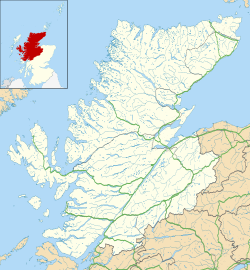
Strontian (/strɒnˈtən/;[1] Scottish Gaelic: Sròn an t-Sìthein [s̪ɾɔːn̪ˠ ən̪ˠ ˈtʲiː.ɪn][2]) is the main village in Sunart, an area in western Lochaber, Highland, Scotland, on the A861 road. Prior to 1975 it was part of Argyllshire. It lies on the north shore of Loch Sunart, close to the head of the loch. In the hills to the north of Strontian lead was mined in the 18th century and in these mines the mineral strontianite was discovered, from which the element strontium was first isolated.

Key Information

The village name in Gaelic, Sròn an t-Sìthein, translates as the nose [i.e. 'point'] of the fairy hill, meaning a knoll or low round hill inhabited by the mythological sídhe. The nearby hamlets of Anaheilt, Bellsgrove, and Upper and Lower Scotstown are now generally considered part of Strontian, with Polloch several miles away on the terminus of the road to Loch Shiel. Strontian is the location of Ardnamurchan High School, the local fire station, police station and other facilities.

Geology and mining history

[edit]

It was observed in the 19th century that there is granite on one side of the Strontian mines and gneiss on the other.[3] The area immediately around the village is Granodiorite, part of a larger intrusion of around 90 square kilometres (35 square miles) that extends south as far as Loch Linnhe. This is surrounded by a Hornblende Biotite Granite, giving way in the south to a Tonalite. The rocks are around 385 to 453 million years old, intruded into the metasediments of the Moine Supergroup. It has been postulated that it was emplaced in the shear zone termination of an offshoot of the Great Glen fault and that it may be diapiric in form.

The history of mining in the Strontian area dates to 1722, when Sir Alexander Murray discovered galena in the hills the region. A mine was opened in 1725, in partnership with Thomas Howard, 8th Duke of Norfolk and General Wade.[4] Various materials have been mined here including lead, and strontianite, which contains the element named after the village, Strontium. While there have been inhabitants of the area for centuries, particularly in the woods north of the current village, the community as it exists now was established in 1724 to provide homes for the local mining workers.

Welcome sign at Strontian

Lead mined at Strontian was used in bullets manufactured for the Napoleonic Wars. In the early part of the 19th century, part of the workforce was made up of captured forces from Napoleon's imperial army.

Discovery of strontium

[edit]

In 1790, Adair Crawford, a doctor, recognised that the Strontian ores exhibited different properties to those normally seen with other "heavy spars" sources.[5] He concluded "... it is probable indeed, that the Scottish mineral is a new species of earth which has not hitherto been sufficiently examined". The new mineral was named strontites in 1793 by Thomas Charles Hope, a professor of chemistry at the University of Glasgow.[6][7] He confirmed the earlier work of Crawford and recounted: "... Considering it a peculiar earth I thought it necessary to give it an name. I have called it Strontites, from the place it was found; a mode of derivation in my opinion, fully as proper as any quality it may possess, which is the present fashion". The element was eventually isolated by Sir Humphry Davy in 1808 by the electrolysis of a mixture containing strontium chloride and mercuric oxide, and announced by him in a lecture to the Royal Society on 30 June 1808.[8] In keeping with the naming of the other alkaline earths, he changed the name to strontium.[9][10][11][12] While several elements have been discovered there, strontium is the only element named after a place in the United Kingdom.

The first large-scale application of strontium was in the production of sugar from sugar beet. Although a crystallisation process using strontium hydroxide was patented by Augustin-Pierre Dubrunfaut in 1849[13] the large-scale introduction came with the improvement of the process in the early 1870s. The German sugar industry used the process well into the 20th century. Prior to World War I the beet sugar industry used 100,000 to 150,000 tons of strontium hydroxide for this process per year.[14]

Conditions for workers

[edit]

In 1851, a miner named Duncan Cameron was killed by a rock-fall in the lead mine. A lengthy inquest followed for the office of the Procurator Fiscal of Tobermory. A number of witnesses to the accident testified that the workings were unsafe and that precautions for the workmen were insufficient. A case was brought against James Floyd, superintendent of the mines, for the culpable homicide of Duncan Cameron.

A number of complaints had previously been made to Sir James Riddell, local landowner and proprietor of the mines. One piece of evidence presented to the inquest notes:

This insufficiency arises from the want of proper props in the workings & in the removal by Mr Barrat of the Middlings or partitions left by the former Company for supporting the workings - a feeling of this nature given expression to by almost all the workmen has existed for the last three years and a number of men left the work altogether in consequence, as they said, of the insecurity of the Mines – I knew this myself but I had either to submit to work there or starve – Necessity with me had no law – The other mines in which I had wrought are worked in a different, safer, principle & more attention paid to the security of the lives of the workmen.

It was noted elsewhere that because the miners were paid for piece-work, no one was able or employed to undertake safety procedures in the mines.[15]

In 1854, miners attempted to bring a case against the mining company, with many of those who presented evidence at the 1851 inquest involved in the action. The legal action failed and was ruled out of order by the sheriff substitute, with 4 pounds 15 shillings in court costs.[16]

Ariundle Oakwood National Nature Reserve

[edit]

Ariundle Oakwood is a National Nature Reserve and surviving fragment of the native oak woods that once spread along the Atlantic coast from Spain to Norway.

Religious history of Strontian

[edit]

Telford Parliamentary Church (Church of Scotland)

[edit]

The village church was built in the 1820s by Thomas Telford, one of 32 "Parliamentary Churches" he designed for the Highlands and Islands. The government set up a commission in 1823 under John Rickman to build churches in some of the most thinly populated parishes. The project was funded by a grant of £50,000 and meant to include a manse with each church – each church and manse to cost not more than £1,500.[17] Telford decided that it would be most economical to build all the buildings to the same plan. The layout of each church was a simple T-plan. There were two doors and windows in the front wall, which measured 16 m (52 ft 6 in). One gable had a belfry of four plain pillars supporting a pyramidal top. The bell rope came down the outside of the gable. At each side of the building there were two windows. The exterior and interior were undecorated. There was a hexagonal pulpit against the inside front wall.

The church is still in use. The Old Manse, former Church of Scotland Manse, was built to a standard H-plan by Telford in 1827. It is a category C(S) listed building[18] and is today a private residence which also houses the Sunart Archives.

Floating Free Church

[edit]

Strontian was the site of reputedly the first moored boat church in the country.

Following the Disruption of 1843 in which the Church of Scotland Free (later the Free Church of Scotland) walked out of the Church of Scotland General Assembly, a congregation of 500 members around Strontian petitioned Sir James Riddell, who then owned the entirety of Ardnamurchan, for land and permission to build a new church. A number of attendants affirmed, in testimony to the Select Committee on Sites for Churches, illnesses contracted by worshippers attending services held outdoors in inclement weather. A letter by Riddell to Graham Speirs, Esq., notes "I find it impossible, conscientiously, to grant sites for churches, manses, and schools, which would imply a sanction on my part, and give a perpetuity on my estates, to a system which I believe to be anti-social and anti-Christian."[19]

With permission refused, subscriptions were taken from the local congregants of £1,400 to have a suitable craft built in Clyde. A floating church was established 150 metres offshore in Loch Sunart in 1846.[20] Eventually a site was obtained in nearby Acharacle and a Free Church was built there in 1868.

Village life

[edit]
Strontian and Sgùrr Dhòmhnuill viewed from the south shore of Loch Sunart

Demographics

[edit]

Strontian is a hamlet with a population of 200 recorded in 1991. This represented a decline from earlier recorded populations of 803 in 1871 and 691 in 1881.[21] The population has since rebounded to a 2013 estimate of ca. 350.[22]

19th century

[edit]

According to John MacCulloch in his descriptive letters to Sir Walter Scott during the 1820s, Strontian is described as "a wild and uninteresting country, though there is some grandeur in one scene, in a deep valley which is terminated by the fine form of Scuir Donald ... Strontian possesses now an excellent inn."[23]

An 1830 source describes it: "The village of Strontian is very pleasantly situated, directly at the head of Loch Sunart, the hills adjoining to which are crowned with beautiful and very thriving plantations. The Loch itself is here extremely picturesque ... [i]n a neighbourhood civilized and populous it would speedily become a favourite retreat."[24]

In the 1830s, residents from Strontian and the surrounding area were among the first to use the "Bounty Scheme" to emigrate to Australia. The Brilliant, a Canadian-built ship, sailed from Tobermory to New South Wales in 1837 with 322 passengers, 105 of whom were from Ardnamurchan and Strontian.[25] The Bounty Scheme, which ran from 1835 to 1841, was proposed by Edward Gibbon Wakefield as a way for Australian settlers to subsidise the emigration of skilled tradespeople from Britain.[26]

In the 1850s more emigrants left from the Strontian and Anaheilt area. The Allison sailed from Liverpool in 1851 for Melbourne with a number of Highlanders from the area aboard.[27]

Strontian today

[edit]
Shopping centre in Strontian

'Strontian House' was built for Sir Alexander Murray of Stanhope in the late 1720s and was named after Colonel Horsy, Governor of the York Buildings Company. Latterly known as the Loch Sunart Hotel, it was still referred to as 'Horsy Hall' and sometimes misspelt 'Horsley Hall'.[28] The hotel was destroyed by fire in 1999.[29] A hotel was later opened in an existing building in the village.

In 1968, Strontian was listed among 2000 "moribund" Highland villages and selected to receive government funding for regeneration. This resulted in the shopping centre, cafe, and information kiosk which are located in the centre of the village.[30]

In 2002 a high school was built in Strontian to serve secondary students of the Ardnamurchan peninsula. Previously local students had to travel to Fort William, Mallaig, or Tobermory for high school, often staying in hostel accommodation and making journeys of up to 4 hours round-trip.[31]

Other villages

[edit]

Anaheilt (Scottish Gaelic: Àth na h-Èilde, meaning Ford of the Hind) is a village one mile (1.5 kilometres) north of Strontian. The population in 1723 comprised eight families with 8 men, 10 women and 20 children, total 38. In 1806 its area extended to 953.720 acres (385.957 hectares): 42.100 acres (17.037 ha) ploughable land, 56.835 acres (23.000 ha) cultivated with the spade, 9.170 acres (3.711 ha) meadow and 845.615 acres (342.208 ha) moor and pasture. Much of the cultivated and plougable land was turned to 28 crofts by 1828.[28]

Bellsgrove, and Upper and Lower Scotstown are other historic villages, now considered part of Strontian.

References

[edit]
[edit]
Revisions and contributorsEdit on WikipediaRead on Wikipedia
from Grokipedia
Strontian is a small hamlet in the Sunart district of western , within the Highland council area of , located on the A861 road near the head of Sunart. The village's name derives from Gaelic roots meaning "nose of the fairies" or similar, reflecting its scenic setting amid hilly terrain and coastal waters. Established in the to house workers for lead mines in the surrounding hills, Strontian became historically notable when samples from these mines yielded the , first described in 1791, which led to the isolation of the in 1790 by Adair Crawford and its formal recognition thereafter. The mining era peaked in the 18th and early 19th centuries but declined due to low yields, leaving a legacy of amid the area's natural beauty, which now supports community life for a of around as of late 20th-century records, down from over 800 in the 1870s. Today, Strontian serves as a local hub with amenities like a , post , and shop, while attracting visitors for outdoor pursuits in the nearby peninsula and Sunart's shores.

Geography and Setting

Location and Topography

Strontian is situated in the Sunart area of western within the Highland council area of , positioned on the northern shore of Loch Sunart and accessible via the A861 road. The village lies at approximately 56°42′N 5°34′W. This coastal setting places it near the head of the 31-kilometer-long sea loch, which reaches depths of up to 124 meters. The features steep glens, the valley of the River Strontian, and surrounding hilly interspersed with and bogs. The Gaelic name, Sròn an t-Sìthein, translates to "nose [or point] of the fairy hill," referring to a prominent knoll or low hill in the landscape associated with . Strontian is proximate to the peninsula, approximately 25 miles to the southwest, enhancing its position amid rugged peninsular terrain. The remote, isolated geography, characterized by limited road access and mountainous surroundings, influenced the village's establishment in 1724 as housing for workers near local mineral deposits, necessitating self-contained logistics for early industrial activities. This positioning facilitated proximity to resources while challenging transport, shaping Strontian as a compact settlement.

Climate and Environment

Strontian experiences a temperate characterized by mild temperatures, high , and persistent precipitation, typical of the ' western maritime influence moderated by the North Atlantic Drift. Winters are generally mild with average January daytime temperatures around 7.1°C and nighttime lows of 1.8°C, while summers remain cool, peaking at an average high of 18.2°C and low of 11.1°C. Annual sunshine totals approximately 1,197 hours, reflecting frequent cloud cover. Precipitation is abundant, averaging between 1,599 mm and 2,203 mm annually, distributed fairly evenly across months with no pronounced , fostering damp conditions conducive to lush, moss-dominated vegetation in surrounding woodlands. This high rainfall, while supporting without historical dominance by extreme events like prolonged droughts or severe frosts, posed logistical challenges for 18th-century lead mining operations, as wet terrain and muddy tracks hindered ore transport to coastal ports. The 's consistency—rarely dipping below 0°C in lows or exceeding 20°C in highs—has maintained environmental baselines favorable for perennial flora growth, though the persistent moisture contributed to risks in upland areas during active extraction periods.

Geology and Mineral Resources

Geological Context

The Strontian district is underlain by metasedimentary rocks of the Dalradian Supergroup, comprising a sequence of slightly metamorphosed schists, epidiorites, schists, quartzites, and marbles that formed in a sedimentary basin along the Laurentian margin. These rocks were deformed and metamorphosed during the , which involved continental collision and generated shear zones conducive to hydrothermal fluid circulation and mineralization. The produced north-trending structures, including the Strontian Shear Zone, a major fault system up to 15 meters wide and at least 300 meters deep, which localized metallic deposition without significant potential. Mineralization occurs primarily as quartz-hosted veins within these Dalradian host rocks, featuring () as the dominant ore mineral, accompanied by (), , , , and (). The Main Vein and associated levels, such as those at Whitesmith, exhibit baryte-rich zones with strontianite occurrences, formed through late-stage hydrothermal processes linked to the Caledonian deformation around 430 million years ago. Galena veins typically contain traces of silver, with historical assays indicating recoverable quantities sufficient to support extraction alongside lead, though specific ratios varied by ; for instance, peak production reached approximately 400 tons of lead annually in the , reflecting economically viable concentrations in wider vein systems. This vein-style deposition, driven by tectonic compression and fluid migration rather than igneous devolatilization alone, distinguishes Strontian's metallic ores from broader Highland granite-related systems.

Mining History and Operations

The lead mines at Strontian were developed following the discovery of mineralization in 1722 by Alexander Murray of Stanhope, who formed a partnership to exploit the deposits. In 1729, the York Buildings Company obtained a to operate the site, initiating systematic extraction of lead ore, which contained traces of silver and . Operations involved underground workings accessed via shafts and , including the Grand Level adit driven by the York Buildings Company to facilitate drainage and haulage. Ore was processed at on-site smelting facilities, with output transported by boat across nearby Loch Sunart to coastal shipping points for export. Production peaked around 1730, yielding several hundred tons of annually and employing up to 600 workers at the height of activity. The mines generated an estimated 400 tons of lead per year during this period, though profitability fluctuated due to high transport costs over rugged terrain and variable ore grades. Continuous working by the York Buildings Company persisted until 1815, after which intermittent tribute-based operations by smaller firms continued into the , when a crash in lead prices led to widespread closure. Total historical lead output from the Strontian veins remains unquantified precisely but supported localized economic activity without achieving the scale of major Scottish districts like . Baryte mining resumed in the area during the , with Strontian Minerals Ltd commencing open-cut extraction from the Main in 1983 to supply the drilling industry. Operations expanded existing workings into large opencuts, yielding industrial-grade , but ceased in the late amid declining global demand and market oversupply, culminating in the company's by 1990. This phase prioritized bulk mechanized production over selective underground methods, leaving significant surface disturbances but no sustained economic viability due to volatile pricing.

Discovery and Extraction of Strontium

In 1787, an unusual mineral specimen from lead mines near the village of Strontian, , was analyzed by Adair Crawford, a physician and chemist in , who identified it as containing a novel "earth" distinct from known substances like (barium oxide) or lime (calcium oxide). Crawford's examination revealed properties such as the partial of its salts in and a characteristic crimson-red flame coloration when heated, setting it apart from similar earths. Further confirmation came in 1792 from , a Scottish , who conducted comparative tests on samples from Strontian, demonstrating through reactions and differences that the mineral—later named (SrCO₃)—yielded compounds intermediate between calcium and in chemical behavior, thus establishing as a new element via empirical differentiation rather than assumption of prior classifications. These analyses relied on first-principles observations of reactivity, gradients (strontium salts more soluble than but less than calcium), and spectral emissions, providing causal evidence for its unique atomic identity without reliance on spectral lines or atomic weights, which were undeveloped at the time. The element strontium was first isolated in metallic form in 1808 by through of a molten mixture of (SrCl₂) and mercuric , using a battery-powered to decompose the compound and yield impure strontium amalgam, which was then distilled to pure metal. This electrolytic method marked a breakthrough in isolating alkaline earth metals, confirming the elemental nature predicted by earlier mineral analyses. ( 38) derives its name directly from Strontian, one of the few elements named after a specific locality, honoring the site's causal role in its identification. Historically, strontium extraction from involved —heating the carbonate ore (SrCO₃) to approximately 1,200–1,500°C to decompose it into (SrO) and —followed by reduction with carbon or aluminum to produce the metal, though such processes were inefficient until electrolytic refinements in the . These methods prioritized verification of the element's properties over large-scale production, aligning with the era's focus on .

Historical Development

Early Settlement and Lead Mining

Strontian was established in 1724 as a settlement to accommodate lead miners exploiting galena veins discovered two years earlier in the surrounding hills by Sir Alexander Murray, the local landowner. The remote location of the deposits necessitated a dedicated village for housing workers and their families, as well as facilities for ore processing and shipment, transforming the area from sparse prior habitation into a mining-focused community driven by the economic promise of lead extraction. Mining commenced formally in 1725 under Murray's initial , which constructed a smelt mill, though early efforts faced challenges from poor access and high transport costs. The Strontian subsequently leased the operations with £2,000 in capital, peaking output around 1730 and drawing skilled workers mainly from southern , supplemented by English miners. initiatives included building and stores to sustain the labor force, with lead production enabling improvements and sea-based trade through Loch Sunart to offset regional isolation. By the , accessible reserves dwindled, causing output to fall as extraction costs outpaced yields from shallower veins, independent of operational mismanagement. Records indicate sustained but diminishing activity into the , with approximately 5,000 tons of lead raised between 1741 and 1768, after which early-phase viability eroded without deeper technological advances.

19th-Century Social and Economic Changes

Following the peak of lead mining activity in the early 18th century, operations at Strontian transitioned to intermittent workings in the 19th century, reflecting broader challenges in Scottish lead extraction such as remote location, transportation difficulties, and fluctuating ore yields. The Strontian Mining Company leased the mines in 1846 but abandoned efforts by 1850 after limited success, with subsequent small companies extracting only a few hundred tons of ore annually through sporadic reworking, including at sites like Corrantee Mine between 1850 and 1872. By 1869, a new Strontian Lead Mining Company was formed with £8,000 capital to further develop the workings, though output remained modest compared to earlier eras. These efforts sustained some employment but failed to restore the village's prior economic vitality, contributing to population stability at low levels amid regional depopulation pressures. The local population, centered on mining families and ancillary workers, experienced gradual decline as mine viability waned, with inhabited houses decreasing by eight between the 1841 and 1851 censuses according to the parish minister's report. Emigration waves in the Highlands during this period, driven by agricultural shifts and the aftermath of the Clearances, intersected with Strontian's mining downturn, prompting some residents to seek opportunities elsewhere, though direct ties remained localized to ore exhaustion rather than wholesale evictions. Miners' wages aligned with contemporary Scottish norms for lead extraction, typically 10-18 shillings per week for adult male laborers depending on role and output, often supplemented by subsistence agriculture on marginal lands or seasonal fishing in nearby Loch Sunart. Housing consisted of basic company-provided cottages near the workings, with hazards including falls and flooding persisting from prior centuries, though no disproportionate accident rates beyond industry standards are recorded for the period. Economic diversification became essential as faltered, with residents relying on small-scale for crops like potatoes and oats, alongside inshore for and whitefish, which provided supplementary income without evidence of organized atypical to the era. These activities buffered against full collapse but underscored the village's shift from mining dependence to mixed rural subsistence, mirroring wider Highland adaptations to industrialization's uneven reach.

Religious Institutions and Schisms

The Telford Parliamentary Church in Strontian, constructed in 1829 to a standardized T-plan design overseen by engineer under an granting £50,000 for Highland churches, functioned as the central edifice for the quoad sacra parish. This simple gabled structure with a bell-cote provided regular worship services, fostering institutional continuity and social cohesion amid the lead mining boom, where it anchored community rituals and moral order for dispersed workers. The national , which split the as evangelical ministers rejected perceived state interference in ecclesiastical appointments, reverberated locally, drawing significant support for the newly formed of Scotland among Strontian's parishioners. Landowners, often aligned with the established church, denied sites for Free Church buildings, prompting innovative adaptations to sustain worship. In 1853, the commissioned a floating moored in Sunart near Strontian—an iron-hulled with an onboard seating up to 500, constructed at a cost of £1,400 through congregational subscriptions—to serve remote Highland communities denied land access. This vessel enabled itinerant services via boat access, embodying voluntary and preserving doctrinal , though initial divisions tested familial and communal ties in the mining parish. By 1867, sympathetic land grants allowed construction of a permanent , resolving the provisional setup and restoring fixed institutional presence. The schism's local legacy underscored causal tensions between control and congregational agency, with the Free Church's enterprise mitigating isolation for adherents in rugged terrain.

Natural Heritage

Ariundle Oakwood National Nature Reserve

Ariundle Oakwood National Nature Reserve encompasses 67 hectares of ancient broadleaved woodland situated approximately 3 kilometers northeast of Strontian along the River Strontian. Designated as a National Nature Reserve in 1977, it preserves a fragment of the native Atlantic oakwoods that historically fringed western Europe's coasts from to , characterized by sessile oak () and () canopies. The woodland's humid, mild —annual rainfall exceeding 2,000 millimeters—promotes prolific epiphytic growth, with over 270 species of lichens, mosses, liverworts, and ferns draping the trees, forming a bryophyte-dominated rather than dense layers typical of drier woods. Empirical surveys document this as part of Britain's largest continuous expanse of such oak habitat around Loch Sunart, supporting specialized adapted to moist microclimates. by NatureScot and and Scotland prioritizes oak regeneration through non-native removal (e.g., via and replanting with natives), deer to reduce browsing pressure (target densities below 10 deer per square kilometer), and selective glade creation to enhance light penetration and , based on periodic condition assessments under Standards. Access is provided via the 4.5-kilometer Ariundle Trail, a moderate loop originating from the reserve car park, traversing boardwalks, steep slopes, and riverbanks with bridges over the Strontian, suitable for 1.5-hour walks amid the stands. Historically, the woods underwent cyclical every 20 years from the 18th to early 19th centuries to supply for regional iron at sites like Bonawe Furnace, leaving detectable platforms from former burning stacks; 20th-century cessation of intensive use, combined with modern interventions, has enabled coppice stool regrowth and canopy closure, as evidenced by expanded hazel understory coverage in post-2000 monitoring.

Biodiversity and Conservation Efforts

Ariundle Oakwood, adjacent to Strontian, supports a diverse flora characteristic of Atlantic oakwoods, dominated by sessile oaks (Quercus petraea) alongside hazel, birch, rowan, alder, willow, ash, and wych elm. The understory features abundant epiphytic ferns, mosses, liverworts, and lichens, with over 200 lichen species recorded, including nationally rare forms such as Biatora vernalis. Bryophyte diversity is notable, with approximately 130 species documented in surveys of the site. Fauna includes elusive mammals like otters, pine martens, wildcats, badgers, and pipistrelle bats, alongside red squirrels, , foxes, and deer species. Birdlife encompasses wood warblers, pied flycatchers, and overhead golden eagles, while feature , dragonflies, and rare supported by the moist, shaded habitats. Conservation emphasizes deer to reduce pressure and enable natural regeneration of native trees while preserving open glades for wildflowers and . Efforts include targeted removal of non-native invasives, such as , to mitigate threats to regeneration and integrity. Periodic 10-year plans guide monitoring and adaptive strategies, ensuring sustained conditions without evidence of widespread degradation in key indicators like coverage. Access controls, including designated paths and boardwalks, limit tourism impacts on sensitive ground vegetation.

Modern Community

Demographics and Population

The Sunart Community Council area, encompassing the village of Strontian, recorded a population of 408 residents based on data aligned with the 2011 census. This figure reflects a broader rural Highland context of low population density, approximately 1.9 persons per square kilometer. Strontian itself functions as a small hamlet within this area, with resident numbers estimated around 200, consistent with patterns of sparse settlement in remote Scottish localities. Population trends indicate a long-term decline from 19th-century peaks, with 674 residents documented in the Strontian area in 1891, including 614 in the portion tied to historical mining activities. Earlier counts showed 803 in 1871 and 591 in 1881, marking a high point linked to lead mining families before outmigration reduced numbers through the . By the late , the population stabilized at lower levels, with 200 recorded in 1991 for the hamlet, evidencing persistent depopulation in post-industrial rural settings. Demographic composition features a majority Scottish , aligning with the Highland region's overwhelmingly demographic profile exceeding 97% as of recent national data. Age distribution skews older, mirroring broader Scottish rural patterns where the proportion of residents aged 65 and over surpasses urban averages, though specific medians for Strontian remain undocumented in census aggregates. balance approximates national norms, with no localized deviations reported in available records.

Economy and Daily Life

Strontian's economy has shifted since the closure of the mine in 1990, moving away from extractive industries toward , local s, , and small-scale farming and . draws visitors for walking trails, lochside activities, and proximity to natural reserves, supporting seasonal businesses such as campsites, cafés, and a and . Local enterprises emphasize , with residents engaging in operations and artisanal production to sustain livelihoods amid the village's remote Highland location. Daily life centers on community-driven amenities that foster resilience and local engagement. The village maintains a primary school, newly constructed and owned by the community through a 2016 benefit society, which opened in October 2018 with capacity for around 20-30 pupils and provisions for future adaptation into affordable housing. Essential services include a village shop, pub, post office with fuel, and community council-led housing initiatives, such as the completion of five affordable rental units on School Road by Lochaber Housing Association. These efforts address housing needs without evident spikes in unemployment, reflecting adaptive local enterprise bolstered by tourism inflows.

Infrastructure and Amenities

Strontian is primarily accessible by road via the A861, which links the village to surrounding areas in the Highland region. Travel to Fort William and other eastern destinations depends on the , operating between Ardgour on the A861 and the A82, serving as a critical lifeline connection for local communities. The absence of a line underscores the village's reliance on road and ferry transport, with no available. Essential amenities in Strontian include a petrol station, multiple grocery shops, a , cash machine, café, , three restaurants, craft shop, and EV charging points. Community facilities comprise the Strontian Village Hall, which hosts events, games nights, and sales of local crafts such as textiles, , and . The nearby Sunart Centre provides additional services including a 200-seat , , room hire for meetings, and adult learning programs through West Highland College. In July 2025, ownership of the historic Strontian Church building transferred to the community following three years of fundraising and negotiations, enabling plans for refurbishment to preserve the structure for local use. Public conveniences are available, supported by Highland Council schemes.

Legacy and Impact

Scientific and Industrial Contributions

Strontianite, a strontium carbonate mineral with the formula SrCO₃, was identified in ore samples from lead mines near Strontian in 1787, marking the initial recognition of a novel substance distinct from baryta or lime. In 1790, Edinburgh physician Adair Crawford analyzed these samples and proposed the presence of a new "earth" he termed strontia, based on its unique chemical properties such as solubility and precipitation behaviors differing from known alkalies. Scottish chemist confirmed Crawford's findings through comparative experiments in 1791–1792, establishing strontia as a distinct oxide and naming it after the locality; the mineral itself was formally named by Friedrich Gabriel Sulzer in 1791. This discovery advanced by necessitating refined separation techniques for rare earths, contributing to early understandings of elemental individuality prior to widespread . The element was first isolated as a metal in 1808 by through of strontia fused with mercury, enabling further study of its alkaline-earth properties akin to calcium and . from the Strontian mines served as a primary early source, facilitating industrial extraction processes; by the mid-19th century, strontium compounds were applied in the strontian process for recovering from beet , peaking in European use around that era before obsolescence. Later applications included strontium salts in for red flames, ceramic ferrite magnets, and aluminum alloys, with global production relying on celestite but tracing foundational characterization to Strontian's deposits. Strontian's operations, initiated under a 1722 for lead extraction, pioneered adaptations for remote Highland terrains, including adit-driven drainage and processing amid challenging . By the 1980s, the sites shifted to (barite) extraction by Strontian Minerals Ltd, yielding over 100,000 tonnes annually for drilling muds, extending the area's resource legacy into modern until closure in the late due to market shifts. These operations demonstrated scalable techniques for vein-hosted minerals in geologically complex settings, influencing subsequent remote mineral ventures.

Environmental and Cultural Significance

The environmental legacy of Strontian's lead and baryte mining includes tailings and discharges that have released strontium and barium into local river systems and alluvial soils over extended periods. Studies of sediments near former workings in the Sunart region, encompassing Strontian, document trace-level persistence of these elements without evidence of acute or widespread pollution beyond historical inputs. Nearby Ariundle Oakwood, coppiced in the 18th and 19th centuries to supply charcoal for smelting at Strontian mines and the Bonawe Furnace, demonstrates ecological resilience, regenerating as a National Nature Reserve with intact ancient woodland characteristics despite past exploitation. Culturally, Strontian holds significance for the 1790 discovery of in its lead mines, leading to the isolation of and the element's derived from the village. The site's Gaelic name, Sròn an t-Sìthein ("promontory of the fairy place"), reflects grounded local associating the landscape with fairy lore, rather than supernatural claims. leverages this heritage, with the village's association drawing visitors to explore historical sites and trails commemorating the industry's role in scientific , though without modern environmental controversies. Historical mining enterprises faced enterprise-driven challenges, including the York Buildings Company's fraudulent operations from 1730 to 1737, which involved misleading investors on yields, and isolated accidents such as the 1851 rock-fall fatality of miner Duncan Cameron. These incidents, while factual, stemmed from operational risks and speculative ventures typical of the era, without ongoing repercussions.

References

Add your contribution
Related Hubs
User Avatar
No comments yet.