Hubbry Logo
Adaptive systemAdaptive systemMain
Open search
Adaptive system
Community hub
Adaptive system
logo
7 pages, 0 posts
0 subscribers
Be the first to start a discussion here.
Adaptive system
Adaptive system
from Wikipedia

An adaptive system is a set of interacting or interdependent entities, real or abstract, forming an integrated whole that together are able to respond to environmental changes or changes in the interacting parts, in a way analogous to either continuous physiological homeostasis or evolutionary adaptation in biology. Feedback loops represent a key feature of adaptive systems, such as ecosystems and individual organisms; or in the human world, communities, organizations, and families. Adaptive systems can be organized into a hierarchy.

Artificial adaptive systems include robots with control systems that utilize negative feedback to maintain desired states.

The law of adaptation

[edit]

The law of adaptation may be stated informally as:

Every adaptive system converges to a state in which all kind of stimulation ceases.[1]

Formally, the law can be defined as follows:

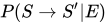
Given a system , we say that a physical event is a stimulus for the system if and only if the probability that the system suffers a change or be perturbed (in its elements or in its processes) when the event occurs is strictly greater than the prior probability that suffers a change independently of :

Let be an arbitrary system subject to changes in time and let be an arbitrary event that is a stimulus for the system : we say that is an adaptive system if and only if when t tends to infinity the probability that the system change its behavior in a time step given the event is equal to the probability that the system change its behavior independently of the occurrence of the event . In mathematical terms:

  1. -
  2. -

Thus, for each instant will exist a temporal interval such that:

Benefit of self-adjusting systems

[edit]

In an adaptive system, a parameter changes slowly and has no preferred value. In a self-adjusting system though, the parameter value “depends on the history of the system dynamics”. One of the most important qualities of self-adjusting systems is its “adaptation to the edge of chaos” or ability to avoid chaos. Practically speaking, by heading to the edge of chaos without going further, a leader may act spontaneously yet without disaster. A March/April 2009 Complexity article further explains the self-adjusting systems used and the realistic implications.[2] Physicists have shown that adaptation to the edge of chaos occurs in almost all systems with feedback.[3]

Practopoietic theory

[edit]

According to practopoietic theory, creation of adaptive behavior involves special, poietic interactions among different levels of system organization. These interactions are described on the basis of cybernetic theory in particular, good regulator theorem. In practopoietic systems, lower levels of organization determine the properties of higher levels of organization, but not the other way around. This ensures that lower levels of organization (e.g., genes) always possess cybernetically more general knowledge than the higher levels of organization—knowledge at a higher level being a special case of the knowledge at the lower level. At the highest level of organization lies the overt behavior. Cognitive operations lay in the middle parts of that hierarchy, above genes and below behavior. For behavior to be adaptive, at least three adaptive traverses are needed.[4]

See also

[edit]

Notes

[edit]

References

[edit]
[edit]
Revisions and contributorsEdit on WikipediaRead on Wikipedia
from Grokipedia
An adaptive system is a dynamic entity that modifies its behavior or structure in response to environmental changes, typically to improve performance, achieve goals, or maintain stability. This adaptation often involves feedback mechanisms that enable learning from experience, distinguishing adaptive systems from those with fixed responses. The concept of adaptive systems emerged prominently in the field of , pioneered by in the mid-20th century, who viewed them as mechanisms for and control in both machines and living organisms. A foundational principle is Ashby's Law of Requisite Variety, which states that effective requires the controlling subsystem to possess a variety of states at least as great as the disturbances it counters. Adaptive systems operate through dual feedback loops: immediate corrective responses to perturbations and longer-term structural adjustments that alter future behavior. Unlike self-organizing systems, which evolve in isolation without external input, adaptive systems remain open to environmental data to refine their operations. Examples of adaptive systems span diverse domains, including biological processes like plant growth circumventing obstacles or animal learning through , engineering applications such as thermostats maintaining equilibrium, and computational models in that adjust algorithms based on data inputs. In and , adaptive systems dynamically tune parameters to handle uncertainties, ensuring robust performance in varying conditions. Social and organizational contexts also feature adaptive systems, such as healthcare networks that evolve practices in response to emerging challenges, highlighting their role in managing complexity. These systems underscore the interplay of feedback, learning, and goal-directed change, influencing fields from to .

Fundamentals

Definition and Core Concepts

An adaptive system is a set of interacting components that modifies its behavior or structure in response to changes in its environment to achieve or maintain specific objectives, such as stability, , or . This capacity for adjustment distinguishes adaptive systems from static ones, which remain unchanged regardless of external inputs. In foundational terms from , an adaptive processes inputs (stimuli from the environment), produces outputs (responses or actions), interacts with its environment (the surrounding conditions influencing or affected by the ), and often incorporates feedback (information about outputs that influences future inputs) to guide adjustments. Core to adaptive systems is the concept of environmental responsiveness, where detection of changes occurs through sensors in engineered contexts or equivalent biological mechanisms, such as sensory receptors, enabling the system to alter its state proactively or reactively. A key distinction lies in regulatory strategies: maintains internal balance by restoring variables like body temperature to a stable set point via , as originally described in physiological contexts, while involves proactive adjustments to anticipated environmental demands, achieving stability through change rather than rigid constancy. For instance, a simple exemplifies by sensing temperature deviations and activating heating or cooling to keep room conditions within viable limits, mirroring low-level homeostatic regulation. The notion of adaptive systems emerged in mid-20th-century , formalized by in the 1950s and 1960s as systems that sustain essential variables within physiological or operational bounds through , though its roots trace to earlier biological observations of self-regulating organisms.

Key Characteristics

Adaptive systems exhibit primary characteristics that enable adjustment in varying environments, ranging from simple reactive mechanisms to more complex forms with additional properties. Flexibility is the ability to alter in response to environmental shifts. Robustness refers to the system's resilience against disturbances, maintaining core functions despite changes. These systems often rely on feedback loops for adjustment, with some demonstrating non-linearity where small changes can lead to significant effects. A distinction exists between reactive adaptation, which responds to observed changes via feedback, and proactive adaptation, which uses to adjust in advance. Metrics like the adaptation rate measure the time to reach stability after a perturbation.

Historical Development

Origins in Cybernetics and Systems Theory

The conceptual foundations of adaptive systems emerged during through military applications requiring real-time adjustment to dynamic environments, such as anti-aircraft predictors that used feedback mechanisms to track fast-moving targets like enemy aircraft. , working on these predictors, recognized that effective aiming demanded predicting trajectories amid uncertainty, laying groundwork for by integrating human operator insights with mechanical computation. This wartime necessity shifted engineering toward systems capable of self-correction, influencing early thought. In 1943, Warren McCulloch and published a seminal model of neural networks, portraying the as a network of binary neurons that could compute logical functions and adapt through modifiable connections, serving as an early prototype for artificial adaptive systems. Their work demonstrated how simple threshold-based units could simulate complex behaviors, including learning via synaptic changes, bridging neurophysiology and computation. Building on this, Wiener formalized in his 1948 book Cybernetics: Or Control and Communication in the Animal and the Machine, where feedback emerged as the core principle enabling —systems that monitor outputs and adjust inputs to achieve goals, drawing analogies from biological regulation to machines. The , held from 1946 to 1953 under the Josiah Macy Jr. Foundation, fostered interdisciplinary dialogue on these ideas, convening scientists like Wiener, McCulloch, and others to explore circular causal and feedback mechanisms in biological and social systems, explicitly addressing as a process of environmental responsiveness. These meetings emphasized purposeful, goal-seeking behaviors over rigid mechanistic , reorienting toward dynamic interaction. W. Ross Ashby advanced these concepts in his 1952 book Design for a Brain: The Origin of Adaptive Behaviour, introducing "ultrastable systems" as mechanisms that maintain stability through multiple internal states, allowing to severe environmental disturbances via step-function feedback—exemplified by his Homeostat device, which self-reorganized to restore equilibrium. This notion captured the essence of as switching between stable configurations without external programming, inspired by biological resilience. Complementing , Ludwig von Bertalanffy's general , detailed in his 1968 book General System Theory: Foundations, Development, Applications, portrayed adaptive systems as open entities that exchange , , and with their surroundings to sustain steady states and evolve , contrasting with closed systems prone to equilibrium and decay. Von Bertalanffy's framework underscored how such openness enables growth and self-maintenance, integrating cybernetic control with broader systemic principles. Feedback loops, foundational to these origins, provided the mechanism for such exchanges and adjustments.

Evolution in Modern Disciplines

In the 1970s, theory gained prominence as a key advancement in engineering disciplines, enabling systems to adjust parameters in real-time to handle uncertainties and changing conditions. Karl Johan Åström's pioneering work on self-tuning regulators, introduced in his 1973 paper, exemplified this by combining with control strategies to allow regulators to adapt automatically without prior knowledge of exact . This approach marked a shift from static controllers to dynamic ones, influencing industrial applications like process control. The 1980s saw the integration of adaptive systems concepts with emerging ideas from and , broadening their scope beyond engineering into physics and complexity science. Ilya Prigogine's development of dissipative structures theory, culminating in his 1984 book Order Out of Chaos co-authored with , demonstrated how far-from-equilibrium systems could self-organize and adapt through fluctuations, providing a theoretical bridge to chaotic dynamics. This work highlighted as an emergent property in open systems, influencing ecological and chemical models. By the 1990s, adaptive systems principles permeated , particularly through the rise of techniques that emphasized learning from interaction. emerged as a for adaptive , with seminal contributions like Christopher Watkins' 1989 algorithm enabling agents to optimize actions via trial-and-error in dynamic environments, gaining traction in the decade through applications such as Richard Sutton and Andrew Barto's foundational frameworks. Concurrently, Stuart Kauffman's 1993 book The Origins of Order: Self-Organization and Selection in applied adaptive concepts to self-organizing biological systems, arguing that order arises spontaneously in , thus extending adaptation from individual to collective levels. Post-2000, adaptive systems informed resilience engineering, especially in , where flexibility became essential for addressing uncertainties like climate variability. Adaptive governance frameworks, as articulated in Carl Folke et al.'s 2005 synthesis, promoted decentralized, learning-based to enhance resilience, with applications in such as community-based . In the , advancements in adaptive robotics further exemplified this evolution, with evolutionary algorithms driving autonomous skill development; for instance, Dario Floreano and colleagues' 2010 experiments demonstrated how Darwinian selection could evolve complex behaviors in robots interacting with unpredictable environments. Complexity science has increasingly framed as a multi-scale , spanning from genetic networks to societal structures, where interactions at lower levels propagate to higher-order . This perspective, explored in multilevel evolutionary models by Laurent Lehmann and Laurent Keller in 2006, underscores how adaptive processes at the level influence and cultural dynamics. Additionally, complexity approaches have illuminated tipping points in adaptive systems—thresholds where small changes trigger abrupt shifts—as analyzed in Max Rietkerk et al.'s 2021 study on spatial , revealing how can stabilize systems against collapse in ecological and social contexts.

Types of Adaptive Systems

Biological Adaptive Systems

Biological adaptive systems refer to the dynamic processes by which living organisms and ecosystems adjust to environmental pressures, ensuring and functionality through physiological responses and evolutionary changes. These systems operate at , , and levels, leveraging inherent variability to maintain or exploit new opportunities. Central to this is the distinction between genetic , which involves heritable changes in DNA over generations, and phenotypic plasticity, where a single produces varying phenotypes in response to environmental cues without genetic alterations. Phenotypic plasticity enables immediate, reversible adjustments, such as in plant leaf thickness varying with light exposure, while genetic builds long-term resilience through mechanisms like . Physiological adaptation exemplifies rapid, individual-level responses in biological systems. For instance, humans acclimatizing to high altitudes experience hypoxia, prompting the body to increase production, which stimulates synthesis and elevates levels to improve oxygen delivery. This process, peaking within days to weeks, enhances aerobic capacity and prevents , demonstrating how organisms fine-tune internal to transient stressors. In contrast, evolutionary adaptation unfolds across generations, as outlined in Charles Darwin's foundational 1859 publication , where acts on heritable variations, preserving traits that confer reproductive advantages in specific environments. A seminal case is the peppered moth (Biston betularia), whose melanic form surged in frequency during Britain's (circa 1840s–1890s) as soot-darkened trees favored darker against bird predation, with the light form rebounding post-pollution controls. At the ecosystem scale, biological adaptive systems manifest in interdependent dynamics, such as predator-prey interactions that oscillate in response to resource fluctuations. Classic models like Lotka-Volterra equations describe these cycles but have been extended to incorporate environmental variability, showing how prey populations may evolve anti-predator behaviors or predators refine hunting strategies amid shifts, stabilizing structure. Microbial communities further highlight adaptive prowess through (HGT), where bacteria exchange genetic material via conjugation, transformation, or transduction, rapidly disseminating advantageous genes across populations. This mechanism accelerated antibiotic resistance in bacteria shortly after penicillin's widespread use in the 1940s, with resistant strains like emerging by 1942 due to selective pressure from clinical applications. Epigenetic modifications provide another layer of rapid adaptation in biological systems, altering gene expression through mechanisms like DNA methylation or histone acetylation without changing the underlying DNA sequence. These heritable yet reversible changes enable quick phenotypic shifts, such as enhanced stress tolerance in plants exposed to drought, facilitating survival in fluctuating conditions before genetic evolution catches up. In ecosystems, epigenetics influences microbial consortia, allowing collective responses to toxins or nutrient scarcity via transmitted regulatory patterns. Overall, these intertwined processes—physiological, evolutionary, and epigenetic—underpin the resilience of biological adaptive systems, from single cells to complex biomes.

Engineered Adaptive Systems

Engineered adaptive systems are human-designed technologies that dynamically adjust their or in response to changing environmental conditions or requirements, often incorporating feedback loops to maintain stability and optimize functionality. These systems emerged prominently in the mid-20th century, driven by needs in and , where fixed-parameter designs proved inadequate for varying dynamics such as atmospheric disturbances. Unlike biological systems, engineered ones rely on programmable algorithms, sensors, and actuators to enable , drawing brief inspiration from natural feedback mechanisms to enhance robustness. In , adaptive control systems have been pivotal for aircraft stability. The first adaptive , developed by in the mid-1950s, represented a breakthrough by automatically adjusting control parameters to handle varying flight conditions, and was applied to vehicles like the F-94 fighter, F-101 interceptor, X-15 rocket plane, and X-20 Dyna-Soar glider. For instance, modern aircraft autopilots use to counteract by real-time estimation and compensation of aerodynamic changes, ensuring precise trajectory tracking even under gust loads. This capability was demonstrated in early flight tests of the X-15 in 1959, where adaptive schemes managed the hypersonic vehicle's unstable dynamics. Software-based adaptations are common in , where adaptive filters continuously tune their coefficients to minimize errors in noisy environments. A foundational example is the least mean squares (LMS) algorithm, introduced by Bernard Widrow and colleagues in the 1960s, which enables filters to converge on optimal weights for applications like echo cancellation and in communications systems. These filters adjust to time-varying signals, such as in wireless channels affected by , by iteratively updating parameters based on error feedback. Computational adaptive systems leverage algorithms inspired by optimization processes to solve complex problems. Neural networks, for example, adapt through learning rules that modify synaptic weights to approximate desired mappings, with the algorithm—developed by Rumelhart, Hinton, and Williams in 1986—enabling efficient training for tasks like and control. Genetic algorithms, pioneered by John Holland in the 1970s, evolve solutions via selection, crossover, and mutation to optimize parameters in dynamic environments, such as scheduling or problems where objectives shift over time. A key concept in engineered adaptation is model reference adaptive control (MRAC), where system parameters are adjusted online to make the closed-loop response match that of a predefined , ensuring consistent performance despite uncertainties. Proposed by Whitaker et al. in 1958 for design, MRAC uses theory to guarantee convergence, and has been implemented in flight control systems to handle parameter variations like mass changes or failures. Hardware adaptations, such as in reconfigurable robots, allow physical reconfiguration for task versatility; for instance, modular systems like those developed by Yim et al. in the can self-assemble into different morphologies to navigate varied terrains, adapting structure to environmental demands. In astronomical instrumentation, adaptive optics systems correct for atmospheric distortions in real-time using deformable mirrors and wavefront sensors. These gained widespread adoption post-1990s, with the first astronomical implementations on large telescopes like the ESO's in the early 2000s, achieving near-diffraction-limited imaging by adjusting thousands of actuators per second. NASA's use of adaptive flight software in Mars rovers, starting with autonomous capabilities in the 1997 Sojourner mission and evolving in later models like the Mars Exploration Rovers (2004), enables on-the-fly path planning and hazard avoidance, adapting to rocky terrains without constant commands.

Mechanisms of Adaptation

Feedback and Control Loops

Feedback serves as a fundamental mechanism in adaptive systems, enabling short-term adjustments to maintain stability or achieve desired performance by comparing system outputs against reference inputs. In , deviations from the setpoint are dampened to restore equilibrium, as seen in a that reduces heating when the temperature exceeds the target, thereby promoting system stability. , conversely, amplifies deviations to drive rapid changes, such as in electronic oscillators where output reinforces input to sustain oscillations, though it risks instability if unchecked. Control loops form the structural basis for implementing feedback, distinguishing between open-loop and closed-loop configurations. Open-loop systems operate without feedback, relying on predefined inputs to produce outputs, which limits adaptability to disturbances since no corrective action occurs based on actual performance. Closed-loop systems, incorporating feedback, continuously monitor outputs and adjust inputs accordingly, enhancing robustness in varying conditions. A prominent example of closed-loop control is the proportional-integral-derivative (PID) controller, which computes an error signal as the difference between the desired setpoint and the measured , then applies corrective action through three terms. The proportional term provides an output proportional to the current error, the integral term accounts for accumulated past errors to eliminate steady-state offsets, and the derivative term predicts future errors by considering the rate of change, yielding the control signal: u(t)=Kpe(t)+Ki0te(τ)dτ+Kdde(t)dtu(t) = K_p e(t) + K_i \int_0^t e(\tau) \, d\tau + K_d \frac{de(t)}{dt} where e(t)e(t) is the , and KpK_p, KiK_i, KdK_d are the respective gains tuned for optimal response. This formulation, first theoretically analyzed by Nicolas Minorsky in 1922 for ship steering, remains widely adopted in industrial automation due to its simplicity and effectiveness. Stability in feedback loops is critical to prevent oscillations or divergence, analyzed using the Nyquist criterion, which assesses closed-loop stability by examining the open-loop plot's encirclements of the critical point (-1, 0) in the . Formulated by in 1932, this graphical method ensures the number of unstable poles matches the plot's encirclements, guiding gain adjustments for reliable operation. Early cybernetic devices exemplified feedback adaptation, such as W. Ross Ashby's homeostat built in 1948, a four-unit analog machine that used uniselector switches and random variation to reconfigure connections until equilibrium was restored against environmental perturbations, demonstrating ultrastable adaptation through negative feedback. In dynamic environments, fixed PID gains may lead to suboptimal performance or instability, necessitating adaptive tuning where gains are automatically adjusted based on real-time system identification to minimize oscillations and maintain responsiveness. Such tuning complements longer-term learning mechanisms by focusing on immediate rule-based corrections for stability.

Learning and Self-Organization

In adaptive systems, learning mechanisms facilitate long-term structural and behavioral adjustments by processing environmental data to improve performance over time. Supervised learning involves training models on labeled datasets to map inputs to known outputs, enabling predictive adaptations in controlled environments. Unsupervised learning, by contrast, discovers inherent structures or patterns in unlabeled data, supporting exploratory adaptations without predefined goals. allows agents to iteratively refine actions based on rewards and penalties received from interactions with the environment, promoting goal-directed in dynamic settings. A foundational example in reinforcement learning is Q-learning, an off-policy temporal-difference method that updates an action-value function to estimate the expected cumulative reward for state-action pairs. The update rule is given by: Q(s,a)Q(s,a)+α[r+γmaxaQ(s,a)Q(s,a)]Q(s,a) \leftarrow Q(s,a) + \alpha \left[ r + \gamma \max_{a'} Q(s',a') - Q(s,a) \right] where α\alpha is the learning rate determining the update magnitude, rr is the immediate reward, γ\gamma is the discount factor for future rewards, ss and aa are the current state and action, and ss' is the next state. This algorithm converges to optimal policies under suitable conditions, enabling adaptive decision-making in uncertain domains. Self-organization in adaptive systems refers to the of ordered structures and behaviors from local interactions without external direction, enhancing system coherence and functionality. describes self-maintaining systems that produce and sustain their own components through recursive processes, as exemplified in living cells where metabolic networks regenerate boundaries and structures internally. This concept underscores how adaptive systems can autonomously preserve identity amid perturbations. is vividly illustrated in cellular automata such as , a grid-based simulation where simple rules governing cell birth, survival, and death lead to complex patterns like gliders and oscillators, demonstrating where the system balances on the edge of chaos to generate diverse configurations. Unique to learning processes in these systems is Hebbian learning, a biological principle where synaptic strength increases between neurons that are frequently activated simultaneously, encapsulated by the "cells that fire together wire together." This mechanism drives associative memory and in neural networks, allowing adaptive systems to strengthen relevant connections through repeated co-activation. Similarly, ant colony optimization, developed in the 1990s, draws from biological swarms where ants deposit pheromones to mark paths, inspiring algorithms that enable decentralized problem-solving in routing and scheduling by simulating emergent . Learning and self-organization embody bottom-up adaptation, where changes arise from decentralized, local rules and interactions, differing from top-down approaches that impose hierarchical controls. This bottom-up nature confers resilience to unforeseen changes by distributing adaptability across components, allowing the system to reorganize spontaneously and maintain functionality when facing novel disruptions, as seen in social-ecological systems where learning buffers against shifts.

Theoretical Frameworks

Practopoietic Theory

Practopoietic theory, developed by Danko Nikolić in 2015, posits that in biological systems arises from hierarchical levels where lower mechanisms enable the creation of higher adaptive ones through interaction with the environment and structured feedback mechanisms. This framework emphasizes that living systems actively resist decay by dynamically reorganizing to enhance viability and flexibility. Unlike , which focuses on self-maintenance and closure in operational terms, practopoiesis highlights active resistance to environmental disruptions via hierarchical adaptations that build complexity over time. At the core of practopoiesis is the concept of a of adaptive layers, termed practopoietic levels, ranging from low-level to high-level . These layers operate through "traverses," which are iterative adaptive acts where lower levels generate and refine higher ones, increasing the 's overall adaptability with each additional traverse. For instance, a T1 (one traverse) maintains basic , like responses; a T2 (two traverses) incorporates learning via plasticity; and a T3 (three traverses) achieves advanced through meta-adaptation. The distinguishes between viable states, which ensure survival by sustaining core functions, and adaptive states, which go further by improving performance and expanding behavioral repertoires in response to changing environments. Practopoietic systems manifest across multiple scales, with interactions modeled qualitatively as feedback-driven cycles that propagate adjustments upward and downward through the . At the cellular level, occurs via and protein regulation, where environmental signals trigger traverses to maintain metabolic balance. Organismal levels involve neural and behavioral adaptations, such as in brains, which refines neural circuits based on experience to optimize information processing and resist perturbation-induced inefficiencies. Social levels extend this to collective dynamics, like evolutionary pressures shaping group behaviors in populations, where higher-layer traverses enable emergent beyond individual capabilities. These layer interactions form a "practopoietic cycle," where perturbations at one level necessitate compensatory actions across others, fostering resilience through qualitative eco-feedback loops rather than static equilibria.

Other Theories in Adaptation

Cybernetic theory, pioneered by in his 1948 work, posits that adaptation arises primarily through feedback loops that enable systems to self-regulate and maintain stability amid disturbances, applicable to both engineered devices and biological organisms. This framework addresses multi-scale adaptation by modeling feedback across hierarchical levels, from individual components like servomechanisms to larger networks in animal behavior and social organizations, where information flow adjusts responses to environmental changes. In contrast, the theory of , formulated by and in 1974, defines as autopoietic machines characterized by self-production and operational closure, where internal processes recursively generate and maintain the system's boundaries while permitting structural with the external environment. Autopoiesis handles multi-scale adaptation through nested organizations, such as cellular components forming multicellular organisms, ensuring viability by conserving the network of processes that define the system's identity across biological hierarchies without relying on external directives. Ilya Prigogine's theory of dissipative structures, developed in the 1970s, explains in open systems far from , where continuous influx and dissipation of energy drive the emergence of ordered patterns from fluctuations, as seen in chemical oscillations like the Belousov-Zhabotinsky reaction. This approach addresses multi-scale by illustrating how local instabilities propagate to global structures, from molecular assemblies to planetary atmospheres, fostering resilience through irreversible processes that amplify order amid chaos. Resilience theory, introduced by C.S. Holling in his paper, conceptualizes adaptation via the adaptive cycle—a dynamic loop of exploitation (growth), conservation (stability), release (collapse), and reorganization (renewal)—that allows ecological systems to absorb shocks and reorganize. It explicitly tackles multi-scale adaptation through the model, where cycles at finer scales (e.g., populations) interact with broader ones (e.g., forest ecosystems), enabling cross-scale influences that enhance overall system persistence and transformation. Enactivism, elaborated by Francisco Varela in collaboration with Evan Thompson and Eleanor Rosch in 1991, frames adaptation as embodied sense-making, where cognition emerges from the ongoing, history-dependent interactions between an autonomous agent and its world, without representational intermediaries. This theory addresses multi-scale adaptation by integrating sensorimotor contingencies across temporal and spatial levels, from immediate perceptual adjustments to long-term skill development, emphasizing how organisms enact their environments through coupled dynamics.

Applications and Examples

In Engineering and Technology

Adaptive systems in and enable dynamic responses to environmental changes, optimizing performance in real-world applications. One prominent example is adaptive traffic control systems, such as the (SCATS), which has been operational in since the mid-1970s and dynamically adjusts signal timings based on real-time traffic volumes detected by sensors at intersections. This system coordinates signals across urban networks to minimize congestion and improve flow, demonstrating how adaptive algorithms can reduce average delays by up to 20% in high-traffic areas compared to fixed-time controls. In , autonomous vehicles leverage adaptive systems through , integrating data from , , and cameras to enable real-time adaptation to road conditions, obstacles, and weather variations. For instance, these systems use multi-sensor fusion pipelines to predict and react to dynamic environments, such as sudden movements or changes, ensuring safer by processing heterogeneous data streams with low latency. Cloud computing platforms exemplify adaptive resource management, with services like (AWS) Auto Scaling automatically adjusting compute capacity based on application load metrics, such as CPU utilization or request rates. This mechanism scales instances up during peak demand and down during lulls, maintaining performance while optimizing costs, and has been integral to handling variable workloads in data-intensive applications since its introduction in the early . Another technological application is adaptive noise cancellation in hearing aids, which advanced significantly in the post-2000 era with enabling real-time suppression of background while preserving speech clarity. Modern devices employ adaptive algorithms that continuously analyze acoustic environments and adjust filtering parameters, improving signal-to-noise ratios by 10-15 dB in noisy settings like restaurants or traffic. Case studies highlight the robustness of adaptive systems in , such as the 787 Dreamliner's flight controls, which adapt to disturbances like by modulating control surfaces in real time to maintain stability and passenger comfort. This uses envelope features to prevent stalls or excessive maneuvers, contributing to enhanced safety during turbulent conditions. In fault-tolerant computing, NASA's software-implemented fault tolerance approaches, like the SIFT (Software Implemented Fault Tolerance) developed in the and refined for missions, enable recovery from errors through redundant execution and error detection, ensuring mission-critical operations continue despite hardware or software faults. For example, SIFT's recovery blocks allow alternate software modules to take over upon failure detection, achieving reliability rates exceeding 10^9 hours mean time to failure in simulated environments. Integration with the (IoT) facilitates distributed adaptation, where networked devices collaboratively adjust behaviors across ecosystems, such as smart grids optimizing energy distribution based on real-time consumption data from sensors. This enables scalable responses in large-scale deployments, like industrial IoT for , where adaptive models learn from device interactions to preempt failures. However, such systems face challenges, including computational overhead from continuous monitoring and decision-making processes, which can increase by 15-30% in resource-constrained environments and necessitate efficient algorithms to mitigate latency.

In Biology and Ecology

In biology, adaptive systems manifest through mechanisms that enable organisms and populations to respond dynamically to environmental changes, enhancing and functionality. A prominent example is , where adaptive drug dosing adjusts therapeutic interventions in real-time based on physiological feedback. Insulin pumps, for instance, utilize closed-loop systems that continuously monitor blood glucose levels and automatically deliver precise insulin doses to maintain in diabetic patients, significantly reducing the risk of hypoglycemic events compared to manual dosing. Conservation biology employs adaptive management strategies to address uncertainties in ecosystem restoration, iteratively refining interventions based on monitoring data. In the Florida Everglades, restoration efforts initiated in 2000 under the Comprehensive Everglades Restoration Plan have used adaptive approaches to restore hydrological flows and conditions, while separately addressing like Burmese pythons through data-driven removal programs and population monitoring, leading to improved native species recovery in targeted areas. This approach underscores how adaptive systems in facilitate resilient responses to anthropogenic pressures, such as habitat alteration. Ecological adaptation is evident in agricultural practices responding to climate variability, where genetic engineering tools like CRISPR have enabled the development of drought-resistant crops since 2012. For example, CRISPR-edited rice varieties exhibit enhanced yield stability under water stress, with field trials showing improved performance in arid conditions compared to non-edited counterparts. Similarly, coral reef resilience models predict and mitigate bleaching responses by simulating adaptive physiological adjustments in symbiotic algae, informing interventions like shading or probiotics that have shown potential to improve survival rates in bleached reefs in various studies. Case studies of viral adaptation highlight rapid evolutionary changes within biological systems. During the in the 2020s, mutations such as those in the enabled immune evasion, with variants like showing up to 10-fold higher transmissibility due to adaptive shifts in receptor binding. In animal , adaptive behaviors have been tracked using GPS since the , revealing how like African elephants adjust migration routes in response to resource availability, optimizing intake amid . Adaptive strategies in and bolster services, such as and , by promoting functional redundancy among . These approaches play a critical role in preservation, as seen in adaptive co-management frameworks that integrate indigenous with scientific monitoring to sustain diverse habitats under stress. As of 2025, ongoing research into , including applications for corals, continues to enhance adaptive resilience in marine ecosystems.

Benefits and Limitations

Advantages of Adaptivity

Adaptive systems provide enhanced performance in uncertain environments by dynamically adjusting parameters to cope with disturbances, unmodeled dynamics, and changing conditions, often outperforming fixed systems in maintaining stability and . In , techniques like L1 adaptive control guarantee uniform transient performance and robustness, enabling systems to track references with minimal error even under high uncertainty. Similarly, extremum-seeking adaptive control optimizes unknown processes in real time, yielding exponential convergence to optimal operating points and efficiency gains, such as reduced consumption in combustion engines. A key advantage is improved resilience to failures, where adaptive mechanisms enable rapid recovery and , significantly reducing in critical infrastructures like . Self-healing adaptive , for example, autonomously detect anomalies and reroute resources, minimizing service interruptions from hardware faults or cyberattacks and ensuring higher availability than static architectures. This resilience extends to broader operational longevity, offsetting initial design with lower long-term costs and extended lifespan in applications. Adaptive systems also scale effectively to handle complex, multifaceted problems that overwhelm non-adaptive approaches, facilitating applications in diverse domains. In , adaptive algorithms continuously evolve to capture market dynamics, outperforming static predictive models in shifts and generating superior returns by adapting to volatility. In and , adaptivity drives evolutionary advantages, with heritable traits enabling higher and reproduction rates in response to environmental pressures, as seen in populations where adaptive variations increase fitness under stress. Industrially, adaptive processes, such as dynamic role-adaptive , reduce material waste through real-time adjustments, yielding economic benefits via . Evidence from computational simulations consistently shows adaptive systems surpassing non-adaptive counterparts in variable scenarios, with metrics like reduced tracking errors and faster highlighting their superiority in dynamic contexts.

Challenges and Constraints

Adaptive systems often introduce heightened , which can lead to unpredictable behaviors due to nonlinear interactions and emergent that defy simple modeling. This arises from the dynamic interplay of components, making it challenging to forecast system responses accurately, as small changes can amplify into significant . For instance, "adaptation traps" occur when systems become locked into maladaptive states, such as rigidity traps where excessive control stifles flexibility or poverty traps where insufficient resources prevent adjustment, ultimately reducing overall . In contexts, over-adjustment in feedback mechanisms can exacerbate this, causing oscillations or in control loops, as seen in nonlinear where general theories fail to handle such behaviors comprehensively. A major constraint is the high computational demands of adaptive systems, particularly in real-time applications where continuous learning and adjustment require substantial processing resources. Real-time adaptive learning algorithms, for example, often demand significantly more computational power—potentially orders of magnitude higher than static systems—to process incoming data and update models on the fly, limiting their deployment in resource-constrained environments. Additionally, the "no free lunch" theorem demonstrates that no single adaptive can excel across all possible problem domains without prior assumptions about the environment, implying that performance gains in one scenario come at the expense of others, thus constraining universal applicability. Maladaptation represents another key limitation, where adaptive responses intended to enhance fitness instead lead to detrimental outcomes due to environmental mismatches. In biological systems, human obesity exemplifies this, as evolutionary adaptations for in scarce-food ancestral environments become in modern abundance, promoting chronic health issues. In artificial intelligence, ethical constraints emerge from bias amplification, where adaptive AI systems trained on skewed data iteratively reinforce and exacerbate societal biases, potentially leading to discriminatory decisions at scale. Reliability concerns are particularly acute in safety-critical applications, such as adaptive braking systems in , where unpredictable adaptations could compromise performance and endanger lives, necessitating rigorous verification to ensure fault-tolerance. Adaptive systems must balance trade-offs between adaptation speed and accuracy, as faster responses often reduce precision due to incomplete information processing, rooted in underlying network topologies that limit simultaneous optimization. Consequently, human oversight remains essential in highly adaptive technologies to mitigate risks of instability or errors, providing intervention points for validation and correction.

References

Add your contribution
Related Hubs
User Avatar
No comments yet.