Hubbry Logo
AeolosaurusAeolosaurusMain
Open search
Aeolosaurus
Community hub
Aeolosaurus
logo
8 pages, 0 posts
0 subscribers
Be the first to start a discussion here.
Aeolosaurus
Aeolosaurus
from Wikipedia

Aeolosaurus
Temporal range: Late Cretaceous 83–66 Ma
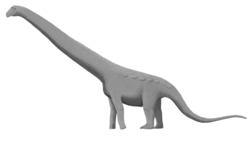
Life reconstruction of Aeolosaurus rionegrinus
Scientific classification Edit this classification
Kingdom: Animalia
Phylum: Chordata
Class: Reptilia
Clade: Dinosauria
Clade: Saurischia
Clade: Sauropodomorpha
Clade: Sauropoda
Clade: Macronaria
Clade: Titanosauria
Clade: Lithostrotia
Clade: Aeolosaurini
Genus: Aeolosaurus
Powell, 1987
Type species
Aeolosaurus rionegrinus
Powell, 1987
Other species
  • A. colhuehuapensis
    Casal et al., 2007

Aeolosaurus (/ˌlˈsɔːrəs/; "Aeolus' lizard") is a genus of titanosaurian sauropod dinosaur from the Late Cretaceous Period of what is now South America. Like most sauropods, it would have been a quadrupedal herbivore with a long neck and tail. Aeolosaurus is well known for a titanosaur, as it is represented by the remains of several individuals belonging to at least two species. However, like most titanosaurs, no remains of the skull are known. The holotype of Aeolosaurus rionegrinus consists of a series of seven tail vertebrae, as well as parts of both forelimbs and the right hindlimb. It was discovered in the Angostura Colorada Formation in Argentina, which dates from the Campanian stage of the Late Cretaceous, about 83 to 74 million years ago. The species A. maximus was transferred over to the new genus Arrudatitan in 2021.[1]

Etymology

[edit]

This dinosaur is named after the Greek mythological figure Aeolus, Keeper of the Winds in Homer's Odyssey, because of the frequent winds that blow across Patagonia, where the remains were found. The generic name also includes the Greek sauros ('lizard'), the traditional suffix used in dinosaur names. The specific name (A. rionegrinus), refers to its location, in the Rio Negro Province of Argentina. Both genus and species were named and described by Argentine paleontologist Jaime Powell in 1987.[2]

Provenance

[edit]

Aeolosaurus is a widespread genus of titanosaur known from the Late Cretaceous of South America. Fossils have been collected from the Allen, Angostura Colorada, Lago Colhué Huapí, and Los Alamitos Formations of Argentina and the Serra da Galga Formation of Brazil.[3] All Aeolosaurus fossils are from the Campanian and Maastrichtian ages of the Cretaceous period.

History

[edit]

The type species of Aeolosaurus, Aeolosaurus rionegrinus, was originally named along with the genus in the doctoral thesis of Jaime E. Powell. However, according to the ICZN, names from dissertations are not valid, so it was not formally named until it was published the following year.[2][4] Powell's thesis was ultimately published in 2003, which is sometimes incorrectly cited as having named the genus.[4][5] In 2004, Aeolosaurus and Gondwanatitan were recognized as forming a new group of titanosaurs, which was named Aeolosaurini.[6] In 2007, a second species, A. colhuehuapensis was named, also from Patagonia.[7] A third species, A. maximus, was named in 2011.[3] A. maximus was moved to the genus Arrudatitan in 2021.

Description

[edit]

Like all sauropods, Aeolosaurus was a large, long-necked, quadrupedal herbivore. A. rionegrinus was roughly 14 meters (46 ft) long and 6 tonnes (6.6 short tons) in weight according to Gregory S. Paul.[8] In 2020 Molina-Pérez and Larramendi gave a larger estimation of 18.1 meters (60 ft) and 14.7 tonnes (16.2 short tons).[9] A. rionegrinus was heavily built for a titanosaur, with limb bones similar in robustness to those of Saltasaurus.[3]

Aeolosaurs, Aeolosaurus in particular, have very distinctive caudal vertebrae. The genus Aeolosaurus is diagnosed by the shared presence of down-curved prezygapophyses on its anterior caudal vertebrae and chevrons from the anterior and middle portions of the tail with concave posterodorsal surfaces that contain double articular facets.[3] The caudal vertebrae of Aeolosaurus and the related genus Gondwanatitan share anteriorly-inclined neural spines in the anterior caudal vertebrae.[10] The vertebrae from the middle part of its tail had elongated centra.[11] Aeolosaurus had vertebral lateral fossae that resembled shallow depressions.[11] Fossae that similarly resemble shallow depressions are known from Saltasaurus, Alamosaurus, Malawisaurus, and Gondwanatitan.[11] Its middle tail vertebrae's neural spines angled anteriorly when the vertebrae are aligned.[11] These vertebrae resemble those of Cedarosaurus, Venenosaurus, and Gondwanatitan.[11] The tail of Aeolosaurus was apparently curved strongly downward, a trait likely shared with other members of Aeolosaurini.[12] This curvature would likely have led to the posterior portion of the tail being very low to the ground, though likely not touching it. The curved base of the tail may have enabled the m. caudofemoralis longus, which extended from the femur to the tail vertebrae, to exert more force while retracting the hindlimb.[12]

Aeolosaurus, like many lithostrotian titanosaurs, bore osteoderms.[13] However, its osteoderms were unusual and most closely resemble those of Mendozasaurus.[14] As in all osteoderm-bearing titanosaurs, the osteoderms were probably arranged in one or two rows along the flanks.

Classification

[edit]

Aeolosaurus is most closely related to the genera Gondwanatitan and Panamericansaurus.[15][16] Together with Gondwanatitan, it defines the clade Aeolosaurini.[6] The two Aeolosaurus species from Argentina, A. rionegrinus and A. colhuehuapensis, appear to be more closely related to each other than to the Brazilian species A. maximus.[3]

Aeolosaurus sp. tail vertebrae

The classification of Aeolosaurus and its relatives is heavily based on features of the tail vertebrae, which are the only bones preserved in most aeolosaurs.[3]

Aeolosaurus has been included in several cladistic analyses. The phylogeny of Aeolosaurini here is based on Gallina and Otero 2015, with the application of clade names according to their phylogenetic definitions.[3][6][16][17][18]

Aeolosaurini

Species

[edit]

There are currently two named valid species of Aeolosaurus, as well as several specimens that have been referred to the genus but not given a species. In addition, Gondwanatitan faustoi, the closest known relative of the genus, has been proposed to represent an additional species of Aeolosaurus, as Aeolosaurus faustoi.[19] However, Gondwanatitan is typically considered a distinct genus.[4]

Aeolosaurus sp. forelimb elements

Another specimen, described in 1993, consists of five tail vertebrae, and some bones from the forelimb and pelvis. Since there are two right ulna (forearm) bones, the specimen must consist of at least two individuals. These bones were also associated with two osteoderms, or bony armor plates, providing evidence that this dinosaur was armored. This specimen is from the Allen Formation of Rio Negro, dating back about 70 to 68 million years ago to the middle Maastrichtian stage. While this specimen bears features that characterize the genus Aeolosaurus, it is from a younger time period and shows enough differences that the authors recognized it as a possible second species.[13] Additional material from the same quarry, described in 2013, shows that the quarry contained the remains at least three individuals of Aeolosaurus.[21]

Another partial skeleton, including four more tail vertebrae and material from both limbs on the left side of the body, was described in 1997. This was recovered from the Los Alamitos Formation of Rio Negro, which falls between the other two dates. This specimen was also referred to the genus Aeolosaurus, but not to the species A. rionegrinus, and may represent a third species.[22]

However, since the genus Aeolosaurus is not well known, the authors chose not to formally name either of these possible new species. For now, they are both simply known as "Aeolosaurus sp." Future discoveries may give scientists more information on variation within the genus, and show that all of the above specimens belong to A. rionegrinus, or that they merit being formally named.

A middle caudal vertebra from the Serra da Galga Formation, CPP 248, cannot be evaluated for any diagnostic features of the genus Aeolosaurus.[4] However, because it clearly does not belong to Gondwanatitan, it is most likely that this vertebra represents Aeolosaurus, a genus otherwise unknown from the Serra da Galga Formation.[3]

Another series of 15 tail vertebrae was assigned to Aeolosaurus in the original description, but it was later determined that the series does not belong to this genus, as it lacks several features found in the other specimens of Aeolosaurus.[2][13]

Paleoecology

[edit]

Aeolosaurus lived during the Campanian and Maastrichtian ages of the Late Cretaceous and shared its environment with hadrosaurs.[3][5] The unnamed Allen Formation species of Aeolosaurus inhabited an environment that it shared with five other species of titanosaur, including Rocasaurus muniozi, as well as hadrosaurs and ankylosaurs.[21]

Aeolosaurus compared to dinosaur fauna from the Allen Formation (Aeolosaurus in light green, fourth from left)

References

[edit]
Revisions and contributorsEdit on WikipediaRead on Wikipedia
from Grokipedia
Aeolosaurus is a of titanosaurian sauropod from the Period of , known from partial skeletal remains including caudal vertebrae, limb bones, and pelvic elements. Named for , the Greek god of the winds, in reference to the windy Patagonian region where it was first discovered, the comprises two valid from : the A. rionegrinus and A. colhuehuapensis. Like other titanosaurs, it was a large, quadrupedal with a long neck and tail, estimated to have reached lengths of about 12–14 meters and weights of around 6 metric tons. The , Aeolosaurus rionegrinus, was named and described by Jaime E. Powell in 1987 based on fossils from the Late Angostura Colorada Formation in , , . These remains include a series of anterior to middle caudal vertebrae, a , and other elements that exhibit distinctive procoelous centra and anteriorly positioned postzygapophyses, features diagnostic of the genus. The second , A. colhuehuapensis, was described in 2011 from an articulated series of 21 caudal vertebrae collected from the Bajo Barreal Formation () in , further highlighting the genus's characteristic vertebral morphology with well-developed prezygapophyses and inclined neural arches. Formerly, a species from was assigned to the genus but was reclassified as Arrudatitan maximus in 2021. Aeolosaurus belongs to the clade Aeolosaurini within , a group of advanced titanosaurs characterized by specialized caudal vertebrae adapted possibly for enhanced tail flexibility or strength. Phylogenetic analyses place it as a sister to other South American aeolosaurins like Overosaurus and Rinconsaurus, supporting a Gondwanan distribution during the . Fossils attributed to the genus have been reported from multiple formations in Patagonia, indicating it was a relatively widespread member of Late Cretaceous sauropod faunas, coexisting with other titanosaurs such as and Neuquensaurus. Although no complete skeletons are known, the preserved elements suggest a robust build suited to browsing vegetation in forested or floodplain environments of the time.

Discovery and Research

Discovery

The initial fossils attributed to Aeolosaurus rionegrinus were discovered in the 1980s in , , within strata of the Angostura Colorada Formation. The specimen, MJG-R 1 (housed at the Museo Jorge Gerhold in Ingeniero Jacobacci), comprises seven anterior caudal vertebrae along with associated postcranial elements, including incomplete scapulae and humeri, the right ulna and radius, five metacarpals, nearly complete ischia, the right and , an astragalus, and associated fragments. These remains represent the foundational material for the genus, collected from fluvial and floodplain deposits indicative of a continental environment. Subsequent discoveries have expanded the known distribution of Aeolosaurus material across several Late Cretaceous units in Patagonia. Additional specimens, including partial vertebral series and isolated limb bones, have been recovered from the Lago Colhué Huapí Formation (Chubut Province), and the Los Alamitos Formation (Río Negro Province) in , as well as the Serra da Galga Formation (Minas Gerais State) in . All these formations span the to stages of the , dating to approximately 83–66 million years ago, based on biostratigraphic correlations with ammonites and . The referral of Brazilian specimens to Aeolosaurus was initially proposed based on shared caudal vertebral morphology but has faced scrutiny due to differences in proportional features and stratigraphic age discrepancies, prompting debates on generic assignment. The genus name Aeolosaurus alludes to the persistently windy conditions of the Patagonian discovery sites, invoking , of winds.

Naming

The genus Aeolosaurus and its type species A. rionegrinus were formally named and described by Argentine paleontologist Jaime E. Powell in 1987 as part of his doctoral thesis submitted to the Universidad Nacional de Tucumán. The description was based primarily on a partial featuring distinctive procoelous caudal vertebrae, which Powell identified as diagnostic for the new . No synonyms or misassignments were proposed at the time of naming, establishing A. rionegrinus as the valid without immediate taxonomic controversy. The etymology of the genus name Aeolosaurus derives from Aeolus, the Greek mythological god of the winds—alluding to the strong, persistent Patagonian winds near the type locality—combined with the Greek sauros, meaning "lizard" or "reptile." The species epithet rionegrinus honors Río Negro Province in Argentina, the region encompassing the discovery site. Powell initially classified Aeolosaurus within the Titanosauridae, a group of advanced sauropod dinosaurs characterized by procoelous caudal vertebrae, and drew comparisons to contemporaneous South American forms such as Saltasaurus, noting shared features like robust limb elements and vertebral pneumaticity. The holotype specimen (MJG-R 1), housed at the Museo Jorge Gerhold in Ingeniero Jacobacci, Argentina, comprises seven anterior caudal vertebrae, incomplete scapulae and humeri, the right ulna and radius, five metacarpals, nearly complete ischia, the right tibia and fibula, an astragalus, and associated fragments. The original diagnosis highlighted unique vertebral traits distinguishing Aeolosaurus from other titanosaurs, including prezygapophyses directed upward on the anteriormost caudal vertebrae (slightly curving downward on subsequent ones), widened prezygapophyseal facets with dorsal and ventral protuberances, and deep lateral fossae on the . These features, particularly the pneumatic fossae and procoelous articulation, underscored its placement among derived titanosaurs adapted to environments in Patagonia.

Subsequent Research

In 2007, a second species of Aeolosaurus, A. colhuehuapensis, was described by et al. based on an articulated series of 21 caudal vertebrae ( UNPSJB-PV 959) recovered from the Bajo Barreal Formation (, Campanian-Maastrichtian) near Lago Colhué Huapi in central , . This material was distinguished from the type species A. rionegrinus by features such as a deep fossa between the transverse process and neural arch base on middle caudal vertebrae, expanding the known geographic and morphological range of the genus within . A third species, initially named Aeolosaurus maximus in 2011 from caudal vertebrae in the Adamantina Formation () of southeastern , underwent reassessment in 2021 by Silva Junior et al., who erected the new genus Arrudatitan for it due to significant differences in vertebral morphology from Argentinean Aeolosaurus species. Specifically, the postzygapophyses in A. maximus (now Arrudatitan maximus) are positioned at the anterior half of the centrum in anterior-middle caudal vertebrae, contrasting with the more anterior or border placement in A. rionegrinus and A. colhuehuapensis; additionally, an accessory intrapostzygapophyseal lamina forms unique lateral camerae on the spinopostzygapophyseal fossa. Phylogenetic analysis by Silva Junior et al. further supported this separation, placing Arrudatitan in a or as sister to Punatitan rather than closely allied with Aeolosaurus. Subsequent studies in the 2020s have addressed the referral of additional material to Aeolosaurus, with ongoing debates centered on fragmentary titanosaurian remains from formations like the Anacleto and Allen in . For instance, Carballido et al. (2020) noted that some non-saltasaurine titanosaur vertebrae from northwestern share caudal features with Aeolosaurus but remain unassigned due to incompleteness, while Brazilian referrals have been increasingly questioned post-reclassification. Literature from the early 2020s, including discussions by Zaher et al. (2011, revisited in later works), highlights potential undescribed species in Patagonian localities based on isolated caudal elements exhibiting aeolosaurin-like procoely and neural arch shifts, though formal referrals await more complete specimens. Recent analyses post-2020 have employed computed (CT) scans to examine internal vertebral structures in Aeolosaurini, including Aeolosaurus, revealing pneumatic features and growth patterns that bolster the clade's . Vidal et al. (2021) used 3D reconstructions from CT-derived models of anterior caudal vertebrae (C4-C9) in Aeolosaurus maximus (pre-reclassification) to test neutral pose , identifying dense internal laminae and camerae that support aeolosaurin rigidity and distinguish the group from other titanosaurs. Similar CT applications in related taxa, such as pathological caudal lesions in indeterminate titanosaurs (Carballido et al., 2023), have corroborated shared internal bony structures like vascular foramina patterns in Aeolosaurus-like material. Phylogenetic updates from 2023 to 2025 have refined Aeolosaurus' position within , increasingly aligning it closer to Rinconsauria based on expanded datasets. Mihai et al. (2024) recovered Aeolosaurus and Arrudatitan as sister taxa within Aeolosaurini, forming a sister to Saltasaurinae and positioned near Rinconsauria in a broader titanosaur tree incorporating European material. A 2025 geometric morphometric study by Mazzetta et al. on hind limb evolution showed Aeolosaurus hind elements overlapping with rinconsaurians like Muyelensaurus and Mendozasaurus, suggesting shared adaptations for terrestrial locomotion and supporting a close rinconsaurian-aeolosaurin relationship within South American titanosaurs. These analyses emphasize Aeolosaurus' role in dispersal patterns across .

Description

General Build and Size

Aeolosaurus was a quadrupedal, herbivorous within the , distinguished by its long neck, extended tail, and robust, pillar-like limbs that supported a barrel-shaped torso typical of advanced titanosaurs. As a member of the aeolosaurine group, it exemplified the derived morphology of South American titanosaurs, with a adapted for browsing vegetation at varying heights. No complete or cranial material is known for the genus, limiting detailed reconstructions to fragmentary postcranial remains including vertebrae, girdle elements, and limb bones from multiple specimens. Adult individuals of Aeolosaurus are estimated to have measured 12 to 18 meters in total length, derived from comparisons of preserved vertebral series and limb elements to the closely related , which shares similar proportions but a slightly shorter overall span. These estimates account for the incomplete nature of the material, primarily consisting of anterior caudal vertebrae and partial fore- and hindlimbs, extrapolated using phylogenetic bracketing within . Body mass calculations, employing volumetric modeling of trunk and limb girths alongside scaling equations from circumferences, place Aeolosaurus in the range of 6 to 14.7 metric tons—substantially lighter than colossal contemporaries like , which approached or exceeded 70 metric tons, reflecting a more streamlined build suited to its forested habitat. The overall proportions of Aeolosaurus featured notably elongated cervical and caudal vertebral sequences relative to its dorsal column, contributing to a lengthened presacral and postsacral profile that may have enhanced among titanosaurs. This configuration, combined with moderately slender limb elements, suggests a degree of uncommon in larger sauropods, potentially allowing for more maneuverable movement in dense . Additionally, isolated osteoderms associated with Aeolosaurus specimens indicate the presence of armored dermal scutes embedded in the skin, a defensive known in several derived titanosaurs, including members of .

Diagnostic Features

The genus Aeolosaurus is primarily diagnosed by features of its , particularly the caudal vertebrae, as no cranial material or complete elements have been recovered. The middle caudal vertebrae exhibit procoelous , characterized by a concave anterior articular surface and a convex posterior condyle, accompanied by deep lateral fossae and reduced neural arches positioned far anteriorly on the centrum. These traits, including the anterior placement of postzygapophyses relative to the anterior margin of the centrum in mid-caudals, are autapomorphic for Aeolosaurus and define the clade Aeolosaurini within . Preserved appendicular elements include the humerus and femur, both with rounded proximal heads that articulate via ball-and-socket joints, consistent with a stable quadrupedal posture; however, no manus or pes bones are known, limiting detailed comparisons. Osteoderms, documented in specimens referred to A. colhuehuapensis, consist of scattered, plate-like dermal elements along the flanks and proximal tail, thicker and more solid than those of Saltasaurus loricatus, lacking a pronounced cingulum and exhibiting a rhomboid outline.

Classification

Phylogenetic Position

Aeolosaurus is recognized as a member of the advanced titanosaurian within , the dominant group of sauropod dinosaurs during the . It belongs to the tribe Aeolosaurini, defined cladistically as the least inclusive containing Aeolosaurus rionegrinus and Gondwanatitan faustoi, supported by shared derived traits of the caudal vertebrae such as prezygapophyses extending more than 50% of the centrum length and anteriorly positioned postzygapophyses. Phylogenetic studies indicate that Aeolosaurus forms part of the South American radiation of titanosaurs following the breakup of Gondwana, with close affinities to other regional forms. In particular, the Argentine species of Aeolosaurus (A. rionegrinus and A. colhuehuapensis) are recovered as sister taxa to each other, often forming a clade with Punatitan and the reclassified Brazilian taxon Arrudatitan maximus (formerly Aeolosaurus maximus). Aeolosaurini is nested within Rinconsauria (encompassing genera like Rinconsaurus and Muyelensaurus) and the broader Colossosauria. Earlier analyses suggested a sister relationship to Gondwanatitan faustoi, but updated matrices refine this to a broader association within Aeolosaurini, emphasizing the post-Gondwanan diversification in Patagonia. Key synapomorphies supporting Aeolosaurini membership include the anterior or level positioning of postzygapophyses with the anterior border of the centrum in anterior and middle caudal vertebrae, distinguishing it from more derived groups like Saltasauridae. Cladistic analyses from 2021 to 2025, such as those by Silva Junior et al. and Soto et al., utilizing expanded character matrices excluding problematic taxa like Arrudatitan, position Aeolosaurus within Aeolosaurini, often in a or weakly supported nested in Rinconsauria under broader . These studies highlight Aeolosaurus as part of this Gondwanan group. However, earlier 2010s analyses occasionally placed Aeolosaurus nearer to as a whole due to limited caudal material and coarser matrices, a placement refuted by subsequent refinements incorporating more vertebral and appendicular data, which stabilize its Aeolosaurini affinity.

Valid Species

The genus Aeolosaurus currently includes two valid species, both known primarily from caudal vertebral series that exhibit characteristic pneumatic features diagnostic of aeolosaurine titanosaurs. The type species, A. rionegrinus, was named and described by Powell in 1987 based on holotype specimen MJG-R 1 (housed at the Museo Jorge Gerhold, Cinco Saltos, , ), comprising seven anterior to middle caudal vertebrae along with partial and elements including scapulae, humeri, , , metacarpals, , femora, , , and astragalus. These fossils were recovered from the Upper (Campanian) Anacleto Formation (Neuquén Group) near Bajo de las Tunas, , . The species remains valid due to the uniquely deep, elongate pneumatic fossae on the lateral surfaces of the caudal centra, which are more pronounced than in other titanosaurs, providing a key autapomorphy for the genus. The second valid species, A. colhuehuapensis, was established by Casal et al. in 2007 from holotype specimen UNPSJB-PV 959 (Universidad Nacional de la Patagonia San Juan Bosco, , , ), consisting of an articulated series of 21 caudal vertebrae (from anterior to posterior positions) and associated osteoderms. This material originates from the Upper (late ) Bajo Barreal Formation (specifically the Lago Colhué Huapí Member) on an island in Lago Colhué Huapí, Sarmiento Department, , . It is distinguished from A. rionegrinus by shallower and less complex pneumatic fossae on the caudal , as well as the presence of dermal armor in the form of osteoderms, which are not reported for the type species; these features support its specific validity within the genus. A third species, A. maximus (Santucci and de Arruda-Campos, 2011), was originally assigned to Aeolosaurus based on MPMA 12-0001-97, a partial skeleton including dorsal, sacral, and caudal vertebrae, ribs, and limb bones from the Upper (Santonian–) Adamantina Formation (Bauru Group), Presidente Prudente Municipality, São Paulo State, . However, this assignment has been invalidated; in 2021, Silva Junior et al. reclassified it as the type species of a new genus, Arrudatitan maximus, citing differences in vertebral morphology such as shallower and less extensive pneumatic fossae, more elongate centrum proportions, and reduced neural arch complexity compared to Patagonian Aeolosaurus species, alongside the biogeographic separation between the Argentine and Brazilian localities. Post-2021 taxonomic referrals to Aeolosaurus have excluded all Brazilian material, recognizing no junior synonyms among the valid species. As of 2025, no additional species have been formally described, though indeterminate Aeolosaurus sp. material from Patagonian formations (e.g., Allen and Los Alamitos) continues to be reported in ongoing studies without species-level attribution.

Paleoecology

Geological Context

Aeolosaurus fossils are primarily recovered from formations in , , within the and Golfo San Jorge basins, dating to the Campanian-Maastrichtian stages of the . The type species, A. rionegrinus, originates from the Anacleto Formation in the Basin, northern , which forms part of the Río Colorado Subgroup and consists of purple to reddish-brown claystones, mudstones, and fine-grained sandstones interbedded with and siliceous concretions. These sediments represent low-energy depositional environments, including meandering fluvial channels, overbank areas, and shallow lacustrine settings within extensive alluvial plains and riverine floodplains, indicative of a dynamic with periodic flooding. The species A. colhuehuapensis is known from the Lago Colhué Huapí Formation in the Golfo San Jorge Basin, central , a unit spanning the –Maastrichtian and comprising continental sediments such as sandstones, siltstones, and mudstones. This formation reflects a semi-arid paleoenvironment with fluvial overbank and lacustrine , as well as potential aeolian influences in its upper sections, supporting deposition in lowstand systems tracts during relative sea-level fluctuations. Initial Brazilian records attributed to Aeolosaurus came from the Serra da Galga Formation in the Bauru Group, southeastern , which features aeolian sands and fluvial deposits from the ; however, following a 2021 reassessment, A. maximus was excluded from the genus and recognized as a distinct titanosaur outside Aeolosaurini. Taphonomic evidence from Aeolosaurus sites highlights preservation influenced by fluvial dynamics. The of A. colhuehuapensis includes 21 articulated caudal vertebrae and seven haemal arches embedded in overbank mudstones, indicating minimal post-mortem transport and rapid burial in fine-grained, low-energy deposits that protected the remains from significant or scavenging. In contrast, other Aeolosaurus specimens, particularly from the Anacleto Formation, occur in partially disarticulated assemblages within bonebeds, suggesting episodes of hydraulic transport by seasonal floodwaters across the before final deposition. The rare occurrence of osteoderms in the fossil record, such as those associated with A. rionegrinus, points to localized rapid burial events that favored the preservation of these dermal elements amid otherwise dispersive fluvial conditions. The broader paleoenvironment of these formations was shaped by the Neuquén Basin's evolution as a retroarc foreland system during the Late Cretaceous, under a semi-arid climate with marked seasonality, including wet winters and dry summers driven by monsoonal patterns. Sedimentary records and paleoclimate models indicate episodic fluvial aggradation linked to eustatic sea-level changes, which influenced basin subsidence and sediment supply, fostering habitats of seasonal rivers and vegetated floodplains amid broader aridification trends. Recent sedimentological studies post-2020 have further linked these deposits to climate variability, with palynofloral evidence from the Lago Colhué Huapí Formation reinforcing semi-arid conditions transitioning to slightly more humid intervals in the Maastrichtian.

Contemporaries and Interactions

Aeolosaurus inhabited the fluvial floodplains of the Anacleto Formation in northern Patagonia during the Campanian stage of the Late Cretaceous, sharing its ecosystem with a diverse array of vertebrates. Among dinosaurs, it coexisted with other titanosaurian sauropods such as Antarctosaurus wichmannianus, the non-hadrosaurid ornithopod Gasparinisaura cincosaltensis, and theropods including the abelisaurid Aucasaurus garridoi and the megaraptorid Aerosteon riccoloradensis. The assemblage also included crocodylomorphs, chelid turtles, squamates, and small mammals, reflecting a stable, low-energy riverine environment supportive of a varied tetrapod community. In the Lago Colhué Huapí Formation, A. colhuehuapensis coexisted with a more derived assemblage, including hadrosaurid ornithopods such as Bonapartesaurus rionegrensis, megaraptorid theropods like Joaquinraptor stacki, and other titanosaurs, indicative of a ecosystem with increasing ornithischian diversity. As a low-level browser, Aeolosaurus likely consumed ground-level vegetation such as ferns, cycads, and prevalent in the settings of its habitat. Inferences from dental microwear and tooth morphology in related titanosaurs indicate a diet dominated by tough, abrasive plant matter, with wear facets suggesting frequent contact with fibrous foliage rather than soft fruits or seeds. Multiple individuals of Aeolosaurus are known from various localities, though no large monospecific bonebeds have been documented. The presence of osteoderms along its body, similar to those in other lithostrotian titanosaurs, likely served a defensive function against predators like abelisaurids, providing armored protection during encounters. No of nesting sites or reproductive behaviors specific to Aeolosaurus has been found, unlike in some coeval titanosaurs. Ecologically, Aeolosaurus occupied a mid-sized niche within a of diverse sauropods, estimated at 10–12 meters in length and weighing around 6–7 tons, bridging smaller forms like saltasaurines and larger diplodocoids or basal titanosaurs in the assemblage. This positioning allowed it to exploit intermediate browsing heights without direct competition from giants. Recent stable isotope analyses of from related Patagonian sauropods, such as Bonitasaura salgadoi, indicate limited seasonal migration within arid to semi-arid basins, suggesting Aeolosaurus may have remained in localized habitats year-round rather than undertaking long-distance movements.

References

Add your contribution
Related Hubs
User Avatar
No comments yet.