Hubbry Logo
AndesaurusAndesaurusMain
Open search
Andesaurus
Community hub
Andesaurus
logo
8 pages, 0 posts
0 subscribers
Be the first to start a discussion here.
Andesaurus
Andesaurus
from Wikipedia

Andesaurus
Temporal range: Cenomanian
99.6–97 Ma
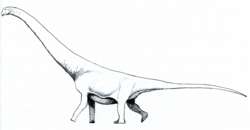
Illustration of Andesaurus
Scientific classification Edit this classification
Kingdom: Animalia
Phylum: Chordata
Class: Reptilia
Clade: Dinosauria
Clade: Saurischia
Clade: Sauropodomorpha
Clade: Sauropoda
Clade: Macronaria
Clade: Titanosauria
Genus: Andesaurus
Calvo & Bonaparte, 1991
Species:
A. delgadoi
Binomial name
Andesaurus delgadoi

Andesaurus (/ˌændəˈsɔːrəs/ AN-də-SOR-əs; "Andes lizard") is a genus of basal titanosaurian sauropod dinosaur which existed during the middle of the Cretaceous Period in South America. Like most sauropods, it would have had a small head on the end of a long neck and an equally long tail.

History of discovery

[edit]
Andesaurus compared to some humans.

In 1991, paleontologists Jorge Orlando Calvo and José Fernando Bonaparte named Andesaurus, which refers to the Andes and also includes the Greek word sauros ("lizard"), because of the proximity of this animal's remains to the Andes. Andesaurus fossils were found by Alejandro Delgado, after whom the single known species (A. delgadoi) is named.

The only known material of Andesaurus is a partial skeleton consisting of a series of four vertebrae from the lower back, as well as 27 tail vertebrae, divided up into two series from separate parts of the tail. The vertebrae from the middle part of its tail had elongated centra.[1] Elements of the pelvis were also discovered, including two ischia and a pubis bone, along with rib fragments and an incomplete humerus and femur.

Description

[edit]

Andesaurus was a medium-sized sauropod. Total length estimates place the known remains at 15 metres (49 ft)[2] to 18 metres (59 ft) long,[3] and around 7 metric tons (7.7 short tons) in body mass.[2]

The dorsal vertebrae of Andesaurus bear the typical features of an opisthocoelous centrum and large lateral pleurocoel (pneumatic depression). Unlike related Phuwiangosaurus, there is no ventral keel under any of the vertebrae, and there is a pneumatic feature on the front of the neural arch, the latter being found in most neosauropods. Potentially diagnostic for Andesaurus, there is an additional ridge supporting the lower articulation for the ribs (parapophysis), although poor preservation in other vertebrae means it can only be identified on one bone. The hyposphene-hypantrum articulations of Andesaurus are smaller than more basal sauropods, but less reduced than in Argentinosaurus or Epachthosaurus, where the surface is only articular ridges, and also less reduced than more derived titanosaurs where the articulation is entirely absent. Pre- and post-spinal laminae are present in the vertebrae of Andesaurus, like in other somphospondylans.[4]

Tail vertebrae (caudals) of Andesaurus are slightly procoelous, where the anterior face is concave and the posterior face of convex. This convexity is less prominent than more derived titanosaurs, but is still diagnostic of the clade as a whole. The first caudal has a flat anterior and slightly convex posterior face, different from the subsequent vertebrae similar to in Epachthosaurus. A prominent depression is present on the bottom surface of some anterior caudals, a feature present in diplodocids and multiple titanosaurs. Anterior caudals are shorter proportionally, the bones becoming almost double the proportional length towards the end of the tail. Lateral pleurocoels are present on some vertebrae, as well as small lateral foramina. These foramina are known in some titanosaurs and non-titanosaurs, but their phylogenetic distribution is poorly understood. Like in all titanosauriformes, the neural arch is on the anterior portion of the centrum, and the neural spines are elongate and rectangular. The variation along the caudal series is similar to Epachthosaurus and Malawisaurus.[4]

Classification

[edit]

Several plesiomorphic (primitive) features characterize Andesaurus as the most basal known member of Titanosauria. In fact, this clade has been defined to contain Andesaurus, Saltasaurus, their most recent common ancestor, and all of its descendants.[5] The most prominent plesiomorphy is the articulations between its tail vertebrae. In most derived titanosaurs, the tail vertebrae articulate with ball-and-socket joints, with the hollowed-out socket end on the front (procoelous caudal vertebrae), while in Andesaurus, both ends of the vertebrae are flat (amphiplatyan caudals), as seen in many non-titanosaurian sauropods. Andesaurus itself is only characterized by a single feature, the tall neural spines on top of its back vertebrae, and needs further study.[6]

Some other basal titanosaurs from Argentina, including Argentinosaurus and Puertasaurus, were also sauropods of enormous size. The most derived group of titanosaurs, the Saltasauridae, included some of the smallest known sauropods, including Saltasaurus itself. Thus it is possible that the largest sizes were attained among the more basal members of the clade.[7]

Palaeoecology

[edit]
Restoration with the contemporary Giganotosaurus

These fossils were discovered in the Candeleros Formation, the oldest formation within the Neuquén Group of Neuquén Province, Argentina. This formation dates to the Cenomanian stage of the Late Cretaceous period, about 99.6 to 97 million years ago.[3] For the most part, the Candeleros represents an ancient braided river system. Besides Andesaurus, the formation also contains fossils of the theropods Buitreraptor and Giganotosaurus, as well as other sauropods including the rebbachisaurid Limaysaurus.

References

[edit]

Further reading

[edit]
Revisions and contributorsEdit on WikipediaRead on Wikipedia
from Grokipedia
Andesaurus is a of basal titanosaurian sauropod dinosaur that lived during the mid-Cretaceous period, specifically the Albian to early Cenomanian stages, approximately 100 to 95 million years ago, in what is now , . The type and only species, A. delgadoi, is known from a partial including several dorsal, sacral, and caudal vertebrae, , chevrons, a partial , and elements of the pectoral and pelvic girdles along with limb bones, discovered in the of . Named after the nearby Mountains, with the species honoring the discoverer Alejandro Delgado, Andesaurus represents one of the earliest known titanosaurs and provides key insights into the early diversification of this group due to its mix of primitive and derived traits. The specimen (MLP-DP 146) was collected in 1985 from the Candeleros Member of the Río Limay Formation and formally described in 1991 by paleontologists Jorge O. Calvo and José F. Bonaparte, who classified it as a primitive member of the Titanosauridae family based on features such as pneumatic foramina in the vertebrae and the structure of the limb bones. Subsequent anatomical revisions in 2011 by Philip D. Mannion and Calvo provided a detailed redescription, identifying five autapomorphies unique to Andesaurus: neural spines on posterior dorsal vertebrae that are more than twice the height of the centrum; square-shaped centra in anterior to middle caudal vertebrae; an anteroposteriorly elongate fossa on middle–posterior caudal centra; a on the ventral surface of metacarpal I; and a prominent ventromedial on the distal half of metacarpal V. These studies also confirmed 16 synapomorphies shared with other titanosaurs, such as lateral pneumatic foramina in dorsal vertebrae and ventrolateral ridges on caudal vertebrae, while noting its slender limb bones and a measuring 1.35 m in length that is approximately 87% the length of the estimated 1.55 m femur, suggesting a relatively gracile build for a large sauropod estimated at 15–18 meters in length. Phylogenetically, Andesaurus is consistently positioned at the base of , often as the sister taxon to more derived clades like plus Saltasauroidea, highlighting its importance in understanding the transition from basal sauropods to the diverse titanosaurs. Although known from limited material with no cranial remains, Andesaurus exemplifies the early radiation of titanosaurs in , coexisting in its paleoenvironment with other dinosaurs such as the theropod and the sauropod Limaysaurus. Its discovery underscores the richness of mid-Cretaceous fossil sites in , contributing to broader knowledge of sauropod evolution during a time of significant faunal turnover.

Discovery

History of Discovery

The fossils of Andesaurus delgadoi were discovered in 1987 by local worker Alejandro Delgado while prospecting for fossils in the Andes region of Neuquén Province, Argentina. The fossils were found partially exposed and weathered, having been situated several meters underwater in Lake Ezequiel Ramos Mejía until water levels dropped sufficiently for recovery. An excavation campaign organized by the Universidad Nacional del Comahue shortly thereafter recovered the partial skeleton, which consisted of fragmentary vertebrae, pelvic elements, and limb bones exposed on the surface and weathered by environmental conditions, complicating field recovery and initial assessment. The specimens underwent preparation in the late 1980s, during which paleontologists Jorge O. Calvo and José F. Bonaparte recognized them as representing a novel sauropod based on distinctive vertebral and limb features. Calvo and Bonaparte formally named the dinosaur Andesaurus delgadoi in 1991, honoring for his discovery, with the description published in the journal Ameghiniana and highlighting its basal titanosaur affinities from the . A more comprehensive anatomical redescription was provided by Philip D. Mannion and Jorge O. Calvo in 2011, addressing limitations in the original brief account and refining interpretations of the material (MUCPv-132) through detailed comparisons.

Type Locality and Specimen

The type locality of Andesaurus delgadoi is situated in the outcrops of the , approximately 5 km southeast of El Chocón in the Picún Leufú Department, , within the Neuquén Basin of . This site lies in the lower section of the (formerly the Candeleros Member of the Río Limay Formation), part of the Río Limay Subgroup of the Neuquén Group. The stratigraphic unit is dated to the late –early stages of the mid-Cretaceous, corresponding to approximately 100–97 million years ago. The specimen, designated as MUCPv-132, comprises a partially articulated and disarticulated postcranial recovered from a bonebed at the type locality. It includes four articulated posterior dorsal vertebrae, 27 articulated caudal vertebrae (divided into two sections representing the middle and distal portions of the ), several associated chevrons, both , the left pubis, several fragments, the proximal portion of the right , and the proximal half of the left . The fossils exhibit evidence of and , with some transverse compression and distortion in the vertebrae, but lack any preserved skin impressions or . The is housed in the collections of the Museo de Ciencias Naturales de la Universidad Nacional del Comahue, located in Zapala, , . Subsequent studies have confirmed the specimen's integrity and provided more detailed anatomical observations, noting minor additional elements such as thoracic ribs and sacral vertebrae incorporated in the re-description.

Description

The osteology of Andesaurus delgadoi is known from a single partial ( MUCPv 132), comprising four posterior dorsal vertebrae, several dorsal ribs, two sacral vertebrae, 25 caudal vertebrae, haemal arches (chevrons), a partial right , right metacarpal I, left metacarpal V, the left pubis and , and a partial left . This material reveals a basal titanosaur morphology with a mix of plesiomorphic and derived features. The includes opisthocoelous dorsal vertebrae characterized by deep lateral pleurocoels within fossae, a titanosaur synapomorphy, and low neural arches relative to the centrum height, though the posterior dorsal neural spines are notably tall, exceeding twice the height of the centrum—an autapomorphy of the . Hyposphene-hypantrum articulations are present, representing a plesiomorphic trait shared with more basal sauropods. The two preserved sacral vertebrae exhibit mildly concave anterior articular surfaces and lack chevron facets, with robust articulating directly onto the centra. Caudal vertebrae transition from mildly procoelous anteriorly to amphiplatyan posteriorly, with anterior and middle centra square-shaped in lateral view, another autapomorphy; middle to posterior centra bear an anteroposteriorly elongate lateral fossa and ventrolateral ridges flanking a ventral midline hollow, the latter a titanosaur synapomorphy. Unlike many derived titanosaurs, the caudal centra lack extensive pneumaticity. The robust chevrons are unbridged dorsally, with the haemal canal occupying approximately 50% of the total height and the distal blade reduced to about one-third of the total length, aligning with titanosaur characteristics while retaining a plesiomorphic unbridged condition. In the , the preserved distal half of the right features a square proximolateral corner and a prominent supracondylar fossa, both titanosaur synapomorphies, with the deltopectoral crest expanding medially and the distal end showing a slight twist. The partial left has a straight shaft that is strongly compressed anteroposteriorly, with the fourth positioned proximally along the medial margin. The includes an elongated left pubis with a transversely compressed iliac articular surface and an oval , and a left shorter than the pubis that lacks an obturator process or distal emargination beyond the pubic articulation—features consistent with basal titanosaurs. The dorsal ribs are flattened and plank-like, with distinct capitula and tubercula for articulation, but show no evidence of pneumaticity, differing from the extensive air sac extensions seen in more derived titanosaurs. Andesaurus exhibits five autapomorphies: neural spines of posterior dorsals taller than twice the centrum height; square-shaped anterior-middle caudal centra in lateral view; an anteroposteriorly elongate fossa on middle-posterior caudal centra; a ventral ridge on metacarpal I; and a prominent ventromedial ridge on the distal half of metacarpal V. It shares 16 synapomorphies with Titanosauria, such as dorsal pleurocoels and reduced chevron blades, but retains plesiomorphies like hyposphene-hypantrum articulations and non-pneumatized caudal vertebrae, distinguishing it from derived forms like those in Saltasaurinae, which feature more complex pneumaticity and bridged chevrons. These traits position Andesaurus as a basal member, resembling other early titanosaurs such as Phuwiangosaurus and Malawisaurus in overall simplicity.

Size and Morphology

Andesaurus delgadoi is estimated to have measured approximately 15 meters in length. The body mass has been estimated at approximately 7 metric tons. This dinosaur exhibited a typical sauropod as a long-necked, quadrupedal supported by pillar-like limbs, with a robust that likely accounted for over half of its total length given the 25 caudal vertebrae in the . Its morphology was relatively primitive among titanosaurs, featuring elongated vertebrae with camellate internal bone tissue and reduced pneumaticity compared to more derived forms like those in . The forelimbs were subequal in length to the hindlimbs, though the (1.35 m long) was shorter than the (estimated at 1.55 m long), consistent with a level-backed posture in basal titanosaurs. The represents an adult individual, indicated by fused neural arches, closed epiphyses, and a fully ringed in the pubis.

Classification

Taxonomic History

Andesaurus delgadoi was first described and named by José O. Calvo and José F. Bonaparte in 1991, based on a partial recovered from the Río Formation in , . They classified it within Titanosauridae and erected the new subfamily Andesaurinae to accommodate its primitive characteristics, such as the absence of certain advanced titanosaurian features in the vertebrae and limb elements. In the early 2000s, subsequent reviews placed Andesaurus firmly within but cast doubt on the validity of Andesaurinae due to the taxon's fragmentary remains, which limited robust comparisons with other titanosaurs. For instance, Upchurch et al. (2004) recovered Andesaurus as a basal member of in their phylogenetic analysis but treated it as at the subfamily level, emphasizing the need for more complete material to resolve its affinities. A comprehensive redescription by Philip D. Mannion and Jorge O. Calvo in 2011 reaffirmed Andesaurus as a valid titanosaurian sauropod, highlighting its basal position within the clade based on shared synapomorphies like pneumatic foramina in the dorsal vertebrae. They rejected Andesaurinae as a monophyletic group, arguing it was paraphyletic and encompassed primitive titanosaurs that did not form a distinct lineage. Following the 2011 redescription, Andesaurus has been incorporated into larger sauropod phylogenetic matrices, consistently emerging as a basal titanosaur with no new species named or additional specimens referred to it. Recent analyses of South American titanosaurs place it in an position within basal , outside more derived subclades like Eutitanosauria, underscoring its role as a key early representative of the group. The nomenclature has remained stable, with no recognized synonyms and the original (MUCPv-132) as the sole referred material.

Phylogenetic Position

Andesaurus delgadoi is consistently positioned as a basal member of in cladistic analyses, serving as the sister taxon to more derived clades such as and Saltasauroidea. This placement is supported by 16 synapomorphies shared with other titanosaurs, including lateral pneumatic foramina in dorsal vertebrae situated within deep fossae, anterior–middle caudal vertebrae with paired ventrolateral ridges flanking a ventral midline hollow, and a laterally bowed metacarpal I, among features of the vertebral laminae, limb girdle robustness, and pneumaticity in the and caudals. These characters underscore its primitive status within the clade while highlighting shared advanced traits with Titanosauriformes, such as extensive vertebral pneumaticity. Key phylogenetic analyses reinforce this basal position. In Mannion and Calvo (2011), Andesaurus is recovered outside Lithostrotia, the derived subgroup encompassing taxa with procoelous caudals and other advanced features, based on a revised scoring of its osteology in a comprehensive sauropod matrix. Similarly, in Mannion et al. (2012), an analysis places Andesaurus basal to more derived forms like Futalognkosaurus dukei, emphasizing its role in the early radiation of South American titanosaurs. Subsequent studies, including Otero et al. (2023), continue to recover Andesaurus in polytomies at the base of Titanosauria, confirming its transitional role without new material altering this position as of 2025. Distinguishing plesiomorphies, such as amphiplatyan caudal centra and the absence of osteoderms, further separate it from advanced titanosaurs like those in Saltasauroidea, while its pneumatic features align it firmly within Titanosauria. Alternative hypotheses occasionally group Andesaurus with Malarguesaurus lilloensis in the family Andesauridae, proposed on the basis of shared robust humeri and certain vertebral traits. However, this proves unstable in recent phylogenetic matrices, often collapsing into polytomies due to incomplete specimens and homoplastic characters, with broader analyses favoring Andesaurus as a solitary basal titanosaur. Overall, Andesaurus exemplifies the early diversification of titanosaurs in during the mid-Cretaceous, bridging primitive titanosauriforms and the later Gondwanan dominance of the group.

Paleoecology

Geological Setting

The Andesaurus fossils were recovered from the , the lowermost unit of the Río Limay Subgroup within the Neuquén Group, a major sedimentary sequence in the Neuquén Basin of northern , . This formation is dated to approximately 100–95 million years ago, spanning the late to early stages of the mid- to early , based on and correlations within the basin. The of the consists primarily of massive coarse- to medium-grained sandstones and conglomerates, interbedded with thinner layers of mudstones, siltstones, and claystones. These sediments reflect a fluvial dominated by channels, alluvial plains, and associated , with evidence of low-sinuosity streams and terminal fan systems transitioning into a setting. structures indicate episodic high-energy flows, while paleosols and rhizoconcretions suggest periods of exposure and soil formation on stable surfaces. The paleoenvironment was characterized by a with seasonal rainfall, supporting an alluvial landscape prone to periodic flooding and sediment aggradation in riverine settings. fossils, including those of Andesaurus, are typically preserved in channel lag deposits within these sandy , implying rapid by fluvial action that minimized post-mortem transport and weathering. The Andesaurus remains show no signs of predation or scavenging marks, consistent with quick entombment in dynamic river environments.

Contemporaneous Fauna and Environment

The of northern preserves a rich assemblage of mid-Cretaceous vertebrates contemporaneous with Andesaurus delgadoi, reflecting a dynamic ecosystem during the late to early . Theropod dinosaurs dominated the carnivorous niches, with the massive carcharodontosaurid carolinii serving as the , capable of preying on large herbivores given its estimated length of 12–13 meters and body mass exceeding 6 tons. Smaller theropods included the abelisaurid Ekrixinatosaurus novasi (approximately 6–7 meters long), the megaraptoran Bicentenaria argentina (about 3 meters long), the dromaeosaurid gonzalezorum (around 1 meter long), and the alvarezsaurid Alnashetri cerropoliciensis (less than 1 meter long), indicating a range of predatory and insectivorous behaviors among coelurosaurs. Recent discoveries include an unnamed giant titanosaur sauropod exceeding 30 meters in length, further highlighting sauropod size diversity. Other herbivores encompassed the rebbachisaurid sauropod tessonei (up to 15 meters long), which likely occupied mid-level browsing niches, and the thyreophoran ornithischian kaniukura (about 1.5–2 meters long), a basal ankylosauriform with armored defenses. Crocodylomorphs such as the notosuchian species, including the recently described A. manzanensis (2024), contributed to the semiaquatic and terrestrial predatory guilds, alongside , snakes, , amphibians, , and small mammals that filled lower trophic levels. Andesaurus delgadoi, estimated at around 11–12 meters long, likely functioned as a high-browser in this environment, utilizing its long neck to access coniferous and fern-dominated vegetation in and riparian zones, distinct from the lower-feeding strategies of rebbachisaurids like . The diverse sauropod community suggests niche partitioning, with basal titanosaurs such as Andesaurus exploiting taller canopy layers while rebbachisaurids targeted or aquatic plants, reducing competition in a landscape of mixed forests and seasonal water bodies. Predation pressure on large herbivores is inferred from bite marks on smaller bones (e.g., sphenodontians and crocodyliforms) attributed to dromaeosaurids and other theropods, though no such traces are known on Andesaurus specimens, possibly due to its size deterring attacks or preservation biases. The biotic environment was set within a semi-arid fluvial-eolian system featuring braided rivers, eolian dunes, and wet interdune areas with riparian vegetation belts of ferns, cycads, and , supporting high faunal diversity. Broader mid-Cretaceous Patagonian stable records from associated formations indicate a warm, seasonal with mean annual temperatures exceeding 20°C and periodic aridity, conducive to the observed Gondwanan radiation. Overall, the has yielded remains of over 20 taxa across multiple clades, underscoring a peak in sauropod and theropod diversity during this interval of South American prehistory.
Add your contribution
Related Hubs
User Avatar
No comments yet.