Hubbry Logo
Albert Grey, 4th Earl GreyAlbert Grey, 4th Earl GreyMain
Open search
Albert Grey, 4th Earl Grey
Community hub
Albert Grey, 4th Earl Grey
logo
8 pages, 0 posts
0 subscribers
Be the first to start a discussion here.
Albert Grey, 4th Earl Grey
from Wikipedia

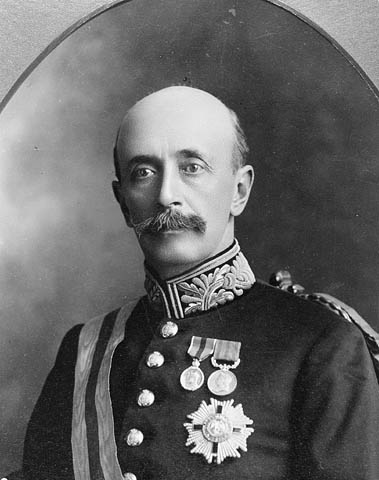
Albert Henry George Grey, 4th Earl Grey (28 November 1851 – 29 August 1917) was a British peer and politician who served as Governor General of Canada from 1904 to 1911, the ninth since Canadian Confederation. He was a radical Liberal aristocrat and a member of a string of liberal high society clubs in London. An active and articulate campaigner in late Victorian England, he was associated with many of the leading Imperialists seeking change.

Key Information

Albert Grey was born into a noble and political family, though at birth not in direct line to inherit the earldom. His father, General Charles Grey, was a younger brother of the 3rd Earl, who died without issue. As General Grey was deceased, the titles descended to his eldest living son Albert, then in his forties. Albert was educated at Harrow School before going up to Trinity College, Cambridge, where he graduated MA and LLM.[1] "His grandfather was the 2nd Earl Grey, who was prime minister of the United Kingdom from 1830 to 1834 and, reputedly, the recipient of a diplomatic gift from China of black tea scented with bergamot oil, which became known as Earl Grey tea."[2]

In 1878, Albert Grey entered into politics as a member of the Liberal Party and, after relinquishing a tied vote to his opponent, eventually won a place in the British House of Commons in 1880. In 1894 Grey inherited an earldom from his uncle, the third Earl, and thereafter took his place in the House of Lords, while simultaneously undertaking business ventures around the British Empire as Director of the British South Africa Company from 1898, he managed a steep learning curve during high level tension between the colonial administration and Boers, prior to the outbreak of the Second Boer War. As administrator in Rhodesia he was directly responsible to Cecil Rhodes for conduct of the colony's business from 1894 to 1897. On his return in 1899 he was appointed Lord Lieutenant of his native Northumberland.[3]

Grey was appointed as Governor General of Canada by King Edward VII in 1904, on the recommendation of Prime Minister of the United Kingdom Arthur Balfour, to replace the Earl of Minto as viceroy and occupied that post until succeeded by Prince Arthur, Duke of Connaught and Strathearn, in 1911. Grey travelled extensively in Canada and was active in Canadian political affairs, including efforts to secure national unity. He built several legacies, the most prominent being the Grey Cup.

Youth, education, and early career

[edit]
At Harrow
Grey in 1873 (front row, second from right), Shakespeare Society, Trinity College, Cambridge

Grey was the younger and only surviving son of General Sir Charles Grey—a younger son of former British prime minister the second Earl Grey and later the private secretary to Prince Albert and later still to Queen Victoria—and his wife, Caroline Eliza Farquhar, eldest daughter of Sir Thomas Harvie Farquhar, Bt. He was born at Cadogan House, Middlesex. Many members of the family had enjoyed successful political careers based on reform, including to colonial policies; Grey's grandfather, while prime minister, championed the Reform Act 1832 and in 1846, Grey's uncle, the third Earl Grey, as Secretary of State for War and the Colonies during the first ministry of Lord John Russell, was the first to suggest that colonies should be self-sustaining and governed for the benefit of their inhabitants, instead of for the benefit of the United Kingdom.[4]

Grey was educated at Harrow School and then Trinity College, Cambridge, where he studied history and law.[4][5] After graduating in 1873, Grey became private secretary to Sir Henry Bartle Frere and, as Frere was a member of the Council of India, Grey accompanied Prince Albert Edward, Prince of Wales, on his tour of India. In 1877, Grey married Alice Holford, daughter of Robert Stayner Holford, the Member of Parliament for East Gloucestershire. Together, they had five children, one of whom died in early childhood.[4]

Parliamentary and administrative career

[edit]

Grey stood for parliament at South Northumberland in 1878 (at the age of 28). He received the same number of votes as his opponent Edward Ridley, but Grey declined a scrutiny and was not returned.[6] It was not until the general election of 1880 that Grey, the Liberal Party candidate, was elected as a member of parliament (MP) for South Northumberland, a seat he held until it was replaced under the Redistribution of Seats Act 1885 and he moved to be the MP for Tyneside, following that year's election. In 1884 he wrote to the Manchester-based Women's Suffrage Journal declaring his support for women's suffrage, writing that "[t]here are no questions which receive so little attention, or which, in my opinion, so urgently call for the close and serious consideration of social reformers, as those affecting the condition of women. The possession of a vote by women who are heads of households will lead to the formation of associations and unions for the protection and advancement of the interests of their sex."[7]

Another reform he supported was electoral reform, favouring proportional representation and Single transferable voting. He was active in the Proportional Representation Society of Britain. (At the time of his passing, he was its president).[8] He organised a model STV election in Northumberland in 1885, remarkably using untrained coal miners as staff to conduct it successfully.[9]

Inspired by the theories of Giuseppe Mazzini, Grey became an advocate of imperialism and was one of the founders of the Imperial Federation League, which sought to transform the British Empire into an Imperial Federation. Grey thus split with Prime Minister William Gladstone in 1886 over Irish home rule and became a Liberal Unionist, but the shift was short-lived as Grey failed to retain his seat in the 1886 general election.[10]

Eight years later, in October 1894,[4] Grey succeeded his uncle, the 3rd Earl Grey, as the 4th Earl Grey and returned to Parliament when taking his seat in the House of Lords. As a friend of Cecil Rhodes, Lord Grey became one of the first four trustees responsible for the administration of the scholarship funds which established the Rhodes Scholarship and he was invited by Rhodes to be a member of the board of directors and director of the British South Africa Company, coming to serve as the main liaison between Rhodes and the Secretary of State for the Colonies, Joseph Chamberlain, in the periods immediately before and after the Jameson Raid on the Transvaal. As the Administrator of Southern Rhodesia, Sir Leander Starr Jameson, was disgraced by the Jameson Raid, the British government, then headed by the Marquess of Salisbury, in 1896 asked Lord Grey to serve as Jameson's immediate replacement, staying in that role until 1897.[4] Two years later, Grey was also appointed as Lord Lieutenant of Northumberland and published a brief biography of a young relative,[11] Hubert Hervey, who was killed in the Second Matabele War.[12]

Governor General of Canada

[edit]
Grey in the governor general's office at Rideau Hall, Ottawa

In office

[edit]

On 4 October 1904 announcement made that King Edward VII had,[13] by commission under the royal sign-manual and signet, approved the recommendation of his British prime minister, Arthur Balfour, to appoint Grey as his representative to Canada, replacing Grey's brother-in-law, the Earl of Minto. (Minto was married to Grey's sister, Mary Caroline Grey.) The appointment came at a good time for Grey, as a series of failed investments in South Africa had left him penniless; a gift from his wife's aunt, Lady Wantage (widow of the Lord Wantage), was used to supplement his salary as governor general.

On 16 June 1905 Grey was designated as "Governor General of Canada and Commander-in-Chief of the Dominion of Canada," which followed on the passing of the Militia Act in 1904. At the request of Sir Robert Baden-Powell, Grey also undertook the role of Chief Scout of Canada.

During the time Grey occupied the viceregal office (1904-1911) Canada experienced large-scale immigration, industrialisation, and economic development, and secured increased independence from the United Kingdom.[4]

It was with Grey's granting of Royal Assent to the appropriate Acts of Parliament that Alberta and Saskatchewan were separated from the North-West Territories to become provinces,[14] The Governor General, writing to the King at the time, stated "[each one] a new leaf in Your Majesty's Maple Crown."[15]

As Governor General, he travelled extensively around the growing country. He journeyed abroad to the Dominion of Newfoundland (then not yet a part of Canada) and several times to the United States to visit President Theodore Roosevelt, with whom Grey developed a strong bond.[4]

Grey with Prince George, Prince of Wales, at the celebrations of the tercentenary of Quebec in Quebec City, 24 July 1908

Grey often exercised his right, as representative of a constitutional monarch, to advise, encourage, and warn. He expressed his desire for social reform and national cohesion. He supported prison reforms to provide greater social justice. He was also an advocate for electoral reform, endorsing proportional representation.[16] His past calls for political equality for Irish Catholics were relevant to Canada's internal politics, divided as the population was between Catholics and Protestants, Francophones and Anglophones.[17] Shortly after his installment as Governor General, his office sent out inquiries to provincial legislatures as to what legislative measures had been taken on the principle of PR.[18]

As governor General, Grey also encouraged his prime minister, Sir Wilfrid Laurier, to support the Imperial Federation he had long championed, but Laurier was uninterested. Grey suggested the construction of a railway hotel in the federal capital - the outcome was the palatial Château Laurier, completed in 1912.[4]

Grey's years of urging Laurier to get the Cabinet and Parliament to agree to the idea of a Canadian navy were more fruitful. At the Governor General's urging, the Canadian and British governments agreed to have Canada assume control of the former British garrisons at Halifax, Nova Scotia, and Esquimalt, British Columbia, after which the Royal Canadian Navy was created by the Naval Service Act. The Act was so identified with Grey that, in Quebec, it was referred to as Grey's Bill and opposed by Henri Bourassa and his Ligue nationaliste canadienne.

Although Grey strongly promoted national unity among French and English Canadians, as well as advocating unity within the entire British Empire, his pronouncements frequently raised the ire of Bourassa and the Quebec nationalists. Grey helped plan the tercentennial of Quebec in 1908. This event marked the 300th anniversary of the landing of Samuel de Champlain at what later became Quebec City. The Cabinet agreed to Grey's suggestion to have the Plains of Abraham designated as a national park. this was to be done to coincide with the Quebec celebrations, and Grey believed the official ceremony would promote Franco-Anglo-American friendship. The government arranged for the attendance of the Prince of Wales (later King George V), American and French warships, and a host of visiting dignitaries. The Ligue saw the ceremony as solely a tribute to the Empire. Bourassa and other Quebec nationalists complained that Grey had transformed a day intended to celebrate Samuel de Champlain into a celebration of James Wolfe.

At other times, and unlike future viceroys, the Governor General's influence expanded blatantly into government policy. Grey initially supported Asian immigration to Canada. He opposed the head tax imposed by the Chinese Immigration Act of 1885 on Chinese immigrants to Canada. He was invited to visit the province of British Columbia but declined as protest against the exclusionary measures implemented by the BC government under premier Richard McBride. However, following the Japanese victory in the Russo-Japanese War, he expressed concerned about the so-called Yellow Peril and worked with the federal Cabinet to explore restrictions on Asian immigration other than the head tax. He was nevertheless appalled by the 1907 anti-Asian riots in Vancouver, organised by BC's Asiatic Exclusion League. Later that same year, he arranged a visit to Canada by Prince Fushimi Sadanaru of the Empire of Japan.[19]

Legacy

[edit]
The Grey Cup

Throughout his tenure as governor general, Grey supported the arts and, when he departed Canada in 1911, he left behind him the Grey Competition for Music and Drama, first held in 1907. Grey also donated trophies to the Montreal Horse Show and for figure skating.[19]

He was a patron of sport, his feelings on health and fitness a part of his broader desire for a reform movement.[19] He supported Canadian football and established the Grey Cup, which is awarded to the winner of the Senior Amateur Football Championship of Canada; it is today presented to the champions of the professional-level Canadian Football League. In 1963 Grey was elected to the Canadian Football Hall of Fame for his contributions to the game.

He gave to the Crown a horse-drawn carriage he had purchased from the Governor-General of Australia, which is still today used as the state landau,[20] and added a study and conservatory to Rideau Hall, the sovereign's and governor general's Ottawa residence; the latter was torn down in 1924.[4]

Grey and his wife were commended for their work in Canada and for their championing social reforms. Laurier said Lord Grey gave "his whole heart, his whole soul, and his whole life to Canada."[4]

Final years

[edit]

On leaving office in 1911 Earl Grey and his family returned to the United Kingdom, where he became president of the Royal Colonial Institute (now the Royal Commonwealth Society).

He did not retire from public affairs. He lobbied and organised toward several goals:

1. to help those who are endeavouring to fight the slums.

2. to help the worker forward in the path of his natural evolution from the status of worker to that of partner.

3. proportional representation – by "the removal of the disparity between Parliamentary constituencies with 40 thousand electors, on the one hand, and on the other, other constituencies with less than as many hundreds" (through creation of equal-sized single-member districts. Earl Grey was also a proponent of PR in the sense of elected representation reflecting how votes are cast. In 1916, he was honorary president of the Proportional Representation Society of Canada and president of the British PR Society.[21]

4. Public House Trust [temperance refreshment houses], which is "a necessary adjunct to the first two items of his programme."[22]

On 28 March 1916, he was appointed by King George V as Chancellor of the Order of St. Michael and St. George.[23]

Grey died in August 1917 at his family residence. (On his deathbed, he penned a "stirring" letter to the editor of the London Times on the need to retain the adoption of proportional representation in the Electoral Reform Bill, being debated by British Parliament at the time.)[24]

Family

[edit]
Earl and Countess Grey
Lady Sybil Grey & Lady Evelyn Grey Jones, c. 1914

Grey married Alice Holford (d. 22 September 1944), daughter of Robert Stayner Holford, of Westonbirt House (Gloucestershire) and Dorchester House (London) on 9 June 1877 and had five children, one of whom died in early childhood:

  1. Lady Victoria Mary Sybil Grey (9 June 1878 – 3 February 1907) married Lt-Col. Arthur Morton Grenfell, of Wilton Park in 1901, and had children.
  2. Charles Robert Grey, 5th Earl Grey (15 December 1879 – 2 April 1963), who had two daughters by his wife Lady Mabel Laura Georgiana Palmer, daughter of William Palmer, 2nd Earl of Selborne. The elder daughter Mary (1907–2002) married the 1st Baron Howick of Glendale.
  3. Lady Sybil Grey (15 July 1882 – 4 June 1966) O.B.E. married Lambert William Middleton (1877–1941) of Lowood House, Melrose, Scottish Borders, nephew of Sir Arthur Middleton, 7th Baronet and Frederick Edmund Meredith. She was invested as an Officer, Order of the British Empire in 1918, having served as the Commandant of the Dorchester House Hospital for Officers. She was well known for her work with the Red Cross in Russia during WWI, and for her work with tuberculosis sufferers (founding the Lady Grey Society). She was an amateur photographer and filmmaker of note, and recorded village life at Darnick and St. Boswells.[25] After her husband died she sold Lowood House and moved to Burley, Hampshire. They had a son and a daughter.
  4. Lady Evelyn Alice Grey (14 Mar 1886–15 Apr 1971) married Sir Lawrence Evelyn Jones, 5th Bt. M.C., grandson of Sir Willoughby Jones.
  5. Lady Lillian Winifred Grey (11 June 1891 – 7 April 1895)

Ancestry

[edit]
Ancestors of Albert Grey, 4th Earl Grey
8. Charles Grey, 1st Earl Grey
4. Charles Grey, 2nd Earl Grey
9. Elizabeth Grey
2. Sir Charles Grey
10. William Ponsonby, 1st Baron Ponsonby
5. Mary Elizabeth Ponsonby
11. The Hon. Louisa Molesworth
1. Albert Grey, 4th Earl Grey
12. Sir Walter Farquhar, 1st Baronet, of Cadogan House
6. Sir Thomas Harvie Farquhar, 2nd Baronet, of Cadogan House
13. Anne Stevenson
3. Caroline Eliza Farquhar
14. Reverend Morton Rockcliffe
7. Sybella Martha Rockcliffe
15. Martha Bennett

Honours

[edit]
Ribbon bars of the Earl Grey
Appointments
Medals

Honorary military appointments

[edit]

Honorific eponyms

[edit]
Statue of the Earl Grey at Parc des Champs de Bataille, Quebec City
Geographic locations
Schools

Arms

[edit]
Coat of arms of Albert Grey, 4th Earl Grey
Crest
A scaling ladder or, hooked and pointed sable.
Escutcheon
Quarterly, 1 & 4: Gules, a lion rampant, within a bordure engrailed, argent, in dexter chief point a mullet or; 2 & 3: Barry of six argent and azure, a bend gules charged with a bezant.
Supporters
Dexter, a lion guardant purpure, ducally crowned or; sinister, a tiger guardant, proper.
Motto
De bon vouloir servir le roy (To serve the king with good will).
Orders
The Most Honourable Order of the Bath - Knight Grand Cross (GCB)[32]

References

[edit]
[edit]
Revisions and contributorsEdit on WikipediaRead on Wikipedia
from Grokipedia

Albert Henry George Grey, 4th (28 November 1851 – 29 August 1917), was a British aristocrat, , and imperial administrator who served as the ninth from 1904 to 1911. Born in as the son of General Charles Grey, private secretary to , and Caroline Eliza Farquhar, he was educated at and , graduating in 1873. Entering politics as a Liberal for Northumberland constituencies from 1880 to 1886, he aligned with the Liberal Unionists after the split over Irish Home Rule, and later held administrative posts including Administrator of from 1896 to 1897 and Lord Lieutenant of from 1899.
Appointed Governor General by King Edward VII, Grey actively promoted social reforms, imperial unity, and Canadian national development during his tenure, traveling extensively across the dominion—including the first such visit to Newfoundland—and fostering relations with the . He advocated for a Canadian to strengthen ties within the , supported the creation of the National Battlefields Commission in 1908 and the International Joint Commission in 1909, and encouraged prison and electoral reforms while maintaining close collaboration with Prime Minister Sir . Notable contributions included donating the in 1909 as the championship trophy for and establishing the Earl Grey competitions for music, drama, and literature in 1907 to advance arts and patriotism. His imperialist vision emphasized Canada's pivotal role in the Empire, though it drew criticism for perceived insensitivity toward French Canadian interests and initial support for Asian immigration amid provincial restrictions. Grey's later years involved continued advocacy for and as a radical Liberal peer, reflecting his commitment to progressive causes within a framework of British constitutional traditions; he died at his family seat in Howick, , survived by his wife Alice Holford and their children.

Early Life

Upbringing and Education

Albert Henry George Grey was born on 28 November 1851 in London, England, the second son of General the Honourable and his wife Caroline Eliza Farquhar, making him the grandson of , who as prime minister had overseen the passage of the that expanded the electoral franchise and reformed parliamentary representation. His father's career and the family's noble Whig heritage immersed Grey in an environment of public service and political discourse from an early age, with connections to the royal court reflecting the aristocratic circles in which he was raised during Queen Victoria's reign. Grey received his early education at , a prominent public school known for educating sons of the British elite. He then proceeded to , where he excelled academically, graduating in 1873 with a first-class in the and . This rigorous intellectual training, combined with the family's legacy of liberal reform and governance, laid the groundwork for Grey's lifelong engagement with imperial and political affairs, fostering an outlook attuned to the responsibilities of empire and constitutional development.

Family Influences and Early Interests

Albert Henry George Grey was born on 28 November 1851 in , the second son (third of six children) of General Charles Grey and Caroline Eliza Farquhar. His father, who had served over 20 years in the military, as MP for Wycombe from 1832 to 1837, and in under Lord Durham in 1838, later became private secretary to Prince Albert from 1852 to 1861 and to until 1870. This court proximity at exposed Grey to administrative intricacies and instilled a profound sense of imperial duty and public service from an early age. The death of his elder brother in 1855 positioned Grey as eventual heir to the earldom, amplifying aristocratic expectations within the family. Raised amid royal circles, he absorbed values of governance and responsibility, shaped by his father's experiences in colonial administration, including contributions to reports on in . Sibling dynamics in a large family further reinforced collective obligations to the estate and empire, fostering Grey's early appreciation for hierarchical yet reform-oriented structures. Grey pursued diverse personal interests, emerging as an enthusiastic amateur athlete engaged in sports such as and during his youth at and , where he graduated in 1873. These activities cultivated physical vigor and camaraderie, traits he later applied to imperial advocacy. In the mid-1870s, he accompanied the Prince of Wales (future ) on a tour of from 1875 to 1876, gaining firsthand exposure to colonial administration and diverse imperial challenges. Influenced by his family's Whig-Liberal heritage—his grandfather was the 2nd , from 1830 to 1834—Grey developed a blending liberal with staunch imperial unity, skeptical of excessive that might undermine the empire's cohesion. His father's Durham mission experiences underscored practical colonial governance, prioritizing federated strength over separatist tendencies in Gladstonian policy. This foundation, rooted in pre-1880 courtly and familial imperatives, oriented Grey toward a pro-empire emphasizing administrative efficiency and moral obligation.

British Political Career

Entry into Parliament and Liberal Affiliation

Albert Grey entered Parliament as a Liberal, securing election to the for the constituency of South Northumberland in the general election of April 1880, following an unsuccessful contest there in 1878. He achieved victory by a substantial majority, reflecting local support for his family's Whig-Liberal heritage in the region. Grey aligned with the progressive wing of the Liberal Party, engaging in London's liberal high-society clubs where he networked with reformers advocating social changes, including . During his tenure, he contributed to parliamentary debates on colonial policy, drawing on familial precedents of imperial administration to emphasize cohesive governance across the empire. Following the Redistribution of Seats Act 1884, he was re-elected in the December 1885 general election for the newly delineated Northumberland (Tyneside) division, continuing his service until the next election. The Liberal Party's fracture over Irish Home Rule in prompted Grey's decisive shift; he voted against William Ewart Gladstone's Home Rule Bill, viewing its provisions for as risking imperial disintegration rather than fostering unity. Aligning with the Liberal Unionists under Lord Hartington, Grey prioritized preserving the United Kingdom's integrity and imperial cohesion, critiquing excessive autonomy measures that could encourage separatist tendencies elsewhere in the empire. He organized alongside other young Whig Liberals in support of this faction but was defeated as a Liberal Unionist candidate in the , ending his Commons career.

Advocacy for Imperial Federation and Key Positions

Grey played a prominent role in the Imperial Federation League from its inception on 18 November , serving as a founding member and advocating for formalized empire-wide political and economic structures to foster mutual defense and trade preferences. The league's platform, which Grey endorsed, posited that preferential tariffs among empire members would enhance economic resilience against external competitors, including the growing industrial might of the and protectionist policies in , while joint military commitments would provide a deterrent to imperial fragmentation. These measures, Grey argued, were grounded in observable patterns of colonial interdependence, where isolated autonomies risked vulnerability to foreign influence, as evidenced by contemporaneous trade data showing Britain's export reliance on dominion markets exceeding 30% by the mid-1880s. In parliamentary debates and league publications during his tenure as MP for South Northumberland (1880–1885), Grey stressed Canada's strategic position as a linchpin for unity, cautioning that divergent colonial tariffs—such as Canada's of imposing duties up to 35% on British goods—eroded cohesion and invited economic isolation. He opposed such , contending that from intra- commerce demonstrated greater prosperity through aligned policies, with federation enabling shared naval funding to address threats like Russian expansionism in , where British commitments strained resources without colonial reciprocity. Following the Liberal Party's division in 1886 over William Gladstone's Irish Home Rule Bill, Grey defected to the Liberal Unionists, one of approximately 93 MPs who voted against the measure on 8 June, viewing it as a causal precursor to dominion-style autonomies that imperiled imperial integrity. This alignment reinforced his prioritization of as essential to Britain's economic and strategic preeminence, linking integrated imperial defense—potentially pooling 20–25% of colonial revenues for a unified fleet—to sustained global influence over fragmented trends.

Administrative and Overseas Roles

Involvement in South Africa

Following his succession to the earldom on 2 October 1894, Albert Grey relocated to the , drawn by the influence of , the colony's prime minister and a proponent of British imperial expansion in southern . There, Grey accepted Rhodes's invitation to engage with the (BSAC), of which he became a director in the mid-1890s, focusing on the company's chartered administration and economic ventures northward into and . His role emphasized practical colonial governance and resource development, aligning with Rhodes's vision of extending British economic and civilizing influence, though Grey's directorship involved oversight rather than operational mining; the BSAC's interests centered on gold prospecting and land settlement rather than diamonds, which were more associated with Rhodes's separate operations in Kimberley. Grey's support for Rhodes extended to administrative duties in Rhodesia, where he served as administrator of Southern Rhodesia from October 1896 to 1898, succeeding in the aftermath of the failed on the Transvaal in December 1895–January 1896. Appointed directly under Rhodes's authority via the BSAC, Grey managed the territory during the Second Matabele War (1896–1897), coordinating suppression of Ndebele resistance with forces and imperial troops, which resulted in the defeat of King Lobengula's forces and consolidation of British control over an area exceeding 400,000 square kilometers. While initially aligned with Rhodes's expansionist policies, Grey navigated the raid's fallout, which implicated Rhodes in unauthorized aggression against and led to Rhodes's resignation as Cape premier in January 1896; Grey's correspondence and administrative reports reflected caution regarding the raid's destabilizing effects on BSAC credibility and Anglo-Boer relations, prioritizing stabilization over further adventurism. In this capacity, Grey advocated for economic development through settler incentives, railway extensions, and mining concessions, viewing these as mechanisms to integrate British capital with local resources and foster self-sustaining colonies. He promoted ideas of federation to harmonize British and Boer interests, arguing in private and company circles for coordinated governance across southern African territories to avert conflicts like those presaging the Second Boer War (1899–1902), though his efforts yielded limited immediate political traction amid rising uitlander grievances in the Transvaal. These experiences solidified Grey's conviction in the empire's role in delivering economic prosperity—evidenced by BSAC land grants exceeding 11 million acres to settlers—and cultural advancement, countering indigenous warfare with structured administration, even as they highlighted tensions from overreliance on chartered companies. By 1898, Grey departed , having overseen post-war reconstruction but amid criticisms of BSAC overreach in native affairs.

Lord Lieutenant of Northumberland

Albert Grey was appointed Lord Lieutenant of Northumberland on 1 March 1899 by , immediately following his return from administrative roles in during the Boer War. He retained the position until 13 December 1904, resigning upon his nomination as . As the monarch's representative, Grey managed ceremonial duties, recommended appointments of magistrates and the , and supervised the county's and volunteer forces amid wartime demands for and . Grey's tenure bridged his imperial experiences in and with domestic governance, emphasizing youth development to instill discipline and imperial loyalty. He supported initiatives like rifle-shooting clubs and cadet movements to promote and , aligning with broader efforts to prepare Britons for . Concurrently, as administrator of the family estate at , he applied colonial administrative insights to local estate management, fostering practical improvements in rural operations. Through patronage of county institutions and measured handling of post-war sentiments, Grey sustained his Liberal Unionist political stance while reinforcing community allegiance to , positioning the role as a preparatory step for higher imperial responsibilities.

Governor General of Canada

Appointment and Initial Activities

Albert Henry George Grey, 4th Earl Grey, was selected by British Prime Minister Arthur James Balfour in August 1904 to serve as , succeeding his brother-in-law Gilbert Elliot, 4th Earl of Minto. The formal commission was issued on 26 September 1904, with King Edward VII confirming the appointment. Grey departed Britain shortly thereafter, arriving by ship at , on 10 December 1904, where he was immediately sworn into office amid a ceremonial welcome. He then traveled by train to , establishing residence at , the traditional viceregal seat, and assembling his official staff, including military aides-de-camp and household personnel drawn from British and Canadian sources. From the outset, Grey pursued an active representational role, embarking on initial tours across to foster public engagement. In speeches delivered during these early journeys, he extolled Canada's natural resources—particularly minerals and forests—as foundations for economic growth and emphasized national unity within the as essential for collective strength. These addresses reflected his conviction that held pivotal importance to imperial cohesion, a theme he pressed immediately upon assuming duties. Grey quickly cultivated a personal rapport with Sir , engaging in regular consultations that informed his advisory input on governmental matters, though this occurred against a backdrop of evolving Canadian , where dominion leaders increasingly asserted control over and foreign engagements separate from direct imperial oversight.

Domestic Reforms and Social Initiatives

During his tenure as Governor General, Albert Grey advocated for improvements in , including support for nursing initiatives aimed at reducing disease prevalence in rural and urban areas. Lady Grey served as honorary president of the Victorian Order of Nurses, which focused on practical home nursing and to address community needs without relying on large-scale government expansion. Grey himself emphasized the importance of pure milk supplies, visiting farms to discuss methods for eliminating impurities, as contaminated milk contributed significantly to high rates at the time. Grey promoted to enhance rural productivity and self-sufficiency. In a despatch dated 23 December 1905, he highlighted the need for expanded training in scientific farming practices, influencing discussions on curriculum development for agricultural colleges across . He also endorsed rural reforms, including co-partnership models between farmers and educators to foster practical skills in and crop improvement, as noted in contemporary agricultural publications. To encourage youth development and , Grey supported expansion, donating a challenge shield in to incentivize and among school-based units, which emphasized discipline and marksmanship without mandatory . In sports, he donated the trophy on 4 December to the Canadian Rugby Union for the amateur football championship, first awarded to the Varsity Blues, aiming to build national cohesion through competitive athletics. Grey patronized by inaugurating a dominion-wide and music in 1907, providing trophies to recognize amateur performers and composers, which stimulated local cultural production. He actively participated in the Tercentenary celebrations from 1906 to 1908, overseeing exhibitions and pageants that showcased Canadian history and craftsmanship to promote civic pride. For conservation, Grey campaigned from 1907 to 1908 for the acquisition and preservation of the , resulting in the establishment of the National Battlefields Commission on 23 March 1908 to maintain the site as a public historic park. These efforts prioritized tangible preservation of natural and historical landscapes over regulatory overreach.

Imperial and Foreign Policy Engagements

Grey actively promoted Canada's contributions to imperial naval defense during his governorship, particularly in response to the 1909 Dreadnought crisis triggered by German naval expansion. He endorsed financial aid to the Royal Navy, including debates over allocating funds for British battleships, as a means to bolster rather than pursuing isolated Canadian naval autonomy, aligning with his broader vision of military interdependence within the . This stance reflected his opposition to policies that could lead toward full , which he saw as undermining the strategic and economic advantages of imperial unity. In foreign relations with the , Grey contributed to negotiations resolving transboundary issues, notably the North Atlantic fisheries dispute and the International Boundary Waters Treaty signed on January 11, 1909. The treaty established the International Joint Commission to regulate shared waters along the Canada-U.S. border, preventing upstream diversions and pollution while affirming equal riparian rights, thereby protecting Canadian resource sovereignty amid American industrial pressures. These efforts balanced diplomatic accommodation with firm defense of national interests, averting potential conflicts over waterways critical to trade and . Grey's diplomatic correspondence and travels further advanced imperial economic cohesion, advocating for preferential tariffs and integrated mechanisms reminiscent of a to counter and maximize intra-Empire commerce. He highlighted empirical data showing that Empire-oriented preferences increased Canadian exports to Britain by fostering reciprocal markets, outperforming alternatives like unrestricted U.S. reciprocity which risked economic dependence. Through such initiatives, Grey reinforced causal links between imperial integration and sustained prosperity, cautioning against fragmentation that could erode defensive and commercial synergies.

Controversies and Political Interventions

During his tenure as Governor General, Albert Grey engaged in several political interventions that drew criticism from Canadian nationalists and Prime Minister , primarily over his advocacy for imperial unity, which clashed with growing sentiments for greater autonomy. Grey opposed the proposed 1911 reciprocity agreement with the , arguing that it would erode imperial preference policies and dilute Canadian economic ties to Britain, potentially fragmenting the Empire's preferential trade network. He privately urged prominent Liberals to reject the deal, aligning with Conservative leader Robert Borden's stance, though Laurier dismissed such interference as overreach favoring colonial subordination over independent Canadian interests. Proponents of Grey's position contended that reciprocity risked subordinating Canada's economy to American influence, undermining the imperial cohesion he sought to strengthen amid rising . Grey's strong promotion of the Naval Service Act of 1910, which established a Canadian naval force available for imperial service, elicited backlash in , where it was dubbed "Grey's Bill" by opponents. Nationalists led by and Frederick Monk criticized the legislation for prioritizing British naval needs over purely domestic defense, viewing Grey's public enthusiasm and behind-the-scenes pressure on Laurier as undue vice-regal meddling that compromised . Defenders highlighted Grey's role in advancing naval preparedness amid global tensions, arguing that the Act fostered stability by integrating into imperial defense without full separation, averting potential economic and isolation. Laurier, favoring a more autonomist approach, resisted Grey's pushes for immediate contributions to British , leading to strained relations but no formal invocation of reserve powers. The 1908 Tercentenary celebrations, organized under Grey's direction to commemorate Samuel de Champlain's arrival, sparked controversy for emphasizing the British as a unifying imperial milestone, which French Canadian nationalists like Bourassa and Armand Lavergne decried as an anglocentric erasure of indigenous and French heritage. Grey's vision integrated imperial symbolism, including British military displays, to promote pan-Empire , but critics portrayed it as provocative cultural imposition amid simmering ethnic tensions. Such events underscored Grey's broader interventions, including a failed secret initiative from to compel Newfoundland's entry into , which bypassed Laurier's preferences and highlighted his willingness to maneuver discreetly for imperial consolidation, though it yielded no resolution. These actions, while stabilizing imperial relations in the eyes of unionists, fueled autonomist narratives of overreach, reflecting deeper divides between Grey's realism on Empire preservation and nationalist demands for detachment.

End of Term and Return to Britain

Grey's tenure as Governor General ended on 13 October 1911, after extensions requested by the and , despite his earlier desire to depart in September 1909 owing to fatigue from imperial advocacy and criticism in nationalist media. This conclusion aligned with the federal election defeat of Laurier's Liberals by Robert Borden's Conservatives on 21 September 1911, with Grey performing his final duty by swearing in Borden and the new cabinet. He avoided public recriminations over prior political interventions or the reciprocity debate that contributed to the Liberal loss, thereby sustaining respect from both major parties. Grey was succeeded by Prince Arthur, Duke of Connaught and Strathearn, who arrived at Quebec aboard the RMS Empress of Britain on 12 October 1911 to assume the viceregal role. Thousands assembled at Ottawa's railway station to farewell Grey as he departed for England shortly thereafter, reflecting his widespread popularity despite regional critiques. In parting addresses, he highlighted the Empire's reciprocal advantages, portraying Canada’s ties to Britain as a source of shared prosperity and strength rather than unilateral obligation. Grey returned to Britain in October 1911, transitioning without immediate partisan controversy and focusing initially on rest amid the physical toll of his prolonged duties.

Later Life and Death

Post-Governorship Engagements

Upon returning to Britain in October 1911 following the end of his term as , Grey re-engaged in advocacy for imperial unity, delivering public addresses on the structural challenges facing the Empire. In a notable speech to the Royal Colonial Institute on 12 November 1912, titled "Some Problems of Empire," he outlined the necessities for coordinated dominion contributions to imperial cohesion and security. Grey's interventions in the during 1913 further highlighted his emphasis on organic union among the dominions for purposes of collective defense, arguing against fragmented approaches to imperial obligations. In July 1912, Grey traveled to to unveil the near , honoring , with whom he had collaborated extensively on colonial administration and expansion in the preceding decades. This visit underscored his ongoing commitment to imperial networks, as he assumed the presidency of the Royal Colonial Institute, fostering dialogue among proponents of Empire-wide cooperation. Through such engagements, Grey sustained alliances with Unionist and imperialist figures who shared his vision for dominion involvement in pre-war defense preparations. Grey also maintained business interests tied to imperial resource development, continuing as a director of the , which oversaw mining operations and territorial administration in . Concurrently, he supported philanthropic efforts in social and educational spheres, extending his earlier initiatives to promote welfare and institutional reforms within Britain. These activities positioned him as a bridge between colonial experiences and metropolitan policy debates amid rising European tensions.

Final Years and Passing

Grey's health declined markedly after the outbreak of the First World War in 1914, amid his management of estates and philanthropic interests in . Though in his sixties, he endorsed Britain's war efforts in alignment with his enduring advocacy for imperial cohesion, as reflected in contemporary commentary on his pro-consular legacy. He died on 29 August 1917 at , , at age 65, from cancer after undergoing a serious operation. Grey was survived by his wife Alice and three children: son and daughters Sybil and Evelyn. Immediate tributes emphasized his contributions to imperial solidarity, positioning him among key figures who bolstered British ties across dominions, even as the war exposed fissures in centralized empire governance. His passing coincided with mounting dominion assertiveness, rendering his pre-war aspirations for formalized —encompassing political and —largely unattained, supplanted by trends toward autonomous self-rule rather than unified structures.

Political Ideology

Views on Imperialism and Empire Unity

Albert Grey developed a strong commitment to following the Liberal Party's adoption of Irish Home Rule policies in , which prompted his resignation from the party and alignment with advocates. As a founding member of the Imperial Federation League established in 1884, he championed the transformation of the into a federated structure that would bind dominions through shared political, economic, and military institutions, arguing that such unity was essential for collective strength against emerging global rivals like and the . Grey's advocacy rested on causal reasoning that emphasized the Empire's role as a defensive bulwark and engine of prosperity, positing that decentralized risked fragmentation and vulnerability, as evidenced by the historical instability of loosely allied confederations compared to integrated empires. He rejected devolutionist critiques—often rooted in nationalist sentiments favoring separation—by highlighting empirical benefits such as intra-Empire trade volumes, which by the early accounted for over 30% of Britain's total exports, and military synergies like coordinated naval resources that deterred aggression without proportional increases in individual expenditures. In his view, resource sharing, including access to colonial markets and raw materials, had empirically sustained Britain's industrial dominance since the mid-19th century, countering anti-imperial narratives that dismissed such ties as exploitative by demonstrating mutual gains in wealth and security. Over time, Grey's ideas evolved from the League's early focus on preferential tariffs and a central imperial parliament to a more organic model of unity, applicable in contexts like , where he favored evolutionary ties preserving sovereignty in local affairs while ensuring imperial consultation on foreign policy and defense. He critiqued forced separation as destabilizing, drawing on precedents like the American Revolution's costs—estimated at over £80 million in lost revenues and military setbacks—to argue that preserved stability through shared institutions rather than risking dissolution into rival blocs. This perspective informed his later presidency of the Royal Colonial Institute from , where he promoted non-partisan cooperation to foster enduring imperial bonds amid growing autonomist pressures.

Liberal Reforms and Social Conservatism

As a radical Liberal peer, Albert Grey advocated for , participating in the Speaker's Conference on in 1916–1917, where he aligned with supporters of extending voting rights to women while emphasizing balanced representation. His support for stemmed from a desire to ensure that diverse sections of opinion received fair parliamentary voice, arguing that full representation of divisions would stabilize governance and prevent the dominance of any single faction, rather than endorsing pure . This approach reflected a commitment to reforms enhancing efficiency and hierarchy preservation, such as industrial profit-sharing and technical education, which aimed to foster cooperation between classes without undermining social order or promoting redistributive . Grey's social conservatism manifested in initiatives prioritizing moral and voluntary self-improvement over state-imposed change, including the establishment of the Public House Trust before 1904 to promote temperance through non-alcoholic alternatives and community benefits, as well as advocacy for and cadet movements to instill discipline. He cautioned against over-centralization, favoring decentralized —evident in his push for Canadian within imperial structures—and preferred voluntary associations for social progress, as seen in his administration of the Trust to build character and human capital aligned with traditional imperial values. These efforts integrated domestic reforms with broader goals of strengthening societal resilience, critiquing unchecked democratic impulses by grounding progress in structured, efficiency-driven hierarchies rather than radical leveling. In 1909, he donated the trophy to encourage , viewing physical and moral development as bulwarks against social decay.

Personal Life

Marriage and Immediate Family

Albert Henry George Grey, 4th Earl Grey, married Alice Holford, daughter of art collector Robert Stayner Holford and Mary Anne Lindsay, on 9 June 1877 at St George, Hanover Square, . Alice, aged 18 at the time of the wedding, supported her husband in social and ceremonial duties throughout his career, including as viceregal consort of Canada from 1904 to 1911, where she assisted with charitable initiatives amid rapid national growth in and industry. The couple had five children: one son, Charles Grey (born 1879), who succeeded his father as 5th Earl Grey and managed family estates including Howick Hall in Northumberland, the longstanding Grey family seat since 1319; and four daughters—Victoria Mary, Sybil (later Lady Sybil Middleton), Evelyn Alice, and Lillian, the latter dying at age four. The daughters pursued lives reflective of aristocratic circles, with Sybil and Evelyn noted in society travels and portraits alongside their mother. Their family life exemplified the stability of British landed aristocracy, centered at Howick Hall, where the Greys maintained traditions of estate management and social hosting even during extended imperial postings; Alice's enduring presence provided continuity, outliving her husband until 1944.

Ancestry and Hereditary Background

Albert Henry George Grey was born into the Grey family of Howick, a Northumberland lineage elevated through military distinction and Whig political service, with his immediate forebears embodying aristocratic reformism tempered by commitment to empire and hierarchy. As the son of General Charles Grey (1804–1870), private secretary to Queen Victoria, and Caroline Eliza Farquhar, Grey was the grandson of Charles Grey, 2nd Earl Grey (1764–1845), who as Prime Minister from 1830 to 1834 steered the Reform Act 1832 through Parliament, redistributing seats from "rotten boroughs" to growing industrial centers and extending the vote to an additional approximately 200,000 propertied middle-class men while retaining property qualifications and excluding most laborers. This measure addressed systemic electoral imbalances without endorsing the broader egalitarian demands of radicals, reflecting the family's preference for controlled evolution over disruption. Grey's great-grandfather, (1729–1807), a career army officer who led successful campaigns against French forces in the and commanded in during the Revolutionary War, received the earldom on 11 April 1806 alongside the subsidiary Viscountcy of Howick, honors granted for wartime achievements that bolstered British imperial holdings. The Howick title tied directly to the family's ancestral estates in , where served as the seat, symbolizing landed influence accumulated since the from cadet branches of earlier Grey nobility. The following table outlines key forebears influencing Grey's inherited context of pragmatic governance and imperial orientation:
AncestorRelation to GreyNotable Roles and Impacts
(1729–1807)Great-grandfatherGeneral; secured earldom via military victories preserving colonial assets; created Earl Grey 11 April 1806.
(1764–1845)Grandfather (1830–1834); enacted , enfranchising middle-class property owners amid unrest but upholding aristocratic safeguards.
(1802–1894)UncleColonial Secretary (1846–1852); advanced dominion self-government models, foreshadowing federated empire structures.
This heritage contrasted sharply with contemporaneous non-aristocratic radicals, such as Chartist leaders advocating universal male suffrage and the , by prioritizing incremental adjustments that sustained elite oversight and imperial cohesion over wholesale democratic leveling.

Honours and Legacy

Military and Official Honours

Grey served as honorary Colonel of the Governor General's Horse Guards from 10 1904, coinciding with the start of his governorship, until 13 October 1911. He was invested as a Knight Grand Cross of the Order of St Michael and St George (GCMG) and Knight Grand Cross of the Royal Victorian Order (GCVO) prior to 1909. By late , these honours were formally associated with his viceregal role. Grey was referenced as a (PC) in official proceedings by 2 1909, reflecting his elevation to His Majesty's Privy Council earlier that year. He later received the Knight Grand Cross of the (GCB) in 1911 for distinguished . Grey also held the Knight of Grace of the Order of St John from 3 March 1910. These distinctions, primarily tied to his administrative and imperial duties rather than active combat service, underscored his ceremonial military affiliations and high-level official recognition within the .

Named Institutions and Enduring Commemorations

The most prominent enduring commemoration established by Albert Grey is the , a trophy he commissioned and donated in 1909 to the Canadian for the amateur championship of . Valued at $48 at the time, it was first awarded that year to the University of Toronto Varsity Blues and has since become the annual championship trophy of the Canadian Football League, symbolizing national sporting supremacy and drawing audiences of approximately 4 million viewers per event. This initiative reflected Grey's efforts to foster national cohesion through competitive athletics, evolving into a major cultural institution that unites communities across despite the sport's regional roots. Grey also sponsored the Earl Grey Musical and Dramatic Trophy Competition, announced in 1906 to promote across and Newfoundland through national-level contests in music and . Competitions culminated in events like the 1909 finals at His Majesty's Theatre in , with securing victories in both categories that year, underscoring Grey's aim to cultivate cultural unity via amateur artistic endeavors. Elements of this legacy persist, such as the Earl Grey Trophy awarded at the Winnipeg Music Festival for outstanding school choral performances in grades 7 through 12. Additionally, Grey donated trophies for other amateur pursuits, including and the Montreal Horse Show, contributing to the infrastructure of Canadian sports beyond football. Several Canadian institutions and geographical features bear Grey's name, affirming his role in public life. Schools include Earl Grey School in Winnipeg, Manitoba—constructed in 1914 as Western Canada's first junior high and designated a heritage building—and Earl Grey Senior Public School in , , opened in 1910. An elementary school in Earl Grey, , also honors him. Geographical commemorations encompass the village of Earl Grey in , Mount Earl Grey, and Earl Grey Pass in , renamed after his horseback traversal during his governorship. These namings highlight Grey's tangible promotion of imperial and national integration, with the Grey Cup's ongoing prominence demonstrating a practical legacy of cohesion over mere symbolism.

References

  1. https://en.wikisource.org/wiki/Dictionary_of_National_Biography%2C_1927_supplement/Grey%2C_Albert_Henry_George
Add your contribution
Related Hubs
User Avatar
No comments yet.