Hubbry Logo
Alfred State CollegeAlfred State CollegeMain
Open search
Alfred State College
Community hub
Alfred State College
logo
8 pages, 0 posts
0 subscribers
Be the first to start a discussion here.
Alfred State College
from Wikipedia

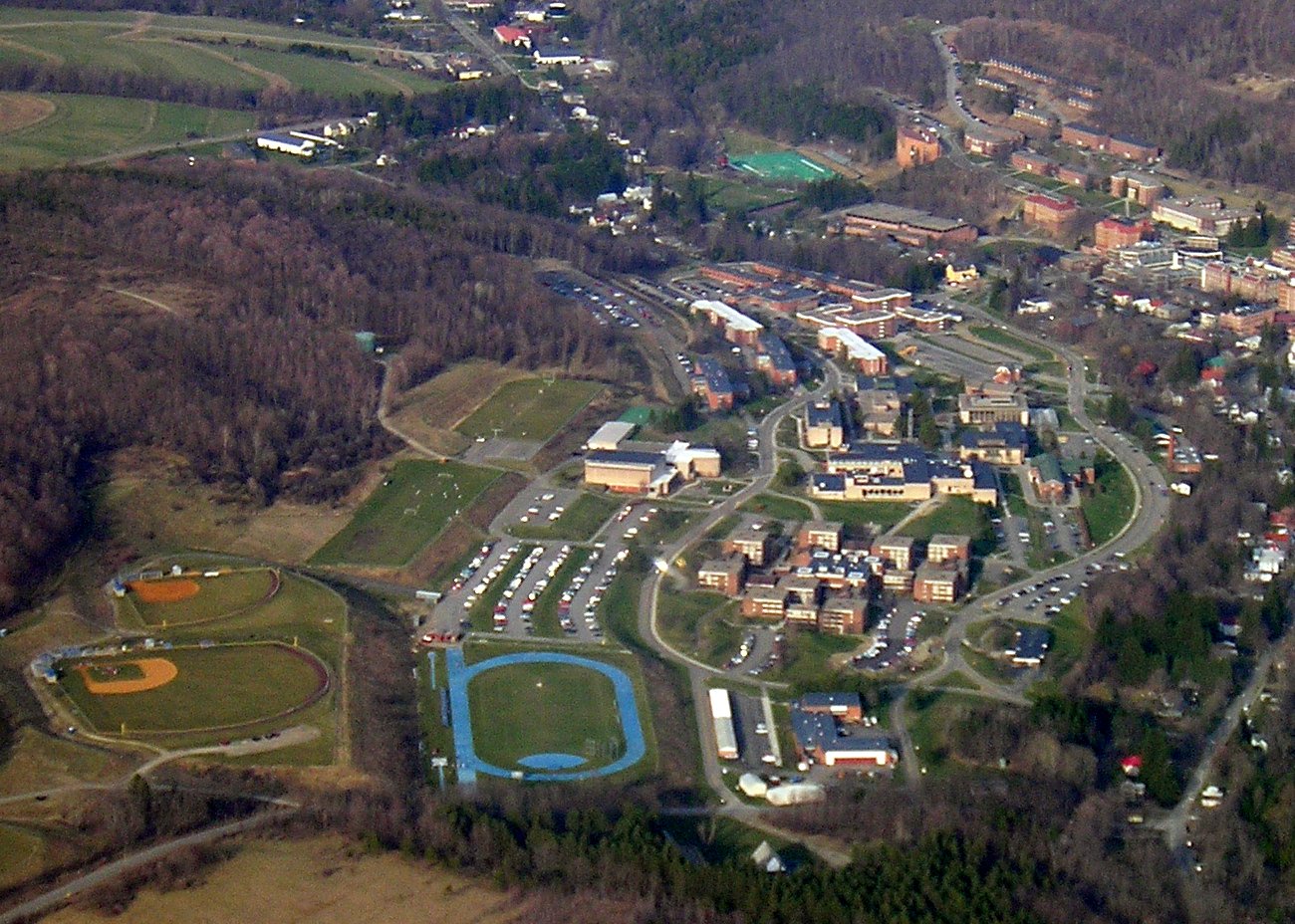
Aerial view of Alfred State taken in April 2006. Alfred University is shown in the upper right and Alfred, New York appears to the right

Key Information

Alfred State College (ASC, SUNY Alfred, SUNY Alfred State) is a public college in Alfred, New York, United States. It is part of the State University of New York (SUNY) system. The college offers bachelor's and associate degree programs. It is accredited by the Middle States Commission on Higher Education and is a member of the Rochester Area Colleges consortium.

History

[edit]

Both Alfred University and Alfred State have their roots in an early teaching college called the Alfred Select School. The school was visionary in its equal opportunity policy. In 1908 President Boothe C. Davis of Alfred University persuaded the New York State legislature to locate the New York State School of Agriculture at the Alfred University Campus; the resulting allocation of $75,000 for three buildings, a farm, livestock, and machinery would set plans for the school in motion.

In 1937, the School of Engineering Technologies was founded by the original three academic faculty members; Al French, Bill Harrison and Herm Sickler. Four years later, the school was given junior college status and renamed the New York State Agricultural and Technical College at Alfred.

By 1948, increased enrollment was a reason for moving the school across Main Street, where it remains today.

Schools and departments

[edit]

Alfred State offers 80 majors in the arts, applied technology, architecture and management and engineering technology. Teaching staff are in a 17:1 ratio to students, and are generally well-educated in their field, while maintaining ties to their profession.

The college is divided into the following schools:

  • The School of Arts & Sciences
  • The School of Applied Technology (located at the Wellsville campus)
  • The School of Architecture, Management and Engineering Technology

Facilities and construction

[edit]

Founded with three buildings, a farm, and some livestock, Alfred State has expanded to include 13 residence halls, state-of-the-art smart classrooms, a motorsports facility, an organic farm, the Orvis Activities Center, as well as a second campus of Applied Technology located in Wellsville, New York.

Pioneer Stadium accommodates soccer and football, and is surrounded by an eight-lane running track. Facilities also include a Central Dining Hall, a 150-bed townhouse complex, an Engineering Technology Building, and a Student Leadership Center.[3]

Student life

[edit]
Undergraduate demographics as of Fall 2023[4]
Race and ethnicity Total
White 69%
 
Hispanic 13%
 
Black 12%
 
Two or more races 5%
 
Asian 1%
 
Economic diversity
Low-income[a] 45%
 
Affluent[b] 55%
 

Student government

[edit]

The Student Senate of Alfred State[5] administers over half a million dollars in club and administrative funds through the Student Activity Fee. Student Senate supports, facilitates, and leads its clubs and organizations through an annual Leadership Retreat, weekly leadership seminars, and special projects. In addition to funding, Student Senate allows students of both Wellsville and Alfred main campus to participate in collaborative decision-making processes. The Student Senate General Assembly has voting rights on the board of trustees of the college, known as the College Council, through its College Council Representative. The Student Senate General Assembly also has a voice on the Faculty Senate with a non-voting member but has voting members on many committees including the Academic Affairs Committee. They also have three members on the Auxiliary Campus Enterprises and Services board of directors.

Greek life

[edit]

There are several fraternities and sororities on campus.

Museums and galleries

[edit]

The Brent Llewellyn Art Gallery at SUNY Alfred State in Alfred, New York, founded in 2010, is located in the campus Engineering Technology Building.

Athletics

[edit]
Alfred State athletics wordmark
The Pioneers football team (right) lines up on defense during a 2017 game against the Coast Guard Bears

The Alfred State athletic teams are called the Pioneers. The college is a member of the Division III ranks of the National Collegiate Athletic Association (NCAA), primarily competing in the Allegheny Mountain Collegiate Conference (AMCC) for most of its sponsored sports since the 2019–20 academic year. The Pioneers also compete as a member of the Eastern Collegiate Athletic Conference, the Eastern Collegiate Football Conference (ECFC) for football, the State University of New York Athletic Conference (SUNYAC) for men's and women's indoor and outdoor track & field, and the Empire Collegiate Wrestling Conference (ECWC) for wrestling. They also previously competed in the short-lived American Collegiate Athletic Association (ACAA) from 2017–18 to 2018–19; and as an NCAA D-III Independent from 2013–14 to 2016–17.

Alfred State competes in 17 intercollegiate varsity sports. Men's sports include baseball, basketball, cross country, football, soccer, swimming & diving, track & field (indoor and outdoor) and wrestling; while women's sports include basketball, cross country, soccer, softball, swimming & diving, track & field (indoor and outdoor) and volleyball.

Notes

[edit]

References

[edit]
[edit]
Revisions and contributorsEdit on WikipediaRead on Wikipedia
from Grokipedia
Alfred State College is a public institution of higher education located in , and part of the (SUNY) system. Established in 1908 with roots in , it has evolved into a career-focused college emphasizing hands-on, to prepare students for professional success. The college offers more than 80 majors across fields such as , allied health, applied , and , , and liberal arts and sciences, available at the associate, baccalaureate, and certificate levels. With a student-faculty ratio of 16:1 and small class sizes, Alfred State prioritizes personalized attention and real-world application through state-of-the-art facilities and industry partnerships. Situated in the rural region of , approximately 70 miles south of Rochester and 15 miles north of the border, the college spans a 1,062-acre campus that supports a vibrant community life, including 14 residence halls, over 90 student clubs, and 18 intercollegiate sports teams. As of fall 2025, it enrolls 3,758 undergraduate students, with an acceptance rate of 64% and a test-optional admissions policy. Tuition for the 2024-2025 is $8,892 for in-state students and $13,832 for out-of-state students, with 93% of undergraduates receiving financial aid and an average net price of $16,489. Alfred State is recognized for its strong outcomes and affordability, boasting a 99% placement rate for graduates into employment or further education within six months of completion. In the 2026 U.S. News & World Report rankings, it placed #16 among Regional Colleges North and #1 for Best Undergraduate Teaching, while also ranking as the #1 most affordable college in New York State and #1 for return on investment in Western New York. The institution's mission centers on fostering critical thinking, leadership, and practical skills, encapsulated in its "Pioneer Spirit" that drives student achievement in a supportive environment.

History

Founding and Early Development

Alfred State College traces its origins to May 8, 1908, when New York Governor Charles Evans Hughes signed legislation establishing the New York State School of Agriculture in Alfred, New York, as part of a broader initiative to provide practical education for the state's rural communities and initially affiliated with Alfred University. The institution was dedicated on June 8, 1910, and formal instruction commenced on October 18, 1909, under the direction of four faculty members and an initial enrollment of 46 students—10 female and 36 male. To support its operations, the state acquired a 230-acre farm from the Charles Stillman family in 1909 for $14,500, which served as the foundational campus and included early facilities such as Agriculture Hall, constructed between 1909 and 1910 at a cost of $40,898, along with a dairy barn and milk house. The school's curriculum emphasized hands-on agricultural training tailored to the needs of rural New York, including courses in farming techniques, livestock management, domestic science, and general , with students engaging in practical activities like operating the campus farm. By 1911, enrollment had grown to 122 students, reflecting initial interest in this vocational approach, and all 148 students had joined the Country Life Club by 1913 to promote farm-oriented lifestyles. Early operations also featured Farmers' Institutes from 1910 to 1914, which brought extension to local communities. Despite early promise, the institution faced significant enrollment challenges in the mid-1920s, dropping to 48 students by 1926 amid financial pressures that led to the omission of state funding in the budget. These difficulties intensified during the , with persistently low enrollment threatening closure, but the school was sustained through vigorous lobbying by local farmers who recognized its value to the region's agricultural economy, ultimately securing continued state support and paving the way for modest curriculum expansions.

Expansion and Name Changes

In 1936, the institution was renamed the Alfred Agricultural and Technical Institute, commonly known as Alfred Ag Tech, to emphasize its expanding focus on technical training alongside , reflecting a shift toward broader vocational programs during the era. This renaming coincided with added offerings in and building trades, helping to stabilize enrollment after lows as few as 48 students in the late 1920s. Following , a significant influx of veterans propelled rapid growth, with enrollment surging to 1,600 students by fall 1946, necessitating new housing like Wood Hall, Dobson House, and Pelton House in 1946, followed by additional women's dormitories in 1953. By 1956, the college acquired the 150-acre Saunders Farm for western campus expansion, further supporting its transition from primarily agricultural roots to diversified technical education. In 1964, the name was updated to the State University of New York Agricultural and Technical College at Alfred, often shortened to Alfred State Tech, reflecting further evolution within the SUNY system under presidents like Walter C. Hinkle and David H. Huntington. Enrollment reached 3,000 by 1969, prompting major infrastructure investments, including the opening of the Paul Orvis Activities Center and the 118,398-square-foot Engineering Technology Building, which enhanced facilities for emerging technology programs. These expansions also included the permanent establishment of the Wellsville campus in 1967 at a former refinery site, with its enrollment growing to 474 students by 1969. By 1985, the institution was officially renamed Alfred State College, signifying its maturation into a comprehensive technical college where associate degrees remained dominant, solidifying its role in providing practical, career-oriented amid ongoing growth in the and early , such as the addition of the Hinkle Belltower and the largest SUNY dormitory, MacKenzie Hall, in 1973.

Integration into SUNY System

Following World War II, Alfred State College formally integrated into the (SUNY) system in 1948 upon SUNY's establishment, separating from and providing access to state funding and standardized governance structures. This affiliation came after the formation of a Benevolent Association in 1946, which had initially supported facility management through private investments amid postwar enrollment surges. The integration aligned the institution with broader SUNY objectives, facilitating rapid expansion and ensuring long-term stability for its technical and agricultural programs. In 1991, Alfred State introduced four-year programs, marking a significant from its prior focus on associate degrees and enabling greater academic depth in applied fields. This expansion broadened the 's appeal, contributing to sustained enrollment growth that exceeded 3,500 students in subsequent years, reflecting increased demand for career-oriented higher education within the SUNY framework. As of fall 2025, Alfred State operates as a SUNY of with 3,758 undergraduate students and around 247 instructional faculty and staff, under the of President Steven A. Mauro, who assumed the role in 2022. The institution emphasizes hands-on, career-focused education, preparing students for in-demand professions through practical training and industry partnerships. Recent strategic initiatives, including the 2023-2027 plan, update the mission to prioritize applied learning in a supportive , while addressing 21st-century needs via expanded programs that offer flexible degree completion options without compromising SUNY quality standards.

Academic Programs

Schools and Divisions

Alfred State College organizes its academic programs into three primary schools, each overseeing distinct areas of study to support the institution's emphasis on hands-on, career-oriented education. These schools collectively administer approximately 80 majors, fostering an integrated approach to learning that combines technical training with foundational skills. The School of Arts and Sciences provides the liberal arts, sciences, and general foundations essential for all students, emphasizing communication, problem-solving, adaptability, critical reasoning, and ethical understanding to prepare graduates for diverse fields such as and . Led by Dean Dr. Kathleen Casey since April 2024, the school supports interdisciplinary efforts by integrating broad academic skills across programs. The School of Applied Technology, located at the Wellsville campus, focuses on vocational and technical training in high-demand areas like , , automotive technology, and , offering practical, industry-aligned instruction through expert faculty. Under Dean Jeffrey Stevens, it plays a key administrative role in delivering advanced technical programs that emphasize real-world application and workforce readiness. The , , and oversees professional programs in , , and fields, blending technical expertise with theoretical knowledge to develop and skills for industries including and . Directed by Dean Dr. Liping Jiang since May 2025, the school facilitates collaborations that enhance hands-on learning and professional networking.

Degree Offerings and Majors

Alfred State College offers more than 80 majors across associate's, bachelor's, and certificate levels, with a strong emphasis on hands-on, career-oriented programs in fields such as , allied , , , and liberal arts. These degrees include Associate in Applied Science (AAS), Associate in Science (AS), Associate in Occupational Studies (AOS), (BTech), (BS), (BBA), and various certificates, designed to prepare students for immediate workforce entry or . In , programs like Agricultural Automation and (AAS) and Agribusiness Management (BTech) focus on modern farming and management practices. Allied health offerings include Veterinary Technology (AAS) and (AAS/BS), which emphasize practical clinical skills. Business majors encompass (AAS), (AS/BBA), and (BBA), integrating real-world applications. Engineering technology degrees such as (AAS/BS) and (AAS/BS) are accredited by the Engineering Technology Accreditation Commission of , ensuring high standards in technical education. Liberal arts programs, including Liberal Arts and Sciences: Humanities (AA), provide foundational studies for transfer or diverse career paths. Unique features of these programs include required internships and applied learning experiences, which connect students to professional environments and enhance employability, with many majors offering co-op-like opportunities through the college's JobLink portal. Several programs are available , such as certain business and health sciences options, providing flexibility for non-traditional students. Enrollment trends show steady growth, with the incoming class reaching 1,493 full-time students in fall 2025—the largest since 2010—and popular majors such as , , and , particularly in business and health professions.

Campus and Facilities

Alfred Campus Layout

The Alfred State College campus spans 260 acres in the rural village of , nestled in the region and characterized by a mix of academic, residential, and agricultural zones integrated with the surrounding hillside terrain. The layout centers on a main academic quad area, accessible primarily via Route 244 and North Main Street, with buildings clustered for efficient pedestrian flow between classrooms, labs, and student services. Key academic structures include the School of Engineering Technology (SET) building, which houses programs in , , and ; the Physical and Health Sciences (PHS) building for and life sciences; and the Agriculture Science Laboratory (AGRLAB) supporting veterinary technology and crop production. The Hinkle Memorial Library serves as a central hub for research and study, while Harris Hall provides lecture spaces and adjacent lounges designed for collaborative work. Residential facilities are prominently featured in the layout, with the MacKenzie Complex—a large suite- and tower-style area renovated in recent years—accommodating a significant portion of the near the academic core. Other residence halls, such as the Townhouse Complex and Townhouse Commons, offer apartment-style living on the campus periphery, fostering a amid wooded trails and open green spaces. The Paul B. Orvis Activities Center, opened in , anchors recreational aspects with its gymnasium, pool, and fitness areas, located adjacent to the central quad for easy access. Agricultural elements extend the campus footprint, including the 800-acre College Farm used as a hands-on laboratory, greenhouses for research, and the Veterinary Technology Center for practical training. Accessibility is prioritized through features like designated parking for individuals with disabilities and in pathways connecting buildings. On-campus transportation includes the Big Blue Trolley, an electric shuttle service that circulates through academic, residential, and farm areas during class hours, enhancing mobility for students without personal vehicles. The campus integrates seamlessly with Alfred village amenities, such as local shops and dining along , just steps from residence halls and the Pioneer Center hub, promoting a walkable environment that blends life with small-town charm.

Wellsville Campus

The Wellsville Campus of Alfred State College is situated at 2530 River Road in , approximately 15 miles northwest of the main Alfred campus in the region. This satellite location primarily hosts the School of Applied Technology, offering associate degrees and certificates in hands-on, career-oriented programs such as heavy equipment operations, automotive service technician, building trades, and surveying and geomatics engineering technology. These programs emphasize practical skills for industries like , , and transportation, with coursework delivered through specialized labs and real-world simulations. Established in December 1965 as a pilot extension site by the college's Board of Trustees, the Wellsville Campus was created to test the viability of delivering away from the primary Alfred location, addressing regional needs for skilled trades training. Over time, it has evolved into a key hub for workforce development, partnering with local industries to equip students with certifications and competencies that support in Allegany County and surrounding areas of New York and . The campus's smaller scale fosters a focused environment, serving students primarily through daytime classes and serving as an accessible entry point for non-traditional learners seeking rapid career advancement. Facilities at Wellsville include dedicated spaces such as the Operations labs, automotive bays, technology areas, and building trades workshops, many equipped with industry-grade machinery and simulators for safe, year-round practice in tasks like equipment operation and diagnostics. Additional amenities support student success, including a , fitness center, gymnasium, health services, and the Pioneer Student Union for dining and gatherings. Residential options are limited, with no traditional on-campus dormitories; most students commute from local areas or utilize off-campus housing in Wellsville. This setup aligns with the campus's commuter-oriented model, prioritizing accessibility for working adults and regional residents pursuing applied education.

Recent Investments and Construction

Since 2016, Alfred State College has invested over $200 million in campus infrastructure, focusing on modernizing facilities to support student life, academics, and future growth through 2026. These efforts include major renovations to residence halls and academic buildings, enhancements to specialized labs, and preparations for new constructions. A key project was the $60 million renovation of the MacKenzie Complex, the largest residence hall in the SUNY system, completed in 2024. This multi-phase overhaul transformed the 1973-era complex into a modern facility with a ski lodge aesthetic in its renewed commons and living areas, accommodating nearly 1,200 students across suite-style towers and rowhouses. Upgrades featured energy-efficient systems, new entrance foyers, and interior improvements such as semi-private lounges and reconfigured bathrooms. The MacKenzie Commons now houses TimberLinez, a new offering and lunch options, alongside a dedicated cardio workout studio to promote student wellness. Academic facilities have also seen significant enhancements, including upgrades to Harris Hall, which now includes a plush study area in its lobby and a fully renovated 158-seat equipped for contemporary teaching. In the technology program, the Doc Bruce Construction Materials Lab received $100,000 in new equipment for testing soils, concrete, and asphalt, honoring the legacy of late professor William "Doc" and supporting hands-on training in materials research. Additionally, a $200,000 federal grant from the funded heavy equipment simulators for the Heavy Equipment Operations program, enabling virtual training for up to 80 students annually in safe, realistic scenarios. Looking ahead, construction is underway for a new Science facility, set to open in 2026, which will include a and advanced labs to bolster programs in and related fields. The Pioneer Center is undergoing a comprehensive and expansion, introducing a new commercial kitchen, indoor and outdoor dining areas, upgraded fitness and wellness spaces, and conference facilities to better serve students and campus events. Earlier infrastructure like , which opened in 2009 with a turf field, seating for 1,500, and supporting buildings, has received 2020s upgrades including a new Beynon Sport Surface track and turf replacements to maintain its role in athletics.

Student Life

Housing and Dining

Alfred State College provides on-campus for approximately 2,363 students across 14 residence halls, offering a range of options from traditional dorms to suites and apartments designed to support a safe and inclusive living environment. First-year students are guaranteed in designated halls such as Braddon, Burdick, Peet, and Shults, which feature corridor-style doubles and are located near central campus amenities. These traditional dorms emphasize , with features like coed wings in some buildings and proximity to the Central Dining Hall. Upperclassmen have access to suite-style and apartment options, including the renovated MacKenzie Complex, which accommodates approximately 1,100 students in single rooms, shared bathrooms, and gender-inclusive floors following a $60 million upgrade completed in 2024 that modernized living spaces and added communal areas. Other apartment-style accommodations, such as MacKenzie Commons and townhouses, cater to juniors and seniors with private bedrooms, full kitchens, and pet-friendly policies for select animals under 40 pounds. Living-learning communities in certain halls connect residents with academic programs like or to enhance collaborative experiences. As a residential , Alfred State requires full-time students to live on unless they obtain an Off-Campus Housing Waiver, typically granted to those aged 23 or older, veterans, married students, or fourth-year students meeting GPA thresholds. Many upperclassmen who receive waivers choose off-campus housing in the nearby Alfred village, where rental options are available through local resources like Alfred Rentals. Dining services at Alfred State, managed by Auxiliary Campus Enterprise & Services (ACES), emphasize nutrition, variety, and sustainability, incorporating fresh, locally sourced ingredients in many offerings. The Central Dining Hall serves as the primary cafeteria, featuring stations like The Terrace for home-style meals, Alfie’s for international cuisine, Amigos for Mexican-inspired dishes, and The Nook for grab-and-go items, with extended hours including late-night options. TimberLinez, located in the renovated MacKenzie Commons, provides casual dining with breakfast through late-night service, focusing on customizable meals and vegan/vegetarian choices. All on-campus residents must participate in a meal plan, which includes flexible options tailored to student needs and , ensuring access to balanced, health-focused meals across campus venues.

Student Government and Organizations

The Student Senate at Alfred State College functions as the primary student-led , dedicated to enhancing the overall student experience through advocacy for campus improvements, academic support, and event programming. Composed of elected representatives and appointed officers, the Senate holds regular meetings open to all students and manages a to fund initiatives that address student needs, such as for academic resources and recreational activities. Elections occur annually in the spring, allowing students to run for positions like president, vice presidents for various affairs, and senators representing different academic divisions, fostering direct input into college policies. Alfred State College supports over 90 student clubs and organizations, providing diverse opportunities for involvement in cultural, academic, and hobby-based pursuits outside of athletics and Greek life. Cultural groups, such as the Multicultural Club, promote diversity through events and discussions that build community understanding and inclusion. Academic clubs tied to majors like and offer networking, guest speakers, and hands-on projects to complement coursework. Hobby-based examples include the Club, where students design, build, and compete in robotics challenges to develop technical skills, and outdoor adventure groups that organize , , and exploration trips for personal growth and . These organizations are overseen by the Student Senate, which approves funding and ensures alignment with campus goals. The Student Leadership Center serves as a key resource hub within the college, connecting students, faculty, and staff to opportunities, programs, and organizational support services. Housed in a dedicated facility, it provides training in areas like event planning, budgeting, and team collaboration, while maintaining leadership suites for club operations and hosting the Center for to encourage initiatives. Through these efforts, the center empowers students to take active roles in and extracurriculars, enhancing skills applicable to future careers. Annual events bolster student involvement, including the Student Clubs & Organizations Leadership Conference, which features workshops on topics like club , fundraising, and to equip officers with practical tools. Orientation activities, such as the Week of Welcome, integrate new students by introducing them to the Student Senate, clubs, and leadership resources through interactive sessions and mixers. These programs, often coordinated via the Student Leadership Center, occur at the start of each academic year to promote immediate engagement and long-term participation in campus governance and organizations.

Greek Life

Greek Life at Alfred State College is governed by the Greek Senate, a student-led body that oversees all fraternity and sorority chapters and ensures adherence to the institution's standards for student organizations. The Senate promotes the four core pillars of Greek life: , , , and brotherhood/sisterhood, which guide chapter activities, member development, and community engagement. As of 2025, Alfred State recognizes eleven active Greek organizations, including six fraternities—Gamma Theta Gamma, Epsilon, Lambda Tau Phi, Mu , Pi Rho Zeta, and Psi Delta Omega—and five sororities, such as Alpha Beta Chi, Delta Chi Omega, Pi Nu Epsilon, Psi Sigma Psi, and Zeta Psi Omega. These local chapters emphasize building lifelong bonds while contributing to campus and community initiatives. For instance, Alpha Beta Chi partners with through letter-writing campaigns and fundraisers, while other groups organize town cleanups and support local charities. The framework for Greek life is outlined in the Greek Relationship Statement, established on June 27, 2008, and updated in February 2018, which formalizes the partnership between the college's Student Affairs division, the Greek Senate, and individual chapters. This agreement stresses high academic and behavioral standards, requiring chapters to maintain full, provisional, or probationary recognition based on compliance with college policies. Hazing is explicitly prohibited under both New York State law and institutional rules, with violations potentially resulting in chapter suspension, expulsion, or legal consequences; examples of banned activities include physical abuse, forced consumption of substances, and psychological manipulation. The statement is reviewed biennially to align with evolving educational and developmental goals.

Health, Wellness, and Recreation

The and Wellness at Alfred State College provides comprehensive on-campus medical services, including treatment for illness and injury, staffed by a licensed , registered nurses, and licensed counselors, with medications and supplies covered by a mandatory fee. Counseling services address concerns through confidential sessions, and records are maintained via an electronic portal. The center operates on both the Alfred and Wellsville campuses, with appointments available by calling 607-587-4200 or emailing [email protected]. Additionally, The Oasis in the Student Leadership offers wellness resources such as chairs, , a audio library, and events including and sessions. Campus safety is supported by the University Police Department, a fully sworn, armed unit that provides 24/7 response and patrols, dispatched by trained communications specialists. Non-emergency assistance is available at 607-587-3999, while emergencies require dialing 911, with officers responding to all incidents including medical crises. The department utilizes the RAVE Mobile Safety system for alerts sent to students' Alfred State accounts and personal devices, ensuring timely notifications during crises. Behavioral intervention protocols are in place through a dedicated team to address concerns before they escalate. Recreation facilities include multiple fitness centers equipped for cardio and , located in the Allegany Room at Central Dining Hall, MacKenzie Commons, Pioneer Student Union in Wellsville, and the Orvis Activities Center. These centers operate Monday through Thursday from 6:30 a.m. to 11 p.m., from 6:30 a.m. to 6 p.m., and weekends from 1 p.m. to 6 p.m., with access requiring a current ID and online waiver for students and faculty/staff. Indoor recreation features a and group fitness classes such as , , , and , held in the Shults Hall Studio. Intramural programs emphasize social interaction and fun through co-ed, men's, and women's leagues in sports like soccer, basketball, and dodgeball, organized each semester with playoffs. The college's rural setting enhances opportunities, including a course, for , e-bike rentals, and ski/snowboard programs, supported by the Hiking and Camping Club. Wellness initiatives promote holistic through workshops on , , and mental ; fairs with flu shots, blood drives, and STI testing; and events like De-Stress Fest during finals, featuring therapy pets and crafts. Virtual challenges, such as hydration competitions and bingo, encourage participation with prizes, alongside pop-up events for education and stress management.

Arts and Culture

Museums and Galleries

The Bret Llewellyn Art Gallery serves as the primary exhibition space for visual arts at Alfred State College, dedicated to showcasing contemporary works by students, faculty, and regional artists. Established in 2010 through a ribbon-cutting ceremony, the gallery honors Bret Llewellyn, a 1980 alumnus in marketing whose generosity funded the space. Located in Room 312 on the third floor of the Engineering Technology Building on the Alfred campus, it provides a dedicated venue for artistic expression distinct from the ceramic-focused collections at nearby Alfred University institutions. The gallery plays a central role in integrating into the college's curriculum, particularly supporting programs in Digital Media and Animation (DMA). Exhibitions often feature student-curated projects from courses such as Survey of and , allowing participants to gain hands-on experience in exhibition design and presentation. Annual student shows highlight emerging talent, while professional exhibitions bring in regional creators to inspire the community; examples include solo displays like Amy Lee Ketchum's "My " in 2023, which explored Asian American identity through and assets. Since its opening, the space has hosted over 17 exhibitions, encompassing solo, group, and thematic series such as the "17 Days" program, which rotated daily works by emerging artists. Public access is a key aspect of the gallery's mission, with free admission during standard operating hours of through , 9 a.m. to 5 p.m., and extended evenings for events like the Alfred Art Walk. Visitors can attend artist talks, receptions, and workshops, such as the closing event for the Ketchum , which included a discussion on cultural representation in media. These programs foster broader engagement, connecting the college's artistic initiatives to the surrounding without duplicating the specialized offerings of adjacent institutions.

Cultural Events and Programs

Alfred State College hosts a variety of annual cultural events that promote diversity and , including International Education Week, which highlights global perspectives through interactive activities such as showcases, African bead-making sessions, and Indonesian fabric dyeing. This week-long celebration also features guest lectures by international fellows, fostering cross-cultural and tying into broader student life initiatives. Additionally, the monthly Alfred Art Walk, held on the third Thursday from 5 to 8 p.m., collaborates with local galleries and campus venues to showcase dynamic cultural happenings, including performances and community gatherings. The college's performing arts programs emphasize theater productions and music ensembles, providing students with hands-on opportunities in drama, vocal, and instrumental music. The student-run Drama Club produces a musical each fall and a play each spring, covering diverse genres such as musicals, farces, dark comedies, and murder mysteries, with roles in , , and technical design. Vocal music activities include large choral groups, smaller ensembles, and performances, while instrumental offerings encompass concert bands, groups, brass and woodwind ensembles, percussion units, and pep bands, ranging from advisor-led large groups to student-directed smaller ones. These groups contribute to college events, such as the annual Spring Concert held in the Cappadonia , and extend collaborations to performances. Support for cultural clubs integrates seamlessly with academic programs in arts and sciences, enriching the campus through over 90 student organizations focused on , , and identity-based initiatives. The Cultural Life Center serves as a hub for these groups, hosting the Cultural Life Assembly—an advisory council comprising leaders of cultural and identity-based clubs—to coordinate events and promote belonging. This structure encourages student participation in diversity celebrations and , blending extracurricular activities with coursework to develop creative and interpersonal skills.

Athletics

Varsity Sports Programs

Alfred State College competes in as the Pioneers, sponsoring 15 varsity sports programs that emphasize student-athlete development and competitive excellence. The athletics department supports eight men's teams and seven women's teams, providing opportunities for over 400 student-athletes annually. Men's varsity sports include , , cross country, football, , soccer, diving (final season, 2025–26), indoor and outdoor , and wrestling. Women's varsity sports consist of , cross country, , soccer, , diving (final season, 2025–26), indoor and outdoor , and . These programs adhere to principles, focusing on academic success alongside athletic participation without athletic scholarships. The Pioneers primarily compete in the Allegheny Mountain Collegiate Conference (AMCC) through the 2025-26 academic year, with a full transition to the Athletic Conference (SUNYAC) beginning in fall 2026. Football participates in the Conference starting in 2025, while wrestling remains affiliated with the AMCC. This shift to the SUNYAC aligns with regional rivalries and enhances competitive opportunities across multiple sports. In recent years, Alfred State has demonstrated growing competitiveness within the AMCC, achieving its highest points total in the 2024-25 Learfield Directors' Cup standings with 69 points. The football program highlighted this progress by securing a 35-28 victory over rival in the inaugural Alfred Cup game on November 8, 2025, contributing to an 8-6 all-time series lead in the competition. Other team successes include strong performances in cross country and , where Pioneers athletes have earned individual AMCC honors and qualified for regional meets.

Athletic Facilities and Achievements

Pioneer Stadium, the flagship outdoor athletic facility at Alfred State College, opened in 2009 and serves as the home for football, , men's soccer, and women's soccer. The features a synthetic turf field, an eight-lane all-weather track resurfaced in 2019, a video , and systems, seating for 1,500 spectators, and a fully equipped . Recent enhancements include a new turf surface, upgraded track, dedicated strength and conditioning room, and modernized coach offices to support training and operations. Additional outdoor venues include Pioneer Park, which encompasses dedicated fields for and , providing essential playing surfaces for these programs with features such as covered dugouts and electronic scoreboards for baseball. The soccer fields are integrated into , offering a shared, high-quality turf venue for both men's and women's teams. Indoors, the Activities Center supports multiple sports with a gymnasium, strength training areas, athletic training room, and locker rooms; it previously housed a six-lane, 25-yard with capacities from 4 to 11 feet deep and seating for 140, which was closed in 2023 due to structural leaks threatening the building. Wrestling facilities are located in the Orvis Wrestling Room, a dedicated practice space equipped with new wall mats installed in 2020, while competitions occur in the main gymnasium. Alfred State College athletic programs have secured multiple conference championships, including Allegheny Mountain Collegiate Conference (AMCC) titles in men's wrestling (2023, 2024), men's soccer (2023), women's volleyball (2022), and both men's and women's swimming and diving (2020). The football team captured the Eastern College Football Conference (ECFC) championship in 2024, marking their second consecutive appearance in the tournament, where they advanced to the first round before a loss to . Other highlights include NCAA regional qualifications and national championship berths for individual athletes, as well as wrestlers advancing to nationals. Student-athletes at Alfred State benefit from the college's overall six-year graduation rate of 55%, with no athletically related aid awarded, aligning with Division III standards.

References

Add your contribution
Related Hubs
User Avatar
No comments yet.