
Hubbry Logo
Algebraic statisticsAlgebraic statisticsMain
Open search
Algebraic statistics
Community hub
Algebraic statistics
logo
7 pages, 0 posts
0 subscribers
Be the first to start a discussion here.
Algebraic statistics
from Wikipedia

Algebraic statistics is a branch of mathematical statistics that focuses on the use of algebraic, geometric, and combinatorial methods in statistics. While the use of these methods has a long history in statistics, algebraic statistics is continuously forging new interdisciplinary connections.

This growing field has established itself squarely at the intersection of several areas of mathematics, including, for instance, multilinear algebra, commutative algebra, algebraic geometry, convex geometry, combinatorics, theoretical problems in statistics, and their practical applications. For example, algebraic statistics has been useful for experimental design, parameter estimation, and hypothesis testing.

History

[edit]

Algebraic statistics can be traced back to Karl Pearson, who used polynomial algebra to study Gaussian mixture models. Subsequently, Ronald A. Fisher, Henry B. Mann, and Rosemary A. Bailey applied Abelian groups to the design of experiments. Experimental designs were also studied with affine geometry over finite fields and then with the introduction of association schemes by R. C. Bose. Orthogonal arrays were introduced by C. R. Rao also for experimental designs.

The field experienced a major revitalization in the 1990s. In 1998, Diaconis and Sturmfels introduced Gröbner bases for constructing Markov chain Monte Carlo algorithms for conditional sampling from discrete exponential families. Pistone and Wynn, in 1996, applied computational commutative algebra to the design and analysis of experiments, providing new tools for understanding confounding and identifiability in complex experimental settings. These works, along with the monograph by Giovanni Pistone, Eva Riccomagno, and Henry P. Wynn, in which the term “algebraic statistics” was first used, played a pivotal role in establishing this field as a unified area of research.

Modern researchers in algebraic statistics explore a wide range of topics, including computational biology, graphical models, and statistical learning.

Active Research Areas

[edit]

Phylogenetics

[edit]

Maximum likelihood estimation

[edit]

Method of moments

[edit]

Graphical models

[edit]

Tropical statistics

[edit]

Statistical learning theory

[edit]

Algebraic geometry has also recently found applications to statistical learning theory, including a generalization of the Akaike information criterion to singular statistical models.[1]

Other topics

[edit]

Algebraic analysis and abstract statistical inference

[edit]

[relevant?]

Invariant measures on locally compact groups have long been used in statistical theory, particularly in multivariate analysis. Beurling's factorization theorem and much of the work on (abstract) harmonic analysis sought better understanding of the Wold decomposition of stationary stochastic processes, which is important in time series statistics.

Encompassing previous results on probability theory on algebraic structures, Ulf Grenander developed a theory of "abstract inference". Grenander's abstract inference and his theory of patterns are useful for spatial statistics and image analysis; these theories rely on lattice theory.

Partially ordered sets and lattices

[edit]

Partially ordered vector spaces and vector lattices are used throughout statistical theory. Garrett Birkhoff metrized the positive cone using Hilbert's projective metric and proved Jentsch's theorem using the contraction mapping theorem.[2] Birkhoff's results have been used for maximum entropy estimation (which can be viewed as linear programming in infinite dimensions) by Jonathan Borwein and colleagues.

Vector lattices and conical measures were introduced into statistical decision theory by Lucien Le Cam.

Introductory Example

[edit]

Consider a random variable X which can take on the values 0, 1, 2. Such a variable is completely characterized by the three probabilities

and these numbers satisfy
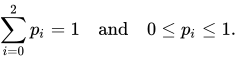
Conversely, any three such numbers unambiguously specify a random variable, so we can identify the random variable X with the tuple .

Now suppose X is a binomial random variable with parameter q and n = 2, i.e. X represents the number of successes when repeating a certain experiment two times, where each experiment has an individual success probability of q. Then

and it is not hard to show that the tuples which arise in this way are precisely the ones satisfying


The latter is a polynomial equation defining an algebraic variety (or surface) in , and this variety, when intersected with the simplex given by

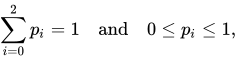
yields a piece of an algebraic curve which may be identified with the set of all 3-state Bernoulli variables. Determining the parameter q amounts to locating one point on this curve; testing the hypothesis that a given variable X is Bernoulli amounts to testing whether a certain point lies on that curve or not.


References

[edit]
[edit]
Revisions and contributorsEdit on WikipediaRead on Wikipedia
from Grokipedia
Algebraic statistics is an interdisciplinary field that integrates tools from , , and to analyze statistical models, particularly those defined by equations and involving discrete random variables. The field emerged prominently in the late , with foundational work by Diaconis and Sturmfels in 1998 introducing Markov bases for log-linear models of contingency tables, which enabled exact goodness-of-fit tests via algebraic methods. This development bridged classical statistics with computational algebra, allowing the study of likelihood equations and structures through ideals and varieties in rings. Key concepts include toric ideals, which parametrize probability distributions in discrete models such as graphical models and hidden Markov models, and Gröbner bases, used to solve systems of equations arising in . Algebraic statistics has applications across diverse areas, including —such as reconstruction using likelihood methods like Felsenstein's and parametric —and social sciences, where it models ranked preferences or through polytope algebras and . Recent extensions include applications to and analysis. In network analysis, it examines conditional independencies in multi-variable systems using tensor representations, as seen in studies of Bernoulli trials or medical experiments assessing variable interactions. Computational tools like 4ti2 for Markov bases and Singular for ideal computations have made these methods practical, while ongoing research explores secant varieties and phylogenetic invariants to enhance model . The field's growth, documented in influential texts like Pachter and Sturmfels' 2005 book Algebraic Statistics for Computational Biology, underscores its role in advancing both theoretical inference and applied .

Overview

Definition and Scope

Algebraic statistics is an interdisciplinary field that applies tools from , , and to the study and analysis of statistical models, with a particular emphasis on those featuring parametrizations. These tools enable the algebraic description of probability distributions and inference procedures, transforming traditional statistical problems into questions about algebraic structures such as ideals and varieties. The field emerged as a response to the need for exact computational methods in complex probabilistic settings, distinguishing it from classical statistics by prioritizing symbolic and combinatorial techniques over numerical approximations. The scope of algebraic statistics centers on discrete statistical models, such as those involving contingency tables and hidden Markov models, where the underlying data-generating processes correspond to algebraic varieties defined over rings. Unlike broader statistical approaches that often rely on asymptotic approximations or simulation-based methods, algebraic statistics focuses on finite-sample exactness through algebraic invariants, making it especially suited for models with rational or map parametrizations that capture dependencies in categorical data. This delineation excludes purely continuous or non-algebraic models, emphasizing instead the intersection of statistics with exact computability in discrete spaces. At its core, algebraic statistics involves parametrizing probability distributions through rational maps from spaces to probability simplices, allowing the representation of models as images of these maps. It further examines ideals generated by conditional independences, which encode the structural constraints of graphical models, and employs Gröbner bases to facilitate exact inference tasks like hypothesis testing and . These components provide a rigorous framework for deriving algebraic certificates of statistical properties, such as and likelihood maximizers, without resorting to iterative numerical solvers. The interdisciplinary scope of algebraic statistics extends to through the study of lattice polytopes associated with toric models, to via secant varieties that describe secant dimensions in mixture models, and to optimization by integrating for relaxations in likelihood computations. These connections highlight its role in bridging with applied , fostering advancements in fields like and .

Importance and Interdisciplinary Connections

Algebraic statistics plays a vital role in modern data analysis by enabling exact symbolic computations for key statistical tasks such as model selection, hypothesis testing, and parameter estimation, particularly in high-dimensional settings where numerical methods are prone to failure due to instability or intractability. This approach leverages algebraic structures to provide rigorous guarantees that are absent in approximate numerical techniques, ensuring precise solutions even for complex discrete data distributions. A key advantage over classical statistical methods lies in its ability to handle non-identifiable models through primary decomposition of polynomial ideals, which breaks down the solution set into irreducible components that reveal underlying identifiability structures. Furthermore, it delivers certificates of optimality, for instance via the Hilbert series of toric ideals, which encodes the degrees of freedom in statistical models by yielding a Hilbert polynomial whose leading term corresponds to the model's dimension. The field's interdisciplinary connections underscore its broad impact across sciences. In biology, algebraic statistics facilitates phylogenetic reconstruction by modeling evolutionary processes on trees using toric varieties and invariants, allowing inference of ancestral relationships from genetic sequence data with algebraic guarantees of consistency. Within machine learning, it intersects with tensor decompositions to address latent variable models, where algebraic tools ensure parameter identifiability and efficient recovery of low-rank structures in multi-way arrays representing high-dimensional data. Algebraic methods inspired by algebraic statistics connect to game theory in economics through the representation of equilibria—such as Nash or dependency equilibria—as points on algebraic varieties, enabling the use of commutative algebra to study stability and multiplicity in strategic interactions. Algebraic statistics also tackles pressing challenges in big data, including computational complexity, by deploying specialized algebraic algorithms to resolve issues like moment problems. For example, Fourier-Motzkin elimination projects systems of linear inequalities arising in such problems onto lower dimensions, providing exact feasibility certificates and bounding feasible parameter regions without exhaustive enumeration. This method proves particularly effective in scaling algebraic techniques to large-scale datasets, offering polynomial-time solutions in certain structured cases where heuristic optimizations falter. Recent developments as of 2024 include applications to environmental and ecological modeling for climate change analysis, as well as enhancements to methods like Bayesian additive regression trees using algebraic and combinatorial tools.

Historical Development

Early Foundations (Pre-1990s)

The roots of algebraic statistics trace back to early developments in probability theory during the pre-20th century, where polynomial representations began to emerge as tools for modeling probabilistic outcomes. Jacob Bernoulli's seminal work in Ars Conjectandi (1713) laid foundations for combinatorial probability calculations using polynomial expansions, providing a systematic way to encode sequences of probabilities into power series, implicitly highlighting the polynomial structure inherent in discrete distributions long before explicit algebraic frameworks were applied in statistics. In the 20th century, advanced with contributions that revealed implicit algebraic structures in probabilistic models. Ronald A. Fisher's 1922 paper on the mathematical foundations of theoretical statistics formalized the and explored its properties within families of distributions that later became known as exponential families, where the log-likelihood takes a in parameters, suggesting an underlying without explicit polynomial ideals at the time. This work emphasized sufficiency and , providing the probabilistic backbone for models analyzable via algebraic methods. Building on such ideas, Shelby J. Haberman's research in the 1970s focused on log-linear models for analyzing contingency tables, employing to estimate parameters under Poisson sampling, which effectively solved systems of equations arising from marginal constraints in multi-way tables. Haberman's approach highlighted the multiplicative structure of expected frequencies, a key precursor to algebraic representations of these models. Key milestones in the pre-1990s period included early explorations of combinatorial tools for statistical testing. John N. Darroch and Dorothy Ratcliff's 1972 development of for log-linear models offered an algorithmic solution for in exponential families defined on contingency tables, with connections to chi-squared goodness-of-fit tests through the evaluation of model adequacy via deviance measures. This method anticipated later combinatorial moves for exploring the of observed data under fixed margins, akin to precursors of Markov bases used in exact conditional tests. In the 1990s, Giovanni Pistone and Eva Riccomagno initiated applications of Gröbner bases to statistical problems, particularly in experimental and discrete models, where these bases facilitated the computation of ideal membership for toric ideals arising from factorial structures. The transition toward explicitly algebraic views of statistical models gained traction in the 1980s through work on graphical models. Steffen L. Lauritzen's contributions, including his collaborations on analysis, recognized the structure underlying log-linear parameterizations in undirected graphical models, where constraints correspond to binomial edges in the variety's defining ideal. This perspective bridged probabilistic factorization with , setting the stage for viewing as solving equations on toric varieties without delving into modern computational tools.

Modern Advances (1990s-Present)

The emergence of algebraic statistics as a distinct field in the 1990s was marked by the seminal work of and Bernd Sturmfels, who in their 1998 paper developed algebraic algorithms for sampling from conditional distributions in discrete exponential families, with a focus on contingency tables. This approach leveraged toric ideals to construct Markov bases, enabling exact goodness-of-fit tests by facilitating uniform sampling over conditional tables without relying on approximations. In the , the discipline expanded through foundational texts and computational tools that bridged algebra and applied statistics. The book Algebraic Statistics for by Lior Pachter and Bernd Sturmfels (2005) synthesized these methods for biological applications, such as and phylogenetic reconstruction, emphasizing toric varieties and Gröbner bases for likelihood inference. Complementing this theoretical advancement, the software package 4ti2 was introduced to compute Markov bases and perform related algebraic operations on integer lattices, making these techniques accessible for practical statistical modeling. From the 2010s to the present, algebraic statistics has increasingly intersected with . Advances in have further enhanced , with 2020s research utilizing min-plus algebras to derive efficient algorithms for learning causal structures in extreme value models, outperforming traditional methods on benchmark datasets. Prominent contributors have shaped these developments: Sullivant advanced phylogenetic algebraic geometry by studying the ideals and varieties arising from tree-based evolutionary models, providing tools for and parameter estimation in . Mathias Drton pioneered algebraic techniques for Gaussian graphical models, developing methods to test conditional independences and recover sparse structures from covariance data using determinantal ideals. As of 2023, emerging trends include quantum algebraic statistics, exemplified by the of quantum graphical models, which extends classical varieties to quantum states for entanglement analysis and processing.

Algebraic Foundations

Key Algebraic Structures

In algebraic statistics, serve as the foundational algebraic objects for modeling probability distributions. A over , denoted Q[p1,,pm]\mathbb{Q}[p_1, \dots, p_m], consists of multivariate polynomials in indeterminates p1,,pmp_1, \dots, p_m with coefficients in Q\mathbb{Q}, where these indeterminates typically represent probability parameters. These rings parametrize statistical models by encoding the algebraic relations among probabilities, particularly in discrete settings like contingency tables or hidden Markov models. A key example is the representation of exponential families as toric rings, where the takes the form pu=exp(ATαu)/Z(α)p_u = \exp(A^T \alpha \cdot u) / Z(\alpha) for a AA and Z(α)Z(\alpha), capturing log-linear dependencies in graphical models. Ideals within these polynomial rings define the constraints of statistical models, while the corresponding varieties describe the feasible parameter spaces. An ideal IQ[p1,,pm]I \subseteq \mathbb{Q}[p_1, \dots, p_m] is a subset closed under addition and multiplication by ring elements, generated by polynomials that enforce model equations, such as those arising from conditional independences. Prime ideals play a crucial role in representing irreducible models, as the quotient ring Q/I\mathbb{Q}/I being an integral domain ensures the model's algebraic structure cannot be decomposed further, corresponding to indecomposable toric varieties. The affine variety V(I)V(I), defined as the zero set {pCmf(p)=0 fI}\{ p \in \mathbb{C}^m \mid f(p) = 0 \ \forall f \in I \}, geometrically realizes the parameter space of feasible probability distributions, often intersecting with the probability simplex to bound positive probabilities. For instance, in log-linear models, the variety VAV_A is the Zariski closure of the image of the parametrization map, delineating the manifold of attainable marginal distributions. Gröbner bases provide an algorithmic tool for manipulating ideals to analyze model complexity. A Gröbner basis of an ideal II with respect to a is a generating set {g1,,gs}\{g_1, \dots, g_s\} such that the leading terms generate the leading-term ideal, allowing reduction of any in II to zero via —effectively reducing the ideal to a canonical form via . This structure enables computation of the of the variety V(I)V(I), which equals the of the and indicates the in the model, as well as the degree, measuring the number of intersection points with a generic and quantifying intrinsic complexity. In practice, software like Macaulay2 or 4ti2 implements these computations for statistical ideals, such as determining the dimension of phylogenetic models. Lattice polytopes arise in the combinatorial aspects of algebraic statistics, particularly for discrete models involving integer constraints. A lattice polytope is the convex hull of lattice points in Zd\mathbb{Z}^d, and in this context, it connects to the marginal polytope of a contingency table model, which is the convex hull of all possible marginal probability vectors (sufficient statistics) attainable under the model, encoding the feasible supports for observed data. Fiber polytopes for fixed margins are also lattice polytopes, and the Ehrhart polynomial LP(t)L_P(t) of such a polytope PP is a polynomial of degree dimP\dim P that counts the number of lattice points in the tt-dilate tPZdtP \cap \mathbb{Z}^d, providing an exact formula for enumerating the integer points in model fibers—essential for exact hypothesis testing and sampling in contingency tables without approximation. For example, in toric models, the coefficients of the relate to volumes and symmetries of the polytope, facilitating precise computation of the number of contingency tables with given margins.

Toric Ideals and Markov Bases

In algebraic statistics, toric ideals arise as the kernel of a parametrization map encoding the algebraic relations imposed by the . Specifically, for a discrete model with AZd×nA \in \mathbb{Z}^{d \times n} (dd sufficient statistics dimensions, nn table cells), the toric ideal IAI_A is the kernel of the map π:K[x1,,xn]K[t1,,td]\pi: \mathbb{K}[x_1, \dots, x_n] \to \mathbb{K}[t_1, \dots, t_d] given by π(xi)=j=1dtjAji\pi(x_i) = \prod_{j=1}^d t_j^{A_{j i}} for i=1,,ni = 1, \dots, n. This kernel consists of binomials xu+xu\mathbf{x}^{\mathbf{u}^+} - \mathbf{x}^{\mathbf{u}^-} such that u+uker(ZnZd)\mathbf{u}^+ - \mathbf{u}^- \in \ker(\mathbb{Z}^n \to \mathbb{Z}^d), where u±Nn\mathbf{u}^\pm \in \mathbb{N}^n have disjoint supports, reflecting the linear constraints of the model. The generators of this ideal directly correspond to the conditional independences or other structural constraints in the underlying probability model, providing an algebraic certificate for the dimension and variety of the model. Markov bases extend this framework by providing a combinatorial tool for exact in discrete models, defined as a minimal set of vectors Bker(A)\mathcal{B} \subset \ker(A) (where AA is the of the model) such that adding multiples of elements from B\mathcal{B} connects any two points in a {yNm:Ay=Ax}\{ \mathbf{y} \in \mathbb{N}^m : A\mathbf{y} = A\mathbf{x} \} via lattice walks that preserve the sufficient statistics. A key states that if B\mathcal{B} is a Markov basis, then the fiber graph—vertices as tables in the fiber, edges via moves in B\mathcal{B}—is connected, enabling uniform sampling from the conditional distribution via methods without rejection, as the chain is irreducible and aperiodic under suitable choices. This connectivity ensures that the is uniform over the fiber, facilitating exact goodness-of-fit tests for models like log-linear families. Computing minimal Markov bases involves solving integer programs to find generating sets for the lattice ideal, often using algorithms that compute Gröbner bases of the toric ideal or directly optimize over the syzygies via branch-and-bound methods in software like 4ti2. However, determining a minimal Markov basis is NP-hard in general, even for simple hierarchical models, due to the exponential growth in the number of generators with model dimension. A classic example is the independence model for a 2×22 \times 2 contingency table with cells labeled a,b,c,da, b, c, d, where the toric ideal is generated by the binomial adbcad - bc, corresponding to the constraint on row and column margins. The associated Markov basis consists of the vector (1,1,1,1)(1, -1, -1, 1), which generates moves that preserve margins and connect all tables with fixed totals, such as transitioning between observed and expected counts under .

Core Methods

Maximum Likelihood Estimation

In algebraic statistics, (MLE) involves solving the score equations derived from the log-likelihood function, logLθ=0\frac{\partial \log L}{\partial \theta} = 0, which often yield a for parametric models with discrete or mixed supports. These equations arise naturally in models such as multinomial distributions or hidden Markov models, where the parameters θ\theta parameterize the , transforming the into finding of an . The multiplicity of solutions to these polynomial systems is analyzed using , which provides an upper bound on the number of intersection points of hypersurfaces in , reflecting the geometric complexity of the likelihood landscape. This bound, known as the maximum likelihood degree (ML degree), quantifies the algebraic difficulty of MLE and remains invariant under reparameterizations of the model. Algebraic methods address these polynomial systems using Gröbner bases to triangularize the ideal, enabling the identification of critical points including the global maximum. For instance, in low-dimensional cases, Gröbner bases simplify the system into univariate whose roots correspond to candidate MLEs, with numerical refinement used to select the likelihood-maximizing solution. The expectation-maximization (EM) algorithm, commonly used for models with hidden variables, admits an algebraic reformulation where the E-step computes expectations over latent varieties and the M-step solves restricted likelihood equations, often as toric ideals for discrete supports. This perspective reveals convergence properties through the geometry of secant varieties associated with incomplete data. Identifiability in MLE is assessed via analysis, where the model is locally identifiable if the at a point does not contain the direction, ensuring a unique local maximum. In mixture models, such as Gaussian mixtures, the likelihood equations define points on secant varieties, and non- occurs when these varieties have deficient dimensions, leading to multiple parameter sets yielding the same observed distribution. For example, in bivariate Gaussian mixtures, algebraic conditions on the structure determine when the secant variety fills the ambient space, guaranteeing identifiability up to label switching. A example arises in exponential families, where the simplify to forms like xilogθjnlogθj=0\sum x_i \log \theta_j - n \log \sum \theta_j = 0 for multinomial sampling with nn trials, solvable algebraically in small dimensions using resultants to yield explicit rational expressions for the MLE. This highlights how the natural parameters θj\theta_j balance observed counts xix_i against normalization, with Gröbner bases providing a computational path for higher dimensions. Recent advances as of 2024 employ numerical , such as homotopy continuation methods, to compute MLE solutions in complex models with high ML degrees.

Method of Moments

The method of moments in algebraic statistics formulates parameter estimation as the solution to equations that equate theoretical moments of a to their empirical counterparts computed from . These moment equations arise from expressing expected values, such as E[Xk]\mathbb{E}[X^k] for a XX, in terms of model parameters, resulting in a of relations. For instance, in a Gaussian model, the second-order moment satisfies the equation E[X2]=μ2+σ2,\mathbb{E}[X^2] = \mu^2 + \sigma^2, where μ\mu is the and σ2\sigma^2 is the variance; higher-order moments yield additional polynomials that must hold simultaneously. When the number of sample moments exceeds the number of parameters, the system becomes overdetermined, and solutions are sought by projecting onto the defined by the moment equations, often using least-squares minimization constrained to the variety. This geometric approach leverages tools from computational algebra to identify feasible parameter sets, ensuring consistency by testing membership in the moment ideal via Gröbner bases or saturation techniques. In mixture models, such as Gaussian mixtures, the moment variety Gn,dG_{n,d} parameterizes all possible moment sequences up to order dd in nn dimensions, and secant varieties σk(Gn,d)\sigma_k(G_{n,d}) capture mixtures of kk components; solving involves intersecting sample moments with these varieties. Algebraic resolution of these systems employs syzygies—relations among the generators of the moment ideal—to derive minimal sets of independent conditions necessary for and estimation. The syzygy module of the ideal provides a basis for redundant relations, reducing in solving for parameters; for example, in homoscedastic Gaussian mixtures, syzygies among minors enforce the necessary moment constraints. In non-parametric settings, algebraic techniques address the , which determines whether a given sequence of real numbers corresponds to the moments of a positive measure on R\mathbb{R}. This is resolved by checking positive semidefiniteness of associated and representing the representing measure via sums-of-squares () decompositions of positive polynomials, ensuring the sequence lies in the moment cone. methods, implemented via , provide certificates of positivity and enable dual optimization over moment sequences, with applications to and goodness-of-fit testing in algebraic frameworks. Recent work as of 2025 uses numerical for the method of moments in high-dimensional settings, improving scalability for mixture models.

Applications in Modeling

Graphical Models

Graphical models provide a framework for representing multivariate probability distributions through graphs, where vertices correspond to random variables and edges encode conditional dependencies or independencies. In algebraic statistics, these models are analyzed using polynomial ideals that capture the constraints imposed by the graph structure on the moments, cumulants, or probabilities of the distribution. This algebraic approach facilitates the study of , parameter estimation, and by leveraging tools from and . Conditional independence ideals form the algebraic core of graphical models, encoding the separation criteria derived from the graph. In directed acyclic graphs (DAGs), d-separation determines conditional independencies: two nodes are d-separated given a conditioning set if every path between them is blocked, meaning non-colliders are in the set or colliders and their descendants are not. The generators of these ideals consist of polynomials vanishing on the distributions satisfying these independencies, such as binomial relations in discrete models or determinantal ideals in Gaussian cases. For instance, in a simple chain graph representing the conditional independence between variables X1X_1 and X3X_3 given X2X_2, the ideal is generated by binomials of the form uijkuijkuijkuijku_{i j k} u_{i' j k'} - u_{i j k'} u_{i' j k}, where uijku_{i j k} denotes the joint probability for states ii of X1X_1, jj of X2X_2, kk of X3X_3, capturing the Markov properties through the factorization of the joint distribution. For Gaussian Markov random fields, which correspond to undirected graphs, the vanishing ideals are defined by constraints on the inverse covariance matrix, known as the concentration matrix. Entries in the concentration matrix K=Σ1K = \Sigma^{-1} are zero for pairs of variables separated by the graph, reflecting conditional independencies. These ideals are often toric, generated by quadratic polynomials in the entries of the Σ\Sigma. Parameter estimation in these models involves solving algebraic equations subject to the graph's constraints. For chordal graphs, which admit perfect elimination orderings, the concentration matrix can be decomposed into sums over maximal cliques, enabling explicit via or algorithms that enforce . This decomposition exploits the graph's structure to reduce the problem to estimating parameters on cliques and propagating them globally. Model selection in graphical models benefits from algebraic techniques like primary decomposition of conditional independence ideals, which reveals the irreducible components corresponding to possible graph structures. Score-based tests compare observed data against these decompositions to select the model with the highest posterior probability or lowest discrepancy, using Gröbner bases to compute the necessary statistics efficiently. This approach is particularly useful for testing nested models or identifying minimal sets of independencies.

Phylogenetics

Phylogenetic invariants are functions that vanish on the algebraic varieties parameterizing probability distributions generated by specific evolutionary models, enabling the identification of topologies without estimating numerical parameters such as lengths. These invariants provide a non-parametric approach to reconstruction, distinguishing between different topologies by evaluating whether observed site pattern frequencies satisfy the polynomials associated with a hypothesized . Seminal work introduced these invariants for discrete-state models, demonstrating their utility in resolving evolutionary relationships from sequence data. A prominent example involves quartet invariants for four taxa, which help determine the topology among the three possible resolved quartets. For taxa labeled A, B, C, D under models like the general , the invariant is derived from the expected frequencies of site patterns. Specifically, for the topology ((A,B),(C,D)), the key invariant is given by DABDCDDACDBDDADDBC=0,D_{AB} D_{CD} - D_{AC} D_{BD} - D_{AD} D_{BC} = 0, where DXY=det(MXY)D_{XY} = \det(M_{XY}) and MXYM_{XY} is the 4×44 \times 4 matrix with entries pstXYp_{st}^{XY}, the joint probability of observing state ss at taxon X and tt at Y. This vanishes on the variety for the correct but not for alternatives. Quartet invariants extend to group-based models, where Fourier transforms linearize the parameterization, facilitating the computation of higher-degree invariants via toric ideals. Distance-based methods in algebraic phylogenetics employ metrics defined on tree spaces to infer topologies, leveraging the additive property of tree metrics under certain models. These metrics, such as those derived from log-det transformations for aligned sequences, embed trees into Euclidean spaces while preserving , allowing distance matrices to be tested for tree-likeness via invariants like the four-point condition. The Cavender-Farris-Neyman (CFN) model, a binary symmetric , parameterizes distributions as a , where the invariants form a toric ideal generated by binomials corresponding to cycle structures in the tree's parameterization. This toric structure enables efficient computations for and on claw trees and balanced trees. Maximum likelihood estimation on phylogenetic trees involves optimizing branch lengths to maximize the probability of observed data under a specified model, often requiring solutions to likelihood equations that resemble Poisson processes for substitution rates. In continuous-time Markov models, branch lengths represent expected substitutions, estimated by solving transcendental equations derived from the matrix exponential parameterization, such as P(t)=exp(Qt)\mathbf{P}(t) = \exp(\mathbf{Q} t), where Q\mathbf{Q} is the rate matrix and tt the branch length. Software like PAUP* implements these via numerical algebraic solvers, including Newton-Raphson iterations on the score equations, to compute maximum likelihood estimates for tree parameters under models like Jukes-Cantor or general time-reversible. Algebraic approaches further analyze the ML degree of phylogenetic varieties, quantifying the number of critical points in the optimization landscape.

Emerging and Advanced Areas

Tropical Statistics

Tropical statistics emerges as a robust framework within algebraic statistics, leveraging to handle uncertainty and outliers in probabilistic inference. Tropicalization transforms classical algebraic varieties associated with statistical models into piecewise-linear objects by replacing addition with minimization and multiplication with addition, known as the min-plus algebra. This shift facilitates the analysis of log-likelihood functions and enables computations that are more resilient to perturbations in data. The core operation in this algebra is the tropical sum, defined as ab=min(a,b)a \oplus b = \min(a, b), with tropical multiplication given by ab=a+ba \otimes b = a + b. These operations extend to vectors and matrices, forming a semiring that underpins tropical varieties—sets defined by the non-negativity of tropical polynomials, which correspond to the limits of classical varieties under logarithmic scaling. In statistical modeling, tropical varieties represent piecewise-linear approximations of exponential families, capturing the geometry of maximum likelihood estimation in a combinatorial manner. For instance, the tropicalization of a graphical model's variety yields a fan structure that encodes conditional independence constraints as linear inequalities. A key application is tropical principal component analysis (PCA), which adapts classical PCA to the tropical projective for dimension reduction and detection. Tropical PCA identifies the "closest" tropical linear space or to observed data points using a tropical metric, such as dtr(v,w)=maxi,jviwivj+wjd_{\text{tr}}(v, w) = \max_{i,j} |v_i - w_i - v_j + w_j|, making it robust to outliers because the max-norm emphasizes extreme deviations without being overly influenced by noise. This method has been applied to phylogenetic data, where it projects tree spaces into lower dimensions, revealing clusters and removing anomalous trees to improve model fit, as demonstrated on datasets with 252 sequences from eight Apicomplexa . In , tropical statistics employs ultrametrics derived from tropical distances to construct dendrograms that reflect evolutionary or hierarchical structures. Ultrametrics satisfy the strong d(x,z)max(d(x,y),d(y,z))d(x, z) \leq \max(d(x, y), d(y, z)), aligning naturally with the min-plus and enabling divisive analysis (DIANA) algorithms over the tropical projective . Such methods outperform Euclidean clustering in accuracy when applied to simulated phylogenetic trees under multi-species models, achieving higher recovery rates for true clusterings in datasets of 1000 gene trees sampled from 20 individuals. This approach links to by modeling tree metrics as tropical convex hulls. For , the tropical is formulated as the maximum of the negative log-, or "max-log," which tropicalizes the classical by evaluating trop(u)=iuiθi=mini(ui+θi)\ell_{\text{trop}}(u) = \bigoplus_i u_i \otimes \theta_i = \min_i (u_i + \theta_i) over parameters θ\theta. This perspective simplifies optimization in discrete models, such as those for contingency tables, where tropical ideals are generated by bases of tropical binomials corresponding to conditional independences. These tropical exponential families generalize classical ones by parameterizing distributions via tropical cumulants, offering scalable tools for robust testing in high-dimensional data.

Statistical Learning Theory

Algebraic statistics intersects with by employing tools from and to analyze model complexity, identifiability, and generalization in settings. These methods provide rigorous frameworks for understanding phenomena like and regularization, often through the parameterization of statistical models as algebraic varieties. For instance, the geometry of these varieties reveals bounds on learning capacity, while tensor decompositions ensure unique recovery of latent structures in high-dimensional data. In algebraic regularization, techniques such as the penalty promote sparsity by encouraging solutions where many coefficients vanish, akin to testing membership in ideals generated by sparse in a . The ideal membership problem—determining whether a given lies in an ideal spanned by sparse generators—mirrors the sparsity constraints in Lasso regression, allowing algebraic algorithms like Gröbner bases to certify sparse solutions efficiently. This perspective extends to broader sparse modeling, where the support of the solution corresponds to the minimal generators of the ideal, providing a combinatorial certificate for regularization outcomes. Furthermore, the algebraic geometry of the VC dimension quantifies the shattering capacity of hypothesis classes; for discrete Markov networks, the VC dimension equals the dimension of the associated toric ideal, linking to the algebraic complexity of the model. This connection enables bounds on learnability using existential theory of the reals to compute VC dimensions via descriptions. Tensor methods in algebraic statistics leverage canonical polyadic (CP) decomposition to address identifiability in topic models, where the observed word co-occurrence tensor is decomposed into a sum of rank-1 components representing latent topics. Uniqueness of this decomposition, guaranteed under Kruskal's conditions on the factor matrices, ensures that model parameters can be recovered from moments of the data distribution, facilitating efficient learning algorithms like tensor power iteration. In independent component analysis (ICA), secant varieties of moment varieties play a central role in establishing identifiability; the generic points on the k-th secant variety correspond to mixtures of k independent components, and non-degeneracy conditions (e.g., non-Gaussianity) ensure unique decomposition of the observed covariance structure. This geometric framework, rooted in the closure of unions of linear spans through variety points, provides algebraic certificates for the recoverability of mixing matrices in blind source separation. Generalization bounds in kernel methods benefit from algebraic extensions, such as C*-algebraic structures in reproducing kernel Hilbert modules (RKHM), which refine measures to account for operator-valued kernels. These bounds show that the expected decays as O(1/√n) for n samples, with the complexity term controlled by the module's algebraic , offering tighter estimates than standard analyses. A key concept linking algebra to learning is via the degree of the variety: higher-degree varieties parameterizing the model can interpolate training data more flexibly, but their increased algebraic degree amplifies variance, leading to poor out-of-sample performance as quantified by the variety's embedding . Similarly, ties to the Hilbert function of the coordinate ring, which tracks the growth rate of basis elements in graded degrees and serves as an algebraic proxy for the function class's richness, bounding the expected supremum deviation over random labels. This integration highlights how algebraic invariants like the Hilbert function predict gaps in overparameterized models.

Algebraic Analysis and Abstract Inference

Algebraic analysis in statistics reframes classical problems using tools from commutative and non-commutative , treating statistical models as algebraic varieties or semialgebraic sets defined by equations and inequalities. In this framework, abstract views the process of drawing conclusions from data as ring homomorphisms between rings of observables, where the is represented by a generated by random variables, and the parameter space maps to the probability via a parametrization homomorphism whose kernel defines the model's toric ideal. Sufficiency emerges algebraically through quotient ideals: a is sufficient if the conditional distribution factors through a by the ideal generated by functions invariant under the sufficient , preserving the structure of the while reducing dimensionality, as detailed in the geometry of sufficient statistics cones for exponential families where maximum likelihood estimates exist when data points lie in the cone's interior. Decision theory receives an algebraic treatment by encoding Bayesian updates and risk measures into polynomial structures. Algebraic Bayes factors can be computed as ratios derived from the cells of Gröbner fans associated with the ideals of marginal and conditional likelihoods, providing a combinatorial certificate for model comparison in discrete settings like contingency tables, where the fan's regular corresponds to optimal posterior approximations. estimation over spaces addresses equivariant problems under group actions, such as recovering signals up to ; here, invariants from the invariant ring RGR^G (where GG acts on Rp\mathbb{R}^p) allow estimation of orbits from noisy observations, with sample complexity scaling as Θ(σ2d)\Theta(\sigma^{2d^*}), where dd^* is the minimal degree of separating invariants, achieving optimal rates for problems like cryo-electron microscopy. Non-commutative extensions extend this framework to quantum statistics, replacing commutative polynomial rings with free algebras to model entangled quantum systems. In free algebraic statistics, observables are non-commuting operators, and statistical models are defined over free semialgebraic sets where positivity constraints become positive-semidefiniteness of Hermitian matrices; for instance, independence models lift to positive operator-valued measures (POVMs) with tensor-product decompositions, capturing quantum correlations in non-local games via the free convex hull of rank-one parametrizations. This approach facilitates inference in entangled models by evaluating polynomials on matrix tuples, enabling algebraic optimization for quantum hypothesis testing and parameter estimation beyond classical limits. A key result in this algebraic paradigm is the algebraization of the Neyman-Pearson lemma through orthogonal ideals: the most powerful test for simple hypotheses corresponds to the quotient by an orthogonal ideal in the ring of test functions, where orthogonality ensures the separates the null and alternative measures maximally, generalizing the classical lemma to invariant and equivariant settings via of the hypothesis ideal. This provides a computation for critical regions, ensuring type I error control while maximizing power in algebraic models of discrete .

Partially Ordered Sets and Lattices

In algebraic statistics, partially ordered sets (posets) provide a natural framework for modeling preference orders in ranking data, where the states of a statistical model correspond to orderings of a finite set of items represented as maximal chains in a graded poset. These models parameterize families of probability distributions over rankings using rational functions, leading to algebraic varieties that capture dependencies among preferences; for instance, the Plackett-Luce model is non-toric, while toric examples include the Birkhoff and Bradley-Terry models, whose toric ideals and Markov bases are analyzed via the poset's combinatorial structure. The Dedekind-MacNeille completion extends such posets to complete lattices by embedding them into the smallest complete lattice containing the original order, facilitating closure operators that ensure the statistical model's hierarchical structure is fully deductive and handles incomplete rankings through ideal completions. Lattice theory plays a central role in algebraic statistics through distributive lattices, which model marginalization operations in multi-way under hierarchical log-linear models. In these models, the set of allowable interactions among categorical variables forms a distributive lattice ordered by refinement of marginal constraints, where the operations correspond to combining or intersecting marginal distributions, enabling exact tests via toric ideals. Birkhoff's representation theorem asserts that every finite distributive lattice is isomorphic to the lattice of order ideals in a poset of join-irreducible elements, providing an algebraic decomposition for such marginal lattices in analysis; this representation aids in enumerating sufficient statistics and computing Gröbner bases for in sparse data settings. For inference in these structures, algebraic tests assess lattice compatibility by verifying whether marginal or conditional distributions derive consistently from a global within the lattice of kernels, using projections and conditionings as lattice operations to check dominance relations. Möbius inversion from the of the lattice inverts summation over order ideals to perform inclusion-exclusion on probabilities, computing query probabilities as P(Φ)=v1^μL(v,1^)P(λ(v))P(\Phi) = \sum_{v \leq \hat{1}} \mu_L(v, \hat{1}) P(\lambda(v)), where μL\mu_L is the , thus enabling efficient Bayesian updates and avoiding overcounting in hierarchical models. A key example is the Boolean lattice for power set models, where the poset of subsets ordered by inclusion models independence structures in multi-dimensional binary data, such as in latent class analysis; the zeta function is defined by ζ(S,T)=1\zeta(S,T) = 1 if STS \subseteq T and 0 otherwise, facilitating Möbius inversion to compute exact probabilities over subset events via the incidence algebra.

Illustrative Examples

Basic Example: Independence Models in Contingency Tables

A fundamental illustration of algebraic statistics arises in testing independence between two binary variables using a 2×2 contingency table, where observed counts u=(u11,u12,u21,u22)\mathbf{u} = (u_{11}, u_{12}, u_{21}, u_{22}) follow a multinomial distribution with total sample size n=uijn = \sum u_{ij} and unknown probabilities p=(p11,p12,p21,p22)Δ3\mathbf{p} = (p_{11}, p_{12}, p_{21}, p_{22}) \in \Delta_3, the 3-simplex. Under the null hypothesis of independence, the probabilities satisfy pij=aibjp_{ij} = a_i b_j for parameters a1,a2,b1,b2>0a_1, a_2, b_1, b_2 > 0 with ai=bj=1\sum a_i = \sum b_j = 1, forming a toric model whose algebraic variety is the rank-1 surface in R4\mathbb{R}^4 defined by the condition that the probability matrix has rank at most 1. This model preserves fixed row and column marginals, and the corresponding toric ideal in the homogeneous coordinate ring is generated by the single binomial I=p11p22p12p21,I = \langle p_{11} p_{22} - p_{12} p_{21} \rangle, which encodes the independence constraints algebraically. To test the hypothesis conditional on the observed marginals, algebraic methods employ a Markov basis for the integer kernel of the encoding the marginal constraints, enabling conditional via sampling. For the 2×2 model, the minimal Markov basis consists of a single essential move up to : m=(1,1,1,1),\mathbf{m} = (1, -1, -1, 1), corresponding to adding or subtracting 1 from the diagonal entries while adjusting the off-diagonals to preserve margins; this basis connects all tables in the Fu={vN4:Av=Au}\mathcal{F}_\mathbf{u} = \{ \mathbf{v} \in \mathbb{N}^4 : A\mathbf{v} = A\mathbf{u} \}, where AA is the 2×2 for rows and columns. The is the Pearson chi-squared value X2(v)=i,j(vijv^ij)2v^ij,X^2(\mathbf{v}) = \sum_{i,j} \frac{(v_{ij} - \hat{v}_{ij})^2}{\hat{v}_{ij}}, with expected counts v^ij\hat{v}_{ij} computed from the marginals, evaluated at tables v\mathbf{v} in the fiber. A step-by-step exact test proceeds as follows: first, generate the Markov basis using computational software, which for this model yields {±m}\{\pm \mathbf{m}\}; then, starting from the observed u\mathbf{u}, perform a on Fu\mathcal{F}_\mathbf{u} by adding integer multiples of basis elements while staying non-negative, approximating the uniform distribution over the after sufficient steps (mixing time is rapid here due to the simple basis). The p-value is the proportion of sampled tables with X2(v)X2(u)X^2(\mathbf{v}) \geq X^2(\mathbf{u}), providing a non-asymptotic alternative to the standard chi-squared approximation, which assumes large nn and follows a χ12\chi^2_1 distribution. For small samples, the method avoids the approximation's inaccuracies, as the grows factorially but remains tractable for tables. The for the asymptotic equal the of the , which is 1 here, reflecting the single algebraic constraint reducing the 3-dimensional to a 2-dimensional surface (after for the normalization pij=1\sum p_{ij} = 1). This aligns with the statistical (21)(21)=1(2-1)(2-1) = 1, linking the geometric dimension of the model to classical .

Advanced Example: Phylogenetic Invariants

In phylogenetic reconstruction, an advanced application of algebraic statistics involves using invariants to infer quartet trees from distance data under the additive tree model. Consider four taxa labeled A, B, C, and D, where pairwise distances dijd_{ij} represent the expected evolutionary distances between taxa i and j, assumed to follow an additive model on an unrooted binary tree. Under this model, the distances satisfy the four-point condition: for any quartet, the two largest of the three possible sums dAB+dCDd_{AB} + d_{CD}, dAC+dBDd_{AC} + d_{BD}, and dAD+dBCd_{AD} + d_{BC} are equal, corresponding to the path lengths crossing the internal branch of the true tree topology. The key invariants are constructed as linear polynomials in the distances, each vanishing precisely on the variety defined by one of the three possible quartet topologies. Specifically, the six polynomials consist of the three primary differences and their negatives: δABCD=dAC+dBDdADdBC\delta_{AB|CD} = d_{AC} + d_{BD} - d_{AD} - d_{BC}, δACBD=dAB+dCDdADdBC\delta_{AC|BD} = d_{AB} + d_{CD} - d_{AD} - d_{BC}, δADBC=dAB+dCDdACdBD\delta_{AD|BC} = d_{AB} + d_{CD} - d_{AC} - d_{BD}, and δABCD-\delta_{AB|CD}, δACBD-\delta_{AC|BD}, δADBC-\delta_{AD|BC}. For the true topology AB|CD, δABCD=0\delta_{AB|CD} = 0 holds exactly, while the other two δ\deltas are negative and equal (each minus twice the length of the internal branch); the negatives ensure the ideal is generated symmetrically for computational purposes in software. These polynomials derive from the edge invariants of the tree metric, providing a coordinate-free description of the model variety. To reconstruct the tree, evaluate the observed distances on these polynomials and identify the via the sign patterns or magnitudes. Under the with no noise, exactly one δ\delta vanishes (equals zero), and the corresponding split defines the topology; the other two δ\deltas share the same negative sign. With noisy data, the topology is the one minimizing the of its δ\delta, or more algebraically, solve the system δk=0\delta_k = 0 for each k using resultants to eliminate variables and test membership in the variety (though for linear cases, direct evaluation suffices; resultants are crucial for higher-degree invariants in sequence-based models). This approach extends the basic models by handling continuous distance parameters and multivariate dependencies. These invariants offer robustness to mild model misspecification, such as heterogeneous substitution rates across sites, as the persists under certain transformations (e.g., gamma-distributed rates), unlike higher-degree invariants that may fail. However, severe long-branch attraction can distort sign patterns, requiring additional checks like δ\delta-plots to detect outliers. Software implementations, such as 's distance-based methods or Macaulay2 for ideal membership testing, facilitate practical computation; for instance, computes the distances and applies the four-point metric to score topologies efficiently.

References

Add your contribution
Related Hubs
User Avatar
No comments yet.