Hubbry Logo
HaliacmonHaliacmonMain
Open search
Haliacmon
Community hub
Haliacmon
logo
8 pages, 0 posts
0 subscribers
Be the first to start a discussion here.
Haliacmon
Haliacmon
from Wikipedia
Haliacmon
Map
Native nameΑλιάκμονας (Greek)
Location
CountryGreece
Physical characteristics
Source 
 • locationPindus Mountains
 • coordinates40°21′50.95″N 20°48′9.18″E / 40.3641528°N 20.8025500°E / 40.3641528; 20.8025500
 • elevation~2100 m (~6,890 ft)
Mouth 
 • location
Aegean Sea
 • coordinates
40°28′4″N 22°39′15″E / 40.46778°N 22.65417°E / 40.46778; 22.65417
Length297 km (185 mi)
Basin size8,813 km2 (3,403 sq mi)

The Haliacmon (Greek: Αλιάκμονας, Aliákmonas; formerly: Ἁλιάκμων, Aliákmon or Haliákmōn) is the longest river of Greece, flowing entirely on Greek soil in the region of Macedonia, with a total length of 297 km (185 mi).[1] In Greece there are three rivers longer than Haliacmon: Evros (Greek: Έβρος), Strymonas (Greek: Στρυμόνας), both coming from Bulgaria, and Axios (Greek: Αξιός) coming from North Macedonia, but the length of each one of them in Greek territory is less than that of Haliacmon, which flows entirely in Greece. Haliacmon is the traditional English name for the river, but many sources cite the formerly official Katharevousa version of the name, Aliákmon. Today, the only official variant is the demotic Aliákmonas. It flows through the Greek regions of Western Macedonia (Kastoria, Grevena and Kozani regional units) and Central Macedonia (Imathia and Pieria regional units). Its drainage basin is 8,813 km2 (3,403 sq mi).[2]

Name

[edit]

The Latin name Haliacmon is derived from Ancient Greek Αλιάκμονας, a composite derived from άλας (salt, sea) and άκμων (anvil). In Greek mythology, Haliacmon was one of the river gods, who were sons of Oceanus and Tethys, according to the allegorical obsessive-anthropomorphic concept familiar to the Ancient Greeks, on geological upheaval after Deucalion's deluge.

An ancient tradition says that sheep that drank water from Haliacmon would turn their colour to white. This tradition is confirmed by the following record of the Roman author Pliny the Elder (23-79 AD) : Similarly in Macedonia, those who want their sheep to be white go to Haliacmon, while those (who want them to be) black (go) to Axios (Vardar).

Ottoman Turks called the river Ince-Karasu (narrow-black water), a name still used in Turkey. The Eastern South Slavic name is Бистрица, Bistritsa (Бистрица, from Proto-Slavic *-bystr, meaning "clear, lucid, limpid")[3] which is still in use in Bulgaria and North Macedonia.[4][5][6]

Course and tributaries

[edit]

Before the construction of its diversion dam near the village of Aghia Varvara in the mid-1950s, Haliacmon had no permanent river bed in its lowland course. It often flooded and formed extensive marshes. Its devastating fury in December 1935 remains fresh in memory of the elder inhabitants of the region (Veria and Alexandreia).

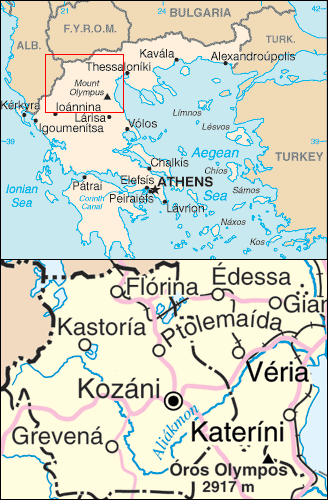
The Haliacmon rises in the Gramos mountains of Western Macedonia, near the international border with Albania. In its upper course it flows generally towards the east, and turns southeast near Kastoria. It describes a wide curve around the Vourinos mountains, and turns northeast near the village Paliouria. It feeds the large artificial lake Polyfyto, that was created after the construction of the namesake hydroelectric dam and consists almost its entire course through the Kozani prefecture. Over the bridge runs the Lake Polyfytos Bridge, part of the Athens-Kozani national road. Southeast of Veria, the Haliacmon enters the central Macedonian plains, an area of great importance to agriculture. It flows into the Thermaic Gulf west of the delta of the Axios (Vardar), northeast of the coastal town Methoni.

Haliacmon's tributaries include Gramos, Ladopotamos, Pramoritsa, Grevenitikos, Venetikos, Tripotamos and Krasopoulis.

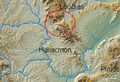
Course of the Haliacmon, as seen from the Terra satellite. (The river course has been highlighted.)
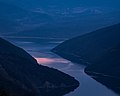
The bridge (1352 m.) over the Polyphytos artificial lake of the river Aliakmonas near Servia.

The Haliacmon flows along the towns (in downstream order) Nestorio, Argos Orestiko, Neapoli, Paliouria, Velventos, Veria and Alexandreia.

Wetland

[edit]
Haliacmon (Aliakmonas)

Haliacmon contains 33 kinds of fish. These include brown trout, gilt-head bream, sardine, carp, pike, eel, european anchovy, nursehound, bogue, garfish, red porgy, saddled seabream, angler, bream, mediterranean sand smelt, sand steenbras, mullus barbatus, freshwater bass, tuna, salmon, Mediterranean moray, weever, longfin gurnard, dogfish, dusky grouper, school shark and turbot. About 30 of them are indigenous, while the rest were introduced by human intervention. Many of them are considered scarce and one, mavrotsironi, lives nowhere else in the world, i.e. it is endemic. Μost of these kinds of fish have no commercial value but only biological, since they support the food web. Fish found in Haliacmon, like carp and rainbow trout, indicate that its water is still pure. Some eels are found in its estuaries, that cannot migrate, hindered by the dams.

For amateur fishermen the river has been enriched with introduced rainbow trout, that is not easy to reproduce, so there is no danger of disturbance of the river's ecosystem.

In the place where the river flows into the sea, there has been formed over the years an extended delta of 4.000 hectares, because of the large dam that was constructed and retains much of the brought matters. As a result, silting has been greatly reduced and during the summer, when there is not much water, the sea enters and largely overwhelms the river bed. Flathead mullets and European seabasses are found in Haliacmon's delta. In the shallow marine areas formed there, the fry of many Aegean Sea's fish finds a place to reproduce, while about 90% of Greece's mussels are produced in the Haliacmon-Axios (Vardar) delta. Aliki Kitrous is an area of 254 hectares, where 15–20.000 tons of salt are produced per year. The delta is a national park known as the Axios-Loudias-Haliacmon Delta National Park.

Many kinds of birds have been observed in Haliacmon's region. They use it for accommodation and overwintering, like the ducks, or to rest on their long migratory journey. There have been observed 215 kinds of birds and about ⅓ of them nest in the region. Over 10% of the birds are endangered. They include Dalmatian pelican and curlew, that are considered to be among the rarest birds in the world. 27 kinds of rare and protected kinds of birds nest in the region, like purple heron.

History

[edit]

In antiquity, Claudius Ptolemy called the chain of mountains in which the river rises (northern Pindus) the Canalovii. According to Julius Caesar, the Haliacmon formed the line of demarcation between Macedon and Thessaly. In the upper part of its course it took a southeast direction through Elimiotis, which it watered; and then, continuing to the northeast, formed the boundary between Pieria, Eordaea, and Imathia. In the time of Herodotus the Haliacmon was apparently joined by the Loudias 7, 127, the discharge of the lake of Pella; but a change has taken place in the course of the Loudias, which no longer joins the Haliacmon, but flows directly into the Aegean Sea. The image below shows a wind gap between the Haliacmon and Loudias watersheds that is the probable ancient course of the Haliacmon.

It was the domain of the eponymous river god Haliacmon.

[edit]

References

[edit]
[edit]
Revisions and contributorsEdit on WikipediaRead on Wikipedia
from Grokipedia
The Haliacmon, also known as the Aliákmonas, is the longest river entirely within , spanning 297 kilometers (185 miles) from its source in the Grámmos Mountains of the Pindus Range near the Albanian border to its mouth in the Thermaic Gulf of the . It flows southeast through the regions of West and , including areas like , , , , and Pieria, draining a basin that supports vital , hydroelectric power, and ecosystems. In antiquity, the river—named Haliacmon after the Greek words for "salt" and ""—served as a natural boundary between Macedon and , noted by historians like and for its strategic role in protecting against northern invasions and its former connection to the Loudias River near Lake . personified it as a Potamoi river god, one of the sons of and Tethys, embodying the waterways of around . The ancient geographer Claudius Ptolemy identified its source in the Canalovii Mountains, highlighting its enduring geographical significance. Ecologically, the Haliacmon is a , particularly in its 4,000-hectare delta, which hosts 33 fish species, including the endemic mavrotsironi and other , and 215 bird species, with 10% endangered such as the . The upper basin supports wildlife like brown bears, wolves, and golden eagles, while the delta wetlands host migratory birds; recent concerns include untreated wastewater discharges affecting water quality (as of 2025). Economically, the delta yields 90% of Greece's mussels and 15,000–20,000 tons of salt annually, alongside for crops and power generation from dams like the Polyphytos Hydroelectric Project. Major tributaries, including the Venetikos, Pramorítsa, and Edesseos, enhance its flow and contribute to the Pindos National Park's diverse habitats.

Etymology and Naming

Ancient Origins

The name Haliacmon derives from the Ancient Greek words ἅλς (háls), meaning "salt" or "sea," and ἄκμων (ákmōn), meaning "anvil" or "stone," possibly evoking the river's role as an unyielding natural boundary or its proximity to saline features near its mouth. In Greek mythology, Haliacmon was personified as a river god, one of the Potamoi, the divine sons of the Titans Oceanus and Tethys. Hesiod lists him among the numerous river deities born to this primordial couple in his Theogony, emphasizing the river's integration into the cosmic genealogy of waters flowing from the encircling Oceanus. This depiction underscores the ancient Greek conception of rivers as living entities with divine parentage, governing the fertile landscapes of Macedonia and Pieria. Ancient texts frequently reference the Haliacmon as a significant geographical marker, particularly as a boundary river separating regions in . , in his , describes it as forming the border of Upper Macedonia, highlighting its importance in delineating territorial divisions during classical times. Today, it is known in as Aliákmonas.

Historical and Modern Names

The Latin form Haliacmon appears in Roman geographical texts, such as Pliny the Elder's , where it describes the river's location along the Macedonian coast. This transliteration from the Haliákmōn persisted in classical to denote the waterway in the region of Emathia. During the Ottoman era, the river acquired the Turkish name İnce Karasu, translating to "thin black water," reflecting local observations of its narrow, dark-flowing course; this designation is documented in Ottoman administrative records and persists in some Turkish contexts today. In Eastern South Slavic languages, particularly Bulgarian and Macedonian dialects, the river is known as Bistritsa (Бистрица), a term derived from Proto-Slavic roots implying "clear" or "swift" waters, and it remains in use among regional communities. The modern official name in is Αλιάκμονας (Aliákmonas), the demotic form standardized after the mid-20th century, with English transliterations including Aliakmon or the traditional Haliacmon.

Geography

Course and Basin

The Haliacmon, known in modern Greek as Aliakmonas, originates in the Pindus Mountains near Mount Grammos in the region of Western Macedonia, at an elevation of approximately 2,100 meters. It emerges from springs in the high alpine terrain close to the Albanian border, marking the start of its entirely Greek course. As the longest river in Greece, the Haliacmon stretches for a total of 297 kilometers, flowing eastward and southeastward through mountainous and lowland landscapes before reaching the sea. The river's path traverses the prefectures of Kastoria and Grevena in Western Macedonia, where it carves through rugged valleys and gorges, before entering the prefecture of Kozani, still within Western Macedonia. It then crosses into Central Macedonia, passing through Imathia, where the terrain transitions to fertile plains. Ultimately, the Haliacmon discharges into the Thermaic Gulf of the Aegean Sea near the settlement of Methoni in the Pieria prefecture. This trajectory shapes a diverse geographical profile, from steep upstream gradients to meandering lower reaches. The Haliacmon's drainage basin spans 8,813 square kilometers, primarily within the administrative regions of West Macedonia and Central Macedonia, influencing a significant portion of northern Greece's hydrology and land use. This basin encompasses varied topography, including high plateaus, forested slopes, and agricultural lowlands, supporting regional water resources. Key settlements along the river include Neapoli and Nestorio in its upper reaches, as well as Veria and Alexandreia downstream, where the river has historically facilitated human activity and development.

Tributaries

The Haliacmon receives contributions from a dense network of tributaries along its course through western and central Macedonia, enhancing its flow and supporting the region's hydrology. Major left-bank tributaries include the Gramos River, originating from the Grammos massif near the Albanian border, which forms part of the river's upper headwaters. Another significant left-bank tributary is the Venetikos River, the longest at approximately 46 km, which drains the mountainous areas of the Grevena regional unit and joins the Haliacmon near the town of Servia, creating a notable widening of the channel upstream of the Polyfyto reservoir. Right-bank tributaries include the Almopaios River, the main eastern feeder that joins about 40 km upstream of the river's mouth downstream of the Agia Varvara Dam. Other notable right-bank streams such as the Tripotamos and Maliakonas further augment drainage from the eastern flanks. In total, the system encompasses over 20 named tributaries, with the upper reaches alone featuring streams like the Pramoritsa, Sarandaporos, Grevenitis, and Melas, which integrate into the main stem across diverse terrains.

Hydrology

The Haliacmon River, known modernly as the Aliakmon, exhibits a mean annual discharge at its mouth of approximately 73 m³/s, with variations influenced by the Mediterranean climate of its 8,813 km² basin. This discharge peaks during winter months due to increased rainfall, reaching monthly averages up to 137 m³/s in March, while the high-water period generally spans October to May. Seasonal flow patterns reflect the region's climatic regime, with high flows in autumn and winter often exceeding 100 m³/s, driven by and from upstream mountains. In contrast, summer flows drop significantly below 50 m³/s, typically to around 22 m³/s in August, due to reduced rainfall and high evapotranspiration rates. Water quality in the Haliacmon is generally good in upstream sections, where higher dissolved oxygen and lower nutrient levels support diverse aquatic life, but deteriorates moderately downstream due to agricultural runoff introducing nutrients and sediments. pH levels range around 7.5-8.0, indicating neutral to slightly alkaline conditions conducive to typical riverine biota, though seasonal fluctuations can occur with higher values upstream. Historical flow changes have been markedly altered by dam constructions along the river, which have reduced the natural discharge by approximately 39% and significantly mitigated flood risks through controlled releases and reservoir storage. These modifications have stabilized seasonal extremes but also influenced downstream flow regimes.

Ecology and Environment

Wetlands and Delta

The Haliacmon River discharges into the Thermaic Gulf, forming a delta of approximately 4,000 hectares that is shared with the adjacent Axios and Loudias rivers. This delta represents the terminal feature of the river's course, where fluvial sediments have accumulated to create low-lying depositional landforms extending westward from the gulf's coastline. The formation process spans millennia, driven by the deposition of silt, sand, and clay carried by the river, which has progressively built up marshes and shallow lagoons in a relatively tideless environment. Historically, the Haliacmon maintained a direct connection with the Loudias River, acting as a combined outlet for waters from Lake Pella, though human modifications including canalization and flood control measures in the 20th century have since separated their paths. Prominent among the delta's physical features are the Aliki Kitrous salt flats, an expanse of 254 hectares where seawater is evaporated in shallow ponds to harvest solar salt. These flats, located near the village of Kitros, leverage the region's semi-arid climate and brackish inflows for production, yielding 15,000–20,000 tons annually during the evaporation season from March to October. The Haliacmon delta integrates into the broader Axios-Loudias-Aliakmon Delta National Park, designated in 2009 to encompass the interconnected estuarine systems of these rivers along the gulf's western margin. The associated wetlands comprise brackish marshes dominated by halophytic vegetation, extensive reed beds of species like Phragmites australis, and coastal lagoons that fluctuate with seasonal river flows and gulf tides. This wetland mosaic covers approximately 11,800 hectares, functioning as a dynamic interface between freshwater inputs and marine influences. Sedimentation rates, influenced by upstream dam constructions, have moderated delta progradation in recent decades, preserving these habitats against erosion while altering natural accretion patterns.

Biodiversity

The Haliacmon River supports a diverse ichthyofauna, with 33 fish species recorded in its waters and adjacent areas, of which approximately 30 are indigenous (autochthonous). Prominent indigenous species include the brown trout (Salmo trutta), a cold-water salmonid thriving in the river's upstream reaches, and the common carp (Cyprinus carpio), which inhabits lower, warmer sections despite its introduced status in some contexts. Endemism is notable, exemplified by the subspecies Gobio uranoscopus elimeius, restricted to the Aliakmon basin, and the mavrotsironi, a fish endemic to the Haliacmon. Avifauna along the Haliacmon is exceptionally rich, with 215 bird species observed across its course and delta, including 27 protected under European directives. Key protected species encompass the Dalmatian pelican (Pelecanus crispus), a vulnerable piscivore that forages in the river's shallower zones, and the pygmy cormorant (Microcarbo pygmaeus), which breeds in riparian reedbeds. These birds utilize the river's varied habitats, from montane forests to coastal wetlands, for nesting and migration. Mammalian and reptilian diversity includes the Eurasian otter (Lutra lutra), a semi-aquatic predator reliant on the river's fish populations and present in Greece's northern freshwater systems. In coastal areas near the delta, loggerhead turtles (Caretta caretta) occur, utilizing nearshore waters for foraging on benthic invertebrates. Riparian zones feature characteristic vegetation such as willows (Salix spp.) and tamarisks (Tamarix spp.), which stabilize banks and provide habitat structure for wildlife. Endemism is particularly elevated in the upstream mountainous areas, where geographic isolation fosters unique adaptations in fish and invertebrate communities, contributing to the basin's overall biodiversity hotspot status. Wetland habitats along the river further bolster this diversity by offering seasonal refuges for migratory species.

Conservation and Threats

The Haliacmon River faces significant environmental threats primarily from agricultural activities, which contribute to nutrient pollution through elevated levels of nitrates and phosphates leaching into the waterway. These pollutants, originating from fertilizer runoff in the intensively farmed basin, exceed EU water quality standards in downstream sections, promoting eutrophication and algal blooms that degrade aquatic habitats. Excessive water abstraction for irrigation further exacerbates these pressures, reducing river flows and altering natural hydrological regimes, particularly during dry seasons when demands peak in the agricultural lowlands. This over-extraction threatens the sustainability of the river's ecosystem by diminishing habitat availability for fish and invertebrates. Climate change poses an additional long-term risk, with projections indicating a 10-20% reduction in river flows by 2050 due to decreased precipitation and increased evapotranspiration in the basin. Such changes could intensify water scarcity and further impair ecological connectivity. Conservation efforts for the Haliacmon include its delta's designation as a Ramsar wetland site in 1988, recognizing the Axios-Loudias-Aliakmon Delta's international importance for biodiversity and requiring sustainable management to prevent further degradation. The area is also protected under the EU's network, which safeguards critical habitats through regulated land use and restoration mandates to maintain favorable conservation status. National park management in the Axios Delta National Park focuses on habitat restoration initiatives, such as reforestation and wetland rehabilitation, to counteract pollution and hydrological alterations. These programs aim to enhance natural filtration processes and support recovery of degraded riparian zones. Recent challenges include habitat fragmentation caused by dams along the river, which disrupt migratory pathways and isolate upstream and downstream ecosystems, affecting species distribution. Invasive species, such as the American mink introduced to Europe, have also emerged as a concern in the delta's wetlands, preying on native birds and small mammals and reducing local biodiversity. The Greek Ministry of Environment and Energy oversees ongoing monitoring programs for the , including regular assessments of water quality parameters like nutrient levels and dissolved oxygen, as well as tracking populations of key species to inform adaptive management strategies. These efforts utilize hydrologic observatories and standardized protocols to detect trends and guide interventions.

Infrastructure and Human Modification

Dams and Reservoirs

The Haliacmon River, known in modern Greek as Aliákmonas, features a complex multi-reservoir system managed primarily by the Public Power Corporation (PPC) of Greece, designed for generation, flood control, and The system's development accelerated in the post-World War II era as part of Greece's push for energy independence and infrastructure modernization, with major projects constructed from the 1970s onward to harness the river's flow for sustainable electricity production. The Polyfyto Dam, the largest in the system, is a rockfill structure completed in 1974 on the middle course of the river near . Standing at 112 meters high, it impounds a reservoir with a net storage capacity of 1.22 billion cubic meters and a surface area of 74 square kilometers, forming Lake Polyfyto—one of Greece's largest artificial lakes. The associated hydroelectric power plant has an installed capacity of 375 MW, generated by three , contributing significantly to the national grid with annual production supporting regional energy needs. This dam serves multiple purposes, including flood mitigation, irrigation for the Thessaloniki plain, and water supply for urban use, while its reservoir alters the river's natural flow regime, creating a stable but modified hydrological profile downstream. Upstream and downstream facilities complement Polyfyto's role. The Asomata Dam, an earthfill structure operational since 1985, focuses on irrigation for local agriculture and supplies water to adjacent pumped-storage operations, with a modest net reservoir capacity of 10 million cubic meters and a 110 MW hydroelectric plant featuring two 55 MW turbines. The Sfikia Dam, Greece's first pumped-storage facility commissioned after construction began in 1979, has a net storage of 18 million cubic meters and a 315 MW capacity from three 105 MW reversible turbines, enabling efficient energy storage by pumping water between reservoirs during off-peak periods. These dams collectively form an integrated cascade that regulates the 's discharge, fostering artificial lake ecosystems with enhanced biodiversity potential but reduced seasonal flow variability compared to the pre-dam era. Further upstream, the Ilarion Dam, an earthfill structure completed in 2014, stands 130 meters high with a net reservoir capacity of 270 million cubic meters and 155 MW output, aimed at augmenting the system's overall and resources. Smaller reservoirs like Agia Varvara, with 3 million cubic meters capacity and 0.92 MW output, support localized irrigation and minor power generation.

Bridges and Other Structures

The Polyfytos Bridge, spanning Lake Polyfytos on the Haliacmon River in western Macedonia, Greece, is a prestressed concrete structure completed in 1975 after construction began in 1972 alongside the lake's formation. Measuring 1,372 meters in length and 13.5 meters in width, it ranks among Greece's longest bridges and was designed by Italian engineer to connect the regional road network efficiently. This balanced cantilever bridge carries the GR-3/E65 highway, linking areas like Kozani and Larissa while crossing the artificial reservoir created by the Polyfytos Dam. In recent developments, structural assessments have focused on enhancing seismic resilience, prompted by regional earthquakes in the 2010s and observations of cracks; the bridge was closed in March 2023 for repairs but reopened in June 2023 following integrity evaluations. Downstream, the Veria Bridge near the city of Veria provides a modern road crossing over the , functioning as a girder bridge integrated with local infrastructure for vehicular and pedestrian access. Upstream near Nestorio, historical Ottoman-era stone arch bridges, such as the old bridge in nearby , represent enduring examples of traditional masonry engineering suited to the river's rugged upper reaches. Navigation along the Haliacmon remains limited, with dams restricting river flow and precluding commercial shipping; however, the reservoirs like Lake Polyfytos support small-scale recreational boating and water sports.

History

Ancient References

The Haliacmon, known in ancient Greek as Ἁλιάκμων (Haliakmōn), is referenced in classical literature as a significant river in particularly in the region of Macedonia. In Herodotus' Histories (5th century BCE), the river is described as forming a natural boundary between Bottiaea and Macedonia, where it merges with the Lydias River before flowing into a single stream. This demarcation highlights its role in defining territorial limits during the Persian Wars era, with Herodotus noting the river's waters as a key geographical marker in the expansion of Macedonian influence. In Hesiodic tradition, the Haliacmon is listed among the river gods born to and Tethys, personifying the waterway's vital presence in the fertile plains north of and tying into broader Greek myths of divine rivers shaping mortal destinies. Roman authors further documented the Haliacmon's distinctive properties and strategic importance. , in his Commentarii de Bello Civili (1st century BCE), identifies the river as the dividing line between Macedon and , emphasizing its military significance during his campaigns against , where forces under Marcus Favonius fortified positions along its banks. , in Naturalis Historia (1st century CE), notes the river's unique effect on local livestock, stating that sheep drinking its waters produce white lambs, a phenomenon attributed to the properties of the Haliacmon's flow through Macedonia. Archaeologically, the Haliacmon's proximity to key ancient sites underscores its centrality in classical geography. The river bordered the alluvial plain of Bottiaea, enclosing the site of Pella, the birthplace of (356 BCE) and capital of Macedon under , where excavations reveal urban development reliant on the river's irrigation and transport. Herodotus also links the Haliacmon to the lake near Pella via the Loudias River, illustrating hydrological connections that supported early Macedonian settlements.

Medieval to Modern Developments

During the Byzantine period, the region surrounding the Aliákmon River served as a strategic natural barrier against invasions from the north, including those by Slavs, Saracens, Bulgars, and Normans between the 7th and 13th centuries. The river valley, part of the broader Macedonian landscape, facilitated monastic development, with the Aliákmonas valley emerging as a center of Byzantine-era monasticism, including hermitages and cave dwellings that contributed to cultural continuity amid regional instability. Under Ottoman rule from the 15th to 19th centuries, the river, known to the Ottomans as Ince-Karasu or "narrow-black water," supported local economies through water-powered mills and rudimentary irrigation systems along its course. Late Ottoman infrastructure, such as picturesque stone bridges spanning its tributaries, reflected the river's role in facilitating trade and agriculture in western and central Macedonia. During the Greek War of Independence in 1821, communities along the Aliákmonas contributed to the revolutionary effort, exemplified by the Hanging Monastery of Saint Nikanor, which melted down its silver artifacts to fund the uprising against Ottoman forces. In the 20th century, efforts to manage the river's frequent flooding intensified after the 1930s, with drainage projects and swamp reclamation in the surrounding plains aimed at protecting agricultural lands in central Macedonia. During World War II, the Aliákmon formed a key defensive line for Allied forces against the German invasion in April 1941, anchoring positions that sought to link with Greek troops in before the eventual retreat. Postwar modernization included the construction of a diversion dam near Ághia Varvára in the mid-1950s to stabilize the riverbed in its lowland sections, followed by additional reservoirs built by the Public Power Corporation starting in the early 1970s to support hydroelectric power and further flood mitigation. These developments marked a shift toward harnessing the river for national infrastructure amid Greece's economic recovery. In recent decades, the Aliákmonas has been the focus of EU-funded environmental initiatives, including the LIFE ATIAS project (2019–2024), which addressed invasive alien species along the river and its tributaries through early warning systems and habitat monitoring in northern Greece, successfully advancing containment efforts for species like the American mink as of its completion in 2024. Additionally, research on ecological flows in the Axios-Loudias-Aliakmonas National Park, supported by European structural funds, aims to balance water management with biodiversity conservation in the river's delta wetlands.

Economy and Cultural Significance

Agricultural and Economic Uses

The Haliacmon River plays a vital role in irrigation for agriculture in northern , supplying water to approximately 130,000 hectares of farmland across the regions of Macedonia, including the plains of , , and Pieria. This irrigation supports key crop production, such as rice in the delta area, alongside broader regional cultivation of cotton, wheat, and fruits, enhancing food security and economic output in the region. Salt production at the Aliki Kitrous flats, located near the river's delta, yields 15,000 to 20,000 tons annually through solar evaporation methods, making it a longstanding export commodity for Greece. These operations rely on the brackish waters influenced by the 's outflow into the Thermaic Gulf. The delta supports mussel aquaculture that accounts for 90% of Greece's total mussel harvest, a major contributor to local markets and the regional economy. The delta's wetlands provide essential habitats that bolster these fisheries. Hydropower generation from the Polyfyto Dam on the Haliacmon features a 375 MW capacity and generates approximately 420 GWh annually, contributing to Greece's renewable energy output. Dams like Polyfyto also enable regulated water releases that support downstream irrigation.

Cultural and Mythological Role

In Greek mythology, Haliacmon was personified as a river god, one of the Potamoi born to the Titans Oceanus and Tethys, who personified the encircling world-river and its freshwater streams, respectively. Hesiod lists him among their offspring in the Theogony, portraying him as the divine embodiment of the river's course through the rugged terrains of Macedonia and Pieria, north of Mount Olympus. The river's ancient name derives from the Greek roots hals (salt or sea) and akmōn (anvil), evoking imagery of unyielding strength and craftsmanship that symbolically aligns with the domain of Hephaestus, the god whose forge and anvil represented creation and endurance. Greek folklore traditionally associates rivers like the Haliacmon with Naiads, the nymphs of fresh waters who inhabited springs, streams, and fountains, often depicted as protective spirits granting fertility or healing to those who honored them. Local legends in the Macedonian region portray these nymphs dwelling along the Haliacmon's banks, weaving tales of enchantment and the river's vital, life-sustaining role in the landscape. Such narratives underscore the ancient reverence for the river as a sacred entity intertwined with nature's rhythms. In contemporary Greek culture, the Haliacmon—now called Aliakmonas—serves as a enduring symbol of Macedonian identity, embodying resilience through its persistent flow across diverse terrains that have witnessed millennia of human habitation. It features in modern literature and art as a motif of timeless natural beauty and historical continuity, reflecting cultural exchanges among ancient civilizations. Sites like Lake Polyfyto, formed by a dam on the river, draw eco-cultural tourism, where visitors engage with the area's blended heritage, including lore of fairies tied to submerged villages and the landscape's mythical echoes.

References

Add your contribution
Related Hubs
User Avatar
No comments yet.