


Community hub
Recent from talks
Contribute something
Nothing was collected or created yet.
Deucalion
View on Wikipedia
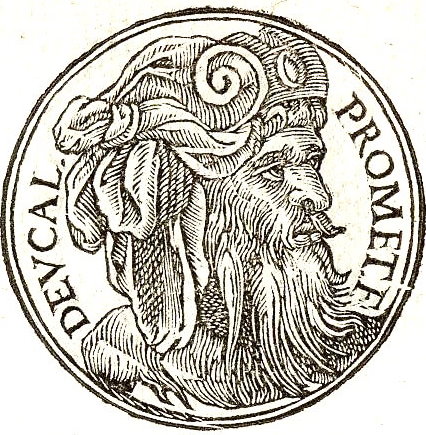
In Greek mythology, Deucalion (/djuːˈkeɪliən/; Ancient Greek: Δευκαλίων) was the son of Prometheus; ancient sources name his mother as Clymene, Hesione, or Pronoia.[1][2] He is closely connected with a flood myth in Greek mythology.
Etymology
[edit]According to folk etymology, Deucalion's name comes from δεῦκος, deukos, a variant of γλεῦκος, gleucos, i.e. "sweet new wine, must, sweetness"[3][4] and from ἁλιεύς, haliéus, i.e. "sailor, seaman, fisher".[5] His wife Pyrrha's name derives from the adjective πυρρός, -ά, -όν, pyrrhós, -á, -ón, i.e. "flame-colored, orange".[6]
Family
[edit]Of Deucalion's birth, the Argonautica[7] (from the 3rd century BC) stated:
There [in Achaea, i.e. Greece] is a land encircled by lofty mountains, rich in sheep and in pasture, where Prometheus, son of Iapetus, begat goodly Deucalion, who first founded cities and reared temples to the immortal gods, and first ruled over men. This land the neighbours who dwell around call Haemonia [i.e. Thessaly].
According to Bibliotheca,[8] Deucalion and Pyrrha had at least two children, Hellen[9] and Protogenea,[10] and possibly a third, Amphictyon.[11] Another account, adds a daughter Melanthea to the list of the couple's progeny.[12] This daughter, also called Melantho, became the mother of Delphus by Poseidon.[13][AI-generated source?]
Deucalion's and Pyrrha's children are apparently named in one of the oldest texts, Catalogue of Women, include daughters Pandora and Thyia, and at least one son named, Hellen.[14] Their descendants were said to have dwelt and ruled in Thessaly.[15]
One source mentioned three sons of Deucalion and his wife: Orestheus, Marathonios and Pronous (father of Hellen).[16][17] Lastly, Deucalion sired a son, no mention of the mother, Candybus who gave his name to the town of Candyba in Lycia.[18]
| Relation | Names | Sources | |||||||||||||||||
|---|---|---|---|---|---|---|---|---|---|---|---|---|---|---|---|---|---|---|---|
| Homer | Hesiod | Hellan. | Acus. | Apollon. | Diod. | Diony. | Ovid | Strabo | Apollod. | Harp. | Hyg. | Paus. | Lact. | Steph. | Suda | Tzet. | |||
| Sch. Ody. | Cat. | Arg. | Sch. | Met. | Lex. | Fab. | Div. Ins. | Lyco. | |||||||||||
| Parentage | Prometheus and Clymene | ✓ | ✓ | ||||||||||||||||
| Prometheus and Hesione | ✓ | ✓ | |||||||||||||||||
| Prometheus and Pronoia | ✓ | ✓ | |||||||||||||||||
| Prometheus | ✓ | ✓ | ✓ | ||||||||||||||||
| Spouse | Pyrrha | ✓ | ✓ | ✓ | ✓ | ✓ | ✓ | ||||||||||||
| Children | Hellen | ✓ | ✓ | ✓ | ✓ | ✓ | |||||||||||||
| Pandora | ✓ | ||||||||||||||||||
| Thyia | ✓ | ||||||||||||||||||
| Orestheus | ✓ | ✓ | |||||||||||||||||
| Marathonius | ✓ | ||||||||||||||||||
| Pronous | ✓ | ||||||||||||||||||
| Amphictyon | ✓ | ✓ | ✓ | ✓ | ✓ | ||||||||||||||
| Protogeneia | ✓ | ✓ | ✓ | ||||||||||||||||
| Candybus | ✓ | ||||||||||||||||||
| Melantho | ✓ | ||||||||||||||||||
Mythology
[edit]
Deluge accounts
[edit]The flood in the time of Deucalion was caused by the anger of Zeus, ignited by the hubris of Lycaon and his sons, descendants of Pelasgus. According to this story, King Lycaon of Arcadia had sacrificed a boy to Zeus, who, appalled by this offering, decided to put an end to the "Bronze" Age by unleashing a deluge. During this catastrophic flood, the rivers ran in torrents and the sea flooded the coastal plain, engulfing the foothills with spray, and washing everything clean.
Deucalion, with the aid of his father Prometheus, was saved from this deluge by building a chest.[20] Like the biblical Noah and the Mesopotamian counterpart Utnapishtim, he used this device to survive the great flood with his wife, Pyrrha.
The most complete accounts are given by Ovid, in his Metamorphoses (late 1 BCE to early 1 CE), and by the mythographer Apollodorus (1st or 2nd century CE).[8] Deucalion, who reigned over the region of Phthia,[21] had been forewarned of the flood by his father Prometheus. Deucalion was to build a chest and provision it carefully (no animals are rescued in this version of the flood myth), so that when the waters receded after nine days, he and his wife Pyrrha, daughter of Epimetheus, were the one surviving pair of humans. Their chest touched solid ground on Mount Parnassus,[22] or Mount Etna in Sicily,[23] or Mount Athos in Chalkidiki,[24] or Mount Othrys in Thessaly.[25]
Hyginus mentioned the opinion of a Hegesianax that Deucalion is to be identified with Aquarius, "because during his reign such quantities of water poured from the sky that the great Flood resulted."[26]
Once the deluge was over and the couple had given thanks to Zeus, Deucalion (said in several of the sources to have been aged 82 at the time) consulted an oracle of Themis about how to repopulate the earth. He was told to "cover your head and throw the bones of your mother behind your shoulder". Deucalion and Pyrrha understood that "mother" was Gaia, the mother of all living things, and the "bones" to be rocks. They threw the rocks behind their shoulders and the stones formed people. Pyrrha's became women; Deucalion's became men.[27] These people were later called the Leleges who populated Locris.[28] This can be related to Pindar's account that recounted "Pyrrha and Deucalion came down from Parnassus and made their first home, and without the marriage-bed they founded a unified race of stone offspring, and the stones gave the people their name."[29]
The 2nd-century AD writer Lucian gave an account of the Greek Deucalion in De Dea Syria that seems to refer more to the Near Eastern flood legends: in his version, Deucalion (whom he also calls Sisythus)[30] took his children, their wives, and pairs of animals with him on the ark, and later built a great temple in Manbij (northern Syria), on the site of the chasm that received all the waters; he further describes how pilgrims brought vessels of sea water to this place twice a year, from as far as Arabia and Mesopotamia, to commemorate this event.[31]
Variant stories
[edit]On the other hand, Dionysius of Halicarnassus stated Deucalion's parents to be Prometheus and Clymene, daughter of Oceanus, and mentioned nothing about a flood but instead named him as commander of those from Parnassus who drove the "sixth generation" of Pelasgians from Thessaly.[32]
One of the earliest Greek historians, Hecataeus of Miletus, was said to have written a book about Deucalion, but it no longer survived. The only extant fragment of his to mention Deucalion does not mention the flood either, but named him as the father of Orestheus, king of Aetolia.[16] The much later geographer Pausanias, following on this tradition, named Deucalion as a king of Ozolian Locris and father of Orestheus.
Plutarch mentioned a legend that Deucalion and Pyrrha had settled in Dodona, Epirus;[33] while Strabo asserted that they lived at Cynus, and that her grave was still to be found there, while his may be seen at Athens.[34] This can be related to an account that after the deluge, Deucalion, founder and king of Lycoreia in Mt. Parnassus[35] was said to have fled from his kingdom to Athens with his sons Hellen and Amphictyon during the reign of King Cranaus. Shortly thereafter, Deucalion died there and was said to have been buried near Athens.[36] During his stay in there, he was credited with having built the ancient sanctuary of Olympian Zeus.[37] Additionally, Strabo mentioned a pair of Aegean islands named after the couple.[38]
Interpretation
[edit]Mosaic accretions
[edit]The 19th-century classicist John Lemprière, in Bibliotheca Classica, argued that as the story had been re-told in later versions, it accumulated details from the stories of Noah: "Thus Apollodorus gives Deucalion a great chest as a means of safety; Plutarch speaks of the pigeons by which he sought to find out whether the waters had receded; and Lucian of the animals of every kind which he had taken with him. &c."[39] However, the Epic of Gilgamesh contains each of the three elements identified by Lemprière: a means of safety (in the form of instructions to build a boat), sending forth birds to test whether the waters had receded, and stowing animals of every kind on the boat. These facts were unknown to Lemprière because the Assyrian cuneiform tablets containing the Gilgamesh Epic were not discovered until the 1850s.[40] This was 20 years after Lemprière had published his "Bibliotheca Classica". The Gilgamesh epic is widely considered to be at least as old as Genesis, if not older.[41][42][43] Given the prevalence of religious syncretism in the ancient Greek world, these three elements may already have been known to some Greek-speaking peoples in popular oral variations of the flood myth, long before they were recorded in writing. The most immediate source of these three particular elements in the later Greek versions is unclear.
Dating by early scholars
[edit]For some time during the Middle Ages, many European Christian scholars continued to accept Greek mythical history at face value, thus asserting that Deucalion's flood was a regional flood, that occurred a few centuries later than the global one survived by Noah's family. On the basis of the archaeological stele known as the Parian Chronicle, Deucalion's Flood was usually fixed as occurring some time around 1528 BC. Deucalion's flood may be dated in the chronology of Saint Jerome to c. 1460 BC. According to Augustine of Hippo (City of God XVIII,8,10,&11), Deucalion and his father Prometheus were contemporaries of Moses. According to Clement of Alexandria in his Stromata, "in the time of Crotopus occurred the burning of Phaethon, and the deluges of Deucalion."[44]
Notes
[edit]- ^ The scholia to Odyssey 10.2 names Clymene as the commonly identified mother, along with Hesione (citing Acusilaus, FGrH 2 F 34) and possibly Pronoia.
- ^ A scholium to Odyssey 10.2 (=Catalogue fr. 4) reports that Hesiod called Deucalion's mother "Pryneie" or "Prynoe", corrupt forms which Dindorf believed to conceal Pronoea's name. The emendation is considered to have "undeniable merit" by A. Casanova (1979) La famiglia di Pandora: analisi filologica dei miti di Pandora e Prometeo nella tradizione esiodea. Florence, p. 145.
- ^ δεῦκος. Liddell, Henry George; Scott, Robert; A Greek–English Lexicon at the Perseus Project
- ^ γλεῦκος. Liddell, Henry George; Scott, Robert; A Greek–English Lexicon at the Perseus Project
- ^ ἁλιεύς. Liddell, Henry George; Scott, Robert; A Greek–English Lexicon at the Perseus Project
- ^ πυρρός. Liddell, Henry George; Scott, Robert; A Greek–English Lexicon at the Perseus Project
- ^ Apollonius Rhodius, 3.1404-1408
- ^ a b Apollodorus, 1.7.2
- ^ Thucydides, 1.3.2; Apollodorus, 1.7.2 where some account states that Hellen’s father is instead Zeus
- ^ Pherecydes, fr. 3F23; Hyginus, Fabulae 155
- ^ Apollodorus, 3.14.6 where in some traditions, he was called an autochthonous (son of the soil); Pseudo-Scymnos, Circuit de la terre 587 ff.
- ^ Hesiod, Catalogue of Women fr. 5 Most, pp. 46, 47 [= fr. 4 Merkelbach-West, p. 5 = Scholia on Homer's Odyssey 10.2 (Dindorf, p. 444)]
- ^ Tzetzes ad Lycophron, 208 (Gk. text)
- ^ Hes. Catalogue fr. 2, 5 and 7; cf. M.L. West (1985) The Hesiodic Catalogue of Women. Oxford, pp. 50–2, who posits that a third daughter, Protogeneia, who was named at (e.g.) Pausanias, 5.1.3, was also present in the Catalogue.
- ^ Hesiod, Ehoiai fr. 5 as cited in Scholiast on Apollonius Rhodius, 4.265–426
- ^ a b Hecateus, fr. 1F13 (Gantz, p. 167)
- ^ Gantz, Timothy (1993). Early Greek Myth: A Guide to Literary and Ancient Sources. London: Johns Hopkins University Press. p. 167. ISBN 0-8018-4410-X.
- ^ Stephanus of Byzantium, s.v. Kandyba (Κάνδυβα)
- ^ Grimal, p. 531; Hard, p. 702.
- ^ Pleins, J. David (2010). When the great abyss opened : classic and contemporary readings of Noah's flood ([Online-Ausg.]. ed.). New York: Oxford University Press. p. 110. ISBN 978-0-19-973363-7.
- ^ Strabo, 9.5.6
- ^ Pindar, Olympian Odes 9.43; cf. Ovid, Metamorphoses I.313–347
- ^ Hyginus, Fabulae 153
- ^ Servius' commentary on Virgil's Bucolics 6.41
- ^ Hellanicus, FGrH 4F117, quoted by the scholia to Pindar, Olympia 9.62b: "Hellanicus says that the chest didn't touch down on Parnassus, but by Othrys in Thessaly.
- ^ Hyginus, De astronomica 2.29.1
- ^ Parker, Janet; Stanton, Julie, eds. (2008) [2003]. "Greek and Roman Mythology". Mythology: Myths, Legends, & Fantasies (Reprinted ed.). Lane Cove, NSW, Australia: Global Book Publishing. pp. 32–35. ISBN 978-1-74048-091-8.
- ^ Hesiod, Ehoiai fr. 234; Strabo, 7.7.2
- ^ Pindar, Olympian Odes 9.43–46
- ^ The manuscripts transmit scythea, "Scythian", rather than Sisythus, which is conjectural.
- ^ Lucian, De Dea Syria 12–13; H. Strong & J. Garstang, p. 50–51
- ^ Dionysius of Halicarnassus, Antiquitates Romanae 1.17.3
- ^ Plutarch, Life of Pyrrhus 1
- ^ Strabo, 9.4.2
- ^ Parian Chronicle 3; St. Jerome, Chronicon B1535
- ^ Pausanias, 1.18.8; Eusebius, Chronicle 2, p. 26; Parian Chronicle 4-7
- ^ Pausanias, 1.18.8; Parian Chronicle 5
- ^ Strabo, 9.5.14
- ^ Lemprière, Bibliotheca Classica p. 475
- ^ George, Andrew R. (2008). "Shattered tablets and tangled threads: Editing Gilgamesh, then and now". Aramazd. Armenian Journal of Near Eastern Studies. 3: 11. Retrieved 12 September 2018.
- ^ George, A. R. (2003). The Babylonian Gilgamesh Epic: Introduction, Critical Edition and Cuneiform Texts. Oxford University Press. pp. 70–. ISBN 978-0-19-927841-1. Retrieved 8 November 2012.
- ^ Rendsburg, Gary. "The Biblical flood story in the light of the Gilgamesh flood account" in Gilgamesh and the world of Assyria, eds Azize, J & Weeks, N. Peters, 2007, p. 117
- ^ Wexler, Robert (2001). Ancient Near Eastern Mythology.
- ^ The Stromateis (Book 1), Chapter 21.
Sources
[edit]- Hesiod, Catalogue of Women fragments 2–7 and 234 (7th or 6th century BC)
- Hecataeus of Miletus, frag. 341 (500 BC)
- Pindar, Olympian Odes 9 (466 BC)
- Plato, "Timaeus" 22B, "Critias" 112A (4th century BC)
- Apollonius of Rhodes, Argonautica 3.1086 (3rd century BC)
- Virgil, Georgics 1.62 (29 BC)
- Gaius Julius Hyginus, Fabulae 153; Poeticon astronomicon 2.29 (c. 20 BC)
- Dionysius of Halicarnassus, Roman Antiquities 1.17.3 (c. 15 BC)
- Ovid, Metamorphoses, 1.318ff.; 7.356 (c. 8 AD)
- Strabo, Geographica, 9.4 (c. 23 AD)
- Bibliotheca 1.7.2 (c. 1st century AD?)
- Plutarch, Life of Pyrrhus, 1 (75 AD)
- Lucian, De Dea Syria 12, 13, 28, 33 (2nd century AD)
- Pausanias, Description of Greece 10.38.1 (2nd century AD)
- Nonnus, Dionysiaca 3.211; 6.367 (c. 500 AD)
References
[edit]- Apollodorus, The Library with an English Translation by Sir James George Frazer, F.B.A., F.R.S. in 2 Volumes, Cambridge, MA, Harvard University Press; London, William Heinemann Ltd. 1921. ISBN 0-674-99135-4. Online version at the Perseus Digital Library. Greek text available from the same website.
- Apollonius Rhodius, Argonautica translated by Robert Cooper Seaton (1853-1915), R. C. Loeb Classical Library Volume 001. London, William Heinemann Ltd, 1912. Online version at the Topos Text Project.
- Apollonius Rhodius, Argonautica. George W. Mooney. London. Longmans, Green. 1912. Greek text available at the Perseus Digital Library.
- Dionysus of Halicarnassus, Roman Antiquities. English translation by Earnest Cary in the Loeb Classical Library, 7 volumes. Harvard University Press, 1937-1950. Online version at Bill Thayer's Web Site
- Dionysius of Halicarnassus, Antiquitatum Romanarum quae supersunt, Vol I-IV. . Karl Jacoby. In Aedibus B.G. Teubneri. Leipzig. 1885. Greek text available at the Perseus Digital Library.
- Gaius Julius Hyginus, Astronomica from The Myths of Hyginus translated and edited by Mary Grant. University of Kansas Publications in Humanistic Studies. Online version at the Topos Text Project.
- Gaius Julius Hyginus, Fabulae from The Myths of Hyginus translated and edited by Mary Grant. University of Kansas Publications in Humanistic Studies. Online version at the Topos Text Project.
- Hesiod, Catalogue of Women from Homeric Hymns, Epic Cycle, Homerica translated by Evelyn-White, H G. Loeb Classical Library Volume 57. London: William Heinemann, 1914. Online version at theio.com
- Nonnus of Panopolis, Dionysiaca translated by William Henry Denham Rouse (1863-1950), from the Loeb Classical Library, Cambridge, MA, Harvard University Press, 1940. Online version at the Topos Text Project.
- Nonnus of Panopolis, Dionysiaca. 3 Vols. W.H.D. Rouse. Cambridge, MA., Harvard University Press; London, William Heinemann, Ltd. 1940-1942. Greek text available at the Perseus Digital Library.
- Pausanias, Description of Greece with an English Translation by W.H.S. Jones, Litt.D., and H.A. Ormerod, M.A., in 4 Volumes. Cambridge, MA, Harvard University Press; London, William Heinemann Ltd. 1918. ISBN 0-674-99328-4. Online version at the Perseus Digital Library
- Pausanias, Graeciae Descriptio. 3 vols. Leipzig, Teubner. 1903. Greek text available at the Perseus Digital Library.
- Pindar, Odes translated by Diane Arnson Svarlien. 1990. Online version at the Perseus Digital Library.
- Pindar, The Odes of Pindar including the Principal Fragments with an Introduction and an English Translation by Sir John Sandys, Litt.D., FBA. Cambridge, MA., Harvard University Press; London, William Heinemann Ltd. 1937. Greek text available at the Perseus Digital Library.
- Plato, Critias in Plato in Twelve Volumes, Vol. 9 translated by W.R.M. Lamb. Cambridge, Massachusetts, Harvard University Press; London, William Heinemann Ltd. 1925. Online version at the Perseus Digital Library. Greek text available at the same website.
- Plato, Timaeus in Plato in Twelve Volumes, Vol. 9 translated by W.R.M. Lamb. Cambridge, Massachusetts, Harvard University Press; London, William Heinemann Ltd. 1925. Online version at the Perseus Digital Library. Greek text available at the same website.
- Plutarch, Plutarch's Lives. With an English Translation by Bernadotte Perrin. Cambridge, MA. Harvard University Press. London. William Heinemann Ltd. 1920. Online version at the Perseus Digital Library. Greek text available at the same website.
- Publius Ovidius Naso, Metamorphoses translated by Brookes More (1859-1942). Boston, Cornhill Publishing Co. 1922. Online version at the Perseus Digital Library.
- Publius Ovidius Naso, Metamorphoses. Hugo Magnus. Gotha (Germany). Friedr. Andr. Perthes. 1892. Latin text available at the Perseus Digital Library.
- Publius Vergilius Maro, Bucolics, Aeneid, and Georgics of Vergil. J. B. Greenough. Boston. Ginn & Co. 1900. Online version at the Perseus Digital Library.
- Lucian, The Syrian goddess; being a translation of Lucian's De dea Syria, with a life of Lucian by Herbert A. Strong. Edited with notes and an introd. by John Garstang. London: Constable & Company Ltd. 1913. Online version at the Internet Archive. Greek text available at the Perseus Digital Library
- Strabo, The Geography of Strabo. Edition by H.L. Jones. Cambridge, Mass.: Harvard University Press; London: William Heinemann, Ltd. 1924. Online version at the Perseus Digital Library.
- Strabo, Geographica edited by A. Meineke. Leipzig: Teubner. 1877. Greek text available at the Perseus Digital Library.
External links
[edit]


- Deucalion from Charles Smith, Dictionary of Greek and Roman Biography and Mythology (1867), with source citations and some variants not given here.
- Deucalion from Carlos Parada, Genealogical Guide to Greek Mythology.
- . Encyclopædia Britannica. Vol. VII (9th ed.). 1878. p. 134.
- The Warburg Institute Iconographic Database (images of Deucalion and Pyrrha)
| International | |
|---|---|
| Other | |

Deucalion
View on GrokipediaBackground
Etymology
The name Deucalion (Ancient Greek: Δευκαλίων, romanized Deukalíōn) appears in early Greek literature, including fragments of Hesiod's Catalogue of Women, where it is attested as the name of a figure descended from Prometheus.[3] A folk etymology derives Deucalion from the Ancient Greek words δεῦκος (deûkos), a regional variant of γλεῦκος (gleûkos) meaning "sweet new wine" or "must," and ἁλιεύς (halieús) meaning "sailor" or "fisherman," yielding an interpretation as "sweet sailor."[4][5] This compound may evoke a seafaring theme symbolically linked to survival amid waters, with the "sweet wine" element suggesting renewal and the restarting of viticulture in a post-catastrophe world.[6] Scholarly analysis proposes alternative derivations, such as dissimilated forms of λευκός (leukós, "white"), potentially reflected in variants like Leukaríōn (Λευκαρίων) in later sources, or even a pre-Greek substrate origin, as evidenced by its appearance in Linear B tablets as de-u-ka-ri-jo.[7] Deucalion's wife Pyrrha (Ancient Greek: Πύρρα, romanized Pýrrha) derives her name from πυρρός (pyrrhós), an adjective meaning "flame-colored" or "red," often denoting red hair or a fiery hue.[8] This etymology carries symbolic weight, contrasting the water-based deluge with motifs of fire and rebirth, as the pair's story involves regeneration from earth's elements.[9]Family
Deucalion was the son of the Titan Prometheus, with ancient accounts varying on his mother's identity. According to Hesiod's Catalogue of Women, his mother was Pronoia, an Oceanid nymph associated with foresight.[10] Other traditions name her as Clymene, an Oceanid daughter of Oceanus, or Hesione, another daughter of Oceanus; in some variants, Pronoia is equated with an epithet of Pandora.[11] These parentage details underscore Deucalion's ties to the primordial creators of humanity, as Prometheus was renowned for molding mankind from clay. Deucalion married Pyrrha, his cousin and the daughter of Prometheus's brother Epimetheus and Pandora, the first woman crafted by the gods.[1] This union linked the forethought of Prometheus (through Deucalion) with the afterthought of Epimetheus (through Pyrrha), symbolizing a foundational partnership in early human genealogy. Deucalion and Pyrrha had several children, who played key roles in mythic lineages. Their son Hellen became the eponymous ancestor of the Hellenes (Greeks), though some accounts attribute his paternity to Zeus instead.[1] Other sons included Amphictyon, who later ruled Attica, and Orestheus, from whom the Thessalian town of Oresthas derived its name.[1] Daughters comprised Protogeneia, who bore Aethlius to Zeus and thus linked to the rulers of Elis; Thyia, who with Zeus fathered Magnes (eponym of Magnesia) and Macedon (eponym of Macedonia); and Pandora, sometimes distinguished as a second bearer of that name.[10] Additional offspring mentioned in variant traditions include Marathonios.[11] Deucalion's family established the primary post-deluge lineages in Greece, particularly in Thessaly, where his descendants, including those of Hellen, are said to have ruled the region. This genealogical role positioned Deucalion's offspring as progenitors of major Greek tribes, such as the Aeolians, Dorians, and Ionians through Hellen's sons.[10]Mythology
The Deluge
In Greek mythology, the Deluge was a cataclysmic flood unleashed by Zeus to eradicate the corrupt Bronze Age humanity, whose impiety and wickedness had provoked divine anger. According to Apollodorus, Zeus targeted these men specifically, overwhelming the greater part of Greece while sparing some who fled to high mountains like those in Thessaly. Ovid elaborates on the catalyst, recounting how King Lycaon of Arcadia, seeking to test Zeus's divinity, served the god human flesh from a Molossian hostage during a feast, an act of ultimate sacrilege that exemplified broader human depravity.[1][2] Deucalion, son of the Titan Prometheus and king in the regions around Phthia, received forewarning from his father about the impending destruction. Following Prometheus's advice, Deucalion constructed a chest and provisioned it with supplies before embarking with his wife Pyrrha, daughter of Epimetheus. This preparation allowed them to survive as Zeus initiated the flood by pouring torrential rains from the heavens, causing rivers to burst and seas to merge with the land in a deluge that submerged nearly all of Hellas.[1][2] The flood persisted unabated for nine days and nights, drowning humanity, livestock, and structures alike, until only scattered peaks remained above the waters. Deucalion and Pyrrha floated in their chest across the chaotic expanse, eventually grounding on the slopes of Mount Parnassus, the primary site of their landing in canonical accounts, where the rains finally ceased. Some traditions mention alternative landing sites such as Mount Etna, Athos, or Othrys, though these are less emphasized.[1][2][12] Upon disembarking, the couple offered sacrifices to Zeus, the god of Escape, in gratitude for their deliverance. Desolate amid the ruined world, they then consulted the oracle of Themis at Delphi for guidance on restoring human life, marking the transition from survival to renewal. Lucian's retelling in De Dea Syria echoes the nine-day duration and attributes the flood to humanity's disregard for oaths, hospitality, and suppliants, underscoring the theme of divine retribution for moral decay.[1][2][12]Repopulation of Humanity
After surviving the deluge and landing on Mount Parnassus, Deucalion and Pyrrha consulted the oracle of Themis at Delphi to learn how to restore the human race.[2] The oracle instructed them: "Leave the temple and with veiled heads and loosened clothes throw behind you the bones of your great mother!"[2] Initially hesitant, as Pyrrha feared offending her mother's spirit, Deucalion reinterpreted the cryptic words, concluding that their "great mother" was Gaia, the Earth, and her "bones" were stones.[2] This interpretation aligned with the mythological view of Earth as the primordial source of life.[13] Veiling their heads and loosening their garments as directed, they descended the temple steps and cast stones over their shoulders without looking back.[2] The stones thrown by Deucalion gradually lost their hardness, softened like wax, and transformed into men; those cast by Pyrrha became women.[2][13] Over time, the earthy parts turned to flesh, the rigid portions to bone, and the new forms ripened into fully shaped humans, resembling roughly carved marble statues at first.[2] Hyginus similarly describes Jupiter commanding them to throw stones, with Deucalion's creating men and Pyrrha's women, deriving the Greek term laos (people) from las (stone).[13] This stone-throwing mechanism symbolizes humanity's emergence from Earth's primordial material, evoking autochthonous creation myths where people arise directly from the soil, as in tales of earth's children.[2] The resulting race was hardy and enduring, reflecting their stony origins and capacity for labor, marking a transition from raw survival to civilized society on the repopulated earth.[2] The process tied to Parnassus's rocky terrain underscored the geological link between the survivors' refuge and the new humans' earthy genesis.[13]Variant Accounts
In some accounts, Deucalion is portrayed not as a survivor of a divine deluge but as a historical king who led military campaigns against the Pelasgians in Thessaly, driving them out after five generations of their settlement there and forcing their dispersal to regions including Dodona.[14] This floodless variant emphasizes Deucalion's role as a commander of allied forces, including the Curetes, Leleges, Aetolians, and Locrians, without any reference to a catastrophic flood or ark.[14] Alternative traditions place Deucalion's post-flood landing and settlement in locations other than Mount Parnassus, such as Athens, where Attic sources claim he resided and even founded the ancient sanctuary of Olympian Zeus, supported by the existence of his purported grave near the temple.[15] Links to the oracle at Dodona appear in some variants without emphasis on the flood, portraying Deucalion and Pyrrha as settlers there who established early worship practices.[16] Additionally, Cynus in Locris is identified as Deucalion's residence, with Pyrrha's grave preserved there, while his own tomb is located in Athens. A variant influenced by Near Eastern traditions, recorded by Lucian, attributes to Deucalion a chest (larnax) that carried not only his family but pairs of all animals during the flood, with the deluge caused by the sea rather than rain, and survivors limited to those inside the vessel.[17] This account parallels Mesopotamian flood narratives but frames them within the Greek myth of Deucalion as the founder of a sanctuary.[17] Regional adaptations vary the myth's focus across Greece: the Thessalian version centers Deucalion as king of Phthia without deluge details, while Arcadian and Boeotian traditions recast him as a culture hero who introduced laws, agriculture, and altars to the twelve gods, omitting the flood entirely.[18] These differences highlight localized emphases on Deucalion's civilizing role over cataclysmic survival.[18]Interpretations
Connections to Biblical and Near Eastern Myths
The myth of Deucalion's flood exhibits striking parallels with the biblical narrative of Noah in the Book of Genesis. In both accounts, a supreme deity—Zeus in the Greek tradition and Yahweh in the Hebrew—decides to eradicate humanity due to widespread moral corruption, sparing only a righteous couple who survive in a floating vessel: Deucalion and Pyrrha in a chest built on Prometheus's advice, akin to Noah's ark divinely instructed. Following the deluge, the survivors land on a mountain (Parnassus for Deucalion, Ararat for Noah), offer sacrifices, and repopulate the earth through their descendants, with Deucalion's stone-throwing ritual echoing the generative role of Noah's sons Shem, Ham, and Japheth as progenitors of nations.[19] These similarities prompted early scholarly observations of potential borrowing or shared motifs. In his 1788 Classical Dictionary, John Lemprière remarked that Deucalion's flood, dated by some to around 1503 BCE, was regarded by certain authorities as identical to the Mosaic deluge, despite differing details, and suggested that later Greek retellings incorporated "Mosaic accretions" derived from the Hebrew Genesis, likely disseminated via the Septuagint translation in the Hellenistic era.[20] Further connections emerge with Near Eastern traditions, particularly the Mesopotamian flood hero Utnapishtim from the Epic of Gilgamesh. Excavations in the 1850s led by George Smith uncovered cuneiform tablets detailing a deluge ordained by gods to punish humanity, with Utnapishtim constructing a boat to save his family and animals, enduring a six-day flood, and landing on Mount Nisir—elements resonant with both Noah's 40-day ordeal and Deucalion's nine-day voyage, including animal preservation and post-flood bird releases in some versions. Smith's 1876 The Chaldean Account of Genesis highlighted these parallels, positing a common ancient Near Eastern archetype influencing divergent cultural narratives.[21] Scholars propose syncretic transmission of these motifs to Greece through Phoenician maritime contacts or Hellenistic cultural exchanges, framing Deucalion as a Hellenized counterpart to Noah or Utnapishtim. Early Jewish and Christian writers, as analyzed by comparativists like Bruce M. Metzger, explicitly equated Deucalion with Noah to affirm the universality of the biblical flood tradition, underscoring inter-cultural adaptations in the ancient Mediterranean world.[22]Historical Dating Attempts
Early efforts to date Deucalion's flood emerged in antiquity and persisted through medieval and Renaissance periods, often driven by attempts to harmonize Greek mythology with biblical and Near Eastern chronologies. The Parian Chronicle, an inscribed marble stele from the island of Paros dating to around 264/263 BCE, provides one of the earliest specific datings, placing the flood in the time of Deucalion at 1528/1527 BCE.[23] This chronology aligns the event with the mythic era following the return of the Heraclidae to the Peloponnese, treating the flood as a pivotal marker in Greek historical succession. In the patristic tradition, Christian scholars sought to integrate Deucalion's deluge into biblical timelines, frequently equating it with or distinguishing it from Noah's flood while anchoring it to Mosaic history. Clement of Alexandria, in his Stromata (Book I, Chapter 21), positions the flood during the reign of Crotopus, king of Argos, approximately 40 generations (roughly 1,200 years) after the Exodus under Moses, implying a date around 1500 BCE to assert the antiquity of Hebrew records over Greek myths.[24] Similarly, Eusebius of Caesarea in his Chronicon describes Ogyges' flood—preceding Deucalion's by 250 years—as occurring 1,200 years after the biblical deluge, while Jerome's Latin adaptation of the work dates Deucalion's flood to circa 1460 BCE, linking it genealogically to Noah's descendants through euhemeristic interpretation.[25] Augustine of Hippo, in The City of God (Book XVIII, Chapter 8), further connects the Ogygian flood (associated with early Attic kings) to Deucalion's era, noting scholarly disputes over Ogyges' floruit but affirming its precedence over Deucalion's deluge as a lesser cataclysm in Greek lore.[26] During the Renaissance and early modern period, scholars expanded these efforts by cross-referencing Greek accounts with Egyptian and Assyrian king lists to establish a unified ancient chronology. For instance, attempts to synchronize Deucalion's flood with the reign of Crotopus in Argos—often placed around 1500 BCE—drew on Manetho's Egyptian dynasties and fragmentary Assyrian regnal records to position the event shortly after the biblical flood, sometimes as late as 1400 BCE.[27] Isaac Newton, in his Chronology of Ancient Kingdoms Amended (1728), exemplifies this approach by aligning the "four first ages" of man post-Deucalion with Egyptian pharaonic successions and Assyrian eponyms, dating the flood to approximately 1500 BCE while treating mythic figures like Prometheus as historical intermediaries.[27] These dating attempts were fundamentally shaped by methodological assumptions, particularly euhemerism—which reinterpreted gods and heroes as deified historical persons—and biblical literalism, which presupposed the flood's historicity as a global event to be synchronized across traditions, often overlooking the mythological and symbolic dimensions of the narratives.[28] Such frameworks prioritized scriptural authority and selective king-list correlations over archaeological or textual inconsistencies, leading to varied and anachronistic timelines.Modern Scholarly Perspectives
Modern scholars in anthropology have interpreted the Deucalion flood myth as a cultural memory of actual Bronze Age environmental catastrophes in the Mediterranean region. For instance, some analyses link the narrative to the massive volcanic eruption of Thera (Santorini) around 1600 BCE, which triggered tsunamis and climatic disruptions that could have inspired tales of widespread inundation and renewal.[29] Similarly, the Black Sea deluge hypothesis, proposed by geologists William Ryan and Walter Pitman, posits a catastrophic inundation of the Black Sea basin around 5600 BCE due to rising Mediterranean waters breaching the Bosporus, potentially displacing populations and seeding flood myths across Eurasian cultures, including the Greek tradition of Deucalion; however, this hypothesis remains highly debated and has faced significant rebuttals in subsequent research.[30][31] These interpretations emphasize how oral traditions preserved echoes of real disasters, transforming them into symbolic stories of divine judgment and human survival without direct archaeological corroboration for the myth itself.[32] Linguistic and comparative studies within Indo-European scholarship position Deucalion's story as part of a broader archetypal flood motif shared across IE-speaking cultures, reflecting proto-historical migrations and shared mythic heritage. This pan-Indo-European pattern includes parallels with the Hindu figure Manu, who survives a deluge on a boat guided by a fish (Vishnu's avatar) to repopulate the earth, and the Norse giant Bergelmir, who escapes a primordial blood-flood in a lúðr (trough or boat) to found a new race.[33] Such correspondences suggest a reconstructed IE *flood narrative involving a survivor couple or family preserving humanity through water-based cataclysm and rebirth, likely disseminated via early IE expansions from the Pontic-Caspian steppe.[34] These theories rely on etymological and thematic alignments rather than direct textual borrowing, highlighting the myth's role in encoding cultural resilience and cosmological order. Psychoanalytic and structuralist approaches offer symbolic readings of the Deucalion myth, focusing on universal human psyche and cognitive structures. Inspired by Claude Lévi-Strauss's structuralism, interpreters view the flood as embodying binary oppositions central to mythic thought, such as water (chaos, dissolution) versus fire (Promethean creation, order), and destruction (divine wrath) versus rebirth (stones to humans), resolving cultural tensions through narrative mediation.[35] Freudian perspectives, meanwhile, frame the deluge as a motif of psychic renewal, where the flood represents repressed collective anxieties over mortality and primal urges, with Deucalion and Pyrrha's repopulation symbolizing the ego's reconstruction amid unconscious floods of instinctual drives.[36] These frameworks prioritize the myth's psychological functions—catharsis and integration—over literal events, treating it as a projection of innate human conflicts. Critiques of euhemeristic interpretations, which seek historical kernels in myths by rationalizing deities as deified mortals, underscore the Deucalion narrative's primarily symbolic nature. Scholars argue that while euhemerism usefully demystifies some Greek legends, applying it to Deucalion yields no verifiable archaeological evidence for a specific flood survivor or kingly figure tied to the myth's timeline.[37] Instead, the story functions etiologically to explain human origins and societal norms, with its lack of material traces reinforcing views of myth as metaphorical rather than biographical history.[38] Seminal works like G. S. Kirk's Myth: Its Meaning and Functions in Ancient and Other Cultures (1970) analyze Greek flood variants, including Deucalion's, as adaptive narratives blending local traditions with broader cosmological themes, distinct from folktales yet serving social cohesion. More recent scholarship in the 2020s explores connections between climate-induced events and IE flood myths, positioning Deucalion within a classical strand that parallels Indic and Iranian versions, emphasizing thematic continuity over environmental determinism. These studies highlight ongoing debates on the myth's evolution amid interdisciplinary evidence from linguistics, anthropology, and paleoclimatology.Cultural Legacy
Genealogical Role
In Greek mythology, Deucalion serves as a pivotal progenitor figure, whose descendants form the foundational lineage of the Hellenic peoples following the great deluge. His son Hellen is regarded as the eponymous ancestor of the Hellenes, or Greeks, establishing a unified ethnic identity across diverse tribes. Hellen, born to Deucalion and Pyrrha, fathered three sons—Aeolus, Dorus, and Xuthus—who became the founders of the major Greek ethnic groups: the Aeolians from Aeolus, the Dorians from Dorus, and the Ionians and Achaeans from Xuthus and his offspring.[1] This genealogy underscores Deucalion's role in repopulating and organizing post-flood humanity into the structured tribes that defined classical Greek society.[39] Deucalion's broader lineage extends through his daughter Protogeneia, who bore Aethlius to Zeus, linking the family to early kings of Elis and further branches of Peloponnesian royalty. Additionally, his son Amphictyon is credited with founding the Amphictyonic League, an ancient religious and political alliance of Greek tribes centered on the oracles at Delphi and Thermopylae, which fostered interstate cooperation and unity.[1] These connections highlight Deucalion's descendants as architects of both ethnic and institutional frameworks in early Greek history. Herodotus places Deucalion's era as the time when the Hellenic people inhabited Phthiotis, the original homeland of the Greeks, with Deucalion as the father of Hellen, their eponymous ancestor.[39] Strabo reinforced this by noting the tomb of Hellen in Thessaly, affirming Deucalion's Thessalian origins and his central place in national myths.[40] Later extensions in Apollodorus detailed these lines, integrating them into a comprehensive mythic chronology.[1] Variations in ancient accounts sometimes localized Deucalion's ancestry more narrowly; for instance, certain traditions positioned him as a direct forebear of the Thessalians through his rule in Phthia, while others connected his lineage to Arcadian tribes via extended branches like Aethlius. These regional emphases reflect the adaptive nature of Greek ethnic myths, tailored to affirm local identities within the broader Hellenic narrative.Depictions in Literature and Art
Deucalion's story has been prominently featured in ancient literature, particularly in Ovid's Metamorphoses, where Book 1 (lines 313–415) provides a vivid Roman adaptation of the Greek flood myth. In this narrative, Ovid describes Deucalion and Pyrrha as the sole survivors of Zeus's deluge, landing on Mount Parnassus and consulting the oracle of Themis, who instructs them to throw their "mother's bones" (stones) behind their backs to repopulate humanity; the stones thrown by Deucalion transform into men, while Pyrrha's become women, symbolizing earth's renewal.[41] Earlier Greek accounts appear in fragments of Hesiod's Catalogue of Women (8th–7th century BCE), which portray Deucalion as the son of Prometheus and Pronoia, fathering Hellen with Pyrrha after the flood, and allude to the stone-born race as a new human generation.[10] Visual representations in ancient art are scarce, but later Hellenistic and Roman influences include descriptive allusions rather than surviving monuments directly depicting Deucalion's landing on Parnassus. Philostratus the Elder (3rd century CE) in his Imagines evokes a painting of the deluge with Poseidon unleashing waters upon Thessaly, indirectly evoking Deucalion's survival amid the chaos. In Renaissance art, Peter Paul Rubens's oil sketch Deucalion and Pyrrha (1636–1637), housed in the Museo Nacional del Prado, captures the couple casting stones on a barren landscape, with emerging human figures rising from the earth to emphasize themes of regeneration post-flood.[42] Medieval and Renaissance literature often alluded to Deucalion's flood as a classical parallel to biblical events. John Milton's Paradise Lost (Book 11) references Deucalion as a distorted pagan memory of Noah's biblical deluge, portraying him as Prometheus's son who survived a lesser flood, thereby underscoring the superiority of the Judeo-Christian narrative while acknowledging shared motifs of divine wrath and human preservation. Modern depictions extend these themes into Romantic and 20th-century works. J.M.W. Turner's dramatic flood paintings, such as Shade and Darkness – The Evening of the Deluge (1843), evoke the cataclysmic waters overwhelming humanity, drawing indirect inspiration from classical deluge myths like Deucalion's to convey sublime destruction and rebirth, though primarily aligned with biblical imagery. In literature, James Joyce alludes to Deucalion in Ulysses (1922), particularly in episodes exploring mythic cycles, where the flood survivor represents eternal recurrence and human resilience amid chaos. The 2014 film Noah, directed by Darren Aronofsky, incorporates indirect parallels to Deucalion through its emphasis on a lone family's survival and earth's repopulation, blending biblical elements with broader mythological motifs of stone-born humanity and mountainous refuge. Across these representations, symbolic motifs recur: the ark or chest as a vessel of salvation, the stones hurled by Deucalion and Pyrrha embodying earth's generative power, and Mount Parnassus as a site of divine oracle and renewal, collectively iconizing themes of catastrophe and human rebirth in Western art and literature.[11]References
- https://en.wikisource.org/wiki/Hesiod%2C_the_Homeric_Hymns_and_Homerica/The_Catalogues_of_Women