Hubbry Logo
Alisma plantago-aquaticaAlisma plantago-aquaticaMain
Open search
Alisma plantago-aquatica
Community hub
Alisma plantago-aquatica
logo
8 pages, 0 posts
0 subscribers
Be the first to start a discussion here.
Alisma plantago-aquatica
from Wikipedia

Alisma plantago-aquatica
Scientific classification Edit this classification
Kingdom: Plantae
Clade: Tracheophytes
Clade: Angiosperms
Clade: Monocots
Order: Alismatales
Family: Alismataceae
Genus: Alisma
Species:
A. plantago-aquatica
Binomial name
Alisma plantago-aquatica
L., 1753

Alisma plantago-aquatica, also known as European water-plantain, common water-plantain or mad-dog weed, is a perennial flowering aquatic plant widespread across most of Europe and Asia, and apparently spread elsewhere in both the Old and New World.

Description

[edit]
Flower

Alisma plantago-aquatica is a hairless plant that grows in shallow water, consists of a fibrous root, several basal long stemmed leaves 15–30 centimetres (6–12 inches) long, and a triangular stem up to 1 metre (3+12 feet) tall. It has branched inflorescence bearing numerous small flowers, 1 cm (12 in) across, with three round or slightly jagged, white or pale purple petals. The flowers open in the afternoon. There are three blunt green sepals and six stamens per flower. The carpels often exist as a flat single whorl.[2] It flowers from June until August.[3] The fruits appear as a ring of seeds inside each flower.[3]

Chemistry

[edit]

Chemical constituents of Rhizoma Alismatis—rhizomes of Alisma orientale (syn. Alisma plantago-aquatica var. orientale) as a traditional Chinese medicine—include alisol A 24-acetate and alisol B 23-acetate.[4] The content of these two compounds are significantly different in Rhizoma Alismatis of different areas.

Similar species

[edit]

Narrow-leaved water plantain Alisma lanceolatum differs only in that the leaf tips are acuminate and shape is narrow lanceolate.

Image of a water plantain by Theodore Green (1931).

According to some sources, presumed specimens found in North America are actually the similar A. subcordatum and A. trivale.[3]

Taxonomy

[edit]

The word alisma is said to be a word of Celtic origin meaning "water", a reference to the habitat in which it grows. Early botanists named it after the Plantago because of the similarity of their leaves.[5]

Distribution and habitat

[edit]

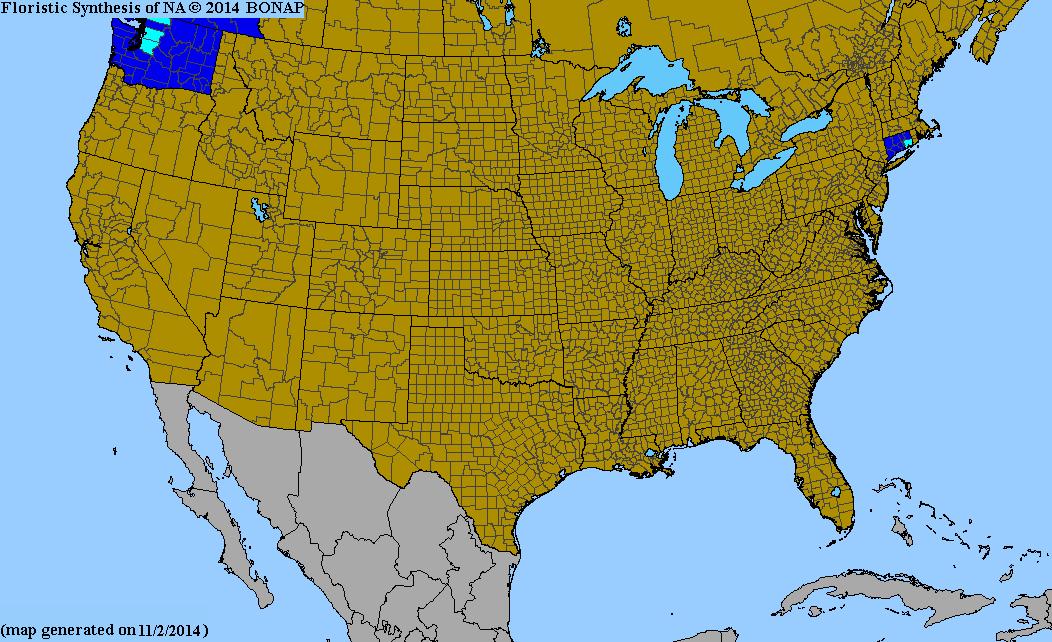
The species is widespread across most of Europe and Asia from Portugal and Morocco to Japan, Kamchatka and Vietnam. It is also regarded as native in northern and central Africa as far south as Tanzania, and in Australia.[6] It is reportedly naturalized in southern Africa, New Zealand, Alaska, British Columbia, Washington state and Connecticut.[7][8][9] Some sources maintain that the species is widespread across North America, but these reports appear to have been based on misidentified specimens.[10] It is found on mud or in fresh waters.[3]

Uses

[edit]

The rootstocks contain starch and can be boiled or soaked to remove bitterness before eating. Aquatic plants in general should be cooked before consumption to kill parasites.[11]

According to Flora of the U.S.S.R. (1934), "A powder prepared from dried roots is used in popular medicine as a cure for rabies and crushed leaves are used against mammary congestion; fresh leaves are employed in homeopathy. ... Since this species is often confounded or identified with others of the genus, the reported data may also refer to [A. orientale or A. lanceolatum]."[12] A. plantago-aquatica is also known as mad-dog weed,[13] as if it could be used to cure rabies, but should not be confused with Scutellaria lateriflora (mad-dog skullcap), which is also sometimes called mad-dog weed.

Alisma orientale is sometimes treated as a variety of this species (A. plantago-aquatica var. orientale).[14][15] The rhizomes of A. orientale have been used as a traditional Chinese medicine, ze xie.[16] However, it may have serious side effects or even toxic effects such as hepatotoxicity in patients with chronic hepatitis B.[17]

References

[edit]
[edit]
Revisions and contributorsEdit on WikipediaRead on Wikipedia
from Grokipedia
Alisma plantago-aquatica, commonly known as water plantain or European water-plantain, is a aquatic or semi-aquatic in the family , characterized by its clumped and growth up to 1 m tall. It produces basal rosettes of grey-green, elliptic to ovate, ribbed leaves, typically 10–30 cm long and 1–12 cm wide, with rounded bases on petioles up to 30 cm long, which become lax and narrower when submerged. The is a tall, branched up to 80 cm high bearing numerous small flowers, 1–1.5 cm in diameter, arranged in whorls of three, each with three white (occasionally pinkish) petals, three green sepals, six stamens, and numerous carpels that develop into a ring of buoyant follicles for water dispersal. Native to temperate , , and extending to , A. plantago-aquatica thrives in mesotrophic to eutrophic wetlands such as margins, ditches, canals, marshes, and slow-flowing rivers, often in shallow (up to 30 cm deep) or exposed fertile at elevations from to 2500 m. It tolerates a wide range (6.3–7.5) and cold temperatures down to -33°F, spreading via buoyant seeds dispersed by currents and waterfowl, with primarily by flies. The species has been introduced to regions including (e.g., , Washington, Missouri), , , , , and parts of , where it can form dense stands in disturbed wetlands. Historically valued for human uses, the starch-rich is and has been consumed as a source, while the serves medicinal purposes as a and antibacterial agent; it is also cultivated as an ornamental in aquatic gardens. However, in non-native areas, it is sometimes considered invasive, competing with crops like in paddies, obstructing waterways, and showing resistance to certain herbicides in some populations. Overall, A. plantago-aquatica is assessed as Least Concern by the IUCN due to its wide distribution and adaptability.

Taxonomy

Classification

Alisma plantago-aquatica is classified within the kingdom Plantae, phylum Tracheophyta, clade Angiosperms, clade Monocots, order Alismatales, family Alismataceae, genus Alisma, and species A. plantago-aquatica (Linnaeus, 1753). This placement reflects its status as a vascular monocot adapted to wetland environments, with the binomial authority tracing back to Carl Linnaeus's Species Plantarum in 1753. Phylogenetically, A. plantago-aquatica occupies a basal position within the monocots as part of the order , which represents an early-diverging lineage sister to the remaining monocot clades excluding Acorales. The family, including Alisma, is closely related to other aquatic families within Alismatales, such as , sharing evolutionary adaptations like submerged or emergent growth forms that facilitate life in freshwater habitats. These traits underscore the order's role in understanding monocot diversification toward hydrophytic lifestyles. The species has numerous synonyms reflecting historical taxonomic revisions and regional variations, including Alisma angustifolium Hoppe, Alisma ceretanica Sennen, Alisma latifolium Gilib., and Alisma paniculatum Stokes. Regional subspecies, such as A. plantago-aquatica subsp. orientale (Sam.) Sam., highlight intraspecific diversity across its native range.

Etymology and history

The genus name Alisma derives from the Ancient Greek word alisma (ἄλισμα), referring to an aquatic plant, as first recorded by the Greek physician Pedanius Dioscorides in his 1st-century AD work De Materia Medica. The specific epithet plantago-aquatica combines plantago, alluding to the broad, lanceolate leaves that resemble those of the genus Plantago (plantains), with aquatica, the Latin term for "water-dwelling." The name Plantago itself stems from the Latin planta, meaning "sole of the foot," due to the foot-like shape of plantain leaves. Alisma plantago-aquatica received its first formal scientific description from in his seminal work (1753), where it was named Alisma Plantago (later standardized with a ). This publication marked the application of to the species, building on earlier pre-Linnaean references in Greek and Roman texts, such as Dioscorides' description of a similar water plantain. Prior to Linnaeus, the plant appeared in herbal traditions without standardized naming, often grouped with other aquatic species based on and morphology. In early European botanical observations, A. plantago-aquatica was frequently compared to Plantago species due to the shared leaf shape, venation, and basal rosette arrangement, influencing its epithet and common names like "water plantain." Linnaeus's 18th-century taxonomic expansions formalized its classification within the Alismataceae family, distinguishing it from terrestrial plantains and integrating it into the emerging system of plant phylogeny based on reproductive and vegetative traits.

Description

Morphology

Alisma plantago-aquatica is a , emergent aquatic that is glabrous and grows to heights of 30–100 cm, forming basal rosettes supported by fibrous adventitious roots emerging from a short . The plant exhibits in morphology depending on environmental conditions, such as depth, but maintains a clumped with all leaves arising from the base. The leaves are strictly basal and petiolate, with petioles ranging from 1.5–40 cm long and sheathing at the base; the emersed blades are ovate to broadly lanceolate, measuring 15–30 cm long and 1–14 cm wide, with a rounded to cordate base, acute to acuminate apex, and 3–9 prominent veins. Submerged leaves, when present, are narrower, translucent, and shorter at 8–10 cm long and about 5 cm wide, adapted for aquatic conditions. The flowering stem is an erect, terete to triangular scape up to 1 m tall, bearing a much-branched, pyramidal 15–75 cm long with 3–9 whorls, each containing 3–10 flowers or branches; the bracts are membranous and lanceolate, 1–25 mm long. Flowers are bisexual, about 1 cm in diameter, and arranged in whorls; they feature three ovate green sepals (1.7–3.5 mm long), three white to purplish-pink petals (3.4–6.4 mm long) that are obovate and slightly erose-margined, six stamens with elliptic anthers (0.5–1.4 mm), and numerous pistils; blooming occurs from to fall, primarily in summer. The fruits form a ring of 20–40 achenes per flower on a receptacle 4–6.5 mm in diameter, with each achene ovoid to elliptic, 1.5–3.1 mm long and 0.9–2 mm wide, laterally compressed, featuring 1–3 abaxial grooves and an erect . These buoyant achenes aid in dispersal.

Reproduction

Alisma plantago-aquatica is a aquatic herb with hermaphroditic (bisexual) flowers that are primarily -pollinated. The flowers, which measure up to 15 mm in diameter and feature three white to pinkish petals, three sepals, six stamens, and 19–30 carpels, open for a single day from approximately 9:00 a.m. to 8:00 p.m., with peak activity in the afternoon. Pollination is mainly achieved by hoverflies (Syrphidae) and bees (), though other visitors include flies (Diptera such as Drosophilidae, Hybotidae, , and Sepsidae) and beetles (Coleoptera like ). The species is self-compatible and capable of self-fertilization, but cross-pollination by is more efficient, resulting in higher carpel fertilization rates (up to 98.8% in intact flowers). In the , flowering typically occurs from to , often in whorls along tall panicles. Each flower can produce 19–30 (achenes), one per carpel, though estimates range up to 40 under optimal conditions; a single plant may bear numerous inflorescences with hundreds of flowers, leading to substantial seed output. The ovoid achenes, measuring 1.7–3.1 mm and featuring a median abaxial groove and erect , exhibit high viability and can remain dormant in for many years, facilitating seasonal . is promoted by and alternating temperatures (e.g., 40–70°F cycles), with rates up to 100% under suitable conditions, and often occurs in spring in shallow after breaks. Seed dispersal primarily occurs via hydrochory, as the buoyant achenes float on water currents for several days, and zoochory, with birds and ingesting and excreting viable seeds unharmed. via rhizome division or shoots is possible but occurs infrequently compared to seed-based propagation. As a helophyte, A. plantago-aquatica overwinters via short, stout , resuming growth from these structures in favorable conditions.

Similar species

Alisma plantago-aquatica can be confused with its close relative Alisma lanceolatum, particularly in regions where both occur, such as parts of . A. lanceolatum features narrower, lanceolate leaves that gradually narrow to a cuneate base, in contrast to the broader, ovate to elliptical-ovate leaves of A. plantago-aquatica with rounded to subcordate bases. Additionally, A. lanceolatum has pointed inner perianth segments, anthers approximately as long as wide, and styles arising above the middle of the carpel, whereas A. plantago-aquatica exhibits rounded inner segments, anthers about twice as long as wide, and styles arising near the middle of the carpel. These floral and fruiting characters provide the most reliable distinctions, as leaf shape can overlap due to environmental variation. Species in the genus , commonly known as arrowheads, are frequent look-alikes due to their aquatic habit and white flowers, with a broader global distribution including and . Sagittaria species typically have sagittate (arrow-shaped) emergent leaves with a single prominent mid-vein, differing from the elliptic to ovate leaves of A. plantago-aquatica, which possess multiple (up to 7 or more) parallel longitudinal veins and rounded bases. Flowers in Sagittaria are larger, up to 3 cm in diameter and often unisexual, arranged in racemes or sparse panicles, while A. plantago-aquatica produces smaller bisexual flowers (about 1 cm wide) in dense, whorled-branched panicles. Petioles in Sagittaria are often triangular in cross-section, unlike the D-shaped petioles of A. plantago-aquatica. In , A. plantago-aquatica is often misidentified as the Alisma subcordatum or Alisma triviale, both of which were historically treated as varieties of A. plantago-aquatica, leading to taxonomic confusion. A. subcordatum (southern water-plantain) has petals roughly equal in length to the sepals and smaller fruits (1.5–2.2 mm long), compared to the longer petals and larger fruits (1.8–3 mm) in A. triviale (northern water-plantain). A. plantago-aquatica itself shows purplish-white to pink petals (3.4–6.4 mm) and ovoid achenes (1.7–3.1 mm) with a single median abaxial groove, aiding differentiation from these natives through and fruit details. Seedlings of A. plantago-aquatica may also be mistaken for those of Echinodorus species (burheads) in the same , due to similar floating cotyledons, but mature plants differ in leaf venation and structure, with Echinodorus having more robust, elliptic leaves and spherical fruit heads.

Distribution and ecology

Geographic range

Alisma plantago-aquatica is native to temperate and subtropical regions across , spanning from —including and the —through , to as far east as . This broad native distribution encompasses a variety of climates within the temperate , with the species also occurring naturally in northern and , extending southward to . In addition, it is considered native to select regions of , such as , , the Australian Capital Territory, and Victoria. The species has been introduced and become naturalized in several areas beyond its native range, primarily through human activities. In North America, populations are established as introduced in Alaska, British Columbia, Washington state, and Missouri, where it persists in wetland environments. It is also naturalized in southern Africa, including South Africa and Zimbabwe, as well as in New Zealand and additional Australian territories such as Tasmania and Queensland. Further introductions have occurred in South America, notably in Argentina, Brazil, and Chile, often associated with agricultural and aquatic systems. While generally not highly invasive, it shows potential to spread in wetlands and has been noted as a weed in rice fields in some introduced regions. The historical spread of Alisma plantago-aquatica in is linked to post-glacial migration following the , with phylogeographic studies revealing genetic continuity and a wide distribution south of the ice sheets, enabling rapid recolonization of northern areas as climates warmed. Human-mediated dispersal has accelerated its global expansion since the , primarily via ornamental cultivation—first recorded at in 1768—and subsequent escapes, alongside transport through trade, water systems, and bird vectors, leading to 19th-century establishments in and the .

Habitat requirements

Alisma plantago-aquatica thrives in shallow freshwater environments, including , ditches, marshes, and the margins of slow-moving rivers, where it often emerges from mudflats or wet sediments. The plant exhibits emergent growth in water depths ranging from 0 to 30 cm, allowing its leaves and flowers to rise above the surface while roots anchor in the substrate below. It prefers neutral to alkaline and conditions with a between 6.3 and 7.5, though it can tolerate mildly acidic soils down to 6.0. The species favors nutrient-rich, eutrophic waters that support its growth in poorly drained, mucky soils, but it shows some tolerance for brackish conditions while primarily occurring in freshwater habitats. In terms of climate, A. plantago-aquatica is adapted to temperate and subtropical regions, requiring full sun exposure for optimal development and demonstrating hardiness in USDA zones 5 through 9.

Ecological role

Alisma plantago-aquatica serves as an important component in ecosystems, providing and food resources for various aquatic organisms. The plant forms extensive stands that offer shelter for aquatic invertebrates, whose populations benefit from the structural complexity created by its emergent leaves and stems. Additionally, its seeds and fruits are consumed by waterfowl, such as and geese, which aids in cycling within the wetland. The decomposition of its foliage further supports invertebrate communities by producing , a key food source in aquatic food webs. The species contributes to ecosystem stability through sediment stabilization in wetlands, where its robust systems bind soils and reduce along shorelines. This role is particularly valuable in dynamic aquatic environments, helping to maintain and prevent sediment resuspension during flows. Furthermore, A. plantago-aquatica exhibits potential by accumulating such as (Cu) and lead (Pb) in its roots and leaves, effectively removing these from contaminated water bodies. Studies have demonstrated its efficacy in experimental treatment systems, where it hyperaccumulates metals at concentrations exceeding those in surrounding sediments, suggesting applications in constructed wetlands for . In terms of biotic interactions, seeds of A. plantago-aquatica are primarily dispersed by waterfowl and , which ingest and excrete viable nutlets, facilitating its spread across networks. In introduced regions, the plant can compete with native and by rapidly colonizing open water edges, though its overall competitive impact remains limited. It poses a minor invasive risk in parts of , with uncertain establishment potential according to assessments, as it has not shown widespread displacement of native . The of A. plantago-aquatica is assessed as Least Concern by the IUCN, reflecting its stable global populations and wide distribution. Minor threats include habitat drainage for and development, which can fragment areas and reduce suitable sites, but the species' adaptability ensures resilience in most regions.

Chemistry and toxicity

Chemical constituents

The rhizomes of Alisma plantago-aquatica, known as Rhizoma Alismatis in , are the primary source of its bioactive compounds, with triterpenoids representing the dominant class. Key triterpenoids include alisol A 24-acetate and alisol B 23-acetate, which are protostane-type compounds isolated from the rhizomes and contribute significantly to the plant's pharmacological profile. Over 118 triterpenoids have been identified across Alisma species, with many, such as 16β-methoxyalisol B monoacetate and 16β-hydroxyalisol B monoacetate, elucidated through spectroscopic analysis of extracts. In addition to triterpenoids, the plant contains , particularly in aqueous extracts of the , which exhibit properties due to their structural characteristics, including high molecular weight and specific compositions. , such as the novel phenolic acid plantain A and known derivatives like p-hydroxybenzoic acid, have also been isolated from the plant material via chromatographic separation. Sesquiterpenoids, including four pairs of new enantiomeric guaiane-type compounds recently identified in extracts, add to the chemical diversity, with structures determined by NMR and . Extraction of these constituents traditionally involves processing the rhizomes, often through or extraction, to yield the bioactive fractions used in herbal preparations. Modern isolation employs techniques such as , ODS-A chromatography, and semi-preparative (HPLC) to purify individual compounds like triterpenoids and sesquiterpenoids from crude extracts. These methods enable precise structural elucidation and support the plant's applications in medicinal contexts.

Toxicity and safety

Alisma plantago-aquatica contains toxic principles in its fresh leaves and roots that impart and irritant properties, potentially causing adverse effects upon ingestion or dermal contact. These components, which remain unidentified in primary but are neutralized through , pose risks including digestive upset from raw consumption and skin irritation from the plant's . Additionally, the plant's rhizomes harbor protostane-type triterpenoids such as alisol A and alisol B, which at high doses—particularly in concentrated traditional preparations—have been linked to . While specific case studies for A. plantago-aquatica are limited, related species like A. orientale have been associated with potential from chronic overuse in , with studies indicating risks of liver damage. is effectively destroyed by , , or cooking, rendering processed forms of the plant safe for use. However, it is contraindicated for pregnant or individuals due to insufficient safety data and potential risks to fetal development, as well as for those with pre-existing liver conditions given the hepatotoxic potential of its compounds.

Cultivation

Growing conditions

Alisma plantago-aquatica requires full sun exposure for optimal growth and flowering, though it can tolerate partial shade in some conditions. It thrives in consistently wet or submerged environments, such as margins, boggy areas, or containers with standing up to 30 cm deep. The plant prefers loamy, fertile mud that remains saturated throughout the growing season, with a ranging from 6.3 to 7.5. This is hardy in USDA zones 4 to 9, making it suitable for temperate climates where it can persist year-round. In colder regions within zone 4, mulching or temporary protection from deep frost helps ensure overwintering success. Like its natural habitats, cultivated demand reliable moisture without drying out. Maintenance involves minimal intervention; fertilize sparingly with a balanced aquatic formula to avoid promoting excessive foliage at the expense of blooms or . In aquarium or container setups, regular cleaning and balanced nutrient levels help control growth, preventing competition with the plant.

Propagation methods

Alisma plantago-aquatica can be propagated through both and vegetative methods, making it suitable for cultivation in ponds or nurseries. propagation is commonly used for producing new from wild or commercial sources, while vegetative division offers a quicker way to establish clones from established specimens. For seed propagation, fresh seeds should be sown as soon as they are ripe, ideally in a cold frame or controlled environment to mimic wetland conditions. Place the seeds on the surface of moist soil or in shallow water (about 3 cm deep) to maintain saturation, with germination typically occurring in 2–6 weeks at temperatures of 15–20°C. Physiological dormancy is present, so cold stratification at 3–5°C for 30–90 days in damp or moist conditions improves germination rates, which can reach high percentages under light or dark regimes once stratified. Seeds stored in cold water (1–3°C) retain viability for months and germinate readily within 4–6 days post-storage, but air-drying reduces viability significantly. Vegetative propagation is achieved by dividing the rhizomes in spring or autumn, when the plant is dormant or actively growing but not flowering. Each division should include roots and shoots for successful establishment; the segments root easily in wet, boggy or shallow , often without additional hormones. This method is straightforward and allows for rapid multiplication in horticultural settings. Challenges in include slow from , as seedlings may take several months to develop into robust , and the need for sterile or high-quality water to avoid fungal contaminants or poor water conditions that hinder growth. Protection from herbivores and stable water levels during early stages can enhance success rates.

Uses

Culinary applications

Alisma plantago-aquatica has been utilized as a source in various cultures, primarily for its starchy rhizomes, though its consumption requires careful preparation to mitigate natural bitterness and potential . The rhizomes, also referred to as or tubers, are the most commonly consumed part and can be boiled or roasted after processing to render them palatable. Young leaves and shoots may also be eaten, typically after cooking or in small quantities when processed to reduce acridity, though they are less frequently used due to their toughness. Preparation of the rhizomes involves soaking them overnight in water to leach out bitter compounds, followed by boiling for 20–30 minutes or roasting to eliminate astringency and destroy any parasitic elements, transforming the raw, acrid material into a starchy food suitable for eating. Leaves, if used, are best blanched or boiled thoroughly to improve texture and safety. These methods have been documented in traditional foraging practices to ensure edibility. Historically, the plant served as a in regions of Europe and , where its rhizomes provided sustenance during shortages; for instance, Hungarian ethnic groups in the Carpathian Basin collected it as a supplementary starch source during times of scarcity, while Indigenous Lakota communities in harvested and dried the roots for later use. In parts of , such as among forest dwellers in , , it contributed to wild edible plant diets during lean periods. Nutritionally, the rhizomes are high in , offering a reliable source of calories similar to other root vegetables, but they are relatively low in protein and other macronutrients, making them more of an energy provider than a balanced . Proper through cooking is essential, as raw parts contain compounds that can cause gastrointestinal upset if not neutralized.

Medicinal properties

Alisma plantago-aquatica, known in (TCM) as Ze Xie or Rhizoma Alismatis, has been used for over 2,000 years primarily for its properties to treat conditions such as , , , with turbid urine, , , and . In European folk , the plant has been employed for and kidney complaints, including cystitis and renal issues. Modern research has explored the therapeutic potential of A. plantago-aquatica extracts, particularly from the , revealing and effects attributed to and terpenoids. These compounds inhibit pro-inflammatory cytokines like TNF-α and IL-6, suppress activation, and reduce markers such as ROS and MDA in cell and animal models. Hypolipidemic activity has been demonstrated in high-fat diet-induced models, where extracts lower serum triglycerides, total , and LDL while increasing HDL by inhibiting enzymes like . A 2017 rat study showed that water extracts (480 mg/kg) significantly alleviated chronic non-bacterial by reducing index, PSA levels, and inflammatory mediators including TNF-α, IL-1β, COX-2, and TGF-β1. Recent isolation of guaiane sesquiterpenoids from the rhizomes in 2024 highlighted their potential, with one compound exhibiting strong inhibition (IC₅₀ = 12.89 μM) relevant to managing and . A 2024 study further demonstrated that from A. plantago-aquatica ameliorate acetaminophen-induced acute in mice by regulating hepatic metabolic profiles and modulating . Rhizome extracts are typically dosed at 5–10 g daily in decoction form in TCM formulations. Evidence for efficacy remains limited to in vitro, animal, and preliminary studies, with few human clinical trials; hepatotoxicity has been reported in some cases, necessitating liver function monitoring during use.

Ornamental and other uses

Alisma plantago-aquatica is commonly cultivated as an ornamental plant in water gardens, ponds, and bog areas due to its attractive basal rosette of long-stalked, oval to lance-shaped leaves and clusters of small, white to pale pink flowers borne on tall, branched stems. The fragrant blooms, appearing from late spring through summer, draw pollinators such as bees and hoverflies, enhancing biodiversity in these aquatic settings. Beyond aesthetics, the plant serves in environmental applications, particularly of contaminated with like and lead. A 2021 study demonstrated that A. plantago-aquatica specimens from conditionally clean habitats effectively accumulate these metals, outperforming those from polluted sites in purification efficiency. Historically, it has been known as "mad-dog weed" in , stemming from traditional European uses of its roots as a remedy against , reflecting its cultural ties to protective practices. In contemporary contexts, A. plantago-aquatica symbolizes restoration efforts, often planted in constructed or rehabilitated aquatic habitats to stabilize soils and promote native recovery, as seen in various conservation guides for establishing emergent plants. It also holds a minor role in homeopathic preparations, where fresh leaves are used to address congestion-related conditions.

References

Add your contribution
Related Hubs
User Avatar
No comments yet.