



Community hub
Recent from talks
Contribute something
Nothing was collected or created yet.
Closed-form expression
View on Wikipedia
 | This article needs additional citations for verification. (June 2014) |
In mathematics, an expression or formula (including equations and inequalities) is in closed form if it is formed with constants, variables, and a set of functions considered as basic and connected by arithmetic operations (+, −, ×, /, and integer powers) and function composition. Commonly, the basic functions that are allowed in closed forms are nth root, exponential function, logarithm, and trigonometric functions.[a] However, the set of basic functions depends on the context. For example, if one adds polynomial roots to the basic functions, the functions that have a closed form are called elementary functions.
The closed-form problem arises when new ways are introduced for specifying mathematical objects, such as limits, series, and integrals: given an object specified with such tools, a natural problem is to find, if possible, a closed-form expression of this object; that is, an expression of this object in terms of previous ways of specifying it.
Example: roots of polynomials
[edit]
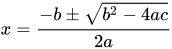
is a closed form of the solutions to the general quadratic equation

More generally, in the context of polynomial equations, a closed form of a solution is a solution in radicals; that is, a closed-form expression for which the allowed functions are only nth-roots and field operations In fact, field theory allows showing that if a solution of a polynomial equation has a closed form involving exponentials, logarithms or trigonometric functions, then it has also a closed form that does not involve these functions.[citation needed]

There are expressions in radicals for all solutions of cubic equations (degree 3) and quartic equations (degree 4). The size of these expressions increases significantly with the degree, limiting their usefulness.
In higher degrees, the Abel–Ruffini theorem states that there are equations whose solutions cannot be expressed in radicals, and, thus, have no closed forms. A simple example is the equation Galois theory provides an algorithmic method for deciding whether a particular polynomial equation can be solved in radicals.

Symbolic integration
[edit]Symbolic integration consists essentially of the search of closed forms for antiderivatives of functions that are specified by closed-form expressions. In this context, the basic functions used for defining closed forms are commonly logarithms, exponential function and polynomial roots. Functions that have a closed form for these basic functions are called elementary functions and include trigonometric functions, inverse trigonometric functions, hyperbolic functions, and inverse hyperbolic functions.
The fundamental problem of symbolic integration is thus, given an elementary function specified by a closed-form expression, to decide whether its antiderivative is an elementary function, and, if it is, to find a closed-form expression for this antiderivative.
For rational functions; that is, for fractions of two polynomial functions; antiderivatives are not always rational fractions, but are always elementary functions that may involve logarithms and polynomial roots. This is usually proved with partial fraction decomposition. The need for logarithms and polynomial roots is illustrated by the formula

which is valid if and are coprime polynomials such that is square free and



Alternative definitions
[edit]Changing the basic functions to include additional functions can change the set of equations with closed-form solutions. Many cumulative distribution functions cannot be expressed in closed form, unless one considers special functions such as the error function or gamma function to be basic. It is possible to solve the quintic equation if general hypergeometric functions are included, although the solution is far too complicated algebraically to be useful. For many practical computer applications, it is entirely reasonable to assume that the gamma function and other special functions are basic since numerical implementations are widely available.
Analytic expression
[edit]This is a term that is sometimes understood as a synonym for closed-form (see "Wolfram Mathworld".) but this usage is contested (see "Math Stackexchange".). It is unclear the extent to which this term is genuinely in use as opposed to the result of uncited earlier versions of this page.
Comparison of different classes of expressions
[edit]The closed-form expressions do not include infinite series or continued fractions; neither includes integrals or limits. Indeed, by the Stone–Weierstrass theorem, any continuous function on the unit interval can be expressed as a limit of polynomials, so any class of functions containing the polynomials and closed under limits will necessarily include all continuous functions.
Similarly, an equation or system of equations is said to have a closed-form solution if and only if at least one solution can be expressed as a closed-form expression; and it is said to have an analytic solution if and only if at least one solution can be expressed as an analytic expression. There is a subtle distinction between a "closed-form function" and a "closed-form number" in the discussion of a "closed-form solution", discussed in (Chow 1999) and below. A closed-form or analytic solution is sometimes referred to as an explicit solution.
| Arithmetic expressions | Polynomial expressions | Algebraic expressions | Closed-form expressions | Analytic expressions | Mathematical expressions | |
|---|---|---|---|---|---|---|
| Constant | Yes | Yes | Yes | Yes | Yes | Yes |
| Elementary arithmetic operation | Yes | Addition, subtraction, and multiplication only | Yes | Yes | Yes | Yes |
| Finite sum | Yes | Yes | Yes | Yes | Yes | Yes |
| Finite product | Yes | Yes | Yes | Yes | Yes | Yes |
| Finite continued fraction | Yes | No | Yes | Yes | Yes | Yes |
| Variable | No | Yes | Yes | Yes | Yes | Yes |
| Integer exponent | No | Yes | Yes | Yes | Yes | Yes |
| Integer nth root | No | No | Yes | Yes | Yes | Yes |
| Rational exponent | No | No | Yes | Yes | Yes | Yes |
| Integer factorial | No | No | Yes | Yes | Yes | Yes |
| Irrational exponent | No | No | No | Yes | Yes | Yes |
| Exponential function | No | No | No | Yes | Yes | Yes |
| Logarithm | No | No | No | Yes | Yes | Yes |
| Trigonometric function | No | No | No | Yes | Yes | Yes |
| Inverse trigonometric function | No | No | No | Yes | Yes | Yes |
| Hyperbolic function | No | No | No | Yes | Yes | Yes |
| Inverse hyperbolic function | No | No | No | Yes | Yes | Yes |
| Root of a polynomial that is not an algebraic solution | No | No | No | No | Yes | Yes |
| Gamma function and factorial of a non-integer | No | No | No | No | Yes | Yes |
| Bessel function | No | No | No | No | Yes | Yes |
| Special function | No | No | No | No | Yes | Yes |
| Infinite sum (series) (including power series) | No | No | No | No | Convergent only | Yes |
| Infinite product | No | No | No | No | Convergent only | Yes |
| Infinite continued fraction | No | No | No | No | Convergent only | Yes |
| Limit | No | No | No | No | No | Yes |
| Derivative | No | No | No | No | No | Yes |
| Integral | No | No | No | No | No | Yes |
Dealing with non-closed-form expressions
[edit]Transformation into closed-form expressions
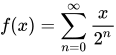
[edit]The expression: is not in closed form because the summation entails an infinite number of elementary operations. However, by summing a geometric series this expression can be expressed in the closed form:[1]

Differential Galois theory
[edit]The integral of a closed-form expression may or may not itself be expressible as a closed-form expression. This study is referred to as differential Galois theory, by analogy with algebraic Galois theory.
The basic theorem of differential Galois theory is due to Joseph Liouville in the 1830s and 1840s and hence referred to as Liouville's theorem.
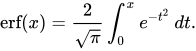
A standard example of an elementary function whose antiderivative does not have a closed-form expression is: whose one antiderivative is (up to a multiplicative constant) the error function:

Mathematical modelling and computer simulation
[edit]Equations or systems too complex for closed-form or analytic solutions can often be analysed by mathematical modelling and computer simulation (for an example in physics, see[2]).
Closed-form number
[edit] | This section may be confusing or unclear to readers. In particular, as the section is written, it seems that Liouvillian numbers and elementary numbers are exactly the same. (October 2020) |
Three subfields of the complex numbers C have been suggested as encoding the notion of a "closed-form number"; in increasing order of generality, these are the Liouvillian numbers (not to be confused with Liouville numbers in the sense of rational approximation), EL numbers and elementary numbers. The Liouvillian numbers, denoted L, form the smallest algebraically closed subfield of C closed under exponentiation and logarithm (formally, intersection of all such subfields)—that is, numbers which involve explicit exponentiation and logarithms, but allow explicit and implicit polynomials (roots of polynomials); this is defined in (Ritt 1948, p. 60). L was originally referred to as elementary numbers, but this term is now used more broadly to refer to numbers defined explicitly or implicitly in terms of algebraic operations, exponentials, and logarithms. A narrower definition proposed in (Chow 1999, pp. 441–442), denoted E, and referred to as EL numbers, is the smallest subfield of C closed under exponentiation and logarithm—this need not be algebraically closed, and corresponds to explicit algebraic, exponential, and logarithmic operations. "EL" stands both for "exponential–logarithmic" and as an abbreviation for "elementary".
Whether a number is a closed-form number is related to whether a number is transcendental. Formally, Liouvillian numbers and elementary numbers contain the algebraic numbers, and they include some but not all transcendental numbers. In contrast, EL numbers do not contain all algebraic numbers, but do include some transcendental numbers. Closed-form numbers can be studied via transcendental number theory, in which a major result is the Gelfond–Schneider theorem, and a major open question is Schanuel's conjecture.
Numerical computations
[edit]For purposes of numeric computations, being in closed form is not in general necessary, as many limits and integrals can be efficiently computed. Some equations have no closed form solution, such as those that represent the Three-body problem or the Hodgkin–Huxley model. Therefore, the future states of these systems must be computed numerically.
Conversion from numerical forms
[edit]There is software that attempts to find closed-form expressions for numerical values, including RIES,[3] identify in Maple[4] and SymPy,[5] Plouffe's Inverter,[6] and the Inverse Symbolic Calculator.[7]
See also
[edit]- Algebraic solution – Solution in radicals of a polynomial equation
- Computer simulation – Process of mathematical modelling, performed on a computer
- Elementary function – Type of mathematical function
- Finitary operation – Addition, multiplication, division, ...
- Numerical solution – Methods for numerical approximations
- Liouvillian function – Elementary functions and their finitely iterated integrals
- Symbolic regression – Type of regression analysis
- Tarski's high school algebra problem – Mathematical problem
- Term (logic) – Components of a mathematical or logical formula
- Tupper's self-referential formula – Formula that visually represents itself when graphed
Notes
[edit]- ^ Hyperbolic functions, inverse trigonometric functions and inverse hyperbolic functions are also allowed, since they can be expressed in terms of the preceding ones.
References
[edit]- ^ Holton, Glyn. "Numerical Solution, Closed-Form Solution". riskglossary.com. Archived from the original on 4 February 2012. Retrieved 31 December 2012.
- ^ Barsan, Victor (2018). "Siewert solutions of transcendental equations, generalized Lambert functions and physical applications". Open Physics. 16 (1). De Gruyter: 232–242. arXiv:1703.10052. Bibcode:2018OPhy...16...34B. doi:10.1515/phys-2018-0034.
- ^ Munafo, Robert. "RIES - Find Algebraic Equations, Given Their Solution". MROB. Retrieved 30 April 2012.
- ^ "identify". Maple Online Help. Maplesoft. Retrieved 30 April 2012.
- ^ "Number identification". SymPy documentation. Archived from the original on 2018-07-06. Retrieved 2016-12-01.
- ^ "Plouffe's Inverter". Archived from the original on 19 April 2012. Retrieved 30 April 2012.
- ^ "Inverse Symbolic Calculator". Archived from the original on 29 March 2012. Retrieved 30 April 2012.
Further reading
[edit]- Ritt, J. F. (1948), Integration in finite terms
- Chow, Timothy Y. (May 1999), "What is a Closed-Form Number?", American Mathematical Monthly, 106 (5): 440–448, arXiv:math/9805045, doi:10.2307/2589148, JSTOR 2589148
- Jonathan M. Borwein and Richard E. Crandall (January 2013), "Closed Forms: What They Are and Why We Care", Notices of the American Mathematical Society, 60 (1): 50–65, doi:10.1090/noti936
External links
[edit]Closed-form expression
View on GrokipediaDefinition and Fundamentals
Core Definition
In mathematics, a closed-form expression is one that expresses a mathematical object, such as a number, function, or solution to an equation, using a finite number of standard operations and functions applied to constants and variables.[3] These functions typically include the basic arithmetic operations of addition, subtraction, multiplication, and division; root extractions; exponentials; logarithms; trigonometric functions; and inverse trigonometric functions, often composed in finite ways—commonly referred to as elementary functions.[5] However, the accepted repertoire can be broader, incorporating well-established special functions such as the Gamma or Bessel functions, depending on the context.[1] Such expressions exclude representations involving infinite processes, including infinite series, continued fractions, or limits of sequences.[5] For instance, the roots of the quadratic equation are given by the closed-form expression which relies solely on permitted operations. Similarly, the indefinite integral qualifies as closed-form, as it uses an elementary function without infinite terms.[5] The notion of "elementary functions" carries some ambiguity, as the exact set can vary by context, though common conventions limit it to those closed under the specified operations.[6] A rigorous framework is provided by Liouville's theorem on integration in finite terms, which specifies necessary and sufficient conditions for an integral to be expressible using elementary functions, typically involving forms like sums of logarithmic derivatives and algebraic adjustments within a differential field. Closed-form expressions are a subset of analytic expressions, the latter permitting broader representations such as power series.[2]Historical Context
The concept of closed-form expressions originated in the algebraic pursuits of the 16th and 17th centuries, as mathematicians sought explicit formulas for solving polynomial equations using finite combinations of arithmetic operations and root extractions. A pivotal milestone came in 1545 when Gerolamo Cardano published the formula for resolving general cubic equations in his treatise Ars Magna, incorporating radicals to express roots in a compact, non-iterative manner.[7] These solutions for polynomial roots exemplified the early aspiration for expressions that avoid infinite processes or approximations, motivating further refinements in algebraic theory. The 19th century marked both expansions and fundamental limitations in the scope of closed forms. Niels Henrik Abel's proof in 1824, published in 1826, established the Abel–Ruffini theorem, showing that no general solution by radicals exists for quintic equations or higher-degree polynomials, thereby delineating the intrinsic boundaries of radical-based closed-form solutions.[8] This result shifted focus toward alternative expression classes, such as those involving transcendental functions, while underscoring the theorem's enduring role in group theory and field extensions. Parallel developments in integration theory further formalized closed-form criteria during this era. Joseph Liouville's investigations from 1833 to 1841 introduced the theory of integration in finite terms, using differential algebra to specify conditions under which antiderivatives of elementary functions remain elementary, thus providing a rigorous framework for identifying integrable forms.[9] The 20th century advanced these ideas through computational lenses, enabling algorithmic verification of closed forms. In 1969, Robert Risch developed a systematic algorithm for symbolic integration of transcendental elementary functions, deciding the existence of closed-form antiderivatives and constructing them via structured decomposition, which influenced modern computer algebra systems.[10]Key Examples
Polynomial Equations
Polynomial equations represent a foundational area where closed-form expressions, particularly those involving radicals, have been developed for finding roots. For quadratic equations of the form with , the roots are given by the quadratic formula: This expression, derived through completing the square, dates back to ancient civilizations but was formalized in the 9th century by Persian mathematician al-Khwarizmi in his treatise Al-Jabr.[11] For cubic equations, closed-form solutions were first discovered in the 16th century by Italian mathematicians Scipione del Ferro and Niccolò Tartaglia, with Gerolamo Cardano publishing the general formula in 1545. The formula applies to the depressed cubic , where the roots can be expressed as: x = \sqrt{{grok:render&&&type=render_inline_citation&&&citation_id=3&&&citation_type=wikipedia}}{-\frac{q}{2} + \sqrt{\left( \frac{q}{2} \right)^2 + \left( \frac{p}{3} \right)^3}} + \sqrt{{grok:render&&&type=render_inline_citation&&&citation_id=3&&&citation_type=wikipedia}}{-\frac{q}{2} - \sqrt{\left( \frac{q}{2} \right)^2 + \left( \frac{p}{3} \right)^3}}. This involves cube roots and square roots, handling both real and complex cases through Cardano's method of substitution to reduce the general cubic to the depressed form.[12][13] Quartic equations, of degree four, also admit closed-form solutions by radicals, primarily through Lodovico Ferrari's method developed in 1540 and published by Cardano in 1545. Ferrari's approach depresses the general quartic via substitution, then introduces a parameter to form a perfect square, leading to a cubic resolvent equation whose solution yields the roots via quadratic formulas. The explicit expressions involve nested radicals, confirming solvability for all quartics.[11][14] The solvability of polynomial equations by radicals is delimited by Galois theory, introduced by Évariste Galois in the 1830s. This framework shows that polynomials of degree at most four are always solvable by radicals, as their Galois groups permit such expressions, whereas the general polynomial of degree five or higher is not, as proven by Niels Henrik Abel in 1824, building on Paolo Ruffini's incomplete proof from 1799. This impossibility holds for the general case, though specific higher-degree polynomials may still be solvable.[15][16]Indefinite Integrals
In symbolic integration, a closed-form expression for an indefinite integral refers to an antiderivative expressible in terms of elementary functions, such as polynomials, rationals, exponentials, logarithms, and trigonometric or inverse trigonometric functions. Determining whether such an antiderivative exists for a given elementary integrand is a central problem, with significant theoretical and computational implications. Successes often arise for rational functions or those involving algebraic extensions, while challenges emerge for transcendental cases, particularly those with nested exponentials or non-algebraic behaviors. Liouville's theorem provides the foundational criterion for the existence of elementary antiderivatives. It states that if an elementary function admits an elementary antiderivative, then this antiderivative must take the form , where and the are in the same differential field as , and the are constants; more generally, for integrands of the form where is a rational function, the theorem specifies conditions under which no elementary antiderivative exists by analyzing the structure of the field extensions.[17] This theorem, originally developed in the 1830s, implies that many integrals cannot be expressed elementarily, guiding both theoretical proofs of non-integrability and algorithmic searches.[17] A classic example of an elementary antiderivative is which follows from the trigonometric substitution , yielding an inverse tangent upon integration and back-substitution. In contrast, the integral has no elementary antiderivative, as proven using extensions of Liouville's theorem that rule out the required field structures for algebraic, logarithmic, or exponential terms.[18] Non-elementary cases often require special functions for closed-form representation. For instance, the Gaussian integral where is the error function, a non-elementary special function arising in probability and heat conduction; this form is nonelementary because violates the conditions of Liouville's theorem for integration in the field of elementary functions. Exponential forms serve as building blocks in such integrands, complicating the search for elementary solutions when combined with quadratics. The Risch algorithm offers a systematic decision procedure for determining whether an elementary antiderivative exists and computing it when possible, particularly for integrals involving logarithms and exponentials in towers of field extensions.[19] Developed in 1969, it recursively reduces the problem by handling rational, algebraic, and transcendental parts, and has been implemented in computer algebra systems like Mathematica and Axiom for symbolic integration tasks.[19] While complete for elementary functions, the algorithm's complexity grows with the depth of extensions, limiting practical use for highly nested cases but confirming non-elementarity for functions like .[19]Exponential and Logarithmic Forms
Closed-form expressions involving exponential and logarithmic functions often arise in modeling dynamic processes, such as growth and decay phenomena, where transcendental operations provide exact solutions without requiring numerical approximation. These functions extend the algebraic framework by incorporating rates of change that cannot be captured solely through polynomials or radicals, yet they maintain a finite, explicit form using elementary transcendental operations. For instance, exponential terms naturally emerge in scenarios governed by proportional rates, yielding solutions that are both analytically tractable and interpretable. A prominent example is the solution to the first-order linear differential equation , which models exponential growth or decay with constant rate . The general closed-form solution is , where is an arbitrary constant determined by initial conditions.[20] This expression is derived by separation of variables, integrating both sides to obtain , and exponentiating to isolate .[21] When , the solution describes unbounded growth, as seen in population models; for , it represents decay, such as radioactive half-life calculations. Logarithmic functions appear in the inverse problems of these exponential models, particularly when solving for time or parameters. In exponential growth , the time to reach a target value is given by the closed-form , assuming and .[22] This formula facilitates direct computation of durations, such as doubling times in biological or economic contexts, by leveraging the inverse relationship between exponentials and natural logarithms. The continuous compound interest formula exemplifies these forms in financial mathematics: , where is the principal, the annual rate, and the time in years. This arises as the limit of the discrete compounding expression as , yielding a closed-form continuous model.[23] For inverse calculations, such as solving for given , the result is , mirroring the growth scenario. More complex inverses require the Lambert W function, defined as the multivalued inverse of , so that . While not elementary, it is frequently accepted in extended closed-form contexts for equations like , enabling solutions in combinatorics, physics, and optimization problems.[24] Its principal branch provides real-valued results for , with applications including solving transcendental equations that resist purely elementary resolution.[25]Related Concepts
Analytic Expressions
Analytic expressions refer to functions that can be locally represented by convergent power series expansions around every point in their domain, where the series has a positive radius of convergence. This means that for a function defined on an open set or , at each point , there exists such that for all , with the series converging to .[26][27] A classic example is the exponential function, given by the power series , which converges for all real (or complex) and thus represents globally./7%3A_Power_series_methods/7.1%3A_Power_Series) This representation allows analytic expressions to capture a wide class of functions through infinite sums, in contrast to stricter closed-form expressions limited to finite combinations of elementary operations and functions. In the context of complex analysis, analytic expressions coincide with holomorphic functions, which are complex-differentiable at every point in their domain and admit local power series expansions.[28] Holomorphic functions analytic throughout the entire complex plane are termed entire functions; examples include polynomials and the exponential function, whose power series converge everywhere without singularities.[29] However, many analytic expressions are holomorphic only in specific domains, where the radius of convergence is bounded by singularities, such as branch points or poles, limiting the series' validity to open disks within that domain.[27] The Taylor series provides a fundamental tool for expressing analytic functions, generating the coefficients from the function's derivatives at a point , and converging to the function within the disk of analyticity.[30] This infinite series constitutes a closed-form representation in the analytic sense, as it exactly equals the function where it converges, but it extends beyond elementary closed-forms by incorporating potentially infinite terms rather than restricting to finite expressions built from algebraic, trigonometric, exponential, and logarithmic operations.[31] A representative example is the sine function, expressed as the Taylor series , which converges for all real and defines analytically, though the series form highlights its non-elementary infinite nature in this representation./7%3A_Power_series_methods/7.1%3A_Power_Series)Closed-Form Numbers
A closed-form number is a mathematical constant that can be expressed using a finite sequence of elementary operations—such as addition, subtraction, multiplication, division, exponentiation, roots, logarithms, and trigonometric functions—starting from rational numbers. This concept, formalized in certain frameworks, defines the set of such numbers as the smallest subfield of the complex numbers closed under the exponential and natural logarithm functions, ensuring expressions remain finite and explicit.[6] Algebraic numbers constitute a primary class of closed-form numbers, as they are roots of non-zero polynomials with integer coefficients, and many can be explicitly constructed using radicals or other elementary operations. For instance, all rational numbers are algebraic of degree 1, satisfying linear polynomials like with integer . Square roots of rationals, such as , are algebraic of degree 2 when irrational, solving quadratic equations like . A representative example is the golden ratio , which satisfies the minimal polynomial and arises in geometric and combinatorial contexts.[32][33] Transcendental closed-form numbers extend this class to include irrationals not satisfying any polynomial equation with rational coefficients, yet still expressible finitely within the allowed operations. Prominent examples are , the base of the natural exponential, defined as , and , defined as where is algebraic. These definitions avoid infinite processes by relying on the exponential and logarithm as primitive functions, though and classically admit series representations like and (with arctan via its Taylor series); such infinite expansions are accepted in closed-form contexts when the number is definable via finite elementary expressions otherwise. The transcendentality of and is established by the Lindemann-Weierstrass theorem, which states that if distinct algebraic numbers are linearly independent over the rationals, then are algebraically independent over the rationals. Applying this, is transcendental since it is with 1 algebraic and non-zero; similarly, (algebraic) implies is transcendental, as an algebraic would contradict the theorem's independence.[6][34][35] The collection of closed-form numbers, encompassing all algebraic numbers and select transcendentals like and , is countable. This follows from the countability of algebraic numbers: each has a unique minimal polynomial with integer coefficients, and the set of all such polynomials is countable (as finite sequences of integers), with each yielding finitely many roots. Rationals and quadratic irrationals like thus qualify as closed-form, but the real numbers overall are uncountable, so most reals are transcendental and lack finite closed-form expressions, necessitating infinite information for their description.[6][36]Alternative Formulations
In pure mathematics, one strict formulation of closed-form expressions limits them to the class of elementary functions, built from rational numbers through finite compositions of addition, subtraction, multiplication, division, root extractions, exponentials, logarithms, and trigonometric functions (along with their inverses). This definition, aligned with foundational work on decidability in real closed fields extended to transcendental operations, ensures that expressions can be manipulated and evaluated using only a finite sequence of algebraic and analytic operations without recourse to limits, infinite series, or special functions.[37][38] Such restrictions stem from efforts to characterize solvable problems in first-order logic over the reals, where quantifier elimination guarantees equivalence to quantifier-free formulas involving these operations.[39] Extended formulations broaden this scope to include a finite number of special functions, such as the gamma function or Bessel functions , when they facilitate exact representations in contexts like special function theory or differential equations. For instance, solutions to certain recurrence relations or integral transforms may incorporate these functions as "closed" if the overall expression remains finite and non-recursive, allowing for computational evaluation via established algorithms despite transcending elementary means. This approach is formalized in frameworks like hyperclosure, which augments elementary operations with evaluations of hypergeometric series terminating in special functions, providing a rigorous extension for number-theoretic and analytic applications.[2] In the physical sciences and applied mathematics, definitions adopt a more flexible, context-dependent stance, deeming expressions "closed-form" if they are explicit and amenable to direct computation, even including non-elementary integrals or sums when standardized. A prominent example is the error function , which appears in probability density functions for the normal distribution and is treated as closed-form due to its role in exact analytical solutions for diffusion processes and statistical mechanics, despite lacking an elementary antiderivative.[40] Similarly, finite sums involving special functions in quantum mechanics or electromagnetism are accepted if they avoid numerical iteration.[2] Debates persist over borderline cases, particularly asymptotic approximations. Stirling's formula, , exemplifies this: while it yields an explicit elementary expression for large with high accuracy (error ), its inexactness disqualifies it from strict closed-form status, as it approximates rather than equals the exact factorial, which itself lacks an elementary closed form. These discussions highlight the tension between theoretical rigor and practical utility, with historical evolution—from algebraic radicals in the 19th century to transcendentals in the 20th—reflecting shifting priorities across fields.[41][2]Classifications and Comparisons
Finite vs. Infinite Expressions
Closed-form expressions are characterized by their finite nature, consisting of a bounded number of standard mathematical operations such as addition, multiplication, exponentiation, and root extraction, without requiring iteration or summation to infinity.[42] This finite structure allows direct evaluation using a fixed sequence of computations, distinguishing them from expressions that inherently involve unbounded processes.[42] In contrast, infinite expressions serve as alternatives when closed forms are unavailable or complex, including power series and continued fractions that extend indefinitely. For instance, the natural logarithm function can be represented by the infinite power series for , which requires an unlimited number of terms for exact representation.[42] Similarly, the hyperbolic tangent function admits an infinite continued fraction expansion, , derived from the reciprocal of the cotangent hyperbolic expansion.[43] A key distinction arises in convergence: while infinite expressions may evaluate to values expressible in closed form under certain conditions, their form remains non-closed due to the infinite construct. The geometric series for converges to a finite closed-form expression, yet the series itself is not considered closed-form because it demands infinite summation.[42] This equivalence highlights that the representational form, rather than the numerical value, determines classification. Practically, infinite expressions offer computational advantages when closed forms are absent, enabling approximations through partial sums or convergents that improve with more terms, though they necessitate checks for convergence radius or domain.[42] Such forms are particularly useful in analysis and numerical methods, providing tools for evaluation where finite alternatives do not exist.[43]Hierarchy of Expression Types
The hierarchy of closed-form expressions is structured as a progression of field extensions, beginning with the simplest algebraic forms and extending to increasingly complex transcendental structures, as characterized in differential algebra.[44] This classification reflects the building blocks permitted in finite-term expressions, ensuring computability and analytic properties while delineating boundaries of expressiveness. At the foundational level, rational expressions form the base, consisting of quotients of polynomials with coefficients in the rational numbers . These expressions, such as , generate the initial differential field , which is closed under differentiation and serves as the starting point for all higher extensions.[44] Rational expressions capture basic arithmetic operations and are inherently algebraic, providing a complete description of polynomial behaviors without introducing irrationality or transcendence. The second level incorporates radical extensions, adjoining algebraic elements via nth roots to the rational base field, thereby encompassing all algebraic numbers expressible in radicals. This step forms simple algebraic extensions for , allowing solutions to polynomial equations by radicals, as in expressions like .[44] Such extensions maintain algebraicity, enabling the representation of constructible numbers and roots without transcendental operations. Advancing to the third level, elementary transcendental extensions introduce exponentials, logarithms, and trigonometric functions through logarithmic and exponential adjunctions in the tower. Here, fields like or for are formed, with trigonometric functions arising as compositions of these (e.g., ).[44] This level defines the core of standard closed-form expressions, permitting solutions to differential equations in finite terms via Liouville's structure theorem. The fourth level extends to special functions, such as the gamma function and the Riemann zeta function , which are neither algebraic nor elementary transcendental but are accepted in broader closed-form contexts due to their fundamental role in mathematical physics and their evaluation at algebraic arguments yielding hyperclosed values.[2] These functions often arise as solutions to specific differential equations and provide closed-form representations for integrals or series that evade elementary methods. Analytic series expansions may also appear at this level, though only finite or named forms qualify as closed. Ultra-complex structures, such as finite towers of exponentials (e.g., with n levels) or higher hyperoperations, reside within the elementary transcendental class but exceed typical closed-form usage due to their extreme nesting and computational intractability; operations beyond tetration, like pentation, lie outside standard closed-form hierarchies.[2] This hierarchy culminates in finite expressions as one endpoint, contrasting with infinite series or products that define non-closed forms at the other extreme. Regarding inclusion relations, all closed-form expressions constructed via this hierarchy yield analytic functions—holomorphic where defined—owing to the analyticity of their building blocks under composition and extension.[44] However, the converse fails: not all analytic functions admit closed-form expressions, as exemplified by the error function , which is entire (analytic everywhere) but lacks an elementary antiderivative or equivalent closed-form representation.[17]Limitations and Boundaries
While the Risch algorithm provides a decision procedure for determining whether an indefinite integral of an elementary function admits an elementary antiderivative, no general algorithm exists to decide if an arbitrary integral possesses a closed-form expression beyond elementary functions.[45] For definite integrals, the problem is even more restrictive; it is undecidable whether the value of a given definite contour multiple integral of an elementary meromorphic function over an everywhere real analytic cycle is zero, implying fundamental limits on verifying closed-form evaluability.[46] Hilbert's 13th problem highlights additional boundaries in the expressibility of multivariable functions, positing that certain algebraic functions of three or more variables cannot be represented as finite superpositions of algebraic functions of two variables. In the algebraic context, this implies that solutions to higher-degree polynomial equations may require auxiliary functions depending on more variables than the original problem, complicating closed-form representations for systems involving multiple parameters.[47] Even when closed-form solutions exist for higher-degree polynomials, their complexity grows rapidly with degree, rendering them impractical. For instance, while general sextic equations can be solved using transformations like the Tschirnhausen reduction followed by expressions involving inverse regularized beta functions or elliptic integrals, the resulting formulas are exceedingly lengthy and obscure, often spanning pages and involving nested radicals and transcendental operations that obscure interpretability. The notion of a "closed-form expression" also exhibits philosophical boundaries that vary between pure mathematics and applied fields like physics. In pure mathematics, closed forms are typically restricted to finite combinations of elementary functions, excluding infinite series or recursively defined special functions unless explicitly allowed in a hierarchy like hyperclosure.[48] In contrast, physics often adopts a more permissive definition, considering expressions involving special functions—such as polylogarithms or multiple zeta values in Feynman integrals—as closed forms if they enable analytic continuation and numerical evaluation without infinite summation.[49] This discrepancy underscores that "closed" is context-dependent, with physics prioritizing computational utility over strict algebraic finiteness.[48]Approaches to Non-Closed Forms
Algebraic Transformations
Algebraic transformations involve rewriting expressions, particularly those arising from solving equations or evaluating integrals, into equivalent forms that admit closed-form solutions using elementary functions. These manipulations rely on substitutions, factorizations, and completions to simplify structures that initially appear non-closed, such as polynomials with higher-degree terms or rational functions with composite denominators. By eliminating problematic terms or converting transcendental elements to algebraic ones, these techniques enable expressions in terms of radicals, logarithms, or other basic operations.[50] One fundamental method is substitution and completion, which removes intermediate terms to reduce complexity. For cubic equations of the form , the substitution depresses the equation by eliminating the quadratic term, yielding a form that can be solved using Cardano's formula involving cube roots.[50] This transformation, known since ancient times and formalized in the Renaissance, preserves the roots while facilitating radical expressions for the solutions.[51] Partial fraction decomposition applies to rational functions, breaking them into sums of simpler fractions for integration into closed forms. Consider , which decomposes as ; integrating yields , a closed logarithmic expression.[52] This method extends to higher-degree denominators with linear or quadratic factors, provided the numerator degree is lower, ensuring the result involves elementary antiderivatives.[52] The Weierstrass substitution addresses trigonometric integrals by converting them to rational forms. Setting , it expresses , , and , transforming into a rational integral solvable by partial fractions.[53] This technique, effective for rational functions of sine and cosine, yields closed forms in logarithms and arctangents.[53] However, algebraic transformations have limitations; for instance, general quintic equations cannot be solved by radicals and require elliptic functions for closed-form expressions, as established by Abel and Galois.[54] In such cases, while Tschirnhaus transformations reduce the quintic to Bring-Jerrard form , further resolution demands non-elementary functions like hypergeometric series or elliptic modular functions.[54]Differential Galois Theory
Differential Galois theory, also known as Picard-Vessiot theory, provides an algebraic framework analogous to classical Galois theory for determining whether solutions to linear ordinary differential equations (ODEs) can be expressed in closed form using elementary functions. In classical Galois theory, field extensions arising from roots of polynomials are analyzed via Galois groups to assess solvability by radicals; similarly, for a linear homogeneous ODE of order over a differential field with algebraically closed constants, the Picard-Vessiot extension is the minimal differential extension of generated by a full set of linearly independent solutions, containing no new constants. The differential Galois group consists of the differential automorphisms of this extension that fix pointwise, forming a linear algebraic group that encodes the algebraic and differential relations among the solutions.[55][56] A key result in the theory is that the ODE is solvable by quadratures—meaning its solutions lie in a Liouvillian extension of , built by adjoining exponentials, integrals (logs), and algebraic extensions—if and only if the identity component of the differential Galois group is solvable, i.e., has a composition series with abelian factors. This criterion parallels the solvability by radicals in algebraic Galois theory, where solvable groups yield expressions using nested roots; here, solvable groups allow solutions via elementary functions such as rationals, exponentials, logarithms, and algebraic operations. For second-order equations with rational coefficients, algorithms like Kovacic's can compute the Galois group to decide this solvability explicitly.[56][57] Illustrative examples highlight the theory's power in proving non-solvability. The Airy equation over has Picard-Vessiot extension generated by the Airy functions and , with differential Galois group , which is simple and thus not solvable; consequently, no closed-form expression in elementary functions exists for its general solution. Similarly, Bessel's equation for excluding cases where is an integer has Galois group over , rendering solutions (Bessel functions and ) non-elementary; however, for specific like , the group reduces to a solvable form, yielding solutions in terms of sine and cosine.[56][58] Applications of differential Galois theory extend to proving non-integrability for broader classes of linear ODEs, such as determining when with meromorphic lacks Liouvillian solutions by identifying irreducible or non-solvable Galois groups. This has implications in analysis and physics, where special functions arise precisely because closed forms are impossible.[57][56]Numerical Approximations
When a closed-form expression for a function, integral, or solution to a differential equation is unavailable or intractable, numerical approximation methods offer practical ways to obtain accurate estimates with controlled error bounds. These techniques rely on iterative computations, discretization, or randomization to simulate the underlying mathematical behavior, often achieving high precision for practical applications in science and engineering. Unlike exact symbolic methods, numerical approaches trade off analytical insight for computational efficiency, enabling solutions to problems that defy closed-form resolution. Series expansions, such as Taylor or asymptotic series, approximate functions locally around a point by representing them as infinite sums of polynomials, which can be truncated for finite approximations. For instance, the Taylor series expansion of the sine function around is given by yielding the approximation for small , which is particularly useful for functions without elementary closed forms, like the error function or Bessel functions. Asymptotic series extend this idea for large or small parameter limits, providing rapid convergence in those regimes despite potential divergence elsewhere. These methods are foundational in perturbation theory and have been rigorously analyzed for error estimation via remainder terms. For definite integrals lacking antiderivatives in closed form, quadrature methods discretize the integration interval and approximate the integrand using polynomial interpolation. Simpson's rule, a Newton-Cotes formula, fits a quadratic polynomial over subintervals of width , yielding the approximation for a single interval, with composite versions extending to broader domains for higher accuracy. Gaussian quadrature, in contrast, optimally chooses integration nodes and weights based on orthogonal polynomials, achieving exact results for polynomials up to degree with points, making it superior for smooth integrands without closed-form antiderivatives, such as those in elliptic integrals. Numerical solvers for differential equations address cases where explicit solutions elude closed forms, employing step-by-step integration or spatial discretization. For ordinary differential equations (ODEs), Runge-Kutta methods, particularly the fourth-order variant (RK4), advance solutions via weighted averages of slopes evaluated at intermediate points within each step , as in the update formula followed by , offering a balance of accuracy and stability for non-stiff systems like those in chemical kinetics. For partial differential equations (PDEs), the finite element method (FEM) divides the domain into a mesh of elements, approximates solutions via basis functions (e.g., piecewise linears), and solves the resulting variational weak form, enabling approximations for complex geometries in problems like heat conduction or fluid dynamics without analytical solutions. In high-dimensional settings, such as multidimensional integrals arising in statistical physics or quantum mechanics, Monte Carlo simulations leverage random sampling to estimate expectations, circumventing the curse of dimensionality that plagues deterministic methods. By generating uniform random points in the integration domain and averaging the function values, the integral approximates where is uniform, with variance decreasing as for samples; variance reduction techniques like importance sampling further enhance efficiency for integrals in path-dependent processes or particle simulations.Computational Aspects
Symbolic Computation
Symbolic computation plays a central role in generating and manipulating closed-form expressions through computer algebra systems (CAS), which automate algebraic manipulations to produce exact symbolic solutions for problems such as solving polynomial equations and computing definite integrals. Leading systems include Mathematica, developed by Wolfram Research, which provides extensive tools for symbolic integration and polynomial solving; Maple, from Maplesoft, known for its robust handling of algebraic structures; and SageMath, an open-source alternative that integrates capabilities from multiple libraries for multivariate polynomial computations. These systems employ algorithms to decide whether a closed-form expression exists and to construct it when possible, often transforming complex inputs into simplified elementary or special function forms. A key algorithm for solving systems of polynomial equations in closed form is the computation of Gröbner bases, which reduces the system to a canonical form amenable to explicit solution extraction. In Mathematica, the GroebnerBasis function computes a Gröbner basis for ideals in polynomial rings, enabling triangularization for back-substitution to yield closed-form roots.[59] Maple's Groebner package similarly supports basis computation with options for monomial orderings, facilitating solutions for nonlinear systems up to moderate degrees.[60] SageMath leverages Singular's engine for efficient Gröbner basis calculations in multivariate settings, allowing users to solve ideals over fields like the rationals.[61] For integration, implementations of the Risch algorithm decide whether antiderivatives of elementary functions admit closed forms and construct them when affirmative, though full realizations remain partial, particularly for algebraic extensions. Mathematica incorporates Risch-based methods for transcendental cases but relies on heuristics for algebraic integrals, as detailed in recent advancements.[62] Maple's int command uses Risch structures for elementary integration, succeeding for many rational and exponential inputs.[63] SageMath interfaces with Maxima for Risch-inspired symbolic integration, handling logarithmic and exponential forms effectively.[64] Simplification in these systems often involves heuristic rewriting rules to convert expressions into more compact closed forms, such as transforming hypergeometric series into products of gamma functions via identities like those in Gauss's theorem. Mathematica's HypergeometricPFQ and FunctionExpand utilities apply such reductions, simplifying functions to gamma expressions for specific parameters. Maple's simplify/hypergeom routine rewrites hypergeometric terms using contiguous relation transformations and gamma simplifications.[65] In SageMath, the simplify_hypergeometric method, powered by Maxima, converts eligible series to gamma-based closed forms, prioritizing readability.[66] These heuristics enhance usability but may not always yield the most elementary representation. Despite these advances, challenges persist in symbolic computation of closed-form expressions. Handling branch cuts in multi-valued functions like logarithms and roots requires careful definition of principal branches to ensure consistent results across computations; for instance, systems must track cut locations during simplification to avoid discontinuities in complex domains.[67] Additionally, output verbosity arises in high-degree solutions, where Gröbner bases or explicit roots for polynomials of degree five or higher produce exceedingly large expressions, complicating interpretation and storage—computational complexity grows doubly exponentially with variables and degrees in worst cases.[68] These issues underscore the need for advanced simplification post-processing in CAS to manage expression size while preserving exactness.Numerical Evaluation
Numerical evaluation of closed-form expressions typically proceeds by direct computation using arithmetic operations and library functions in floating-point systems. For polynomials appearing in these expressions, Horner's method provides an efficient and stable approach by rewriting the polynomial as a sequence of nested multiplications and additions, thereby minimizing the number of operations and intermediate results to reduce overflow risks. For an th-degree polynomial , Horner's method evaluates it as requiring exactly multiplications and additions, which is optimal in terms of arithmetic operations compared to the multiplications in the naive power-sum form. This nesting also improves numerical stability for evaluation points where , as backward recursion variants further bound error growth in high-degree cases.[69] Standard function libraries in numerical computing environments implement evaluations for transcendental functions like exponentials, logarithms, and trigonometric operations using algorithms tailored to IEEE 754 floating-point arithmetic. These built-in functions, such asexp, log, and sin in languages like C or Python's math module, employ techniques like argument reduction and polynomial approximations (often via Chebyshev series) to achieve results correctly rounded to the nearest representable value within the format's precision. The IEEE 754 standard specifies the required accuracy for basic operations but leaves transcendental function implementations to vendors, with recommendations for error bounds not exceeding 0.5 units in the last place (ulp) for typical ranges. This enables reliable computation of closed-form expressions incorporating such functions in double-precision (64-bit) or single-precision (32-bit) formats.[70]
Round-off errors arise during numerical evaluation due to the finite precision of floating-point representations, affecting the accuracy of results from operations like radicals. For instance, the square root of 2, , is approximated in IEEE 754 double precision as 1.4142135623730951, introducing a relative round-off error of approximately , comparable to the machine epsilon for that format. The conditioning of the square root function is favorable, with a condition number of about 0.5, implying that relative perturbations in the input amplify to at most half that magnitude in the output under ideal arithmetic. However, iterative algorithms like Newton-Raphson for square root computation accumulate round-off errors across iterations, with bounds estimated as (where is the number of iterations), necessitating a balance between convergence speed and precision loss to minimize total error.[71]
To achieve precision beyond standard floating-point limits, arbitrary-precision arithmetic libraries such as MPFR are utilized for evaluating closed-form expressions, particularly those involving irrational constants. MPFR, a C library built on GNU MP, supports user-defined precisions up to thousands of bits and provides correctly rounded results for all operations, including dedicated functions like mpfr_const_pi for computing to arbitrary accuracy via series or other algorithms. For example, can be evaluated to 1000 decimal places in seconds on modern hardware, enabling high-fidelity approximations for expressions like those in physics or cryptography where double precision suffices insufficiently. This approach ensures reproducibility and exact rounding modes compliant with IEEE 754 extensions.[72]