


Community hub
Recent from talks
Contribute something
Nothing was collected or created yet.
Army Ministry
View on Wikipedia
| 陸軍省 Rikugun-shō | |
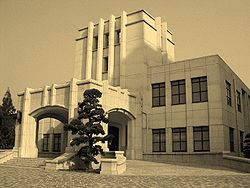
 Army HQ building, Ichigaya, Tokyo, from 1937–1945 | |
| Agency overview | |
|---|---|
| Formed | April 1872 |
| Preceding agency | |
| Dissolved | November 1945 |
| Superseding agency | |
| Jurisdiction |  Imperial Japanese Army Imperial Japanese Army |
The Army Ministry (陸軍省, Rikugun-shō), also known as the Ministry of War, was the cabinet-level ministry in the Empire of Japan charged with the administrative affairs of the Imperial Japanese Army (IJA). It existed from 1872 to 1945.
In the IJA and the Imperial Japanese Navy (IJN), the ministries were in charge of Gunsei (軍政, military administration), and Army General Staff Office and Navy General Staff were in charge of Gunrei (軍令, military command). The two were distinguished.
History
[edit]The Army Ministry was created in April 1872, along with the Navy Ministry, to replace the Ministry of War (兵部省, Hyōbushō) of the early Meiji government.
Initially, the Army Ministry was in charge of both administration and operational command of the Imperial Japanese Army. However, with the creation of the Imperial Japanese Army General Staff Office in December 1878, it was left with only administrative functions. Its primary role was to secure the army budget, weapons procurement, personnel, relations with the National Diet and the Cabinet and broad matters of military policy.
The post of Army Minister was politically powerful. Although a member of the Cabinet after the establishment of the cabinet system of government in 1885, the Army Minister was answerable directly to the Emperor (the commander-in-chief of the Imperial Japanese Armed Forces under the Meiji Constitution) and not the Prime Minister.
From the time of its creation, the post of Army Minister was usually filled by an active-duty general in the Imperial Japanese Army. This practice was made into law under the Military Ministers to be Active-Duty Officers Law (軍部大臣現役武官制, Gumbu daijin gen'eki bukan sei) in 1900 by Prime Minister Yamagata Aritomo to curb the influence of political parties into military affairs. Abolished in 1913 under the administration of Yamamoto Gonnohyōe, the law was revived again in 1936 at the insistence of the Army General Staff by Prime Minister Hirota Kōki. At the same time, the Imperial Japanese Army prohibited its generals from accepting political offices except by permission from Imperial General Headquarters. Taken together, these arrangements gave the Imperial Japanese Army an effective, legal right to nominate (or refuse to nominate) the Army Minister. The ability of the Imperial Japanese Army to refuse to nominate an Army Minister gave it effective veto power over the formation (or continuation) of any civilian administration, and was a key factor in the erosion of representative democracy and the rise of Japanese militarism.
After 1937, both the Army Minister and the Chief of the Army General Staff were members of the Imperial General Headquarters.
With the surrender of the Empire of Japan in World War II, the Army Ministry was abolished together with the Imperial Japanese Army by the Allied occupation authorities in November 1945 and was not revived in the post-war Constitution of Japan.
Organization
[edit]As in other Japanese ministries, each bureau (局) belonged to a vice-minister. In addition, departments (部) and their higher-level organizations, headquarters (本部, "main department") were established as external bureaus.
- Vice Minister of the Army (陸軍次官)
- Military Affairs Bureau (軍務局)
- Personnel Bureau (人事局)
- Ordnance Bureau (兵器局)
- Development Bureau (整備局)
- Military Administration Bureau (兵務局)
- Intendance Bureau (経理局)
- Medical Bureau (医務局)
- Judge Bureau (法務局)
- Warhorse Bureau (軍馬局)
- external bureaus;
- Army Fortification Department (陸軍築城部)
- Army Transport Department (陸軍運輸部)
- Army Land Transport Department (陸軍陸運部)
- Army Military Relief department (陸軍恤兵部)
- Army Department (陸軍軍馬補充部)
- Army Aviation Department/Army Headquarters (陸軍航空部/陸軍航空本部)
- Army Technical Headquarters (陸軍技術本部)
- Army Ordnance Headquarters (陸軍兵器本部)
- Army Armour Headquarters (陸軍機甲本部)
- Army Ordnance Administrative Headquarters (陸軍兵器行政本部)
- Army Fuel Administrative Headquarters (陸軍燃料本部)
- Army Shipping Command (陸軍船舶司令部)
- Army Arsenals (陸軍造兵廠)
- Army Ordnance Depot (陸軍兵器廠)
- Yasukuni Shrine
The Army Ministry and Imperial General Headquarters were located in Ichigaya Heights, which is now part of Shinjuku, Tokyo.
Ministers of the Army of Japan
[edit]Ministers of the Army or Ministry of War (陸軍大臣) is the Minister of State in charge of the Ministry. Under Japanese law prior to 1945, each ministers belonged directly to the Emperor.
| No. | Portrait | Name | Term of Office | Cabinet | |
|---|---|---|---|---|---|
| 1 | .jpg)
|
Ōyama Iwao 大山 巌 |
22 December 1885 |
17 May 1891 |
1st Itō |
| Kuroda | |||||
| 1st Yamagata | |||||
| 1st Matsukata | |||||
| 2 | 
|
Takashima Tomonosuke 高島 鞆之助 |
17 May 1891 |
8 August 1892 | |
| 3 |
|
Ōyama Iwao 大山 巌 |
8 August 1892 |
20 September 1896 |
2nd Itō |
| 2nd Matsukata | |||||
| 4 |
|
Takashima Tomonosuke 高島 鞆之助 |
20 September 1896 |
12 January 1898 | |
| 5 | 
|
Katsura Tarō 桂 太郎 |
12 January 1898 |
23 December 1900 |
3rd Itō |
| 1st Ōkuma | |||||
| 2nd Yamagata | |||||
| 4th Itō | |||||
| 6 | 
|
Kodama Gentarō 兒玉 源太郎 |
23 December 1900 |
27 March 1902 | |
| 1st Katsura | |||||
| 7 | 
|
Terauchi Masatake 寺内 正毅 |
27 March 1902 |
30 August 1911 | |
| 1st Saionji | |||||
| 2nd Katsura | |||||
| 8 | 
|
Ishimoto Shinroku 石本 新六 |
30 August 1911 |
2 April 1912 |
2nd Saionji |
| 9 | 
|
Uehara Yūsaku 上原 勇作 |
5 April 1912 |
21 December 1912 | |
| 10 | 
|
Kigoshi Yasutsuna 木越 安綱 |
21 December 1912 |
24 June 1913 |
3rd Katsura |
| 1st Yamamoto | |||||
| 11 | 
|
Kusunose Yukihiko 楠瀬 幸彦 |
24 June 1913 |
16 April 1914 | |
| 12 | 
|
Oka Ichinosuke 岡 市之助 |
16 April 1914 |
30 March 1916 |
2nd Ōkuma |
| 13 | 
|
Ōshima Ken'ichi 大島 健一 |
30 March 1916 |
29 September 1918 | |
| Terauchi | |||||
| 14 | 
|
Tanaka Giichi 田中 義一 |
29 September 1918 |
9 June 1921 |
Hara |
| 15 | 
|
Yamanashi Hanzō 山梨 半造 |
9 June 1921 |
2 September 1923 | |
| Takahashi | |||||
| Katō | |||||
| 16 |
|
Tanaka Giichi 田中 義一 |
2 September 1923 |
7 January 1924 |
2nd Yamamoto |
| 17 | 
|
Kazushige Ugaki 宇垣 一成 |
7 January 1924 |
20 April 1927 |
Kiyoura |
| Katō | |||||
| 1st Wakatsuki | |||||
| 18 | 
|
Yoshinori Shirakawa 白川 義則 |
20 April 1927 |
2 July 1929 |
1st Tanaka |
| 19 |
|
Kazushige Ugaki 宇垣 一成 |
2 July 1929 |
14 April 1931 |
Hamaguchi |
| 20 | 
|
Jirō Minami 南 次郎 |
14 April 1931 |
13 December 1931 |
2nd Wakatsuki |
| 21 | 
|
Sadao Araki 荒木 貞夫 |
13 December 1931 |
23 January 1934 |
Inukai |
| Saitō | |||||
| 22 | 
|
Senjūrō Hayashi 林 銑十郎 |
23 January 1934 |
5 September 1935 | |
| Okada | |||||
| 23 | 
|
Yoshiyuki Kawashima 川島 義之 |
5 September 1935 |
9 March 1936 | |
| 24 | 
|
Hisaichi Terauchi 寺内 寿一 |
9 March 1936 |
2 February 1937 |
Hirota |
| 25 | 
|
Kōtarō Nakamura 中村 孝太郎 |
2 February 1937 |
9 February 1937 |
Hayashi |
| 26 | .jpg)
|
Hajime Sugiyama 杉山 元 |
9 February 1937 |
3 June 1938 | |
| 1st Konoe | |||||
| 27 | 
|
Seishirō Itagaki 板垣 征四郎 |
3 June 1938 |
30 August 1939 | |
| 1st Hiranuma | |||||
| 28 | 
|
Shunroku Hata 畑 俊六 |
30 August 1939 |
22 July 1940 |
Abe |
| Yonai | |||||
| 29 | .jpg)
|
Hideki Tojo 東條 英機 |
22 July 1940 |
22 July 1944 |
2nd Konoe |
| 3rd Konoe | |||||
| Tojo | |||||
| 30 |
|
Hajime Sugiyama 杉山 元 |
22 July 1944 |
7 April 1945 |
Koiso |
| 31 | 
|
Korechika Anami 阿南 惟幾 |
7 April 1945 |
14 August 1945 |
Suzuki |
| 32 | 
|
Prince Naruhiko Higashikuni 東久邇宮稔彦王 |
17 August 1945 |
23 August 1945 |
Higashikuni |
| 33 | 
|
Sadamu Shimomura 下村 定 |
23 August 1945 |
1 December 1945 | |
| Shidehara | |||||
Timeline
[edit]
See also
[edit]References
[edit]- Edgerton, Robert B. (1999). Warriors of the Rising Sun: A History of the Japanese Military. Westview Press. ISBN 0-8133-3600-7.
- Harries, Meirion (1994). Soldiers of the Sun: The Rise and Fall of the Imperial Japanese Army. Random House. ISBN 0-679-75303-6.
- "Foreign Office Files for Japan and the Far East". Adam Matthew Publications. Retrieved 2 March 2005.
| International | |
|---|---|
| National | |
| Academics | |
| Other | |

Army Ministry
View on GrokipediaEstablishment and Early Development
Meiji Restoration Context
Prior to the Meiji Restoration, Japan's military was fragmented into feudal domain (han) armies, numbering over 200 autonomous units under daimyo control, with samurai as the hereditary warrior elite bearing arms and privileges. This decentralized structure, rooted in the Tokugawa shogunate's balance of power, fostered divided loyalties and inefficiencies, as domains prioritized local interests over national cohesion.[6] The Boshin War (January 1868–June 1869) exemplified these weaknesses, pitting imperial restoration forces—primarily from Satsuma and Chōshū domains, totaling around 100,000 troops—against shogunate armies of comparable size, culminating in the imperial victory at the Battle of Ueno on July 4, 1868, and the shogunate's collapse, which underscored the causal link between feudal disunity and vulnerability to internal conflict.[7] External pressures intensified the imperative for centralized military reform. Commodore Matthew Perry's arrival in 1853 with four U.S. warships enforced gunboat diplomacy, compelling Japan to negotiate the Kanagawa Treaty (March 31, 1854), ending over two centuries of sakoku isolation and exposing the nation to Western technological superiority. Subsequent unequal treaties, such as the Harris Treaty of 1858, granted extraterritorial rights and fixed low tariffs to Western powers, evoking fears of colonization akin to China's Opium Wars and prompting the Meiji oligarchy—dominated by Satsuma-Chōshū leaders—to pursue rapid industrialization and military modernization as a pragmatic defense against imperial encroachments.[8] [9] Foundational steps toward a national army addressed these threats empirically. The 1871 abolition of the han system centralized administrative control under the imperial government, followed by the 1873 conscription ordinance (Chigun-zōi-hō), which mandated three years of service for all males aged 20–28 regardless of class, replacing samurai exclusivity with a merit-based, universal force to ensure scalable defense capabilities. Samurai resistance, fueled by the 1876 commutation of hereditary stipends into low-yield bonds that halved effective incomes, erupted in the Satsuma Rebellion (January–September 1877), where 40,000 insurgents under Saigō Takamori faced a 300,000-strong conscript army; the imperial forces' victory, with 6,000 casualties versus 20,000 rebels, demonstrated the superior efficacy of mass mobilization over feudal warriors, justifying further centralization.[10] [11]Formal Creation and Initial Reforms
The Army Ministry, known as the Rikugun-shō, was formally established in 1871 through the reconfiguration of the existing Ministry of War (Hyōbushō), which had relied on decentralized domain-based forces, into centralized departments for army and navy administration to enable unified national command.[12] This shift addressed the inefficiencies of ad hoc wartime structures from the Boshin War, prioritizing empirical standardization of recruitment, training, and logistics over feudal loyalties, with initial leadership under figures like Etō Shimpei facilitating the transition to professional bureaucracy.[13] Early reforms emphasized adopting French military models for infantry and artillery, as Japanese missions observed the Prusso-French War's lessons on disciplined conscript forces, leading to the invitation of French advisors in 1872 to overhaul tactics and equipment uniformity.[14] These changes yielded verifiable successes, such as the effective suppression of the 1877 Satsuma Rebellion, where conscript divisions demonstrated superior cohesion and firepower compared to samurai insurgents, validating the causal efficacy of centralized training in quelling domestic unrest without reliance on elite warrior classes.[15] Subsequent adjustments included revisions to the 1873 Conscription Ordinance in 1878, which tightened eligibility by prohibiting men under twenty-one from forming branch families to curb evasion, thereby expanding the recruit pool amid growing fiscal capacity from Meiji industrialization.[16] By 1885, these efforts supported the army's growth to seven divisions, with standardized rifles and artillery procured through nascent domestic foundries, linking military scalability directly to economic outputs like silk exports and railway development that funded procurement without excessive foreign debt.[17]Organizational Framework
Internal Bureaus and Administrative Structure
The Army Ministry operated through a centralized hierarchical structure under the direct authority of the Army Minister, a senior active-duty general who served as a cabinet member and reported to the Emperor via the Prime Minister, ensuring administrative separation from operational command handled by the General Staff Office. This framework emphasized functional specialization among bureaus to optimize efficiency in personnel management, resource allocation, and support services, with inter-bureau coordination managed through the minister's secretariat to prevent redundancies and align with cabinet oversight.[18][19] Core administrative divisions included the Military Affairs Bureau (軍務局), which oversaw officer promotions, assignments, and general personnel policies; the Ordnance Bureau (兵器局), tasked with weapons development, procurement, and technical specifications; the Intendancy Bureau (or Military Maintenance Bureau), responsible for logistical planning, supply distribution, and financial accounting; and the Medical Affairs Bureau, which administered military hospitals, sanitation standards, and veterinary services. These bureaus interdependent operations ensured seamless administrative support, such as the Ordnance Bureau supplying equipment data to the Intendancy for inventory scaling, while maintaining strict delineation from field-level execution to avoid command overlap.[18][20] Post-Russo-Japanese War (1904–1905), the ministry bureaucratized its structure to accommodate the army's growth from 13 to 17 divisions by 1918, introducing subdivided sections within existing bureaus for enhanced scalability in mobilization and sustainment, driven by the causal demands of sustaining larger expeditionary forces for imperial defense. Further expansions in the 1890s added specialized units for emerging needs, culminating in the establishment of the Aeronautical Bureau in 1920 as an extra-ministerial entity to centralize aviation procurement, research, and administrative oversight, reflecting technological adaptations without integrating operational air command.[21]Relationship with the Imperial General Headquarters and General Staff Office
The separation of the Imperial Japanese Army General Staff Office from the Army Ministry was formalized on December 5, 1878, when the council of state abolished the ministry's internal general staff bureau and established an independent General Staff Office directly under the Emperor's authority.[22] This structural duality assigned operational and strategic responsibilities—such as war planning, mobilization, and tactical doctrine—to the General Staff, while confining the ministry to administrative functions including personnel management, logistics sustainment, procurement, and budgetary allocation.[23] The arrangement, modeled on Prussian precedents and championed by figures like Yamagata Aritomo, aimed to insulate military strategy from political interference but inherently created parallel chains of command within the army.[24] During wartime crises, the Imperial General Headquarters (Daihon'ei) was activated to centralize supreme command under the Emperor, subsuming the General Staff's operational role while incorporating the Army Minister in its Army Section alongside the Chief of the Army General Staff.[18] For instance, on June 5, 1894, amid escalating tensions with China over Korea, the IGHQ was established within the General Staff Office, enabling unified direction of forces and placing operational units under its authority, though the ministry retained veto influence over fiscal and logistical commitments not aligned with strategic directives.[25] This temporary subordination facilitated coordinated mobilization, as seen in the rapid deployment of divisions during the First Sino-Japanese War, but preserved the ministry's peacetime administrative primacy, often leading to postwar reassertions of budgetary control.[26] The persistent dualism engendered frictions, particularly in resource allocation, where the General Staff's advocacy for expansive operational plans clashed with the ministry's constraints on funding and supply chains, as evidenced by recurrent inter-agency disputes documented in military records.[27] This independence enabled swift strategic responsiveness—contributing to successes in mobilization during conflicts like the Russo-Japanese War—but also permitted the General Staff to pursue autonomous agendas, such as continental expansion priorities, occasionally bypassing ministerial fiscal realism and exacerbating internal army divisions.[23] Archival accounts of these tensions highlight how the lack of unified oversight under peacetime conditions allowed operational imperatives to outpace administrative sustainability, influencing broader decision-making toward militaristic overextension.[27]Core Administrative Functions
Personnel, Conscription, and Training Oversight
The Army Ministry administered Japan's conscription system, initiating universal male conscription via the 1873 Conscription Ordinance, which required able-bodied men aged 20 to 40 to undergo physical examinations and serve three years actively followed by reserve obligations, though early exemptions favored first sons, the wealthy, and certain professions to mitigate social resistance.[28] [29] This policy dismantled feudal samurai privileges and professionalized the force, enabling army expansion to approximately 17 divisions by the 1910s amid preparations for potential continental threats.[30] By the 1927 Military Service Law, the ministry refined the process into selective service, mandating examinations at age 20 for all males while conscripting only the physically superior for active duty, with the remainder assigned to reserves, thereby optimizing manpower amid fiscal constraints without diluting quality.[31] Personnel management under the ministry emphasized structured training oversight, including direct supervision of the Imperial Japanese Army Academy, founded in 1874 on ministry initiative at Ichigaya and serving as the primary officer training institution to instill tactical proficiency and loyalty.[32] Recruit training regimens, standardized across divisions, focused on rigorous physical conditioning, marksmanship, and infantry maneuvers, with the ministry's bureaus coordinating curricula to ensure uniformity and adaptability to encirclement tactics suited for outnumbered engagements. Officer promotions blended seniority with merit assessments via service records and command evaluations, prioritizing battlefield performance over lineage to foster a competent cadre post-Meiji feudal remnants.[33] These mechanisms yielded empirically observable outcomes in discipline and readiness: desertion incidents remained minimal due to cultural emphasis on duty and harsh penalties, sustaining unit cohesion during extended campaigns against numerically superior Russian and Chinese forces from 1894 onward.[34] Combat proficiency, evidenced by rapid mobilization and victory in the Russo-Japanese War despite logistical disparities, stemmed from this training focus, allowing the army to counter asymmetric threats through superior small-unit initiative and endurance rather than sheer numbers.[35]Armaments Production, Procurement, and Logistics
The Army Ministry directed the establishment and expansion of state-owned arsenals to support armaments production, beginning with facilities like the Koishikawa Arsenal in Tokyo, which initiated small arms manufacturing and repairs by the late 1870s following initial setup in the early Meiji period.[36] These arsenals transitioned from heavy reliance on imported weaponry—prevalent during the Sino-Japanese War of 1894–1895—to domestic capabilities after the Russo-Japanese War of 1904–1905, driven by strategic imperatives for self-sufficiency amid financial strains and technological maturation.[37] By the interwar era, production scaled significantly; for instance, the Imperial Japanese Army manufactured over 6.4 million rifles and carbines between 1906 and 1945, with output peaking in the 1930s and 1940s to equip expanding forces despite material shortages.[38] Procurement policies emphasized partnerships with industrial conglomerates, or zaibatsu, to circumvent resource embargoes imposed by Western powers starting in 1940, fostering innovations in aircraft and armored vehicle production. Mitsubishi Heavy Industries, under Ministry oversight, became a primary contractor for fighters like the A6M Zero, leveraging prewar aviation expertise to produce thousands of units amid aluminum and fuel constraints, though output was hampered by bombing and suboptimal factory layouts.[39][40] Similar collaborations extended to tanks, such as the Type 97 Chi-Ha, where zaibatsu firms adapted civilian manufacturing lines to military needs, prioritizing quantity over advanced metallurgy due to import restrictions on high-grade steel. These efforts, while enabling sustained fielding of equipment, often resulted in reliability issues, as evidenced by higher failure rates in tropical Pacific environments compared to Allied counterparts.[41] Logistics functions fell under specialized bureaus within the Ministry, including the Railways and Transportation Department, which coordinated rail networks and supply depots essential for protracted operations. In the Second Sino-Japanese War from 1937, these systems sustained over a million troops in China by managing rice, ammunition, and fuel distribution via expanded Manchurian railways, where depots at key nodes like Mukden handled monthly tonnages critical to offensive momentum.[26] During Pacific campaigns post-1941, however, overextended sea and island-hopping logistics exposed vulnerabilities, with Ministry-directed shipping convoys suffering 80% losses by 1944 due to submarine interdiction, underscoring the causal limits of centralized procurement in geographically dispersed theaters absent robust convoy protections.[42]Budgetary Control and Financial Management
The Army Ministry exerted significant fiscal influence over national priorities by securing escalating shares of government expenditures, rising from approximately 19 percent in 1880 to 25 percent by 1886, reflecting the Meiji government's emphasis on military modernization amid perceived threats from Western powers and regional rivals. By the post-First Sino-Japanese War period, defense allocations reached 63.2 percent of the national budget, underscoring the ministry's success in prioritizing armaments and troop readiness over other sectors.[43] This trajectory intensified in the 1930s war economy, where military outlays approached 70 percent of total expenditures under mobilization for continental expansion, justified internally by doctrines of strategic encirclement and resource security needs.[44] Key mechanisms included special accounts for extraordinary military operations, bypassing standard Diet oversight; for instance, the Special Account Act funded Manchurian operations with an initial 1.46 billion yen, later expanded to 2.02 billion yen, enabling rapid deployment without immediate fiscal reconciliation.[45] The ministry resisted civilian austerity measures, as seen in Finance Minister Takahashi Korekiyo's 1935 proposal to curtail military spending for debt reduction, which provoked institutional pushback and preserved army allocations amid economic strain.[45] Cabinet records from the era document the army's de facto veto through ministerial appointments, compelling governments to accommodate demands or face collapse.[43] These fiscal strategies entailed trade-offs, including elevated taxation rates and postponed civil infrastructure investments during the Meiji to Taishō eras, as protected military budgets absorbed revenues otherwise allocatable to domestic development.[46] Such reallocations facilitated military expansions that yielded operational successes but contributed to broader economic pressures, including inflation and resource diversion, without altering the ministry's core procurement and logistics mandates.[47]Leadership and Political Influence
List and Timeline of Army Ministers
The position of Army Minister was typically occupied by active-duty generals, a requirement formalized by imperial ordinance in 1900 to mandate that service ministers hold active-duty status, thereby allowing the military to veto cabinet formations by withholding suitable candidates.[48] This rule, rooted in earlier practices, persisted until the ministry's dissolution and underscored the army's structural dominance in governance.[43] The chronology of Army Ministers spans from the late Meiji period through the wartime era, with early stability giving way to more frequent transitions, particularly after 1930 when over 20 individuals served amid rapid cabinet shifts—averaging less than a year per tenure in many cases.[49] Key early figures like Ōyama Iwao held multiple consecutive terms, totaling over a decade in office across four cabinets from 1885 to 1896, while later examples include Hideki Tōjō's extended service from 1940 to 1944 across three cabinets.[49]| No. | Name | Cabinet | Tenure Start | Tenure End |
|---|---|---|---|---|
| 1-4 | Ōyama Iwao | Various (Itō, Kuroda, Yamagata, Matsukata) | 22 Dec 1885 | 17 May 1891 (intermittent) |
| 5 | Takashima Tomonosuke | 1st Matsukata | 17 May 1891 | 8 Aug 1892 |
| 6-7 | Ōyama Iwao | 2nd Itō, 2nd Matsukata | 8 Aug 1892 | 20 Sep 1896 |
| 8 | Takashima Tomonosuke | 2nd Matsukata | 20 Sep 1896 | 12 Jan 1898 |
| 9-12 | Katsura Tarō | Various (Itō, Ōkuma, Yamagata) | 12 Jan 1898 | 23 Dec 1900 |
| 13-14 | Kodama Gentarō | 4th Itō, 1st Katsura | 23 Dec 1900 | 27 Mar 1902 |
| 15-17 | Terauchi Masatake | Various (Katsura, Saionji) | 27 Mar 1902 | 30 Aug 1911 |
| 18-57 | Subsequent ministers (e.g., Ugaki Kazushige multiple terms 1924-1931; Araki Sadao 1931-1934; Tōjō Hideki 1940-1944; Anami Korechika 1945) | Various cabinets | 1911 | 1 Dec 1945 |
Notable Ministers and Their Tenures
Yamagata Aritomo, a foundational figure in the Imperial Japanese Army's development, served as War Minister during key reform periods in the late 19th century, including oversight of post-1885 expansions that increased divisional strength and integrated conscription more rigorously into national defense structures.[24] His establishment of the Army General Staff Office in 1878, further refined under his influence, separated strategic planning from ministerial administration, enabling independent operational command that proved decisive in preparing for and executing victories in the Russo-Japanese War of 1904–1905.[24]Terauchi Masatake held the Army Minister position from 1902 to 1911, during which he managed procurement and logistical scaling that supported sustained field operations in Manchuria.[50] His tenure linked military administration to colonial governance, particularly through his subsequent role as the first Governor-General of Korea from 1910 to 1916, where he applied army oversight to infrastructure and security policies.[50] Later, as Prime Minister from 1916 to 1918 while retaining influence over army policy, Terauchi directed the Siberian Intervention, deploying up to 70,000 troops by 1920 to secure resource zones and counter Bolshevik advances until withdrawal in 1922.[51] Tojo Hideki served as War Minister from July 1940 to September 1944, consolidating ministerial authority with general staff functions to streamline wartime decision-making amid escalating Pacific commitments.[52] Under his leadership, the ministry drove total mobilization policies that expanded active army divisions from 50 in 1941 to over 170 by 1945, swelling personnel to roughly 5 million through accelerated conscription and industrial reorientation.[52] This centralization prioritized resource allocation for frontline sustainment, though it strained domestic logistics by diverting labor from civilian sectors.[52]