Hubbry Logo
Art of ChampaArt of ChampaMain
Open search
Art of Champa
Community hub
Art of Champa
logo
8 pages, 0 posts
0 subscribers
Be the first to start a discussion here.
Art of Champa
Art of Champa
from Wikipedia

This late 11th- or 12th-century sculpture illustrates both the preferred medium of the Cham artists (stone sculpture in high relief), and the most popular subject-matter, the god Shiva and themes associated with the god. Shiva can be recognized by the third eye in the middle of his forehead and by the attribute of the trident. The hands above his head are making the gesture called uttarabodhi mudra, which is regarded as a symbol of perfection.

Champa was an Southeast Asian civilization that flourished along the coasts of what is now central and southern Vietnam for roughly a one thousand-year period between 500 and 1700 AD. The original Cham and Proto-Chamic peoples were mainland Austronesian sailors, who adopted as their principal vocations those of trade, shipping, and piracy. Their cities were ports of call on important trade routes linking India, China and the Indonesian islands. The history of Champa was one of intermittent conflict and cooperation with the people of Java, the Khmer of Angkor in Cambodia and Đại Việt (Annam) of the Vietnamese in what is now northern Vietnam. It was to Dai Viet that Champa finally lost its independence.

The architecture of the Indian rock-cut temples, particularly the sculptures, were perhaps widely influenced by or similar with South Indian, and Indianized architecture of neighboring Cambodian and Javanese temples.[1][2][3][4] The artistic legacy of Champa consists primarily of sandstone sculptures - both sculpture in the round and relief sculpture - and brick buildings. Some metal statues and decorative items have also survived. Much of the remaining art expresses religious themes, and though some pieces would have been purely decorative, others would have served important functions in the religious life of the Chams, which synthesized elements of Hinduism (especially Saivism), Buddhism and indigenous cults.

This artistic legacy has been decimated by neglect, war, and vandalism. Much of the damage has been done in the 20th century. Some French scholars such as Henri Parmentier and Jean Boisselier were able to take photographs, create drawings, and pen descriptions of works which have been destroyed in the meantime. Neglect continues to endanger the legacy of Champa to this day, especially the neglect of the inscribed stone steles, the source of much valuable information on the history of Champa. The participants in the Vietnam War wrought their share of devastation, wiping out for example the vestiges of the Buddhist monastery at Dong Duong (Quảng Nam).[5] Willful vandalism and pilfering are an ongoing concern.

The largest collection of Cham art is on exhibit at the Museum of Cham Sculpture in Da Nang. Substantial collections are housed in the Guimet Museum in Paris, the Museum of Vietnamese History in Saigon, and the Museum of History in Hanoi. Smaller collections may be found in the Museum of Fine Arts in Saigon and the Museum of Fine Arts in Hanoi.

Forms of visual art

[edit]

The remnants of classical Cham art extant today consist mainly in temples of brick, sandstone sculptures in the round, and sandstone sculptures in high and low relief. A few bronze sculptures and decorative items made of metal remain as well. There are no works of marble or other higher quality stone. Likewise there are no paintings or sketches. The people of Champa wrote, and perhaps also sketched, on leaves, which have not withstood the hot and humid climate of coastal Vietnam. Items made of perishable materials, such as wood, for the most part have not survived.[6]

Metal statues and jewelry

[edit]

The remaining works of art made of metal include bronze statues of the Mahayanist deities Lokesvara and Tara dated approximately 900 AD and associated with the Buddhist art of Dong Duong. An even older bronze statue of the Buddha bears a strong resemblance to Indian Buddhist statues of the Amaravati style; scholars doubt that it was originally from Champa, surmising instead that it must have come into the country as part of the maritime trade that linked India with Southeast Asia and China.[7]

This Cham kosa, or metal sleeve to be fitted over a linga, is the face of shiva, as can be recognized from the third eye in the center of the forehead and the chignon hairstyle known as jatamukuta.

We have abundant textual evidence of much classical Cham art that once existed that has been lost to the ravages of time and the depredations of human vandals, looters, and conquerors. For example, the early 14th-century Chinese historian Ma Duanlin reported the existence of a large statue of the Buddha made of gold and silver; the current whereabouts of this statue are unknown. The Cham kings themselves have left us stone inscriptions describing the gifts of now lost precious objects they made to the shrines and sanctuaries of the realm. Especially noteworthy was the practice of donating decorated metallic sleeves (kosa) and diadems (mukuta) to important lingas and the divinities with which they were affiliated. For example, an inscription on a stone stele dated approximately 1080 and found at Mỹ Sơn reports that King Harivarman IV (r. 1074–1080) donated a "large, resplendent golden kosa adorned with the most beautiful jewels, more brilliant than the sun, illuminated day and night by the rays of shining gems, decorated by four faces" to the deity Srisanabhadresvara, a local embodiment of Shiva. A few years later, around 1088, Harivarman may have been outdone by his successor Indravarman, who donated a golden kosa with six faces (facing in the four cardinal directions, toward the Northeast and the Southeast) topped off by a nagaraja (serpent-king) ornament, and decorated with precious gemstones including a ruby, a sapphire, a topaz, and a pearl.[8] Neither of these treasures has survived.[citation needed]

The written sources, including the Chinese books of history and the Cham inscriptions, also report on some of the catastrophic events, primarily acts of war, that led to the loss of Cham art. In the second quarter of the 5th century AD, according to the historian Ma Duanlin, a Chinese general named Yuen Kan sacked the capital of Champa, making off with many "rare and precious objects", including "tens of thousands of pounds of gold in ingots coming from statues which he had smelted." Similarly, at the beginning of the 7th century a marauding Chinese general named Liu Fang made off with "eighteen massive tablets of gold" commemorating the 18 previous kings of Champa.[9] It is to be assumed that in the centuries that followed, frequent raids and conquests by Khmer and Vietnamese armies, which led to the eventual destruction of Champa as an independent political entity, likewise resulted in the removal of any portable works of art, including of course any works made of precious metals.[citation needed]

Temples

[edit]
Chiên Đàn temple in Quảng Nam province.
The profile of the 13th-century temple Po Klong Garai near Phan Rang includes all the buildings typical of a Cham temple. From left to right one can see the kalan, the attached mandapa, the saddle-shaped kosgrha, and the gopura.
Dương Long Towers in Bình Định, the tallest still-existing Champa temple.

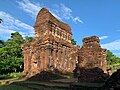
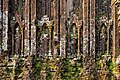
Unlike the Khmer of Angkor, who for the most part employed a grey sandstone to construct their religious buildings, the Cham built their temples from reddish bricks. Some of these brick structures can be still be visited in the Vietnamese countryside. The most important remaining sites include Mỹ Sơn near Da Nang, Đồ Bàn (Vijaya) near Quy Nhơn, Po Nagar near Nha Trang, and Po Klong Garai near Phan Rang.[citation needed]

Buildings constituting a temple

[edit]
Hòa Lai Towers in Ninh Thuận province.

Typically, a Cham temple complex consisted of several different kinds of buildings.[10]

  • The kalan was the brick sanctuary, typically in the form of a tower, used to house the deity.
  • The mandapa was an entry hallway contiguous with a sanctuary.
  • The kosagrha or "fire-house" was the construction, typically with a saddle-shaped roof, used to house the valuables belonging to the deity or to cook for the deity.
  • The gopura was a gate-tower leading into a walled temple complex.

These building types are typical for Hindu temples in general; the classification is valid not only for the architecture of Champa, but also for other architectural traditions of Greater India.[citation needed]

Most significant temples

[edit]
The temple of Po Nagar in Nha Trang.

The culturally most important temples of historical Champa were the temple of Bhadresvara located at Mỹ Sơn near modern Da Nang, and the temple of the goddess known as Bhagavati (her Hindu name) or Yan Po Nagar (her Cham name) located just outside modern Nha Trang.

  • The temple of Bhadresvara was the principle religious foundations of northern Champa (known as Campadesa, Campapura or nagara Campa in the inscriptions). Scholars have identified the temple of Bhadresvara, a local incarnation of the universal deity Shiva, with the edifice "A1" at Mỹ Sơn. Though today A1 is in the process of devolving into a pile of rubble, it still existed as a magnificent tower when French scholars described it at the beginning of the 20th century.[11]
  • The temple of Yan Po Nagar was the principal religious foundation of southern Champa (or Panduranga, a word that is the basis for the modern name "Phan Rang.") Its buildings date from between the 8th and 13th centuries. The temple remains standing to this day across the Cai River from Nha Trang, and is in relatively good condition.[12]

Sandstone sculptures

[edit]
A decorative theme that originated in Java, and from there emanated to other parts of Greater India, is that of the makara sea monster disgorging some other being. In this 10th- or 11th-century Cham sculpture, the makara disgorges a naga.

The Cham created freestanding sandstone sculptures in the round, as well as high and bas-relief carvings of sandstone. In general, they appear to have preferred sculpting in relief, and they excelled especially at sculpture in high relief. Cham sculpture went through a marked succession of historical styles, the foremost of which produced some of the best works of Southeast Asian art.[13]

The subject-matter of Cham sculpture is drawn mostly from the legends and religion of Indian civilization. Many of the sculptures are representations of particular Hindu and Buddhist deities, most prominently Shiva, but also Lokesvara, Visnu, Brahma, Devi, and Shakti. Such sculptures may have served a religious purpose rather than being purely decorative. Any sculpture in the round of an important deity that is completely forward-oriented, not engaged in any particular action, and equipped with symbolic paraphernalia, would have been a candidate for ritual or devotional use. Cham sculptors also created numerous lingas, phallic posts linked symbolically with Shiva (if the cross-section is a circle) or with the trimurti (if the post is segmented, consisting of a lower square section symbolic of Brahma, a middle octagonal section symbolic of Visnu, and a top circular section symbolic of Shiva). The ritual uses of the linga are familiar from modern Hinduism.[citation needed]

This carving of an elephant is found on a pedestal belonging to the Mỹ Sơn A1 style.

A few of the sculptures in the art of Champa depart from the Indian subject-matter to reveal something of the life of the historical Cham people. An example are the especially well-executed representations of elephants that serve as decorative details in some pieces: from written sources we know that the Cham relied on elephants for military and other purposes, since they lacked a steady supply of horses. Other sculptures reflect the cultural legacy of Greater India and express legendary themes more typical of Javanese or Cambodian art than the art of India. An example of such a theme is the motif of the makara sea-monster, which came to Champa from Java, where it is prominent in the art of the Borobudur and other temples of the same period.[citation needed]

Periods and styles of Cham art

[edit]
The sanctum sanctorum of king Po Rome (r. 1627-1651).

Scholars agree that it is possible to analyze the art of Champa in terms of distinct "styles" typical for various historical periods and different locations. Several have attempted through their study to set down a classification of historical styles. Perhaps the most influential of these attempts are those of the French scholars Philippe Stern (The Art of Champa (formerly Annam) and its Evolution, 1942) and Jean Boisselier (Statuary of Champa, 1963).[14] Summarizing the conclusions of these scholars, art historian Jean-François Hubert has concluded that it is possible to distinguish at least the following styles and sub-styles:[15]

  • Mỹ Sơn E1 (7th to 8th century)
  • Dong Duong (9th to 10th century)
  • Mỹ Sơn A1 (10th century)
    • Khuong My (first half of 10th century)
    • Trà Kiệu (second half of 10th century)
    • Chanh Lo (end of 10th century to mid-11th century)
  • Thap Mam (11th to 14th century)

Each style is named after a place in Vietnam at which works exemplative of that style have been found.

Mỹ Sơn E1 Style

[edit]

The ruins at Mỹ Sơn are not all of the same style and do not all belong to the same period of Cham history. Scholars have coded the ruins to reflect the diversity of periods and styles. The earliest identifiable style has been dubbed the Mỹ Sơn E1 Style. It is named after a particular structure, which scholars refer to as Mỹ Sơn E1. Works of this style reflect foreign influence from a variety of sources, primarily from the Khmer of pre-Angkorian Cambodia, but also from the art of Dvaravati, the Javanese art of Indonesia, and of southern India.[16]

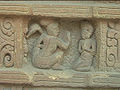
Perhaps the most famous work of the Mỹ Sơn E1 style is a large sandstone pedestal dated from the second half of the 7th century. Originally, the pedestal had a religious function, and was used to support a huge lingam as a symbol for shiva, the primary deity in Cham religion. The pedestal itself is decorated with relief carvings featuring scenes from the lives of ascetics: ascetics playing various musical instrument, an ascetic preaching to animals, an ascetic receiving a massage. To the Cham, the pedestal symbolized Mount Kailasa, the mythological abode of shiva which also accommodated numerous forest- and cave-dwelling ascetics, just as the lingam it supported represented the god himself.[17]

Another important work of the Mỹ Sơn E1 style is the unfinished sandstone pediment that was once affixed over the main entrance to the temple at Mỹ Sơn E1. The pediment shows the dawn of the present era according to Hindu mythology. Vishnu is reclining at the bottom of the ocean. His bed is Sesha the serpent. A lotus grows upwards from Vishnu's navel, and Brahma emerges from the lotus in order to recreate the universe.[18]

Dong Duong Style

[edit]

In 875, the Cham king Indravarman II (r. ?-893) founded a new dynasty at Indrapura, in what is now the Quảng Nam region of central Vietnam.[19] Departing from the religious traditions of his predecessors, who were predominantly Shaivists, he founded the Mahayana Buddhist monastery of Dong Duong, and dedicated the central temple to Lokesvara.[20] The temple complex at Dong Duong having been devastated by bombing during the Vietnam War, our knowledge of its appearance is limited to the photographs and descriptions created by French scholars earlier in the 20th century.[21] A fair number of sculptures of the period have survived, however, in the museums of Vietnam, and collectively they are known as the works of the Dong Duong Style. The style lasted until well into the 10th century.[citation needed]

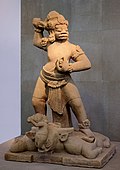
The Dong Duong style of sculpture has been described as a highly original style of "artistic extremism", "with exaggerated, almost excessively stylized features."[22] The figures are characterized by their thick noses and lips and by the fact that they do not smile.[23] Prominent motifs include scenes from the life of the Buddha, Buddhist monks, dharmapalas (guardians of the Buddhist law), dvarapalas (armed temple guardians), the bodhisattva Avalokiteshvara, and the goddess of compassion Tara, who was also regarded as the shakti or spouse of Avalokiteshvara.[24]

Mỹ Sơn A1 Style

[edit]

The art of the Mỹ Sơn A1 style belongs to the 10th and 11th centuries, a period of Hindu revival following the Buddhist period of Dong Duong, and also a period of renewed influence from Java. This period has been called the "golden age" of Cham Art.[25] The style is named after a temple at Mỹ Sơn, "the most perfect expression of Cham architecture" according to art historian Emmanuel Guillon, that fell victim to the Vietnam War in the 1960s. Most of the remaining monuments at Mỹ Sơn also belong to the Mỹ Sơn A1 style, including most of the constructions of groups B, C, and D.[26]

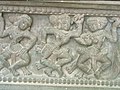
As to the sculpture of the Mỹ Sơn A1 style, it is known as being light and graceful, in contrast with the more severe style of Dong Duong. According to Guillon, "It is an art of dance and movement, of grace, and of faces which sometimes wear a slight, almost ironic style, as though surprised by their own beauty." Indeed, dancers were a favorite motif of the Mỹ Sơn A1 sculptors. The style is also known for its fine relief images of real and mythical animals such as elephants, lions and garudas.[27]

The Mỹ Sơn A1 style encompasses not only works of art found at Mỹ Sơn, but also works found at Khuong My and Trà Kiệu, though the latter are sometimes treated as representing distinct styles. The works of Khuong My in particular are frequently treated as transitional between the styles of Dong Duong and Mỹ Sơn A1.[28] Likewise, works found at Chanh Lo are sometimes treated as belonging to the Mỹ Sơn A1 style and sometimes treated as transitional between the Mỹ Sơn A1 and Thap Mam styles.[29]

Khuong My Style

[edit]

In the village of Khuong My in the Vietnamese province of Quảng Nam stands a group of three Cham towers dating from the 10th century. The style of the towers and the artwork associated with them is transitional between the powerful style of Dong Duong and the more charming and delicate Mỹ Sơn A1 style. The style of Khuong My also exhibits Khmer and Javanese influence.[30]

Trà Kiệu Style

[edit]

Although the Cham monuments at Trà Kiệu in Quảng Nam Province have been destroyed, a number of magnificent pieces of sculpture associated with the site remain and are preserved in museums. Especially noteworthy are a large pedestal serving as a base for a lingam that is known simply as the "Trà Kiệu Pedestal" and another pedestal known as the "Dancers' Pedestal."[31]

The Trà Kiệu Pedestal, consisting of a base decorated with friezes in bas relief, an ablutionary cistern, and a massive lingam, is regarded as one of the masterpieces of Cham art. The figures on the friezes are especially beautiful, and represent episodes from the life of Krishna as related in the Bhagavata Purana. At each corner of the pedestal, a leonine atlas appears to support the weight of the structure above him.[32]

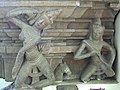
The Dancers' Pedestal, likewise, is regarded as a masterpiece. The purpose and function of the pedestal, which has the shape of a corner piece, remain obscure. Each side of the corner is graced by a dancing apsara and a music-playing gandharva. The base underneath these figures is adorned with leonine heads and makaras.[33]

Thap Mam Style

[edit]

After the 10th century, Cham art went into gradual decline. Both architecture, as exemplified by the temples of Po Nagar and Po Klong Garai, and sculpture became more stereotyped and less original. Only the sculptures of mythical animals, such as the makara or the garuda, could rival their counterparts of the earlier styles.[34]

The Thap Mam Style of the 11th through the 14th centuries is named for an archaeological site in Bình Định Province, formerly Vijaya. The sculpture of this style is characterized by "a return to hieratic formalism and the simplification of shape, leading to a certain loss of vitality."[35] The sculptors seem to have been concerned more with the detail of ornamentation than with the grace and motion of the figures themselves. Indeed, the style has been characterized as "baroque", in reference to the proliferation of ornamental details that distinguishes it from its more "classical" predecessors.[23]

One of the most original motifs of the Thap Mam period was the sculpting in stone of a row of female breasts around the base of a pedestal. The motif first emerged in the 10th century (the Trà Kiệu Pedestal at one point had such a row of breasts) and became characteristic of the Thap Mam Style. It appears to have no counterpart in the art of other Southeast Asian countries.[36] Some scholars have identified this theme with figure of Uroja ("breasts"), the mythical ancestor of an 11th-century dynasty at Mỹ Sơn, and claim a connection between this Uroja and the goddess venerated at Po Nagar.[37]

See also

[edit]

References

[edit]

Footnotes

[edit]
[edit]
Revisions and contributorsEdit on WikipediaRead on Wikipedia
from Grokipedia
The Art of Champa encompasses the rich artistic traditions of the ancient Indianized kingdom of , located in present-day central and southern , which flourished from the late CE until its absorption into Vietnam in the early . This art form is renowned for its synthesis of Indian Hindu and Buddhist influences with local Cham innovations, manifesting primarily in monumental brick temples, intricate sculptures, and decorative motifs that blend realism with mythical elements. Key sites such as the Sanctuary, a dedicated to worship, exemplify this legacy through structures like kalan towers and linga pedestals, dating from the 4th to 13th centuries CE. Champa art evolved through distinct stylistic periods, reflecting interactions with neighboring cultures including Khmer, Indonesian, and Chinese influences alongside a core Indic koine. Early phases from the 7th to 9th centuries featured simple brick temples at Mỹ Sơn, such as the E1 style (late 7th–8th century) with Khmer-inspired elements, though the site was established in the late 4th century, transitioning in the 9th century to the heavier, Buddhist-oriented Dong-duong style characterized by colossal pedestal-shrines. The 10th century Tra-Kieu phase introduced more humane and graceful figures with Indonesian touches, while the 12th century Thap-mam style emphasized decorative exuberance, including dynamic dancing motifs and animal representations like lions mimicking real forms. Sculpture in Champa art often depicted deities such as , , and in , with a focus on narrative panels and guardian figures that highlighted the kingdom's seafaring economy and religious devotion. Architectural innovations included closed-sanctum temples from the late onward, incorporating gopura gateways and halls, alongside unique dual cults like the linga-anthropomorphic at . These works not only served religious purposes but also unified Cham communities through visual culture, inscriptions, and trade-mediated exchanges across the . Today, Champa art survives in museums and restored sites, underscoring its enduring cultural significance in Southeast Asian heritage.

Historical and Cultural Context

Geography and Timeline

The Kingdom of occupied a strategic coastal region in central and , extending from present-day Quang Binh Province in the north to Binh Thuan Province in the south, with its core territories hugging the eastern seaboard along the . This elongated domain, often divided into principalities, encompassed diverse landscapes including river valleys, mountains, and offshore islands, facilitating maritime trade routes that connected Champa to , , and Southeast Asian polities. Key sites within this geography included the fertile Mỹ Sơn valley in Quang Nam Province, a secluded inland sanctuary ideal for religious complexes, and bustling coastal trade ports such as those near modern and Qui Nhon in Binh Dinh Province, which served as economic hubs for exchanging spices, aromatics, and luxury goods. Champa emerged as an Indianized kingdom around 192 CE, when the Cham leader Khu Lien, a local ruler under Chinese influence, established the polity of Linyi (later known as Champa) amid the fragmentation of Han Dynasty authority in the region. By the 4th century, under King Bhadravarman I, the kingdom fully adopted Hinduism—particularly Shaivism—as its dominant religion, which profoundly influenced cultural and artistic patronage through royal endowments to temples and deities like Shiva. The polity's early centuries saw consolidation through alliances and conflicts with neighboring powers, including Funan to the south and Chinese-dominated territories to the north. Following the Vietnamese sack of the capital Indrapura in 982 CE, Champa relocated its main capital southward to Vijaya (in present-day Binh Dinh Province) around 1000 CE, adapting to external threats while maintaining a decentralized structure of principalities. Throughout the 11th to 13th centuries, maintained its independence via naval prowess and diplomacy, but earlier Khmer pressures in the 12th century—such as the 1145 invasion that sacked Vijaya under —along with escalating Vietnamese thrusts in the 14th and 15th centuries under the disrupted traditional patronage networks and artistic production. These incursions culminated in the decisive Vietnamese conquest of Vijaya in 1471 CE by Emperor , which effectively dismantled the kingdom's northern and central territories, leaving only the southern Panduranga region as a until its final absorption in 1832. This timeline frames Champa's artistic evolution as a product of its maritime-oriented geography and intermittent stability amid geopolitical flux.

Religious Influences

The art of Champa was profoundly shaped by the primary worship of as the state's titular deity, a tradition that emerged in the CE under early rulers like Bhadravarman I, who dedicated temples such as those at Mỹ Sơn to Shaivite rituals involving linga veneration and offerings to ensure royal legitimacy and prosperity. This Shaivite focus manifested in artistic expressions centered on temple dedications, where sculptures and served as conduits for rituals honoring Shiva's cosmic , blending indigenous animistic elements with Brahmanical practices to reinforce the kingdom's spiritual and political identity. In the , was officially introduced under King Indravarman II (r. 854–893 CE), who constructed major complexes like the Dông Duong dedicated to Laksmiṇḍra Lokeśvara, marking a shift toward Buddhist while maintaining Hindu elements. This adoption fostered a syncretic religious landscape, where art reflected hybrid combining Shaivite and motifs, such as deities embodying both destructive and compassionate attributes, to symbolize the integration of esoteric Buddhist doctrines with established Hindu rituals. External influences on Champa's religious art stemmed primarily from Indian models of the Pallava and periods, transmitted through maritime trade routes along the kingdom's coastal geography, which enabled the influx of Brahmanical texts, sculptural techniques, and temple prototypes that adapted to local contexts. Secondary Khmer and Javanese elements appeared in ritual practices, influenced by regional interactions and conquests, incorporating shared Southeast Asian motifs into Cham ceremonies without supplanting the dominant Indian-derived framework.

Forms of Cham Art

Temple Architecture

Cham temple architecture is distinguished by its primary use of fired bricks for constructing the main structures, a material choice that provided durability in the tropical climate and contrasted sharply with the stone-dominated temples of contemporary Indian architecture. These bricks were typically laid with a fine mortar made from a mixture of sand, lime, and vegetable resin, which allowed for smooth surfaces and resistance to weathering. The outer walls were often adorned with sandstone bas-reliefs, carved separately and affixed to the brickwork, enhancing the aesthetic without compromising the structural integrity of the core brick framework. The core components of a Cham temple complex include the kalan, the towering main sanctuary dedicated to the presiding deity; the kosagrha, an antechamber or hall used for preparatory rituals; and the gopura, an imposing gateway tower marking the entrance. These elements were arranged along a strict east-west axial plan, symbolizing the cosmic path from the profane world to the divine realm, with the kalan positioned at the western end as the focal point. This linear organization facilitated processions and ritual movements, emphasizing hierarchy and in the layout. Construction techniques in Cham temples relied on corbelled arches and false vaults to span interiors and create enclosed spaces, methods that avoided the need for true arches while allowing for taller structures. The roofs of the kalan towers featured multi-tiered pyramidal forms, diminishing in size upward to evoke the mythical , the cosmic mountain central to and representing the connecting earth and heaven. Exemplars of these architectural principles can be seen in the temple complexes at , where the integration of these elements created enduring religious sanctuaries.

Sandstone Sculpture

Sandstone sculpture constituted a vital component of Cham art, primarily employed to embellish Hindu temples with symbolic and narrative elements that reinforced religious devotion and royal patronage. Quarried from local sources such as those near Tra Kieu and riverbeds adjacent to My Son in central Vietnam, the sandstone was transported via local waterways to temple sites, enabling efficient construction of durable, monumental works. This material's relative softness when freshly extracted facilitated detailed carving, while its hardening upon exposure ensured longevity against tropical climates. Artisans employed chiseling techniques with iron tools to incise intricate motifs, including floral patterns like lotus buds and foliage, mythical creatures such as makaras and nāgas, and narrative scenes from , all integrated into temple walls, pedestals, and lintels. These carvings served protective and didactic purposes, transforming sacred spaces into visual encyclopedias of mythology. High-relief panels, protruding dramatically from surfaces, frequently illustrated episodes from the , such as Rāvaṇa's defeat or Rama's archery feats, as seen on the 10th-century Tra Kieu pedestal and the 7th–8th-century My Son E1 altar. Guardian dvarapalas, robust male figures wielding weapons and adorned with belts, stood as sentinels at entrances, with notable examples from the 9th-century Dong Duong site and 10th-century Marble Mountains exemplifying their fierce, dynamic poses. Linga-yoni symbols, embodying Shiva's generative forces through phallic and vulvic forms, were carved as sacred icons for worship, prominently featured on the My Son E1 pedestal and Dong Duong bases. Freestanding statues, often reaching heights of up to 1.5 meters, were erected on altars within temple sanctuaries to house deities or commemorate rulers, as in the 5-foot seated from Dong Duong or Ganeśa figures from My Son. Friezes, extending several meters in length, encircled temple bases to convey cosmological narratives through sequential motifs of dancers, worshippers, and mythical battles, such as the 11-figure procession on the Tra Kieu platform. In later developments, like the ornate Mỹ Sơn style of the 10th–11th centuries, these elements incorporated more fluid, Javanese-inspired compositions for heightened expressiveness.

Metalwork and Jewelry

Metalwork in , particularly casting, flourished from the 7th to 10th centuries, employing the lost-wax technique to create intricate statues of such as and his mount . These hollow-cast s, often featuring iron armatures for structural support, depicted in standing or seated poses with attributes like the and discus, as seen in a 6th-century alloy from measuring approximately 25 cm in height. was commonly applied to enhance their significance, aligning with broader Southeast Asian practices influenced by Indian , though local adaptations emphasized portability for temple or court use. A notable example is an 8th-9th century from the Dong Duong monastery in Quang Nam, cast with eight arms and relic deposits inside, demonstrating advanced hollow-casting that allowed for lightweight yet detailed figures up to 50 cm tall. Jewelry in Cham society, crafted primarily from gold and silver alloys (typically 60-70% gold with silver and trace copper), served as status symbols and was frequently interred in royal burials to honor the deceased. Repoussé techniques dominated production, hammering thin sheets over molds to form motifs of flora, animals, and deities, as evidenced in 10th-12th century pieces from Tra Kieu, including necklaces, earrings, and belts weighing 5-30 grams each. A richly decorated gold pectoral from this period, featuring a dancing amid floral scrolls, exemplifies the fine repoussé work (61% gold alloy) used for elite adornments, often set with garnets or zircons for added prestige. Earrings and pendants, such as a gold motif with an onyx lingam (31 grams, 10th-12th century), incorporated with local stylistic flourishes, reflecting syncretism in personal ornaments. Functional metal items, including ritual bells and weapons, incorporated engraved scenes to narrate mythological or royal narratives, underscoring Champa's role in regional metal trade networks with India and Indonesia. An 8th-century copper alloy footed dish from central Vietnam (diameter 28 cm) bears chased engravings of equestrian hunts, likely used in court rituals and sourced via maritime exchanges that supplied raw metals scarce in India. Bronze ritual bells and linga sheaths (lingakosas) from the 8th-10th centuries, crafted with repoussé and chasing, protected sacred icons and facilitated ceremonies, their designs echoing Indonesian influences from Śrīvijaya trade routes. Weapons like ceremonial daggers, occasionally engraved with Vishnu avatars, highlight the integration of martial and religious elements, bolstered by imports of tin and copper from Indonesian archipelago ports.

Periods and Styles

Mỹ Sơn E1 Style

The Mỹ Sơn E1 style represents the earliest distinct phase of Cham art, emerging in the late CE as a foundational expression of and sculpture in the kingdom of . Dated primarily to circa 650–700 CE, this style is associated with the reign of King Prakasadharma (also known as Vikrantavarman I, r. 653–687 CE), whose 657–658 CE inscriptions at underscore the site's role as a royal Shaivite sanctuary dedicated to Bhadresvara. These inscriptions highlight the king's efforts to legitimize his rule through Brahmanical patronage, marking a period of political consolidation and cultural alignment with South Indian traditions amid regional interactions with Khmer and influences. Characterized by austere simplicity and elongated proportions in its figures, the style emphasizes minimal ornamentation, reflecting an early adaptation of Indian prototypes to local materials and techniques. Sculptures feature static poses that convey solemnity and reverence, with rougher carving surfaces indicative of nascent stoneworking practices transitioning from wood to durable . This symbolizes the establishment of Shaivite , prioritizing symbolic purity over decorative excess in depictions of divine forms. influences from are evident in the stylistic affinities, such as the hierarchical composition and floral motifs, which underscore Champa's integration into broader Indic cultural networks. Key examples include the group at , particularly the colossal sandstone -shrine (measuring approximately 270 x 271 cm), which served as a or divine throne enclosing a plain linga central to Shaivite . This features basic high-relief carvings of apsaras, , dancers, and musicians in subdued, elongated forms, adorned with simple floral patterns and Cham-Khmer jewelry motifs like serpentine cords and lotus blooms, rather than intricate narratives. These elements highlight the style's role in performance, with the rough-textured surfaces and static figures evoking a sense of eternal stability befitting Shiva's cosmic abode. Over time, this foundational minimalism paved the way for more dynamic expressions in subsequent Cham styles.

Dong Duong Style

The Dong Duong style emerged around 875 CE as part of the construction of the Dong Duong Buddhist monastery complex, established as the capital of Indrapura under King Indravarman II, the first Cham ruler to actively patronize Buddhism. This style marked a significant shift in royal patronage from Hinduism to Buddhism, blending Buddhist iconography with indigenous Cham artistic elements in over 70 known bronze and stone figures discovered at the site. Distinct features of the Dong Duong style include rounded, sensual body forms evident in statues of Avalokiteshvara, characterized by flowing drapery, gentle expressions, and enlarged hands and feet that emphasize a naturalistic and compassionate aesthetic. These sculptures reflect a profound Cham originality, with thick robe folds and fluid proportions that distinguish them from earlier rigid forms. The style drew notable influence from Javanese Sailendra art, incorporating elements like guardian lions and narrative depth, while also showing subtle ties to and Gupta-period in its feminized depictions. Site-specific reliefs on the monastery walls and altar pedestals at Dong Duong depict bodhisattvas, maritime scenes, and key episodes from the Buddha's life, such as Queen Maya's dream, highlighting the integration of narratives and female figures like Haradevi Rajakula. These carvings, executed in with intricate detail, underscore the monastery's role as a center of Buddhist learning and merit-making through donations recorded in inscriptions. This brief period of Buddhist dominance in , lasting into the early , represented a syncretic phase before the revival of under subsequent rulers.

Mỹ Sơn A1 Style

The Mỹ Sơn A1 style represents a peak of ornate Hindu art in Champa, flourishing from approximately 975 to 1050 CE primarily at the Mỹ Sơn sanctuary complex under the patronage of 10th–11th century Cham kings. This period marked a revival of complex Hindu iconography following earlier Buddhist influences, characterized by dynamic sandstone sculptures of deities featuring twisting poses that convey movement and energy, elaborate headdresses often adorned with intricate jewelry and floral motifs, and floral garlands draping the figures to emphasize divine abundance and grace. These elements reflect a decorative exuberance that integrated local Cham aesthetics with broader Indian-inspired traditions, using high-relief carving techniques on temple pediments and altars to create vivid, almost theatrical representations of the divine. Within the A1 style, distinct sub-variations emerged, such as the Khuong My type around 1000 CE, which features coarser, more angular figures with robust proportions and simplified detailing that convey a sense of grounded power in the sculptures. In contrast, the Trà Kiệu sub-variation, prominent in late 10th-century pieces, displays refined elegance with slender, Pallava-like proportions, smoother contours, and heightened attention to anatomical harmony, evoking a classical Indian influence adapted to Cham sensibilities. Both sub-variations fall under the broader A1 umbrella, sharing the style's emphasis on ornate surface decoration while differing in their approach to figural dynamism and regional execution, with some influences persisting into the early . Iconic examples from the Mỹ Sơn A1 style include dynamic Dancing Shiva Nataraja figures, capturing the god's cosmic dance with multiple arms in fluid motion amid flames and attendants, and multi-armed Vishnu avatars such as Varaha or Narasimha, depicted with fierce yet protective expressions and symbolic attributes like the boar head or lion-man form. These works embody the post-Buddhist Hindu resurgence in Champa, where temple-centric worship reasserted Shaivite and Vaishnavite dominance through renewed iconographic complexity from the 7th to 11th centuries. Interactions with Khmer culture further enriched the style, evident in shared motifs like inverted fleurons and performing male figures in reliefs, facilitated by marriage alliances and trade routes along the Mekong River during the 7th–8th centuries and beyond. Elements of earlier E1 simplicity occasionally appear in the bases of A1 pedestals, providing structural restraint amid the overall exuberance.

Thap Mam Style

The Thap Mam style emerged in the late phase of Cham art, developing from the 12th to 15th centuries CE (circa 1100–1471 CE) in the southern region of known as Vijaya, centered in present-day . This period coincided with the political fragmentation and decline of the kingdom under repeated invasions from Khmer and Vietnamese forces, leading to a more austere artistic expression compared to earlier opulent phases. Sculptures and architectural elements from this era feature angular, emaciated figures carved in , alongside constructions that emphasize simplicity and reduced ornamentation, reflecting resource constraints and cultural adaptation amid instability. Recent excavations (as of 2025) at Thap Mam sites have revealed additional artifacts underscoring the style's regional variations. Key characteristics of the Thap Mam style include a fusion of indigenous Cham traditions with Khmer and Vietnamese influences, evident in the incorporation of Angkorian decorative motifs and Lý-Trần dynasty dragon elements into local . This hybridization is particularly apparent in the stark, unadorned lingas symbolizing and robust warrior figures, such as dvarapalas with exaggerated facial features and mythical attributes, which adorn temple doorways and respond to the era's martial themes. The style's incised details and stereotyped forms, often lacking the dynamism of prior periods, convey a sense of resilience through their monumental yet restrained presence. Representative examples include the Thap Mam towers themselves, where brick kalans house simplified lingas and warrior reliefs, and sculptures from sites like Bánh Ít featuring stylized apsaras in flowing poses that blend celestial grace with local austerity. These works, preserved in sites like the Museum of Cham Sculpture, illustrate the Thap Mam style's role in maintaining before Champa's assimilation into Vietnamese territory in 1471.

Iconography and Symbolism

Hindu Deities and Motifs

In Cham art, holds a central position within the Shaivite cosmology that dominated the religious landscape of the kingdom, often represented through both abstract and anthropomorphic forms that emphasize his role as creator and destroyer. The linga, an abstract phallic symbol embodying 's generative power, is a ubiquitous motif in Cham temples, frequently paired with the base to signify cosmic fertility and duality; examples include the cylindrical lingas on pedestals at sites like Hòa Lai and , where multi-linga arrangements, such as seven lingas on a single in the B1 temple, underscore ritual multiplicity. Anthropomorphic depictions of portray him as a robust figure with a , jatamakuta headdress, and serpentine earrings, reflecting a synthesis of Indian Hindu traditions and local Cham aesthetics; these statues, often seated in , integrate indigenous matriarchal elements, as seen in the rough, expressive features of sculptures from the Vijaya period. Shiva's iconography frequently includes attributes like the trident (trishula), symbolizing his dominion over the three realms, and the bull Nandi as his vahana (mount), positioned on bases or in companion reliefs to denote loyalty and fertility. For instance, a 10th- or 11th-century sandstone group from depicts Shiva flanked by his consort Uma and Nandi, with the trident implied in his authoritative pose, highlighting the deity's familial and protective aspects in temple guardians or sanctum figures. Nandi appears in bas-reliefs, such as Shiva riding the bull with Parvati at Ỷu Điểm, reinforcing Shiva's transcendent journey across cosmic planes. These elements appear across Cham sculpture, with 92 of 128 known inscriptions dedicated to Shiva, affirming his primacy in royal and devotional contexts. Vishnu and his avatars feature prominently in Cham iconography, illustrating narratives of preservation and cosmic rescue drawn from Hindu mythology. Depictions of Vishnu's boar avatar Varaha, who lifts the earth from primordial waters, symbolize stability and divine intervention, as evidenced in reliefs and pedestals that adapt Puranic tales to affirm royal legitimacy; such motifs appear alongside other avatars like Rama in archer poses on 9th-10th century platforms at Trà Kiệu, where Vishnu's form integrates with directional guardians. Brahma, the creator deity, is often rendered in temple pediments to evoke the genesis of the universe from Puranic cosmogonies, such as his emergence from Vishnu's navel lotus in the Anantasayana pose. A mid-7th century sandstone tympanum from central Vietnam illustrates this scene, with Brahma seated cross-legged above the reclining Vishnu on the serpent Ananta, encapsulating the cyclical birth of creation within Shaivite-dominated sanctuaries like Mỹ Sơn E1. These lintel compositions, blending Cham and early Khmer styles, position Brahma as part of the trimurti alongside Shiva and Vishnu in group-tower complexes like Chien Dan. Recurring motifs in Cham art include the , a mythical crocodile-like creature symbolizing aquatic forces and , carved on pedestals and doorways as guardians of sacred spaces; they evoke Varuna's domain and appear in reliefs with dancers and musicians at sites like Po Nagar. The kala-makara, combining the time-devouring kala head with flanking makaras, adorns gateways and lintels to represent the transition from primordial chaos to ordered cosmos, as in the 12th-century arches of 's A1 and G1 towers, where kala's fierce visage—bulging eyes and fanged maw—embodies impermanence and Shiva's destructive aspect. In the A1 style, these motifs show refined adaptations with terracotta accents for enhanced symbolic depth.

Local Adaptations and Variations

Cham artists incorporated indigenous animist motifs, such as nagas as serpent guardians, into their sculptures and reliefs, blending these pre-Hindu elements with Indian prototypes to reflect local environmental and cultural realities. Rooted in ancient Austronesian serpent worship, nagas were depicted as multiheaded protectors in temple balustrades and pedestals at sites like and Trà Kiêu, symbolizing guardianship over rivers and seas vital to Cham maritime trade and navigation. This adaptation emphasized the nagas' association with water realms, evoking the Cham seafaring identity and protection against natural forces, as seen in reliefs where serpents coil around divine figures or architectural elements. Gendered variations in Cham iconography are exemplified by female deities like Po Nagar, the sky and mother goddess, who fused attributes of Shiva's consort—such as multi-armed forms holding emblems of power—with indigenous roles as a and goddess. Born from the union of sky and sea in Cham lore, Po Nagar is credited with creating the , , cultivation, and handicrafts, embodying agricultural abundance and matrilineal authority in southern principalities like Kauthara. Her prominence in southern temple complexes, such as the 8th-century Po Nagar sanctuary near , highlights regional adaptations where she retained chthonic and agrarian qualities as , the of , while prioritizing local reverence for female divinity over patrilineal northern traditions. In later periods, Cham art featured hybridizations of Buddhist and Hindu elements, influenced by contacts with Khmer and Vietnamese cultures, resulting in figures like Avalokiteshvara adapted with distinct Cham facial features. At the 9th-century Đồng Dương monastery, bronzes such as the Laksmindralokesvara depict Avalokiteshvara with thick lips, a prominent , round eyes, and occasional Chinese-style facial structures combined with Khmer-Cham jewelry like floral bracelets and serpentine cords, reflecting royal patronage under Indravarman II and pan-Asian Buddhist exchanges. These fusions extended to pedestals and reliefs integrating with Buddhist motifs, such as seated Buddhas in pendant-leg postures unique to Cham style, shaped by Khmer stylistic elements like inverted fleurons and Vietnamese trade routes documented in 12th-century Chinese texts.

Legacy and Preservation

Cultural Significance

Following the fall of the Champa Kingdom in 1471, Cham art has served as a profound symbol of ethnic resilience for the Cham people, who have preserved their cultural identity amid assimilation pressures in modern . Surviving sculptures, temple ruins, and motifs continue to embody Cham heritage, fostering community cohesion and resistance to cultural erasure. This legacy is vividly expressed in contemporary practices, such as the Kate Festival in as of 2025, where Cham communities honor ancestors and heroes through rituals incorporating artistic elements like traditional dances and temple processions, reinforcing intergenerational ties and spiritual continuity. In studies of Southeast Asian Indianization, Cham art illustrates how artistic production mediated power and devotion within a multi-ethnic kingdom, blending Indian Hindu-Buddhist iconography with local traditions to legitimize rulers and unite diverse populations. Pedestal-shrines and temple sculptures, such as those at Mỹ Sơn and Đồng Dương, depicted cosmic dualism and courtly rituals that symbolized royal authority and religious piety, facilitating Champa's role as a trade hub in the Indian Ocean network. These works highlight syncretic adaptations, including navagraha planetary deities and apsara figures, which influenced regional artistic exchanges with Khmer, Javanese, and Dvaravati cultures from the 7th to 12th centuries. The global heritage value of Cham art is underscored by the World Heritage designation of the in 1999, recognizing it as an outstanding testimony to the expansion of Hindu culture in through its tower-temples and bas-reliefs. This inscription under criteria (ii) and (iii) emphasizes the site's role in demonstrating cultural interchanges and its unique expression of Cham religious and political thought, ensuring international efforts toward its safeguarding. As living cultural anchors, such sites continue to inform cross-cultural dialogues on ancient Indianization processes.

Museums and Modern Study

The Museum of Cham Sculpture in , , established in 1919 following construction initiated in 1915 by French archaeologists, serves as the repository for art, housing nearly 2,000 artifacts primarily from the 5th to 15th centuries, with over 500 sandstone sculptures on public display. These include intricate carvings of deities, lintels, and pedestals excavated from sites like and Trà Kiệu, showcasing the kingdom's Hindu-Buddhist iconography. Internationally, the Musée Guimet in holds one of the most significant collections of artifacts outside , featuring over 200 sculptures acquired during French colonial expeditions in the late 19th and early 20th centuries, many of which reflect the era's architectural and stylistic influences from Indian and Southeast Asian traditions. Preservation efforts for Champa art have faced severe challenges, particularly looting during the Vietnam War (1955–1975), when sites such as Đồng Dương suffered extensive damage and artifact theft amid bombings and ground conflicts, resulting in the loss of numerous sandstone statues and architectural fragments to black markets. Post-1990s restoration projects have involved international collaborations, including French-Vietnamese efforts; the École française d'Extrême-Orient (EFEO) resumed operations in Vietnam in 1993 and has contributed to research, expert consultations, and material conservation at sites like Mỹ Sơn, alongside initiatives using anastylosis techniques led by teams such as Italian and Polish experts. These initiatives, often funded by UNESCO and bilateral agreements, have focused on protecting vulnerable sandstone elements from erosion and illicit trade, with ongoing site management plans emphasizing community involvement in monitoring. Modern scholarship on Champa art has advanced significantly in the 21st century, incorporating digital technologies like to analyze and preserve artifacts; for instance, a 2020 pilot project at the Da Nang museum utilized laser scanning to create high-resolution models of sculptures, enabling virtual reconstructions and non-invasive condition assessments, with expansions in digitalization continuing as of 2025. These tools have illuminated trade networks, revealing Champa's role in maritime exchanges from the 7th to 10th centuries, as evidenced by stylistic parallels in ceramics and motifs linking coastal sites to routes. Debates persist in epigraphic studies, particularly regarding the dating of early inscriptions like the Võ Cạnh (circa 3rd–4th century CE), where scholars contest attributions to versus precursor polities like Lâm Ấp based on paleographic and contextual . Such analyses, on interdisciplinary approaches, continue to refine chronologies and Champa's integration into broader Asian cultural spheres.

References

Add your contribution
Related Hubs
User Avatar
No comments yet.