Hubbry Logo
Cello Suites (Bach)Cello Suites (Bach)Main
Open search
Cello Suites (Bach)
Community hub
Cello Suites (Bach)
logo
8 pages, 0 posts
0 subscribers
Be the first to start a discussion here.
Cello Suites (Bach)
Cello Suites (Bach)
from Wikipedia
Cello Suites
BWV 1007 to 1012
by J. S. Bach
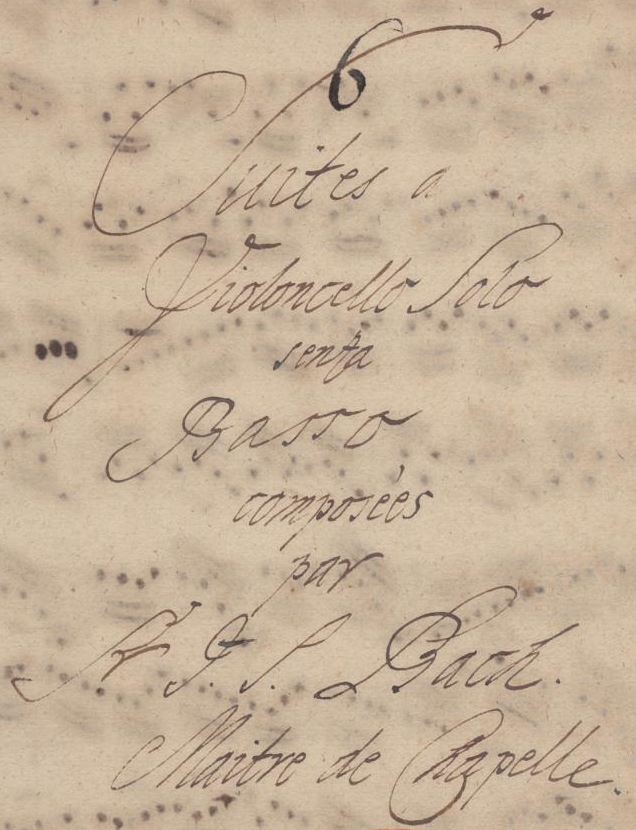
Title page of Anna Magdalena Bach's manuscript: Suites á Violoncello Solo senza Basso
Composedbetween 1717 (1717) and 1723 (1723)
InstrumentalCello solo

The six Cello Suites, BWV 1007–1012, are suites for unaccompanied cello by Johann Sebastian Bach (1685–1750). They are some of the most frequently performed solo compositions ever written for cello. Bach most likely composed them during the period 1717–1723, when he served as Kapellmeister in Köthen. The title given on the cover of the Anna Magdalena Bach manuscript was Suites à Violoncello Solo senza Basso (Suites for cello solo without bass).

As usual in a Baroque musical suite, after the prelude which begins each suite, all the other movements are based around baroque dance types.[1] The cello suites are structured in six movements each: prelude, allemande, courante, sarabande, two minuets or two bourrées or two gavottes, and a final gigue.[2] Gary S. Dalkin of MusicWeb International called Bach's cello suites "among the most profound of all classical music works"[3] and Wilfrid Mellers described them in 1980 as "Monophonic music wherein a man has created a dance of God".[1][4]

Due to the works' technical demands, étude-like nature, and difficulty in interpretation because of the non-annotated nature of the surviving copies and the many discrepancies between them, the cello suites were little known and rarely publicly performed in the modern era until they were recorded by Pablo Casals (1876–1973) in the early 20th century. They have since been performed and recorded by many renowned cellists and have been transcribed for numerous other instruments; they are considered some of Bach's greatest musical achievements.[5]

History

[edit]
The first page from the manuscript by Anna Magdalena Bach of Suite No. 1 in G major, BWV 1007

An exact chronology of the suites (regarding both the order in which the suites were composed and whether they were composed before or after the solo violin sonatas) cannot be completely established. Scholars generally believe that—based on a comparative analysis of the styles of the sets of works—the cello suites arose first, effectively dating the suites earlier than 1720, the year on the title page of Bach's autograph of the violin sonatas.[6]

The suites were not widely known before the early 20th century.[7] It was Pablo Casals who first began to popularize the suites, after discovering an edition by Friedrich Grützmacher (who was the first cellist to perform an entire Bach suite) in a thrift shop in Barcelona in 1889 when he was 13. Although Casals performed the suites publicly, it was not until 1936, when he was 60 years old, that he agreed to record them, beginning with Suites Nos. 2 and 3, at Abbey Road Studios in London. The other four were recorded in Paris: 1 and 6 in June 1938, and 4 and 5 in June 1939. Casals became the first to record all six suites; his recordings are still available and respected today.[8] In 2019, the Casals recording was selected by the Library of Congress for preservation in the National Recording Registry as "culturally, historically, or aesthetically significant".[9]

The suites have since been performed and recorded by many cellists. Yo-Yo Ma won the 1985 Grammy Award for Best Instrumental Soloist Performance for his album Six Unaccompanied Cello Suites. János Starker won the 1998 Grammy Award for Best Instrumental Soloist Performance for his fifth recording of Six Unaccompanied Cello Suites.

Manuscript

[edit]
Page from a facsimile of A. M. Bach's manuscript
Violoncello da spalla

Unlike with Bach's solo violin sonatas, no autograph manuscript of the Cello Suites survives, making it impossible to produce modern urtext performing editions. Analysis of secondary sources, including a hand-written copy by Bach's second wife, Anna Magdalena, has produced presumably authentic editions, although critically deficient in the placement of slurs and other articulations, devoid of basic performance markings such as bowings and dynamics, and with spurious notes and rhythms. As a result, the texts present performers with numerous problems of interpretation.[10]

German cellist Michael Bach has stated that he believes the manuscripts of the suites by Anna Magdalena Bach are accurate. According to his analysis, the unexpected positioning of the slurs corresponds closely to the harmonic development, which he suggests supports his theory.[11] His position is not universally accepted. The most recent studies[which?] into the relationships among the four manuscripts show that Anna Magdalena Bach's manuscript may not have been copied directly from her husband's holograph but from a lost intervening source. Thus, the slurs in the Magdalena manuscript may not come from Bach himself and would not be clues to their interpretation.[citation needed]

Recent research has suggested that the suites were not necessarily written for the familiar cello played between the legs (da gamba), but an instrument played rather like a violin, on the shoulder (da spalla). Variations in the terminology used to refer to musical instruments during this period have led to modern confusion, and the discussion continues about what instrument "Bach intended", and even whether he intended any instrument in particular. Sigiswald Kuijken and Ryo Terakado have both recorded the complete suites on this "new" instrument, known today as a violoncello (or viola) da spalla;[12] reproductions of the instrument have been made by luthier Dmitry Badiarov.[13]

Editions

[edit]

The cellist Edmund Kurtz published an edition in 1983, which he based on facsimiles of the manuscript by Anna Magdalena Bach, placing them opposite each printed page. It was described as "the most important edition of the greatest music ever written for the instrument".[14] However, Kurtz chooses to follow the Magdalena text exactly, leading to differences between his and other editions, which correct what are generally considered to be textual errors in the source.[15]

Arrangements

[edit]

Bach transcribed at least one of the suites, Suite No. 5 in C minor, for lute. An autograph manuscript of this version exists as BWV 995.[16]

Using the Bach edition prepared by cellist Johann Friedrich Dotzauer and published by Breitkopf & Härtel in 1826, Robert Schumann wrote arrangements with piano accompaniment for all six Bach cello suites.[17] Schumann's publisher accepted his arrangements of the Bach violin sonatas in 1854, but rejected his Bach cello-suite arrangements.[18] His only cello-suite arrangement surviving is the one for Suite No. 3, discovered in 1981 by musicologist Joachim Draheim in an 1863 transcription by cellist Julius Goltermann.[17][18] It is believed that Schumann's widow Clara Schumann, along with violinist Joseph Joachim, destroyed his Bach cello-arrangement manuscripts sometime after 1860, when Joachim declared them substandard.[17][18] Writing in 2011, Fanfare reviewer James A. Altena agreed with that critique, calling the surviving Bach-Schumann cello/piano arrangement "a musical duckbilled platypus, an extreme oddity of sustained interest only to 19th-century musicologists".[17]

Joachim Raff, in 1868 while working on his own suites for solo piano and for other ensembles, made arrangements of the suites for piano solo, published from 1869 to 1871 by Rieter-Biedermann.[19]

In 1923, Leopold Godowsky composed piano transcriptions of Suites Nos. 2, 3, and 5, in full counterpoint for solo piano, subtitling them "very freely transcribed and adapted for piano".[20]

The cello suites have been transcribed for numerous solo instruments, including the violin, viola, double bass, viola da gamba, mandolin, piano, marimba, classical guitar, recorder, flute, electric bass, horn, saxophone, clarinet, bassoon, trumpet, trombone, euphonium, tuba, ukulele, and charango. They have been transcribed and arranged for orchestra as well.

Structure

[edit]

The suites are in six movements each, and have the following structure and order of movements.

  1. Prelude
  2. Allemande
  3. Courante
  4. Sarabande
  5. Galanteries: two minuets in each of Suite Nos. 1 and 2; two bourrées in each of Suite Nos. 3 and 4; two gavottes in each of Suite Nos. 5 and 6
  6. Gigue

Scholars believe that Bach intended the works to be considered as a systematically conceived cycle, rather than an arbitrary series of pieces. Compared to Bach's other suite collections, the cello suites are the most consistent in order of their movements. In addition, to achieve a symmetrical design and go beyond the traditional layout, Bach inserted intermezzo or galanterie movements in the form of pairs between the sarabande and the gigue.

Only five movements in the entire set of suites are completely non-chordal, meaning that they consist only of a single melodic line. These are the second minuet of Suite No. 1, the second minuet of Suite No. 2, the second bourrée of Suite No. 3, the gigue of Suite No. 4, and the sarabande of Suite No. 5. The second gavotte of Suite No. 5 has but one unison chord (the same note played on two strings at the same time), but only in the original scordatura version of the suite; in the standard tuning version it is completely free of chords.

Suite No. 1 in G major, BWV 1007

[edit]
The arpeggiated motion in the prelude to Cello Suite No. 1

The prelude, mainly consisting of arpeggiated chords, is the best known movement from the entire set of suites and is regularly heard on television and in films.[21]

  1. Prelude
  2. Allemande
  3. Courante
  4. Sarabande
  5. Minuet I / II
  6. Gigue

Suite No. 2 in D minor, BWV 1008

[edit]

The Prelude consists of two parts, the first of which has a strong recurring theme that is immediately introduced in the beginning. The second part is a scale-based cadenza movement that leads to the final, powerful chords. The subsequent allemande contains short cadenzas that stray away from this otherwise very strict dance form. The first minuet contains demanding chord shiftings and string crossings.

  1. Prelude
  2. Allemande
  3. Courante
  4. Sarabande
  5. Minuet I / II
  6. Gigue

Suite No. 3 in C major, BWV 1009

[edit]

The Prelude of this suite consists of an A–B–A–C form, with A being a scale-based movement that eventually dissolves into an energetic arpeggio part; and B, a section of demanding chords. It then returns to the scale theme, and ends with a powerful and surprising chord movement.

The allemande is the only movement in the suites that has an up-beat consisting of three semiquavers instead of just one, which is the standard form.

The second bourrée, though in C minor, has a two-flat (or G minor) key signature. This notation, common in pre-Classical music, is sometimes known as a partial key signature. The first and second bourrée of the 3rd Suite are sometimes used as solo material for other bass instruments such as the tuba, euphonium, trombone and bassoon.

  1. Prelude
  2. Allemande
  3. Courante
  4. Sarabande
  5. Bourrée I / II
  6. Gigue

Suite No. 4 in E major, BWV 1010

[edit]

Suite No. 4 is one of the most technically demanding of the suites, as E is an uncomfortable key on the cello and requires many extended left hand positions. The key is also difficult on cello due to the lack of resonant open strings.[22] The prelude primarily consists of a difficult flowing quaver movement that leaves room for a cadenza before returning to its original theme.

The very peaceful sarabande is quite obscure about the stressed second beat, which is the basic characteristic of the 3
4
dance, since, in this particular sarabande, almost every first beat contains a chord, whereas the second beat most often does not.

  1. Prelude
  2. Allemande
  3. Courante
  4. Sarabande
  5. Bourrée I / II
  6. Gigue

Suite No. 5 in C minor, BWV 1011

[edit]

Suite No. 5 was originally written in scordatura with the A-string tuned down to G, but nowadays a version for standard tuning is included in almost every printed edition of the suites along with the original version. Some chords must be simplified when playing with standard tuning, but some melodic lines become easier as well.

The Prelude is written in an A–B form, and is a French overture. It begins with a slow, emotional movement that explores the deep range of the cello. After that comes a fast and very demanding single-line fugue that leads to the powerful end.

This suite is most famous for its intimate sarabande, which is one of the few movements in the six suites that does not contain any double stops (chords). Mstislav Rostropovich described it as the essence of Bach's genius. Paul Tortelier viewed it as an extension of silence. Rostropovich, extending Tortelier's "silence" to an extreme, would sometimes play the Sarabande as a recital encore at a metronome marking of 32 or slower, one note per beat, with no vibrato and no slurs, each note standing alone in a "well of silence". Yo-Yo Ma played this movement on September 11, 2002 at the site of the World Trade Center, while the names of the dead were read on the first anniversary of remembrance of those lost in the September 11 attacks.

The 5th Suite is also exceptional as its courante and gigue are in the French style, rather than in the Italian form of the other five suites.

An autograph manuscript of Bach's lute version of this suite exists as BWV 995.[16]

  1. Prelude
  2. Allemande
  3. Courante
  4. Sarabande
  5. Gavotte I / II
  6. Gigue

Suite No. 6 in D major, BWV 1012

[edit]
Open strings of the viola pomposa.

It is widely believed that Suite No. 6 was composed specifically for a five-stringed violoncello piccolo, a smaller cello, roughly 78 normal cello size with a fifth upper string tuned to E, a perfect fifth above the otherwise top string. However, some say there is no substantial evidence to support this claim: whilst three of the sources inform the player that it is written for an instrument à cinq cordes, only Anna Magdalena Bach's manuscript indicates the tunings of the strings, and the other sources do not mention any intended instrument at all.

Other possible instruments for the suite include a cello da spalla, a version of the violoncello piccolo played on the shoulder like a viola, as well as a viola with a fifth string tuned to E, called a viola pomposa. As the range required in this piece is very large, the suite was probably intended for a larger instrument, although it is conceivable that Bach—who was fond of the viola—may have performed the work himself on an arm-held violoncello piccolo. However, it is equally likely that beyond hinting the number of strings, Bach did not intend any specific instrument at all as the construction of instruments in the early 18th century was highly variable.

Cellists playing this suite on a modern four-string cello encounter difficulties as they are forced to use very high positions to reach many of the notes. Performers specialising in early music and using authentic instruments generally use the five-string cello for this suite. The approach of Watson Forbes, in his transcription of this suite for viola, was to transpose the entire suite to G major, avoiding "a tone colour which is not very suitable for this type of music" and making most of the original chords playable on a four-stringed instrument.[23]

This suite is written in much more free form than the others, containing more cadenza-like movements and virtuosic passages. It is also the only one of the suites that is partly notated in the alto and soprano clefs (modern editions use tenor and treble clefs), which are not needed for the others since they never go above the note G4 (G above middle C).

Mstislav Rostropovich called Suite No. 6 "a symphony for solo cello" and characterised its D major tonality as evoking joy and triumph.

  1. Prelude
  2. Allemande
  3. Courante
  4. Sarabande
  5. Gavotte I / II
  6. Gigue

Speculations about Anna Magdalena Bach

[edit]

Martin Jarvis formerly of Charles Darwin University School of Music, in Darwin, Australia, speculated in 2006 that Anna Magdalena may have been the composer of several musical pieces attributed to her husband.[24] Jarvis proposes that Anna Magdalena wrote the six Cello Suites and was involved in composing the aria from the Goldberg Variations (BWV 988). Musicologists, critics, and performers, however, pointing to the thinness of evidence of this proposition, and the extant evidence that supports Johann Sebastian Bach's authorship, remain skeptical of the claim.[24][25]

Notable recordings

[edit]

There have been a large handful of recordings of the Cello Suites. Some notable interpretations include:

Year of recording Cellist Label Notes
1939 Pablo Casals Gramophone Multiple LP reissues
1953 Antonio Janigro Westminster CD reissue 1996
1954–56 Enrico Mainardi Archiv
1959 Janos Starker EMI/Columbia
1960 Gaspar Cassado Vox
1960 Jean-Max Clément L'Oiseau-Lyre Reissued on CD in 2020
1961 Pierre Fournier Archiv
1961 August Wenzinger Barenreiter–Musicaphon
1963 Enrico Mainardi Eurodiscs multiple reissues on Eurodisc and Denon
1963 Paul Tortelier His Master's Voice
1965 Nikolaus Harnoncourt Harmonia Mundi
1965 Janos Starker Mercury several reissues and remasterings
1972 Reine Flachot Intercord Reissued on Saphir
1978 André Navarra Calliope
1978 Miloš Sádlo Supraphon
1979 Anner Bylsma RCA Red Seal
1979 Maurice Gendron Philips Recorded in 1964, not released until 1976. Reissued in 1994 on Philips Classics Records
1982 Miklós Perényi Hungaroton
1983 Yo-Yo Ma CBS Masterworks
1983 Paul Tortelier EMI Digital
1984 Erling Bengtsson Danacord
1984 Julius Berger Orfeo
1984 Janos Starker Sefel Records
1985 Jorg Baumann Teldec
1985 Lynn Harrell Decca
1985 Mischa Maisky Deutsche Grammophon
1985 Heinrich Schiff EMI
1986 Saša Večtomov Supraphon Reissued on CD in 2020 by Supraphon
1990 Pieter Wispelwey Channel Classics
1991 Roel Dieltiens Accent Reissued as digital download in 2006
1992 Anner Bylsma Sony Classical
1992 Dimitry Markevitch Gallo
2015 David Watkin Resonus Classics

References

[edit]
[edit]
Revisions and contributorsEdit on WikipediaRead on Wikipedia
from Grokipedia
The Six Suites for Unaccompanied Cello, BWV 1007–1012, are a renowned collection of works composed by the German composer Johann Sebastian Bach for solo without accompaniment. Each suite follows the traditional suite form, beginning with a Prelude and comprising an , , , two optional movements known as Galanterien (such as Menuets in Suites 1 and 2, Bourrées in 3 and 4, and Gavottes in 5 and 6), and concluding with a . Bach likely composed the suites around 1720 during his tenure as at the court of Prince Leopold of Anhalt-Cöthen in , a period marked by his focus on secular instrumental music following works like the . The collection demonstrates Bach's innovative mastery of and implied on a single instrument, elevating the from its typical role in continuo to a solo voice. No autograph manuscript by Bach survives, with the earliest known copies dating to around 1726 and attributed to his second wife, , and the organist Johann Peter Kellner; these lack performance indications, leaving interpretive freedom to performers. The suites were first published in 1824 in , edited by the cellist Louis-Pierre Norblin and issued by Janet et Cotelle, initially regarded more as technical studies than concert pieces. Their modern revival began in the late when the young discovered a copy in a thrift shop around 1890, leading to his intensive study, public debut near 1900, and influential recordings between 1936 and 1939 that established them as a cornerstone of the repertoire. Notable features include the tuning in Suite No. 5, which alters the pitch of the A string to G for expanded resonance, and Suite No. 6, originally composed for a five-string or violoncello piccolo. Today, the suites are widely performed and recorded by leading cellists, frequently transcribed for other instruments, and celebrated for their technical demands and emotional depth, influencing generations of musicians and marking a pivotal achievement in Bach's oeuvre.

Overview

Composition and Context

Johann Sebastian Bach composed the Six Suites for Unaccompanied (BWV 1007–1012) during his tenure as at the court of Prince Leopold of Anhalt-Cöthen from 1717 to 1723. This period marked a shift toward secular , as the Calvinist court emphasized non-liturgical compositions over vocal church works. Bach's role involved directing the court's orchestra and producing a substantial body of chamber and orchestral , including the , which align temporally with the cello suites around 1720. The suites were likely intended for the court's skilled cellist, Christian Bernhard Linike, though scholarly debate exists regarding possible performers such as the gambist Christian Ferdinand Abel; recent research favors Linike given his role as cellist since 1716. No premiere or dedication is documented, but the works exemplify the emerging prominence of the as a solo instrument during the early , transitioning from its traditional role in continuo to virtuosic unaccompanied . Bach's innovation in this regard helped establish the cello's potential for expressive depth and technical display without harmonic support. These suites form part of Bach's broader exploration of unaccompanied , paralleling his Sonatas and Partitas for Solo (BWV 1001–1006), composed slightly earlier in the Cöthen period. Both sets demonstrate Bach's mastery in implying multiple voices on a single instrument, pushing the boundaries of instrumental idiom and contrapuntal writing in the absence of ensemble textures.

Significance and Instrumentation

Johann Sebastian Bach's Six Suites for Unaccompanied , BWV 1007–1012, stand as the pinnacle of solo cello composition, demonstrating unparalleled mastery of polyphonic techniques on a single instrument and establishing a benchmark for expressive depth and structural innovation. These works blend complexity with serenity, achieving organic unity through interwoven melodies, melodic sequences, and harmonic progressions that imply multi-voice , such as two-part structures in preludes and movements. Their emotional variety, drawing on Affektenlehre principles, incorporates and Neapolitan chords to evoke profound expressivity, making them timeless miracles of musical perfection. The suites' influence extends to later composers, including , whose three Cello Suites (Op. 72, 80, and 87) homage Bach through similar six-movement structures, forms, and unaccompanied polyphony, and , whose Sonata for Solo Cello, Op. 8 (1915), employs —tuning the lower strings down a — inspired by Bach's innovative use of altered tunings to expand timbral possibilities. Composed for unaccompanied violoncello—typically the cello played without an endpin, relying on the player's body to support the instrument—the suites demand idiomatic exploitation of the cello's capabilities, including multiple stopping for chordal textures and implied harmonies that suggest fuller ensembles. Suite No. 5 employs , detuning the A string to G for richer and easier chord execution, while Suite No. 6 was likely intended for a five-string violoncello piccolo. These choices highlight Bach's innovative approach to and technique, incorporating bowed effects for flow and left-hand in passages like the Third Suite's Prelude to simulate plucked s. The technical demands of the suites explore the cello's full registral potential, spanning over four octaves—from low C to high A in , and even higher in the and five-string configurations—requiring control in wide skips, , and fugal writing. Progressing in difficulty across the set, they feature structural innovations in dance movements, such as extended sarabandes with ornamental freedom and gigues demanding rapid scalar passages. By showcasing these elements without , Bach elevated the cello's status from its traditional role as a continuo instrument to a solo voice in the early , laying the groundwork for its in Western .

Manuscripts and Editions

Surviving Manuscripts

No autograph manuscript of Johann Sebastian Bach's Cello Suites, BWV 1007–1012, survives, leaving scholars reliant on 18th-century copies for textual transmission. The earliest and most significant is the fair copy by Bach's second wife, , dated approximately 1727–1731 and housed in the Staatsbibliothek zu (Mus. ms. Bach P 269). This manuscript, likely prepared for the violinist and copyist Georg Heinrich Ludwig Schwanberg, a pupil of Bach, serves as the for most modern editions due to its completeness and proximity to Bach's lifetime. A performance copy by organist and composer Johann Peter Kellner, dated 1726 and also held at the Staatsbibliothek zu (Mus. ms. Bach P 804), represents another early source, though it is incomplete, omitting the and most of the from Suite No. 5, and lacking indications for that suite as well as notation for a five-string in Suite No. 6. An anonymous copy from the mid-, circa 1750s–1770s, associated with copyist Johann Nikolaus Schober and housed in the Staatsbibliothek zu , provides additional textual variants, including differences in notes and rhythms. Another anonymous copy from the late 18th century, circa 1790s (Source D), resides in the Österreichische Nationalbibliothek in and provides additional textual variants, including more elaborate ornamentation. These manuscripts exhibit key discrepancies that complicate textual reconstruction, particularly in slurs, fingerings, and dynamics. Anna Magdalena's copy features ambiguous and inconsistently drawn slurs, with few added ornaments limited to trills and appoggiaturas in the Allemandes and Courantes of Suite No. 5, reflecting a clean but potentially error-prone transcription from a lost intermediate source. In contrast, Kellner's version includes unique realizations and articulations absent in Anna Magdalena's, such as additional slurs and interpretive additions that suggest performance-oriented adaptations, alongside variations in notes and rhythms across suites. The Schober-associated anonymous copy shares some readings with the others but introduces further variants in phrasing. The anonymous copy amplifies these differences with more extensive ornaments and dynamic indications, diverging further in slurs and fingerings from the earlier sources, though it shares some readings with Kellner's in specific passages. Such variations arise from each copyist's independent access to lost precursors, precluding a single authoritative text. The provenance of these manuscripts traces their circuitous paths through 18th- and 19th-century collections, underscoring their historical fragility. Anna Magdalena's copy remained in private hands until acquired by collector Georg Poelchau around 1832 and entered the Berlin State Library in 1841, establishing it as the foundational artifact for the suites' revival. Kellner's manuscript, originating in Frankenhäuser, circulated within musical circles but was lost to public view until rediscovered in the 19th century and incorporated into the Prussian State Library's holdings, likely via auctions or private sales. The Schober-associated copy's history involves circulation among Berlin musical circles before entering the library collection. The Vienna anonymous copy's history involves possible connections to Carl Philipp Emanuel Bach's estate, passing through Johann Nikolaus Schober in the 1760s before being sold by dealer Johann Traeg in 1799 and acquired by the Austrian National Library, reflecting broader dissemination among Viennese musicians. Authentication relies on paleographic and material analyses, confirming their 18th-century origins. Watermark studies, notably by Alfred Dürr in 1957, align the paper in Anna Magdalena's and Kellner's copies with stocks from the 1720s–1730s, supporting their dates and distinguishing them from later forgeries. Ink analysis and handwriting examination further verify the copyists' identities, with Kellner's script matching his dated s and Anna Magdalena's consistent with her other Bach transcriptions. These manuscripts' integrity has been pivotal in the (BWV) cataloging by Wolfgang Schmieder in 1950, assigning them numbers BWV 1007–1012 based on their collective evidence, as no exists to supersede them.

Published Editions

The first printed edition of Bach's Cello Suites appeared in 1824, published by Janet et Cotelle in Paris and edited by Louis-Pierre Norblin; it drew primarily from the Johann Peter Kellner manuscript (c. 1726) and introduced bowings and fingerings not found in the surviving handwritten sources, reflecting early 19th-century French performance conventions. In the late 19th and early 20th centuries, editions increasingly incorporated interpretive elements shaped by the cellists' personal styles and the era's technical advancements. Hugo Becker's 1911 Edition Peters publication added romantic-era slurs, portamento indications, and fingerings (such as frequent 1-1 and 4-4 shifts) that emphasized expressive slides and faster tempos, often diverging from Baroque dance rhythms to suit contemporary virtuosic demands. Carl Schroeder's 1910 edition, by contrast, adopted a minimalist stance with sparse bowings and fingerings, prioritizing the performer's autonomy over prescriptive markings and aligning more closely with emerging historical awareness. Pablo Casals' landmark recordings from the 1930s revitalized interest in the suites, influencing subsequent editions; for instance, Diran Alexanian's 1929 Carl Fischer edition reflected Casals' analytical phrasing through innovative fingerings (e.g., alternating 1-4 patterns) and subtle dynamic suggestions, while Pierre Fournier's 1972 International Music Company edition featured extensive slurring for legato smoothness, avoiding scordatura tuning in Suite No. 5 to facilitate modern performance. Modern critical editions emphasize source fidelity, minimizing anachronistic interventions to highlight variants among the four principal manuscripts (Anna Magdalena Bach, Kellner, anonymous Berlin, and Westphal copies). The G. Henle Verlag edition, edited by Egon Voss in 1985 with fingerings by Reiner Ginzel, relies chiefly on 's manuscript (c. 1727–1731) as the , using dashed lines for slurs and providing a separate volume for direct comparison, thus enabling performers to discern authentic articulations from additions. Similarly, Bärenreiter's 2014 urtext edition (revised from the New Bach Edition), edited by Andrew Talle, reassesses source relationships using high-resolution of the manuscripts to resolve ambiguities in phrasing and bowing; it presents a clean musical text without fingerings or dynamics, accompanied by a critical commentary detailing over 300 variants and advocating for Baroque-informed tempi and articulations. These editions have sparked ongoing controversies regarding editorial interventions, particularly the addition of slurs, dynamics, and markings absent from Bach's sources, which can impose 19th-century on the works' polyphonic clarity and improvisatory potential. Post-2020 , including Talle's updated analyses and digital projects, further prioritizes to mitigate such issues, promoting editions that preserve the suites' interpretive openness while correcting scribal errors like those in the Kellner copy's rhythmic inconsistencies.

Arrangements and Transcriptions

The Bach Cello Suites have inspired numerous arrangements and transcriptions since the , adapting the solo works for , , and other instruments to highlight their polyphonic structure and emotional depth on varied timbres. One early example is Siloti's four transcriptions from the suites, published in , which emphasize the implied harmonies through the keyboard's capabilities. In the early , Luigi Forino arranged the Prelude from Suite No. 4 for , expanding the solo line into an ensemble texture while preserving the original's contrapuntal essence. These adaptations often aim to make the suites more accessible to performers on instruments with different ranges or to explore the music's inherent beyond the 's limitations, such as realizing multiple voices simultaneously. For instance, Suite No. 6 in , BWV 1012, is frequently transcribed for five-string instruments like the violoncello to better suit its higher and tuning. Mario Castelnuovo-Tedesco's 1943 arrangement of the entire Suite No. 6 for solo and further elaborates the implied accompaniments, adding harmonic support without altering the core melodic lines. In the late 20th century, created transcriptions of the suites between 1968 and 1978, including a notable 1976 performance of Suite No. 6 that showcased the keyboard's ability to delineate the works' intricate . collaborated with on the 1992 album Hush, featuring Ma's arrangement of the from Suite No. 6 for and voice, blending with the suite's introspective quality. Similarly, recorded movements like the from Suite No. 5 on in the 2000s, transposing to exploit the instrument's resonant, lute-like tone for a historically informed reinterpretation. Modern innovations continue this tradition, incorporating electronic elements and . For example, Michael Brook's 1980s guitar adaptations with processing effects, as explored in ambient recordings, transform the suites' arpeggiated textures into ethereal soundscapes. In 2025, Jonathan Freeman-Attwood published a Faber Music transcription of the complete suites for solo , enabling players to engage with Bach's virtuosic demands through the instrument's lyrical projection and agility.

Musical Structure

General Form and Movements

Each of Bach's six Cello Suites follows a standard suite structure consisting of six movements: a Prelude followed by five dance movements—an , , , a pair of optional dances (known as galanterien), and a concluding . This format, rooted in the French and German suite traditions, adapts stylized dances into instrumental pieces while emphasizing the solo cello's capabilities. All movements except the Prelude are in , typically with repeated sections, allowing for a balanced progression from introductory to rhythmic closure. The Prelude serves as a free-form , often virtuosic and improvisatory in character, introducing the suite's key and mood through arpeggios, sequences, or fugal elements; for instance, it ranges from flowing arpeggiated patterns in Suite No. 1 to a more structured prelude-and-fugue in Suite No. 5. The Allemande, in moderate tempo and duple meter (usually 4/4 or 2/2), features a flowing, elegant melody with short upbeats and elaborate harmonic sequences, evoking a graceful binary dance. The Courante follows as a faster, lively movement in triple meter, with variants: the Italian style (in Suites 1, 3, 4, and 6) emphasizes running notes and rhythmic drive, while the French style (in Suite 5) incorporates for a more flowing pulse. The Sarabande, slow and expressive in triple meter, highlights affective depth through its characteristic second-beat emphasis and harmonic suspensions, ranging from introspective melancholy to poignant resolution across the suites. The paired optional dances provide contrast and variety: Minuets in Suites 1 and 2 (courtly and duple-metered), Bourrées in Suites 3 and 4 (lively and rhythmic in duple meter), and Gavottes in Suites 5 and 6 (rustic with upbeats in duple meter). The Gigue closes each suite with energetic vitality, often in compound meter (such as 6/8 or 12/8) and , frequently employing imitative or fugal to propel the music to a spirited conclusion. These dances retain rhythmic and stylistic traits—such as dotted figures in the or sequential patterns in the —but are adapted for the cello's unaccompanied voice, blending monophonic lines with implied . Variations among the suites enhance their progression: the keys progress as follows: , , , E♭ major, , , with increasing technical demands; for example, Suite No. 5 features two Gavottes instead of a single pair, and Suite No. 6 requires tuning on a five-string for expanded . Binary sections are generally equal in length for Suites 1–3 and 5, but the second half extends in Suite 4 and parts of Suite 6, allowing for greater developmental contrast. Polyphonic techniques are central to the suites' ingenuity, given the unaccompanied format: Bach implies bass lines and inner voices through wide melodic leaps, double stops, and chordal implications, creating rich harmonic progressions and contrapuntal textures without additional instruments. Examples include invertible counterpoint in the Gigues and sequential step-lines in the Preludes, which evoke multi-voice dialogue while respecting the cello's idiomatic range and bowing demands. This approach not only sustains interest across movements but also underscores the suites' status as masterworks of solo string composition.

Suite No. 1 in G major, BWV 1007

Suite No. 1 in , BWV 1007, stands as the foundational work among Bach's six suites for unaccompanied , composed likely between 1717 and 1723 during his tenure in Cöthen. The suite is set in the bright and accessible key of , which utilizes the cello's open strings effectively to create a resonant and optimistic character, emphasizing harmonic clarity and a conventional tonal structure with progressions such as tonic-subdominant-dominant-tonic. This key choice establishes an introductory tone for the set, highlighting the instrument's natural range without demanding extreme positions or , and the overall duration typically ranges from 15 to 18 minutes in performance. The suite follows the standard Baroque dance structure with seven movements: a Prelude, Allemande, Courante, Sarabande, two Minuets, and Gigue. The Prelude, in perpetual motion with arpeggio-driven passagework, unfolds in a two-part (bars 1–22 and 23–36), featuring (alternating string colors in bars 31–36) and a descent (bars 37–38) that builds tension through chords and circle-of-fifths progressions, culminating in stable tonic resolutions. The flows in tempo with (16 bars per half), incorporating flowing , Neapolitan chords (bar 22), and steady sixteenth-note rhythms that emphasize the third scale degree for melodic coherence. The adopts an elegant French style in fast triple meter (binary, 18+24 bars), driven by running sixteenth notes and lively dance rhythms with limited but poignant neighbor-tone figures. The , profound in its simplicity (binary, 16 bars in triple meter), features agogic accents on the second beat, expressive trills on the third scale degree (bars 6 and 10), and rhetorical gestures that convey depth through brief, gestural phrasing. The paired Minuets provide light contrast: the first in (binary, 8+16 bars) uses anapestic and dactylic rhythms with turn figures, while the second shifts to for poignant neighbor tones and step-line melodies (binary, 8+16 bars), both grounded in chaconne-like bass patterns. The concludes with rhythmic drive in 6/8 meter (binary, 12+22 bars), leaning toward Italian concerto style with , three-eighth-note patterns, and modal shifts from back to for energetic closure. Innovations in this suite lie in its foundational exploitation of cello idioms, achieving polyphonic texture through single-line writing, broken chords, and implied harmonies without reliance on advanced effects like extensive harmonics—though it includes the fewest double stops and chords among the set, such as occasional dyads in the and Minuets to suggest . The work serves as a pedagogical starting point for cellists, introducing essential techniques like shifting, sustained for arpeggios, and string alternation, while the manuscript (ca. 1720s) features distinctive bowing variants in the Prelude, such as slurs grouping notes in twos or threes to guide articulation and phrasing in style. These elements underscore the suite's role in elevating the solo from to a , self-sufficient voice.

Suite No. 2 in D minor, BWV 1008

The Suite No. 2 in , BWV 1008, stands as a poignant progression from the introductory clarity of the first suite, delving into deeper emotional through its minor tonality, which conveys seriousness, sadness, tragedy, and a sense of loss while allowing for a wider expressive range. Composed around 1717–1723, this work escalates technical demands on the solo , employing 's inherent gravity to create an intimate yet intense sonic landscape that contrasts the suite's relative lightness. The suite's structure follows the traditional sequence, but Bach infuses it with personal expressivity, making it a cornerstone of the for its blend of melancholy introspection and virtuosic flair. The movements unfold with distinctive character: the Prelude opens chromatically and improvisatorily, resembling a through its somber, arpeggiated figures, pedal tones on A, and sequences of sixteenth notes that build harmonic complexity over approximately 40 measures, ending unresolved in . The Allemande follows intimately with varied rhythms, featuring descending four-note motives, chromatic thirty-second notes, and two four-note chords that underscore its serious, spanning 32 bars. In the Courante, Italianate influences emerge through virtuosic bowing, three-note chords, and a breathless cascade of sixteenth notes in 16-bar sections, heightening the suite's technical escalation. The Sarabande is ornate and deeply affective, emphasizing the second beat with double stops, deep tones, and a melancholic oscillation between C♯ and D at its close, evoking profound mourning. The two Minuets introduce a melancholic twist: the first is intense with three-note chords and dance-like propulsion in , while the second shifts to for a gentler, uplifting contrast before returning . The Gigue concludes with double-dotted rhythms and intense sequential writing in 12/8 meter (compound triple) over 32+44 bars, building to a vigorous close on a in . Innovations in this suite mark a notable increase in multiple stops—such as double and triple configurations—and , which amplify emotional depth beyond the first suite's simpler textures; for instance, 's use of and Neapolitan chords creates bifocal shifts (e.g., to ), enhancing its lament-like improvisation. These elements, including augmented seconds in the and complex harmonies in , demand greater cellistic control while evoking a broader emotional . Interpretively, the suite typically lasts 18–20 minutes in performance, allowing space for its affective nuances. No autograph survives, but the Johann Peter Kellner copy (c. 1726), made by a non-cellist, includes added slurs and articulations that suggest early interpretive choices, such as regular phrasing in arpeggios, influencing modern editions. Revisions in sources, like the Prelude's bar 19 (G to A), highlight textual variants that performers must navigate for authenticity.

Suite No. 3 in C major, BWV 1009

The Suite No. 3 in C major, BWV 1009, radiates an extroverted that contrasts with the inward of the preceding Suite No. 2 in , BWV 1008, leveraging the bright resonance of to project bold, orchestral sonorities on the cello. The key of facilitates extensive use of the cello's open strings, particularly the C and G, creating a festive openness and allowing for powerful projection through resonant drones and double stops. This suite's structure follows the standard form of prelude and five movements, but its movements emphasize vigorous passagework and wide-ranging lines that evoke a soloist's display within an imagined orchestral context. Unlike the warmer intimacy of Suite No. 4 in E♭ major, BWV 1010, the brighter tonality here amplifies a sense of joy and extroversion. The Prelude opens with fanfare-like scalar figures and arpeggiated passages spanning two octaves, echoing the style of orchestral overtures through quasi-improvisatory flourishes and dramatic tonal shifts to and . The follows with lively sixteenth- and thirty-second-note runs in , building bold momentum from its opening scalar ascent. A dancing Italian-style in triple meter propels forward with running eighth notes and descending chordal figures over 84 bars, demanding rapid traversal of the cello's full range. The stately balances wide-ranging chords with narrow melodic suspensions on the second beat, culminating in a four-part chord incorporating the B-A-C-H motif as a soggetto cavato. The two Bourrées introduce rustic upbeat rhythms, with the first emphasizing melodic drive and the second shifting to the minor mode through syncopated step-wise lines in regular phrase units. The concludes joyfully with galliard-influenced exuberance, featuring playful fourth intervals and a 108-bar structure that spans the instrument's ambitus. Innovations in this suite include the Prelude's orchestral evocation via layered progressions and vigorous tonic-dominant resolutions, which heighten its energetic character. Bach employs extensive high positions across movements like the Prelude, , , and to achieve two-octave spans, implying dynamic contrasts through textural shifts despite the absence of explicit markings in the sources. Interpretively, the manuscript provides the clearest notation among the suites for this work, with reliable notes, rhythms, and articulations, though minor revisions and one possible copying error in the 's measure 19 suggest careful fidelity to the original. Performances typically last 16–19 minutes, often approached with to capture the suite's extroverted vitality, as in Ma's recording totaling approximately 20 minutes. The dance rhythms, as outlined in the general form, underpin each movement's rhythmic drive without altering the binary structures.

Suite No. 4 in , BWV 1010

Suite No. 4 in , BWV 1010, stands out for its lyrical warmth and subtle complexities, tempering the exuberance of the preceding Suite No. 3 in C major with nuanced expression while maintaining a classical poise in the major key that contrasts with the tuning alterations and minor-key pathos of Suite No. 5. The key of , with its three flats, produces a mellow, horn-like on the , as the limited use of open strings—particularly avoiding the highest A string—creates a darker, deeper that enhances the suite's contemplative and philosophical mood without descending into . This supports a balanced exploration of the 's registers, avoiding extremes to emphasize smooth, flowing lines and intricate textures. The suite comprises six movements, each showcasing Bach's mastery of solo cello idiom. The Prelude is polyphonic and ricercar-like, built on imitative counterpoint that unfolds in a series of motivic entries, evoking a keyboard or organ texture through its layered voices. The Allemande follows with graceful, lyrical phrasing over conventional harmonic progressions, allowing for expressive rubato in its flowing melody. The Courante, in Italian style, moves with a flowing energy, its clear sectional form (26 bars in the first part, 38 in the second) highlighting rhythmic vitality and technical demands. The Sarabande turns introspective, with unique metric accents on beats 1 or 3 rather than the typical second beat, fostering a profound emotional depth through its sparse texture. The two Bourrées offer elegant contrast: the first is extended and lively, demanding virtuosic passagework, while the second is shorter (12 bars) and syncopated for playful lightness. The Gigue concludes with canonic intricacy, its Italian-type running eighth notes in 12/8 time weaving complex, imitative lines that balance rigor and lyricism. Among the suite's innovations, the Prelude's imitative exemplifies Bach's ability to imply on a monophonic instrument, while the overall balanced register use—staying within comfortable mid-to-upper ranges—promotes a cohesive, warm sound without the registral leaps found elsewhere. Interpretively, variants in slurs between surviving manuscripts, such as the copy and the Kellner edition, allow performers flexibility in articulation, particularly in the dance movements where phrasing can enhance the subtle rhythmic shifts. The entire suite typically lasts 17–20 minutes in performance, its harmonic implications aligning with the broader French suite model of tonal stability and graceful resolution.

Suite No. 5 in C minor, BWV 1011

The Suite No. 5 in C minor, BWV 1011, stands out among Bach's cello suites for its employment of tuning, in which the highest (normally A) is lowered by a whole tone to G, causing the written to sound in . This alteration deepens the instrument's resonance, produces a slightly muffled on the retuned , and simplifies the of certain high-register passages and multi-stopped chords, allowing for richer textures on the four- cello. The innovation draws from practices, such as Italian traditions, to expand expressive possibilities while maintaining the notated fingerings as if in . Composed likely between 1717 and 1723 during Bach's time in , the suite follows the standard structure with six movements: Prelude, , , , I, II (en rondeau), and . The Prelude unfolds rhapsodically with florid, improvisatory flourishes that evoke keyboard figuration, transitioning into a fugal section featuring monophonic imitation and extensive variations in a serious, anticipatory mood. The , in with bifocal tonality shifting between and , conveys agitation through predominant dotted rhythms—over one-third of its beats—and resolute scalar patterns implying two-part . The , also , exudes energy via French-style hemiolas, frequent elided cadences, and multi-metric shifts between simple triple and duple meters, unified by similar dotted rhythms. The , passionate and enigmatic, employs a chordless melody in with a narrow range and harmonic ambiguities, suggesting resignation or transcendence without the double stops common to other suites' sarabandes; its desolate, mournful quality arises from five four-bar sections in a state-restate-conclude pattern. The paired offer terrestrial contrast: the first robust and emphatic in ternary or arch form with varied rhythms and French dotted character, the second flowing and unified in rondo-like structure with even triplet eighth-notes. The , driving and fugal, proceeds in compound duple meter with subtle hemiolas and tonal shifts to relative keys, emphasizing rhythmic nuance in French style. Interpretively, the suite demands careful instrument adjustments for the , which can alter intonation and bowing demands, particularly in multi-stopped passages like the Prelude's opening. Manuscript sources, primarily Anna Magdalena Bach's copy, present ambiguities in tuning indications—three of four early manuscripts specify the G-D-G-C configuration—and articulations, such as slurs and dotted notations, influencing performance practice toward historically informed French Baroque styles with optional double-dotting. Dotted rhythms prevail across movements, unifying the work's serious associated with the minor key. Typical performances last 18–21 minutes, though durations vary with and ornamentation choices.

Suite No. 6 in D major, BWV 1012

Suite No. 6 in D major, BWV 1012, is the final and most expansive of Bach's cello suites, composed in D major and requiring the highest technical demands among the set. It is specifically notated for a five-string instrument, typically identified as the violoncello piccolo tuned A–D–G–C–E, which allows access to an extended upper register not feasible on a standard four-string cello without significant adjustments. This instrumentation enables Bach to explore the full sonic potential of the cello, culminating the cycle's progression toward greater virtuosity and polyphonic complexity. The suite's structure follows the standard Baroque dance sequence but amplifies each element, with the entire work typically lasting 20–23 minutes in performance. The suite opens with a Prelude in ornate style, echoing the grand, dotted rhythms and majestic character of Lully's overtures, set in compound 6/8 meter across 104 bars in . This movement features virtuosic sixteenth-note passages (e.g., bars 83–89), a dramatic climax on high G (bars 73–74), and resonant three-part chords (bars 98–99), establishing a buoyant and expansive tone. The follows as a lyrical and expansive dance in slow quadruple meter, often marked Adagio, with intricate small-note figurations (32nd, 64th, and 128th notes) and binary structure that emphasizes expressive sequences. The , in rapid Italian style, demands virtuosic agility over 72 bars, spanning a range of two octaves plus a sixth through unit-based motifs. The presents complex double-dotted rhythms and second-beat accents in a 32-bar structure (8+24 bars), conveying a sense of positive emotional depth without the heavier chordal emphasis of earlier sarabandes. The paired evoke a festive atmosphere, with Gavotte I in a complex, courtly manner and Gavotte II offering a simpler, rustic contrast, both highlighting the instrument's agility. The concluding unfolds in varied canonic structure within compound meter, blending athletic energy with imitative to provide triumphant closure. Among the suites, BWV 1012 innovates through its exploitation of the highest range, reaching notes like high G that demand thumb position and precise intonation, particularly on the added fifth string. The Prelude's stylistic nod to Lully underscores Bach's synthesis of French and Italian influences, while the overall length and technical scope mark this as the cycle's polyphonic climax. Interpretively, the intended instrument remains debated, with performances alternating between the violoncello piccolo for authenticity and the standard cello adapted via high positions, as evidenced in the Anna Magdalena Bach manuscript's notations that prioritize upper-register demands.) This versatility highlights the suite's enduring challenge, requiring performers to balance rhetorical expression with technical precision.

Authorship Speculations

Attribution to Johann Sebastian Bach

The six Cello Suites, BWV 1007–1012, have been traditionally attributed to Johann Sebastian Bach since their earliest known documentation, with the Bach-Werke-Verzeichnis catalog of 1950 formally assigning them to him as compositions from his Cöthen period (1717–1723). This attribution is rooted in the stylistic hallmarks of the suites, which demonstrate Bach's characteristic polyphonic complexity and idiomatic writing for solo strings, closely paralleling his Sonatas and Partitas for Solo Violin (BWV 1001–1006) in their exploitation of implied multiple voices on a single instrument and the Well-Tempered Clavier (BWV 846–893) in their harmonic depth and contrapuntal ingenuity. For instance, the fugal elements in the Prelude of Suite No. 5 echo the scale-based subjects found in the g-minor fugue of the Well-Tempered Clavier, while the overall mastery of polyphony—creating the illusion of ensemble textures on one cello—aligns uniquely with Bach's oeuvre, as biographer Johann Nikolaus Forkel noted in 1802: "If ever a composer showed polyphony in its greatest strength, it was certainly our late lamented Bach." Historical evidence further bolsters this attribution through manuscript copies made by Bach's family members and pupils during his lifetime and shortly after. The is the copied by Bach's second wife, , around 1727–1731, which explicitly titles the collection "6 Suites à Violoncello Solo senza Basso composées par Sr. J. S. Bach, Maitre de Chapelle à Coethen," directly crediting Johann Sebastian as the and linking it to his Cöthen tenure. A contemporaneous copy by Bach's pupil , dated circa 1726, similarly presents the suites without any indication of alternative authorship, and both manuscripts served as the basis for later 18th-century transmissions, including a transcription of Suite No. 5. Bach's son Carl Philipp Emanuel referenced the suites in the 1750 obituary he co-authored with agronomist Johann Friedrich Agricola, listing "Six Solos for the Violoncello" among his father's instrumental works, underscoring their recognition within the family circle as exemplary demonstrations of Bach's string composition prowess. Scholarly consensus affirming Bach's authorship solidified in the 19th century following the suites' first printed edition in by cellist Louis-Pierre Norblin in , which reproduced them under Bach's name based on a from Carl Philipp Emanuel's estate, with no contemporary challenges to their origin. Forkel's 1802 prominently featured the Cello Suites alongside the violin solos as pinnacles of Bach's unaccompanied instrumental art, praising their technical demands and expressive depth as evidence of his unparalleled expertise: "This is evidenced by his solos for the violin and for the violoncello without [accompanying] bass." This acceptance persisted unchallenged into the 20th century, with the suites' inclusion in standard Bach and catalogs reinforcing their place in his canon, where the intricate and structural sophistication serve as a distinctive counter to any later speculations by uniquely embodying Bach's synthetic fusion of French suite forms with German contrapuntal rigor.

Anna Magdalena Bach Hypothesis

The Anna Magdalena Bach hypothesis suggests that Johann Sebastian Bach's second wife, (1701–1760), composed or substantially contributed to the Six Suites for Unaccompanied (BWV 1007–1012), possibly as a composition student under her husband's tutelage. This idea originated with Australian musicologist Martin Jarvis, who first publicly advanced it in 2006 based on analyses dating back to the 1970s, and elaborated it in his 2011 book Written by Mrs Bach. Jarvis argued that Anna Magdalena's professional training as a singer at the and courts, combined with her documented musical skills, positioned her to create these works during the , a period when Bach was occupied with church duties in . Key evidence cited by includes the sole surviving early of the suites, copied in Anna Magdalena's hand and dated to approximately 1723–1730, which he proposed as the potential original composition rather than a transcription. He also invoked forensic document examination of her handwriting, claiming it showed precocious maturity predating her 1721 marriage to Bach (e.g., in 1713 manuscripts), and stylistic traits like a perceived "" in the suites' phrasing, ornamentation, and expressive flow, which he linked to her personal voice. Furthermore, her established role as a for Bach's other compositions, such as the Clavier-Büchlein (1722 and 1725) and parts of the (BWV 988), underscored her intimate involvement in the family's musical production, potentially extending to creative input. The hypothesis has faced strong scholarly rejection for insufficient and methodological flaws. Leading Bach expert Christoph Wolff, former director of the Bach-Archiv , dismissed it outright, stating there is no documentary, manuscript, or musical support for Anna Magdalena as composer; he highlighted a 2008 where Jarvis's claims were thoroughly debunked through rigorous paleographic and historical scrutiny. Critics, including Ruth Tatlow and Yo Tomita, further noted discrepancies in the of the cello suites manuscript compared to her verified copies (e.g., more angular script versus her typical rounded style), and Jarvis's erroneous interpretation of the phrase "ecrite par Madame Bachen son Epouse" on a related as indicating authorship rather than copying, ignoring 18th-century dictionaries where "ecrite" denotes transcription. This theory emerged amid late-20th-century efforts to recognize women's overlooked roles in music history, aligning with feminist that seeks to attribute anonymous or collaboratively credited works to female figures in male-dominated eras like Bach's.

Recent Theories and Scholarship

In the 2020s, scholars have advanced the understanding of the Suites through meticulous , leveraging digital tools and comparative analysis to reconstruct relationships among the surviving manuscripts. Andrew Talle's urtext edition for Bärenreiter, published in the early 2020s as part of the New Bach Edition–Revised, introduces a synoptic of the four primary handwritten sources alongside the 1824 first print, highlighting deviations in articulation and phrasing to offer a text closer to Bach's lost . This approach reveals nuanced source interdependencies, such as the influence of Bach's own arrangement in Suite No. 5, and underscores period performance practices without imposing modern interpretations. Complementing these efforts, cellist David Starkweather's 2021 digital edition aligns all five earliest manuscript copies measure by measure in a vertically comparative format, incorporating hyperlinks and cleaned facsimiles for enhanced readability. This resource facilitates scholarly scrutiny of textual variants, including those from Anna Magdalena Bach's copy and the Westphal manuscript, promoting deeper insights into editorial decisions and performer choices rather than resolving definitive origins. Edward Klorman's 2025 monograph, Bach: The Cello Suites, synthesizes these developments while dispelling longstanding myths about the works' dismissal as pedagogical exercises in the 19th century. Drawing on the manuscript evidence and Bach's Köthen context, Klorman affirms the composer's authorship amid the absence of an autograph, emphasizing cultural and stylistic markers that align the Suites with Bach's innovative solo instrumental oeuvre. He refutes fringe doubts—stemming from the lack of direct handwriting—by highlighting the consistency of stylistic fingerprints across Bach's output and the suites' integration into his broader compositional landscape. Alternative instrument theories have gained traction in recent discussions, particularly regarding Suite No. 6's high register, which some attribute to a five-string violoncello piccolo (or viola pomposa) rather than standard . Recordings and editions, such as Bärenreiter's 2024 viola arrangement, explore these possibilities, suggesting the music's adaptability to smaller-stringed instruments like viola for intimate performances, though consensus holds the original intent as unaccompanied violoncello. Ongoing debates, informed by post-2020 digital comparisons, show no shifts in attribution but increasingly prioritize interpretive flexibility over unresolved , shifting focus to the Suites' enduring role in performance practice.

Performance and Reception

Historical Revival and Practice

During the 19th century, Bach's Cello Suites were largely neglected and rarely performed in public concerts, often regarded merely as technical exercises for aspiring cellists rather than as substantial musical works. This obscurity stemmed from the broader underappreciation of Bach's solo instrumental music outside scholarly circles, with the suites viewed as pedantic studies lacking the dramatic appeal of operatic or symphonic repertoire. The revival began in the early through the efforts of Spanish cellist , who discovered a worn copy of the suites in a Barcelona music shop in 1890 at the age of 13. Casals immersed himself in the music, practicing it privately for over a decade before introducing it to audiences around 1903–1905, where it gradually gained recognition as profound repertoire. His complete recordings from 1936 to 1939, made for in and , were pivotal, employing a Romantic interpretive style with expressive rubato and continuous vibrato that captivated listeners and established the suites as staples of the cello canon. These recordings not only popularized the works but also normalized performing all six suites in sequence, including all repeats, without accompaniment. Following , interest in the suites surged, with a boom in performances and recordings that solidified their place in international life. Soviet cellist contributed significantly during this period, bringing virtuosic intensity and emotional depth to his interpretations, as heard in his 1995 recording made at the Abbey Church of Vézelay, which emphasized dramatic phrasing and technical prowess. Performance practices evolved markedly from the mid-20th century onward, shifting away from the Romantic-era emphasis on lines and heavy toward (HIP) principles. This transition involved adopting Baroque-era instruments, such as gut strings for warmer tone and less sustain, and convex bows for sharper articulation that highlights the suites' dance rhythms and polyphonic textures. Dutch cellist Anner Bylsma pioneered this approach with his 1979 recording on a period cello tuned to A=415 Hz, advocating for varied bow strokes to reflect stylistic nuances. In the , debates persist over the use of versus modern cellos, with proponents of arguing that period instruments better capture the suites' intimate, rhetorical character, while modern setups offer greater projection and uniformity suited to large venues. Figures like Casals and Rostropovich represent the Romantic-modern tradition, influencing generations, whereas HIP advocates such as Bylsma have broadened interpretive possibilities, fostering a diversity of approaches that continue to enrich the suites' landscape. As of , this diversity includes new recordings by emerging artists, such as those integrating digital and cross-cultural elements in live streams and hybrid performances.

Notable Recordings

The pioneering recording of Bach's Cello Suites was made by Pablo Casals between 1936 and 1939 for EMI, marking the first complete set committed to disc and characterized by its romantic expressivity, profound breadth, and grandeur that brought the works to a wider audience. Emanuel Feuermann contributed partial recordings in the 1940s, including movements from Suite No. 3, noted for their technical precision and virtuosic clarity, though he did not complete the full cycle before his death in 1942. In the mid-20th century, Pierre Fournier's 1960 recording for exemplified elegance and lyrical poise, with a strong structural grasp that emphasized the suites' formal beauty and emotional depth. Mstislav Rostropovich's early efforts in the 1950s, such as his 1955 live performance of select suites at the Festival for Supraphon, conveyed intense passion and dramatic intensity, while his complete 1995 set for Warner Classics further explored this fervent approach on a larger scale. Later 20th- and 21st-century interpretations have diversified interpretive styles, with Yo-Yo Ma's 1983 debut recording for offering a infused with youthful and emotional connectivity, later revisited in his 2018 "Six Evolutions" recording (part of The Bach Project) for the same label, which integrated multimedia elements to deepen the suites' storytelling. Anner Bylsma's 1979 recording on a for was groundbreaking in its practice, employing gut strings and period tuning for a lighter, more agile articulation true to 18th-century ; his 1992 modern-instrument version for the same label provided a contrasting, fuller . More recently, Alisa Weilerstein's 2020 complete set for Pentatone highlights sensitive characterization and rich tonal warmth, blending technical mastery with introspective nuance. Recordings have evolved from predominantly full sets in the early era to include focused selections of individual suites, reflecting performers' personal affinities, while demonstrating greater diversity in gender and nationality—exemplified by women cellists like , whose 1960s recordings of Suites Nos. 1 and 2 for captured a vibrant, emotive immediacy despite her youth.

Cultural Impact and Legacy

The Bach Cello Suites have profoundly shaped cello pedagogy, forming the bedrock of standard repertoire in conservatory curricula worldwide and serving as a primary vehicle for developing technical proficiency and interpretive depth. Since cellist encountered the suites as a young student in 1890 and began performing them publicly in the early 1900s, they have been integral to training programs, emphasizing polyphonic textures, bowing techniques, and emotional expression on a solo instrument. Institutions such as the and the routinely assign the suites to advanced students, viewing them as indispensable for mastering the cello's soloistic potential. Beyond education, the suites have exerted a lasting influence on subsequent composers, inspiring a resurgence of unaccompanied cello works in the . Kodály's Sonata for Solo Cello, Op. 8 (1915) draws directly from Bach's innovations, incorporating tuning and expansive structures to create one of the most significant solo cello compositions since the suites. Similarly, Benjamin Britten's Suites for Cello (1964–1971) explicitly homage Bach through their cyclical forms and technical demands, while Max Reger's Three Suites for Unaccompanied Cello, Op. 131c (1915) adapt movements to modern harmonies. These works, along with others by composers like , underscore the suites' role in elevating the unaccompanied cello as a viable genre for contemporary expression. In media and popular culture, the suites have transcended classical boundaries, appearing in films and multimedia projects that highlight their emotional resonance. François Girard's The Red Violin (1998) features excerpts from the suites to underscore themes of artistry and legacy, with cellist Anner Bylsma performing on-screen. Yo-Yo Ma's Inspired by Bach series (1997), a collaboration with filmmakers including Girard, comprises six short films pairing each suite with visual interpretations of human endeavor, from architecture to dance. Ma extended this exploration in his 2018 Bach: Six Suites project (The Bach Project), performing the complete set in 36 global venues to foster cultural dialogue, including a performance at UNESCO's 75th anniversary event in 2021. In the 2020s, the Prelude from Suite No. 1 has fueled viral memes and videos on platforms like TikTok, where a 2023 clip of a man intensely vocalizing the melody amassed millions of views, blending humor with the music's hypnotic quality. The suites' global legacy reflects growing recognition of their universal appeal, supported by initiatives promoting diversity among performers and audiences. Efforts such as the American Bach Society's 2021 diversity grant program fund projects to broaden access to Bach's works among underrepresented scholars and musicians, while non-Western performers—including cellists from , , and —have integrated the suites into cross-cultural performances, as seen in collaborative videos featuring global artists. These developments have amplified the suites' role in fostering inclusivity, with rising participation from Asian American and Pacific Islander musicians exemplified by Ma's own heritage-driven interpretations.

References

Add your contribution
Related Hubs
User Avatar
No comments yet.