Hubbry Logo
BallaterBallaterMain
Open search
Ballater
Community hub
Ballater
logo
8 pages, 0 posts
0 subscribers
Be the first to start a discussion here.
Ballater
Ballater
from Wikipedia

Ballater (/ˈbælətər/, Scottish Gaelic: Bealadair) is a village in Aberdeenshire, Scotland, on the River Dee, immediately east of the Cairngorm Mountains. Situated at an elevation of 213 metres (699 feet), Ballater is a centre for hikers and known for its spring water, once said to cure scrofula. It is home to more than 1400 inhabitants and has had a long connection with the British royal family.

Key Information

History

[edit]
The old railway station now used as a visitor and exhibition centre
Victoria and Albert Halls

The medieval pattern of development along this reach of the River Dee was influenced by the ancient trackways across the Grampian Mounth, which determined strategic locations of castles and other Deeside settlements of the Middle Ages.[2]

In the early 14th century, the area was part of the estates of the Knights of St John, but the settlement did not develop until around 1770; first as a spa resort to accommodate visitors to the Pannanich Mineral Well, then later upon the arrival of the railway in 1866 it was visited by many tourists taking advantage of the easier access thus afforded. The Victoria and Albert Halls, opposite the railway station, were completed in 1895.[3]

Ballater railway station, the former terminus of the Deeside Railway, was closed in 1966, but remains in use as a visitor centre with an exhibition recording the village's royal connection. Many buildings date from the Victorian era and the centre of the village is a conservation area. The old visitor centre was substantially damaged by fire in May 2015 but has subsequently been restored and reopened.[4]

The first stone bridge over the Dee at Ballater was built in 1783, but lost to floods in 1789. Thomas Telford constructed a second stone bridge in 1809, which was swept away in 1829. A wooden bridge was built in 1834, and replaced by the present stone bridge in 1885. Queen Victoria opened the bridge in November 1885, naming it the Royal Bridge.

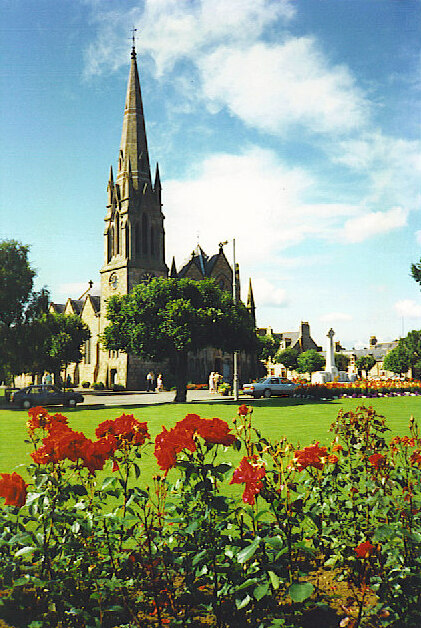
Glenmuick Church

[edit]

After the first bridge over the River Dee had been built the village developed with a "Centrical Church" replacing the churches at Tullich, Glengairn and Foot o' Gairn which had become ruins.[5]

A foundation stone was laid in 1798 and the first service was held on 14 December 1800. The church was designed by Mr Massey of Aberdeen and cost £670. It measured 72 feet (22 m) long by 34 feet (10 m) wide. Doors, at the east and west ends, each had a stair leading to a gallery. The building had four windows at the front and two gable windows, all glazed with plain glass. In the interior was a pulpit, a sound board, a latron and stair and rail. In 1879 a clock was manufactured by Messrs Gillett & Brand of Croydon; the winding mechanism was electrified in 1982. A vestry was added in the early 1850s.[5]

Royal connection

[edit]

Balmoral Castle, the British royal family's holiday home, lies 7 miles (11 kilometres) west, and the family has visited the town frequently since the time of Queen Victoria. Birkhall lies 1 mile (1.5 kilometres) southwest of Ballater. Victoria Barracks is used by the Royal Guard for the castle.[6]

For decades, local stores had royal warrants bestowed upon them. Five years after the death of Queen Elizabeth The Queen Mother, who had granted them, the warrants lapsed and, to the chagrin of many townsfolk and especially shop owners, they were not renewed.[7] Shops which still display the arms marking the royal warrant include the butchers H. M. Sheridan.[8]

In September 2022, following the death of Queen Elizabeth II, the cortège bearing her coffin passed through the village, on its way to Edinburgh.[9]

Climate

[edit]

A Met Office weather station collects weather data at Balmoral, just over 7 miles (11 kilometres) west of Ballater. Like most of Scotland and the British Isles, Ballater experiences a maritime climate with cool summers and mild winters. Its upland position means temperatures throughout the year are cooler than lower-lying areas, and snowfall more plentiful during winter months.

Climate data for Balmoral: 283 m (928 ft) 1991–2020 normals, extremes 1960–2020
Month Jan Feb Mar Apr May Jun Jul Aug Sep Oct Nov Dec Year
Record high °C (°F) 15.8
(60.4)
15.1
(59.2)
22.7
(72.9)
22.7
(72.9)
25.8
(78.4)
29.9
(85.8)
29.0
(84.2)
29.5
(85.1)
25.4
(77.7)
20.9
(69.6)
17.3
(63.1)
14.7
(58.5)
29.9
(85.8)
Mean daily maximum °C (°F) 5.2
(41.4)
5.7
(42.3)
7.8
(46.0)
10.5
(50.9)
13.9
(57.0)
16.2
(61.2)
18.3
(64.9)
17.5
(63.5)
15.1
(59.2)
11.2
(52.2)
7.6
(45.7)
5.5
(41.9)
11.2
(52.2)
Daily mean °C (°F) 2.0
(35.6)
2.2
(36.0)
3.9
(39.0)
6.0
(42.8)
8.8
(47.8)
11.6
(52.9)
13.6
(56.5)
12.9
(55.2)
10.8
(51.4)
7.4
(45.3)
4.2
(39.6)
2.0
(35.6)
7.1
(44.8)
Mean daily minimum °C (°F) −1.3
(29.7)
−1.2
(29.8)
−0.2
(31.6)
1.5
(34.7)
3.7
(38.7)
6.9
(44.4)
8.8
(47.8)
8.3
(46.9)
6.5
(43.7)
3.7
(38.7)
0.8
(33.4)
−1.5
(29.3)
3.0
(37.4)
Record low °C (°F) −23.5
(−10.3)
−19.5
(−3.1)
−18.2
(−0.8)
−10.0
(14.0)
−6.7
(19.9)
−3.3
(26.1)
−1.0
(30.2)
−3.0
(26.6)
−4.8
(23.4)
−7.8
(18.0)
−16.7
(1.9)
−22.7
(−8.9)
−23.5
(−10.3)
Average rainfall mm (inches) 87.6
(3.45)
62.6
(2.46)
54.4
(2.14)
60.3
(2.37)
52.8
(2.08)
56.2
(2.21)
61.0
(2.40)
67.1
(2.64)
59.0
(2.32)
97.3
(3.83)
90.1
(3.55)
88.0
(3.46)
834.2
(32.84)
Average rainy days (≥ 1 mm) 13.6 12.4 12.0 10.7 10.9 10.9 11.2 10.5 10.1 13.9 14.2 14.4 144.8
Source 1: Meteoclimat[10]
Source 2: KNMI (extremes)[11]
Climate data for Balmoral (283 m or 928 ft asl, averages 1971–2000, extremes 1960–present)
Month Jan Feb Mar Apr May Jun Jul Aug Sep Oct Nov Dec Year
Record high °C (°F) 15.8
(60.4)
13.9
(57.0)
17.8
(64.0)
22.7
(72.9)
25.3
(77.5)
28.3
(82.9)
29.0
(84.2)
29.5
(85.1)
25.4
(77.7)
20.9
(69.6)
17.3
(63.1)
14.2
(57.6)
29.5
(85.1)
Mean daily maximum °C (°F) 4.6
(40.3)
5.0
(41.0)
7.0
(44.6)
9.6
(49.3)
13.1
(55.6)
15.8
(60.4)
18.2
(64.8)
17.5
(63.5)
14.1
(57.4)
10.7
(51.3)
7.0
(44.6)
5.2
(41.4)
10.7
(51.2)
Mean daily minimum °C (°F) −2.0
(28.4)
−1.9
(28.6)
−0.3
(31.5)
0.8
(33.4)
3.2
(37.8)
6.2
(43.2)
8.3
(46.9)
7.8
(46.0)
5.9
(42.6)
3.3
(37.9)
0.2
(32.4)
−1.3
(29.7)
2.5
(36.5)
Record low °C (°F) −23.5
(−10.3)
−19.5
(−3.1)
−18.2
(−0.8)
−10
(14)
−6.7
(19.9)
−3.3
(26.1)
−1.0
(30.2)
−3.0
(26.6)
−4.8
(23.4)
−7.8
(18.0)
−16.7
(1.9)
−22.7
(−8.9)
−23.5
(−10.3)
Average precipitation mm (inches) 96.72
(3.81)
59.04
(2.32)
65.26
(2.57)
57.92
(2.28)
57.31
(2.26)
52.76
(2.08)
51.09
(2.01)
58.75
(2.31)
75.3
(2.96)
93.3
(3.67)
84.89
(3.34)
80.56
(3.17)
832.9
(32.78)
Source 1: Royal Dutch Meteorological Institute/KNMI[12]
Source 2: Met Office for December record high[13]

Attractions

[edit]

Ballater is a centre for tourism in Royal Deeside, with the Cairngorms and Balmoral Castle nearby. There are two bike hire shops in the village.

The old Ballater station, containing Queen Victoria's waiting room, was for many years a visitor centre with a replica royal carriage.[14] However, the building was almost completely destroyed by fire in 2015. The rebuilding of the station, bistro and adjoining visitor centre was undertaken and subsequently completed in Autumn 2018.[15] Balmoral Castle is a 10-minute drive from the village.

There are many walks from the village. For the easy going walker, there is Craigendarroch, a small, peculiarly shaped hill near the village. About 12 km (7 miles) south-west of Ballater is Loch Muick. From there experienced walkers can head up the prominent mountain, Lochnagar. Ballater is the home of many challenging walks due to the abundance of Munroes in the area.

There are many well-mapped cycle routes from Ballater into the surrounding areas, including the Deeside Way and a number of popular mountain biking trails. The forests at Cambus o'May have trails for experienced riders.[16]

The River Dee flows through Ballater, and is famous for salmon fishing.

Events in the town include:

  • The Ballater Walking Festival each May attracts many hillwalkers of all levels.[17] Participants are guided through the hills and valleys of the eastern Cairngorms.
  • The Ballater Boules Challenge, on alternate Sundays from November to March each year, provides an alternative sport when the weather is not cold enough for the traditional game of curling.[18]
  • Victoria Week, held annually in August, is a celebration of Ballater's connection with Queen Victoria and Balmoral Castle.[19]

The village has its own 'tongue in cheek', on-line newspaper, the Ballater Bugle.[20]

Recently five Ballater residents refurbished the Automobile Association's Patrol Box at Cambus o'May, one of only an estimated 8 to 10 such historical call boxes remaining in situ in Great Britain.[21]

Transport

[edit]

There is a bus garage located near the village centre which provides an hourly public service to Aberdeen's Union Square bus station. The bus company was granted permission to build a new site at Pannanich Road in December 2014.[22] In April 2015 the former bus station was re-opened as a Co-op supermarket.[23]

Notable residents

[edit]

Government

[edit]

See also

[edit]

References

[edit]
[edit]
Revisions and contributorsEdit on WikipediaRead on Wikipedia
from Grokipedia
Ballater is a picturesque Victorian village in , northeastern , located in the heart of Royal Deeside within the , approximately 7 miles (11 km) east of along the River Dee. With a of 1,381 as of 2022, it serves as a gateway to the surrounding mountains and forests, renowned for its royal connections, historic spa heritage, and role as a hub for outdoor pursuits such as hiking, skiing, and the annual Ballater . The village's name derives from the Gaelic "Bealadair," meaning "pass of the water," reflecting its position at a historic crossing point over the River Dee, with early medieval trackways traversing the nearby . Development began in earnest around 1770 when brothers Francis and William Farquharson established a spa resort at Pannanich Wells, capitalizing on the mineral springs believed to have curative properties; by the early , the area attracted visitors seeking benefits, including treatments for ailments like scrofula. Ballater's growth accelerated in the following the arrival of the Deeside Railway in 1866, which made it a popular retreat for the after purchased Balmoral Estate in 1852; the queen herself opened the current Royal Bridge in 1885 and frequently visited, bestowing "royal" status on local institutions like the and railway station. The village center, a designated conservation area, features well-preserved 19th-century architecture, including the former railway station—now a after a 2015 fire—along with landmarks such as the Victoria and Albert Halls built in 1895. Geographically, Ballater sits at an of 213 meters (700 feet) amid dramatic scenery, with the River Dee providing opportunities for and watersports, while nearby Munros like offer challenging climbs; it lies about 50 miles (80 km) west of , accessible via the A93 road, and borders ancient remnants at sites like the Muir of Dinnet National Nature Reserve. Economically, drives the local economy, supported by independent shops, eateries, and attractions including the Royal Lochnagar Distillery—opened in 1845 and granted a royal warrant—and the Ballater , fostering a community blend of heritage preservation and modern .

Geography

Location and Topography

Ballater is situated in , , at approximately 57°03′N 3°03′W, along the River Dee in the heart of Royal Deeside, serving as the eastern gateway to the . The village lies at an elevation of about 213 meters above , nestled within a landscape shaped by the meandering Dee River and flanked by rolling hills. The surrounding topography features the dramatic Dee Valley, a U-shaped glacial trough carved during the Pleistocene era, with evidence of ancient ice action including eskers, meltwater channels, and moraines that contribute to the area's fertile floodplains and diverse terrain. To the south, the prominent mountain rises to 1,155 meters, dominating the skyline and offering rugged corries and plateaus typical of the ' granite . Dense forests of Scots pine and birch cloak the valley sides, enhancing the natural integration of the village's Victorian-era granite buildings, which reflect local quarried stone and the era's influenced by royal patronage.

Climate

Ballater experiences a temperate classified as Köppen Cfb, characterized by mild temperatures without extreme seasonal variations. Summers are cool, with the average high temperature in reaching 18.6°C, while nights remain moderate at around 9.4°C. Winters are cold and prone to , with featuring an average low of -1.1°C and daytime highs of about 5.4°C (1981–2010 averages). Annual totals approximately 890 mm, distributed over roughly 148 rainy days, with the highest amounts occurring in autumn and winter months, particularly , which sees the peak rainfall of around 103 mm (1981–2010 averages). This pattern reflects the region's exposure to Atlantic weather systems. Sunshine averages 1,253 hours per year, providing moderate daylight, though is common. Wind patterns are influenced by the nearby , with being the windiest month at an average speed of 14.9 mph, often from southerly or westerly directions channeled through the valley. The town's elevation of 213 meters and position in the River Dee valley create a distinct , where cold air drainage increases the risk of and occasional cover, especially in winter, extending the period of potential ground to about 84 days annually (1981–2010 averages). This also moderates temperatures compared to higher surrounding areas but amplifies local weather variability due to the ' orographic effects. Such conditions support year-round outdoor activities like walking and , provided appropriate seasonal preparations are made.

History

Early Settlement and Origins

The Dee Valley, where Ballater is situated, shows evidence of human activity dating back to prehistoric times. Archaeological finds including Pictish symbol stones from the early medieval period have been discovered near the site of Tullich Church, indicating settlements by the who utilized the fertile riverbanks for habitation and resource gathering. The establishment of a church at Tullich in the 7th century by the Celtic missionary St. Nathalan marked a significant early Christian foundation in the area, serving as a focal point for local communities amid the surrounding ancient trackways across the Grampian Mounth that facilitated medieval travel and trade. In the medieval period, the Ballater area formed part of the Forest of Dee, a vast royal hunting ground in that supported the Scottish monarchy's pursuits from at least the , with nearby sites like in serving as hunting lodges. By the early , lands around Tullich Church were held by the Knights Hospitaller of the Order of St. John, following the dissolution of the Knights Templar, who had previously controlled the site as part of their preceptory on the River Dee; this ecclesiastical ownership underscores the region's integration into broader medieval religious and landholding networks. Historical records from this era highlight the area's role in the Forest of Dee's management, emphasizing controlled access for hunting and forestry rather than dense settlement. The early economy of the Ballater vicinity relied on the natural resources of the Dee Valley, where small-scale thrived on the alluvial soils for crops and , complemented by in the upland woodlands for timber and , and in the River Dee, which provided sustenance and limited trade for sparse communities. Prior to the , the population remained low and scattered, consisting mainly of farmers, foresters, and fisherfolk clustered around sites like Tullich, without formal village status or significant urban development until the late when interests began to coalesce around Pannanich Wells. This sparsity reflected the remote, forested character of the region, limiting growth until external influences prompted organized settlement.

Victorian Development and Spa Era

During the early , Ballater's transformation into a prominent accelerated, building on the fame of the Pannanich Wells springs, which had been known since their discovery in the mid-18th century for their purported curative properties, particularly in treating scrofula—a form of affecting the lymph nodes—following a reported cure in a local woman around 1760. By the , renewed promotion of the springs' benefits drew increasing numbers of visitors seeking remedies for various ailments, leading to expanded facilities and the establishment of Ballater as a dedicated accommodation hub for tourists unable to stay at the remote Pannanich site itself. This era marked a shift from modest rural settlement to a burgeoning , with the springs' waters advertised for their iron-rich content and efficacy against skin conditions and glandular disorders. The arrival of the Deeside Railway significantly amplified Ballater's growth, with the line reaching the town as its western terminus in 1866 after initial openings to in 1853 and in 1859, facilitating easier access for tourists and health seekers from and beyond. This connectivity transformed Ballater into a key stopover for visitors to the upper Dee Valley, boosting annual arrivals and solidifying its status as a Victorian-era destination. Queen Victoria's inaugural visit to the region in September 1848, when she and Prince Albert toured the Balmoral estate, further elevated Ballater's profile, inspiring a wave of affluent travelers and prompting local improvements to cater to royal tastes. This influx spurred an architectural boom characterized by sturdy constructions, reflecting the era's prosperity and aesthetic influences from Victoria's Highland enthusiasm. Prominent hotels like the Invercauld Arms (expanded in the mid-19th century) and numerous villas emerged along the main streets, built from local grey to evoke Scottish baronial style while providing comfortable lodgings for spa-goers and sightseers. The population reflected this expansion, rising from approximately 271 residents in 1841 to 1,256 by 1901, driven primarily by , railway-related employment, and the influx of health-seeking visitors establishing seasonal residences.

20th Century to Present

In the mid-20th century, Ballater's connectivity underwent a significant transformation with the closure of the Deeside Railway, which had served as the primary link from since the . Passenger services on the line ended on 26 February 1966, following recommendations in the Beeching Report, leading to the complete shutdown of the Ballater branch by July of that year. This shift compelled the town to rely more heavily on road transport, particularly the A93 trunk road, for access to and from and beyond, while the disused rail corridor was repurposed into the Deeside Way, a popular multi-use path for walking, cycling, and equestrian activities. A major setback occurred on 12 May 2015, when a devastating fire engulfed the Old Royal Station, the historic terminus of the Deeside Railway and a B-listed building with royal associations. The blaze destroyed approximately 90% of the structure, rendering it a gutted shell and prompting an immediate response that involved multiple crews and temporary closures. In response, Council spearheaded a comprehensive restoration project, funded in part by grants including £107,500 from for fabric reinstatement. The £3 million rebuild, which incorporated modern extensions while preserving the Victorian-era aesthetic, transformed the site into a visitor and community hub, with the renovated building reopening in August 2018. The town faced further challenges from severe flooding during the winter of 2015–2016, exacerbated by Storm Frank on 30 December 2015, which caused the River Dee to burst its banks and led to the evacuation of hundreds of residents from homes and businesses in Ballater. The floods inundated much of the village, damaging infrastructure, properties, and local commerce, with subsequent events in early 2016 compounding the disruption through power outages and access issues. Recovery efforts were coordinated by Council and the Scottish Flood Forum, involving temporary accommodations for affected households—over two-thirds of flooded homes required stays exceeding nine months—and long-term support addressing mental health impacts like anxiety and financial hardship, as identified in a three-year CREW-funded study. The initiative included enhanced flood defenses, programs, and national funding allocations exceeding £200 million for UK-wide winter flood recovery, helping Ballater rebuild while highlighting vulnerabilities in rural flood-prone areas. More recently, the Ballater and Crathie Community , launched in 2023 under the guidance of councils and the Authority, has outlined priorities for the next five years to bolster sustainability and aid tourism recovery in the wake of the . The plan emphasizes responsible tourism practices, such as attracting new businesses and developing event programs to diversify visitor experiences, alongside environmental goals like enhancing resilience through improved and upgrades. It builds on post- lessons to foster a more resilient community, focusing on economic vibrancy and connectivity in Upper Deeside.

Royal Connections

Association with Balmoral Castle

The association between Ballater and Balmoral Castle began in earnest with the purchase of the Balmoral Estate by Prince Albert for Queen Victoria in 1852, following their initial lease of the property in 1848. Victoria's frequent stays at Balmoral, where she found solace in the Scottish Highlands after the death of Prince Albert in 1861, drew increasing numbers of visitors to the region, spurring Ballater's development as a gateway town and boosting local tourism and infrastructure. To facilitate the monarch's travels, the Ballater railway station—known as the Royal Station—was constructed and opened on 17 1866 by the and Railway as the line's terminus, later absorbed by the of Railway, ensuring discreet access to Balmoral without extending further toward at Victoria's request. The station featured specialized facilities, including a private added for in 1886, complete with ornate paneling and a dedicated royal , allowing for secure and comfortable arrivals during her annual Highland retreats. This royal patronage has fostered enduring traditions in Ballater, such as the granting of royal warrants to local businesses, enabling them to display the emblem "By Appointment to His Majesty The King" for supplying goods to the royal household. Notable examples include George Strachan Ltd., a family-run store in Ballater holding a royal warrant for provisions, and other establishments like bakeries and chemists that have served the family over generations. The continues this connection through annual summer visits to Balmoral, typically from late to early , during which the estate serves as a private retreat for gatherings, barbecues, and Highland traditions, with Ballater benefiting from the influx of security and staff; this tradition persists under King Charles III, with annual visits to Balmoral continuing as of 2025, supporting local security, staff influx, and tourism. The ties were poignantly highlighted in September 2022 when Queen Elizabeth II passed away at Balmoral on September 8 at the age of 96. The Ballater community responded with widespread mourning, including lining the streets in silence as her coffin departed for on September 11 amid floral tributes and heartfelt gestures, and participating in national moments of reflection at local churches.

Architectural and Cultural Legacy

Ballater's architectural legacy is deeply intertwined with its royal associations, particularly from the when Queen Victoria's frequent visits to spurred development and modernization in the village. The central area of Ballater is designated as a conservation area, safeguarding its characteristic granite-built structures and timber details that reflect the prosperity of the 19th-century . These buildings, many constructed or renovated during Victoria's reign, embody the Scottish Baronial and Gothic Revival styles popular at the time, ensuring the village retains its picturesque, period charm as a gateway to Royal Deeside. A prime example of this preservation effort is the B-listed Old Royal Station, originally established in as the terminus of the Deeside Railway and remodeled in 1886 specifically for royal travel to Balmoral. Serving as the monarchs' primary arrival point until the line's closure in 1966, the station featured bespoke waiting rooms for and was nearly destroyed by fire in 2015. Following extensive restoration led by Council, it reopened in 2018 as a multifunctional venue housing a library, café, and exhibition space on local railway history, blending heritage conservation with contemporary community use. Culturally, the royal influence manifests in longstanding events that celebrate Ballater's heritage. The Ballater Royal Horticultural Society's annual Garden Festival, held since the society's founding in the early 20th century, showcases floral displays and themed competitions—such as the 2025 "" motif—drawing on the area's gardening traditions fostered during the Balmoral era. Similarly, Ballater Victoria Week, established in 1987 to honor the 150th anniversary of Queen Victoria's accession, features a program of royal-themed festivities including billed as the "Friendly Games on Royal Deeside," trails, and community parades that evoke Victorian pageantry. This enduring legacy has solidified Ballater's identity through the "Royal Deeside" moniker, a branding strategy employed by local initiatives to promote heritage experiences centered on the village's royal history and preserved . By highlighting these elements, the branding attracts visitors seeking authentic connections to British monarchy traditions, boosting while reinforcing community ties to the past.

Demographics and Society

Population and Community

Ballater's stood at 1,381 residents as of the 2022 census. The settlement spans an area of around 7 km². The demographic profile of Ballater is characterized by low ethnic diversity, with over 98% of residents identifying as and more than 73% born in , indicating a predominantly Scottish . The features an aging , with 37.7% of inhabitants aged 65 and over, compared to 10.6% under 18, contributing to a median age estimated around 50 years. Community life in Ballater is vibrant and tightly knit, supported by over 45 local groups, societies, and committees that foster social engagement. Annual events such as the Ballater Bonfire Night, organized by the Ballater Charitable Chiels, draw residents together for fireworks displays and celebrations in Monaltrie Park, enhancing communal bonds. Housing in Ballater reflects its historical development, with a mix of well-preserved Victorian-era homes showcasing granite architecture from the 19th-century spa boom and newer modern builds, including recent proposals for over 100 additional residences. However, the village faces ongoing challenges from flood risk, particularly along the River Dee, where events like Storm Frank in 2015 damaged numerous properties and prompted resilience initiatives.

Notable Residents

Sir Patrick Geddes (1854–1932), a pioneering biologist, sociologist, and town planner, was born in Ballater, where his father's regiment was stationed to guard nearby . Geddes spent his early childhood in the village before moving to Perth, but his birthplace influenced his lifelong interest in and regional development, concepts he later applied in projects like the regeneration of Edinburgh's Old Town. His work emphasized holistic approaches to , integrating , , and , and he is credited with coining the term "" to describe interconnected urban areas. Alexander Gordon (1818–1895), a successful brewer and philanthropist born in Glen Girnock near Ballater to a farming family, amassed his fortune through breweries in before retiring to the area. Deeply connected to local estates, Gordon generously supported Ballater's infrastructure, gifting the Victoria and Albert Halls in 1895 as a community venue for education, entertainment, and assemblies, which remain a cultural hub today. His donations also funded improvements like the Polhollick Bridge over the River Dee and contributions to the parish built in 1873, reflecting his commitment to enhancing village life. Among religious figures associated with Ballater, Bishop Colin Grant (1832–1889) was born in Glen Gairn near the village and served as the Roman Catholic Bishop of from March to May 1889. Ordained in 1855 after studying at Blairs College, Grant's early life in the rural area shaped his pastoral work, including roles in local missions before his brief episcopal tenure marked by advocacy for Catholic education in Scotland. Bishop John Matheson (1901–1950), who served as parish priest at St. Nathalan's in Ballater from 1930 to 1943, later became the Bishop of from 1947 until his death in 1950. During his time in Ballater, Matheson strengthened community ties in the remote , and his brief episcopal leadership focused on early post-war church renewal in northern . Billy Beattie (c. 1889–1917), a Scottish player born in Ballater, represented clubs like Hornets in the before enlisting in , where he served as a and was on the Western Front. His local roots and athletic contributions highlight Ballater's early 20th-century sporting heritage.

Economy and Governance

Local Economy

Ballater's local economy is predominantly driven by , which serves as the primary sector and generates significant employment opportunities through accommodations, guided tours, and attractions tied to the area's royal heritage. The village benefits from its proximity to , drawing visitors interested in royal history and Highland scenery, with establishments like the Royal Lochnagar Distillery offering whisky tours that attracted over 49,000 visitors in 2023 and contribute to hospitality jobs. This sector supports a range of businesses, including hotels and guesthouses, fostering seasonal employment peaks during summer months. Complementing tourism, other key industries include , , and small-scale retail, which provide stable, albeit smaller, economic contributions. The River Dee, renowned for , supports activities that add approximately £15 million annually to Aberdeenshire's , with local beats near Ballater employing guides and outfitters. Agriculture in the surrounding area focuses on and , sustaining rural livelihoods, while retail outlets, such as the Co-op supermarket repurposed from a former bus depot in , cater to both residents and tourists with essential goods. These sectors employ residents in accommodation, food services, and , reflecting the area's diversified yet tourism-reliant base. The unemployment rate in the East Cairngorms Intermediate Zone, which includes Ballater, was 1.7% in September 2023, slightly lower than the average of 1.8%; this remained stable at 1.8% for as of March 2024, though it experiences seasonal fluctuations due to tourism's influence. Economic challenges persist, particularly from the devastating impacts of Storm Frank in December 2015, which flooded over 100 properties and businesses, necessitating prolonged recovery efforts including infrastructure rebuilding and financial aid. The 2023 Ballater and Crathie Community Action Plan addresses these by prioritizing sustainable business growth, flood resilience measures, and support for green industries to enhance long-term , with ongoing implementations in 2024-2025 including partnerships and enhanced flood defenses.

Administration and Community Organizations

Ballater forms part of Council, falling within Ward 15: , Upper Deeside and Donside, which elects three councillors to represent local interests. The village has lacked an independent since 1975, when its status as a police burgh was abolished under the Local Government () Act 1973, transferring administrative powers to regional and district authorities. The Ballater and Crathie Community Council serves as the primary elected local body, comprising volunteers who ascertain, coordinate, and express community views to Council and other public authorities on planning, development, and related issues. Established under statutory provisions, the council also undertakes practical actions to promote community wellbeing, such as surveys, events, and advocacy for neighborhood improvements. Key community organizations include the Ballater Community Trust, which manages and invests in local assets to enhance sustainability and wellbeing, notably supporting recovery efforts following the 2015 fire that destroyed the historic Ballater Railway Station. The Visit Ballater partnership, a collaborative initiative involving local businesses and groups, promotes the village through marketing of events, accommodations, and attractions to boost and economic visibility. Recent initiatives reflect proactive community governance, including flood defense advocacy led by the Ballater Community Trust and the Flood Issues Group, which secured funding for HESCO barrier installations and collaborated with Council and estates to mitigate risks from events like Storm Frank in 2015. The 2023 Ballater and Crathie Community Action Plan, developed under the Community Council's leadership, addresses housing by prioritizing affordable options through partnerships with housing associations and the Authority, while enhancing education access via training programs for hospitality skills and expanded childcare provisions to support families and workforce development.

Attractions and Infrastructure

Key Landmarks and Sites

Glenmuick , a Category B designed by J. Russell Mackenzie of , was constructed between 1873 and 1874 in Victorian Gothic style, replacing an earlier structure from 1800 and reflecting Ballater's growth during Queen Victoria's era of interest in Balmoral. The church occupies a prominent position in the village's central Church Square, offering scenic views of the surrounding countryside. Its features include a canted , clock tower with , and an interior with largely unaltered box pews, underscoring its role in the community's historical and architectural fabric. The Old Royal Station, originally opened by the Great North of Scotland Railway as the terminus for the from , was reconstructed following a devastating fire on 12 May 2015, with restoration completed under The Prince’s Foundation to preserve its heritage. Today, it functions as a and VisitScotland information centre, featuring exhibits on its railway history, including its role as the nearest station to until closure in 1966 due to the . Highlights include a replica royal carriage and Queen Victoria's restored waiting room, alongside a and tearoom that enhance its appeal as a cultural hub. Established in 1845 by John Begg on the south bank of the River Dee, the Royal Lochnagar Distillery was renamed after a visit by and Prince Albert in 1848, who granted it royal warrant and solidified its ties to , located just one mile away. As Diageo's smallest distillery with an annual capacity of 500,000 litres, it emphasizes traditional methods like its open-topped mash tun and offers expert-led tours and tastings that explore its single malt production process. These experiences highlight the distillery's historical significance in Royal Deeside's whisky heritage. The Ballater War Memorial, unveiled on 24 July 1922 and rededicated on 24 July 2022, stands as a measuring 5,000 mm high, crafted from Kemnay and positioned outside Glenmuick Church in Church Square. It commemorates 63 local men lost in the First World War and 33 from the Second World War, with names inscribed on panels flanking the central column, accessible via steps above a low wall. This enduring monument serves as a focal point for community remembrance in the village. Pannanich Wells, developed around 1770 by Francis Farquharson of Monaltrie, feature a pair of Category C listed red well heads—the upper with a pedimented recess and metal-covered basin, and the lower with a crow-stepped flanked by a bench—marking ancient springs renowned for their medicinal properties. Gaining fame in the mid-18th century after reports of curing ailments like neck sores, the wells spurred local development, including a , hotel, and the growth of Ballater itself as a destination. Their curative reputation, tied to the area's mineral-rich , continues to evoke the village's historical legacy.

Transport and Accessibility

Ballater's primary road access is provided by the A93, which connects the town to approximately 40 miles (64 km) to the east and to about 17 miles (27 km) to the west. This serves as the main artery for vehicular travel through Royal Deeside, offering scenic routes alongside the River Dee. Public bus services, operated by Stagecoach Bluebird on route 201, run frequently from 's Union Square Bus Station to Ballater, with journeys taking around two hours and extending further to ; the service operates hourly during peak times on weekdays. The town's railway station, once a key link on the Deeside Railway line from , closed to passengers on 28 February 1966 and to goods traffic in July of that year as part of the . The historic line, which facilitated Ballater's growth as a Victorian-era resort serving , has since been dismantled, with the trackbed repurposed for the Deeside Way path. The nearest active rail station is now , about 40 miles away. Proposals for reviving a along parts of the route have surfaced periodically, including calls in 2021 for the to consider reinstatement for tourism and connectivity, though as of 2025 no construction has advanced. Air travelers access Ballater via Aberdeen International Airport (ABZ), located roughly 39 miles (63 km) east and reachable in about 50 minutes by car along the A93. For local navigation within the Cairngorms National Park, extensive cycling and walking paths are available, including the 41-mile traffic-free Deeside Way, which follows the old railway alignment from Aberdeen to Ballater and forms part of National Cycle Network Route 195. Additional park trails, such as those around Loch Muick and Glen Muick, support pedestrian and bike exploration from Ballater. Transport in Ballater faces seasonal challenges, including winter closures of the A93 due to snow and ice, particularly at the Braemar snow gates, which can isolate the area for days during severe weather. The region is also prone to flooding, as evidenced by the devastating impacts of Storm Frank in December 2015, which inundated roads and required extensive repairs along the Dee Valley. To address accessibility gaps, community initiatives include the Ballater Community Car Club, which facilitates car-sharing via an online platform to reduce costs and emissions, and the Silver Circle Community Transport scheme, offering subsidized group rides to nearby towns like and for eligible residents.

References

Add your contribution
Related Hubs
User Avatar
No comments yet.