Hubbry Logo
Barassi LineBarassi LineMain
Open search
Barassi Line
Community hub
Barassi Line
logo
8 pages, 0 posts
0 subscribers
Be the first to start a discussion here.
Barassi Line
Barassi Line
from Wikipedia

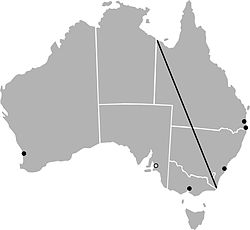
The Barassi Line, as proposed by Ian Turner in 1978. The line divides regions where Australian rules football (southwest) and rugby league (northeast) dominate. Solid dots mark cities with at least one top-level club defying the divide; hollow dots indicate former clubs.

The Barassi Line is an imaginary line in Australia which approximately divides areas where Australian rules football is the most popular football code from those where rugby is more widely followed, particularly rugby league but also rugby union. On either side of the line, crowd figures, media coverage, and participation rates tend to favour the locally dominant code.[1][2][3]

While the term was coined by historian Ian Turner in his 1978 Ron Barassi Memorial Lecture,[4] the divide emerged much earlier, in the 1880s, and became firmly established by the early 20th century. Roughly speaking, the line follows Queensland's western border, drops southeast through western New South Wales, and ends at Cape Howe on the New South Wales–Victoria border.[5] As a result, Queensland and New South Wales' eastern population centres fall on the rugby side, while Victoria, Tasmania, South Australia, Western Australia, the Northern Territory, and New South Wales' Riverina, Murray, and Far West regions fall on the Australian rules side. The line also runs through the Australian Capital Territory, where Australian rules and rugby enjoy comparable levels of grassroots support, although only elite rugby competitions have established representative teams there. The line splits the population roughly in half, owing to the concentration of Australians on the east coast.

In the 1980s, state leagues and competitions began expanding beyond the Barassi Line, with varying levels of success and financial support.[6][7][8][9] Four clubs in the Australian Football League (AFL), the elite Australian rules competition, currently compete beyond the line: Sydney Swans (relocated 1982), Brisbane Lions (formed 1996), Gold Coast Suns (2009), and Greater Western Sydney Giants (2010). The Brisbane Bears (1987–1995) also competed in the league before merging to form the Lions.[10] In rugby league, the only current National Rugby League (NRL) club based beyond the line is the Melbourne Storm (formed 1997). Defunct rugby league teams include the WA Reds (1995–1997)[11] and Adelaide Rams (1997–1998).[12] The Super Rugby club Western Force (formed 2005) is currently the only professional rugby union team beyond the line, following the dissolution of the Melbourne Rebels (2009–2024).[13][14] Active expansion bids include Cairns (AFL) and Perth (NRL).

The Barrassi Line is regarded as globally unique and arguably Australia's "strongest sociogeographic dividing characteristic".[15] Most other sports are unaffected by the divide; for example, cricket has maintained broad national popularity, while soccer is also popular throughout Australia.

Origin of the term

[edit]
Statue of Australian rules football star Ron Barassi Jr., namesake of the Barassi Line

The Ron Barassi Memorial Lecture was a series of lectures named after Ron Barassi Sr. given between 1966 and 1978 by Ian Turner, a professor of history at Monash University.[16] Barassi Sr. played a number of Australian rules football games for Melbourne in the Victorian Football League (VFL) before enlisting to fight in World War II and subsequently dying in action at Tobruk.[17]

The Barassi Line itself was named after Ron Barassi Jr., the elder Barassi's son, who was a star player for Melbourne and Carlton and a premiership-winning coach with Carlton and North Melbourne. He believed in spreading the code of Australian rules football around the nation with an evangelical zeal, and became coach and major supporter of the relocated Sydney Swans. He foresaw a time when Australian rules football clubs from around Australia, including up to four from New South Wales and Queensland, would play in a national football league with only a handful of them based in Melbourne, but his ideas were largely ridiculed at the time.[18]

History and development of Australia's football divide

[edit]

There is documentary evidence of "foot-ball" being played by European colonists in Australia as early as the 1820s. These games were poorly documented but appear to have been informal, one-off affairs.[citation needed]

Origin of Australian rules football (1850s)

[edit]

In 1858, cricketers, sports' enthusiasts and school students began to regularly play variants of English public school football in the parklands of Melbourne.[19]

The following year, four members of the newly formed Melbourne Football Club codified the laws which was later known as Victorian rules and Australian rules football.

The code reached New South Wales as early as 1861, Queensland by 1866 and had been played in other colonies by 1868. However despite an explosion in popularity in Victoria, it struggled to gain acceptance outside of its home colony.[citation needed]

Arrival of rugby (1860s)

[edit]

Rugby football became organised in Sydney, New South Wales in the early 1860s, and by the end of the decade, local schools were formally competing. During this time, Melbourne, in the wake of the Victorian gold rush, had become Australia's largest and most influential city, and its homegrown football code was introduced to New South Wales as early as 1866. Intercolonial rivalries were strong and New South Wales saw Melbourne's rise not only as an economic threat, but a cultural one to their British colonial status. As such, journalists in New South Wales began promoting the "old English game of football" (rugby football) as a viable alternative to the Victorian code.[citation needed]

Australian rules and rugby vie for dominance in the north (1870s)

[edit]

The demise of Australian rules in Sydney began in 1869 when the largest schools, under pressure from the local media, switched to rugby.[20] Intercolonial rivalry between Sydney and Melbourne was by far the strongest with the Victorian colony surpassing it as Australia's most prominent city just a decade after its separation. While Australian rules remained dominant in Queensland, rugby began to prove a strong competitor in its capital Brisbane as interest in intercolonials against New South Wales began to grow. However Victorian rules began to increase its southern footprint with South Australia and Tasmania in the late 1870s, adopted the code to facilitate through representative matches against Victoria. The decision was made easier given the similarities to their own code and the Victorian code would grow there virtually unopposed. While slow to grow initially, rugby by the 1880s had become firmly established in Sydney, Perth and Brisbane.[21]

Divide begins to form (1880s–1890s)

[edit]

Queensland followed Sydney in 1884 when the colony's largest schools there voted to switch to rugby, causing the collapse of the code by there by the end of that decade.[22] By the 1890s, Australian rules was extinct in Sydney and Brisbane with rugby spreading virtually unopposed throughout the respective colonies of New South Wales and Queensland. In Queensland, the Northern Rugby Football Union successfully banned the Australian code and rugby's popularity rose through success in intercolonial matches with New South Wales. As Australian rules gradually recovered its position in New South Wales, the Southern Rugby Football Union, the colony's governing football body introduced a ban on the Victorian code as early as 1874 to prevent its spread across the Victorian border.[23] While it was not able to halt the Australian code, it severely impaired its growth until the turn of the century.

In the 1890s Australian rules began to surpass rugby union as the dominant code in Western Australia by the turn of the 20th Century and clear north-east/west divide between Australian rules and rugby territory had begun to form.

Australian rules experienced a national resurgence at the turn of the century however Rugby League's introduction in 1908 ushered in professionalism which after World War I firmly established the code over rugby union in Sydney and Brisbane respectively, with the governing bodies assisting to spread this code through the major cities to the remote areas of the state mainly through school football. Rugby league's spread however met resistance in areas where Australian rules remained strong, such as the Riverina and Broken Hill in New South Wales as well as the Northern Territory which had developed a strong Australian rules following after the war. In the newly declared territories of the Australian Capital Territory and Northern Territory both codes would at times compete for marketshare, though Australian rules would continue to prove dominant.

Battle lines drawn in the Riverina (1940s)

[edit]

In 1946, Rugby league authorities convinced the New South Wales government to ban Australian rules in public schools in an effort to oust it from the Riverina, which resulted in schools previously playing the code in its major heartlands of Albury and Wagga switching to Rugby league.[24] While it did not succeed in extinguishing the Australian code there entirely, it usurped the Australian code's premier status in these places, allowing Rugby League to halt the line at Wagga.[citation needed]

At the time the term was first used, existing club competitions were semi-professional and state-based. The first national club football competitions emerged in the late 20th century: the Championship of Australia, the NFL Night Series and the National Soccer League.[25] However, these struggled for national interest.[citation needed]

Code wars as national competitions professionalise and expand (1980s)

[edit]

In the 1980s, the VFL and New South Wales Rugby League premiership began a period of professionalism and expansion, forming the basis of today's Australian Football League (AFL) and National Rugby League (NRL). The Australian Capital Territory found itself isolated behind the line and it wasn't until the introduction of the Canberra Raiders in 1982 that it also began to fall into line. The result is the development of a regional dichotomy with strongly ingrained generational football cultures on either side.[citation needed]

Given the dominance of Australian rules and rugby on either side, other codes have also been slow to establish sustainable national competitions. The multinational body SANZAAR, which organises the Super Rugby competition in rugby union, expanded their domestic competitions in 1996 to include teams from both sides. Football Federation Australia revamped its flagship competition, the A-League, to focus on a more nationally balanced competition in 2005. However, its current composition reflects association football's participation and growth per capita, which is by far strongest in the east (where it faces less competition with Australian rules).[26]

Current status

[edit]
Bar graph showing the number of adult participants in Australian football, rugby league, and rugby union across Australian states and territories.

Australian rules football is now the most popular football code to the west and south, including the capitals of Melbourne, Perth, Adelaide, Hobart, and Darwin while rugby league is more popular on the eastern side, including the capitals of Sydney, Brisbane and Canberra. Each side represents roughly half of the Australian population due to the concentration of the population on the east coast.[27]

A 2022 study of grassroots support found that just 15% of Australian rules football clubs (243 of 1616) and 13% of rugby league clubs (109 of 863) are located across the line.[28] In many areas the other side's sport remains virtually unknown, lacking any meaningful media profile or awareness. The football culture is significantly ingrained such that it even has an influence on Australians' movement throughout the country.[29] These "insurmountable cultural barriers" have created a significant challenge for each code's national development.[30]

League structures and expansions

[edit]

The pursuit of national exposure for sports is influenced by the ratings systems used by Australian television. By the late 1980s, the main football codes in Australia realised that in order to garner the desired high national ratings, and increase the value of their product for television broadcast deals and corporate sponsors, they needed to maximise their national exposure.[31][32] This meant heavy investment in grassroots development and in the support of clubs on the "other" side of the Barassi Line.[citation needed]

Australian rules football

[edit]

In 1990, the Victorian Football League changed its name to the Australian Football League (AFL) to pursue a more national focus. A major reason for the expansion into these non-traditional areas has been to increase both the number of games played each week, and the potential television audience. This resulted in income from television rights rising dramatically.[33][34] From the 1997 AFL season, six of sixteen AFL clubs (Sydney, Brisbane Lions, West Coast, Adelaide, Fremantle and Port Adelaide) were based outside Victoria, with two (Sydney and Brisbane) on the rugby league side of the Barassi Line. Barassi's prophecy of a national Australian rules football league with four teams in New South Wales and Queensland has since been fulfilled with the establishment of Gold Coast and Greater Western Sydney in 2011 and 2012 respectively.[citation needed]

Australian Capital Territory

[edit]
Manuka Oval, home of the code in the ACT. During the 2010s, the Greater Western Sydney Giants drew higher average attendances here than at their primary home ground, Giants Stadium in Sydney.

The Australian Capital Territory (ACT) was once seen as one of the dividing points of the Barassi Line. In 1981, the Australian Capital Territory Australian Football League had just begun to edge out rugby league in popularity with an increase in participation, and the first calls were made for the VFL to become a national competition.[35] Under significant pressure from rugby league junior development in the territory and fearing the impact on its strong local competition of entry of a Sydney team, a formal bid for a license to enter a Canberra team into the VFL was made. The VFL dismissed it, stating it would consider Canberra for a license "within the next 10 years".[36] The league was insistent that the license should go to Sydney, which it believed had a much larger potential broadcast audience. The following year, the New South Wales Rugby League entered the Canberra market with a new club, the Canberra Raiders.[37] The long-term impact of the lack of an AFL club and the introduction of the Raiders saw Australian rules football fall from marginally most popular to least popular of the football codes. Subsequent bids for a Canberra team were rejected by the VFL in 1981, 1986 and 1988, and then by the AFL in 1990 and 1993.[citation needed]

The AFL began playing matches at the newly developed Bruce Stadium as 1990 with a view of it being the future home of the sport. However, politician and former Canberra Raiders rugby league player Paul Osborne began a successful campaign to exclude the AFL from the expanding stadium which ultimately resulted in its conversion into a rectangular field in 1997, effectively putting an end to any future ACT AFL bids.[38][39] Following this setback, the AFL preferred its existing clubs—most notably North Melbourne—to sell their home games to Manuka Oval. AFL clubs have done so since 2002; however, they have refrained from committing to the market long-term.[40][41]

In 2012, the Greater Western Sydney Giants signed a 10-year deal with the ACT Government worth $23 million, which resulted in the club playing four home games in Canberra each season. The Giants draw higher average attendances at Manuka Oval in Canberra than at their home ground, Giants Stadium in Sydney. In 2015, in response to questions relating to a proposed Canberra team, then AFL CEO Gillon McLachlan stated that "Canberra have their own team, the Giants". The AFL also claimed that Manuka Oval needed to be upgraded in order for the league to commit further to the market.[42] After a failed $800 million stadium upgrade proposal, the AFL stated that the Giants–Canberra deal would continue regardless of if the redevelopment occurs.[43] A significant share of Giants members are from the ACT; the figure was 5,800 in 2022.[44] In 2015, the Giants set a target to overtake the Raiders membership and have more than 10,000 members by 2018.[45] However, this failed, and the Raiders membership has rapidly outpaced it. Despite this, the deal was extended by the ACT government and the AFL to 2032 for three AFL matches and one AFLW match.[46]

According to Tweedie's 2022 study, the ACT is "close to 50-50" in grassroots support,[28] with Australian rules participation increasing substantially since 2016 and GWS selling out three successive games during the 2024 AFL season. GWS is now drawing larger crowds in Canberra than rugby union's ACT Brumbies, but is facing continued growth in popularity of rugby league's Canberra Raiders.[47][48] Inadequate ageing infrastructure continues a significant deterrent to any future AFL expansion there.[49]

New South Wales

[edit]
GWS Giants Inaugural Banner, 24 March 2012
Banner at the inaugural Sydney Derby between Greater Western Sydney and Sydney in 2012, heralding the Australian Football League's 'giant leap' in New South Wales.

Encouraged by the VFL, the South Melbourne Football Club relocated to Sydney and became the Sydney Swans in 1982. The club endured limited success and a series of wooden spoons in their first decade in Sydney before turning a corner in the mid-1990s, culminating in premierships in 2005 and 2012.[50]

The lack of public support in Sydney caused significant financial losses to the club and league during the late 1980s and early 1990s. Excluding a period of privatisation, despite significant loans and writedowns to the club, the league declared the Sydney Swans insolvent in 1984 and again in 1988.[51][52] In 1992, the 15 other AFL clubs were asked to vote on expelling the Swans due to its inability to survive in Sydney.[53] AFL clubs were left with little other option but to commit to subsidising the club to maintain an audience in Sydney.[53] These subsidies were increased until the Swans became viable in the long term. This long-term sustainability was initially aided by a grand final appearance in 1996 and fallout from the Super League war on rugby league.[citation needed]

In addition to promoting the Swans, the AFL attempted to use Auskick participation as a tool to increase awareness in the Sydney market by introducing a generation of children to the sport; however, the success of this strategy has been criticised. The AFL commissioned a study in 2012 by David Lawson, a Melbourne University academic, that found that contrary to reports by the league, club participation rates in Sydney had actually stalled, and that the AFL was masking low figures by using short-term, non-club-affiliated Auskick participants and comparing them to competitive junior club participation numbers in other sports.[54] The league was also accused of faking registration figures in an attempt to gain access to Sydney playing fields.[55]

The AFL introduced a second New South Wales team, the Greater Western Sydney Giants, in 2012, subsidised with millions of dollars of investment and a generational vision to grow into the Greater Western Sydney region. AFL CEO Andrew Demetriou predicted that it would take "20 to 30 years" for GWS to become a "powerhouse club" in terms of support drawing from a potential supporter base of over 2 million people.[56] The league helped secure AFL legend coach Kevin Sheedy to help initially establish the club.[57] As part of its effort to win over rugby league followers in Sydney, the AFL recruited rugby league star Israel Folau, who had not even heard of the sport, using a promotional salary of more than $6 million over four years. Folau broke his AFL contract after just one season and his conversion was criticised by the media as a failed promotional exercise.[58][59] The strategic success of the Giants franchise has been widely questioned.[60] Despite a grand final appearance in 2019, the club's Sydney audience failed to grow,[60] especially among working class rugby league fans. Though in 2021, a fall in the popularity of rugby union and the NSW Waratahs saw many union fans switch to the Swans, further establishing it as a sports club of choice for Sydney's wealthy.[61]

The AFL began zone and academy recruitment programs, fostering talented young players from clubs in the Riverina (where the code retains a strong following) to Sydney and helping the code to recruit talented athletes from metropolitan areas. In addition to the growth of the game in Sydney, this grassroots expansion has contributed to the Barassi Line moving slightly further north of the border.[62] However, the long campaign to lift the sport's popularity in Sydney and New South Wales has been hindered by deep rooted cultural barriers, which even an Australian Senate inquiry has described as insurmountable.[63][30] In 2023 and 2024, despite strong performances from the Giants and Swans, junior numbers are rapidly declining in Western Sydney with numerous junior clubs forced to fold or merge.[64]

In the AFL's 2023 distribution of variable funding to all 18 clubs, GWS tied Gold Coast in receiving $25 million (equal highest amount), while the Swans, along with Melbourne, Port Adelaide and Western Bulldogs, received $16 million (equal 9th highest amount).[9]

Queensland

[edit]
The Gold Coast Suns at the redeveloped Cararra Stadium in 2011.

After existing in the shadow of rugby football for almost a century, interest in Australian rules and the Queensland Australian Football League grew substantially in the 1970s and 1980s, aided by significant interstate migration. The Brisbane Bears were founded as the VFL's first privately owned expansion team in 1986, initially based on the Gold Coast. It suffered enormously with the introduction of the Brisbane Broncos, a rugby league expansion club based in the state's capital specifically created to deny the Bears and the VFL a market.[65] The Bears performed poorly on-field, including back-to-back wooden spoons in 1990 and 1991. Poor support for the club in both Gold Coast and Brisbane saw it run into financial difficulties despite significant AFL subsidies and concessions. With their demise imminent, the AFL intervened and forced a merger with the historic Melbourne-based club Fitzroy in 1996.[citation needed]

The newly formed Brisbane Lions were vastly more successful, becoming the first triple-premiership winner in 46 years, winning back-to-back in 2001, 2002 and 2003.[66] The success of the Lions contributed to a boom in the sport across the major Queensland cities.[citation needed]

On the back of the code's subsequent growth, the AFL pushed heavily for a permanent presence on the Gold Coast, and despite failed attempts to relocate an existing club, granted a new license to the Gold Coast Football Club in 2009. As part of its effort to win over rugby league followers in Queensland, the AFL recruited rugby league star Karmichael Hunt using a promotional salary of more than $3.2 million.[67] The AFL considered Hunt's promotional recruitment "a good investment" despite his return to rugby league.[68]

While the AFL has gained market share in the major cities, the Barassi Line has barely moved in Queensland. A notable exception is the expansion of AFL Mount Isa in the state's west to include the outback Dajarra Rhinos team in 2018, the only senior club of any code within hundreds of kilometres of the state border. Rugby league remains otherwise entrenched at the grassroots across the state.[15] The Lions and Suns generally only receive support from the Queensland public when they are performing well, and as such require significant concessions from the AFL to remain viable.[69] The Lions, in particular, in 2023 had the competition's highest level of debt requiring more than $18 million a year in assistance from the AFL, while the Suns receive the highest amount of assistance - $25 million a year - to stay solvent.[9]

In 2023, the Far North Queensland city of Cairns entered an official bid for the AFL's 20th license with a team based out of a redeveloped Cazaly's Stadium, vying with a Darwin-based club for entry by 2030.[70][71] The stadium has hosted at least one AFL premiership match every year since 2011, with an average attendance of 7,120.[72] While Cairns' population is higher than Darwin's, AFL attendances and overall participation are lower and a Cairns-based club would also compete for market share with the Townsville-based North Queensland Cowboys and would likely require a similar AFL assistance package to the Lions and Suns.[citation needed]

Rugby league

[edit]
Melbourne Storm players after the 2007 Grand Final. This premiership, among other team achievements, was later stripped from them due to salary cap breaches.

Apart from occasional visiting teams and false starts the Rugby league's local presence was virtually nonexistent behind the Barassi line until 1950 when the Northern Territory Rugby Football League Association was founded in Darwin, followed by the South Australian Rugby League in Adelaide in 1976. Rugby league's expansion across the Barassi line has been driven primarily from the top down by professional franchises and benefited in part from its familiarity with rugby union.[73]

In 1995, the Australian Rugby League (ARL) created four new expansion teams including one in Perth, resulting in the first major rugby league club based on the Australian rules football side of the Barassi Line, the Western Reds. By the time the breakaway Super League started in 1997, it had begun establishing more clubs on the opposite side of the line. The Adelaide Rams and the Melbourne Storm were due to start in the 1998 Super League season, but in the meantime, the opposing leagues made restitution and established the National Rugby League (NRL).[74] Part of the agreement to form a new league included a reduction of clubs in the league, especially those recently established in difficult markets, resulting in the disbanding of the clubs in Perth and Adelaide.[75] The Storm continued with success in the new competition, achieving their first premiership win in 1999.[76]

When a Melbourne NRL side was proposed in 1997, Barassi stated to the media, "I've always thought rugby league would be a success in Melbourne. They've got to start down here sometime and the earlier the better. Melburnians love their sport and I'm sure they'd get behind rugby league. But they won't accept rubbish and that's the key to it".[77]

In the aftermath of the Super League war, the NRL became very reluctant to expand.[78][79][80][81][82] Commissioner chairman Peter V'landys signalled that the competition was focused on creating a second team in Brisbane (which became the Dolphins), instead of investing money into AFL states such as Western Australia, which "don't have a huge audience" for rugby league.[83]

Melbourne remains the sole NRL club on the other side of the line. Perth is the only current expansion bid, the consortia chaired by Peter Cummins has been active since 2012,[84] though some see it as only possible to maintain a national supporter base if merged with that of another bid by a Sydney club, such as that of the North Sydney Bears (known as the Perth Bears bid).[85][86]

The ARL continues to use the State of Origin series as a promotional tool across the Barassi line, hosting more than eight Origin matches in Melbourne since 1990, two in Perth since 2019, and two in Adelaide since 2020, though some have criticised the promotional value of hosting it outside of its heartland.[87]

Rugby union

[edit]
Western Force running out for their first game home game at Subiaco Oval in 2006.

Rugby union has also attempted to expand on the Australian football side of line, with mixed results. Western Australia, and Perth in particular, is a market which has had strong historical grassroots support. This is due primarily to a strong expatriate presence, particularly of Anglo-Celtic Australians, South African Australians and New Zealand Australians for whom rugby is generationally popular.[88] While grassroots rugby participation is statistically lower in Victoria and Melbourne, it too has a statistically significant population of expatriates from which to draw support.[89]

Shortly after the sport went professional in August 1995, the Australian Rugby Union (ARU) joined forces with the New Zealand Rugby Football Union and South African Rugby Union to create the Super 12 competition. It began in 1996 with five regional franchises from New Zealand, four provincial teams from South Africa, and three state/territory teams from Australia. The three Australian teams were all in rugby territory. For the 2006, with the competition then becoming the Super 14, significantly, the new Australian team, the Western Force, was based in Perth.[88]

The following year, the ARU sought to create a national domestic competition, launching the Australian Rugby Championship (ARC). It launched with eight teams, with the Melbourne Rebels and Perth Spirit based on the opposite side of the line. However, the ARC lasted only one season.[90]

The next expansion of rugby union on the opposite side of the line came in 2011, when the current Melbourne Rebels were added as Australia's fifth team in the newly renamed Super Rugby.[91]

In 2013, the ARU announced that a new domestic competition, the National Rugby Championship (NRC), would start play in 2014. Of its nine inaugural teams, two were across the line: Melbourne Rising and a revived Perth Spirit. Both Melbourne Rising and Perth Spirit made the finals series three times, and Perth won the NRC title in 2016. The NRC was last held in 2019.[citation needed]

Neither the Western Force nor the Melbourne Rebels have qualified for the finals series in either the Super 14 or Super Rugby. In 2017, the Western Force was cut from the Super Rugby competition for the 2018 season.[92]

In 2024, the Melbourne Rebels were axed after insurmountable financial debts and losses.[14]

Physical commemorations

[edit]

The Barassi Line is symbolically marked on Federation Way between the towns of Corowa and Wahgunyah near the New South Wales—Victoria state border at the Murray River. Two sets of Australian rules football goal posts are aligned diagonally on either side of the road, with a sign located nearby explaining the site.[93] The set of goal posts were installed in 2005 as part of work associated with the Centenary of Federation funded bridge and bypass road, and was opened on 5 April 2005 by the Federal Member for Farrer, Sussan Ley on behalf of Prime Minister John Howard. Barassi himself visited the site in October 2012 on the occasion of installation of new signage by the Indigo Shire.[94]

See also

[edit]

References

[edit]
[edit]
Revisions and contributorsEdit on WikipediaRead on Wikipedia
from Grokipedia
The Barassi Line is an imaginary boundary across that delineates regions where enjoys primary popularity—primarily in Victoria, , , and —from those dominated by in and . Roughly tracing from Eden on the south coast, through , and northward to the Northern Territory-Queensland border, the line encapsulates a longstanding cultural and participatory divide in football codes. Coined by historian Ian Turner during his 1978 Ron Barassi Memorial Lecture, the term honors , a Hall of Fame Australian rules footballer and coach renowned for his role in popularizing the sport. The divide originated in the late , stemming from differing colonial influences: public school traditions from fostered rugby in , while Melbourne's private school networks emphasized Australian rules, leading to entrenched local competitions by the . The Barassi Line's significance lies in its illustration of Australia's fragmented football landscape, where participation disparities persist—Australian rules claims over 80% of players in southern states, contrasted with rugby league's dominance in the northeast accounting for the bulk of national rugby participants. Efforts by the Australian Football League to expand via teams in , , , and have challenged the boundary, with rising participation and attendance in traditionally rugby-strong areas prompting debates on its northward shift. Despite these incursions, the line endures as a marker of regional loyalties, underscoring the codes' competition for talent, media, and fan bases in a without a unified national football code.

Definition and Conceptual Framework

Origin and Naming of the Barassi Line

The term "Barassi Line" refers to an imaginary geographical boundary in Australia delineating the dominance of Australian rules football from that of rugby league and rugby union, a concept formalized in 1978 by historian Ian Turner during his delivery of the Ron Barassi Memorial Lecture at La Trobe University. Turner, a lecturer in history at Monash University, introduced the term to encapsulate the longstanding cultural and sporting divide that had emerged over the preceding century, particularly intensifying in the late 19th century amid competition between the codes in border regions. The line is named after Ron Barassi Jr. (1936–), a legendary figure in who played 254 games for and Carlton, winning six premierships as a player with between 1955 and 1964, and later coaching to premierships in 1975 and 1977. Although the memorial lecture honored , who died in a car accident in 1953, Turner selected the son's name for the divide, recognizing Barassi Jr.'s status as one of the sport's most iconic and influential personalities at the time, emblematic of 's heartland south and west of the line. Turner's coinage built on empirical observations of participation rates and club affiliations, rather than arbitrary demarcation, highlighting how historical factors like colonial settlement patterns and institutional rivalries had entrenched the divide by the , with the term providing a for this causal geographic polarization in code loyalty. The naming has since been widely adopted in academic and media discussions of Australian , though Turner himself viewed it as a playful yet insightful rather than a rigid .

Description of the Geographical Divide

The Barassi Line delineates an approximate geographical boundary across Australia, separating territories where Australian rules football prevails from those dominated by rugby league and rugby union. First conceptualized by historian Ian Turner in his 1978 Ron Barassi Memorial Lecture, the line extends from Cape Howe on the southeastern New South Wales-Victoria border near Eden, proceeding northwest through inland points including near Canberra in the Australian Capital Territory, Broken Hill in western New South Wales, and Birdsville on the Queensland-South Australia border, before aligning with Queensland's western frontier and continuing into the Northern Territory toward Arnhem Land. This demarcation places Victoria, , , and firmly in Australian rules heartland, while , , and much of the fall under rugby code influence. Transitional zones, such as the district in southern and parts of the Murray region, feature overlapping loyalties, with local competitions reflecting historical contests between codes rather than uniform adherence to one side. Empirical participation data reinforce the divide's reality: AusPlay surveys for 2024 reveal Australian football commanding higher per capita engagement in southern and western states, contrasting with rugby league's lead in eastern states, where it registered over 174,000 adult participants nationally but with concentrations east of the line exceeding Australian rules involvement by wide margins.

Theoretical Versus Empirical Boundaries

The theoretical boundary of the Barassi Line, first articulated by historian Ian Turner during his 1978 Ron Barassi Memorial Lecture, envisions an imaginary demarcation running from Cape Howe near Eden in southeastern New South Wales, northwest through Canberra, and northward to the Gulf of Carpentaria or Arnhem Land in the Northern Territory. This conceptualization frames the line as a sociocultural fault line, separating the heartlands of Australian rules football—predominantly Victoria, Tasmania, South Australia, and Western Australia—from the rugby league strongholds of New South Wales and Queensland, with rugby union exerting influence in pockets but secondary to league in the northeast. Turner's thesis emphasized historical settlement patterns and code adoption, positing the divide as reflective of deeper colonial-era divergences rather than mere geography. Empirical assessments, drawn from grassroots club mappings and national participation surveys, largely validate the theoretical line's broad trajectory but reveal deviations and gradations rather than a rigid . A 2013 of 2,478 community-level football clubs identified Australian rules clubs comprising 65% of the total (1,616 clubs) versus 35% for (862 clubs), with dominance patterns aligning southwest-northeast but exhibiting anomalies: Australian rules prevails in 78% of contested border zones, such as ' region (where clubs like those in favor AFL) and isolated rugby footholds like in . Participation data from the Australian Sports Commission's AusPlay survey reinforces this, showing Australian football engagement rates exceeding 10% of the population in Victoria and as of 2023–2024, dropping to approximately 1.2% in and where participation surpasses 3–4% in those states. Northern jurisdictions, including and , account for over 93% adherence in traditional metrics, underscoring the line's persistence despite professional AFL incursions via teams like the (established 1982) and (2012). These empirical boundaries, informed by verifiable metrics like club density and weekly organized play, highlight causal frictions in transitional areas—such as the valley—where historical code wars and demographic shifts have produced hybrid loyalties, contrasting the theoretical model's idealized binary. While AFL expansion has modestly eroded the line's northeastern edges through targeted development (e.g., 7% participation growth in NSW's Sapphire Coast in 2025), core divides remain entrenched, with rugby codes retaining over 80% in Queensland's non-professional sectors. This discrepancy underscores the theoretical line's utility as a for cultural , tempered by data-driven evidence of localized permeability.

Historical Development of the Divide

Emergence of (1850s–1860s)

emerged in the colony of Victoria during the late 1850s, primarily as a winter training activity for cricketers amid the social and demographic upheavals of the , which swelled Melbourne's from around 25,000 in 1851 to over 130,000 by 1861. The game's origins trace to informal kick-abouts among British colonists, drawing loosely from varied English public school football variants such as those at , but adapted for local conditions including larger fields and minimal structure to suit the terrain and player numbers. On July 10, 1858, Thomas Wentworth "Tom" Wills, a prominent cricketer educated at and recently returned from , published a letter in Bell's Life in Victoria and Sporting Chronicle advocating for a "foot-ball club" with a "code of laws" to maintain cricketers' fitness during the off-season, emphasizing a distinct Australian game rather than direct importation of British rules. The inaugural organized match under experimental rules occurred on August 7, 1858, at Richmond Paddock (now Yarra Park) in , pitting students from against Scotch College; co-umpired by Wills and teacher H.C.A. Harrison, the contest spanned three Saturdays due to its intensity and lack of codified boundaries, marking the first documented inter-school fixture and highlighting early chaotic play with handling, kicking, and running permitted. This event spurred club formation, with the Melbourne Football Club established later that year—recognized as the code's oldest club—initially comprising cricketers and drawing up basic rules in 1859 that prohibited carrying the ball (requiring bouncing while running) and allowed behinds for minor scores, distinguishing it from handling-focused rugby variants. By 1860, inter-club matches proliferated in 's suburbs, with teams like and Richmond forming, though participation remained confined to Victoria's urban centers and elite schools, reflecting class-based adoption among Anglo-Irish settlers rather than broader working-class appeal at the time. In the , the code consolidated through rule refinements by committees including Wills and Harrison, such as standardizing goal dimensions in 1866 and introducing boundary umpires, fostering structured competition via the establishment of the Victorian Football Association's precursors. , founded in 1859, hosted early challenge matches against , underscoring regional entrenchment in Victoria's Port Phillip District, where over 20 clubs operated by 1866; this southern focus sowed seeds for geographic divides, as northern colonies like prioritized rowing and later rugby due to differing demographics and institutional ties. Empirical records from contemporary newspapers confirm low interstate diffusion, with no verified adoption north of the until decades later, attributing initial dominance to Victoria's infrastructure repurposed for football.

Introduction and Spread of Rugby Codes (1860s–1870s)

, derived from the English public school game codified at , was introduced to primarily through British settlers, military personnel, and alumni of English schools familiar with the handling code. The earliest organized play occurred in , where informal matches took place among university students and crews of visiting ships in the early 1860s; the established the colony's first rugby club in 1864, initially playing intra-club games or against naval teams adhering to rudimentary rugby rules. By 1869, the sport had reached regional areas like Newcastle, with a match recorded between the Volunteer Artillery and United Cricket Club on June 5. These developments contrasted with the simultaneous emergence of in Victoria, setting the stage for regional code preferences that later defined the Barassi Line divide. In the 1870s, rugby gained institutional traction in , fostering structured competition. Clubs such as the Wallaroo Football Club formed in 1870 explicitly to play under rugby rules, drawing participants from 's growing urban population and emphasizing the code's physical, handling-based style over kicking-focused variants. This culminated in the establishment of the Southern Rugby Union in 1874 by ten clubs, which adopted the Rugby Football Union's laws and organized inter-club fixtures, marking the formal governance of the sport in the colony. Participation remained concentrated in 's schools and elite circles, influenced by British expatriate traditions, though it began attracting broader interest amid debates over rule standardization. The sport's initial spread beyond New South Wales was limited during this decade, with Queensland seeing sporadic play by 1876 among settlers in Brisbane, but without widespread club formation until the 1880s. Interstate matches, such as early trials between NSW and Queensland sides, were not recorded until later, reflecting rugby's foothold primarily in the southeastern coastal regions where British colonial networks were strongest. This eastern concentration, unencumbered by Australian rules' Victorian origins, reinforced nascent territorial allegiances that persisted into the 20th century.

Intensifying Competition in Border Regions (1880s–1890s)

In the far western reaches of New South Wales, the mining boom in Broken Hill during the mid-1880s facilitated the rapid introduction of Australian rules football by migrants from Victoria and South Australia, where the code was already entrenched. Matches were first documented in 1885, followed by an informal competition by 1888 involving teams from Broken Hill, Silverton, and nearby mining settlements, reflecting the code's appeal to working-class participants in isolated communities. By 1890, the formation of the Barrier Ranges Football Association marked the institutionalization of Australian rules, with rugby union struggling to compete due to the demographic dominance of southern transplants and the code's suitability for large, open fields common in the outback. This regional entrenchment created tension with rugby advocates from eastern NSW, who viewed the incursion as a challenge to the colony's predominant football culture, though Australian rules quickly established de facto supremacy in the area. Further east in the district, Australian rules football's expansion from Victoria intensified rivalry with during the 1880s and 1890s, as agricultural settlement patterns drew players and spectators from code-strong southern areas. The game gained traction around 1880 through cross-border matches and local club formations in towns like and , outpacing rugby's slower rural penetration from Sydney-centric organizations. By the early 1890s, dedicated associations emerged, fostering regular fixtures that highlighted stylistic differences—Australian rules' emphasis on kicking and open play versus rugby's scrummaging—leading to debates over player poaching and venue priorities in mixed-code towns. Rugby union retained pockets of support, particularly among establishment-linked groups, but Australian rules' community-based growth, evidenced by rising participation in inter-town carnivals, underscored its competitive edge in these borderlands prior to . These border contests exemplified broader colonial tensions, with leveraging geographic proximity and migrant networks to challenge rugby's nominal hold in NSW, setting the stage for enduring divides. While rugby benefited from institutional ties to British traditions, Australian rules' adaptability to local conditions—such as dusty grounds and amateur ethos—intensified recruitment battles, though quantitative dominance metrics from the era remain sparse due to inconsistent record-keeping. The period's dynamics highlighted causal influences like labor mobility over centralized governance, as rugby's Sydney-based unions proved less agile in peripheral regions.

Post-Federation Consolidation and Riverina Conflicts (1900s–1940s)

Following Australian federation in 1901, experienced consolidation in the region of southern , bolstered by geographic proximity to Victoria and influxes of settlers familiar with the code from southern states. Local clubs emerged in towns such as Ungarie, founded in 1916, reflecting the sport's grassroots appeal among farming communities and miners who introduced informal versions of the game. By the mid-1920s, structured competitions formed, including the Northern Riverina Australian Football Association in May 1924, comprising five inaugural clubs: Lake Rovers, Ungarie, Girral, Tullibigeal, and Burgooney, which organized inter-town matches to formalize play. This period saw the serve as a talent pipeline to Victorian leagues, with players like Haydn Bunton from progressing to elite levels, underscoring the code's entrenched local support and pathways for development. The advent of rugby league in New South Wales in 1908 introduced competitive pressures, as the new code, backed by professional structures and urban interests in , sought to supplant Australian rules in peripheral areas including the . Initially, 's expansion focused on coastal and northern NSW, leaving the agrarian relatively insulated, where Australian rules dominated club and community fixtures due to cultural ties southward. However, by the 1940s, deliberate incursions intensified, with the launching targeted campaigns in border towns like to convert schools and districts. In 1944, rugby league authorities appointed sportsmasters with rugby backgrounds, supplied equipment, and dispatched coaches to undermine Australian rules' foothold. These efforts culminated in overt conflicts over educational institutions, pivotal for participation and long-term . In 1946, Australian rules was trialed briefly in public schools but banned after five weeks amid advocacy, effectively prioritizing the rival in state-funded settings. Concurrently, the sponsored school carnivals, such as one in Junee the preceding month, drawing 70 teams and embedding in competitions. Observers noted this as a systemic push to erode Australian rules, warning that without counteraction—such as subsidies for equipment, transport, and inter-district events—the risked permanent displacement in the region. Despite these pressures, pockets of resistance persisted, with Australian rules leagues like the post-World War I Bolagamy District Football Association maintaining viability amid the wars.

Professionalization and National Expansion Pressures (1950s–1980s)

The Victorian Football League (VFL) underwent gradual professionalization during the 1950s and 1960s, with player match payments remaining below half the average weekly wage, necessitating most participants to maintain external employment. The Coulter Law, which capped wages and regulated recruiting from 1930 to 1970, constrained earnings and talent distribution, but its abolition in 1970 enabled rising payments and a shift toward part-time to full-time professionalism by the late 1970s and 1980s. This evolution heightened economic pressures on VFL clubs, confined largely to Victoria's saturated market, prompting discussions of national expansion to access broader populations and revenues beyond traditional Australian rules strongholds. Financial instability intensified these pressures, culminating in the relocation of the South Melbourne Football Club to Sydney in 1982, the first permanent interstate move of a VFL team. Driven by acute liquidity crises—including a failed appeal for a $400,000 VFL loan—the shift aimed to leverage Sydney's larger population for survival and growth, directly challenging rugby's dominance north of the Barassi Line. Prominent coach Ron Barassi emerged as a leading proponent of such expansion, arguing for a national competition with multiple teams in New South Wales and Queensland to elevate the code's profile and competitiveness against entrenched rugby interests. Concurrently, rugby league reinforced its territorial hold through parallel professional advancements. The (NSWRL) saw top players transition to full-time status by the early 1980s, while the inaugural in 1980—featuring Queensland's 20–10 victory over —ignited unprecedented interstate rivalry and fan engagement, boosting attendance and media interest in core rugby regions. These dynamics underscored the Barassi Line's resilience amid expansion bids, as VFL efforts to encroach encountered cultural and competitive resistance, setting the stage for further national pushes in the late 1980s with teams like the (admitted 1987).

Causal Factors Underlying the Divide

Educational and Class Influences on Code Adoption

The entrenchment of the Barassi Line was significantly shaped by educational institutions, which served as primary conduits for code adoption among youth. In and , elite private schools, drawing from British public school traditions, prioritized from the late 1860s onward, embedding it as a marker of social distinction and physical prowess for upper-middle-class students. These institutions, such as those in the Greater Public Schools (GPS) and Associated Independent Colleges (AIC) systems, fostered rugby's dominance through inter-school competitions, limiting exposure to and reinforcing regional preferences. In contrast, Victorian private schools under associations like the Associated Grammar Schools of Victoria (AGSV) adopted as their core winter , mirroring public school curricula where the code had originated locally in the 1850s. Socioeconomic class dynamics further stratified code loyalty, with rugby codes aligning with distinct strata north of the line. Rugby union's association with affluent, independent schools positioned it as a vehicle for and networking among elites, perpetuating its uptake in higher socioeconomic environments. Rugby league, emerging in as a breakaway from union, appealed to working-class communities and public schools in industrial areas, capturing mass participation without the elitist connotations of its counterpart. South of the line, Australian rules transcended class barriers more readily, thriving in state-funded public schools that emphasized egalitarian access and local , which appealed to diverse migrant and laboring populations during the colonial gold rushes. This broader socioeconomic embrace in southern education systems helped consolidate Australian rules as a unifying code, less tethered to class-based exclusion. These educational patterns created self-reinforcing cycles: school-based training and competitions locked generations into specific codes, with limited cross-exposure until modern expansions. Public schools in eastern states largely followed private leads toward rugby variants, while southern public systems doubled down on Australian rules, amplifying the geographical-cultural divide first articulated by historian Ian Turner in 1978. Over time, this has contributed to persistent participation disparities, though recent AFL incursions into border regions challenge the rigidity.

Regional Demographic and Settlement Patterns

The distinct patterns of colonial settlement in fostered isolated regional identities that reinforced the divergence in football code preferences underlying the Barassi Line. Victoria, as the origin of in the , exerted cultural influence over adjacent and western settlements through shared economic ties and migration. , established as a free settler colony in 1836 with its capital founded soon after, rapidly adopted the Victorian code; the first clubs emerged by 1860, followed by the formal South Australian Football Association in 1877, embedding the sport in rural and urban communities alike. This early institutionalization occurred amid a from under 1,000 in 1836 to over 116,000 by 1855, driven by free and agricultural expansion, which prioritized local, participatory sports over imported British variants. Western Australia's settlement, initially limited to a penal outpost at Swan River in with fewer than 5,000 residents by 1890, transformed via the gold rushes that attracted over 30,000 Victorian and South Australian migrants seeking fortune in the eastern goldfields. These inflows, comprising skilled workers and families familiar with Australian rules, established the sport's dominance; Perth's first organized matches drew directly from this Victorian diaspora, outpacing rugby's sporadic introduction by British administrators. By 1900, the West Australian Football Association formed amid a population boom to 180,000, with inland mining towns developing insular leagues insulated from eastern influences due to geographic isolation and sparse connectivity. In contrast, the eastern seaboard's linear settlement pattern, radiating from Sydney's 1788 convict foundation northward to Queensland's outpost in 1824, concentrated over 70% of early colonial along coastal ports by the mid-19th century. This density, coupled with direct ties to British military garrisons and naval ports, facilitated rugby's entrenchment as a hierarchical, contact-heavy code suited to urban barracks and elite schools, with minimal penetration westward across the due to arid barriers and low inland settlement until the . , settled from 1803 with a of 40,000 by , aligned with southern patterns through proximity to Victoria, adopting Australian rules by the amid small-scale farming communities that favored the code's open-field play over rugby's structured formations. These settlement dynamics—decentralized and migrant-driven in the south and west versus coastal-centralized in the east—created demographic silos where local codes achieved near-monocultural status, with Australian rules correlating to regions of pastoral and mining dispersion rather than linear urban corridors.

Media, Governance, and Economic Drivers

Media coverage in the late 19th and early 20th centuries reinforced the Barassi Line through regional silos, with newspapers prioritizing the dominant local code and providing minimal space for rivals. In Victoria, outlets like The Argus and devoted extensive reporting to Victorian Football Association (VFA) and later (VFL) matches starting from the , embedding Australian rules in public discourse and community identity. Conversely, publications such as emphasized and league fixtures from the 1860s onward, often portraying Australian rules as an imported southern novelty with scant coverage even during interstate tours. This disparity persisted into the broadcast era, where local radio and television stations aligned with prevailing preferences, limiting national cross-pollination and entrenching code loyalty along geographic lines. Governing bodies further solidified the divide by establishing autonomous jurisdictions that discouraged overlap or unification. The VFL, formed in , centralized control over Australian rules competitions, rules, and player pathways in southern states, maintaining insularity until national expansion in the . In contrast, the New South Wales Rugby Football League (NSWRL), established in after the rugby schism, dominated eastern territories, enforcing professional structures and territorial rights that resisted incursions from other codes. Attempts at compromise, such as 1933 proposals for unified rules blending elements of both sports, collapsed amid opposition from these entrenched organizations, which prioritized preserving their monopolies over collaborative reform. This fragmented governance model aligned with settlement patterns, preventing the emergence of a singular national code and perpetuating administrative boundaries mirroring the Barassi Line. Economic imperatives anchored codes to their heartlands, where high attendance and sponsorship revenues sustained viability without reliance on contested territories. By the , VFL grand finals routinely drew over 60,000 spectators in , generating gate receipts that funded club operations and infrastructure, while NSWRL equivalents in achieved comparable densities in a smaller market. These localized revenue streams created disincentives for aggressive expansion, as incursions faced low uptake and financial losses; for instance, early AFL forays into required subsidies due to crowds under 5,000 for non-traditional matches. Television rights amplified this post-1950s, with AFL leveraging southern viewer bases for superior deals—such as the $1.25 billion pact in 2012—while NRL focused on eastern strongholds, though recent cycles show narrowing gaps as both codes professionalize nationally.

Modern League Structures and Participation Metrics

Australian Rules Football: Core Territories and Growth

Australian rules football exhibits its deepest entrenchment in Victoria, South Australia, Western Australia, and Tasmania, regions characterized by the highest per capita participation rates and longstanding state-based leagues predating national professionalization. In 2024, Victoria hosted over 222,000 registered participants, comprising nearly half of the national total exceeding 528,000, underscoring its role as the sport's origin and primary hub since the Victorian Football League's formation in 1877. South Australia recorded approximately 64,000 participants through the South Australian National Football League (SANFL), which has sustained elite competition since 1877 and supports two AFL clubs, Adelaide and Port Adelaide. Western Australia followed with around 84,500 players via the West Australian Football League (WAFL), established in 1885, bolstering AFL franchises West Coast Eagles and Fremantle Dockers amid robust local talent pipelines. Tasmania, despite lacking an AFL team until the forthcoming Tasmania Devils entry in 2028, demonstrated resilient grassroots strength with a 13% participation surge in 2024, driven by initiatives like school programs and female engagement efforts, reflecting the island's historical ties to the sport through the since 1906. These core territories collectively sustain over 70% of AFL's registered base, with updated tallies by late 2024 pushing national figures past 580,000 and toward 600,000, fueled by 4% year-on-year growth concentrated in traditional strongholds. Professional AFL presence has reinforced local leagues, channeling talent while state competitions maintain community-level vibrancy, evidenced by record junior enrollments like South Australia's 12,000 NAB AFL Auskick participants. Growth trajectories in these areas emphasize expanded female and inclusive formats, with women's participation nearly doubling since AFL Women's inception in 2017, alongside investments in facilities and pathways that have elevated overall numbers without diluting regional dominance. This stability contrasts with expansion elsewhere, as core states prioritize depth over breadth, yielding sustained high attendance—such as Victoria's 28% adult engagement rate—and talent production that supplies 80-90% of AFL draftees annually from these jurisdictions.

Victoria, South Australia, Western Australia, and Tasmania

Victoria hosts ten of the Australian Football League's (AFL) eighteen clubs, including foundational teams such as Carlton, Collingwood, Essendon, and , which have collectively secured the majority of premierships since the league's inception in 1897. The state-based () complements the AFL by providing a semi-professional pathway for talent development, with over 1,000 games annually across its structure. Participation in Australian football in Victoria reached 245,000 registered players as of 2025, underscoring its role as the sport's epicenter and contributing significantly to the national total exceeding 600,000 participants. This growth reflects expansions in junior programs, with NAB AFL Auskick enrollment surging, and the () competition featuring six Victorian-based teams, fostering broader community engagement. South Australia maintains a robust ecosystem through the (SANFL), established in 1877, which fields nine premier division clubs and serves as a talent feeder for AFL franchises and , admitted in 1991 and 1997, respectively. These teams have drawn average home crowds exceeding 40,000 in recent seasons, bolstering the code's cultural dominance. Registered participation stood at 69,800 in 2025, with junior numbers hitting records like over 12,000 NAB AFL Auskickers in 2024, up from 11,867 the prior year. The SANFL's longevity and AFL integration have sustained high retention rates, particularly in regional areas like the and , where local leagues thrive. Western Australia's two AFL entrants, West Coast Eagles (joined 1987) and Fremantle Dockers (1995), compete in the West Australian Football League (WAFL), a historic competition dating to 1885 that emphasizes player development amid the state's vast geography. Participation figures reached 88,300 in 2025, supporting over 400 affiliated clubs and highlighting steady growth in remote communities via initiatives like AFL Remote. The WAFL's alignment with AFL pathways has yielded talents like Nic Naitanui, while women's programs have expanded, with AFLW teams for both franchises driving a 10% annual increase in female registrants. Economic factors, including mining sector sponsorships, have funded infrastructure upgrades, reinforcing the code's primacy over rugby variants. Tasmania, lacking an AFL club until the Tasmania Devils' entry scheduled for 2028, relies on the (TFL, reformed as the State League in 2024) for elite competition among seven clubs. The state's passion is evident in record attendance, such as 23,395 for a 2022 representative match, and grassroots surges, with overall participation growing 13% in 2024 and junior numbers up 8.5%. Auskick programs shattered records with over 2,800 participants, reflecting heightened enthusiasm post the AFL's May 2023 license grant. Tasmania's per capita youth involvement, at 10.7% for ages 0-14, exceeds mainland states, positioning it for seamless integration into national structures upon the Devils' debut, complete with priority draft access and a $5 million player incentive pool announced in September 2025.

Encroachments into New South Wales and Queensland

The Sydney Swans' relocation from South Melbourne to Sydney in 1982 represented the first major incursion of Australian rules football into New South Wales, a state historically aligned with rugby league. Facing financial insolvency, the club shifted its home games to the Sydney Cricket Ground while retaining some Melbourne ties initially, officially becoming the Sydney Swans in 1983. Early years were turbulent, with on-field struggles and fan base challenges in a region where rugby codes dominated participation and media coverage, yet the move established a foothold that enabled gradual community engagement. To accelerate growth in , the AFL introduced the as a expansion club in , focusing on the underserved western suburbs with a population exceeding 2 million. Supported by substantial AFL in facilities and talent pathways, the Giants aimed to cultivate junior development amid entrenched rugby loyalty; by 2024, AFL NSW/ACT reported over 71,000 registered participants across leagues and programs. Participation metrics reflect incremental gains, though recent junior numbers in western Sydney have shown variability, underscoring ongoing competition from rugby league's grassroots strength. In , the Gold Coast Suns' entry into the AFL in 2011 extended the sport's reach into a rugby heartland, building on local competitions dating to 1961. The club's establishment, backed by AFL licensing in 2009, targeted the Gold Coast's growing population and tourism-driven economy, with participation surging from 137,989 players in 2012 to over 265,000 by later years amid expanded academies and events. AFL Queensland recorded 68,250 registered participants in 2023, up 10,000 from 2022, signaling sustained encroachment despite rugby league's numerical superiority. ![Australian_football_Rugby_League_Rugby_Union_Participation_AusPlay_2024_Data.png][center] These initiatives have blurred the Barassi Line's boundaries through targeted , such as academies and state commissions formed in the , fostering measurable upticks in player numbers and . However, empirical data indicates Australian rules remains a minority code in both states, with retaining higher overall engagement per AusPlay surveys, highlighting the limits of expansion against culturally embedded preferences.

Rugby League: Dominant Regions and Stability

![Australian_football_Rugby_League_Rugby_Union_Participation_AusPlay_2024_Data.png][center] Rugby league maintains its strongest foothold in and , where it has served as the premier winter sport since the formation of the in 1907 and the Queensland Rugby League in 1908. These states account for the vast majority of the code's participation base, with registered players concentrated in urban centers like and as well as regional areas such as the in NSW and . In 2024, the (NRL) reported total participation across all formats reaching 1.035 million individuals, including approximately 202,000 registered club players, marking a 20% year-on-year increase. led with significant growth, including a 14% rise in female club registrations to 29,970, while saw 13% growth in the same category. AusPlay survey data for 2023-2024 indicates participation at 0.8% of the adult population nationally, with the code's per capita rates notably higher in and compared to other states. This dominance is underpinned by robust community club structures, with historical data showing sustained player numbers; for instance, Sydney's suburban districts alone fielded 38,000 players across 1,873 teams in the . The stability of rugby league in these regions stems from entrenched cultural traditions, including the annual State of Origin series between NSW and Queensland, which has bolstered fan engagement and participation since its inception in 1980. Unlike expansions into AFL heartlands, rugby league has experienced consistent growth rather than territorial challenges, with Queensland's population influx and community forecasting models predicting continued expansion in key age groups over the next decade. Minimal inroads elsewhere, such as in Victoria or Western Australia, underscore the code's geographic resilience, with professional NRL clubs primarily based in the eastern seaboard states.

Rugby Union: Secondary Influences and Overlaps

Rugby Union holds a secondary position to Rugby League east of the Barassi Line, concentrated in New South Wales and Queensland, where it draws participants primarily from private schools and affluent communities. In 2023, participation stood at approximately 145,000 adults and 95,000 children, significantly trailing Rugby League's 1.035 million total participants reported for 2024. Rugby Australia's efforts yielded nearly 15% growth in overall player numbers by 2024, surpassing pre-COVID levels, yet the code remains overshadowed by League's mass appeal in working-class demographics. Overlaps with are pronounced in shared eastern territories, manifesting in dual-code player pathways and occasional high-profile switches, such as league converts bolstering Wallabies squads amid talent shortages. This intra-rugby competition dilutes Union's grassroots base, with League securing broader public school adoption. West of the line, Union's influence is marginal, limited to niche clubs and the professional franchise in , the sole team persisting beyond traditional boundaries as of 2025. Inter-code overlaps with occur sporadically in border zones like the Australian Capital Territory and southern , where multi-code competitions and school programs expose youth to both disciplines. However, Union's penetration into core AFL states—Victoria, , , and —remains negligible, with participation confined to expatriate communities and select private institutions, failing to challenge AFL's hegemony. Rugby Australia's expansion initiatives, including franchises in (discontinued post-2020) and Perth, have yielded limited sustained engagement, underscoring the Barassi Line's resilience against Union's secondary incursions.

Expansion Efforts, Challenges, and Debates

AFL Expansion Strategies and Outcomes (1990s–Present)

The Australian Football League (AFL) intensified expansion efforts beyond its southern strongholds in the 1990s, initially consolidating in South Australia and Western Australia before targeting New South Wales and Queensland to broaden its national footprint. In 1991, the Adelaide Crows joined as South Australia's inaugural AFL club, followed by Fremantle Dockers in Western Australia in 1995 and Port Adelaide Power in 1997, leveraging established local participation bases to enhance competitive depth without directly challenging the Barassi Line's rugby-dominated eastern territories. These additions increased the league to 16 teams by 1997, with strategies emphasizing infrastructure investment and player drafts to foster viability. Subsequent pushes into non-traditional markets focused on licensing new franchises in and , where held sway. The , formed via the 1997 merger of the (admitted 1987) and Fitzroy Lions, achieved three premierships between 2001 and 2003, boosting visibility and participation in . In 2011, the Gold Coast Suns entered the competition, followed by the (GWS) Giants in 2012, both backed by AFL subsidies exceeding $100 million initially, priority draft picks, and zoning academies to develop local talent amid low grassroots numbers. These measures aimed to cultivate fan bases in rugby heartlands, with the league relocating matches and hosting "Opening Rounds" in northern states from 2023 onward to maximize exposure. Outcomes have been mixed, with early successes overshadowed by persistent challenges in on-field performance and commercial metrics for newer eastern clubs. The and have thrived, securing premierships in 2012, 2014, 2022 for Sydney and 2001–2003, 2016 for Brisbane, driving membership growth and attendance spikes during winning eras. Conversely, and GWS Giants have recorded limited finals appearances, with the Suns averaging 21,004 attendees per home game in 2024 and GWS facing crowds as low as 3,413 in select fixtures, far below Victorian clubs' averages exceeding 30,000. Despite draft concessions yielding talents like (via GWS academy pathways), northern teams continue relying on southern recruits, prompting AFL demands for self-sufficiency as subsidies taper. Participation metrics reflect gradual encroachment, particularly in Queensland, where AFL numbers surged 13% to nearly 85,000 by 2025, outpacing national averages and fueled by academies producing draftees for Swans and Lions. NSW academies have similarly contributed to grand finalists' rosters, though critics argue advantages distort national draft equity. Overall, while expansion has elevated AFL's profile—evidenced by total league attendance records—the Barassi Line persists, with rugby codes retaining higher per capita engagement in core areas, underscoring the limits of financial incentives absent deep cultural roots. ![Australian_football_Rugby_League_Rugby_Union_Participation_AusPlay_2024_Data.png)[center]

Rugby Codes' Responses and Counter-Expansions

Rugby league responded to Australian rules football's territorial encroachments by establishing the Melbourne Storm in 1998 as Victoria's first professional club, aiming to cultivate a foothold in an AFL-dominant region. The initiative, part of the newly formed National Rugby League (NRL), sought to leverage Melbourne's population density and introduce the code amid perceptions of untapped potential beyond traditional strongholds. Early challenges included alleged obstructions from AFL entities in hiring staff, highlighting competitive tensions. The Storm achieved rapid success, securing NRL premierships in 1999, 2007, 2009, 2012, 2017, 2020, and 2023, which bolstered participation growth to over 200,000 tackle participants nationally by 2025, with notable increases in Victoria. Further counter-expansion materialized in Western Australia, where the NRL announced the Perth Bears franchise for the 2027 season, backed by A$65 million in state government funding over seven years to penetrate another AFL heartland. This move aligns with NRL strategies to expand to 20 teams by the decade's end, prioritizing geographic diversification amid AFL pressures in and . In rugby heartlands, league reinforced grassroots programs and hosted high-profile events like matches in since 2006 to sustain loyalty and counter AFL academies. Rugby union's responses emphasized consolidation within and rather than southward incursions. Super Rugby franchises like the and maintained professional structures, drawing on established pipelines for talent development. Union invested in domestic competitions and academies to mitigate AFL's junior recruitment gains, though without equivalent territorial pushes into southern states. Participation stability in union's core areas reflected a defensive posture, prioritizing cultural entrenchment over aggressive expansion.

Evidence of Blurring: Participation Data and Regional Shifts

(AFL) participation has shown notable growth in regions north of the traditional Barassi Line, particularly (NSW) and , where has historically dominated. In , registered AFL participants reached 68,250 in 2023, marking a 17% increase from 58,250 in 2022, driven by expanded community programs and junior development initiatives. This upward trend continued into 2024 with a further 6% rise, contributing to combined AFL participation exceeding 120,000 across and NSW. Rugby league maintains robust participation in its core territories, with NSW recording 117,282 registered players and 70,903 in 2024, supporting overall national records amid 7% male and 20% female growth in NSW. However, AFL's encroachment is evident in relative gains; for instance, 's AFL numbers approached parity with 's in absolute terms by mid-decade, reflecting targeted investments like academies and facilities that have boosted engagement in rugby strongholds. AusPlay surveys corroborate broader adult participation trends, estimating over 641,000 national AFL players in recent years, with disproportionate increases outside Victoria and . Regional shifts underscore this blurring, particularly in border and transitional zones. On the Sapphire Coast in southern NSW—a area long aligned with rugby codes—AFL participation rose 7% in 2025, registering nearly 1,100 players and prompting discussions of line relocation. In the Australian Capital Territory (ACT), which straddles the conceptual divide, mixed loyalties persist, but AFL's professional presence via has correlated with sustained community uptake. These patterns, fueled by migration, media exposure, and code-specific expansions, indicate gradual erosion of strict demarcations, though rugby league's per capita dominance in urban NSW and centers remains intact.

Criticisms of the Line's Persistence and Predictions of Erosion

Despite substantial investments in expansion teams such as the (established 2012) and (established 2011), critics argue that the Barassi Line's persistence reflects overestimations of cultural malleability rather than insurmountable barriers, pointing to historical permeability evidenced by early cross-code player movements and overlaps predating formalized leagues. Localized shifts, such as a 7% rise in Australian rules participation to 1,100 players in Tathra, —a border —have fueled assertions that the line is outdated, with local leaders like Bega-Tathra Football Club president Cymmon Parker highlighting family-driven adoption of multiple codes as evidence of eroding exclusivity. Historian Hunter Fujak, while affirming the line's overall intactness based on mappings of over 2,500 clubs, acknowledges such "individual stories" as drivers of incremental change, critiquing rigid interpretations for ignoring granular dynamics like women's competitions boosting AFLW engagement in traditionally areas. Skeptics of unyielding persistence, including regional advocates like Val Little, contend that AFL growth in rugby strongholds—exemplified by Riverina and Murray districts—necessitates redrawing the boundary, as traditional delineations fail to capture evolving preferences shaped by accessible facilities and intergenerational participation rather than inherited loyalties alone. This view posits the line's endurance as a self-fulfilling artifact of incomplete in development, with data showing Australian rules claiming tens of thousands of participants in and approximately 50,000 in , though dwarfed by rugby league's baseline dominance. Predictions of further erosion often hinge on long-term demographic and infrastructural trends, with analysts forecasting gradual conversion beyond expatriate Victorian bases, potentially spanning decades as teams like the cultivate local talents such as Isaac Heeney. However, such projections face scrutiny for underplaying reciprocal incursions, as rugby league's minimal junior footprint in Victoria (around 200 players) contrasts with AFL's northern gains, yet fails to displace entrenched professional ecosystems. Quantitative assessments, including junior numbers and attendance metrics, suggest the divide may blur asymmetrically, with AFL niche viability in non-heartlands reliant on sustained subsidies rather than outright dominance.

Cultural and Physical Representations

Monuments, Maps, and Public Markers

The Barassi Line is physically marked by an installation at the Federation Bridge spanning the between Wahgunyah, Victoria, and , , featuring four metal posts designed to resemble goal posts, positioned alongside a plaque that details the concept as an imaginary boundary separating regions of dominant participation from rugby league strongholds. This marker, erected as part of the bridge's pedestrian walkway opened in April 2005, serves as a symbolic nod to the cultural divide near the Victoria- border, though the line itself extends further northeast through . Public maps visualizing the Barassi Line have been produced through academic and data-driven projects, often plotting the density of community football clubs to delineate the boundary. researcher Hunter Fujak mapped 2,478 Australian rules and clubs across in 2022, revealing a shifting but persistent divide roughly aligning with Ian Turner's 1978 conception from Eden, , northward through and beyond. Similarly, a 2022 Wikimedia Australia Wikidata fellowship project geolocated 2,479 clubs in 1,929 locations to generate interactive maps comparing Australian rules versus prevalence, highlighting concentrations south and west of the line. An award-winning data visualization titled "The Barassi Line," submitted to the Information is Beautiful Awards in 2023, illustrates the historical and contemporary sporting divide using club distributions and participation metrics to trace the line's path from coastal inland. These mappings, while not permanent public fixtures, have been shared online and in academic contexts to quantify the cultural phenomenon, with some interactive versions allowing users to explore club-based boundaries. No large-scale monuments dedicated solely to the Barassi Line exist beyond the Federation Bridge installation, reflecting its status as a conceptual rather than institutionalized divide.

Symbolism in Australian Sporting Identity

The Barassi Line symbolizes the profound cultural and regional schism in Australian football preferences, delineating areas dominated by Australian rules football from those favoring rugby league and union. Originating from historian Ian Turner's 1978 Ron Barassi Memorial Lecture, the concept illustrates a divide rooted in early 20th-century institutional rivalries, migration patterns from British Isles versus Ireland, and state-based league formations, fostering entrenched tribal loyalties that shape community identities. This demarcation, running roughly from Cape Howe to the Gulf of Carpentaria, embodies a unique Australian phenomenon where sporting allegiance functions as a proxy for regional pride, often overriding national unity in football discourse. In the context of national sporting identity, the line highlights persistent parochialism, with southern states associating Australian rules with indigenous innovation and egalitarian values, while eastern states link rugby codes to working-class resilience and international ties. Participation data from AusPlay surveys indicate that as of 2023-2024, Australian rules retains over 50% in Victoria, , and , contrasted with rugby league's 40% dominance in and , underscoring the line's role in perpetuating code-specific cultural silos. This symbolism extends to , where cross-code marriages or relocations can evoke identity conflicts, as noted in qualitative studies of fan behaviors. Efforts to erode the line through AFL expansions, such as the 1990 introduction of the Adelaide Crows and 2011 , represent symbolic challenges to this divide, aiming to cultivate a pan-Australian football identity. Yet, the line's resilience, evidenced by rugby codes' counter-expansions and stable junior participation rates— clubs numbering over 1,400 in NSW alone versus AFL's nascent growth—affirms its emblematic status as a barrier to full sporting homogenization. , the AFL icon after whom the line is named, publicly endorsed nationalizing Australian rules in the , arguing it could unify disparate regional passions under a shared , though empirical outcomes show limited blurring as of 2025.

References

Add your contribution
Related Hubs
User Avatar
No comments yet.