



Community hub
Recent from talks
Contribute something
Nothing was collected or created yet.
Virtual temperature
View on WikipediaIn atmospheric thermodynamics, the virtual temperature () of a moist air parcel is the temperature at which a theoretical dry air parcel would have a total pressure and density equal to the moist parcel of air.[1] The virtual temperature of unsaturated moist air is always greater than the absolute air temperature, however, as the existence of suspended cloud droplets reduces the virtual temperature.

The virtual temperature effect is also known as the vapor buoyancy effect.[2] It has been described to increase Earth's thermal emission by warming the tropical atmosphere.[3][4]
Introduction
[edit]Description
[edit]In atmospheric thermodynamic processes, it is often useful to assume air parcels behave approximately adiabatically, and approximately ideally. The specific gas constant for the standardized mass of one kilogram of a particular gas is variable, and described mathematically as

where is the molar gas constant, and is the apparent molar mass of gas in kilograms per mole. The apparent molar mass of a theoretical moist parcel in Earth's atmosphere can be defined in components of water vapor and dry air as


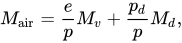
with being partial pressure of water, dry air pressure, and and representing the molar masses of water vapor and dry air respectively. The total pressure is described by Dalton's law of partial pressures:


Purpose
[edit]Rather than carry out these calculations, it is convenient to scale another quantity within the ideal gas law to equate the pressure and density of a dry parcel to a moist parcel. The only variable quantity of the ideal gas law independent of density and pressure is temperature. This scaled quantity is known as virtual temperature, and it allows for the use of the dry-air equation of state for moist air.[5] Temperature has an inverse proportionality to density. Thus, analytically, a higher vapor pressure would yield a lower density, which should yield a higher virtual temperature in turn.[citation needed]
Derivation
[edit]Consider a moist air parcel containing masses and of dry air and water vapor in a given volume . The density is given by


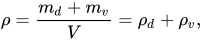
where and are the densities the dry air and water vapor would respectively have when occupying the volume of the air parcel. Rearranging the standard ideal gas equation with these variables gives


- and

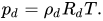
Solving for the densities in each equation and combining with the law of partial pressures yields
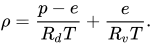
Then, solving for and using is approximately 0.622 in Earth's atmosphere:
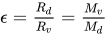

where the virtual temperature is
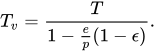
We now have a non-linear scalar for temperature dependent purely on the unitless value , allowing for varying amounts of water vapor in an air parcel. This virtual temperature in units of kelvin can be used seamlessly in any thermodynamic equation necessitating it.

Variations
[edit]Often the more easily accessible atmospheric parameter is the mixing ratio . Through expansion upon the definition of vapor pressure in the law of partial pressures as presented above and the definition of mixing ratio:


which allows
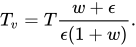
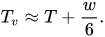
Algebraic expansion of that equation, ignoring higher orders of due to its typical order in Earth's atmosphere of , and substituting with its constant value yields the linear approximation



With the mixing ratio expressed in g/g.[6]
An approximate conversion using in degrees Celsius and mixing ratio in g/kg is[7]

Knowing that specific humidity is given in terms of mixing ratio as , then we can write mixing ratio in terms of the specific humidity as . We can now write the virtual temperature in terms of specific humidity as


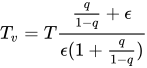
Simplifying the above will reduce to
![{\displaystyle T_{v}=T[{\frac {q}{\epsilon }}+(1-q)]}](https://wikimedia.org/api/rest_v1/media/math/render/svg/6db393995501b73028aab893b5c9b421ce2a7fff)
and using the value of , then we can write


Virtual potential temperature
[edit]Virtual potential temperature is similar to potential temperature in that it removes the temperature variation caused by changes in pressure. Virtual potential temperature is useful as a surrogate for density in buoyancy calculations and in turbulence transport which includes vertical air movement.
Density temperature
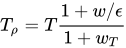
[edit]A moist air parcel may also contain liquid droplets and ice crystals in addition to water vapor. A net mixing ratio can be defined as the sum of the mixing ratios of water vapor , liquid , and ice present in the parcel. Assuming that and are typically much smaller than , a density temperature of a parcel can be defined, representing the temperature at which a theoretical dry air parcel would have the a pressure and density equal to a moist parcel of air while accounting for condensates:[8]: 113


Uses
[edit]Virtual temperature is used in adjusting CAPE soundings for assessing available convective potential energy from skew-T log-P diagrams. The errors associated with ignoring virtual temperature correction for smaller CAPE values can be quite significant.[9] Thus, in the early stages of convective storm formation, a virtual temperature correction is significant in identifying the potential intensity in tropical cyclogenesis.[10]
Further reading
[edit]- Wallace, John M.; Hobbs, Peter V. (2006). Atmospheric Science. ISBN 0-12-732951-X.
References
[edit]- ^ Bailey, Desmond T. (February 2000) [June 1987]. "Upper-air Monitoring" (PDF). Meteorological Monitoring Guidance for Regulatory Modeling Applications. John Irwin. Research Triangle Park, NC: United States Environmental Protection Agency. pp. 9–14. EPA-454/R-99-005.
- ^ "Cold air rises—what that means for Earth's climate". phys.org. Retrieved 2020-07-10.
- ^ Yang, Da; Seidel, Seth D. (2020-04-01). "The Incredible Lightness of Water Vapor". Journal of Climate. 33 (7): 2841–2851. Bibcode:2020JCli...33.2841Y. doi:10.1175/JCLI-D-19-0260.1. ISSN 0894-8755.
- ^ Seidel, Seth D.; Yang, Da (2020-05-01). "The lightness of water vapor helps to stabilize tropical climate". Science Advances. 6 (19) eaba1951. Bibcode:2020SciA....6.1951S. doi:10.1126/sciadv.aba1951. ISSN 2375-2548. PMC 7202867. PMID 32494724.
- ^ "AMS Glossary". American Meteorological Society. Retrieved 2014-06-30.
- ^ Doswell, Charles A.; Rasmussen, Erik N. (1 December 1994). "The Effect of Neglecting the Virtual Temperature Correction on CAPE Calculations". Weather and Forecasting. 9 (4): 625–629. Bibcode:1994WtFor...9..625D. doi:10.1175/1520-0434(1994)009<0625:TEONTV>2.0.CO;2.
- ^ U.S. Air Force (1990). The Use of the Skew-T Log p Diagram in Analysis and Forecasting. United States Air Force. pp. 4–9. AWS-TR79/006.
- ^ Emanuel, Kerry A. (1994). "Moist Thermodynamic Processes". Atmospheric Convection. Oxford University Press. ISBN 0-19-506630-8. Retrieved 18 October 2023 – via Google Books.
- ^ Doswell, Charles A.; Rasmussen, Erik N. (1994). "The Effect of Neglecting the Virtual Temperature Correction on CAPE Calculations". Weather and Forecasting. 9 (4): 625–629. Bibcode:1994WtFor...9..625D. doi:10.1175/1520-0434(1994)009<0625:TEONTV>2.0.CO;2.
- ^ Camargo, Suzana J.; Sobel, Adam H.; Barnston, Anthony G.; Emanuel, Kerry A. (2007). "Tropical cyclone genesis potential index in climate models". Tellus A. 59 (4): 428–443. Bibcode:2007TellA..59..428C. doi:10.1111/j.1600-0870.2007.00238.x.
Virtual temperature
View on GrokipediaOverview
Definition
Virtual temperature, denoted , is defined as the temperature that a theoretical parcel of dry air would need to possess in order to have the same total pressure and density as an actual parcel of moist air at the same location.[4][5] This construct arises in atmospheric thermodynamics to account for the effects of water vapor on air density while allowing moist air behavior to be approximated using dry air equations.[4] The definition presupposes the ideal gas law for dry air, expressed as where is the total pressure, is the density, is the specific gas constant for dry air (approximately 287 J kg⁻¹ K⁻¹), and is the temperature. In this framework, adjusts the temperature term to reflect the lower density of moist air due to the lighter molecular weight of water vapor compared to dry air constituents. In unsaturated moist air, exceeds the actual temperature because the presence of water vapor reduces the parcel's density relative to dry air at the same and .[6] Conversely, in saturated air with suspended liquid water droplets (known as liquid water loading), the added mass of these denser droplets increases the overall density, resulting in being lower than .[7] Virtual temperature is measured in kelvin and functions as a scalar multiplier that can substitute for actual temperature in thermodynamic relations originally formulated for dry air.Significance
The virtual temperature serves a critical purpose in atmospheric science by permitting the dry-air equation of state to be applied to moist air through a simple temperature scaling, which streamlines hydrostatic balance computations and thermodynamic analyses in numerical weather prediction and climate models. This adjustment accounts for the lower density of water vapor compared to dry air, avoiding the need for separate moist-air formulations and reducing computational complexity in regions with significant humidity.[4] The concept of virtual temperature was first introduced by Cato Guldberg and Henrik Mohn in 1876.[8] It has since been used to overcome shortcomings in representations of moist air dynamics, as exemplified in D. K. Lilly's 1968 analysis of cloud-topped mixed layers, where virtual temperature facilitated more accurate modeling of buoyancy and stability under strong inversions.[9] Without incorporating virtual temperature, density miscalculations in humid environments can lead to errors in pressure-to-height conversions of up to 10-20 meters across tropospheric layers, particularly in the tropics where moisture content is high.[10] A key impact of virtual temperature lies in its representation of the vapor buoyancy effect, which introduces an approximate 1 K warming in the tropical troposphere relative to actual temperature; this enhancement promotes greater buoyancy in moist air parcels, thereby intensifying convective processes and contributing to increased clear-sky outgoing longwave radiation by about 1 W m⁻² globally. Such effects help stabilize the tropical climate through negative feedbacks that mitigate excessive warming in dry subsiding regions.[11][12]Physical Principles
Air Density and Water Vapor Effects
The density of moist air arises from its composition as a mixture of dry air and water vapor, treated as ideal gases following Dalton's law of partial pressures. According to this law, the total atmospheric pressure equals the sum of the partial pressure of dry air and the vapor pressure : . This partial pressure framework allows the densities of each component to be calculated separately using the ideal gas law.[13][14] The molecular weight of dry air is approximately 29 g/mol, primarily from nitrogen (28 g/mol) and oxygen (32 g/mol), whereas water vapor has a lower molecular weight of 18 g/mol. The total density of moist air is thus the sum of the dry air density and the water vapor density : . Since water vapor molecules are lighter than the average dry air molecules they displace, the presence of water vapor reduces the overall mass per unit volume, making moist air less dense than dry air at the same temperature and pressure.[13][15][16] This density reduction stems from variations in the ideal gas law for moist air. The specific gas constant for dry air is J kg⁻¹ K⁻¹, while for water vapor it is J kg⁻¹ K⁻¹, reflecting the inverse relationship with molecular weight. The effective gas constant for moist air can be expressed as , where is the ratio of the molecular weight of water vapor to dry air (). At constant temperature and total pressure , the higher effective causes moist air to occupy a greater volume than dry air, further lowering its density by replacing heavier dry air molecules with lighter water vapor ones.[13][17][14] In humid regions like the tropics, where mixing ratios can exceed 20 g kg⁻¹, this effect becomes notable; for instance, at 30°C and a mixing ratio of 20 g kg⁻¹, the density of moist air is reduced by approximately 1.2% compared to dry air at the same conditions. Overall, density reductions reach up to 2-3% in highly saturated tropical air, enhancing buoyancy and influencing atmospheric processes. This physical mechanism underpins the virtual temperature concept, which equates the density of moist air to that of dry air at an adjusted temperature.[13][17][15]Vapor Buoyancy Mechanism
In the atmosphere, the buoyancy acceleration of a rising air parcel is determined by , where is the acceleration due to gravity, is the density difference between the parcel and its environment, and is the environmental density. This acceleration drives vertical motion, with positive buoyancy occurring when the parcel density is lower than the surrounding air. Water vapor contributes to this by reducing the overall density of the moist parcel relative to dry air at the same temperature and pressure, as its molecular weight (18 g/mol) is lower than that of dry air (29 g/mol), thereby enhancing the ascent rate compared to an equivalent dry parcel.[18][19] The vapor buoyancy effect, quantified through virtual temperature, provides an equivalent temperature perturbation that amplifies buoyancy in moist air. For a water vapor mixing ratio of 10 g/kg, this effect corresponds to roughly 1-2 K of warming in typical tropospheric conditions (around 280-300 K), promoting stronger updrafts in moist convective processes by making vapor-laden parcels effectively warmer and lighter. This dynamic enhancement is particularly pronounced in regions with high humidity, where even modest increases in mixing ratio can significantly boost convective vigor.[11][13] A key aspect of this mechanism is its dependence on the phase of water in the parcel. During unsaturated ascent, the virtual temperature directly increases buoyancy owing to the low density of water vapor alone. However, once saturation occurs and condensation forms clouds, the added mass of liquid water droplets (liquid loading) increases the parcel's density, often counteracting or reversing the vapor-induced buoyancy gain and potentially slowing or inhibiting further ascent.[20][21] This mechanism also influences Earth's global energy budget, particularly in the tropics. By elevating the virtual temperature in moist regions and inducing compensatory warming in adjacent drier columns to maintain hydrostatic balance, the vapor buoyancy effect enhances clear-sky outgoing longwave radiation by approximately 1-3 W/m², providing a stabilizing feedback that increases radiative cooling as surface temperatures rise.[11]Formulation
Derivation
The derivation of the virtual temperature begins with the equation of state for moist air, treated as an ideal gas mixture of dry air and water vapor under the assumptions of thermodynamic equilibrium and Dalton's law of partial pressures. The partial pressure of dry air is , where is the total pressure and is the water vapor pressure.[22] The density of dry air is given by where is the specific gas constant for dry air and is the actual temperature in Kelvin. Similarly, the density of water vapor is with as the specific gas constant for water vapor. The total density of unsaturated moist air (neglecting liquid water) is then The virtual temperature is defined such that the moist air density equals that of dry air at the same total pressure and temperature , using the dry air gas constant: Equating the two expressions for , Multiplying through by yields The ratio of gas constants is , derived from the molar masses of dry air ( g/mol) and water vapor ( g/mol) via , since and with the universal gas constant. Substituting gives and solving for produces the exact formula This derivation assumes ideal gas behavior for both components, negligible liquid water content (valid for unsaturated air), and that all constituents share the same temperature . It is applicable below the homopause (approximately 90 km altitude) where dry air is well-mixed.[22]Approximate Expressions
In atmospheric science, linear approximations for virtual temperature simplify computations by relating it directly to the actual air temperature and a measure of humidity, bypassing the need for precise vapor pressure calculations. A standard form uses specific humidity (in kg/kg):valid for kg/kg, which encompasses most tropospheric scenarios where moisture content is moderate.[23] This expression assumes small perturbations from dry air conditions and leverages the ideal gas law for moist air.[16] The coefficient 0.608 arises from the physical properties of air components, specifically , where is the ratio of the molecular weight of water vapor to dry air (or equivalently, the ratio of their specific gas constants). This approximation holds under the condition of small , the ratio of vapor pressure to total pressure.[13] For cases where mixing ratio (in g/kg) is the available humidity metric, equivalent approximations are:
(with and in °C), or in Kelvin,
These derive from the specific humidity form by noting for low moisture levels, facilitating practical use in field measurements or models.[24] These linear forms yield errors below 0.5 K in typical tropospheric conditions (e.g., g/kg), as higher-order terms in the expansion are negligible; however, inaccuracies grow in extreme humidity exceeding these limits.[24] They prove valuable for rapid assessments in radiosonde analyses or forecasting tools lacking full thermodynamic data.[13]