Hubbry Logo
Polytropic processPolytropic processMain
Open search
Polytropic process
Community hub
Polytropic process
logo
8 pages, 0 posts
0 subscribers
Be the first to start a discussion here.
Polytropic process
Polytropic process
from Wikipedia

A polytropic process is a thermodynamic process that obeys the relation:

where p is the pressure, V is volume, n is the polytropic index, and C is a constant. The polytropic process equation describes expansion and compression processes which include heat transfer.

Particular cases

[edit]

Some specific values of n correspond to particular cases:

In addition, when the ideal gas law applies:

Where is the ratio of the heat capacity at constant pressure () to heat capacity at constant volume ().

Equivalence between the polytropic coefficient and the ratio of energy transfers

[edit]
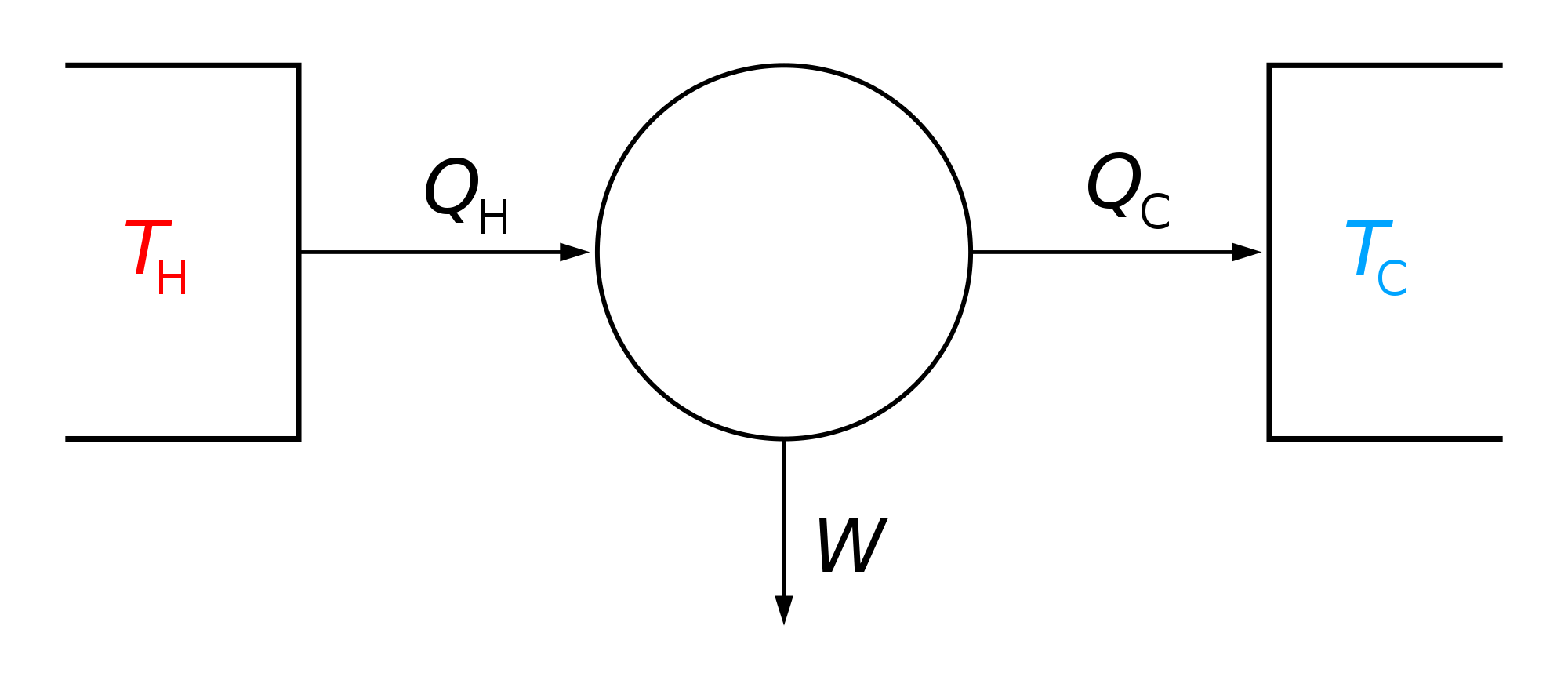
Polytropic processes behave differently with various polytropic indices. A polytropic process can generate other basic thermodynamic processes.

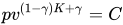
For an ideal gas in a closed system undergoing a slow process with negligible changes in kinetic and potential energy the process is polytropic, such that where C is a constant, , , and with the polytropic coefficient .
Relationship to ideal processes

[edit]

For certain values of the polytropic index, the process will be synonymous with other common processes. Some examples of the effects of varying index values are given in the following table.

Variation of polytropic index n
Polytropic
index
Relation Effects
n < 0 Negative exponents reflect a process where work and heat flow simultaneously in or out of the system. In the absence of forces except pressure, such a spontaneous process is not allowed by the second law of thermodynamics [citation needed]; however, negative exponents can be meaningful in some special cases not dominated by thermal interactions, such as in the processes of certain plasmas in astrophysics,[1] or if there are other forms of energy (e.g. chemical energy) involved during the process (e.g. explosion).
n = 0 Equivalent to an isobaric process (constant pressure)
n = 1 Equivalent to an isothermal process (constant temperature), under the assumption of ideal gas law, since then .
1 < n < γ Under the assumption of ideal gas law, heat and work flows go in opposite directions (K > 0), such as in vapor compression refrigeration during compression, where the elevated vapour temperature resulting from the work done by the compressor on the vapour leads to some heat loss from the vapour to the cooler surroundings.
n = γ Equivalent to an isentropic process (adiabatic and reversible, no heat transfer), under the assumption of ideal gas law.
γ < n < ∞ Under the assumption of ideal gas law, heat and work flows go in the same direction (K < 0), such as in an internal combustion engine during the power stroke, where heat is lost from the hot combustion products, through the cylinder walls, to the cooler surroundings, at the same time as those hot combustion products push on the piston.
n = +∞ Equivalent to an isochoric process (constant volume)

When the index n is between any two of the former values (0, 1, γ, or ∞), it means that the polytropic curve will cut through (be bounded by) the curves of the two bounding indices.

For an ideal gas, 1 < γ < 5/3, since by Mayer's relation

Other

[edit]

A solution to the Lane–Emden equation using a polytropic fluid is known as a polytrope.

The term "polytropic poison" has been used exclusively in publications from Russia regarding lead poisoning[2] and chloroprene to indicate multisystemic toxic effects.[3]

In entomology it has been used to denote insects visiting various flowers for nectar.[4]

See also

[edit]

References

[edit]
Revisions and contributorsEdit on WikipediaRead on Wikipedia
from Grokipedia
A polytropic process is a thermodynamic process involving the expansion or compression of a gas or vapor, characterized by the relation pVn=CpV^n = C, where pp is the pressure, VV is the volume, nn is the polytropic index (a constant determined by the specific process), and CC is a constant. This relation describes a reversible path where both heat transfer and work occur, generalizing several ideal processes for real-world approximations in systems like engines and compressors. The polytropic index nn typically ranges from 0 to \infty, with specific values corresponding to familiar thermodynamic processes: n=0n = 0 for isobaric (constant pressure), n=1n = 1 for isothermal (constant temperature), n=γn = \gamma (where γ=Cp/Cv\gamma = C_p / C_v) for reversible adiabatic (no heat transfer), and n=n = \infty for isochoric (constant volume). For an ideal gas undergoing a polytropic process, the work done is given by W=p1V1p2V2n1W = \frac{p_1 V_1 - p_2 V_2}{n-1} (for n1n \neq 1), and the heat transfer can be derived from the first law of thermodynamics as Q=ΔU+WQ = \Delta U + W, where ΔU\Delta U is the change in internal energy. These processes assume constant specific heat, allowing for analytical solutions that bridge ideal and non-ideal behaviors, though deviations occur with real gases. Polytropic processes are widely applied in engineering contexts, such as modeling compression in vapor cycles (where 1<n<γ1 < n < \gamma, leading to heat rejection) or expansion in internal combustion engines (where heat losses make n<γn < \gamma). They provide a practical framework for calculating efficiency and performance in turbomachinery, with the index nn often determined experimentally to account for irreversibilities like friction or heat dissipation. Unlike purely ideal processes, polytropes capture intermediate behaviors, making them essential for thermodynamic analysis in power generation and HVAC systems.

Definition and Fundamentals

Definition

A polytropic process is a generalized thermodynamic path followed by a fluid, in which the pressure and volume are related by a power-law relationship parameterized by the polytropic index, allowing it to describe a wide range of expansion or compression behaviors. This process applies to ideal gases, real gases, and vapors, providing a flexible model for systems where heat transfer and work occur simultaneously. Unlike specific processes such as isobaric or isochoric, the polytropic path captures intermediate behaviors through variation in the index value, making it suitable for approximating real-world fluid dynamics in engineering applications. The term "polytropic" was coined in the 19th century by German engineer Gustav Zeuner, who introduced it around 1866 to model non-ideal thermodynamic changes, particularly in steam engines and compressors where actual processes deviate from idealized assumptions. Zeuner's work focused on incremental state changes in gases and vapors, laying the foundation for using polytropic paths to represent practical approximations of complex heat and work interactions in machinery. This historical development emphasized the process's role in bridging theoretical ideals with empirical observations in early thermodynamic engineering. Polytropic processes are typically analyzed under the assumptions of a closed system, where no mass crosses the boundary, and quasi-static changes occur slowly enough to maintain near-equilibrium conditions at every stage, without chemical reactions altering the system's composition. These prerequisites ensure that the process can be treated as a sequence of equilibrium states, facilitating the application of thermodynamic principles like the first law. The utility of the polytropic model lies in its ability to interpolate between distinct processes—such as those with constant temperature or entropy—by adjusting the index, thus providing a versatile tool for analyzing efficiency and performance in devices like reciprocating engines and turbines.

Governing Equation

The polytropic process is mathematically characterized by the governing equation PVn=CPV^n = C, where PP denotes pressure, VV denotes volume, nn is the polytropic index, and CC is a constant that remains invariant throughout the process. This equation encapsulates a wide range of thermodynamic behaviors by varying the value of nn, providing a unified framework for processes involving heat and work transfer in gases or vapors. The equation is derived for an ideal gas from the first law of thermodynamics under the assumption of a constant effective specific heat. For N moles of gas, the heat transfer is δQ=CdT\delta Q = C \, dT, where C is the total effective heat capacity. The first law gives dU=δQPdVdU = \delta Q - P \, dV, with dU=NCVdTdU = N C_V \, dT. Substituting yields NCVdT=CdTPdVN C_V \, dT = C \, dT - P \, dV, or PdV=(CNCV)dTP \, dV = (C - N C_V) \, dT. Using the ideal gas law PV=NRTPV = N R T, differentiate to PdV+VdP=NRdTP \, dV + V \, dP = N R \, dT, and solve for dT to substitute back, leading after algebraic manipulation and integration to PVn=CP V^n = C, where the polytropic index n=1+NRCNCVn = 1 + \frac{N R}{C - N C_V}. This derivation assumes ideal gas behavior and quasi-equilibrium. For ideal gases, the governing equation extends to other thermodynamic variables, such as temperature and volume. Combining PVn=CPV^n = C with the ideal gas law PV=NRTPV = N R T leads to TVn1=\constantT V^{n-1} = \constant, illustrating how temperature varies inversely with volume raised to the power n1n-1. Similarly, relations like TP(1n)/n=\constantT P^{(1-n)/n} = \constant can be derived for pressure-temperature paths. The polytropic index nn is dimensionless, ensuring dimensional homogeneity in the equation PVn=CPV^n = C, as the exponents on pressure and volume (both with dimensions of energy per mole or similar) balance without introducing units to nn. This property allows nn to be determined empirically from process measurements, maintaining consistency across different systems.

Polytropic Index

The polytropic index, denoted nn, is a dimensionless parameter that characterizes the pressure-volume relationship in a polytropic process, influencing the balance between heat capacity effects and the degree of heat transfer relative to work done during compression or expansion. It determines how the process deviates from ideal cases like adiabatic or isothermal behavior, with higher values of nn indicating less heat exchange and steeper pressure-volume curves on logarithmic diagrams. Specific values of nn correspond to well-known thermodynamic processes: n=0n = 0 for an isobaric process at constant pressure, n=1n = 1 for an isothermal process at constant temperature, n=γn = \gamma (where γ\gamma is the specific heat ratio Cp/CvC_p / C_v) for an adiabatic process with no heat transfer, and nn \to \infty for an isochoric process at constant volume. These assignments highlight nn's role in parameterizing a continuum of processes between constant-pressure and constant-volume limits. The range of nn is typically 0<n<0 < n < \infty for standard gas compression and expansion processes, reflecting varying levels of heat involvement; values between 1 and γ\gamma (e.g., 1.4 for air) are common in engineering applications like compressors, where partial heat loss occurs. In rare expansions involving significant cooling or unusual heat addition, nn can be negative, leading to pressure increases with volume. To determine nn, experimental methods involve fitting pressure-volume data from measured process paths or calculating from inlet and outlet temperatures and pressures using the relation n=ln(P2/P1)ln(V1/V2)n = \frac{\ln(P_2 / P_1)}{\ln(V_1 / V_2)}. Theoretical models based on heat transfer rates, such as those accounting for finite-rate heat exchange in dynamic systems, yield nn iteratively by incorporating factors like thermal conductivity and surface area. The polytropic index relates to the specific heats through the effective polytropic specific heat Cn=Cvγn1nC_n = C_v \frac{\gamma - n}{1 - n}, where CvC_v is the specific heat at constant volume and γ=Cp/Cv\gamma = C_p / C_v; this can be rearranged as n=γm1mn = \frac{\gamma - m}{1 - m}, with m=Cn/Cvm = C_n / C_v representing a normalized measure of heat capacity influenced by heat loss or gain during the process. This connection underscores nn's parameterization of non-adiabatic effects without implying reversibility.

Thermodynamic Properties

Work Done

In a polytropic process for a closed system, the boundary work is calculated as the integral of pressure with respect to volume, W=V1V2PdVW = \int_{V_1}^{V_2} P \, dV, where the sign convention defines positive work as that done by the system during expansion and negative during compression. For a process following PVn=CP V^n = C with n1n \neq 1, substituting P=CVnP = C V^{-n} into the integral yields W=P2V2P1V11n,W = \frac{P_2 V_2 - P_1 V_1}{1 - n}, which simplifies equivalently to W=P1V1P2V2n1W = \frac{P_1 V_1 - P_2 V_2}{n - 1} using algebraic rearrangement. This formula applies to both ideal and non-ideal gases, provided the polytropic relation holds, and assumes quasistatic conditions for the boundary work evaluation. For the special case where n=1n = 1, corresponding to an isothermal process for an ideal gas, the relation becomes PV=CP V = C, and the work integral evaluates to W=P1V1ln(V2V1).W = P_1 V_1 \ln \left( \frac{V_2}{V_1} \right). This logarithmic form arises directly from integrating P=CVP = \frac{C}{V}, resulting in positive work for expansion (V2>V1V_2 > V_1) and negative for compression. Graphically, the work done corresponds to the area beneath the process curve on a pressure-volume (P-V) diagram, where the polytropic path is steeper for larger nn values. For expansion from a fixed initial state, increasing nn (e.g., from 1 to γ1.4\gamma \approx 1.4 for air) reduces the area under the curve, thereby decreasing the magnitude of work output compared to shallower paths like isobaric (n=0n = 0). The work in a polytropic process relates to heat transfer through the first law of thermodynamics.

Heat Transfer

In a polytropic process for an , the QQ is calculated using of , Q=ΔU+WQ = \Delta U + W, where ΔU\Delta U is the change in and WW is the done by the system. For an undergoing such a process, ΔU=mcv(T2T1)\Delta U = m c_v (T_2 - T_1), with mm as the , cvc_v as the specific heat at constant volume, and T2T1T_2 - T_1 as the temperature change; the work WW is given by W=mR(T2T1)1nW = \frac{m R (T_2 - T_1)}{1 - n}, where RR is the specific and nn is the polytropic index. Substituting these into yields the explicit expression for : Q=mcvγn1n(T2T1),Q = m c_v \frac{\gamma - n}{1 - n} (T_2 - T_1), where γ=cp/cv\gamma = c_p / c_v is the specific heat ratio. This formula equivalently appears as Q=mcvnγn1(T2T1)Q = m c_v \frac{n - \gamma}{n - 1} (T_2 - T_1), highlighting the dependence on nn relative to γ\gamma. The can also be related directly to the work done: Q=γnγ1WQ = \frac{\gamma - n}{\gamma - 1} W. This relation stems from and the expressions for ΔU\Delta U and WW, emphasizing how the polytropic index modulates the exchange relative to mechanical work. Additionally, the process involves an effective cn=cvγn1nc_n = c_v \frac{\gamma - n}{1 - n}, such that Q=mcn(T2T1)Q = m c_n (T_2 - T_1); this cnc_n can be positive, negative, or zero depending on nn, reflecting the non-standard heat-temperature relationship in polytropic paths. The direction of heat flow is determined by the sign of QQ, which depends on nn compared to γ\gamma and the process direction (e.g., expansion or compression). For n=γn = \gamma, Q=0Q = 0, indicating no as in an . When n<γn < \gamma, is typically added to the system (positive QQ) during expansion, as the process deviates from adiabatic conditions toward requiring thermal input to follow the PVn=PV^n = constant path. Heat transfer QQ is measured in SI units of joules (J) or, in imperial units, British thermal units (Btu). For a numerical illustration, consider 1 kg of air (γ=1.4\gamma = 1.4, cv=0.717c_v = 0.717 kJ/kg·K) undergoing expansion from T1=300T_1 = 300 K to T2=250T_2 = 250 K with n=1.2n = 1.2. Here, ΔT=50\Delta T = -50 K, so Q=1×0.717×1.21.41.21×(50)=0.717×(1)×(50)=35.85 kJ,Q = 1 \times 0.717 \times \frac{1.2 - 1.4}{1.2 - 1} \times (-50) = 0.717 \times (-1) \times (-50) = 35.85~\text{kJ}, indicating heat addition to the system during the expansion.

Internal Energy Change

For an ideal gas undergoing a polytropic process, the change in internal energy depends solely on the temperature change between the initial and final states, as the internal energy is a function of temperature only. The formula for the internal energy change is given by ΔU=mCv(T2T1),\Delta U = m C_v (T_2 - T_1), where mm is the mass of the gas, CvC_v is the specific heat at constant volume, and T1T_1 and T2T_2 are the initial and final temperatures, respectively. The temperatures in a polytropic process are related to the volumes through the equation derived from the and the polytropic relation PVn=\constantPV^n = \constant: T2T1=(V1V2)n1,\frac{T_2}{T_1} = \left( \frac{V_1}{V_2} \right)^{n-1}, where V1V_1 and V2V_2 are the initial and final volumes, and nn is the polytropic index. This relation shows that the temperature variation—and thus ΔU\Delta U—is indirectly influenced by nn through the process path, even though internal energy itself does not depend directly on nn. The magnitude of ΔU\Delta U varies with nn; for processes closer to isothermal (n=1n = 1), where T2=T1T_2 = T_1 and ΔU=0\Delta U = 0, the change is minimal, while it increases for values of nn farther from 1, such as in (n=γn = \gamma), leading to larger temperature differences. For real gases, the internal energy change includes additional contributions from intermolecular forces and volume effects, typically accounted for using departure functions that quantify deviations from .

Specific Cases

Isobaric Process

In the context of polytropic processes, the isobaric process occurs when the polytropic index n=0n = 0, maintaining constant pressure throughout the thermodynamic change. This condition implies P=constantP = \text{constant}, distinguishing it from other polytropic cases where pressure varies with volume according to PVn=constantPV^n = \text{constant}. For an ideal gas, the constant pressure aligns with the ideal gas law PV=mRTPV = mRT, leading to a direct proportionality between volume and temperature: V/T=constantV/T = \text{constant}. This relationship holds as long as the gas behaves ideally, allowing temperature changes to drive proportional volume expansions or contractions without altering pressure. The work done by the system during an isobaric process is calculated as the product of the constant and the change in . Mathematically, this is expressed as W=P(V2V1),W = P (V_2 - V_1), where PP is the constant pressure, and V1V_1 and V2V_2 are the initial and final s, respectively. This formula arises from the integral W=V1V2PdVW = \int_{V_1}^{V_2} P \, dV, simplifying under constant PP. For expansion (V2>V1V_2 > V_1), the work is positive (done by the system), representing the maximum possible for a given volume change among polytropic processes with the same initial state, as pressure remains at its highest value throughout. Heat transfer in an for an is governed by of , Q=ΔU+WQ = \Delta U + W, where the change in ΔU=mCv(T2T1)\Delta U = m C_v (T_2 - T_1) depends solely on temperature change. Substituting the isobaric work yields Q=mCp(T2T1)Q = m C_p (T_2 - T_1), with CpC_p as the at constant pressure (Cp=Cv+[R](/page/R)C_p = C_v + [R](/page/R), where RR is the ). This heat input is the maximum required for a given ΔT\Delta T among polytropic processes, as the maximized work contribution amplifies the total energy needed beyond the fixed internal energy change. Isobaric processes are frequently applied in heating scenarios at constant pressure, such as in piston-cylinder devices where external pressure is balanced by atmospheric or reservoir conditions, facilitating controlled .

Isothermal Process

An represents a special case of the polytropic process with polytropic index n=1n = 1, where the TT remains constant throughout. For an , this condition implies the relation PV=PV = constant, derived from the PV=mRTPV = mRT under constant TT. This process occurs when the gas undergoes compression or expansion while exchanging with its surroundings to precisely maintain the temperature, ensuring no net change in the system's thermal state. The work done by the during an isothermal expansion from initial volume V1V_1 to final volume V2V_2 is given by W=mRTln(V2V1),W = m R T \ln \left( \frac{V_2}{V_1} \right), where mm is the mass of the gas and RR is the specific . For an , the change ΔU=0\Delta U = 0 in an , as internal energy depends solely on temperature. Consequently, from the first law of , the QQ equals the work done WW (positive for expansion, indicating heat absorption by the system). In a reversible , which requires quasi-static execution to maintain equilibrium at every stage, the change of the is ΔS=mRln(V2V1).\Delta S = m R \ln \left( \frac{V_2}{V_1} \right). This positive value for expansion reflects increased disorder due to greater volume availability for molecular motion. Such processes are fundamental to the Carnot cycle's isothermal legs, supporting the cycle's reversible operation and theoretical efficiency limit.

Adiabatic Process

The represents a specific instance of the polytropic process for an , characterized by the polytropic index n=γn = \gamma, where γ=Cp/Cv\gamma = C_p / C_v is the ratio of the specific heat at constant to the specific heat at constant volume. In this process, no is transferred to or from the ([Q](/page/Q)=0[Q](/page/Q) = 0), leading to the governing relation PVγ=constantPV^\gamma = \text{constant}. This equation arises from the combination of of and the assumptions under adiabatic conditions. A key derived relation for the connects and as TVγ1=constantTV^{\gamma-1} = \text{constant}. This follows from substituting the into the pressure- relation and integrating, highlighting how varies inversely with raised to the power γ1\gamma - 1, with steeper changes for diatomic gases where γ1.4\gamma \approx 1.4 compared to monatomic gases where γ=5/3\gamma = 5/3. Since Q=0Q = 0, simplifies to ΔU=W\Delta U = W, where WW is the work done on the system. For an , the change in is ΔU=mCv(T2T1)\Delta U = m C_v (T_2 - T_1), yielding W=mCv(T1T2)W = m C_v (T_1 - T_2) for expansion from state 1 to state 2 (where T2<T1T_2 < T_1) when considering work done by the system as positive. These expressions hold precisely for reversible adiabatic processes, which are quasi-static and isentropic. Irreversible adiabatic processes, such as rapid expansions involving friction or non-equilibrium effects, deviate from the ideal n=γn = \gamma behavior but can be approximated using a polytropic model with an effective index nγn \neq \gamma, fitted from experimental pressure-volume data to capture entropy generation and inefficiencies.

Isochoric Process

The isochoric process represents a limiting case of the polytropic process as the polytropic index nn approaches infinity, where the volume remains constant throughout. In this scenario, the process adheres to the polytropic relation pVn=constantpV^n = \text{constant}, which simplifies to constant volume as nn \to \infty. For an ideal gas undergoing an isochoric process, the ideal gas law implies that the ratio of pressure to temperature P/TP/T remains constant, since PV=mRTPV = mRT with fixed VV and mass mm. Thus, any change in temperature directly scales the pressure, expressed as P2/P1=T2/T1P_2 / P_1 = T_2 / T_1, where subscripts 1 and 2 denote initial and final states; this relation is essential for modeling constant-volume heating or cooling scenarios in ideal gases. Due to the absence of volume change, no boundary work is performed, so the work done W=0W = 0. By the first law of thermodynamics, the heat transfer QQ then equals the change in internal energy ΔU\Delta U, yielding Q=ΔU=mcv(T2T1)Q = \Delta U = m c_v (T_2 - T_1), with cvc_v as the specific heat capacity at constant volume. This highlights that all energy input via heat directly alters the internal energy without mechanical work output.

Relationships and Comparisons

Equivalence to Energy Transfer Ratios

In a polytropic process for an ideal gas, the index nn can be interpreted physically as arising from a constant ratio of infinitesimal heat transfer to infinitesimal work, δQδW=K\frac{\delta Q}{\delta W} = K, where KK is a constant specific to the process. This energy transfer ratio distinguishes the polytropic process from other thermodynamic paths and directly links to the pressure-volume relation PVn=constantPV^n = \text{constant}. For an ideal gas, the first law of thermodynamics, δQ=dU+δW\delta Q = dU + \delta W (with δW=PdV\delta W = P dV as work done by the system), implies K=1+dUδWK = 1 + \frac{dU}{\delta W}. Integrating over the process yields the overall ratio K=QW=1+ΔUWK = \frac{Q}{W} = 1 + \frac{\Delta U}{W}, where ΔU\Delta U is the change in internal energy and WW is the net work done by the system. Deriving the explicit form of nn from this ratio involves the ideal gas properties and specific heats. The boundary work for a polytropic process is W=R(T1T2)n1W = \frac{R (T_1 - T_2)}{n - 1}, where RR is the gas constant and T1>T2T_1 > T_2 for expansion, while ΔU=cv(T2T1)=cv(T1T2)\Delta U = c_v (T_2 - T_1) = -c_v (T_1 - T_2) with cvc_v the specific heat at constant volume. Substituting into the first law gives Q=ΔU+WQ = \Delta U + W, leading to QW=1(n1)cvR\frac{Q}{W} = 1 - \frac{(n - 1) c_v}{R}. Since Rcv=γ1\frac{R}{c_v} = \gamma - 1 (where γ=cpcv\gamma = \frac{c_p}{c_v} is the heat capacity ratio), rearranging yields n=1(γ1)ΔUWn = 1 - (\gamma - 1) \frac{\Delta U}{W}. This equation demonstrates that nn equates to a specific ratio of non-work energies (internal energy change relative to work), encapsulating how the process partitions energy between storage in the gas and mechanical output. Physically, the index nn thus reflects the balance between compression or expansion work and heat dissipation or addition during the process. A higher nn (closer to γ\gamma) indicates less relative to work, approaching adiabatic conditions where energy changes are dominated by internal energy adjustments without external heat exchange. For instance, when heat transfer is zero (Q=0Q = 0), ΔU=W\Delta U = -W and n=γn = \gamma. This energy ratio perspective provides insight beyond the geometric PP-VV description, highlighting polytropic processes as those maintaining proportional energy exchanges throughout.

Comparison with Reversible Processes

Polytropic processes serve as approximations to ideal reversible processes in thermodynamic analyses, particularly for gases undergoing compression or expansion with . In the limit of n=1n = 1, a polytropic process for an becomes a reversible , where temperature remains constant due to slow, quasi-static that maintains with the surroundings. Conversely, when n=γn = \gamma (the ratio of specific heats), the process aligns with a reversible adiabatic (, characterized by no and constant , as insulation prevents any exchange with the environment. A key distinction arises in , where polytropic processes account for irreversibilities that reduce compared to their reversible counterparts. For compressors, the polytropic ηp\eta_p, which measures the ratio of isentropic to actual work for stages, is given by ηp=γ1γnn1\eta_p = \frac{\gamma - 1}{\gamma} \cdot \frac{n}{n - 1}. This value equals 1 for the reversible adiabatic case (n=γn = \gamma) but falls below 1 for irreversible polytropic processes (n>γn > \gamma), reflecting increased work input due to factors like and non-ideal . Irreversibilities in polytropic processes manifest as entropy generation, primarily from heat transfer occurring at finite rates across temperature gradients rather than infinitesimally. Unlike reversible processes, where entropy change is solely due to reversible heat transfer (ΔS=δQrevT\Delta S = \int \frac{\delta Q_{\text{rev}}}{T}), polytropic processes produce additional entropy through these gradients, quantifying the loss of available work. Modern validations using (CFD) confirm the accuracy of polytropic approximations in modeling real flows, such as in compressors and engines, by comparing simulated pressure-volume paths and against experimental data. These studies demonstrate that polytropic models effectively capture deviations from ideality in complex geometries, with errors typically under 5% for head and efficiency predictions.

Applications and Extensions

Engineering Applications

Polytropic processes are extensively applied in the and of compressors and turbines, particularly in multi-stage compression systems where real-gas behavior and necessitate a polytropic exponent nn between 1 and γ\gamma (the adiabatic index). In centrifugal and axial compressors, polytropic modeling allows for the calculation of head, a key performance metric representing the imparted to the per unit , using the formula H=nn1RT[(P2P1)(n1)/n1],H = \frac{n}{n-1} R T \left[ \left( \frac{P_2}{P_1} \right)^{(n-1)/n} - 1 \right], where RR is the gas constant, TT is the inlet temperature, and P1P_1, P2P_2 are inlet and outlet pressures, respectively. This approach accounts for inefficiencies such as friction and cooling, enabling more accurate predictions of power requirements and stage efficiencies in turbomachinery. For turbines, similar polytropic expansions model the work extraction in gas and steam turbines, optimizing blade design and overall cycle performance. In internal combustion engines, polytropic processes approximate the expansion stroke during the power phase, where heat losses to cylinder walls and incomplete combustion lead to an effective polytropic exponent n1.3n \approx 1.3. This value captures the deviation from ideal adiabatic expansion (n=γ1.4n = \gamma \approx 1.4), allowing engineers to estimate indicated work and more realistically in cycle simulations for spark-ignition and diesel engines. Such modeling is crucial for predicting under varying loads and speeds. Refrigeration cycles, particularly vapor-compression systems, employ polytropic compression to represent the non-isentropic behavior in reciprocating or centrifugal compressors, incorporating cooling effects from jacket water or intercooling. By selecting an appropriate nn (typically 1.1 to 1.3 for common refrigerants like R-134a), the process accounts for during compression, improving (COP) calculations and refrigerant selection. This is especially relevant in industrial chillers and units where efficiency gains from polytropic analysis reduce . The application of polytropic processes in engineering traces back to the early , integrated into analyses of Rankine and Brayton cycles for steam and gas power plants to bridge ideal and real behaviors. Today, software tools like Aspen Plus facilitate detailed simulations of polytropic compression and expansion in these cycles, using built-in models for multi-stage units and efficiency correlations to optimize plant design and operation.

Generalizations Beyond Ideal Gases

The polytropic process, originally formulated for ideal gases, can be generalized to real gases by incorporating the compressibility factor ZZ, which accounts for deviations from ideal behavior due to intermolecular forces and finite molecular volume. For real gases, the standard relation PVn=constantPV^n = \text{constant} is approximated using equations of state (EOS) such as the Peng-Robinson or Soave-Redlich-Kwong models to capture non-ideal effects during compression or expansion, though the constant nn assumption may not hold accurately in high-pressure regimes where properties vary significantly, often requiring numerical methods or variable nn. Alternatively, for van der Waals gases, the polytropic model incorporates attractive and repulsive intermolecular forces explicitly, leading to a modified EOS that influences the effective polytropic index nn, often resulting in nonclassical gas dynamic behaviors such as anomalous wave speeds. These generalizations allow accurate prediction of work and in real gas systems, such as supercritical fluids in compressors. In multi-phase systems involving liquids and vapors, polytropic approximations are applied to model processes in devices like and condensers, where phase transitions and play key roles. For liquid pumping, due to low , the fluid is treated as incompressible with constant vv, so pump work is calculated as v(p2p1)v (p_2 - p_1); polytropic modeling is rarely applied, but if used, nn approaches infinity. In condensers, vapor condensation is modeled as an (n=0n = 0), where heat rejection occurs at nearly constant while decreases due to phase change, facilitating energy balance assessments in cycles. These adaptations extend the polytropic framework beyond single-phase gases, though they require empirical adjustments for effects. Beyond engineering, polytropic processes find interdisciplinary applications, such as in where stellar polytropes model self-gravitating spheres under . In this context, the Lane-Emden equation describes and profiles via P=Kρ1+1/nP = K \rho^{1 + 1/n}, with n=3n = 3 providing stability for convective stars like those on the , independent of central and approximating radiative envelopes. In acoustics, sound wave propagation in fluids is treated as a near-polytropic process with nn approaching the adiabatic index γ1.4\gamma \approx 1.4 for air, enabling predictions of wave speed and attenuation in stratified or bubbly media without significant generation. These uses highlight the versatility of polytropic models in scaling complex, large-scale phenomena. Despite these extensions, polytropic processes have limitations in scenarios involving phase changes or turbulent flows. During phase transitions, such as or , the abrupt release or absorption of violates the quasi-equilibrium assumption, causing deviations from the PVnPV^n relation and requiring hybrid models like those combining polytropic and isenthalpic steps. In turbulent flows, viscous and chaotic mixing introduce non-reversible effects that render the constant nn approximation invalid, often necessitating alternatives like isentropic processes for high-speed compressible flows where shocks dominate. For such cases, more advanced or numerical methods are preferred over polytropic simplifications. Recent advances in the leverage (CFD) and (ML) to determine effective polytropic exponents in complex flows, overcoming traditional analytical limitations. CFD simulations, using volume-of-fluid or multiphase models, extract nn from pressure-volume data during transient events like hydraulic shocks, achieving for real gas and multi-phase interactions. ML techniques, such as , further enhance this by predicting variable nn in turbulent or relativistic hydrodynamics, reducing computational costs by orders of magnitude while incorporating EOS corrections for non-ideal behaviors. These methods have enabled precise modeling in applications from pipeline flows to astrophysical simulations.

References

Add your contribution
Related Hubs
User Avatar
No comments yet.
