Hubbry Logo
Beit ed-DineBeit ed-DineMain
Open search
Beit ed-Dine
Community hub
Beit ed-Dine
logo
8 pages, 0 posts
0 subscribers
Be the first to start a discussion here.
Beit ed-Dine
Beit ed-Dine
from Wikipedia
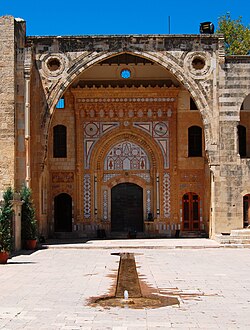
One of many Courtyards in Beiteddine Palace.

Key Information

Beit ed-Dine (Arabic: بيت الدين), also known as Btaddine (Arabic: بتدين) is a small town and the administrative capital of the Chouf District in the Mount Lebanon Governorate in Lebanon. The town is located 45 kilometers southeast of Beirut,[1] and near the town of Deir el-Qamar from which it is separated by a steep valley. It had 1,613 registered voters in 2010 and its inhabitants are predominantly Christians from the Maronite, Melkite and Greek Orthodox denominations.[2] Beit ed-Dine's total land area consists of 244 hectares and its average elevation is 860 meters above sea level.[1]

The town is well known for the Beiteddine Palace, which hosts the annual summer Beiteddine Festival.

History

[edit]

Ottoman era

[edit]

Emir Bashir II of the Shihab dynasty, who later became the ruler of the Mount Lebanon Emirate, started building the palace in 1788 at the site of the Druze hermitage (hence the palace's name, translating as "House of Faith"[3]), indicating that the town was initially populated by Druze before Bashir lived in it.[citation needed] Bashir moved the headquarters of the emirate from Deir al-Qamar to Beit ed-Dine by 1811.[4] He ruled from the palace he built, known as the Beit ed-dine Palace, which he supplied with water by building a lengthy canal connecting the palace to the Safa River.[4]

After 1840, when Emir Bashir II was sent into exile the palace was used by the Ottomans as a government building. During the French Mandate its role was preserved and it served as a local administrative office. In 1934, it was declared a national monument.[citation needed] During the 1860 Mount Lebanon civil war, around 200 Christians from Deir al-Qamar fled to the Ottoman barracks at Beit ed-Dine to seek shelter before their town was attacked by Druze fighters.[5] After Deir al-Qamar was plundered by the Druze and its inhabitants massacred, they proceeded to attack the Christians who sought shelter at Beit ed-Dine. The outnumbered Ottoman garrison did not resist and the barracks were assaulted.[6] During the French-led international intervention in the war, the French colonel, d'Arricau, chose Bashir's palace in Beiteddine as his headquarters.[7] In the 1860s, the headquarters of the Ottoman deputy governor in Mount Lebanon was relocated to the Beiteddine Palace.[8]

During official celebrations in Beit ed-Dine marking the enthronement of Sultan Abdul Hamid II in 1908, Druze and Maronites from the vicinity clashed in the town, resulting in the deaths of one person from each sect.[9] A week later, a delegation of the local, reformist Liberal Party issued a set of demands in Beit ed-Dine calling for reforms such as the abolition of new taxes and the dismissal of corrupt officials.[9] The governor of Beirut Vilayet, Yusuf Pasha, rejected the demands and ordered the demonstrator's dispersal.[9] However, the Ottoman garrison in Beit ed-Dine sympathized with the demonstrators and refused to disperse them.[9] The governor ultimately acceded to the demonstrators' demands.[9]

Modern Era

[edit]
Beiteddine is the capital of the Chouf District

In 1943, Bechara El Khoury, the first Lebanese president, declared it the official president's summer residence. During the Lebanese Civil War (1975–1990) it was heavily damaged. After 1984, when fighting in the area receded, Walid Jumblatt ordered its restoration. Parts of the palace are today open to the public while the rest is still the president's summer residence.

Bashir built three more palaces in the town for his sons, till today only Mir Amin Palace survived and is today a luxury hotel.[citation needed]

Beiteddine is home to a Lebanese Red Cross First Aid Center.[10]

Demographics

[edit]

In 2014, Christians made up 98.58% of registered voters in Beit ed-Dine. 84.33% of the voters were Maronite Catholics.[11]

See also

[edit]

References

[edit]

Bibliography

[edit]
[edit]
Revisions and contributorsEdit on WikipediaRead on Wikipedia
from Grokipedia

Beiteddine Palace (Arabic: قصر بيت الدين), also known as Beit ed-Dine, is a 19th-century palace complex located in the village of Beiteddine in Lebanon's Chouf Mountains, approximately 40 kilometers southeast of Beirut at an elevation of 850 meters. Constructed between 1788 and 1818 under the direction of Emir Bashir Chehab II, an Ottoman-appointed governor of the region, the palace served as his primary residence and administrative headquarters until 1840.
The palace exemplifies early 19th-century Lebanese architecture, blending traditional Arabic elements with Italian baroque influences in its design, which incorporates intricate stone carvings, arches, and domes executed by local craftsmen under the guidance of an Italian architect. Its layout centers on three sequential courtyards—the outer Dar Al Baraniyyeh for public reception, the central Dar Al Wousta featuring a large , and the inner Dar Al Harim reserved for private quarters including a and kitchens—surrounded by terraced gardens, orchards, and that enhance its aesthetic and functional harmony with the mountainous terrain. Following its use during the French Mandate for local administration and designation as a historic monument in 1930, the palace became the summer residence of Lebanon's presidents after independence in 1943, though it suffered significant damage and loss of contents during the 1982 Israeli invasion and subsequent occupation, with parts claimed by Druze militias until restoration and return to state control in 1999. Today, extensively restored, it functions as a major cultural site, housing the Rashid Karami Museum with artifacts from Bronze Age to Islamic periods and former stables displaying 5th-6th century Byzantine mosaics, while hosting the annual Beiteddine Festival of music and arts since 1985.

History

Construction Under Emir Bashir II (1788–1818)

Emir Bashir II Shihab, who ascended as of the Emirate in 1788 following the abdication of his predecessor amid internal strife, initiated the construction of as a symbol of his emerging authority. Born into the , a family of Sunni origin that had ruled the region under Ottoman oversight, Bashir leveraged alliances with Ottoman officials like and local leaders to consolidate power against feudal rivals, including other Shihab branches and Druze clans. The project, spanning from 1788 to 1818, reflected his ambition to centralize governance in the fractious landscape of , where competition between Druze and Maronite factions often erupted into violence. The palace's location in Beit ed-Dine, nestled in the Chouf Mountains at the foothills of , was chosen for its elevated terrain offering natural defensibility against incursions, amid a region historically contested by emirs. This strategic perch facilitated oversight of surrounding valleys and trade routes, aligning with Bashir's efforts to impose order on disparate muqata'at (tax districts) controlled by hereditary notables. Construction mobilized extensive resources, drawing on labor from local Christian and communities, where able-bodied men were compelled to contribute unpaid work, supplemented by skilled artisans transported from and . Bashir's administration enforced such levies rigorously, including directives for subjects to supply water and materials without compensation, underscoring the authoritarian mechanisms that funded his rule through heightened taxation and feudal exactions. Intended primarily as an administrative rather than mere residence, served as a base for tax collection, judicial proceedings, and diplomatic receptions, enabling Bashir to project sovereignty while navigating Ottoman demands for tribute. By , upon completion, it had transformed a modest site—possibly overlying earlier structures—into a fortified complex that embodied Bashir's shift toward Maronite alliances, which bolstered his position against opposition but sowed seeds of sectarian tension. This era of building coincided with Bashir's suppression of local revolts, such as those over fiscal impositions, illustrating how the palace's erection intertwined with his coercive consolidation of the emirate's fragmented authority.

Role in 19th-Century Conflicts and Egyptian Occupation

During the period of Egyptian occupation in from 1831 to 1840, Beiteddine Palace functioned as the primary residence and administrative center for Emir Bashir II Shihab, who had forged an alliance with Ibrahim Pasha, son of , to consolidate power against Ottoman authority. Bashir provided support to Egyptian forces, including troops for the 1831–1832 siege of Acre, leveraging the palace as a strategic base in the Chouf Mountains for coordinating regional governance and suppressing local dissent amid the imposition of Egyptian administrative reforms, such as heavy taxation and . This alliance enabled Bashir to expand his influence over , but it also fueled tensions, as Egyptian policies provoked widespread revolts, including Druze-led uprisings in 1837–1838 against forced levies that drained local populations and economies. The palace's role shifted dramatically during the 1840 Oriental Crisis, when a coalition of British, Ottoman, and Austrian forces intervened to counter Egyptian , supporting local rebellions that eroded Bashir's control. On October 14, 1840, Bashir surrendered to British representatives and was exiled to , marking the end of his rule and the effective abandonment of Beiteddine as his seat of power; the withdrawal of Egyptian troops from the region followed shortly thereafter. While coastal sites like and faced direct naval bombardments, inland strongholds such as Beiteddine experienced indirect impacts from the broader campaign, including logistical disruptions and the flight of loyalists, though no verified records confirm strikes on the palace itself. Following Bashir's deposition, Ottoman authorities assumed direct control of the palace in 1841, repurposing it as a government administrative building for the southern district of Mount Lebanon, a transition documented in regional Ottoman records that highlight initial looting by retreating forces and subsequent neglect due to fiscal constraints and political instability. This marked a decline in the site's prominence, as Ottoman governors prioritized coastal centers, leading to sporadic maintenance and the palace's use primarily for bureaucratic functions rather than princely residence until later 19th-century reforms.

Decline and 20th-Century Transitions

During the French Mandate (1920–1943), Beiteddine Palace transitioned from its 19th-century role as an emir's seat to a local administrative office under French oversight, signifying a decline from its former political and residential grandeur to more mundane governmental functions. This period saw limited maintenance focused on utility rather than opulence, with the site declared a historic monument around 1930, initiating modest preservation amid broader colonial administrative priorities. The Lebanese Civil War (1975–1990) further eroded the palace's condition, with heavy damage inflicted during clashes in the Chouf Mountains, including the intense "War of the Mountains" (1983–1984) between Druze forces of the Progressive Socialist Party, led by Walid Jumblatt, and Christian militias. While the core structure endured without complete ruin, surrounding battles restricted access and subjected the site to militia occupation, primarily by Druze groups who utilized it amid sectarian strife that displaced populations and devastated regional infrastructure. The of 1989, which ended the war and restructured Lebanon's confessional power-sharing, paved the way for stabilization in the Chouf region by 1990, curtailing militia dominance and enabling initial post-conflict repairs under stewardship. By the late 1990s, these efforts culminated in the palace's handover to the in 1999, marking its shift toward formalized heritage status rather than wartime utility.

Post-Independence Developments

Following Lebanon's independence in 1943, was repurposed as the official summer residence of the , marking a shift from its pre-independence administrative uses under the French Mandate to a symbol of national sovereignty amid the country's political framework, where executive power is allocated to Maronite Christians. , the first post-independence president, established this tradition by utilizing the palace for seasonal retreats, a practice continued by successors that underscored its role in state ceremonial functions while navigating Druze-majority regional dynamics in the Chouf Mountains. The palace's status as a historic , formalized during the French Mandate around 1930, persisted into the independence era, providing legal protections under emerging Lebanese heritage frameworks that prioritized sites linked to Ottoman-era governance and local emirates. During the 1950s and 1960s, it hosted presidential activities, including under (1952–1958), whose administration leveraged the site for diplomatic and familial purposes, reflecting the era's emphasis on centralized authority despite sectarian tensions. Initial restorations, such as those initiated by President in 1969, addressed wear from prior uses, preserving structural elements like courtyards and chambers essential for ongoing viability. Post-civil war reconstruction from the onward integrated the palace into formalized national heritage laws, enabling state oversight and limited private contributions to repairs following damages incurred during the 1982 Israeli invasion, which had compromised outer sections but left core architecture largely intact for repurposing. This period aligned with Lebanon's Agreement-driven stabilization, emphasizing confessional power-sharing while elevating the site as a non-partisan emblem of continuity. By the early 2000s, following Syria's 2005 military withdrawal, enhanced perimeter security measures were implemented to safeguard the palace against regional instability, coinciding with its designation for cultural events that reinforced its public accessibility without altering foundational designs.

Architecture and Design

Architectural Influences and Materials

The architecture of embodies a fusion of late Ottoman influences in its ornamentation with neoclassical elements in the , reflecting the integration of Lebanese building traditions and European stylistic imports during the early . This blend arose from the involvement of Lebanese constructors, such as Rustam and Mujahes from Shuwayr, alongside European engineers who adapted designs to the site's and . Primary construction materials included locally quarried blocks, frequently alternated in yellow and ivory hues for both aesthetic and structural purposes, ensuring resilience to the Chouf Mountains' harsh weather variations and erosion. Cedar wood, harvested from Lebanon's indigenous forests, formed ceilings, beams, doors, and intricate carvings, prized for its natural durability and resistance to moisture and insects in the humid, elevated environment. Marble elements were imported from for flooring and decorative accents, enhancing opulence while complementing the stone framework. features such as arcades and vaults, constructed with these materials, distribute weight efficiently across the palace's expansive layout, promoting stability amid the region's seismic risks and steep terrain. Imported tiles from , , , and covered floors and roofs, providing weatherproofing suited to the alternating wet winters and dry summers. These choices prioritized longevity, with the palace's core structure remaining intact since completion around despite Lebanon's turbulent history.

Interior Layout and Key Chambers

The interior of Beiteddine Palace is structured around a series of interconnected and wings, divided into three primary zones: the outer Dar el-Barani for public access, the middle Dar el-Wousta for administrative functions, and the inner Dar el-Harem for private use. This layout facilitated hierarchical spatial progression, with utility prioritized for governance and residence; the main block, including core chambers, was completed around 1818 after initial construction began in 1788. Access to the Dar el-Wousta occurs via a prominent double-flight from the entrance , leading to wings arranged around a central featuring a that supported daily operations and ventilation. The Diwan, located in the Dar el-Harem, functions as the central audience and reception hall, spanning two levels to accommodate official proceedings and court sessions. Positioned for the Emir's oversight, it includes dedicated spaces for seating and deliberation, emphasizing its role in administrative utility over private leisure. Adjacent reception rooms in the Dar el-Wousta served ministers and secretaries, enabling efficient handling of governance tasks near public entry points. The quarters, comprising the private apartments in the Dar el-Harem across ground and upper floors, encircle an internal equipped with fountains and utility areas such as expansive kitchens capable of serving over 500 individuals daily. These chambers included domed bath facilities with systems, underscoring practical adaptations for extended residency, alongside a covered used for the Emir's personal oversight of matters. The upper wing housed specialized rooms like the (Mahkamat), reflecting integrated judicial functions within the residential core.

Decorative Elements and Artifacts

The interiors of Beiteddine Palace prominently feature intricately carved and painted cedar wood ceilings and walls, adorned with that praises the ruling emirs and invokes religious motifs. These calligraphic elements, executed in traditional Ottoman-influenced styles, symbolically reinforced the Shihab dynasty's authority by visually embedding dynastic legitimacy and piety into the palace's fabric, a common practice in princely residences to project enduring power amid regional rivalries. Fine mosaics and in and further embellish reception halls and salons, with patterns drawing from Arabic geometric designs integrated with local Lebanese craftsmanship. In the , elaborate basins dating to the early 19th century construction period under Bashir II pair with intricate tilework, showcasing hydraulic functionality alongside ornamental motifs that echo the palace's assertion of refined sovereignty. Most decorative features, including the painted ceilings and inlaid panels, are originals from the 1788–1840 building phase, authenticated through stylistic consistency with Shihab-era Lebanese-Arabesque art and material analysis of cedar sourcing from forests. Ancient floor mosaics, some dating to the 5th–6th centuries CE from pre-existing sites, were incorporated as relics to evoke historical continuity, though distinct from the primary 19th-century ornamentation. No widespread 20th-century replicas supplant these core elements, preserving their role in symbolizing the emirs' cultural patronage.

Grounds and Surrounding Landscape

Terraced Gardens and Orchards

The terraced gardens and orchards enveloping adapt to the steep slopes of the Chouf Mountains through dry-stone retaining walls, a technique rooted in ancient Levantine agricultural practices that maximized on gradients exceeding 30 degrees. Constructed concurrently with the palace between 1788 and 1818 under Emir Bashir II Shihab, these features supported fruit-bearing trees, including olive groves that provided staple produce for the residence's inhabitants, contributing to operational self-sufficiency amid the region's isolation. Orchard plantings emphasized native Mediterranean species suited to the soils and , such as Olea europaea (), which dominated for its drought resistance and economic value in oil production, alongside figs (Ficus carica) and other hardy perennials integral to local feudal estates. These selections aligned with the Shouf's historical agrarian , where terraces yielded diverse yields to sustain ruling families and dependents without reliance on distant markets, though yields varied with —typically 800-1,000 meters at Beiteddine. Historical accounts note no exotic imports, prioritizing resilient locals over ornamental varieties. Maintenance demanded coordinated labor from communities, often conscripted under the Shihab emirate's system, involving seasonal , soil amendment with local manure, and terrace repairs to prevent —tasks reflecting the hierarchical feudal structure where agricultural output underpinned political authority. By the , such systems supported an estimated 20-30% of a estate's caloric needs through and nut harvests, though overexploitation led to periodic soil depletion documented in regional chronicles.

Water Features and Engineering

The water supply system at Beiteddine Palace relied on a 14-kilometer aqueduct constructed by Emir Bashir II (r. 1788–1840) to channel water from mountain springs at higher elevations, ensuring gravity-fed delivery to the complex amid the semi-arid Chouf Mountains. This engineering addressed the challenge of sourcing water from valleys below, which initially perplexed involved architects, by leveraging topographic gradients for reliable flow without mechanical aids. Local springs, including Al Ka'a Spring near the palace, supplemented the primary aqueduct, directing potable and utilitarian water through covered channels to minimize and contamination. Within the palace, the system fed multiple fountains and shallow pools, such as the large central fountain in the Dar al-Wousta courtyard and adjacent smaller basins, which served both ornamental and evaporative cooling functions in the . These nymphaea-style features, reminiscent of classical hydraulic designs, distributed via stone conduits and overflow mechanisms that extended to terraced orchards and fields downslope, optimizing resource use in an era predating modern pumps. The infrastructure demonstrated resilience but necessitated periodic repairs following 19th- and 20th-century conflicts, including and channel restorations documented in Lebanese reports from the to address war-related damage and seismic wear. This maintenance underscores the system's dependence on manual oversight for clearance and joint sealing, with surviving aqueduct remnants attesting to the durability of under gravitational pressures.

Integration with Local Terrain

Beiteddine Palace occupies a site at an elevation of approximately 850 meters in the Chouf Mountains, southeast of , enabling oversight of surrounding valleys and escarpments critical for regional control during the early . This elevated position on the Chouf escarpment leveraged the area's rugged geography for natural defensibility, serving as the power center for Emir Bashir II's governance over . The choice prioritized strategic vantage over mere scenic appeal, with the terrain's slopes influencing the palace's fortified layout to integrate with the landscape's contours. The structure's adaptations to local conditions include alignment with prevailing mountain wind patterns, facilitating natural ventilation through open courtyards and arcades amid the higher-altitude that moderates summer heat. Surrounding terraced slopes, historically cultivated, demonstrate terrain-responsive engineering to mitigate runoff and stabilize the escarpment. However, the broader Chouf region contends with erosion vulnerabilities stemming from past , as evidenced by ongoing landscape restoration initiatives in the adjacent Shouf Reserve, which address slope instability through and surveys.

Cultural and Artistic Role

Hosting of Beiteddine Art Festival

The Beiteddine Art Festival was established in 1985 during the as an initiative by Nora Jumblatt following the restoration of . Initially comprising small cultural events, it evolved into a prominent annual summer festival featuring music, theater, and dance performances staged in the palace's historic courtyards and halls. This setup leverages the site's architectural grandeur to create an immersive experience, drawing international artists despite ongoing regional instability. The festival has played a key role in cultural revival, hosting global performers and sustaining artistic activity amid conflict, with over 735,000 spectators attending across its first 35 years by 2019. Pre-economic editions attracted 30,000 to 50,000 visitors annually, funded primarily through ticket sales (65%), sponsorships (20%), and support (15%). Its persistence has been credited with preserving Lebanon's and fostering youth engagement with traditional and contemporary arts. In 2025, discussions at highlighted the festival's legacy, with Nora Jumblatt addressing preservation efforts at during events in October. Performances occurred from July 10 to 27, complemented by exhibitions, though regional conflicts led to some suspensions and adaptations. Critics have noted its elite orientation, with high ticket prices limiting access amid Lebanon's widespread poverty and since 2019, potentially prioritizing prestige over broad public benefit. Funding opacity, reliant on private sponsors tied to political figures like the , has also raised questions about transparency in resource allocation during national crises. Seasonal events further impose logistical disruptions on the site's preservation and routine access.

Museums and Collections

The Beiteddine Palace houses several specialized museums showcasing archaeological and ethnographic artifacts, primarily displayed in the upper floors and dedicated wings. The Mosaic Museum features an exceptional collection of dating to the 4th and 5th centuries AD, most originating from the ancient coastal site of Jiyeh (Porphyreon), with intricate depictions of birds, flowers, and geometric patterns preserved floors. These mosaics, excavated and transferred for protection, provide verifiable evidence of early Christian artistic techniques in the region, emphasizing technical craftsmanship over interpretive narratives. Complementing this, the Ethnographic Museum displays Phoenician pottery, Roman glassware, traditional Lebanese costumes, and jewelry, spanning and items to Ottoman-period textiles. The Weapons Museum exhibits arms and armor, including swords, firearms, and ceremonial pieces from the 18th and 19th centuries associated with Bashir II's era, reflecting the palace's role as a military-administrative center. These holdings, curated for public education following post-civil war restorations in the , prioritize artifact and material analysis, with displays integrated into original palace chambers to maintain contextual authenticity. Access to the collections is generally open to visitors outside festival periods, though temporary closures occur during the annual Beiteddine Art Festival to prioritize event logistics, limiting scholarly examination at peak times. Historical catalogs note gaps in the , including select Bashir-era furnishings and documents dispersed during 19th-century political upheavals, though no comprehensive records specific to have been digitized for verification. Ongoing curation efforts focus on conservation rather than expansion, ensuring exhibits remain tied to archaeologically confirmed origins amid Lebanon's resource constraints.

Symbolism in Lebanese Heritage

Beiteddine Palace stands as a potent symbol of political ascendancy in 19th-century , commissioned by Bashir II Shihab II—a ruler who consolidated power from 1788 until his exile in 1840—and constructed between 1818 and the early 1840s on the site of an ancient hermitage, thereby evoking the "House of Faith" as a nexus of religious piety and feudal authority. This architectural assertion of dominance amid Ottoman reflects causal dynamics of sectarian power balances, where Bashir's regime leveraged the palace not merely as a residence but as a projection of centralized control over diverse confessional groups in the Chouf Mountains. In Lebanese identity discourses, the palace's symbolism is refracted through sectarian lenses, embodying Druze resilience and autonomy for adherents of that faith, yet contested in Maronite historical narratives that emphasize Bashir's alliances with Egyptian forces under Ibrahim Pasha and his role in suppressing Christian resistances during the 1831-1840 Egyptian occupation, which involved documented demolitions of villages and exactions on non-Druze populations. These tensions underscore realism over confessional harmonization myths, as Bashir's governance—marked by heavy taxation, forced labor for , and selective persecutions—fostered enduring Druze-Maronite animosities culminating in the 1860 , rendering the site a flashpoint in heritage debates rather than unalloyed national pride. Cultural depictions amplify its representational weight, with appearances in mid-20th-century Lebanese cinema, such as the 1968 film Farewell to Lebanon, where palace interiors frame narratives of aristocratic intrigue and romance, distilling feudal opulence into emblems of pre-modern Lebanese society. Similarly, the 1939 French-Lebanese production Yamilé Under the Cedars utilizes the locale to evoke inter-confessional taboos under Ottoman-era constraints, highlighting the palace's utility in visually anchoring stories of sectarian friction and elite privilege. Contemporary academic engagements, including the Lebanese American University's Center for Lebanese Heritage event on October 6, 2025, featuring researcher Eddy Choueiry's analysis of the palace as an "architectural pearl," reaffirm its innovations in national patrimony discussions, yet such forums often sidestep fuller reckonings with Bashir's tyrannical legacy—including his 1840 betrayal of Egyptian allies and subsequent Ottoman reprisals—to prioritize aesthetic and touristic valorization over unvarnished causal histories of authoritarian excess. Critics in Lebanese intellectual circles argue this selective emphasis risks overglorification, obscuring empirical records of Bashir's mass conscriptions and fiscal depredations that alienated subjects across sects and precipitated his downfall.

Political and Administrative Functions

Historical Governance Center

Beiteddine Palace served as the administrative headquarters for Emir Bashir II Shihab during his rule over the from 1789 to 1840, functioning as the core site for political decision-making and oversight of regional affairs. The complex, constructed progressively from 1788 onward, included dedicated spaces such as the Diwan Khan wing, which hosted council meetings central to bureaucratic operations and the exercise of executive authority. Expansions in the 1810s, including additional wings for administrative and supportive functions, aligned with Bashir's consolidation of power amid shifting regional dynamics, particularly his deepening ties with Pasha of by the 1830s, which bolstered his military and fiscal capabilities against Ottoman oversight. These developments enabled enhanced control over taxation and resource allocation, with overseeing treasury-like functions to fund palace maintenance and regional projects. Ottoman firmans periodically reaffirmed Bashir's governance rights, granting him tax-farming privileges over while nominally maintaining . Bashir's administration at Beiteddine emphasized coercive mechanisms to centralize , diminishing the of and Maronite feudal muqata'jis through direct enforcement of levies and labor obligations, including for like roads and fortifications supporting his alliances. This model of emir-centric control, executed from until Bashir's deposition in 1840, left a legacy of centralized governance that informed the subsequent Ottoman Mutasarrifate system (1861–1918), which adopted similar administrative concentration while adapting to European pressures for .

Modern Use as Presidential Summer Residence

In 1943, following Lebanon's independence, President designated Beiteddine Palace as the official summer residence for Lebanese presidents, marking its transition from Ottoman-era administrative use to a symbol of republican continuity. This established a tradition of annual retreats to the palace during the warmer months, leveraging its elevated location in the Chouf Mountains for respite from Beirut's heat. Subsequent presidents maintained this practice when security permitted, with President Camille Chamoun utilizing the residence in 1953 alongside First Lady Zalfa Chamoun. The palace sustained significant damage during the (1975–1990) and the 1982 Israeli invasion, leading to periods of limited access and repair-focused closures rather than routine presidential occupancy. By the 2010s, President revived the tradition, arriving at Beiteddine on August 24, 2017, to chair cabinet sessions and conduct official duties from the site. Aoun extended his stay into a two-week period in August 2019, departing on August 29 before returning to the . Contemporary use remains intermittent amid Lebanon's political instability and economic crises, with portions of the palace reserved for presidential functions while others accommodate public under heightened protocols, including checkpoints during regional tensions. This dual role underscores the site's enduring administrative significance, though actual occupancy has been sporadic, often curtailed by events such as the 2019–2020 protests and the 2020 Beirut port explosion's aftermath.

Interactions with Tourism and Politics

Beiteddine Palace exemplifies the coexistence of tourism and political functions, as it serves as the Lebanese president's summer residence while maintaining accessibility for visitors. During presidential stays, such as those by President in 2019, tourists continue to explore the grounds, with their activities overlapping with the arrival and departure of official guests. Certain rooms, however, become off-limits to the public when the is present, introducing limited restrictions that enhance the site's exclusivity but do not fully halt tourist access. This dual role generates frictions, particularly through the cancellation or suspension of cultural events like the Beiteddine Festival amid political and security crises. The 2024 edition was cancelled due to ongoing instability, following historical patterns of disruptions from wars, assassinations, and regional tensions. Similarly, the 2025 festival was suspended owing to political and security issues that prevented international artists from arriving, underscoring how Lebanon's volatile politicizes the venue and prioritizes security over tourism continuity. While the arrangement yields benefits such as sustained visitor revenue during political occupancy, it also invites critiques of over-politicization, as event halts diminish the palace's role in fostering and public engagement. These interactions highlight tensions between the site's heritage as a hub and its modern appeal as a tourist , often resolved in favor of immediate political imperatives.

Tourism and Economic Impact

Visitor Attractions and Accessibility

Beiteddine Palace serves as a primary visitor attraction through self-guided tours of its grand courtyards, ornate reception halls, and surrounding terraced gardens, showcasing 19th-century Lebanese architecture with detailed stonework and fountains. Access is available daily except Mondays, with peak visitation occurring in spring and summer months when milder weather enhances outdoor exploration. The site holds a 4.6 out of 5 rating on based on over 400 reviews, praised for its historical preservation and scenic mountain views, though some note time constraints for full appreciation. Admission fees are approximately $7 for adults, covering entry to the palace grounds and basic exhibits, with potential additional charges for specialized areas. From , the palace is reachable by car via a 40-50 km route through the Chouf Mountains, typically taking 1 to 1.5 hours depending on traffic and road conditions. On-site facilities include parking areas for vehicles and nearby cafes offering local cuisine, facilitating comfortable visits for day-trippers. However, for users is limited due to uneven terrain, multiple staircases, and lack of ramps in key sections of the palace structure. Post-economic crisis, visitors predominantly comprise domestic Lebanese travelers seeking cultural outings, supplemented by regional tourists.

Economic Contributions to Local and National Economy

The , as a premier site, drives local economic activity primarily through tourism-related expenditures, supporting jobs in guiding, , and the sale of traditional crafts and agricultural products such as fruits from the surrounding Chouf Mountains. Visitors to contribute to revenue streams for nearby vendors and artisans, with spillover effects extending to adjacent historical sites like Deir el-Qamar, amplifying demand for local services and goods. The annual Beiteddine Festival, hosted at the palace since 2000, provides seasonal employment for hundreds in event operations, including setup, security, ticketing, and ancillary services, while stimulating sales of local produce and handicrafts to festival-goers. In , the festival sold approximately 27,000 tickets, generating direct income and indirect economic multipliers through attendee spending on accommodations and dining in the region. These activities foster short-term boosts to the local economy, particularly during peak summer seasons. On a national scale, Beit ed-Dine bolsters Lebanon's sector, a key economic pillar that contributed roughly 20% to GDP prior to the 2019 crisis, through its role in attracting and promoting heritage sites. The palace's draw as a presidential summer residence and festival venue enhances Lebanon's appeal to international visitors, indirectly supporting broader industry revenues estimated at USD 3.8 billion in direct contributions in 2018. This positions Beit ed-Dine as a contributor to national efforts in recovery, though its impact remains tied to overall sector stability.

Challenges from Conflicts and Crises

The Beiteddine Palace, as a key asset reliant on seasonal visitors and the annual Beiteddine Festival, has encountered repeated closures and reduced accessibility amid Lebanon's conflicts. The 2006 Israel-Hezbollah war led to widespread detours and disruptions in the Chouf region, curtailing access to the site and contributing to a broader slump, though the festival's resilience claims overlook such operational halts. More recently, escalating regional tensions prompted the suspension of the 2025 Beiteddine Festival on June 23, citing political and issues that impeded international artists' arrivals and safety. Similarly, the festival was canceled in 2024 due to analogous perils, underscoring vulnerabilities in event-dependent revenue streams. The 2020 Beirut port explosion exacerbated these issues by devastating Lebanon's cultural infrastructure, rendering many sites indirectly inaccessible amid economic fallout and heightened instability, while compounding the effects of that halted festivals nationwide. Lebanon's ongoing economic meltdown, initiated in 2019, has driven a precipitous drop in , with arrivals falling by approximately 80% compared to pre-crisis levels, severely impacting heritage sites like Beiteddine through diminished foreign and domestic visitors. This overreliance on exposes the palace to exogenous shocks, as funding shortages for maintenance and events persist, with festival organizers struggling amid and currency devaluation. Critics argue that narratives of inherent resilience ignore empirical on these disruptions, including illegal encroachments in surrounding areas that further strain during crises. While the World Bank projected a 4.7% GDP growth for in 2025 partly buoyed by recovery, this forecast was revised downward to 3.5% by due to persistent regional conflicts impairing visitor inflows and delaying reforms necessary for sustained rebound. Without structural diversification beyond , such dependencies amplify risks from future escalations.

Preservation and Restoration

20th-Century Conservation Efforts

The Beiteddine Palace was designated a historic monument in 1934 under the French Mandate, marking the onset of official conservation initiatives managed by Lebanon's General Directorate of Antiquities. This classification prompted initial restoration campaigns focused on structural stabilization and preservation of Ottoman-era architectural elements, drawing on French administrative influences that prioritized select heritage sites amid colonial oversight. However, comprehensive surveys and interventions remained limited in the post-independence decades of the 1940s and 1950s, as national resources were diverted toward political consolidation and economic development rather than systematic heritage maintenance. The from 1975 to 1990 inflicted severe damage on the palace, including looting of furnishings and structural degradation during intense fighting in the Chouf Mountains, notably the War of the Mountain phase between September 1983 and February 1984. In the war's aftermath, non-state actors led early recovery efforts; following the receding of hostilities around 1984, , head of the , directed restorations by affiliated militias who had occupied the site, addressing immediate repairs to roofs, walls, and interiors before relinquishing control to the central government. By the late and , state-led inventorying and partial rehabilitations resumed under the Directorate of Antiquities, emphasizing documentation of artifacts and stabilization against further decay from neglect during prolonged conflict. These efforts, though constrained by ongoing instability and funding shortages, laid groundwork for legal reinforcements, including broader protections enacted in the late that indirectly bolstered sites like Beiteddine by mandating heritage inventories and restricting private encroachments. Delays in systematic conservation until the post-war period highlighted systemic vulnerabilities in Lebanon's heritage management, where armed conflicts repeatedly overshadowed preventive measures.

Recent Initiatives and Threats

In September 2024, the National Heritage Foundation launched an urgent rescue mission at Beiteddine Palace, targeting the partial restoration of the Hammam through the installation of over 450 glass pieces to prevent further structural decay amid Lebanon's compounded crises. This intervention highlighted the fragility of the site's 19th-century features, including its intricate tilework and arches, which require specialized materials often scarce due to import disruptions. Academic contributions advanced preservation discourse in 2025, with the Lebanese American University's Center for Lebanese Heritage inaugurating its season with events focused on the palace's architectural legacy and maintenance challenges. On October 6, a lecture titled "قصر بيت الدين لؤْلؤَة معمارية" examined its design elements, while the October 14 session "The Palace and Its Keepers" featured insights from Beiteddine International Festival head Nora Jumblatt on historical conservation strategies. These forums emphasized interdisciplinary approaches, integrating architecture, history, and engineering to inform future interventions. Digital archiving efforts emerged as a proactive measure against physical vulnerabilities, exemplified by the 2024 BeitLegacy capstone project, which employed to generate 3D models of key palace areas for virtual preservation and . Such initiatives mitigate risks from inaccessibility during unrest by enabling remote analysis of motifs like the palace's cedar woodwork and fountains. Persistent threats stem from Lebanon's sovereign declared in 2020, which has slashed public funding for heritage sites by curtailing allocations from the , exacerbating deferred maintenance on the palace's courtyards and stables. The 2024 escalation of hostilities in compounded these issues, with proximity to conflict zones raising concerns over indirect damage from airstrikes or looting, despite no confirmed incidents at the site. Debates among heritage experts center on balancing public access—vital for revenue generation—with risks of accelerated wear from foot traffic, though visitor numbers have plummeted amid economic and security woes rather than surging.

Role of International and Local Organizations

The Directorate General of Antiquities (DGA), under Lebanon's , has played a central role in the preservation of since its designation as a historic in 1934, undertaking restorations to return the site to its original 19th-century grandeur following periods of neglect and wartime damage. These efforts included structural repairs to courtyards, fountains, and architectural elements, enabling the palace's adaptation as a presidential summer residence post-1943 independence while maintaining its heritage status. The DGA continues oversight of maintenance, though resource constraints amid Lebanon's economic crises have limited comprehensive updates. The , influential leaders in the Chouf region, has contributed through private initiatives tied to cultural events, with Nora Jumblatt, organizer of the annual Beiteddine Festival since 2000, advocating for and funding targeted preservation amid political instability. Festival proceeds have supported minor repairs, such as stabilizing facades, reflecting a blend of familial stewardship and public-private collaboration, though these remain supplementary to state efforts rather than systematic overhauls. Internationally, granted provisional enhanced protection to on November 18, 2024, as part of 34 Lebanese sites shielded under the 1954 Hague Convention amid risks from armed conflict, emphasizing legal safeguards against deliberate destruction without direct for physical restoration. This status builds on prior consultations for emergency inventories but highlights partial effectiveness, as protections deterred damage during escalations yet could not prevent broader infrastructural decay from Lebanon's 2019-ongoing crises. grants have indirectly aided regional heritage via broader programs, though specific allocations to Beiteddine remain unverified beyond general international mentions for festival-linked projects. Overall, these organizations have achieved targeted successes in legal and structural safeguards, yet persistent gaps and conflict exposure underscore incomplete restoration coverage.

Associated Village of Beiteddine

Geographical and Historical Context

Beit ed-Dine is located in the Chouf Mountains of , approximately 40 kilometers southeast of , within the . The village sits at an elevation of about 850 meters above , amid rugged, forested terrain characteristic of the region. Historically, the area has been a stronghold, with the village predating the 19th-century palace constructed nearby by Emir Bashir II. Originally, the site functioned as a Druze hermitage, reflected in its name meaning "House of Faith." The village's proximity to the palace site facilitated its role in the latter's development, supplying local labor through mandatory contributions from able-bodied male residents and materials such as cedar wood from surrounding forests. Beit ed-Dine, located in the Druze heartland of the Chouf Mountains, features a population that is overwhelmingly , aligning with the district's sectarian composition where form the predominant community in rural villages. This constitutes the core demographic, with minimal presence of other sects, reflecting historical settlement patterns in the Shuf region. Precise figures for the village remain elusive due to Lebanon's lack of a comprehensive since 1932, relying instead on approximations from administrative data. Population trends in Beit ed-Dine mirror broader rural Lebanese patterns, characterized by relative stability punctuated by waves, particularly among younger residents departing for economic opportunities abroad. Pre-2019, modest growth occurred, bolstered by inflows to the adjacent , which sustained local residency despite national outflows. However, the 2019 economic crisis, compounded by the 2020 port explosion, disruptions, and ongoing political , accelerated emigration, contributing to an aging demographic structure in Chouf villages. Estimates suggest a contraction in the , with over 195,000 Lebanese emigrating between 2018 and 2021, disproportionately affecting rural areas like the Chouf. Remittances from communities have partially offset depopulation pressures, maintaining a semblance of stability amid these outflows.

Local Economy and Community Life

The economy of Beiteddine village primarily sustains through on terraced mountain slopes, where residents grow organic fruits, vegetables, olives, and grapes, often producing and wine as key outputs. Techniques such as dew collection have been tested to address in the high-altitude fields, with experimental setups yielding up to 5 liters per square meter annually during dry periods in the . Small-scale , including family-run guesthouses and restaurants, provides supplementary income by offering authentic rural experiences, while craftsmanship in , , and supports local markets. Remittances from family members form a critical pillar, aligning with national patterns where such transfers reached $6.8 billion in , equivalent to 37.8% of Lebanon's GDP, often funding household needs and operations in rural areas like the Chouf. Community life emphasizes close-knit social structures, where traditional clans influence interpersonal relations, , and cultural preservation, fostering resilience amid regional tensions. Daily routines incorporate religious observances, weddings, and local festivities featuring traditional Lebanese music, dance, and shared meals of regional , which reinforce communal bonds and heritage. The onset of Lebanon's economic crisis in 2019 has amplified challenges, with surging nationally to over 30% by 2023 and affecting village livelihoods through collapsed banking access and , prompting greater reliance on remittances and subsistence farming. shortages from erratic rainfall have strained , critiquing over-dependence on external factors rather than diversified self-sufficiency, though initiatives in Chouf villages have emerged to distribute aid and promote local production. occurs mainly through public schools in adjacent Chouf towns like Deir el-Qamar, with limited on-site facilities underscoring the need for regional to support youth retention.

References

Add your contribution
Related Hubs
User Avatar
No comments yet.