


Community hub
Recent from talks
Contribute something
Nothing was collected or created yet.
Bell Rock Lighthouse
View on Wikipedia
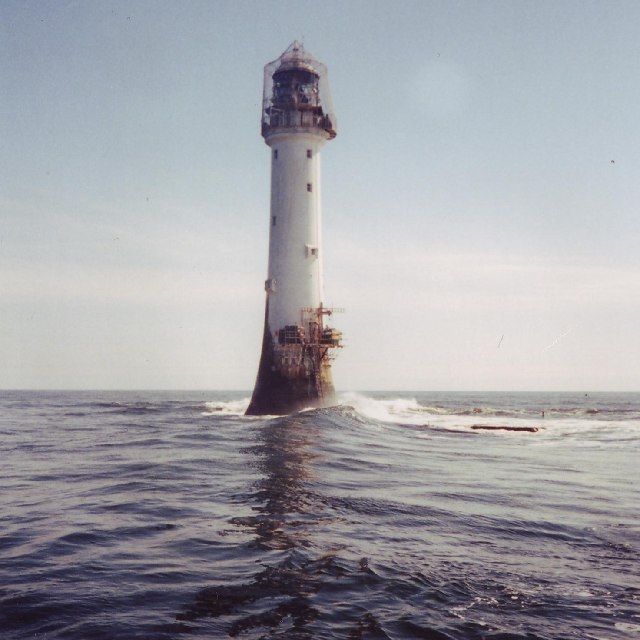
The Bell Rock Lighthouse, off the coast of Angus, Scotland, is the world's oldest surviving sea-washed lighthouse.[4] It was built between 1807 and 1810 by Robert Stevenson on the Bell Rock (also known as Inchcape) in the North Sea, 11 miles (18 km) east of the Firth of Tay. Standing 35 metres (115 ft) tall, its light is visible from 35 statute miles (56 km) inland.[1]
Key Information


The masonry work on which the lighthouse rests was constructed to such a high standard that it has not been replaced or adapted in 200 years.[5] The lamps and reflectors were replaced in 1843; the original ones are now in the lighthouse at Cape Bonavista, Newfoundland, where they are currently on display.[6] The working of the lighthouse has been automated since 24 October 1988.[1] The Northern Lighthouse Board, which has had its headquarters at 84 George Street in Edinburgh since 1832, remotely monitors the light.
The lighthouse previously operated in tandem with a shore station, the Bell Rock Signal Tower, built in 1813 at the mouth of Arbroath harbour. Today this building houses the Signal Tower Museum, a visitor centre that offers a detailed history of the lighthouse.
Because of the engineering challenges that were overcome to build the lighthouse, it has been described as one of the Seven Wonders of the Industrial World.[7]
History
[edit]According to legend, Bell Rock got its name because, in the 14th century, the Abbot of Arbroath had had a warning bell installed on it, which was stolen a year later by a Dutch pirate. (This legend is immortalised in "The Inchcape Rock", a poem by the 19th-century poet Robert Southey.)
Before the construction of the lighthouse, the rock had caused many shipwrecks because, except for a few hours a day at low tide, it lies just below the surface of the sea. By the turn of the 19th century, it was estimated that, in a typical winter, as many as six ships were wrecked on the rock. (In one storm, seventy ships had been lost off the east coast of Scotland.)
Planning
[edit]In 1799, the Masters of Trinity House in Leith (who oversaw most of the shipping issues on the eastern coast) determined to build a light on the Bell Rock, due to the high numbers of losses. They commissioned Scottish engineer Robert Stevenson to devise a design for a lighthouse on the Bell Rock, but the proposal was shelved due to concerns about cost, the relatively radical nature of the proposed design and Stevenson's relative youth. The cost would be borne by the east coast towns (as it was not only Dundee ships being lost).[8]
However, after the warship HMS York was wrecked on the rock in 1804 (and all aboard perished)—causing a furore in Parliament—Stevenson sent his design to the renowned engineer John Rennie. Rennie approved the design and cost estimate, which led to the passage of the Cape Rock Lighthouse (Scotland) Act 1806 (46 Geo. 3. c. 132) approving the proposal and enabling construction to begin.[9]
The Northern Lighthouse Board awarded Rennie the contract to design and build the lighthouse and appointed Stevenson as chief assistant.[10] The design was based on the earlier Eddystone Lighthouse, which had been designed by John Smeaton, and which Stevenson had visited and studied in detail in 1801[11]—it too was built on an offshore reef using interlocking stones.[12] The Bell Rock lighthouse contained several newer features, such as the rotating lights alternating between red and white that were designed by the carpenter Francis Watt.[13] Stevenson's written account of the work gave little or no credit to Rennie, and questions about "[t]he apportionment of responsibility for this work led to prolonged disputes between their respective descendants, but it is now certain that while Stevenson designed the lighthouse in the main, Rennie's role too was significant."[14]
Construction
[edit]
In 1807, Stevenson hired 60 men (including a blacksmith so that the pickaxes used to cut the foundations could be re-sharpened on site). Stevenson did not want to use black powder as it might have damaged the rock on which the lighthouse was to stand. The workers set sail for the rock on 17 August 1807, and would be away for two months.[15] While initially some workers had been reluctant to agree to work even on the Sabbath in order to complete the lighthouse on time and on budget, in the end, all but four of the workers agreed to do it, and even those four (who were stonemasons) eventually also worked on Sundays.[16]
Because the rock was covered by water for 20 hours each day (up to 12 feet (3.7 m) of water at high tide), the men lived at first on a ship moored 1 mile (2 km) off the rock, requiring the workers to row out to the rock and back in boats each day, which was time-consuming, and at one point, one of the boats went adrift and was lost. So the workers’ first task was to build a beacon house on tall wooden struts on the reef surrounding the rock, with places for up to 15 men, so that workers would have a place to stay on site. The foundations and beacon legs were raised during the first season. Then, in the winter, work at the rock was paused as stonemasons cut rocks for the lighthouse out of Cairngall granite.[17][15]
In early 1808, work at the rock resumed. The beacon house barracks was completed and the first three courses of stone for the lighthouse were laid. In the whole of this second season only 80 hours of building work took place on the rock. During this time, while the beacon house barracks were still under construction, a young worker was knocked unconscious by a buoy ring and drowned. As he had been the primary breadwinner for his family, Stevenson offered the now-vacant position to his younger brother, Alexander Scott, who accepted.

In September 1808, John Bonnyman, a stonemason, had to have a finger amputated following an accident with the beam crane on the Rock; as recompense for this mishap he was later appointed one of the first lighthouse keepers.[19]
Stevenson was frustrated by a visit from Rennie, in 1809, whom he saw as interfering with his work. As a strategy to ward off further visits, he wrote Rennie a total of 82 letters, asking detailed questions about a large range of construction issues (including what type of window putty and locks to use). Rennie replied in detail to every letter, but Stevenson largely ignored the replies.
In June 1809, one of the principal builders, Michael Wishart, was caught beneath a crane when it collapsed, and his feet were severely injured, preventing him from working further on the project.[20] He asked Stevenson if he could be appointed lighthouse keeper and he ultimately took up a position as assistant keeper in 1811.[21]
Work stopped on 22 August 1809, by which time a large part of the tower had been completed.[15]
In January 1810, Stevenson's twins died of whooping cough, and a fortnight later his youngest daughter Janet also died of this disease. Rennie wrote Stevenson a consoling letter. During this final period of construction the lighthouse became something of a tourist attraction. Many people were anxious to see the completion of the tallest off-shore lighthouse in the world. In this final season, while the men were staying in the beacon house, a 7-hour storm struck. Worker Charles Henderson was lost, and his body was never found. Work was finally completed after having consumed about 2500 granite stones, all drawn by one horse, Bassey.[15]
Ultimately, the project came in 50 percent above the original estimate of £42,000 (2009: £2,490,000) budget.[22] Since the construction of the lighthouse the only recorded shipwrecks have been that of HMS Argyll during wartime blackouts in 1915 and the Banff-registered cargo vessel Rosecraig that ran aground in fog on the evening of 21 September 1908, and sank. Her seven crew members were saved.[23]
Operation
[edit]The tower was automated in 1988.[24] Superintendence and management of the light remains the responsibility of the Northern Lighthouse Board, as part of their responsibility for Scotland and the Isle of Man.[25] For example in 2025 they sought planning permission to repair the access path from the helipad across the rock to the lighthouse.[25]
Incidents
[edit]Loss of HMS Argyll
[edit]
The lighthouse on the rock had been ordered to switch its lights off during the First World War for fear of assisting German U-boats in their operations, and the light was only turned on by special permission. On 28 October 1915 while in view of the lighthouse, HMS Argyll under the command of Captain James Tancred sent a signal requesting the light to be turned on. The ship proceeded on its course believing the signal had been received, but it had not and the light was not switched on. Soon afterwards, Argyll ran aground, suffering extensive damage to much of the hull. Two destroyers—HMS Hornet and HMS Jackal—assisted in the rescue of her crew. Despite the damage, there were no fatalities among her crew. After all valuable items onboard had been salvaged, including her 6-inch (150 mm) guns, she was blown up by the naval salvage team.[26] In 1970, her two large propellers were recovered by divers and sold for scrap.
1955 helicopter accident
[edit].jpg)
On 15 December 1955, RAF Bristol Sycamore helicopter XG501, crewed by Flight Sergeant P. A. Beart and Sergeant E. F. Hall, departed from RAF Leuchars at 09:35 to perform a sea-winching exercise at the Bell Rock lighthouse. At approximately 10:00, the helicopter's tail rotor struck the anemometer on the top of the lighthouse, and as a result the aircraft crashed into the sea. The incident was witnessed by the crew of a second helicopter that immediately transmitted a distress call and flew to the scene of the crash. In response to the distress signal, four aircraft, a further two Sycamore helicopters, an RAF rescue launch and three lifeboats searched the area, recovering the body of XG501's navigator; the body of the pilot was not recovered. The lighthouse was damaged, including the loss of its light, but its keepers were uninjured. Owing to bad weather, the lighthouse could not be repaired until after 20 December, when conditions permitted the delivery of supplies.[1][27]
Bell Rock Races
[edit]Several sailing clubs including Forth Corinthian at Granton and the East Lothian Yacht Club at North Berwick have used the Bell Rock and its lighthouse as a marker for yacht racing, typically attempted by amateur sailors in cruising yachts and running through the night.[28][29] Between 1973 and 2001, the course formed part of the Forth Yacht Clubs Association's Forth Offshore Group.[30]
In music and literature
[edit]Scottish musician Alastair McDonald re-worded a traditional song called The Mermaid's Tale, and set the scene on Bell Rock instead of the Eddystone light. The first verse runs:
- My father was the keeper of the Bell Rock Light
- And he married a mermaid one dark night
- And from this union there came three
- A codling and a kipper and the other was me
Arbroath musician Ian Lamb also slightly reworked the melody for the traditional song "Come All Ye Tramps and Hawkers" and wrote "The Bell Rock Light" to mark the lighthouse's bicentenary in 2011. The first verse runs:
- We left the town of old Arbroath and set out on the sea
- The wind blew from the east that day it proved cold company
- The Inchcape Reef was our plain aim where many lives were lost
- Countless ships had hit the rock at dreadful human cost
R. M. Ballantyne's novel The Lighthouse (1865) is centred on the construction of the Bell Rock Lighthouse.
See also
[edit]

- Cranhill, area of Glasgow with streets named after lighthouses, including Bell Rock
- List of Northern Lighthouse Board lighthouses
- Trinity House of Leith
References
[edit]- ^ a b c d "Bell Rock Lighthouse", Northern Lighthouse Board, archived from the original on 14 April 2012, retrieved 20 October 2009
- ^ Rowlett, Russ. "Lighthouses of Eastern Scotland". The Lighthouse Directory. University of North Carolina at Chapel Hill. Retrieved 9 May 2016.
- ^ "Northern Lighthouse Board - Bell Rock". Northern Lighthouse Board. Retrieved 20 January 2019.
- ^ "Bell Rock Lighthouse", David Taylor, retrieved 20 October 2009
- ^ Coast Revisted 19 August 2007 – BBC 2
- ^ "Cape Bonavista lighthouse", Foghorn Publishing, retrieved 2 September 2012
- ^ Cadbury (2003), pp. 65–106
- ^ Cassell's Old and New Edinburgh; vol. 6, ch. 24
- ^ Cadbury, Deborah (2003), Seven Wonders of the Industrial World, Fourth Estate, pp. 76–77, ISBN 9780007163045
- ^ Harman, Claire (2005), Robert Louis Stevenson, Harper Collins, p. 7
- ^ Harman (2005), p. 6
- ^ "Both engineers agree in describing the lighthouse as being a copy of Smeaton's Eddystone Tower with sundry improvements in details and dimensions."Boucher, Cyril Thomas Goodman (1963), John Rennie, 1761–1821: The Life and Work of a Great Engineer, p. 59
- ^ Boucher (1963), p. 61
- ^ Saint, Andrew. "Rennie, John (1761–1821)". Oxford Dictionary of National Biography. Oxford Dictionary of National Biography (online ed.). Oxford University Press. doi:10.1093/ref:odnb/23376. (Subscription, Wikipedia Library access or UK public library membership required.)
- ^ a b c d Seven Wonders of the Industrial World, BBC TV
- ^ Stevenson, Robert Louis (2011), Records of a Family of Engineers, Cambridge University Press, ISBN 9781108026611
- ^ McKean, Charles (1990). Banff & Buchan: An Illustrated Architectural Guide. Mainstream Publications Ltd. p. 163. ISBN 185158-231-2.
- ^ "Bell Rock Lighthouse". National Galleries: Collection. National Galleries of Scotland. Retrieved 18 January 2016.
- ^ "Operations of 1808", Bellrock.org.uk
- ^ Stevenson, Robert, The Bell Rock Lighthouse, Cambridge University Press, p. 82
- ^ "1811–1823". Bellrock.org.uk.
- ^ Lynn F. Pearson Lighthouses Volume 312 of Shire book, Osprey Publishing, 2003 ISBN 0-7478-0556-3
- ^ Banffshire Journal archives
- ^ Love, John A. (2015). "Chapter 5: A Most Dangerous Situation". A Natural History of Lighthouses. Dunbeath: Whittles Publishing Ltd. ISBN 978-1-84995-217-0.
- ^ a b Northern Lighthouse Board (6 February 2025). "Bell Rock Walkway – supporting information" (PDF). Marine license application. marine.gov.scot.
- ^ "HMS Argyll: Bell Rock, North Sea". Canmore. Royal Commission on the Ancient and Historical Monuments of Scotland. Archived from the original on 6 March 2014. Retrieved 6 March 2014.
- ^ "Helicopter Crash, Bell Rock Lighthouse", UK Parliament, 12 December 1955, archived from the original on 20 October 2012, retrieved 3 May 2011
- ^ "Bell Rock Race" (PDF). Fairwind, The Forth Corinthian Yacht Club Newsletter. July 1998. p. 4.
- ^ "Remembering Ken MacLean". East Lothian Yacht Club. 11 October 2022.
- ^ "FYCA History". Forth Yacht Clubs Association. Retrieved 21 October 2025.
Further reading
[edit]- Bathurst, Bella (2005), The Lighthouse Stevensons, Harper Perennial, ISBN 0-00-720443-4
- Seven Wonders of the Industrial World, BBC TV Series and DVD
- Cadbury, Deborah (2003), Seven Wonders of the Industrial World, Fourth Estate, ISBN 0-00-716304-5
- Cadbury, Deborah (6 January 2004), Dreams of Iron and Steel, Fourth Estate, ISBN 0-00-716306-1
- The Miracle Lighthouse, National Geographic Channel Documentary, October, 2007, BBC Production, 2003
External links
[edit]
- "Lighthouses". Northern Lighthouse Board.
- "History of the light". Northern Lighthouse Board. Archived from the original on 14 April 2012.
- "The Scottish Lighthouses". Lighthouses of Scotland and the Island of Man.
- "Bell Rock Lighthouse". A Reference Site for Stevenson's Bell Rock Lighthouse.
- Stevenson, Alan (1861). Biographical Sketch of the Late Robert Stevenson: Civil Engineer.
Read at the Royal Society of Edinburgh, at the meeting of 17 February 1851, and dealing at length with the Bell Rock Lighthouse
- Spencer, Christopher (2003). "Who Built the Bell Rock Lighthouse?". BBC, British history, Empire and Sea Power.
- "The Building of the Bell Rock". Archived from the original on 2 October 2011., from Stevenson, Robert Louis. "Records of a Family of Engineers". Scotsites. Archived from the original on 19 May 2007.
| International | |
|---|---|
| National | |
| Geographic |
|
| Other | |
Bell Rock Lighthouse
View on GrokipediaLocation and Site
The Inchcape Rock
The Inchcape Rock, also known as Bell Rock, is a perilous reef situated in the North Sea, approximately 11 miles (18 km) southeast of Arbroath on the east coast of Angus, Scotland, at coordinates 56°25′58″N 2°23′17″W.[1] The reef is composed of sandstone, a hard sedimentary rock, and extends roughly 1,400 feet in length by 300 feet in width at its broadest point.[6] At high tide, the rock is fully submerged, with water depths reaching up to 16 feet over its surface, rendering it invisible to mariners.[1] It becomes exposed only during low water of spring tides, typically for about two hours daily, allowing brief glimpses of its jagged form.[7] The reef's position in the shipping lanes to the Firths of Tay and Forth exposes it to intense North Sea storms, where waves can surge up to 70 feet high, compounding its threat to navigation and contributing to a history of shipwrecks.[8] The name "Inchcape" derives from the Gaelic "Innis Sgàib," meaning "the gully island" or "hummock isle," reflecting its low-lying, measured profile.[8] "Bell Rock" stems from a 14th-century legend recounted in historical accounts, in which the Abbot of Aberbrothok (modern Arbroath) installed a warning bell on a float moored to the reef to alert sailors; this aid was maliciously cut away by the pirate Sir Ralph the Rover, who later perished when his own vessel struck the rock in a storm.[1][8]Maritime Hazards and Historical Need
The Inchcape Rock, a submerged reef in the North Sea approximately 11 miles (18 km) southeast of Arbroath, presented severe navigational hazards to mariners throughout the 18th and early 19th centuries due to its position on busy shipping lanes between the Firths of Forth and Tay.[9] The rock, visible only during low tide for a few hours, lay hidden beneath turbulent waters during high tide and storms, leading to frequent collisions with vessels navigating the east coast of Scotland.[10] By the turn of the 19th century, estimates indicated that as many as six ships wrecked on the reef each typical winter, contributing to over 50 known losses in the 18th and early 19th centuries alone.[10] Notable disasters underscored the peril, including the wreck of the warship HMS York in January 1804, which struck the rock during a gale and sank with all 491 crew members aboard, marking one of the deadliest single incidents.[11] These shipwrecks exacted a profound human and economic toll on North Sea trade routes, vital for commerce between Scotland and northern Europe.[9] The loss of vessels carrying goods such as timber, wine, and other cargo disrupted fishing industries and coastal economies in Angus and Fife, where communities depended on safe passage for local trade and livelihoods.[9] Human casualties were staggering; for instance, the 1804 HMS York disaster alone claimed nearly 500 lives, while broader records from the period document hundreds more deaths from repeated strandings, forcing ships to detour northward in foul weather and exacerbating risks along the entire eastern seaboard.[11] The economic fallout included not only direct losses of ships and cargoes but also indirect burdens on salvage efforts and insurance, straining resources in ports like Arbroath and Dundee.[9] Early attempts to mitigate the rock's dangers proved ineffective before 1800, relying on rudimentary warnings that failed against the sea's fury. A medieval legend attributed to the 14th-century Abbot of Aberbrothock described the installation of a warning bell on a floating buoy, intended to ring in the swell and alert sailors, but it was reportedly cut loose by pirates, dooming subsequent vessels.[9] No verifiable records confirm such a device, and later efforts, including proposed beacons in the late 18th century, were abandoned due to the impracticality of maintaining markers on the shifting, wave-battered reef.[9] The escalating toll culminated in parliamentary action; following advocacy from engineers and traders, an Act of Parliament passed on 21 July 1806, commissioned the Northern Lighthouse Board to construct a permanent lighthouse, authorizing a £25,000 loan to address the longstanding hazard.[12]Design and Engineering
Architectural Features
The Bell Rock Lighthouse features a tapered cylindrical tower constructed primarily from interlocking granite blocks sourced from multiple quarries including Rubislaw (Aberdeen) for the outer courses, Mylnefield (near Dundee), and Craigleith, with granite for outer layers and sandstone for inner and upper courses, ensuring exceptional durability against relentless North Sea storms.[1][13] The structure stands 35 meters (115 feet) tall, with a base diameter of 12.8 meters (42 feet) widening slightly for stability before tapering to 4.6 meters (15 feet) at the lantern room; the lower 9 meters (30 feet) form a solid base to withstand wave impacts, above which lie five internal chambers connected by a spiral staircase of 96 steps.[1] Approximately 2,100 tons of dovetailed masonry were used in total, with individual blocks weighing up to 1.5 tons, designed to lock together without mortar in the foundational courses for enhanced resilience on the submerged reef.[13] The optical system originally comprised 24 Argand oil lamps, each with a 3/4-inch wick and paired with silver-plated parabolic reflectors of 25-inch diameter, mounted in a revolving frame powered by clockwork to produce Scotland's first rotating light, alternating between red and white sectors for directional guidance.[1] This innovative apparatus, visible up to 18 nautical miles, was later upgraded to a first-order dioptric (Fresnel) lens system in the early 20th century, followed by an electric lamp in the mid-1960s and a Dalén acetylene gas optic in 1988, maintaining the 18-nautical-mile range while improving reliability and efficiency.[1] Influenced by John Smeaton's 1759 Eddystone Lighthouse, the design by John Rennie, with Robert Stevenson as resident engineer adapting onshore principles for an offshore, sea-washed environment, incorporating a storm-proof balcony gallery at 28 meters (92 feet) for maintenance access and a ventilating ball atop the cupola to regulate air flow and prevent condensation within the lantern room.[9] These features, including the circular base and robust interlocking masonry, prioritized withstanding extreme conditions, with the gallery serving as a refuge during gales and the ventilation system ensuring clear optics.[9] The tower used four types of stone: granite from Rubislaw and Cairngall quarries for the outer layers, and sandstone from Mylnefield and Craigleith for inner and upper courses.[13]Innovative Construction Methods
The construction of the Bell Rock Lighthouse necessitated innovative prefabrication techniques to maximize efficiency during the limited time available on the intertidal reef. Granite stones were meticulously dressed and shaped at a dedicated work-yard in Arbroath, Scotland, where molds crafted from seasoned fir timber ensured precise fitting for each course of the tower. Each stone was marked and numbered according to its designated position, allowing for rapid assembly on-site; for instance, the first entire course was completed by June 4, 1808, while courses up to the 23rd were prepared by July 1809.[14][15] These prefabricated blocks, weighing up to several tons, were then transported by purpose-built vessels such as the Smeaton and Patriot, which made swift voyages across the Firth of Tay; the Smeaton, for example, delivered 136 stones over seven tides in 1808 and completed a round trip in just 20 hours on July 28 of that year.[16][17][18] On-site assembly relied on specialized methods adapted to the reef's submersion cycles and harsh marine environment. A temporary beacon house served as a critical base camp, erected starting August 18, 1807, with beams secured by iron bats in drilled holes and later expanded to include cabins, a kitchen, and a mortar gallery 25 feet above the rock; by June 19, 1809, it accommodated 23 artificers.[19][20] Below the high-water mark, stones were interlocked using dovetailed joints without mortar for enhanced stability, secured instead with oaken trenails, wedges, or iron stanchions to withstand wave forces; mortar was applied only above this level, with grouting completed in 1809.[21][22][23] Logistical innovations addressed the severe constraints of tidal exposure and workforce management. Operations were confined to approximately 70 workable days per year, with actual low-water labor limited to 2-3 hours per ebb tide, totaling around 265 hours in 1808 alone.[24][25] A rotating workforce of up to 60 persons, comprising artificers like masons and smiths alongside seamen, operated in shifts to optimize these windows; peaks included 52 workers simultaneously in 1808 and 57 on June 25, 1809.[23][26] Mechanical tools such as balance-cranes, derricks, and winch-machines—offering mechanical advantages of 15:1 or 60:1—facilitated heavy lifting without steam power, with the balance-crane capable of hoisting stones 30 feet high.[27][28][29] These approaches, detailed in engineer Robert Stevenson's contemporary account, enabled the tower's completion despite the site's inaccessibility.[9]Construction History
Planning and Challenges
The planning for the Bell Rock Lighthouse began in earnest in the early 1800s, driven by the persistent maritime hazards posed by the Inchcape Rock, which had claimed numerous vessels over the centuries. In 1806, an Act of Parliament (46 George III, c. 132) was passed on 21 June, authorizing the Northern Lighthouse Board to construct a permanent beacon or lighthouse on the site, along with a floating light as an interim measure; this legislation provided for a government loan of £25,000 and the levying of light dues (1.5 pence per ton for British vessels and 3 pence for foreign) to fund the project. John Rennie was appointed chief engineer in 1806, with Robert Stevenson appointed as resident engineer in 1807. Stevenson's design was approved by Rennie following consideration of competing designs from figures such as Captain George Brodie, Mr. Cooper, and Thomas Telford. Stevenson's selection for the resident role was influenced by his prior experience and the mentorship of his father-in-law, Thomas Smith, the Board's inaugural engineer who had groomed Stevenson for lighthouse projects after Robert's marriage to Smith's daughter Jean in 1797.[9][30][31] Surveys conducted in 1800 and 1807 were pivotal in shaping the plans, revealing the site's formidable obstacles. Stevenson's initial 1800 inspection, undertaken with James Haldane, measured the rock's exposed area at low tide as approximately 280 by 300 feet, with the highest point only 12 feet below high water, underscoring the need for a robust foundation to support a stone tower amid constant submersion. The 1807 surveys, involving Stevenson, John Rennie, and Peter H. Hamilton, further detailed the rock's configuration using pick-axes to trace outlines during brief low-tide windows; these assessments confirmed the medium level at 3 feet 3 inches above the low-water mark of spring tides and highlighted fissures requiring deep excavation for stability. Tidal exposure limited workable periods to just 2 to 3 hours per day at neap tides or up to 7 hours at springs, while storm risks were evident from events like the 1799 gale that reshaped the reef and the October 1807 tempest that displaced anchors during site evaluation.[9][32] Anticipated challenges extended beyond the environment to logistical, financial, and legal domains, with Stevenson's initial cost estimate pegged at £42,685 to cover materials, labor, and contingencies—though public speculation ranged from £20,000 to £100,000—ultimately exceeded by the project's actual expenditure of around £61,000 due to unforeseen delays and overruns. Worker safety posed acute risks, as demonstrated by the 1806 wreck of the supply vessel Traveller, which drowned five men en route to the site, emphasizing the perils of transporting crews and equipment in rough seas. Supply lines from Arbroath harbor, relying on vessels like the 40-ton sloop Smeaton, were vulnerable to weather disruptions, necessitating secure moorings and backup floating bases. Legally, the 1806 Act granted navigation rights and protections, including Admiralty authority to impress seamen for the work and safeguards against interference, while requiring public notices in newspapers to affirm the Board's jurisdiction over the isolated reef.[9][3][33]Building Process and Timeline
The construction of the Bell Rock Lighthouse began in the summer of 1807, when calm weather permitted the initial excavation of the foundation site on the submerged reef. On July 10, Robert Stevenson oversaw the ceremonial laying of the first foundation stone with a masonic rite, marking the start of operations after preliminary surveys and the mooring of the floating light vessel Pharos nearby. A workforce of around 50 artificers, including stonemasons, smiths, and joiners, along with 13 to 18 seamen, was transported daily via tenders such as the Smeaton, with work confined to brief windows around low tide during the summer months—typically allowing only about 70 effective working days per year due to seasonal storms and tidal constraints.[9][34] By late 1807, efforts focused on erecting a temporary beacon house for worker shelter, with iron bats fixed into the rock on August 18 and the structure's beams raised between October 1 and 6, accommodating up to 52 men by October 20. Progress was interrupted by severe weather, including a gale on September 2 that caused the tender Smeaton to break its moorings, stranding 32 workers who were rescued by a pilot boat in a perilous operation. The beacon was completed by October 6, providing essential protection for subsequent phases, after which the site was secured for winter with loosened chains to withstand surges. Artificers logged approximately 180 hours on the rock that season.[9][34] In 1808, operations resumed on May 25 with foundation deepening and stone laying, achieving the first full course of 123 dovetailed granite blocks (totaling 388 tons) by August 12. A workforce peaking at 62 men faced disruptions from a gale on June 8 that drove vessels to Leith Roads, and tragedy struck on September 21 when a worker was killed during the third course's completion. The season ended September 21 with 17 additional stones placed, after which Stevenson inspected the site on October 31. The following year, 1809, saw resumed work on May 27, with rapid advances including 57 stones laid in one day on June 24 and cooking facilities established on the beacon for 24 resident artificers. A violent gale from June 1 to 4 trapped 11 men overnight on the beacon, highlighting the site's hazards, but by August 25, the solid base reached 31 feet 6 inches above the rock, with 52 stones added that season and peak employment at 78.[9][34][32] The 1810 season commenced April 18 with a wooden bridge and balance crane installed, enabling the erection of upper courses; the final cargo of stones arrived by July 9, completing the 84th course and the tower structure by July 30, after which a fatal accident claimed another worker on October 16. With the workforce reduced to 22 artificers, the lantern room was glazed and fitted by October 23, including the ventilator ball. The entire project, spanning from July 1807 to completion in late 1810, encompassed roughly 1,020 calendar days but was limited by weather to focused summer efforts. On February 1, 1811, the 24 Argand lamps were lit for the first time, extinguishing the Pharos floating light and rendering the structure operational after four intensive seasons.[9][34][1]Operational History
Early Years and Keepers
Upon its completion in February 1811, the Bell Rock Lighthouse entered service with the exhibition of its light on the 1st, marking the end of reliance on the temporary floating light vessel Pharos and significantly enhancing navigation safety in the North Sea approaches to the Firths of Tay and Forth.[9] The structure, designed by John Rennie with Robert Stevenson as resident engineer, immediately accommodated three resident keepers in its upper chambers, with operations centered on maintaining the revolutionary revolving apparatus of 24 argand oil lamps backed by parabolic silvered reflectors, which produced alternating red and white flashes visible up to 15 nautical miles.[1] Initial habitation periods were limited to six weeks due to the isolation and harsh conditions, but these were soon extended to three months to allow for more sustainable rotations.[35] The keeper complement consisted of four men in total, with three stationed at the lighthouse and the fourth rotating to shore leave at the Arbroath signal station for family visits and resupply; John Reid, previously mate on the floating light, served as the first principal keeper.[36] Their duties encompassed winding the clockwork mechanism every four hours to rotate the light array, trimming wicks and replenishing oil reservoirs to ensure consistent illumination, maintaining detailed logbooks of weather, vessel sightings, and equipment performance, and signaling distress or navigational aid via flags or balls from the gallery.[9] Keepers also provided temporary refuge and assistance to any shipwreck survivors or pilots reaching the rock, underscoring the station's dual role in vigilance and humanitarian support.[37] These manual routines operated without interruption, even during storms that submerged the base up to 20 feet, demonstrating the tower's engineering resilience from the outset.[1] The lighthouse's activation correlated with a marked decline in maritime casualties on the Inchcape Reef, which had previously claimed dozens of vessels annually, including over 70 in a single 1799 storm along the adjacent coasts; post-1811 records indicate no confirmed losses directly attributable to the rock itself until wartime disruptions over a century later.[9] This effectiveness stemmed from the light's innovative catadioptric design, which not only pierced fog and darkness but also alerted mariners to the reef's hazards through its distinctive flash sequence, thereby safeguarding vital trade routes.[38] Early enhancements focused on optical efficiency, with the original argand lamps—each burning spermaceti oil in a circular wick for up to 18 hours—refined in the 1820s through the addition of frost-proof reservoirs and surplus oil trays to combat winter icing.[38] By the 1840s, further modernization arrived with the replacement of the parabolic reflectors in 1849 by Thomas Stevenson's hemispherical multi-lamp array incorporating Fresnel prisms, which amplified intensity while reducing fuel consumption.[38] Concurrently, fog bells weighing 5 hundredweight each were installed and integrated into the revolving mechanism, rung continuously in poor visibility to supplement the visual signal and address the limitations of light alone in dense weather.[38]Automation and Modern Maintenance
The Bell Rock Lighthouse was converted to fully automatic operation on 26 October 1988, marking the end of manned service and the installation of a Dalen acetylene gas optic to replace the previous electric system from 1964.[1][39] This automation eliminated the need for resident keepers, who had previously managed the light through a rotation system involving relief crews.[39] Since then, the lighthouse has been remotely monitored and controlled by the Northern Lighthouse Board from its headquarters at 84 George Street in Edinburgh, using electronic systems that transmit operational data via a linked coastal station.[1] Subsequent technological upgrades have focused on enhancing efficiency and sustainability. In 1988, during automation, solar panels were installed around the lantern gallery to charge batteries that power the optic's rotation and auxiliary systems, supplemented by a diesel generator for backup during extended low-light periods.[40][41] These solar installations have made the lighthouse more environmentally friendly, reducing reliance on fossil fuels while maintaining reliable operation in its remote offshore location.[39] Ongoing trials and refinements to solar power continue to address energy demands amid increasing storm intensity linked to climate change. Maintenance efforts emphasize preservation of the structure's integrity, given its Category A listed status granted on 23 March 1998 by Historic Environment Scotland, recognizing its exceptional architectural and historical significance.[41] The Northern Lighthouse Board conducts annual inspections and routine upkeep, typically involving teams of technicians who access the site by helicopter or boat during low-tide windows, performing tasks such as structural surveys, equipment checks, and repairs to weather-exposed elements.[42] Recent work has included the replacement of a storm-damaged walkway connecting the helipad to the tower in 2024, with further repairs planned into 2025 to mitigate erosion from intensified coastal weathering attributed to climate change.[43] In contemporary maritime navigation, the Bell Rock Lighthouse complements GPS and electronic aids by providing a vital visual reference point, particularly in conditions of poor visibility or GPS signal disruption, ensuring redundancy for safe passage around the hazardous Inchcape Reef.[44] Its continued operation underscores the enduring role of traditional aids to navigation in supporting modern shipping routes.[45]Incidents and Legacy Events
Shipwrecks and Rescues
The Bell Rock, a hazardous reef submerged for most of the day except at low tide, was a major peril to shipping along Scotland's east coast for centuries prior to the lighthouse's construction, claiming numerous vessels and lives in its treacherous waters. Historical records indicate that between 1793 and 1803, at least four ships were known to have wrecked on the rock, including two fishing smacks en route from London to Banff, a brig from Holland, and a sloop from Hamburg, as reported by Leith traders to underscore the need for a navigational aid.[9] In the devastating storm of December 1799, approximately 70 vessels were stranded or lost along the nearby eastern Scottish coast, with many casualties attributed to the area's reefs, including the Bell Rock, highlighting the rock's deadly reputation.[9] On average, around six ships perished on the reef each winter in the early 19th century, contributing to thousands of lives lost over time in this busy shipping corridor.[2] Following the lighthouse's activation in 1811, shipwrecks on the Bell Rock dramatically declined, demonstrating its immediate effectiveness in maritime safety. The only recorded losses since construction have been two incidents: the grounding of the steamer Rosecraig on 21 September 1908 during fog, with the crew of seven saved, and HMS Argyll on October 28, 1915.[2] The armored cruiser HMS Argyll, carrying 650 crew members, ran aground during a wartime blackout when the lighthouse light was extinguished to avoid aiding enemy submarines; despite the vessel catching fire and becoming a total loss after salvage teams scuttled it to prevent it from posing a further hazard, no lives were lost as the crew evacuated safely at high water.[46][47] The lighthouse keepers observed the grounding and alerted shore authorities, prompting the Arbroath lifeboat to launch and stand by, though it was not ultimately needed for rescue.[46] The lighthouse not only prevented wrecks but also facilitated direct rescue efforts by its keepers in the early decades of operation. Keepers, stationed in the tower with access to a dedicated lighthouse boat, assisted in extracting crews from distressed vessels near the reef during the 1820s, contributing to the saving of over 200 lives in the lighthouse's first few decades through timely warnings and interventions.[9] These efforts were part of a broader legacy, with the structure credited for averting thousands of potential wrecks in the heavily trafficked North Sea lanes by providing a reliable warning light, reducing local ship losses to near zero and safeguarding countless mariners.[48][30]Accidents and Safety Improvements
During the construction of the Bell Rock Lighthouse in the early 1810s, workers faced perilous conditions on the exposed reef, leading to several fatalities from accidents including drownings. One notable incident occurred on October 16, 1810, when Charles Henderson, a worker, slipped and fell while crossing the rope bridge between the temporary beacon house and the lighthouse site, and was presumed drowned in the surrounding waters. Another worker, Charles Land, died from a cold and fever following a boat capsizing during operations, while William Walker was killed when a heavy stone crushed his thigh. These early mishaps highlighted the extreme risks of building on a submerged rock only visible at low tide, prompting immediate attention to rudimentary safety measures like reinforced access structures, though construction continued under tight timelines.[36] During World War II, the lighthouse endured attacks by enemy aircraft. It was machine-gunned on 31 October 1940, 30 March 1941, and 5 April 1941, with a bomb dropped approximately 10 yards from the tower base on 1 April 1941. Damage was minor, including nine bullet holes in the dome, 14 broken lantern panes, four damaged lens prisms, six smashed red shades, and harm to a balcony tank, rail, and astragal. No injuries occurred, and the light was exhibited only for Allied shipping.[49] The most significant operational accident at the Bell Rock Lighthouse occurred on December 15, 1955, when a Royal Air Force Sycamore helicopter from RAF Leuchars crashed into the lantern gallery during an unauthorized low-level flight intended to drop newspapers and magazines to the keepers as a goodwill gesture. The impact killed the two RAF crew members, Flight Sergeant Percy Albert Beart and Sergeant Edward Francis Hall; the lighthouse keepers were unhurt but assisted in the aftermath. The lighthouse's light was temporarily extinguished, and structural damage required repairs once weather permitted access. This tragedy, occurring amid heavy seas sweeping the rock, underscored the dangers of aerial approaches to remote sea-washed lighthouses without standardized protocols.[50][51][49][1] In response to such incidents, the Northern Lighthouse Board (NLB) implemented key safety enhancements over the decades, beginning with the introduction of radio communication in the 1920s to reduce isolation and enable rapid distress signaling from remote stations like Bell Rock. By the 1930s, a radio beacon was installed at the lighthouse, further improving navigational safety and keeper coordination with shore-based teams. Following the 1955 crash, helicopter access became a formalized relief method by the late 1950s, but with stricter operational guidelines, including mandatory weather assessments and no low-level maneuvers, to facilitate safer crew rotations and supply deliveries that previously relied on perilous boat climbs. These aerial operations evolved into routine procedures, supported by the lighthouse's helipad, which allows landings during favorable conditions.[52] Recent safety upgrades address ongoing environmental threats to access infrastructure; in 2024, amid intensified storm erosion, the NLB conducted repairs to replace the grated walkway from the helipad to the tower, which had been washed away, using durable materials to enhance resistance to wave impact and ensure reliable emergency access. In 2025, the NLB completed further erosion-resistant reinforcements to the helipad and pathways, informed by structural surveys, to mitigate risks from climate-driven sea level rise and extreme weather. These improvements reflect the NLB's broader commitment to safety, where lessons from Bell Rock incidents have informed standardized protocols across its network, including mandatory training for helicopter operations, regular equipment inspections, and integrated communication systems to prevent recurrence of historical accidents.[43][53][54][55][56]Cultural Impact
In Literature and Folklore
The folklore of the Inchcape Rock, the perilous reef off Scotland's east coast where the Bell Rock Lighthouse was later built, revolves around a medieval legend of a warning bell installed by the Abbot of Aberbrothock to protect ships from the hidden danger. The tale recounts how a notorious pirate, Sir Ralph the Rover, maliciously cuts down the bell during calm seas, cursing the rock; months later, a storm causes his own vessel to crash upon it, fulfilling a prophetic retribution as he perishes with his crew. This cautionary story of hubris and divine justice was vividly captured in Robert Southey's ballad "The Inchcape Rock," first published in 1802, which dramatizes the events through rhythmic verse to emphasize moral consequences.[57] The lighthouse's construction inspired literary works that highlighted its heroic engineering amid isolation and danger. R.M. Ballantyne's 1865 novel The Lighthouse fictionalizes the project's four-year ordeal from 1807 to 1811, following a young blacksmith-turned-builder who aids engineer Robert Stevenson in erecting the tower on the submerged rock, weaving in themes of resilience, romance, and maritime peril through vivid depictions of storms and beacon-building.[58] Sir Walter Scott referenced the structure in his 1816 novel The Antiquary, where characters in a coastal Scottish town discuss its innovative design as a wonder that tames the sea's fury, reflecting contemporary awe at the feat.[59] In Scottish Romantic literature, the Bell Rock Lighthouse emerged as a potent symbol of human ingenuity conquering natural chaos, illuminating paths through darkness both literal and metaphorical while underscoring the sea's enduring threat. Scott's 1814 poem "Pharos Loquitur," composed during his visit to the site and later published, personifies the lighthouse as a steadfast sentinel—"A ruddy gem of changeful light / Bound on the dusky brow of night"—that guides mariners safely, evoking Romantic ideals of enlightenment, isolation, and defiant progress against elemental peril.[9][35]In Music, Art, and Modern Events
The Bell Rock Lighthouse has been a subject of artistic representation since the early 19th century, most notably in Joseph Mallord William Turner's watercolor Bell Rock Lighthouse completed in 1819. Commissioned for Robert Stevenson's Account of the Bell Rock Lighthouse, the painting depicts the structure enduring a violent storm in the North Sea, emphasizing its precarious yet enduring position on the reef. Housed in the Scottish National Gallery, the work captures the lighthouse's dramatic isolation and the fury of the surrounding waters, drawing from Stevenson's own descriptions of perilous conditions during construction.[60] Contemporary engravings from the same era further immortalized the lighthouse's construction, providing detailed visual records of the engineering feat. For instance, an 1810 engraving illustrates the balance beam mechanism used to lift stone blocks into place amid tidal constraints, highlighting the innovative techniques employed by the Stevenson family. These illustrations, often included in historical accounts like Stevenson's, served both documentary and inspirational purposes, showcasing the lighthouse as a symbol of human triumph over nature's hazards.[61] In music, the lighthouse's legend has inspired folk traditions and modern compositions rooted in Scottish maritime heritage. Adaptations of Robert Southey's 1802 poem "The Inchcape Rock," which recounts the folklore of a warning bell on the reef, have been set to music, including a 2014 melodrama narration by Timothy West with original score by Russell Hepplewhite, blending spoken verse with orchestral elements to evoke the tale's moral drama.[62] Scottish folk musician Alastair McDonald reimagined the traditional song "The Mermaid's Tale," relocating its narrative to the Bell Rock and transforming it into a cautionary sea ballad that echoes the site's perilous history. Contemporary tracks draw from this legacy in Scottish sea shanties, such as David Arkenstone's instrumental "Legend of Bell Rock" from his 1996 album Myths and Legends, which incorporates Celtic influences to portray the lighthouse as a mythical beacon guiding sailors through stormy seas.[62] Modern events celebrate the lighthouse's enduring cultural significance through maritime activities and commemorations. The annual Bell Rock Race, organized by clubs like the Forth Corinthian Yacht Club, has drawn sailors since at least the mid-20th century, featuring offshore courses around the reef that test navigation skills in the North Sea's challenging waters.[63] Tourism thrives via boat tours departing from Arbroath, operated by companies such as Inchcape Marine Services, allowing visitors to approach the structure for views of its architecture and surrounding wildlife, including seals and seabirds; these excursions operate year-round, weather permitting.[64] The 2011 bicentenary, marked as the "Year of the Light," included exhibits at the Signal Tower Museum in Arbroath with refurbished displays on the lighthouse's history, alongside regattas and fireworks, drawing thousands to honor its role in maritime safety.[65][66] Ongoing annual celebrations include the Bell Rock Music and Food Festival in Arbroath, held since around 2007, which features live music, local food, and ties into the area's maritime heritage associated with the lighthouse.[67]References
- https://en.wikisource.org/wiki/Page:Dictionary_of_National_Biography_volume_54.djvu/251