Hubbry Logo
BerlinettaBerlinettaMain
Open search
Berlinetta
Community hub
Berlinetta
logo
8 pages, 0 posts
0 subscribers
Be the first to start a discussion here.
Berlinetta
Berlinetta
from Wikipedia
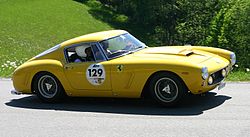
Ferrari 250GT Berlinetta SWB

A berlinetta (from Italian: berlinetta; Italian pronunciation: [berliˈnetta]) is a sports coupé, typically with two seats but also including 2+2 cars.[1] The original meaning for berlinetta in Italian is “little saloon”,[2] derived from the Berlin carriage. Introduced in the 1930s, the term was made popular by Ferrari in the 1950s. Maserati, Opel, Alfa Romeo, Volkswagen, and other European car manufacturers, as well as Chevrolet in the United States,[3] have used berlinetta as model label.

Berlinette

[edit]

Berlinette is the French name for a Berlinetta, which is defined as a sporty, low-profile two-door type of automobile body style closely related to the coupé.[4]

After World War II, the term came to refer to a small vehicle with enclosed coachwork similar to a two-door berline, or sedan in France. It supplanted use of the term "coach" for a similar but older body style, which had replaced the even older term "demi-berline".[5]

The most common recent usage was in reference to the Alpine A110 sports car, which was often simply called "la Berlinette".[6]

References

[edit]
Revisions and contributorsEdit on WikipediaRead on Wikipedia
from Grokipedia
A berlinetta is a sports coupé automobile body style featuring a two-door configuration with a closed , typically designed for two passengers but occasionally accommodating seating, emphasizing a low-slung, aerodynamic profile for enhanced performance and elegance. The term "berlinetta" derives from Italian, serving as the diminutive form of "berlina," which translates to "saloon" or sedan, literally meaning "little saloon." The berlinetta style originated in during the 1930s as a compact, sportier evolution of traditional saloon designs, initially applied to custom-bodied luxury and cars. It gained prominence in the post-World War II automotive landscape, particularly through Italian manufacturers seeking to blend grand touring comfort with competitive racing capabilities. Ferrari played a pivotal role in popularizing the term starting in the late 1940s, with its first informal use on models like the 166 S and official adoption by 1956 on the 250 GT Berlinetta, which set benchmarks for the style's blend of speed, style, and exclusivity. Over the decades, the berlinetta has become synonymous with high-performance grand tourers from brands such as , , and , influencing iconic models like the GTB/4 Daytona Berlinetta (produced from 1968 to 1973 with 1,284 units) and the series prototypes. These vehicles often feature mid- or front-engine layouts, sophisticated chassis, and coachwork by renowned design houses like and Bertone, prioritizing both road usability and track prowess. In modern contexts, the term endures in production models like the , as well as more recent models like the 296 GTB (2021) and 12Cilindri (2024), underscoring its lasting appeal in the evolution of sports car design.

Definition and Etymology

Term Origin

The term "berlinetta" is the form of "berlina" in Italian, where "berlina" originally referred to a closed saloon , evolving to denote a "little saloon" by the early in automotive contexts. This linguistic root traces back to the French "berline," a type of enclosed four-wheeled named after its origins in during the , which influenced European for passenger vehicles. The adaptation to "berlinetta" reflected the shift toward more compact designs as automobiles replaced horse-drawn conveyances. The term entered automotive usage in during , marking its first documented applications to compact, enclosed two-door coaches that prioritized streamlined over larger saloon bodies. These early berlinettas were distinguished from the broader "coupé" category—typically a fixed-roof, two-door —by their emphasis on a sporty, low-slung profile optimized for enhanced and in or grand touring scenarios. This Italian designation also lent itself to the French "berlinette," a direct linguistic adaptation used for analogous small, sporty coupes in Francophone markets.

Linguistic Variants

The Italian-derived term "Berlinetta" has been adapted primarily in French as "Berlinette," serving as an equivalent descriptor for sporty, low-profile two-door coupés in automotive . This variant originated in the mid-20th century within French automotive press and manufacturer terminology, reflecting a direct linguistic borrowing tailored to French conventions. In French usage, "Berlinette" often connotes designs emphasizing lightness and agility, particularly those oriented toward and high-performance driving, as exemplified by the (produced from 1962 to 1977). This subtle shift in implication distinguishes it from broader coupé classifications, highlighting a focus on compact, responsive vehicles suited to dynamic applications. English and other non-Italian languages exhibit rare variants, with the original "Berlinetta" typically borrowed without alteration, as evidenced by its adoption in American marketing contexts. For example, Chevrolet employed the term directly for premium coupé models in the late , integrating it into English-language product naming to evoke Italianate sophistication.

Design Characteristics

Body Style Features

A berlinetta features a standard two-door configuration with a fully enclosed cabin, typically accommodating two passengers or, in some variants, a seating to provide limited rear space. This layout emphasizes a low roofline that contributes to its sleek , paired with an elongated hood that extends forward to achieve balanced proportions and a sporty stance. The term itself derives from the Italian diminutive of "berlina," meaning "little saloon," underscoring its compact yet luxurious form. Aerodynamic efficiency is a hallmark of the berlinetta's design, often manifested through a sloped rear roofline that tapers smoothly to reduce drag, along with minimal front and rear overhangs to optimize and stability. In Italian examples, these elements frequently incorporate fluid, curvaceous lines inspired by the styling of coachbuilder , enhancing both visual elegance and performance-oriented functionality. What distinguishes the berlinetta from conventional sedans or standard coupés is its sporty, lightweight construction, which prioritizes and ; early models commonly employed aluminum panels over tubular frames to minimize weight while maintaining structural integrity.

Performance and Engineering Aspects

Berlinettas commonly employ engine layouts—front, rear, or mid-mounted—that optimize for superior handling and , often achieving a near-ideal 50/50 balance to minimize understeer during cornering and enhance traction on driven rear wheels. In classic performance-oriented examples, engine outputs typically ranged from approximately 100 horsepower in early Italian designs to over 500 horsepower in more advanced variants, enabling top speeds exceeding 150 mph while maintaining drivability. Engineering efforts in Berlinettas prioritize lightweight constructions, such as tubular frames or semi-monocoque aluminum structures, to reduce overall mass and improve dynamic responsiveness. These are paired with systems—often featuring double wishbones and coil springs at all four corners—to deliver precise control and agility suitable for both winding roads and track use. Such setups lower the center of gravity and unsprung weight, contributing to the car's neutral handling characteristics without compromising structural integrity. A core aspect of Berlinetta is the balance between grand touring comfort for extended journeys and racing-inspired performance elements, including tuned and robust braking systems. In modern berlinettas, features like active aero devices and carbon-ceramic discs provide high-speed stability and rapid deceleration, while adaptive dampers ensure a compliant ride over varied surfaces. The body's low profile further supports these traits by reducing aerodynamic drag, allowing for efficient high-velocity travel.

Historical Development

Early Italian Origins

The Berlinetta style originated in during , evolving as a compact, enclosed two-door coupé that blended sporting performance with practical weather protection, distinct from the prevalent open tourers of the prior decade. This design shift was propelled by the growing emphasis on in European , where enclosed bodies reduced drag and improved high-speed stability during endurance races like the and . Manufacturers such as and Lancia pioneered these vehicles on lightweight derived from racing platforms, prioritizing speed and handling over luxury. Alfa Romeo's 6C 1750, introduced in 1929 and produced through 1933 with approximately 2,635 units built, stands as one of the earliest exemplars of the Berlinetta form. Powered by a 1,752 cc twin-cam inline-six engine—available in naturally aspirated (64 hp) or supercharged (85 hp) variants—the model achieved top speeds of up to 95 mph on its flexible with an 108-inch . Berlinetta variants excelled in competition, securing multiple victories including 1-2-3 finishes at the in 1929 and 1930, driven by aces like and Giuseppe Campari. The term "Berlinetta" itself gained currency in this period to denote these diminutive saloons, reflecting their Italian roots in compact, performance-focused coachwork. Coachbuilders were instrumental in shaping the Berlinetta's aesthetic and engineering, often fabricating bespoke bodies on Alfa Romeo's racing-derived chassis to optimize weight and airflow. Carrozzeria Touring Superleggera, renowned for its innovative Superleggera construction using aluminum tubes and fabric panels, produced lightweight Berlinettas like the 1931 6C 1750 GT Aerodinamica, which weighed only 140 kg for its body and claimed class honors at the 1933 Mille Miglia. This teardrop-shaped design exemplified the era's aerodynamic focus, bridging road use with track prowess. Zagato complemented these efforts by applying aviation-inspired aluminum framing to Alfa Romeo 6C chassis from the late 1920s onward, creating sporty enclosed variants that emphasized agility and visual flair for privateer racers. Lancia contributed to the Berlinetta's early development with the , launched in and featuring V4-powered Berlinetta bodies tested in wind tunnels for superior streamlining. These models, weighing around 880 kg, underscored the transition to monocoque-integrated designs that enhanced torsional rigidity for demands, aligning with Alfa Romeo's innovations in a competitive Italian landscape. By the late , such enclosed sports cars had become symbols of Italy's automotive ingenuity, setting the stage for broader adoption amid the continent's racing fervor.

Post-War Evolution and Ferrari Influence

Following World War II, Enzo Ferrari embraced the Berlinetta body style to expand his company's road car offerings, marking a pivotal shift toward accessible grand tourers derived from racing pedigree. In 1954, Ferrari introduced the 250 GT Coupé at the Paris Motor Show, its first standardized production model aimed at everyday motorists rather than bespoke racers. This Berlinetta featured the Colombo V12 engine, originally honed for competition, delivering a balance of refined road usability—such as improved comfort and reliability—and performance technology that contributed to class victories at the 24 Hours of Le Mans in 1959. By 1956, Enzo formalized the "Berlinetta" designation with the 250 GT Berlinetta, solidifying the style as a core Ferrari archetype. Through the 1960s and into the 1970s, Ferrari refined the Berlinetta's engineering, evolving from long-wheelbase designs to shorter, more agile variants like the 250 GT SWB Berlinetta, which enhanced handling while maintaining grand touring poise. The 365 GTB/4 Daytona, produced from 1968 to 1973, represented the zenith of front-engine Berlinettas with its quad-cam V12 and aerodynamic styling, achieving top speeds over 170 mph and influencing subsequent aesthetics through its blend of brute power and elegant lines. This era also heralded Ferrari's transition to mid-engine layouts, culminating in the 1973 365 GT4 Berlinetta Boxer, which repositioned the V12 behind the driver for superior weight distribution and track-inspired dynamics, setting a template for future high-performance coupés. Ferrari's Berlinettas standardized the format as a premium sports coupé category, elevating it from niche coachbuilt exclusives to desirable production vehicles with broader appeal. Early models like the 250 GT series saw annual outputs in the dozens, but by the Daytona, production scaled to 1,284 units, reflecting matured manufacturing and global demand that transformed the Berlinetta into an icon of automotive luxury and performance.

Notable Examples

Ferrari Berlinettas

The Ferrari 250 GT Berlinetta Lusso, introduced at the 1962 Paris Motor Show and produced through 1964, represented the pinnacle of the 250 series' grand touring elegance, featuring a Pininfarina-designed two-seater coupe body with smooth, flowing lines that emphasized the Berlinetta's compact, enclosed form. Powered by Gioacchino Colombo's iconic 3.0-liter V12 engine delivering approximately 240 horsepower, it combined refined road manners with sporting prowess on a 2,400 mm wheelbase chassis weighing 1,020 kg dry. A total of 350 units were built, making it a rare and coveted classic that bridged Ferrari's competition heritage with luxury grand touring. Succeeding the 250 series, the 275 GTB from 1964 to 1968 advanced Ferrari's engineering with the introduction of independent rear suspension and an all-synchromesh five-speed gearbox, all housed in a Pininfarina-styled Berlinetta body that refined the previous model's proportions for better and driver visibility. Its 3.3-liter Colombo V12 produced 280 horsepower, enabling a top speed of 258 km/h, while approximately 785 units were manufactured across its variants, including the later four-camshaft 275 GTB/4. This model solidified Ferrari's reputation for blending high performance with everyday usability in the Berlinetta format. The 365 GTB/4, popularly known as the Daytona and produced from 1968 to 1973, epitomized the front-engine Berlinetta's evolution with its aggressive design, featuring a long hood and hidden headlights that evoked Ferrari's racing pedigree. Equipped with a 4.4-liter V12 generating 352 horsepower, it achieved a top speed exceeding 280 km/h, with 1,284 examples built before emissions regulations prompted its retirement. Complementing these V12 icons, the 308 GTB of 1975 to 1980 marked Ferrari's shift to mid-engine layout in production Berlinettas, introducing a 2.9-liter V8—the company's first in a road car—producing 255 horsepower and powering a total production of approximately 3,000 units, the initial models featuring bodies for weight savings. These Berlinettas played a pivotal role in Ferrari's dominance of GT racing during the 1950s and 1960s, with the 250 series securing three consecutive victories in the rally from 1960 to 1962 and contributing to overall constructors' championships in the GT class. Their styling and V12 engines, later supplemented by flat-12 configurations in models like the 365 GT4 BB, established benchmarks for performance and aesthetics that influenced subsequent designs. Today, they command substantial collector value, with well-preserved 250 GT Lussos routinely auctioning for $1.5 million to $2 million, reflecting their enduring status as blue-chip investments in the market.

Other Italian Berlinettas

Beyond Ferrari, other Italian manufacturers produced notable berlinettas that exemplified the style's blend of performance and elegance. The 2900B Touring Berlinetta (1937–1939), with only 44 examples built, featured a supercharged 2.9-liter straight-8 producing up to 180 horsepower in racing tune, achieving speeds over 200 km/h; its aerodynamic coachwork by Carrozzeria Touring helped secure class victories at and the . Maserati's A6GCS/53 Berlinetta (1953–1955), limited to around 12 Pinin Farina-bodied units, utilized a 2.0-liter inline-6 delivering 170 horsepower, emphasizing lightweight construction and Grand Prix-derived engineering for both road and competition use, including successes in events like the .

Non-Italian Applications

The adoption of the "Berlinetta" designation outside Italy primarily occurred in American automotive marketing, where it was applied to upscale variants of mass-market s to evoke a sense of European . Chevrolet introduced the Berlinetta trim for its Camaro model in , positioning it as a luxury-oriented alternative to the standard sport , complete with enhanced interior appointments, refined styling cues, and a focus on comfort over raw performance. This trim continued through the transition to the third-generation Camaro in 1982, exemplified by the 1981–1986 models, which featured a base 2.8-liter with optional V8 powertrains, plush seating, woodgrain accents, and an absence of aggressive ground effects to emphasize ride quality and quiet cabin isolation. In contrast to the lightweight, handcrafted Italian originals, these American Berlinettas were heavier vehicles built for high-volume production on assembly lines, prioritizing affordability and broad appeal over exotic performance. Sales of the Camaro Berlinetta reflected its role as a popular luxury option within the segment, with production reaching approximately 67,236 units in 1979 and around 39,744 in 1982, though numbers declined to about 4,479 by 1986 as performance-oriented trims like the IROC-Z gained favor. While Chevrolet's use dominated non-Italian applications, the term appeared sporadically in European marketing for upscale coupes, such as by German manufacturer (e.g., Manta Berlinetta models), though these instances were limited and served mainly as stylistic references rather than defining model names.

References

Add your contribution
Related Hubs
User Avatar
No comments yet.