


Community hub
Recent from talks
Contribute something
Nothing was collected or created yet.
 | This article has multiple issues. Please help improve it or discuss these issues on the talk page. (Learn how and when to remove these messages)
|


_(cropped).jpg)

A sport utility vehicle (SUV) is a car classification that combines elements of road-going passenger cars with features from off-road vehicles, such as raised ground clearance and four-wheel drive.
There is no commonly agreed-upon definition of an SUV, and usage of the term varies between countries. Thus, it is "a loose term that traditionally covers a broad range of vehicles with four-wheel drive."[1] Some definitions claim that an SUV must be built on a light truck chassis; however, broader definitions consider any vehicle with off-road design features to be an SUV. A crossover SUV is often defined as an SUV built with a unibody construction (as with passenger cars); however, the designations are increasingly blurred because of the capabilities of the vehicles, the labelling by marketers, and the electrification of new models.[2]
The predecessors to SUVs date back to military and low-volume models from the late 1930s, and the four-wheel-drive station wagons and carryalls that began to be introduced in 1949. Some SUVs produced today use unibody construction; however, in the past, more SUVs used body-on-frame construction. During the late 1990s and early 2000s, the popularity of SUVs significantly increased, often at the expense of the popularity of large sedans and station wagons. SUVs accounted for 45.9% of the world's passenger car market in 2021.[3]
SUVs have been criticized for a variety of environmental and safety-related reasons. They generally have poorer fuel efficiency and require more resources to manufacture than smaller vehicles, contributing more to climate change and environmental degradation.[4] Between 2010 and 2018, SUVs were the second-largest contributor to the global increase in carbon emissions worldwide.[5] Their higher center of gravity increases their risk of rollovers. Their higher front-end profile makes them at least twice as likely to kill pedestrians they hit.[6][7][8] Additionally, the psychological sense of security they provide influences drivers to drive less cautiously,[9] and may in-turn, cause others with smaller vehicles to opt for SUVs in the future under the sense of security, all the while increasing the rate of fatalities of pedestrians.[10][11][12]
Definitions
[edit]There is no universally accepted definition of the sport utility vehicle.[13] Dictionaries, automotive experts, and journalists use varying wordings and defining characteristics, in addition to regional variations of usage by both the media and the general public. The auto industry also has not settled on one definition of the SUV.[13]
American English
[edit]Automotive websites' descriptions of SUVs range from specifically "combining car-like appointments and wagon practicality with steadfast off-road capability" with "chair-height seats and picture-window visibility"[14] to the more general "nearly anything with available all-wheel drive and raised ground clearance".[15] It is also suggested that the term "SUV" has replaced "jeep" as a general term for off-road vehicles.[16]
American dictionary definitions for SUVs include:
- "rugged automotive vehicle similar to a station wagon but built on a light-truck chassis"[17]
- "automobile similar to a station wagon but built on a light truck frame"[18]
- "large vehicle that is designed to be used on rough surfaces but that is often used on city roads or highways"[17]
- "passenger vehicle similar to a station wagon but with the chassis of a small truck and, usually, four-wheel drive"[19]
British English
[edit]In British English, the terms "4x4" (pronounced "four-by-four"), "jeep", four wheel drive, or "off-road vehicle" are generally used instead of "sport utility vehicle".[citation needed] The sardonic term "Chelsea tractor" is also commonly used, due to the perceived popularity of the vehicles with urban residents of Chelsea, London, and their likeness to vehicles used by farmers.[20]
The Collins English Dictionary defines a sport utility vehicle as a "powerful vehicle with four-wheel drive that can be driven over rough ground. The abbreviation SUV is often used."[21]
Other countries
[edit]In Europe, the term SUV is generally used for road-oriented vehicles, described as "J-segment" by the European Commission.[22][23][24] "Four-by-four" or the brand name of the vehicle is typically used for off-road-oriented vehicles. Similarly, in New Zealand, vehicles designed for off-road use are typically referred to as "four-wheel drives" instead of SUVs.
Government regulations
[edit]In the United States, many government regulations simply have categories for "off-highway vehicles" which are loosely defined and often result in SUVs (along with pick-up trucks and minivans) being classified as light trucks.[13][25] For example, corporate average fuel economy (CAFE) regulations previously included "permit greater cargo-carrying capacity than passenger carrying volume" in the definition for trucks, resulting in cars with removable rear seats, like the PT Cruiser, being classified as light trucks.[26]
This classification as trucks allowed SUVs to be regulated less strictly than passenger cars under the Energy Policy and Conservation Act for fuel economy, and the Clean Air Act for emissions.[27] However, from 2004 onwards, the United States Environmental Protection Agency (EPA) began to hold sport utility vehicles to the same tailpipe emissions standards as cars for criteria pollutants, though not greenhouse gas emissions standards as they were not set until 2010.[28][29] In 2011, the CAFE regulations were changed to classify small, two-wheel-drive SUVs as passenger cars.[30]
However, the licensing and traffic enforcement regulations in the United States vary from state to state, and an SUV may be classified as a car in some states but as a truck in others.[31] For industry production statistics, SUVs are counted in the light truck product segment.[32]
In India, all SUVs are classified in the "Utility Vehicle" category per the Society of Indian Automobile Manufacturers (SIAM) definitions and carry a 27% excise tax.[33] Those that are 4 metres (13 feet) long, have a 1,500 cc (92 cu in) engine or larger, along with 170 mm (6.7 in) of ground clearance, are subject to a 30% excise duty.[34]
In Australia, SUV sales were helped by having lower import duties than passenger cars. Up until January 2010, SUVs were subject to a 5% import tariff, compared with 10% for passenger cars.[35][36]
Higher parking fee
[edit]In February 2024, voters in Paris mandated a triple parking charge rate for SUVs, citing environmental impact and street capacity; this followed similar decisions in Lyon and Tübingen with similar ordinances being considered by London, Brussels and Amsterdam.[37]
Characteristics
[edit]Chassis
[edit]

Many years after most passenger cars had transitioned to unibody construction, most SUVs continued to use a separate body-on-frame method, due to being based on the chassis from a light truck, commercial vehicle, pickup truck, or off-road vehicle.
The first mass-produced unibody four-wheel-drive passenger car was the Russian 1955 GAZ-M20 Pobeda M-72,[38][39] which could be considered the first crossover car. The 1977 Lada Niva was the first off-road vehicle to use both a unibody construction and a coil-sprung independent front suspension. The relatively compact Niva is considered a predecessor to the crossover SUV and combines a hatchback-like passenger car body with full-time four-wheel drive, low-range gearing, and lockable center differential.
Nonetheless, unibody SUVs remained rare until the 1984 Jeep Cherokee (XJ) was introduced and became a sales success. The introduction of the 1993 Jeep Grand Cherokee resulted in many of Jeep's SUV models using unibody construction,[40] with many other brands following suit since the mid-1990s. Today, most SUVs in production use a unibody construction and relatively few models continue to use body-on-frame construction.
Body style
[edit]SUVs are typically of a two-box design similar to a station wagon. The engine compartment is in the front, followed by a combined passenger/cargo area (unlike a sedan, which has a separate trunk/boot compartment).
Up until approximately 2010, many SUV models were available in two-door body styles.[41] Since then, manufacturers began to discontinue the two-door models as the four-door models became more popular.[42][43][44]
A few two-door SUVs remain available, such as the body-on-frame Suzuki Jimny, Mahindra Thar, Toyota Land Cruiser Prado, Ford Bronco,[45] and Jeep Wrangler[46][47] as well as the Range Rover Evoque crossover SUV.
Safety
[edit]
SUVs typically have high ground clearance and a tall body. This results in a high center of mass, which made SUVs more prone to roll-over accidents.[48][49] In 2003, SUVs were quoted as 2.5 times more likely to roll over in a crash than regular cars.[48][50]
Between 1991 and 2001, the United States saw a 150% increase in sport-utility vehicle rollover deaths. In 2001, though roll-overs constituted just 3% of vehicle crashes overall, they caused over 30% of occupant fatalities in crashes;[48] and in crashes where the vehicle did roll over, SUV occupants in the early 2000s were nearly three times as likely to be killed as other car passengers.[48] Vehicles with a high center of gravity do sometimes fail the moose test of maneuverability conducted by Swedish consumer magazine Teknikens Värld, for example, the 1997 Mercedes-Benz A-Class and 2011 Jeep Grand Cherokee.[51]
The increasing popularity of SUVs in the 1990s and early 2000s was partly due to buyers perceiving that SUVs provide greater safety for occupants, due to their larger size and raised ride height.[48][52][53][54] Regarding the safety of other road users, SUVs are exempted from U.S. regulation stating that a passenger car bumper must protect the area between 16 and 20 inches (41 and 51 cm) above the ground. This often increases the damage to the other car in a collision with an SUV, because the impact occurs at a higher location on the other car.[55][56] In 2000–2001, 60% of fatal side-impact collisions were where the other vehicle was an SUV, an increase from 30% in 1980–1981.[57]
The introduction of electronic stability control (ESC) and rollover mitigation, as well as increased analysis of the risks of a rollover, led the IIHS to report in 2015 that "the rollover death rate of 5 per million registered vehicle years for 2011 models is less than a quarter of what it was for 2004 models. With ESC dramatically reducing rollover risk, the inherent advantages offered by SUVs' greater size, weight, and height emerge more clearly. Today's SUVs have the lowest driver death rate of any vehicle type."[58]
The high danger for cyclists and pedestrians of being seriously injured or even killed by SUV drivers has caused some public protests against SUVs in urban areas.[59] In 2020, a study by the U.S.-based IIHS found that, of a sample of 79 crashes from three urban areas in Michigan, SUVs caused more serious injuries compared to cars when impacts occurred at greater than 31 km/h (19 mph). The IIHS noted the sample size of the study was small and that more research is needed.[60] The popularity of SUVs contributed to an increase in pedestrian fatalities in the U.S. during the 2010s, alongside other factors such as distracted and drunk driving.[61]
A 2021 study by the University of Illinois Springfield showed that SUVs are 8 times more likely to kill children in a collision than passenger cars, and multiple times more lethal to adult pedestrians and cyclists.[62]
Environmental impact
[edit]SUVs generally have poorer fuel efficiency than smaller cars,[63] and thus contribute more to environmental degradation and global warming.
SUVs emit about 700 megatonnes of carbon dioxide per year,[4] a gas which is linked to global warming.[64] According to the International Energy Agency, from 2010 SUVs have been the second-largest contributor to the increase in global CO2 emissions, second only to the power sector.[4]
SUVs were responsible for all of the 3.3 million barrels a day growth in oil demand from passenger cars between 2010 and 2018, whereas efficiency improvements in smaller cars saved over 2 million barrels a day, with electric cars reducing oil demand by under 100,000 barrels a day.[4]
Whereas SUVs can be electrified,[65] or converted to run on a variety of alternative fuels, including hydrogen,[66] their (manufacturing) emissions will always be larger than smaller electric cars.[67] On average, SUVs consume about a quarter more energy than medium-size cars.[4] Furthermore, the vast majority of these vehicles are not converted to use alternative fuels.
Between 2010 and 2018 SUVs were the second largest contributor to the global increase in carbon emissions worldwide.[5]
Types of SUV
[edit]Crossover SUV
[edit]The "crossover SUV" segment (also known as "CUVs" or simply "crossovers") has become increasingly popular since around 2010. Crossovers are often based on a platform shared with a passenger car, as a result, they typically have better comfort and fuel economy, but less off-road capability (many crossovers are sold without all-wheel drive) than pickup truck-based SUVs.[68][69][70]
The difference between crossovers and other SUVs is sometimes defined as a crossover being built using a unibody platform (the type used by most passenger cars), while an SUV is built using a body-on-frame platform (the type used by off-road vehicles and light trucks).[71][72][73] However, these definitions are often blurred in practice, since unibody vehicles are also often referred to as SUVs.[74][75] Also, crossover is a relatively recent term and early unibody SUVs (such as the 1984 Jeep Cherokee) are rarely called crossovers. Due to these inconsistencies, the term SUV is often used as a catch-all for both crossovers and SUVs.[76]
Outside of the United States, the term crossover tends to be used for C-segment (compact) or smaller vehicles, with large unibody vehicles—such as the Mercedes-Benz GLS-Class, BMW X7, and Range Rover—usually referred to as SUVs rather than crossovers. In the United Kingdom, a crossover is sometimes defined as a hatchback model with raised ride height and SUV-like styling features.[77][78]
- Examples: Category:Crossover sport utility vehicles ( 344 )
Mini SUV
[edit]The smallest size class of SUVs is the "mini SUV". In Japan, SUVs under 3,400 mm (133.9 in)—such as the Mitsubishi Pajero Mini—are included in the kei car category and therefore attract lower taxes.
Many recent vehicles labeled as mini SUVs are technically subcompact crossovers and are built on the platform of a subcompact (also called supermini or B-segment) passenger car.
- Examples: Category:Mini sport utility vehicles ( 97 )
-
 Mitsubishi Pajero Pinin, mini SUV
 -
 Suzuki Jimny, off-road mini SUV


Compact SUV
[edit]The "compact SUV" is the next bigger-size class after mini SUVs.
Many recent vehicles labeled as compact SUVs are technically compact crossovers and are built on the platform of a compact (C-segment) passenger car.
- Examples: Category:Compact sport utility vehicles ( 200 )
-
 Nissan Xterra, compact truck-based SUV
 -

-
 Jeep Cherokee, unibody SUV

_at_IAA_2019_IMG_0688.jpg)
_Sport_01.jpg)
Mid-size SUV
[edit]The next larger size is called the "mid-size SUV". Some mid-size SUVs are based on platforms shared with passenger cars and therefore, are crossovers. Other mid-size SUVs are based on compact or mid-size pickups.
- Examples: Category:Mid-size sport utility vehicles ( 207 )
-
 Toyota Fortuner (also called SW4), mid-size truck-based SUV
 -
 Ford Bronco, off-road mid-size SUV with a compact two-door version available
 -
 Jeep Grand Cherokee, unibody mid-size SUV
_front_view.png)


Full-size SUV
[edit]Full-size SUVs are the largest size of commonly produced SUVs. Some, such as the Ford Expedition, and Chevrolet Tahoe, are marketed for their off-road capabilities, and others, such as the Lincoln Navigator and Cadillac Escalade, are marketed as luxury vehicles. While a few full-size SUVs are built on dedicated platforms; most share their platforms with full-size pickup trucks.
- Examples: Category:Full-size sport utility vehicles ( 102 )
-
 Jeep Wagoneer, full-size SUV on a pickup truck-based platform
 -
 Cadillac Escalade, full-size luxury SUV
 -
 Mercedes-Benz GLS-class, full-size unibody SUV


Extended-length SUV
[edit]Some North American SUVs are available as a long-bodied version of a full-size SUV, which is called an "extended-length SUV" like the Ford Expedition EL and the Chevrolet Suburban. The additional length is used to provide extra space for rear passengers or cargo. As per the full-size SUVs they are based on, most extended-length SUVs are built on dedicated platforms, full-sized pickups (1⁄2 ton), or heavy-duty pickups (3⁄4 ton or more).
Extended-length SUVs are mostly sold in North America but may also be exported to other markets in small numbers.
-
 GMC Yukon XL, extended-length SUV
 -
 Ford Excursion, extended-length SUV based on a heavy-duty truck platform
 -
 Range Rover L, extended-length unibody SUV


- Examples: Category:Expanded length sport utility vehicles ( 16 )
Coupe SUV
[edit]Some SUVs or crossovers with sloping rear rooflines are marketed as "coupe crossover SUVs" or "coupe SUVs", even though they have four side doors for passenger access to the seats and rear hatches for cargo area access.
History
[edit]1930s to 1948
[edit].jpg)

Just before and during World War II, prototypes and low-volume production examples of military cars with sedan or station wagon-type bodies and rugged, off-road capable four-wheel drive chassis began to appear around the world. These early models included the 1936 Kurogane Type 95 from Japan, the 1938 GAZ-61 from Russia as well as the 1941 Volkswagen Kommandeurswagen and 1936 Opel Geländesportwagen[79] from Germany. An early predecessor to the design of modern SUVs[citation needed] was the 1940 Humber Heavy Utility, a four-wheel-drive off-road vehicle built on the chassis of the Humber Super Snipe passenger car.[80]
The most prohibitive initial factors to the potential civilian popularity of an SUV-like car were their cost and the availability of certain critical parts. Before the war, adding four-wheel drive to a car almost doubled its cost.[81] Compared to a common, rear-wheel drive vehicle, any 4WD (four-wheel drive) needed many essential extra components, including a transfer case, a second differential, and constant-velocity joints for the driven front axle—which were expensive due to the precision involved in this required manufacturing gears and other specialized parts. Before World War II, these were produced in the United States by only a few specialized firms with limited production capacity. Due to the increase in demand for parts for the war effort, in the spring of 1942 Ford, Dodge, and Chevrolet joined in fabricating these parts in mass quantities, boosting their production more than 100-fold.[82]
An early usage of the term was the 1947 Crosley CC Four Sport Utility model, which used a convertible wagon body style and is therefore unrelated to the design of later SUVs.[83][84][85]
1949 to 1970s
[edit]_extensively_restored.JPG)

.jpg)

Several models of carryall wagons began to be offered with four-wheel drive, beginning in 1949 when the Willys Jeep Station Wagon introduced the option of four-wheel drive.[86][87] Four-wheel-drive versions of the Chevrolet Suburban were introduced for 1955, followed by the International Harvester Travelall in 1956 (credited as being the first full-size SUV)[88] and the Power Wagon Town Wagon in 1957.[88][89]
Developed as a competitor to the Jeep CJ, the compact International Scout was introduced in 1961, offering either two- or four-wheel drive and a variety of engine options. The Harvester Scout provided many other options designed to appeal to a wide range of customers for numerous uses as well.[90] The 1963 Jeep Wagoneer (SJ) introduced a sophisticated station wagon body design that was more carlike than any other four-wheel-drive vehicle on the market.[91] The 1967 Toyota Land Cruiser FJ55 station wagon was the first comfort-oriented version of the Land Cruiser off-road vehicle. The two-door Chevrolet K5 Blazer (and related GMC K5 Jimmy) were introduced for 1969, and the two-door International Scout II was introduced in 1971. The first European luxury off-road vehicle was the 1970 Range Rover Classic, which was marketed as a luxury car for both on-road and off-road usage.[92][93]
In 1972 Subaru Leone 4WD wagon was introduced in Japan, which was not designed as an off-road vehicle, but a version of the front-wheel-drive passenger car. Some argue that this was the first SUV.[94] It was also classified as a commercial vehicle in the home market, just like later SUVs.[95]
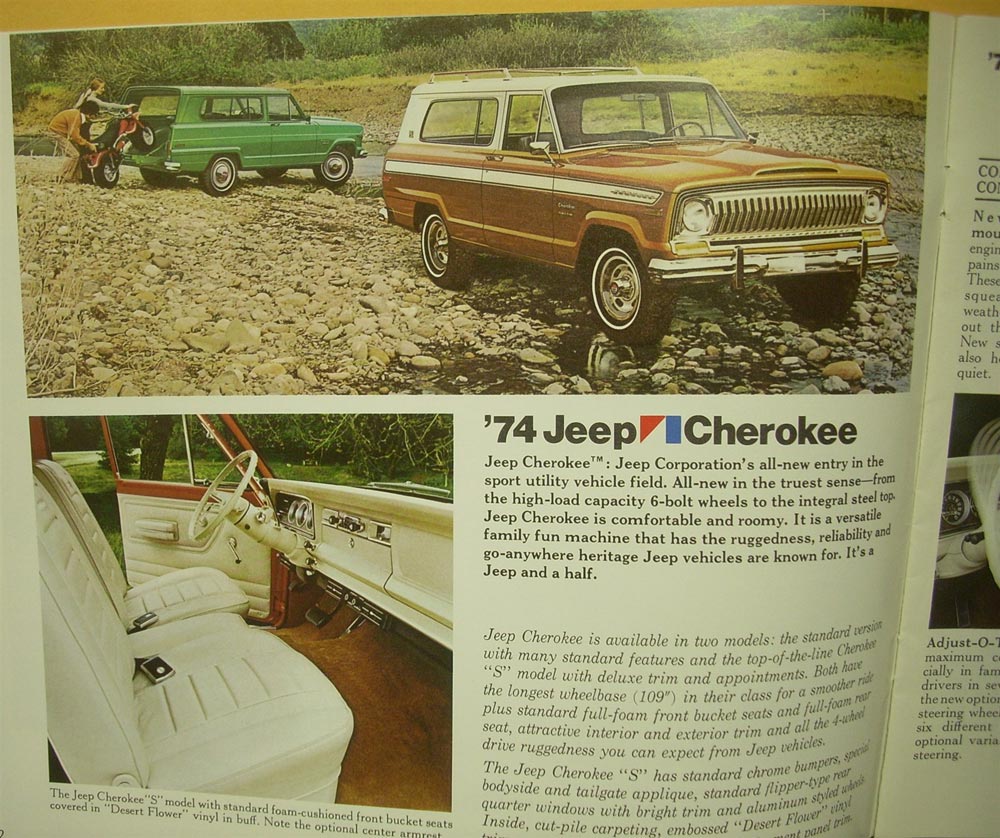
The first relevant usage of the term SUV was in advertising brochures for the full-sized 1974 Jeep Cherokee (SJ), which used the wording "sport(s) utility vehicle" as a description for the vehicle.[96][97] The 1966 Ford Bronco included a "sport utility" model; however, in this case it was used for the two-door pickup truck version.[98]
The VAZ-2121 (now designated Lada Niva Legend) was the first mass-market 4WD unibody car in some markets in 1977.[99] The AMC Eagle introduced in the North American market in 1979, and is often called the first mass-market "crossover", although that term had not been coined at the time.[100][101] In contrast to truck or utility-vehicle based designs and the Niva that was purpose-built for rural areas, American Motors Corporation (AMC) utilized a long-serving existing car platform and designed a new automatic full-time AWD system.[102][103] It was first with "SUV styling on a raised passenger-car platform combined with AWD."[2] Four Wheeler magazine described the AMC Eagle as "the beginning of a new generation of cars".[104]
1980s to 1990s
[edit]_(cropped).jpg)

The compact-sized 1984 Jeep Cherokee (XJ) is often credited as the first SUV in the modern understanding of the term.[105] The use of unibody construction was unique at the time for a four-wheel drive and also reduced the weight of the new Cherokee. It also appealed to urban families due to having a more compact size (compared to the full-size Wagoneer and previous generation Cherokee SJ models) as well as a plush interior resembling a station wagon.[105] As the new Cherokee became a major sales success, the term "sport utility vehicle" began to be used in the national press for the first time.[105] "The advent and immediate success of AMC/Jeep's compact four-door Cherokee turned the truck industry upside down."[106]
The U.S. corporate average fuel economy (CAFE) standard was introduced in 1975 to reduce fuel usage, but included relaxed regulations for "light trucks" to avoid businesses paying extra taxes for work vehicles. This created a loophole that manufacturers increasingly exploited since the 1980s oil glut (which started an era of cheap gasoline), whereby SUVs were designed to be classified as light trucks despite their primary use as passenger vehicles to receive tax concessions and less stringent fuel economy requirements.[107] This enabled manufacturers to sell more profitable, larger, more polluting vehicles, instead of the smaller, less polluting, less profitable cars, that the CAFE regulations intended.
For example, the United States Environmental Protection Agency agreed to classify the new Jeep Cherokee as a light truck following lobbying from its manufacturer; the Cherokee was then marketed by the company as a passenger vehicle.[52] This increased the SUV boom as other manufacturers introduced their own SUVs in response to the compact Cherokee taking sales from their regular cars.[108]
In 1994 the U.S. Environmental Protection Agency began classifying vehicles by "market class". For SUVs in 1994 they included three Jeep models, the Cherokee, Grand Cherokee and Wrangler. Two Ford models were the Bronco and the Explorer. Six General Motors models including the GMC Jimmy, the Yukon, and the Suburban 1500; the Chevrolet Suburban 1500, and the Blazer (1500 and S10); the Geo Tracker (Convertible or Van); and finally the Oldsmobile Bravada. Eleven Japanese models classified as SUVs were the Toyota 4Runner and Land Cruiser; the Honda Passport; the Nissan Pathfinder; the Mazda Navajo; the Mitsubishi Montero; the Isuzu Amigo, Rodeo, and Trooper; and the Suzuki Samurai and Sidekick. From Europe the three Land Rover models, the Range Rover, the Defender and the Discovery were classified as SUVs.
By late 1996 Consumers Digest magazine was calling the trend an "SUV craze",[109] and by 1999 the U.S. sales of SUVs and light trucks for the first time exceeded sales of regular passenger cars.[48]: 2
2000s
[edit]By 2003, there were 76 million SUVs and light trucks on U.S. roads, representing approximately 35% of the vehicles on the road.[48]

Car manufacturers were keen to promote SUV sales over other types of cars due to higher profits in the segment. An SUV could be sold with a profit margin of US$10,000 or more (US$18,000 per SUV in the case of the Ford Excursion), while compact cars were often sold at a loss of a few hundred dollars per car.[110][111][112] As a result, several manufacturing plants were converted from car production to SUV production (such as the General Motors plant in Arlington, Texas in 1996), and many long-running U.S. sedan models were discontinued.[113][114][115]
From the mid-2000s until 2010, U.S. sales of SUVs and other light trucks experienced a dip due to increasing fuel prices and then a declining economy. From 2008 until 2010, General Motors closed four assembly plants that were producing SUVs and trucks.[116] Sales of SUVs and light trucks sales began to recover in 2010, as fuel prices decreased and the North American economy improved.[117]
2010s to 2020s
[edit]

In 2019, the International Energy Agency (IEA) reported that the global number of SUVs and crossovers on the road multiplied by six since 2010—from 35 million to 200 million vehicles, and their market share has grown to 40 percent of worldwide new light-vehicle sales at the end of the decade.[118]
By 2013, small and compact SUVs had increased to become the third-largest market segment.[32] Since the early 2000s, new versions have been introduced to appeal to a wider audience, such as crossovers and other small SUVs.[119] Larger SUVs also remained popular, with sales of General Motors' large SUV models increasing significantly in 2013.[120]
In 2015, global sales of SUVs overtook the "lower medium car" segment, to become the largest market segment, accounting for 22.9% of "light vehicle" sales in 2015.[119] The following year, worldwide SUV sales experienced further growth of 22%. The world's fastest-growing SUV markets in 2014–2015 were: China (+ 47.9%), Italy (+ 48.6%), Spain (+ 42%), Portugal (+ 54.8 %), and Thailand (+ 56.4%).[119] The SUV segment further grew to 26% of the global passenger car market in 2016, then to 36.8% of the market in Q1–Q3 of 2017.[121][122][119]

In the U.S. at the end of 2016, sales of SUVs and light-duty trucks had surpassed traditional car sales for the year by over 3 million units.[123] Manufacturers continued to phase out the production of sedan models, replacing them with new models of SUVs.[124] Luxury brands have increasingly introduced SUV or crossover models in the 2010s. For example: Rolls-Royce Cullinan, Bentley Bentayga, Aston Martin DBX, Maserati Levante, Lamborghini Urus, and Ferrari Purosangue.[125]
In 2019 SUVs made up 47.4% of U.S. sales compared to only 22.1% for sedans.[126]
Motorsport
[edit]
SUVs have competed in various off-road racing competitions, such as the Dakar Rally, Baja 1000, FIA Cross-Country Rally World Cup, King of the Hammers, and Australasian Safari. SUVs have also competed in the Trophee Andros ice-racing series.
Nicknames
[edit]Several derogatory or pejorative terms for SUVs are based on the combination of an affluent suburb name and "tractor", particularly for expensive vehicles from luxury brands. Examples include "Toorak Tractor" (Melbourne, Australia),[127][128] "Chelsea Tractor" (London, England)[129] and "Remuera Tractor" (Auckland, New Zealand). These terms relate to the theory that four-wheel drive capabilities are not required by affluent SUV owners, and that the SUV is purchased as a status symbol rather than for practical reasons.
In Norway, the term Børstraktor ('Stock Exchange Tractor') serves a similar purpose.[130] In the Netherlands, SUVs are sometimes called "P.C. Hooft-tractors" after the exclusive P.C. Hooftstraat Amsterdam shopping street.[131]
Commercial SUVs
[edit]
A commercial SUV is an SUV or crossover, that is used for commercial purposes. The category is very similar to panel trucks since the Chevrolet Suburban (an SUV) had panel truck versions, which were used for commercial purposes.
The first SUV-like vehicle that had commercial versions was the Chevrolet Suburban panel truck. Panel trucks by American manufacturers were built until the late 1970s.
While panel trucks manufactured by European manufacturers were rare, commercial versions of off-road vehicles were very common, Land Rover manufactured commercial versions of the Land Rover and the Defender. Commercial SUVs are factory-built and most of them are not independent conversions, which means they can be bought from dealerships and showrooms.[132]
Examples of SUVs used as commercial vehicles in Europe include: Citroen C5 Aircross Commercial SUV,[133] the Land Rover Discovery, the Dacia Duster Flika,[134] and the Mitsubishi Pajero.
See also
[edit]
References
[edit]Notes
[edit]- ^ "SUV Meaning: What is an SUV?". Car and Driver. 13 April 2020. Retrieved 30 August 2022.
- ^ a b Wardlaw, Christian (15 September 2021). "What is a Crossover SUV?". J.D. Power. Retrieved 30 August 2022.
- ^ "New registrations of SUVs in key car markets, 2010-2021 – Charts – Data & Statistics". iea.org. 21 December 2021. Retrieved 1 October 2024.
- ^ a b c d e Cozzi, Laura; Petropoulos, Apostolos (15 October 2019). "Growing preference for SUVs challenges emissions reductions in passenger car market". International Energy Agency. Archived from the original on 4 February 2020. Retrieved 18 February 2020.
On average, SUVs consume about a quarter more energy than medium-size cars. As a result, the global fuel economy worsened caused in part by the rising SUV demand since the beginning of the decade, even though efficiency improvements in smaller cars saved over 2 million barrels a day, and electric cars displaced less than 100,000 barrels a day. In fact, SUVs were responsible for all of the 3.3 million barrels a day growth in oil demand from passenger cars between 2010 and 2018, while oil use from other types of cars (excluding SUVs) declined slightly.
- ^ a b Kommenda, Niko (25 October 2019). "SUVs second biggest cause of emissions rise, figures reveal". The Guardian. Retrieved 1 October 2024.
- ^ Rose, Joel (14 November 2023). "Taller cars and trucks are more dangerous for pedestrians, according to crash data". npr.org. Retrieved 1 October 2024.
- ^ Tyndall, Justin (March 2024). "The effect of front-end vehicle height on pedestrian death risk". Economics of Transportation. 37 100342. doi:10.1016/j.ecotra.2024.100342. Retrieved 1 October 2024.
- ^ Lawrence, Eric D.; Bomey, Nathan; Tanner, Kristi (1 July 2018). "Death on foot: America's love of SUVs is killing pedestrians". Detroit Free Press. Archived from the original on 14 December 2019. Retrieved 24 December 2019.
- ^ Gladwell, Malcolm (4 January 2004). "Big and Bad". The New Yorker. Archived from the original on 19 February 2016. Retrieved 1 October 2024.
- ^ "Big cars might make you feel safer. But here's how vehicle size impacts others in a crash". UNSW Sites. Retrieved 21 November 2024.
- ^ Milman, Oliver (1 September 2020). "How SUVs conquered the world – at the expense of its climate". The Guardian. Retrieved 21 November 2024.
- ^ "Are cars getting too big for the road?". www.bbc.com. 8 February 2024. Retrieved 21 November 2024.
- ^ a b c Bradsher 2002, p. 4.
- ^ Bumbeck, Mike (27 August 2024). "Utility in Style – The 1972 Jeep Wagoneer blends an iconic design with modern driveability". Hemmings Classic Car. Retrieved 1 October 2024.
- ^ Heaps, Russ (25 March 2022). "SUV vs. Crossover: What's the Difference?". autotrader.com. Retrieved 1 October 2024.
- ^ Glucksberg, Sam (2001). Understanding Figurative Language: From Metaphor to Idioms. Oxford University Press. p. 112. ISBN 9780198027126. Retrieved 1 October 2024 – via Google Books.
- ^ a b "Definition of SUV". Merriam-Webster. Archived from the original on 5 January 2018. Retrieved 26 October 2020.
- ^ "Definition of Sport-utility Vehicle". Merriam-Webster. 3 January 2018. Archived from the original on 8 December 2017. Retrieved 26 October 2020.
an automobile similar to a station wagon but built on a light truck frame
- ^ Webster's New World College Dictionary (Fourth ed.). Houghton Mifflin Harcourt.
- ^ "Stereotype of 'Chelsea tractor' reflects reality of urban SUV sales, says report". The Guardian. 7 April 2021. Retrieved 9 January 2023.
- ^ Collins Cobuild Advanced English Dictionary. HarperCollins. Retrieved 10 November 2019.
- ^ "Regulation (EEC) No 4064/89 - Merger Procedure" (PDF). ec.europa.eu. Luxemburg: Office for Official Publications of the European Communities. 17 March 1999. p. 2. Archived (PDF) from the original on 27 March 2009. Retrieved 3 March 2019.
- ^ "Car prices within the European Union / Prix des voitures au sein de l'Union européenne / Autopreise in der europäischen Union" (PDF). ec.europa.eu (in English, French, and German). Brussels: Publications Office of the European Union. 1 January 2011. Archived (PDF) from the original on 6 November 2011. Retrieved 3 March 2019.
- ^ "Impact on the Competitiveness of the European Automotive Industry of Potential FTA with India and ASEAN" (PDF). europa.eu. p. 8. Archived from the original (PDF) on 29 April 2013.
- ^ Davis, Stacy C.; Williams, Susan E.; Boundy, Robert G. (2016). "Transportation Energy Data Book" (PDF) (35th ed.). Oak Ridge National Laboratory. pp. 3–5. Archived (PDF) from the original on 6 January 2018. Retrieved 25 July 2021.
- ^ Fuhs, Allen (2008). Hybrid Vehicles: and the Future of Personal Transportation. CRC Press. p. 263. ISBN 9781420075342. Retrieved 8 April 2019.
- ^ Yacobucci, Brent D. (17 April 2003). "Sport Utility Vehicles, Mini-Vans, and Light Trucks: An Overview of Fuel Economy and Emissions Standards" (PDF). CRS Report for Congress. Archived (PDF) from the original on 16 August 2017. Retrieved 23 December 2011.
- ^ "The Plain English Guide to the CleanAirAct" (PDF). United States Environmental Protection Agency. April 2007. p. 8. Archived (PDF) from the original on 14 October 2015. Retrieved 6 December 2017.
- ^ "Light Duty Vehicle Emissions". 29 June 2022. Retrieved 10 January 2023.
EPA first set greenhouse gas emission standards for vehicles in 2010, which took effect in MY 2012.
- ^ "Fact #726: SUVs: Are They Cars or Trucks?". Office of Energy Efficiency & Renewable Energy (EERE) U.S. Department of Energy. 7 May 2012. Archived from the original on 12 January 2014. Retrieved 12 January 2014.
- ^ Fuhs, Allen (2008). Hybrid Vehicles: and the Future of Personal Transportation. CRC Press. p. 7. ISBN 9781420075342. Retrieved 6 December 2017.
- ^ a b "Production of Small and Compact SUVs Shifts to Top Gear in North America, Finds Frost & Sullivan". prnewswire.com (Press release). 14 January 2014. Retrieved 14 January 2014.
- ^ Bhattacharya, Sindhu (20 December 2013). "Budget 2013: Why SUV found special mention this budget day". Firstpost. Retrieved 6 December 2017.
- ^ "SUV tax creating uneven playing field: Mahindra". NDTV. 2 May 2013. Retrieved 6 December 2017.
- ^ "Tariff reduction will soften price rises". Blog.autopeople.com.au. 18 November 2008. Archived from the original on 6 January 2009. Retrieved 16 November 2010.
- ^ "Matters of great import". Carpoint. 6 January 2010. Archived from the original on 16 October 2015. Retrieved 7 January 2024.
- ^ Lecco, Tommaso (6 February 2024). "Paris to SUVs: Get off my streets!". Politico.
- ^ "M-72 all-terrain vehicle". spb.ru (in Russian). Retrieved 13 April 2019.
- ^ Thompson, Andy (2008). Cars of the Soviet Union. Somerset, U.K.: Haynes Publishing. p. 57.
- ^ "Jeep Grand Cherokee Review". Edmunds. Retrieved 10 April 2011.
- ^ Hunting, Benjamin (21 April 2019). "The 6 Best (and 5 Weirdest) 2 Door SUVs of All Time". DrivingLine. Retrieved 16 January 2021.
- ^ DeMuro, Doug (1 April 2013). "Attention Automakers: Please Stop Selling Two-Door SUVs". The Truth About Cars. Retrieved 16 January 2021.
- ^ DeMuro, Doug (21 June 2017). "Every Single Two-Door SUV Has Failed". Autotrader. Retrieved 16 January 2021.
- ^ "Toyota Sharpens Best-Selling Prado Range" (Press release). Australia: Toyota. 14 October 2013. Archived from the original on 6 March 2016. Retrieved 16 January 2021.
- ^ Hyatt, Kyle; Szymkowski, Sean (15 July 2020). "2021 Ford Bronco pricing: Here's how much the 2-door and 4-door cost". Roadshow. Retrieved 16 January 2021.
- ^ "2020 Jeep Wrangler 2-Door: Lowest Cost to Own Among Off-Road SUVs". Kelley Blue Book. 5 February 2020. Retrieved 16 January 2021.
- ^ Lee, Christian (2007). High-Performance Jeep Wrangler TJ Builder's Guide. CarTech. p. 14. ISBN 9781932494266. Retrieved 16 January 2021.
- ^ a b c d e f g SUV safety: issues relating to the safety and design of sport utility vehicles: hearing before the Committee on Commerce, Science, and Transportation. United States Senate, One Hundred Eighth Congress, first session. 26 February 2003. p. 18. ISBN 9781422334188 – via Diane Publishing.
- ^ Valdes-Dapena, Peter (16 October 2019). "Volvo's first fully electric car will also be one of its safest cars ever". CNN Business. Retrieved 30 August 2022.
- ^ Penenberg, Adam (2003). Tragic Indifference: One Man's Battle with the Auto Industry over the Dangers of SUVs. HarperBusiness. p. 12. ISBN 0-06-009058-8.
- ^ "Jeep Grand Cherokee fails Swedish moose test, lessons for U.S. consumers". Consumer Reports. 13 July 2012. Retrieved 27 August 2020.
- ^ a b Bradsher 2002.
- ^ "The 50 Worst Cars Of All Time". Time. 7 September 2007. Archived from the original on 13 September 2007. Retrieved 23 May 2010.
- ^ Croft, Robin (2006). "Folklore, families and fear: understanding consumption decisions through the oral tradition". Journal of Marketing Management. 22 (9/10): 1053–1076. doi:10.1362/026725706778935574. ISSN 0267-257X. S2CID 144646252.
- ^ "When cars and SUVs crash: Bumper mismatch boosts costs". CNN. 2 December 2010. Retrieved 14 April 2019.
- ^ "Q&As – Vehicle size and weight". U.S.: Insurance Institute for Highway Safety. April 2018. Retrieved 11 February 2019.
- ^ "Side-impact crash test program". Insurance Institute for Highway Safety. Archived from the original on 30 December 2010.
- ^ "Improved vehicle designs bring down death rates".
- ^ Oltermann, Philip (9 September 2019). "Berliners call for 4x4 ban after four people killed in collision". The Guardian. ISSN 0261-3077. Retrieved 12 May 2020.
- ^ "New study suggests today's SUVs are more lethal to pedestrians than cars". US: Insurance Institute for Highway Safety. 16 June 2020. Retrieved 16 January 2021.
- ^ Dean, Tamara (22 November 2022). "'He was fast … he ran you right over': what it's like to get hit by an SUV". The Guardian. Retrieved 10 April 2023.
- ^ Edwards, M.; Leonard, D. (September 2022). "Effects of large vehicles on pedestrian and pedalcyclist injury severity". Journal of Safety Research. 82: 275–282. doi:10.1016/j.jsr.2022.06.005. PMID 36031254. S2CID 249860954.
- ^ "Source The AutoChannel". The Auto Channel. Retrieved 31 December 2010.
- ^ "Causes of climate change". Met Office. Retrieved 1 February 2025.
- ^ "Kreisel Electric and Arnold Schwarzenegger present the world's first electrified Hummer H1". Austria: Kreisel. Retrieved 24 January 2020.
- ^ Lianos, Miguel (23 June 2004). "Hydrogen cars ready to roll - for a price". U.S.: NBC. Retrieved 24 January 2020.
- ^ Tobert, Andrew (7 September 2019). "Bigger is not better – how SUVs are killing the climate". Greenpeace International. Retrieved 24 January 2020.
- ^ "Smart Buying Essentials What is a Crossover Vehicle?". Intellichoice. Archived from the original on 17 July 2011. Retrieved 27 July 2015.
- ^ Isidore, Chris (9 January 2006). "GM and Ford's New Cross to Bear". CNN Money. Retrieved 27 July 2015.
- ^ "Crossover 101". aol.com. Archived from the original on 16 April 2016.
- ^ "Difference between a crossover vehicle and SUV?". hertzcarsales.co.uk. 30 January 2019. Archived from the original on 6 November 2020. Retrieved 22 April 2019.
- ^ "What is the Difference Between Crossovers and SUVs? « Harbin Automotive". harbinautomotive.com. Archived from the original on 22 April 2019. Retrieved 22 April 2019.
- ^ "What's the Difference Between an SUV, a Crossover, & a CUV?". thenewswheel.com. 30 March 2017. Retrieved 22 April 2019.
- ^ "SUV vs. Crossover: What's the Difference?". autotrader.com. Retrieved 22 April 2019.
- ^ "SUVs vs. Crossovers: What's the Difference?". usnews.com. Retrieved 22 April 2019.
- ^ "The Difference Between SUVs and Crossover Cars". carwriteups.co.uk. 9 April 2018. Retrieved 22 April 2019.
- ^ "What's the difference between a crossover, SUV and 4x4?". carbuyer.co.uk. Retrieved 22 April 2019.
- ^ "SUV vs Crossover: What are the Differences and Similarities?". leasefetcher.co.uk. Archived from the original on 22 April 2019. Retrieved 22 April 2019.
- ^ Carlsson, Mårten (26 June 2018). "Opel Terrängsportbil" [Opel Off-Road Car]. Klassiker (in Swedish). Sweden. Retrieved 11 July 2019.
- ^ "10 Strange Military Vehicles of World War II". wonderslist.com. 30 January 2014. Retrieved 10 April 2019.
- ^ Allen, Jim (10 January 2016). "Origins Of The Jeep: Birthing A 75-Year Legend". Four Wheeler Network. Retrieved 11 February 2019.
- ^ Thomson, Harry C.; Mayo, Lida (2003). The Ordnance Department: procurement and supply. United States Army in World War II: The technical services. Washington, D.C.: Office of the Chief of Military History, Dept. of the Army (published 1960). p. 274 – via United States Army Center of Military History.
- ^ "History 101: The Crosley Automobile". Daily KOS. U.S. 26 May 2014. Retrieved 24 February 2018.
- ^ "Details on Crosley CC Models 1946 - 1948". Crosley Automobile Club. U.S. Retrieved 24 February 2018.
- ^ "Crosley 1948". Archived from the original on 23 February 2018 – via Classic Car Catalogue.
- ^ "1960 Willys Four-Wheel-Drive Station Wagon: Your (Great-) Grandfather's SUV". Autoweek. 15 February 2007. Retrieved 5 October 2017.
- ^ Greg. "The Very First Sport Utility Vehicle: The Jeep Station Wagon". Autoroundup. Archived from the original on 5 October 2017. Retrieved 6 December 2017.
- ^ a b Allen, Jim (1 November 2012). "1959 International Harvester B-120 Travelall – Four Wheeler Magazine". Four Wheeler Network. Archived from the original on 7 January 2018. Retrieved 7 January 2018.
- ^ "The 1958 Station Wagons". Changing Times: The Kiplinger Magazine. Vol. 12, no. 2. February 1958. p. 22. Retrieved 9 January 2018.
- ^ "Why We Love Them: International Harvester Scout". Bring a Trailer. 27 May 2018. Retrieved 15 October 2019.
- ^ Lewin, Tony; Borroff, Ryan (2003). How to Design Cars Like a Pro: A Comprehensive Guide to Car Design from the Top Professionals. MotorBooks/MBI Publishing. p. 191. ISBN 9780760316412.
- ^ "1970 Range Rover advertisement". YouTube. 11 February 2018. Archived from the original on 18 May 2019. Retrieved 13 April 2019.
- ^ "Old Range Rover ad". YouTube. 13 June 2009. Archived from the original on 29 October 2021. Retrieved 13 April 2019.
- ^ "Subaru Leone 4WD Wagon was the first SUV". outbacktravelaustralia.com.au. Retrieved 30 August 2022.
- ^ 自動車ガイドブック [Automobile Guide Book 1975~76] (in Japanese), vol. 22, Japan: Japan Automobile Manufacturers Association, 31 October 1975, pp. 279–280, 0602-509072-2228
- ^ "1974 model year Jeep brochure picture – Cherokee page". U.S.: Jeep. 1973. Retrieved 4 January 2018.
- ^ "1974 model year Jeep Cherokee brochure – front". U.S.: Jeep. 1973. Retrieved 4 January 2018.
- ^ "1966 Ford Bronco U-100 4-Wheel Drive models & features brochure". U.S.: Ford. 1965. Archived from the original on 3 January 2018. Retrieved 4 January 2018.
- ^ "The Lada Niva: Russia's Forgotten Off-Road SUV". 25 December 2019.
- ^ Baxter, Eric (13 July 2011). "Who coined the term 'crossover vehicle?'". howstuffworks. Retrieved 9 May 2021.
- ^ Gold, Aaron (9 May 2017). "AMC Eagle: No, Seriously, This Was the First Crossover SUV". Autotrader. Retrieved 9 May 2021.
- ^ Hunting, Benjamin (14 February 2021). "How Bad Was The Lada Niva, The Ultra-Cheap Alternative Russian 4X4?". DrivingLine. Retrieved 30 August 2022.
- ^ Appel, Tom (9 May 2019). "Review Flashback! 1980 AMC Eagle". The Daily Drive by Consumer Guide. Retrieved 9 May 2021.
- ^ Brubaker, Ken (27 December 2018). "Firing Order: That Time I Bought an AMC Eagle". Four Wheeler. Retrieved 30 August 2022.
- ^ a b c Bradsher 2002, p. 40.
- ^ Ludel, Moses (1995). Toyota truck & Land Cruiser owner's bible. Robert Bentley. p. 18. ISBN 978-0-8376-0159-5. Retrieved 24 June 2011.
- ^ "From the Battlefield to the Soccer Field". Traffic Safety Center Online Newsletter. Summer 2005. Archived from the original on 10 March 2012. Retrieved 8 January 2013.
- ^ Bradsher 2002, p. 41.
- ^ "SUV Craze". Consumers Digest. 1996.
- ^ Schoenberger, Robert (6 June 2008). "As buyers shun SUVs, expect to pay more for that small car". Cleveland Business News. Retrieved 16 November 2010.
- ^ "Ford idle, for now". USA Today. 16 October 2008. Retrieved 23 May 2010.
- ^ White, Jerry (27 May 2000). "GM, Ford idle 1,365 workers-auto industry layoffs signal coming downturn in US economy". Wsws.org. Retrieved 16 November 2010.
- ^ Maynard, Micheline (28 October 2006). "End of the Line for Ford Taurus". The New York Times. Retrieved 15 March 2018.
- ^ "Final Ford Taurus interview". ABC News. 26 July 2007. Archived from the original on 29 October 2021.
- ^ Neff, John (19 October 2006). "So long, friend. Ford producing last Taurus next week". Autoblog. Retrieved 26 July 2007.
- ^ Van Praet, Nicolas (4 June 2008). "Caw Girds For War". Financial Post. U.S. Archived from the original on 16 February 2009. Retrieved 11 February 2019.
- ^ Healey, James (30 July 2010). "Surprise: Sales of big SUVs surging faster than small cars". USA Today. Retrieved 23 April 2012.
- ^ Webster, Ben (14 November 2019). "Soaring demand for SUVs exacerbates climate crisis". The Times. U.K. Retrieved 26 October 2020.
- ^ a b c d "SUVs Become the Largest and Fastest-Growing Automotive Segment in 2015". Euromonitor International. 9 August 2016. Archived from the original on 6 August 2017. Retrieved 26 October 2020.
- ^ Wayland, Michael (20 January 2019). "2015 GMC Yukon and Chevy Suburban, Tahoe: GM expects new SUVs to continue industry dominance". MLive. Michigan, U.S. Retrieved 26 October 2020.
- ^ "World Best Selling SUV 2016". Focus2Move. 25 January 2017. Archived from the original on 29 January 2017. Retrieved 6 January 2018.
- ^ "World Best Selling SUV 2017". Focus2Move. 29 November 2017. Archived from the original on 6 January 2018. Retrieved 6 January 2018.
- ^ "Auto Sales December 2016 compared to 2015". The Wall Street Journal. 4 January 2017. Archived from the original on 5 January 2017. Retrieved 28 October 2020.
- ^ Jeneault, Elizabeth (17 January 2017). "Hyundai Trims Fat, Looks to Add More SUVs to Lineup". suvs.com. Retrieved 28 October 2020.
- ^ Burn, Jonathan (19 March 2018). "Ferrari SUV confirmed fastest SUV crown targeted". Auto Express. Retrieved 10 November 2019.
- ^ Voelk, Tom (21 May 2020). "Rise of S.U.V.s: Leaving Cars in Their Dust, With No Signs of Slowing". The New York Times. Retrieved 14 September 2020.
- ^ "The Australian travel slang dictionary". Australian Traveller. Australia. 9 June 2015. Retrieved 18 February 2018.
- ^ "The evolution of the SUV". eMotor. 3 January 2018. Archived from the original on 17 February 2018. Retrieved 18 February 2018.
- ^ Campbell, Denis (26 September 2004). "Terminator guns for the Chelsea Tractor". The Guardian. London. Retrieved 19 July 2009.
- ^ Sæter, Embret (26 November 2009). "Bloddopet børstraktor" (in Norwegian). DN.no. Retrieved 2 January 2012.
- ^ Nizet, Rik (14 January 2014). "Lamborghini lanceert ook PC Hooft-tractor" [Lamborghini also launches a PC Hooft-tractor]. De Ondernemer ('The Entrepreneur') (in Dutch). De Persgroep. Retrieved 17 February 2018.
- ^ Chin, Joshua (27 July 2020). "The Wonderful World Of The Commercial SUV Market". Automacha. Retrieved 25 December 2020.
- ^ "Citroën C5 Aircross Commercial SUV". Ireland: Citroën. Retrieved 25 December 2020.
- ^ Mihalascu, Dan (21 May 2018). "Dacia Duster Fiskal light commercial vehicle debuts in Austria". Drivemag. Romania. Retrieved 25 December 2020.
Bibliography
[edit]- Bradsher, Keith (2002). High and Mighty: SUVs – The World's Most Dangerous Vehicles and How They Got That Way. New York: PublicAffairs. ISBN 1-58648-123-1.
- Chapman, Giles (2005). SUV: The World's Greatest Sport Utility Vehicles. London: Merrell Publishers. ISBN 1858942748.
- Henshaw, Peter (2005). The Ultimate Guide to SUVs and Off-Road Vehicles. Edison, NJ, USA: Chartwell Books. ISBN 0785818200.
- Jacobs, David H. (1998). Sport Utility Vehicles: The Off-Road Revolution. New York: Todtri Book Publishers. ISBN 1577170857.



Terminology
Definitions and Classifications
A sport utility vehicle (SUV) is a class of motor vehicle that integrates passenger car comfort and handling with off-road capability, typically featuring an enclosed body for 5–8 occupants, higher ground clearance than sedans, and optional all-wheel or four-wheel drive systems for traction in varied conditions.[10] [11] These vehicles originated as rugged utility transports but evolved into family-oriented models emphasizing space, towing capacity up to 10,000 pounds in full-size variants, and payload ratings exceeding 1,500 pounds.[12] SUVs lack a universal regulatory definition but are often categorized under light trucks in standards like those from the U.S. Environmental Protection Agency (EPA), where vehicles with a wheelbase over 110 inches and track width exceeding 55 inches may qualify for less stringent fuel economy and safety rules compared to passenger cars.[13] In rental industry codes from the Association of Car Rental Industry Systems Standards (ACRISS), SUVs are light trucks styled for family use, usually with four-wheel drive and seating for at least five.[14] The Society of Automotive Engineers (SAE) does not prescribe a rigid SUV standard, treating classifications as manufacturer-defined blends of utility and sport features, which allows marketing flexibility but blurs lines with related types.[15] Classifications distinguish traditional SUVs, built on body-on-frame construction akin to pickup trucks for enhanced durability and off-road prowess, from crossover utility vehicles (CUVs), which employ unibody designs derived from car platforms for superior on-road dynamics, lighter weight (often under 4,000 pounds), and better fuel efficiency averaging 20–30 mpg.[16] [17] Body-on-frame SUVs prioritize ruggedness, with separate chassis supporting heavier loads and higher towing capacities, while unibody crossovers—comprising over 70% of modern "SUV" sales—offer car-like ride quality but reduced articulation for extreme terrain.[18] Drive system variants further classify SUVs: rear- or front-wheel drive for efficiency on pavement, all-wheel drive for automatic torque distribution in slip, and selectable four-wheel drive with low-range gearing for crawling over obstacles at speeds under 5 mph.[10] These structural differences yield measurable performance gaps; body-on-frame models exhibit rollover thresholds up to 20% higher in National Highway Traffic Safety Administration (NHTSA) tests due to elevated centers of gravity, while unibody designs align closer to sedans in crash energy management.[19] Hybrid and electric classifications emerge within SUVs, integrating batteries for ranges up to 40 miles on power alone in models like the Toyota RAV4 Prime, but retaining core utility traits.[20]Regional and Regulatory Variations
In the United States, SUVs have historically been classified as light trucks under federal regulations, a distinction originating from the 1964 "Chicken Tax" that imposed a 25% tariff on imported light trucks, prompting domestic manufacturers to design vehicles meeting truck criteria such as having at least 50% of interior volume behind the front seats.[21][21] This classification subjects SUVs to less stringent Corporate Average Fuel Economy (CAFE) standards compared to passenger cars, with light trucks facing lower fuel efficiency targets—historically around 20-25 mpg versus 27-30 mpg for cars—contributing to higher average fuel consumption and emissions from the U.S. fleet.[21] Safety regulations also differ, with light trucks exempt from certain side-impact and roof-strength tests applied to cars until updates in the 2010s, though this has led to higher rollover risks in early SUV models.[21] In the European Union, SUVs are generally categorized as passenger cars under emissions and safety frameworks, subjecting them to uniform Euro 6 and upcoming Euro 7 standards that cap CO2 emissions at 95 g/km fleet-wide since 2020, with penalties for exceedance.[22][22] Higher vehicle registration taxes, often based on CO2 output and engine size—such as France's progressive "malus" fee exceeding €50,000 for high-emission SUVs—and elevated fuel taxes (up to €2 per liter in some countries) discourage larger models, resulting in European SUVs being lighter and more efficient on average than U.S. counterparts.[23][22] Safety rules emphasize pedestrian protection, mandating softer front-end designs and advanced driver-assistance systems, contrasting U.S. focus on occupant crash protection.[24] Asia-Pacific regions exhibit diverse approaches, with China mandating new energy vehicle (NEV) quotas since 2019—rising to 40% by 2030—that favor electrified SUVs, supported by subsidies but now tightening export standards to align with destinations like the EU.[25][26] Japan's kei car regulations limit small SUVs to compact dimensions for tax breaks, while Australia's 2025 fuel efficiency standards impose fleet-average penalties, boosting imports of lower-emission Chinese SUVs projected to capture over 40% market share by 2035.[27][27] In India and Southeast Asia, local content rules and import duties on large SUVs promote domestic assembly, though emissions align closer to Euro norms for urban air quality.[28] Ongoing U.S.-EU discussions on mutual recognition of standards, as outlined in a 2025 joint statement, aim to harmonize lighting, ADAS, and emissions testing but face resistance over safety divergences, such as Europe's pedestrian-focused rules versus U.S. vehicle-centric ones.[29][24] These variations reflect causal factors like geography—vast U.S. distances favoring capability over efficiency—and policy priorities, with Europe's denser urban environments driving emission curbs despite higher per-vehicle costs.[22]Design and Engineering
Chassis and Body Construction
SUVs utilize two principal methods of chassis and body construction: body-on-frame and unibody designs. Body-on-frame construction consists of a separate ladder-type chassis frame to which the passenger body is bolted, a method inherited from trucks and prevalent in early SUVs for its robustness in off-road and heavy-duty applications.[30] This separation allows the frame to absorb impacts independently, facilitating repairs and enhancing durability under torsional stresses encountered in rugged terrain or towing scenarios exceeding 7,000 pounds in models like the Toyota Land Cruiser.[31] However, the added weight—often 500-1,000 pounds more than unibody equivalents—results in reduced fuel efficiency, typically 2-4 miles per gallon lower, and increased road noise due to frame flex.[32] Unibody construction integrates the body structure and chassis into a single welded unit, akin to passenger cars, which first gained prominence in SUVs with the 1984 Jeep Cherokee XJ, marking a shift toward lighter, more efficient vehicles amid post-1970s fuel crises.[33] This design enhances on-road handling through greater rigidity and a lower center of gravity, improving cornering stability and reducing body roll, while also enabling better integration of modern safety features like crumple zones that deform to dissipate crash energy.[32] Unibody SUVs, such as the Honda Pilot, achieve superior fuel economy—up to 25 mpg combined versus 18 mpg for comparable body-on-frame rivals—and exhibit 18% lower fatality rates in crashes per a National Highway Traffic Safety Administration analysis of comparable models.[34] Drawbacks include higher repair costs for structural damage and reduced suitability for extreme off-roading, where frame separation in body-on-frame allows better wheel articulation without compromising the cabin.[31]| Construction Type | Key Advantages | Key Disadvantages | Typical SUV Applications |
|---|---|---|---|
| Body-on-Frame | Superior towing/hauling (e.g., 10,000+ lbs in full-size models); easier frame repairs; better off-road durability[30] | Heavier weight leading to poorer efficiency; more flex affecting on-road precision[31] | Full-size and heavy-duty SUVs like Ford Expedition, Jeep Wagoneer[35] |
| Unibody | Lighter structure for better mpg and handling; enhanced crash safety via energy absorption[34] | Less resilient to heavy abuse; costlier structural fixes[32] | Compact and midsize SUVs like Toyota RAV4, Subaru Forester[36] |
Powertrain Options and Performance
SUVs employ a range of powertrain configurations, primarily internal combustion engines (ICE) fueled by gasoline or diesel, supplemented by hybrid systems and, increasingly, fully electric drivetrains. Gasoline engines dominate in passenger-oriented models, typically featuring turbocharged four-cylinder or V6 configurations delivering 200-400 horsepower (hp) and 200-400 pound-feet (lb-ft) of torque, with fuel economies ranging from 20-30 miles per gallon (mpg) combined depending on vehicle size and drivetrain.[37][38] Diesel powertrains, favored for their superior low-end torque (often exceeding 400 lb-ft), provide enhanced towing capabilities up to 8,000 pounds in full-size models like the Chevrolet Tahoe, while achieving 25-35 mpg highway, though they are less common in markets with strict emissions regulations.[39][40] Hybrid powertrains, including mild hybrids (MHEV) with 48-volt systems assisting ICE for smoother acceleration and efficiency gains of 10-20%, full hybrids combining engines like a 2.5-liter four-cylinder with electric motors for 230-300 hp total, and plug-in hybrids (PHEV) offering 20-50 miles of electric-only range, balance performance and economy. For instance, the Toyota Sequoia's hybrid V6 setup yields 437 hp and 583 lb-ft, enabling 0-60 mph acceleration in under 6 seconds alongside 20-22 mpg combined. Mid-size and larger SUVs typically achieve quicker 0-60 mph times (7–9 seconds or faster) compared to smaller SUVs, as stronger engines offset their extra weight, rarely resulting in slower performance than compact models.[41][42][43][44] PHEV variants like the Jeep Grand Cherokee 4xe maintain towing up to 6,000 pounds despite added battery weight.[45] Electric SUVs leverage battery-electric powertrains with instant torque (400-1,000 lb-ft) for rapid acceleration—often 0-60 mph in 3-5 seconds—but face limitations in towing (typically under 5,000 pounds) and range (200-300 miles) due to energy demands.[46] Performance varies by application: on-road metrics prioritize horsepower and gearing for highway merging, while towing emphasizes torque and cooling systems, with diesel and hybrid options excelling in capacities from 3,500-9,000 pounds across mid- to full-size SUVs.[47] Off-road performance hinges on low-speed torque, drivetrain layout (part-time 4WD preferred over full-time AWD for durability), and gearing; diesel engines provide superior crawl ratios for rock crawling, whereas electric motors offer precise control without gear shifts, though ground clearance and suspension tuning ultimately dictate capability over powertrain alone.[48] Fuel economy in hybrids can reach 35-40 mpg in compact models, contrasting with 15-20 mpg for high-performance V8 gasoline variants.[49]| Powertrain Type | Typical Output | Fuel Economy (Combined MPG) | Towing Capacity (lbs) | Key Advantage |
|---|---|---|---|---|
| Gasoline (V6/Turbo-4) | 250-400 hp, 250-400 lb-ft | 20-30 | 5,000-7,000 | Versatile on-road acceleration[50] |
| Diesel (I6/V6) | 300-500 hp, 400-600 lb-ft | 25-35 | 7,000-10,000 | High torque for heavy loads[39] |
| Hybrid/PHEV | 200-450 hp combined | 25-40 | 3,500-6,000 | Efficiency with electric boost[46] |
| Electric | 300-600 hp, 400-1,000 lb-ft | N/A (200-300 mi range) | 3,500-5,000 | Instant torque, zero emissions |
Interior Features and Utility
SUV interiors prioritize versatility and practicality, featuring flexible seating arrangements that typically accommodate five to eight passengers across two or three rows. Compact SUVs generally seat five with a second-row bench, while mid-size and full-size models often include an optional or standard third row for seven or eight occupants, configurable via bench seats for maximum capacity or captain's chairs in the second row for enhanced comfort and access to the rear.[51][52] This design supports family transport or group travel, with adult-sized space in the first two rows and tighter but usable third-row accommodations in larger vehicles.[53] Cargo utility derives from the SUV's elevated, boxier cabin architecture, which enables greater volume than sedans of comparable exterior dimensions. In mid-size three-row SUVs, cargo space measures approximately 14-20 cubic feet behind the third row, 40-60 cubic feet behind the second row, and up to 80-100 cubic feet with rear seats folded flat.[54] Full-size models like the Chevrolet Suburban offer up to 144.5 cubic feet maximum, facilitated by power-folding seats and underfloor storage compartments.[55] These features allow seamless conversion between passenger and freight modes, with wide rear openings and low load floors aiding loading of bulky items such as luggage or sporting equipment.[56] Additional interior utilities include elevated seating positions that enhance driver visibility and ease of ingress-egress compared to lower-slung vehicles, multiple integrated storage bins, and abundant cup holders—often six or more—to support daily practicality.[57] Materials range from durable cloth in base models to leather upholstery in higher trims, prioritizing longevity for active use, while modern examples incorporate flat-folding mechanisms and power-adjustable rows for optimized space allocation.[58] This configuration underscores the SUV's role as a multipurpose vehicle, balancing occupant comfort with hauling capacity grounded in efficient cabin geometry.Vehicle Variants
Size Categories
Subcompact and mini SUVs represent the smallest segment, typically measuring less than 170 inches in overall length, with widths around 69-72 inches and heights of 61-65 inches, designed primarily for urban maneuverability and fuel efficiency while offering seating for four to five passengers.[59] These vehicles often prioritize affordability and compact footprints over extensive cargo space or off-road capability, with examples including the Honda HR-V and Subaru Crosstrek.[59] Wheelbases in this category generally fall under 105 inches, limiting third-row seating but enabling easier parking in constrained environments.[60] Compact SUVs build on the subcompact foundation, extending lengths to 165-176 inches, widths to 69-72 inches, and heights to 61-65 inches, accommodating five passengers with moderate cargo volumes suitable for small families or daily commuting.[59] This class emphasizes a balance of versatility and efficiency, often featuring unibody construction for improved handling compared to larger body-on-frame designs, as seen in models like the Jeep Cherokee.[12] Wheelbases typically range from 100-110 inches, supporting optional all-wheel drive without excessive fuel penalties.[60] Midsize SUVs occupy the intermediate range, with lengths of 180-195 inches, widths of 72-79 inches, and heights of 65-73 inches, enabling configurations for five to seven passengers including optional third rows for greater utility.[59] These vehicles cater to families requiring expanded interior space and towing capacities up to 5,000-7,000 pounds, exemplified by the Jeep Grand Cherokee and Toyota 4Runner.[59] Longer wheelbases, often 110-120 inches, enhance stability and ride comfort, though classifications can overlap with compact models depending on manufacturer specifications.[61] Full-size SUVs extend to lengths of 192-221 inches, widths of 76-82 inches, and heights of 73-77 inches, providing seating for seven to nine occupants and substantial cargo areas, often on body-on-frame platforms derived from pickup trucks for superior towing—frequently exceeding 8,000 pounds.[59] Models such as the Cadillac Escalade and Chevrolet Tahoe dominate this segment, prioritizing heavy-duty performance over urban agility.[59] Wheelbases surpass 120 inches, contributing to their use in commercial or large-family applications, though higher centers of gravity increase rollover susceptibility compared to smaller classes.[60] Extended-length variants of full-size SUVs, such as the GMC Yukon XL or Ford Excursion, further elongate dimensions beyond 220 inches with wheelbases over 130 inches, maximizing passenger and freight capacity for up to nine seats while maintaining truck-based durability.[60] These models address niche demands for maximum interior volume but incur penalties in maneuverability and fuel economy.[62] Industry segmentation by size lacks formal regulatory standards like those from the EPA, which focuses on interior volume or gross vehicle weight rather than exterior metrics, leading to variations across regions and automakers.[63]| Category | Typical Length (inches) | Width (inches) | Height (inches) | Common Seating | Key Utility Focus |
|---|---|---|---|---|---|
| Subcompact | <170 | 69-72 | 61-65 | 4-5 | Urban efficiency |
| Compact | 165-176 | 69-72 | 61-65 | 5 | Family commuting |
| Midsize | 180-195 | 72-79 | 65-73 | 5-7 | Versatile towing |
| Full-size | 192-221 | 76-82 | 73-77 | 7-9 | Heavy-duty capacity |
| Extended | >220 | 76-82 | 73-77 | 7-9+ | Maximum volume |
Specialized and Hybrid Types
Specialized SUVs encompass variants engineered for demanding conditions beyond standard on-road use, such as extreme off-road traversal or high-end luxury applications. Off-road specialized models typically employ body-on-frame construction, elevated ground clearance exceeding 8 inches, and mechanical four-wheel-drive systems with low-range gearing and locking differentials to conquer rough terrain. The Lexus GX 550 Overtrail, for example, incorporates a full-time four-wheel-drive setup with crawl control and multi-terrain select, enabling it to ford up to 27.6 inches of water and climb 32-degree inclines.[64] Similarly, the Toyota Land Cruiser features a hybrid powertrain in its 2025 iteration, pairing a 2.4-liter turbocharged engine with electric motors for 326 horsepower while retaining 8.7 inches of ground clearance and a locking center differential.[65] Luxury specialized SUVs integrate premium materials, advanced suspension for ride comfort, and sophisticated electronics, often on unibody platforms for refined handling. The Mercedes-Benz G550 Professional variant emphasizes durability with portal axles for superior articulation, allowing up to 16 inches of ground clearance in off-road mode, alongside leather interiors and Burmester audio systems.[64] These models prioritize occupant refinement over pure utility, with features like massaging seats and adaptive air suspension, as seen in the Land Rover Range Rover, which combines 11.6 inches of wading depth with a 13.1-inch digital cockpit.[66] Hybrid SUVs merge internal combustion engines with electric propulsion to enhance fuel efficiency and reduce emissions, categorized into mild hybrids for torque assist, full hybrids for seamless electric-gas transitions, and plug-in hybrids (PHEVs) with external charging for extended electric range. The 2025 Jeep Grand Cherokee 4xe PHEV offers 375 horsepower and up to 25 miles of electric-only driving, suitable for light off-road duties via its Quadra-Trac II system.[65] Full hybrid examples like the Toyota RAV4 Hybrid achieve 41 mpg combined in EPA testing, leveraging a 2.5-liter engine and electric motors for 219 total horsepower without plug-in capability.[67] Luxury hybrids, such as the Lexus RX 500h, deliver 366 horsepower from a performance-oriented hybrid setup, balancing acceleration with 36 mpg highway efficiency.[68] These configurations address regulatory pressures for lower emissions while preserving SUV versatility, though real-world efficiency depends on driving patterns and battery management.[69]Historical Evolution
Early Prototypes (Pre-1950s)
The Chevrolet Suburban, introduced in 1935 as the Carryall Suburban, represented an early production precursor to modern SUVs through its design as an all-steel-bodied station wagon mounted on a 1/2-ton truck chassis, providing seating for up to eight passengers alongside substantial cargo capacity of 75 by 77 inches. Powered by a 60-horsepower inline-six engine, it emphasized utility for rural and family transport, evolving from pre-1935 coachbuilt wagon bodies on Chevrolet truck frames that dated back to at least 1933 military adaptations for enclosed officer transport. This configuration prioritized durability and versatility over pure passenger comfort, marking a shift from open trucks toward enclosed, multi-purpose vehicles capable of light off-road duties on standard rear-wheel-drive setups.[70][71][72] ![1937 Chevrolet Carryall Suburban][float-right] In the late 1930s, Marmon-Herrington began converting civilian Ford trucks to four-wheel drive, starting with the first such adaptation in 1935 on a Ford V8 chassis, which included passenger-oriented variants like woody station wagons by the early 1940s. These conversions addressed limitations in traction for off-road and adverse weather conditions, using proprietary all-wheel-drive systems installed post-production, with dozens produced by the decade's end for commercial and exploratory use. Such modifications laid groundwork for integrating selectable four-wheel drive into utility vehicles, though they remained niche due to added cost and complexity compared to two-wheel-drive trucks.[73][74] Military imperatives accelerated prototyping in the late 1930s and early 1940s, notably with the Soviet GAZ-61 phaeton introduced in 1938, a four-wheel-drive passenger car derived from the GAZ-M1 sedan chassis, featuring an independent front suspension and 50-horsepower engine for reconnaissance and staff transport. Concurrently, in the United States, the 1940 Bantam Reconnaissance Car prototype—developed by American Bantam Car Company in response to U.S. Army specifications for a lightweight, 1,300-pound, 40-horsepower four-wheel-drive vehicle—paved the way for standardized Jeeps, with Willys-Overland and Ford submitting competing prototypes by November 1940 that refined the design for mass production as the Willys MB in 1941. These efforts prioritized compact off-road capability with minimal passenger accommodations, influencing post-war civilian adaptations into wagon-like SUVs.[75][76][77]Post-War Growth (1950s-1970s)
The post-World War II era marked the civilian adaptation of military four-wheel-drive vehicles, primarily through Willys-Overland's Jeep lineup. In 1946, Willys introduced the Jeep Utility Wagon, a closed-body variant built on the CJ chassis, targeting rural and farm users for its hauling capacity and off-road prowess; production continued until 1965 with adaptations for broader appeal. The CJ-5 model debuted in 1955 with a 71-inch wheelbase extension for better stability and ride comfort, incorporating a column-shift three-speed transmission, and achieved production of 214,760 units through 1963. Kaiser-Frazer acquired Willys in 1953 for $60 million, sustaining Jeep's role as the dominant utility vehicle amid growing recreational demand.[78][79] Mid-decade innovations diversified the segment. International Harvester unveiled the Scout 80 in November 1960 for the 1961 model year, engineered as a dedicated compact SUV rival to Jeep, featuring optional four-wheel drive, a removable top, and a unibody-like integrated cab; it prioritized speed and utility over pure truck origins, with initial development spanning just 24 months. Ford responded with the Bronco in 1966, designed for off-road competition against Jeep and Scout, incorporating coil-spring front suspension for superior handling and a 92-inch wheelbase for maneuverability; first-generation production ran through 1977, emphasizing simplicity and trail capability. Jeep's 1963 Wagoneer introduced automatic transmission and V8 power to four-wheel-drive wagons, blending truck durability with car-like refinement and setting a template for future models.[80][81][5] Internationally, Toyota expanded Land Cruiser exports, leveraging the BJ model's military heritage. Shipments began to Australia in 1959 and limited U.S. sales in 1958, with the 40 Series launch in 1960 enhancing civilian viability through refined petrol engines and global durability testing; by the late 1960s, it established Toyota's reputation in export markets like Saudi Arabia from 1955 onward. In Europe, Land Rover's post-1948 Series I saw steady growth for agricultural and expedition use, though U.S.-centric models dominated early SUV evolution. Sales volumes remained modest, representing a niche market driven by practical needs rather than mass consumer appeal, with four-wheel-drive vehicles comprising under 2% of U.S. light vehicle registrations by 1970.[4][82][83]Market Expansion (1980s-2000s)
The Jeep Cherokee XJ, introduced in 1984 by American Motors Corporation, marked a pivotal shift in the SUV market by employing unibody construction, which improved on-road handling and fuel efficiency compared to traditional body-on-frame trucks, broadening appeal to urban and suburban drivers beyond off-road enthusiasts.[84] This model sold steadily through the 1980s, contributing to the initial expansion of SUV adoption as consumers sought vehicles combining car-like comfort with light off-road capability.[85] Into the 1990s, the market accelerated with the debut of the Ford Explorer in 1991, which quickly became a sales leader, ranking as the ninth best-selling vehicle in the U.S. by 1994 and outselling all imported SUVs combined that year.[86] From 1995 to 2000, Ford sold over two million Explorers in the U.S., fueling a broader surge where SUV sales grew by 70% between 1994 and 1999.[86][87] Annual SUV sales growth averaged 10.8% from 1985 to 1998, reflecting light truck sales rising from 1.86 million units in 1980 to over 3.6 million by the mid-1980s and continuing upward into the decade.[87][88] Several factors drove this expansion, including consumer preference for elevated seating positions offering perceived safety and visibility, all-wheel-drive traction in adverse weather, and versatility for family hauling that supplanted declining station wagon sales.[89] Regulatory advantages under Corporate Average Fuel Economy (CAFE) standards classified many SUVs as light trucks, permitting manufacturers higher profit margins and less stringent efficiency requirements than passenger cars, incentivizing production shifts.[89] Marketing emphasized rugged lifestyles and premium trims, aligning with cultural trends toward outdoor activities, while stable fuel prices post-1980s oil shocks reduced penalties for less efficient vehicles.[90] By the early 2000s, SUVs had captured a substantial share of the U.S. light vehicle market, setting the stage for further dominance.[87]Recent Developments (2010s-2025)
During the 2010s, SUVs experienced explosive market growth, with global sales rising to account for 48% of all car sales by 2023, reflecting consumer preferences for versatile vehicles offering elevated seating, cargo space, and perceived safety over traditional sedans.[91] In the United States, SUV market share among new vehicle sales climbed from 38% in 2016 to 52% by 2025, driven by factors including low fuel prices in the early decade, urban consumer demand for compact crossovers, and a shift away from passenger cars.[92] Worldwide, the number of SUVs in operation expanded nearly sixfold from 2010 levels to 200 million units by 2019, underscoring the segment's dominance in both developed and emerging markets.[93] Crossover SUVs, characterized by unibody construction blending car-like handling with SUV utility, supplanted traditional body-on-frame models as the preferred variant, comprising the majority of sales by the mid-2010s due to improved fuel efficiency, lower production costs, and better on-road dynamics.[94] This trend accelerated with models like the Tesla Model Y, which became the top-selling plug-in electric SUV globally starting in 2020, exemplifying how electrification integrated into crossover designs to meet regulatory pressures and consumer interest in zero-tailpipe-emission vehicles.[95] By 2023, electric and hybrid SUVs captured significant shares, with battery electric vehicles at 12% and hybrids at 18% of certain regional mid-size SUV sales, fueled by advancements in battery technology and government incentives.[96] Safety technologies advanced markedly, with advanced driver-assistance systems (ADAS) becoming standard in most SUVs by the late 2010s, including automatic emergency braking, lane-keeping assist, and adaptive cruise control, contributing to improved crash avoidance ratings from bodies like the IIHS and NHTSA.[97] [98] Many 2025 models earned top safety designations through enhanced structural designs and features like blind-spot monitoring and intersection collision avoidance, reducing occupant injury risks in frontal and side impacts compared to earlier generations.[99] [100] Revivals of rugged off-road SUVs, such as the 2020 Land Rover Defender and 2021 Ford Bronco, catered to niche demand for capable trail vehicles amid broader crossover proliferation, incorporating modern powertrains like turbocharged engines and hybrid options for balanced performance.[101] The SUV segment's revenue reached projections of US$1 trillion globally by 2025, with continued growth anticipated at a 1.87% CAGR through 2030, propelled by luxury variants emphasizing connectivity, infotainment integration like Apple CarPlay, and larger interiors despite criticisms of increased emissions from heavier, less efficient designs relative to sedans.[102] Electrification trends persisted into 2025, with diverse electric SUV offerings from compact to full-size models, though challenges like battery sizing and infrastructure limited full market penetration, maintaining internal combustion and hybrid dominance in non-urban segments.[103][91]
Safety Performance
Occupant Protection in Crashes
![Ford Focus versus Ford Explorer crash test IIHS][float-right] Modern sport utility vehicles (SUVs) incorporate structural designs and safety technologies that generally provide robust occupant protection in crash scenarios, as evaluated through standardized tests by agencies such as the National Highway Traffic Safety Administration (NHTSA) and the Insurance Institute for Highway Safety (IIHS). NHTSA's New Car Assessment Program assigns 5-star ratings based on frontal, side, and rollover resistance tests, with many SUVs achieving overall 5-star ratings for models tested as of 2025, reflecting effective energy absorption via crumple zones, reinforced passenger compartments, and multiple airbag systems including front, side, curtain, and knee variants.[19] Similarly, IIHS crashworthiness evaluations, which include small overlap frontal, updated moderate overlap frontal, and side impact tests, result in "Good" ratings for a majority of midsize SUVs in driver and passenger protection metrics.[104] In frontal crashes, SUVs benefit from their greater mass and higher hood lines, which can override lighter passenger cars in collisions, reducing intrusion into the occupant space; for instance, IIHS small overlap frontal tests, simulating 25% vehicle width impacts at 40 mph, yield "Good" ratings for models like the 2025 Mazda CX-90 and Ford Mustang Mach-E, indicating minimal head and chest injury risks.[104] Side impact protection has advanced with the IIHS's 2021 test update, using a heavier moving deformable barrier (MDB) mimicking an SUV striking at 37 mph, where most midsize SUVs earn "Good" ratings due to strong side structures and torso-pelvis airbags that limit rib and pelvic injuries.[105] However, rear-seat occupant protection remains a relative weakness in many midsize SUVs, with IIHS updated moderate overlap tests from 2023 revealing inadequate restraint systems and chest deflection controls in models lacking advanced rear pretensioners, prompting stricter criteria for 2025 Top Safety Pick awards.[106][107] Rollover protection hinges on roof strength and stability control, with IIHS roof crush tests requiring a strength-to-weight ratio of at least 4 for a "Good" rating, a threshold met by most contemporary SUVs through high-strength steel pillars and reinforced A- and B-pillars that resist deformation under loads exceeding four times the vehicle's weight.[108] Federal Motor Vehicle Safety Standard 216 mandates a minimum 1.5 times weight resistance, but IIHS data correlates higher ratios with 20-25% reduced serious injury risk in rollovers, underscoring engineering improvements in unibody SUVs over traditional body-on-frame designs.[109] Real-world outcomes reflect these advancements: while absolute SUV occupant fatalities rose with market share, per-vehicle-mile-traveled death rates for SUVs have declined relative to sedans due to mass advantages and safety integrations, though precise 2023 NHTSA figures emphasize ongoing rollover vulnerabilities in taller models without electronic stability control.[110] Overall, empirical crash data affirm that properly engineered SUVs offer superior protection for their occupants compared to lighter vehicles in multi-vehicle impacts, driven by physics of momentum conservation rather than regulatory narratives alone.Comparative Data vs. Sedans and Trucks
In 2023, sport utility vehicles (SUVs) demonstrated the lowest driver death rate among major passenger vehicle categories, recording 29 deaths per million registered vehicle years for vehicles 1-3 years old, compared to 66 for cars (primarily sedans) and 33 for pickup trucks.[111] This overall advantage for SUVs stems from lower rates in both single-vehicle crashes (11 deaths per million) and multiple-vehicle crashes (18 deaths per million), outperforming cars (23 and 43, respectively) and pickups (15 and 18).[111] The disparity in multiple-vehicle crashes highlights SUVs' protective edge in collisions with lighter sedans, where the greater mass and height of SUVs result in less severe occupant deceleration forces due to reduced change in velocity.[112] Larger, heavier vehicles inherently absorb more crash energy externally, shielding occupants better than smaller counterparts, assuming comparable structural designs.[112] Real-world outcomes reflect this physics-based superiority, as SUVs' elevated front ends and weight often override sedan hoods, minimizing intrusion into the SUV's occupant compartment while the sedan's lower structure bears disproportionate damage.[112] Compared to pickup trucks, SUVs exhibit marginally better overall safety, with equivalent multiple-vehicle rates but fewer single-vehicle fatalities, likely attributable to SUVs' unibody construction and advanced stability systems that mitigate rollover propensity more effectively than traditional body-on-frame pickups.[111] Pickup trucks, optimized historically for payload over passenger refinement, show higher single-vehicle risks despite similar multi-vehicle performance.[111] Standardized crash tests from NHTSA and IIHS evaluate vehicles within classes rather than cross-comparing, but aggregated fatality data underscores SUVs' balanced profile, benefiting from automotive advancements like electronic stability control without the trucks' elevated rollover exposure.[19]Rollover Risks and Stability Measures
Sport utility vehicles (SUVs) exhibit a higher propensity for rollover crashes compared to passenger cars primarily due to their elevated center of gravity, which reduces static stability and increases the likelihood of tipping during abrupt maneuvers or loss of control.[113][114] The static stability factor (SSF), calculated by the National Highway Traffic Safety Administration (NHTSA) as track width divided by twice the center-of-gravity height, quantifies this risk; lower SSF values indicate greater rollover vulnerability, with SUVs typically ranging from 1.15 to 1.30 versus over 1.50 for sedans.[115] In real-world data, single-vehicle rollover crashes accounted for 24% of SUV occupant fatalities in 2023, compared to 16% for cars and 28% for pickups.[111] Historical incidents, such as the 2000 Ford Explorer-Firestone tire controversy, highlighted these risks, where tread separation on underinflated tires contributed to over 200 U.S. deaths and 700 injuries in rollover events, prompting enhanced scrutiny of SUV design and tire standards.[116] NHTSA's rollover resistance testing, integrated into its New Car Assessment Program (NCAP) since 2004, evaluates vehicles using the SSF and dynamic fishhook maneuvers to predict single-vehicle rollover thresholds, assigning star ratings that inform consumer choices.[19] Models with three-star rollover ratings, indicating a 22-24% estimated risk in single-vehicle crashes, underscore persistent challenges in taller, truck-based SUVs despite improvements in unibody crossovers.[117] To mitigate these risks, electronic stability control (ESC) systems, which use sensors to detect yaw and sideslip, apply selective braking and engine torque adjustments to prevent loss of control leading to rollover.[118] Mandated by NHTSA for all new vehicles in the U.S. starting with 2012 models, ESC reduces police-reported rollover crashes by 85% in light trucks and SUVs (LTVs) and 64% in passenger cars.[119] Independent analyses confirm ESC lowers fatal rollover odds by 72.9% in SUVs and 39.7% in cars, with overall single-vehicle crash fatalities cut by up to 50% in SUVs.[120][121] Additional measures include rollover-resistant glazing, reinforced roof structures meeting Federal Motor Vehicle Safety Standard 216 since 2009 updates, and advanced driver aids like curve speed warning, though body-on-frame SUVs retain higher inherent risks than lower-profile unibody designs.[122] ![Ford Focus versus Ford Explorer crash test IIHS][float-right] Comparative testing reveals stability disparities; for instance, early 2000s Explorer models showed vulnerability in dynamic maneuvers, contrasting with sedans' lower rollover thresholds.[123] Modern trends toward wider stances and lower CG heights in compact and midsize SUVs have incrementally improved SSF values, yet empirical data affirm that no measure fully eliminates the physics-driven rollover advantage of sedans over taller vehicles.[124]Environmental Considerations
Fuel Efficiency and Tailpipe Emissions
Sport utility vehicles typically exhibit lower fuel efficiency than passenger sedans and hatchbacks, owing to their greater mass—often exceeding 4,000 pounds for mid-size models—poorer aerodynamics from higher profiles and boxier shapes, and elevated centers of gravity that increase rolling resistance. These factors result in combined city-highway fuel economies averaging 20-25 miles per gallon for conventional gasoline-powered SUVs in recent model years, compared to 28-35 miles per gallon for comparable passenger cars.[125][44] U.S. Environmental Protection Agency data for model year 2023 indicate that the fleet-wide average real-world fuel economy for new light-duty vehicles, which includes SUVs classified as light trucks, reached 27.1 miles per gallon, a record high driven partly by technological advancements like direct fuel injection and turbocharging. However, within this, SUV segments lagged: car-based SUVs achieved approximately 25 miles per gallon on average, while truck-based models hovered around 18-22 miles per gallon, reflecting their heavier frames and larger engines. Tailpipe carbon dioxide emissions correlate directly with fuel consumption, with SUVs emitting roughly 400-500 grams of CO2 per mile—higher than the 350-400 grams for sedans—due to the inverse relationship where lower miles per gallon equate to more fuel burned per distance traveled (approximately 8,887 grams of CO2 per gallon of gasoline).[126][127][125] Historically, SUV fuel efficiency has improved from low-teens miles per gallon in the 1970s and 1980s—exemplified by early models like the 1984 Jeep Cherokee at 15-18 miles per gallon—to the mid-20s by the 2020s, a roughly 70% gain in the car-SUV subcategory since 2002, attributable to engine downsizing, variable valve timing, and transmission enhancements. This progress occurred despite Corporate Average Fuel Economy (CAFE) standards that long differentiated light trucks (encompassing most SUVs) from passenger cars, imposing less stringent targets—such as 17.5 miles per gallon for light trucks versus 24 miles per gallon for cars in 1982—which incentivized manufacturers to market SUVs as trucks to evade stricter automobile requirements, thereby slowing efficiency gains relative to sedans until harmonized standards post-2010.[128][129][130] Beyond CO2, tailpipe emissions from SUVs include nitrogen oxides (NOx), particulate matter (PM), and hydrocarbons (HC), which federal Tier 3 standards implemented since 2017 have curtailed through catalytic converters and exhaust gas recirculation, achieving near-zero levels for compliant models under controlled testing. Nonetheless, real-world NOx and PM outputs remain elevated in SUVs during acceleration or off-road use due to richer air-fuel mixtures in larger-displacement engines, contributing disproportionately to urban smog formation compared to smaller vehicles; diesel SUVs, less common in the U.S. passenger market, emit higher PM but lower CO2 per mile under optimal conditions, though particulate filters mitigate this since the 2010s. Overall, while per-mile tailpipe pollutants have declined fleet-wide, the aggregate environmental impact of SUVs persists from their lower efficiency and rising market share, which exceeded 50% of U.S. light-duty sales by 2023.[125]Full Lifecycle Emissions Analysis
Full lifecycle emissions for sport utility vehicles (SUVs) encompass greenhouse gas (GHG) emissions across the cradle-to-grave stages, including raw material extraction and processing, vehicle manufacturing, fuel or electricity production and distribution, vehicle operation (including maintenance), and end-of-life disposal with recycling credits.[131] For conventional gasoline SUVs, the operational (use) phase typically accounts for 80-90% of total emissions, driven by tailpipe combustion and upstream fuel production, while manufacturing contributes 10-15%, reflecting higher material inputs like steel and components compared to smaller vehicles.[132] Larger SUVs exhibit elevated manufacturing emissions due to greater mass and volume, with empirical modeling showing small gasoline SUVs at approximately 50 g CO₂e per mile for the vehicle cycle phase alone.[132] Argonne National Laboratory's GREET model, which integrates vehicle-cycle and fuel-cycle analyses, estimates cradle-to-grave GHG emissions for a small 2020-model-year gasoline SUV at 429 g CO₂e per mile over a 178,102-mile lifetime, assuming U.S. average fuel production and usage patterns with 28 mpg efficiency.[131] Alternative GREET-based assessments for comparable small gasoline SUVs yield around 350 g CO₂e per mile total, with well-to-wheel (fuel production to combustion) emissions at ~300 g CO₂e per mile.[132] These figures exceed those for sedans by 20-25% on average, attributable to SUVs' inferior fuel economy from higher weight, taller profiles reducing aerodynamic efficiency, and larger engines.[133] End-of-life emissions are minor, often offset by recycling of ferrous materials, contributing less than 5% net.[131] Hybrid electric SUVs reduce lifecycle emissions through improved efficiency in the use phase, with GREET projections for small models at ~250 g CO₂e per mile total, including ~200 g for well-to-wheel.[132] Battery electric SUVs with a 300-mile range emit approximately 200-223 g CO₂e per mile cradle-to-grave under 2020 U.S. grid conditions (carbon intensity ~400 g CO₂e/kWh), reflecting higher upfront manufacturing emissions from battery production (often 20-30% of total for EVs) but near-zero tailpipe emissions offset by grid-sourced electricity.[131] [132] This yields 48-52% lower totals than equivalent gasoline SUVs, though results vary with grid decarbonization; cleaner grids amplify EV advantages, while dirtier ones narrow the gap.[131] Larger battery packs in full-size electric SUVs increase manufacturing burdens, potentially raising totals by 10-20% relative to compact models before use-phase savings.[132]| Powertrain | Cradle-to-Grave Emissions (g CO₂e/mi) | Manufacturing Share (%) | Key Assumption |
|---|---|---|---|
| Gasoline (small SUV) | 350-429 | 10-15 | 28 mpg, 178k-183k miles lifetime[131] [132] |
| Hybrid (small SUV) | ~250 | ~20 | Blended efficiency gains[132] |
| Battery Electric (300-mi range, small SUV) | 200-223 | 20-30 | U.S. 2020 grid mix[131] [132] |