


Community hub
Recent from talks
Contribute something
Nothing was collected or created yet.
Black rockfish
View on Wikipedia
| Black rockfish | |
|---|---|

| |
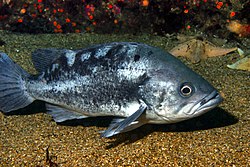
| At the Vancouver Aquarium | |
Scientific classification 
| |
| Kingdom: | Animalia |
| Phylum: | Chordata |
| Class: | Actinopterygii |
| Order: | Perciformes |
| Family: | Scorpaenidae |
| Genus: | Sebastes |
| Species: | S. melanops
|
| Binomial name | |
| Sebastes melanops Girard, 1856
| |
| Synonyms[1][2] | |
The black rockfish (Sebastes melanops), also known variously as the black seaperch, black bass, black rock cod, sea bass, black snapper and Pacific Ocean perch,[3] is a species of marine ray-finned fish belonging to the subfamily Sebastinae, the rockfishes, part of the family Scorpaenidae. It is sometimes misidentified as the "red snapper".[3]
Taxonomy
[edit]The black rockfish was first formally described in 1856 by the French biologist Charles Frederic Girard with the type locality given as Cape Flattery, Washington, and Astoria, Oregon.[2] In 1864 Theodore Gill described a new species Sebastosomus simulans from Cape Flattery and none of Girard's specimens can be traced to that locality. S. simulans has been regarded as a synonym of Sebastes melanops but there are enough differences between Gill's type and specimens of black rockfish to suggest that it is a different taxon but more study is needed to identify which taxon.[4] Some authorities classify this species in the subgenus Sebastosomus. The specific name melanops is a compound of melanos meaning "black" and ops which means "appearance", presumed to be a reference to the blackish brown back with black spotted brownish flanks.[5]
Distribution
[edit]The black rockfish is found in the northeastern Pacific Ocean from Amchitka Island in the Aleutian Islands of Alaska to Santa Monica Bay in California.[6] There have been two records of this species from the Iwate Prefecture of northern Japan.[4]
Habitat
[edit]This species is found in the waters of the continental shelf[7] and is associated with reefs at depths down to 366 m (1,201 ft) but it is more typically found between 182 and 274 m (597 and 899 ft)[1] They frequent areas of rocky reefs and live among kelp, as well as jetties and other structures.[8]
Description
[edit]

The black rockfish attains a maximum total length of 63 cm (25 in) and has a maximum published weight of 4.8 kg (11 lb).[1] It has a fusiform body which is deep and laterally compressed.[6] The head is weakly spined with only the nasal spines always present while the preocular and postocular spines are normally absent and the supraocular, tympanic, coronal, parietal and nuchal spines are always absent.[1] The head eyes are moderately large eyes with a bulge in the intraorbital space and the upper jaw reaches to the posterior margin of the eye. They have a continuous dorsal fin which contains 13-14 spines and 13-16 soft rays. The membranes between the spines are deelply incised. The anal fin has a rounded posterior profile and contains 3 spines and 7-9 soft rays. The caudal fin is truncate to emarginate.[6]
The overall color is mottled grey and black with a black spot on the posterior of the spiny dorsal fin which fades as the fish grows. Adults can have dark stripes on the head running from the eye over the operculum. The dark color on the upper body is frequently paler than that on the flanks, leading to a mottled appearance. This dark color fades to white on the underside.[9]
Biology
[edit].jpg)
Black rockfish are pelagic, that is, they occur on the continental shelf. Like other pelagic fish, they spend most of their time amid the water columns and are generally associated with rougher terra. This can make it somewhat inconvenient for commercial fisheries, which are often situated in nearshore, shallow water, and rocky areas (reefs). They make up an important component of nearshore fisheries in Southeastern Alaska.[7]
Rockfish are slow-growing and extremely long-lived, and black rockfish become sexually mature only after 6 to 8 years of age. Specimen collected off Alaska have been aged to 49 years old. In addition they benefit from a low natural mortality rate, at only about 7% of the total population.[7]
Black rockfish breed via internal fertilization, meaning that female members of the species store sperm until the development of the eggs. The phases between the start of the process and the end are separated by several months. The majority of the young are reared in late winter to early spring. Females produce between 125,000 and 1,200,000 eggs every breeding season. However, it has been noted that not all of the eggs are released every year. It has been occasionally observed that the female may absorb the eggs back into her system.[7]
Tagging studies off Washington, Oregon, and Southeast Alaska indicate that although for the most part they spend most of their life in a small area, some long-distance travel does occur.[7]
A potential PCR-RFLP genetic sex marker developed for gopher rockfish[10] does not successfully distinguish male and female black rockfish.[11]
Fisheries
[edit]
The black rockfish is a prime target for anglers, and a reproductive rate unusually high for its slow-growing genus makes it more resistant to fishing than its cousins, such as the yelloweye rockfish, are. They are harvested in Oregon, California, Washington, British Columbia, Alaska, and the Pacific. They are a fairly common catch along the West Coast of North America, where populations are stable.[3]
Schools of adults often aggregate over rocky bottoms or at the sea surface, habits that make them susceptible to targeted fishing.[7]
References
[edit]- ^ a b c d Froese, Rainer; Pauly, Daniel (eds.). "Sebastes melanops". FishBase. August 2021 version.
- ^ a b Fricke, Ron; Eschmeyer, William N. & van der Laan, Richard (eds.). "Species in the genus Sebastes". Catalog of Fishes. California Academy of Sciences. Retrieved 22 November 2021.
- ^ a b c "Rockfish, Black". Monterey Bay Aquarium Foundation. 2009. Archived from the original on 6 July 2010. Retrieved 14 December 2009.
- ^ a b Kai, Y.; N. Muto; T. Noda; J. W. Orr & T. Nakabo (2013). "First record of the rockfish Sebastes melanops from the Western North Pacific, with comments on its synonymy (Osteichthyes: Scorpaenoidei: Sebastidae)". Species Diversity. 18 (2): 175–182. doi:10.12782/sd.18.2.175.
- ^ Christopher Scharpf & Kenneth J. Lazara, eds. (22 May 2021). "Order Perciformes (Part 8): Suborder Scorpaenoidei: Families Sebastidae, Setarchidae and Neosebastidae". The ETYFish Project Fish Name Etymology Database. Christopher Scharpf and Kenneth J. Lazara. Retrieved 20 November 2021.
- ^ a b c "Black rockfish Sebastes melanops". SIMoN Tools. Retrieved 22 November 2021.
- ^ a b c d e f "Black Rockfish (Sebastes melonops) Species Profile". Alaska Department of Fish and Game. Retrieved 22 November 2021.
- ^ "Black Rockfish (Sebastes melanops)". centralcoastbiodiversity. Retrieved 22 November 2021.
- ^ "Black Rockfish (Sebastes melanops)". Washington Department of Fish and Wildlife. Retrieved 22 November 2021.
- ^ Fowler, Benjamin L.S.; Buonaccorsi, Vincent P. (2016). "Genomic characterization of sex‐identification markers in Sebastes carnatus and Sebastes chrysomelas rockfishes". Molecular Ecology. 25 (10): 2165–2175. doi:10.1111/mec.13594. PMID 26923740.
- ^ Vaux, Felix; Aycock, Hannah M.; Bohn, Sandra; Rasmuson, Leif K.; O'Malley, Kathleen G. (2020). "Sex identification PCR–RFLP assay tested in eight species of Sebastes rockfish". Conservation Genetics Resources. 12 (4): 541–544. doi:10.1007/s12686-020-01150-y. S2CID 216609309.
Black rockfish
View on GrokipediaTaxonomy
Classification
The black rockfish is classified under the binomial name Sebastes melanops, originally described by the French-American ichthyologist Charles Frédéric Girard in 1856 based on specimens from the northeastern Pacific coast.[2][6] The type locality for the species includes Cape Flattery in Washington and the vicinity of Astoria, Oregon, near the mouth of the Columbia River.[7] It belongs to the family Scorpaenidae, commonly known as scorpionfishes and rockfishes, a group characterized by robust bodies and spiny fins adapted to temperate marine environments.[8] Within this family, S. melanops is placed in the genus Sebastes, which encompasses over 100 species of viviparous rockfishes primarily distributed across the North Pacific Ocean.[9][10] Historically, Sebastosomus simulans (described by Theodore Nicholas Gill in 1864) has been treated as a junior synonym of S. melanops, but the original description of the holotype indicates morphological differences, such as fewer pectoral-fin rays (18 versus typically 19 in S. melanops) and a shorter upper jaw, suggesting it may represent a distinct species pending further study including examination of the holotype and genetic analyses.[7] Phylogenetic analyses position S. melanops within a diverse subclade of Sebastes species exhibiting similar reproductive and ecological traits in coastal waters.[10]Etymology and Synonyms
The genus name Sebastes derives from the Greek sebastos, meaning "august" or "venerable," a reference to the dignified appearance of these fish.[11] The specific epithet melanops combines the Greek words melas (black) and ops (face or eye), alluding to the species' dark coloration around the head.[11] This nomenclature reflects the fish's distinctive visual traits within the family Scorpaenidae.[11] The black rockfish was first formally described in 1856 by Charles Frédéric Girard in the Proceedings of the Academy of Natural Sciences of Philadelphia, based on specimens from the Pacific coast of North America.[11] Over time, taxonomic revisions have clarified its nomenclature, with historical synonyms including Sebastodes melanops (Girard, 1856) and Sebastosomus simulans (Gill, 1864), which were once considered separate but later synonymized under Sebastes melanops. Additional junior synonyms, such as Sebastes columbianus (Hubbs and Schultz, 1933), emerged from early morphological studies but were resolved through comparative examinations of type specimens. In early 20th-century ichthyology, particularly in works by David Starr Jordan and Barton Warren Evermann, debates arose over subgeneric divisions within Sebastes, including whether species like the black rockfish belonged to subgenera such as Sebastodes due to variations in spine counts and body proportions; these discussions ultimately reinforced the current unified genus placement. Common names for the species include black rockfish (the standard vernacular), black seaperch, black bass, and Pacific Ocean perch, reflecting regional fishing traditions along the North American Pacific coast.[12]Description
External Morphology
The black rockfish (Sebastes melanops) exhibits a robust, fusiform body that is compressed laterally, giving it a streamlined yet sturdy appearance typical of the genus.[13][2] The body is covered in small ctenoid scales, with a lateral line featuring 46-55 pores that aid in sensory detection.[14] Adult coloration is predominantly mottled gray-black dorsally, often accented by dark stripes running from the eye to the gill plate, transitioning to a lighter, dirty white or whitish ventral surface.[1][13] A diagnostic black spot marks the posterior portion of the spinous dorsal fin, which fades as the fish ages.[1] The fins are generally dark, with the pelvic fins lighter in contrast.[14] The head is equipped with a large mouth, where the maxilla extends to or beyond the posterior margin of the orbit, facilitating prey capture, and moderately large eyes.[4][1] Head spines are weak to very weak, lacking prominent structures such as a strong symphyseal knob on the lower jaw.[2][1] Diagnostic fin structures include a continuous dorsal fin with 13-14 sharp spines followed by 13-16 soft rays, where the spines are venomous and capable of inflicting painful stings or infections upon contact.[2][1] The anal fin bears 3 spines and 7-9 soft rays, presenting a rounded or posteriorly slanted profile, while the caudal fin features an indented posterior margin.[2] Juveniles display brighter, more vivid coloration upon settlement, ranging from orange to dark brown, with older juveniles adopting the mottled gray-black pattern but retaining more pronounced dark spots and bars that gradually fade.[1] Sexual dimorphism manifests primarily in body size, with females achieving slightly larger dimensions than males, up to a maximum length of approximately 69 cm.[1]Size and Growth Patterns
The black rockfish (Sebastes melanops) attains a maximum total length of 69 cm and a maximum weight of 5 kg.[1] These dimensions represent the upper limits observed across populations, with females typically achieving larger sizes than males.[15] Black rockfish exhibit slow growth, particularly in early life stages. Juveniles, which recruit to nearshore habitats at approximately 3.5–9.3 cm standard length after about six months of pelagic existence, reach 10–15 cm total length by the end of their first year under typical environmental conditions.[16] Growth rates vary with temperature and food availability, ranging from -0.023 to 0.314 mm per day in length for juveniles of 35–93 mm, with optimal growth at higher rations and moderate temperatures around 12–18°C.[16] By maturity, individuals approach an asymptotic length of around 50 cm, though regional studies indicate slight variations.[15] The species has a lifespan of up to 50 years, with maximum observed ages of 48–56 years depending on the population.[17][15] Age determination relies on annuli counts in otoliths, using methods such as break-and-burn, which yield low error rates (average 1%) and validate growth trajectories through back-calculation.[17] Growth patterns are commonly modeled using the von Bertalanffy growth function, which describes length-at-age aswhere is length at age , is the asymptotic length, is the growth coefficient, and is the hypothetical age at zero length. For coastal populations in California, Oregon, and Washington, sex-specific parameters include cm and –0.2 year for females (e.g., cm, year) and slightly lower (46–51 cm) with higher (0.21–0.27 year) for males, reflecting faster initial growth but smaller ultimate size in males.[15] These parameters are derived from otolith-based age-length data and fit regional variations, emphasizing the species' indeterminate growth over decades.[17]