Recent from talks
Nothing was collected or created yet.
Bota bag
View on WikipediaThis article needs additional citations for verification. (October 2023) |

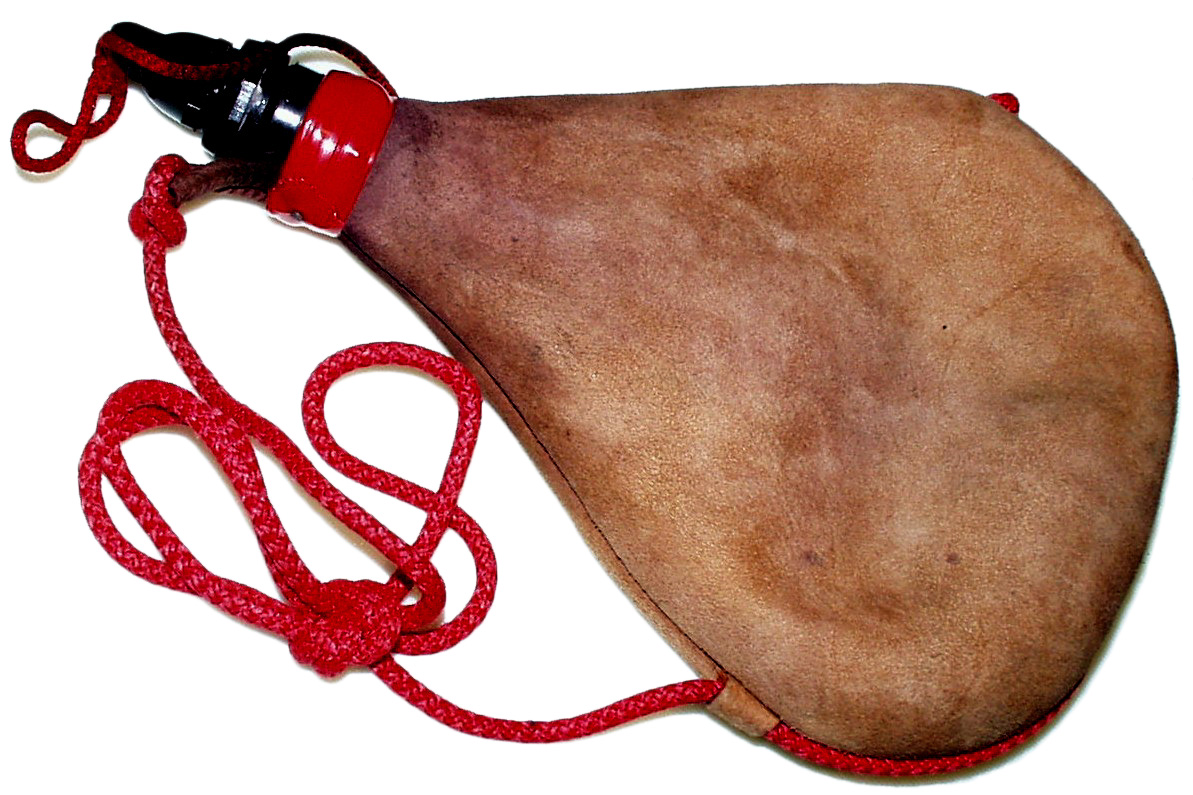
A bota bag is a traditional Spanish liquid receptacle, used mainly as a wineskin. It is often made out of leather (when made of goatskin it is simply known as a goatskin), and is typically used to carry wine, although any liquid can be filled into it.[1]
Construction
[edit]Traditionally, bota bags were lined with goat bladders, in other cases tree sap or other resins were used to prevent liquids from seeping through. Modern bota bags have a plastic liner and nozzle.
Variants
[edit]The zahato [s̻ahato] is the traditional goatskin bottle of the Basque shepherds. With its narrow nozzle, it is possible to drink "zurrust", i.e. intercepting the jet without touching the bottle. The name of zahato or zahako (variants: xahako [ʃahako], zarako) is a diminutive zahat-to/-ko of zahagi 'big goatskin bottle'. Its manufacturer is a zahatogile.
The zahato is made of two pieces of tanned and close-cropped goatskin. Softened, they are cut out on a last and are sewn on their sides. Then the bottle is turned up, seam and hair inside. After drying, it is inflated, then coated with pitch to make it impermeable. The nozzle, traditionally in horn, is fixed by a red collar. The zahato is carried across the shoulder with the red cord which surrounds it along the seam.
See also
[edit]References
[edit]- ^ Medina, F. Xavier (2005-01-30). Food Culture in Spain. Westport: Greenwood (Bloomsbury Publishing USA). p. 87. ISBN 0-313-05968-3.
Bota bag
View on GrokipediaHistory and Origins
Etymology
The term "bota" for the traditional Spanish wineskin derives from the Late Latin buttis (genitive buttīs), meaning a cask, barrel, or bottle used for liquids. This word entered the Romance languages during the early medieval period.[7][1] In the Basque language, the equivalent term is "zahato" (or variants like "zahako" and "xahako"), a diminutive form of "zahagi," which semantically breaks down to denote a "goatskin bottle" or small leather wineskin. Phonetically, "zahato" incorporates the aspirated 'h' sound typical of Basque (pronounced [s̻ahato]), with "zah-" likely deriving from roots related to skin or hide (cf. "zahagi" for "leather" or "pelt"), emphasizing the material's origin in tanned goatskin; historical records from the Basque Country document its use since at least the 16th century in pastoral contexts.[8] Linguistic variations across the Iberian Peninsula reflect shared Latin heritage with regional adaptations. In Portuguese, "bota" mirrors the Spanish usage for both boot and wineskin, retaining the dual sense from Late Latin. Catalan employs "borratxa" for the wineskin, though descriptive phrases like "botella de pell" (skin bottle) are also common to highlight the construction. These terms connect to the broader evolution of wineskin nomenclature discussed in the historical development of the bota bag.[9]Historical Development
The bota bag traces its origins to ancient Mediterranean traditions of using animal skins for liquid transport, with evidence of such wineskins dating back to at least the 8th century BCE in Greek literature, such as Homer's Odyssey, where they were employed for carrying wine, including to intoxicate others.[10] By Roman times in the 1st century BCE, goatskin bags had become common for portable storage of wine, water, and oils, sewn together, sealed with pitch, and carried by travelers, soldiers, and during festivals like the Vinalia, offering a lightweight alternative to fragile amphorae.[11] The design has roots in the Middle East and was introduced to the Iberian Peninsula by the Moors during their occupation from the 8th to 15th centuries, adapting local leatherworking traditions.[2] Following the Roman legacy and Moorish influence, wineskins became part of Iberian practices during the medieval period, coinciding with the expansion of viticulture.[12] From the 16th to 19th centuries, the bota bag played a vital role in rural Spanish life, particularly among shepherds, travelers, and farmers, providing a durable, portable means to carry wine over long distances without breakage.[13] Its design allowed for easy integration into saddlebags or backpacks, sustaining workers in remote areas where glass or barrels were impractical, and it became a staple in the daily sustenance of Iberian agrarian and nomadic communities.[12] The bota bag's prominence declined in the 20th century with the rise of industrialized glass bottles and changing social norms, including prohibitions on wine consumption at work and public events, which curtailed its everyday utility.[5] However, post-1950s cultural preservation efforts revived its production, with family workshops like Las Tres Z.Z.Z. in Pamplona expanding output to over 200,000 units annually by the late 1970s, emphasizing traditional craftsmanship to maintain its place in Spanish heritage.[5]Design and Construction
Materials
The primary material for traditional bota bags is goatskin, often referred to as cabritilla, valued for its durability, flexibility, and pliability that allows the bag to conform to the body during transport. Sourced historically from local goat herds in regions like Andalusia and the Basque Country, where leather production centers such as Ubrique have long utilized these hides, goatskin provides a lightweight yet robust exterior suitable for the Iberian climate.[14][15] Historically, traditional bota bags were sometimes lined with goat bladders to prevent leakage, though pitch became the standard sealant. The hides undergo vegetable tanning using natural tannins derived from sources like oak and chestnut bark, a process that preserves the leather's natural properties while enhancing resistance to wear without the harsh chemicals of chrome tanning.[16] This method, though water-intensive, has a comparatively lower environmental impact than synthetic alternatives, as it relies on renewable plant extracts and produces biodegradable byproducts when managed sustainably.[17] To ensure impermeability, the interior of the goatskin is treated with waterproofing agents such as pitch, a resin derived from pine or juniper trees, which seals the leather's pores and prevents leakage while imparting a subtle flavor compatible with wine storage.[6][18] For spouts and closures, components include leather straps for carrying, wooden or cork plugs for sealing, and occasional bone or horn reinforcements around the nozzle to provide rigidity and durability during use.[6][18] In modern iterations, traditional goatskin is often lined with synthetic rubbers like latex or food-grade plastics, which reduce overall weight, minimize absorption of odors, and improve hygiene by facilitating easier cleaning compared to untreated leather. These alternatives maintain the bag's classic form while addressing concerns over bacterial growth in organic materials. The use of such liners in variants like the Basque zahato underscores how material choices adapt to regional preferences for robustness in rugged terrains.[19][6][20]Manufacturing Process
The traditional manufacturing process of a bota bag is a labor-intensive artisanal craft, primarily carried out by specialized leatherworkers known as boteros, particularly in regions like La Rioja, Spain. It begins with preparation of the hide, where selected goatskins are tanned using vegetable tannins derived from woods such as oak or chestnut to render them supple and durable. The tanned hide is then carefully cut into specific patterns: typically two large pieces to form the main body and narrower strips for reinforcing the seams, ensuring an efficient use of the material while allowing for the bag's characteristic teardrop shape.[13][21] Seaming follows, where the cut pieces are assembled inside-out to facilitate precise work on the interior surfaces. The edges are hand-stitched using sinew, leather thongs, or waxed thread in a tight, overlapping pattern to create a watertight structure without modern machinery; this inversion technique allows the botero to hide the stitches on the exterior once turned right-side out. This step demands years of practiced skill to avoid weak points, as the seams must withstand pressure from contained liquids.[13][22] Waterproofing is achieved by heating the assembled bag over a low flame or in warm conditions to open the leather pores, then applying a coat of hot pitch—traditionally derived from pine resin—brushed evenly across the interior. The bag is then inflated slightly and hung to cure, allowing the pitch to harden and form an impermeable seal; this curing period typically lasts 2 to 4 weeks, during which the bag is monitored to ensure even drying and prevent cracks.[13][23] In the finishing stage, the cured bag is turned right-side out, and the spout (cuello) is attached via reinforced stitching or lashing, often using leather tubing or a horn insert for controlled pouring. Carrying straps are sewn or tied securely to the sides, and optional decorative elements, such as embossed patterns or polished suede finishes, may be added for aesthetic appeal. The entire process encompasses over 40 steps and requires 10 to 20 hours of dedicated labor per bag by a skilled botero, underscoring its status as a fading artisanal tradition. Slight variations exist in regional adaptations, such as the Basque zahato.[13][22][21]Variants and Regional Adaptations
Traditional Spanish Bota
The traditional Spanish bota bag adopts a classic pear-shaped or flask-like design, characterized by a wide body that ensures stability when laid down, with capacities typically ranging from 1 to 5 liters to suit daily needs. This form, known as "lágrima" in Spanish, allows for efficient storage and pouring while minimizing spillage during transport.[24][25] Its spout features a narrow leather or cane nozzle, designed for controlled pouring directly into the mouth or a glass, and is typically secured with a simple plug or attached strap to prevent leaks. Aesthetically, the bota is often plain or adorned with minimal tooling for durability, deriving its colors—ranging from natural browns and tans—through traditional vegetable tanning processes that enhance longevity without elaborate decoration.[26][27] Weighing under 1 kg when empty, the bota emphasizes portability with an integrated braided shoulder strap, enabling easy carrying across fields or during travel. This lightweight construction made it ideal for vineyard workers in central and southern Spain, where the design evolved and standardized by the 18th century to support laborious fieldwork and wine transport.[24][28] In contrast to Basque adaptations like the zahato, which feature narrower nozzles and elongated shapes, the Spanish bota prioritizes a broader, more versatile profile.[25]Basque Zahato
The Basque zahato represents a specialized variant of the wineskin, tailored for the needs of shepherds in the Basque Country, particularly those practicing transhumance in the Pyrenees. Crafted as a distinctive regional adaptation, it shares foundational materials like tanned goatskin with the broader Spanish bota tradition but incorporates elements suited to rugged, individual use during long herding migrations.[20] In design, the zahato adopts a cylindrical or bottle-shaped form, constructed from two pieces of tanned and close-cropped goatskin that are softened, cut to shape on a last, and sewn end-to-end along their sides. The assembly is then turned inside out—with the seam and hair facing inward—before being inflated and coated internally with pitch to ensure impermeability against liquids like wine. A narrow horn nozzle, termed zurrumugi, is affixed to one end, enabling precise control over the flow for directed drinking in challenging outdoor conditions. This structure, approximately 1,000 years old, evolved specifically for Basque herders navigating mountainous terrain, emphasizing portability and durability over communal sharing.[29] With a typical capacity of 2–4 liters, the zahato is optimized for personal sustenance, allowing shepherds to carry sufficient wine or water without excess bulk during extended periods away from settlements. Decoratively, it often features painted folk motifs such as animals or landscapes, as seen in examples illustrating bullfighting scenes that evoke regional cultural narratives. A red wool collar secures the horn nozzle, while a matching red cord runs along the seam for shoulder carrying, reinforcing its ties to Basque identity and rural heritage.[20][29] The zahato's nozzle facilitates the "zurrust" drinking technique, in which the user pinches and directs a thin jet of liquid mid-air to catch it directly in the mouth without contacting the bag itself—a skill honed for efficiency and hygiene among mobile herders. This adaptation underscores the zahato's role in supporting the autonomy of transhumant Basque shepherds from the 17th to 19th centuries, when seasonal migrations peaked in the Pyrenees, though its core form traces back further in oral and material traditions.[29]Other Regional Forms
North African influences, particularly from the Moorish era, contributed to Iberian leather bag designs.[2]Cultural Significance
Role in Spanish and Basque Traditions
The bota bag holds a central place in Spanish cultural identity, symbolizing rustic simplicity and the deep-rooted wine heritage of the Iberian Peninsula. As a practical vessel for transporting and sharing wine, it embodies the conviviality of Mediterranean life, where offering a drink from the bota to guests signifies hospitality and communal bonds.[30] In rural settings, it has long been an essential companion for field workers, facilitating shared meals and breaks that strengthen social ties among laborers.[31] Historically associated with men in agrarian contexts, the bota bag reflects traditional gender roles in Spanish rural society, where it served as a tool for male-dominated tasks like farming and herding.[31] Its use underscores a heritage of resourcefulness, with the leather container preserving wine's freshness during long days of labor, thus integrating seamlessly into the rhythms of everyday rural existence.[26] In Basque traditions, the bota bag—known locally as the zahato—ties closely to the cultural identity of Euskal Herria, the Basque homeland, particularly among shepherds who carried it during solitary mountain work. It fostered social connections through shared sips of wine alongside music from instruments like the trikitixa, evoking homeland memories and resilience in isolated pastoral life.[32] The zahato appears in Basque folklore, such as the zahagi-dantza (wineskin dance) performed during carnival in places like Markina-Xemein, where it features in ritualistic movements that celebrate community and heritage.[33] References in traditional songs further embed it in cultural narratives, portraying it as a vessel of both sustenance and symbolic excess in tales of folklore.[34] As a marker of Basque pride, the zahato reinforces ethnic identity, often highlighted in diaspora events to preserve ties to ancestral customs.[35]Use in Festivals and Social Customs
In the San Fermín festival held annually in Pamplona, Spain, bota bags play a central role in the celebrations, serving as portable containers for wine that participants carry and drink to enhance the event's atmosphere of revelry and communal joy. The festival, which features the famous running of the bulls, attracts thousands who don traditional white attire accented with red sashes and use bota bags to share wine during street parties and pre-run gatherings, fostering a sense of camaraderie among revelers. This practice has been documented since at least the early 20th century, with the bota bag's association popularized by Ernest Hemingway's 1926 visit to Pamplona, where he purchased several from local artisan Las Tres Z.Z.Z. and depicted their use in his novel The Sun Also Rises, immortalizing the wineskin's place in the fiesta's bacchanalian spirit.[5][36] A key social custom involving bota bags is the communal sharing during group outings or "paseos," leisurely walks where friends or family pass a single wineskin to sip wine, emphasizing equality and collective enjoyment without individual glasses. This practice, common in rural and festive gatherings, underscores the bota bag's role in democratizing drink consumption and strengthening social bonds in Spanish and Basque communities.[3] In modern revivals, bota bags have been incorporated into tourism events along Spain's wine routes, such as those in Rioja, where guided tours offer demonstrations on filling, drinking from, and sharing the wineskin to educate visitors on traditional techniques. These interactive sessions, often held at vineyards or during harvest-themed activities, revive the artifact's cultural relevance for international audiences while promoting sustainable, hands-on experiences in enotourism.[37]Usage and Practical Aspects
Drinking Techniques
The traditional method for drinking from a bota bag involves holding the bag overhead with one hand supporting the bottom and the other grasping the neck near the spout, then squeezing gently to propel a controlled arc of liquid directly into the open mouth without the lips touching the nozzle.[38][39] This technique, rooted in Spanish and Basque pastoral practices, allows for hygienic sharing among groups and aerates the wine for enhanced flavor during consumption.[3] The narrow spout design facilitates the formation of this stream, enabling precise aiming with practice.[40] In Basque traditions, an advanced variation known as zurrust—referring to the gulping action—requires intercepting a narrower, higher-pressure jet mid-air at arm's length to demonstrate skill, often during social gatherings or festivals.[41] This method demands coordination and experience to avoid spills, as the forceful squeeze propels the liquid in a fine arc that must be caught accurately.[40] To fill a bota bag, warm it briefly in sunlight or an oven at low heat (around 100°C for 5 minutes) to soften the interior lining, then use the wide mouth or a funnel to pour in liquid such as wine, avoiding overfilling to prevent excessive internal pressure that could cause bursts or leaks.[42][43] For initial use or after storage, rinse repeatedly with a small amount of wine or salted water, shaking to distribute and clean the interior before a full fill.[42][43] Safety practices emphasize starting with small squeezes and short distances to develop aim and control, reducing the risk of liquid spraying onto the face or clothing.[39][40] Hygienic handling includes rinsing the bag with water before each use to prevent bacterial buildup, particularly when sharing.[38] Common errors include tilting the bag too low, which causes drips onto the chin or chest, or applying excessive force, resulting in uncontrolled sprays and wine loss.[40][39] Novices often touch the spout with their lips, which is considered improper and can lead to ridicule in traditional settings.[40]Care and Maintenance
Proper care and maintenance of a bota bag are essential to preserve its functionality, prevent bacterial growth, and extend its service life, particularly for traditional leather versions with pitch or latex linings. The specific methods vary slightly depending on the lining material, but general principles emphasize gentle handling to avoid damaging the leather exterior or internal sealant. For cleaning, rinse the interior with cold water immediately after use to remove wine residues or other liquids. For a more thorough sanitization, fill the bota bag with cold water and let it sit for 24-36 hours to cure and loosen buildup, then discard the water and repeat if necessary; some sources recommend adding inexpensive wine for the final curing step to seal the pitch lining. Air dry the bag inverted in a well-ventilated area to ensure complete drying and prevent mold. For the leather exterior, gently hand wash with cold water and mild, neutral soap using a soft cloth, avoiding soaking or harsh chemicals that could degrade the material.[43][44] Storage practices focus on preventing drying out or degradation of the leather. Always empty the bota bag completely and allow it to dry fully before storing, as residual moisture can lead to mildew. Keep it in a cool, dry, dark place away from direct sunlight, which can cause the leather to fade, dry out, and crack over time; use a breathable dust bag or open shelf rather than airtight containers to maintain humidity balance around 40-50%. Avoid extreme temperatures or humid environments, as they can warp the leather or affect the lining.[44][45][46] Repairs should address common issues like leaks from the lining or tears in the leather promptly to maintain waterproofing. For clumped pitch in traditional models, warm the bota bag by submerging it in hot (not boiling) water for a few minutes, then shake vigorously to redistribute the resin, ensuring an even seal. Small tears in the leather can be patched using matching leather scraps and a leather-specific adhesive or pitch for reinforcement, though professional restoration is advised for extensive damage. Many manufacturers offer re-pitching services to restore the internal lining when it wears thin.[42][43] With consistent care, traditional pitch-lined bota bags can last for many years, often decades if used primarily for wine and maintained regularly. Signs of wear, such as persistent musty odors, leaks, or a hardened lining, signal the need for refurbishment or replacement to ensure safety and hygiene. Latex- or plastic-lined modern variants require less intensive upkeep but still benefit from the same drying and storage protocols; condition the leather exterior occasionally with a suitable product to retain suppleness, and avoid heat sources above 40°C that could warp the synthetic lining.[43][6][44]Modern Developments
Contemporary Production
In contemporary production, bota bags are primarily manufactured in small to medium-scale workshops across Spain, particularly in regions like Navarre and La Rioja, where family-run operations blend traditional handcrafting with modern facilities to meet global demand. For instance, Las Tres Z.Z.Z., established in Pamplona in 1873, operates a factory opened in 1970 that employs about 30 workers and incorporates innovations from early 20th-century advancements, such as improved sealing techniques introduced by co-founder Gregorio Pérez to enhance durability and reliability.[5] While core processes like skin selection and manual shaping remain artisanal, industrial shifts include machine-sewing for reinforced seams and semi-automated elements in larger workshops, enabling higher output; historical records from Las Tres Z.Z.Z. show peak production exceeding 215,000 units annually in the late 1970s, with similar scales in La Rioja-based operations like UYUNIX, which has handcrafted bags since 1865 using goat leather.[47][48] A key adaptation in modern bota bags is the use of hybrid materials, combining traditional vegetable-tanned goat leather exteriors for authenticity and durability with BPA-free plastic or latex interiors to facilitate easier cleaning and prevent flavor absorption from liquids other than wine. This design, seen in products from Spanish makers like those sold through La Tienda, allows for versatile use while maintaining the bag's lightweight portability, with the plastic lining ensuring food-safe containment without leaching chemicals.[49][50] Artisanal production persists through small botero workshops and family guilds, which emphasize hand-tanning and assembly to preserve centuries-old techniques. The EU has introduced a framework for geographical indications (GIs) for craft and industrial products under Regulation (EU) 2023/2411, which becomes fully effective on December 1, 2025, and could potentially apply to traditional leather goods like bota bags from specific regions.[51] These operations, numbering in the dozens across northern Spain, focus on premium, small-batch items rather than mass production. Economically, bota bag production supports a niche export market, with Spanish makers shipping to over 50 countries, including strong demand in Latin America and the United States, driven by tourism and outdoor recreation trends; prices typically range from €20 for entry-level synthetic models to €100 for fully handmade leather versions, reflecting the labor-intensive process.[5][52] Sustainability has gained prominence in the 2020s, with producers shifting toward eco-tanning methods using vegetable extracts instead of chrome salts, as seen in workshops employing traditional plant-based processes that reduce water pollution and align with the EU Green Deal (2019) and related circular economy initiatives as of 2025. Some modern variants incorporate recycled plastics for linings or straps, minimizing waste while adhering to stricter chemical safety standards.[50][53]Current Applications
In contemporary society, bota bags have found popularity as souvenirs and tourism items in Spain, where they are commonly sold at wineries, airports, and local markets to visitors seeking authentic cultural artifacts. These traditional vessels provide an immersive experience during wine tours, allowing participants to transport and sip beverages in a manner reminiscent of historical Spanish practices, enhancing the educational and sensory aspects of vineyard visits. For instance, travelers often purchase them as mementos from regions like Rioja or Andalusia, where they symbolize the country's winemaking heritage.[54][55][56] Beyond tourism, bota bags have been adapted for modern outdoor activities such as hiking, camping, and eco-tourism, serving as lightweight, portable containers for water or other non-alcoholic beverages. Their durable leather construction and strap design make them ideal for backpacking and nature excursions, with contemporary versions featuring food-grade linings to ensure safety and hygiene during extended use in remote areas. Manufacturers market them specifically for these purposes, emphasizing their versatility in sustainable travel and adventure settings.[57][58][59] Bota bags also appear in cultural reenactments and as props in media, including Renaissance fairs, historical society events, and films depicting periods from medieval Europe to the American West. At Renaissance festivals, such as the New York Renaissance Faire, they are sold and used by attendees to maintain period authenticity while carrying drinks, blending practical utility with immersive role-playing. In cinematic contexts, they serve as evocative accessories for characters in historical dramas and Westerns, evoking frontier lifestyles since mid-20th-century productions.[60][59][61] Vintage bota bags have emerged as collectibles among enthusiasts of folk art and antiques, with well-preserved 19th- and early 20th-century examples fetching prices around $50 to $100 at online auctions and specialty sales. These items appeal to collectors for their handcrafted details, such as painted motifs or aged leather, often displayed as decorative pieces rather than functional ones. Additionally, niche markets have developed vegan alternatives made from synthetic or plant-based leathers with latex interiors, catering to ethical consumers in the 2020s who prioritize cruelty-free options for outdoor or event use. Customization services allow personalization with engravings or initials, making them popular for weddings and private celebrations as unique, thematic gifts.[62][63][64][65]References
- https://en.wiktionary.org/wiki/borratxa
