Hubbry Logo
Cinema of BrazilCinema of BrazilMain
Open search
Cinema of Brazil
Community hub
Cinema of Brazil
logo
8 pages, 0 posts
0 subscribers
Be the first to start a discussion here.
Cinema of Brazil
Cinema of Brazil
from Wikipedia

Cinema of Brazil
No. of screens3,530 (2024)[1]
 • Per capita1.6 per 100,000 (2015)[1]
Main distributorsUniversal (20.8%)
Disney (17.3%)[2]
Produced feature films (2015)[3]
Total129
Fictional79 (61.2%)
Animated26 (10.0%)
Documentary50 (38.8%)
Number of admissions (2015)[4]
Total172,943,242
National films22,485,736 (13%)
Gross box office (2015)[4]
TotalR$2.35 billion
National filmsR$278 million (11.8%)

Cinema of Brazil refers to the film industry based in Brazil. The Brazilian cinema was introduced early in the 20th century but took some time to consolidate itself as a popular form of entertainment. Its film industry has gone through periods of ups and downs, a reflection of its dependency on state funding and incentives.

History

[edit]

Early days

[edit]

A couple of months after the Lumière brothers' invention, a film exhibition was held in Rio de Janeiro. As early as 1898, Affonso Segreto supposedly filmed the Guanabara Bay from the ship Brésil on a return journey from Europe, though some researchers question the veracity of this event as no copy of the film remains. He would go on to make documentaries with his brother Paschoal Segreto.

From the early beginning of the 20th century, as early as 1900 to the year of 1912, Brazilian films had made a major impact on the internal market, which saw an annual production of over one-hundred films.[5] In 1908, during a period coined Brazil's "golden age" of Cinema, the country saw its first widely popular film, titled Os Estranguladores, by Antonio Leal.[5]

An ad of a May 1987 issue of Gazeta de Petrópolis, as shown in 1995 by Jorge Vittorio Capellaro and Paulo Roberto Ferreira, was introduced as the new "birth certificate" of Brazilian cinema, as three short films were advertised: Chegada do Trem em Petrópolis, Bailado de Crenças no Colégio de Andarahy and Ponto Terminal da Linha dos Bondes de Botafogo, Vendo-se os Passageiros Subir e Descer.

Carmen Miranda in Alô, Alô Carnaval (1936). The Brazilian actress gained visibility overseas.

During this belle époque of Brazilian cinema, when black and white silent films were less costly to produce, most work resulted from the effort of passionate individuals willing to take on the task themselves rather than commercial enterprises. Neither is given much attention by the state, with legislation for the sector being practically non-existent. Film theaters only become larger in number in Rio and São Paulo late in the following decade, as power supply becomes more reliable.

Foreign films as well as short films documenting local events were most common. Some of the first fictional work filmed in the country were the so-called "posed" films, reconstructions of crimes that had recently made the press headlines. The first success of this genre is António Leal and Francisco Marzullo's Os Estranguladores (1908). "Sung" films were also popular. The actors would hide behind the screen and dub themselves singing during projection. During the 1920s film production flourished throughout several regions of the country: Recife, Campinas, Cataguases, Juiz de Fora and Guaranésia.

Also in the early 20th century of Brazilian cinema, there was a major lack of Black presence in films that were being made. Brazilian and American films are common in this aspect, as both countries had endured similar types of European colonization, and how the colored were not given any time or recognition on film. Many of the early films being produced in Brazil were also made by Italian Brazilians, with respect to the likes of Affonso Segreto.[6] Another way Brazil and America had similar aspects in their films is the idea of "blackface" in America, and the "redface" in Brazil.

At the end of World War One, silent Brazilian cinema moved to the growing expansion of women and their social class, mainly the middle, and shows their modernization and diversification. Hollywood influenced the idea of women becoming more seductive in Brazilian cinema as well with new types of hairstyles, smoking cigarettes, and looking "exotic", in terms of appearance.[7]

Hollywood films were also extremely popular during this time, accounting for as much as 85 percent of film material being exhibited on Brazilian screens in 1928. That year, an estimated 16,464,000 linear feet of film was exported to Brazil, making it Hollywood's third largest foreign market. European films, mostly from Germany and France, were also exhibited with relative frequency.[8] Fan magazines like Cinearte and A Scena Muda were published during this time, featuring both domestic and Hollywood films and stars.

1930s and 1940s

[edit]
Scene from the 1943 Brazilian film Way to Heaven, Caminho do Céu. A kiss between Celso Guimarães and Rosina Pagã, protagonists.

Atlântida

[edit]

During the 1940s and 1950s, films produced by the Atlântida Cinematográfica peaked and attracted large audiences by continuing with chanchadas. Among the actors that became strongly associated with Atlântida who had previously worked in Cinédia films are Oscarito, a comedian somewhat reminiscent of a Harpo Marx and commonly cast as lead, and Grande Otelo, who usually had a smaller supporting role and is often Oscarito's sidekick.

The two actors became widely popular throughout Brazil as an amazing comical duo. Otelo, would see much of the humor falling on him at the time due to his Afro-Brazilian characteristics, while Oscarito became the comical foil in the film, a more pale-toned man with like characteristics.

The two helped to display the diversity in Brazilian cinema to reflect on the diversity of Brazil itself.[9] José Lewgoy was commonly cast as a villain while Zézé Macedo often took on the role of the undesired, nagging wife.

The films of this period have often been brushed aside as being overly commercial and americanized, though by the seventies a certain amount of revisionism sought to restore its legitimacy. Despite being overlooked by intellectual elites, these films attracted large audiences as none of the Cinema Novo films would achieve.

Today, the telenovela, especially the "novela das sete" (a nickname given to soap operas produced by the Rede Globo channel aired around seven p.m. Mondays through Saturdays) is sometimes identified as carrying on the spirit of the chanchada. Many of the films produced by the company have been lost throughout the years due to fire and flooding of its storage facilities.

Vera Cruz

[edit]

The Companhia Cinematográfica Vera Cruz was a production company founded in the state of São Paulo during the forties and most notable for its output during the following decade. It is in this period that Lima Barreto's classic O Cangaceiro was produced. The movement was named after the large production studio, inspired by Hollywood scale.

However, despite O Cangaceiro, which was clearly inspired by western genre, the essence of these films followed the Italian cinema's style, popular between São Paulo's cultural elite in that time. Vera Cruz films were highly commercialized, which led some directors to begin experimenting with independent cinema. This movement away from commercialized Vera Cruz style films came to be called Cinema Novo, or New Cinema. Vera Cruz eventually bankrupted and closed.

Director Glauber Rocha, a central figure of the Cinema Novo movement

Rocha often spoke of his films as being a departure from what he considered to be the colonizer's view, to whom poverty was an exotic and distant reality, as well as the colonized who regarded their third world status as shameful. He sought to portray misery, hunger and the violence they generate and thus suggest the need for a revolution. Deus e o Diabo na Terra do Sol and Terra em Transe are some of his most famous works.

Other key directors of the movement include Nelson Pereira dos Santos, Ruy Guerra, Leon Hirszman, and Carlos Diegues. Freedom to express political views becomes scarce as the 1964 Brazilian military regime takes place and repression increases over the following years, forcing many of these artists with a marxist or communist bent into exile. In 1985, with the end of the military regime, these artists and singers returned to Brazil.

B Films

[edit]

A "marginal cinema" emerges associated with the Boca de Lixo area in São Paulo. In 1968, Rogério Sganzerla releases O Bandido da Luz Vermelha, a story based on an infamous criminal of the period. The following year Júlio Bressane's Killed the Family and Went to the Movies (Matou a família e foi ao cinema) came out, a story in which the protagonist does exactly what is described by the title. Marginal cinema of this period is sometimes also referred to as "udigrudi", a mocking of the English word underground. Also popular was Zé do Caixão, the screen alter ego of actor and horror film director José Mojica Marins.

Associated with the genre is also the pornochanchada, a popular genre in the 1970s. As the name suggests, these were sex comedies, though they did not depict sex explicitly. One key factor as to why these marginal films thrived was that film theaters were obliged to obey quotas for national films. Many owners of such establishments would finance low-budget films, including those of pornographic content. Though the country was under military regime, censorship tended to be more political than cultural. That these films thrived could be perceived by many as a cause of embarrassment, yet they managed to draw in enough audiences so as to stay on the market consistently throughout those years.

1970s and 1980s

[edit]

Films in this period benefited from state-run agencies, most notably Embrafilme. Its role was perceived as somewhat ambiguous. It was criticized for its dubious selection criteria, bureaucracy and favouritism, and was seen as a form of government control over artistic production. On the other hand, much of the work of this period was produced mainly because of its existence.

A varied and memorable filmography was produced, including Arnaldo Jabor's adaptation of Nelson Rodrigues' All Nudity Shall Be Punished (1973), Carlos Diegues' Bye Bye Brazil (1979), Hector Babenco's Pixote (1981) and Nelson Pereira do Santos' Memoirs of Prison (1984). One of the most successful films in Brazilian film history is an adaptation of Jorge Amado's Dona Flor and Her Two Husbands (1976) by Bruno Barreto.

Retomada and contemporary cinema

[edit]
Fernanda Montenegro, mostly recognized for her leading role in Central Station, for which she was nominated for the Academy Award for Best Actress, becoming the first Brazilian actress to ever be nominated in the category. Also for this work, she was nominated for the Golden Globe Award for Best Actress – Motion Picture Drama and won the Silver Bear at the Berlin International Film Festival.
Brazilian actor Rodrigo Santoro lifts a statue he received for the best actor award at the 44th Festival of Brasília for the film My Country, Meu País, by André Ristum.

The early nineties, under the Fernando Collor government, saw a significant decrease in State funding that lead to a practical halt in film production and the closing of Embrafilme in 1989. However, in the mid nineties the country witnessed a new burst in cinematic production, mainly thanks to the introduction of incentive laws under the new FHC government.

The comedy Carlota Joaquina - Princess of Brazil came out in 1995 and is held by many as the first film of the retomada, or the return of national film production. Since then there have been films with Academy Award nominations such as O Quatrilho, Four Days in September, Central Station and City of God.

The dark urban film The Trespasser was chosen as the best film of the period by magazine Revista de Cinema. Some other films that have attracted attention are Carandiru, The Man Who Copied, Madame Satã, Behind the Sun, Olga and Two Sons of Francisco, though perhaps some of these would no longer qualify as films of the retomada, since the term is only adequate to describe the initial boost that occurred in the nineties.

Still common in Brazilian cinema is a taste for social and political criticism, a trait that reflects its strong Cinema Novo influences. For the common movie goer, there has been a shift in perception towards Brazilian cinema as becoming more audience friendly.

Television shows of the Rede Globo network such as Casseta & Planeta and Os Normais have also received film versions and Globo Filmes, Globo's film production branch, has been behind many of the films that have come out over the years, often as a co-producer. Globo's presence is seen by some critics as being overly commercial, thus compelling certain filmmakers to work outside its system to create independent work. Documentaries have also had a strong place in Brazilian cinema thanks to the work of renowned directors such as Eduardo Coutinho and João Moreira Salles.

In 2007, the film Elite Squad gained headlines due to how quickly leaked DVD copies spread among viewers before its release on theaters, but also due to the large number of audience members who cheered police brutality scenes.[10]

in 2025, I'm Still Here won an Academy Award for Best International Feature Film.[11]

As of 2025, Brazil has three Film Cities by UNESCO making it the only country to have it. Santos became the first Brazilian film city in 2015, is known for its port and many production companies.[12] Penedo became the second Brazilian film city in 2023, where the old town is often used as locations and holds an annual film festivals.[13] São Paulo became the third and newest Brazilian city in 2025, is often called as Brazilian film center and hosts annual São Paulo Film Festival.[14]

Domestic market

[edit]
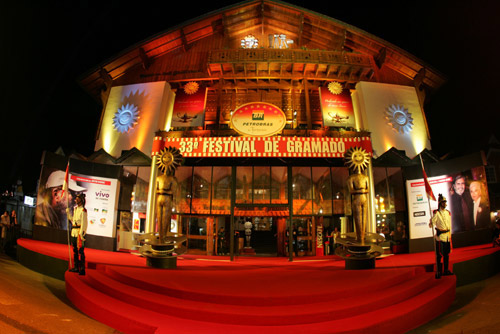
Gramado Film Festival in the Brazilian city of Gramado
16th Tiradentes Film Festival brings together audiences, directors, producers and those interested in cinema in general for 10 days of activities related to the production, dissemination and circulation of Contemporary Brazilian cinema.

Since the 1970s, the quantity of movie theaters has declined heavily. During the 1990s, it became common for small theaters to close while multiplex theaters, which are usually found in shopping centers, gained market share. By December 1999, Cinemark Theatres was the largest theater chain with 180 screens followed by local exhibitor, Grupo Seveirano Ribeiro, with 170 and UCI Cinemas with 80 screens.[15] In the last decades, the accessibility of televisions and computers sold at lower prices combined with success in making telenovelas of high production quality made cinema less attractive to lower income audiences. In addition, ticket prices increased more than tenfold in a span of twenty years.

In the early 1990s Brazilian film production suffered as a result of the president Fernando Collor's laissez-faire policy; the sector had depended on state sponsorship and protection. However, with the retomada Brazilian film regained speed, though not to the same extent it had seen before. A significant increase in audience was recorded, however, from 2000 to 2002, with 7 million viewers, to 2003, when 22 million viewers came to theaters to watch national films.

Because these films were made possible thanks to incentive laws introduced in the 1990s and that the number of viewers drawn in from year to year can fluctuate significantly, it is often questioned whether film production has in fact reached a certain amount of stability and whether or not it could in the future succumb to any governmental whims.

Incentive laws allow Brazilian films to receive funding from companies that, by acting as sponsors, are allowed tax deductions. A common criticism is that, through this system, though films are no longer directly controlled by state, they are, nevertheless, subject to the approval of entrepreneurs who are logically cautious as to which content they wish to associate their brands. Even with funding, there are still areas that require some struggle from filmmakers, such as distribution, television participation and DVD release.[16]

See also

[edit]

References

[edit]

Sources

[edit]
  • Pinazza, Natália and Bayman, Louis (eds) (2013). 'Directory of World Cinema: Brazil. Bristol: Intellect.
  • Augusto, Sérgio. Esse mundo é um pandeiro: chanchada de Getúlio a JK. Companhia das Letras.
  • Benamou, Catherine, and Marsh, Leslie Louise. "Women Filmmakers and Citizenship in Brazil: From Bossa Nova to the Retomada." In Hispanic and Lusophone Women Filmmakers: Theory, Practice and Differences ed. Parvati Nari and Julián Daniel Gutierrez-Albilla, 54–71. Manchester, England: University of Manchester Press, 2013.
  • Burton, Julianne. Cinema and Social Change in Latin America: Conversations with Filmmakers. Austin, TX: University of Texas Press, 1986.
  • Dennison, Stephanie and SHAW, Lisa. Popular Cinema in Brazil. Manchester, England: University Manchester Press, 2004.
  • Gomes, Paulo Emilo Sales. Cinema: trajetória no subdesenvolvimento. Paz e Terra. * 30 Anos de Cinema e Festival: a história do Festival de Brasília do Cinema Brasileiro / coordinated by Berê Bahia. Brasília, Fundação Cultural do Distrito Federal, 1998.
  • Caldas, Ricardo Wahrendorff & Montoro, Tânia. A Evolução do Cinema no Século XX. Casa das Musas, Brasília, 2006.
  • Brazilian Cinema. Ministry of Culture, Brasília 1999 (catalog).
  • Glauber Rocha: del hambre al sueño. Obra, política y pensamiento. Malba - Colección Constantini, Artes Gráficas Ronor S.A., April 2004.
  • Nagib, Lúcia. Brazil on Screen: Cinema Nôvo, New Cinema, Utopia. London: IB Tauris, 2007.
  • Nagib, Lúcia, ed. The New Brazilian Cinema. London: I.B. Tauris & Co, 2006.
  • Navitski, Rielle Brazilian Cinema and Moviegoing Oxford University Press, 2020.
  • Pick, Suzana M. The New Latin American Cinema: A Continental Project. Austin, TX: University of Texas Press, 1993.
  • Torres San Martín, Patricia. "Lost and Invisible: A History of Latin American Women Filmmakers." In Hispanic and Lusophone Women Filmmakers: Theory, Practice and Differences ed. Parvati Nari and Julián Daniel Gutierrez-Albilla, 29–41. Manchester, England: University of Manchester Press, 2013.
  • Wilson, Pamela, and Stewart, Michelle. Global Indigenous Media: Cultures, Poetics, and Politics. Durham, NC: Duke University Press, 2008.

Further reading

[edit]
[edit]
Revisions and contributorsEdit on WikipediaRead on Wikipedia
from Grokipedia
The Cinema of Brazil encompasses the nation's film production, which began with public screenings in 1896, mere months after the Lumière brothers' debut in Paris, and evolved through phases of modest output, musical comedies, and politically charged movements into a sector generating over 450 million US dollars in box office revenue by 2023. Pioneered by early filmmakers adapting European techniques to local stories, Brazilian cinema gained momentum in the 1930s with chanchadas—lighthearted musicals featuring samba and carnival elements—before the 1960s Cinema Novo wave, led by directors such as Glauber Rocha and Nelson Pereira dos Santos, emphasized gritty portrayals of poverty, inequality, and rural life to challenge urban elitism and inspire social reform. Notable achievements include international festival prizes for films like City of God (2002) and Elite Squad (2007), alongside actors such as Fernanda Montenegro earning Academy Award nominations, culminating in Brazil's first Oscar win for Best International Feature with Walter Salles's I'm Still Here (2024) in 2025, amid an industry resurgence driven by co-productions and projected 2025 revenues exceeding 500 million US dollars.

Historical Development

Origins and Silent Era (1890s-1920s)

The introduction of motion pictures to occurred shortly after their invention in , with the first public projections taking place in Rio de Janeiro in July 1896, using Cinématographe equipment imported by Italian immigrants. These initial screenings featured short actualities, such as urban scenes and everyday events, attracting urban audiences in theaters located on Rua do Ouvidor, the city's commercial hub. Exhibition rapidly expanded to by late 1896, establishing cinema as a novel spectacle akin to fairs and , though kinetoscope peepshows had appeared earlier in 1894 without projected images. Pioneering production began with Affonso Segreto, an Italo-Brazilian operator, who shot the country's earliest surviving film, Vista da baía de Guanabara (View of ), in June 1898 while arriving by ship from Europe; this 21-second actuality depicted the harbor entrance and was publicly screened later that year. His brother Paschoal Segreto contributed to early infrastructure by opening Brazil's first dedicated cinema house, Salão de Novidades do Fotógrafo Segreto, in Rio de Janeiro in July 1897, which programmed both imported and nascent local shorts. Through the early , output remained modest, focusing on shorts—documenting carnivals, parades, and landscapes—with Italian immigrants dominating as cameramen and entrepreneurs due to their familiarity with the . By 1908–1912, dubbed the bela época (beautiful era), annual production peaked at approximately 100 short films, many exhibited in touring shows and fixed nickelodeons, though distribution favored urban centers like Rio and . The transition to narrative fiction emerged around 1909, with adaptations of popular novels and theatrical farces, such as Os Estranguladores (The Stranglers, 1908) by Antônio Leão da Silva, one of the first Brazilian-made dramas influenced by European serials. Production hubs proliferated in the , including São Paulo's early studios and regional efforts in , yielding features like A Parda Nilce (1915), but technical limitations—hand-cranked cameras, rudimentary editing, and reliance on natural light—constrained quality and length, with most films under 20 minutes. Imported Hollywood and European pictures increasingly dominated screens by the late , comprising over 90% of exhibition by 1920, as local filmmakers lacked processing labs and distribution networks, fostering a cycle of short-lived ventures rather than sustained industry growth. In the 1920s, silent cinema diversified with experimental works and amateur clubs, particularly in and , where directors like Humberto Mauro began honing techniques in low-budget melodramas and comedies, setting precedents for future realism. Annual output stabilized at 20–30 titles, often self-financed by theaters, but economic instability and the 1929 crash halted momentum, leaving Brazilian as a fragmented, import-dependent endeavor with fewer than 200 total productions documented from the era. Live musical accompaniment and intertitles in characterized screenings, enhancing accessibility amid high illiteracy rates, yet the absence of state support or perpetuated reliance on foreign models.

Transition to Sound and Commercial Foundations (1930s-1940s)

The transition to synchronized sound in Brazilian cinema began with the exhibition of foreign talkies in April 1929 at the Cine Rosário in Rio de Janeiro, prompting local producers to adapt amid a global shift that disrupted silent-era operations. The first Brazilian sound feature, Acabaram-se os Otários (1929), a directed by Luiz de Barros, marked this pivotal change, utilizing rudimentary technology and featuring live musical performances to overcome challenges. This innovation initially caused economic strain, with box-office attendance falling by 40 percent as theaters upgraded equipment and audiences awaited affordable sound films, leading to a 30 percent loss of movie houses between 1930 and 1935. However, sound enabled the integration of popular radio broadcasts and carnival music, fostering domestic musical revues that drew from U.S. models but incorporated Brazilian and humor to appeal locally. Commercial foundations solidified in the 1930s under President Getúlio Vargas's cultural policies, which envisioned a stable national film industry to counter Hollywood dominance and promote Brazilian identity. Adhemar Gonzaga established Cinédia studios in 1930, producing early sound hits like Alô, Alô Brasil! (1935) and launching stars such as Carmen Miranda, whose performances in musicals like Alô Alô Carnaval (1936) blended stage revue energy with film, achieving commercial success through radio tie-ins and urban appeal. These chanchadas—light comedies satirizing everyday life and foreign tropes—prioritized low-cost production, relying on theater actors and minimal sets, with Cinédia outputting around a dozen features by mid-decade amid annual national production hovering below 10 films. By the late 1930s, studios like Sonofilmes (founded 1937) expanded this model, emphasizing profitability over artistic ambition to recapture audiences lost to dubbed imports. In the 1940s, wartime import restrictions boosted local output, with Atlântida Cinematográfica (established 1941) dominating via prolific chanchada production, releasing over 20 films by decade's end, including Caminho do Céu (1943), which exemplified escapist romances blending music and mild drama. This era's commercial viability stemmed from state incentives under Vargas, including tax exemptions and propaganda quotas, though chronic underfunding and equipment shortages limited quality, resulting in an industry geared toward immediate box-office returns rather than export or prestige. Annual production rose modestly to 15-20 features by 1945, sustained by domestic circuits in Rio and São Paulo, where chanchadas outperformed dramas by exploiting cultural familiarity and live-show synergies. Despite these gains, reliance on formulaic genres exposed vulnerabilities to post-war Hollywood resurgence, underscoring the era's foundational yet fragile commercial base.

Studio Expansion and Atlântida Chanchadas (1940s-1950s)

Atlântida Cinematográfica, established in Rio de Janeiro in 1941 by producers including José Carlos Burle and Moacir Fenelon, marked a pivotal expansion in Brazil's infrastructure during the 1940s. The studio emerged amid Getúlio Vargas's push for national industrialization, which included policies favoring domestic cultural production to counter foreign imports, enabling low-capital ventures to scale operations despite limited technological resources. Atlântida quickly dominated Rio's output, producing films on modest budgets while competing with established outfits like Cinédia and Sonofilmes, and laying groundwork for commercial viability through efficient, audience-oriented filmmaking. The studio's signature output, chanchadas—lighthearted musical comedies blending parody, rhythms, and motifs—flourished in the 1940s and 1950s as a response to Hollywood dominance. These films satirized everyday Brazilian life and foreign tropes, often featuring comic duos like Oscarito and Grande Otelo, and prioritized rapid production cycles over artistic pretensions to maximize profitability and broad appeal across social classes. Produced on shoestring budgets, chanchadas nonetheless drew substantial audiences by reflecting popular radio and theatrical traditions, with Atlântida releasing multiple titles annually that sustained studio growth amid economic constraints. This formula not only filled theaters but also fostered a domestic , contrasting with the era's sporadic dramatic efforts. By the early 1950s, Atlântida's chanchadas exemplified the genre's peak, with films like Carnaval Atlântida (1952) integrating musical numbers and humorous takes on to reinforce the studio's market lead. The approach prioritized empirical audience draw—evidenced by consistent box-office success—over ideological depth, though it faced criticism for superficiality from emerging intellectual circles. This phase represented causal progress in industrial terms, as studio replication of proven formats enabled output expansion without heavy state subsidy, setting precedents for later ventures despite ultimate vulnerabilities to imported competition.

Vera Cruz Era and Early Industrial Ambitions (1950s)

The Companhia Cinematográfica Vera Cruz, founded in 1949 by industrialist Francisco Matarazzo Sobrinho and Francisco Zampari in near , represented Brazil's most ambitious attempt to establish a vertically integrated akin to Hollywood's . The enterprise involved substantial capital investment in a 30,000-square-meter facility equipped with soundstages, processing labs, and editing suites, aiming to produce high-quality features for both domestic consumption and export. To achieve technical proficiency, the company recruited expatriate talent, including Italian directors and technicians, and Brazilian director as production chief, prioritizing polished narratives and spectacle over the comedic chanchadas prevalent in Rio-based studios. This model sought to professionalize filmmaking through , with initial outputs like the 1950 feature Caiçara demonstrating aspirations for literary adaptations and dramatic realism. A pinnacle of Vera Cruz's output was O Cangaceiro (1953), directed by Lima Barreto, which depicted the exploits of northeastern bandits and garnered international recognition by winning the Film Festival's award for best , alongside a special mention for its soundtrack. The film's success—grossing significantly in and marking Brazil's first major festival triumph—validated the studio's emphasis on marketable genres like Western-style adventures rooted in national . By 1954, Vera Cruz had completed approximately 22 projects, including shorts and features, employing hundreds and fostering skills in and among local crews. However, these ambitions clashed with economic realities: production budgets often exceeded 10 million cruzeiros per film (equivalent to millions in modern terms adjusted for ), far outpacing revenues from a domestic market saturated by cheaper Hollywood imports lacking import quotas or subsidies. The studio's bankruptcy in stemmed directly from unsustainable overheads, including reliance on costly foreign expertise and failure to secure export deals amid global distribution barriers, rendering the operation unviable without state . This collapse exposed the causal mismatch between imported industrial templates and Brazil's nascent market—limited to urban theaters serving about 50 million viewers with low ticket prices—and prompted a reevaluation of , as high fixed costs amplified risks in an unprotected sector. Despite the financial ruin, Vera Cruz's legacy endured through its cadre of trained professionals, who migrated to independent productions, and its demonstration that genuine industrialization required aligned policies on funding and trade rather than mere emulation of foreign models. The era thus highlighted early tensions in Brazilian cinema between elite-driven ambitions for global parity and the imperatives of local viability, setting the stage for leaner, socially oriented filmmaking in the ensuing decade.

Cinema Novo and Social Realism (1960s)

emerged in Brazil during the late 1950s and early 1960s as a response to the country's deep social and economic disparities, particularly in rural areas like the Northeast, where and prevailed. Directors sought to depict the harsh realities of inequality, , , and powerlessness through low-budget, black-and-white films often using non-professional actors and , drawing inspiration from to prioritize authenticity over commercial gloss. This approach contrasted with earlier studio productions, aiming to provoke awareness and reform rather than entertainment. A foundational film was Vidas Secas (Barren Lives), directed by Nelson Pereira dos Santos and released in 1963, adapting Graciliano Ramos's 1938 novel to portray a migrant family's struggle against drought, hunger, and exploitation in the . The narrative follows Fabiano, his wife Sinhá Vitória, their children, and dog Baleia, highlighting existential isolation and failed aspirations amid environmental and social adversity, with minimal dialogue underscoring their voicelessness. Similarly, Glauber Rocha's Deus e o Diabo na Terra do Sol (Black God, White Devil), released in 1964, explored messianic fanaticism and banditry in the backlands, blending realism with mythic elements to critique feudal structures and revolutionary impulses. In 1965, Rocha articulated the movement's philosophy in his "Aesthetics of Hunger" manifesto, presented at a Latin American cinema retrospective in , arguing that filmmakers must embrace underdevelopment and violence as aesthetic necessities rather than imitate European formalism or conceal misery for bourgeois comfort. This document emphasized devouring "rotten flesh" of reality to fuel a revolutionary cinema, rejecting polished narratives in favor of raw depictions that could incite change. Other contributors, including Ruy Guerra and Leon Hirszman, expanded these themes, producing around a dozen key films by mid-decade that collectively challenged urban elites' detachment from rural suffering. By the late 1960s, Cinema Novo's faced constraints from the 1964 military coup, which curtailed funding and imposed censorship, yet its output—averaging fewer than 20 features annually compared to later booms—established a legacy of critical inquiry into Brazil's structural inequalities, influencing global perceptions of Latin American cinema. The movement's insistence on empirical portrayal of and exploitation, without romanticization, stemmed from directors' direct engagement with affected communities, yielding works that prioritized causal links between policy failures and human destitution over abstract ideology.

Military Dictatorship Influences and B Films (1970s)

The intensification of censorship following Institutional Act No. 5 in December 1968 profoundly shaped Brazilian cinema during the 1970s, as the military regime targeted films perceived as subversive, leading to the suppression or alteration of works from the Cinema Novo movement that had critiqued social inequalities in the prior decade. Directors such as Glauber Rocha faced exile due to their leftist affiliations, while others resorted to allegory or abandoned explicit political themes to secure approvals from the Department of Press and Propaganda (DIP). This repressive framework, which peaked in the early 1970s under President Emílio Garrastazu Médici, prioritized content aligned with national security and moral standards, effectively marginalizing arthouse productions in favor of commercially viable alternatives. In parallel, the establishment of Empresa Brasileira de Filmes (Embrafilme) in June 1969 marked a state-driven effort to industrialize cinema, offering subsidies that covered 40-60% of production costs initially and up to 100% for select projects by the late 1970s, thereby increasing annual output from around 30 in the late to over 100 by decade's end. While Embrafilme facilitated infrastructure and distribution, its oversight ensured films avoided regime criticism, channeling resources toward apolitical genres that sustained theaters amid economic "miracle" growth but limited international export potential. This funding model inadvertently bolstered B films—low-budget, formulaic productions emphasizing over —produced in São Paulo's Boca do Lixo neighborhood, where independent filmmakers exploited quick turnaround times (often 10-15 days per shoot) and minimal sets to meet market demands. The hallmark of B cinema was the , a sex-comedy hybrid drawing from chanchada traditions and Italian commedia sexy influences, which proliferated as permitted absent political undertones, resulting in over 200 such titles released between 1969 and 1980. These films, often scripted by figures like Oswaldo de Oliveira and starring performers such as David Cardoso and Meiry Vieira, featured repetitive narratives of urban seduction, farce, and light social satire, screened in venues to capture working-class audiences seeking diversion from dictatorship-era hardships. Exemplars like As Feras (1971) and A Dama do Lotação (1978) achieved domestic box-office success, contributing to Brazilian films' peak 30% market share in the late , though their emphasis on softcore titillation drew criticism for reinforcing superficiality over substantive critique. In this causal dynamic, regime controls displaced confrontational cinema, fostering B films as a pragmatic adaptation that preserved industry viability but diluted artistic depth, with some scholars arguing the genre's banality masked latent discontent through veiled metaphors.

Post-Dictatorship Transition and Stagnation (1980s)

The end of Brazil's in 1985 initiated a political transition toward , yet the film industry faced profound stagnation due to intertwined economic crises and structural weaknesses inherited from prior decades. eroded production budgets and power, with annual rates surpassing 200% from 1983 to 1985 and escalating to over 1,000% by the late 1980s, culminating in monthly peaks exceeding 80% in early 1990. This fiscal turmoil, compounded by the external debt crisis, rendered cinema attendance a luxury amid widespread , as high ticket prices relative to wages deterred mass audiences. National film production, which had reached a record 102 features in 1980 under lingering state subsidies, declined to 84 by 1983 and continued falling through the decade, dropping to 74 titles in 1989. The state-owned Embrafilme, established in 1969 and pivotal for financing independent projects into the early 1980s, struggled with budgetary constraints and ambiguous governmental priorities during the Nova República era, failing to offset the sector's contraction. Although political liberalization post-1985 permitted uncensored explorations of dictatorship-era traumas in select works, such as amateur documentaries and fiction films re-enacting repression, these efforts remained marginal amid dwindling resources. Competition from television—dominated by telenovelas attracting millions of viewers daily—and the advent of affordable further marginalized theatrical releases, shifting cultural consumption patterns and exacerbating theater closures. By decade's end, the industry's output had contracted sharply, with numbers plummeting to single digits in the early 1990s, underscoring a failure to capitalize on democratic openings without robust economic stabilization or renewed incentives. This period highlighted cinema's vulnerability to macroeconomic shocks, as reliance on volatile state funding proved insufficient against imported Hollywood dominance and domestic media alternatives.

Retomada Revival and State-Supported Growth (1990s-2000s)

The Retomada, or revival of Brazilian cinema, emerged in the mid-1990s following a severe downturn in the 1980s characterized by economic hyperinflation, the dissolution of state agency Embrafilme in 1990 under President Fernando Collor de Mello, and a drastic reduction in national film production to as few as nine features in 1993. This period marked a recovery driven primarily by private investment incentives rather than direct government subsidies, contrasting with earlier state-heavy models that had proven unsustainable. The pivotal Audiovisual Law (Law No. 8,685/1993) introduced tax deductions allowing individuals and companies to allocate up to 3% of their income tax liability to approved film projects, channeling private capital into production without requiring public expenditure. This mechanism spurred a rebound, with national films' market share rising from 3% in 1995 to 5.3% by 1997, and production volumes increasing steadily from the low teens annually in the early 1990s. The 1995 release of Carlota Joaquina, Princess of Brazil, directed by Carla Camurati, is widely regarded as the inaugural success of this era, blending historical drama with commercial appeal to signal renewed viability for domestic filmmaking. By the early 2000s, institutional reforms further bolstered growth, including the establishment of the National Film Agency (ANCINE) in 2001, tasked with regulating the sector, overseeing incentives, and administering the Audiovisual Sector Fund (FSA) derived from contributions by pay-TV operators and other sources. ANCINE's framework facilitated a surge in cinema screens from declining numbers in the 1990s to expansion post-2001, alongside diversified funding that reduced reliance on volatile direct subsidies. This state-supported ecosystem enabled high-profile outputs, such as Walter Salles's Central do Brasil (1998), which earned an Academy Award nomination for Best Foreign Language Film and drew significant domestic audiences, underscoring the Retomada's blend of artistic ambition and market responsiveness. The decade's momentum culminated in blockbusters like Fernando Meirelles's City of God (2002), which attracted over 3.1 million initial viewers in Brazil and garnered four Oscar nominations, highlighting urban social themes while achieving commercial breakthroughs that elevated Brazilian cinema's global profile. Overall, the Retomada transformed a moribund industry into one producing dozens of features annually by the mid-2000s, though its heavy dependence on tax incentives exposed vulnerabilities to policy shifts and economic fluctuations, as evidenced by later challenges under subsequent administrations. Production quality and output diversified, incorporating genres from dramas to comedies, yet critics note that state mechanisms sometimes prioritized volume over innovation, with private incentives favoring safer, market-oriented projects.

Contemporary Period and Market Resurgence (2010s-2025)

The marked a continuation of commercial momentum from the Retomada era, with domestic comedies and action films driving performance amid expanding multiplex infrastructure. "Elite Squad 2: The Enemy Within" (2010), directed by , sold over 11 million tickets, setting a record for a Brazilian production since 1970 and grossing approximately R$100 million, reflecting strong audience appetite for urban dramas with social undertones. Subsequent hits like the "My Mom Is a Character" trilogy (2013, 2016, 2019), produced by Downtown Filmes, collectively exceeded 20 million admissions by capitalizing on relatable family humor and broad appeal, underscoring the dominance of genre entertainment over arthouse fare in domestic markets. These successes contributed to a peak in national film admissions, with over 170 million tickets sold annually by the late , though foreign imports—particularly Hollywood blockbusters—captured the majority share. Political shifts under President Jair Bolsonaro's administration (2019–2022) imposed severe constraints, including executive interventions at ANCINE that halted funding mechanisms like the Audiovisual Sector Fund, leading to a reported 50% drop in approved projects and widespread production halts by 2020. The exacerbated this, slashing theater admissions to 39 million in 2020 from 173 million in 2019 and delaying releases, though streaming platforms like enabled limited distribution for titles such as "" (2020). Artistically, the period saw innovative works like "" (2019), directed by and Juliano Dornelles, which blended Western, sci-fi, and political to critique rural marginalization, earning the Jury Prize at and signaling resilient independent voices amid institutional turmoil. Post-2022, under President Luiz Inácio Lula da Silva's return, policy reversals reinvigorated the sector through restored subsidies and a R$2 billion credit line announced in 2023, fostering a market resurgence evidenced by domestic films' share climbing from 3.3% in 2023 to 10.1% in 2024 and 10.6% through mid-2025. Total cinema revenue rebounded, with 120 million tickets sold in 2024—a 9.5% year-over-year increase—and projections for $501.65 million in 2025, driven by hits like "Nothing to Lose" sequels and evangelical productions such as "Os Dez Mandamentos: O Filme" (2016). The industry's broader economic footprint reached R$70.2 billion in GDP contribution by 2024, supporting 608,970 jobs, though challenges persist in export reliance and competition from U.S. studios. Emerging trends include hybrids addressing inequality and regional identities, with festivals like Mostra de amplifying peripheral narratives.

Economic and Industrial Dimensions

Funding Models and Government Subsidies

The Brazilian film industry relies heavily on a mix of government subsidies, tax incentives, and mechanisms to stimulate private investment, primarily administered through the National Cinema Agency (ANCINE), established in 2001 as an independent agency under the to regulate and fund audiovisual production. Key legislation includes the Audiovisual Law (Law 8,685/1993), which provides tax incentives allowing investors to deduct up to 100% of contributions from for approved projects, and the Federal Cultural Incentives Law (Lei Rouanet, Law 8,313/1991), enabling tax-deductible donations to cultural initiatives including film. These models shifted from direct state production in earlier decades to indirect support post-, aiming to leverage private capital while addressing chronic underfunding that had limited output to around 10 films annually in the early 1990s. ANCINE facilitates both direct funding via grants, loans, and public notices—such as the 2023 international co-production call with the BRDE bank—and indirect tools like FUNCINE funds, which pool private investments with tax benefits to finance national films, expanding involvement since their authorization under the Audiovisual Law. Regional incentives complement federal efforts, including São Paulo's cash rebate of 20-30% on qualified local spend for productions with minimum expenditures, and Rio de Janeiro's up to 35% rebate for projects primarily filmed there, capped at R$4 million per film. These have supported over 1,000 projects historically, though approval requires ANCINE registration and compliance with content quotas favoring Brazilian works on pay-TV platforms. Under the Lula administration since 2023, funding has surged with historic allocations, including a June announcement of BRL 1.6 billion (about USD 295 million) for the audiovisual sector—the largest ever—to bolster production amid post-pandemic recovery, alongside RioFilme's R$131 million (USD 23 million) package for and TV in 2025. State-owned committed R$100 million by 2027 specifically for cinema, targeting content accessibility and industry strengthening. Such boosts have enhanced co-production appeal, with attracting international partners through combined public-private models. Private investment, while secondary, has grown via tax-advantaged vehicles and equity funds; for instance, MUV Capital partnered in with Retrato Filmes for co-investments in Brazilian releases, drawing from high-net-worth individuals and family offices alongside FUNCINE structures. This hybrid approach has increased annual film output to over 100 by the , though reliance on subsidies exposes the sector to fiscal volatility, as seen in funding freezes during the 2016-2022 periods under prior governments. Overall, these models prioritize national content mandates over pure market viability, fostering growth but occasionally critiqued for inefficient allocation amid broader risks in public spending.

Domestic Market Performance and Challenges

The Brazilian cinema market has shown signs of recovery in recent years following the disruptions caused by the , with total ticket sales reaching approximately 125.4 million in 2024, up from lower figures in prior years. Domestic films captured a 10.1% of that year, a significant increase from 3.3% in 2023, driven by 197 national releases—a 22.4% rise—and hits that drew over 7.37 million viewers in the first nine months of 2024 alone, compared to 3.72 million for all of 2023. By mid-2025, this share stabilized around 10.6%, with audience growth for Brazilian films reaching 241% year-over-year in 2024, reflecting renewed interest in local comedies and genre films amid a total valued at roughly $454 million USD in 2023. Despite these gains, the domestic market remains challenged by persistent dominance of imported films, particularly Hollywood blockbusters, which consistently claim over 80-90% of in non-peak years, limiting Brazilian productions to sporadic breakout successes rather than sustained viability. Exhibition infrastructure, while expanding to 3,551 screens by 2025, is concentrated in urban centers like Rio de Janeiro and , which account for 70% of national , exacerbating regional disparities and reducing accessibility for rural audiences. Piracy continues to undermine revenue, with illegal streaming and physical copies diverting potential theater attendance and VOD sales, compounded by economic factors such as high ticket prices relative to average incomes, which restrict cinema-going to about 20% of consumers annually. Post-pandemic recovery has been uneven, with total attendance still trailing pre-2019 peaks by significant margins—such as the 2019 high of over 200 million tickets—due to lingering habits of home viewing and production halts that reduced output pipelines. Distribution bottlenecks persist as a core issue, requiring multifaceted solutions beyond subsidies, including better negotiation power for independents against major chains. Overall, while 2024 marked progress with 456 total releases and a sector economic impact exceeding R$32.7 billion, structural dependencies on state intervention and foreign competition hinder self-sustaining growth.

Production Infrastructure and Technological Adoption

Brazil's film production infrastructure has historically been constrained by economic instability and reliance on imported technology, with major advancements occurring primarily in urban centers like and Rio de Janeiro. Early efforts in the , such as the Companhia Cinematográfica Vera Cruz, established rudimentary studios but faced challenges in scaling due to limited domestic processing capabilities, often outsourcing color film development to foreign laboratories. By the late , infrastructure remained fragmented, with production concentrated in small-scale facilities lacking advanced equipment. The establishment of the Agência Nacional do Cinema (ANCINE) in 2001 marked a turning point, channeling government subsidies toward facility development, though systemic underinvestment persisted until the 2020s. Recent expansions have positioned São Paulo as a hub for modern studios, driven by private and public investments. In 2024, Banijay Estúdios opened Latin America's largest independent audiovisual complex in , featuring three studios totaling over 10,000 , including a 6,383 soundstage equipped for high-volume production. Complementing this, 555 Studios in the same city provides 650 of space with two virtual production volumes supporting 6K and 4K workflows, enabling LED wall-based filming for cost-efficient integration. initiatives have accelerated this growth; in 2024, the federal administration announced BRL 1.6 billion (approximately USD 295 million) in historic funding for the audiovisual sector, prioritizing upgrades and co-production facilities. São Paulo's municipal agency, Spcine, allocated R$143.7 million in 2025 to enhance local studios and equipment access, aiming to attract international shoots amid global competition. Rio de Janeiro's RioFilme followed with R$131 million (USD 23 million) in incentives for production and distribution in May 2025. These developments reflect a causal shift from subsidy-dependent models to infrastructure-led industrialization, though regional disparities persist, with rural and northeastern areas underserved compared to southern metros. Technological in Brazilian cinema lagged behind global standards due to import barriers and fiscal constraints, with conversion in theaters occurring gradually through as exhibitors upgraded from silent projectors. Color processing in the 1950s required foreign labs, delaying domestic mastery until the 1970s via imported stocks and limited local labs. The digital transition accelerated post-2000, facilitated by ANCINE's policies promoting incentives, though full analog-to-digital shifts in cameras and editing were uneven, with many independents retaining workflows into the 2010s for artistic reasons. By the 2020s, computer-generated imagery (CGI) surged, supported by state innovation funds; the Brazilian CGI market expanded robustly as of August 2025, driven by demand for in streaming-era content. Newer facilities like 555 Studios integrate virtual production technologies, including LED volumes for real-time rendering, reducing costs by up to 30% compared to traditional green-screen methods. This uptake aligns with broader policies, such as the 2022-2026 E-Digital Strategy, which indirectly bolsters tech via broadband and ICT investments, enabling 4K/6K workflows and AI-assisted editing. Despite progress, challenges remain in widespread access to high-end VFX pipelines, with smaller producers often to international firms due to domestic gaps.

Stylistic and Thematic Elements

The chanchada, a genre of musical comedy films, emerged as the dominant form of popular entertainment in Brazilian cinema from the 1930s to the 1960s. These low-budget productions, often parodying Hollywood films or Brazilian literature, integrated elements of samba, carnival, and radio theater, featuring rapid musical numbers and comedic duos like Oscarito and Grande Otelo. Centered in Rio de Janeiro studios such as Cinédia, chanchadas emphasized light-hearted escapism and national cultural motifs, achieving widespread domestic appeal through quick production cycles and alignment with popular music trends. During the from 1964 to 1985, pornochanchadas evolved as a subgenre of sex comedies, blending erotic content with chanchada-style humor to provide diversion amid . Produced primarily in São Paulo's Boca do Lixo district, these films incorporated genres like thrillers and horror while evading strict political oversight through sexual explicitness and , sustaining commercial viability for independent producers. Over 100 such titles were released in the alone, reflecting audience demand for affordable, risqué entertainment despite international dismissal as lowbrow. In the contemporary era, family-oriented and romantic comedies have reclaimed prominence in Brazilian cinema's popular sector, frequently topping domestic box office charts. Series like Minha Mãe é uma Peça (My Mom Is a Character), with its third installment ranking among the highest-grossing national films, exemplify this trend through relatable domestic humor and broad accessibility. From 1997 to 2017, 14 of the top 20 highest-earning Brazilian releases were comedies, underscoring their role in countering market dominance by Hollywood imports and sustaining local production viability. These films prioritize formulaic narratives and star-driven appeal over experimental styles, mirroring chanchada's commercial imperatives in a digitized distribution landscape.

Artistic Movements and Political Narratives

Cinema Novo, emerging in the late 1950s and peaking through the 1960s, marked a foundational artistic movement in Brazilian cinema, characterized by austere aesthetics and a commitment to portraying the realities of , exploitation, and cultural . Filmmakers adopted documentary-style techniques, , and amateur performers to depict the lives of the disenfranchised, drawing from Italian neorealism's emphasis on while adapting it to Brazil's specific contexts of rural backwardness and urban migration. This approach rejected polished commercial cinema, aiming instead for a "hungry aesthetic" that mirrored the nation's material scarcity. Politically, Cinema Novo films encoded narratives of class struggle and anti-imperialist critique, often aligning with Marxist interpretations of Brazil's economic dependency and elite corruption. Key works like Nelson Pereira dos Santos's Vidas Secas (1963), based on Graciliano Ramos's novel, illustrated the harsh existence of migrant workers in the Northeast, underscoring systemic failures in agrarian reform and industrialization. Glauber Rocha's Eztética da Fome (1965) articulated the movement's ethos, positing hunger not as pity-inducing spectacle but as a catalyst for violent upheaval against colonial legacies. These narratives, while artistically innovative, reflected the filmmakers' leftist orientations, which anticipated but failed to avert the 1964 military coup that installed an authoritarian regime. Under dictatorship censorship from 1964 to 1985, Cinema Novo's direct political advocacy evolved into allegorical and experimental forms to circumvent bans, as in Rocha's Terra em Transe (1967), a hallucinatory dissection of power dynamics in a fictional Latin American state that mirrored Brazil's institutional decay. This period saw the movement's fragmentation, with directors facing exile or self-imposed silence, yet its influence persisted in underground expressions like Cinema Marginal (circa 1969-1973), which amplified through gritty, profane depictions of urban vice and state violence, exemplified by Ozualdo Candeias's low-budget provocations. In the democratic era post-1985, artistic movements gave way to thematic political engagements less unified by but rooted in reckoning with authoritarian legacies and neoliberal inequalities. Films such as Héctor Babenco's (1980), bridging dictatorship's end, exposed as a symptom of social abandonment, while contemporary entries like Walter João's Ainda Estou Aqui (2024) dramatize familial rifts under military rule, drawing on declassified archives to highlight arbitrary detentions and from 1971. These narratives, often state-funded, prioritize historical testimony over stylization, though debates persist on their selective focus on leftist victims amid broader regime atrocities.

Regional Variations and Emerging Voices

Brazilian cinema exhibits significant regional variations, with productions outside the dominant centers of Rio de Janeiro and reflecting distinct cultural identities, landscapes, and socio-economic realities. In the Northeast, films often draw from the sertão's harsh environment, exploring themes of drought, migration, and , as seen in classics like O Auto da Compadecida (2000), which adapts a Northeastern literary tale into a comedic epic with over 2.5 million admissions domestically. Contemporary Northeastern cinema has reinvented these motifs through genre-blending works, such as Bacurau (2019) from , directed by and Juliano Dornelles, which critiques rural exploitation and garnered international acclaim including the Jury Prize at . This regional output, supported by events like the Festival de Cinema do Nordeste Brasileiro (FECINE), established in 2023, has produced over 50 films annually focused on local narratives, challenging urban-centric stereotypes. In the South, particularly Rio Grande do Sul, gaúcho cinema emphasizes pampas traditions, rural myths, and historical identity, with the Portal do Cinema Gaúcho cataloging more than 600 feature films since 1911. The 2024 Dicionário de Filmes Gaúchos documents over 400 titles up to 2022, highlighting productions like Deu Pra Ti Anos 70 (1981), which captures gaúcho social upheavals through period drama. The Gramado Film Festival, held annually since 1973 in the Serra Gaúcha, has premiered regional works addressing local folklore and economic shifts, fostering a distinct cinematic idiom tied to the region's cattle herding heritage and European immigrant influences. Northern cinema, especially from the , features emerging indigenous voices using film for cultural preservation and advocacy against deforestation and land encroachment. The Mídia Indígena cooperative has produced shorts alerting to threats against uncontacted tribes, such as those faced by the Awá Guajá since the . Notable works include Lithipokoroda (2021) by Baniwa filmmaker Lilly Baniwa, a blending performance and documentary to assert indigenous autonomy in São Gabriel da Cachoeira, Amazonas. Kayapó directors like Pat-I Kayapó have documented community resistance in since , with films screened internationally to highlight territorial disputes involving over 13 million hectares of indigenous land. These efforts, amplified by festivals like the Mostra de Cinema de , integrate digital tools to bypass traditional funding barriers, enabling grassroots production amid Brazil's 2020s economic constraints on regional filmmaking.

Key Contributors and Productions

Pioneering Figures and Directors

Affonso Segreto, an Italo-Brazilian engineer, filmed the first documented motion picture in Brazil on June 19, 1898, capturing Vista da Baía de Guanabara from the steamship Brasil upon his return from Europe; this short footage, lasting about 20 seconds, is widely recognized as the inception of Brazilian cinema, predating organized production but establishing the medium's viability in the country. Alongside his brother Paschoal Segreto, Affonso imported early equipment and organized Brazil's inaugural public film screenings in Rio de Janeiro later that year, screening Brothers' works and local views, which sparked initial audience interest despite rudimentary technology and limited infrastructure. Their efforts laid foundational technical and exhibition practices, though production remained sporadic, focused on newsreels of public events and landscapes until the . Humberto Mauro emerged as a dominant figure in the 1920s silent era, directing Brazil's first feature-length films independently in Cataguases, , beginning with Na Primavera da Vida in 1926, a that drew over 10,000 viewers regionally and demonstrated viable low-budget narrative filmmaking without state support. Mauro followed with Tesouro Perdido (1927), emphasizing adventure themes, and Brasa Dormida (1928), which explored rural romance, amassing a filmography of over 30 works that prioritized authentic Brazilian locales over imported Hollywood aesthetics, influencing regional studios and earning him acclaim as the era's premier director for technical innovations like on-location shooting. His transition to sound films in the 1930s, including Ganga Bruta (1933), integrated folk elements and marked a shift toward national identity in cinema, though commercial pressures from U.S. imports constrained output. Francisco Marzullo contributed to early narrative shorts, directing Os Estranguladores in 1906, a crime-themed film that achieved commercial success and highlighted the potential for domestic genres amid growing exhibition halls. Mário Peixoto's experimental silent feature Limite (1931), shot with non-professional actors and emphasizing poetic abstraction over plot, represented avant-garde innovation with its 120-minute runtime and innovative editing, though financial woes limited its distribution to elite circles; it remains a benchmark for artistic ambition in pre-sound Brazilian film. These directors navigated infrastructural deficits—such as absent processing labs and reliance on imported film stock—prioritizing empirical adaptation over ideological agendas, fostering a resilient proto-industry by the 1930s despite uneven quality and foreign dominance.

Landmark Films and Their Impacts

(1931), directed by Mário Peixoto, stands as an experimental depicting three individuals adrift at sea, employing poetic and non-linear storytelling to explore entrapment and desire; it is regarded as a foundational masterpiece that frequently tops lists of Brazilian cinematic achievements. The Cinema Novo movement of the 1960s produced landmark films addressing Brazil's socio-economic disparities. Nelson Pereira dos Santos's Vidas Secas (Barren Lives, 1963) portrayed the struggles of a migrant family in the drought-stricken Northeast, emphasizing poverty and land inequality to foster social awareness and elevate Brazilian cinema's international critical reception. 's Deus e o Diabo na Terra do Sol (Black God, White Devil, 1964) followed an exploited farmer's descent into myth-laden violence, critiquing underdevelopment through the "aesthetic of hunger" and marking Rocha's breakthrough in challenging exploitative structures. Rocha's subsequent Terra em Transe (, 1967) allegorized political turmoil post-1964 military coup, using hallucinatory style to engage intellectuals with Brazil's ideological conflicts and despair. In the late 1990s, Walter Salles's Central do Brasil (, 1998) initiated the retomada revival amid post-1991 industry collapse, chronicling an elderly woman's redemptive journey with an orphaned boy across rural Brazil to find his family, blending tropes with humanist realism. The film secured the at , a BAFTA for Best Foreign Language Film, and two Academy Award nominations, re-establishing Brazilian cinema's global presence and nurturing local talent. Fernando Meirelles's Cidade de Deus (City of God, 2002), adapted from Paulo Lins's novel, traced gang dynamics in Rio de Janeiro from the to via non-professional actors and kinetic editing infused with music video aesthetics, narrated by a evading . Attracting over 2 million Brazilian viewers in its first two months, it ignited national debates on urban disenfranchisement and set new benchmarks for authentic depictions of class and racial in Brazilian filmmaking.

Global Engagement and Influence

International Exports and Awards

Brazilian cinema has garnered international acclaim primarily through prestigious awards at global film festivals and selective theatrical releases abroad, though commercial exports have historically lagged behind domestic performance due to limited distribution networks and language barriers. Early breakthroughs included films from the movement, such as Black God, White Devil (1964) by , which competed at and influenced global arthouse circuits, signaling Brazil's emergence in festival programming. Subsequent entries like Central Station (1998), directed by , earned an Academy Award nomination for Best Foreign Language Film and grossed approximately $22 million worldwide, marking one of the first significant crossover successes that highlighted themes of to international audiences. The early 2000s saw heightened visibility with City of God (2002), directed by , which received four Oscar nominations—including Best Director, Best Adapted Screenplay, Best Cinematography, and Best Film Editing—without a win, yet propelled Brazilian urban narratives into global discourse and achieved $30.6 million in worldwide box office earnings, with $7.5 million from the U.S. alone. This film's critical and commercial traction abroad, distributed by , exemplified how festival buzz could drive exports, though broader market penetration remained constrained by competition from Hollywood and European cinema. Other nominees like (2007) and Waste Land (2010) further demonstrated recurring recognition for gritty, documentary-inflected dramas, accumulating over a dozen total nominations across categories prior to a breakthrough win. A watershed moment arrived in 2025 when I'm Still Here (2024), directed by , became the first Brazilian film to win the Academy Award for Best International Feature Film, lauded for its portrayal of dictatorship-era displacement and earning praise for authentic historical reckoning over sanitized narratives. The film's global exceeded $36 million, including $20 million from international territories, underscoring growing export viability amid streaming platforms' interest in Latin American content. At , Brazilian entries have also shone recently; The Secret Agent (2025) by secured the FIPRESCI Prize in and additional accolades for direction and Wagner Moura's lead performance, reinforcing Brazil's prestige while positioning it for further Oscar contention. These achievements coincide with Brazil's designation as Country of Honour at the 2025 in , facilitating expanded sales and co-production deals that enhance export pipelines. Despite these milestones, international exports remain modest compared to domestic hits, with successes often tied to arthouse distributors rather than wide releases; for instance, I'm Still Here outperformed predecessors internationally but still derived most revenue from . This pattern reflects structural challenges, including ' appeal limits and sporadic for marketing abroad, yet recent Oscar and validations have catalyzed a renaissance, evidenced by increased festival invitations and streaming acquisitions by platforms like .

Co-Productions and Cross-Cultural Exchanges

Brazil's National Film Agency (ANCINE) has formalized bilateral co-production agreements with more than 20 countries, including Germany, Canada, Chile, Italy, Portugal, Argentina, and Mexico, enabling shared financing, creative input, and distribution for feature films and television projects. These treaties stipulate that Brazilian producers must retain at least 40% ownership of rights in non-treaty collaborations, with two-thirds of cast and crew sourced domestically to qualify for incentives like tax credits and public funding. By December 2023, ANCINE and the BRDE launched public notices specifically for cinema co-productions, streamlining approvals and attracting foreign investment amid domestic funding constraints. The Brazil-Argentina co-production agreement has produced multiple films leveraging complementary Latin American narratives, such as explorations of shared historical and social themes, enhancing regional market penetration. Overall, Brazil has executed over 500 international co-productions by 2025, with recent expansions including a June 2025 audiovisual treaty with Nigeria for joint film and TV development, and planned matchups with Colombia, Uruguay, and Chile under Mercosur frameworks. These ventures mitigate local production risks by pooling resources, often resulting in higher-budget outputs eligible for global festivals and streaming platforms. Cross-cultural exchanges manifest through platforms like the Brazilian Filmmakers Collective, founded in 2021 to network expatriate Brazilian directors with international partners, fostering technique-sharing and diaspora-driven projects. Brazil's 2025 designation as Country of Honour at the in amplified these ties, hosting co-production forums that introduced Brazilian crews to European and Latin American methodologies, while events like CineBH in facilitate annual business exchanges for distribution deals. Such interactions have integrated foreign cinematographic innovations, like advanced from German collaborators, into Brazilian works without diluting core thematic focuses on and inequality.

Controversies and Critical Perspectives

Debates on State Intervention and Funding Efficiency

State intervention in Brazilian cinema has primarily occurred through institutions like the National Cinema Agency (ANCINE), established by Law No. 10.454 on October 24, 2001, which oversees funding mechanisms such as the Audiovisual Sector Fund (FSA) and tax incentives under the 1993 Audiovisual Law. These tools channel public resources—derived from sources including cable TV levies and federal budgets—into production, distribution, and exhibition, with FSA disbursements reaching $122 million for 660 projects in 2019 despite operational challenges. Proponents of such intervention contend it fosters national cultural output and economic multipliers, as evidenced by the audiovisual sector's estimated R$70.2 billion contribution to GDP in 2024, supporting over 800,000 jobs through direct and indirect effects. Critics, however, question the efficiency of these allocations, arguing that state funds disproportionately support low-audience arthouse projects over commercially viable ones, leading to dependency rather than market-driven innovation. For instance, many ANCINE-backed films exhibit poor box office performance, with audience data indicating that empirically audience-preferred genres like comedies—often privately financed—outperform subsidized political or experimental works, suggesting misallocation away from consumer demand. This inefficiency is compounded by administrative hurdles and political fluctuations; under President from 2019 to 2022, ANCINE's financing nearly halted amid budget cuts of nearly 50%, which some attributed to exposing but others decried as sector strangulation, halting projects and reducing output. Return on investment remains opaque, with limited public audits revealing that while aggregate incentives like the recent R$1.6 billion (approximately $295 million) injection in aim for growth, individual project often fall short of private benchmarks—evident in cases where 75% privately funded films achieve profitability without subsidies, contrasting state-reliant productions' reliance on ongoing support. criteria have also invited over ideological capture, as applicants must disclose sensitive content like political themes or explicit scenes, raising concerns of selective efficiency favoring aligned narratives over broad appeal. Empirical analyses underscore that private market signals, unburdened by bureaucratic selection, better predict attendance and , as Brazilian cinema's historical dissociation from viewer data has perpetuated subsidies for intellectually driven rather than causally effective content. Overall, while state mechanisms have scaled production volumes, debates persist on their causal efficacy in yielding self-sustaining industry growth versus perpetuating fiscal drains amid Brazil's endemic corruption risks in public spending.

Ideological Influences and Content Biases

![Glauber Rocha][float-right] The movement, emerging in the early 1960s, profoundly shaped ideological content in Brazilian cinema through its explicit embrace of Marxist critiques of and . Filmmakers like articulated a "hunger aesthetic" that portrayed Brazil's poverty not as mere spectacle but as a revolutionary force demanding structural change, influenced by and Third World liberation ideologies. 's films, such as Deus e o Diabo na Terra do Sol (1964), depicted class conflict and peasant uprisings with a clear Marxist lens, prioritizing non-professional actors from marginalized communities to underscore authentic exploitation over commercial narratives. This approach biased content toward , aiming to mobilize viewers against elite dominance, though critics note its romanticization of violence risked alienating broader audiences in favor of intellectual elites. Under the from to 1985, ideological expression faced severe , compelling directors to employ and irony to critique and economic disparities indirectly. Productions like Rocha's O Dragão da Maldade contra o Santo Guerreiro (1969) encoded resistance through mythic narratives of symbolizing popular revolt, reflecting a bias toward subversive leftism despite regime suppression that exiled key figures and halted explicit political filmmaking. State funding via Embrafilme paradoxically sustained some oppositional voices, fostering a content skew where escapist chanchadas coexisted with veiled dissent, but dominant influences remained and collectivist. Academic analyses, often from left-leaning institutions, emphasize this era's radicalism while underplaying regime-aligned comedies that comprised much of commercial output. Post-redemocratization in 1985, Brazilian cinema retained a leftist ideological imprint, with state-backed films prioritizing themes of racial inequality, , and legacies, as seen in recent works like I'm Still Here (2024), which indicts military-era disappearances through family drama. Funding mechanisms like the Audiovisual Law have incentivized content aligned with progressive narratives on , leading to biases against conservative or market-driven stories; for instance, Bolsonaro-era attacks highlighted perceptions of taxpayer-funded "indoctrination" in films critiquing . Empirical data from production trends show overrepresentation of favelas and indigenous struggles—hallmarks of Cinema Novo's legacy—while rural conservative perspectives remain marginal, reflecting institutional preferences in film schools and festivals dominated by urban intellectuals. This persistence, while rooted in Brazil's real socioeconomic divides, risks one-sided causal attributions that privilege systemic blame over individual agency, as critiqued in analyses questioning the movement's transformative efficacy.

References

Add your contribution
Related Hubs
User Avatar
No comments yet.