


Community hub
Recent from talks
Contribute something
Nothing was collected or created yet.
Flag of Brazil
View on Wikipedia
 | |
| |
| Use | National flag and ensign    |
|---|---|
| Proportion | 7:10 |
| Adopted |
|
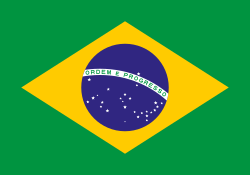
| Design | A green field with a large yellow rhombus in the center, bearing a blue disk which forms a celestial globe depicting twenty-seven small white five-pointed stars spanned by a white equatorial curved band with the National Motto Ordem E Progresso ('Order and Progress') written in green. |
| Designed by | Raimundo Teixeira Mendes |
| Part of a series on the |
| Culture of Brazil |
|---|
 |
| Society |
| Topics |
| Symbols |

The national flag of Brazil is a blue disc depicting a starry sky (which includes the Southern Cross) spanned by a curved band inscribed with the national motto Ordem e Progresso ('Order and Progress'), within a yellow rhombus, on a green field. It was officially adopted on 19 November 1889, four days after the Proclamation of the Republic, to replace the flag of the Empire of Brazil. The concept was the work of Raimundo Teixeira Mendes, with the collaboration of Miguel Lemos, Manuel Pereira Reis and Décio Villares.
The green field and yellow rhombus from the previous imperial flag were preserved (though slightly modified in hue and shape). In the imperial flag, the green represented the House of Braganza of Pedro I, the first Emperor of Brazil, while the yellow represented the House of Habsburg of his wife, Empress Maria Leopoldina.[1] A blue circle with white five-pointed stars replaced the arms of the Empire of Brazil –its position in the flag reflects the sky over the city of Rio de Janeiro on 15 November 1889. The motto Ordem e Progresso is derived from Auguste Comte's motto of positivism: "L'amour pour principe et l'ordre pour base; le progrès pour but" ("Love as a principle and order as the basis; progress as the goal").[2]
Each star, corresponding to a Brazilian Federal Unit, is sized in proportion relative to its geographic size, and, according to Brazilian Law, the flag must be updated in case of the creation or extinction of a state. At the time the flag was first adopted in 1889, it had 21 stars. It then received one more star in 1960 (representing the state of Guanabara), then another in 1968 (representing Acre), and finally four more stars in 1992 (representing Amapá, Roraima, Rondônia and Tocantins), totaling 27 stars in its current version.
History
[edit]Colonial Brazil (1500–1815)
[edit]
The Portuguese territories in the Americas, corresponding roughly to what is now Brazil, never had their own official flag, since Portuguese tradition encouraged hoisting the flag of the Kingdom of Portugal in all territories of the Portuguese Crown.
The first Brazilian vexillological symbols were private maritime flags used by Portuguese merchant ships that sailed to Brazil. A flag with green and white stripes was used until 1692.[3] The green and white colors represented the House of Braganza and the national colours of Portugal. In 1692, that flag was no longer used by ships that sailed to Brazil and became the flag of the merchant vessels in coastal Portugal. In 1692, a new flag was introduced for merchant vessels sailing to Brazil. The new flag had a white field with a golden armillary sphere. The armillary sphere had served as the personal emblem of King Manuel I of Portugal (reigned 1494–1521). During his reign Portuguese ships used it widely, and eventually it became a national emblem of Portugal and, more specifically, of the Portuguese empire. A similar flag was introduced for the Portuguese ships that sailed to India, but with a red armillary sphere. Despite representing the entire Portuguese empire, the armillary sphere began to be used more extensively in Brazil – the largest and most developed colony at the time – not only in maritime flags, but also on coins and other media. It eventually became the unofficial ensign of Brazil.
United Kingdom of Portugal, Brazil, and the Algarves (1815–1822)
[edit]-
 Flag of the United Kingdom of Portugal, Brazil and the Algarves (1816–1822)
.svg)
In 1815, Brazil was elevated to the rank of kingdom, and the kingdoms of Portugal, Brazil and the Algarves were united as a single state – the United Kingdom of Portugal, Brazil and the Algarves. The Charter Act of 1816 established the insignia of the new kingdom.[4] It specified that the arms of the Kingdom of Brazil was to be composed of a gold armillary sphere on a blue field.[4] During this time, the flag of Brazil was the flag of the United Kingdom of Portugal, Brazil, and the Algarves.
Empire of Brazil (1822–1889)
[edit]-
 Flag of the independent Kingdom of Brazil (18 September – 1 December 1822)
 -
 First flag of the Empire of Brazil with 19 stars (1822–1853). On 29 August 1853, Imperial Law No. 704 created the Province of Paraná, resulting in the addition of a 20th star.
 -
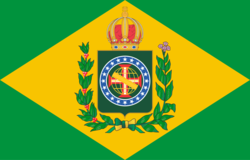 Second flag of the Empire of Brazil with 20 stars (1853–1889)
 -
 The Founding of the Brazilian Fatherland, a 1899 allegorical painting depicting statesman José Bonifácio de Andrada e Silva, one of the founding fathers of the country, with the imperial flag and Brazil's three major ethnic groups
.svg)


.jpg)
The flag of Brazil was designed by Jean-Baptiste Debret as the Royal Standard of the Prince Royal of the United Kingdom of Portugal, Brazil and the Algarves, Pedro I.
After the Brazilian Declaration of Independence, and with the coronation of Pedro I as Emperor of Brazil, the Royal Standard was modified to become the flag of the Empire of Brazil. The new flag featured the imperial coat of arms within a yellow rhombus, on a green field.[5] The green and yellow colors represented the dynastic houses of Pedro I and his consort Maria Leopoldina of Austria.[2]
The imperial flag was slightly modified during the reign of Pedro II, when an extra star was added to the imperial arms to conform to the new territorial organization of the country.
Republic of Brazil (1889–present)
[edit]-
 Provisional flag of the Republic of the United States of Brazil (15–19 November 1889)
 -
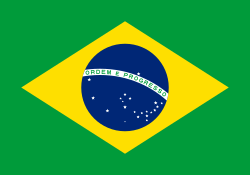 Flag from 1889–1960
71 years of use
(21 stars) -
 Flag from 1960–1968
8 years of use
(22 stars) -
 Flag from 1968–1992
24 years of use
(23 stars)
.svg)
.svg)
.svg)
.svg)
Upon the proclamation of the Republic, one of the civilian leaders of the movement, the jurist Ruy Barbosa, proposed a design for the nation's new flag strongly inspired by the flag of the United States. It was flown from 15 to 19 November 1889, when marshal Deodoro da Fonseca (acting as provisional president of Brazil) vetoed the design, citing concerns that it looked too similar to the flag of another country.[6]

Fonseca suggested that the flag of the new republic should resemble the old imperial flag.[6] This was intended to underscore continuity of national unity during the transition from a constitutional monarchy to a republic.[6] Raimundo Teixeira Mendes presented a project in which the imperial coat of arms was replaced by a blue celestial globe and the positivist motto. It was presented to Fonseca, who promptly accepted. The flag was designed by a group formed by Raimundo Teixeira Mendes, Miguel Lemos, Manuel Pereira Reis and Décio Villares.[7] It was officially adopted on 19 November 1889.[8]
The flag has been modified on three occasions to add additional stars intended to reflect newly created states: 1960 (22 stars), 1968 (23 stars) and 1992 (27 stars). In contrast to many other national flags with elements representing political subdivisions, modifications to the flag of Brazil were not always made promptly upon political reorganisation, resulting in multi-year periods of history where there was a mismatch between the number of stars and the number of states and federal districts.[9] The most recent modification was made on 11 May 1992, with the addition of four stars to the celestial globe (representing states created between 1982 and 1991), and a slight change in the stars' positions was made to match the astronomical coordinates correctly.
Design
[edit]Decree No. 4, issued on 19 November 1889, legally replaced the flag used under the constitutional monarchy with the new national flag.[10] The last change was held on 11 May 1992, Law No. 8.421, altered the celestial globe with the addition of six stars.[10]
Construction
[edit].svg)
The precise positions of the 27 stars on the globe make the Brazilian flag one of the most complicated national flags to construct. The official design is defined by Law No. 5,700, issued on 1 September 1971.[11] The flag's length is twenty modules and the width, fourteen, translating into an aspect ratio of 10:7. The distance of the vertices of the yellow rhombus to the outer frame is a module and seven-tenths (1.7 m). The blue circle in the middle of the yellow rhombus has a radius of three and a half modules (3.5 m). The center of the arcs of the white band is two modules (2 m) to the left of the meeting point of the extended vertical diameter of the circle with the base of the outer frame. The radius of the lower arc of the white band is eight modules (8m) and the radius of the upper arc of the white band is eight and a half modules (8.5 m). The width of the white band is a half of a module (0.5 m).
The caption "Ordem e Progresso" is written in green letters. The letter P lies on the vertical diameter of the circle. The letters of the word "Ordem" and the word "Progresso" are a third of a module (0.33 m) tall. The width of these letters is three-tenths of a module (0.30 m). The conjunction E has a height of three-tenths of a module (0.30 m) and a width of a quarter of a module (0.25 m).
The stars are of five different sizes: first, second, third, fourth and fifth magnitudes. They are drawn within circles whose diameters are: three-tenths of a module (0.30 m) for the first magnitude, a quarter of a module (0.25 m) for the second magnitude; a fifth of a module (0.20 m) for the third magnitude, a seventh of a module (0.14 m) for the fourth magnitude, and a tenth of a module (0.10 m) for the fifth magnitude.[12]
Stars
[edit]
- Procyon (α Canis Minoris)
- Canis Major: five stars, the largest depicting Sirius
- Canopus (α Carinae)
- Spica (α Virginis)
- Hydra: two stars, the larger being Alphard
- Crux Australis: five stars, the largest depicting Alpha Crucis
- Sigma Octantis (σ Octantis, south pole star)
- Triangulum Australe: three stars of similar size
- Scorpius: eight stars, the largest depicting Antares
Paulo Araújo Duarte of the Federal University of Santa Catarina claims that "the creators of our republican flag intended to represent the stars in the sky at Rio de Janeiro at 8:30 in the morning on 15 November 1889, the moment at which the constellation of the Southern Cross was on the meridian of Rio de Janeiro and the longer arm [of the cross] was vertical".[12] Another article, citing "O Céu da Bandeira (The Sky of the Flag)", by J. R. V. Costa, says the exact time was actually 08:37.[citation needed] This last article includes the flag's designer's explanation of his intentions regarding the stars.[citation needed] According to Brazil's national act number 5,700 of 1 September 1971, the flag portrays the stars as they would be seen by an imaginary observer an infinite distance above Rio de Janeiro standing outside the firmament in which the stars are meant to be placed (i.e. as found on a celestial globe). Thus Beta Crucis appears to the right of the constellation and Delta Crucis to the left, in mirror image of the way they actually appear in the sky (and, coincidentally, the way they appear on the Brazilian coat of arms).
The star Spica is the only one above the white band; it symbolises part of Brazilian territory in the northern hemisphere (and the State of Pará).
The Sigma Octantis (south pole star) is small, but all the other stars turn around it. Its unique position in the sky of the southern hemisphere represents the stability of the Federal District in the Brazilian union.
The shining star in constellation represent the size of territory of the state in the Brazilian region (constellation).
The flag of Brazil contains 27 stars, representing the Brazilian states and the Federal District.[12] The constellation of the Southern Cross is on the meridian (indicated by the number 6 in the diagram). To the south of it is Polaris Australis (Sigma Octantis, numbered 7), representing the Federal District. A single star lies above the band, representing the large northern state of Pará, which straddles the equator.
The band with its motto appears roughly coincident with the ecliptic, as in the armillary symbol of Manuel I of Portugal and colonial Brazil,[13] or otherwise the celestial equator,[14] while none of the stars symbolized lie north of these lines. Some interpretations of the band also identify it with the Amazon River.[13]
Stars and states
[edit]The stars depicted on the flag and the states they represent are:[12]
| State | Star | Constellation | Size (1=largest) |
State made |
Star added |
|---|---|---|---|---|---|
| Amazonas | Alpha Canis Minoris (Procyon) | Canis Minor, the Little Dog | 1 | 1889 | 1889 |
| Mato Grosso | Alpha Canis Majoris (Sirius) | Canis Major, the Great Dog | 1 | 1889 | 1889 |
| Amapá | Beta Canis Majoris (Mirzam) | Canis Major, the Great Dog | 2 | 1991 | 1992 |
| Rondônia | Gamma Canis Majoris (Muliphen) | Canis Major, the Great Dog | 4 | 1982 | 1992 |
| Roraima | Delta Canis Majoris (Wezen) | Canis Major, the Great Dog | 2 | 1991 | 1992 |
| Tocantins | Epsilon Canis Majoris (Adhara) | Canis Major, the Great Dog | 3 | 1989 | 1992 |
| Pará | Alpha Virginis (Spica) | Virgo, the Virgin | 1 | 1889 | 1889 |
| Piauí | Alpha Scorpii (Antares) | Scorpius, the Scorpion | 1 | 1889 | 1889 |
| Maranhão | Beta Scorpii (Graffias) | Scorpius, the Scorpion | 3 | 1889 | 1889 |
| Ceará | Epsilon Scorpii (Larawag)[15] | Scorpius, the Scorpion | 2 | 1889 | 1889 |
| Alagoas | Theta Scorpii (Sargas) | Scorpius, the Scorpion | 2 | 1889 | 1889 |
| Sergipe | Iota Scorpii | Scorpius, the Scorpion | 3 | 1889 | 1889 |
| Paraíba | Kappa Scorpii | Scorpius, the Scorpion | 3 | 1889 | 1889 |
| Rio Grande do Norte | Lambda Scorpii (Shaula) | Scorpius, the Scorpion | 2 | 1889 | 1889 |
| Pernambuco | Mu Scorpii (Xamidimura & Pipirima)[15] | Scorpius, the Scorpion | 3 | 1889 | 1889 |
| Mato Grosso do Sul | Alpha Hydrae (Alphard) | Hydra, the Water Serpent | 2 | 1979[note] | 1960[note] |
| Acre | Gamma Hydrae | Hydra, the Water Serpent | 3 | 1962 | 1968 |
| São Paulo | Alpha Crucis (Acrux or Estrela de Magalhães) | Crux, the Southern Cross | 1 | 1889 | 1889 |
| Rio de Janeiro | Beta Crucis (Mimosa) | Crux, the Southern Cross | 2 | 1889 | 1889 |
| Bahia | Gamma Crucis (Gacrux) | Crux, the Southern Cross | 2 | 1889 | 1889 |
| Minas Gerais | Delta Crucis (Imai)[16] | Crux, the Southern Cross | 3 | 1889 | 1889 |
| Espírito Santo | Epsilon Crucis (Ginan[15]) | Crux, the Southern Cross | 4 | 1889 | 1889 |
| Rio Grande do Sul | Alpha Trianguli Australis (Atria) | Triangulum Australe, the Southern Triangle | 2 | 1889 | 1889 |
| Santa Catarina | Beta Trianguli Australis | Triangulum Australe, the Southern Triangle | 3 | 1889 | 1889 |
| Paraná | Gamma Trianguli Australis | Triangulum Australe, the Southern Triangle | 3 | 1889 | 1889 |
| Goiás | Alpha Carinae (Canopus) | Carina, the Keel of Argo | 1 | 1889 | 1889 |
| Distrito Federal | Sigma Octantis (Polaris Australis) | Octans, the Octant | 5 | 1889[note] | 1889 |
- ^ Brazil's original Federal District was created in 1889 from the former Neutral Municipality covering the then-capital city of Rio de Janeiro, and represented on the flag by the star Sigma Octantis (Polaris Australis). In 1960, to correspond with the creation of the new capital, Brasília, the Federal District was reconstituted on new territory carved out of the state of Goiás, bordering the Minas Gerais state; it continued to be represented on the flag by Sigma Octantis. The former Federal District became the new state of Guanabara and a new star, Alphard, was added to the flag to represent it. Guanabara was eliminated as a separate state in 1975; however, Alphard was not removed from the flag and from 1975 to 1979 it represented no state. When the new state of Mato Grosso do Sul was created in 1979, it was assigned Alphard.[9]
Colours
[edit]The specific shades of colors used in the flag are not specified in any legal document. The values listed below can be found in the files available for download from the Brazilian government website:[17]
| Green | Yellow | Blue | White | |
|---|---|---|---|---|
| RGB | 0/148/64 |
255/203/0 |
48/38/129 |
255/255/255
|
| Hexadecimal | #009440 |
#ffcb00 |
#302681 |
#ffffff
|
| CMYK | 84/12/96/1 |
0/21/93/0 |
100/97/10/1 |
0/0/0/0
|
Proposed design alterations
[edit].webp)
In 2021, the movement "Amor na Bandeira" (in English, Love in the Flag)[18][19] proposed to update the flag's motto from "Ordem e Progresso" to "Amor, Ordem e Progresso" (Love, Order and Progress), in allusion to the motto of positivism "L'amour pour principe et l'ordre pour base; le progrès pour but" (Love as a principle and order as the basis; progress as the goal), formulated by the French philosopher Augusto Comte, which inspired the original motto in the flag. One of the main proponents of the movement was the politician Eduardo Suplicy, who had previously supported bill PL 2179/2003 by Deputy Chico Alencar, which had the same goal. That 2003 bill also aimed to change the expression on the Brazilian flag to Love, Order and Progress.[20][21]
Flag protocol
[edit]
Federal Law No. 5,700, issued on 1 September 1971, defines the flag protocol in Brazil.[22][23] The flag must be permanently hoisted at the Praça dos Três Poderes in Brasília. The flag must be raised and lowered daily at the presidential palaces (Palácio do Planalto and Palácio da Alvorada); ministries; National Congress; Supreme Federal Tribunal; Supreme Court of Justice; seats of the Executive, Legislative and Judicial branches; diplomatic missions; Federal, state and local institutions; and merchant navy units. When a flag is no longer fit to use, it must be delivered to a military facility to be burned during a special ceremony on 19 November ("Flag Day").
The flag must be flown at half-staff when the President decrees official mourning. In addition, state and local governments may decree official mourning with the death of a mayor or governor. When the flag is displayed at half-staff, prior to raising or lowering it, the flag must be raised to the top of the flagpole and then lowered to the halfway mark. When the flag is being carried in procession, a black crape ribbon must be tied to the top of the mast.
A foreign flag may only be flown with a Brazilian Flag along its right side. The only exceptions are when the foreign flag is displayed in an embassy or consulate and in prize-giving ceremonies of sport competitions won by foreign athletes. When multiple flags are raised or lowered simultaneously, the Brazilian Flag must be the first to reach the top of the flagpole and the last to reach the bottom.
Folding
[edit]| Stage | Description | Example |
|---|---|---|
| First | The upper half of the flag's height is folded into the reverse side. | .gif)
|
| Second | The folding proceeds by folding the flag's lower half into the reverse side until most of the blue disc and the motto face up. | |
| Third | The flag is then folded into three parts along the width axis, with the fly and hoist folded into the reverse side, leaving the blue disc and motto facing up. |
Flag anthem
[edit]
The Brazilian Flag Anthem (Hino à Bandeira Nacional) is a song dedicated to the country's flag. It is performed on 19 November (Flag Day). The Portuguese lyrics were written by poet Olavo Bilac, and the music composed by Francisco Braga.[25]
| Portuguese lyrics[25] | English translation |
|---|---|
|
Salve, lindo pendão da esperança! Chorus Em teu seio formoso retratas Contemplando o teu vulto sagrado, Sobre a imensa nação brasileira, |
Hail, precious banner of hope! Chorus In thy beauteous bosom thou portrayest Beholding thy sacred shadow, Over the immense Brazilian Nation, |
Other flags
[edit].jpg)
Governmental flags
[edit]The president and vice president are also represented by their own flag.[26] The President Standard is a dark green rectangle (ratio 2:3) holding the national coat of arms on its center. It is usually hoisted at the President's official residence, the Palácio da Alvorada, and at the President's workplace, the Palácio do Planalto. It is also displayed on the presidential car, as small-sized flags. The Vice Presidential Standard is a yellow rectangle (ratio 2:3) with twenty-three blue stars disposed in a cross dividing the flag into four equal quadrants, with the coat of arms in the middle of the upper left quadrant.
-
 Presidential Standard
 -
 Vice Presidential Standard
 -
 Flag of the Minister of Defence


.svg)
Military flags
[edit]Some of the branches of the Brazilian military also have their own flags.
-
 Brazilian Army (since 1987[27])
 -
 Brazilian Air Force (de facto flag, since 1999[28])
 -
 Brazilian Navy flag
 -
 Brazilian air force general flag
 -
 Brazilian naval admiral flag
 -
 Flag-insignia of the chief of the Joint Chiefs of Staff of the Brazilian Armed Forces.


.svg)
Naval jack
[edit]The Brazilian naval jack (jaque) is a rectangular flag (ratio 3:4) bearing 21 white stars on a dark blue field – a horizontal row of 13 and a vertical column of 9, orthogonally displayed.[29]
-
 Naval jack.

Previous flags
[edit]The list below identifies previous flags used in Brazil.[30]
-
 Flag of the United Kingdom of Portugal, Brazil and the Algarves (1816–1822)
 -
 Flag of the Brazilian Kingdom (18 September – 1 December 1822)
 -
 Flag of the Empire of Brazil, first version (1 December 1822 – 29 August 1853)
 -
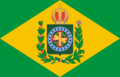 Flag of the Empire of Brazil, second version (30 August 1853 – 15 November 1889)
 -
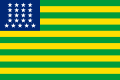 Provisional Flag of Republic of the United States of Brazil (15 – 19 November 1889)
 -
 First Flag of the United States of Brazil (19 November 1889 - present)
.svg)
Rejected flags
[edit]The best-known rejected flags are listed below.[31] Several projects were heavily inspired by the green-yellow Imperial Flag, while a black-white-red pattern was also proposed. Those colours would represent the major groups of Brazilian population, red being the natives, white the European settlers and immigrants and black the Africans.[32]
-
 Project of Lopes Trovão, 1888. It was raised, when the Republic took place, but has been changed by the similar proposal of Ruy Barbosa.
 -
 Project of Júlio Ribeiro, 1888. Eventually became the flag of the State of São Paulo with the addition of Acre on the map
 -
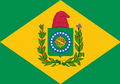 Project of Deodoro da Fonseca, 1889
 -
 Project of Antônio da Silva Jardim, 1890
 -
 Project of José Maria da Silva Paranhos, Jr., 1890
 -
 Project of Oliveira Valadão, 1892
 -
 Project of Eurico de Góis, 1908
 -
 Project of Wenceslau Escobar, 1908
 -
 Second project of Eurico de Góis, 1933

.svg)
.png)
.svg)
.svg)
.svg)
.svg)
.svg)
.svg)
See also
[edit]References
[edit]- ^ "Brazil — Photo Details". The World Factbook. CIA. Archived from the original on 12 January 2021. Retrieved 8 October 2010.
- ^ a b Catarin, Cristiano (2007). "Bandeira e significados" [Flag and meanings]. HISTORIANET (in Brazilian Portuguese). Archived from the original on 7 December 2007. Retrieved 9 October 2010.
- ^ "BANDEIRAS NAVAIS PORTUGUESAS" [PORTUGUESE NAVAL FLAGS]. Cruzeiros National Association (in European Portuguese). Archived from the original on 27 November 2010. Retrieved 9 October 2010.
- ^ a b "1816 Law 09". Brown University. John Carter Brown Library. Archived from the original on 10 August 2010. Retrieved 9 October 2010.
- ^ "Decreto de D. Pedro I de 18 de setembro de 1822". Wikisource. Retrieved on 9 October 2010. (in Portuguese).
- ^ a b c Seyssel, Ricardo (2006). "Um Estudo Histórico Perceptual: A Bandeira Brasileira Sem Brasil" [A Perceptual Historical Study: The Brazilian Flag Without Brazil] (PDF). Institute of Arts. São Paulo State University (in Brazilian Portuguese). São Paulo. Archived from the original (PDF) on 26 July 2011. Retrieved 10 October 2010.
- ^ "Brazil — Designers of the Flag". FotW. Archived from the original on 22 January 2019. Retrieved 8 October 2010.
- ^ "LEI N. 5.700 - DE 1° DE SETEMBRO DE 1971" [LAW N. 5,700 - OF SEPTEMBER 1, 1971]. Brazilian Army (in Brazilian Portuguese). Archived from the original on 19 August 2010. Retrieved 8 October 2010.
- ^ a b "Brazil: Evolution of the Modern National Flag". crwflags.com. FotW. Archived from the original on 28 May 2023. Retrieved 11 July 2015.
- ^ a b "Símbolos e Hinos" [Symbols and Anthems]. Federal government of Brazil (in Brazilian Portuguese). 18 January 2010. Archived from the original on 19 May 2011. Retrieved 9 October 2010.
- ^ "Law on the National Flag: details of construction". FotW. Archived from the original on 18 January 2024. Retrieved 8 October 2010.
- ^ a b c d Duarte, Paulo Araújo. "Astronomia na Bandeira Brasileira" [Astronomy on the Brazilian Flag]. Federal University of Santa Catarina (in Brazilian Portuguese). Archived from the original on 2 May 2008. Retrieved 9 July 2009.
- ^ a b "Episodes". Science in Portugal. 28 May 1968. Retrieved 12 June 2022.
- ^ Vlahos, Perry (26 June 2014). "Stars significant on Brazilian flag". The Sydney Morning Herald. Retrieved 12 June 2022.
- ^ a b c "Naming Stars". International Astronomical Union. Archived from the original on 11 April 2020. Retrieved 16 December 2017.
- ^ "IAU Catalog of Star Names". International Astronomical Union. Retrieved 17 September 2018.
- ^ "Bandeira Nacional". Brazilian Government. 4 July 2011. Archived from the original on 24 May 2024.
- ^ Magalhães, Vítor (18 November 2021). "Movimento propõe adicionar a palavra "amor" na bandeira do Brasil" [Movement proposes adding the word "love" to the Brazilian flag]. O Povo (in Brazilian Portuguese). Archived from the original on 18 November 2021. Retrieved 6 July 2023.
- ^ Costa, Cristyan (19 November 2021). "Bandeira do Brasil: campanha propõe escrever 'amor' antes de 'Ordem e Progresso'" [Flag of Brazil: campaign proposes writing ‘love’ before ‘Order and Progress’]. Oeste Magazine (in Brazilian Portuguese). Archived from the original on 23 November 2021. Retrieved 6 July 2023.
- ^ "Projeto inscreve palavra amor na bandeira nacional" [Project inscribes the word love on the national flag]. Chamber of Deputies (in Brazilian Portuguese). 20 February 2004. Archived from the original on 7 July 2023. Retrieved 6 July 2023.
- ^ "PL 2179/2003". Chamber of Deputies (in Brazilian Portuguese). Archived from the original on 25 June 2020. Retrieved 6 July 2023.
- ^ Uso da Bandeira Nacional Archived 2019-05-03 at the Wayback Machine Brasil República. Retrieved on 15 June 2009. (in Portuguese).
- ^ Lei no. 5,700 de 1 de Setembro de 1971 Presidência da República. Retrieved on 9 October 2010. (in Portuguese).
- ^ Hino à Bandeira Nacional – Coral (Exército Brasileiro) Dominiopublico.gov.br. Retrieved on 2010-10-10. (in Portuguese).
- ^ a b "HINO À BANDEIRA NACIONAL" [ANTHEM TO THE NATIONAL FLAG]. Brazilian Army (in Brazilian Portuguese). Archived from the original on 22 February 2014. Retrieved 10 October 2010.
- ^ President and Vice President (Brazil) Flags of the World. Retrieved on 9 October 2010.
- ^ "D94336".
- ^ "Portaria nº 592/GC3, de 6 de setembro de 1999".
- ^ Cerimonial da Marinha Archived 2010-08-27 at the Wayback Machine Marinha do Brasil. Retrieved on 2010-10-09. (in Portuguese)
- ^ "Bandeiras Históricas do Brasil". Exército Brasileiro (in Portuguese). Archived from the original on 14 December 2007.
- ^ Projetos de mudança da Bandeira Nacional Brasileira Archived 2013-06-27 at the Wayback Machine BrasilRepública. Retrieved on 2010-10-08. (in Portuguese).
- ^ MARTIUS, p. 381
External links
[edit] Quotations related to Flag of Brazil at Wikiquote
 Media related to National flag of Brazil at Wikimedia Commons
- Bandeira Nacional at the Brazilian Government
- Bandeira - Insígnia at the Brazilian Government
- Brazil at Flags of the World
- Brazil Archived 2022-04-10 at the Wayback Machine at Flags Corner


Flag of Brazil
View on GrokipediaHistory
Colonial Brazil (1500–1815)
During the colonial period from 1500 to 1815, Brazil lacked a distinct national flag as a Portuguese colony and instead utilized various standards of the Portuguese Crown. On April 22, 1500, Portuguese explorer Pedro Álvares Cabral claimed the territory for Portugal by erecting stone padrões inscribed with the royal arms and raising the Portuguese royal banner, marking the formal initiation of colonization.[7] The banner of the Order of Christ, featuring a white field charged with a red patriarchal cross potent (the Cross of Christ), was extensively employed in Portuguese maritime expeditions and early settlements in Brazil, symbolizing the religious and exploratory mandate under which colonization proceeded. This flag, rooted in the military order that succeeded the Knights Templar and sponsored Portugal's overseas ventures, appeared on ships and fortifications from the 1500s onward.[8][9] From 1645 to 1815, the Flag of the Princes of Brazil—personal ensign of the Portuguese heir-apparent bearing the title "Prince of Brazil"—functioned as a prominent colonial standard in the territory, reflecting the integration of Brazil into the royal succession nomenclature despite its peripheral status. This usage persisted through the establishment of the Viceroyalty of Brazil in 1549 and subsequent administrative divisions into captaincies, with no evidence of unique vexillological symbols supplanting Portuguese emblems until the early 19th century.[8] Intermittently, foreign occupations disrupted standard Portuguese usage, such as the Dutch control of northeastern Brazil from 1630 to 1654, during which the Dutch West India Company's flag with its monogram flew over captured areas, though Portuguese forces reinstated their banners upon reconquest.[8]United Kingdom of Portugal, Brazil, and the Algarves (1815–1822)
On 16 March 1815, King João VI issued a decree elevating the State of Brazil to the rank of kingdom, thereby constituting the United Kingdom of Portugal, Brazil, and the Algarves.[10] This status formalized Brazil's co-equality with Portugal and the Algarves following the transfer of the Portuguese court to Rio de Janeiro in 1808 amid the Napoleonic Wars.[10] In 1816, legislation established a unified flag for the United Kingdom, replacing prior colonial banners in Brazil.[8] The design comprised a white field emblazoned with the escutcheon of the United Kingdom, quartered to display the arms of Portugal (five blue shields with white crescents on silver), Brazil (a green shield charged with a golden armillary sphere), and the Algarves (a red shield with seven silver towers).[8] The armillary sphere in Brazil's arms evoked the navigational instruments central to Portuguese exploration and colonial expansion.[8] This flag functioned as the civil and state ensign across the United Kingdom's territories, including Brazil, symbolizing the political union until Brazil's declaration of independence on 7 September 1822.[8] Royal variants incorporated a crimson border and crown, denoting sovereignty under João VI, who ruled from Brazil as the effective capital.[11] Usage persisted in Brazilian ports and official contexts through late 1822, bridging colonial symbols to emerging national identity.[8]Empire of Brazil (1822–1889)
The flag of the Empire of Brazil originated from a decree issued by Dom Pedro I on 18 September 1822, which established the national coat of arms and flag shortly after independence from Portugal.[12] This design, crafted by French painter Jean-Baptiste Debret, initially served the brief Kingdom of Brazil phase before the empire's proclamation on 7 October 1822.[12] A formal imperial version was introduced on 1 December 1822, incorporating an imperial crown atop the coat of arms.[11] The flag displayed a green field overlaid by a yellow lozenge extending to the edges, enclosing the imperial coat of arms at the center.[11] The coat of arms featured a blue circular band containing 19 silver stars arranged around a gold armillary sphere superimposed on the Cross of Christ, topped by the imperial crown, with coffee and tobacco branches embracing the sides tied in a national bow-knot.[12] The green and yellow colors derived from the heraldry of the House of Bragança, the dynasty of Dom Pedro I.[11] [4] The stars symbolized the provinces of the empire.[11] Initially numbering 19, their count increased to 20 under Emperor Pedro II to reflect administrative expansions, including new provincial divisions.[11] Minor adjustments occurred, such as changing the crown's lining from red to green in 1822 and standardizing the shield shape by the mid-19th century.[11] Coffee and tobacco branches represented Brazil's key economic resources.[11] The flag persisted unchanged in core design until the republic's establishment on 15 November 1889.[11]Republic of Brazil (1889–present)
Following the proclamation of the Republic on 15 November 1889, a provisional flag consisting of alternating green and yellow stripes with a black canton bearing white stars in clusters was raised but met with widespread disapproval for its resemblance to the United States flag and lack of connection to imperial colors.[4][13] It was replaced after four days by Decree No. 4 of 19 November 1889, which established the basic design still in use: a green field symbolizing the forests, a yellow lozenge for minerals, and a blue celestial globe encircled by 21 white stars within the lozenge, overlaid by a white band inscribed with the positivist motto "Ordem e Progresso."[14][15] The design, proposed by philosophers Raimundo Teixeira Mendes and Miguel Lemos with astronomical input from Manuel Pereira Reis, retained the empire's green and yellow to evoke continuity while replacing the imperial coat of arms with republican symbols.[16] The 21 stars initially represented Brazil's 20 states plus the federal capital (Neutral Municipality of Rio de Janeiro).[14] In June 1960, after the federal capital relocated to Brasília—creating the new Federal District and elevating the former Rio de Janeiro area to Guanabara State—a 22nd star was added to reflect the updated administrative divisions.[14] Law No. 5443 of 28 May 1968 introduced a 23rd star, positioned between the "O" and "G" of the motto, corresponding to adjustments for territorial changes including Acre's full integration, while also refining the stellar arrangement to better match the night sky over Rio de Janeiro on 15 November 1889.[14][1] The most recent modification occurred with Law No. 8.421 of 11 May 1992, which added four stars to reach 27, representing the 26 states and Federal District following the creation of Amapá, Roraima, Rondônia (elevated from territory), and Tocantins in the late 1980s.[17][14] This configuration has remained unchanged, with stars denoting constellations visible from the capital on the republic's founding date.[15] No alterations to colors, proportions, or the motto have been made since 1889, emphasizing stability in national symbolism despite political shifts.[14]Symbolism
Colors and their meanings
The green field of the Brazilian flag symbolizes the nation's abundant forests and vegetation, encompassing biomes such as the Amazon rainforest and Atlantic Forest that cover significant portions of the country's territory. This interpretation aligns with the republican design's emphasis on Brazil's natural endowments, as articulated in official descriptions.[18][19] The yellow lozenge in the center represents Brazil's mineral riches, historically including vast gold reserves discovered during the colonial era, which fueled economic development and symbolized national prosperity.[18][19] The blue disc depicting the celestial globe evokes the clear skies of Brazil, specifically those visible in Rio de Janeiro at the proclamation of the Republic on November 15, 1889, at approximately 8:30 a.m., when the design was conceptualized.[20][18] White, used in the equatorial band traversing the globe and in the stars, signifies peace, purity, and the aspirations for national harmony following the transition to republican governance.[18][20] These color attributions, while not codified in Law No. 5,700 of September 1, 1971—which regulates the flag's form and protocol—stem from the intentions of designer Raimundo Teixeira Mendes and the positivist influences on the 1889 republican flag, reinterpreting the imperial green and yellow (originally denoting the Houses of Braganza and Habsburg-Lorraine, respectively) to emphasize geographic and resource-based symbolism.[21][3]Central globe and motto
The central element of the Brazilian flag is a blue disc, representing a celestial globe, centered within the yellow lozenge and encircled by white stars depicting the night sky.[16] This disc symbolizes the Southern Hemisphere's starry firmament as observed from Rio de Janeiro at 8:30 a.m. on November 15, 1889, the date of the republic's proclamation.[16] The globe's design was finalized by artist Décio Villares based on astronomical calculations to ensure positional accuracy relative to the Brazilian sky.[22] A curved white band traverses the globe horizontally, inscribed with the national motto "Ordem e Progresso" in green capital letters, positioned such that equal white spaces separate the text above and below.[16] The motto, meaning "Order and Progress," derives from the positivist philosophy of Auguste Comte, abbreviating his maxim "O amor por princípio e a ordem por base; o progresso por fim" (Love as the principle and order as the base; progress as the goal). This adaptation, adopted by Brazil's republican founders, symbolizes the structured societal advancement envisioned through scientific order and rational governance as foundational to progress.[4] The globe and motto were conceptualized by positivist intellectual Raimundo Teixeira Mendes, with input from Miguel Lemos and Manuel Pereira Reis, as part of the flag's design submitted for the 1889 republican competition.[16] Officially adopted via Provisional Government Decree No. 4 on November 19, 1889, these elements replaced imperial heraldry to signify republican ideals of rational governance and forward momentum, diverging from monarchical traditions while retaining national continuity.[22]Stars and celestial representation
The 27 white, five-pointed stars arrayed across the blue celestial globe replicate the positions of prominent stars visible in the sky over Rio de Janeiro at 8:30 a.m. on November 15, 1889, the morning of the republic's proclamation.[23] [24] This deliberate astronomical mapping, proposed by the flag's designer Raimundo Teixeira Mendes and refined by astronomer Manuel José da Silva, positions the stars as viewed from outside the celestial sphere, forming recognizable constellations including Crux (the Southern Cross), Scorpius, Virgo, Canis Major, Canopus, Triangulum Australe, Ara, Grus, and Piscis Austrinus.[23] The Southern Cross appears aligned with the meridian, reflecting Brazil's location in the southern hemisphere.[24] Although commonly misconstrued as a nighttime depiction, the configuration corresponds to the predawn or early morning sky, countering assumptions of an evening observance during the proclamation events.[23] Star sizes vary to approximate apparent magnitudes, with brighter stars rendered larger; for instance, the prominent Spica (Alpha Virginis, magnitude 1.0) and Canopus (Alpha Carinae, magnitude -0.7) are among the most sizable.[25] These celestial elements symbolize the enduring order of the universe, complementing the flag's positivist motto "Ordem e Progresso."[23] Each star also designates one of Brazil's 26 states or the Federal District, a symbolic overlay added to the astronomical template; originally 21 stars in 1889 matched the then-existing units, with subsequent additions for new states inserted into predefined positions without disrupting the overall stellar pattern.[2] This dual representation underscores the flag's intent to evoke both federal unity and cosmic permanence at the republic's founding.[24]Design
Construction specifications
The construction of the Brazilian national flag adheres to geometric specifications defined in Law No. 5,700 of September 1, 1971, as amended by subsequent legislation including Law No. 8,421 of May 11, 1992.[26][27] The flag's proportions are fixed at a ratio of 7:10, achieved by dividing the desired hoist-side width into 14 equal modules, with each module serving as the unit for all measurements; the fly-side length then measures 20 modules.[26] The yellow lozenge occupies the center of the green rectangular field, with its vertices positioned at the midpoints of the flag's four edges: horizontally at 7 modules from the hoist for the left and right vertices, and vertically at 7 modules from the top and bottom for the upper and lower vertices.[26] This configuration ensures the lozenge's diagonals align with the flag's horizontal and vertical axes, spanning 14 modules horizontally and 14 modules vertically.[26] The blue celestial globe is depicted as a circle with a diameter of 3.5 modules, centered precisely at the intersection of the lozenge's diagonals, which coincides with the flag's geometric center.[26] Traversing the globe horizontally is a white band of 0.5 modules in height, inscribed with the motto "Ordem e Progresso" in capital letters; the lettering measures 0.24 modules in height, with "Ordem" positioned above the band and "Progresso" below, centered relative to the globe's equator.[26] These specifications mandate exact adherence for official reproductions, with no explicit margins for error in the governing law, though practical manufacturing tolerances are regulated by the National Institute of Metrology, Quality and Technology (Inmetro) to ensure uniformity.[28] The modular system facilitates scalable construction while preserving proportional integrity across varying flag sizes.[26]Stars' positions and state correspondences
The positions of the 27 stars on the flag of Brazil are configured to replicate the arrangement of the night sky over Rio de Janeiro at 8:30 a.m. on November 15, 1889, the moment of the proclamation of the republic.[2] This astronomical depiction incorporates stars from nine constellations: Canis Minor, Canis Major, Virgo, Scorpius, Hydra, Crux, Triangulum Australe, Carina, and Octans.[2] [29] The relative sizes of the stars on the flag—scaled in five categories from 1 (largest, 0.30 of 1/14 flag width) to 5 (smallest, 0.10 of 1/14 flag width)—approximate their apparent magnitudes as viewed from Earth, though not precisely matching astronomical values.[2] Each star designates one of Brazil's 26 states or the Federal District, with correspondences established by federal decree and updated via legislation such as Law No. 8,421 of May 11, 1992, which includes an appendix specifying the assignments.[30] When new states are formed, additional stars are incorporated in positions aligning with the flag's celestial template, replacing or supplementing prior representations for extinct entities.[26] The following table details the current correspondences, star designations, constellations, and relative sizes:| State/Federal District | Star Designation | Constellation | Relative Size |
|---|---|---|---|
| Acre | Gamma Hydrae | Hydra | 3 |
| Alagoas | Theta Scorpii (Sargas) | Scorpius | 2 |
| Amapá | Beta Canis Majoris (Mirzam) | Canis Major | 2 |
| Amazonas | Alpha Canis Minoris (Procyon) | Canis Minor | 1 |
| Bahia | Gamma Crucis (Gacrux) | Crux | 2 |
| Ceará | Epsilon Scorpii (Larawag) | Scorpius | 2 |
| Distrito Federal | Sigma Octantis (Polaris Australis) | Octans | 5 |
| Espírito Santo | Epsilon Crucis (Gina) | Crux | 4 |
| Goiás | Alpha Carinae (Canopus) | Carina | 1 |
| Maranhão | Beta Scorpii (Graffias) | Scorpius | 3 |
| Mato Grosso | Alpha Canis Majoris (Sirius) | Canis Major | 1 |
| Mato Grosso do Sul | Alpha Hydrae (Alphard) | Hydra | 2 |
| Minas Gerais | Delta Crucis | Crux | 3 |
| Pará | Alpha Virginis (Spica) | Virgo | 1 |
| Paraíba | Kappa Scorpii (Girtab) | Scorpius | 3 |
| Paraná | Gamma Trianguli Australis | Triangulum Australe | 3 |
| Pernambuco | Mu Scorpii (Xamidimura) | Scorpius | 3 |
| Piauí | Alpha Scorpii (Antares) | Scorpius | 1 |
| Rio de Janeiro | Beta Crucis (Becrux) | Crux | 2 |
| Rio Grande do Norte | Lambda Scorpii (Shaula) | Scorpius | 2 |
| Rio Grande do Sul | Alpha Trianguli Australis (Atria) | Triangulum Australe | 2 |
| Rondônia | Gamma Canis Majoris (Muliphein) | Canis Major | 4 |
| Roraima | Delta Canis Majoris (Wezen) | Canis Major | 2 |
| Santa Catarina | Beta Trianguli Australis | Triangulum Australe | 3 |
| São Paulo | Alpha Crucis (Acrux) | Crux | 1 |
| Sergipe | Iota Scorpii | Scorpius | 3 |
| Tocantins | Epsilon Canis Majoris (Adhara) | Canis Major | 2 |
Color specifications and proportions
The proportions of the Flag of Brazil are defined by Law No. 5,700 of September 1, 1971, which establishes an aspect ratio of 7:10, with the hoist-side width measuring seven modules and the fly-side length ten modules.[3] This ratio was first formalized in Federal Decree-Law No. 4,545 of July 31, 1942, dividing the width into 14 equal parts for precise construction of elements such as the yellow lozenge, which spans from hoist to fly with vertices touching the edges, and the blue circle centered within it at a radius of three modules from the center.[16] The green field forms a rectangle encompassing the entire flag, while the white band inscribed with "Ordem e Progresso" curves across the blue disk, positioned such that its endpoints align with the horizontal diameter and it occupies one-fifth of the circle's height.[16] Color specifications for the flag are nominal rather than chromatically precise, as Brazilian legislation, including Law No. 5,700, designates only green for the field, yellow for the lozenge, blue for the celestial globe, and white for the stars, band, and lettering, without mandating exact shades or values like Pantone or RGB equivalents.[3] This absence allows for minor variations in official and commercial reproductions, though standardized representations in vexillological references commonly employ the following approximate values for consistency:| Color | HEX | RGB | CMYK | Pantone (approximate) |
|---|---|---|---|---|
| Green | #009C3B | (0, 156, 59) | (100, 0, 62, 39) | 356 C |
| Yellow | #FFDF00 | (255, 223, 0) | (0, 13, 100, 0) | 116 C |
| Blue | #002776 | (0, 39, 118) | (100, 67, 0, 54) | 288 C |
| White | #FFFFFF | (255, 255, 255) | (0, 0, 0, 0) | N/A |
Proposed alterations and rejections
One notable proposal to alter the Brazilian flag involved modifying its motto from "Ordem e Progresso" to "Amor, Ordem e Progresso," drawing from Auguste Comte's positivist maxim "amor por princípio, ordem por base, progresso por fim." This change was advocated by Senator Eduardo Suplicy in a 2012 Senate speech, who highlighted prior efforts including bills by Darcy Ribeiro in 1991 and Chico Alencar in 2003 and 2004.[34][35] The proposal sought to emphasize love as a foundational principle but gained limited traction and was not enacted, preserving the original motto adopted in 1889.[34] In 2021, the "Amor na Bandeira" movement revived this idea, campaigning to add "Amor" above the existing phrase on the flag's central blue globe, arguing it better reflected Brazilian values and completed the positivist triad.[36] Despite online petitions and public advocacy, the alteration faced opposition over concerns of disrupting national symbolism and tradition, resulting in its rejection without legislative approval.[37] Earlier in the republican era, various designs were floated but rejected, such as Eurico de Góis's 1908 proposal featuring a green rectangle, yellow lozenge, and a blue disc with the republic's coat of arms instead of stars and motto..svg) Another suggestion around the early 1900s aimed to remove the white band bearing the motto, citing incompatibility with republican ideals, yet it failed to advance due to attachment to the established design. These efforts underscore recurring debates on symbolism but consistently upheld the flag's core elements amid Brazil's political stability.
Protocol and Legal Status
Display and usage rules
The Brazilian national flag is hoisted daily at principal public buildings, including the Palácio do Planalto, the National Congress, and the Supreme Federal Court.[3] Mandatory hoisting occurs on national holidays and days of mourning at all public offices, educational institutions, and trade union headquarters; schools must also perform weekly hoistings.[3] The flag may be used in all expressions of patriotic sentiment, whether official or private, including on masts, walls, or in processions.[3] Hoisting and lowering can occur at any time, though standard practice sets hoisting at 8:00 a.m. and lowering at 6:00 p.m., with exceptions on 19 November, when it remains hoisted through the night illuminated.[3] When displayed with other flags, the national flag occupies the position of honor—central if the number is odd, or to the right otherwise—and is raised first to the peak and lowered last.[3][26] No foreign flag may be displayed without the national flag positioned to its right, of equal size and prominence.[3] For funerals or national mourning declared by the president, the flag is flown at half-mast after first being raised to the top of the staff.[3] It must never be lowered in salute or dipped in tribute.[3] In public and military settings, the flag's width should measure one-fifth to one-seventh of the mast height.[3] Prohibited uses include displaying a damaged or soiled flag, altering its design or colors, employing it as clothing, bedding, or packaging, or using it in any manner denoting disrespect.[3] Within the armed forces, usage adheres to specific military regulations insofar as they do not conflict with the law.[3]Folding procedures
The folding procedure for the Brazilian national flag is prescribed for ceremonial contexts, particularly during the lowering (arriamento) after detachment from the halyard, to ensure respectful handling and visibility of key symbolic elements such as the blue globe and motto "Ordem e Progresso."[38][39] This method prioritizes folding along the flag's dimensions to form a compact triangle or roll that exposes the central emblem, distinguishing it from ad hoc folding and aligning with protocols under Lei nº 5.700 of 1 September 1971, which governs national symbols.[26] The standard steps, as outlined in military and official manuals, are as follows:- Hold the flag by the hoist (the edge attached to the halyard) and the fly (the opposite free edge), then fold it in half lengthwise to align the green field inward, forming a double layer.[38][39]
- Fold the resulting rectangle widthwise three times: bring the hoist edge under to meet the approximate position of the blue globe's edge on the inner layer, then repeat for the fly edge, ensuring the folds tuck beneath without obscuring the globe.[38][39] This creates a triangular shape approximating the flag's proportions (7:10 ratio).[38]
- Roll the folded triangle from the fly end toward the hoist, maintaining the motto facing outward and upward for prominence.[38][39]