


Community hub
Recent from talks
Contribute something
Nothing was collected or created yet.
Roraima
View on Wikipedia
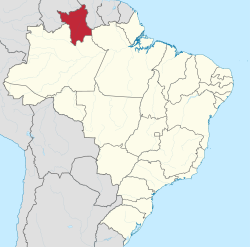
Roraima (Brazilian Portuguese: [ʁoˈɾajmɐ] ⓘ or [ʁoˈɾɐ̃jmɐ])[5] is one of the 26 states of Brazil. Located in the country's North Region, it is the northernmost and most geographically and logistically isolated state in Brazil.[6] It is bordered by the state of Pará to the southeast, Amazonas to the south and west, Venezuela to the north and northwest, and Guyana to the east.[7]
Key Information


The state covers an area of approximately 223,644.527 square kilometres (86,300 sq mi),[1] slightly larger than Belarus, being the fourteenth largest Brazilian state by area.[8] The city of Boa Vista is the capital and largest city in the state, and is the only capital in the country located entirely in the Northern Hemisphere.[9] Antônio Denarium, a member of the conservative Progressistas party, has been the governor of the state since 2019.[10]
Roraima is the least populous state in Brazil, with an estimated population of 631,181 inhabitants as of 2020.[1] It is also the state with the lowest population density in Brazil, with 2.01 inhabitants per square kilometre. Its economy, based mainly on the tertiary sector, registers a high growth rate, although its Gross Domestic Product (GDP) is the lowest in the country, with R$ 16.024 billion, representing only 0.20% of the Brazilian economy.[11]
The history of Roraima is strongly linked to the Branco River, which allowed the first Portuguese settlers to arrive in the region. The Branco River Valley's strategic position made it coveted by the English and the Dutch, who entered Brazil through the Guiana Shield in search of indigenous people to be enslaved. The Spaniards also came to invade the northern part of the Branco River and the Uraricoera River through Venezuela. The Portuguese settlers defeated and expelled all invaders, establishing Portugal's sovereignty over the region of Roraima and part of the Amazonas.[12]
As a result of crisis in Venezuela since the 2010s, Roraima has become the leading entry point for Venezuelan refugees in Brazil. Displaced Venezuelans in Roraima are estimated to number around 100,000, approximately one-sixth of the state's population.[13]
Etymology
[edit]The word "Roraima" comes from the Pemon language. Its etymology gives it three possible meanings: "Green Peak", "Mother of the Winds" and "Cashew Mountain".[14] It would be the junction of roro (parrot) and imã (father, former).[15] In that language, roro- or also rora- means "green", and imã means mountain or peak, thus forming the word "Green Peak", reflecting the natural landscape of that specific region.[16]
There is a possibility that the word "Roraima" has two other meanings: "Mother of the Winds" and "Cashew Mountain". The first meaning comes from the windy climate in the region, where indigenous people believed that the winds that blew through southern Venezuela came from that place. The second, "Cashew Mountain", is due to the many mountains and hills that exist in the area.[17]
History
[edit]The first Portuguese settlers arrived in the region by the Branco River. Before the arrival of the Portuguese, the English and the Dutch were already attracted to the region, to explore the Branco River Valley through the Guyanas. Portugal's sovereignty over the region was only established after the Spaniards invaded the northern part of the Branco River, along with the Uraricoera River. From 1725, Carmelite missionaries began the task of converting the indigenous peoples in the region.[18]
The Portuguese occupation intensified from the 1730s when it traveled the Branco River in search of consolidation of the borders and indigenous labour. For this, they organized rescue troops (purchase of indigenous people transformed into slaves during wars of opposing ethnic groups), war troops (punishment and enslavement of indigenous people who attacked Portuguese nuclei or prevented evangelization) and the search for Brazilian products for sale, the so-called sertão drugs. Also, they promoted descents – villages of missionaries and indigenous volunteers or compulsory.[19]

In the middle of the 18th century, the Portuguese Crown became concerned with the constant Spanish expeditions to the western region of the Amazon. Thus, the idea of creating the Royal Captaincy of São José do Rio Negro was considered, which occurred through the Royal Charter of March 3, 1755. The main reason for the creation of the captaincy was the fear of the Spanish threat from the Viceroyalty of Peru, and the arising fear from the Dutch expeditions in Suriname to trade and imprison indigenous peoples.[20]
The demarcations foresaw by the Treaty of Madrid, of 1750, also lead to a great extent: with the creation of a new administrative unit in the region, the intention was to implement, in practice, the colonization of the Upper Negro River, creating the necessary infrastructure for the meeting and the work of the Portuguese and Spanish demarcation committees, and this meeting never took place, having Portuguese moulds temporarily occupied the course of the lower Branco River in the meantime, carrying out plantations of manioc and other food, for the provisioning of the commission.[20]
The São Joaquim Fort, built in 1755 at the confluence of the Uraricoiera River with the Takutu River, was decisive in the conquest of the Branco River by the Portuguese. The Fort, which no longer exists today, had the main purpose of providing the Portuguese with total sovereignty of Portugal over the lands of the Branco River Valley, which aroused international greed due to its little exploitation.[18]
.jpg)
The Portuguese colonizers, after assuming sovereignty and total control of the region, created several villages and towns in the locality, together with indigenous natives. Nossa Senhora da Conceição and Santo Antônio, on the Uraricoera River; São Felipe, on the Takutu River and Nossa Senhora do Carmo and Santa Bárbara, on the Branco River, were the main settlements created at the time, housing a significant population number. However, due to the conflicts between the indigenous and the colonizers, because the indigenous people did not accept to submit to the conditions imposed by the Portuguese, the villages did not develop.[18]
To guarantee the presence of the Portuguese settlers in the lands of the Branco River Valley, commander Manuel da Gama Lôbo d'Almada started breeding cattle and horses in the territory, in 1789. The farms of São Bento, São José and São Marcos, on the Uraricoera and Takutu rivers, respectively, were the first to permanently introduce cattle and equine breeding, between 1793 and 1799. Currently, the São Marcos farm belongs to the indigenous people and is located in front of the place where Fort São Joaquim was located.[18]

For a year, between 1810 and 1811, English soldiers entered the Valley but were expelled by the commander of São Joaquim Fort. The border between Brazil and Guyana, whose border demarcation process had already been closed, needed to be re-marked, due to the great English invasions that occurred in that period.[18] Therefore, the colonization of the Branco River was divided into four periods: From 1750 to the beginning of the 19th century, with the discovery of the Branco River; from the mid-19th century until the creation of the municipality of Boa Vista, in 1890; from 1890 until the creation of the Federal Territory of Rio Branco; and the creation of the Federal Territory of Rio Branco to elevate it to the category of Brazilian federative unit renamed Roraima.[18]
Decree-Law No. 5,812 of September 13, 1943, which dismembered the state of Amazonas, created the Federal Territory of Rio Branco. In 1962, the territory was called the Federal Territory of Roraima and elevated to the category of Brazilian federative unit by the Brazilian Constitution of 1988.[20]
The colonization of the region was highly encouraged at the end of the 19th century, with the establishment of National Farms. However, the state's population only found stability after its emancipation, a century later, with the gold and diamond mines that attracted migratory waves from different regions of the country. This disorderly immigration and exploitation resulted in many conflicts and deaths due to illnesses and murders in the locality.[20] Currently, almost all of the state's indigenous reserves are approved.[20]
Geography
[edit]
Roraima is a state in the North Region of Brazil, being the northernmost state in the Federative Republic of Brazil. It has 1,922 kilometres of border with South American countries. It is bordered by the state of Pará to the southeast for 107 km, Amazonas to the south and west for about 1,200 km partly across the Jufari, Jauaperi and Alalau rivers, Venezuela to the north and northwest for 1,403 km across the Serra Parima and north across the Serra Pacaraima, and Guyana to the east for 964 km.[7] Roraima covers an area of approximately 223,644.527 km2 (86,300 square miles),[1] slightly larger than Belarus, being the fourteenth largest Brazilian state by area.[8]
Approximately 104,018 km2 (40,200 square miles) of the state is composed of indigenous areas, representing almost half of the state's territory (46.37%).[21] The area of environmental preservation in the state, under the responsibility of the Chico Mendes Institute for Biodiversity Conservation (ICMBio), is also extensive, with 18,879 km2 (7,300 square miles), 8.42% of Roraima's area.[21] For this reason, Roraima is the Brazilian state with the second-highest percentage of territory formed by protected areas, behind only the state of Amapá.[22]
Relief
[edit]Mount Roraima, located in Pacaraima Mountains, is the highest point in the state and one of the highest in the country, with 2,875 m (9,400 feet). The relief in the state is quite varied. Near the borders of Venezuela and Guyana are the mountains of Parima and Pacaraima, where Mount Roraima is located, with an altitude of 2,875 m (9,400 feet). As it is in the far north of Brazil, its points in the far north are the Uailan River and Mount Caburaí.[22]
Roraima is predominantly flat. About 60% of the area is below 200 m (700 feet), about 25% averages between 200 and 300 metres, 14% from 300 to 900 metres and only 1% has elevations over 900 metres above sea level. There are also two geomorphological structures: the Wavy Plateau and the Northern Escarpments, which are part of the Guiana Shield. Its Wavy Plateau is a large pediplain, formed by isolated and dispersed massifs and peaks.[22]
Because of its variations, the relief is divided into five degrees: The first-degree houses areas of the state that can be flooded, which do not have a specific form of relief, but which are covered by a thin layer of water; the second degree would be the Branco River pediplain, an important unit of enormous expression in the state since it occupies a large part of its lands. In this pediplain, the altitudes vary from 70 to 160 metres and have a low slope towards the river channels. The third degree is formed by elevations that can reach an altitude of 400 metres.[22] There are mountain ranges such as Serra da Lua, Serra Grande, Serra da Batata and others. The fourth degree is characterized by elevations that can vary from 600 to 2,000 metres of altitude, formed mainly by the Pacaraima mountain range, Serra do Parima and Serra do Urucuzeiro. These mountains are joined in the form of chains and the rivers that form the Uraricoera river are born there. Finally, the fifth degree, groups the highest regions, formed by elevations that reach almost 3,000 metres of altitude.[22]
.jpg)

.jpg)
.jpg)
Climate
[edit]
According to the Köppen-Geiger climate classification, the prevailing climate in Roraima is similar to that of other states in the North Region that shelter the Amazon rainforest: basic variations of the tropical climate.[23] The average temperature during the year varies from 20 °C (68 °F) in points of relief with higher altitudes, to 38 °C (100 °F) in areas of smooth or flat relief.[23]
The rainfall index in the eastern part is about 2000 millimetres. In the western part, it is approximately 1500 millimetres. In the capital and nearby areas, the indexes reach 2600 millimetres.[23]
In general, the climate varies according to the region. The south and west of the state have a tropical rainforest climate (Af).[24] The average annual temperature ranges from 25 to 28 °C (77 to 82 °F).[25][24] In the north and east, the prevailing climates are the tropical monsoon climate (Am) and tropical savanna climate (Aw), where the average temperature is similar to the other regions of the state, however the rainfall index is lower, and the dry season is well defined.[25]
Despite the latitude, in the extreme northwest and northeast, in the highest areas of the state, it is possible to find climatic patterns compatible with those of humid subtropical climates (Cfa and Cwa),[24] as in the region around Mount Roraima, which has an annual average temperature between 20 and 22 °C (68 and 72 °F), and a dry season between December and March.[26]
Hydrography
[edit]
The state of Roraima has extensive hydrography. Its territory is abundantly irrigated by 14 rivers, being these: Água Boa do Univiní, Ailã, Ajarani, Alalaú, Branco, Catrimani, Cauamé, Itapará, Mucajaí, Surumu, Takutu, Uraricoera, Urubu and Xeruini.[27]
The hydrography of Roraima is part of the Amazon River basin and is basically based on the Branco River sub-basin of 45,530 km2 (17,600 square miles), the largest and most important in the state. This river is one of the tributaries of the Negro River.[28]
Most of the rivers in the region have a large number of beaches in the summer, ideal for tourism and leisure. Besides, there are rapids rivers located in the north of the state, which are an option for water sports, such as canoeing. Almost all water sources in the state originate within its territory, except for two rivers with springs in Guyana. All Roraiman rivers flow into the Amazon Basin.[27]
Fauna and flora
[edit]
The diversity of landscapes and biomes in Roraima contributes to the formation of the fauna in Roraima.[30] In the Roraiman Amazon rainforest region, animals such as jaguars, tapirs, peccaries, alligators, margay cats, otters, deers, monkeys, and other species are found.[30]
In the general fields of the Branco River and the savannas, there are anteaters, armadillos, tortoises, pampas deer, pacas, agouti, several species of snakes and other species.[30] Among many species, the wild horses stand out, they are called cavalos lavradeiros (in English: savannah horses or steppe horses), one of the last populations of wild horses in the world.[31][29][32] In the Branco River basin, where most fish species are found, the variety of species is large. Among the main fish are the pacu, peacock bass, surubi, matrinxã, redtail catfish, tambaqui, acará, mandi, cachorra, piranha, traíra, piraíba, arowana and many other species.[30]
On the beaches of the lower Branco River, it is still possible to find species of turtles, such as the yellow-spotted river turtle. There are many species of birds in the state, from large to small ones. Among the large ones, the passarão (literally big bird) and the jabiru stand out. Among the small ones, guans, herons, crested caracara and others stand out.[30]
.jpg)

In Roraima, the flora is divided into three regions:
- Amazon rainforest (Floresta tropical amazônica): composed of dense and humid forest typical of the lower Branco River, extending through the southwest region.[30]
- General fields of the Branco River (Campos Gerais do Rio Branco): approximately 44,000 km2 (17,000 sq mi), also known as the lavrado region. Lavrado is also known as the savannah. Formed by grass-plot, but along the watercourses, called igarapés, there are large palm trees known as buritizeiros. In the lavrado there are also, in great quantity, bushes, paricaranas and muricizeiros.[30]
- Mountainous region (Região Serrana): with typical mountainous vegetation, thinner trees and valleys rich in humus with good-quality grass for livestock.[30]
In any of the regions, there are three different types of vegetation cover taking into account the river banks. These are:
- Mainland forests (Matas de terra firme): comprising forests located in lands never affected by river floods.[30]
- Floodplain forests (Matas de várzeas): these are the forests that cover the lands affected by the floods of rivers.[30]
- Riparian forests (Matas ciliares): these are preserved by law and are also flooded every year by river floods.[30]
Demography
[edit]| Year | Pop. | ±% |
|---|---|---|
| 1950 | 18,116 | — |
| 1960 | 29,489 | +62.8% |
| 1970 | 41,638 | +41.2% |
| 1980 | 82,018 | +97.0% |
| 1991 | 215,950 | +163.3% |
| 2000 | 324,397 | +50.2% |
| 2010 | 450,479 | +38.9% |
| 2022 | 636,707 | +41.3% |
| Source:[2] | ||


According to the population estimate of 2020 carried out by the Brazilian Institute of Geography and Statistics (IBGE), Roraima had a population of 631,181 inhabitants, which makes the state the least populous federative unit in Brazil.[1] The capital, Boa Vista, concentrates 66.4% of the state's population.[33] The population of Roraima has almost doubled in twenty years. In 1991, the state had only 217,583 inhabitants, a significant increase of 95.51% in population growth.[34] The municipalities that showed the highest population growth were Boa Vista, the capital, and Rorainópolis. As for the annual population growth in Roraima, the state ranks among the fastest-growing in Brazil, with a rate of 4.6%, much higher than the national average of 1.6% growth. In this regard, it is second only to Amapá, which registers more than 5% annual growth.[35] However, this high population growth has been declining in recent years.[34] An example of this is the rate presented in 2000 when Roraima showed 49.09% of population growth with 1991. In the last census, in 2010, that number dropped to 31.13%.[34] Of the total population of the state in 2010, 229,343 inhabitants are men and 221,884 inhabitants are women.[36] In recent years, the growth of the urban population has intensified significantly, exceeding the total rural population. According to the 2000 estimate, 80.3% of the inhabitants lived in cities.[35]
The population density was 1.8 inhab./km2 in 2006.[35] This mark is lower than the Brazilian density, 19.94 inhab./km2.[37] The distribution of the state population is uneven, with a greater concentration in the capital region and the south of the state. Five municipalities – Boa Vista, Rorainópolis, Alto Alegre, Caracaraí and Bonfim – concentrate more than half of the population of Roraima.[35]
In 2017, the Human Development Index (HDI) of Roraima was 0.752, considered high and placing the state in 12th position among the 26 states in Brazil.[38]
|
| Rank | Municipality | Immediate region | Population
(2020) |
Percentage of total
population |
|---|---|---|---|---|
| 1 | Boa Vista †† | Boa Vista | 419,652 | 66.4% |
| 2 | Rorainópolis † | Rorainópolis | 30,782 | 4.8% |
| 3 | Caracaraí † | Caracaraí | 22,283 | 3.5% |
| 4 | Pacaraima † | Pacaraima | 18,913 | 2.9% |
| 5 | Cantá | Boa Vista | 18,799 | 2.9% |
| 6 | Mucajaí | Boa Vista | 18,172 | 2.8% |
| 7 | Alto Alegre | Boa Vista | 15,380 | 2.4% |
| 8 | Amajari | Pacaraima | 13,185 | 2.0% |
| 9 | Bonfim | Boa Vista | 12,557 | 1.9% |
| 10 | Iracema | Caracaraí | 12,296 | 1.9% |
| 11 | Normandia | Pacaraima | 11,532 | 1.8% |
| 12 | Uiramutã | Pacaraima | 10,789 | 1.7% |
| 13 | Caroebe | Rorainópolis | 10,383 | 1.6% |
| 14 | São João da Baliza | Rorainópolis | 8,348 | 1.3% |
| 15 | São Luiz | Rorainópolis | 8,110 | 1.2% |
Ethnicity
[edit]Cultural, political and economic traits inherited from the Portuguese, Spanish and Dutch are influential in Roraima. Also, the importance of the indigenous peoples in terms of ethnic contribution cannot be forgotten. It was the indigenous people who initiated human occupation in the Amazon region, and their descendants, the caboclos, developed in close contact with the environment, adapting to the regional peculiarities and opportunities offered by the forest.[41]
In its historical formation, the Roraiman demography is the result of the miscegenation of the three basic ethnic groups that make up the population in the state: the Indigenous, the Europeans and the Africans, thus forming the mestizos of the region (caboclos). Later, with the arrival of migrants, especially from the Northeast of Brazil,[42] a "broth" of singular culture was formed, which characterizes a large part of the population, its values and way of life.[42]
According to the 2022 census, the total population of Roraima was composed of Pardos (mixed-race, 57.3%), Whites (20.7%), Indigenous (14.1%), Afro-Brazilians (7.7%) and Asians (0.1%).[43] Roraima also recognizes mestizo identity. Mestizo Day (June 27) is an official date in the state.[44]
Religion
[edit]
According to data from 2010, from the Brazilian Institute of Geography and Statistics (IBGE), the main religious denominations of Roraima were: Catholicism (50.5%), Protestantism (30.3%), no religion (12.98%), Indigenous religions (2.75%), Spiritism (0.91%), Buddhism (0.13%), Candomblé (0.08%), Esoteric traditions (0.03%), Judaism and Islam (0.03% each), Umbanda (0.02%) and Hinduism (0.01%).[45] The Roman Catholic Diocese of Roraima with 22 parishes under Bishop Evaristo Pascoal Spengler (2023),[46] a suffragan diocese of the Archdiocese of Manaus, is the only Catholic diocese in the state of Roraima. It belongs to the Ecclesiastical Province of Manaus and the Northern Regional Episcopal Council of the National Conference of Bishops of Brazil. The episcopal see is in the Cristo Redentor Cathedral, in the city of Boa Vista. In addition to the majority Catholic Church, there are dozens of different Protestant denominations in the state.[45] In recent years, Eastern religions, Mormonism and evangelical denominations have grown considerably in the state.[45] Among the Christian restorationist denominations, Jehovah's Witnesses (0.55%) and the Church of Jesus Christ of Latter-day Saints (0.15%) stand out. Among the new Eastern religions, the Church of World Messianity stands out (0.06%). Other beliefs are shared by 1.47% of the population.[45]
Education
[edit]In 2009, the state had a network of 585 elementary schools, of which 322 are state schools, 252 municipal, 10 private and 1 federal public school. The teaching staff consisted of 4,842 teachers, of whom 2,952 worked in state public schools, 1,627 in municipal public schools and 217 in private schools. 86,547 students studied in these schools, of which 82,208 in public schools and 4,339 in private schools. High school was given in 100 establishments, with an enrollment of 17,512 students. Of the 17,512 students, 16,175 were in public schools and 1,337 in private schools.[47]

As for higher education, the Federal University of Roraima (UFRR), the State University of Roraima (UERR) and the Federal Institute of Roraima (IFRR) stand out. There are also private Higher Education establishments: Roraiman College of Higher Education (FARES),[48] Estácio Atual College,[49] Cathedral College and Faculty of Sciences, Education and Theology of Northern Brazil (FACETEN).[50][51][52][47]
About 14,500 pre-school students were also registered, divided into 270 teaching units. Of these, 258 were municipal, with none at the state level. There were 857 pre-school teachers in the state.[52]
In 2019 the illiteracy rate in the state was 5%, placing Roraima in the 7th position among the states of Brazil with the highest percentage of literate population, ahead of all states in the North and Northeast regions.[53] In 2019, in the Basic Education Development Index (IDEB), the state reached a score of 5.7 points, being higher than the national average and becoming the 15th position among the Brazilian states.[54]
In 2011, the average grade of Roraima in the National High School Exam (ENEM) is 35.03 in the objective test and 56.37 in the essay test, being one of the highest scores in the North-Northeast of Brazil. In these two regions, Roraima lost only to Amazonas (57.77). However, even with the second highest score, the Roraiman average was below the national average, which was 57.26. Regarding the number of students, 7,463 participated in ENEM in 2010, of which 2,404 were high school graduates and 4,493 graduates. 85.52% of the total students came from public schools.[55]
A survey carried out by Portal G1 identified Roraima as one of the Brazilian states that best remunerates middle school teachers, with an average salary of R$ 2,099.47 for 25 hours per week. According to the survey, the highest salary in the country, in the Federal District – in the amount of R $3,121.96 – was related to a workload of 40 hours. In the same year, the NGO Todos pela Educação also mentioned Roraima as the second Brazilian state with the highest investment in basic education students per year, with R$4,834.43, for each student.[56]
Health care
[edit]| Child mortality | 20.1 per thousand births[57] |
|---|---|
| Doctors | 8.3 per 10,000 inhab. (2005)[58] |
| Hospital beds | 1.6 per thousand inhab. (2005)[58] |
In 2005, there were 455 hospital establishments in the state, with 725 beds and 56 doctors, 10 graduated nurses and 60 nursing assistants.[58] In 2010, of the 455 existing hospitals, 378 were for adults and children, 22 were exclusively for children, being 49 general and 3 specialized.[59] In 2005, 85.2% of the population of Roraima had access to the water network, while 75% benefited from the sanitary sewage network.[57]
According to the 2010 Brazilian Census, 81.4% of the population of Roraima rated their health as good or excellent; 72.5% of the population regularly undergo medical consultations; 44.9% of the inhabitants consulted the dentist regularly and 7.4% of the population has been hospitalized in the last twelve months. Approximately 22% of the inhabitants declared to have a chronic disease and only 9.8% have health insurance. Another significant fact is the fact that 44.7% of the inhabitants declare that they always need the Family Health Unit Program (PUSF).[60]
Regarding women's health, 30.5% of women over 40 years old had a clinical breast exam in the last twelve months; 39.1% of women between 50 and 69 years old had a mammogram in the last twenty-four months, and 85.6% of women between 25 and 59 years old had a preventive exam for cervical cancer in the last thirty-six months.[60]
Economy
[edit]| Agricultural production in Roraima
(2006)[61] | ||
|---|---|---|
| Crop | Amount (t) | |
| Coffee | 24,000 | |
| Maize | 15,740 | |
| Banana | 13,415 | |
| Soybean | 11,005 | |
| Cassava | 8,745 | |
| Orange | 467 | |
| Sugar cane | 373 | |
| Bean | 82 | |
With a Gross Domestic Product (GDP) of only R$ 13,37 billion, the economy of the state of Roraima is the smallest in Brazil, corresponding to only 0.2% of Brazil's economy. It is based on agricultural production, mainly in grain agribusiness, with emphasis on rice, soybeans and corn. It is said that the state works in the so-called "paycheck economy", when there is a circulation mainly of the amounts paid in salaries to public servants and private employees of commerce.[62]
In livestock, the live cattle trade for slaughter in Manaus was, until the 1970s, the main economic base. For years, between 6 and 10 thousand oxen were traded with Manaus annually. This type of trade brought foodstuffs, clothing, household items, among others, to Roraima. This form of supply ended due to two main factors: population growth in the state, through the inauguration of the Manaus–Boa Vista Road, and the decrease in the cattle herd.[62][63]
Rice took the place of meat, starting to be traded with Manaus in the late 1970s. In 1977, agricultural mechanization for rice crop was introduced, increasing production capacity. In the beginning, mechanization was applied in the area of plowing for the production of upland rice, which did not have the success expected by several factors. One of them was the lack of physical structure for storing production, as there were no dryers and warehouses. However, this system made it possible to shift production to irrigated rice. With more capitalized producers and government support in the construction of warehouses and dryers, production became viable. This type of rice came to be produced in the floodplains of the Branco, Takutu, Uraricoera and Cauamé rivers, with productivity high enough to cover the high costs of implanting and maintaining this crop in Roraima.[62][63]
Subsequently, the cultivation of soybeans appeared in the plowing, with the planted area being increased year by year. The biggest problems of this crop are in the area of guaranteeing land tenure, its incompatibilities with environmental laws, in addition to irregularity and poor reliability of transport. These two largest crops in Roraima decreased with the conquest by the peoples from the Demarcation of the Raposa Serra do Sol Indigenous Area.[62][63]
Other crops such as corn, cassava and beans are also present. But they do not reach the level of rice and soy production. In the case of manioc for the production of flour, Roraima is self-sufficient. In the area of fruit growing, pineapple, orange, banana, papaya, melon, watermelon, grape, lemon, passion fruit and tangerine are produced in the state. The melon, watermelon and papaya stand out for their quality recognition. There has been great progress with vegetables in recent years. The production of lettuce, green onions, parsley, peppers, sweet potatoes, string beans, pumpkin, cabbage and sweet pepper have increased, and it can be said that there is also self-sufficiency in this sector. Greenhouse production has helped in this process.[62][63]

Roraima has always occupied a secondary position in the economic geography of the Amazon when it comes to plant extractivism, producing Brazil nuts, rowanberries and wood. The first two in the southern region of the state, especially under the Branco River. They are sold in Manaus, but on a small scale. The wood has been explored and traded with Venezuela and, more recently, with other countries in Europe and Asia.[62][63]
The Roraiman industry is small. In the Industrial District of Boa Vista, located on the edge of the BR-174, there were 58 plants in operation in 2015. They produce cereals, wood, leather, and others. The commercial sector is traditional, buying from other places, such as São Paulo and Manaus, and reselling in Boa Vista and other municipalities.[62][63]
Getting closer commercially with neighboring countries to practice foreign trade is a path that has been recently traced. The main trading partner for exports and imports is Venezuela; the main product exported in 2004 and 2010 was wood; in 2015, there was a good diversification with the export of soy, leather and mineral water, in addition to wood. The products imported in greater quantity have been machines, devices and mechanical instruments. The municipalities that export the most are Boa Vista, Bonfim, Caracaraí, Mucajaí and Rorainópolis.[62][63]
Politics
[edit]
Roraima is a state of Brazil governed by three powers, the executive, represented by the governor, the legislative, represented by the Legislative Assembly of the State of Roraima, and the judiciary, represented by the Court of Justice of the State of Roraima and other courts and judges. Popular participation in government decisions through referendums is also allowed. The current constitution of the state of Roraima was enacted on December 31, 1991, in addition to the changes resulting from subsequent constitutional amendments.[64]
.jpg)
The Roraima Executive Branch is centered on the state governor,[65] who is elected by universal suffrage and direct and secret vote, by the population for terms of up to four years in duration, and can be reelected for another term. The Senador Hélio Campos Palace is the seat of the Roraima government since 1991.[66]
The Legislative Power of Roraima is unicameral, constituted by the Legislative Assembly of the State of Roraima. It consists of 24 deputies, who are elected every 4 years. In the National Congress, the representation of Roraima is made up of 3 senators and 8 federal deputies.[65][67] The highest court of the Roraima Judiciary is the Court of Justice of the State of Roraima. The judiciary is made up of judges and judges of law.[65]
When it comes to political representation organizations, 34 of the 35 Brazilian political parties have representation in the state.[68] According to information released by the Superior Electoral Court (TSE), based on data from April 2016, the political party with the largest number of affiliates in Roraima is the Progressive Republican Party (PRP), with 6,732 members, followed by the Social Democracy Party (PSDB), with 5,356 members and the Democratic Labor Party (PDT), with 5,087 members. Other political parties in the state, by number of members, are the Progressive Party (PP), with 4,521 members; and the Workers' Party (PTB), with 3,406 members. Also according to the Superior Electoral Court, the Sustainability Network (REDE) and the Unified Socialist Workers Party (PSTU) are the least representative political parties in Roraima, with 21 and 24 members, respectively.[68] The New Party (NOVO) is the only Brazilian party that has no representation in Roraima.[68]
Subdivisions
[edit]Roraima is politically divided into 15 municipalities.[69] The most populous of them is Boa Vista, with 419,652 inhabitants,[39] being the oldest municipality in the state, emerged as a village, the first with urban characteristics in Roraima.[70] The municipalities are distributed in four immediate geographical regions, which in turn are grouped into two intermediate geographical regions, according to the division of the Brazilian Institute of Geography and Statistics (IBGE) in force since 2017.[71][72]
Transportation
[edit]Airways
[edit]
In the state, there is only one international airport managed by Infraero, Boa Vista International Airport - Atlas Brasil Cantanhede, located in the state capital.[73] In 2009, the airport in the state capital handled 190,469 passengers and 931,248 air cargo.[74] The state also has 7 other state-class and smaller airports: Auaris Airport, in Amajari; Mucajaí Airport, in Mucajaí; Pacaraima Airport, in Pacaraima; Surucucu, Uaicas and Surucucus Airport, in Alto Alegre, the latter located inside the Yanomami Indigenous Territory; and Caracaraí Airport, in Caracaraí. These airports are of municipal and state administration.[75]
Air transport is the fastest to regulate in Roraima, being in better conditions than the others. The cities, districts and towns of the inland of Roraima are served, in most cases, by transport from Boa Vista. That said, it is the most isolated federative unit in Brazil.[6] There is no rail network in the state.[6]
Highways
[edit]
The only Brazilian state that has a road connection with Roraima is Amazonas, through the BR-174, which connects the municipalities in the South to the municipalities in the North of the state, and is also responsible for connecting Brazil to Venezuela. The BR-174 is 992 kilometres (600 mi) long and crosses the territory of the state from south to north, crossing the Branco River at the height of Caracaraí through the Caracaraí Bridge.[6][76]
There is also the BR-210, also called Perimetral Norte, a project originating in the mid-twentieth century, from the Federal Government, which had been carried out only partially and which, in principle, would link the state to Pará, Amapá and the municipality of São Gabriel da Cachoeira (in Amazonas). This highway is 481 kilometres (300 mi) long and crosses the state in an east–west direction. Another highway in Roraima that crosses Brazil is the BR-401, connecting the state with Guyana. It starts in Boa Vista and crosses the Branco River through the Macuxis' Bridge, entering the Guyanese territory. Other federal highways are BR-431, BR-432 and BR-433. Federal roads in Roraima add up to 1,638 kilometres (1,000 mi).[6][76]
There are state highways as well, including the RR-205 (which connects the capital to the headquarters of Alto Alegre) and the RR-203 (connecting the headquarters and districts of Amajari to the BR-174), both of which are fully paved, signposted, and with good traffic conditions. Other important highways are the RR-325 and the RR-319, which cut through important agricultural areas and colonies of rural settlements. State highways add up to just over 2,000 kilometres (1,200 mi) in length and are largely in conditions of improper use.[77][76]
Waterways
[edit]
River transport is also notable in the state, as well as in other states in the Amazon rainforest. However, river navigation is limited to the Branco River.[78] Transportation on the Branco River is heavily used for the economy, but with little passenger movement to inland cities. Regular navigation on this river occurs only in the mouth section (Negro River/Caracaraí), about 440 kilometres (300 mi) long. In this segment, the Branco River has a maximum draft of 5 metres in the period of floods and a minimum of 0.7 metres in the period of drought. Roraima is at a disadvantage in relation to the other Amazonian states in terms of waterway system. As it is the only one in which all its notorious rivers have their source in their own territory – the state's hydrographic system is 100% Roraiman –, it is bound to have few river outlets. In fact, Roraima has only one major fluvial outlet: through the Branco river, reaching the Negro river, heading from there to Manaus and São Gabriel da Cachoeira. Even so, the most important river in Roraima still poses additional difficulties.[76]
Tourism
[edit]Roraima has great tourism potential, especially in ecotourism. Because it is located in the extreme north of Brazil, in the northern part of this country and because it borders on three South American countries, Roraima maintains close commercial relations based on tourism with these countries, especially Venezuela. Natural attractions are the main tourist points of the state, especially Mount Roraima.[79] Mount Roraima is one of the oldest places on the planet and attracts many tourists from all over the world.[80]

Archaeologists have a strong interest in Pedra Pintada, which is the most important site of archaeology in the state. In it, there are inscriptions of ancient civilizations, such as rock paintings, pieces of ceramics, hatchets, necklace beads, among other artifacts that indicate the history of human evolution, dating back to four thousand years. The rock is a granite monolith sixty metres in diameter and about 40 metres high. On the outer face, there are red rock paintings that are still considered an enigma for scientists. There are also funerary caves up to 12 meters long. Pedra Pintada is located in Pacaraima.[81]
Serra do Tepequém is also a state tourist attraction. It has a rich handicraft in soapstone and its area is free to explore diamonds. The place serves as a trekking practice, to the Paiva, Sobral, Barata and Funil waterfalls. The plateau is the culmination of the entire mountain, where the mountain range that delimits the borders between Brazil and Venezuela begins. It has an average altitude of 1,500 metres and is located in the municipality of Amajari.[82] Another tourist spot in the state is Mount Caburaí. Geographers have proven that it is located 70 km north of Oiapoque, Amapá, which makes the mountain the northernmost point in Brazil, having been recognized by the official institutions responsible for geographic territorial demarcations, such as the Ministry of Education and the Brazilian Institute of Geography and Statistics (IBGE).[83]
Also noteworthy is Lake Caracaranã, in the municipality of Normandia. With almost 6 kilometres of perimeter, it is known for its fine sand beaches surrounded by cashew trees.[84]
Notable people
[edit]- Bianca Matte (b. 1990), Beauty Queen[85]
- Thiago Maia (b. 1997), professional footballer.
- Lucas Barbosa (b. 1992), mixed martial artist, World Champion.
- Arthur Silva (b. 1995), footballer.
- Luiz Altamir Melo (b. 1996), swimmer, World Champion, former World Record holder.
See also
[edit]References
[edit]- ^ a b c d e f "Roraima | Cities and States | IBGE". www.ibge.gov.br. Retrieved 22 April 2021.
- ^ a b "2022 Census Overview" (in Portuguese).
- ^ "PIB por Unidade da Federação, 2021". ibge.gov.br.
- ^ "Atlas do Desenvolvimento Humano no Brasil. Pnud Brasil, Ipea e FJP, 2022". www.atlasbrasil.org.br. Retrieved 11 June 2023.
- ^ "Qual o jeito correto de pronunciar Roraima?" (in Brazilian Portuguese). 31 July 2008. Retrieved 13 May 2021.
- ^ a b c d e "Roraima - Características Físicas e Humanas". 7 July 2011. Archived from the original on 7 July 2011. Retrieved 27 April 2021.
- ^ a b "Roraima". Só Geografia (in Brazilian Portuguese). Retrieved 24 April 2021.
- ^ a b "Áreas Territoriais | IBGE". www.ibge.gov.br. Retrieved 22 April 2021.
- ^ Br, Inaê; RR, ão e Jackson FélixDo G1 (5 October 2016). "Rorãima, Roráima? Veja curiosidades sobre estado que completa 28 anos". Roraima (in Brazilian Portuguese). Retrieved 22 April 2021.
{{cite web}}: CS1 maint: numeric names: authors list (link) - ^ "Conselhos aprovam intervenção em Roraima, e Temer assina decreto na 2ª feira, diz Etchgoyen". G1 (in Brazilian Portuguese). 8 December 2018. Retrieved 22 April 2021.
- ^ "Resumo por UF - Sistema de Contas Regionais 2020". Agência de Notícias - IBGE (in Brazilian Portuguese). Retrieved 20 December 2022.
- ^ "History of Roraima". Roraima virtual. Archived from the original on 19 May 2007. Retrieved 14 February 2016.
- ^ "Displaced Venezuelans struggle to survive in northern Brazil - Venezuela (Bolivarian Republic of) | ReliefWeb". reliefweb.int. 14 August 2019. Retrieved 11 December 2022.
- ^ "Roraima: The paradise of the far north". Wonder Amazon (in Portuguese). Archived from the original on 1 February 2010. Retrieved 8 April 2011.
- ^ "Território, Cultura e Regionalismo: Aspectos Geográficos em Símbolos Estaduais Brasileiros" (PDF) (in Portuguese). Paulista State University Júlio de Mesquita Filho (UNESP) and Institute of Geosciences and Exact Sciences Campus of Rio Claro. 2009. Retrieved 14 February 2016.
- ^ "Estados brasileiros da Região Norte - Origem dos nomes" (in Portuguese). Fernando Dannemann. 2011. Archived from the original on 23 August 2011. Retrieved 14 February 2016.
- ^ "Notícias e conteúdos" (in Portuguese). LFG. Archived from the original on 6 July 2011. Retrieved 20 April 2011.
- ^ a b c d e f "A história de Roraima". Roraima Virtual. Retrieved 16 February 2016.
- ^ Filho, Gregório F.G. (2012). "O Forte São Joaquim e a construção da fronteira no extremo norte: a ocupação portuguesa no vale do rio Branco (1775-1800)" (PDF). Dissertação de Mestrado. Federal University of Santa Maria. Retrieved 5 April 2019.
- ^ a b c d e "Roraima". Portal São Francisco (in Portuguese). 13 June 2016. Retrieved 25 April 2021.
- ^ a b "Portal Do Governo Do Estado De Roraima - Dados gerais sobre Roraima". 6 July 2011. Archived from the original on 6 July 2011. Retrieved 24 April 2021.
- ^ a b c d e "Portal Roraima". www.portal.rr.gov.br. Retrieved 24 April 2021.
- ^ a b c "Aspectos naturais de Roraima". Brasil Escola (in Brazilian Portuguese). Retrieved 24 April 2021.
- ^ a b c Alvares, Clayton Alcarde; Stape, José Luiz; Sentelhas, Paulo Cesar; de Moraes Gonçalves, José Leonardo; Sparovek, Gerd (1 December 2013). "Köppen's climate classification map for Brazil". Meteorologische Zeitschrift. 22 (6): 711–728. Bibcode:2013MetZe..22..711A. doi:10.1127/0941-2948/2013/0507. S2CID 55147576.
- ^ a b Revista Tocantinense de Geografia. Universidade Federal do Tocantins. doi:10.22241/2317-9430/rtg.
- ^ Kennedy, Dana (1 August 2004). "A Trip to the Moon". The New York Times. ISSN 0362-4331. Retrieved 24 April 2021.
- ^ a b "Aspectos naturais de Roraima - Hidrografia". Brasil Escola (in Brazilian Portuguese). Retrieved 25 April 2021.
- ^ "Bacias hidrográficas". Portal do Governo do Estado de Roraima. Archived from the original on 14 May 2008. Retrieved 16 March 2011.
- ^ a b "Raça: Lavradeiro" (in Brazilian Portuguese). Retrieved 25 June 2021.
- ^ a b c d e f g h i j k Cavalcanti, Mozarildo (20 May 2011). "História de Roraima". Archived from the original on 20 May 2011. Retrieved 25 June 2021.
- ^ "Pesquisa investe na conservação do cavalo lavradeiro de Roraima". Revista Horse - Tudo sobre cavalo (in Portuguese). Archived from the original on 29 October 2021. Retrieved 25 June 2021.
- ^ "Genética do cavalo lavradeiro vai ser estudada no Brasil". www.dn.pt (in Portuguese). Retrieved 25 June 2021.
- ^ "Censo 2010: Boa Vista concentra 65,3% da população de Roraima; São Luis é o menos populoso com 1,5%". 6 July 2011. Archived from the original on 6 July 2011. Retrieved 25 April 2021.
- ^ a b c "População cresce, mas sem infraestrutura". Jornal Folha de Boa Vista. Archived from the original on 24 December 2010. Retrieved 16 March 2011.
- ^ a b c d "Brasil - Roraima". www.portalbrasil.net. Retrieved 25 April 2021.
- ^ "População recenseada por situação do domicílio, sexo, forma de declaração da idade, idade e relação com a pessoa responsável pelo domicílio". IBGE - Sidra. Archived from the original on 17 December 2010.
- ^ Instituto Brasileiro de Geografia e Estatística. Censo Demográfico de 1991. Rio de Janeiro: IBGE, 1991.
- ^ "Atlas Brasil". atlasbrasil.org.br. Archived from the original on 18 October 2020. Retrieved 25 April 2021.
- ^ a b "IBGE Roraima Panorama". cidades.ibge.gov.br. Retrieved 25 April 2021.
- ^ "Censo 2022 - Panorama".
- ^ "Ensaios sobre a riqueza do pensamento ameríndio" (PDF). Scielo. Retrieved 17 March 2011.
- ^ a b Vale, Ana Lia Farias (August 2006). "Imigração de nordestinos para Roraima". Estudos Avançados (in Portuguese). 20 (57): 255–261. doi:10.1590/S0103-40142006000200019. ISSN 0103-4014.
- ^ "Censo 2022 - Panorama".
- ^ "Você sabia que 27 de junho é o Dia do Mestiço? -" (in Brazilian Portuguese). 27 June 2016. Retrieved 25 April 2021.
- ^ a b c d "Tabela 2094: População residente por cor ou raça e religião". sidra.ibge.gov.br. Retrieved 25 April 2021.
- ^ "Roraima (Diocese) [Catholic-Hierarchy]".
- ^ a b "Escolas". 6º BEC. Retrieved 28 March 2011.
- ^ "Faculdade Roraimense de Ensino Superior". Retrieved 4 February 2014.
- ^ "Faculdade Estácio Atual". Archived from the original on 28 December 2010. Retrieved 4 February 2014.
- ^ "Faculdade Cathedral". Retrieved 4 February 2014.
- ^ "Mundo Vestibular. Faculdade de Ciências, Educação e Teologia do Norte do Brasil". Archived from the original on 4 December 2017. Retrieved 4 February 2014.
- ^ a b "Ensino - matrículas, docentes e rede escolar 2008". IBGE. Retrieved 28 March 2011.
- ^ "IBGE: Analfabetismo cai no país, mas fica estagnado no Nordeste". Valor Econômico (in Brazilian Portuguese). 15 July 2020. Retrieved 1 May 2021.
- ^ "MEC". ideb.inep.gov.br (in Brazilian Portuguese). Retrieved 2 May 2021.
- ^ "Enem: Roraima supera Norte e Nordeste". Jusbrasil (in Brazilian Portuguese). Retrieved 2 May 2021.
- ^ "Educação em Roraima é considerada uma das melhores do país". O Globo (in Brazilian Portuguese). 29 June 2011. Retrieved 2 May 2021.
- ^ a b "Brasil - Roraima". www.portalbrasil.net. Retrieved 2 May 2021.
- ^ a b c "Serviços de saúde 2009". Brazilian Institute of Geography and Statistics. 2009. Retrieved 28 March 2011.
- ^ "Cadernos de Informações em Saúde - Roraima". tabnet.datasus.gov.br. Retrieved 2 May 2021.
- ^ a b "Acesso e Utilização dos Serviços, Condições de Saúde e Fatores de Risco e Proteção à Saúde 2008". Brazilian Institute of Geography and Statistics. Archived from the original on 3 September 2010. Retrieved 11 April 2011.
- ^ "Censo Agropecuário de 2006". IBGE - Estados. 2007. Archived from the original on 19 February 2009. Retrieved 11 April 2011.
- ^ a b c d e f g h Freitas, Aimberê (2017). História e Geografia de Roraima: Boa Vista. Luiz Aimberê Soares de Freitas. p. 212. ISBN 9788563211057.
- ^ a b c d e f g Migueis, Roberto (2018). Geografia do Amazonas: Manaus. Editora Valer. p. 144. ISBN 9788575128749.
- ^ Estadual (1991), Roraima [Constituição. "Constituição do estado de Roraima". www2.senado.leg.br (in Brazilian Portuguese). Retrieved 26 April 2021.
{{cite web}}: CS1 maint: numeric names: authors list (link) - ^ a b c "Constituição do Estado de Roraima" (PDF). Senado Federal. Retrieved 22 March 2011.[dead link]
- ^ "Governo do Estado de Roraima". Buscalaw. Retrieved 22 March 2011.
- ^ "Número de deputados pode aumentar nas próximas eleições". Vote Brasil. Retrieved 22 March 2011.
- ^ a b c "Estatísticas do eleitorado – Eleitores filiados". www.tse.jus.br (in Brazilian Portuguese). Retrieved 27 April 2021.
- ^ "Estado de Roraima - Brasil". 28 October 2007. Archived from the original on 28 October 2007. Retrieved 27 April 2021.
- ^ "História de Boa Vista". Brasil Escola. Retrieved 22 March 2011.
- ^ "Divisão Regional do Brasil". IBGE. 2017. Archived from the original on 24 September 2004.
- ^ "Biblioteca IBGE" (PDF). 1. IBGE. 1990. Retrieved 25 September 2017.
{{cite journal}}: Cite journal requires|journal=(help) - ^ "Infraero Aeroportos - Roraima". Archived from the original on 23 November 2012. Retrieved 31 March 2011.
- ^ "Movimento Operacional". Retrieved 31 March 2011.[dead link]
- ^ "Aeroportos no Estado de Roraima - Aeroportos públicos homologados pela ANAC em Roraima". www.emsampa.com.br. Retrieved 2 May 2021.
- ^ a b c d "Roraima - Características Físicas e Humanas --> [Estradas e Transportes]". 7 July 2011. Archived from the original on 7 July 2011. Retrieved 2 May 2021.
- ^ "Municípios de Roraima". Archived from the original on 10 September 2012. Retrieved 4 February 2012.
- ^ "Roraima (RR) - BrasilChannel.com.br". www.brasilchannel.com.br. Retrieved 2 May 2021.
- ^ "Roraima Adventures | Turismo de Aventura". Roraima Adventures | Turismo de Aventura (in Brazilian Portuguese). Retrieved 2 May 2021.
- ^ "Venha ao Místico Monte Roraima". Secretaria de Planejamento e Desenvolvimento de Roraima (SEPLAN). Archived from the original on 6 July 2011. Retrieved 7 April 2011.
- ^ "Serviço - Sitio Arqueológico Pedra Pintada". www.institutoestradareal.com.br. Archived from the original on 2 May 2021. Retrieved 2 May 2021.
- ^ "Serra do Tepequém". Secretaria de Planejamento e Desenvolvimento de Roraima (SEPLAN). Archived from the original on 6 July 2011.
- ^ "Monte Caburaí". Secretaria de Planejamento e Desenvolvimento de Roraima (SEPLAN). Archived from the original on 6 July 2011. Retrieved 7 April 2011.
- ^ RR, Emily CostaDo G1 (10 April 2014). "Em RR, lago Caracaranã ficará aberto à visitação neste fim de semana". Roraima (in Brazilian Portuguese). Retrieved 2 May 2021.
{{cite web}}: CS1 maint: numeric names: authors list (link) - ^ RR, Neidiana OliveiraDo G1 (1 September 2013). "Conheça Bianca Matte, bela que representará RR no Miss Brasil 2013". Roraima (in Brazilian Portuguese).
{{cite web}}: CS1 maint: numeric names: authors list (link)
External links
[edit] Definitions from Wiktionary
 Media from Commons
 News from Wikinews
 Quotations from Wikiquote
 Texts from Wikisource
 Textbooks from Wikibooks
 Resources from Wikiversity
 Travel information from Wikivoyage


- (in Portuguese) Official Website
- (in English) Brazilian Tourism Portal Archived 3 March 2016 at the Wayback Machine

Roraima.
Capital: Boa Vista | ||
| Boa Vista |  | |
| Nordeste de Roraima | ||
| Caracarai | ||
| Sudeste de Roraima | ||

Roraima
View on GrokipediaRoraima is a state in northern Brazil, the country's northernmost, covering an area of 223,505 km² with a population of 738,772 as estimated for 2025 and a density of 2.85 inhabitants per km² based on 2022 census data.[1][1] Its capital and largest city is Boa Vista, where over half the population resides.[1] Originally part of Amazonas territory, it was established as the Federal Territory of Rio Branco in 1943, renamed Roraima in 1962, and elevated to full statehood in 1988.[2] The state borders Venezuela to the north and Guyana to the east, as well as the Brazilian states of Amazonas and Pará to the south and west, positioning it at the heart of the Guiana Shield with diverse ecosystems ranging from Amazonian rainforests and open savannas to ancient tepui plateaus.[3][4] Mount Roraima, a prominent flat-topped mountain rising to 2,772 meters at the triple border with Venezuela and Guyana, exemplifies these geological formations and serves as a key natural landmark, source of major rivers, and site of unique biodiversity isolated for millions of years.[5] Wait, no Britannica, alternative: from [web:26] but skip, use [web:20] livescience: plateau on triple border. But to cite: [6] Roraima's economy relies on agriculture (notably grains like rice and soybeans), livestock, forestry, and mining, though illegal gold mining in indigenous lands has caused environmental degradation, mercury pollution, and health crises among groups like the Yanomami, whose territory spans Roraima and Amazonas and houses around 27,000 people.[7][8][8] Federal operations since 2023 have reduced such activities, destroying equipment and addressing malnutrition deaths reduced by 68%.[8] Over half of Roraima's housing in indigenous areas reflects its significant native populations, including reserves like Yanomami and Raposa Serra do Sol, amid ongoing tensions over land rights and resource extraction.[9][8]
Etymology
Name Origin and Significance
The name "Roraima" originates from the Pemon indigenous language spoken by groups in the Guiana Highlands, combining "roro" or "rora," denoting blue-green or green, with "imã," signifying mountain or great, thus meaning "great blue-green mountain" or "green mountain." This etymology directly references Mount Roraima, the prominent tepui that serves as the state's namesake and highest point at 2,875 meters.[10][11] Variations exist across local indigenous languages; in Yanomami, it may signify "thundering mountain," while Macuxi interprets it as "Monte Verde" or "serra do caju." These linguistic roots underscore the region's pre-colonial indigenous presence and the mountain's awe-inspiring presence in local lore, often associated with origins of waters due to its numerous cascading waterfalls feeding major rivers like the Orinoco and Amazon basins.[11][12] The adoption of "Roraima" for the Brazilian state reflects its geographical centrality, with the mountain straddling the triple border of Brazil, Venezuela, and Guyana. The Federal Territory of Rio Branco was redesignated as Roraima by Decree-Law No. 4,150 on December 13, 1962, emphasizing the landmark's role in regional identity and distinguishing the area from southern territories. This naming signifies not only topographic prominence but also cultural ties to indigenous heritage amid Brazil's northern frontier development.[13]History
Pre-Colonial and Indigenous Foundations
Archaeological investigations in Roraima reveal human occupation dating to the Early Holocene, with radiocarbon dates from the Arara Vermelha Rock Shelter indicating initial use around 9,485–9,410 years BP and a continuous stratigraphic sequence spanning approximately 8,000 years.[14] This site contains sheltered petroglyphs, offering rare preserved evidence of early rock art traditions in the humid Amazonian lowlands, where organic materials typically degrade rapidly.[14] Additional sites, including those with archaeological dark earth—anthropogenic soils enriched by long-term human activity—point to sustained indigenous modification of the landscape in Roraima's headwaters, reflecting adaptive strategies to the savanna-forest mosaic of the Guiana Shield.[15] The pre-colonial indigenous populations of Roraima primarily comprised groups from the Cariban and Arawakan language families, including the Macuxi, Wapixana, Taurepang, Ingarikó, and Patamona, who maintained territories spanning the region's plateaus, savannas, and river valleys.[16] These peoples, part of broader Guianese networks, established kinship-based villages and exploited diverse ecosystems, with evidence of seasonal mobility tied to resource availability across borders now dividing Brazil, Venezuela, and Guyana.[17] Oral traditions and archaeological correlates suggest these groups viewed the tepui highlands, such as Mount Roraima, as sacred realms integral to their cosmologies, influencing settlement patterns and ritual practices.[6] Subsistence economies centered on hunting, fishing, gathering wild plants, and shifting cultivation of crops like manioc, maize, and peanuts, supported by tools evident in regional lithic assemblages.[18] These practices fostered resilient social structures, with villages organized around extended families and leaders, enabling adaptation to the area's variable rainfall and soils without large-scale deforestation until later periods.[19] Pre-colonial demographics remain estimates, but the prevalence of over 80 registered archaeological sites underscores widespread, low-density occupation rather than urban centers.[20]Colonial Exploration and Settlement
European exploration of the Roraima region began in the mid-18th century as part of broader Portuguese efforts to map and claim the northern Amazon frontier. In 1725, the first Portuguese missionaries arrived to evangelize indigenous groups and support territorial assertions by the Crown, establishing initial contacts with local Aruak and Carib peoples along the Rio Branco and its tributaries.[21] Systematic surveys followed, with Francisco Xavier Ribeiro de Sampaio navigating the Rio Negro and ascending the Rio Branco in 1774–1775, documenting the area's suitability for cattle ranching and justifying Portuguese possession through detailed journals and maps.[22] These expeditions highlighted the strategic value of the river valleys for access and defense against rival powers.[23] The initial permanent European settlements emerged amid interstate rivalry. In 1773, Spanish forces under Captain Joaquín de Acosta established two small fortified outposts on the Uraricaá and Uraricoera rivers in northwest Roraima, representing the first colonial footholds in the territory despite lacking prior Portuguese presence there.[22] Portugal responded decisively; in October 1775, a contingent of 58 soldiers, officers, and over 100 indigenous auxiliaries advanced up the Rio Branco to assert claims.[23] By 1776, Captain Felipe Sturm's forces expelled the Spaniards and constructed Fort São Joaquim at the confluence of the Tacutu and Uraricoera rivers, serving as a military bastion and symbol of Portuguese sovereignty for over a century.[22] Settlement efforts centered on integrating indigenous populations under Portuguese administration. By 1781, more than 1,000 Indians had been resettled into six villages near the fort to provide labor for agriculture and defense, though this sparked a rebellion over exploitative demands, quelled with a royal pardon in 1784.[22] Subsequent uprisings in 1790 and 1798 met harsher suppression, including banishments and a decisive defeat at Praia do Sangue, effectively dismantling organized native settlements and reinforcing military control.[22] Civilian colonization remained minimal, with the region functioning primarily as a frontier outpost rather than a populated colony until after Brazilian independence.[22]Integration into Independent Brazil
Following Brazil's declaration of independence on September 7, 1822, the region encompassing present-day Roraima was incorporated into the newly formed Empire of Brazil as part of the Province of Amazonas, reflecting the continuity of Portuguese colonial administrative divisions in the Amazon basin.[24] This integration was largely nominal, given the area's extreme remoteness, dense rainforests, and predominance of indigenous groups such as the Macuxi and Wapixana, who maintained semi-autonomous tribal structures with limited non-indigenous settlement.[22] Brazilian authorities exerted control primarily through sporadic military expeditions along the Branco River, aimed at asserting sovereignty amid overlapping claims by Venezuela and British Guiana.[23] Settlement efforts accelerated modestly in the mid-19th century under imperial policy to populate frontiers and secure borders, with the establishment of the freguesia (parish) of Nossa Senhora do Carmo at Boa Vista on November 9, 1858, via Law 92 of the Province of Amazonas, marking the first formalized administrative outpost in the upper Branco River valley.[22] This site, chosen for its strategic riverine access, served as a hub for cattle ranching and rudimentary trade, though population growth remained stagnant due to harsh tropical conditions, disease prevalence, and logistical isolation from southern Brazil. By the late 19th century, economic activities centered on extractive industries like rubber tapping, drawing small influxes of migrant workers, but the region hosted fewer than 1,000 non-indigenous inhabitants as of 1890.[25] Boa Vista itself was formally founded as a village on July 9, 1890, providing a fixed base for imperial officials and fostering gradual integration through missionary outposts and riverine transport.[26] Border disputes complicated full integration, as Venezuela contested Brazilian claims to the northern highlands, including Mount Roraima, leading to diplomatic tensions resolved only partially during the Empire via uti possidetis principles favoring effective occupation.[23] Brazil reinforced its presence through garrisons and surveys, such as those in the 1870s, which delineated the Pacaraima Mountains as a natural boundary, though armed skirmishes with indigenous groups resisting encroachment persisted.[22] With the Empire's fall in 1889 and the advent of the First Republic, administrative oversight shifted to civilian governors in Amazonas, but Roraima's peripheral status endured, with integration relying on informal networks of sertanistas (frontiersmen) and Capuchin missionaries who established aldeias (indigenous villages) to assimilate native populations under Brazilian jurisdiction.[21] This era laid the groundwork for later territorial delineation, emphasizing resource extraction over dense colonization.Path to Statehood
The region comprising modern Roraima was separated from the state of Amazonas and established as the Federal Territory of Rio Branco on September 13, 1943, through Decree-Law No. 5.812 issued during Getúlio Vargas's Estado Novo regime, desmembrating it from Amazonas as part of a federal policy of occupation and integration of the Northern Region.[27] The territory's limits were defined by decrees along international borders to the north with Venezuela and British Guiana (now Guyana), and to the south by the Jauaperi River and other Amazonian natural landmarks. Initially, it encompassed two municipalities: the capital Boa Vista and Catrimani, formed from part of the former Moura municipality from Amazonas; Catrimani was never effectively installed and was replaced by Caracaraí in 1955. The objectives included reinforcing state presence in frontier areas, promoting colonization, infrastructure, territorial protection, and national economic integration through appointed administrators, public services, roads, educational institutions, and migration incentives. This territorial status provided direct federal administration, with governors appointed by the national government, aimed at centralizing control over sparsely populated frontier areas amid strategic and developmental concerns, fostering infrastructure projects like road construction and settlement incentives but limiting local autonomy and representation in Congress.[21][22] In 1962, the territory was renamed the Federal Territory of Roraima by Law No. 4.182, to avoid confusion with the municipality of Rio Branco, capital of Acre, and to adopt a designation based on the Roraima mountain, a geographic symbol of the region, reflecting indigenous nomenclature and aligning with broader efforts to integrate Amazonian peripheries under the military regime that seized power in 1964.[28][21] Throughout the 1960s to 1980s, the territory experienced accelerated colonization via programs such as the "March to the West," which promoted migration from southern Brazil to bolster national security and economic exploitation of resources, yet persistent underdevelopment, indigenous land conflicts, and isolation fueled demands for greater self-governance.[22][21] The transition to statehood occurred with the promulgation of Brazil's 1988 Constitution on October 5, which, in restoring democratic federalism after two decades of military rule, transformed existing federal territories into states to enhance regional representation and decentralization, applying criteria similar to those used for Rondônia's earlier elevation in 1981, effective October 5, 1988, with Boa Vista remaining the capital.[29] Specifically, Transitional Constitutional Provisions Act Article 14 elevated Roraima, Amapá, and others, stipulating installation upon the inauguration of governors elected in 1990, thereby granting full legislative and executive powers and political-administrative autonomy.[30] This shift increased Roraima's congressional seats from none to three federal deputies and one senator, though it amplified fiscal dependencies on federal transfers given the state's low population of approximately 225,000 in 1991 and reliance on extractive industries.[23][21]Post-Statehood Developments and Challenges
Following statehood on January 1, 1988, Roraima experienced rapid population expansion driven by internal migration and federal colonization incentives, growing from approximately 100,000 residents in the mid-1980s to 217,583 by 1991, making it Brazil's fastest-growing state during that period.[21] This surge was fueled by agricultural settlement projects and mining booms, particularly in gold and diamonds, which attracted laborers despite rudimentary infrastructure.[22] Economic activity diversified modestly into cattle ranching and rice production, but the state remained heavily reliant on federal transfers, contributing only 0.2% to Brazil's GDP by 2017 with a population of about 500,000.[31] Infrastructure improvements included expansions to the BR-174 highway connecting Boa Vista to Manaus, enhancing access to markets, and the upgrading of Boa Vista International Airport to handle increased traffic, though connectivity challenges persisted due to seasonal flooding and poor secondary roads.[32] Urban development concentrated in Boa Vista, which absorbed much of the growth through organic expansion and public investments in civic centers and universities like the Federal University of Roraima, established in 1989.[22] By the 2010s, these efforts supported a shift toward services and tourism around natural attractions like Monte Roraima, though the economy's extractive focus limited broad-based prosperity. The Venezuelan refugee crisis, intensifying from 2017 amid that country's economic collapse, posed acute challenges, with over 70,000 arrivals in Roraima by late 2018 overwhelming shelters, healthcare, and sanitation systems in border areas like Pacaraima.[33] By 2021, Brazil hosted around 260,000 Venezuelans, with Roraima absorbing the initial brunt, leading to spikes in unemployment, informal settlements, and social tensions, including xenophobic incidents in 2018 that prompted temporary border closures. Federal responses like Operation Acolhida relocated over 100,000 migrants to other states by 2023, mitigating some pressure but straining local budgets and exacerbating vulnerabilities such as language barriers and limited public policy integration.[34] Ongoing issues include illegal garimpo mining invading indigenous territories, contributing to deforestation and mercury contamination in rivers, and chronic underinvestment in water infrastructure amid seasonal droughts.[21] Border security with Venezuela and Guyana remains fraught, with smuggling and militia incursions complicating governance, while population pressures from migration continue to challenge electoral politics and service delivery in this low-density state.[35] Despite these, the influx has spurred short-term economic growth through labor inflows, though long-term fiscal impacts include rising extreme poverty rates.[33]Geography
Topography and Relief
Roraima's topography is marked by a contrast between rugged northern highlands and expansive central-southern lowlands, shaped by the Precambrian rocks of the Guiana Shield. The northern region features the Pakaraima Mountains, including ancient tepuis—flat-topped mesas with sheer cliffs rising up to 1,000 meters—formed from erosion-resistant sandstones of the Roraima Supergroup. Mount Roraima, the state's highest elevation at 2,734 meters, exemplifies this landform as a tri-border tepui with horizontal summit plateaus isolated from surrounding terrain.[36][37][38] The central and southern areas exhibit low-relief savannas and plateaus, with average elevations of 200 to 400 meters, comprising the largest continuous savanna expanse in the Brazilian Amazon as part of the Rio Branco-Rupununi complex. These gently undulating plains, interspersed with gallery forests and inselbergs, result from prolonged weathering of crystalline basement rocks, fostering open vegetation suited to seasonal flooding and fires.[39][40][41] Notable intermediate features include the Serra do Tepequém, a central plateau reaching about 1,000 meters, where moderate dissection supports mining and ecotourism amid transitional savanna-forest mosaics. Overall, the state's relief varies from minimal dissection in savanna zones to pronounced escarpments in tepui areas, influencing local hydrology and biodiversity isolation.[42][43]Climate Patterns and Variability
Roraima's climate is tropical, featuring consistently high temperatures and marked seasonal contrasts in precipitation. Under the Köppen classification, the state predominantly exhibits Aw (tropical savanna) conditions in southern areas transitioning to Am (tropical monsoon) in northern zones, with minimal temperature variation year-round. Average annual temperatures hover around 27°C, with daily highs typically reaching 34°C and lows about 24°C in key locations like Boa Vista.[44][45] Precipitation totals approximately 1783 mm annually, concentrated in the wet season from December to May, when monthly amounts often surpass 300 mm, contrasted by the dry season from June to November with under 100 mm per month. This bimodal pattern supports savanna ecosystems but leads to periodic water scarcity during dry periods.[44][46] Interannual variability is significantly influenced by the El Niño-Southern Oscillation (ENSO), with El Niño phases correlating to rainfall deficits and heightened drought risk, as evidenced by reduced precipitation across northern Amazonia, including Roraima, during the 1997–1998 event. Dry spells, termed veranicos, interrupt even the rainy season, amplifying hydrological stress. Recent observations show minimum temperatures rising, with a 1.81°C increase noted at Caracarai station over multi-decadal records, alongside severe droughts in 2023–2024 that intensified regional aridity.[47][48][49]Hydrography and Biodiversity
Roraima's hydrographic network primarily belongs to the Amazon basin, with the Branco River serving as the dominant waterway and the largest tributary of the Rio Negro. The Branco River spans approximately 750 km and drains a basin covering 235,073 km², encompassing the entirety of Roraima's territory.[50] Formed near Boa Vista by the confluence of the Uraricoera River and other tributaries such as the Tacutu, the Branco River exhibits whitewater characteristics due to sediment load, distinguishing it from the blackwater Negro.[51] The basin supports fisheries and influences regional hydrology, though satellite mapping indicates a 53% decline in Roraima's surface water extent from 1985 to 2022, attributed to drought, deforestation, and climate variability.[52] Roraima's biodiversity reflects its position on the Guiana Shield, featuring a mosaic of Amazonian rainforests, open savannas (lavrados), seasonally flooded wetlands, and isolated tepui plateaus that foster high endemism. Protected areas like Viruá National Park, spanning infertile sandy soils prone to periodic flooding, harbor over 1,200 recorded vascular plant species with estimates exceeding 4,000, alongside 500 freshwater fish species representing 66% of the regional ichthyofauna.[53] This park also sustains populations of threatened vertebrates, including the giant otter (Pteronura brasiliensis), underscoring its role in conserving aquatic and terrestrial habitats despite economic non-viability for agriculture.[54] Tepui formations, exemplified by Monte Roraima National Park, host specialized flora and fauna adapted to nutrient-poor, wind-swept summits, including endemic amphibians like the Roraima frog (Anomaloglossus roraima) and black frog (Oreophrynella quelchii). Savanna ecosystems in the lavrados exhibit phytophysiognomic diversity, blending grasses, shrubs, and gallery forests that support herbivores such as pampas deer and capybaras, though systematic inventories remain limited due to remoteness. The Rio Branco basin itself qualifies as an evolutionary hotspot, with avian assemblages revealing megadiversity driven by biogeographic isolation and habitat heterogeneity.[55] Overall, Roraima's ecosystems, while rich, face pressures from habitat fragmentation, emphasizing the need for expanded conservation amid ongoing environmental monitoring.[56]Demographics
Population Dynamics and Growth
Roraima's population reached 636,707 according to the 2022 Brazilian Census by the Instituto Brasileiro de Geografia e Estatística (IBGE).[57] This figure represented a 41.3% increase from 450,479 in the 2010 Census, the highest growth rate among Brazilian states for that period.[58] Earlier decadal growth was even more pronounced, rising from 217,583 in 2000 to 450,479 in 2010, effectively more than doubling the population.[59] IBGE estimates placed the population at 716,793 as of July 1, 2024, reflecting continued expansion.[60] The state's demographic growth has been propelled primarily by net positive migration, particularly the influx of Venezuelan nationals fleeing economic collapse and political instability since around 2015.[61] Roraima, as the primary border entry point, absorbed over 117,000 Venezuelan arrivals by 2018 alone, with immigrants comprising about 13% of the total population by the 2022 Census.[62][63] This external migration has outpaced internal Brazilian inflows and natural increase in driving recent dynamics, straining local infrastructure while boosting absolute numbers.[64] Natural growth contributes modestly, supported by a total fertility rate of 2.26 children per woman, among the highest in Brazil.[65] Despite rapid expansion, Roraima maintains low population density at 2.85 inhabitants per square kilometer, with over 70% concentrated in the capital Boa Vista and surrounding urban areas.[57] This uneven distribution underscores migration's role in concentrating growth amid vast indigenous territories and savannas.[58]Ethnic and Cultural Composition
Roraima's population, totaling 636,707 according to the 2022 Brazilian census, exhibits a diverse ethnic makeup reflective of its Amazonian frontier status, with self-identified pardos (individuals of mixed European, African, and indigenous ancestry) comprising the largest group at approximately 57.3%, followed by whites at 20.7%, indigenous peoples at 14.1% to 15.4%, Afro-Brazilians at 7.7%, and Asians at 0.2%.[66][67] This distribution underscores Roraima's higher indigenous proportion compared to the national average of 0.8%, driven by the state's extensive indigenous territories covering nearly half its land area. Non-indigenous groups predominantly trace origins to Portuguese settlers, northeastern Brazilian migrants, and regional mixing, fostering a caboclo (indigenous-European mixed) cultural substrate prevalent in rural and urban settings like Boa Vista. Indigenous ethnic groups dominate the cultural landscape, with over a dozen distinct peoples maintaining traditional practices amid modernization pressures. The Macuxi form the largest group, historically central to the region's savanna highlands and known for matrilineal kinship systems, basketry, and resistance to land encroachments; they are followed in size by the Wapixana, who emphasize communal agriculture and spiritual rituals tied to the landscape. Other significant groups include the Yanomami in northern reserves, noted for their isolated, semi-nomadic hunter-gatherer lifestyles and vulnerability to external diseases; the Taurepang, Ingarikó, and Patamona, who share Carib linguistic roots and cross-border ties with Guyana and Venezuela; and smaller populations like the Waiwai. These communities preserve around 20 indigenous languages, with oral traditions, shamanism, and sustainable resource use shaping daily life, though urbanization has led to some cultural hybridization, such as bilingual education initiatives.[68] Recent Venezuelan migration, peaking after 2015 due to economic collapse and political instability, has significantly altered Roraima's composition, with the state serving as the primary Brazilian entry point and hosting tens of thousands of migrants as of 2024, contributing to population growth from 450,000 in 2010 to over 716,000. Predominantly mestizo and of mixed indigenous-Spanish descent, these newcomers introduce Spanish-language influences, urban informal economies, and cultural elements like arepa cuisine and Catholic syncretism, enriching but straining local diversity; however, integration challenges, including language barriers and resource competition, have sparked social tensions without formal ethnic tracking in censuses. Government relocation programs have dispersed over 144,000 Venezuelans from Roraima to other states since 2018, mitigating some pressures while leaving a lasting imprint on the state's multicultural fabric.[64][69]Urbanization and Settlement Patterns
Roraima displays a pronounced urban concentration, with approximately 78.2% of its population residing in urban areas as of the 2022 census data aggregation.[70] The state's total population stood at 636,707 inhabitants, reflecting a density of just 2.85 persons per km² across its vast 223,505 km² territory.[1] This urbanization level marks a sharp increase from earlier decades; for instance, urban dwellers comprised only about 50% in the 1970s, rising to over 80% by 2000 estimates, driven by administrative centralization and inward migration.[71] The capital, Boa Vista, dominates settlement, housing 413,486 residents in 2022—roughly 65% of the state's total—and exemplifying rapid urban expansion with a 45.4% growth from 2010.[72] This growth accelerated post-1988 statehood, as federal investments in infrastructure and services drew migrants from rural interiors and neighboring countries, particularly Venezuela since 2015, boosting urban inflows for employment in public administration and commerce. Smaller urban centers like Caracaraí (population ~10,000) and Mucajaí serve as secondary hubs, but collectively, they account for less than 15% of residents, underscoring Boa Vista's primate city status.[1] Rural settlement patterns remain sparse and fragmented, primarily along federal highways such as BR-174 (linking Boa Vista northward to Venezuela) and BR-210 (extending south), where linear dispersions facilitate access to markets. INCRA-directed colonization projects in southern savannas, established from the 1970s onward, cluster agricultural and ranching communities in modules of 100-500 families each, focusing on rice, corn, and cattle amid cleared areas—yet these cover under 10% of arable land due to indigenous territories occupying 46% of Roraima, restricting non-native expansion.[73] Overall, rural populations (~22%) engage in subsistence farming and extractive activities, with abandonment rates high in remote plots due to poor soils and isolation, contributing to urban drift.[74]Indigenous Peoples and Land Issues
Major Indigenous Groups
Roraima is home to 13 distinct indigenous ethnic groups residing across 32 demarcated territories, representing a significant portion of the state's demographic composition. According to the 2022 Brazilian census conducted by the Instituto Brasileiro de Geografia e Estatística (IBGE), the indigenous population numbers 97,320 individuals, accounting for 15.3% of Roraima's total 636,303 residents, the highest proportional share among Brazilian states.[75] These groups maintain diverse languages, subsistence practices centered on hunting, fishing, horticulture, and tuber cultivation, and have engaged in ongoing assertions of territorial rights against encroachment.[76] The Macuxi (also Makuxi) constitute one of the predominant groups, with a strong presence in the multi-ethnic Raposa Serra do Sol Indigenous Territory, encompassing 1.76 million hectares and supporting approximately 26,176 residents as of federal records. This territory, homologated in 2009 after protracted legal disputes, hosts Macuxi alongside allied groups, reflecting their historical resistance to colonial and modern land occupations since the 18th century. The Macuxi, numbering prominently among Brazil's third-largest indigenous ethnicity nationally, preserve social structures and cultural migrations intact from pre-contact eras.[77][76][78] The Yanomami, including subgroups such as Ninam, Sanöma, and Yanoma, occupy the Yanomami Indigenous Territory straddling Roraima and Amazonas states, which recorded 27,152 inhabitants in 2013 federal data, with subsequent census growth aligning to state totals. Semi-nomadic and reliant on forest resources, they have endured documented invasions by illegal miners (garimpeiros), leading to health epidemics and advocacy for demarcation enforcement since the territory's 1992 establishment.[77][76] The Wapichana (Wapixana) inhabit riverine areas along the Branco and Rupununi systems, including communities in Surumu, Taiano, Amajari, and Serra da Lua, governed by traditional tuxaua leaders who mediate communal decisions. They contribute distinct elements to regional agroforestry and cuisine, such as beiju and caxiri, while sharing cross-border ties with Guyanese kin.[76] Additional significant groups encompass the Taurepang, Ingarikó, Patamona, and Waimiri-Atroari, each associated with specific territories like northern savannas and plateaus, speaking Arawakan or Cariban languages, and facing parallel pressures from infrastructure projects and resource extraction. These populations collectively underscore Roraima's frontier dynamics, with federal agencies like FUNAI responsible for protection amid verified territorial overlaps and migrations.[76][79]Territorial Rights and Conflicts
The Raposa Serra do Sol Indigenous Territory, spanning approximately 1.7 million hectares in eastern Roraima, was homologated by presidential decree on April 15, 2005, following decades of indigenous advocacy against encroachments by rice farmers and miners.[80] The demarcation process faced intense opposition from non-indigenous settlers, leading to violent clashes and legal battles that culminated in a 2009 Brazilian Supreme Court ruling upholding the continuous territory but imposing conditions such as removal of all non-indigenous occupants and prohibiting new economic activities incompatible with indigenous traditions.[81] This decision expelled around 20 rice farming families and curtailed mining operations, yet persistent private interests, including proposals under President Bolsonaro in 2018 to reopen the area for agriculture and extraction, have sustained tensions.[82] The Yanomami Indigenous Land, partially in northern Roraima and covering 9.6 million hectares across Brazil, has been ravaged by illegal gold mining since the 1980s, with intensified invasions post-2019 correlating to a humanitarian crisis marked by mercury contamination of rivers, outbreaks of malaria (over 20,000 cases in 2022), malnutrition deaths (570 children in 2022), and armed attacks on villages.[83] [84] Federal interventions under President Lula from January 2023, including military evictions and a public health emergency declaration, reduced illegal mining sites by 94% and garimpeiro presence by over 90% by March 2025, alongside R$477 million in seized equipment and expanded health services that cut malnutrition deaths by 68%.[85] [8] However, residual violence persists, with miners launching assaults like the May 2023 attack on Uxiu village killing at least two Yanomami, and incomplete territorial control allowing re-invasions.[86] [87] The 2023 Marco Temporal law (Law 14.701), requiring indigenous land claims to prove occupation as of October 5, 1988, has exacerbated conflicts in Roraima by stalling new demarcations and emboldening invasions; a 2025 CIMI report documented a rise in violence, with 22 territories nationwide facing possessory incursions and resource extraction in 2024, including unregularized lands in Roraima like São Marcos, where FUNAI-mediated conciliation in September 2025 addressed community disputes over internal boundaries.[88] [89] [90] This framework, upheld by the Supreme Court despite indigenous arguments of historical displacement, has linked to two-thirds of 2024 conflicts occurring in undemarcated areas, prioritizing evidentiary cutoffs over pre-1988 evictions caused by colonization.[91][92]Health Crises and Humanitarian Impacts
Illegal gold mining in the Yanomami Indigenous Territory, spanning northern Roraima and Amazonas, has precipitated acute health crises among the Yanomami people, including widespread malnutrition, malaria outbreaks, and mercury poisoning from contaminated water and fish.[83][84] Miners' incursions, which intensified from 2019 onward, disrupted traditional food sources by depleting wildlife and polluting rivers, exacerbating chronic undernutrition; between 2018 and 2022, at least 570 Yanomami children under age five died from preventable causes such as malnutrition and infections, with infant mortality rates reaching three per week in the preceding four years.[93][94] Malaria incidence surged due to miners introducing the disease vector, with 173,386 cases reported in Brazilian Indigenous territories from 2018 to 2022, disproportionately affecting Yanomami communities where infection rates correlated directly with mining activity—a 1% rise in illegal mining linked to a 31% increase in malaria.[84][95] Mercury, used in gold extraction, bioaccumulates in the food chain, posing neurodevelopmental risks; prenatal exposure in Yanomami lands has been quantified through burden-of-disease studies, revealing elevated toxin levels in hair and blood samples from affected populations.[96][97] Humanitarian repercussions include interpersonal violence, sexual exploitation of women and children by miners, and displacement from ancestral lands, compounding psychological trauma and social breakdown.[98][99] In response, the Brazilian federal government declared a public health emergency in January 2023, deploying health teams and eviction operations; by January 2025, illegal mining sites decreased drastically, malnutrition-related child deaths fell 68%, and health infrastructure expanded, though 308 Yanomami deaths occurred in 2023 from ongoing disease and violence, indicating persistent vulnerabilities.[8][100] Beyond Yanomami, other Roraima Indigenous groups like the Macuxi face elevated risks of respiratory illnesses and violence tied to land encroachments, but data specificity remains limited compared to the Yanomami case, with broader reports noting systemic underfunding of Indigenous health services contributing to higher suicide rates and untreated chronic conditions across Amazonian territories.[101][102]Economy
Primary Sectors and Production
The primary sectors of Roraima's economy are dominated by livestock rearing and crop cultivation, leveraging the state's savanna landscapes and tropical climate for extensive grazing and diversified farming. Cattle ranching constitutes the largest component, with the bovine herd reaching 1,155,681 heads in 2023, reflecting steady growth from prior years driven by demand for beef production and exports.[103] By mid-2025, the herd expanded to approximately 1.3 million heads, supported by technological adoption in breeding and pasture management on native savannas.[104] Slaughter volumes have risen correspondingly, with 105,301 bovines processed in the first half of 2025 alone, projecting an annual total exceeding 180,000 heads and marking historical highs in output.[105] Crop production focuses on staples suited to the region's soils and rainfall, including cassava, rice, bananas, corn, and soybeans, often through family-scale or commercial operations. In 2018, key outputs included 75,110 tons of cassava, 73,355 tons of bananas and plantains, and 72,664 tons of rice, contributing to a total agricultural production value of about R$179.6 million USD equivalent.[106] More recent municipal data highlights Bonfim as a leader in rice, corn, and beans, while Caroebe produced 17,000 tons of bananas in 2024, valued at R$51 million.[107] Supplementary activities encompass extractive forestry, notably Brazil nut harvesting, and small-scale fishing in rivers like the Branco, though these yield lower volumes compared to livestock and grains. Overall, these sectors underpin rural employment but face constraints from limited infrastructure and environmental pressures on land use.[108]Mining Operations and Controversies
Illegal gold mining, known locally as garimpo, dominates extractive activities in Roraima, particularly within the Yanomami Indigenous Territory that spans the state's northern regions bordering Venezuela.[109] These operations often involve small-scale, unregulated artisanal miners using hydraulic techniques and mercury amalgamation, with gold frequently laundered through refineries in Roraima cities like Boa Vista before export.[110] Between 2016 and 2020, illegal mining in Yanomami areas surged by 3,350%, devastating 3,272 hectares of forest and savanna.[111] Much of this activity violates Brazil's 1988 Constitution, which prohibits mining on indigenous lands without congressional approval, though enforcement has historically been lax.[112] Environmental controversies center on widespread deforestation, soil erosion, and heavy metal pollution. Mercury used in gold extraction contaminates rivers like the Uraricoera, bioaccumulating in fish and entering food chains, with geochemical studies in Yanomami territories detecting elevated mercury levels in water and sediments as of 2023.[113] These impacts have accelerated habitat loss in floodplains critical for biodiversity, contributing to broader Pan-Amazon degradation exceeding 350,000 hectares from placer mining since the 1980s.[114] Social and health crises compound the issues, as influxes of miners—often Venezuelan nationals—have fueled violence, organized crime affiliations (including Brazil's PCC gang), and epidemics like malaria, with over 20,000 cases reported in Yanomami lands in 2022 alone.[115] Indigenous groups report malnutrition, birth defects, and territorial invasions threatening isolated peoples.[116] Government responses intensified under President Lula da Silva's administration starting in January 2023, with Operation Liberation launched in February targeting Yanomami sites in Roraima and Amazonas.[117] Coordinated raids by federal police, the army, and environmental agencies conducted over 4,000 operations by March 2025, reducing detected illegal mining in Yanomami Territory by 94.11% via satellite monitoring and on-ground evictions.[85] Despite this, challenges persist, including financial networks funding operations and cross-border smuggling; in October 2025, Federal Highway Police seized R$8 million in illegal gold linked to Yanomami garimpos in Roraima.[118] Critics, including indigenous leaders, argue that prior lax policies under President Bolsonaro (2019–2022) enabled the boom, while current efforts face logistical hurdles in remote terrains and potential resurgence tied to drug trade indicators.[110][119]Fiscal Dependencies and Development Hurdles
Roraima's state finances exhibit a pronounced reliance on federal transfers, which constituted approximately 63% of total state revenue in recent assessments tied to migration pressures.[31] This dependency aligns with broader patterns in northern Brazilian states, where transfers often exceed 60% of revenue, rendering local budgets susceptible to fluctuations in national fiscal policy and economic performance.[120] Historically, the state's economy has been characterized as fragile—for instance, its GDP in 2002 was R$1.488 billion (approximately US$420 million)—with public sector payrolls forming the near-exclusive foundation, limiting autonomous revenue generation from taxation or private enterprise.[121][122] Such fiscal vulnerabilities exacerbate development challenges, including inadequate infrastructure that hampers connectivity and investment. Road networks remain underdeveloped, with persistent gaps in linkages to neighboring Guyana, constraining trade and logistics despite potential regional integration.[123] High construction costs, ranking Roraima fifth nationally, further inflate public works expenses, diverting resources from diversification efforts.[124] The state's low positioning in national competitiveness rankings—25th in 2023—reflects structural barriers like remoteness, environmental regulations on Amazonian lands, and limited industrial base, perpetuating reliance on extractive activities prone to volatility.[125] Venezuelan migration has intensified these hurdles, imposing uncompensated fiscal strains estimated in billions of reais for shelter, health, and security, prompting state demands for federal reimbursement.[126] While GDP growth reached 11.3% in 2022—outpacing national averages—sustained progress requires reducing transfer dependence through agribusiness expansion, yet indigenous land demarcations and logistical isolation pose ongoing obstacles to scaling production.[127][128]Government and Politics
Administrative Divisions
Roraima is divided into 15 municipalities, the smallest number among Brazil's states, each functioning as an autonomous local government unit with elected mayors and legislative councils responsible for municipal services, zoning, and taxation. These divisions were established progressively since the state's creation in 1988, with the most recent municipality, São Luiz, formed in 1994. The municipalities cover the state's 223,645 km² area, with boundaries defined by state law and overseen by the Brazilian Institute of Geography and Statistics (IBGE) for cartographic purposes.[129][1] The capital, Boa Vista, dominates administratively and demographically, comprising over half of Roraima's 636,707 inhabitants as of the 2022 IBGE census, with 393,526 residents, due to its role as the economic and service hub. Other municipalities vary widely in size and population; for instance, Caracaraí spans 49,056 km² but has only about 10,000 residents, reflecting sparse settlement in rural and indigenous-dominated areas. Administrative challenges include vast distances, limited infrastructure, and overlaps with indigenous territories, which occupy roughly 46% of the state and constrain municipal expansion.[130][129]| Municipality | Population (2022) | Area (km²) |
|---|---|---|
| Amajari | 7,314 | 7,117 |
| Alto Alegre | 6,010 | 7,393 |
| Boa Vista | 393,526 | 2,861 |
| Bonfim | 12,576 | 10,601 |
| Cantá | 14,894 | 7,477 |
| Caracaraí | 10,237 | 49,056 |
| Caroebe | 3,991 | 18,225 |
| Mucajaí | 11,925 | 11,672 |
| Normandia | 6,492 | 9,637 |
| Pacaraima | 10,456 | 6,089 |
| Rorainópolis | 11,501 | 8,516 |
| São João da Baliza | 6,047 | 6,399 |
| São Luiz | 4,991 | 2,789 |
| Uiramutã | 9,540 | 8,129 |
| Ririzal | Wait, error; actually the 15th is Iracema? No, standard list per IBGE: the municipalities are Amajari, Alto Alegre, Boa Vista, Bonfim, Cantá, Caracaraí, Caroebe, Iracema, Mucajaí, Normandia, Pacaraima, Rorainópolis, São João da Baliza, São Luiz, Uiramutã. Populations and areas from IBGE 2022 data. | Iracema: 4,367 |