


Community hub
Recent from talks
Contribute something
Nothing was collected or created yet.
British Rail Class 197
View on Wikipedia
| British Rail Class 197 Civity | |
|---|---|
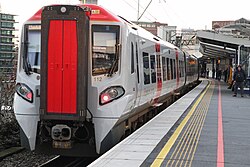
 A TfW Rail Class 197 at Manchester Piccadilly in 2024 | |
 Standard class interior of the Class 197 | |
| In service | 14 November 2022 – present |
| Manufacturer | CAF |
| Built at | Newport, South Wales (body shells imported from Spain)[1] |
| Family name | Civity |
| Replaced | |
| Constructed | 2020–present[2] |
| Formation | 2 or 3 cars per unit[3] (See § Variants) |
| Capacity |
|
| Owners | SMBC Leasing[5] and Equitix[6] |
| Operators | Transport for Wales Rail |
| Depots | |
| Specifications | |
| Train length |
|
| Car length |
|
| Doors | Double-leaf sliding plug (2 per side per car)[4] |
| Maximum speed | 100 mph (160 km/h) |
| Prime mover(s) | MTU[1] (1 per car) |
| Engine type | Turbo-diesel |
| Cylinder count | 6 per engine |
| Displacement | 12.8 L (780 cu in) per engine |
| Power output |
|
| Transmission | ZF EcoLife hydromechanical[note 1][1] |
| Braking system(s) | Electro-pneumatic (disc) (Knorr-Bremse EP2002)[1] |
| Safety system(s) | |
| Coupling system | Dellner |
| Multiple working | Within class |
| Track gauge | 1,435 mm (4 ft 8+1⁄2 in) standard gauge |
The British Rail Class 197[10] is a class of diesel multiple unit passenger train built by CAF, based on its Civity platform. They are operated by Transport for Wales Rail (TfW), split into 51 two-car units and 26 three-car units.[11]
Seventy-seven Class 197 sets were ordered in 2018 under the franchise obligations made by KeolisAmey Wales, the then-operator of the Wales & Borders franchise. They are based on the Class 195 units that were being received by Arriva Rail North at that time, albeit with various customisations to suit the specification and preferences of KeolisAmey and TfW. This specification was refined to include greater comfort features and to respond to public concerns. Testing of the type commenced shortly after the first completed train arrived at Crewe for commissioning in April 2021.
The first Class 197 set entered service in November 2022 and the type was officially launched two months later. It is planned for the Class 197 to eventually replace Class 158 trains on various regional and regional express routes that form part of the Wales & Borders rail franchise, such as the Cambrian lines. They are also expected to replace Class 150 and 153 units on the Conwy Valley line, and to allow extension of services between Liverpool Lime Street and Chester into both north and south Wales. In February 2024 they were cleared to run on the Maesteg Line and entered service on the Ebbw Valley Line on 29 April 2024.[12][13]
History
[edit]Background
[edit]Operator KeolisAmey Wales took over the Wales & Borders franchise from Arriva Trains Wales in October 2018. As part of their franchise award, KeolisAmey were required to fully replace the various fleets of trains used to operate the franchise, several of which had originally been inherited from British Rail.[14] Orders were placed with a number of manufacturers for new units, including one for 77 new Civity-family DMUs from Spanish firm Construcciones y Auxiliar de Ferrocarriles (CAF). These were based on the Class 195 units that CAF had started delivering to Arriva Rail North earlier in 2018, and were also assembled at CAF's new factory in Newport.[15] Entry into service was expected between 2021 and 2023.[15] Unlike Class 195 units, however, the TfW-ordered DMUs have gangway connections at their ends, making them look very similar to the Class 196 units operated by West Midlands Trains. The design allowing passengers and crew to move freely between coupled units.
In January 2020, WalesOnline reported that, based on minutes from Transport for Wales board meetings, the organisation had "raised concerns" that the seats specified by KeolisAmey and CAF for the Class 197 order could be considered uncomfortable by passengers. The same model of seat is used on the Class 700 trains employed on Thameslink services in and around London, where some passengers—particularly those making longer journeys—have described them as being like "ironing boards". TfW argued that these would be "unsuitable for long distance journeys", which could last up to three hours on services operated by Class 197 trains, but noted that it did not have a "strong legal argument" to compel KeolisAmey and CAF to change the specification.[16] TfW eventually paid an additional £1.9 million to upgrade to higher-specification Fainsa Sophia seats,[17] although these seats have themselves been the subject of some criticism from passengers of Great Western Railway trains to which they are also fitted.[16][18]
Separately, a passenger advocacy group challenged the fact that TfW had specified only one toilet for each two-car Class 197 unit and two for each three-car unit;[17] a reduction from the one-toilet-per-car configuration on TfW's existing long-distance Class 158 and 175 trains.[4] The group also noted that the Rail Delivery Group's industry guideline for inter-urban trains throughout the UK states that there should be at least one toilet per 85 passengers, and a minimum of two toilets per train regardless of passenger capacity; but that two-car 197s would satisfy neither of these recommendations and that three-car 197s could exceed the 85-passengers-per-toilet ratio when near to fully loaded.[17] TfW stated in response that many services would be operated by two-car Class 197s working as pairs, reducing the number of potential single-toilet services.[19]
Entry to service
[edit]
During December 2019, the Class 197 designation was assigned and, on 14 April 2021, the first completed train—a two-car unit numbered 197001—arrived at Crewe for commissioning.[20][21] Testing of the type commenced soon thereafter.[22] On 18 January 2022, the Office of Rail and Road (ORR) granted authorisation for 20 two-car and 12 three-car Class 197 sets to enter passenger use; these initial units were not equipped to use the European Train Control System (ETCS).[3][23]
Unit 197004 was the first to enter passenger service, doing so on 14 November 2022.[24] That same month, the ORR authorised 21 Class 197 units fitted with CAF Signalling’s onboard ETCS at Baseline 3 Release 2 and GSM-R Baseline 1 for operation in ETCS Level 2 and below under recently-introduced regulations.[23] During January 2023, the Class 197 was officially launched at a ceremony officiated by Minister for North Wales Lesley Griffiths and held at Llandudno railway station.[25][26]
Phased introduction
[edit]2022
[edit]The fleet's introduction was phased. During late 2022, the Class 197 was initially used only on the Conwy Valley line in a part of North Wales.[27]
2023
[edit]By February 2023, the Class 197 was introduced on services between Manchester Airport in North-West England and Llandudno in North Wales and on services between Liverpool Lime Street and Chester, both in North-West England,[27] as well as on North Wales Main Line services.
By late 2023, the Class 197 had been introduced on services between Manchester Piccadilly in North-West England and Swansea in West Wales, via the Welsh Marches line.[28]
By November 2023, the Class 197 had been introduced in service between Swansea and Carmarthen in West Wales.[29]
In November 2023, the Class 197 started working between Wrexham and Bidston on the North Wales/North-West England Borderlands line, alongside the Class 230s, due to unreliability of the Class 230s.[30]
In December 2023, the Class 197 began operating services to Fishguard Harbour and Milford Haven, their previous limit in West Wales having been Carmarthen.[31]
2024
[edit]In April 2024, the Class 197 entered service on the Ebbw Valley Railway, the Maesteg Line and services between Cardiff and Cheltenham Spa, including the subsequent different working of these services from December 2024, though this is only temporary until they are replaced by the Class 231s, which will be made available when the Class 756s replace the Class 231 units on the main South Wales Valleys network.[32][33]
In June 2024, the Class 197 started to be used on services to Pembroke Dock in West Wales.[34]
2025
[edit]In February 2025, the Class 197 started working between Shrewsbury and Birmingham International in the West Midlands of England, on services between Holyhead in North Wales and Birmingham, as well as between Shrewsbury and Birmingham as part of Cambrian Line services between Aberystwyth in Mid-West Wales / Aberystwyth & Pwllheli in North Wales and Birmingham (until the Class 197 units enter service on the Cambrian Line itself - see below - a change of train between Class 158 and Class 197 is made at Shrewsbury).[35]
Future plans
[edit]The next planned Class 197 introduction will be the ETCS-fitted units on the Cambrian Line (between Shrewsbury and Aberystwyth, and its coastal branch between Machynlleth in Mid Wales and Pwllheli) in September 2026,[36] following prior preparation, including the commencement of Class 197 ETCS testing on the line by June 2022,[37] and the completion of type testing in November 2024.[38]
In September 2025, it was announced that TfW has submitted an application to the Office of Rail and Road to run Class 197-operated services between Fishguard Harbour/Milford Haven/Carmarthen and Bristol Temple Meads, via stations including Swansea, Cardiff Central, Newport, Severn Tunnel Junction, Filton Abbey Wood and Stapleton Road. If approved, these services would start in September 2026.[39]
Fleet details
[edit]| Subclass | Operator | Qty. | Year built | Cars | Unit nos. | Notes |
|---|---|---|---|---|---|---|
| 197/0 | Transport for Wales Rail | 30 | 2020–pres. | 2 | 197001–197002, 197004–197021, 197042–197051[40] | Without ETCS |
| 21 | 197003, 197022–197041[41] | With ETCS | ||||
| 197/1 | 12 | 3 | 197101–197112[40] | 2+2 seating only | ||
| 14 | 197113–197126[42] | With a small portion of 2+1 seating |
Variants
[edit]The order for the fleet is divided into four variants, as follows:[40]
- 30 units formed of two cars (DMSL-DMS) with 2+2 standard-class seating only, without ETCS;
- 21 units formed of two cars (DMSL-DMS) with 2+2 standard-class seating only, with ETCS;[note 2]
- 12 units formed of three cars (DMSL-MSL-DMS) with 2+2 standard-class seating only, without ETCS;[40]
- 14 units formed of three cars (DMSL-MSL-DMC) with a small portion of 2+1 seating (intended for the abandoned Standard Plus; declassified to standard class), without ETCS. These are primarily intended for use between Swansea and Manchester.[4]
Two-car units will be able to run in multiple with up to three other two-car units, while three-car units will be able to run in multiple with up to two other three-car units.[4]
Named and notable units
[edit]TfW organised the Magnificent Train Journey competition, aimed at primary school children, to name its Class 197 units.[25]
- 197001: Robin Goch Philadelphia / Philadelphia Robin[44][45]
- 197004: Ddraig Goch Vancouver / Vancouver Red Dragon[44][45]
- 197007: Happy Valley[46]
- 197049: Castell Caeriw Cyflym / Carew Castle Express[47]
- 197119: Mistar Urdd[48]
- 197125: The Cheltenham Spa Express[49]
Additionally, 197120, although not named on nameplates, carries "Gwnaed yng Nghymru / Made in Wales" livery additions with large Welsh Dragons on its DMSL and DMC vehicles that further emphasise the same text statement that is on the door sill plaques of all 197s.[50]
See also
[edit]- British Rail Class 195 - A diesel multiple unit variant of the CAF Civity UK platform built for Northern.
- British Rail Class 196 - A diesel multiple unit variant of the CAF Civity UK platform built for West Midlands Trains.
- British Rail Class 331 - An electric multiple unit variant of the CAF Civity UK platform built for Northern.
- British Rail Class 397 - An electric multiple unit variant of the CAF Civity UK platform built for TransPennine Express.
- British Rail Class 897 - A tri-mode multiple unit variant of the CAF Civity UK platform to be built for London North Eastern Railway.
Notes
[edit]- ^ Combines a mechanical gearbox with a torque converter and hydraulic retarder.[8]
- ^ European Train Control System (ETCS) equipment has been necessary for operation on the Cambrian lines since they were converted to use the European Rail Traffic Management System in late 2010.[43]
References
[edit]- ^ a b c d "First Class 197 DMUs for the Wales and Borders Network". Railvolution. Railway Public s.r.o. 27 May 2021. Retrieved 9 February 2022.
- ^ "Trains for Wales under construction". Rail Business UK. DVV Media International. 2 December 2020. Retrieved 7 December 2020.
- ^ a b "TFW Class 197s authorised for duty". Rail Magazine. No. 950. Peterborough: Bauer Consumer Media. 9 February 2022. p. 12.
- ^ a b c d e f "Table 2B - Rolling Stock Minimum Requirements and Specifications - Sprinter / Rural Service Type" (PDF). Transport for Wales. Retrieved 4 October 2020.
- ^ Sherratt, Philip, ed. (2023). "ROSCO Fleets". Modern Railways: Review 2023. Stamford: Key Publishing. pp. 18–19. ISBN 978-1-80282-569-5.
- ^ "Case Study: Wales & Borders – Commercial and Contract Management". Apex Rail. Retrieved 27 August 2025.
- ^ "Civity Regional Diesel Trains for Wales and Borders". Construcciones y Auxiliar de Ferrocarriles, S.A. Archived from the original on 11 February 2022. Retrieved 11 February 2022.
- ^ "EcoLife Rail - Powershift Transmission". ZF Products for Rail Vehicles. ZF Friedrichshafen AG. Retrieved 10 February 2022.
- ^ "Transport for Wales expands its use of its new fleet". Network News. Rail Magazine. No. 1008. 1 May 2024. p. 24.
- ^ Transport for Wales Rail [@tfwrail] (2 December 2019). "Firstly, the new Wales and Borders diesel trains that will be built here in Wales - the Class 197" (Tweet). Archived from the original on 2 December 2019. Retrieved 1 June 2021 – via Twitter.
- ^ Clinnick, Richard (12 June 2018). "CAF confirmed for new Welsh franchise - all 77 trains to be assembled at Newport". Rail Magazine. Bauer Consumer Media Ltd. Archived from the original on 12 August 2020. Retrieved 1 June 2021.
- ^ "Brand new trains on the Maesteg line". Transport For Wales News.
- ^ Pritchard, Robert (June 2024). "Ebbw Vale launch for 197s". Rolling Stock News. Today's Railways UK. No. 268. p. 61.
- ^ "KeolisAmey reveal new-look Wales trains and services". BBC News. British Broadcasting Corporation. 4 June 2018. Retrieved 4 June 2018.
- ^ a b Barry, Sion (4 June 2018). "How Wales' railways will be transformed with new stations, trains and jobs through investment worth billions". WalesOnline. Cardiff: Reach plc. Retrieved 30 September 2018.
- ^ a b Clark, Rhodri (12 January 2020). "Taxpayers to pay £2m for better seats on Wales' new trains". WalesOnline. Reach plc. Retrieved 4 October 2020.
- ^ a b c Clark, Rhodri (23 April 2020). "Concern about '197' interior spec". Modern Railways. Key Publishing Ltd. Retrieved 3 October 2020.
- ^ Barry, Sion (7 June 2021). "South Wales to Manchester rail services getting train quality upgrade with first class options". BusinessLive. Reach plc. Retrieved 24 October 2021.
- ^ "Transport for Wales defend new Welshpool trains". MyWelshpool. MyTownMedia. 8 August 2020. Retrieved 4 October 2020.
- ^ Michel, Julien (4 December 2019). "Transport for Wales: meet the fleet". Railcolor News. Railcolor-Ziemon. Retrieved 3 October 2020.
- ^ Lissenberg, Ferry (19 April 2021). "DMU for Wales: First CAF Civity diesel train outshopped". Railcolor News. Railcolor-Ziemon. Retrieved 11 February 2022.
- ^ "First of Class 197 on test for Transport for Wales". Rail. No. 932. 2 June 2021. p. 26.
- ^ "Soft launch for Transport for Wales Class 197 DMUs". Rail Business UK. Sutton: DVV Media International. 14 November 2022. Retrieved 14 November 2022.
- ^ a b Kendrick, Suzanne (26 January 2023). "Unveiling of first brand new Transport for Wales trains - Llandudno". northwalespioneer.co.uk.
- ^ Tooley, David (26 January 2023). "New £800 million train fleet for Wales and Borders officially launched". Shropshire Star.
- ^ a b "A "landmark day" in Wales as '197s' officially launched". railmagazine.com. 3 February 2023.
- ^ "Standard Plus plans for Class 197s abandoned after risks emerge". modernrailways.com. 16 November 2023.
- ^ "Carew Castle Express unveiled in Carmarthen". tfw.wales. 16 November 2023.
- ^ "Borderlands bids to revive its fortunes". railmagazine.com. 9 June 2025.
- ^ "Debut for '197' with Standard Plus seating". modernrailways.com. 18 January 2024.
- ^ "Class 197s launch on Ebbw line". modernrailways.com. 25 April 2024.
- ^ "Timetable change from 15 December 2024 - Cardiff - Bridgend - Maesteg". tfw.wales. 23 November 2024.
- ^ "TfW adds brand new trains to the Pembroke line". railwaypro.com. 17 June 2024.
- ^ "Transport for Wales Class 197s start operating into Birmingham". railmagazine.com. 26 February 2025.
- ^ "New trains expected September next year". cambrian-news.co.uk. 28 November 2025.
- ^ "Rail Operations Group begin ETCS testing between Aberystwyth and Shrewsbury on TfW Class 197s". railadvent.co.uk. 28 June 2022.
- ^ "Type testing completed for Cambrian Class 197e". modernrailways.com. 14 November 2024.
- ^ "Transport for Wales plans new Bristol Temple Meads service from 2026". railmagazine.com. 3 September 2025.
- ^ a b c d Fletcher, Steve (13 January 2022). "The Railways (Interoperability) Regulations 2011, as amended – Class 197 Diesel Multiple Units" (PDF). Letter to Paul Simmons (Construcciones y Auxiliar de Ferrocarriles). London: Office of Rail and Road. UK/51/2022/0003. Archived (PDF) from the original on 2 February 2022. Retrieved 5 February 2022.
- ^ Fletcher, Steve (23 November 2022). "The Railways (Interoperability) Regulations 2011, as amended – Authorisation of Class 197 ETCS variant including the onboard use of ETCS Level NTC, ETCS Level 2 and below" (PDF). Letter to Paul Simmons (Construcciones y Auxiliar de Ferrocarriles). London: Office of Rail and Road. UK/51/2022/0009. Archived (PDF) from the original on 29 November 2022. Retrieved 29 November 2022.
- ^ Fletcher, Steve (2 June 2023). "The Railways (Interoperability) Regulations 2011, as amended – CAF Class 197 First Class Diesel Multiple Unit Application for Authorisation" (PDF). Letter to Paul Simmons (Construcciones y Auxiliar de Ferrocarriles). London: Office of Rail and Road. UK/51/2023/0003. Archived (PDF) from the original on 10 June 2023. Retrieved 10 June 2023.
- ^ "Pioneering Rail Technology Gets Tested in Wales". Network Rail (Press release). 12 February 2010. Archived from the original on 29 September 2011. Retrieved 1 June 2021.
- ^ a b Pritchard, Robert (June 2024). "197s named in honour of Hollywood stars". Rolling Stock News. Today's Railways UK. No. 268. p. 61.
- ^ a b "New trains named after Wrexham Football Hollywood stars". Transport for Wales News. Retrieved 6 June 2024.
- ^ "First new TfW train named 'Happy Valley'". Transport for Wales News. Retrieved 27 October 2023.
- ^ "Carew Castle Express unveiled in Carmarthen". Transport for Wales News. Retrieved 17 November 2023.
- ^ "Transport for Wales says "Hei Mistar Urdd" to the rail network". Transport for Wales News. Retrieved 7 May 2025.
- ^ Butlin, Ashley (August 2024). "Multiple Units". Stock Update. The Railway Magazine. Vol. 170, no. 1481. p. 87.
- ^ "Freedom of Information Request (DocX)". Transport for Wales. Archived from the original on 4 October 2024. Retrieved 11 August 2024.
External links
[edit] Media related to British Rail Class 197 at Wikimedia Commons
British Rail Class 197
View on GrokipediaHistory
Background
The Wales & Borders rail franchise was established in December 2003, when it was awarded to Arriva Trains Wales for a 15-year period under the UK's franchising system managed by the Strategic Rail Authority.[9] During Arriva's operation, passenger journeys across the network grew significantly, increasing by approximately 60% from the franchise's inception to around 26 million annually by the mid-2010s.[10] This expansion reflected broader trends in rail usage in Wales, with journeys within the region rising annually from 1995-96 to a peak of 31.1 million in 2018-19.[11] In June 2018, following a competitive dialogue process, the Welsh Government devolved control of the franchise and awarded a new 15-year contract to KeolisAmey Wales, which was nationalized in February 2021 with operations transferred to the Welsh Government-owned Transport for Wales Rail, effective from October 2018, emphasizing investment in infrastructure and fleet renewal as part of greater Welsh autonomy over rail services.[12] The operator inherited an aging fleet dominated by Class 150 Sprinter and Class 158 Express Sprinter diesel multiple units, many dating from the 1980s and 1990s, which struggled with rising demand and led to widespread overcrowding.[13] Reliability was a particular concern, with Class 150 units averaging just 6,507 miles between faults in late 2018, contributing to service disruptions and passenger dissatisfaction amid the network's growth.[14] Early modernization efforts prioritized electrification to address environmental and capacity goals, but the network's extensive non-electrified routes—spanning north and west Wales, the borders, and rural branches—necessitated continued use of diesel units for operational flexibility and cost-effectiveness in the short term.[15] In 2018, the Welsh Government announced the Core Valley Lines project as a key component of the South Wales Metro initiative, backed by £738 million in funding to electrify and upgrade lines to Merthyr Tydfil, Aberdare, Treherbert, Rhymney, and Coryton, aiming to transform regional connectivity.[16] This project directly supported fleet modernization by facilitating the introduction of electric trains on core urban routes while requiring diesel units, such as the Class 197 based on the CAF Civity platform, to replace older stock on unelectrified services and ensure comprehensive network renewal.[17]Ordering and construction
In 2018, KeolisAmey Wales, the operator of the Wales and Borders rail franchise, placed an order with Spanish manufacturer CAF for 77 Class 197 diesel multiple units on behalf of Transport for Wales, comprising 51 two-car sets and 26 three-car sets to serve non-electrified routes across Wales and the border areas.[1][18] This procurement formed a key element of a broader £800 million investment in new rolling stock to modernize the fleet.[19] Construction of the Class 197 units took place at CAF's dedicated manufacturing facility in Newport, Wales, which opened in 2018 and focused on final assembly after bodyshells were produced at CAF's plant in Beasain, Spain.[20] Work on the bodyshells began in early 2020, with the first completed in February of that year and shipped to Newport for integration of components such as engines, interiors, and systems.[21] Production ramped up progressively, with the first complete unit rolling off the line in May 2021.[1] As part of the build process, Transport for Wales allocated an additional £1.9 million for customizations, including upgraded Fainsa Sophia seating to improve passenger comfort over the initially proposed specification.[22] The testing regime for the Class 197 fleet included static verification at CAF's Newport site in early 2021, followed by the transfer of the first two-car unit (197001) to Crewe Works on 14 April 2021 for commissioning and dynamic trials.[23] Mainline testing commenced shortly thereafter, involving route proving runs on the UK network to validate performance, braking, and systems integration under operational conditions.[24] However, the program encountered delays stemming from global supply chain disruptions during the COVID-19 pandemic, which affected component availability and extended the timeline for initial deliveries from mid-2021 to late 2022.[25][26]Entry into service
The first completed Class 197 unit, numbered 197001, arrived at the Arriva Traincare depot in Crewe for commissioning and testing in April 2021.[27] [2] Following delivery, the units underwent extensive testing, including European Train Control System (ETCS) integration trials between Aberystwyth and Shrewsbury starting in June 2022.[28] Driver and crew training programs were implemented in preparation for operations, utilizing simulators for familiarization with the train management system and fault procedures.[29] [30] Initial certification was granted by the Office of Rail and Road (ORR) in January 2022 for key subsystems under the Railways (Interoperability) Regulations, confirming compliance with essential requirements including accessibility features such as dedicated wheelchair spaces and wider doors.[31] [1] Network Rail oversaw infrastructure compatibility testing, with further ORR authorisation for the ETCS variant issued in November 2022, enabling safe integration into the network.[32] These approvals, combined with completed acceptance testing, paved the way for operational readiness. Unit 197001 entered passenger service on 14 November 2022, operating on the Conwy Valley line between Llandudno and Blaenau Ffestiniog as part of a soft launch.[7] [33] The official launch event took place on 26 January 2023 at Llandudno station, officiated by Minister for North Wales Lesley Griffiths MS, marking a milestone in Transport for Wales' fleet modernization.[34] [35] Early operations focused on building reliability, with subsequent units following a phased rollout plan.[36] By mid-2025, over 60 units were in passenger service across various routes, including extensions to Birmingham International. As of November 2025, testing continued for the ETCS-fitted units on the Cambrian lines, with full operational entry anticipated in late 2025 or early 2026.[5][8]Design
Technical specifications
The British Rail Class 197 is a diesel multiple unit constructed on the CAF Civity platform, featuring a diesel-hydraulic powertrain for efficient regional operations. Each powered vehicle incorporates a single Rolls-Royce MTU 6H 1800 R85L 12.8-litre six-cylinder turbocharged diesel engine compliant with Euro Stage V emissions standards, rated at 375 kW.[7][1] The engine drives a ZF Ecolife hydro-mechanical transmission connected to one bogie per car, with each car featuring a powered bogie in both configurations.[7][1] This setup delivers a total power output of 750 kW for two-car units and 1,125 kW for three-car units, supporting a maximum operating speed of 100 mph (160 km/h).[7][37] The units achieve acceleration rates comparable to or slightly better than predecessor Class 175 trains up to 60 mph, contributing to reliable service intervals on regional routes.[38] Fuel efficiency is enhanced through modern engine technology, resulting in lower emissions and reduced consumption relative to older diesel multiple units like the Class 158 and 175.[1][19]| Configuration | Length | Powered Vehicles | Total Power Output |
|---|---|---|---|
| Two-car | 48.05 m | 2 | 750 kW |
| Three-car | 71.40 m | 3 | 1,125 kW |