
.jpg/250px-CRH2A-4028_at_Pearl_River_West_Bridge_(20180924125904).jpg)


.jpg/2000px-CRH2A-4028_at_Pearl_River_West_Bridge_(20180924125904).jpg)
Community hub
Recent from talks
Contribute something
Nothing was collected or created yet.
China Railway CRH2
View on Wikipedia | You can help expand this article with text translated from the corresponding article in Chinese. (November 2022) Click [show] for important translation instructions.
|
| China Railway CRH2 EMU | |
|---|---|
 CRH2A-2044 | |
| In service | 2007–present |
| Manufacturer | Kawasaki Heavy Industries, CRRC Qingdao Sifang |
| Family name | Shinkansen (E2 series) |
| Number built | CRH2A: 120+369+1 trainsets (3920 cars) CRH2B: 27 trainsets (432 cars) CRH2C (stage 1): 30 trainsets (240 cars) CRH2C (stage 2): 30 trainsets (240 cars) CRH2E: 20+5 trainsets (480 cars) CRH2G: 29 trainsets (232 cars)[1] |
| Number scrapped | 1 trainset (10 cars; derailment) |
| Successor | CR300AF, CR300BF, CR400AF, CR400BF |
| Formation | CRH2A: 8 cars per trainset (4M4T) CRH2B/E: 16 cars per trainset (8M8T) CRH2C: 8 cars per trainset (6M2T) |
| Capacity | CRH2A: 610/571/562/588/600/608 CRH2B: 1230 CRH2C: 610/626 CRH2E: 630/880(CRH2E-2463, 2464 and 2465) |
| Operators | China Railway - CR Beijing - CR Shanghai - CR Jinan - CR Xi'an - CR Wuhan - CR Nanchang - CR Zhengzhou - CR Taiyuan - CR Chengdu - CR Guangzhou - CR Nanning |
| Lines served | Most 200–250 km/h (124–155 mph) high speed rail lines across China, plus some conventional lines |
| Specifications | |
| Train length | CRH2A/C: 201.4 m (660 ft 9 in) CRH2B/E: 401.4 m (1,316 ft 11 in) |
| Width | 3,380 mm (11 ft 1 in) |
| Height | 3,700 mm (12 ft 2 in) |
| Platform height | 1,250 mm (4 ft 1 in) |
| Maximum speed | CRH2A/B/E: 250 km/h (155 mph) CRH2C (stage 1): 300 km/h (186 mph) CRH2C (stage 2): 350 km/h (217 mph) |
| Traction system | Water cooling IGBT–VVVF inverter control (CRH2B/E: Mitsubishi Electric type MAP-304-A25V141, CRH2A/C: Hitachi type CII-HHR1420A/B/D, Zhuzhou CSR Times Electric type TGA10/10A/10E/10G) |
| Traction motors | 3-phase AC induction motors (CRH2B/E: Mitsubishi Electric type MB-5120-A, Zhuzhou CSR Times Electric type MT-205 CRH2A/C: Hitachi/CRRC Yongji Electric type YJ-92A, Zhuzhou CSR Times Electric type YQ-365) |
| Power output | CRH2A: 4.8 MW (6,437 hp) CRH2B/E: 9.6 MW (12,874 hp) CRH2C:
|
| Transmission | AC-DC-AC |
| Electric system(s) | 25 kV 50 Hz AC Overhead catenary |
| Current collection | Pantograph |
| Braking system(s) | Regenerative, electronically controlled pneumatic brakes |
| Track gauge | 1,435 mm (4 ft 8+1⁄2 in) standard gauge |
The CRH2 Hexie (simplified Chinese: 和谐号; traditional Chinese: 和諧號; pinyin: Héxié Hào; lit. 'Harmony') is one of the high-speed train models in China. The CRH2 is based on the E2-1000 Series Shinkansen design from Japan with the license purchased from a consortium formed of Kawasaki Heavy Industries, Mitsubishi Electric, and Hitachi, and represents the second Shinkansen train model to be exported.
In 2004, the Ministry of Railway in China purchased an initial 60 sets of the train from Kawasaki Heavy Industries with a maximum speed of 250 km/h (155 mph). However, the newer versions of the CRH2 are not related to the E2-1000 Series despite having the same exterior shell.[2]
Variants
[edit]

CRH2A
[edit]On October 20, 2004, the Ministry of Railway in China ordered 60 sets of CRH2A trains from Kawasaki Heavy Industries in Japan. Along with 60 sets of Bombardier's Regina-based CRH1A, and 40 sets of Alstom's Pendolino-based CRH5A, these train sets are consider as first batch of CRH trains.
Each of the CRH2A set consists of 8 cars. The first 3 sets (CRH2-001A - CRH2-003A) were built in Japan, the next 6 sets (CRH2-004A - CRH2-009A) were delivered in complete knock down form and assembled by CSR Sifang Locomotive and Rolling Stock. The remaining 51 sets (CRH2-010A - CRH2-060A) were built by Sifang through technology transfer from Japan.
The first train arrived at Qingdao port on March 8, 2006, with little fanfare, and was not even publicized in China. These trains have a maximum operation speed of 250 km/h (155 mph) and started providing high-speed train service from April 18, 2007, the date of the sixth national railway speed-up.
According to Chinese and Japanese media, CRH2A trains started test trials ahead of commercial operation on the Shanghai-Hangzhou and Shanghai-Nanjing lines on January 28, 2007.
On September 14, 2010, the Chinese MOR ordered additional 40 sets of CRH2A trains (CRH2-151A - CRH2-190A) from CSR Sifang.
Additionally, from 2012 to 2017, CRH2A-2212 to CRH2A-4131 were introduced.
CRH2A-4020
[edit]Following a derailment in Guizhou in 2022, CRH2A-4020 was converted to become the first dedicated High-Speed freight train of China. The two derailed carriages, 00 and 07, were scrapped, while new windowless carriages were rebuilt in place. The rest of the train was also modified in a similar manner, but the windows were retained. The modified train was revealed in March 2024, and entered testing the following month.[3]
CRH2B
[edit]
In November 2007, the Ministry of Railway in China ordered 10 CRH2 sets with 16 cars per set (8M8T). These trains have been given designations CRH2B (CRH2-111B - CRH2-120B). Each CRH2B has three 1st seating cars (ZY), twelve 2nd seating cars (ZE), and one dining car (CA). Designed maximum operation speed is 250 km/h (155 mph) with a power of 9,600 kW (12,874 hp). These CRH2 have "Phoenix eyes" headlights who were not present on the CRH2A.
The first units were delivered on June 29, 2008,[4][5] and came into service on the Hefei–Nanjing Passenger Railway on August 1, 2008.[6]
CRH2C (CRH2-300)
[edit]
After the introduction of the modified E2-1000 Series, Sifang built its own CRH2 with a maximum safe operating speed of 300 km/h (186 mph). The original train sets imported from Kawasaki had a maximum safe operating speed of 250 km/h (160 mph).
During June 2005 and September 2005, The Chinese Ministry of Railways launched bidding for High speed trains with a top speed over 300 km/h (186 mph). Along with Siemens's Velaro-based CRH3C, CSR Sifang bid 60 sets of CRH2C, includes 30 sets of CRH2C stage one with a top speed of 300 km/h (186 mph), and 30 sets of CRH2C stage two with a top speed of 350 km/h (217 mph).
In development and research of the 350 km/h (217 mph) high speed train, The CRH2-300 project was launched by Chinese MOR and CSR. In 2006 the China Development Bank provided CNY 15 billion developmental financial loans to CSR Group for the projects of 200–300 km/h (124–186 mph) high speed trains.[7] Over 50 academics, 150,000 technicians, 600 contractors were involved in the project.[8] This train's livery is not like the CRH2A, which the blue stripe does not end at the fronts of trainsets.
CRH2C stage one
[edit]
CRH2C Stage one is a modified version of CRH2A. It has a maximum operating speed up to 300 km/h (186 mph) by replacing two intermediate trailer cars with motorized cars. Equipped with an array of the state-of-the-art technologies, including aluminum alloy body with a reduced weight, high speed turntable, high speed pantograph, and optic-fiber based integrated control system.[9]
Chinese MOR ordered 30 sets of CRH2C stage one, name code CRH2-061C - CRH2-090C. The first set, CRH2-061C was unveiled on December 22, 2007.[10][11]
During the test on April 22, 2008, CRH2-061C reached a top speed of over 370 km/h (230 mph) on Beijing-Tianjin high-speed rail.[12]
During the test on December 11, 2009, CRH2-061C reached a top speed of 394.2 km/h (244.9 mph) on Zhengzhou-Xi'an high-speed rail.[13]
Together with CRH3C, the CRH2C stage one first came into service on Beijing-Tianjin Intercity high-speed rail on August 1, 2008, and all CRH2C stage one trains have been replaced by CRH3C in April, 2009. Currently, most of these trains are serving on the Shanghai-Nanjing high speed rail.
CRH2C stage two
[edit]_Train_Leaving_Suzhou_Railway_Station,_Jul_10_2024.jpg)
CRH2C Stage two is the "re-design" version of the CRH2. Some of the details, like the aluminum body structure, noise reduction technology & reduction technique, draw on the CRH3C. And cancelled the driver's door. According to CSR Sifang, the improvements include the following aspects:
- The axle weight of the bogie increased from 14 to 15 tonnes (30,865 to 33,069 lb), to prevent tremble of the train body at a higher speed,[8] the gear ratio has been optimized from 3.036 to 2.379, the critical instability speed is 550 km/h (340 mph).
- The thermal capacity of the bogie has been increased, which satisfied the continuous operation at 350 km/h (217 mph)
- With the YQ-365 type AC traction motor. It has a maximum operating speed up to 350 km/h (217 mph) with a power of 8,760 kW (11,747 hp).
- The rigidity of the car body has been increased to lower the noise and vibration.
- Optimized car body and window design for better air tightness and strength.
- Added pressure protection system to avoid pressure fluctuation in the compartment and improvement of comfort.
- Optimized design of the roof antenna, exterior windscreen and windows for a lower air resistance.[14]
Chinese MOR ordered 30 sets of CRH2C stage two, name code CRH2-091C - CRH2-110C and CRH2-141C - CRH2-150C. The first set, CRH2-091C was unveiled in January 2010 and came into service on Zhengzhou-Xi'an high-speed rail in February, 2010.[15] Currently, most of these trains are serving on the Shanghai-Nanjing high speed rail, too.
CRH2E
[edit].JPG)

In November and December 2007, the Ministry of Railway in China ordered 20 CRH2 sleeper trains with 16 cars per set (8M8T). These trains are modified CRH2Bs, outfitted with traditional railway sleeping berths (couchette car) and have been given designations CRH2E (numbered CRH2-121E - CRH2-140E). Each CRH2E has thirteen 1st class sleeping cars (WR), two 2nd class seating cars (ZE), and one buffet car (CA) or one second class/dining car (ZEC). Designed maximum operation speed is 250 km/h (155 mph) with 9,600 kW (12,874 hp) of power output.
The first batch of CRH2E, CRH2-121E - CRH2-126E, came into service on Beijing-Shanghai railway on December 21, 2008.[4][16] On 23 July 2011, one sleeper coach on CRH2-139E trainset has been derailed in the 2011 Wenzhou train collision, together with CRH1-046B.
The rest of CRH2Es were deployed on Beijing–Guangzhou–Shenzhen–Hong Kong High-Speed Railway since January 2015, operating overnight sleeper trains between Beijing and Guangzhou (including some trains to Shenzhen).
Double Deck CRH2E
[edit]A brand new variant of the CRH2E entered service in 2017 numbered beyond CRH2E-2463.[17][18] Instead of a traditional railway sleeping berth the sleeper train is organized with the corridor running down the middle of the train car with double deck "capsules" on each side.[19] Each capsule is similar in layout to airplane first class, and passengers are no longer sharing the room. Each capsule comes with independent tables, outlets, lamps, hangers and curtains. The body of the train is redesigned to reduce noise levels during travel. The trains have been dubbed "moving hotels".[20]
-
 Front
Front -
 Exterior
 -
 Interior
 -
 Leaving Beijing West railway station
.jpg)

.jpg)
.jpg)
CRH2G
[edit]_Train_Approaching_Pingyao_Ancient_City_Railway_Station,_Oct_5_2023.png)
CRH2G is a specialized cold and sand/windstorm resistant version of the CRH2 manufactured by CRRC Qingdao Sifang. The trains were tested on the Lanzhou–Xinjiang HSR and Harbin–Dalian HSR.[21] Tests where completed on November 10, 2015, and the first sets were assigned to Lanzhou–Xinjiang HSR.[22]
CRH2-380 (CRH2C-2150 experimental train)
[edit]
In 2008, the Chinese MOR & CSR launched CRH2-380 project, the main purpose is to develop new-generation of high speed trains with maximum operation speed of 380 km/h (236 mph). CRH2 is one of the fundamental platforms of the new trains, which is designated as CRH380A. The experimental train is a highly modified CRH2C number 2150. The main difference between this train and the regular CRH380A is the presence of two additional doors on the rear of the first and the last coach like on the CRH2C.
Gallery
[edit]-
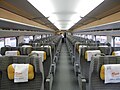 First Class Coach
 -
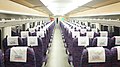 Second Class Coach
 -
 Buffet Car
 -
 The buffet car of the CRH2E
 -
 Compartment Connection


Formation
[edit]At the time of the sixth national railway speed-up, at least 37 CRH2A sets had been delivered by Kawasaki and Sifang.[23] In 2008, all 60 CRH2A sets had been delivered by Kawasaki. The post-2008 production model of the CRH2 are designed and made solely by Sifang with a maximum safe operation speed of 350 km/h (217 mph).[2]
|
Power Destination
|
Coach Type
|
CRH2A (Previous)
[edit]| Coach No. | 1 | 2 | 3 | 4 | 5 | 6 | 7 | 8 |
|---|---|---|---|---|---|---|---|---|
| Type1 | ZE | ZEC | ZE | ZY | ZE | |||
| Type2 | ZE | ZY | ZE | ZEC | ZE | ZY | ZE | |
| Type3 | ZE | ZET | ZE | ZEC | ZE | ZY | ZE | |
| Type4 | ZYS | ZE | ZE | ZEC | ZE | ZYT | ||
| Type5 | ZY | ZE | ZEC | ZE | ZY | |||
| Type6 | ZE | ZEC | ZY | ZE | ||||
| Type7 | ZE | ZYE | ZE | ZEC | ZE | ZY | ZE | |
| Type8 | ZY | ZE | ZEC | ZE | ||||
| Power Configuration | TC | M | TP | T | MP | M | TC | |
| Power Units | Unit 1 | Unit 2 | ||||||
| Capacity1 | 55 | 100 | 85 | 100 | 55 (+16) | 100 | 51 | 64 |
| Capacity2 | 55 | 100 | 46 | 100 | 55 (+16) | 100 | 51 | 64 |
| Capacity3 | 55 | 100 | 43+16 | 100 | 55 (+16) | 100 | 51 | 64 |
| Capacity4 | 15+4 | 51+4 | 85 | 100 | 55 (+16) | 100 | 24+4 | |
| Capacity5 | 42 | 78 | 85 | 100 | 55 (+16) | 100 | 51 | |
| Capacity6 | 55 | 100 | 85 | 100 | 55 (+16) | 78 | 51 | 64 |
| Capacity7 | 55 | 100 | 16+43 | 100 | 71 | 100 | 51 | 64 |
| Capacity8 | 48 | 90 | 90 | 77 | 63 | 90 | 90 | 65 |
- ^1 Other train sets
- ^2 Set Nº. 2006, 2011 and 2021
- ^3 Set Nº. 2015, 2027 and 2030
- ^4 Set Nº. 2042
- ^5 Set Nº. 2043
- ^6 Set Nº. 2044–2060
- ^7 Set Nº. 2151–2211. Coach No. 3 has 16 First Class Seats and 43 Second Class seats
- ^8 Set Nº. 2212–2416, 2427–2460, 2473–2499, 2828, 4001–4071, 4082–4095 and 4114–4131
CRH2A (Renovated)
[edit]| Coach No. | 1 | 2 | 3 | 4 | 5 | 6 | 7 | 8 |
|---|---|---|---|---|---|---|---|---|
| Type1 | ZE | ZEC | ZE | ZY | ZE | |||
| Type2 (EC) | ZY | ZE | ZEC | ZE | ||||
| Power Configuration | TC | M | MP | M | MP | M | TC | |
| Power Units | Unit 1 | Unit 2 | ||||||
| Capacity1 | 55 | 100 | 85 | 100 | 55 (+16) | 100 | 51 | 64 |
| Capacity2 (EC) | 48 | 90 | 90 | 77 | 63 | 90 | 90 | 65 |
- ^1 Set Nº. 2001–2009, 2011–2060 and 2151–2211
- ^2 Set Nº. 2212–2416, 2427–2460, 2473–2499, 2828, 4001–4071, 4082–4095 and 4114–4131
CRH2B
[edit]| Coach No. | 1 | 2 | 3 | 4 | 5 | 6 | 7 | 8 | 9 | 10 | 11 | 12 | 13 | 14 | 15 | 16 |
|---|---|---|---|---|---|---|---|---|---|---|---|---|---|---|---|---|
| Type | ZY | ZE | CA | ZE | ||||||||||||
| Power Configuration | TC | M | TP | T | M | T | M | T | TP | M | TC | |||||
| Power Units | Unit 1 | Unit 2 | Unit 3 | Unit 4 | ||||||||||||
| Capacity | 36 | 68 | 51 | 100 | 85 | 100 | 85 | (32) | 85 | 100 | 85 | 100 | 85 | 100 | 85 | 65 |
- Set Nº. 2111–2120, 2466–2472 and 4096–4105
CRH2C
[edit]| Coach No. | 1 | 2 | 3 | 4 | 5 | 6 | 7 | 8 |
|---|---|---|---|---|---|---|---|---|
| Type | ZE | ZEC | ZE | ZY | ZE | |||
| Power Configuration | TC | M | MP | M | MP | M | TC | |
| Power Units | Unit 1 | Unit 2 | ||||||
| Capacity1 | 55 | 100 | 85 | 100 | 55+16 | 100 | 51 | 64 |
| Capacity2 | 55 | 100 | 85 | 100 | 54+16 | 100 | 51 | 65 |
CRH2E
[edit]| Coach No. | 1 | 2 | 3 | 4 | 5 | 6 | 7 | 8 | 9 | 10 | 11 | 12 | 13 | 14 | 15 | 16 |
|---|---|---|---|---|---|---|---|---|---|---|---|---|---|---|---|---|
| Type1 | ZE | WR | CA | WR | ZE | |||||||||||
| Type2 | ZE | WR | WRC | WR | ZE | |||||||||||
| Type3 | WR | WRC | WR | |||||||||||||
| Power Configuration | TC | M | TP | T | M | T | M | T | TP | M | TC | |||||
| Power Units | Unit 1 | Unit 2 | Unit 3 | Unit 4 | ||||||||||||
| Capacity1 | 55 | 40 | (0) | 40 | 40 | 55 | ||||||||||
| Capacity2 | 55 | 40 | 20 | 55 | ||||||||||||
| Capacity3 | 40 | 60 | 20 | 60 | 40 | |||||||||||
CRH2G
[edit]| Coach No. | 1 | 2 | 3 | 4 | 5 | 6 | 7 | 8 |
|---|---|---|---|---|---|---|---|---|
| Type | ZY | ZE | ZEC | ZE | ||||
| Power Configuration | TC | M | MP | M | MP | M | TC | |
| Power Units | Unit 1 | Unit 2 | ||||||
| Capacity | 48 | 90 | 77 | 63 | 90 | 65 | ||
- Set Nº. 2417–2426, 4072–4081 and 4106–4113
Accidents
[edit]On July 23, 2011, two bullet trains were traveling in the same direction and the train in front, the CRH 1-046B was stopped by a or a faulty signal hit by lightning. The light that the second train was supposed to stop at was hit by lightning, malfunctioned and showed a green signal while it was supposed to be red. The second train was a CRH 2-139E. The CRH2 front cars fell off the viaduct and one standing at a 90° angle between the viaduct and the ground. The cars that fell to the ground are cars 1-3 and the fourth one was the one standing.
On June 6, 2022, D2809, operated by CRH2A-4020, was impacted by a mudslide just outside of Rongjiang Railway Station in Guizhou. The train derailed, and the driver was killed in the accident. All passengers survived.[24]
Distribution
[edit]As of April 2024[update]:
| Operator | Quantity | Serial number | Depot | Notes |
|---|---|---|---|---|
| CRH2A | ||||
| CR Wuhan | 33 | 2011、2013、2022、2029、2033、2035、2039、2043、2046、2050~2052、2054、2055、2059、2060、2152、2162~2164、2173、2179、2192、2193、2200、2201、2205~2211 | Hankou | |
| 15 | 2017、2019、2023、2027、2034、2045、2047~2049、2053、2056、2151、2169、2180、2199 | Wuhan | ||
| CR Shanghai | 28 | 2001~2003、2005、2007、2016、2018、2020、2028、2031、2057、2058、2161、2166、2168、2174~2176、2181~2184、2187、2189、2194~2196、2203 | Shanghai South | |
| 44 | 2004、2006、2008、2009、2012、2014、2015、2021、2024~2026、2030、2032、2036~2038、2040~2042、2044、2153~2160、2165、2167、2170~2172、2177、2178、2185、2186、2188、2190、2191、2197、2198、2202、2204 | Nantong | ||
| CR Nanchang | 19 | 2215~2218、2233、2236、2237、2246、2249、2250、2252、2257、2260、2261、2284、2285、2290、2429、2430 | Nanchang | |
| 20 | 2212~2214、2220~2224、2247、2248、2251、2253~2256、2259、2291~2293、2302 | Nanchang West | ||
| 18 | 2219、2235、2282、2283、2324、2427、2447、2452、2457、2458、4006、4012、4013、4045、4047~4050 | Xiamen North | ||
| 7 | 2234、2258、2451、2453、2454、4008、4046 | Fuzhou South | ||
| 22 | 2271、2275、2326、2434~2437、2440~2442、2446、2455、2456、2476、2477、2493、2494、4009、4014~4017 | Longyan | ||
| CR Chengdu | 25 | 2230、2305、2321、2323、2335、2336、2338~2340、2385、2390、2438、2480~2482、2490、2491、4007、4022、4035~4040 | Chongqing North | |
| 8 | 2228、2231、2304、2325、2373、2492、4023、4042 | Chongqing West | ||
| 13 | 2272、2333、2337、2360、2363、2364、2374、2391、2392、2395~2397、4020 | Guiyang North | ||
| CR Nanning | 55 | 2238、2240~2245、2262、2263、2269、2270、2276、2279、2281、2286、2287、2296、2297、2301、2303、2312~2314、2327、2328、2346~2348、2370、2371、2375、2377、2378、2383、2386、2387、2393、2394、2398、2399、2401、2404、2407、2443~2445、2450、4018、4027、4031、4032、4069、4071、4114、4115 | Nanning | |
| 35 | 2239、2266、2277、2278、2280、2288、2289、2300、2306、2307、2366~2369、2376、2384、2400、2402、2412、2413、2431~2433、2439、4034、4041、4043、4068、4070、4116~4121 | Guilin North | ||
| CR Taiyuan | 20 | 2294、2295、2308~2311、2316~2319、4122~4131 | Taiyuan | |
| CR Guangzhou | 21 | 2274、2298、2320、2330、2331、2341、2349、2350、2380、2381、2389、2403、2405、2416、2474、2488、4002、4004、4025、4056、4067 | Guangzhou South | |
| 26 | 2299、2329、2343、2344、2372、2379、2382、2388、2408、2409、2428、2448、2473、2475、2478、2479、2487、2495、2497、4003、4024、4060、4062~4064、4066 | Foshan West | ||
| 6 | 2449、2496、2498、4055、4061、4065 | Changsha | ||
| CR Jinan | 22 | 2225~2227、2267、2268、2332、2334、2361、2362、2365、2410、2411、2414、2415、2459、2483、2485、2486、4010、4011、4051、4052 | Qingdao | |
| 10 | 2345、2352~2359、2484 | Jinan | ||
| CR Kunming | 43 | 2229、2232、2264、2265、2273、2315、2322、2342、2351、2406、2460、2489、2499、2828、4001、4005、4019、4021、4026、4028~4030、4033、4044、4053、4054、4057~4059、4082~4095 | Kunming South | |
| China Railway | 1 | 2010 | N/a | 200~250 km/h comprehensive inspection train |
| CRH2B | ||||
| CR Shanghai | 10 | 2111~2120 | Nanjing | |
| CR Wuhan | 17 | 2466~2472、4096~4105 | Hankou | |
| CRH2C | ||||
| CR Shanghai | 57 | 2062~2067、2069~2110、2141~2149 | Nanjing | |
| China Railway | 3 | 2061, 2068, 2150 | N/a | Track Inspection Train |
| CRH2E | ||||
| CR Beijing | 17 | 2122~2126、2128、2130~2135、2137、2138、2463~2465 | Beijing | |
| CR Guangzhou | 7 | 2121、2127、2129、2136、2140、2461、2462 | Shenzhen | |
| China Railway | 1 | 2139 | Retired | CRH2E-2139 was severely damaged after Wenzhou train collision on 23 July 2011. Carriages 1 to 5 scrapped after derailment, Carriages 6 to 10 dismantled by MOR, and Carriages 11 to 16 transformed into inspection trains. |
| CRH2J | ||||
| China Railway | 1 | 0205 | N/a | Comprehensive inspection trains in orange livery |
See also
[edit]References
[edit]- ^ [1]
- ^ a b Japan Inc Shoots Itself on the Foot
- ^ "CRH2A(统型)动车组 - 动车组列车 - 记录高速动车组列车及城市轨道交通列车发展历程 —— 慧伊创新科技(北京)有限公司". www.china-emu.cn. Retrieved 2025-08-01.
- ^ a b 关于动卧车票及CRH2系列列车的一些最新消息!
- ^ 视频:我国首列具自主知识产权长大编组动车组下线
- ^ 上海至合肥动车昨首发 全程3.5小时
- ^ 南车集团高速列车项目获国家开发银行150亿贷款
- ^ a b High Speed Rail (HSR) in China: 5 Years Equals 40 Years Archived 2013-01-01 at archive.today
- ^ Proprietary High Speed Locomotives
- ^ 我国自主研制的首列时速300公里动车组下线
- ^ 国产首列时速300公里"和谐号"动车组成功下线 Archived 2008-04-03 at the Wayback Machine
- ^ 京津城际列车跑出370公里时速 创国产动车组纪录 Archived 2008-04-29 at the Wayback Machine
- ^ "最高时速394.2公里比波音747起飞时还快". Archived from the original on 2017-08-27. Retrieved 2010-10-20.
- ^ CRH2C page on CSR Sifang official site[permanent dead link]
- ^ "南车青岛四方股份造动车组装备郑西高铁". Archived from the original on 2020-04-03. Retrieved 2010-10-20.
- ^ 南车四方自主研制的世界首批长大编组卧车动车组投入运营 Archived 2016-03-03 at the Wayback Machine
- ^ "我国首列时速250公里纵向卧铺动车组下线-南方都市报·奥一网". epaper.oeeee.com. Retrieved 2020-06-07.
- ^ "都是小"包间"!中国推出最新型纵向卧铺动车组-中新网". www.chinanews.com. Retrieved 2020-06-07.
- ^ "中国第一款纵向布局"双层"卧铺动车组下线 - 行业 - 人民铁道网 - 中国官方铁路门户". www.peoplerail.com. Retrieved 2017-07-02.
- ^ "China's New High-Speed Sleeper Train is Literally a 'Moving Hotel'". nextshark. July 2017.
- ^ "中国高寒动车组拿到市场"准生证",零下40°C照样跑_10%公司_澎湃新闻-The Paper". www.thepaper.cn. Retrieved 2020-06-07.
- ^ "高寒抗风沙动车组将亮相兰新高铁 11级大风也能行". xj.people.com.cn. 10 Dec 2015. Archived from the original on 3 Apr 2020. Retrieved 2020-06-07.
- ^ 52列動車組將投入運營 37列為南車四方制造的和諧號CRH2型 Archived 2007-10-31 at the Wayback Machine, Science and Technology Daily
- ^ 腾讯网 (2022-06-04). "D2809次旅客列车在贵州榕江站撞上泥石流脱线,致1死8伤_腾讯新闻". news.qq.com (in Chinese (China)). Retrieved 2025-08-01.
External links
[edit] Media related to China Railway CRH2 at Wikimedia Commons

| Lines |
|     | ||||||||||||||||
|---|---|---|---|---|---|---|---|---|---|---|---|---|---|---|---|---|---|---|
| Service names |
| |||||||||||||||||
| Train types |
| |||||||||||||||||
| Operators |
| |||||||||||||||||
| Builders and owners |
| |||||||||||||||||
| People | ||||||||||||||||||


.svg)
.svg)
.svg)
.svg)
.svg)


China Railway CRH2
View on GrokipediaHistory
Origins and Technology Transfer
The China Railway CRH2 originated from China's early 2000s strategy to build a domestic high-speed rail capability by importing and localizing proven foreign designs, with a focus on technology transfer to accelerate indigenous production. In 2004, following unsuccessful bids for Japan's 700-series Shinkansen due to refusals by key stakeholders like JR Tokai, the Ministry of Railways turned to Kawasaki Heavy Industries for a variant of the E2-1000 series, which formed the core platform for the CRH2. This selection emphasized aerodynamic car bodies, articulated train formations, and bogie designs optimized for high-speed stability on upgraded tracks.[8][9] On October 20, 2004, Kawasaki secured a contract from the Ministry of Railways for 60 eight-car trainsets—totaling 480 cars—intended for 250 km/h operations on existing lines as part of the sixth national railway speed-up initiative. The agreement mandated comprehensive technology transfer, including blueprints, manufacturing processes, and engineering expertise, to Chinese partners, reflecting Beijing's policy of linking market access to knowledge sharing for long-term self-reliance. Kawasaki committed to delivering initial units while enabling local assembly to reduce costs and build capacity.[10][11] Kawasaki formalized the transfer through a February 22, 2005, joint venture with CSR Qingdao Sifang Locomotive and Rolling Stock Co., Ltd., establishing Qingdao Sifang Kawasaki Rolling Stock Technology Co., Ltd., for localized production. Three prototype sets were fully built in Japan and shipped to Qingdao, where the first arrived in early 2006; the remaining sets were assembled domestically using transferred technologies, allowing Qingdao Sifang to master welding techniques, aluminum alloy fabrication, and integration of Japanese-derived traction systems. This process enabled rapid scaling, with over 50 sets entering service by 2007, though subsequent IP disputes highlighted tensions over the extent and application of assimilated know-how.[12][13]Initial Deployment and Localization
In October 2004, China's Ministry of Railways signed a contract with Kawasaki Heavy Industries for 60 sets of CRH2A trains, valued at approximately $800 million, establishing a joint venture known as Kawasaki-Sifang Locomotive & Rolling Stock to facilitate technology transfer.[7] This agreement included the provision of three fully assembled trains, six complete knock-down (CKD) kits for local assembly at CSR Qingdao Sifang's facility, and technical support for producing an additional 51 trainsets domestically, encompassing blueprints, manufacturing processes, and training for Chinese engineers, some of whom were sent to Japan.[7] The first CRH2 train arrived at Qingdao port on March 8, 2006.[14] The CRH2 entered commercial service in April 2007, coinciding with the sixth national railway speed-up initiative, initially operating on routes such as Shanghai to Suzhou at speeds up to 250 km/h.[15] These early deployments utilized the imported and locally assembled units to validate performance on upgraded conventional lines before expansion to dedicated high-speed corridors, marking the debut of the "Hexiehao" (Harmony) series in revenue operations.[16] Localization efforts progressed through phased assembly of CKD and semi-knock-down kits, enabling CSR Qingdao Sifang to achieve production rates exceeding two trainsets per week by 2010, with local content requirements escalating to over 70% in supply chains.[7] While Chinese state media portrayed this as successful indigenous digestion of foreign technology, Kawasaki executives later expressed concerns over intellectual property protection and the extent of transfers, attributing rapid scaling to contractual obligations rather than voluntary innovation sharing.[17] By the late 2000s, the process had shifted to predominantly domestic manufacturing, supporting broader CRH2 variant production amid China's high-speed rail buildup.[7]Evolution to Indigenous Production
Following the 2004 technology transfer agreement between Kawasaki Heavy Industries and China South Locomotive & Rolling Stock Corporation (later CRRC), the initial CRH2 production emphasized local assembly of imported components to build manufacturing expertise. Under the deal, three prototype 8-car sets were constructed in Japan and delivered starting in December 2006, while the remaining 57 sets were assembled at Qingdao Sifang Locomotive and Rolling Stock in China using complete knock-down kits and transferred design specifications derived from the E2-1000 Series Shinkansen.[10][11] This phase prioritized rapid deployment for lines like Beijing-Tianjin, operational from August 2008, with local content initially limited to non-critical parts to ensure reliability amid China's aggressive HSR expansion.[11] By 2007-2008, localization advanced through iterative absorption, enabling Qingdao Sifang to produce subsequent CRH2A orders domestically with progressively higher indigenous components, including adapted bogies and auxiliary systems, reducing reliance on Japanese suppliers.[17] The second localization phase, focused on core subsystems like traction motors, achieved cost reductions of approximately 12.5% via substituted domestic equivalents, reflecting causal gains from hands-on technology digestion rather than mere importation.[17] This shift supported scaled production for over 300 CRH2 sets by 2010, aligning with China's "market for technology" strategy that mandated transfers for foreign access.[11] The pivotal step to indigenous production materialized with the CRH2C variant in 2008, the first CRH2 derivative fully designed and manufactured in China by Qingdao Sifang, featuring elongated 16-car formations and aerodynamic tweaks for 350 km/h operations on upgraded lines.[5] Subsequent models like CRH2-380 further embodied self-reliant engineering, incorporating Chinese-developed power electronics and lighter materials, with production exceeding 100 units by 2012 and no foreign kits required.[18] This evolution, completed within roughly four years of initial transfers, established domestic mastery but drew Japanese critiques of intellectual property overreach, as Kawasaki alleged unapproved modifications in designs like the CRH380 series.[9] Despite such disputes, empirical output—China's HSR fleet surpassing 2,000 CRH2-based units by 2015—validated the efficacy of enforced localization in scaling capabilities.[19]Design and Engineering
Basis in Foreign Technology
The China Railway CRH2 series originates from Japanese Shinkansen technology, specifically the E2-1000 series design developed by Kawasaki Heavy Industries. In October 2004, Kawasaki Heavy Industries entered into an export and technology transfer agreement with China's Ministry of Railways, awarding a contract for 60 high-speed trainsets to be produced in collaboration with Qingdao Sifang Locomotive & Rolling Stock Co., Ltd., a subsidiary of China South Locomotive & Rolling Stock Corporation (CSR).[11] This deal facilitated the localization of key components, including the aluminum alloy carbody, advanced bogie systems, and distributed electric propulsion, adapted for operation at a maximum speed of 250 km/h on China's emerging high-speed rail network.[2] Under the agreement, initial trainsets involved direct imports and partial assembly in Japan, with subsequent units manufactured domestically through licensed technology transfer valued at approximately 0.6 billion RMB.[2] The CRH2 incorporated the E2 series' aerodynamic profiling, earthquake-resistant features, and lightweight construction principles, which had proven effective on Japan's Tohoku and Joetsu Shinkansen lines since the late 1990s. This foreign foundation enabled rapid deployment of China's CRH2 fleet starting in 2007, with over 300 sets entering service by 2010.[20] While the technology transfer was formalized through contracts emphasizing joint production and knowledge sharing, subsequent developments in China's high-speed rail, including higher-speed variants, have drawn scrutiny from Japanese firms regarding intellectual property adherence, though official agreements focused on the 200-250 km/h segment.[9] The CRH2's reliance on Kawasaki's expertise marked one of the earliest successful imports of Shinkansen-derived technology outside Japan, following the 700T series export to Taiwan.[12]Key Structural and Aerodynamic Features
The CRH2 utilizes a lightweight aluminum alloy carbody fabricated from hollow profile extrusions, which reduces overall vehicle mass by approximately 20-30% relative to conventional steel constructions, thereby improving energy efficiency and dynamic performance at speeds up to 250 km/h.[21][22] This structure employs welded aluminum sections, typically using alloys such as 6N01 for its extrudability and weldability, forming a rigid monocoque shell that enhances torsional stiffness and fatigue resistance under repeated high-speed loading.[23][24] Aerodynamically, the CRH2 incorporates a streamlined nose profile derived from the Japanese Shinkansen E2-1000 series, featuring a tapered, elongated fairing designed to minimize frontal drag coefficients and suppress micro-pressure waves during tunnel entries, where pressure fluctuations can exceed 20 kPa without mitigation.[25][26] The nose length, typically around 4-6 meters in early models, reduces aerodynamic noise radiation from the head car by optimizing airflow separation, with computational studies indicating that head components contribute over 50% of total train noise at 350 km/h simulations.[27] Smooth exterior surfacing, including pantograph fairings and underbody panels, further diminishes turbulence and slipstream velocities, limiting side force increases under crosswinds to below 10% of total aerodynamic load.[28] These features collectively enable stable operation in diverse conditions, including viaducts and tunnels prevalent in China's high-speed network.[29]Propulsion, Power, and Performance Specifications
The CRH2 series utilizes a distributed propulsion system based on three-phase asynchronous AC induction traction motors, with each motor of the YJ92A type rated at 300 kW output, 2,000 V voltage, 106 A current, and 4,140 r/min rotational speed. These motors are mounted on the bogies of the power cars, enabling efficient torque distribution across the axles for high-speed operation. The traction drive incorporates AC-DC-AC conversion via IGBT-based inverters to control motor speed and torque, drawing from a 25 kV 50 Hz AC overhead catenary supply collected by pantographs.[30][3] Power output for standard CRH2A configurations totals 4,800 kW in 8-car formations, scaling to 9,600 kW in 16-car sets through additional powered bogies, supporting consistent performance across variable train lengths. This equates to approximately 16 motors per 8-car unit, each contributing to the overall hourly-rated capacity under nominal conditions.[31][32] Performance specifications for the baseline CRH2A emphasize operational reliability at design speeds of 250 km/h, with axle loads limited to 14 tons to minimize track wear and ensure stability. Higher-speed variants within the CRH2 family, such as the CRH2C, achieve operational maxima of 300-350 km/h through enhanced motor ratings and aerodynamic optimizations, though base models prioritize 200-250 km/h service on conventional electrified lines. Braking integrates regenerative systems with the traction motors to recover energy, supplemented by pneumatic and disc mechanisms for full-stop control.[33]| Specification | CRH2A Value |
|---|---|
| Traction Motor Type | YJ92A Asynchronous AC |
| Motor Power (per unit) | 300 kW |
| Total Power (8-car) | 4,800 kW |
| Electric System | 25 kV 50 Hz AC |
| Design Speed | 250 km/h |
| Axle Load | ≤14 t |
Variants
CRH2A and Early Models
The CRH2A represents the foundational variant of the CRH2 series, derived from the Japanese E2-1000 Series Shinkansen through a technology transfer agreement with Kawasaki Heavy Industries. In October 2004, China's Ministry of Railways placed an order for 60 eight-car sets, initially specified for a maximum operating speed of 200 km/h, with the design adapted for standard-gauge (1,435 mm) tracks and Chinese operational requirements.[10] The first train arrived at Qingdao port on March 8, 2006, marking the beginning of imports.[34] Of the initial batch, the first three sets (CRH2-001A to CRH2-003A) were fully assembled in Japan by Kawasaki, while subsequent sets involved progressively localized production: six sets (CRH2-004A to CRH2-009A) were delivered as CKD kits for assembly at CRRC Qingdao Sifang Locomotive & Rolling Stock Works, and the remaining 51 were manufactured domestically using transferred technology from Kawasaki, enabling Qingdao Sifang to produce the aluminum-bodied cars with distributed traction systems.[11] This localization process, mandated as part of the procurement contract, facilitated rapid scaling but drew later criticisms from Japanese firms over the scope of intellectual property sharing, including requirements for ongoing design improvements.[35] Each CRH2A set comprises eight cars (4M4T configuration, with four motorized power cars), measuring 201.4 m in length, 3.38 m in width, and 3.7 m in height, with a total seating capacity of 610 passengers and an axle load not exceeding 14 tons.[33] Early CRH2A models entered commercial service on August 1, 2008, primarily on the Beijing–Tianjin intercity railway, where they operated at speeds up to 250 km/h following modifications that exceeded the original contract specifications.[5] Propulsion relies on water-cooled IGBT-VVVF inverters driving asynchronous AC motors, each rated at 300 kW, supporting reliable performance on electrified lines at 25 kV 50 Hz AC. These initial deployments emphasized capacity for short-to-medium intercity routes, with the trains' aerodynamic duck-bill nose and lightweight aluminum structure derived directly from Shinkansen engineering to minimize air resistance and enhance stability. Unlike later indigenous variants, early CRH2A units retained closer fidelity to the Japanese blueprint, including bogie designs optimized for curve negotiation and pantograph systems for overhead catenary contact, though Chinese adaptations addressed local manufacturing tolerances and signaling integration.[33] The CRH2A's role as an early model laid the groundwork for subsequent variants by validating imported technology under Chinese conditions, with over 490 sets eventually produced, though the pioneering units highlighted initial challenges in supply chain localization and speed upratings amid ambitious national rail expansion goals.[11] Operational feedback from these trains informed refinements in cabin ergonomics, such as standard second-class seating and basic first-class accommodations, but also exposed limitations in higher-speed aerodynamics that later models addressed.[33]CRH2B and Capacity-Focused Variants
The CRH2B variant represents a capacity-optimized extension of the CRH2 series, featuring a fixed 16-car formation to handle higher passenger volumes on congested intercity routes compared to the standard 8-car CRH2A. This design doubles the length to 401.4 meters while maintaining the same width of 3,380 mm, with eight powered motor cars (8M8T configuration) delivering 9,600 kW of power for consistent performance.[36] It supports a maximum design speed of 250 km/h and an operational speed of 200 km/h, prioritizing reliability and throughput over top-end velocity.[36] Interior layout emphasizes seating density, comprising three first-class cars (ZY), twelve second-class cars (ZE), and one dining car (CA), accommodating 1,229 passengers total—155 in first class and 1,074 in second class.[36] This configuration enhances efficiency for peak-hour demand without relying on temporary couplings of shorter sets, which were occasionally used elsewhere in the CRH2 family. Production totaled 27 trainsets (432 cars), manufactured by CSR Sifang Locomotive and Rolling Stock (now CRRC Qingdao Sifang) starting in 2008 under localized assembly following initial technology transfer.[3] The CRH2B entered revenue service on August 1, 2008, initially deployed on the Hefei–Nanjing intercity railway to exploit the variant's superior throughput amid growing regional travel needs.[5] Subsequent allocations focused on similar medium-distance corridors requiring balanced speed and capacity, though units have faced phased retirements as higher-capacity indigenous trains like the CRH380 series proliferated. No distinct sub-variants beyond the standard CRH2B emphasize further capacity tweaks, distinguishing it from speed-oriented or specialized siblings in the CRH2 lineup.[3]High-Speed CRH2C and CRH2-380
The CRH2C represents an advanced iteration of the CRH2 series, engineered by CRRC Qingdao Sifang for elevated operational speeds exceeding the standard 250 km/h of earlier models. This variant incorporates structural reinforcements and aerodynamic enhancements derived from the foundational Japanese E2 Shinkansen technology, enabling a maximum operating speed of 350 km/h during testing and routine service up to 300 km/h on select high-speed lines.[6] Initial prototypes underwent rigorous testing, with one unit achieving notable speeds in April 2008 as part of China's push toward 300 km/h rail capabilities.[5] Further refinements in the CRH2C lineup addressed power distribution and traction systems, boasting a total power output of 8,760 kW across distributed propulsion units, which supported stable performance at higher velocities. These trains feature an aluminum alloy body for reduced weight and improved rigidity, critical for maintaining safety margins at speeds approaching 350 km/h. Deployment began on key corridors like the Beijing-Shanghai high-speed railway, where the CRH2C's capacity for 16-car formations allowed for efficient passenger throughput.[37] The CRH2-380, evolving directly from the CRH2C through the CRH2-350 project initiated around 2010, marked a significant step in indigenous high-speed rail development by CRRC Qingdao Sifang. Designated primarily as the CRH380A in production, it achieves a cruising speed of 350 km/h with a maximum capability of 380 km/h, surpassing prior CRH2 limits via optimized asynchronous motors and advanced braking systems.[38] This model replaced imported Japanese components with domestically engineered equivalents, including traction converters and control software, reflecting China's localization strategy post-technology transfer.[20] Key specifications for the CRH380A include a train length of 203 meters for 8-car sets (extendable to 401 meters for 16-car), a width of 3.38 meters, and heightened aerodynamic profiling to minimize drag at sustained high speeds. Power output reaches 9,600 kW, enabling acceleration rates suitable for dense operational schedules on lines such as Beijing-Guangzhou.[39] While test runs demonstrated speeds up to 486 km/h in related prototypes, commercial limits adhere to 350-380 km/h to balance infrastructure constraints and energy efficiency. These variants underscore iterative engineering focused on speed, reliability, and scalability within China's expansive rail network.[5]Specialized CRH2E and CRH2G
The CRH2E represents a sleeper-adapted variant of the CRH2 series, configured as 16-car formations primarily for overnight high-speed services.[3] It features 13 sleeping cars equipped with soft sleeper compartments, typically nine four-berth units per car yielding 468 berths, alongside a buffet car and end power cars with limited seating.[40] Powered by 9,600 kW electric AC traction at 25 kV 50 Hz, the CRH2E achieves a top operational speed of 250 km/h (155 mph).[3] Production included 20 single-deck sets and five double-deck CRH2E-NG units, manufactured by CRRC Qingdao Sifang in collaboration with Kawasaki and CRRC Nanjing Puzhen between 2006 and 2016.[3] Initial deployment occurred on December 21, 2008, along the Beijing-Shanghai route, with subsequent use on long-distance overnight paths such as Beijing-Shenzhen, Beijing-Kunming, and Shanghai-Chengdu.[5] Later iterations, like the CRH2E-2463 model rolled out on March 27, 2017, by CRRC Qingdao Sifang, adopted a longitudinal bunk layout spanning 412.8 meters and accommodating 880 passengers—37% more than predecessors—while retaining the 250 km/h design speed and adding per-berth windows.[41] This configuration enhances capacity for extended journeys, distinguishing it from daytime CRH2 models by prioritizing rest over seating volume. The CRH2G variant adapts the CRH2 platform for severe environmental conditions, with 29 eight-car sets optimized for extremes including sub-zero cold, sandstorms, high winds, elevated temperatures, altitudes, and ultraviolet exposure.[3] Each set, measuring approximately 201 meters and seating 613 passengers, employs 4,800 kW power output and a maximum speed of 250 km/h, featuring a redesigned aerodynamic head shape for resilience.[3] Developed by CRRC Qingdao Sifang around 2014, these trains underwent testing on the Lanzhou-Xinjiang high-speed line (Lan-Xin railway), where harsh desert and mountainous terrains demand robust climate adaptations.[5] Operational deployment of the CRH2G focuses on northwestern routes like Lan-Xin, enabling reliable service amid sand abrasion, thermal fluctuations from -40°C to over 40°C, and high-altitude operations exceeding 2,000 meters.[5] Enhancements include reinforced materials against corrosion and wind loads, supporting consistent performance in regions prone to dust ingress and structural stress.[3] Both CRH2E and CRH2G underscore targeted engineering within the CRH2 lineage, extending the base model's versatility to niche demands without altering core propulsion or gauge standards.[3]Operations
Formations and Train Configurations
The CRH2 series employs fixed trainset formations optimized for high-speed operations, with configurations varying by variant to balance capacity, power distribution, and service type. Most sets feature distributed traction, where motor cars (M) alternate with trailer cars (T), enabling efficient power delivery across the consist. Typical formations draw from the original Japanese E2 Series Shinkansen blueprint but include adaptations for Chinese infrastructure, such as modified bogie spacing and pantograph placement.[3][42] The CRH2A, the most numerous variant, operates in 8-car formations comprising 4 motor cars and 4 trailer cars (4M4T), with a total length of approximately 201.4 meters. Power cars are positioned at ends and intermediate points (e.g., cars 1, 3, 6, 8 as Mc or M cars), supporting a maximum operating speed of 250 km/h. Passenger accommodations include a mix of first-class, second-class, and sometimes buffet cars, with capacities around 610-650 passengers per set.[3][43] CRH2B sets double the length to 16 cars (8M8T configuration), extending to about 401.4 meters to increase capacity for denser routes, accommodating up to 1,200-1,300 passengers. This formation maintains similar motor-trailer alternation but scales power output proportionally, with end cars as powered units flanked by unpowered intermediates.[3][43] Higher-speed CRH2C variants retain the 8-car formation but adopt a 6M2T power distribution for enhanced acceleration and top speeds up to 350 km/h, concentrating more motors toward the center for stability. This setup, with lengths mirroring the CRH2A at 201.4 meters, prioritizes performance over capacity, seating 576 passengers in standard layouts.[42][43] Specialized CRH2E sleeper trains use 16-car formations (8M8T), similar to CRH2B but reconfigured for overnight services with soft sleeper compartments, second-class seats, and dining facilities, totaling around 13 sleeper cars plus support units. Double-deck CRH2E-NG subsets introduce bi-level cars for increased bedding capacity, though limited to five sets. CRH2G variants, less common, follow compact 8-car or modified 16-car setups tailored for regional high-speed routes, emphasizing flexibility in motor placement.[3]| Variant | Cars | Power Config | Length (m) | Capacity (approx.) |
|---|---|---|---|---|
| CRH2A | 8 | 4M4T | 201.4 | 610-650 |
| CRH2B | 16 | 8M8T | 401.4 | 1,200-1,300 |
| CRH2C | 8 | 6M2T | 201.4 | 576 |
| CRH2E/G | 16/8 | 8M8T var. | 401.4/201.4 | Varies (sleeper/regional) |
Deployment and Route Distribution
The CRH2 series, particularly the CRH2A variant, forms a substantial portion of China's early high-speed rail fleet, with 491 units constructed primarily for operations on lines designed for 200–250 km/h service speeds.[44] These trains were initially deployed across multiple railway administrations to support the rapid expansion of the high-speed network in the late 2000s and early 2010s, serving as the primary rolling stock on numerous regional and intercity routes.[45] Deployment focuses on eastern and central China, where dense urban corridors demand high-frequency services with intermediate stops. For instance, CRH2 trains operate on the Hefei–Fuzhou High-Speed Railway, linking economic hubs in Anhui, Jiangxi, Fujian, and Zhejiang provinces.[46] Similarly, they are utilized on the Wenzhou–Ningbo High-Speed Railway in Zhejiang Province, facilitating connectivity between coastal manufacturing centers.[47] Additional allocations include lines under the Shanghai Railway Group, which oversees 124 CRH2-type high-speed trainsets for regional operations as of 2025.[48] Route distribution emphasizes capacity-oriented services rather than ultra-high-speed long-haul expresses, with CRH2 sets often configured in 8- or 16-car formations to match passenger volumes on secondary high-speed corridors.[49] Following the phasing in of newer Fuxing EMUs on premier lines like Beijing–Shanghai, many CRH2 units have been reassigned to less demanding routes or retained for peak-hour surges, ensuring continued utilization amid fleet modernization.[50] This redistribution reflects operational efficiencies gained from the trains' adaptability to varied track infrastructures and signaling systems prevalent in China's heterogeneous rail network.Maintenance and Operational Challenges
The CRH2 series, as electric multiple units (EMUs) derived from Japanese Shinkansen technology and localized in China, requires a structured maintenance regime divided into five levels under China Railway regulations, with levels I and II focusing on daily and weekly inspections, while higher levels (III-V) involve comprehensive overhauls. Third-grade maintenance for CRH2 EMUs typically spans 15 days, addressing components like traction systems and bogies, with costs for an 8-car set at level III estimated at approximately 4 million yuan (about $600,000 USD as of 2023 exchange rates). These intervals are constrained by operational demands, necessitating optimized scheduling to minimize downtime amid high train-set utilization.[51][52][53] Maintenance challenges stem from the rapid scaling of China's high-speed rail network, which outpaced initial depot infrastructure and technician expertise, leading to inefficiencies in track assignment, shunting, and resource allocation for CRH2 fleets. For instance, manual planning often fails to meet daily operational demands or achieve global optimality, prompting development of iterative algorithms for train-set circling and maintenance slotting, as demonstrated in case studies of 124 CRH2 units under China Railway Shanghai Group. Localization of production introduced variability in component quality, exacerbating wear on critical parts like railway wheels, where fatigue from random parameters such as load variations and track irregularities has been analyzed as a risk factor impairing long-term performance. Bogie components, vital for stability at speeds up to 250-350 km/h depending on variants, require reliability assessments based on fault kilometer data, highlighting vulnerabilities to operational stresses.[52][54][55] Operational challenges include the high intensity of service, with CRH2 trains often circling in tight schedules that limit turnaround times for inspections, compounded by the need for condition-based maintenance (CBM) to detect incipient faults in traction systems before failures occur. Research on CRH2 electrical traction highlights the necessity of real-time fault detection methods, such as those applied to DC-link circuits, to predict degradation in capacities and ensure reliability under harsh operating environments. Systemic issues from aggressive network expansion, including over-reliance on imported designs without fully matured domestic supply chains, have historically strained parts availability and training, though breakdowns have declined; by 2016, rail car malfunctions accounted for 7.4% of high-speed rail incidents, with 80% tied to quality defects. Vibration-induced problems in CRH2 vehicles further complicate operations, requiring ongoing monitoring to mitigate safety risks from high-speed dynamics.[56][57][58]Safety and Reliability
Major Accidents and Incidents
On July 23, 2011, CRH2-139E trainset D301, operating on the Ningbo–Taizhou–Wenzhou high-speed railway, rear-ended stalled CRH1A trainset D3115 near Wenzhou in Zhejiang Province, resulting in the derailment of four carriages from D301 and the deaths of 40 people, with 192 others injured.[59] The collision occurred at approximately 99 km/h after D3115 had halted due to a lightning-induced failure in the LKD2-T1 train control system during a thunderstorm, though the subsequent train failed to stop in time despite emergency braking.[60] This incident marked the first fatal high-speed rail accident in China and highlighted vulnerabilities in the signaling infrastructure amid the country's accelerated network expansion.[59] An official investigation attributed the crash to multiple factors, including design flaws in the signal system—such as inadequate protection against lightning strikes and poor integration of components from different manufacturers—and managerial shortcomings, including inadequate maintenance protocols and insufficient training for handling adverse weather.[59][60] Critics, including independent analysts, pointed to broader systemic pressures from the rapid rollout of high-speed rail projects, which prioritized speed of deployment over rigorous testing and quality control, potentially exacerbated by procurement irregularities favoring domestic suppliers.[20] The CRH2-139E's front carriages telescoped upon impact, contributing to the severity, though the train's aluminum body structure largely contained damage compared to more catastrophic failures in non-high-speed incidents.[60] In the aftermath, authorities faced public backlash for rapidly burying derailed carriages under concrete to expedite debris clearance and resuming operations on the line within five days, actions perceived as prioritizing infrastructure recovery over thorough investigation and victim accountability.[61] The Ministry of Railways dismissed several officials, and the probe led to temporary halts in some high-speed operations nationwide for safety reviews, though no design changes were mandated for the CRH2 series itself.[59] Surviving portions of CRH2-139E were repurposed for maintenance duties rather than scrapped.[62] A separate incident occurred on June 4, 2022, when CRH2A-4020 operating as D2809 derailed near Rongjiang in Guizhou Province after striking mud and debris from a landslide triggered by heavy rainfall, killing the train conductor and injuring eight passengers.[63] The derailment affected two carriages but caused no further fatalities, with investigations emphasizing external geological risks over train or track deficiencies.[64] This event underscored ongoing challenges with natural hazards in mountainous regions but did not implicate CRH2 operational flaws.[65] No other major CRH2-involved accidents with significant casualties have been documented.[66]Systemic Safety Criticisms
The CRH2 series, derived from licensed Japanese E2 Shinkansen technology and subsequently localized through domestic production, has faced criticisms for systemic vulnerabilities arising from accelerated manufacturing localization and quality control lapses in component production. Engineering analyses have identified recurrent fatigue failures in railway wheels, attributed to variability in material properties and operational parameters such as load fluctuations and track irregularities, which can propagate to derailment risks or secondary damage to rails and suspensions.[55] [67] Gearbox components in CRH-series trains, including CRH2 variants, have exhibited premature failures due to inadequate lubrication retention, surface fatigue, and design deviations from original specifications, exacerbating wear under high-speed conditions.[68] Traction systems in CRH2 trains present additional systemic concerns, with incipient faults—such as subtle electrical anomalies or sensor degradations—often evading early detection, potentially evolving into cascading failures that compromise propulsion reliability and passenger safety.[69] [57] These issues stem from the challenges of integrating outsourced subsystems during rapid scaling, where price pressures on suppliers led to inconsistent part quality, as evidenced by broader high-speed rail recalls involving defective components.[70] Critics argue that China's emphasis on volume production over rigorous adherence to foreign licensor standards diluted inherent safety margins, with structural elements like bogie frames showing cracks from similar material inconsistencies.[71] [72] Maintenance regimes for CRH2 fleets have been strained by the high operational tempo of China's network expansion, complicating fault prediction and inventory management for critical spares, which amplifies downtime risks and latent defect accumulation.[52] [51] While no large-scale CRH2-specific catastrophes have been directly linked to these flaws, the prevalence of glitches—totaling over 150 in early high-speed operations—underscores a systemic prioritization of deployment speed over iterative safety validation, contrasting with the fault-free record of progenitor Shinkansen designs.[73] [66] Peer-reviewed fault diagnosis research highlights the need for advanced, real-time monitoring to mitigate these inherent risks, indicating that domestic adaptations have introduced complexities not fully resolved through standard protocols.[74] [75]Comparative Reliability Data
The CRH2, licensed from Japan's E2 series Shinkansen design, demonstrates operational reliability influenced by both inherited engineering and China's high-speed rail (HSR) context, including rapid network expansion and varying maintenance practices. Direct quantitative comparisons of metrics like mean distance between failures (MDBF) for CRH2 versus the E2 are limited in public data, with studies focusing more on component-level analysis, such as bogie faults or antiskid valves modeled via Weibull distributions for failure prediction.[76] [77] Systemic factors, including signaling integration and training, have impacted overall performance in China, contrasting with Japan's mature, dedicated infrastructure. Safety records serve as a key proxy for reliability in high-speed operations. The Shinkansen system, including E2 variants, has maintained zero passenger fatalities from derailments or collisions since 1964, despite transporting over 10 billion passengers by 2024, due to integrated safeguards like earthquake detection and rigorous track standards.[78] [79] In comparison, China's HSR network, deploying CRH2 since 2007, experienced the 2011 Wenzhou collision where a CRH1 struck a halted CRH2 amid a signaling malfunction, causing 40 deaths and exposing early vulnerabilities in rapid rollout.[80] Statistical analyses of broader railway safety from 1990–2020 indicate Japan's lower accident rates per train-kilometer, attributed to incremental development versus China's accelerated build-out.[81] Punctuality data further differentiates systems: Shinkansen services achieve over 99.9% on-time performance, with average annual delays under one minute per train, supported by uniform operations on dedicated lines.[82] Chinese HSR, including CRH2 routes, has improved to exceed 95% punctuality in recent years but faced higher variability early on, linked to network density and external disruptions.[83]| Metric | Shinkansen (E2 Basis) | CRH2/China HSR Context |
|---|---|---|
| Passenger Fatalities (Collisions/Derailments) | 0 (1964–2024, >10 billion passengers)[78] | Multiple incidents, e.g., 40 deaths in 2011 Wenzhou crash[80] |
| On-Time Performance | >99.9%, <1 min average delay/year[82] | >95% post-2010s, with early fluctuations[83] |
| Development Approach | Steady, safety-prioritized[79] | Rapid expansion, initial reliability challenges[81] |