



Community hub
Recent from talks
Contribute something
Nothing was collected or created yet.
Calgary Highlanders
View on Wikipedia
| The Calgary Highlanders (10th Canadians) | |
|---|---|
 Badge | |
| Active | 1910–present |
| Country | Canada |
| Branch | Canadian Army |
| Type | Line Infantry |
| Role | Light infantry |
| Size | One battalion |
| Part of | 41 Canadian Brigade Group |
| Garrison/HQ | Mewata Armoury |
| Motto | Airaghardt (Scottish Gaelic for 'onward') [1] |
| Colours | Scarlet with yellow facings (full dress and mess dress) |
| March | "The Highland Laddie" and "Blue Bonnets Over the Border" |
| Anniversaries |
|
| Engagements | |
| Decorations | Canadian Forces' Unit Commendation |
| Battle honours | See § Battle honours |
| Website | calgaryhighlanders |
| Commanders | |
| Colonel-in-Chief | Vacant |
| Honorary Colonel | Brian Parker |
| Notable commanders |
|
| Insignia | |
| Tartan | Government tartan |
| Abbreviation | Calg Highrs |

The Calgary Highlanders (10th Canadians) is a Canadian Army Primary Reserve infantry regiment, headquartered at Mewata Armouries in Calgary, Alberta, Canada. The regiment is a part-time reserve unit, under the command of 41 Canadian Brigade Group, itself part of 3rd Canadian Division, one of four region-based Canadian Army divisions. The regiment is one of only two regiments in the Canadian Forces (with the Canadian Scottish Regiment (Princess Mary's)[3]) to wear an honorary distinction on their uniform, commemorating the counterattack at Kitcheners' Wood. On 9 January 2015, the regiment was recognized with the Canadian Forces' Unit Commendation for outstanding contributions to the war in Afghanistan.[4]
Badge
[edit]The badge is based on that worn by the 10th Battalion, CEF, which the regiment perpetuates. Significantly, a St. Andrew's Cross has been added to the design (this is not a representation of the Roman Numeral ten as is often erroneously reported).
The crown is of the reigning monarch; a Tudor Crown was used from the introduction of this badge[5] until 1953, and the ascension of Queen Elizabeth II. The crown was then changed to a St. Edward's Crown. These are sometimes referred to as "King's" and "Queen's" Crowns. The beaver and maple leaves are representative of Canada and the scrolls bearing thistles are representative of Scotland. The City of Calgary grew out of Fort Calgary, established in 1875 and so named by Colonel James Macleod after Calgary, Scotland, a location near his sister's home.
The badge appears not only as a cap badge, but is also seen on the regiment's drums, as well as the drum major's sash and regimental pipe banners.
Lineage
[edit]
On 1 April 1910 the regiment was raised as the 103rd Regiment "Calgary Rifles". In 1914 the 103rd contributed men to several battalions of the Canadian Expeditionary Force and the Highlanders officially perpetuate the 10th Battalion, CEF, 56th Battalion (Calgary), CEF and 82nd Battalion, CEF. The 103rd Regiment was reorganized on 15 March 1920 as two separate regiments, The Alberta Regiment (now The South Alberta Light Horse) and The Calgary Regiment as part of the Otter Committee reorganizations.[6] On 15 May 1924 The Calgary Regiment was again reorganized and split into two separate regiments, The Calgary Regiment (now The King's Own Calgary Regiment) and The Calgary Highlanders.[6] On 15 September 1921 The Calgary Regiment divided into six battalions, the 1st Battalion became the 1st Battalion, Calgary Highlanders, The Calgary Regiment. The 2nd Battalion, The Calgary Regiment later became the King's Own Calgary Regiment. The 3rd, 4th and 5th battalions were paper units that were never formed; they disbanded in the 1936 reorganizations of the Militia.[6] On 15 May 1924, The Calgary Regiment reorganized as separate regiments.
- Originated 1 April 1910 as the 103rd Regiment "Calgary Rifles"
- Reorganized 15 March 1920 as two separate regiments, The Alberta Regiment (now The South Alberta Light Horse) and The Calgary Regiment
- 1st Battalion of The Calgary Regiment redesignated as 1st Battalion, Calgary Highlanders, The Calgary Regiment
- Reorganized 15 May 1924 as two separate regiments, The Calgary Regiment (now The King's Own Calgary Regiment) and The Calgary Highlanders
- Redesignated 7 November 1940 as the 2nd (Reserve) Battalion, The Calgary Highlanders
- Redesignated 15 December 1945 as The Calgary Highlanders
- Redesignated 21 March 2024 as The Calgary Highlanders (10th Canadians)
Operational history
[edit]Great War
[edit]
Details of the 103rd Regiment "Calgary Rifles" were called out on active service on 6 August 1914 for local protection duties.

The 10th Battalion (Canadians), CEF was authorized on 10 August 1914 and embarked for Britain on 29 September 1914. It disembarked in France on 14 February 1915, where it fought as part of the 2nd Canadian Infantry Brigade, 1st Canadian Division in France and Flanders until the end of the war. The battalion disbanded on 30 August 1920.
The 56th Battalion (Calgary), CEF was authorized on 7 November 1914 and embarked for Britain on 20 March 1916. There it provided reinforcements for the Canadian Corps in the field until 6 July 1916, when its personnel were absorbed by the 9th Reserve Battalion, CEF. The battalion disbanded on 15 September 1917.
The 82nd Battalion, CEF was authorized on 10 July 1915 and embarked for Britain on 20 May 1916. There it provided reinforcements for the Canadian Corps in the field until 18 July 1916, when its personnel were absorbed by the 9th Reserve Battalion, CEF. The battalion disbanded on 21 May 1917.
The Calgary Highlanders perpetuate all three battalions.
Second World War
[edit]The regiment mobilized for active service as The Calgary Highlanders, Canadian Active Service Force (CASF) on 1 September 1939. The regiment trained in Calgary until the summer of 1940 when it departed for CFB Shilo, Manitoba. It was re-designated as the 1st Battalion, The Calgary Highlanders, CASF, on 7 November 1940. On 27 August 1940, it embarked for Britain. In September 1940, the 1st Battalion arrived in England. The Calgary Highlanders, CASF (Canadian Active Service Force) joined the Second Canadian Division there, and the 2nd Battalion was raised in Calgary for part-time service. The battalion's mortar platoon took part in the Dieppe Raid on 19 August 1942. On 6 July 1944, the battalion landed in France as part of the 5th Canadian Infantry Brigade, 2nd Canadian Infantry Division, and it continued to fight in North-West Europe until the end of the war.
During the Dieppe Raid of August 1942, the mortar platoon[7] commanded by Lieutenant FJ Reynolds was attached to the 5th Canadian Infantry Brigade but stayed offshore during the raid. Sergeants Lyster and Pittaway[8] were decorated with a Mention in Despatches for their part in shooting down two German aircraft during the raid, and one officer of the regiment was killed while ashore with a brigade headquarters.
Sergeant Clarence "Ken" Crockett, DCM, of the 1st Battalion, Calgary Highlanders, was nominated for the Victoria Cross for actions in September 1944 and instead received the Distinguished Conduct Medal.
The regiment selected the Battle of Walcheren Causeway for annual commemoration after the war. The overseas battalion disbanded on 15 December 1945.
Post War
[edit]The Calgary Highlanders continued to train infantry soldiers in the late 1940s and into the 1950s. In the 1960s, as nuclear tensions mounted between the United States and the Soviet Union, Militia units in Canada moved away from warfighting roles into national disaster training, a role not very well liked. By the 1970s, the Militia had once again focussed its training activities on war fighting.
In the 1980s, the regiment trained as mechanized infantry using the Grizzly Infantry Fighting Vehicle. Militiamen and even army cadets were routinely flown to NATO exercises in Germany, Norway and Alaska to participate in realistic training, as the perceived threat of Warsaw Pact military aggression was felt to be high. After the fall of the Berlin Wall and the end of the Cold War, the emphasis on training throughout Force Mobile Command moved away from large-scale armoured formations fighting Soviet tank formations in central Europe. The Grizzlies were withdrawn by the mid-1990s and the regiment resumed training in a light infantry role.
Most significantly, The Calgary Highlanders have contributed hundreds of soldiers to peacekeeping missions in the years since 1945, including peacekeeping, peace enforcing, and observation missions in Cambodia, the Persian Gulf, the Middle East, the former Yugoslavia, and Sudan. Recently, they have contributed soldiers to the Canadian mission in Afghanistan, including the deployment in early 2008 of 55 soldiers.[9]
Presentation of colours 1990
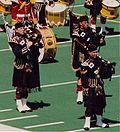
[edit]On 30 June 1990, Queen Elizabeth II presented the unit with a new queen's colour at a Trooping the Colour ceremony held at McMahon Stadium in Calgary. The King's Own Calgary Regiment (RCAC), who shared the queen with the Calgary Highlanders as colonel-in-chief, was also on parade and performed a mounted march-past with their vehicles. The combined bands of the Calgary Highlanders, the King's Own Calgary Regiment and Princess Patricia's Canadian Light Infantry were also on parade.
The largest peacetime deployment of the regiment occurred during the 2013 Alberta floods when over 100 Calgary Highlanders were mobilized to assist the Calgary Emergency Management Agency with flood relief efforts.
Afghanistan
[edit]To qualify for a battle honour, CF units were required to contribute an aggregate of more than 20% of authorized strength to the various task forces which served in Afghanistan between 2002 and 2014.[10] The regiment contributed over 100% of its strength, and was awarded the Canadian Forces' Unit Commendation for this achievement.[11][12]
Alliances
[edit]In the mid-1920s, the regiment formed an official alliance with The Argyll and Sutherland Highlanders (Princess Louise's) of the British Army. In 2006, that affiliation officially ended as the Imperial Argylls were absorbed into the Royal Regiment of Scotland as the 5th Battalion. It is unclear if previous affiliations will be permissible between single battalions of the new regiment, or if any future affiliations will be with the regiment as a whole. In either event, all Canadian regiments now affiliated with British regiments scheduled for amalgamation will need to be renewed separately. The 5th Battalion has since been reduced to a single sub-unit called Balaklava Company and used primarily for ceremonial duties.

Battle honours
[edit]
Battle honours in bold type indicate honours emblazoned on the regimental colour.[14]
First World War
[edit]Honorary distinction: Oak-leaf shoulder badge for the actions of the 10th "Overseas" Battalion, CEF, at the Battle of Kitcheners' Wood on 22/23 April 1915.
Second World War
[edit]- Bourguébus Ridge
- Faubourg de Vaucelles
- Verrières Ridge–Tilly-la-Campagne
- Falaise
- Falaise Road
- Clair Tizon
- Forêt de la Londe
- Dunkirk, 1944
- Wyneghem
- Antwerp–Turnhout Canal
- The Scheldt
- Woensdrecht
- South Beveland
- Walcheren Causeway
- The Rhineland
- The Reichswald
- The Hochwald
- Xanten
- The Rhine
- Groningen
- Oldenburg
- North-West Europe, 1944–1945
Southwest Asia
[edit]- Afghanistan
Facts
[edit]The Calgary Highlanders adopted many dress distinctions of the allied regiment in Scotland in the 1920s and continue to cherish those distinctions into the 21st century, including the red and white diced Glengarry worn by all ranks (except pipers), the badger head sporran worn by officers, warrant officers, and senior NCOs, the six-point horsehair sporran worn by junior NCOs (except pipers), and the striped necktie of the 2nd Battalion, The Argyll and Sutherland Highlanders, also worn by officers, warrant officers, senior NCOs, pipers and drummers of The Calgary Highlanders. It is unclear if any of these dress distinctions will continue to be worn in Scotland now that The Argyll and Sutherland Highlanders (Princess Louise's) have been amalgamated into the Royal Regiment of Scotland.
History
[edit]1910–1938
[edit]The regiment dates back to 1 April 1910 and the creation of the 103rd Regiment (Calgary Rifles), under the command of Lieutenant-Colonel William Armstrong. The regiment did not mobilize for the First World War; however, the 103rd Regiment contributed men to several overseas battalions of the Canadian Expeditionary Force beginning in 1914, including the 10th Battalion.
In 1921, the Canadian Militia was reorganized and the 103rd Regiment became simply "The Calgary Regiment". The 1st Battalion of this new unit became known as the Calgary Highlanders. The regiment was permitted to perpetuate the history of the 10th Battalion, CEF, and inherited that units battle honours (granted in 1929) as well as inheriting the memory of two Victoria Cross holders, Acting Sergeant Arthur George Knight and Private Harry W. Brown, both of whom were awarded the VC posthumously in the last year and a half of the Great War.
The process for awarding battle honours for the First World War took over a decade, and The Calgary Highlanders were first awarded battle honours for the actions of the 10th Battalion, CEF, on 15 September 1929.
The official granting of battle honours to the 10th Battalion was not done until 15 October of the same year. There was also one minor change; while the Calgary Highlanders were granted "Arras, 1917, '18" as a battle honour, the 10th Battalion's honour read only "Arras, 1917."[15]
While the overall battle of Saint-Julien was considered worthy of a battle honour, to the dismay of those regiments perpetuating the units involved, the counter-attack at Kitcheners' Wood was not. This counterattack, 22 April 1915, was thrown into the first German gas attack of the war. In recognition of this gallant effort and the persistence of the Winnipeg Light Infantry, the Calgary Highlanders and the Canadian Scottish, a special 'honorary distinction' was granted by Order in Council No. 10, 1934, of a special oak leaf shoulder badge now unique in the Canadian armed forces, and worn only by those three regiments at the time of adoption in 1938, and today by only two units, The Calgary Highlanders and The Canadian Scottish Regiment (Princess Mary's).[16]
1939–1945
[edit]
The Calgary Highlanders pioneered battle drill for the Canadian Army, which was a realistic system of training infantry for the hardships of modern war. They themselves learned battle drill from the British 47th Division.
On 6 July 1944, one month after the Normandy landings, the regiment landed in France. In Operation Spring, the Calgary Highlanders were part of the Battle of Verrières Ridge, along with the Black Watch, in which the regiment took heavy casualties. The unit saw extensive action in Normandy, marched through Dieppe with the 2nd Division in September 1944 as liberators, then moved on to the fighting for the Channel Ports. By the end of September the regiment was in Belgium and forced a crossing of the Albert Canal, northeast of Antwerp.
The regiment saw extensive fighting in the Netherlands in October 1944, opening the way to South Beveland, and then west to the Walcheren Island Causeway where the brigade fought an extended battle beginning on Hallowe'en night.
From November to February 1945 the regiment wintered in the Nijmegen Salient, then was back in action in the Rhineland fighting, clearing the last approaches to the River Rhine itself. Fighting resumed on the far bank in March, and city fighting in Doetinchem and Groningen followed. The regiment ended the war on VE Day on German soil.
The Victory Campaign had cost The Calgary Highlanders over 400 men killed, from a war establishment of just over 800 men. Several times that many were wounded in action.
| Award | Number |
|---|---|
| Distinguished Service Order | 5 |
| Military Cross | 2 |
| Distinguished Conduct Medal | 7 |
| Military Medal | 15 |
| Mentioned in Dispatches | 13 |
| Foreign Awards (Belgian, French, etc.) | 13 |
History 2010 to present
[edit]The regiment observed its centennial in 2010, an anniversary shared with its sister unit, The King's Own Calgary Regiment, as well as fellow unit in the Calgary garrison, 14 (Calgary) Service Battalion, as well as the Canadian Navy (represented in Calgary by HMCS Tecumseh). The centennial was marked by several unique events, including the last ever military parade at Currie Barracks in Calgary, and an overseas pilgrimage to battlefield sites and places of regimental significance which included the dedication of plaques at Hill 67 and Clair Tison.[17] Also originally part of the centennial events was the announcement of a Calgary Soldiers' Memorial, which was later dedicated on the anniversary of the battle of Vimy Ridge in 2011.[18] In May 2014, the regiment was awarded the Battle Honour "Afghanistan."[19] As part of Canada's role in the Afghanistan War, the regiment deployed over 100 soldiers to the theatre as individual augmentees and on other assignments with the Regular Force, to a total of 126 separate tours of duty. One officer of the regiment was Mentioned in Despatches and others were recognized by commendations.[20] The Regiment was awarded the Battle Honour "Afghanistan" on 9 May 2014.[21][22] The unit received the Canadian Forces' Unit Commendation on 9 January 2015.[12]
-
 Exercise Black Bear 2004

Lineage chart
[edit]| Lineage chart[23] | ||||||||||||||||||||||||||||||||||||||||||||||||||||||||||||||||||||||||||||||||||||||||||||||||||||||||||||||||||||||||||||||||||||||||||||||||||||||||||||||||||||||||||||||||||||||||||||||||||||||||||||||||||||||||||||||||||||||||||||||||||||||||||||||||||||||||||||||||||||||||||||||||||||||||||||||||||||||||||||||||||||||||||||||||||||||||||||||||||||||||||||||||||||||||||||||||||||||||||||||||||||||||||||||||||||||||||||||||||||||||||||||||||||||||||||||||||||||||||||||||||||||||||||||||||||||||||||||||||||||||||||||||||||||||||||||||||||||||||||||||||||||||||||||||||||||||||||||||||||||||||||||||||||||||||||||||||||||||||||||||||||||||||||||||||||||||||||||||||||||||||||||||||||||||||||||||||||||||||||||||||||||||||||||||||||||||||||||||||||||||||
|---|---|---|---|---|---|---|---|---|---|---|---|---|---|---|---|---|---|---|---|---|---|---|---|---|---|---|---|---|---|---|---|---|---|---|---|---|---|---|---|---|---|---|---|---|---|---|---|---|---|---|---|---|---|---|---|---|---|---|---|---|---|---|---|---|---|---|---|---|---|---|---|---|---|---|---|---|---|---|---|---|---|---|---|---|---|---|---|---|---|---|---|---|---|---|---|---|---|---|---|---|---|---|---|---|---|---|---|---|---|---|---|---|---|---|---|---|---|---|---|---|---|---|---|---|---|---|---|---|---|---|---|---|---|---|---|---|---|---|---|---|---|---|---|---|---|---|---|---|---|---|---|---|---|---|---|---|---|---|---|---|---|---|---|---|---|---|---|---|---|---|---|---|---|---|---|---|---|---|---|---|---|---|---|---|---|---|---|---|---|---|---|---|---|---|---|---|---|---|---|---|---|---|---|---|---|---|---|---|---|---|---|---|---|---|---|---|---|---|---|---|---|---|---|---|---|---|---|---|---|---|---|---|---|---|---|---|---|---|---|---|---|---|---|---|---|---|---|---|---|---|---|---|---|---|---|---|---|---|---|---|---|---|---|---|---|---|---|---|---|---|---|---|---|---|---|---|---|---|---|---|---|---|---|---|---|---|---|---|---|---|---|---|---|---|---|---|---|---|---|---|---|---|---|---|---|---|---|---|---|---|---|---|---|---|---|---|---|---|---|---|---|---|---|---|---|---|---|---|---|---|---|---|---|---|---|---|---|---|---|---|---|---|---|---|---|---|---|---|---|---|---|---|---|---|---|---|---|---|---|---|---|---|---|---|---|---|---|---|---|---|---|---|---|---|---|---|---|---|---|---|---|---|---|---|---|---|---|---|---|---|---|---|---|---|---|---|---|---|---|---|---|---|---|---|---|---|---|---|---|---|---|---|---|---|---|---|---|---|---|---|---|---|---|---|---|---|---|---|---|---|---|---|---|---|---|---|---|---|---|---|---|---|---|---|---|---|---|---|---|---|---|---|---|---|---|---|---|---|---|---|---|---|---|---|---|---|---|---|---|---|---|---|---|---|---|---|---|---|---|---|---|---|---|---|---|---|---|---|---|---|---|---|---|---|---|---|---|---|---|---|---|---|---|---|---|---|---|---|---|---|---|---|---|---|---|---|---|---|---|---|---|---|---|---|---|---|---|---|---|---|---|---|---|---|---|---|---|---|---|---|---|---|---|---|---|---|---|---|---|---|---|---|---|---|---|---|---|---|---|---|---|---|---|---|---|---|---|---|---|---|---|---|---|---|---|---|---|---|---|---|---|---|---|---|---|---|---|---|---|---|---|---|---|---|---|---|---|---|---|---|---|---|---|---|---|---|---|---|---|---|---|---|---|---|---|---|---|---|---|---|---|---|---|---|---|---|---|---|---|---|---|---|---|---|---|---|---|---|---|---|---|---|---|---|---|---|---|---|---|---|---|---|---|---|---|---|---|---|---|---|---|---|---|---|---|---|---|---|---|---|---|---|---|---|---|---|---|---|---|---|---|---|---|---|---|---|---|---|---|---|---|---|---|---|---|---|---|---|---|---|---|---|---|---|---|---|---|---|---|---|---|---|---|---|---|---|---|---|---|---|---|---|---|---|---|---|---|---|---|---|---|---|---|---|---|---|---|---|---|---|---|---|---|---|---|---|---|---|---|---|---|---|---|---|---|---|---|---|---|---|---|---|
| ||||||||||||||||||||||||||||||||||||||||||||||||||||||||||||||||||||||||||||||||||||||||||||||||||||||||||||||||||||||||||||||||||||||||||||||||||||||||||||||||||||||||||||||||||||||||||||||||||||||||||||||||||||||||||||||||||||||||||||||||||||||||||||||||||||||||||||||||||||||||||||||||||||||||||||||||||||||||||||||||||||||||||||||||||||||||||||||||||||||||||||||||||||||||||||||||||||||||||||||||||||||||||||||||||||||||||||||||||||||||||||||||||||||||||||||||||||||||||||||||||||||||||||||||||||||||||||||||||||||||||||||||||||||||||||||||||||||||||||||||||||||||||||||||||||||||||||||||||||||||||||||||||||||||||||||||||||||||||||||||||||||||||||||||||||||||||||||||||||||||||||||||||||||||||||||||||||||||||||||||||||||||||||||||||||||||||||||||||||||||||
Uniform
[edit]In addition to the cap badge and oak leaf shoulder titles mentioned above, the regiment wears several other notable distinctions of dress.
- Headdress
The red and white diced glengarry of the Argylls is worn by all ranks (except pipers, who wear black). In combat dress, the khaki tam o'shanter is worn by junior NCMs with the balmoral worn by senior NCMs and officers. A cap badge in yellow metal is worn by trained privates who are not yet infantry qualified. Infantry qualified junior NCMs wear a bronze cap badge, and senior NCMs, officers, and pipe band musicians all wear a nickel-plated cap badge. Tradesmen wear the badge of their branch, as appropriate.
- Ceremonial dress
The theoretical full dress uniform for the regiment would be a scarlet jacket and feather bonnet; this uniform has never been worn in actuality. The regiment did adopt a green coatee in the 1950s, and has retained it as the standard ceremonial uniform; they are worn only by the regimental colour party or by small parties for special occasions (such as weddings, etc.). The Pipes and Drums have always retained full ceremonial band dress, consisting of green doublets for pipers and scarlet doublets with crown lace for drummers. Pipers wear a black cock feather in their glengarries in full dress, with drummers wearing the feather bonnet.
- Highland dress
The Government tartan kilt is worn, with pleats arranged in box style according to the pattern worn by the Argylls. Several types of sporran are worn. All ranks wear a brown leather purse when in walking-out dress (i.e. with green Lovat hose); NCMs wear a simpler version with brass stud closure, officers wear a separate pattern with hidden snap fastener. For dress parades (commanding officer's parade dress), corporals and master corporals wear the six-point horsehair sporran while senior NCMs and officers wear a badger head sporran. Pipers wear three-point horsehair sporrans while the pipe major and drum major wear a separate pattern of three-point sporran. Hose tops and diced hose are in red/white dice, with pipers wearing Rob Roy tartan (red/black dice).
Honorary Colonel R.B. Bennett originally outfitted the Pipes and Drums with Royal Stewart tartan kilts and plaids in the 1920s; when the band of the 1st Battalion arrived in England in 1940 they were very quickly informed that Royal Stewart was the prerogative of royal regiments only, and they were to cease wear of that tartan at once. Pipers in the 2nd Battalion (Calgary) continued to wear Royal Stewart tartan until 1947.
-
 "Government sett", also known as the Black Watch tartan.
_tartan,_tileable.png)
- Mess dress
Mess dress for officers and senior NCMs is based closely on that worn by the Argylls; Honorary Colonel Mannix approved a new distinctive pattern officers' mess jacket in the 1980s, which featured buttons on a turn-back cuff, which differed from the Argylls pattern.
- Combat dress
Other than regimental headdress (when not wearing the CADPAT field cap or helmet), the only distinction a Calgary Highlander has in combat dress are the CALG HIGHRS titles on his slip-ons.
- Regimental order
The regiment created its own order, the Clan of the Gallant Canadians, in 1992.
Traditions
[edit]The Regimental Birthday is April 1. It was on 1 April 1910 that the 103rd Regiment (Calgary Rifles) was officially founded. The regiment toasts the occasion with Black Velvet and raw oysters, homage to the original toasts offered by the founder, Lieutenant-Colonel W.C.G. Armstrong and his officers in 1910. The weekend closest to April 22 is when St. Julien's Day is formally recognized, commemorating the role of the 10th Battalion in the Battle of St. Julien in 1915. The parade day closest to October 31 commemorates the role of The Calgary Highlanders in the Battle of Walcheren Causeway.
Regimental association
[edit]The 10th Battalion Association was merged with The Calgary Highlanders Association in 1956 to become the 10th Battalion Calgary Highlanders Association.
During the Second World War, The Glen was the regimental newspaper of the overseas battalion beginning in September 1939, and The Glen continues to be the regimental journal of the 10th Battalion Calgary Highlanders Association. The Glen is published semi-regularly.
Notable members
[edit]- General John de Chastelain, who served two terms as Chief of the Defence Staff, began his military career as a private in the Regimental Pipes and Drums of The Calgary Highlanders. On 30 June 1990, while serving as CDS, he paraded as a piper with the band during the Presentation of Queen's Colour at McMahon Stadium.
- Brigadier-General G.J.P. O'Brien, OMM, MSC, CD, served in the ranks of the Calgary Highlanders from 1976 to 1979, including a tour of duty with UNDOF. He later transferred to 4th Battalion, The Royal Canadian Regiment, where he was commissioned, went on to command the regiment as a lieutenant-colonel, then commanded 31 Canadian Brigade Group, and was appointed Director General Land Reserve in 2006.
- Lieutenant-Colonel J.G. McQueen was the first commander of the Canadian contingent of the First Special Service Force (The Devil's Brigade).[24]
- Lieutenant-Colonel Mark Tennant rose from the rank of private in 1939 to the rank of major in 1944, and commanded the peacetime regiment after the Second World War. He was also appointed honorary lieutenant-colonel. In civilian life he served for many years as an alderman of the City of Calgary. He was admitted to the Order of Canada following his political service.
- Lieutenant Carl Nickle, later Member of Parliament and member of the Order of Canada.
- Four Calgary Highlanders officers served in the CANLOAN project during the Second World War, two were captured at Arnhem, one was killed in Normandy with the Royal Scots, and one became the last CANLOAN to die in action when he was killed with the Argyll and Sutherland Highlanders in April 1945.[25]
- Sergeants Lyster and Pittaway were mentioned in despatches for their part in shooting down two German aircraft during the Dieppe Raid.
- Scruffy Wallace was a piper in The Calgary Highlanders before leaving the CF and becoming a member of Dropkick Murphys.
-
 CDS General de Chastelain (left), 30 June 1990

Regimental monuments
[edit]As part of the celebrations of the 50th anniversary of VE Day, a special celebrations committee in Doetinchem, Netherlands, recommended that the city park be renamed in honour of Lieutenant-Colonel Mark Tennant and that a monument for the Calgary Highlanders who were killed in the fighting there be established. Tennant distinguished himself during the battle for Doetinchem where the Highlanders fought to clear the city between 1 and 3 April 1945.
As a measure of thanks on the 50th anniversary of the liberation of the Netherlands, the City of Doetinchem named the park "Mark Tennantplantsoen – Een Canadese bevrijder" – "Mark Tennant Park, A Canadian Liberator." Trees in the park still contained shrapnel; mute evidence of the fighting that raged there in April 1945.
The Calgary Soldiers' Memorial bears the names of all Calgary area soldiers who died in war from 1914, with separate sections for both the 10th Battalion, CEF and The Calgary Highlanders.
Regimental plaques can be found at various sites, including Mewata Armouries, Hill 67, Clair Tizon and Loon Plage in Normandy. A plaque to the predecessor unit, the 10th Battalion, can be found at Villers-lès-Cagnicourt, commemorating the Victoria Cross action of Sergeant Arthur Knight, VC.
Order of precedence
[edit]Regimental museum
[edit]Film portrayals
[edit]- The Devil's Brigade (1968). Two main characters can be seen wearing the insignia of the Calgary Highlanders, Corporal Peacock and Private MacDonald (Richard Dawson).
- Legends of the Fall (1994). The character of Samuel Ludlow (Henry Thomas) very clearly wears the insignia of the 10th Battalion, CEF. It is presumed that Tristan Ludlow (Brad Pitt) and Alfred Ludlow (Aidan Quinn) also belong to the same battalion, but neither costume nor dialogue confirm this though a voiceover indicates that all three enlisted together in Calgary.
- Passchendaele (2008). This film project, announced by Paul Gross, filmed in Alberta in the autumn of 2007; Gross depicts a character inspired by his grandfather, Sergeant Michael Dunne, who he claimed served in the 10th Battalion, CEF.[26] The film opened at the Toronto International Film Festival on September 4, 2008, and was released in Canada on October 17, 2008. Historical figures are referenced in the film, for example characters named Colonel Ormond and RSM Watchman are named after living historical counterparts that served with the 10th Battalion.[27]
- The Forgotten Battle (2020). The crossing of the Walcheren Causeway is depicted in this film.
Associated Army Cadet corps
[edit]- 2137 RCACC (Calgary Highlanders)
- 3125 Chestermere RCACC (Calgary Highlanders)
- 3016 Airdrie RCACC (Calgary Highlanders)
- 2383 Foothills RCACC (Calgary Highlanders)
Music
[edit]- 80 Years of Glory by Calgary Highlanders (Aug 17 1993) Audio CD
See also
[edit]- Canadian-Scottish regiment
- Regimental Pipes and Drums of The Calgary Highlanders
- Eswyn Lyster - warbride author, married to Captain Bill Lyster, Calgary Highlanders
Notes
[edit]References
[edit]- ^ (this spelling is erroneous, the correct spelling is air adhart [ɛɾʲˈɤ.ərˠʃt̪])
- ^ "Current Appointments". Calgaryhighlanders.com. 6 November 2010. Retrieved 26 April 2013.
- ^ "DHH history". Archived from the original on 24 October 2014. Retrieved 10 January 2015.
- ^ army news backgrounder
- ^ First approved by General Order 112 in 1925.
- ^ a b c Regiments and Corps of the Canadian Army, Queen's Printer, 1964.
- ^ "Dieppe". Archived from the original on 15 December 2005. Retrieved 15 December 2005.
- ^ "Dieppe Raid August 19 1942". Archived from the original on 5 October 2002.
- ^ "regimental website news item". Calgaryhighlanders.com. Archived from the original on 31 May 2013. Retrieved 26 April 2013.
- ^ "South-West Asia Theatre Honours | Prime Minister of Canada". Archived from the original on 12 May 2014. Retrieved 11 May 2014.
- ^ DND News Release
- ^ a b DND Backgrounder
- ^ Until a full list of alliances is decided upon, the battalions of the Royal Regiment of Scotland will maintain the alliances of their antecedent regiments:Information provided by the regimental secretary of the Royal Regiment of Scotland
- ^ "The Calgary Highlanders". Official Lineages Volume 3, Part 2: Infantry Regiments. Directorate of History and Heritage. Archived from the original on 24 November 2015. Retrieved 23 November 2015.
- ^ Dancocks, Daniel G. Gallant Canadians: The Story of the Tenth Canadian Infantry Battalion (Calgary Highlanders Regimental Funds Foundation, 1990).
- ^ Calgary Highlanders website (frame page) Archived September 5, 2005, at the Wayback Machine
- ^ "Calgary Highlanders centennial announcements". Calgaryhighlanders.com. Retrieved 26 April 2013.
- ^ "Calgary Soldiers' Memorial page". Calgarysoldiersmemorial.ca. Retrieved 26 April 2013.
- ^ Prime Minister of Canada news release Archived 2014-05-12 at the Wayback Machine
- ^ regimental website
- ^ Calgary Highlanders website
- ^ Prime Minister of Canada's news backgrounder Archived 2014-05-12 at the Wayback Machine
- ^ "The Calgary Highlanders". www.canada.ca. 24 October 2018. Retrieved 16 August 2025.
- ^ Burhans, Ronald D. History of the First Special Service Force.
- ^ Smith. Code Word: Canloan
- ^ The service file of Sergeant Michael Dunne does not indicate any service with the 10th. https://recherche-collection-search.bac-lac.gc.ca/eng/Home/Record?app=pffww&IdNumber=366935
- ^ IMDB cast and crew listing
- Barnes, RM, The Uniforms and History of the Scottish Regiments, London, Sphere Books Limited, 1972.
Further reading
[edit]- Calgary's Infantry Regiment: A Pictorial History of The Calgary Highlanders by Michael A. Dorosh (Calgary Highlanders Regimental Funds Foundation, 2024) 440 pages ISBN 978-0-969461-64-7
- The History of The Calgary Highlanders 1921–1954 by Major Roy Farran, DSO, MC (Bryant Press, 1954) 221 pages, no ISBN, now out of print
- Battalion of Heroes: The Calgary Highlanders in World War Two by Doctor David Jay Bercuson (Calgary Highlanders Regimental Funds Foundation, 1994) 297 pages, 48 pages of illustrations and maps. ISBN 0-9694616-1-5
- Gallant Calgarians: The Story of the 10th Battalion Calgary Highlanders Association Heritage Section, 1995-2006 (Published by the 10th Battalion Calgary Highlanders Association Heritage Section) 98 pages, illustrated with 200 colour photographs ISBN 978-0-9782646-6-6
- Gallant Canadians: The Story of the Tenth Canadian Infantry Battalion, 1914–1919 by Daniel G. Dancocks (Calgary Highlanders Regimental Funds Foundation, 1990) 251 pages, lavishly illustrated throughout with photos and maps ISBN 0-9694616-0-7
- The Brigade: The Fifth Canadian Infantry Brigade, 1939–1945 by Dr. Terry Copp (Fortress Publications, Stoney Creek, ON, 1992) ISBN 0-919195-16-4
- Far From Home: A Memoir of a 20th Century Soldier by Jeffery Williams. (University of Calgary Press, 2003) 374 pages, many illustrations. ISBN 1-55238-119-6
- A Backward Glance: The Personal Story of an Infantry Signaller with the Calgary Highlanders in World War Two by Frank Holm (Sault Ste. Marie, Ontario: Self Published, 1989)
- "A Bloody Miracle: A Calgary Highlander Mortar Platoon at the Dieppe Raid" by Eswyn Lyster (Legion Magazine 1989, also in True Canadian War Stories, Jane Dewar, ed., Lester, Orpen and Denny 2002 : ISBN 978-0-88619-140-5)
External links
[edit]Calgary Highlanders
View on GrokipediaIdentity and Symbols
Badge and Insignia
The cap badge of The Calgary Highlanders (10th Canadians) features a beaver couchant on a log environed by a wreath of maple leaves, the Royal Crown proper above flanked by two white scrolls each bearing a thistle proper, and a blue scroll at base inscribed with "CALGARY HIGHLANDERS" in gold letters, the whole above a saltire and thistle proper.[4][1] On 21 March 2024, the regiment was redesignated The Calgary Highlanders (10th Canadians) to perpetuate its First World War lineage.[1] This design was officially adopted in the 1930s following the regiment's redesignation as a highland unit in 1921, incorporating Scottish heraldic elements to reflect its affiliated traditions while perpetuating the lineage of the 10th Battalion, Canadian Expeditionary Force (CEF).[1][4] The insignia evolved significantly from the regiment's origins as the 103rd Regiment "Calgary Rifles" in 1910, when members wore standard rifle regiment shoulder titles featuring a bugle horn and the unit numeral, often inscribed with "CALGARY RIFLES" in brass or cloth form.[1] Upon mobilization for the First World War, personnel contributed to the 10th Battalion CEF, whose cap badge depicted a beaver on a log within a wreath of maple leaves surmounted by a crown and bearing a "10th CANADIANS" scroll, symbolizing Canadian identity post-Confederation through the beaver as a national emblem and maple leaves as emblems of unity.[5] After the war, as The Calgary Highlanders, the unit transitioned to highland-style insignia in the interwar period, with the cap badge formalized in the 1930s to include the saltire and thistles; simultaneously, a simple "C.H." brass shoulder title was introduced around 1921, later replaced in 1934 by a distinctive bronze oak leaf and acorn badge inscribed "CALGARY HIGHLANDERS," commemorating the 10th Battalion's assault at Kitchener's Wood in 1915.[6][7] Post-1945 modifications to the insignia were primarily material and wear-related, adapting to changing uniforms without altering core designs; for instance, during the Cold War era, cloth versions of the oak leaf shoulder title were used on battledress, while the 1968 unification of the Canadian Armed Forces prompted some regiments to revert to pre-unification cap badges, allowing The Calgary Highlanders to retain its traditional highland-pattern badge in bronze for qualified personnel and yellow metal for trainees.[6] By the late 1980s, with the introduction of Distinctive Environmental Uniforms, metal oak leaf emblems returned to epaulettes for parade dress.[6] The badge's elements carry layered symbolism tied to the regiment's dual Canadian-Scottish heritage: the saltire and thistles evoke Scotland's patron saint (St. Andrew) and national flower, aligning with highland regiment conventions, while the central beaver—retained from the 10th Battalion—represents industriousness and Canada's fur trade legacy, adapted from an earlier motif framed by maple leaves, which is retained in the modern wreath to underscore post-Confederation service.[4] The Royal Crown signifies service to the Sovereign.[1]Motto and Traditions
The motto of The Calgary Highlanders (10th Canadians) is "Airaghardt," translating from Scottish Gaelic as "Onward," reflecting the regiment's heritage of perseverance and shared with the City of Calgary.[2] Key traditions of the regiment include the Freedom of the City of Calgary, formally granted on 23 April 1964, which allows the unit to march through the streets with bayonets fixed, colours flying, and drums beating.[8] This honour is exercised annually during St. Julien's Day weekend, commemorating the 10th Battalion's actions at the Second Battle of Ypres in 1915, with a ceremonial parade from Mewata Armoury to City Hall followed by wreath-laying.[9] Annual mess dinners form another cornerstone, held as part of these commemorations to foster regimental camaraderie, often including toasts to fallen comrades and officers' functions.[9] The regiment also maintains ties to Scottish culture through participation in highland games, where its pipes and drums compete in events like the March, Strathspey, and Reel, as well as medleys, showcasing piping and drumming skills at gatherings such as the Canmore Highland Games.[10] These elements collectively shape the regiment's intangible heritage, emphasizing discipline, heritage, and service. The traditions are supported by the Calgary Highlanders Regimental Association, which organizes related events.[2]Formation and Early History
Origins and Lineage (1910–1939)
The Calgary Highlanders trace their origins to the 103rd Regiment "Calgary Rifles," authorized on 1 April 1910 in Calgary, Alberta, as an infantry unit of the Canadian Non-Permanent Active Militia (NPAM). Raised under the command of Lieutenant Colonel William C. G. Armstrong within Military District No. 13, the regiment consisted of eight companies and reflected Alberta's recent entry into Confederation in 1905. Its establishment addressed the growing need for local defense forces in the rapidly expanding western city, drawing recruits from Calgary's civilian population.[1][11] In its early years, the 103rd Regiment emphasized routine training, including 30 paid drills per year and annual summer camps focused on tactical exercises and marksmanship. The unit played a prominent community role in Calgary through public parades, shooting competitions, and social events, fostering civic pride and military preparedness among residents. It adopted distinctive rifle regiment traditions, such as blackened badges for field concealment, which underscored its initial focus on light infantry tactics. By 1914, as tensions escalated toward the First World War, the regiment was not mobilized as a complete unit but served as a key recruiting ground, contributing 846 personnel to the 10th Battalion, Canadian Expeditionary Force (CEF), and supporting the formation of the 31st and 50th Battalions.[11] Following the war, the regiment underwent significant administrative reorganization. On 15 March 1920, the 103rd Regiment "Calgary Rifles" was redesignated and split into two separate units: The Alberta Regiment and The Calgary Regiment, in line with broader Canadian militia reforms under General Order 32/1920. This restructuring perpetuated several CEF battalions, including the 10th, 50th, 56th, and 82nd, integrating their battle honours and traditions into the new formations; the 56th Battalion, CEF, was specifically linked to the 2nd Battalion in the regimental structure. On 15 May 1924, The Calgary Regiment was further reorganized, with its 1st Battalion redesignated as The Calgary Highlanders, marking the adoption of Highland dress and an alliance with the Argyll and Sutherland Highlanders. This change shifted the unit from rifleman roots to a Highland infantry identity, while the 2nd Battalion evolved separately into The King's Own Calgary Regiment.[1][12] Throughout the 1930s, The Calgary Highlanders operated as a part-time NPAM unit, conducting periodic training exercises and maintaining a reserve structure until the 2nd and 3rd Battalions—perpetuating the 56th and 82nd CEF units, respectively—were disbanded on 14 December 1936 amid budget constraints. The regiment continued to strengthen its ties to Calgary's community, providing guards of honour for civic events, including the Royal Visit of King George VI and Queen Elizabeth in May 1939, where it supplied a ceremonial detachment in Calgary and a pipe band escort in Edmonton. These activities reinforced the unit's role as a local institution, preparing it for the impending mobilization in 1939.[1][12]Pre-War Development
Following its reorganization as a distinct Highland regiment on 15 May 1924, the Calgary Highlanders experienced significant expansion in the 1920s, drawing heavily on the legacy of the 10th Battalion, Canadian Expeditionary Force, with approximately 80 percent of its initial membership comprising Great War veterans. This growth was bolstered by the formal alliance with the Argyll and Sutherland Highlanders of Scotland, approved in 1924, which allowed the unit to embrace traditional Highland elements and foster a stronger regimental identity rooted in Scottish military heritage.[12] A key aspect of this affiliation was the adoption of distinctive Highland uniforms in 1925, including the Government tartan kilt pleated in the Argyll and Sutherland style, red and white diced glengarry headwear, and horsehair sporrans, which not only enhanced morale but also distinguished the regiment from other Canadian militia units during parades and ceremonies. Training during this period emphasized practical soldiering, with annual camps held at Sarcee Camp near Calgary, where members honed infantry skills under canvas conditions, preparing for potential mobilization while integrating the new Highland drill and piping traditions. Community engagements further solidified the regiment's local ties, demonstrating its role as a civic asset beyond military duties.[12] The onset of the Great Depression in 1929 imposed severe challenges, marked by drastic reductions in federal funding for the Non-Permanent Active Militia, which limited equipment, pay, and training opportunities across Canadian units, including the Calgary Highlanders. With daily allowances for privates dropping to as low as $1.25 and extended camps curtailed, recruitment drives intensified in the mid- to late 1930s to maintain strength, relying on volunteer appeals and community outreach amid widespread unemployment in Alberta. Despite these constraints, the regiment sustained operations through dedicated leadership and veteran involvement, culminating in high-profile duties like forming a guard of honour for the 1939 royal visit to Calgary on 8 May, which underscored its resilience up to the eve of the Second World War.[12][13]Operational History
First World War
The 10th Battalion, Canadian Expeditionary Force (CEF), earned 19 specific battle honours for its service with the 1st Canadian Division on the Western Front from 1915 to 1918, in addition to the overarching honour "France and Flanders, 1915–18." These honours, awarded by General Orders 123 and 110 of 1929, recognize the unit's contributions to major Canadian operations and are perpetuated today by The Calgary Highlanders through emblazonment on the regimental colours and incorporation into unit traditions.[1][14] The honours, tied to key actions of the 10th Battalion (nicknamed the "Fighting Tenth"), are as follows:- Ypres, 1915, '17: Named for the strategically vital Belgian town of Ypres (modern Ieper) in the Flanders region, this honour commemorates the battalion's defensive stands and assaults in the Ypres Salient during the Second Battle of Ypres in April–May 1915 and Third Battle in July–November 1917. The 10th Battalion counterattacked German positions at Kitchener's Wood on 22–23 April 1915, halting an advance amid the first major use of poison gas and suffering 623 casualties, including the death of its commanding officer.[15][1]
- Gravenstafel: Derived from Gravenstafel Ridge, a low elevation east of Ypres, this honour marks the 10th Battalion's role in defending against a German assault on 22–23 April 1915 as part of the Second Battle of Ypres response to chlorine gas attacks on Allied lines. The unit supported counterattacks in the sector, contributing to the stabilization of the front despite heavy losses.[16][1]
- St. Julien: Named after the village of Saint-Julien near Ypres, this honour recognizes the 10th Battalion's efforts in holding the line during the gas attacks and counteroffensives of 24–26 April 1915 in the Second Battle of Ypres. As part of the 2nd Canadian Infantry Brigade, the battalion reinforced exposed positions, enduring intense artillery and infantry assaults.[15][1]
- Festubert, 1915: Referring to the French village of Festubert in the Artois region, this honour is for the 10th Battalion's attack on enemy trenches known as K5 on 23–25 May 1915, part of a British offensive to support French operations at Artois. The assault resulted in heavy casualties but advanced the line slightly.[15][1]
- Mount Sorrel: Named for Mount Sorrel, a hill southeast of Ypres, this honour covers the 10th Battalion's counterattack on 13 June 1916 to recapture lost ground during a German offensive. The unit recaptured key positions but incurred 274 casualties in the fierce fighting.[15][1]
- Somme, 1916: After the Somme River in northern France, this broad honour encompasses the 10th Battalion's engagements in the Battle of the Somme from July to November 1916, including assaults on Thiepval Ridge and the Regina Trench. The unit advanced amid brutal attritional warfare, suffering significant losses in the push toward German lines.[15][1]
- Thiepval: Named for the village and ridge at Thiepval on the Somme battlefield, this honour highlights the 10th Battalion's capture of sections of the heavily fortified Thiepval Ridge on 15–26 September 1916, involving intense close-quarters combat and 241 casualties for the unit.[15][1]
- Ancre Heights: Referring to the heights along the Ancre River valley near Beaumont-Hamel, this honour is for the 10th Battalion's role in capturing objectives during the later Somme phase on 18 November 1916, under muddy and shell-torn conditions that tested the unit's endurance.[15][1]
- Arras, 1917, '18: Named for the French city of Arras in the Pas-de-Calais, this honour covers the 10th Battalion's operations in the Vimy sector in April 1917 and the Hundred Days Offensive around the Scarpe River in August 1918. In 1918, as part of the 1st Canadian Division, the unit advanced during the Battle of the Scarpe (26–30 August), capturing German positions east of Arras.[1][17]
- Vimy, 1917: After Vimy Ridge near Arras, this honour commemorates the 10th Battalion's successful assault on 9 April 1917 during the Battle of Vimy Ridge, where the unit seized assigned objectives in the initial wave despite barbed wire and machine-gun fire, incurring 374 casualties. The action was pivotal in the capture of the ridge by Canadian forces.[15][1]
- Arleux: Named for the village of Arleux-en-Gohelle east of Vimy, this honour recognizes the 10th Battalion's storming of German lines on 28 April 1917 as part of a follow-up operation to Vimy. The unit captured the village in 1.5 hours alongside other battalions of the 2nd Canadian Division, holding it against counterattacks.[18][19]
- Hill 70: Referring to Hill 70 near Lens, this honour is for the 10th Battalion's capture and defence of the position on 15 August 1917, repulsing multiple German counterattacks; Private Harry Brown of the unit earned the Victoria Cross for rescuing wounded comrades under fire.[15][1]
- Passchendaele: Named for the village of Passchendaele (modern Passendale) in Belgium, this honour marks the 10th Battalion's advance on Hill 52 during the Third Battle of Ypres on 26 October 1917. The unit captured objectives in mud-choked terrain with relatively light casualties compared to other assaults.[15][1]
- Amiens: After the Somme city of Amiens, this honour covers the 10th Battalion's rapid advance on 8 August 1918 during the Battle of Amiens, the opening of Canada's Hundred Days Offensive, where the unit exploited breakthroughs with tanks and aircraft support to overrun German defences.[15][1]
- Scarpe, 1918: Named for the Scarpe River east of Arras, this honour is for the 10th Battalion's participation in the 1st Canadian Division's assaults from 26–30 August 1918, advancing against fortified lines and contributing to the Allied push that forced German withdrawals.[1][17]
- Drocourt-Quéant: Referring to the Drocourt-Quéant Line, a section of the Hindenburg Line fortifications between the villages of Drocourt and Quéant, this honour recognizes the 10th Battalion's assault on 2 September 1918 as part of the Canadian Corps' breakthrough, overcoming barbed wire and trenches in a key advance toward Cambrai.[20][1]
- Hindenburg Line: Named for the extensive German defensive system (Siegfriedstellung) built in 1916–1917 across northern France and Belgium, this honour encompasses the 10th Battalion's crossings and attacks in September 1918, including support for the Canal du Nord assault, which pierced the line and accelerated the German retreat.[15][1]
- Canal du Nord: After the Canal du Nord in northern France, this honour is for the 10th Battalion's crossing and advance on 27 September 1918, navigating dry canal bed obstacles under fire to secure bridges and push forward in the Battle of Cambrai. The action incurred heavy losses but enabled further gains.[15][1]
- Pursuit to Mons: Commemorating the final Allied advance to Mons, Belgium—the site of the war's first major battle in August 1914—this honour covers the 10th Battalion's role in the relentless pursuit from 28 September to 11 November 1918, harrying retreating Germans across open country and entering Mons on Armistice morning.[15][21]
Second World War
The Calgary Highlanders, serving as part of the 5th Infantry Brigade within the 2nd Canadian Infantry Division, earned over 20 battle honours during the Second World War for their actions in the North-West Europe campaign from 1944 to 1945. These honours recognize key engagements from the Normandy landings through the advance into Germany, with capitalized names indicating those selected for emblazonment on the regimental colour. The regiment landed in Normandy on 7 July 1944 and participated in operations that contributed to the liberation of multiple French and Dutch towns, culminating in the defeat of German forces in May 1945.[1][22] The battle honours include:- Bourguébus Ridge (18–23 July 1944): For assaults on fortified German positions south of Caen, where the regiment helped secure vital ground during Operation Goodwood.[14]
- Faubourg de Vaucelles (18–19 July 1944): Actions in capturing this suburb of Caen amid intense urban fighting.[14]
- Verrières Ridge–Tilly-la-Campagne (25 July 1944): Part of Operation Spring, involving heavy casualties in assaults on defended ridges east of Caen.[14]
- Falaise (7–22 August 1944): Encirclement operations that trapped German forces in the Falaise Pocket, with the regiment advancing to close the gap.[14]
- Falaise Road (7–9 August 1944): Pursuit along key routes during the pocket's formation.[14]
- Clair Tizon (11–13 August 1944): Clearing operations northwest of Falaise to support the encirclement.[14]
- Forêt de la Londe (27–29 August 1944): Combat in wooded areas during the advance toward the Seine River.[14]
- Dunkirk, 1944 (8–15 September 1944): Diversionary attacks to draw German reserves away from main Allied advances in northern France.[1]
- Wyneghem (21–22 September 1944): Crossing the Antwerp-Turnhout Canal in Belgium.[14]
- Antwerp–Turnhout Canal (24–29 September 1944): Securing bridgeheads to open the vital port of Antwerp.[14]
- The Scheldt (1 October–8 November 1944): Overall campaign to clear the Scheldt Estuary, enabling Antwerp's use; sub-honours include Woensdrecht (1–27 October 1944) for polder fighting, South Beveland (24–31 October 1944) for amphibious assaults, and Walcheren Causeway (31 October–4 November 1944) for a daring attack that breached island defences despite heavy losses.[1][14]
- The Rhineland (8 February–10 March 1945): Winter offensive into Germany; sub-honours include The Reichswald (8–13 February 1945) for forest clearing, The Hochwald (26 February–4 March 1945) for gap assaults, and Xanten (8–9 March 1945) for town captures.[1][14]
- The Rhine (23 March–1 April 1945): River crossing operations during the final push.[14]
- Groningen (13–16 April 1945): Urban combat to liberate the Dutch city from entrenched defenders.[14]
- Oldenburg (May 1945): Final advances in northern Germany.[1]
- North-West Europe, 1944–1945 (6 June 1944–5 May 1945): Encompassing the entire campaign from Normandy to VE Day.[14]
Post-War Engagements
Following the conclusion of the Second World War, the Calgary Highlanders underwent reorganization within the Canadian Army structure. On 15 December 1945, the 2nd Battalion was redesignated as The Calgary Highlanders, integrating it into the reserve force as a Primary Reserve infantry regiment based at Mewata Armouries in Calgary.[1] This transition marked the regiment's shift from active wartime service to peacetime reserve duties, focusing on local training and readiness while perpetuating its lineage from the 10th Battalion of the Canadian Expeditionary Force.[25] The 1960s and 1980s brought significant restructurings to the regiment amid broader Canadian Armed Forces reforms, particularly the unification process that integrated the army, navy, and air force into a single service on 1 February 1968.[26] Despite these changes, which introduced standardized green uniforms and consolidated command structures, the Calgary Highlanders preserved its distinct highland identity through retained traditions like the Government tartan kilt, glengarry headdress, and pipes and drums band.[25] In the 1970s, as membership fluctuated due to unification-related disruptions and public shifts post-Vietnam, the regiment actively advocated to maintain ceremonial elements, ensuring continuity of its Scottish heritage within the modern reserve framework.[27] Detailed records of the regiment's activities from 1945 onward remain incomplete, with ongoing efforts by the Regimental Association to document contributions to international and domestic operations.[25]Modern Era and Conflicts
Cold War and Peacekeeping
During the Cold War era, the Calgary Highlanders, as part of Canada's Primary Reserve infantry, participated as part of broader NATO reinforcement efforts.[28] The regiment contributed personnel to several United Nations peacekeeping operations from the 1960s through the 1990s, reflecting Canada's commitment to international stability amid Cold War tensions. In the United Nations Force in Cyprus (UNFICYP), established in 1964 to monitor the ceasefire between Greek and Turkish Cypriot communities, Calgary Highlanders soldiers served in rotations, patrolling buffer zones and supporting de-escalation efforts during intermittent violence.[24] Similarly, members deployed to the United Nations Disengagement Observer Force (UNDOF) in the Golan Heights from 1974 onward, observing the Israel-Syria ceasefire and facilitating humanitarian aid amid regional conflicts.[24] In the 1980s, the regiment provided observers to the Multinational Force and Observers (MFO) in the Sinai Peninsula, verifying compliance with the 1979 Egypt-Israel peace treaty by monitoring troop withdrawals and border security.[24] Domestically, Calgary Highlanders personnel supported Operation Salon during the 1990 Oka Crisis, a 78-day standoff between Mohawk protesters and authorities over land rights in Quebec, where they assisted in securing perimeters and logistical support without direct combat involvement.[29] In June 1990, the regiment received new colours from Queen Elizabeth II in a ceremonial parade at McMahon Stadium, underscoring its enduring role in Canada's defense traditions.[28]Afghanistan Deployment
The Calgary Highlanders contributed significantly to Canada's military efforts in Afghanistan from 2002 to 2014, deploying a total of 126 personnel as individual augmentees to support regular force units during Operations ATHENA and ATTENTION.[30] These deployments included rotations to Kabul for non-combat stabilization tasks and to Kandahar Province for more intense combat and advisory operations, aligning with the broader Canadian commitment to NATO's International Security Assistance Force (ISAF).[1] The regiment's involvement emphasized capacity-building for Afghan security forces while reinforcing Canadian battle groups in southern Afghanistan.[30] In Kabul, from May 2011 to March 2014 under Operation ATTENTION, Highlanders personnel assisted in operating the international airport, patrolled the city's western sector, and supported the reconstruction of the Afghan National Army (ANA) through training and logistical aid.[30] This phase shifted focus toward post-combat mentoring to enable Afghan forces to assume greater security responsibilities. In contrast, earlier rotations to Kandahar from August 2005 to July 2011 involved direct combat roles within infantry battle groups, including joint patrols with ANA units to counter insurgent activity in volatile districts like Zhari and Panjwayi.[30] Highlanders soldiers often served as embedded mentors in Operational Mentor and Liaison Teams (OMLTs), advising ANA company commanders on tactics, leadership, and operations to build sustainable Afghan military capabilities.[31] A notable example of the regiment's combat mentoring occurred in 2008 near Pashmul in the Panjwayi district, where Captain Simon Cox, serving as a company commander mentor with an OMLT, directed artillery support during intense fighting alongside ANA forces against Taliban positions.[30] Cox's actions exemplified the dual role of advisory support and direct engagement in high-risk patrols, earning him a Mention in Dispatches for leadership under fire.[30] Such incidents highlighted the dangers faced by reserve augmentees in mentoring operations, where Canadian advisors accompanied Afghan troops on patrols to enhance their operational effectiveness against insurgents.[32] Following the conclusion of Canada's combat mission in 2011 and the full withdrawal in 2014, the Calgary Highlanders returned to their primary reserve status, focusing on domestic training and readiness while having provided more reserve personnel to the Afghan theater than any other Canadian Army reserve regiment.[1] The regiment received the Canadian Forces Unit Commendation in 2015 for its sustained contributions to the mission.[1]Recent Activities (2010–Present)
Following the conclusion of combat operations in Afghanistan, the Calgary Highlanders shifted emphasis to reserve infantry training, emphasizing dismounted light infantry tactics, weapons proficiency, and specialized roles such as a new mortar platoon established in the 2020s.[2] Soldiers conduct weekly evening sessions and monthly weekend exercises at Mewata Armoury, with field training at sites like Nose Hill Park for navigation and leadership drills in 2018 and 2023.[33][34] In September 2025, the regiment participated in personal weapons testing at CFB Wainwright, qualifying on the C7 rifle alongside supporting units to maintain operational readiness.[35] The regiment contributed to domestic emergency responses, notably during Operation LENTUS for the 2013 Alberta floods, where members of Task Force Silvertip, under then-Deputy Commanding Officer Lieutenant-Colonel Kyle Clapperton, assisted with sandbagging, evacuations, and recovery in affected areas like Inglewood.[36][37] During the COVID-19 pandemic in 2020, Highlanders adapted training to virtual formats like Exercise VIRTUAL HIGHLANDER and socially distanced ranges for C7 qualifications, while supporting Operation VECTOR by aiding vaccine distribution efforts.[38] Traditional events were scaled back, with the 2020 Remembrance Day parade replaced by smaller, distributed observances to comply with restrictions.[39] On 21 March 2024, the regiment was officially redesignated The Calgary Highlanders (10th Canadians) to honour its First World War lineage.[1] Ceremonial duties remained a core activity, including annual Remembrance Day parades led by the regiment at Central Memorial Park Cenotaph, such as the 2025 event from 10 a.m. to noon featuring a military procession and wreath-laying.[40] The Pipes and Drums also performed at the Field of Crosses display in November 2020 amid pandemic limitations.[38] The 74th Grand Highland Military Ball, held on May 4, 2024, at the Fairmont Palliser Hotel, honored regimental traditions with a grand march, performances, and fundraising for soldier support, continuing a series disrupted only briefly by COVID.[41][42]Battle Honours
First World War
The 10th Battalion, Canadian Expeditionary Force (CEF), earned 19 specific battle honours for its service with the 1st Canadian Division on the Western Front from 1915 to 1918, in addition to the overarching honour "France and Flanders, 1915–18." These honours, awarded by General Orders 123 and 110 of 1929, recognize the unit's contributions to major Canadian operations and are perpetuated today by The Calgary Highlanders through emblazonment on the regimental colours and incorporation into unit traditions.[1][14] The honours, tied to key actions of the 10th Battalion (nicknamed the "Fighting Tenth"), are as follows:- Ypres, 1915, '17: Named for the strategically vital Belgian town of Ypres (modern Ieper) in the Flanders region, this honour commemorates the battalion's defensive stands and assaults in the Ypres Salient during the Second Battle of Ypres in April–May 1915 and Third Battle in July–November 1917. The 10th Battalion counterattacked German positions at Kitchener's Wood on 22–23 April 1915, halting an advance amid the first major use of poison gas and suffering 623 casualties, including the death of its commanding officer.[15][1]
- Gravenstafel: Derived from Gravenstafel Ridge, a low elevation east of Ypres, this honour marks the 10th Battalion's role in defending against a German assault on 22–23 April 1915 as part of the Second Battle of Ypres response to chlorine gas attacks on Allied lines. The unit supported counterattacks in the sector, contributing to the stabilization of the front despite heavy losses.[16][1]
- St. Julien: Named after the village of Saint-Julien near Ypres, this honour recognizes the 10th Battalion's efforts in holding the line during the gas attacks and counteroffensives of 24–26 April 1915 in the Second Battle of Ypres. As part of the 2nd Canadian Infantry Brigade, the battalion reinforced exposed positions, enduring intense artillery and infantry assaults.[15][1]
- Festubert, 1915: Referring to the French village of Festubert in the Artois region, this honour is for the 10th Battalion's attack on enemy trenches known as K5 on 23–25 May 1915, part of a British offensive to support French operations at Artois. The assault resulted in heavy casualties but advanced the line slightly.[15][1]
- Mount Sorrel: Named for Mount Sorrel, a hill southeast of Ypres, this honour covers the 10th Battalion's counterattack on 13 June 1916 to recapture lost ground during a German offensive. The unit recaptured key positions but incurred 274 casualties in the fierce fighting.[15][1]
- Somme, 1916: After the Somme River in northern France, this broad honour encompasses the 10th Battalion's engagements in the Battle of the Somme from July to November 1916, including assaults on Thiepval Ridge and the Regina Trench. The unit advanced amid brutal attritional warfare, suffering significant losses in the push toward German lines.[15][1]
- Thiepval: Named for the village and ridge at Thiepval on the Somme battlefield, this honour highlights the 10th Battalion's capture of sections of the heavily fortified Thiepval Ridge on 15–26 September 1916, involving intense close-quarters combat and 241 casualties for the unit.[15][1]
- Ancre Heights: Referring to the heights along the Ancre River valley near Beaumont-Hamel, this honour is for the 10th Battalion's role in capturing objectives during the later Somme phase on 18 November 1916, under muddy and shell-torn conditions that tested the unit's endurance.[15][1]
- Arras, 1917, '18: Named for the French city of Arras in the Pas-de-Calais, this honour covers the 10th Battalion's operations in the Vimy sector in April 1917 and the Hundred Days Offensive around the Scarpe River in August 1918. In 1918, as part of the 1st Canadian Division, the unit advanced during the Battle of the Scarpe (26–30 August), capturing German positions east of Arras.[1][17]
- Vimy, 1917: After Vimy Ridge near Arras, this honour commemorates the 10th Battalion's successful assault on 9 April 1917 during the Battle of Vimy Ridge, where the unit seized assigned objectives in the initial wave despite barbed wire and machine-gun fire, incurring 374 casualties. The action was pivotal in the capture of the ridge by Canadian forces.[15][1]
- Arleux: Named for the village of Arleux-en-Gohelle east of Vimy, this honour recognizes the 10th Battalion's storming of German lines on 28 April 1917 as part of a follow-up operation to Vimy. The unit captured the village in 1.5 hours alongside other battalions of the 2nd Canadian Division, holding it against counterattacks.[18][19]
- Hill 70: Referring to Hill 70 near Lens, this honour is for the 10th Battalion's capture and defence of the position on 15 August 1917, repulsing multiple German counterattacks; Private Harry Brown of the unit earned the Victoria Cross for rescuing wounded comrades under fire.[15][1]
- Passchendaele: Named for the village of Passchendaele (modern Passendale) in Belgium, this honour marks the 10th Battalion's advance on Hill 52 during the Third Battle of Ypres on 26 October 1917. The unit captured objectives in mud-choked terrain with relatively light casualties compared to other assaults.[15][1]
- Amiens: After the Somme city of Amiens, this honour covers the 10th Battalion's rapid advance on 8 August 1918 during the Battle of Amiens, the opening of Canada's Hundred Days Offensive, where the unit exploited breakthroughs with tanks and aircraft support to overrun German defences.[15][1]
- Scarpe, 1918: Named for the Scarpe River east of Arras, this honour is for the 10th Battalion's participation in the 1st Canadian Division's assaults from 26–30 August 1918, advancing against fortified lines and contributing to the Allied push that forced German withdrawals.[1][17]
- Drocourt-Quéant: Referring to the Drocourt-Quéant Line, a section of the Hindenburg Line fortifications between the villages of Drocourt and Quéant, this honour recognizes the 10th Battalion's assault on 2 September 1918 as part of the Canadian Corps' breakthrough, overcoming barbed wire and trenches in a key advance toward Cambrai.[20][1]
- Hindenburg Line: Named for the extensive German defensive system (Siegfriedstellung) built in 1916–1917 across northern France and Belgium, this honour encompasses the 10th Battalion's crossings and attacks in September 1918, including support for the Canal du Nord assault, which pierced the line and accelerated the German retreat.[15][1]
- Canal du Nord: After the Canal du Nord in northern France, this honour is for the 10th Battalion's crossing and advance on 27 September 1918, navigating dry canal bed obstacles under fire to secure bridges and push forward in the Battle of Cambrai. The action incurred heavy losses but enabled further gains.[15][1]
- Pursuit to Mons: Commemorating the final Allied advance to Mons, Belgium—the site of the war's first major battle in August 1914—this honour covers the 10th Battalion's role in the relentless pursuit from 28 September to 11 November 1918, harrying retreating Germans across open country and entering Mons on Armistice morning.[15][21]
Second World War
The Calgary Highlanders, serving as part of the 5th Infantry Brigade within the 2nd Canadian Infantry Division, earned over 20 battle honours during the Second World War for their actions in the North-West Europe campaign from 1944 to 1945. These honours recognize key engagements from the Normandy landings through the advance into Germany, with capitalized names indicating those selected for emblazonment on the regimental colour. The regiment landed in Normandy on 6 July 1944 and participated in operations that contributed to the liberation of multiple French and Dutch towns, culminating in the defeat of German forces in May 1945.[1][22] The battle honours include:- Bourguébus Ridge (18–23 July 1944): For assaults on fortified German positions south of Caen, where the regiment helped secure vital ground during Operation Goodwood.[14]
- Faubourg de Vaucelles (18–19 July 1944): Actions in capturing this suburb of Caen amid intense urban fighting.[14]
- Verrières Ridge–Tilly-la-Campagne (25 July 1944): Part of Operation Spring, involving heavy casualties in assaults on defended ridges east of Caen.[14]
- Falaise (7–22 August 1944): Encirclement operations that trapped German forces in the Falaise Pocket, with the regiment advancing to close the gap.[14]
- Falaise Road (7–9 August 1944): Pursuit along key routes during the pocket's formation.[14]
- Clair Tizon (11–13 August 1944): Clearing operations northwest of Falaise to support the encirclement.[14]
- Forêt de la Londe (27–29 August 1944): Combat in wooded areas during the advance toward the Seine River.[14]
- Dunkirk, 1944 (8–15 September 1944): Diversionary attacks to draw German reserves away from main Allied advances in northern France.[1]
- Wyneghem (21–22 September 1944): Crossing the Antwerp-Turnhout Canal in Belgium.[14]
- Antwerp–Turnhout Canal (24–29 September 1944): Securing bridgeheads to open the vital port of Antwerp.[14]
- The Scheldt (1 October–8 November 1944): Overall campaign to clear the Scheldt Estuary, enabling Antwerp's use; sub-honours include Woensdrecht (1–27 October 1944) for polder fighting, South Beveland (24–31 October 1944) for amphibious assaults, and Walcheren Causeway (31 October–4 November 1944) for a daring attack that breached island defences despite heavy losses.[1][14]
- The Rhineland (8 February–10 March 1945): Winter offensive into Germany; sub-honours include The Reichswald (8–13 February 1945) for forest clearing, The Hochwald (26 February–4 March 1945) for gap assaults, and Xanten (8–9 March 1945) for town captures.[1][14]
- The Rhine (23 March–1 April 1945): River crossing operations during the final push.[14]
- Groningen (13–16 April 1945): Urban combat to liberate the Dutch city from entrenched defenders.[14]
- Oldenburg (May 1945): Final advances in northern Germany.[1]
- North-West Europe, 1944–1945 (6 June 1944–5 May 1945): Encompassing the entire campaign from Normandy to VE Day.[14]