



Community hub
Recent from talks
Contribute something
Nothing was collected or created yet.
Loyal Edmonton Regiment
View on Wikipedia| The Loyal Edmonton Regiment | |
|---|---|
 Regimental badge | |
| Active | 1908–present |
| Country | Canada |
| Branch | Primary Reserve |
| Type | Line infantry |
| Role | Light infantry |
| Size | One battalion |
| Part of | 41 Canadian Brigade Group |
| Garrison/HQ | Edmonton, Alberta |
| Nicknames | Loyal Eddies; Eddies; LERs |
| Motto | Fears no foe |
| March | "Bonnie Dundee" |
| Mascot | Lestock (coyote) |
| Anniversaries | Battle of Ortona |
| Engagements | |
| Battle honours | See #Battle honours |
| Website | army |
| Commanders | |
| Current commander | LCol Bryn Wright, CD |
| Honorary colonel | HCol Douglas Cox |
| Honorary lieutenant-colonel | HLCol Mary Cameron |
| Regimental sergeant-major | CWO Kai Tam, CD |
| Insignia | |
| NATO Map Symbol |  -_Infantry_(NATO_APP-6).svg) |
| Abbreviation | L EDMN R or LER |

The Loyal Edmonton Regiment (4th Battalion, Princess Patricia's Canadian Light Infantry), or L Edmn R, is a Primary Reserve infantry unit of the Canadian Armed Forces based in Edmonton, Alberta. The Loyal Edmonton Regiment is part of 3rd Canadian Division's 41 Canadian Brigade Group. They are colloquially known as "The Loyal Eddies".[1]
Lineage
[edit]-
 The Regimental Colour of the Loyal Edmonton Regiment.
 -
 The camp flag of the Loyal Edmonton Regiment.


The Loyal Edmonton Regiment
[edit]- Originated 1 April 1908 in Edmonton, Alberta as the 101st Regiment
- Redesignated 1 March 1909 as the 101st Regiment "Edmonton Fusiliers"
- Redesignated 15 March 1920 as The Edmonton Regiment
- Reorganized 15 March 1920 to form two separate regiments, The Edmonton Fusiliers and The Edmonton Regiment
- Redesignated 7 November 1940 as the 2nd (Reserve) Battalion, The Edmonton Regiment
- Redesignated 7 July 1943 as the 2nd (Reserve) Battalion, The Loyal Edmonton Regiment
- Redesignated 1 November 1945 as The Loyal Edmonton Regiment
- Redesignated 19 October 1954 as The Loyal Edmonton Regiment (3rd Battalion, Princess Patricia's Canadian Light Infantry)
- Redesignated 1 April 1970 as The Loyal Edmonton Regiment (4th Battalion, Princess Patricia's Canadian Light Infantry)[2]
Perpetuations
[edit]The Great War
[edit]History
[edit]The Great War
[edit]The 49th Battalion (Edmonton Regiment), CEF was authorized on 7 November 1914 and embarked for Great Britain on 3 June 1915. It disembarked in France on 9 October 1915, where it fought as part of the 7th Infantry Brigade, 3rd Canadian Division in France and Flanders until the end of the war. The battalion disbanded on 15 September 1920.[2]
The 51st Battalion (Edmonton), CEF was authorized on 7 November 1914 and embarked for Great Britain on 1 April 1916. There it provided reinforcements for the Canadian Corps in the field until 13 November 1916, when it was reorganized as a Garrison Duty Battalion. On 22 June 1916, its personnel were absorbed by the various regimental depots. The battalion disbanded on 15 September 1920.[2]
The 63rd Battalion (Edmonton), CEF was authorized on 20 April 1915 and embarked for Great Britain on 22 April 1916. There it provided reinforcements for the Canadian Corps in the field until 7 July 1916, when its personnel were absorbed by the 9th Reserve Battalion, CEF. The battalion disbanded on 1 September 1917.[2]
-
 The distinguishing patch of the 49th Battalion (Edmonton Regiment), CEF.

Second World War
[edit]The regiment mobilized The Edmonton Regiment, CASF for active service on 1 September 1939. It was redesignated as the 1st Battalion, The Edmonton Regiment, CASF on 7 November 1940; and as the 1st Battalion, The Loyal Edmonton Regiment on 7 July 1943. On 22 December 1939, it embarked for Great Britain. Billeted in the Oxted and Limpsfield area, memorialised with memorabilia in the Oxted Royal British Legion clubhouse.[3] "D" Company participated in the expedition to the Norwegian island of Spitzbergen on 25 August 1941, and the battalion landed in Sicily on 10 July and Italy on 3 September 1943, as part of the 2nd Infantry Brigade, 1st Canadian Infantry Division. The unit landed in France on 15 March 1945 as part of Operation Goldflake, on its way to the Northwest Europe theatre of operations, in which it fought until the end of the war. The overseas battalion disbanded on 15 October 1945.[2]
- Leonforte, July 1943. According to Mitcham and von Stauffenberg in The Battle of Sicily, The Loyal Edmonton Regiment allegedly killed captured German prisoners.[4][page needed]
On 1 June 1945, a second Active Force component of the regiment was mobilized for service in the Pacific theatre of operations, as under the 3rd Canadian Infantry Battalion (The Loyal Edmonton Regiment), CASF. The battalion disbanded on 1 November 1945.[2]
-
 Troops of The Loyal Edmonton Regiment enter Modica during the Allied invasion of Sicily (1943)
 -
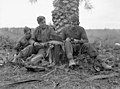 Infantrymen of The Loyal Edmonton Regiment operating a No. 18 wireless set outside Regimental Headquarters, Ortona, Italy, December 21, 1943


Post-War: Korea and NATO
[edit]On 4 May 1951, the regiment mobilized two temporary Active Force companies designated "E" and "F" Companies. "E" Company was reduced to nil strength when its personnel were incorporated into the 1st Canadian Infantry Battalion (later the 3rd Battalion, The Canadian Guards) for service in Germany with the North Atlantic Treaty Organization. It disbanded on 29 July 1953. "F" Company was initially used as a reinforcement pool for "E" Company. On 15 May 1952, it was reduced to nil strength, when its personnel were absorbed by the newly formed 2nd Canadian Infantry Battalion (later the 4th Battalion, The Canadian Guards) for service in Korea with the United Nations. "F" Company disbanded on 29 July 1953.[2]
Afghanistan
[edit]The regiment contributed an aggregate of more than 20% of its authorized strength to the various Task Forces which served in Afghanistan between 2002 and 2014.[5] It suffered three dead and numerous injured during this war.
Recent activities
[edit]The unit continues to carry out individual and small unit training locally and across Canada. The L EDMN R has continued to support NATO, UN, and Canadian domestic operations with multiple individual and group deployments.
The regiment expanded to Yellowknife, Northwest Territories, with the establishment of C Company, The Loyal Edmonton Regiment, in August 2009.[6]
In the summer of 2018, The Loyal Edmonton Regiment and Calgary Highlanders were tasked with standing up a mortar platoon that deployed to the Forward Presence Battle Group in Latvia in early 2020. This was the first Primary Reserve mortar platoon to deploy overseas.[7]
Lineage chart
[edit]| Lineage chart[8] | |||||||||||||||||||||||||||||||||||||||||||||||||||||||||||||||||||||||||||||||||||||||||||||||||||||||||||||||||||||||||||||||||||||||||||||||||||||||||||||||||||||||||||||||||||||||||||||||||||||||||||||||||||||||||||||||||||||||||||||||||||||||||||||||||||||||||||||||||||||||||||||||||||||||||||||||||||||||||||||||||||||||||||||||||||||||||||||||||||||||||||||||||||||||||||||||||||||||||||||||||||||||||||||||||||||||||||||||||||||||||||||||||||||||||||||||||||||||||||||||||||||||||||||||||||||||||||||||||||||||||||||||||||||||||||||||||||||||||||||||||||||||||||||||||||||||||||||||||||||||||||||||||||||||||||||||||||||||||||||||||||||||||||||||||||||||||||||||||||||||||||||||||||||||||||||||||||||||||||||||||||||||||||||||||||||||||||||||||||||||||||||||||||||||||||||||||||||||||||||||||||||||||||||||||||||||||||
|---|---|---|---|---|---|---|---|---|---|---|---|---|---|---|---|---|---|---|---|---|---|---|---|---|---|---|---|---|---|---|---|---|---|---|---|---|---|---|---|---|---|---|---|---|---|---|---|---|---|---|---|---|---|---|---|---|---|---|---|---|---|---|---|---|---|---|---|---|---|---|---|---|---|---|---|---|---|---|---|---|---|---|---|---|---|---|---|---|---|---|---|---|---|---|---|---|---|---|---|---|---|---|---|---|---|---|---|---|---|---|---|---|---|---|---|---|---|---|---|---|---|---|---|---|---|---|---|---|---|---|---|---|---|---|---|---|---|---|---|---|---|---|---|---|---|---|---|---|---|---|---|---|---|---|---|---|---|---|---|---|---|---|---|---|---|---|---|---|---|---|---|---|---|---|---|---|---|---|---|---|---|---|---|---|---|---|---|---|---|---|---|---|---|---|---|---|---|---|---|---|---|---|---|---|---|---|---|---|---|---|---|---|---|---|---|---|---|---|---|---|---|---|---|---|---|---|---|---|---|---|---|---|---|---|---|---|---|---|---|---|---|---|---|---|---|---|---|---|---|---|---|---|---|---|---|---|---|---|---|---|---|---|---|---|---|---|---|---|---|---|---|---|---|---|---|---|---|---|---|---|---|---|---|---|---|---|---|---|---|---|---|---|---|---|---|---|---|---|---|---|---|---|---|---|---|---|---|---|---|---|---|---|---|---|---|---|---|---|---|---|---|---|---|---|---|---|---|---|---|---|---|---|---|---|---|---|---|---|---|---|---|---|---|---|---|---|---|---|---|---|---|---|---|---|---|---|---|---|---|---|---|---|---|---|---|---|---|---|---|---|---|---|---|---|---|---|---|---|---|---|---|---|---|---|---|---|---|---|---|---|---|---|---|---|---|---|---|---|---|---|---|---|---|---|---|---|---|---|---|---|---|---|---|---|---|---|---|---|---|---|---|---|---|---|---|---|---|---|---|---|---|---|---|---|---|---|---|---|---|---|---|---|---|---|---|---|---|---|---|---|---|---|---|---|---|---|---|---|---|---|---|---|---|---|---|---|---|---|---|---|---|---|---|---|---|---|---|---|---|---|---|---|---|---|---|---|---|---|---|---|---|---|---|---|---|---|---|---|---|---|---|---|---|---|---|---|---|---|---|---|---|---|---|---|---|---|---|---|---|---|---|---|---|---|---|---|---|---|---|---|---|---|---|---|---|---|---|---|---|---|---|---|---|---|---|---|---|---|---|---|---|---|---|---|---|---|---|---|---|---|---|---|---|---|---|---|---|---|---|---|---|---|---|---|---|---|---|---|---|---|---|---|---|---|---|---|---|---|---|---|---|---|---|---|---|---|---|---|---|---|---|---|---|---|---|---|---|---|---|---|---|---|---|---|---|---|---|---|---|---|---|---|---|---|---|---|---|---|---|---|---|---|---|---|---|---|---|---|---|---|---|---|---|---|---|---|---|---|---|---|---|---|---|---|---|---|---|---|---|---|---|---|---|---|---|---|---|---|---|---|---|---|---|---|---|---|---|---|---|---|---|---|---|---|---|---|---|---|---|---|---|---|---|---|---|---|---|---|---|---|---|---|---|---|---|---|---|---|---|---|---|---|---|---|---|---|---|---|---|---|---|---|---|---|---|---|---|---|---|---|---|---|---|---|---|---|---|---|---|---|---|---|---|---|---|---|---|---|---|---|---|---|---|---|---|---|---|---|---|---|---|---|---|---|---|---|---|---|---|---|---|---|---|---|---|---|---|---|---|---|---|---|---|---|---|---|---|---|---|---|---|---|---|---|---|---|---|---|---|---|---|---|---|---|---|---|---|---|---|---|---|---|---|---|---|---|---|---|---|---|---|---|---|---|---|---|---|
| |||||||||||||||||||||||||||||||||||||||||||||||||||||||||||||||||||||||||||||||||||||||||||||||||||||||||||||||||||||||||||||||||||||||||||||||||||||||||||||||||||||||||||||||||||||||||||||||||||||||||||||||||||||||||||||||||||||||||||||||||||||||||||||||||||||||||||||||||||||||||||||||||||||||||||||||||||||||||||||||||||||||||||||||||||||||||||||||||||||||||||||||||||||||||||||||||||||||||||||||||||||||||||||||||||||||||||||||||||||||||||||||||||||||||||||||||||||||||||||||||||||||||||||||||||||||||||||||||||||||||||||||||||||||||||||||||||||||||||||||||||||||||||||||||||||||||||||||||||||||||||||||||||||||||||||||||||||||||||||||||||||||||||||||||||||||||||||||||||||||||||||||||||||||||||||||||||||||||||||||||||||||||||||||||||||||||||||||||||||||||||||||||||||||||||||||||||||||||||||||||||||||||||||||||||||||||||
Alliances
[edit]
Battle honours
[edit]In the list below, battle honours in capitals were awarded for participation in large operations and campaigns, while those in lowercase indicate honours granted for more specific battles. Those battle honours followed by a "+" are emblazoned on the regimental colour.[2]
-
The Regimental Colour
Great War
[edit]- Mount Sorrel+, 2–13 June 1916
- Somme, 1916+, 1 July–18 November 1916
- Flers–Courcelette+, 15–22 September 1916
- Ancre Heights, 1 October–11 November 1916
- Arras, 1917, 9 April–4 May 1917
- Vimy, 1917+, 9–14 April 1917
- Hill 70+, 15–25 August 1917
- Ypres, 1917, 31 July–10 November 1917
- Passchendaele+, 12 October 1917 or 26 October–10 November 1917
- Amiens+, 8–11 August 1918
- Arras, 1918+, 26 August–3 September 1918
- Scarpe, 1918+, 26–30 August 1918
- Hindenburg Line+, 12 September–9 October 1918
- Canal du Nord, 27 September–2 October 1918
- Pursuit to Mons+, 11 November 1918
- France and Flanders, 1915–18
Second World War
[edit]- Landing in Sicily+, 9–12 July 1943+
- Piazza Armerina, 16–17 July 1943
- Leonforte, 21–22 July 1943
- Agira, 24–28 July 1943
- Adrano+, 29 July–7 August 1943+
- Troina Valley, 2–6 August 1943
- Sicily, 1943, 9 July 1943 – 17 August 1943
- Colle d'Anchise, 22–24 October 1943
- The Gully, 10–19 December 1943
- Ortona+, 20–28 December 1943+
- Liri Valley+, 18–30 May 1944+
- Hitler Line, 18–24 May 1944
- Gothic Line+, 25 August–22 September 1944+
- Monteciccardo, 27–28 August 1944
- Monte Luro, 1 September 1944
- Rimini Line+, 14–21 September 1944+
- Pisciatello+, 16–19 September 1944+
- San Fortunato, 18–20 September 1944
- Savio Bridgehead+, 20–23 September 1944+
- Naviglio Canal+, 12–15 December 1944+
- Fosso Munio, 19–21 December 1944
- Italy, 1943–1945, 3 September 1943 – 22 April 1945
- Apeldoorn, 11–17 April 1945
- North-West Europe, 1945+
War in Afghanistan
[edit]- Afghanistan+[9]
Victoria Cross recipients
[edit]Regimental badge
[edit]The maple leaves symbolise service to Canada and the regiment's perpetuated units, the 51st and 63rd Battalions of the Canadian Expeditionary Force, and the crown, service to the Sovereign. The number 49 represents the service of the perpetuated unit, the 49th Battalion of the Canadian Expeditionary Force, and the windmill sails allude to the battlefields in Flanders on which the battalion fought in the First World War. The coyote's head commemorates "Lestock", a prairie coyote presented to the regiment as a mascot prior to the 49th Battalion's departure for overseas service in 1915. The red rose came from the badge of the former allied regiment The Loyal Regiment (North Lancashire) (now, through amalgamation, the Duke of Lancaster's Regiment). "THE LOYAL EDMONTON REGIMENT" is a form of the regimental title.[10]
Loyal Edmonton Regiment Military Museum
[edit]The Loyal Edmonton Regiment Military Museum is in Edmonton in the Prince of Wales Armouries Heritage Centre,[11] the building where the regiment was based from 1920 to 1965. The building also houses the City of Edmonton Archives[12] and the Telephone Historical Centre. The museum features two galleries and several smaller exhibits, and displays include historic firearms, uniforms, souvenirs, memorabilia, military accoutrements, and photos. The museum features an exhibit on the role of the 49th Battalion, CEF in Canada's Hundred Days Offensive.
Media
[edit]- A City Goes to War: History of the Loyal Edmonton Regiment (3PPCLI) by Lieut-Colonel G. R. Stevens (1964)
- Our Quarrel with the Foe: Edmonton's Soldiers 1914-1918 by Ian Edwards (2020)
Order of precedence
[edit]| History | |||
|---|---|---|---|
| Structure |
| ||
| Brigade groups |
| ||
| Support brigades | |||
| Small arms |
| ||
| Crewed weapons | |||
| Armoured fighting vehicles | |||
| Schools | |||


Notes
[edit]References
[edit].svg)
- ^ Brown, Scott R.G. (1984). The Loyal Edmonton Regiment at war, 1943-1945 (M.A. thesis) Wilfrid Laurier University
- ^ a b c d e f g h i Canadian Forces Publication A-DH-267-003 Insignia and Lineages of the Canadian Forces. Volume 3: Combat Arms Regiments.
- ^ Oxted & District Branch of The Royal British Legion website History pages.
- ^ Mithcham, Samuel and Friedrich von Stauffenberg The Battle of Sicily
- ^ "South-West Asia Theatre Honours | Prime Minister of Canada". Archived from the original on 2014-05-12. Retrieved 2014-05-11.
- ^ "MacKay makes Arctic army reserve unit official". CBC News. August 17, 2009. Retrieved September 13, 2011.
- ^ "Making a mortar platoon from scratch | Canadian Army Today".
- ^ "The Loyal Edmonton Regiment (4th Battalion, Princess Patricia's Canadian Light Infantry)". www.canada.ca. 2023-10-24. Retrieved 2025-08-11.
- ^ "South-West Asia Theatre Honours". Office of the Prime Minister of Canada. Archived from the original on 12 May 2014. Retrieved 11 May 2014.
- ^ "The Loyal Edmonton Regiment (4th Battalion, Princess Patricia's Canadian Light Infantry)". 29 October 2018.
- ^ "Prince of Wales Armouries Heritage Centre". City of Edmonton. Retrieved 19 August 2016.
- ^ "City of Edmonton Archives". City of Edmonton. Retrieved 19 August 2016.
External links
[edit]Loyal Edmonton Regiment
View on GrokipediaLineage
Formation and Origins
The 101st Regiment was authorized on 1 April 1908 in Edmonton, Alberta, as an infantry unit within the Non-Permanent Active Militia, marking Alberta's first such regiment.[1] This formation occurred amid broader Canadian militia expansion driven by rapid western settlement and the need for local defense capabilities, facilitated by the Militia Act of 1904, which modernized the force structure and enabled the creation of additional regiments in growing regions.[2] The regiment's establishment was spurred by strong local initiative in Edmonton, a city that had incorporated in 1904 and experienced explosive population growth from around 5,000 residents to approximately 18,500 by 1908 due to immigration and economic booms in rail and agriculture.[2][3] In 1907, a petition signed by approximately 500 Edmonton citizens urged the federal government to approve an infantry unit, reflecting community enthusiasm for military organization and civic pride amid the city's transformation into a regional hub.[2] Initially structured as a standard infantry regiment with headquarters in Edmonton, the 101st drew recruits from the city and nearby districts such as Strathcona and rural Alberta areas, forming companies that emphasized local enlistment to build regional cohesion.[4] Organization proceeded gradually compared to contemporaneous units like the 19th Alberta Mounted Rifles; the first instructional course for officers and non-commissioned officers occurred in January 1909 at McKay Avenue School, with annual training limited to one-week summer camps focused on basic drills and marksmanship.[2] Leadership was provided by Lieutenant-Colonel E.B. Edwards, appointed in late 1908, followed by Lieutenant-Colonel "Freddy" Carstairs until 1913, when Major F.A. Osborne took command.[2] On 1 March 1909, the regiment received its first formal designation update to the 101st Regiment "Edmonton Fusiliers," adopting the "fusiliers" title to evoke British infantry traditions and align with the unit's emerging identity tied to the city's namesake.[1] This change highlighted the regiment's roots in Edmonton's burgeoning civic and military culture, setting the stage for further evolution without altering its foundational infantry role.[2]Designations and Evolutions
Following the Great War, the regiment was redesignated as The Edmonton Regiment on 15 March 1920, organizing it as a multi-battalion infantry unit within the Non-Permanent Active Militia.[5] On 15 May 1924, the unit underwent a significant reorganization, splitting into two distinct entities: The Edmonton Fusiliers and The Edmonton Regiment, with the latter retaining the primary infantry role.[5] This division reflected broader efforts to specialize militia functions, though both components traced their roots to the original 101st Regiment Edmonton Fusiliers. During the Second World War, a reserve formation was established as the 2nd (Reserve) Battalion, The Edmonton Regiment, on 7 November 1940, to support mobilization and training efforts.[5] The designation evolved further to 2nd (Reserve) Battalion, The Loyal Edmonton Regiment, on 7 July 1943, incorporating the honorific "Loyal" to recognize its service and heritage.[5] By 1 November 1945, as wartime demands subsided, it was redesignated simply as The Loyal Edmonton Regiment, marking the end of the reserve battalion structure.[5] In the postwar period, the regiment integrated into larger Canadian Army structures, becoming The Loyal Edmonton Regiment (3rd Battalion, Princess Patricia's Canadian Light Infantry) on 19 October 1954, aligning it administratively with the regular force infantry regiment.[5] This affiliation continued with a shift to 4th Battalion designation on 1 April 1970, reflecting ongoing reorganizations within the Canadian Forces.[5] On 12 August 1977, the unit adopted a bilingual title, The Loyal Edmonton Regiment (4e Bataillon, Princess Patricia's Canadian Light Infantry), in line with official language policies.[5] Today, The Loyal Edmonton Regiment serves as a Primary Reserve infantry unit, maintaining its affiliation with Princess Patricia's Canadian Light Infantry.[5]Perpetuations
Great War Units
The Loyal Edmonton Regiment perpetuates three infantry battalions of the Canadian Expeditionary Force (CEF) from the First World War: the 49th Battalion (Edmonton Regiment), CEF; the 51st Battalion (Edmonton), CEF; and the 63rd Battalion (Edmonton), CEF.[1] These units, raised primarily from recruits affiliated with the 101st Regiment (Edmonton Fusiliers), played vital roles in sustaining Canadian infantry strength on the Western Front.[6] The 49th Battalion, authorized on 7 November 1914 and embarked from Canada on 3 June 1915, served as a frontline combat unit within the 7th Infantry Brigade of the 3rd Canadian Division.[1] It fought extensively in France and Belgium, contributing to key operations of the Canadian Corps, including the Battle of the Somme in 1916 where it participated in assaults at Flers-Courcelette and Ancre Heights; the capture of Vimy Ridge in April 1917; and the grueling advance at Passchendaele in late 1917.[1][6] The battalion endured heavy fighting across multiple fronts, also engaging at Mount Sorrel, Hill 70, Amiens, and the Pursuit to Mons in 1918, before disbanding on 15 September 1920.[1] Of the approximately 4,050 soldiers who served with the 49th Battalion during the war, 977 were killed or reported missing, with 2,282 wounded, reflecting the unit's significant sacrifices in bolstering Canadian advances.[7] In contrast, the 51st and 63rd Battalions functioned primarily as reinforcement and depot units. The 51st Battalion, authorized on 7 November 1914 and embarked on 1 April 1916, supplied trained personnel to frontline battalions like the 49th before reorganizing as a garrison duty battalion on 13 November 1916; its personnel were absorbed into other units on 22 June 1917 before being disbanded on 15 September 1920.[1] Similarly, the 63rd Battalion, authorized on 20 April 1915 and embarked on 22 April 1916, provided reinforcements until its absorption into the 9th Reserve Battalion on 7 July 1916, after which it disbanded on 1 September 1917.[1] Both units, recruited from Edmonton, ensured a steady flow of Edmonton-based soldiers to the Canadian Corps, indirectly supporting major engagements such as those at the Somme, Vimy Ridge, and Passchendaele through their reinforcement efforts.[6]Post-Great War Perpetuations
Following the Great War, the Loyal Edmonton Regiment experienced limited additional perpetuations, with its primary focus remaining on reinforcing the traditions and battle honours of its World War I predecessors, such as the 49th, 51st, and 63rd Battalions of the Canadian Expeditionary Force. No major new units were perpetuated post-1918, as the regiment's structure emphasized continuity through redesignations and reorganizations within the Canadian militia system. For instance, upon its formation as The Edmonton Regiment on 15 March 1920, the 1st Battalion explicitly perpetuated the 49th Battalion, inheriting its historical narrative and non-combat customs without incorporating fresh perpetuations from subsequent conflicts or formations.[1][8] A significant development in post-Great War perpetuations occurred through the regiment's affiliation with the Princess Patricia's Canadian Light Infantry (PPCLI) beginning in 1954, when it was redesignated The Loyal Edmonton Regiment (3 PPCLI). This affiliation, formalized under Canadian Army Order 76-3 on 19 October 1954, positioned the regiment as a reserve component of the PPCLI Regimental Family, leading to its renumbering as the 4th Battalion on 1 April 1970 following the establishment of a new regular-force 3rd Battalion. Through this relationship, the Loyal Edmonton Regiment inherited key PPCLI traditions, including the unofficial motto "Once a Patricia, Always a Patricia," shared regimental marches such as "Bonnie Dundee," and piping customs maintained by affiliated groups like the Edmonton Police Service Pipe Band, which was authorized to wear the PPCLI cap badge on 4 February 1972. These elements reinforced the regiment's role in perpetuating PPCLI's broader institutional heritage without introducing new unit perpetuations.[1][8][9] The regiment also played a vital role in preserving non-combat legacies from interwar militia units, particularly through its activities as a non-permanent active militia formation during the 1920s and 1930s. Amid economic challenges and limited government funding, the unit maintained essential training methodologies, such as annual camps and drill practices, which emphasized discipline, marksmanship, and community-based soldiering drawn from its pre-1918 roots. These efforts, documented in regimental histories covering the interwar period, ensured the continuity of militia traditions like volunteer service and local recruitment, even as the regiment faced reorganization in 1924 into The Edmonton Regiment and The Edmonton Fusiliers. By sustaining these practices, the Loyal Edmonton Regiment bridged the gap between wartime mobilization and peacetime readiness, fostering a resilient reserve force identity.[10][11]History
First World War
The 49th Battalion, Canadian Expeditionary Force (CEF), was authorized on 7 November 1914 and mobilized in Edmonton, Alberta, in January 1915 under the command of Lieutenant-Colonel William A. Griesbach, a Boer War veteran and former mayor of Edmonton.[1][8] Recruitment drew primarily from local militia units, including the 19th Alberta Dragoons and Edmonton Fusiliers, with initial training conducted in Edmonton amid the chaotic organization of the CEF under Minister of Militia Sam Hughes.[12] This peacetime preparation was limited, featuring weekly parades and annual camps in Calgary focused on musketry and basic drills, but it was hampered by inadequate facilities and equipment like the unreliable Ross Rifle.[12] By June 1915, the battalion, numbering about 1,100 officers and men, departed Edmonton by train and embarked from Montreal for England aboard the SS Metagama on 4 June, arriving at Devonport on 13 June for further training at Shorncliffe Camp.[1][13][14] The battalion disembarked in France on 9 October 1915, joining the 7th Infantry Brigade of the 3rd Canadian Division in the Ypres Salient, where it first saw action in trench warfare against German positions.[1] Over the course of the war, more than 5,000 personnel served with the unit through rotations and reinforcements, suffering over 3,500 casualties, including killed, wounded, and missing.[15] Key engagements included the defence at Mount Sorrel near Ypres in June 1916, where the battalion helped repel German counterattacks; the Battle of the Somme in September-October 1916, marked by assaults on Zollern and Regina Trenches that cost 253 casualties in days of intense fighting and earned Private John Chipman Kerr the Victoria Cross for capturing a German position single-handedly; and the capture of Vimy Ridge in April 1917, where the 49th provided critical support in mopping up trenches, constructing the Grange Subway tunnel, and evacuating wounded amid heavy artillery fire.[16][17] Further actions at Hill 70 in August 1917 saw the battalion consolidate gains against fierce German resistance, while at Passchendaele in October-November 1917, it endured mud-choked advances that yielded another Victoria Cross to Private Cecil Kinross for destroying a machine-gun nest.[8] The Hundred Days Offensive in 1918 culminated the unit's combat role, with advances through the Drocourt-Quéant Line and Canal du Nord contributing to the final push toward Mons. Command passed from Griesbach in February 1917 to subsequent officers, including Lieutenant-Colonel R.H. Palmer, who led during the later offensives.[8][18] The war-weary battalion returned to Canada, arriving in Edmonton on 22 March 1919 amid parades and receptions, before being demobilized and formally disbanded on 15 September 1920 as part of postwar reductions in the CEF.[1][8]Interwar and Reorganization Period
Following the end of the First World War, the 101st Regiment (Edmonton Fusiliers) underwent demobilization, with its units existing largely on paper amid severe budget cuts that left little funding for uniforms, equipment, or training in the early 1920s.[19] On 15 March 1920, it was redesignated as The Edmonton Regiment within the reorganized Non-Permanent Active Militia, structured with a 1st Battalion perpetuating the 49th Battalion, CEF, a 2nd Battalion perpetuating the 9th Battalion, CEF, and three reserve battalions (51st, 63rd, and 65th).[1] This reformation occurred at the Prince of Wales Armouries in Edmonton, renamed in 1921 and serving as the primary training facility for local militia units, including the regiment, which emphasized integration into Alberta's community through ceremonial duties and public events.[20] Participation remained low, with fewer than 100 officers and men active by the mid-1920s, reflecting post-war weariness and limited resources that restricted training to occasional officer and NCO camps until broader resumption in 1929 at Sarcee Camp near Calgary.[19] On 15 May 1924, The Edmonton Regiment was reorganized into two distinct regiments to allow for specialized infantry and support roles: The Edmonton Fusiliers (perpetuating the 9th Battalion lineage and later evolving into the 19th Alberta Dragoons) and The Edmonton Regiment (retaining the 49th Battalion perpetuation as its 1st Battalion, with 2nd and 3rd Battalions on reserve order).[1][8] This split enabled focused development, with the regiment prioritizing non-permanent active militia duties such as weekly drills, rifle practice at the Winterburn Range, and local defence preparations in Alberta, including enhanced marksmanship competitions and motor transport integration by the late 1930s.[21] The Great Depression profoundly affected the regiment's recruitment and readiness, exacerbating funding shortages that limited paid training to seven days annually at $1.25 per day for privates, supplemented by unpaid drills and community-provided refreshments.[21] Despite these constraints, the unit reached full strength by 1933, attracting unemployed men seeking structure and self-respect through uniforms and activities, though officer shortages persisted into 1934; it also fostered community ties in Alberta via sponsored sports teams and public band concerts.[21] In 1936, the reserve battalions were disbanded amid further militia reductions from 135 to 91 infantry regiments nationwide, yet the regiment maintained operational focus on local defence and ceremonial roles until the eve of the Second World War.[1][21]Second World War
Upon the outbreak of the Second World War, The Edmonton Regiment was mobilized on 1 September 1939 as part of the Canadian Active Service Force, with volunteers reporting for duty and temporary training facilities established in Edmonton, Alberta.[1][22] Equipped with new uniforms and undergoing initial inspections by senior officers including Major-General A.G.L. McNaughton, the unit departed Canada from Halifax aboard the Polish liner Batory on 17 December 1939, arriving in Glasgow on 31 December and proceeding to Aldershot, England, by early January 1940.[22] There, amid equipment shortages and severe winter conditions, the battalion conducted rigorous training focused on drill, route marches, and infantry tactics, redesignated as the 1st Battalion, The Edmonton Regiment, CASF, on 7 November 1940; redesignated the 1st Battalion, The Loyal Edmonton Regiment, on 7 July 1943; a company participated in the Spitzbergen raid in August 1941.[1][22] In July 1943, the battalion, now part of the 2nd Infantry Brigade within the 1st Canadian Infantry Division, landed on "Sugar" Beach during the Allied invasion of Sicily on 10 July as part of Operation Husky, facing light initial opposition but engaging in subsequent advances through towns like Modica and battles at Leonforte and Agira, where it captured key heights and inflicted significant losses on Axis forces.[23] Following the Sicilian campaign, it crossed to the Italian mainland on 3 September 1943 near Reggio di Calabria, initiating a grueling advance through rugged terrain, including actions at Colle d’Anchise and the Moro River crossing in December.[1][23] Under the command of Lieutenant-Colonel J.C. Jefferson, the unit played a pivotal role in the intense urban combat of the Battle of Ortona from 20 to 28 December 1943, employing house-to-house tactics and "mouse-holing" to clear German paratroopers along Corso Umberto I, securing the town at a cost of 172 casualties, including 63 killed.[23] The battalion continued through the Liri Valley offensive in May 1944, breaching the Hitler Line near Aquino despite heavy artillery and tank resistance, and later assaulted the Gothic Line in August–September 1944.[1][23] In early 1945, following the Italian campaign, the battalion transferred to Northwest Europe, joining the final push into Germany and participating in the liberation of Apeldoorn in April, where it accepted the surrender of German forces in the Netherlands.[1] Throughout the war, the 1st Battalion endured heavy losses, with over 300 fatal casualties recorded, reflecting the unit's central role in prolonged and fierce engagements.[24] A reserve component, the 2nd Battalion, The Loyal Edmonton Regiment, was mobilized on 18 March 1942 for home defence duties in Canada as part of the 6th and later 8th Canadian Infantry Divisions, providing coastal and internal security until its disbandment on 30 September 1943.[1] The overseas battalion was disbanded on 15 October 1945.[1]Postwar Operations
Korean War and Early Cold War
Following the Second World War, The Loyal Edmonton Regiment was reactivated as a militia unit and played a key role in Canada's response to the Korean War by mobilizing personnel for active service. On 4 May 1951, the regiment formed two temporary Active Force companies, designated "E" and "F," to support international commitments. "F" Company was specifically allocated for United Nations service in Korea, with its personnel absorbed into the 2nd Canadian Infantry Battalion (later designated as the 2nd Battalion, Princess Patricia's Canadian Light Infantry, or 2 PPCLI) on 15 May 1952, after the company was reduced to nil strength.[1] Over 200 former members of the regiment, including officers and non-commissioned officers, volunteered to reinforce 2 PPCLI during the conflict.[25] These Edmonton volunteers deployed with 2 PPCLI to Korea between 1951 and 1953, contributing to major engagements as part of the 27th British Commonwealth Infantry Brigade within the 1st Commonwealth Division. At the Battle of Kapyong on 24–25 April 1951, 2 PPCLI, bolstered by early reinforcements from units like The Loyal Edmonton Regiment, held off a massive Chinese offensive, preventing a breakthrough toward Seoul; the battalion suffered 10 killed and 23 wounded in the action. Similarly, during the Battle of Hill 355 in November 1951, Edmonton personnel among 2 PPCLI's ranks helped defend strategic positions against repeated assaults, though specific subunit casualties are not isolated in records. Overall, Canada's infantry in Korea, including those from The Loyal Edmonton Regiment, endured 1,558 casualties, with 516 fatalities across the war.[26][27][28] Notable recognition for Edmonton's contributions came through Lieutenant-Colonel James Riley Stone, a former commanding officer of The Loyal Edmonton Regiment, who led 2 PPCLI during Kapyong and subsequent operations; he was awarded a second bar to the Distinguished Service Order on 12 April 1952 for his leadership in repelling enemy attacks and securing objectives, actions that also earned the battalion a U.S. Presidential Unit Citation. The 2nd Canadian Infantry Battalion, incorporating Loyal Edmonton personnel, was disbanded on 29 July 1953 as the armistice took effect.[29] In the early Cold War period, the regiment underwent reorganization to align with NATO commitments. On 19 October 1954, it was redesignated The Loyal Edmonton Regiment (3rd Battalion, Princess Patricia's Canadian Light Infantry), affiliating formally with the regular force PPCLI to enhance integration and readiness for European deployments; this change retained the unit's traditions while supporting Canada's expanded NATO obligations amid post-Korean War budget constraints.[1][30]NATO Commitments and Cold War Era
Following its post-Korean War reorganization, The Loyal Edmonton Regiment was redesignated on 19 October 1954 as The Loyal Edmonton Regiment (3rd Battalion, Princess Patricia's Canadian Light Infantry), establishing a formal affiliation with the regular force Princess Patricia's Canadian Light Infantry (PPCLI) to support NATO commitments.[1] This affiliation positioned the regiment as a reserve battalion capable of providing reinforcements and trained personnel for PPCLI's deployments in Europe, aligning with Canada's broader NATO obligations under the 1949 North Atlantic Treaty.[25] As part of this structure, the regiment contributed to NATO training exercises in Europe, emphasizing rapid deployment and infantry augmentation for allied defense against potential Soviet threats.[10] In the 1950s, the regiment directly supported NATO brigade operations through the mobilization of "E" Company on 4 May 1951 for service in West Germany as part of the 1st Canadian Infantry Battalion, integrated into the 27th Canadian Infantry Brigade Group stationed in the Ruhr Valley.[1] This deployment, which lasted until the company's reduction to nil strength on 12 November 1951 and formal disbandment on 29 July 1953, exemplified the regiment's role in bolstering Canada's forward presence in Europe amid escalating Cold War tensions.[31] Throughout the 1960s, under the PPCLI affiliation, the regiment continued to supply personnel and conduct preparatory training for similar brigade support rotations to West Germany, maintaining readiness for NATO's central front defenses. It also engaged in annual NATO-oriented exercises such as REFORGER, which simulated rapid reinforcement of European allies, with contributions from affiliated reserve units like the Loyal Edmonton providing infantry elements for mobilization drills from Canadian bases.[32] By the 1970s and 1980s, amid federal budget constraints that reduced overall defence spending and prompted a shift toward a "total force" concept integrating reserves with regulars, the regiment was renumbered on 1 April 1970 as The Loyal Edmonton Regiment (4th Battalion, Princess Patricia's Canadian Light Infantry), solidifying its Primary Reserve focus on domestic training and augmentation rather than overseas rotations.[1] This transition emphasized generating combat-ready infantry for PPCLI's NATO needs while adapting to fiscal pressures that prioritized reserve efficiency over expanded active deployments.[33]Afghanistan and Modern Conflicts
The Loyal Edmonton Regiment began augmenting Canadian Armed Forces units deployed to Afghanistan in 2002 as part of Operation Athena, providing personnel for initial rotations focused on security and stabilization efforts in Kabul and surrounding areas. Over the 12-year span from 2002 to 2014, the regiment contributed an aggregate of more than 20% of its authorized strength to various task forces, enabling the unit to support NATO's International Security Assistance Force (ISAF) mission through individual and small-team augmentations.[1] A significant escalation in the regiment's involvement occurred with rotations to Kandahar Province between 2006 and 2011, where members served in force protection and support roles amid intensifying counter-insurgency operations. In early 2006, a 21-member platoon from the regiment, combined with 12 soldiers from the Calgary Highlanders, deployed as part of Task Force 1-06, conducting over 160 convoy escort patrols using G-Wagon and RG-31 vehicles from March to August. This deployment supported broader Canadian efforts in southern Afghanistan, including preparations for major offensives like Operation Medusa in September 2006, a NATO-led push to clear Taliban strongholds in the Panjwaii district. The platoon faced an ambush on February 28, 2006, without casualties, but later incidents included injuries to Lieutenant Doug Thorlakson on August 3, 2006, after he shielded a patrol from an explosion, and the death of Master Corporal Raymond F. Arndt on August 5, 2006, in a collision with a civilian truck during a patrol.[34] Subsequent rotations continued the focus on Kandahar, with 26 regiment members deploying in February 2008 as part of Task Force 1-08 attached to the Kandahar Provincial Reconstruction Team, where they provided force protection, escorted dignitaries, and trained Afghan National Army units in urban operations and checkpoints. On August 4, 2008, during a complex ambush in the Zhari district, Corporal Tyler Myroniuk and Warrant Officer Robin Crane demonstrated exceptional leadership under fire, suppressing enemy positions and evacuating wounded personnel; both received the Medal of Military Valour for their actions. In late 2009, another 25 members joined Task Force 3-09 for similar support duties, including patrols and mentoring, but suffered losses when Corporal Zachery W. McCormack was killed on December 30, 2009, after his LAV hit an improvised explosive device, and Corporal Joshua C. Baker died in a training accident on February 12, 2010, near Kandahar Airfield. Across these Kandahar rotations from 2006 to 2011, the regiment deployed a total of 86 personnel and sustained three fatalities.[34][35] Canada's combat role in Afghanistan transitioned to training and capacity-building by 2011, with the final Canadian military presence withdrawing in March 2014 after transferring responsibilities to Afghan forces. The regiment's experiences in convoy security, urban patrolling, and partnered operations against insurgents informed broader lessons for the Canadian Army's counter-insurgency doctrine, emphasizing adaptive tactics, cultural awareness, and integration with local forces in subsequent training programs.Recent Activities and Current Role
Deployments Since 2010
In August 2009, C Company of The Loyal Edmonton Regiment was established in Yellowknife, Northwest Territories, marking the first Primary Reserve infantry unit based north of the 60th parallel and extending the regiment's operational footprint across northern Alberta and the NWT into the following decade.[36] This expansion supported broader Canadian Armed Forces initiatives to enhance presence in the Arctic region, with the company contributing personnel to various augmentation tasks throughout the 2010s, including security roles during international events.[37] One of the regiment's notable international deployments since 2010 occurred in early 2020, when it led the formation and dispatch of a combined 81mm mortar platoon—comprising approximately 50 personnel from The Loyal Edmonton Regiment and supporting elements from the Calgary Highlanders—to NATO's Enhanced Forward Presence Battle Group in Latvia under Operation REASSURANCE.[38] Tasked in 2018 as the lead unit within 3rd Canadian Division, the platoon underwent intensive training from January 2019, including winter warfare exercises in Wainwright and Yellowknife, followed by live-fire validations, before deploying in January 2020 to provide indirect fire support to Lord Strathcona's Horse (Royal Canadians).[39] This marked the first Primary Reserve mortar platoon to deploy overseas as a formed sub-unit since the Yugoslavian operations in the 1990s, demonstrating the regiment's ability to rapidly build specialized capabilities for multinational deterrence missions.[38] Individual personnel from the regiment have continued to augment UN and other international missions, such as the 2010 training deployment to Sierra Leone under Operation SCULPTURE, while the unit as a whole maintains readiness for NATO commitments.[36] By 2025, ongoing rotational contributions to Operation REASSURANCE in Latvia persisted, with Edmonton-based soldiers participating in six-month deployments to the Multinational Brigade as part of Canada's enhanced NATO presence.[40] These efforts, alongside annual Remembrance Day commemorations hosted by the regiment—such as the November 11, 2025, ceremony at Edmonton City Hall—underscore its sustained operational readiness and ties to alliance obligations.[41]Training and Domestic Operations
The Loyal Edmonton Regiment (LER), a Primary Reserve infantry unit, is headquartered at the Brigadier James Curry Jefferson Armoury in Edmonton, Alberta, with C Company detachment based in Yellowknife, Northwest Territories. As part of 41 Canadian Brigade Group under the 3rd Canadian Division, the regiment provides light infantry capabilities, including a dedicated mortar platoon equipped with 81-mm tubes for tactical fire support. This structure enables the LER to maintain readiness for both routine reserve duties and augmentation to regular forces as needed.[42][37] The regiment's annual training cycle runs from September to June, featuring Thursday evening sessions from 6:30 p.m. to 10:00 p.m. and one full weekend per month, supplemented by full-time summer employment from May to August. Basic infantry training forms the core, covering weapons handling, individual and section tactics, patrolling, reconnaissance, fieldcraft, navigation, winter operations, combat first aid, and unarmed combat, delivered through weekly drills at local facilities. Advanced elements include specialized instruction in urban operations, enabling soldiers to maneuver in built-up environments, as well as airmobile, amphibious, mountain, and arctic warfare to adapt to varied terrains. Joint exercises with the 3rd Canadian Division occur during monthly field training weekends and concentrated summer periods at national centres like the 3rd Canadian Division Training Centre in Wainwright, Alberta, focusing on collective skills such as platoon-level maneuvers and integration with other brigade elements.[42][43][44] Domestically, the LER supports non-combat operations, including disaster response and sovereignty assertion. Its Yellowknife detachment assisted in the 2016 Fort McMurray wildfire response, aiding evacuations and relief efforts alongside other Canadian Armed Forces elements. Sovereignty patrols, led by C Company in the Arctic, contribute to operations like NANOOK-NUNALIVUT, conducting patrols and exercises to demonstrate Canada's presence in northern territories. Community engagement remains a key function, with members participating in local events, parades, and outreach programs in Edmonton and Yellowknife to build public support and regimental ties.[45][46][47] Recruitment emphasizes part-time volunteers who balance service with civilian lives, enrolling Canadians aged 16 to 57 who meet medical and aptitude standards. The process involves application through local recruiters, followed by basic military qualification training at divisional centres. As of 2025, the regiment sustains its roles through ongoing recruitment drives, with the mortar platoon exemplifying specialized units of around 50 personnel trained for indirect fire support. This volunteer model ensures a flexible force ready for domestic augmentation while fostering community integration.[42][48]Traditions and Symbols
Battle Honours
The Loyal Edmonton Regiment has earned a distinguished array of battle honours reflecting its service in major conflicts, awarded under the Canadian Forces policy that recognizes units for creditable participation in specific battles or theatre operations. According to the Department of National Defence, battle honours are granted to combatant units that are committed to an action, actively engage the enemy, and perform a significant role, with theatre honours requiring presence for at least one day and completion of allotted tasks; these honours are approved by the Chief of the Defence Staff and the Governor General, and select ones are emblazoned on regimental colours to commemorate the regiment's heritage.[49] The regiment's honours trace back to its predecessor, the 49th Battalion (Edmonton Regiment), Canadian Expeditionary Force, and encompass actions from the First World War through modern operations.First World War Honours
The regiment's First World War battle honours, primarily from the 49th Battalion's engagements on the Western Front, total 16, with 15 emblazoned on the regimental colours. These include:- Mount Sorrel, 2-13 June 1916
- Somme, 1 July–18 November 1916
- Flers-Courcelette, 15-22 September 1916
- Ancre Heights, 1-11 October 1916
- Arras, 9 April–4 May 1917
- Vimy, 9-14 April 1917
- Hill 70, 15-25 August 1917
- Ypres, 31 July–10 November 1917
- Passchendaele, 26 October–10 November 1917
- Amiens, 8-11 August 1918
- Arras, 26 August–3 September 1918
- Scarpe, 26-30 August 1918
- Hindenburg Line, 12 September–9 October 1918
- Canal du Nord, 27 September–2 October 1918
- Pursuit to Mons, 10-11 November 1918
- France and Flanders, 1915-18
Second World War Honours
During the Second World War, the regiment, as part of the 2nd Canadian Infantry Brigade, earned 24 battle honours for its campaigns in Sicily, Italy, and Northwest Europe, with select ones emblazoned on the colours. The list comprises:- Landing in Sicily, 9-12 July 1943
- Piazza Armerina, 16-17 July 1943
- Leonforte, 21-22 July 1943
- Agira, 24-28 July 1943
- Adrano, 29 July–7 August 1943
- Troina Valley, 2-6 August 1943
- Sicily, 9 July–17 August 1943
- Colle d’Anchise, 22-24 October 1943
- The Gully, 10-19 December 1943
- Ortona, 20-28 December 1943
- Liri Valley, 18-30 May 1944
- Hitler Line, 18-24 May 1944
- Gothic Line, 25 August–22 September 1944
- Monteciccardo, 27-28 August 1944
- Monte Luro, 1 September 1944
- Rimini Line, 14-21 September 1944
- San Fortunato, 18-20 September 1944
- Pisciatello, 16-19 October 1944
- Savio Bridgehead, 20-23 October 1944
- Naviglio Canal, 12-15 December 1944
- Fosso Munio, 19-21 December 1944
- Italy, 3 September 1943–22 April 1945
- Apeldoorn, 11-17 April 1945
- Northwest Europe, 1945