Hubbry Logo
CalpeCalpeMain
Open search
Calpe
Community hub
Calpe
logo
8 pages, 0 posts
0 subscribers
Be the first to start a discussion here.
Calpe
Calpe
from Wikipedia

Calpe (Spanish: [ˈkalpe]; Valencian: Calp [ˈkalp])[2][3] is a coastal municipality located in the comarca of Marina Alta, in the province of Alicante, Valencian Community, Spain, by the Mediterranean Sea. It has an area of 23.5 km2 (9.1 sq mi) and a population density of 990 inhabitants per square kilometre (2,600/sq mi). The city lies at the foot of the Penyal d'Ifac Natural Park. In 2022 the population was 24,096 inhabitants.[4]

Key Information

The economy of Calpe is based mainly on tourism and fishing. Many Iberian, Roman and Arab archeological sites exist in the town because of its strategic coastal location.

The Prime Meridian crosses Calpe.

History

[edit]

There are some remains that testify to the presence of inhabitants in the region of Calpe in prehistoric times; some remains date back to the Bronze Age. The first buildings were introduced by the Iberians, constructed on the higher grounds.

The Penyal d'Ifac (in Spanish Peñón de Ifach) was the natural lookout for the inhabitants that lived in the surrounding areas. Another lookout was the Morro de Toix Mountain, from which the Mascarat Ravine, an essential passage along the coast, could be controlled. The area gained in importance during the Romanization of the Iberian Peninsula. The township's proximity to the sea favoured marine trade and fish factories. Evidence is at the historical site Els Banys de la Reina (the Queen's Baths).

After the Arabs conquered Iberia, they built a castle overlooking the Mascarat Ravine. When the area was conquered by the Crown of Aragon, the Muslim administration was maintained: small townships set apart and protected by a castle or fortress. Therefore, the inhabitants of the region were dependent upon the Castle of Calpe.

In 1290, Calpe came under the control of the Aragonese admiral Roger of Lauria, who ordered that a village named Ifach to be built in the proximity of the Rock of Ifach. In 1359, the battle between the then monarch Peter IV of Aragon and Peter I of Castile in the War of the Two Peters caused the destruction of Ifac and a surge in the population of the Alqueria (from the Arabic Al-garya, meaning the "small town"). This rural building, generally constructed on mountainsides, is of an austere nature and simple design. It is made up of one or two floors at the most, with just the one gallery. In 1386, the administrative unit of the Castle of Calpe was divided into the towns currently known as Benissa, Teulada, Calpe, and Senija.

In 1637, concurrently with the raid on Ceriale and Borghetto, Algerian barbary pirates launched an incursion targeting Calpe. During this invasion, the Corsairs devastated the coastal areas of Valencia, leading to the enslavement of 315 individuals, mostly women and children.[5][6][7][8] In the 17th century, there was an increase in the population, which gave rise to the consolidation of Calpe.

Towards the mid-18th century, several projects arose to build a new fortified wall around the township because by then, the increase in the population forced many inhabitants to live outside the protection of the existing walls. During the 19th century, the village developed towards the west. The basic axis of growth was along the route between Altea and Alicante.

During the second half of the 19th century, the fishing industry began to take off throughout the region. Buildings, such as the Fisherman's Cooperative, were constructed and functioned alongside several existing factories dating from the end of the 18th century. These buildings, however, were not a nucleus of population dedicated to fishing activities.

In 1918, the El Saladar salt flats were cleaned up, and the production of salt could once again take place. Thanks to the technical innovations of the times, bigger fishing vessels were constructed. The first small hotels arose in the area surrounding Els banys de la Reina and the Racó Beach, and catered to the emerging middle classes. The summer tourist trade increased substantially with the construction of the Ifach Parador in 1935.

Between 1945 and the end of the 1950s, many holiday villas and small hotels were built to accommodate the flourishing summer tourist trade. The hotel trade in the region is located almost exclusively on the coastal area. During the second half of the 1960s, as happened along the rest of the Costa Blanca, there was a tremendous boom in construction in Calpe because of political change and the emergence of tourism as a phenomenon of the masses. In the late 1960s and early 1970s, Calpe became the filming location for the films of Spanish Film director Jesus Franco.

Main sights

[edit]
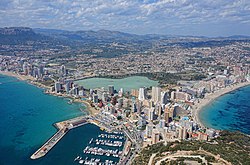
View of Calpe and the Penyal d'Ifac

Some of the most important monuments are the ruins of Els banyas de la reina (the queen's baths), the flooded salt flats, a bird sanctuary for migratory birds, its Gothic Catholic church and the 18th-century tower of La Peça.

The Penyal d'Ifac Natural Park is also a popular tourist destination.

Twin towns

[edit]

Calpe is twinned with:

References

[edit]
[edit]
Revisions and contributorsEdit on WikipediaRead on Wikipedia
from Grokipedia
Calpe (Valencian: Calp) is a coastal in the Marina Alta comarca of the , within the of , situated on the as part of the renowned region. This picturesque town, with a of 27,614 inhabitants as of 2025—over half of whom are foreign nationals— is best known for the iconic Peñón de Ifach—a towering 332-meter that rises dramatically from the , serving as a natural reserve and a defining landmark that bisects the . Historically, Calpe has been inhabited since prehistoric times, with evidence of settlements by Iberian, Phoenician, and Roman civilizations, who utilized the site's strategic vantage for and surveillance; later influences include medieval fortifications from the and a seafaring tradition tied to that persists today. The town's geography features over 13 kilometers of coastline, encompassing fine-sand beaches like Arenal-Bol and La Fossa, as well as rocky coves such as Les Bassetes and La Manzanera, making it a prime destination for sunbathing, water sports, and hiking. Calpe's economy revolves around tourism, which draws visitors for its mild climate, cultural heritage—including Roman baths known as Baños de la Reina and a Gothic-Mudejar church in the historic quarter—and local gastronomy featuring fresh seafood, rice dishes, and Valencian wines. Fishing remains a vital sector, with the Fisherman's Association, established in 1924, managing a fleet that auctions around 1,700 metric tons of catch annually, including species like whiting, squid, and lobster. The Peñón de Ifach Nature Reserve, declared in 1987, protects diverse flora and fauna, offering trails for exploration and underscoring Calpe's commitment to environmental preservation amid its growth as a popular resort for European tourists.

Geography

Location and topography

Calpe is situated on the eastern coast of at approximately 38°38′N 0°02′E, within the Marina Alta of province in the , along the renowned stretch of the Mediterranean shoreline. This positioning places it about 64 km northeast of city and 120 km south of , integrating it into a region characterized by Mediterranean coastal influences and proximity to major transport routes like the N-332 highway. The town's layout reflects its dual nature, divided into the historic Old Town, known as El Centro, with its narrow, whitewashed streets and traditional architecture, and the modern beachfront district of Arenal-Bol, featuring contemporary hotels and promenades along sandy beaches. These areas are physically separated by the imposing Peñón de Ifach, a 332-meter-high that protrudes dramatically from the sea, creating a natural divide and defining the urban topography. The Peñón de Ifach serves as a prominent and anchors the Peñón de Ifach Natural Park, a spanning 45 hectares established in 1987 to preserve its unique ecosystems and geological significance. Surrounding the town, the topography transitions from rugged coastal elevations to inland features, including the Sierra de Toix mountains to the south, which form a ridge extending into the and marking the boundary between the Marina Alta and Marina Baja regions. To the north and east, flat coastal plains dominate, incorporating the salinas or salt flats, a shallow system of about 41 hectares formed in a alluvial depression influenced by the Peñón's positioning and a double sandbar. Geologically, the Peñón de Ifach represents a remnant of tectonic uplift within the Betic Cordillera, where Miocene-era plate movements elevated ancient formations from marine origins to their current prominence above level.

Climate

Calpe experiences a hot-summer classified as Csa under the Köppen system, featuring mild winters with occasional rainfall and hot, arid summers dominated by clear skies and high sunshine hours. This classification reflects the region's typical Mediterranean pattern, where dry conditions prevail from through early fall, moderated by its coastal location along the . Average high temperatures in summer reach 28–30°C (82–86°F) from June to September, while winter lows hover around 8–10°C (46–50°F) during December to February, with rare frosts due to the sea's warming influence. Annual precipitation totals approximately 400–500 mm, concentrated primarily in the fall, particularly October and November, when stormy weather brings the bulk of the year's rain; summers, by contrast, see minimal rainfall, often less than 20 mm per month. These seasonal variations create a reliably sunny environment, with over 2,800 hours of sunshine annually. The iconic Peñón de Ifach rock formation plays a key role in shaping local microclimates, acting as a that shelters adjacent bays from and fosters slightly milder, more stable conditions in enclosed coastal areas compared to exposed parts of the coastline. This reduces wind exposure in sheltered zones, though occasional strong northerly or easterly winds—locally influenced by broader Mediterranean patterns—can introduce gusts up to 40 km/h, particularly in winter and spring. Recent climate trends from 2020 to 2025 highlight escalating challenges for Calpe, including heightened risks amid prolonged dry spells that strained until heavy rains in early 2025 alleviated some pressure, and gradual —projected at 15–60 cm by 2100 in Mediterranean coastal zones—threatening erosion of beaches and . These shifts have led to warmer overall averages, with 2025 marking Spain's hottest summer on record, featuring intense heatwaves with peaks exceeding 45°C in southern regions, exacerbating and in this vulnerable coastal setting.

History

Ancient history

Phoenician traders arrived in the region around 950 BCE, establishing outposts along the to facilitate maritime commerce in metals, ceramics, and preserved fish products. The Peñón de Ifach served as a key vantage point for these settlers, who named it the "Rock of the North" to distinguish it from the southern Pillar of at (Kalpe). Excavations at the rock's base have uncovered traces of early fish-salting facilities, underscoring the site's role in the Phoenician network of Mediterranean trading posts that integrated local Iberian populations through economic exchange. Subsequent to Phoenician influence, the earliest evidence of more substantial human activity in the Calpe area dates to the Iberian period, with settlements established on the western slopes of the Peñón de Ifach rock formation during the 4th and 3rd centuries BCE. These Iberian communities, part of the broader Contestani tribe in eastern , utilized the site's strategic elevation for defense and oversight of coastal routes. Archaeological remnants, including and structural foundations, indicate small-scale agricultural and villages that were later abandoned as Roman influence expanded. Following Rome's victory in the Second Punic War (218–201 BCE), the area around Calpe fell under Roman control as part of the newly formed province of (later Tarraconensis) in 197 BCE, marking the onset of systematic colonization along the eastern Iberian coast. Roman settlers developed the site, known then as Ifach or variably linked to the classical "Calpe" designation associated with Gibraltar's Mons Calpe, into a prosperous coastal focused on maritime activities. Key archaeological evidence includes the Baños de la Reina complex, a 2nd–4th century CE installation featuring rock-hewn pools for , thermal baths, and salting vats (salazones) for producing , a fermented fish sauce central to and trade. This site, sheltered by the Peñón de Ifach, exemplifies the integration of elite residential structures with industrial facilities, supporting export of preserved seafood to broader Mediterranean markets. Inscriptions on amphorae fragments from Calpe and nearby ports confirm the production and shipment of high-quality variants, such as those from , highlighting the economic vitality of the region under imperial oversight. Additional Roman-era findings include a near the with urns, like glassware and coins, and epigraphic evidence of local trade networks, reflecting a diverse population of veterans, merchants, and laborers. By the late CE, Roman Calpe experienced decline amid the broader instability of , exacerbated by Visigothic incursions starting around 409 CE, which disrupted coastal settlements and shifted power dynamics toward inland strongholds.

Medieval and modern history

During the Moorish period from the 8th to 13th centuries, Calpe fell under Muslim rule following the conquest of the Iberian Peninsula, with Arab settlers developing agricultural systems that included advanced irrigation techniques to support intensive farming in the arid coastal region. The settlement, organized as an alquería or rural estate, benefited from these innovations, which enhanced land productivity around the Peñón de Ifach; salt flats in the area, exploited since Roman times, were integrated into local economy for fish preservation, a practice continued and documented under Moorish administration from as early as the 8th century. Fortifications like watchtowers, precursors to later structures such as the Torre de la Peça, were established to defend against regional conflicts. The Reconquista brought Calpe under Christian control in 1238 as part of James I of Aragon's conquest of the Kingdom of Valencia, marking the end of direct Moorish dominance in the area. Integrated into the Crown of Aragon, the town received feudal land grants to encourage Christian repopulation, blending remaining Muslim agricultural knowledge with new settlers' practices; this transition is commemorated annually through the Moros y Cristianos festivals, which recall the clashes between Moorish and Christian forces. The alquería of Calpe was further fortified in the 13th-14th centuries with structures like the Torre de la Peça to safeguard against lingering Muslim incursions from North Africa. In the early modern era spanning the 16th to 19th centuries, Calpe endured persistent threats from Barbary piracy, prompting extensive defensive measures including city walls and tower reinforcements; the Torre de la Peça was repaired under Charles V in the 16th century, and major raids occurred in 1637 and 1744, leading to heightened vigilance tied to local patron saint devotions. As a modest fishing village, the economy centered on maritime activities, bolstered by salt production at the El Saladar flats, which supplied preservation needs for catches and was formally documented from 1510 onward, enabling trade with inland areas. By the 19th century, westward expansion of the village reflected gradual recovery from piracy disruptions, with saltworks remaining vital until their decline in the late 18th century due to environmental issues. The 20th century saw Calpe recover from the devastation of the , which ended in the region with Alicante's fall in March 1939, ushering in Franco's dictatorship and economic stagnation until post-war stabilization. A tourism boom emerged in the , fueled by Spain's opening to international visitors and infrastructure like the N-332 highway, developed in the mid-20th century to connect coastal routes and facilitate mass access to the . This shift urbanized the once-rural community, with hotel construction surging and salt production restarting in 1918 before phasing out by the 1980s. In recent years, including 2025, municipal expansions emphasize sustainability, as seen in the approved €54.9 million budget investing in , drainage improvements, and ; the Urban Agenda outlines projects until 2030 to enhance competitiveness and inclusivity, securing EU funds for environmental restoration and .

Demographics

Population statistics

As of 1 January 2025, Calpe's resident population stood at 27,616, marking an increase of 795 individuals from the 26,821 recorded the previous year, equivalent to an annual growth rate of approximately 3%. This figure is derived from the Instituto Nacional de Estadística (INE)'s annual revision of the padrón municipal, Spain's official municipal register that tracks residents based on continuous updates from local authorities, including registrations, deregistrations, and vital events. Historically, Calpe's has experienced significant expansion, rising from 2,177 inhabitants in 1960 to the current level, with particularly rapid growth accelerating after the amid the rise of . The spans 23.51 km², yielding a of 1,175 inhabitants per km² as of 2025. The age distribution reflects a balanced demographic structure, with approximately 17% of residents under 18 years old and 28% over 65 as of 2022, highlighting an aging segment typical of Mediterranean resort towns. While the padrón captures year-round , Calpe's swells seasonally during summer months, reaching up to approximately visitors and temporary combined as of 2025, though these fluctuations are not included in official resident counts. The foreign influx has notably contributed to recent growth, as explored further in demographic composition analyses.

Ethnic and linguistic composition

Calpe's ethnic composition is markedly diverse, with foreign-born comprising 56.4% of the as of 2025, according to the Instituto Nacional de Estadística (INE). This proportion positions Calpe as the only major in where the foreign-born outnumbers locals, surpassing even some smaller towns in foreign resident density. The main groups hail from the and , which together form over 20% of the foreign , alongside significant presences from , , and other countries such as , reflecting migration patterns driven by , retirement, and economic opportunities. Linguistically, Spanish and Valencian hold co-official status in Calpe as part of the , with both used in administration and . English serves as a in tourism-heavy zones like the Arenal-Bol beachfront, facilitating communication among the international . While specific rates vary, the town's expat density fosters widespread use of multiple languages in daily interactions. Integration efforts are supported by local initiatives, including the Welcome School program launched by Calpe Town Council in October 2025, which provides voluntary training for migrants on key topics such as procedures, , , and healthcare to ease settlement. Cultural enclaves enhance community cohesion, notably the cluster of British-style pubs in the Arenal-Bol district, which act as social hubs for expatriates and preserve elements of their heritage amid the multicultural fabric. Post-2020 pandemic trends have amplified this diversity through an influx of remote workers, particularly from , drawn to Calpe's reliable , scenic environment, and digital nomad-friendly amenities like coworking spaces. This shift has further strengthened the Northern European contingent, contributing to sustained and economic vitality.

Economy

Tourism industry

Tourism serves as the cornerstone of Calpe's , functioning as the primary source of income and for the local population. The sector drives substantial economic activity through visitor spending on accommodation, dining, and services, with average daily expenditure per tourist estimated at approximately €57 per person excluding lodging and transportation. In recent years, has solidified its role as the dominant industry, outpacing traditional sectors like and contributing to the town's overall prosperity amid post-pandemic recovery. Calpe welcomed nearly 300,000 tourists in 2024 and achieved record summer occupancy rates in 2025—reaching 79.87% in June, 81.26% in July, and 82.5% in August—fueled by strong domestic and international demand. The influx reflects a broader rebound, with the Marina Alta , including Calpe, seeing over 1.5 million visitors annually in 2024; the broader province () welcomed nearly 8 million international visitors that year. This surge underscores tourism's scale, supporting local businesses and infrastructure development while highlighting the town's appeal as a Mediterranean destination. Preliminary data for 2025 indicate continued growth, with historic highs in summer occupancy. Accommodation infrastructure in Calpe includes a wide range of options such as hotels, apartments, and homes, catering to diverse preferences. A notable 2025 development is the expansion and refurbishment of the Puerto Blanco marina, adding 140 berths for sports boats and jet skis, along with commercial spaces, promenades, and enhanced beach access to boost . Visitor preferences in Calpe lean heavily toward holidays, cited as the primary motivation by 80.4% of tourists, followed by the favorable at 76.2% and natural resources at 32.3%. and account for a significant portion, while events and festivities attract about 10-20% of visitors, particularly during peak season from to when occupancy nears 90%. Spanish nationals dominate summer stays, comprising over 67% of overnight visitors, complemented by international arrivals from . Natural attractions, such as the iconic Peñón de Ifach, further enhance the appeal for outdoor enthusiasts. To mitigate environmental pressures, Calpe has implemented sustainability initiatives through its Tourism Sustainability Plan (2021-2026), funded by Next Generation funds totaling over €2 million. Allocated €470,000 for green transitions includes efforts to reduce plastic waste via awareness campaigns like "Take Care of Calpe Today. Enjoy It Forever," which promotes responsible practices among visitors and businesses. Additional measures address through improved , energy efficiency projects (€510,000), and digital tools for better visitor flow, earning recognition for climate adaptation planning. The plan also features online training for tourism operators on accessibility and eco-friendly operations, positioning Calpe as a forward-thinking destination.

Fishing and other sectors

Fishing remains a of Calpe's traditional economy, centered around its historic port where a local fleet operates using methods such as and trammel netting. The annual catch totals approximately 1,700 tons of fish, with key including sardines and anchovies. Daily auctions take place at the Lonja de Calpe, a modern facility built in 1991, where fresh hauls are weighed, displayed electronically, and bid on by buyers from to starting at 5:00 p.m. This seafaring activity not only sustains local livelihoods but also intersects briefly with , as visitors observe the lively proceedings at the port. However, the sector grapples with challenges from EU fishing quotas and proposed reductions in allowable fishing days, prompting protests by Calpe's fishermen and calls from local authorities for policy adjustments since 2020. Salt production at the Salinas de Calpe has roots dating to , evolving from Roman-era operations that integrated with nearby fish salting for preservation. The site reached peak activity in the 19th and early 20th centuries, supplying salt to over 40 surrounding towns for industrial and food uses. Commercial exploitation continued sporadically until 1988, after failed revival attempts in the 1980s with modern techniques, after which the area was designated a protected maritime-terrestrial reserve in to prioritize ecological conservation over extraction. Beyond and historical salt works, Calpe's features small-scale , with crops like olives and almonds cultivated on limited in the surrounding Marina Alta region, contributing to local self-sufficiency and regional exports. The real estate sector is expanding rapidly, driven by demand for residential and properties, with house prices in the North increasing by 13.3% year-on-year as of September 2025 amid broader growth. Minor and services include boat repair operations, supported by several specialized firms offering maintenance, carpentry, and engine work for the local maritime community. Employment in and represents a modest share of Calpe's workforce, contrasting with the dominance of services; nationally, these primary sectors account for about 3.6% of jobs in as of 2023, while services encompass 76.5%, a disparity likely more pronounced in tourism-reliant Calpe.

Government and administration

Local governance

Calpe's local governance is administered by the Ayuntamiento de Calpe, a municipal council comprising 21 elected councilors responsible for policy-making and oversight. The council is led by (Alcaldesa) Ana Mª Sala Fernández of the Somos Calpe party, who was invested in June 2023 following the municipal elections, with support from PSPV-PSOE and Compromís coalitions. In November 2025, Juan Manuel del Pino, the first lieutenant alcalde and number two in Somos Calpe, resigned from his position as concejal after contributing to the approval of the 2026 municipal budget. The 2025 municipal budget totals €54.9 million, marking a 16.93% increase from the previous year and prioritizing infrastructure development—such as €250,000 for accessibility and pavement maintenance, road extensions, and €1.07 million for drainage systems—and environmental protection, including €57,439 for solar panels at public facilities. Key policies emphasize sustainability and , exemplified by the Tourism Sustainability in Destination Plan (PSTD), which funds projects like the Fester Museum construction to promote eco-friendly tourism, and initiatives to improve pedestrian mobility, such as the installation of an in the historic center connecting to the Old Town. Municipal services include via three urban bus lines (L1, L2, and L3) that link residential areas, the beach, and the station, operating on fixed routes with fares starting at €1.45 for a single ticket. is handled through a zoned collection system, with rates adjusted in late to reflect generation levels—ranging from €133 to €351 annually per household based on location—and ongoing efforts to optimize disposal via the Consorci Mare.

Twin towns and sister cities

Calpe maintains formal relationships with two municipalities, fostering international cooperation, cultural exchanges, and historical ties through reciprocal visits and joint events. These partnerships aim to promote friendship, share experiences in and local , and strengthen European unity. The longest-standing partnership is with in Cádiz, , established in October 1989 and officially ratified in 2001 during a visit by Puerto authorities to Calpe. This twinning originated from historical migration patterns, as many Calpe fishermen sought refuge and settled in El Puerto during the 1920s to 1940s due to economic hardships in the region. Activities include annual group exchanges, such as the 2024 visit by nearly 100 Calpe residents to participate in the centenary celebrations of El Puerto's fishermen's cofradía, featuring guided tours of landmarks like the Plaza de Toros and Basílica de Nuestra Señora de los Milagros, along with official welcomes and cultural receptions. These exchanges reinforce familial and community bonds, contributing to Calpe's among its foreign residents. Calpe's twinning with , , was formalized in the early 2000s, marking over 25 years of collaboration by 2025. The partnership emphasizes cultural and economic cooperation, with both towns designating public spaces in honor of each other, such as a plaza in Calpe named after . Key activities involve musical and commemorative events, including the de Calpe's performance alongside a during a 2023 exchange and a Calpe delegation's attendance at 's 800th anniversary celebrations in June 2025, which featured historical retrospectives, concerts, and choral performances. Ongoing plans include further joint initiatives proposed by local associations to enhance and artistic exchanges. Additionally, Calpe is developing a partnership with , , initiated in 2022 to promote friendship and experience-sharing between Mediterranean coastal communities; preliminary activities, such as a 2023 concert by the de Calpe, have occurred, with formalization anticipated. These relationships collectively support Calpe's integration of international residents by facilitating understanding.

Culture

Festivals and traditions

Calpe's festivals and traditions reflect a blend of historical reenactments, religious devotion, and community celebrations that draw residents and visitors alike. One of the most prominent events is the Moors and Christians festival, held annually from mid to late October, which reenacts the 13th-century Christian reconquest of the through elaborate parades, mock battles on Arenal Beach, and fireworks displays including the "" in Plaza Mayor. First organized in 1977, the festival is coordinated by the Calpe Association of Moors and Christians, with locals participating in period costumes and marching bands, fostering a strong sense of communal heritage. The year begins with the Parade on , a vibrant Epiphany celebration featuring elaborate floats, costumed performers, and the distribution of gifts to children along routes through central streets like Avenida Gabriel Miró. This tradition emphasizes family involvement and magical storytelling, with the arriving by boat at the port before parading inland. Other notable events include the FiraCalp gastronomic fair, spanning three to four days from late May to early June in Plaza Mayor, where local vendors offer foods, music performances, and trade exhibits to highlight Calpe's culinary and commercial culture. In August, the Patrons' Day festivities honor the Virgin of the Snows, Calpe's co-patron , with solemn processions, floral offerings, and culminating on August 5. Traditions extend to the Bonfires of San Juan on June 23, where communities gather on Arenal-Bol for ritual bonfires, fireworks, and symbolic acts like jumping over flames for purification and good fortune, rooted in pagan and Christian customs. Reflecting Calpe's multicultural resident base, particularly its British expatriate community, British-style Halloween events occur in late October, including costume parties and family activities at venues like Plaza Central, blending international influences with local observance. These festivals significantly engage the community, with organizations like festival committees and guilds mobilizing volunteers for planning and execution, while attracting thousands of attendees annually to reinforce social bonds and cultural identity. For 2025, events like FiraCalp feature expanded programming with additional performances to enhance accessibility and participation.

Local cuisine

Calpe's local cuisine is deeply rooted in its Mediterranean coastal location, emphasizing fresh from the Bay of Calpe and simple, flavorful preparations that reflect the town's fishing heritage. Signature dishes highlight this bounty, such as llauna de Calp, a traditional or bake featuring assorted local like conger eel or monkfish layered with sliced potatoes and ripe tomatoes, cooked slowly to meld the flavors of sea and garden produce. Another staple is , a humble dish originating from fishermen who used unsold catch to make a rich ; the is simmered in this stock and served separately from the to preserve its delicate texture, often accompanied by garlic alioli. Additional signature preparations include arròs del senyoret, a dish with peeled such as , mussels, and prawns in stock, and arroz negro, a dry cooked with cuttlefish ink and bay . Seafood dominates the menu, drawing directly from daily bay catches that supply ingredients for various stews and grilled dishes. These elements underscore Calpe's reliance on sustainable practices, with fresh bay hauls providing the core of many recipes. Desserts lean toward traditional sweets like , the almond-based for which nearby is renowned, often enjoyed as a post-meal treat. Beverages include robust local wines from the Marina Alta subzone of the Alicante DO, such as crisp whites from moscatel grapes or full-bodied reds that pair well with . The tapas culture thrives in the Old Town's bustling bars, where of marinated anchovies or fried calamari encourage leisurely socializing. The dining scene encompasses over 380 restaurants, ranging from casual beachfront chiringuitos to upscale venues, with several earning recognition for innovative takes on regional fare—such as Beat, which holds one star for its refined Mediterranean fusion. In 2025, trends emphasize sustainable sourcing, aligning with Alicante's designation as Spain's Capital of Gastronomy, promoting local prawns and eco-friendly practices through events like tastings and showcookings.

Tourism and attractions

Natural features

Calpe's natural landscape is dominated by the Peñón de Ifach Natural Park, a compact 53.3-hectare reserve (extended in 2015) encompassing a striking outcrop rising 332 meters above the . This protected area, declared a natural park in 1987, supports a diverse Mediterranean shrubland ecosystem with over 300 plant species, including aromatic herbs like and , as well as rare endemics adapted to the rocky terrain. The park's cliffs and slopes host significant fauna, notably breeding populations of birds of prey such as the (Falco peregrinus) and (Falco eleonorae), alongside seabirds including Audouin's gulls (Ichthyaetus audouinii) and European shags (Gulosus aristotelis). A well-marked 3- to 4-hour round-trip trail ascends to the summit via a and steep paths, offering panoramic viewpoints of the coastline while traversing this . Access requires a free daily permit (limited to 300 hikers), reservable online via the official park website. Beyond the Peñón, the Morro de Toix cliffs, rising over 200 meters along Calpe's northern edge, provide another key habitat for , with such as the blue rock thrush (Monticola solitarius), black wheatear (Oenanthe leucura), and Alpine swifts (Tachymarptis melba) nesting in the crags. To the south, the Las Salinas salt flats form a vital hypersaline spanning approximately 40 hectares, serving as a stopover for migratory birds and hosting a resident colony of greater flamingos (Phoenicopterus roseus), which thrive on the nutrient-rich populations. This lagoon supports up to 173 bird in total, underscoring its role in regional avian . The broader ecology of Calpe features classic Mediterranean maquis vegetation, characterized by drought-resistant shrubs and communities that stabilize the arid soils against . In the marine realm, the bay surrounding the Peñón includes meadows of , an endemic that oxygenates waters, sequesters carbon, and shelters and ; these beds are monitored as part of efforts to establish a . Conservation initiatives emphasize the Peñón de Ifach's status as an EU site (codes ES0000459 for birds and ES5211009 for ), which mandates protection of its endemic and breeding colonies through regulated access and restoration. Ongoing projects address from and climate impacts, including shrub planting and soil stabilization along trails. The salt flats benefit from local wetland management to maintain salinity levels for flamingo habitats, while marine protections limit anchoring to preserve integrity.

Historical and cultural sites

Calpe's historical and cultural sites offer a glimpse into the town's layered past, from Roman engineering to medieval fortifications and . The Roman ruins at Baños de la Reina, dating to the 2nd century AD, consist of rock-hewn pools, galleries, and tunnels originally used as a farm and possibly thermal baths, reflecting the importance of maritime resources in ancient Roman coastal settlements. These well-preserved structures, located along the shoreline near the salt flats, demonstrate advanced hydraulic techniques and are now a protected accessible for public visitation. In the medieval period, defensive structures like the Torre Moli del Morelló, a 16th-century circular later adapted in the mid-19th century as a , highlight Calpe's vulnerability to pirate raids along the . Built from local stone with a spiral staircase connecting its two floors, the tower provided surveillance over the western approaches to the town and was later adapted for milling grain. Similarly, the Iglesia Vieja, or Old Church, constructed in the early 15th century in Mudejar-Gothic style atop an earlier from the Christian , served dual purposes as a and a fortified refuge against invasions. Though partially ruined over time due to structural damage and 18th-century reconstructions, its robust walls and Gothic arches remain a testament to the town's defensive architecture during the medieval era. The Museo de Historia de Calpe, housed in the restored 18th-century Casa de la Senyoreta, curates archaeological collections spanning to , including Bronze Age tools like grinders and sickles from the Cosentari site, as well as Iberian pottery from the 4th–1st centuries BC and Roman artifacts such as amphorae and coins. These exhibits provide insight into Calpe's role in ancient trade networks, with displays emphasizing the transition from Iberian settlements to Roman villas. Admission to the is free, and it operates seasonally with guided explanations available. Calpe's Old Town exemplifies traditional Valencian architecture through its whitewashed houses clustered around narrow cobblestone streets, featuring wooden balconies and wrought-iron grilles that evoke 18th- and 19th-century fishing village life. The adjacent Plaza Mayor serves as the cultural heart of this district, hosting events and markets while undergoing periodic urban improvements to enhance pedestrian access and integrate historical elements with modern amenities. Guided tours of the Old Town and key sites like Baños de la Reina and the Iglesia Vieja are offered year-round, often free or at low cost (€3–5 for specialized visits), attracting approximately 200,000 annual visitors to these heritage locations combined.

Beaches and recreational activities

Calpe's coastline features a variety of beaches that cater to different preferences, from expansive sandy stretches to secluded coves ideal for water-based exploration. The prominent Playa del Arenal-Bol is a 4-kilometer-long expanse of golden sand, renowned for its family-friendly atmosphere and Blue Flag certification, which recognizes its high standards of cleanliness, safety, and environmental management. Smaller coves such as Calalga and La Manzanera offer pebbly shores and calm, clear waters particularly suited for , with underwater rock formations and attracting enthusiasts seeking a more intimate coastal experience. Recreational activities in Calpe emphasize water sports and outdoor pursuits, enhanced by the area's mild that supports year-round engagement. Kayaking and stand-up paddleboarding are popular, with rentals available at rates around €20 per hour for individual kayaks or paddleboards from local operators along the beaches. Coastal cycling paths provide scenic routes for leisurely rides, such as the trail from Calpe to , offering views of the shoreline while accommodating both casual and more dedicated cyclists. Nearby, the Ifach Golf Club in features a challenging nine-hole course with sea vistas, open to visitors for a relaxed day on the greens. Beyond water and , Calpe supports diverse recreation options including charters that depart from the , allowing participants to target species like and under guided excursions. retreats are increasingly available, with venues like Oasis Yoga Retreat offering sessions in luxury settings focused on and wellness amid the coastal backdrop. In 2025, new bike infrastructure developments, including upgraded lanes on Avenida de los Ejércitos Españoles, enhance accessibility for trails along the coast. Beach facilities prioritize and inclusivity, with lifeguards stationed during peak season from June to September and ramps provided at main beaches like Arenal-Bol and La Fossa for those with reduced mobility. These amenities contribute to handling daily crowds that can reach up to 10,000 visitors in high summer, ensuring a managed environment for relaxation and activities.

References

Add your contribution
Related Hubs
User Avatar
No comments yet.