Hubbry Logo
CavettoCavettoMain
Open search
Cavetto
Community hub
Cavetto
logo
8 pages, 0 posts
0 subscribers
Be the first to start a discussion here.
Cavetto
Cavetto
from Wikipedia

Cavetto moulding
Illustrations of various examples of ancient Egyptian cornices, all of them having cavettos

A cavetto is a concave moulding with a regular curved profile that is part of a circle, widely used in architecture as well as furniture, picture frames, metalwork and other decorative arts. In describing vessels and similar shapes in pottery, metalwork and related fields, "cavetto" may be used of a variety of concave curves running round objects. The word comes from Italian, as a diminutive of cave, from the Latin for "hollow" (it is the same root as cave).[1] A vernacular alternative is "cove", most often used where interior walls curve at the top to make a transition to the roof, or for "upside down" cavettos at the bases of elements.[2]

The cavetto moulding is the opposite of the convex, bulging, ovolo, which is equally common in the tradition of Western classical architecture. Both bring the surface forward and are often combined with other elements of moulding. Usually, they include a curve through about a quarter-circle (90°).[3] A concave moulding of about a full semi-circle is known as a "scotia".[4]

Only a minor element of decoration in classical architecture, the prominent cavetto cornice is a common feature of the ancient architecture of Egypt and the Ancient Near East.

Architecture

[edit]

Ancient Egyptian architecture made special use of large cavetto mouldings as a cornice, with only a short fillet (plain vertical face) above, and a torus moulding (convex semi-circle) below. This cavetto cornice is sometimes also known as an "Egyptian cornice", "hollow and roll" or "gorge cornice", and has been suggested to be a reminiscence in stone architecture of the primitive use of bound bunches of reeds as supports for buildings, the weight of the roof bending their tops out.[5]

The Egyptian Building (1845) in Richmond, Virginia, with massive cavetto cornice and bell capitals

Many types of Egyptian capitals for columns are essentially cavettos running round the shaft, often with added decoration. These include the types known as "bell capitals" or "papyrus capitals". These features are often reproduced in Egyptian Revival architecture, as in the Egyptian Building (1845) in Richmond, Virginia.[6]

The cavetto cornice, often forming less than a quarter-circle, influenced Egypt's neighbours and as well as appearing in early Greek architecture, it is seen in Syria and ancient Iran, for example at the Tachara palace of Darius I at Persepolis, completed in 486 BC. Inspired by this precedent, it was then revived by Ardashir I (r. 224–41 AD), the founder of the Sasanian dynasty.[7]

The cavetto took the place of the Greek cymatium in many Etruscan temples,[8] often painted with vertical "tongue" patterns, and combined with the distinctive "Etruscan round moulding", often painted with scales.[9]

The Tachara palace of Darius I at Persepolis, completed in 486 BC

This emphasis on the cavetto was very different from its role in mature Ancient Greek architecture, where cavetto elements were relatively small and subordinated to essentially vertical elements, setting the style for the subsequent Western classical tradition.[10] Often an essentially cavetto section is heavily decorated, in Gothic architecture often smothering the shape beneath.

In general, the Greeks made much more use of the cyma moulding, where a cavetto and ovolo were placed one above the other to produce an "S" shape; the cymatium using this was a standard part of the cornice in the classical Ionic order, and often used elsewhere. There are two forms, depending on which curve is uppermost: in the cyma recta, the cavetto is on top, in the cyma reversa, the ovolo. A cavetto alone was sometimes employed in the place of the cymatium of a cornice, as in the Doric order of the Theatre of Marcellus in Rome,[8] one of the standard models for revived classical architecture from the Renaissance onwards.[11] But small cavetto mouldings were normal at various places, including integrated ones, not distinguished as a distinct zone by lines or borders, at the bottom of the shaft of columns, beginning the transition to the wider base. These are called an apophyge, or "concave sweep".[12]

Claude Perrault, one of the architects of Louis XIV's rebuilding of the Louvre Palace, especially the Louvre Colonnade, explained in his architectural textbook Ordonnance for the five kinds of columns after the method of the Ancients (1683) why he had replaced a cavetto with a cyma in his illustration of the Doric capital: "a cavetto is not as strong and is more readily broken than the other molding".[13]

Vessels

[edit]
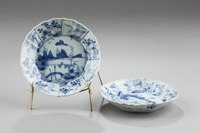
Ming dynasty dish in blue and white porcelain. The cavetto is demarcated by pairs of thin blue lines, and has running scroll decoration, different to that on either side of it in the flat middle and rim.

In plates and other flattish shapes, cavetto is used for the curving area linking the base and the rim. This is the case whether the rim is a broad flat surface (typical 20th-century Western plate), or merely the edge of the cavetto (typical modern cereal bowl). Normally, the term refers to the top surface of the vessel; if the underside is meant (where the curve is now convex), that may be described as "under the cavetto", "under-cavetto" and so forth.[14]

The cavetto is very often left undecorated, but may have decoration of a different sort from the middle or a flat rim, and the term is typically used when it is necessary to describe this. In complicated pottery shapes, where the normal vocabulary of mouldings is appropriate, cavetto may be used in that sense for any concave curving section.[15]

In the terminology of archaeology, especially relating to pottery (and generally not used of pottery after antiquity, or outside archaeology), a cavetto zone or cavetto is a "sharp concavity encircling the body of a vessel", and also a "deep but narrow neck", both used in relation to mainly upright vessels for storing or cooking food.[16]

See also

[edit]

Notes

[edit]

References

[edit]
Revisions and contributorsEdit on WikipediaRead on Wikipedia
from Grokipedia
A cavetto is a concave molding in , featuring a smooth, hollowed-out curve with a profile that approximates a quarter circle. This element, derived from the Italian term cavetto meaning "little hollow," originates from the Latin cavus for hollow, and serves as a decorative and transitional feature between surfaces. In ancient Egyptian architecture, the cavetto gained prominence as a key component of the cavetto cornice, a decorative ledge crowning pylons, gateways, and temple walls, often paired with a torus molding below and sometimes adorned with stylized leaves to evoke bundled papyrus motifs. This form, harkening back to early building materials like reed bundles, symbolized stability and divine order, and persisted through the New Kingdom period in monumental structures like those at Karnak. The cavetto's use extended into Persian, classical Greek, and Roman architecture, where it appeared in cornices, column capitals, and entablatures as a concave counterpart to convex moldings like the ovolo, providing visual delicacy and shadow play. In later periods, including Renaissance and neoclassical designs, architects revived the cavetto for its proportional elegance, integrating it into doorways, window surrounds, and furniture detailing to enhance spatial transitions and ornamental harmony.

Definition and Characteristics

Definition

A cavetto is a concave molding featuring a regular curved profile that forms approximately a quarter-circle arc, or 90-degree segment of a circle, in cross-section. This design creates an inward, hollow curve, distinguishing it as a fundamental element in classical architectural ornamentation. The term "cavetto" derives from the Italian word cavetto, a diminutive of cavo meaning "hollow" or "scoop," which traces back to the Latin cavus signifying "hollow" and emphasizing the molding's recessed form. In English-speaking contexts, particularly for interior applications such as transitions, it is often referred to as a "" molding. As the concave counterpart to the convex molding, which shares a similar quarter-circle profile but projects outward, the cavetto provides visual contrast in decorative schemes. A deeper variant with a semi-circular concave profile is known as a , whereas the cavetto specifically adheres to the quarter-circle configuration. In , it commonly appears in cornices and other trim elements to soften junctions between surfaces.

Profile and Variations

The cavetto molding features a geometric profile consisting of a quarter-circle curve in cross-section, forming a smooth concave transition between adjacent surfaces without sharp edges. This design creates a hollowed effect that emphasizes fluidity and subtle depth, with the radius scaled proportionally to the overall size of the molding to maintain visual harmony. In some instances, the profile approximates a quarter-ellipse for varied , allowing for nuanced adaptations while preserving the essential concave form. Common variations of the cavetto include flattened or elongated curves seen in neoclassical interpretations, which soften the arc for a more restrained aesthetic suitable to modern proportions. It is frequently combined with a —a convex, rounded base molding—to enhance depth and create layered profiles, as in composite bases where the cavetto provides an upper concave element atop the torus swell. These modifications allow the cavetto to integrate seamlessly into diverse stylistic contexts while retaining its core concave character. Cavetto moldings are crafted from materials such as stone, wood, plaster, or metal, each influencing the execution of the curve's smoothness and its interaction with light. The polished or carved surface of the profile modulates shadow play, casting graduated shadows that deepen toward the lower edge and reflect light softly along the upper curve, thereby accentuating architectural transitions. In classical orders, the cavetto's height typically equals its projection, embodying a quarter-circle proportion that contributes significantly to the overall molding assembly.

Historical Origins and Development

Ancient Egyptian Beginnings

The cavetto molding first emerged in during , around 3000 BCE, specifically by the early 3rd Dynasty as evidenced in the complex at . This form developed from archaic tent-shrines constructed of timber and matting, with its concave profile imitating the unbound fringe of woven reed mats or bundled stalks used in early structures. These natural materials, drawn from the Nile's abundant vegetation, not only provided a practical model but also carried symbolic connotations tied to the river's fertility and the sustenance it offered Egyptian civilization. In its primary application, the cavetto served as a crowning element in cornices atop pylons, gateways, and facades, frequently paired with a molding below to replicate the structural beams and overhanging of primitive wattle-and-daub huts translated into stone. This combination created a distinctive profile that transitioned from battered walls to a flat roof, enhancing both aesthetic and functional aspects of monumental buildings in temples and tombs. Notable examples include the naos of Pepy I from the 6th Dynasty at , where the cavetto crowns the housing divine statues, and later adaptations in the Middle and New Kingdoms, such as the naos of at (12th Dynasty) and the temple pylons at constructed under (c. 2000–1000 BCE). In these structures, the molding provided a overhang that shielded interiors from direct and occasional , contributing to the preservation of mud-brick and stone elements. Symbolically, the cavetto cornice represented a protective enclosure for sacred spaces, evoking the encompassing sky and elements of solar religion associated with cosmic rebirth and the sun god's daily arc across the horizon. Its gentle curve mirrored the sun's path, often emphasized by a winged sun disk emblem atop the profile, while the form itself safeguarded divine images within shrines during rituals and processions. In some instances, the molding was painted or carved with hieroglyphic inscriptions detailing royal titles or protective spells, further integrating it into the religious and cosmological framework of Egyptian architecture. The concave design aided durability by directing water away from walls, a practical feature that supported the longevity of these enduring monuments in Egypt's harsh climate.

Spread to Greek, Roman, and Persian Architecture

The cavetto molding, originating in , spread to the Mediterranean and through extensive trade networks and military conquests that facilitated cultural exchanges. Phoenician merchants and intermediaries played a key role in transmitting Egyptian architectural motifs westward via maritime routes connecting to the and , while Persian conquests under in 525 BCE directly incorporated Egyptian elements into Achaemenid building practices during periods of rule over (525–404 BCE and 343–332 BCE). Etruscan traders further bridged these influences to early Roman and Greek contexts by exchanging goods and ideas with both Egyptian-linked Phoenicians and emerging Greek colonies in around the 8th–6th centuries BCE. In Greek architecture from approximately 800–300 BCE, the cavetto was adopted on a smaller scale compared to its bold Egyptian profiles, primarily as an apophyge—a concave sweep at the base and top of columns—to create a smooth transition between the shaft and adjoining elements. This form appeared in bases, where it formed part of the Attic base consisting of tori separated by a cavetto, and in Ionic orders as a secondary crowning or base molding, often less prominent and integrated into harmonious proportions emphasizing optical refinements like . Unlike the symbolic, overhanging Egyptian cavetto cornices, Greek applications focused on structural subtlety, as seen in temple bases at sites like and , where the cavetto supplemented profiles without dominating the overall composition. Roman architects from around 500 BCE to 400 CE expanded the cavetto's use beyond column elements, incorporating it into entablatures, arches, and bed moldings for both functional and decorative purposes, often enriching it with motifs like egg-and-dart to add rhythmic ornamentation. In structures such as theaters and basilicas, the cavetto appeared in cornice profiles and archivolts, blending with ovolo and cyma reversa to achieve greater depth and shadow play, reflecting Rome's synthesis of Greek restraint with imperial scale. This evolution marked a shift from the Greek emphasis on proportional harmony to Roman practicality, where the cavetto supported larger, more varied building programs across the empire. In Persian architecture, particularly during the Achaemenid period around 486 BCE, the cavetto reemerged in a revived form as an "Egyptianizing" in doorways, blending direct Egyptian influences from conquests with local motifs such as lotus patterns and painted details. At ' Tachara , built by Darius I, the central doorway featured a cavetto with traces of decoration, including on leaves, which elevated the molding's symbolic role in royal contexts while adapting it to Persian columned halls and plans. Later Sasanian structures under (224–241 CE) continued this hybrid, using cavetto profiles in arches and portals to evoke imperial continuity, though with increased integration of Zoroastrian . Overall, the cavetto's transmission led to evolutionary refinements: from the ' bold, protective symbolism to the ' and Romans' proportional elegance, and the ' ornate synthesis, prioritizing aesthetic balance and cultural fusion across regions.

Architectural Applications

Use in Cornices and Entablatures

In cornices, the cavetto molding forms the upper concave curve, serving as a prominent feature that creates a defined shadow line and aids in directing rainwater away from building walls to prevent erosion and moisture damage. This profile, approximating a quarter-circle or quarter-ellipse, is particularly characteristic of architecture, where it crowns the tops of pylons, walls, and shrines, often paired with a molding below for added projection and stability. In such contexts, the cavetto functions as the uppermost element, enhancing the horizontal emphasis of rooflines while providing a clean termination to vertical surfaces. Within classical entablatures, the cavetto integrates into the bedmolding of the , positioned below the sima or cymatium and above the in Doric and Ionic orders, to offer a smooth visual transition from the structural mass of walls to the overhanging roof. As described in treatises by , Palladio, and , it occupies specific proportional segments, ensuring harmonic scaling with columns and capitals. This placement contributes to the overall order's character, balancing projection and depth in structures like temples and porticos. The functional advantages of the cavetto's concave form include improved drip edges that minimize water pooling along roof edges and enhanced aesthetic depth via contrasting light and shadow, which accentuates architectural contours under varying illumination. Ornamentally, it is often enriched with carved motifs such as vertical leaves in Egyptian examples or dentils and astragals in classical variants, while in neoclassical revivals of the 18th and 19th centuries, it evokes ancient precedents through simplified profiles or subtle foliation like acanthus. In grand-scale applications, such as major temple complexes, the cavetto's radius scales proportionally to achieve dramatic visual impact, sometimes reaching significant dimensions to match monumental proportions.

Applications in Doorways, Windows, and Columns

In ancient entrances, the cavetto molding frequently crowned the lintels and architraves of doorways and portals, creating a curved, concave profile that softened the transition from the vertical jambs to the horizontal elements above, thereby enhancing the grandeur of sacred spaces. This feature, often paired with a torus molding below, symbolized bundled reeds or palm fronds in stylized form and was integral to false doors in tombs and temples, where it framed symbolic passages for the ka spirit. In Roman architecture, similar cavetto profiles appeared in portal architraves and arch edges, contributing to the majestic scale of triumphal arches and temple facades by providing a gentle inward that directed visual emphasis upward. For window surrounds, the cavetto served as a coved framing element around sills and heads, particularly in and neoclassical buildings, where it created subtle recesses that diffused incoming light and added depth to interior elevations. This application emphasized the molding's role in vertical framing, contrasting with its horizontal uses in cornices by focusing on the interplay of light and shadow within openings. In columnar architecture, the cavetto formed the apophyge, a concave sweep at the base and upper edge of the shaft, facilitating a smooth visual flow from the base or capital to the main body of the column. This element, often a quarter-round profile, marked the transition in classical orders, including the composite capital where concave curves integrated with acanthus leaves and volutes for rhythmic progression. In Vitruvian principles of symmetry and proportion, such moldings aligned with modular systems derived from column diameters, ensuring harmonious scaling in temple and civic structures without specific fractional ratios dominating the design. Aesthetically, the cavetto's recessed form generated shadows that accentuated facade depth and promoted a sense of lightness and continuity in vertical elements.

Applications in Decorative Arts

In Pottery and Vessels

In pottery and vessels, the cavetto refers to a concave molding with a cross-section approximating a quarter circle, typically forming the sloping inner sides of a or the curving transition zone between the base and body or body and rim of a vessel. This profile is often left plain and undecorated to emphasize the overall symmetry and form of the object. Archaeological examples illustrate the cavetto's early adoption in ceramic forms. Neolithic pottery sherds, such as those held in the , feature a distinct cavetto zone below an everted rim, tempered with flint and , and dated to circa 4000–2500 BCE. These fragments suggest the profile's role in prehistoric vessel for everyday or ritual use. In East Asian ceramics, the cavetto appears prominently in (1368–1644 CE) porcelain dishes from , where subtle curving transitions in the cavetto support underglaze blue decorations, such as bands of rocks, trees, and birds, enhancing both aesthetic balance and structural integrity. The functional role of the in lies in its contribution to vessel stability through smooth, even across the curved zone, while also enabling ergonomic handling by providing a natural contour for gripping or pouring. Decorative treatments on the cavetto vary by ; in some prehistoric pottery, the zone is incised or painted with horizontal bands of motifs, reflecting influences from architectural moldings like cornices. The cavetto's presence in vessels underscores a broader cultural continuity from architectural elements to portable decorative arts. This adaptation highlights the profile's versatility across materials and regions, bridging monumental design with utilitarian craft.

In Furniture, Framing, and Other Crafts

In furniture design, the cavetto molding, characterized by its concave quarter-circle profile, has been employed since ancient times to add graceful curvature to structural elements. Ancient Egyptian carpenters incorporated the cavetto, often paired with a torus molding below, on the edges of boxes and tables dating back to the Third Dynasty, enhancing both functionality and aesthetic appeal through its hollowed form. This profile transitioned into later revival styles, such as Victorian Egyptian Revival furniture, where it appeared on items like music cabinets; for instance, a 1874 cabinet by Doe & Hunnewell featured a cavetto cornice with incised lotus motifs, blending ancient Egyptian ornamentation with Western cabinetry techniques. In 19th-century American furniture, heavy cavetto moldings were used on pier mirrors and sideboards, as seen in Baltimore cabinetmaker John Needles' designs, where the profile provided a terminating edge to frames and tabletops. The cavetto's versatility extends to modern , where it serves as a simple molding for edges on furniture components like schoolboxes, rails, and , often cut using planes or router bits to create subtle hollows without requiring extensive finishing. Tools such as the CMT Cavetto Edge Mold router bit facilitate its application in creating traditional profiles on tabletops or drawer fronts, emphasizing the molding's role in softening transitions between surfaces. Additionally, in furniture legs, the cavetto appears in bun feet designs, such as 4.5-inch rubberwood or versions, which provide a classical, rounded base for tables and cabinets. In picture framing, the cavetto molding has been a recurrent element since the 19th century, particularly in American gilded frames, where its concave quarter-circle shape functions as a sight edge to frame artwork elegantly while reflecting architectural influences from Greek and Roman precedents. This profile often pairs with fillets or tori in water-gilded constructions, as documented in early 19th-century treatises, allowing for burnished finishes that highlight the curve's depth. Historically, it contributed to the evolution of frame designs, appearing in both straight-line and formats to create visual depth without ornate embellishment. Beyond furniture and framing, the cavetto finds application in other crafts such as and architectural woodwork, where it acts as a transitional molding between walls and ceilings or in decorative panels, valued for its ability to introduce concave elegance in . In Rococo-inspired pieces, a variant of the cavetto—concave and less than a quarter-circle—adorns furniture edges and small-scale carvings, maintaining the profile's historical role in softening geometric forms.

References

Add your contribution
Related Hubs
User Avatar
No comments yet.