Hubbry Logo
CavtatCavtatMain
Open search
Cavtat
Community hub
Cavtat
logo
8 pages, 0 posts
0 subscribers
Be the first to start a discussion here.
Contribute something
Cavtat
Cavtat
from Wikipedia

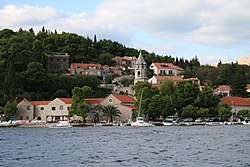
Cavtat (Croatian pronunciation: [t͡sǎʋtat],[3] Italian: Ragusa Vecchia, lit.'Old Ragusa') is a village[4] in the Dubrovnik-Neretva County of Croatia. It is on the Adriatic Sea coast 15 kilometres (9 miles) south of Dubrovnik and is the centre and the main settlement of Konavle municipality.

Key Information

History

[edit]

Antiquity

[edit]

The original city was founded by the Greeks settlers from Corinth[5] in the 6th century BC under the name of Epidaurus (or Epidauros, Greek: Ἐπίδαυρος).[6][7] The surrounding area was inhabited by the Illyrians, who called the city Zaptal.[8]

The town changed its name to Epidaurum when it came under Roman rule in 228 BC. Justinian I the Emperor of the Byzantine Empire sent his fleet to Cavtat during the Gothic War (535–554)[9] and occupied the town.

Monastery of Our Lady of the Snow

The city was sacked and destroyed by the Avars and Slavs in the 7th century.[10] Refugees from Epidaurum fled to the nearby island, Laus (Ragusa), which over time evolved into the city of Dubrovnik.[11]

Middle Ages

[edit]

The town was re-established in the Middle Ages (Italian: Ragusa Vecchia).[12][13] After a short while it came under the control of its powerful neighbor, the Republic of Ragusa.

The modern Croatian name for the city reveals its ancient origins and its link with Dubrovnik. Cavtat is derived from Civitas Vetus, which means old city in Latin Language.

Recent

[edit]

On 13 May 2021, a waterspout of intensity IF0 made landfall just south of Cavtat.[14]

Economy

[edit]

Today, Cavtat is a popular tourist destination with many hotels and private households that rent rooms and apartments. The seafront is filled with shops and restaurants. There are several beaches in Cavtat and its surroundings, among them Pasjača, as well as Ključice, Obod, Rat and Žal. A ferry boat connects the town to neighbouring Mlini and Dubrovnik. There are often many private luxury ships and yachts along the strand.

It was named most popular honeymoon destination in Europe for 2023 by European Best Destinations.[15]

Culture

[edit]
Račić family Mausoleum

The town cemetery on the hill contains a mausoleum belonging to the Račić family and decorated by the sculptor Ivan Meštrović.

In year 2004 Cavtat got the title European Competition for Towns and Villages in Blooms, especially for the well-tended green areas and flower arrangements on the beach promenade.[16]

The Epidaurus Festival of Music[17] has been held annually in Cavtat since 2007.

Notable people

[edit]
Monument dedicated to Baltazar Bogišić in Cavtat

International relations

[edit]

See also

[edit]
[edit]

References

[edit]
[edit]
Revisions and contributorsEdit on WikipediaRead on Wikipedia
from Grokipedia
Cavtat is a picturesque coastal village and municipality in southern , situated on the approximately 20 kilometres south of in the . It serves as the administrative centre of the region, covering an area of 5.89 square kilometres and home to a population of 2,189 as recorded in the 2021 census. Positioned on the peninsula, which juts into a protected bay, Cavtat features a harmonious blend of historic architecture, scenic promenades, and natural surroundings of mountains and forests, making it a serene hub for and . Founded as the ancient Greek colony of (also known as Epidauros) in the , Cavtat evolved into a significant Roman settlement known for its role as a key seaport and . Following Slavic and Avar invasions in the 7th century AD, its inhabitants fled to the nearby hills, contributing to the founding of (then Ragusium), while the site declined until its revival as Ragusa Vecchia, the second most important port in the Dubrovnik Republic during the medieval and periods. The name "Cavtat" derives from the Latin Vetus, meaning "old city," reflecting its ancient origins. In modern times, Cavtat is celebrated for its well-preserved cultural landmarks, including churches, the Rector's Palace, and the designed by sculptor , alongside opportunities for boating, hiking, and exploring hidden coves. As a quieter alternative to bustling , it attracts visitors seeking a relaxed Mediterranean , with easy access via a short bus or ferry ride from the city or , just 6 kilometres away.

Geography

Location and Setting

Cavtat is situated at coordinates 42°34′N 18°13′E along the coast in southern , approximately 20 km south of within the . As the primary coastal settlement in the region, it lies at the edge of the municipality, which stretches inland through a rugged terrain and southward along the shoreline for about 20 km to the village of Molunat. This positioning places Cavtat in a strategic spot on the Dalmatian coast, surrounded by dramatic cliffs and hidden coves that enhance its appeal as a sheltered harbor. The topography of Cavtat centers on the small Rat Peninsula, which juts into the Župa Bay, complemented by the adjacent Sustjepan Peninsula, forming a claw-like configuration that protects the natural harbor. The settlement itself sits at a low elevation of about 1 m above and encompasses an area of 5.89 km², with gently sloping terrain rising to pine-covered hills inland. Notable natural features include pebbly beaches like the striking Pasjača Beach, nestled beneath towering cliffs in the nearby Popovići area, exemplifying the region's blend of coastal accessibility and inland ruggedness. The surrounding environment features the clear waters of the Adriatic coastline fringed by Mediterranean pine forests, which provide shaded paths for seaside promenades and contribute to the area's ecological diversity. Access to Cavtat is primarily via the coastal D8 highway, with regular bus services from , supplemented by ferry connections that offer scenic maritime routes across the bay.

Climate and Environment

Cavtat features a , marked by hot, dry summers and mild, wet winters. The average temperature in reaches 25°C, while averages 8°C, reflecting the seasonal extremes typical of the Adriatic coast. Annual precipitation totals around 1,200 mm, concentrated primarily in the autumn and winter months, with summers experiencing minimal rainfall. The local environment is profoundly influenced by the , which moderates temperatures and sustains elevated humidity levels throughout the year. Prevailing breezes, including the intense bora winds originating from the northeast, frequently sweep across the coast, introducing dry, gusty conditions that can rapidly alter weather patterns and enhance coastal ventilation. Protected coastal ecosystems in the surrounding region encompass formations, wetlands, and marine habitats, designated for preservation to mitigate and habitat loss. Cavtat's position exposes it to occasional events, such as the that formed over the sea and made landfall just south of the town on May 13, 2021. Biodiversity in the area thrives due to its varied coastal and inland terrains, with the Adriatic waters supporting a wealth of including like sardines and anchovies, as well as diverse and occasional cetaceans. Terrestrial ecosystems feature prominent such as Aleppo pines (), which form extensive forests covering much of the landscape and contribute to . Conservation initiatives in the region, including the designation of protected areas like Konavle Rocks and participation in EU-funded projects, focus on safeguarding these habitats from , , and climate pressures to preserve ecological balance.

History

Ancient and Roman Periods

Cavtat traces its origins to the , when it was established as the ancient colony of , a settlement created for commercial trade and strategic defense along the Adriatic seaboard amid Illyrian territories. Positioned on a naturally protected , the colony benefited from its geographical advantages, facilitating maritime exchanges with other Greek outposts while serving as a bulwark against local tribes. The site came under Roman control in 228 BC following the First Illyrian War, during which Roman forces subdued Illyrian queen Teuta's piracy and expanded influence southward; it was subsequently renamed and came under Roman administration as part of the province of Illyricum (formalized in 27 BC). Under Roman administration, flourished as a key settlement, featuring advanced infrastructure such as a 24-kilometer aqueduct supplying from inland sources and defensive fortifications to safeguard against regional threats. The city grew into a prosperous center with villas, baths, and public structures, underscoring its role in Roman Dalmatia's economic and military networks. In the 7th century AD, suffered destruction during invasions by Avar and Slavic forces, which ravaged Byzantine holdings in the around 614–615 AD, prompting the flight of survivors to nearby islands and contributing to the emergence of as a refuge settlement. This event marked the transition from antiquity, leaving the site largely abandoned until later periods. Archaeological excavations at Cavtat, particularly at the site, have uncovered substantial Roman-era remains, including floors, glassware, shards, inscriptions, and structural elements from baths and villas, providing evidence of the city's urban sophistication and cultural blending of Greek, Illyrian, and Roman influences. These artifacts, dating primarily from the 1st to 4th centuries AD, highlight Epidaurum's role as a thriving port and confirm the extent of its infrastructure, such as portions of the aqueduct and defensive walls.

Medieval and Renaissance Eras

During the , particularly from the under the , Cavtat (known historically as Ragusium Vecchia or Ragusa Vecchia) was re-established as a fortified and strategic outpost southeast of Ragusa (modern ), building on its ancient roots as the Roman colony of , which had been destroyed centuries earlier. This revival transformed the site into a key maritime hub for trade routes extending into the and the Mediterranean. By the , following Venetian suzerainty from 1204 to 1358, Cavtat had become an integral part of the Republic's territory and a secondary administrative center governed by Ragusan nobles, facilitating the Republic's role as an intermediary between Christian and Ottoman domains. The 15th and 16th centuries marked a period of architectural and cultural flourishing in Cavtat, driven by the Republic's prosperous -era trade networks, which connected it to , , and Ottoman markets. Defensive walls were constructed in the 1430s, featuring towers and extensions into the sea to protect against maritime threats, reflecting the Republic's emphasis on amid regional instability. Notable structures included the Rector's (Knežev Dvor), a 15th-century edifice in Venetian Gothic style with foundations dating to 1427 that housed administrative functions and now preserves cultural artifacts, and the of St. Nicholas, built in the 15th century with a interior featuring paintings by local artists from the and later periods. These developments were influenced by Venetian architectural models, evident in the palace's elegant facades and the church's integration of Gothic and elements, while Ragusan humanists such as Aelius Lampridius Cervinus promoted Cavtat's classical heritage to bolster the Republic's identity as a bridge between Roman antiquity and Slavic culture. Venetian influences persisted through and , shaping Cavtat's governance and economy even after the Republic gained independence from in 1358, while Ottoman threats prompted key treaties, such as the 1365 agreement with Sultan granting privileges in exchange for tribute—initially 500 ducats annually, rising to 12,500 by the . As a secondary hub to , Cavtat supported the Republic's neutral , hosting envoys and merchants amid Ottoman expansions in the . This era of prosperity waned after the catastrophic earthquake of April 6, 1667, which struck the region with an estimated magnitude of 6.4–7.0, severely damaging Cavtat's structures—including parts of the Rector's Palace and surrounding fortifications—and contributing to the Republic's broader economic decline by killing thousands and disrupting networks.

Modern and Contemporary History

Following the dissolution of the Republic of Dubrovnik in 1808, Cavtat and the surrounding region fell under brief French administration before being incorporated into the in 1815 as part of the . During this period, the town experienced relative stability, with its maritime economy supporting local trade and fishing, though it remained a peripheral settlement compared to . The empire's rule lasted until the end of in 1918, after which Cavtat became part of the Kingdom of Serbs, Croats, and —later renamed the in 1929—marking the start of a unified South Slavic state that integrated the region into broader Yugoslav administrative structures. Under the Yugoslav monarchy and subsequent socialist regime after , Cavtat saw gradual modernization, including infrastructure improvements and the promotion of as a state priority. The town avoided significant destruction during , when the area was incorporated into the Axis-aligned , but post-war reconstruction emphasized collectivization and coastal development within the . By the mid-20th century, projects like the construction of the Hotel Croatia between 1971 and 1973 symbolized the regime's investment in Adriatic resorts, transforming Cavtat into a burgeoning vacation spot for domestic and international visitors. This era of socialist persisted until the federation's breakup in the early , with Cavtat maintaining its cultural ties to while benefiting from federal economic policies. The from 1991 to 1995 brought direct challenges to Cavtat, as (JNA) forces occupied the town on October 16, 1991, advancing toward as part of the Siege of Dubrovnik. Although the town itself sustained minimal structural damage due to its coastal position and limited strategic fortifications, the occupation led to widespread refugee influxes from surrounding areas, forced displacements of able-bodied men to internment camps, and disruptions to daily life until Croatian forces liberated Cavtat in October 1992 as part of post-ceasefire operations. Following Croatia's declaration of independence in 1991 and the war's conclusion with the in 1995, Cavtat entered a phase of post-conflict recovery, focusing on rebuilding infrastructure and reestablishing stability as part of the newly sovereign Republic of Croatia, with EU-funded restoration of cultural sites following accession in 2013. Croatia's accession to the on July 1, 2013, provided Cavtat with access to EU structural funds and market integration, facilitating enhancements in local transport, environmental protection, and facilities that bolstered the town's economic resilience. In recent years, natural events have tested this progress; on May 13, 2021, a weak (intensity IF0) made landfall just south of Cavtat, causing minor disruptions but no major casualties or damage. The early 2020s also saw severely impacted by the , with near-total halts in 2020 leading to significant revenue losses, though recovery accelerated by 2022, approaching pre-pandemic levels by 2025 through diversified visitor sources and enhanced health protocols.

Demographics

According to the 2021 Croatian census conducted by the Croatian Bureau of Statistics, Cavtat had a of 2,189 residents, marking a modest increase from 2,153 in the 2011 census. This growth equates to an annual rate of approximately 0.16%, reflecting steady but limited expansion over the decade. The settlement spans an area of 5.89 km², resulting in a of about 372 inhabitants per km². Historical trends indicate consistent growth in Cavtat since the early , though at a subdued pace compared to broader Croatian urban centers. From an estimated base in the early post-independence period, the has risen gradually, supported by inbound migration linked to the local sector, which attracts seasonal and permanent workers to the coastal economy. This influx helps offset the low birth rates prevalent across coastal , where fertility levels hover around 1.4 children per woman, well below the replacement rate of 2.1. In contrast to national patterns of sharp decline—Croatia's overall fell by nearly 10% between 2011 and 2021—Cavtat's tourism-driven retention of residents has mitigated steeper losses. Within the broader Konavle municipality, of which Cavtat serves as the administrative center, the population stood at 8,607 in , up slightly from 8,577 in 2011, demonstrating relative stability amid regional depopulation. This municipal figure encompasses 32 settlements and highlights Cavtat's role as the most populous locale, accounting for about 25% of 's total residents. Factors such as an aging demographic—20.4% of Cavtat's population was aged 65 or older—pose challenges for future growth, with national projections forecasting Croatia's elderly proportion to reach one-third by 2050. Additionally, seasonal population swells occur due to workers, boosting effective residency during peak months without altering permanent figures.

Ethnic and Social Composition

Cavtat's population is overwhelmingly ethnic Croatian, comprising over 95% of residents according to the 2021 Croatian census data for the surrounding municipality and , with small minorities including Serbs (approximately 1.3%) and other groups such as and making up the remainder. This high degree of ethnic homogeneity reflects the broader demographic patterns in southern , where Croatian identity dominates due to historical settlement and cultural continuity. The ethnic composition was notably influenced by the of the 1990s, which led to the exodus of many non-Croatian residents, further solidifying the Croatian majority. Religiously, the community is predominantly Roman Catholic, aligning with national trends where about 79% of Croatians identify as Catholic in the 2021 , though local adherence in is estimated at around 90% based on late 20th-century surveys. Historical Orthodox influences persist from the region's past under Ottoman and Austro-Hungarian rule, evident in preserved Serbian Orthodox sites, but these represent a minor presence today amid the Catholic majority. Socially, family structures in Cavtat emphasize traditional multigenerational households, where grandparents, parents, and children often cohabit, fostering strong intergenerational ties common in rural Dalmatian communities. Education levels are relatively high, benefiting from proximity to Dubrovnik's universities and schools, with many residents pursuing secondary or higher education in fields like tourism and hospitality. Community life revolves around seasonal tourism, which integrates locals through employment in hotels, guiding, and cultural events, while preserving tight-knit village networks centered on parish activities and family gatherings. The gender distribution is balanced, with a slight female majority typical of coastal (approximately 51% women per 2021 census data for ), and a median age of around 45 years, indicative of aging rural-coastal demographics influenced by of younger residents.

Administration

Local Government

Cavtat serves as the administrative center of the Municipality, located within Croatia's . The municipality operates under a standard Croatian framework, featuring a municipal council (Općinsko vijeće) as the legislative body and a (Načelnik) as the executive head, both elected directly by residents every four years in line with national election cycles. The local government's core responsibilities encompass urban and , promotion of through the dedicated Cavtat-Konavle Tourist Board, and upkeep of public infrastructure such as roads and utilities to support the region's rural and coastal character. These duties ensure coordinated development while preserving 's natural and cultural assets. Since Croatia's accession to the in 2013, Municipality has aligned its governance with EU directives on , environmental standards, and funding mechanisms, facilitating access to cohesion funds for local projects. The annual municipal budget, which reached 39.98 million euros for 2025, relies heavily on tourism-generated revenues, including visitor taxes and related economic contributions that form a substantial portion of fiscal resources. Post-2020, the municipality has advanced initiatives, such as integrated action plans for eco-friendly and rural revitalization, in coordination with Dubrovnik-Neretva County's broader strategies to balance growth with protection. These efforts build on historical precedents of local autonomy from the era of the , adapting them to modern regulatory contexts.

International Relations

Cavtat maintains a sister city relationship with , , established in 2018 to foster cultural exchanges and highlight shared agricultural heritage as coastal communities. This partnership emphasizes people-to-people connections, promoting mutual understanding through events and initiatives that celebrate both regions' farming traditions and vibrant local cultures. As part of its engagement in networks, Cavtat participated in the Entente Florale competition, earning recognition in for excellence in horticultural maintenance and floral displays. The award highlighted the town's well-tended green spaces and flower arrangements, underscoring its commitment to environmental aesthetics and community beautification efforts across . Through its affiliation with the , Cavtat benefits from broader regional ties, including EU-funded initiatives aimed at coastal preservation. The COASTANCE project, for instance, developed guidelines for in the county, supporting sustainable practices that protect Cavtat's shoreline from and . These collaborations, facilitated by the local government, enhance resilience against climate challenges while aligning with biodiversity and marine strategy goals. In recent years, Cavtat has hosted prominent international events, strengthening its global profile. The Central & Eastern European Energy Efficiency Forum (C4E Forum) took place from May 20 to 23, 2025, focusing on sustainable building practices and drawing participants from across . Similarly, the IDC Adriatic CIO Summit occurred from October 12 to 14, 2025, at the , convening IT leaders to discuss and digital strategies in the region.

Economy

Tourism Industry

Tourism serves as the cornerstone of Cavtat's economy, drawing visitors to its scenic Adriatic coastline with a blend of relaxation and accessibility. The town's appeal lies in its tranquil pebble beaches and proximity to cultural hubs, making it a favored spot for leisure seekers. Key attractions include the stunning Pasjača Beach, a secluded golden-sand cove nestled under dramatic cliffs about 12 km south of Cavtat, renowned for its crystal-clear waters and dramatic scenery. Ferry services provide convenient connections to nearby and Mlini, allowing day trips without road travel, enhancing Cavtat's role as a peaceful base for exploring the region. Accommodation options feature several three- to five-star , such as the five-star and , alongside three-star properties like Remisens Hotel Epidaurus, offering luxurious waterfront stays. Visitor numbers have approached record levels in 2024 and 2025, with over 6,000 tourists in Cavtat and the surrounding area during peak season, accompanied by nearly full hotel occupancy. In 2025, the region recorded approximately 640,000 overnight stays as of September, representing a 6.5% increase in arrivals compared to 2024. This surge matches the previous year's highs and underscores strong post-COVID recovery, bolstered by Cavtat's recognition as Europe's top destination in 2023. Infrastructure supports this growth through Dubrovnik Airport's close proximity, just 6 km away, facilitating easy arrivals for international travelers. Private accommodations, including family-run apartments, complement hotel offerings, while nearby Molunat provides campsites for budget-conscious visitors seeking coastal immersion. Sustainable tourism initiatives emphasize balanced growth to preserve Cavtat's natural and cultural assets, with efforts focusing on eco-friendly practices amid the post-pandemic rebound. Events in 2025, such as the Cavtat Summer Festival and the Tango Dream Retreat & Festival, have further boosted arrivals by promoting cultural experiences that align with responsible travel.

Other Economic Activities

In the Konavle region encompassing Cavtat, plays a vital role through traditional and cultivation, sustaining local families and contributing to regional exports. Wineries in the area specialize in indigenous grape varieties, including Malvasija dubrovačka, a prized for its and floral notes, and , a full-bodied red that thrives on the steep terraces above Cavtat. production follows time-honored practices, with small-scale farms pressing olives to create extra virgin oils noted for their fruity, peppery profiles, often certified under protected designations. Local services complement with small-scale , , and rooted in Dalmatian traditions. Artisanal fishing fleets operate from Cavtat's harbor, harvesting Adriatic species like sardines and anchovies for domestic markets and supporting coastal livelihoods. Small traders handle the distribution of goods and through local markets, while gastronomic activities emphasize home-based preparation of regional dishes, such as lamb peka and fresh vegetable stews, primarily for resident consumption. Employment in Cavtat reflects a tourism-led that fosters secondary sectors like for infrastructure maintenance and retail for everyday , with many jobs arising from ongoing . Unemployment remains low at approximately 5% in 2025, aligning with national trends driven by labor market recovery. A significant portion of the workforce commutes daily to via frequent bus services, accessing opportunities in services and administration that bolster household incomes. Tourism's demand for local produce indirectly sustains these agricultural and service activities by encouraging integration.

Culture and Heritage

Architectural Landmarks

Cavtat's architectural landscape is characterized by a harmonious blend of Romanesque, Gothic, and styles, reflecting its evolution from a Roman colony to a medieval port under the . These styles are evident in the town's preserved historic core, where stone facades and ornate details showcase influences from Dalmatian craftsmanship and Mediterranean trade routes. The structures, many registered as cultural monuments since the late , have been meticulously restored to maintain their integrity amid seismic events and historical occupations. A prominent medieval feature is the remnants of Cavtat's city walls, constructed during the 15th and 16th centuries to defend the peninsula settlement, with sections still visible along the elevated paths overlooking the Adriatic. Adjacent to these defenses lies the Rector's Palace, a Renaissance-era building from the late 15th century that served as the administrative seat for the local rector under Dubrovnik's governance, featuring arched loggias and stone carvings typical of the period. The nearby Church of St. Nicholas, built in the late 15th century, exemplifies Gothic-Renaissance transition with its wooden altars, paintings including those by Vlaho Bukovac depicting the four evangelists and the Stations of the Cross (some featuring local landmarks), and a facade integrating pointed arches with classical motifs. Further enhancing the medieval heritage is the Franciscan Monastery of Our Lady of the Snows, founded in the 15th century at the base of St. Rocco Hill, which combines Gothic cloisters with extensions and has been protected as a since 1984 following restorations after the 1667 earthquake. The monastery's bell tower and vaulted interiors house valuable artworks, underscoring its role in preserving religious and artistic traditions. Complementing these inland sites are the coastal promenades, lined with -era buildings from the , including whitewashed villas and arcaded walkways that frame the harbor and integrate decorative elements like sculpted doorways. Dominating the skyline is the Račić Family , completed in 1922 atop the cemetery hill, designed entirely by sculptor as his first major architectural project. This octagonal white-stone structure blends modernist sculpture with Byzantine influences, evident in its domed interior adorned with ethereal angel figures and stylized saints carved in high relief. The mausoleum's clean lines and symbolic motifs mark a departure from traditional forms while honoring local heritage. These landmarks collectively draw visitors seeking cultural immersion, contributing to Cavtat's appeal as a heritage destination.

Festivals and Traditions

Cavtat hosts a vibrant array of cultural festivals that highlight its Dalmatian heritage, drawing both locals and visitors during the summer months. The Epidaurus Festival, established in 2007, is a prominent international event focused on classical music, drama, literature, education, and folklore, typically running from late August to September and featuring renowned performers in historic venues. The Cavtat Summer Festival, spanning from late June to early , encompasses a series of free cultural and entertainment programs known as Cavtat Summer Nights, including open-air concerts, traditional dance performances, street acts, and music shows along the waterfront. Other notable events include the Dalmatian Festival, held on the first weekend of , where multiple a cappella vocal groups perform traditional harmony singing on outdoor stages. Days, occurring in late July, feature parades, live music, , and masked celebrations that blend festive revelry with local customs. Storytelling programs, such as free costumed tours exploring local legends and history, are offered regularly, particularly in evenings during the summer, enhancing communal engagement with Cavtat's . Ongoing traditions in Cavtat emphasize performative and communal elements of Dalmatian culture. Folklore dances, exemplified by the weekly performances of the Čilipi Folklore Society from Easter to late October, showcase centuries-old Konavle customs through vibrant costumes, sword dances, and group routines in nearby village squares. Preservation of local cuisine occurs through festival-integrated tastings and events that promote traditional recipes, such as those using regional herbs and seafood, fostering intergenerational knowledge transfer. Floral decorations, a hallmark of public spaces, earned recognition with the Blue Flower award in 2004 for Cavtat's well-maintained parks, reflecting a tradition of aesthetic enhancement tied to community pride. In recent years, Cavtat has expanded access to its cultural offerings with free programs in 2024 and 2025, including the International Summer School for and other arts, alongside side events during international gatherings that incorporate and sessions. These initiatives, often held in central locations like the Cultural Centre, underscore the town's commitment to inclusive heritage promotion.

Notable People

Artists and Intellectuals

Cavtat has been a cradle for several prominent figures in the arts and intellectual spheres, particularly during the 19th and early 20th centuries, when its cultural ties to broader European and Slavic traditions fostered creative and scholarly pursuits. (1855–1922), born in Cavtat as Biagio Faggioni, emerged as a pivotal painter whose work bridged academic traditions with modern innovations, significantly shaping Croatian art. Initially trained in academism under at the École des Beaux-Arts in , Bukovac transitioned through phases of Realism, , and Symbolism, employing techniques like small, spotty brushstrokes and to evoke emotional depth and dissolve forms. His notable works include My Nest (1897), an oil painting depicting intimate family life in with a brighter palette that reflected his en plein air influences. Returning to in 1893, Bukovac founded the Society of Croatian Artists in 1897 and advocated for the Art Pavilion's construction in 1895, promoting open-air painting and introducing vivid colorism that inspired the Colorful School of , thus establishing him as the founder of Croatian Modern art. He later settled in as a professor in 1903, continuing to influence regional aesthetics until his death. Tino Pattiera (1890–1966), a renowned and born in Cavtat, achieved international acclaim for his warm, heroic voice suited to dramatic roles across opera, operetta, and film. After studying in and discovering his vocal talent in local taverns, Pattiera trained in from 1911 to 1914, debuting professionally at the Opera on 10 February 1916 as Manrico in Verdi's , where his high C in "Di quella pira" drew widespread praise. He performed extensively in theaters early in his career, including auditions and studies there, before gaining prominence on European stages, particularly at , where he sang leading roles in Italian operas like , , , , , and , as well as German works such as and , and French pieces including and . Pattiera's career spanned over three decades, encompassing around 100 recordings for labels like Odeon and Grammophon, and he retired in 1952 after teaching in , returning to Cavtat until his death. Luko Zore (1846–1906), a key philologist and Slavist from Cavtat, advanced Croatian linguistics through meticulous studies of literary language and cultural heritage. Educated in Slavic studies at the University of Vienna after schooling in Cavtat and Dubrovnik, Zore taught at the Dubrovnik Gymnasium from 1870–1871 and 1877–1901, directed the Kotor Gymnasium (1872–1877) and Zadar Teaching School (1894–1896), and served as a school inspector in Bosnia (1890–1893). His scholarly contributions included analyzing loanwords and linguistic evolution in Dubrovnik's literary history, as detailed in his work Naš jezik tijekom naše književnosti u Dubrovniku, which examined influences from authors like Čubranović and Gundulić. Zore also contributed to education reforms by promoting Slavic philology in curricula and serving as private tutor to Prince Nikola of Montenegro from 1901, fostering linguistic standardization and cultural preservation in the region until his death in Cetinje. Baltazar Bogišić (1834–1908), a distinguished and sociologist born in Cavtat, pioneered the integration of into modern legal frameworks, earning recognition as a foundational figure in Montenegrin . After earning doctorates in philosophy from in 1862 and law from in 1864, following studies across , , , , and , Bogišić worked as a in (1863–1868) and lectured at the University of Odessa (1869–1872). Adhering to the historical school of law, he emphasized folk customs as vital legal sources in his sociological analyses of South Slavic peoples, serving as Montenegrin Minister of Justice to codify traditional practices. His seminal achievement was authoring the General Property Code for the (1888), developed over 15 years from 1873 surveys of local customs, which balanced vernacular law with European principles and influenced subsequent codifications, including Japan's . A monument and his personal collection, housing ethnographic and legal artifacts, commemorate him in his Cavtat birthplace, preserved by the Croatian Academy of Sciences and Arts.

Political and Other Figures

Frano Supilo (1870–1917), born in Cavtat to a working-class family, emerged as a prominent Croatian politician and journalist during the era. He co-founded the Croat-Serbian Coalition in 1905, a key political alliance that sought to counter Hungarian dominance in Croatia-Slavonia and promote South Slavic cooperation. Supilo's advocacy for trialism—a federal restructuring of the to include a Slavic component—evolved into support for Yugoslav unity by the eve of , influencing early regional politics toward greater autonomy and eventual union. His efforts extended to journalistic opposition against policies, notably through his role in editing the Zagreb-based Danica newspaper, which amplified calls for democratic reforms in and beyond. Niko Koprivica (1889–1944), another Cavtat native and trained lawyer, played a significant role in local and regional politics during the interwar and periods. Affiliated with the , he served as mayor of in 1944 amid the collapse of the Independent State of Croatia, focusing on administrative continuity and civilian protection in the region. His efforts contributed to post-occupation stabilization efforts, tying into Cavtat's administrative history of resilience during turbulent transitions from Austro-Hungarian to Yugoslav rule. A of Frano Supilo in Cavtat's main square serves as a key recognition of the town's political legacies, symbolizing its contributions to Croatian and Yugoslav political evolution.

References

Add your contribution
Related Hubs
Contribute something
User Avatar
No comments yet.