Hubbry Logo
Chhapar MelaChhapar MelaMain
Open search
Chhapar Mela
Community hub
Chhapar Mela
logo
8 pages, 0 posts
0 subscribers
Be the first to start a discussion here.
Chhapar Mela
Chhapar Mela
from Wikipedia

Guga Ji
Guga Ji

Chhapar Mela is celebrated in the village of Chhapar in the district of Ludhiana, Punjab, India every year in September.[1] This mela (fair), held in memory of Gugga[2] is one of the most popular and spectacular festivals of the Malwa belt of Punjab.[3]

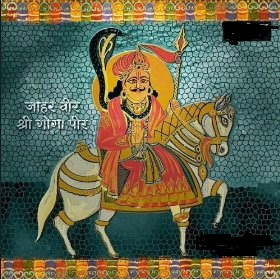
This three-day fair commemorates the descent of the Gugga Veer, a Chauhan Rajput, into the bosom of Mother Earth along with his steed.

According to the legend, he obsessed extraordinary powers over all kinds of snakes. The fair is celebrated at Gugge di Marhi, a big holy place built in his memory that has a reputation for curing people of snake bites. Earth is scooped up seven times to appeal to Gugga Veer for safety against snakes.

People sing folk songs and present folk dances. The fair is held on the Anant Chaturdashi on the 14th day of the bright half of the Bhadon (mid-August through mid-September as per the Hindu calendar).

People mainly worship the snake embodiment of Gugga at this fair. The fair falls on the fourteenth day of Shukla Paksha of the month of Bhadrapad every year. It is believed that the Chhapar Fair was started around 150 years ago by a small congregation of devotees. In recent years the number of people attending the fair has risen to millions.[4]

The Minor Chhapar Mela is also held at the same place. The special trend of scooping the land (seven times) is also practised at this fair. People consider digging of land will bring Gugga Veer to protect them against snakes.[5] The fair has much music, fun and dance. The fair has emerged as a grand festival in the past few decades.[4]

The legend narrates the story of a boy and a snake born together in an agricultural family in Chhapar village. The serpent and the boy were so intimate that if one suffered a pain the other used to cry. One day the mother of the child went to the fields after laying him on a cot. To save him from the scorching sun, the snake stretched its hood over him. Thinking that the snake was going to bite the child, a passerby killed it with a stick. The child died immediately after the death of the snake and the family was left in sorrow. The family was advised by the elders to perform religious ceremonies to worship Gugga and Siddha and a he-goat was left free to mark the place of worship by striking at a particular place. The place was recognised as Mari Gugga where people from all walks of life have been worshipping Gugga on the fourteenth day of the bright half of the month of Bhadon every year. The farmers of the Malwa belt recognise the fair to the extent that they change the agricultural chores according to the dates of the mela.

People also narrate another story regarding the second fair known as Minor Chhapar Mela. At the beginning of the 20th century, the Maharaja was said to have banned the Mela because of a complaint by some farmers. But soon after the ruler banned the event, his horses started dying mysteriously and the misfortune stopped only after the ruler announced plans to organise the Minor Mela following the major one.

According to another story, a faqir once anchored a twig after cleaning his teeth. A local person uprooted the twig in fun. The faqir then cursed the people of the local area so that the place would witness a heavy camp, which would be followed by a deserted look.

References

[edit]
[edit]
Revisions and contributorsEdit on WikipediaRead on Wikipedia
from Grokipedia
Chhapar Mela is an annual three-day fair held in the village of Chhapar, Dehlon, , , primarily dedicated to the worship of Gugga Pir (also known as or Gugga Veer), a revered folk deity and Chauhan warrior believed to be an embodiment of Naag Devta (snake god). The event occurs on the 14th day of the bright half of the Punjabi month of Bhadon (Bhadrapada in the Hindu calendar), coinciding with , typically falling in mid-September, and attracts lakhs of devotees seeking blessings for protection against snakebites and skin ailments. Originating as a purely centered around the , constructed in 1890 amid sand dunes, the mela commemorates the legendary descent of Gugga Pir into the earth along with his horse, drawing rural communities from for rituals and vows. Over time, it has evolved into a vibrant socio-political and commercial spectacle, featuring political rallies, funfair rides, food kiosks, and entertainment that blend traditional Punjabi cultural ethos with modern attractions, though this expansion has somewhat diluted its original spiritual focus. Key activities include devotional prayers and offerings at the shrine, community langar (free meals), folk music and dance performances, games, and shopping stalls selling local handicrafts and cuisine, with the first day traditionally reserved for women and children (known as Chowkian). The fair, organized by local administration including the Deputy Commissioner of Ludhiana, underscores Punjab's rich heritage of rural fairs while serving as a platform for community bonding and regional politics. Recent developments, such as infrastructure upgrades to a modern complex, accommodate the growing crowds and ensure safety and accessibility.

History and Origins

Legendary Foundations

The legendary origins of Chhapar Mela are rooted in the surrounding Gugga Veer, also known as Gugga Pir or Goga Ji, a revered folk deity embodying protection against snakes. Central to these myths is the tale of an extraordinary bond between a boy and a serpent, born simultaneously into an agricultural family in Chhapar village, . From infancy, the boy and snake shared an unbreakable connection, such that any pain inflicted on one immediately affected the other, manifesting as shared cries of distress. The snake acted as a devoted guardian, shielding the boy from the harsh sun by raising its hood, symbolizing an innate harmony between humanity and nature's serpentine forces. Tragedy struck when a passerby, perceiving the snake as a , struck and killed it, causing the boy to succumb instantly from the mirrored agony. Overwhelmed by , the family sought from village elders, who prescribed rituals honoring Gugga and the snake spirit, releasing a he-goat which struck at the spot to mark the burial site, establishing the sacred shrine known as Gugga Mari. This joint resting place, where the and snake were interred together, transformed into the focal point of devotion, believed to harness the duo's eternal unity to ward off serpentine dangers. emphasizes the snake's role as a protective entity, its death underscoring the perils of misunderstanding natural guardians and reinforcing communal vows to venerate such spirits. Gugga Veer himself is depicted in legends as a valiant Chauhan Rajput warrior endowed with supernatural dominion over snakes, capable of commanding them and healing venomous afflictions. According to oral traditions, after heroic exploits, Gugga descended into the bosom of Mother Earth at the Chhapar site alongside his loyal steed, vanishing without return and embedding his essence into the land as an eternal sentinel. This mythic submersion ties directly to the mela's reverence for Naag Devta, the serpent deity, positioning Gugga as its earthly who bestows immunity from snakebites upon devotees. Specific elements, such as villagers ritually scooping seven times at the to invoke his , highlight his guardian spirit status, ensuring no fatal bites occur in the protected realm.

Historical Evolution

The Chhapar Mela originated in the mid-19th century as a modest gathering of local devotees at a simple shrine dedicated to Gugga Pir in Chhapar village, Ludhiana district, Punjab, initially focused on worship practices tied to the folk deity's protective role against snakebites. This early form of the event emerged amid the agricultural rhythms of Punjab's Malwa region, where community participation during the post-monsoon harvest season reinforced its ties to local folk traditions and seasonal cycles. A pivotal milestone occurred in 1890 with the construction of the main , which provided a permanent focal point and facilitated greater organization, marking the transition from an informal village assembly to a more structured annual observance. By the early , sustained community involvement and the 's reputed healing powers had elevated the mela from a minor local fair to a significant regional event, drawing devotees from surrounding areas in and beyond. In the , the mela faced a ban by the , but it was lifted following a mysterious outbreak of horse disease in the royal stables, attributed to a faqir's that predicted large gatherings at the site followed by desertion if disrupted. This allowed the event to resume and grow. Post-independence, the mela experienced accelerated growth, evolving into one of North India's largest rural gatherings by attracting thousands annually through improved and broader cultural recognition within Punjab's folk heritage. In 2018, the Guga Mari underwent a Rs 50 facelift, transforming it into a more modern complex to accommodate growing crowds. This expansion was influenced by the region's agricultural prosperity and increasing mobility, transforming the event into a key platform for communal bonding while preserving its devotional core.

Religious Significance

Gugga Veer and Snake Worship

Gugga Veer, also known as Gugga Pir or Goga Ji, is revered as a 11th-century Chauhan saint- who embodies the snake deity Naag Devta in northern Indian folk traditions. Born into a warrior lineage, he is celebrated for his miraculous abilities to cure snakebites and command serpents, attributes that elevated him posthumously to divine status among agrarian communities. Legends briefly reference his descent into the earth alongside his faithful steed, symbolizing his eternal vigilance over devotees. The theological framework surrounding Gugga Veer reflects a syncretic blend of Hindu and Muslim reverence, positioning him as both a Nathpanthi Jogi in Hindu lore and Jahar Pir in Sufi traditions, fostering interfaith devotion across Punjab, Rajasthan, and Haryana. At the Chhapar shrine in Ludhiana, Punjab—a primary pilgrimage site—this duality manifests in rituals seeking protection from venomous bites and crop-damaging pests, underscoring his role as a guardian of rural life. Devotees, including farmers and cattle herders, attribute to him serpentine companionship, viewing snakes not as threats but as allies in the natural order. Central to Gugga Veer's are beliefs in his protective for the vulnerable, particularly through vows or mannats made for from snake envenomation and skin afflictions. The Chhapar , known as Gugga Maari and constructed in 1890, features simple yet symbolic : a central samadhi evolved into a multi-structure complex, highlighted by a representing his legendary mount and icons of coiled serpents evoking Naag Devta. This site draws pilgrims who tie sacred threads and recite invocations, affirming Gugga's enduring covenant with the land's tillers against nature's perils.

Core Rituals and Beliefs

The core ritual at Chhapar Mela centers on the earth-scooping ritual, during which devotees scoop earth from the grounds surrounding the Gugga Marhi shrine seven times, a practice believed to invoke the protective powers of Gugga Pir against snakebites for life. This sacred soil is often applied as a tilak on the or carried home in small quantities to ward off serpents, reflecting deep-seated beliefs in Gugga's dominion over snakes as a folk who ensures safety in rural, agrarian settings where encounters with field-dwelling reptiles are common during monsoons. The ritual underscores the mela's ties to agricultural prosperity, as protection from venomous snakes safeguards farmers and their livestock, preventing disruptions to harvests and livelihoods. Supporting practices include offerings presented at the , such as cloths tied to a pole known as a chhari, which devotees carry in processions while singing devotional sohlā songs in praise of Gugga. These acts are accompanied by of the Gugga Marhi, where participants vow healing for snakebites, skin ailments, or family protection, often tying the chhari to the as a symbol of fulfilled . Beliefs in are central, with numerous anecdotes of miraculous cures attributed to Gugga's intervention, particularly for venomous bites, reinforcing the deity's role as a benevolent guardian who responds to sincere devotion. The mela distinguishes between a major event held on the fourteenth day of Bhadon (August-September), featuring elaborate processions and large gatherings, and a minor mela occurring on Thursdays at local shrines, which involves simpler rites like the same earth-scooping but with fewer participants and less ceremonial pomp. This duality highlights the ongoing, year-round devotion to Gugga's protective efficacy, adapting the core rituals to seasonal and communal needs while maintaining their focus on serpent-related perils.

Celebrations and Events

Annual Schedule

The Chhapar Mela is held annually on Anant , the 14th day of the Shukla Paksha in the Bhadrapad month (also known as Bhadon in the ), corresponding to mid-August to mid-September in the . The event typically spans three to four days, commencing on Anant Chaturdashi. The structure of the mela unfolds over these days with a progressive build-up of activities. The first day, known as Chowkian and coinciding with , marks the peak of devotion with main rituals, historically drawing primarily women and children, though now open to all. Subsequent days feature continued festivities, community gatherings, and sometimes political events, with gradual dispersal. A smaller event known as the Minor Chhapar Mela is also held earlier in the year at the same site, featuring a briefer one-day schedule focused on similar devotional practices, though the exact date varies annually.

Activities and Attractions

The Chhapar Mela features a range of options that enhance its lively fairground atmosphere, including merry-go-rounds, mini circuses, and various fun rides that draw families and children throughout the event. These attractions operate briskly, providing joyful diversions amid the gatherings. Stalls are a prominent feature, offering handicrafts, arts, toys, and other goods for visitors to browse and purchase, creating a bustling temporary marketplace. Food vendors serve delicious local cuisine and eatables, allowing attendees to savor Punjabi flavors while exploring the fair. Fun games, such as shooting galleries, offer engaging activities for participants of all ages. The overall visitor experience combines leisure with community interaction, as thousands flock to the site for these attractions, fostering social connections through the vibrant setup of markets and amusements. Authorities maintain safety measures, including vigilant policing, to handle the large crowds effectively.

Cultural and Social Impact

Traditional Cultural Elements

The Chhapar Mela serves as a vital platform for integrating Punjab's , where mirasis—heritary Muslim musicians and bards—and dhadis, ballad singers using instruments like the ḍhaḍḍ and sārangī, play central roles in preserving traditions. These performers recount Punjabi epics and legends, including those tied to Gugga Pir, through qissās ( ballads) that blend historical and mythical elements, fostering a living archive of regional lore during the fair's gatherings. Traditional Punjabi attire, including embroidery—characterized by intricate floral silk patterns on cotton cloth—is often worn by women, symbolizing cultural continuity and aesthetic heritage rooted in Punjab's rural craftsmanship. The mela's and forms, such as those accompanying processions with daurū ( drum) and dhol beats, are intrinsically linked to the harvest cycles, marking the post-monsoon transition in Bhadon (August-September) when agricultural communities prepare for sowing and celebrate communal renewal. Community participation in the Chhapar Mela transcends and religious boundaries, drawing , , , and groups like the Valmīkī community from the region, thereby strengthening social bonds through shared festivities and hospitality traditions that echo ancestral practices of hosting kin. This inclusivity reinforces the mela's alignment with the agricultural calendar, signaling the end of the rainy season and the onset of fieldwork, which unites rural families in rituals that blend devotion with seasonal optimism. The fair preserves syncretic traditions by maintaining Hindu-Sikh-Muslim elements in its shared rituals and arts, exemplified by Gugga Pir worship led historically by Bharai communities and now by Valmīkī bards, who perform evolving folk songs like sohlā hymns praising the deity's protective powers against snakebites. These performances, including chharī processions with and dancing, highlight the mela's role in sustaining Punjab's multicultural heritage amid historical shifts post-Partition.

Modern Socio-Political Role

In contemporary times, Chhapar Mela has grown into one of Punjab's largest annual gatherings, attracting lakhs of visitors each and underscoring its status as a major regional event. This massive influx poses significant logistical challenges, including severe on surrounding roads and the need for extensive crowd management by local authorities, such as deploying police for route diversions and temporary parking arrangements. The scale has transformed the fair from a localized religious observance into a statewide spectacle, drawing participants from across the belt and beyond. In 2025, despite regional flooding, thousands of devotees attended the event, demonstrating its enduring appeal and community resilience. The mela has evolved into a key platform for socio-political engagement, shifting from its purely devotional roots to hosting political rallies, speeches by leaders, and discussions on issues. Since the early , major parties like the , (AAP), and (SAD) have utilized the event for voter outreach, with examples including SAD's 2003 rally where a leader addressed agricultural concerns, AAP's 2016 amid election campaigns, and Congress's 2017 gathering focused on economic policies. Notably, in 2015, Punjab Parkash Singh Badal leveraged the platform to announce aid for farmers protesting crop losses, highlighting its role in addressing agrarian unrest. This politicization has made Chhapar Mela a battleground for electoral strategies, particularly in the politically volatile region. The fair's modern impacts extend to economic revitalization and emerging controversies. It provides a substantial boost to local vendors through sales of handicrafts, food, and merchandise, while enhancing tourism in by drawing interstate visitors. However, the event has faced criticism for environmental strain, such as waste accumulation from large crowds and potential water stress in the , alongside concerns over commercialization that dilutes its traditional ethos. In the context of Malwa's , the mela reinforces regional cultural pride among Jat and other communities, serving as a venue where political narratives intersect with local identities and issues like farmer rights.

References

Add your contribution
Related Hubs
User Avatar
No comments yet.