Hubbry Logo
GogajiGogajiMain
Open search
Gogaji
Community hub
Gogaji
logo
8 pages, 0 posts
0 subscribers
Be the first to start a discussion here.
Gogaji
Gogaji
from Wikipedia

Goga Ji
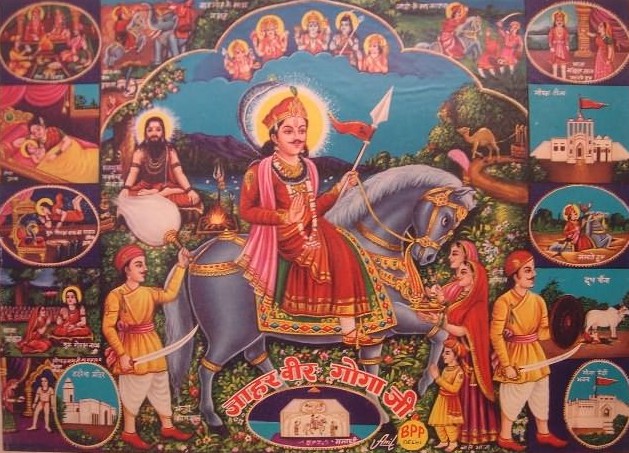
Depiction of Gogaji Maharaj riding his blue horse
Other namesJaharpeer Chauhan
Jaharveer Chauhan
Major cult centerRajasthan, Punjab Region, parts of Uttar Pradesh, Uttarakhand, Haryana, Himachal Pradesh, Jammu, Gujarat
AbodeDadrewa
Gogamedi
WeaponSpear
MountBlue horse
FestivalsGoga Navami (observed on the ninth day of the Krishna Paksha (waning phase of the moon) in the Hindu month of Bhadrapada)
Genealogy
Born1003 AD
Died
Parents
  • Raja Jewar Singh (father)
  • Rani Bachal De (mother)

Gogaji, also known as Raja Jaharveer Singh Chauhan or Jahirpeer and Bagad Wala, is a folk Hindu deity in the northern India.[1] He is worshipped in the northern states of India especially in Uttar Pradesh, Rajasthan, Himachal Pradesh, Haryana, Uttarakhand, Punjab region, , Jammu and Gujarat.[2] He is a chauhan warrior-hero of the region, venerated as a saint and a protector against snake bites. Although there are references to him in the folklore of Rajasthan, little historical knowledge of Gugga Rana exists other than that he ruled the small kingdom of Dadrewa (in present day Rajasthan) and was a contemporary of Prithviraj Chauhan.[3][4]

Etymology

[edit]

According to legend, Gogaji was born in Chauhan clan of Rajputs to the great Chauhan Maharaja Jewar Singh and Rani Bachhal Devi and were rulers of this area during that period – around 900 AD. His desandants adopted the name Bachhil Rajputs after name of Gogaji’s mother.[5][6]

According to one belief, Goga was born with the blessings of Guru Gorakhnath, who gave 'Gugal' fruit (Commiphora wightii) to Goga's mother Bachhal which was used to name him. Another belief is that he was called Goga because of his remarkable service to cows. (Gou in Sanskrit)[7]

Accounts

[edit]
Illustration of Gogaji, based on a rock sculpture at Mandore, published in 'Annals and Antiquities of Rajasthan' (vol. II)

Recorded accounts on Goga vary considerably.[8] The sources do not agree on the time period or who his contemporaries were but he can be placed as living anywhere between the 11th and 14th centuries.[8] According to James Tod, Goga was the chief of the Jangaldesh region and lived during the time of Mahmud of Ghazni in the 10th–11th centuries and was from Bhatinda, who fought with the invader on the bank of the Sutlej.[8] Dashrath Sharma, using Jain sources, such as the Shrawak-Viatudi-Atichar, and the Kyamkhan Rasau, sources from the 15th century, also placed Goga as a contemporary of Mahmud of Ghazni.[8] Pemaram agreed with Sharma and also places him in the same period after evaluating the poetical accounts Gogaji Pirra Chand, Gugapedi, and Gogaji Chauhan ri Nisani.[8] R. C. Temple places him at the time period of Mahmud of Ghazni.[8] William Crooke believed Goga lived in the 13th century and was killed fighting against Firoj Shah of Delhi at the end of the century.[8] Another account states that Goga fought again Ruknuddin Firuz Shah, Sultan of Delhi.[8] Yet another account posits that Goga was a contemporary of Firuz Tughlaq (1351–1388) and fought against Abu Baquer.[8] Most Rajasthani scholars agree with Tod's assessment of placing Goga in the same period of Mahmud of Ghazni century.[8]

According to Chander Shekha, Goga was the Chauhan chief of the region of Dadarewa (present-day Churu district, Rajasthan).[8] He was likely one of the local rulers of northwestern Rajasthan who opposed invaders, similar to Prithviraj Chauhan and Hammirdev, and warred with other north Indian rulers.[8] According to Bankidas, Goga was born to a father named Wacchag while his mother was named Jeevaraj.[8] In western U.P., there is a unique Bijnor version of Goga, which claims he was the son of Prithviraj Chauhan during the Ghurid invasions of the 12th century.[8]

Worship

[edit]

He developed into becoming one of the earliest folk-deities in western Rajasthan and preceded Pabuji and Ramdevj.[8] Worship of Goga can be traced to the early 15th century, as a Jain source known as the Sravukavratadi-atichar warns against his worship and other folk-deities by shravaks.[8] The cult of Goga had many shrines, known as thans, with the principal one (gugaji ri medi) being located at Dadarewa, where a celebration dedicated to Goga is held on Bhadrapada (August-September).[8] Another shrine is located at Gogamedi and there are further ones across Marwar.[8] His shrines are associated with the Khejari tree in Marwar.[8]

As a folk-deity, he is worshipped in many forms, such as a snake-god, a cow-protector, a Muslim pir, and as a Nathpandhi Jogi.[8] The Gogaji ra Rasawvala, written in the later part of the 16th century by Vithu Meha, depict Goga as a protector of cows with his relatives Arjan and Sarjan, with him feuding with these relatives over land.[8] Goga developed as a snake-god as the western region of Rajasthan is inhabited by many snakes, with pastoralist and agricultural people fearing being bitten and poisoned by them or their livestock.[8] Thus, Goga came to be seen as a protector against snakes, whose name was chanted by these people to protect against snakes.[8] Depictions of Goga often include snakes in his company, some even depict Goga as a snake.[8] There are religiously syncretic interpretations of Goga, with him being viewed as a Muslim pir or a Nathpanthi Jogi.[8] In the jogi accounts, he is associated with Gorakhnath.[8] Certain Rajputs who converted to Islam, known as Gogawats, viewed him as Zahra Pir, seeing Goga as their ancestor.[8] The cult of Goga and similar saints, such as Ramdevji, had followers from both Hindu and Muslim backgrounds, with them also being connected to Ismailism.[8] Whilst initially Goga was a figure associated with the downtrodden sections of society, namely pastoralists and peasants, after the 18th century his image underwent a process of Rajputization and his legacy was adopted by the ruling-classes, reimagining him as a Rajput hero.[8] He became one of the panch peer quintet.[8] His image also underwent Hinduization until he went from a folk-hero to a Hindu deity that is worshipped across caste and communal lines, especially by lower-castes.[8] Goga had a mount named Javadia, which also became venerated and many horses kept in the places he is worshipped are named after this famous horse.[8] Outside of Rajasthan, Goga is worshipped in Punjab, the Gangetic Plains (western Uttar Pradesh), and Madhya Pradesh.[8] The cult of Goga was prevalent in 19th century Punjab, where he was particular worshipped as a snake-god by Muslims, Hindus, and Sikhs alike.[8]

Kingdom

[edit]

Goga had a kingdom called Bagad Dedga that spanned over to Hansi near Hisar in Haryana.[9] It is believed that Goga lived during the 12th Century AD[10] In the past, the river Sutlej flowed through the district of Bathinda in present-day Punjab in India.[11] The capital was at Dadrewa near Ganganagar.

Legends

[edit]

Family

[edit]

Goga (Hindi: गोगा) (Rajasthani: (Gugo) गुग्गो) was born in c. 900 AD to queen Bachchal (the daughter of a ruler, Kanwarpala who in 1173 AD ruled over Sirsa in present-day Haryana) and king Zewar belonging to Chauhan family in the village name Dadrewa in Churu district of Rajasthan.[12] The earliest parts of Goga's life were spent in the village of Dadrewa, situated on HissarBikaner highway in Sadulpur tehsil of Churu district in Rajasthan. According to other legends, his father was Vachha Chauhan, the Raja of Jangal Desh, which stretched from the Sutlej to Haryana.[13]

Birth

[edit]

When Bachal was worshipping Gorakhnath, her twin-sister decided to usurp the blessings from the Gorakhnath. In the middle of the night, she wore her sister's clothes and deceived Gorakhnath into giving her the blessing fruit. When Bachal realised it, she rushed to Gorakhnath and said that she had not received anything. To this, Gorakhnath replied that he had already given his blessings and said that her sister was attempting to deceive her. After repeated requests by Bachal, Gorakhnath relented and gave her two Gugal candies. She distributed these candies to ladies having no child, including the 'blue mare' who was pregnant at that time. When the Guru gave the blessing to Bachal, he foretold that her son would become very powerful and would rule over the other two sons of their aunt, Kachal.

Marriage

[edit]

1)Goga was married to Kelam de who was daughter of Buda singh ji rathore King of kolu,Rajasthan.

2)Rani Siriyal

Other

[edit]

Another story is that Arjan and Sarjan were against Goga and was a part of conspiracy with king Anangpal Tomar of Delhi. King Anganpal attacked bagad region with Arjan and Sarjan. Both of them were killed by Goga. Goga spared the king after his miserere. In a quarrel about land he killed his two brothers on which account he drew upon himself the anger of his mother.[12]

Celebration and fairs

[edit]

The history of Goga falls within folk religion and therefore his followers include people from all faiths. Goga is popular as a Devta who protects his followers from snakes and other evils. He has been deified as a snake demigod and is a prominent figure among those who follow the Nāga cult in what is now Rajasthan and since the seventeenth century has been worshipped in the Western Himalayas also, possibly as a consequence of migration there from Rajasthan.[14]

He is particularly popular among those engaged in agrarian pursuits, for whom the fear of snakebite is common. Although a Hindu, he has many Muslim devotees and is chiefly considered to be a saint (pir) who had the power to cure the effects of poison (jahar).[15]

He was reputed to be a disciple of Guru Gorakhnath. According to Muslim oral tradition prevalent in Punjab, he learnt the way of entering and leaving solid earth by a Muslim Pir Hazi Rattan of Bathinda.[16][17] Goga is also believed to have lived for some time in Bathinda.[18]

The cult is prevalent in Rajasthan and other states of northern India, including Punjab, Haryana, Himachal Pradesh and the north western districts of Uttar Pradesh. His followers can also be found in Gujarat and Madhya Pradesh. He also has a number of followers in the Jammu district of J&K state.

Rajasthan

[edit]

His shrine, referred as madi (shortened colloquial term for Samādhi), consists of a one-room building with a minaret on each corner and a Hindu grave inside, marked by a Nishan (a symbol or sign), which is made up of a long bamboo with peacock plumes, a coconut, some colored threads and some handpankhas with a blue flag on the top.

Worship of Goga starts in Bhaadra month of Hindu calendar. On the 9th of Bhadra, the people worship his symbol, a black snake painted on a wall. Worshippers take a fly-flap, known as chhari, round the village. Devotees pay their respect to it and offer churma. The Savayians sing devotional songs known as ‘Pir ke Solle’ in his honour to the accompaniment of deroos. Beating of deroos is the exclusive privilege of the Savayian community; others may sing, dance or offer charhawa. It is believed that the spirit of Gugga temporarily takes abode in the devotee dancer who lashes himself with a bunch of iron chains. People also open their rakhis on this day(bhadra krishna paksh navmi) and offer them to him. They also offer sweet puri (a type of sweet chappati) and other sweets and take his blessing.

Grand fairs are held at samadhi sathal Gogamedi. Gogamedi is 359 km from Jaipur, in Hanumangarh district of Rajasthan. It is believed that Goga went into samādhi at Gogamedi. Thousands of devotees gather to pay homage at this memorial annually in the month of Bhadrapada during the Goga fair, which lasts for three days. The fair is held from the ninth day of the dark half of Bhadrapada (Goga Navami) to the eleventh day of the dark half of the same month. People sing and dance to the beats of drums with multicoloured flags called nishans in their hands. The songs and bhajans on the life history of Gogaji are recited accompanied by music played with traditional instruments like Damru, Chimta, etc. At his birthplace Dadrewa, the fair goes on over a month. Devotees from far eastern places of Dadrewa start arriving from the beginning of the auspicious month of Bhaadra. These devotees are commonly known as purbia (those who belong to east). It is a common sight to see people with snakes lying around their necks. According to a folklore in and around his birthplace Dadrewa it is believed that if someone picks up even a stick from johra (a barren land which has a sacred pond in Dadrewa), it would turn into a snake. Devotees of Gogaji worship him when they get a snake bite and apply sacred ash (bhabhoot) on the bite as an immediate remedy.

Himachal Pradesh

[edit]

In Thaneek Pura, Himachal Pradesh, a very large scale festival and fair is organized on Gugga Navami. The tale of Gugga Ji is recited, from Raksha Bandhan to Gugga Naumi, by the followers who visit every house in the region. These followers while singing the tales of Gugga Ji carry a Chhat (a wooden umbrella) and people offer them grains and other stuff. They bring all the collected offerings to the temple and then the grand festival of Gugga Navami is celebrated for three days. Apart from various pujas and rituals, the wrestling competition (Mall or Dangal) is organized for three days where participants from all over the region compete. The annual three-day fair is also a part of these festivities where people come and enjoy great food, and shop for decorative items, handicrafts, clothes, cosmetics, household goods, and toys for children.

Punjab

[edit]
Gugga Jahar peer, Dera Bakarpur, Mohali, Punjab, India

Goga is known as Gugga in the Punjab who has a significant following. Although Gugga is a deity of Hinduism, he is revered by many Sikhs in the Punjab also. Many Punjabi villages have a shrine dedicated to Gugga Jaharveer known as Medi. A fair is organised annually in many parts of punjab like the village of Hariana in Hoshiarpur district and the village of Chhapar (known as the Chhapar Mela). Gugga's legacy in Punjab can be seen in towns such as Bareta Mandi, which is situated at a distance of 51 km from Mansa in Punjab. "The town is predominantly inhabited by Chauhans who trace their origin from Gugga, ‘Lord of Snakes’. It is said that nobody has ever died here on account of snakebite because of the blessings of Gugga."[19]

In the Punjab region, it is traditional to offer sweet Vermicelli to the shrines of Gugga Ji[20] and sweet fried bread or mathya (Punjabi: ਮੱਥੀਆ). He is worshiped in the month of Bhadon especially on the ninth day of that month. Gugga is meant to protect against snake bites and he is venerated in shrines known as marris. The shrines do not conform to any religion and can range from antholes to structures that resemble a Sikh Gurdwara or a Mosque. When worshipping Gugga, people bring vermicelli (sewai) as offerings and also leave them in places where snakes reside.[16] People perform a devotional dance while dancing on the legendary songs of bravery sung in his praise.[21]

On the day of Gugga Naumi, when offering the sweet dish, songs are sung which include:

Punjabi:

ਪੱਲੇ ਮੇਰੇ ਮਥੀਆਂ
ਨੀ ਮੈਂ ਗੁੱਗਾ ਮਨਾਓੁਣ ਚੱਲੀਆਂ
ਨੀ ਮੈਂ ਬਾਰੀ ਗੁੱਗਾ ਜੀ
[20]

Palle mere mathyaa
ni mein Guggaji di puja karn challyaa
ni mein bari Gugga ji

Translation

I have got mathya
I am going to worship Gugga ji
Oh Gugga ji

See also

[edit]

References

[edit]

Bibliography

[edit]
Revisions and contributorsEdit on WikipediaRead on Wikipedia
from Grokipedia
Gogaji, also known as Goga or Jahar Peer, is a revered folk deity primarily worshipped in the northern Indian states of , , , , and , as well as in (Pakistan), embodying a syncretic figure venerated by both and as a warrior and protector against snake bites, cattle diseases, and injustice. Born in the as a Chauhan prince in Dadrewa village (, ) to Jewar (or Jeevaraj) and Queen Bachhal, he is celebrated in for his heroic battles, devotion to Guru Gorakhnath, and posthumous deification as a semi-divine entity associated with snakes and pastoral welfare. Legends portray Gogaji's life as a saga of valor and tragedy: after years of childless prayers answered by Guru Gorakhnath, he grew into a skilled horseman and warrior who championed the rights of peasants and herders, clashing with his envious cousins Arjan and Sarjan over land and resources. His death in battle—possibly against invading forces or rivals—occurred at in , where he is said to have taken a living (spiritual burial) after slaying his foes, leading to the site's transformation into a major pilgrimage center. Historical accounts, drawing from medieval bardic chronicles, suggest his cult emerged in the 11th–14th centuries amid Chauhan traditions, evolving into a broader folk movement that reflects medieval Rajasthan's social tensions between pastoral communities and feudal powers. The worship of Gogaji centers on annual festivals like Goga Navami (the ninth day of Bhadrapada, typically August–September), featuring vibrant fairs, folk songs (gogapadi), and rituals such as offerings of flags (nishans), coconuts, and snake idols at temples like and Dadrewa, which draw over 100,000 devotees and facilitate cattle trading. As a lok devta (folk god), he symbolizes resistance to oppression and ecological harmony, particularly among lower castes, , and Muslim communities who view him as a pir (), with his cult promoting interfaith unity through shared shrines tended by both Hindu and Muslim . This enduring popularity underscores Gogaji's role in Rajasthan's , blending heroic epics with devotional practices that continue to influence regional identity.

Etymology and Names

Name Origins

The name "Gogaji," commonly used to refer to the folk deity, incorporates the honorific suffix "ji," a linguistic feature widespread in Rajasthani and dialects to express reverence and respect toward revered figures or saints. This suffix reflects the socio-cultural conventions of medieval , where honorifics were appended to names in oral and written traditions to elevate the subject's status. The core element "Goga" emerges prominently in the region's folk , signifying its deep integration into the local linguistic fabric during the medieval period. Early textual references to the name "Goga" or "Gogaji" appear in medieval Rajasthani and related works, illustrating its establishment in written form amid the transition from Apabhramsha to early modern Indo-Aryan dialects like Rajasthani. For instance, the 17th-century Kyamkhan Rasau by Jan Kavi, a key Rajasthani poetic composition, mentions the name in the context of heroic narratives. By the , the name had evolved further within folk traditions, as seen in the Vithu Meha's Gogaji ra Rasawvala, a seminal work that employs "Gogaji" extensively in verse form, adapting it to the rhythmic and phonetic patterns of emerging Rajasthani dialects. Additional ballads, such as Gogaji Pirra Chand and Gugapedi, from the medieval period, demonstrate the name's flexibility and phonetic variations (e.g., "Guga" or "Gugga," including "Gugga Pir") influenced by oral recitation in rural , where dialectal shifts from Prakrit-influenced forms contributed to its standardization in agrarian communities. These texts highlight how the name circulated through bardic performances, undergoing minor adaptations to suit local pronunciations and poetic meters. Later 17th- and 18th-century sources continue this evolution, with Jan Kavi's Kyamkhan Rasau (17th century) and the Gogaji Ra Chhand (AD 1789, Oriental , ) preserving the name in structured poetic traditions, reflecting sustained linguistic continuity in 's medieval literary output. Manuscripts like Goga Pairi and Goga Chauhan Ki Nisani from records further attest to the name's prominence in historical accounts, underscoring its role in bridging oral and documented history without evidence of inscriptions directly referencing it. Overall, the name's development mirrors the broader historical linguistic shifts in , where influences from and substrates blended with incoming Turkic-Persian elements to shape folk nomenclature.

Regional Variations and Titles

Gogaji is known by a variety of regional names and titles that reflect his multifaceted identity as a , , and protector, shaped by local dialects and cultural exchanges. Common honorifics include Jaharveer, signifying a fierce or valorous , and Gugga , a form emphasizing familiarity and devotion among devotees. These titles underscore his legendary exploits in battle and , adapting to the linguistic nuances of northern . Syncretic influences are evident in titles like Goga Peer or Jahar Pir, where "Peer" denotes saintly status in Sufi traditions, highlighting Gogaji's reverence across Hindu and Muslim communities. This overlap is particularly pronounced in and surrounding areas, where he is venerated by diverse groups including . Additional syncretic variants include Zahir Pir or Zahra Pir, reflecting Muslim-influenced appellations associated with the deity. Additionally, his association with the Nath yogic tradition manifests in titles such as Nath Jogi, portraying him as an ascetic figure within the . Regional adaptations further diversify these appellations. In , he is predominantly addressed as Gogaji Maharaj, a respectful form integrating royal connotations suitable to the agrarian Jat communities. folklore refers to him as Gugga or Jahar Pir, as documented in 19th-century collections of local legends. In , variations include Goga Jaharpir, Gugga Jahapir, Jaharbeer, or simply Goga Baba, reflecting the hilly region's blend of Pahari dialects and folk . In Sindh, he is venerated as Gugga Pir, Zahir Pir, Kethalpar, or Bagarwwala, illustrating further extensions of his cult into regions with shared cultural histories. These titles illustrate how Gogaji's transcends boundaries, incorporating elements of valor, , and local identity.

Historical Context

Medieval Emergence

The cult of Gogaji emerged during the medieval period in northern , particularly in , spanning roughly the 10th to 12th centuries. This timeline aligns with the consolidation of Chauhan power in the region, as clans like the Chauhans established principalities amid shifting political landscapes. Gogaji, identified as a Chauhan warrior from Dadrewa in present-day , is historically situated in this era, with his veneration gaining traction as a response to the socio-political dynamics of resistance and expansion. The broader context of medieval emergence was marked by intense socio-political turmoil, including repeated Islamic invasions from , such as those by in the early and the Ghurid conquests in the late , which disrupted strongholds like and . These conflicts exacerbated tensions over land, cattle, and resources, fueling the rise of warrior cults among pastoral and peasant communities in western . In this environment, figures like Gogaji were deified as folk heroes, embodying protection against invaders and embodying the martial spirit of the Chauhan lineage, which transitioned from historical chieftains to semi-divine guardians. The process of deification reflected a broader pattern in medieval , where local warriors were elevated through oral traditions and syncretic practices to sustain community resilience. Earliest archaeological evidence for the cult includes the temple foundations at in , the primary shrine site, dated to approximately 950 years old, placing its origins in the . Stone carvings and inscriptions at these temples, depicting serpents intertwined with warrior motifs, indicate the cult's early integration of as a protective symbol. While direct epigraphic records from the 10th-12th centuries are scarce, later medieval accounts, such as 15th-century Gujarati Jain texts and Rajasthani khyats, reference the cult's established presence, linking it to Chauhan-era sites and confirming its medieval roots without reliance on later embellishments.

Sources and Accounts

The primary literary sources documenting Gogaji's life and veneration include medieval ballads and epics composed in regional dialects. The Gogaji ra Rasau, a key 16th-century text attributed to the Vithu Meha, narrates aspects of Gogaji's exploits as a protector of cattle and warrior, emphasizing his familial conflicts and heroic deeds in verse form. Earlier works, such as the 17th-century Kyamkhan Rasau by Jan Kavi and the 15th-century Shrawak-Viatudi-Atichar, position Gogaji as a historical figure contemporaneous with , linking him to Chauhan lineages. Oral traditions form a vital repository of Gogaji's , transmitted through performative narratives by bhopas, itinerant bard-priests from castes like the Nayak in northwestern . These bhopa performances, often accompanied by musical instruments and scroll paintings (phads), recount Gogaji's story during night-long rituals, preserving details of his deification and protective powers against snakebites and disease. Regional folk songs, including Goga Chhand and Gogaji ri Nishani, sung by communities such as Jogis and peasant women, further amplify his role as a guardian and syncretic , with verses highlighting miracles and vows made at his shrines. Colonial-era accounts by British administrators and scholars provide ethnographic insights into the prevalence of Gogaji's worship across northern . James Tod, in his Annals and Antiquities of Rajasthan (published 1829-1832), describes Gogaji as a Chauhan hero who resisted Ghaznavid incursions, noting the enduring popularity of his cult among Hindu and Muslim devotees for its snake-charming associations. R.C. Temple's Legends of the (1884-1900) documents the deity's appeal in for healing rituals, observing cross-communal veneration in rural fairs. gazetteers, such as the Rajasthan Gazetteer: Churu (1970, drawing on 19th-century surveys), record numerous Gogaji temples and fairs like Goga , underscoring the cult's integration into local agrarian and pastoral life by the British period.

Life and Legends

Family and Birth

Gogaji, revered as a folk deity in , traces his mythological origins to the Chauhan clan, a warrior lineage prominent in medieval northern known for its royal heritage and martial traditions. His family is depicted in legends as part of the ruling elite of Dadrewa, a region in present-day , emphasizing ties to pastoral and agrarian communities. According to folk accounts, Gogaji was the son of King Jewar (also spelled Jhevar or Jeevar), a Chauhan ruler of Dadrewa, and Queen Bachhal (or Bachhala Devi), who belonged to the same lineage. The couple, initially childless, sought divine intervention through fervent prayers, often directed toward Guru Gorakhnath, the founder of the Nathpanthi tradition, or snake deities associated with protection and fertility. In one prominent legend, Queen Bachhal worshiped Guru Gorakhnath for twelve years, leading to a boon in which the guru appeared in a dream to King Jewar, promising the birth of a son endowed with extraordinary powers. This divine promise underscores Gogaji's semi-divine status, positioning him as an incarnation of Padam Naga, a mythical serpent king, which ties his birth to broader motifs of in regional . The birth itself is marked by supernatural signs in the legends, symbolizing his destined role as a protector against venomous threats. Upon his arrival, a is said to have coiled protectively around his cradle, or alternatively, the Gogaji miraculously subdued a live snake by sucking its head, establishing his innate mastery over serpents from infancy. These elements highlight the miraculous nature of his entry into the world, blending royal Chauhan ancestry with yogic and Shaivite influences from Gorakhnath's Nath order. Gogaji's family extended to siblings or close kin, including cousins Arjan and Sarjan (or a brother Sarang in variant tales), who feature in early disputes over , reflecting the clan's internal dynamics within the Chauhan warrior heritage. This fraternal context reinforces the legendary emphasis on familial loyalty and royal bloodlines as foundational to Gogaji's heroic identity.

Youth, Marriage, and Early Exploits

Gogaji, born into the Chauhan clan, spent his formative years in Dadrewa village, where he received rigorous training under the guidance of , a prominent Nathpanthi . Under Gorakhnath's tutelage, Gogaji mastered and acquired yogic powers, most notably the ability to control serpents and cure snakebites, which became central to his legendary identity as a protector. This discipleship not only honed his warrior skills but also imbued him with spiritual authority, as recounted in folk ballads like Goga Chhand (1647 CE) and bardic traditions preserved by the Manganhar community. In his early adulthood, Gogaji married Siriyal (also known as Siriyade or Rani Siryal), the daughter of a ruler from according to some Nathpanthi legends, forging a key alliance through this union. The wedding was marked by miraculous interventions from Guru Gorakhnath, who reportedly arrived with a grand entourage of carriages and followers, taming wild animals and ensuring the ceremony's success despite obstacles, as described in oral narratives and texts like Gogaji ri Nishani. This event symbolized Gogaji's rising prowess and divine favor, blending martial valor with yogic mysticism. Gogaji's early exploits established him as a fierce guardian of his community, particularly in defending and resolving familial disputes. In one prominent , his stepbrothers or cousins, Arjan and Sarjan—sons of his maternal —attempted to steal the village and reportedly harassed Siriyal, prompting Gogaji to confront and slay them in a decisive feud. This act of protecting the pastoral wealth of the Chauhan clan from thieves underscored his role as a among herders and peasants, themes echoed in Rajasthani folk songs such as Ath Gogapedi and Bankidas ri Khyat. Through these initial feats, Gogaji transitioned from a young warrior to a revered figure embodying and protection.

Battles, Miracles, and Kingdom

Gogaji's legends prominently feature his role as a formidable warrior who defended his territory against foreign invaders. In one enduring folk narrative, he led a valiant campaign against in the 11th century, commanding an army comprising 45 sons and 60 nephews in a desperate stand near the River, where he ultimately fell in battle alongside his kin. Another variant of the tale shifts the conflict to the , depicting Gogaji riding his blue horse Bidala into combat against Sultan Firoz Shah Tughlaq or his general, thwarting their advance into Rajasthan's lands. These stories emphasize his unyielding bravery, often portraying him mounted on Bidala—sometimes called Jawala or Javadia—as a symbol of swift, divine intervention in warfare. Interwoven with his martial exploits are accounts of extraordinary miracles that affirm Gogaji's supernatural powers and cement his status as a benevolent guardian. He is famed for curing snake bites, with folklore asserting that devotees can avert venom's effects by chanting his name, tying a sacred thread around the afflicted limb, or applying earth from his shrines. One prenatal miracle recounts how, while still in his mother's womb, Gogaji revived cattle slain by serpents, an act that established him as the supreme snake deity (Nag Devta). His protective role extended to livestock, particularly cows; in a key legend, he battled and defeated cattle-thieves Arjan and Sarjan to rescue stolen herds, thereby safeguarding the economic lifeline of local herders and earning veneration as a cow-protector (Gorakshak). Gogaji's reign over the Dadreva region—encompassing areas in present-day , , and occasionally termed Dandak in oral traditions—exemplifies just and compassionate rule as a Chauhan rana. He prioritized the welfare of peasants and communities, defending their lands and resources from external threats and internal strife. His governance fostered alliances with fellow folk heroes, including Pabuji as a familial tie, while supernatural support from Guru Gorakhnath provided an invisible warrior force during conflicts, enhancing his kingdom's resilience.

Death and Deification

According to folk legends preserved in Rajasthani oral traditions and bardic literature, Gogaji met his end in a fierce battle at , betrayed by his cousins Arjan and Surjan, who formed an alliance with a Muslim prince to plunder his lands and . Mounted on his loyal , Gogaji fought to defend the cows under his , ultimately slaying his treacherous kin along with many of their allies, but he himself succumbed to mortal wounds in the conflict. This martyrdom underscored his role as a guardian of wealth, a central theme in his heroic narrative. Legends further describe Gogaji achieving through a jeevit , wherein, after reciting a sacred kalma, he rode into the earth alive on his , vanishing from the mortal realm without conventional death. Under the direction of his spiritual guide, Guru Gorakhnath, his body was interred at , where it is believed to remain incorrupt and preserved, with his spirit eternally vigilant, roaming to aid devotees in times of peril. This motif of undying presence reinforced perceptions of his divine endurance, distinguishing him from ordinary warriors. Gogaji's transformation into a folk deity occurred gradually through the dissemination of bardic epics, such as the 17th-century Goga Chhand, which chronicled his exploits and elevated him beyond historical chief to a syncretic saint-warrior. Early shrines at and surrounding sites formalized this deification, merging Chauhan valor with Nathpanthi asceticism and elements of Sufi , positioning him as a protector against adversities like snakebites and cattle loss—vows he is said to uphold for the faithful. This process, rooted in medieval pastoral communities' reverence for his sacrifices, solidified his status as Jahar Pir or snake-god by the 16th century.

Worship Practices

Forms and Syncretism

Gogaji is revered in multiple forms across regional folk traditions, reflecting his multifaceted role as a protective . As a snake-god, he is primarily invoked for snakebites, with devotees believing that reciting his name or tying a sacred thread around the affected area can avert death or cure the victim. This aspect draws from legends where Gogaji commands serpents, positioning him as a guardian against venomous threats in agrarian communities. Additionally, he functions as a cow-protector, safeguarding from and harm, which underscores his importance to economies where represent and . In syncretic contexts, Gogaji manifests as a Muslim pir, particularly among Sufi-influenced groups and converts known as Gogawats, who him as Jahar Pir or Zahra Pir for his miraculous interventions. This form highlights his appeal beyond Hindu boundaries, blending Islamic veneration with local heroism. He is also associated with the Nath Jogi tradition as a yogic ascetic, linked to , through whom he gains mastery over snakes, embodying ascetic powers and spiritual discipline. The worship of Gogaji exemplifies interfaith , with shared rituals uniting Hindu, Muslim, and Sikh devotees at mixed shrines where offerings like milk or cloth are presented communally, transcending sectarian divides. These practices foster collective piety, as pilgrims from diverse backgrounds participate in vows and processions honoring his protective qualities. Over time, Gogaji's evolved from a medieval warrior tradition—rooted in martial lore—to a broader multi-form by the , influenced by 18th-century Rajputization and cultural exchanges that integrated folk heroism with devotional pluralism. This transformation allowed his to adapt across communities, emphasizing universal themes of protection and miracles rather than exclusive ethnic or religious identities.

Rituals and Symbols

Devotees of Gogaji engage in rituals primarily aimed at seeking protection from snake bites and invoking the deity's blessings for , livestock, and prosperity. A central practice is the application of sacred ash, known as or bhabhoot, directly to snake bite wounds as an immediate remedy; this act is believed to harness Gogaji's miraculous powers to neutralize poison and promote . In cases of snake bites or other afflictions, individuals may also chant Gogaji's name or mantras during the to amplify the protective effect. Offerings form a key part of , with devotees presenting coconuts, sugar drops (batashas), sweets, milk, and cash at shrines, often accompanied by rubbing on the 's or idol. While traditional animal sacrifices occur in some rural communities as vows fulfilled for granted wishes, modern practices increasingly substitute them with vegetarian alternatives like coconuts or bells to honor the without bloodshed. Night vigils, or jagrans, are conducted especially during festivals, where participants remain awake through the night singing hymns, folk songs such as "Goga Chaukiya," and epic narratives, fostering communal devotion and spiritual ecstasy. Symbols in Gogaji's veneration emphasize his warrior-hero status and role as a guardian against serpents. The blue horse, serving as his divine mount, symbolizes speed, bravery, and unyielding loyalty, often depicted in shrine idols and processions. Snake motifs, including carved or painted serpents, represent his mastery over venomous creatures and his function as a protector from bites. The trident (trishul) stands for his authoritative power and ability to vanquish evil, frequently planted at shrines alongside flags and clay lamps. Protective amulets, such as taweez inscribed with Gogaji's name or symbols, are worn or carried by devotees for ongoing safeguarding against snakes, diseases, and misfortune. Vows (man nat) are integral to devotee practices, where individuals promise pilgrimages to major shrines like , offerings, or participation in jagrans upon the fulfillment of requests, such as family well-being or agricultural success. These commitments often culminate in ritual performances led by bhopa, hereditary priests who enter trance-like possession states to embody Gogaji, delivering oracles, invocations, and guiding the community through .

Iconography and Temples

Gogaji is commonly depicted in iconography as a mounted warrior, often astride a blue horse named Javadia, clad in full armor and wielding a sword, symbolizing his heroic battles against invaders. This representation emphasizes his status as a Chauhan clan hero, with accompanying figures such as his mother Bachhal, wife Siryal, and companion Chajju sometimes included in the scene. In many artistic forms, including Phad scroll paintings, he appears as a larger-than-life heroic figure in profile, with exaggerated features like large eyes, wearing red garments denoting holiness, and positioned centrally to highlight his divine prominence. A prominent motif in Gogaji's is his association with serpents, reflecting his role as a protector against snakebites; he is frequently shown with snakes entwined around his neck or forming a hood, as seen in engraved stone idols and temple carvings. Additionally, depictions portray him in a yogic posture as a Nathpanthi ascetic linked to Guru , underscoring his spiritual powers over nature and venom. These images are crafted from various materials, including engraved stone slabs inscribed with snake motifs, cenotaphs, clay effigies produced by potters for exchange, and cloth-wrapped figures—such as green drapery for Bachhal and red for Siryal. The primary shrine dedicated to Gogaji is the Gogamedi Temple in , , situated on a high mound and serving as the epicenter of his across northern . Constructed over a ago, the temple complex blends medieval Rajasthani and Islamic architectural elements, featuring a central dome, four white minarets, and a spacious courtyard enclosing multiple cenotaphs; it includes a -plated idol of Gogaji on horseback and a separate stone snake carving venerated during rituals. The structure underwent significant renovations in under Maharaja of , who added facades and enhanced the Hindu-style equestrian effigy while preserving Persian inscriptions on the walls. In , notable temples include those in tehsil and surrounding areas like , where shrines often feature raised platforms with simple stone icons of the warrior-saint entwined with serpents, reflecting local agrarian devotion. sites, such as the Guga Mandir in Jeora near the border, exhibit a hybrid Hindu-Muslim design with walls, patterned flooring, and snake-embellished doorways, built on elevated mounds for visibility. These temples typically incorporate annual maintenance, including whitewashing and carving repairs, to sustain their medieval aesthetic amid seasonal fairs. Other regional structures in Churu and districts of , like the Dadrewa shrine, showcase white reconstructions from 1878 with similar equestrian and serpentine motifs.

Festivals and Cultural Impact

Regional Celebrations

The primary regional celebrations of Gogaji occur during the Mela in Rajasthan's , held annually in the month of Bhadrapada (August/September), specifically on Goga Navami (also known regionally as Goganawami or Gugganawami), the ninth day of the Krishna Paksha, lasting three days. This fair, centered at the temple, draws thousands of devotees from across northern for processions where participants in traditional attire carry snake flags and idols of Gogaji, accompanied by and dances such as and performed by local artists. Animal fairs are a key feature, with pilgrims bringing for blessings, reflecting Gogaji's role as a protector of , alongside cultural stalls showcasing Rajasthani handicrafts and . In , observances align with the season in August/September, marked by Gugga Naumi fairs across villages, emphasizing rituals for snake-bite cures through offerings of milk and to snake idols, alongside tributes to Gogaji as a warrior via recitations of his legends. These events feature communal feasts, folk songs, and processions honoring his martial exploits, often culminating in vows for protection against venomous threats. Punjab's celebrations, similarly timed to Goga Navami, include fairs like the Chhapar Mela in , dedicated to Gugga Pir, with cultural programs involving dances, games, and shared meals that pay homage to Gogaji's warrior heritage and snake-charming miracles. Devotees perform aartis and sing bhajans seeking his intercession for health and valor. Local variations in mixed Hindu-Muslim communities integrate syncretic elements, such as Urs-like gatherings where Gogaji is venerated as Jahar Peer, blending devotional qawwalis with Hindu processions during the same period.

Modern Observances and Significance

In contemporary , the worship of Gogaji has adapted to , with devotees establishing shrines in cities such as , where a temple is managed by local priests to serve migrant communities from rural and . These urban adaptations maintain traditional rituals while accommodating modern lifestyles, allowing pastoral and farming families to continue veneration amid migration for employment. Post-independence, the Rajasthan state government has taken an active role in organizing and overseeing the annual Gogamedi fair, providing security, land allocation, and administrative support to facilitate gatherings of thousands of pilgrims and cattle trading, thereby preserving the cult's economic and cultural vitality. Gogaji's reverence significantly influences folk arts, particularly through Phad paintings, large scroll canvases depicting his life and miracles alongside other Rajasthani deities, traditionally used by Bhopa priests for nighttime performances that narrate epics and invoke protection. These paintings, originating from and crafted by hereditary artists like the Joshi family, now extend beyond ritual use into global markets as collectible art, sustaining the oral traditions of the while adapting to contemporary demand for smaller, decorative formats. Environmentally, the deity's association with snake protection and guardianship promotes reverence for these animals; devotees view Gogaji as a defender against snakebites and livestock threats, fostering practices that align with conservation in arid regions like . The syncretic nature of Gogaji worship, blending elements of folk , Sufi , and Nath traditions, continues to foster social harmony, as evidenced by shared shrines like where Muslim Chahal priests manage rituals for most of the year alongside Hindu counterparts, drawing interfaith pilgrims from multiple states for joint celebrations such as Goga Navami. This composite identity, with Gogaji revered as both a warrior saint and Jahar Pir, underscores communal unity in diverse regions of northern . As of 2025, recent portrayals in regional media, including devotional films like Goga Ji Ka Chamatkari released in 2025, have popularized the cult among younger audiences, emphasizing themes of bravery and protection while highlighting syncretic elements to promote . Government initiatives, such as state-managed temple renovations and fair promotions, further recognize Gogaji's role in Rajasthan's , integrating it into and community development efforts.

References

Add your contribution
Related Hubs
User Avatar
No comments yet.