Hubbry Logo
TrombiculosisTrombiculosisMain
Open search
Trombiculosis
Community hub
Trombiculosis
logo
8 pages, 0 posts
0 subscribers
Be the first to start a discussion here.
Trombiculosis
Trombiculosis
from Wikipedia
Trombiculosis
Other namesTrombiculiasis, or Trombiculidiasis
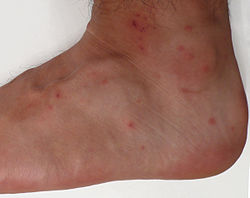
Chigger bites on the foot and ankle
SpecialtyDermatology
Causestrombiculid mites

Trombiculosis is a rash caused by trombiculid mites, especially those of the genus Trombicula (chiggers). The rash is also often known as chigger bites.

Chiggers are commonly found on the tip of blades of grasses to catch a host, so keeping grass short, and removing brush and wood debris where potential mite hosts may live, can limit their impact on an area. Sunlight that penetrates the grass will make the lawn drier and make it less favorable for chigger survival.[citation needed]

Chiggers seem to affect warm covered areas of the body more than drier areas.[1][2] Thus, the bites are often clustered behind the knees, or beneath tight undergarments such as socks, underwear, or brassieres. Areas higher in the body (chest, back, waist-band, and under-arms) are affected more easily in small children than in adults, since children are shorter and are more likely than adults to come in contact with low-lying vegetation and dry grass where chiggers thrive. An exceptional case has been described in the eye,[3] producing conjunctivitis.

Application of repellent to the shoes, lower trousers and skin is also useful. Because they are found in grass, staying on trails, roads, or paths can prevent contact. Dusting sulfur is used commercially for mite control and can be used to control chiggers in yards. The dusting of shoes, socks and trouser legs with sulfur can be highly effective in repelling chiggers.[4]

Another good strategy is to recognize the chigger habitat to avoid exposure in the first place. Chiggers in North America thrive late in summer, in dry tall grasses and other thick, unshaded vegetation. Mite repellents and or Acaricide containing one of the following active ingredients are recommended: Permethrin, picaridin, DEET, catnip oil extract (nepetalactone), citronella oil or eucalyptus oil extract.

Chiggers can also be treated using common household vinegar (5% acetic acid).[citation needed]

Additional images

[edit]
Chigger rash 36 hours after exposure
Chigger bites showing characteristic raised and fluid-filled center

References

[edit]
[edit]
Revisions and contributorsEdit on WikipediaRead on Wikipedia
from Grokipedia
Trombiculosis, also known as trombiculiasis, is a self-limiting resulting from bites by the larval stage of mites in the family , commonly referred to as chiggers. These microscopic larvae attach to the skin, particularly in areas where fits tightly, and inject proteolytic enzymes that liquefy surrounding tissue for feeding, triggering a reaction characterized by intense pruritus and erythematous papules. The condition is most prevalent in warm, humid environments such as grasslands, forests, and moist areas during late summer and early fall in temperate regions, or year-round in tropical climates. The primary causative agents are species like Eutrombicula alfreddugesi in , Neotrombicula autumnalis in , and various Leptotrombidium species in , which are free-living mites whose larvae parasitize vertebrates including humans, though small serve as their natural hosts. Bites typically occur after exposure to infested vegetation, with larvae not burrowing into the skin but forming a stylostome—a tube-like structure from digested tissue—that persists and irritates the host. Symptoms usually manifest 3–6 hours post-bite, escalating to peak itching within 24–48 hours, and include clustered red bumps, swelling, or occasionally vesicles, often in linear patterns along sock lines, waistbands, or skin folds. In severe cases, particularly in children, it may lead to secondary bacterial infections or pronounced swelling, such as "." Diagnosis is primarily clinical, relying on patient history of outdoor exposure in endemic areas and the distinctive lesion distribution, with microscopic identification of mites possible but rarely necessary due to the condition's characteristic presentation. Treatment focuses on symptom relief, including topical corticosteroids, oral antihistamines like diphenhydramine, and cool compresses to alleviate itching, which generally resolves within 1–2 weeks without intervention. In regions where chiggers transmit pathogens like Orientia tsutsugamushi causing , antibiotics such as may be required. Prevention strategies emphasize avoiding high-risk areas, wearing long sleeves and pants, and applying insect repellents containing (at least 30% concentration) or treating clothing with , which can reduce bites by up to 83%.

Background

Definition and Terminology

Trombiculosis is defined as an acute, self-limited resulting from the injection of by larval mites, commonly known as chiggers, belonging to the family during their feeding process on . This condition manifests as localized pruritus and irritation at the bite sites, typically resolving without long-term sequelae in immunocompetent individuals. The term "trombiculosis" derives from the family name , which encompasses these parasitic mites in their larval stage. The nomenclature surrounding this condition includes several synonyms that reflect regional or descriptive usage, such as chigger dermatitis, scrub itch, and trombiculiasis, with the latter often used interchangeably to denote the same infestation-induced reaction. Trombidiasis is another variant term occasionally employed, particularly in older literature, to describe the dermatitis caused by these mites. Etymologically, "Trombicula," the within , originates from the Greek "tromein" meaning "to tremble" and Latin "culex" meaning "," alluding to the mites' rapid, quivering movements. Importantly, trombiculosis pertains exclusively to the dermatological response to chigger saliva and must be distinguished from systemic infections vectored by the same mites, such as caused by Orientia tsutsugamushi, which involves bacterial transmission rather than a direct allergic reaction to salivary enzymes.

Historical Context

Early reports of what is now recognized as trombiculosis date back to the sixth century in , where ancient medical texts described "chigger fever" associated with mite vectors causing febrile illnesses and skin irritations. In , the condition was first formally linked to mites in the , with describing Trombicula batatas in 1758 as part of broader entomological classifications. By 1790, George Shaw identified Trombicula autumnalis, a species tied to seasonal "autumnal dermatitis" or "autumnal itch," characterized by pruritic rashes appearing in late summer and fall. During the , European physicians documented recurring cases of harvest mite infestations, observing that larval mites caused intense itching and papular lesions, particularly in rural areas during harvest seasons. In , Antoine Duges provided a pivotal observation by identifying the parasitic larval stage of these mites as the direct cause of the , distinguishing it from other seasonal skin conditions. These pre-20th-century accounts, though detailed, were often overshadowed in later literature by the focus on mite-vectored diseases. The 20th century brought significant advancements in understanding trombiculosis through taxonomic and epidemiological research. In the 1920s, American entomologist H.E. Ewing developed a foundational classificatory system for genera, cataloging numerous species and clarifying their roles in and animal infestations. studies in the theater intensified scrutiny of chiggers, confirming as primary vectors for (Orientia tsutsugamushi), with over 18,000 cases reported among Allied troops and underscoring the mites' public health impact. By the , investigations revealed that the characteristic resulted from mite salivary enzymes that liquefy host skin cells, forming a feeding stylostome and triggering intense inflammation. In modern times, trombiculosis has gained prominence in , with increased documentation of cases in domestic animals like cats and dogs since the late 20th century, often presenting as seasonal pruritic in endemic regions. This evolution reflects a shift from anecdotal early descriptions to systematic study, though pre-20th-century European observations of non-vectorial remain underemphasized compared to transmission aspects.

Etiology

Causative Agents

Trombiculosis is caused by the larval stage of mites in the family , which belongs to the superfamily Trombidioidea within the order Trombidiformes. This family encompasses over 3,000 described species, with key genera including , Eutrombicula, and Leptotrombidium, many of which are ectoparasites during their larval phase. The causative agents are specifically the hexapod larvae, commonly known as chiggers, which are the only parasitic stage in the mite's life cycle; adults and deutonymphs are free-living and non-parasitic predators or in and . Morphologically, chigger larvae measure 0.2–0.4 mm in length, exhibit a bright red-orange coloration, and possess three pairs of legs, distinguishing them from the eight-legged adults. Their body structure includes a gnathosoma with piercing mouthparts and an idiosoma featuring a for taxonomic identification. These larvae do not suck but instead liquefy host tissues through salivary secretions containing enzyme-like proteolytic substances, such as those historically termed trombiculin, which digest epidermal cells and for feeding via a formed stylostome tube. This tissue-liquefying behavior induces the characteristic skin reaction of trombiculosis without direct . Representative species include Trombicula autumnalis, prevalent in and responsible for seasonal infestations leading to , Eutrombicula alfreddugesi in , and Leptotrombidium akamushi in , which not only causes trombiculosis but also serves as a vector for .

Life Cycle and Human Interaction

The life cycle of trombiculid mites, commonly known as chiggers, consists of seven developmental stages: , prelarva (deutovum), active , protonymph, deutonymph (), tritonymph, and . Eggs are laid by females in clusters within moist or leaf litter, hatching into non-feeding prelarvae after 1-2 weeks under favorable conditions. The prelarvae then molt into the parasitic larval stage, which is the only phase that interacts with vertebrate hosts; subsequent nymphal and stages are free-living and predatory, feeding on small arthropods, insect , or in the . The complete life cycle typically spans 2-3 months in warm, humid environments, though it can extend to 8-10 months in cooler conditions, with multiple generations possible per year depending on . overwinter in the and emerge in spring to mate and oviposit, ensuring population persistence across seasons. Human interaction occurs exclusively during the larval stage, when six-legged larvae actively quest for hosts by waiting on low vegetation such as grass blades or leaf edges in shaded areas. Upon contact, a larva attaches to the host's skin using its chelicerae to pierce the epidermis, then injects salivary enzymes that liquefy surrounding tissues and lymph without burrowing deeper or consuming blood. This process induces the host's immune response to form a stylostome—a narrow, tube-like structure of hardened, eosinophilic tissue that serves as the mite's feeding conduit—allowing the larva to ingest the resulting fluid over 2-4 days until engorged. The larva remains attached during this period, often in areas where clothing constricts the skin, before detaching and dropping to the ground to molt into non-parasitic nymphs. Larvae of certain species can transmit diseases to humans through this feeding mechanism, such as scrub typhus caused by Orientia tsutsugamushi, whereas adults and nymphs avoid vertebrate hosts entirely. Trombiculid larvae thrive under specific environmental conditions that support their questing and survival, with optimal temperatures ranging from 25-30°C and relative of 80-100%, typically in grassy, shrubby, or forested areas with moist, shaded soil. Development accelerates above 15°C, but larvae become inactive below this threshold and perish at temperatures under 6°C; excessive heat above 37°C or direct also limits their activity by desiccating exposed sites. These preferences confine high larval densities to transitional habitats like field edges or undergrowth, where is retained during the day, peaking in late spring through early fall in temperate regions. The life cycle of trombiculid mites is maintained primarily through non-human hosts, including , birds, reptiles such as snakes and lizards, amphibians like toads, and occasionally , which serve as natural reservoirs for larval feeding without causing significant harm to these populations. Humans act as incidental hosts, as larvae readily attach but do not complete on them, ensuring the mites' persistence relies on wild or domestic animal cycles in endemic areas.

Clinical Features

Symptoms

Symptoms of trombiculosis typically manifest 3 to 6 hours after a chigger attaches to the skin, beginning with a sensation of mild that rapidly progresses to intense pruritus at the bite sites. The itching often intensifies, reaching a peak between 24 and 48 hours post-bite, and may persist for 1 to 2 weeks, gradually subsiding as the inflammatory response resolves. This progression can disrupt sleep and daily activities due to the unrelenting discomfort. Primary symptoms from the patient's perspective include severe, burning itching, often described as the most intense of any insect bite, accompanied by small red papules or macules measuring 1 to 2 mm in diameter. These lesions may evolve into vesicles, bullae, or urticarial wheals, with surrounding and occasional swelling. The affected areas commonly occur where clothing fits tightly, such as around the , ankles, armpits, and , frequently appearing in linear or clustered patterns reflective of larval movement across the skin. Vigorous scratching in response to the pruritus often results in excoriations, which can lead to secondary bacterial superinfections like or . In rare instances, such secondary infections may cause systemic symptoms including fever. Symptom severity can vary; in individuals previously sensitized to chigger , reactions may be more pronounced due to , manifesting as heightened swelling and .

Pathophysiology

The larval stage of trombiculid mites, known as chiggers, attaches to the host's skin and pierces the using its to inject containing proteolytic enzymes. These enzymes liquefy surrounding epidermal cells, creating a semi-fluid mixture of tissue that the larva ingests, rather than consuming directly. This enzymatic leads to the formation of a characteristic stylostome—a tube-like structure composed of compacted, host cells and salivary secretions—that serves as a feeding conduit. The stylostome develops progressively over the period of attachment, typically less than 48 hours in humans, starting with an initial cone to which the adhere, and it remains in the skin even after the larva detaches. The host's immune response to the injected mite saliva involves both immediate (Type I) and delayed (Type IV) hypersensitivity reactions to the antigenic components. Type I hypersensitivity is mediated by IgE antibodies, triggering mast cell degranulation and histamine release, which induces vasodilation, increased vascular permeability, and localized edema. Type IV hypersensitivity, a cell-mediated response, develops over 24–48 hours and contributes to the papular lesions through T-cell activation. The mite saliva composition, including digestive enzymes and other proteins, acts as the primary allergen in these reactions (as detailed in the section on causative agents). This dual initiates an inflammatory cascade characterized by release, such as that recruit immune cells to the site. The shows infiltration primarily by and lymphocytes, with lesser numbers of neutrophils, , and histiocytes, leading to epidermal thickening and serous exudation. The persistent stylostome, even post-feeding, continues to provoke by serving as a nidus for ongoing immune activation and tissue remodeling. In experimental models, repeated infestations intensify this cascade, with influx peaking in subsequent exposures. Intense pruritus in trombiculosis arises from direct stimulation due to enzymatic tissue degradation and the release of immune mediators like and cytokines, rather than a specific . Although no true is involved, the proteolytic mimics toxic effects by causing localized tissue damage and irritation. The condition is self-limited, as the larvae typically detach after engorgement within a few days, often less than 48 hours in humans due to dislodgement; however, repeated exposures often lead to and more pronounced reactions rather than waning.

Transmission and Epidemiology

Modes of Transmission

Trombiculosis is primarily acquired through direct contact with the larval stage of trombiculid mites (chiggers), which inhabit low-lying such as grasses, weeds, and shrubs in endemic areas. These microscopic larvae actively quest for hosts by climbing onto passing animals or humans during outdoor activities, attaching to in areas of minimal and tight clothing, including ankles, waistlines, groin, and armpits, where they feed by injecting that liquefy epidermal cells. The condition is non-contagious and does not spread from person to person, as chigger larvae cannot reproduce on human hosts and detach after feeding, typically surviving only briefly on detached or without viable transmission via fomites. Transmission peaks during warm, humid periods favoring larval activity and development, occurring mainly in summer and early fall in temperate regions of the , while persisting year-round in tropical and subtropical zones due to consistent moisture and temperatures above 16°C. Occupational and recreational exposure is elevated among individuals spending extended time outdoors in infested habitats, including farmers tending fields, soldiers on maneuvers, and hikers traversing trails, with larvae often encountered in rural or suburban grassy areas. Rare indoor acquisitions have been documented, occasionally associated with potted plants transported from outdoor settings or pets harboring larvae after environmental contact. While trombiculid mites act as vectors for rickettsial bacteria such as Orientia tsutsugamushi—responsible for via infected saliva during feeding—trombiculosis arises exclusively from the mechanical and enzymatic irritation of mite attachment and skin digestion, independent of any infectious agent. The interaction occurs solely during the six-legged larval stage of the mite life cycle, as adults and nymphs do not parasitize humans.

Geographic Distribution and Risk Factors

Trombiculosis exhibits a , occurring worldwide but predominantly in temperate and tropical regions across , , , and , where warm, humid conditions favor mite proliferation. The condition is largely absent from extreme polar areas and arid deserts, as these environments lack the necessary moisture and for larval survival. Notable hotspots include the , particularly the "chigger belt" spanning and , where infestations peak in overgrown fields, wooded areas, and humid midwestern zones during summer months. In , rice fields and scrub vegetation in areas like and represent high-risk foci, often associated with agricultural activities and contributing to regional disease burdens. European outbreaks occur seasonally in autumn, with elevated prevalence documented in northern regions such as and in , where up to 25% of wildlife show infestation, signaling parallel human exposure risks in grassy habitats. Key risk factors center on direct exposure to mite habitats through outdoor recreation, hiking, or occupational activities like farming in grassy, shrubby, or moist environments near sources. Individuals in these settings, especially during late spring to autumn in temperate climates, face heightened susceptibility, with children, who are more commonly affected due to ground-level play increasing contact with infested . workers and those in rural or agricultural areas also encounter elevated risks from prolonged environmental interaction. Emerging point to urban green spaces as underrecognized hotspots, exemplified by a study in public parks where 76.8% of sampled animals carried chiggers, indicating potential transmission in densely populated settings. Epidemiological patterns show rising incidence linked to , which expands habitats and introduces cases in non-endemic areas such as southern , the , and parts of , while shifting seasonal dynamics. Underreporting persists, particularly in rural tropical regions, owing to the self-limited nature of most cases and frequent misdiagnosis, though global surveillance highlights increasing notifications post-2020 amid and expanded outdoor pursuits.

Diagnosis

Clinical Diagnosis

Clinical diagnosis of trombiculosis relies primarily on a detailed patient history and characteristic physical findings, as the condition is often self-limited and does not typically require confirmation in straightforward cases. During history taking, clinicians inquire about recent outdoor activities in endemic areas, such as grassy fields, wooded regions, or humid environments, particularly during late summer or early fall in temperate zones or year-round in tropical regions. Patients commonly report the onset of intensely pruritic lesions clustered in areas constricted by clothing, such as the waistband, sock lines, or axillae, with symptoms emerging 3 to 6 hours after exposure and peaking within 24 to 48 hours. This temporal association, combined with patient recall of potential chigger contact, strongly supports suspicion, especially in travelers returning from tropical areas presenting with unexplained pruritus. On , key features include multiple erythematous papules, often 1 to 2 mm in diameter, with a central punctum representing the stylostome—a tube-like structure formed by the chigger during feeding. These lesions exhibit surrounding and , without evidence of burrowing tracks or linear excoriations typical of other infestations, and are characteristically distributed in linear or grouped patterns along sites of tight clothing contact, such as the ankles, , or trunk folds. Intense itching leads to excoriations, and in some cases, vesicles or bullae may develop, but the absence of systemic signs like fever distinguishes it from more severe mite-borne illnesses. Distribution patterns are crucial for differentiation, as lesions rarely appear on the face, , or palms despite exposure. In typical presentations, clinical is sufficient based on the of exposure and these hallmark exam findings, obviating the need for further testing. Microscopic examination of skin scrapings or videodermatoscopy can identify the larvae in some cases, though this is rarely required. Seasonal timing—peaking in warmer months—and accurate recall of environmental exposure further aid confirmation, though challenges arise in underreported cases where nonspecific pruritus delays recognition. Rarely, if lesions are atypical, a may reveal and the stylostome remnant, but this is not routinely indicated for presumptive . Clinicians should suspect trombiculosis in individuals with clustered, itchy papules following in chigger habitats, integrating these elements with reported symptom profiles of persistent pruritus lasting 1 to 2 weeks.

Differential Diagnosis

Trombiculosis presents with intensely pruritic, erythematous papules or urticarial s, often clustered in areas of tight clothing or following outdoor exposure, which can mimic several other dermatological conditions. Distinguishing it relies on a detailed history of recent environmental exposure, morphology, and temporal patterns, as laboratory confirmation is rarely needed unless complications arise. Common parasitic differentials include , characterized by burrows, nocturnal intensification of pruritus, and family or close-contact clustering, in contrast to trombiculosis's lack of burrows, non-nocturnal peak itching, and isolated occurrence tied to seasonal outdoor activity. Other ectoparasitoses such as , phthiriasis, , , and tick bites may present with similar pruritic papules but are differentiated by visible lice or nits, burrowing tracks, embedded fleas, or larger attachment sites, respectively, rather than the small central puncta or stylostome remnants seen in chigger bites. Insect bites from fleas, mosquitoes, , or bedbugs often cause scattered, randomly distributed pruritic papules without the linear or clustered arrangement along clothing lines typical of trombiculosis; flea bites may show a linear "breakfast, lunch, dinner" pattern but are linked to indoor pets or infested environments, while or bites lack the delayed onset (hours to days) and prolonged resolution (1-2 weeks) of chigger-induced lesions. , such as from plants like , produces eczematous patches without central puncta and correlates with direct irritant exposure history rather than mite vectors in grassy areas. Infectious mimics like or feature pustules, crusting, or honey-colored exudates with possible fever and bacterial , absent in uncomplicated trombiculosis, which shows sterile inflammatory papules resolving without systemic signs. Viral exanthems, such as those from enteroviruses, present with widespread maculopapular rashes and accompanying fever or , unlike the localized, exposure-linked distribution in trombiculosis. Allergic or idiopathic conditions include urticaria, marked by transient, migratory wheals without fixed puncta or seasonal clustering, and eczema (), which is chronic, non-resolving, and unrelated to acute outdoor exposure. Trombiculosis lesions are typically linear or grouped, self-limited within 1-2 weeks, and directly linked to ; if ambiguity persists, can confirm the stylostome—a tubular structure of and host tissue reaction—not seen in these mimics. In endemic regions, particularly , rare considerations include (transmitted by larval trombiculids), which may overlay skin findings with , fever, and ; or PCR testing is warranted if systemic symptoms emerge to rule it out.

Management

Treatment Approaches

The primary management of trombiculosis focuses on symptomatic relief, as the chigger larvae typically detach spontaneously within a few days, and no specific acaricidal therapy is required for humans. First-line treatments include topical corticosteroids, such as 1% cream, applied to affected areas to reduce and pruritus. Over-the-counter antipruritics like calamine lotion provide soothing relief by cooling the skin and alleviating itching. Oral antihistamines, such as loratadine or diphenhydramine, are recommended for moderate to severe itching, helping to block histamine-mediated responses. Supportive care measures emphasize non-pharmacologic interventions to enhance comfort and prevent complications. Cool baths or compresses can diminish swelling and discomfort, while colloidal oatmeal soaks offer benefits to soothe irritated skin. Patients should be advised to avoid scratching, as this can lead to excoriations and secondary bacterial infections, though the risk is briefly noted in clinical contexts. If secondary bacterial infection develops, such as evidenced by increasing redness, warmth, or pus, oral antibiotics like cephalexin are indicated, typically for 7-10 days depending on severity. prophylaxis may be necessary for open wounds from , following standard guidelines. In regions where chiggers transmit pathogens such as Orientia tsutsugamushi causing , patients should be evaluated for systemic symptoms (e.g., fever, , rash, or at bite site). If is suspected or confirmed, treatment with (100 mg orally twice daily for adults, for at least 7 days or until afebrile for 3 days) is recommended, as it is the drug of choice for rickettsial infections. For severe or refractory cases with widespread inflammation, a short course of oral corticosteroids, such as 0.5-1 mg/kg daily for 3-5 days, may be prescribed to control acute symptoms, though this is used judiciously due to potential side effects. Evidence for these approaches is largely derived from clinical experience and expert consensus, with limited randomized controlled trials; symptomatic relief remains the standard per dermatology guidelines, including updates from the on insect bite management.

Prevention Strategies

Preventing trombiculosis involves a combination of personal protective measures, behavioral modifications, environmental management, and initiatives to minimize exposure to chigger larvae. These strategies focus on reducing contact in endemic areas where Trombicula mites thrive in warm, humid environments with dense vegetation. Personal protection is a primary line of defense, emphasizing physical barriers and chemical repellents. Wearing long-sleeved shirts, long pants tucked into socks or boots, and closed-toe shoes covers exposed skin and prevents larvae from accessing attachment sites. repellents containing 20-30% N,N-diethyl-meta-toluamide () applied to skin and clothing provide effective deterrence against chigger bites, with DEET considered the gold standard for repellency. Additionally, treating clothing, gear, and bedding with 0.5% offers prolonged protection, as the insecticide binds to fabrics and remains active through several washes. For eco-friendly alternatives, plant-derived options such as oil of lemon eucalyptus (at 30% concentration) are recommended by health authorities as effective substitutes for synthetic repellents against various arthropods, including mites. Behavioral strategies further reduce risk by limiting exposure during peak chigger activity, typically in late summer on warm afternoons when larvae quest on . Avoiding tall grasses, brushy areas, and wooded edges, especially in known endemic regions, helps evade infested habitats. Immediately after outdoor activities, taking a hot, soapy and vigorously scrubbing the skin can dislodge unattached larvae, significantly lowering bite incidence. Environmental control targets mite habitats around homes and high-risk sites. Regular mowing of lawns to less than 3 inches, clearing leaf litter, weeds, and overgrown vegetation, and applying herbicides to maintain open yard spaces diminish suitable microhabitats for chiggers. In areas with heavy infestations, such as military camps or recreational fields, targeted application of acaricides like synthetic pyrethroids (e.g., or ) to vegetation can suppress larval populations, though these should be used judiciously to avoid non-target impacts. Public health efforts in endemic regions emphasize on recognition and avoidance of chigger-prone areas, alongside systems to monitor seasonal outbreaks and guide interventions. Programs promoting , including awareness campaigns for outdoor workers and hikers, have proven essential in reducing incidence rates. Studies demonstrate high effectiveness of these measures; for instance, permethrin-treated uniforms increased by 74% compared to untreated clothing with repellent alone during field exposure. and permethrin combinations typically reduce bite rates substantially, often exceeding 80% in controlled settings against larvae. Emerging research on essential oils, such as and ginger extracts, indicates promising repellent activity comparable to low-concentration in tests against chiggers, supporting their use as sustainable options.

References

Add your contribution
Related Hubs
User Avatar
No comments yet.