Hubbry Logo
Allium chinenseAllium chinenseMain
Open search
Allium chinense
Community hub
Allium chinense
logo
8 pages, 0 posts
0 subscribers
Be the first to start a discussion here.
Allium chinense
Allium chinense
from Wikipedia

Chinese onion
Scientific classification Edit this classification
Kingdom: Plantae
Clade: Tracheophytes
Clade: Angiosperms
Clade: Monocots
Order: Asparagales
Family: Amaryllidaceae
Subfamily: Allioideae
Genus: Allium
Subgenus: A. subg. Cepa
Species:
A. chinense
Binomial name
Allium chinense
Synonyms[2]
Synonymy

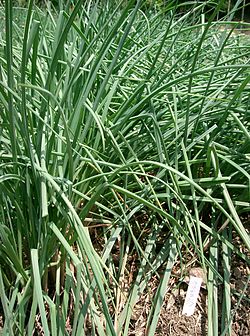
Allium chinense (also known as Chinese onion,[3][4] Chinese scallion,[3] glittering chive,[5] Japanese scallion,[3] Kiangsi scallion,[4] and Oriental onion[3]) is an edible species of Allium, native to China,[3] and cultivated in many other countries.[6] Its close relatives include the onion, scallion, leek, chive, and garlic.[7]

Distribution

[edit]
Flowers of Allium chinense

Allium chinense is native to China (in Anhui, Fujian, Guangdong, Guangxi, Guizhou, Hainan, Henan, Hubei, Hunan, Jiangxi, and Zhejiang provinces).[3] It is naturalized in other parts of Asia as well as in North America.[3][8][9]

Uses

[edit]

Culinary

[edit]
Sold at a market in Shenzhen (left)

Owing to its very mild and "fresh" taste, A. chinense is often pickled and served as a side dish in Japan and Vietnam to balance the stronger flavor of some other component in a meal. For example, in Japanese cuisine, it is eaten as a garnish on Japanese curry.[10]

In Vietnam, pickled A. chinense, known as củ kiệu, is often served during Tết (Lunar New Year).[citation needed]

In Japanese, it is known as rakkyō (辣韮 or 薤). Glass bottles of white rakkyō bulb pickles are sold in Asian supermarkets in North America.[11]

Medicinal

[edit]

Allium chinense is used as a folk medicine in tonics to help the intestines, and as a stomachic.[12]

See also

[edit]
  • Allium tuberosum, also known as garlic chives – Species of onion native to southwestern parts of the Chinese province of Shanxi
  • Pickled onion – Onions pickled in a solution of vinegar or salt

References

[edit]
[edit]
Revisions and contributorsEdit on WikipediaRead on Wikipedia
from Grokipedia
Allium chinense, commonly known as rakkyo or Chinese onion, is a bulbous perennial herbaceous plant in the genus Allium of the family Amaryllidaceae, characterized by clustered narrowly ovoid bulbs 0.5–2 cm in diameter with a white, membranous tunic, linear hollow leaves 1–3 mm wide that are 3–5-angled and subequaling the 20–40 cm terete scape, and a laxly flowered hemispheric umbel of pale to dull purple flowers with broadly elliptic to suborbicular perianth segments 4–6 × 3–4 mm. Native to south-central and southeast China including Hainan, it grows primarily in the temperate biome as a geophyte and has been introduced to regions such as Japan, Korea, Kyrgyzstan, Assam, Bangladesh, the Himalaya, Thailand, and Cuba. The species is cultivated worldwide for its edible bulbs, which are commonly pickled in Chinese and Japanese cuisine under names like rakkyo, as well as its leaves, flowers, seeds, and roots used in various culinary applications and in traditional medicine. It prefers moist, well-drained soils in temperate climates and is shade-intolerant, forming dense clumps up to 30 cm tall with bright green foliage and light purple blooms from October to November.

Taxonomy

Classification

Allium chinense is a within the Allium, classified hierarchically as follows: kingdom Plantae, Tracheophyta, class Liliopsida, order Asparagales, family Amaryllidaceae, Allium, and A. chinense. This placement reflects its position among monocotyledonous flowering plants characterized by bulbous growth and umbellate inflorescences typical of the Allium . Within the , A. chinense belongs to subgenus Cepa, commonly referred to as group, which encompasses with tunicated bulbs and a tendency toward cultivation as or condiments. It is further assigned to section Sacculiferum, distinguished by morphological features such as clustered bulbils and elongated spathe valves. The was originally described by George Don in 1827 in the sixth volume of the Memoirs of the Wernerian Natural History Society. Several synonyms have been recognized for A. chinense, including Allium bakeri Regel, Allium bodinieri H.Lév. & Vaniot, Allium exsertum Baker, Allium exsertum G.Don, Allium martini H.Lév. & Vaniot, and Allium splendens H.Lév. These reflect historical taxonomic revisions based on specimens from . Close relatives within Cepa include Allium cepa () and Allium fistulosum (), sharing evolutionary adaptations for bulb formation driven by photoperiodic responses. Molecular phylogenetic studies, utilizing nuclear and markers, confirm this grouping and highlight conserved genetic traits in bulb development among these species, supporting their within the subgenus.

Etymology

The scientific name Allium chinense comprises the genus Allium, derived from the Latin word allium meaning "garlic," which refers to the pungent, garlic-like odor characteristic of species in this genus. The specific epithet chinense is the neuter form of the Latin adjective chinensis, meaning "of " or "Chinese," denoting the plant's origin in southern . This species was first formally described by Scottish botanist George Don in 1827, in the sixth volume of the Memoirs of the Wernerian Natural History Society. Don's description established the binomial nomenclature still in use today, based on specimens from Asian collections. In various cultures, Allium chinense bears common names tied to its culinary roles, such as "Chinese onion" or "Kiangsi scallion" in English, reflecting its Asian heritage; jiàotóu (藠头) in Mandarin Chinese, literally "bulb head"; rakkyō (辣韮 or 薤) in Japanese, derived from terms evoking its spicy, chive-like qualities and commonly denoting the pickled bulbs central to Japanese cuisine; and củ kiệu in Vietnamese, highlighting its use as a preserved vegetable.

Description

Vegetative Characteristics

Allium chinense is a that grows to a height of 0.3–0.5 m, forming dense clumps through vegetative multiplication and exhibiting an habit in mild climates, though it enters during mid-summer heat. The produces a basal cluster of leaves and an underground , with vigorous tillering that can yield up to 30 bulbs per mature over time. The is underground, narrowly ovoid in shape, measuring (0.5–)1–1.5(–2) cm in diameter, and often clustered. It features an outer that is membranous, typically white, sometimes tinged with red, providing protection while allowing gradual tapering into the leaf bases. In cultivation, bulbs can enlarge to 4–5 cm in diameter after 2–3 years, developing a crisp texture with a strong onion-like flavor. The leaves are , linear, hollow, and arranged in a basal rosette, subequaling the 20–40 cm scape and 1–3 mm in width. They are bright green and possess a 3–5-angled cross-section that is D-shaped or nearly triangular, rendering them slender and thin-walled with less erect posture compared to ; this structure forms distichous clusters around the . The consists of fibrous roots emerging from the base of the , enabling anchorage and uptake in well-drained soils.

Reproductive Structures

The reproductive structures of Allium chinense are adapted for , though is limited in cultivated populations, with vegetative via being predominant. The is a lax, nearly hemispheric borne on a solid, terete scape that measures 20–40 cm tall and is covered by leaf sheaths only at the base; the scape emerges laterally from the cluster. The typically contains 6–30 flowers and lacks bulbils, with a persistent, , two-valved spathe; pedicels are subequal, 2–4 times longer than the segments (approximately 1–3 cm), and often bracteolate. Individual flowers are campanulate, hermaphroditic, and range from pale to dull or lavender, occasionally tinged with . They consist of six tepals in two whorls, broadly elliptic to suborbicular and measuring 4–6 mm long by 3–4 mm wide, with the inner tepals slightly longer than the outer; the segments are thick and persistent. The six stamens have equal filaments that are filiform to subulate, approximately 1.5 times the length of the (about 6–9 mm), connate at the base and adnate to the segments; the inner three filaments are broadened at the base with one on each side, while the outer three are narrower. The is obovoid-globose with basal concave nectaries covered by hoodlike projections, and the style is long-exserted. Fruit development is rare due to female sterility in many cultivated populations, resulting in limited seed set; when it occurs, the fruit is a loculicidal capsule containing black that are viable for , though dispersal is primarily achieved through division rather than or bulbils. Young seedpods, if formed, are and provide a mild flavor. Chromosomes: 2n = 24, 32. In its native range, flowering typically occurs from October to November, triggered by environmental cues such as day length and temperature; the flowers attract pollinators including bees and other insects, though successful fertilization is infrequent in cultivation.

Distribution and Habitat

Native Range

Allium chinense is native to China, occurring naturally in the provinces of Anhui, Fujian, Guangdong, Guangxi, Guizhou, Hainan, Henan, Hubei, Hunan, Jiangxi, and Zhejiang. The species grows primarily in the temperate , favoring grasslands, forest edges, and open woodlands. It prefers sandy, well-drained soils that support its bulbous growth in these environments. Ecologically, A. chinense inhabits grasslands, open woodlands, and rocky slopes.

Introduced and Cultivated Ranges

Allium chinense has been introduced and naturalized in several regions outside its native range in , particularly in East and Southeast Asia. It is widely naturalized in and Korea, where it often occurs on field edges and disturbed areas, as well as cultivated in and sporadically naturalized in parts of (including , , East Himalaya, and West Himalaya), where it has established beyond some cultivation sites. It has also been introduced to , , and . The species was introduced to from around the , initially as a medicinal , and has since become extensively cultivated and naturalized there as rakkyō. In Indo-China (including ) and , introductions likely occurred through historical trade and agricultural exchanges from central and eastern , leading to both cultivation and sporadic . In , A. chinense is cultivated on a small scale in and , introduced primarily through Asian immigrant communities in the late 19th and early 20th centuries. serves as a minor cultivation center, with limited acreage near Castroville grown for fresh markets serving ethnic populations, while in , it is produced for its small bulbs. Major cultivation hotspots include , , and parts of . In , rakkyō is a commercial crop, especially in , with annual production of approximately 24,000 tons as of 1997 and average yields of 6 tons per , reaching up to 20 tons per in southern regions. produces it as a key vegetable, while , , , and other Southeast Asian countries grow it extensively for local markets. Globally, A. chinense is actively cultivated in tropical and subtropical areas for its bulbs and leaves, with exports supporting , particularly to regions with Asian communities.

Cultivation

Propagation

Allium chinense is primarily propagated vegetatively through bulb division, as this method ensures true-to-type and is the standard practice for commercial cultivation. Bulbs are divided in autumn or spring, with mother bulbs typically planted in to allow for growth and multiplication; each plant can produce approximately 30 daughter bulbs by harvest in June. Offsets or small bulbs are separated from the parent clump and planted immediately into prepared beds or containers just below the surface (1-2 cm deep) and spacing of 10-15 cm apart, promoting rapid establishment and development. This approach is favored due to its reliability in humid subtropical environments, though it carries challenges such as low multiplication rates and a high risk of transmission between bulbs. Seed propagation is less common but feasible for introducing or overcoming viral issues in vegetative stock. Seeds are sown in spring within a to break , often requiring moist stratification at low temperatures (around 4°C for several weeks) to promote , which typically occurs within 2-4 weeks at 15-20°C once conditions are optimal. Seedlings are then pricked out into pots (three per pot) and overwintered in a before to the field the following spring, approximately 8-10 weeks after initial emergence, when they have developed sufficient root systems. This method suits controlled environments but demands careful management to achieve viable stands, as species often exhibit that delays uniform without pretreatment. In regions like , sprouting bulbs (sets) are planted from November to February, aligning with cooler, wetter periods to support division and tillering without the need for seed starting. Vegetative via bulb multiplication remains the dominant technique globally, particularly in , where the plant's natural structure facilitates easy separation of offsets for replanting. Challenges in both methods include ensuring to prevent during establishment, as the species thrives in moist conditions native to its range.

Growing Requirements

Allium chinense thrives in subtropical to temperate climates, corresponding to USDA hardiness zones 6-9, where it can tolerate temperatures as low as -15°C and up to 38°C. It prefers mild growing conditions with average temperatures between 15-25°C but enters and dies back in hot mid-summer weather, resuming growth in late summer. Light frost is tolerated, but prolonged freezing may damage bulbs in colder zones. The plant requires well-drained, light sandy or loamy soils to prevent , with a preferred range of 6.0-7.5. It performs best in rich loam amended with , such as for and lime for calcium, applied several months before planting to optimize availability. Poorly drained or heavy clay soils should be avoided, as waterlogging promotes fungal issues. Watering should be moderate and consistent to keep the moist but not waterlogged during active growth. Fertilization involves applying a balanced, low-nitrogen formula during the to support foliage and development without excessive top growth. Bulbs are spaced 10-15 cm apart in rows 60 cm wide to allow for tillering and air circulation. Common pests include and onion flies, which can damage leaves and bulbs, while diseases such as stem rot, leaf scorch, and brown spot are prevalent in humid or poorly drained conditions. These issues are exacerbated by water stress or high , leading to and discoloration. Organic management strategies, including , improved drainage, and natural repellents from the plant's own pungent oils, are recommended to control infestations. Bulbs are typically ready for harvest 8-10 months after fall planting, once leaves die back in late summer, indicating and maturity. At this stage, clumps are lifted, dried, and cleaned for storage or use.

Uses

Culinary

Allium chinense, commonly known as Chinese onion or rakkyō in , features edible bulbs, leaves, and scapes that are integral to East Asian culinary traditions. The clustered bulbs, prized for their crisp texture and mild , are most famously pickled in as rakkyō-zuke, a often served alongside rice to provide a sweet-tart contrast. In and , the leaves and scapes are commonly stir-fried with meats or or incorporated into fresh salads for their subtle onion-like flavor. Preparation methods vary by region but emphasize preserving the plant's natural crunch and aroma. In , bulbs are typically blanched briefly, salted for 1-2 weeks to draw out moisture, and then steeped in a brine of , , and sometimes for 1-2 months, resulting in a tangy, mildly sweet pickle. Vietnamese preparations often involve the bulbs raw in a similar vinegar-sugar mixture for holiday dishes, where they serve as a symbolic fresh start. Nutritionally, the fresh bulbs are low in calories at approximately 25 kcal per 100 g and provide significant amounts of (around 160 mg per 100 g), contributing to their properties alongside organosulfur compounds that impart the characteristic , milder than but evocative of onions. They also contain precursors and other vitamins like B1, supporting their role as a nutrient-dense addition to meals. Culturally, Allium chinense holds staple status in East Asian diets, symbolizing prosperity in Vietnamese New Year feasts and complementing everyday Japanese meals as a . As of 2020, annual production in was approximately 7,400 tons, predominantly destined for rakkyō-zuke recipes that highlight its versatility in balancing rich flavors.

Medicinal

In traditional Chinese and Japanese folk medicine, Allium chinense is utilized as a stomachic tonic to promote and support intestinal health, with decoctions commonly prepared from its bulbs and leaves to alleviate abdominal discomfort and . It is also incorporated into herbal formulas for treating coronary heart disease, , and related cardiac conditions, reflecting its role in warming the lungs and reducing . Additionally, the plant serves as an expectorant and for respiratory issues like coughs and . The medicinal properties of Allium chinense are attributed to bioactive compounds such as sulfur-containing volatiles, including and diallyl trisulfide, which exhibit antimicrobial effects against pathogens like Candida species and methicillin-resistant Staphylococcus aureus. Flavonoids, notably , contribute anti-inflammatory actions by inhibiting pro-inflammatory cytokines. Steroidal , such as those isolated from the bulbs, demonstrate potential cytotoxicity against cancer cells . Modern pharmacological studies have validated several traditional uses, revealing strong activity in extracts that scavenge free radicals and protect against , potentially benefiting cardiovascular health. In investigations show from Allium chinense inducing in cisplatin-resistant and gastric cells, suggesting anti-cancer potential. The plant's hypotensive and hypolipidemic effects support its application in herbal remedies for and , with extracts ameliorating cardiac hypertrophy in animal models of heart disease. In herbal practice, though precise amounts depend on the preparation and individual condition. Precautions include limiting intake to avoid gastrointestinal irritation or allergic reactions, similar to other species, and consulting a healthcare provider due to potential interactions with blood-thinning medications. Allium chinense lacks approval from regulatory bodies like the FDA for therapeutic use and should not replace conventional treatments.

References

Add your contribution
Related Hubs
User Avatar
No comments yet.