Hubbry Logo
ClavichordClavichordMain
Open search
Clavichord
Community hub
Clavichord
logo
8 pages, 0 posts
0 subscribers
Be the first to start a discussion here.
Clavichord
Clavichord
from Wikipedia
Clavichord
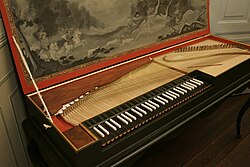
1977 unfretted clavichord by Keith Hill
Keyboard instrument
Other namesClarichord
Hornbostel–Sachs classification314.122-4-8
(Simple chordophone with keyboard sounded by tangents)
DevelopedEarly 14th century

The clavichord is a stringed rectangular keyboard instrument[1] that was used largely in the Late Middle Ages, through the Renaissance, Baroque and Classical eras.[2] Historically, it was mostly used as a practice instrument and as an aid to composition, not being loud enough for larger performances.[2] The clavichord produces sound by striking brass or iron strings with small metal blades called tangents. Vibrations are transmitted through the bridge(s) to the soundboard.[1]

Etymology

[edit]

The name is derived from the Latin word clavis, meaning "key" (associated with more common clavus, meaning "nail, rod, etc.") and chorda (from Greek χορδή) meaning "string, especially of a musical instrument". An analogous name is used in other European languages (It. clavicordio, clavicordo; Fr. clavicorde; Germ. Klavichord; Lat. clavicordium; Port. clavicórdio; Sp. clavicordio). Many languages also have another name derived from Latin manus, meaning "hand" (It. manicordo; Fr. manicorde, manicordion; Sp. manicordio, manucordio). Other names refer to the monochord-like nature of a fully fretted clavichord (It. monacordo or monocordo; Sp. monacordio). Italian also used sordino, a reference to its quiet sound (sordino usually designates a mute).[3]

History and use

[edit]
The "Lépante" fretted clavichord,[4] Musée de la Musique, Paris

The clavichord was invented in the early fourteenth century.[5][6] In 1404, the German poem "Der Minne Regeln" mentions the terms clavicimbalum (a term used mainly for the harpsichord) and clavichordium, designating them as the best instruments to accompany melodies.

One of the earliest references to the clavichord in England occurs in the privy-purse expenses of Elizabeth of York, queen of Henry VII, in an entry dated August 1502:

Item. The same day, Hugh Denys for money by him delivered to a stranger that gave the queen a payre of clavycordes. In crowns form his reward iiii libres.[7]

The clavichord was very popular from the 16th century to the 18th century, but mainly flourished in German-speaking lands, Scandinavia, and the Iberian Peninsula in the latter part of this period. It had fallen out of use by 1850. In the late 1890s, Arnold Dolmetsch revived clavichord construction and Violet Gordon-Woodhouse, among others, helped to popularize the instrument. Although most of the instruments built before the 1730s were small (four octaves, four feet long), the latest instruments were built up to seven feet long with a six octave range.[1]

It was a preferred instrument in the 18th century due to its unique expressive features, size, elegance, and affordability. Due to its lower cost compared to other instruments, the clavichord was accessible, making it the first choice for individuals who wanted to learn the keyboard. Composers such as Wolfgang Amadeus Mozart (1756–1791), used to bring the clavichord with them on their travels to practice.[8][page needed]

During the Mozart family's visit to Augsburg, they had the chance to visit the outstanding German keyboard instruments maker, Johann Andreas Stein (1728–1792), and purchased a clavichord from him. In a letter to his friend, Leopold Mozart (1719–1787) described it as "A pretty little keyboard instrument, which does us good service for practicing on during our travels."[8][page needed]

Until electronic amplification in the twentieth century, it was impossible to use the quiet clavichord in anything but a small room. However, during the clavichord's heyday, evenings of music-making in the home formed the largest part of people's musical experiences. In the home the clavichord was the ideal instrument for solo keyboard music and instrumental accompaniment.[citation needed]Organists also were known to practice in their homes on pedal clavichords.

Today clavichords are played primarily by Renaissance, Baroque, and Classical music enthusiasts. They attract many interested buyers, and are manufactured worldwide. There are now numerous clavichord societies around the world, and some 400 recordings of the instrument have been made in the past 70 years. Leading modern exponents of the instrument have included Christopher Hogwood and Thurston Dart.

Modern music

[edit]

The clavichord has also gained attention in other genres of music, in the form of the Clavinet, which is a solid body electric clavichord with magnetic pickups that plug into an amp. Stevie Wonder uses a Clavinet in many of his songs, such as "Superstition" and "Higher Ground". A Clavinet played through an instrument amplifier with guitar effect pedals is often associated with funky, disco-infused 1970s rock.

Guy Sigsworth has played clavichord in a modern setting with Björk, notably on the studio recording of "All Is Full of Love". Björk also made extensive use of and even played the instrument herself on the song "My Juvenile" of her 2007 album Volta.

Tori Amos uses the instrument on "Little Amsterdam" from the album Boys for Pele and on the song "Smokey Joe" from her 2007 album American Doll Posse. Amos also featured her use of the Clavinet on her 2004 recording "Not David Bowie", released as part of her 2006 box set, A Piano: The Collection.

In 1976 Oscar Peterson played (with Joe Pass on acoustic guitar) songs from Porgy And Bess on the clavichord. Keith Jarrett also recorded an album titled Book of Ways (1986) in which he plays a series of clavichord improvisations. The Beatles' "For No One" (1966) features Paul McCartney playing the clavichord. Rick Wakeman plays the Clavinet in the track "The Battle" from the album Journey to the Centre of the Earth.

Structure and action

[edit]
Schematic diagram of clavichord mechanism: A/B. Keys. 1A/1B. Tangents. 2A/2B. Keylevers. 3. String. 4. Soundboard. 5. Bridge-pin, next to hitch-pin. 6. Damping felt, next to tuning peg. (Note that this sketch is a simplification. In the actual instrument, the strings run perpendicular to the keylevers. In other words, the strings run lengthwise in the instrument.)[9]
Tangents

In the clavichord, strings run transversely from the hitchpin rail at the left-hand end to tuning pegs on the right. Towards the right end they pass over a curved wooden bridge. The action is simple, with the keys being levers with a small brass tangent, a small piece of metal similar in shape and size to the head of a flat-bladed screwdriver, at the far end. The strings, which are usually of brass, or else a combination of brass and iron, are usually arranged in pairs, like a lute or mandolin. When the key is pressed, the tangent strikes the strings above, causing them to sound in a similar fashion to the hammering technique on a guitar. Unlike in a piano action, the tangent does not rebound from the string; rather, it stays in contact with the string as long as the key is held, acting as both the nut and as the initiator of sound. The volume of the note can be changed by striking harder or softer, and the pitch can also be affected by varying the force of the tangent against the string (known as Bebung). When the key is released, the tangent loses contact with the string and the vibration of the string is silenced by strips of damping cloth.

Detail of the Clavichord at Museu de la Música de Barcelona

The action of the clavichord is unique among all keyboard instruments in that one part of the action simultaneously initiates the sound vibration while at the same time defining the endpoint of the vibrating string, and thus its pitch. Because of this intimate contact between the player's hand and the production of sound, the clavichord has been referred to as the most intimate of keyboard instruments. Despite its many (serious) limitations, including extremely low volume, it has considerable expressive power, the player being able to control attack, duration, and volume, and even provide certain subtle effects of swelling of tone and a type of vibrato unique to the clavichord.

Fretting

[edit]
Large five-octave unfretted clavichord by Paul Maurici, after J.A. Hass
Fretted clavichord, copy of an unsigned instrument conserved in Namur, Belgium. The way the same string pair is used for several notes is clearly visible in the full size image.

Since the string vibrates from the bridge only as far as the tangent, multiple keys with multiple tangents can be assigned to the same string. This is called fretting. Early clavichords frequently had many notes played on each string, even going so far as the keyed monochord—an instrument with only one string—though most clavichords were triple- or double-fretted. Since only one note can be played at a time on each string, the fretting pattern is generally chosen so that notes rarely heard together (such as C and C) share a string pair. The advantages of this system compared with unfretted instruments (see below) include relative ease of tuning (with around half as many strings to keep in tune), greater volume (though still not really enough for use in chamber music), and a clearer, more direct sound. Among the disadvantages: temperament could not be re-set without bending the tangents; and playing required a further refinement of touch, since notes sharing a single string played in quick succession had to be slightly separated to avoid a disagreeable deadening of the sound, potentially disturbing a legato line.

Some clavichords have been built with a single pair of strings for each note. The first known reference to one was by Johann Speth in 1693 and the earliest such extant signed and dated clavichord was built in 1716 by Johann Michael Heinitz. Such instruments are referred to as unfretted whereas instruments using the same strings for several notes are called fretted. Among the advantages to unfretted instruments are flexibility in tuning (the temperament can be easily altered) and the ability to play any music exactly as written without concern for "bad" notes. Disadvantages include a smaller volume, even though many or most unfretted instruments tend to be significantly larger than fretted instruments; and many more strings to keep in tune. Unfretted instruments tend to have a sweeter, less incisive tone due to the greater load on the bridge resulting from the greater number of strings, though the large, late (early 19th century) Swedish clavichords tend to be the loudest of any of the historic clavichords.

Pedal clavichord

[edit]
J. Verscheure Reynvaan: engraving of an eighteenth-century pedal clavichord

While clavichords were typically single manual instruments, they could be stacked, one clavichord on top of another, to provide multiple keyboards. With the addition of a pedal clavichord, which included a pedal keyboard for the lower notes, a clavichord could be used to practice organ repertoire. Most often, the addition of a pedal keyboard only involved connecting the keys of the pedalboard to the lower notes on the manual clavichord using string so the lower notes on the manual instrument could be operated by the feet. In the era of pipe organs, which used man-powered bellows that required several people to operate, and of churches only heated during church services if at all, organists used pedal harpsichords and pedal clavichords as practice instruments (see also: pedal piano).[10] There is speculation that some works written for organ may have been intended for pedal clavichord. An interesting case is made by Speerstra (2004) that Bach's "Eight Little Preludes and Fugues", now thought spurious, may actually be authentic. The keyboard writing seems unsuited to organ, but Speerstra argues that they are idiomatic on the pedal clavichord. As Speerstra and Williams (2003) also note, the compass of the keyboard parts of Bach's six trio sonatas for organ (BWV 525–530) rarely go below the tenor C, so they could have been played on a single manual pedal clavichord, by moving the left hand down an octave, a customary practice in the 18th century.

Repertoire

[edit]

Much of the musical repertoire written for harpsichord and organ from the period circa 1400–1800 can be played on the clavichord; however, it does not have enough (unamplified) volume to participate in chamber music, with the possible exception of providing accompaniment to a soft baroque flute, recorder, or single singer. J. S. Bach's son Carl Philipp Emanuel Bach was a great proponent of the instrument, and most of his German contemporaries regarded it as a central keyboard instrument, for performing, teaching, composing and practicing. The fretting of a clavichord provides new problems for some repertoire, but scholarship suggests that these problems are not insurmountable in Bach's Well-Tempered Clavier.

C. P. E. Bach, one of the leading representatives of the 'Empfindsamer stil' or 'Sensitive Style,' emphasized emotional depth and expressiveness in his compositions. The clavichord was very successful in conveying these characteristics. With its unique sound, touch sensitivity, and ability to convey the most delicate nuances, the clavichord became C. P. E. Bach's most preferred instrument.[8][page needed] C. P. E. Bach also used the fortepiano in his compositions, but he was much more interested in the technical features provided by the clavichord. He mentioned this in his book (Versuch über die wahre, Art das Clavier zu spielen, Carl Philipp Emanuel Bach, Berlin, 1759.): "Of the many keyboard instruments, many of which are little known because of defects, or because they have not yet been introduced everywhere, there are two which have been most widely acclaimed, the harpsichord and the clavichord. The former is used mainly in louder music, the latter alone. The more recent pianofortes, when they are durable and well built, have many advantages, although their touch must be carefully worked out, a task which is not without difficulties. They sound well by themselves and in small ensembles. Yet, I hold that a good clavichord, except for its weaker tone, shares equally in the attractiveness of the pianoforte and in addition features the vibrato (Bebung) and portato (Tragen der Töne) which I produce by means of added pressure after each stroke. It is at the clavichord that a keyboard player may be most exactly evaluated."[8][page needed][11][page needed]

Among recent clavichord recordings, those by Christopher Hogwood (The Secret Bach, The Secret Handel, and The Secret Mozart), break new ground. In his liner notes, Hogwood pointed out that these composers would typically have played the clavichord in the privacy of their homes. In England, the composer Herbert Howells (1892–1983) wrote two significant collections of pieces for clavichord (Lambert's Clavichord and Howells' Clavichord), and Stephen Dodgson (1924–2013) wrote two clavichord suites. A comprehensive catalogue of modern clavichord works and discography was published in 2024.[12]

In a note written by Wolfgang Amadeus Mozart's wife, Constanze Mozart (1761–1842), found inside Mozart's clavichord, it is mentioned that Mozart composed his works, including The Magic Flute, La Clemenza di Tito, The Requiem, and a Masonic Cantata, on this clavichord.[8][page needed]

Haydn composed the greater part of "The Creation", one of his masterpieces, on the clavichord. He used the clavichord to accompany the voice.[8][page needed]

See also

[edit]

References

[edit]

Further reading

[edit]
[edit]
Revisions and contributorsEdit on WikipediaRead on Wikipedia
from Grokipedia
The clavichord is a compact, rectangular , recognized as the simplest and quietest among European , featuring a wooden case with a soundboard, strings stretched across bridges, and a keyboard mechanism where each key raises a small metal to strike and sustain a until the key is released. This direct contact between the tangent and enables players to control subtle nuances in volume, tone color, attack, and release through varying touch pressure, including a distinctive effect called bebung achieved by gently tilting the key. Originating in by the early , possibly evolving from the medieval monochord, the clavichord flourished through the , , and Classical periods, serving primarily as a tool for private practice, composition, and intimate music-making rather than public performance due to its delicate, low-volume sound. Early designs were typically fretted, sharing strings among multiple notes to save space, while unfretted versions emerged in the late , allowing one string per key for greater pitch accuracy and expressiveness. It remained popular in until the early , with composers like Johann Sebastian Bach, , , , and writing or adapting works that highlighted its spiritual and sensual qualities. The instrument's advantages include its small size—often fitting on a table or stand—minimal maintenance needs, and portability compared to larger keyboards like the or , making it ideal for domestic settings and pedagogical use. Though largely supplanted by the in the , the clavichord experienced a revival starting in the through enthusiasts and builders, and it continues to be valued today for its unique expressiveness in historical performance practice and modern compositions.

Etymology and Origins

Etymology

The term clavichord originates from the clavicordium, a compound formed from clavis ("key") and chorda ("string" or "cord"), directly referencing the instrument's key-operated string-striking action. This nomenclature first appears in written records during the , marking the instrument's emerging documentation in European musical culture. Early references to the instrument employed variant terms such as monochordia (or monocordia), derived from the ancient monochord—a single-string acoustic device used for tuning and demonstrating musical intervals—which influenced the clavichord's initial design and terminology in 15th- and 16th-century texts. These terms highlighted the shared principle of a single string serving multiple notes, a feature central to proto-clavichords. Regional linguistic adaptations further evolved the name, with the German Klavichord (or occasionally Klavizimbel in compound forms) reflecting phonetic shifts while retaining the Latin roots, as seen in Central European manuscripts from the late medieval period. The term's connection to precursors like the chekker—an enigmatic early keyboard device documented from 1360—underscores its roots in experimental stringed mechanisms, but clavichord gradually supplanted these as the preferred designation by the .

Early Historical Development

The clavichord emerged in late medieval , likely evolving from earlier stringed instruments such as the monochord—a single-string device used for demonstrating pitch relationships—and the , a plucked , through the addition of a keyboard mechanism that enabled polyphonic playing. The earliest documented to the instrument dates to 1404 in the German poem Der Minne Regeln by Eberhard Cersne, a work on poetry that employs terms like clavicordium and monocordium to describe a keyboard device with alternating light and dark keys, suggesting its nascent form as a small, rectangular stringed instrument. Iconographic from the same period, such as a in the 1425 altarpiece at Minden Cathedral, further supports its presence in German cultural contexts by the early . Significant technical progress occurred in the mid-15th century, particularly with the refinement of the tangent action, where brass tangents strike and sustain strings to produce sound. This mechanism is meticulously outlined in the astronomical and musical treatise of Henri Arnaut de Zwolle, composed around 1440 and preserved in the (ms. Latin 7295), which illustrates three distinct clavichord designs featuring tangents for and a extending to b''. These descriptions highlight the instrument's simple construction, using a wooden soundboard and fretted strings to achieve multiple pitches from fewer strings, marking a pivotal step toward greater expressiveness in early . In its initial forms, the clavichord functioned primarily as a portable and softly voiced instrument, well-suited for intimate practice and study in monastic communities and courtly households across 15th-century . Its compact, rectangular build—often under four feet in length—and minimal volume allowed musicians, including organists and poets, to rehearse privately without the need for larger performance spaces, fostering its role as an accessible tool for musical education in these settings.

Historical Evolution

Renaissance and Baroque Periods

During the 16th century, the clavichord experienced notable expansion and refinement, with builders improving scaling techniques to achieve greater tonal balance and extending the instrument's range to approximately four octaves, typically spanning from C to c³ or similar compasses in models around one meter in length. Surviving anonymous examples from this period, attributed to maker Hans Müller and dating to the 1540s, illustrate these advancements through their compact yet expanded patterns and brass stringing, which enhanced playability for domestic use. These developments marked a shift from earlier, smaller prototypes to more versatile instruments suitable for polyphonic music of the era, as described in treatises like those of Sebastian Virdung and Martin Agricola. In the Baroque period, the assumed a central role in music education and private composition, prized for its sensitivity and dynamic nuance derived from the tangent's direct contact with the strings. Johann Sebastian Bach extensively employed the instrument for teaching and to his students, including works like the , which exploited its expressive capabilities to instill technical precision and . Biographer Johann Nikolaus Forkel noted that Bach preferred the clavichord for initial composition sketches due to its intimate responsiveness, allowing subtle variations in touch that informed pieces such as the Well-Tempered Clavier. This pedagogical prominence extended across , where the instrument's quiet volume made it ideal for home study amid the era's emphasis on mastery of and ornamentation. Regional variations highlighted the clavichord's adaptability during these eras, with Italian makers producing compact, fretted models. These instruments featured ornate cases and diatonic scales suited to vocal and solo fantasias in the polyphonic style of composers like Antonio Cabezón. In contrast, German builders advanced toward fretless designs by around 1700, eliminating shared frets to enable independent string vibration per note and fuller chromatic expression, as seen in early unfretted prototypes from makers like Hieronymus Haas. This innovation, documented in inventories and treatises by Jakob Adlung, catered to the complex keyboard idioms of Baroque Germany, including those of Bach and his contemporaries, while maintaining the instrument's characteristic intimacy.

Decline and 19th-20th Century Revival

By the mid-18th century, the clavichord's popularity began to wane as musical tastes and performance contexts evolved, with louder instruments such as the and the emerging supplanting it in public settings. Its inherently soft , suitable primarily for intimate private practice and composition, rendered it inadequate for the growing emphasis on orchestral and halls where greater volume was required. By the late , the fortepiano's advantages in expressive nuance, tonal range, and projection—exemplified by innovations like expanded octaves reaching five-and-a-half by the 1790s—led to its dominance in keyboard and , with titles increasingly omitting references to the clavichord or harpsichord. In the , amid the piano's ascendance, the clavichord garnered sporadic antiquarian interest, particularly in where the burgeoning cult around Johann Sebastian Bach spurred appreciation for historical keyboard instruments. This curiosity manifested in as a nostalgic symbol of the past, fostering early efforts to restore and replicate surviving examples before the century's close. Such interest laid groundwork for more systematic revival, though production remained negligible until the turn of the . The pivotal revival began with Arnold Dolmetsch, who in 1894 constructed the first new clavichords since 1858, initiating a professional resurgence in instrument making. Over the next two decades, Dolmetsch produced more than 50 instruments across workshops in , , and , focusing on historical copies such as those modeled on Johann Adolf Hass's 1763 design (featuring a five-octave from F1 to f3) and Christian Gotthelf Hoffmann's 1784 model with an S-shaped bridge. As the sole professional builder for 17 years, his work emphasized fidelity to 18th-century prototypes, bridging scholarship with practical performance. The 20th century saw a broader resurgence through the early music movement, which gained momentum post-World War II and emphasized authentic instruments for historical repertoire. Builders like Robert Goble advanced this trend; after apprenticing under Dolmetsch in the early 1920s for twelve years, Goble established his own workshop in 1937 at Haslemere, Surrey, relocating to Headington, Oxford, in 1947 to expand production of clavichords and harpsichords. Goble's instruments, known for their quality and historical accuracy, supported the movement's growth by supplying performers and educators, helping integrate the clavichord into modern early music practice.

Design and Acoustics

Overall Structure and Materials

The clavichord features a rectangular wooden case, typically constructed with dovetailed joints for stability, housing the keyboard on the left side and the soundboard on the right. The case is commonly made from softwoods like for the baseboard and harder woods such as for the sides and , providing a yet resonant that measures approximately 150-200 cm in length, 40-50 cm in width, and 10-15 cm in height for instruments spanning 4 to 5 octaves. The soundboard, usually crafted from for optimal vibration transmission, is supported by a belly rail on the left, the wrestplank on the right, and liners along and back, with internal ribs and cross-bars reinforcing the area beneath the bridge to enhance acoustic efficiency. The bridge, positioned on the soundboard near the right end, is a wooden component often fitted with small pins to secure and guide the strings, directing their vibrations directly to the soundboard for intimate sound projection. Strings are stretched diagonally across the instrument from hitch pins on the left spine to tuning pins in the wrestplank, typically double-strung in pairs for efficiency, with materials varying historically: for the trebles and iron or for the bass notes. Scaling for a standard 4- to 5-octave range (often from F1 to G5 or similar) involves graduated lengths and gauges, with bass strings occasionally overspun with for and lower tension. The , a small metal at the end of each keylever, briefly contacts the to initiate while serving as a movable bridge point.

Key Action and Sound Production

The clavichord's sound is produced through a direct mechanical action where depressing a key raises a small metal , typically made of or iron, attached to the rear end of the . This strikes the corresponding from below, initiating that is confined to the segment between the point of contact and the instrument's bridge, while the portion behind the remains non-vibrating and is damped by a cloth strip. The remains in continuous contact with the as long as the key is held, sustaining the and transmitting it through the bridge to the soundboard, which amplifies the tone; upon releasing the key, the descends, and the damping cloth silences the almost immediately. A defining feature of the clavichord is its exceptional touch sensitivity, enabling performers to achieve dynamic expression through variations in finger force and velocity. The speed and pressure applied to the key directly influence the tangent's impact on the : a gentle touch results in a softer, more subdued tone, while a firmer or faster depression produces greater by increasing the initial energy transfer to the . This allows for subtle nuances, such as bebung—a vibrato-like effect created by slight oscillations in finger pressure that momentarily alter the 's vibrating length and tension. Unlike the , which plucks strings with a fixed for uniform volume regardless of touch, the clavichord's striking mechanism provides this expressive control, making it ideal for intimate, nuanced playing. Acoustically, the clavichord yields an intimate, delicate with limited projection, audible primarily at close range due to the inefficiency of its tangent-string contact, which generates lower levels compared to louder keyboard instruments. The tone's quiet volume stems from the small vibrating segment and the soundboard's modest amplification within the instrument's typically wooden case, rendering it unsuitable for large venues but perfect for private practice or chamber settings. The point of tangent contact introduces characteristic into the , though the overall spectral slope remains relatively consistent across dynamic levels, contributing to the instrument's warm, bell-like with subtle harmonic richness.

Technical Features

Fretting Systems

The fretting system in clavichords involves the use of diagonal frets placed on the soundboard to divide into segments, allowing a single or pair of to produce multiple notes when struck by tangents at different points. This arrangement, known as gebunden or fretted, was a hallmark of early clavichord design from the onward, enabling 2 to 4 notes per depending on the era and model. Early frets were often loose slips inserted between the , while later bonded frets were glued directly to the soundboard for stability. In medieval and clavichords, multiple fretting predominated, with up to four notes sharing a pair, such as f/f♯/g/g♯, suited to limited diatonic scales and early repertoires. By the , this evolved to triple fretting (three notes per ) and then diatonic double fretting, where each natural note had its own segment shared with an adjacent accidental, using approximately seven pairs per (e.g., c/c♯, d, e♭/e, etc.). This diatonic system minimized conflicts in common keys like or . The primary advantages of fretted systems included a compact instrument size, reduced material costs through fewer strings (e.g., 36-37 pairs for a four-octave model), and quicker tuning due to shared strings maintaining relative pitches. These features made fretted clavichords portable and economical for private use. However, limitations arose from interference: notes sharing a string could not be played simultaneously without the tangent of the higher note the lower, and close pitches on the same string produced beating tones or dissonances when sounded in succession. Such constraints restricted modulation and in later music. By the early , these intonation challenges and demands for greater expressive range prompted a transition to unfretted (bundfrei) clavichords, where each key had its own dedicated string pair, allowing independent sounding of all notes and improved purity of intervals. Surviving examples, such as those by Johann Heinrich Silbermann around 1775, illustrate this shift, with unfretted designs becoming standard by the late as musical styles favored chromaticism and . Fretted systems persisted in some regions until the early but were largely supplanted for their limitations in modern intonation.

Tuning and Temperament

The clavichord's tuning historically favored , particularly the quarter-comma variant introduced by Pietro Aron in 1523, which tempered perfect fifths by a quarter of the to achieve nearly pure major thirds essential for and . This system, widespread across for keyboard instruments including the clavichord, prioritized consonant intervals in common keys while accepting limitations in remote ones. Tuning proceeds by adjusting the tension of strings, typically made of or iron, anchored at one end by hitchpins on the hitchpin rail and at the other by wrestpins (tuning pins) inserted into a wrestplank, allowing precise alterations with a tuning key to set pitches relative to a reference note like A at 493 Hz for historical pitch standards. In fretted clavichords, where multiple notes share strings to conserve space, tuning presents unique challenges due to the partials () of shared strings, which can introduce dissonant beats and exacerbate intervals—such as the narrow fifth between G♯ and E♭ measuring approximately 737 cents in quarter-comma meantone—rendering certain progressions harsh in keys like or . These arise because the temperament's unequal semitones (chromatic at about 76 cents, diatonic at 117 cents) force compromises in positions along the string, limiting the instrument to roughly a dozen viable keys without retuning. To mitigate this, some historical designs incorporated split keys, allowing a single key lever to operate two tangents for distinct pitches on the same string pair, as seen in early 16th-century German keyboards adapting meantone for broader usability. Modern clavichord builders and performers often adapt , dividing the octave into 12 equal semitones of 100 cents each, to enhance versatility for contemporary and diverse historical repertoires, though this slightly sharpens major thirds compared to meantone's purity. This shift, practical for unfretted instruments with one string per note, aligns with 18th-century evolutions toward well-tempered systems and facilitates ensemble play at A=440 Hz, while still permitting meantone for period-specific performances.

Variants and Extensions

Pedal Clavichord

The pedal clavichord represents a specialized extension of the standard clavichord, incorporating a separate pedalboard to enable organists to replicate the full range of an organ's manual and pedal capabilities in a compact, home-based format. This variant emerged as a practical solution for musicians in regions where access to church organs was limited by , needs, or the absence of assistants to pump . While conceptual references to pedal attachments date to the , the developed form with integrated manuals and pedals became prominent in the , particularly in and , where it served as an essential tool for technical refinement without the logistical challenges of larger instruments. A notable surviving example is the two-manual pedal clavichord constructed by Johann David Gerstenberg of Geringswalde, , in 1760, preserved in the Museum of Musical Instruments at the University of . This instrument exemplifies the era's craftsmanship, combining two bichord manuals (each spanning C to e³, approximately 45 notes) with an independent pedal section of 12 notes (C to d¹), all housed in a single frame to mimic a small organ's layout. The design relies on the clavichord's core action mechanism, where keys raise s to strike and sustain string vibrations, but adapts it for pedals through elongated tangent levers and bridges to accommodate longer bass strings—often tuned to simulate the resonant 16-foot stops of an organ, producing deeper tones without requiring excessive instrument length. Primarily employed as a pedagogical device, the pedal clavichord allowed organists in North and Central to practice complex and pedal techniques indoors, fostering precision in articulation and registration that translated directly to organ performance. Its quiet and modest size—typically around 2 meters long and requiring no air supply—made it ideal for private study, though its bulkier construction compared to unfretted models limited portability and appeal for concert use. By the late , as organ-building advanced and home heating improved, such instruments remained niche but influential in training generations of players, including those interpreting works by composers like J.S. Bach.

Unfretted and Modern Adaptations

Unfretted clavichords, which assign a dedicated pair of strings to each key rather than sharing strings across multiple , first appeared in the late seventeenth century as a response to the intonation and polyphonic limitations of earlier fretted models. This innovation allowed performers to play any combination of simultaneously without unwanted interference, facilitating more complex in . The earliest documented reference to such an instrument dates to 1693, though surviving examples begin around 1716 with a model by the German maker Johann Michael Heinitz. By the eighteenth century, unfretted clavichords had become standard in , particularly in and , where builders like Hieronymus Albrecht Hass produced instruments with ranges up to five octaves, such as FF to f''' , emphasizing clarity and dynamic nuance for composers like C.P.E. Bach. These designs prioritized a rectangular case with a soundboard and bridge to amplify the tangent-struck strings, maintaining the instrument's intimate volume while expanding its expressive potential. In the twentieth and twenty-first centuries, modern adaptations have revitalized the clavichord for contemporary use, including amplified versions that integrate electronic pickups or MIDI interfaces to boost output without altering the tactile response. One such modification involves installing magnetic pickups under the strings of a traditional unfretted model, enabling connection to amplifiers or synthesizers for ensemble or recording applications while retaining the instrument's characteristic bebung vibrato. Extended-range unfretted clavichords, reaching up to six octaves, draw from nineteenth-century precedents where larger cases accommodated broader compasses for Romantic-era , and modern builders continue this trend in reproductions to suit diverse musical demands. Contemporary makers like Keith Hill, who has constructed over 58 clavichords since the , apply acoustical research to enhance resonance and touch sensitivity, modeling instruments after historical exemplars such as the 1748 Friederici while optimizing soundboard voicing for clearer articulation across registers.

Performance and Repertoire

Playing Techniques

The clavichord demands a highly nuanced touch, where the player controls dynamics through variations in finger pressure on the keys. A light touch initiates a soft, intimate sound, while increased pressure produces greater volume, enabling subtle gradations from pianissimo to mezzo-forte without mechanical aids. This sensitivity arises from the of the on the , allowing the performer to shape the tone's attack, sustain, and decay in real time. One of the instrument's most distinctive expressive techniques is Bebung, a vibrato-like effect achieved by gently rocking or bouncing the fingertip on the key after depression, which modulates the string's tension and pitch. This creates a trembling or undulating quality unique to the clavichord, as the tangent remains in contact with the vibrating string, permitting ongoing pitch variation during sustain. , in his seminal Essay on the True Art of Playing Keyboard Instruments (1753), praises Bebung for its capacity to add emotional depth, recommending its use sparingly to enhance melodic lines without overpowering the music. Ornamentation on the clavichord relies on precise finger coordination, particularly for trills, which are executed through rapid alternation of adjacent or non-adjacent fingers to produce even, sustained oscillations between notes. The instrument's prolonged sustain—enabled by the tangent's persistent contact—allows these trills to resonate fully, offering a legato quality distinct from the more percussive articulation of other keyboards. Bach's Essay advises employing fingers 2-3 or 1-3 for trills to achieve speed and clarity, emphasizing that the clavichord's responsiveness rewards such deliberate fingering with expressive fluidity. Effective clavichord requires a relaxed posture with arms level to the keyboard and wrists slightly lowered, promoting fingertip dominance over weight to ensure clean key depression. Fingers should maintain a natural curve, contacting the keys at the tips to secure the against the string and prevent slippage, which can occur if pressure is uneven or release abrupt—especially on fretted models where adjacent notes share strings. This technique minimizes unwanted or buzzes, as noted in historical accounts of keyboard practice, allowing sustained control over the sound's purity.

Historical Repertoire

The historical for the clavichord during the 15th and 16th centuries primarily consisted of intabulations of vocal polyphonic music, adapting sacred and secular songs to the keyboard's capabilities for private performance and study. These arrangements, often notated in , allowed players to realize complex vocal lines on instruments like the clavichord, emphasizing its intimate and expressive touch. A notable example is the work of Hans Buchner, whose Fundamentum organisandi (c. 1520) includes extensive intabulations of German lieder and motets, such as settings of "Resonet in laudibus," which were playable on the clavichord despite their primary association with the organ. This practice reflected the clavichord's role in domestic music-making, where vocal models were transcribed to explore polyphonic textures without the need for singers. In the Baroque era, the became a staple for pedagogical and expressive works, with Johann Sebastian Bach's Two-Part Inventions (BWV 772–786) and Three-Part Sinfonias (BWV 787–801), composed around 1720–1723, exemplifying its suitability for developing playing and contrapuntal independence. Bach's to the collection highlights the clavier's potential for a "" style, which the clavichord's mechanism uniquely supported through subtle volume control via finger pressure. Similarly, Johann Kuhnau's Biblical Sonatas (1700, revised edition 1710), a set of six programmatic pieces depicting scenes, were suitable for the clavichord alongside organ and , as the dynamic indications like "" and "più piano" in the Second Sonata ("Saul Cured of Evil Spirits by David's ") leverage its expressive nuances for tone painting, consistent with the 's allowance for similar instruments. Kuhnau's specifies "su VOrgano, Clavicembalo ed altri Stromenti somiglianti," underscoring the clavichord's logical medium for these innovative, narrative-driven that blend prelude-fugue forms with descriptive elements. National traditions further enriched the clavichord's historical repertoire through adaptations from regional string instruments. In Spain, transcriptions of vihuela music, such as those from Luis de Narváez's Delphin de música (1538) and the collective Libro de cifra nueva (1557) by Luys Venegas de Henestrosa, were arranged for keyboard, incorporating fantasias and variations on vocal models that suited the clavichord's soft timbre for solo performance. These pieces, blending polyphony with ornamental divisions, bridged lute-like intimacy and keyboard polyphony, influencing Iberian domestic music. In England, the virginalist school—composers like William Byrd, John Bull, and Orlando Gibbons—produced pavans, galliards, and fantasias in collections such as the Fitzwilliam Virginal Book (c. 1609–1619), whose music was equally idiomatic on the clavichord, harpsichord, or chamber organ, fostering a tradition of varied rhythms and affective expression. This repertoire emphasized the clavichord's role in Elizabethan and Jacobean households, where its portability and sensitivity enhanced improvisatory and variational techniques.

Modern Usage and Composers

The clavichord's revival in the , spearheaded by figures like Arnold Dolmetsch and Joan Benson, integrated it into the broader movement, where it found a niche in intimate performances and scholarly reconstructions. Smaller chamber groups occasionally employ the clavichord for continuo roles in intimate repertoire settings, emphasizing its subtle dynamic control in domestic or educational settings, though its low volume restricts larger concert halls. Twentieth- and twenty-first-century composers have composed new works to exploit the clavichord's unique expressiveness, particularly its capacity for Bebung—a finger-induced that allows pitch variation while a note sustains. created two landmark collections: Lambert's Clavichord (1926–1927) and Howells' Clavichord (1951–1956), comprising short, evocative pieces that highlight the instrument's intimate . Similarly, composed Four Lessons for Two Keyboards (1978) for a pair of clavichords, incorporating special techniques like damping and brushing to evoke influences while embracing the instrument's tactile responsiveness. Other notable contributions include Ernst Pepping's Klavierstücke (1930s) and Lou Harrison's experimental suites, which blend historical forms with modernist sensibilities. In the , the clavichord continues to inspire new works, with performers like Francis Knights documenting modern compositions in publications such as Modern Clavichord Music (2024), though major orchestral integrations remain rare due to volume constraints. In contemporary contexts, the clavichord supports educational applications by fostering precise touch and phrasing, as its direct string-striking mechanism mirrors foundational keyboard techniques without mechanical intermediaries, making it ideal for pedagogy in conservatories like the . Experimentally, electroacoustic hybrids amplify the clavichord's nuances; for instance, builders like Bill Napier-Hemy have integrated pickups into custom designs, enabling integration with synthesizers in improvised electronic works, as heard in recordings pairing clavichord with EMS Synthi modules.

References

Add your contribution
Related Hubs
User Avatar
No comments yet.