Hubbry Logo
search
logo
1805131

Colchester Garrison

logo
Community Hub0 Subscribers
Read side by side
from Wikipedia

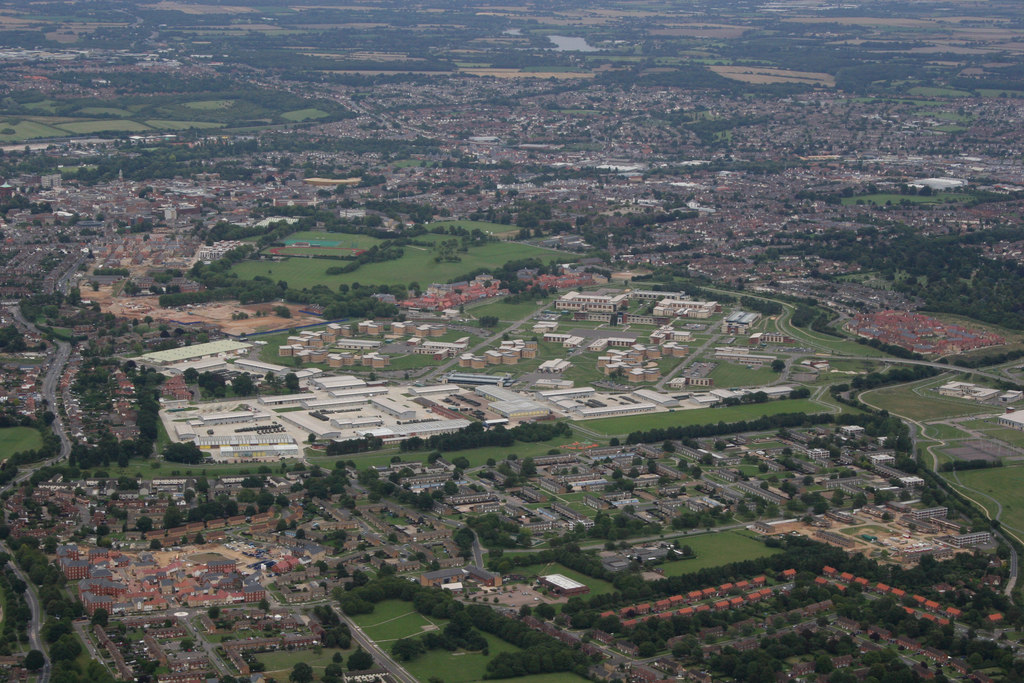
Colchester Garrison is a major garrison located in Colchester in the county of Essex, eastern England. It has been an important military base since the Roman era. The first permanent military garrison in Colchester was established by Legio XX Valeria Victrix in AD 43, following the Roman conquest of Britain. Colchester was an important garrison town during the Napoleonic Wars and throughout the Victorian era. During the First World War, several battalions of Kitchener's Army were trained there.

Key Information

Today, Colchester Garrison is most known for being home to the Parachute Regiment, known as "The Paras".

History

[edit]

Napoleonic Wars (1792–1815)

[edit]

Colchester Garrison played an eminent role during the Napoleonic Wars. The troops were originally billeted in local inns and houses. After petitioning from the borough council, new infantry barracks were built in 1794. By 1800 additional infantry, artillery, and cavalry barracks had been built in the area bounded by Barrack Street to the north, Wimpole Road to the west, and Port Lane to the east. In 1805 the barracks were home to 7,000 officers and men. After the Napoleonic Wars the barracks were reduced. The sale of the older barracks and the freehold site on which they stood started in 1817 and was completed in 1840. The Army retained 14 acres (57,000 m2) and an infantry barracks for 851 officers and men. Much of the old barracks land was developed as the "New Town" area of Colchester during the Victorian era.[1] The south wing of the Military Hospital was purchased by Rev Jefferson and seven other subscribers and rebuilt on a plot of land on Lexden Road as the Essex and County Hospital.[2]

Crimean War (1854–1856)

[edit]

Colchester Garrison experienced rapid expansion during the Crimean War. Between 1855 and 1856 wooden infantry barracks for 5,000 troops were erected on Ordnance Field. The government purchased 167-acre (0.68 km2) Middlewick Farm for use as a training area and a rifle range in 1857. Middlewick Ranges were still in use by the garrison until the land was sold in 2024.[3]

British German Legion

[edit]

In 1856 10,000 troops of the British German Legion were billeted in the infantry barracks and in tented encampments on Barrack Field.[1] The British German Legion was raised in 1854 as a foreign corps in British service (similar to the Kings German Legion during the Napoleonic Wars). The Legion was raised for service in the Crimean War, under the provisions of the Enlistment of Foreigners Act 1854.[4] The Legion did not see active service although a large number of legionaries went to the Crimea where they mostly died of fever without seeing the battlefields. The Legion was disbanded in Colchester in 1857, but the majority of the remaining personnel went to the Eastern Cape as part of the Kaffraria Settlement. Because preference was given to those who were married or had a fiancée, men without German wives or fiancees married, in great numbers, Colchester girls. There are dozens of marriages recorded in the Colchester Churches, mainly St Botolph's, and the remainder were married at the Garrison Church. This establishment was later found not to be registered for marriages, and so the affected couples were declared wed by Act of the Cape Parliament in 1858.[5]

First World War (1914–1918)

[edit]
Officers Mess, Hyderabad Barracks, Colchester

Territorial Force

[edit]
Essex Regiment
[edit]

8th (Cyclist) Battalion, Essex Regiment, (TF) was based in Colchester at the outbreak of war in August 1914. It was redesignated 1/8th Battalion as additional "Terrier" battalions were raised from volunteers during the early months of the war. The 2/8th and 3/8th Battalions were formed in September 1914 and April 1915 respectively. All three Terrier battalions were allocated to home defence and remained in the United Kingdom throughout the war.[6]

Essex Yeomanry
[edit]

The Essex Yeomanry (EY), a cavalry regiment, was mobilised at the outbreak of war. The regiment joined the Royal Horse Guards and the 10th Royal Hussars in France in November 1914 as part of 8th Cavalry Brigade, 3rd Cavalry Division.[7] During the war, 2nd and 3rd line regiments were raised in Colchester to reinforce the 1st line. 2 EY served as garrison troops in Ireland during the war, 3 EY was absorbed into the 4th Reserve Cavalry Regiment in 1917.[8]

On 14 March 1918, Essex Yeomanry left 8th Cavalry Brigade to become a cyclist unit, then to form a machine gun battalion with the Bedfordshire Yeomanry. The German spring offensive forestalled this plan, and the regiment was remounted on 28 March and sent to the 1st Cavalry Division. From 4 April it was split up with a squadron joining each regiment in 1st Cavalry Brigade (2nd Dragoon Guards, 5th Dragoon Guards and 11th Hussars).[9]

Essex RHA
[edit]

Essex Battery, RHA was mobilised in Colchester and Chelmsford in 1914. The battery was a Territorial Force Royal Horse Artillery unit. A 2nd line unit, 2/1st Essex Battery, RHA, was raised later.[10]

Kitchener's Army

[edit]

The 12th (Eastern) Division was organised at Colchester from August 1914 to February 1915. The division was one of the first New Army divisions to be formed, as part of K1. The division included Kitchener battalions from the Essex Regiment, the Suffolk Regiment, the Norfolk Regiment, the Royal Berkshire Regiment, the Cambridgeshire Regiment, the Royal Fusiliers, the Queen's Regiment, The Buffs, the Royal West Kent Regiment, and the East Surrey Regiment. The division moved to France in 1915 and fought at the Battle of Loos (1915), the Battle of the Somme (1916), the Battle of Cambrai (1917) and the Battle of the Hindenburg Line (1918).[11]

Second World War (1939–1945)

[edit]

4th Infantry Division

[edit]

Colchester was the home garrison of the 4th Infantry Division in September 1939. Resident units on the outbreak of war on 3 September, included 2nd Battalion Lancashire Fusiliers, 1st Battalion East Surrey Regiment, 1st Battalion Oxfordshire and Buckinghamshire Light Infantry, 5th Royal Inniskilling Dragoon Guards, 17th/21st Lancers, 27th Field Regiment Royal Artillery, 30th Field Regiment Royal Artillery and 14th Anti-Tank Regiment Royal Artillery. The division deployed to France in 1940 as part of the British Expeditionary Force.[12]

Home Guard

[edit]

During the war the town was defended by local defence volunteers of 8th Essex Battalion of the Home Guard. At the height of its strength, the battalion mustered over 2,000 men. The battalion possessed no fewer than 22 different types of weapon, including Vickers machine guns, flame throwers, and 2 pounder anti tank guns. Additional support throughout the area was provided by 13th Essex Battalion, made up of volunteers from the GPO who were charged with the protection of critical telecommunications infrastructure.[13]

The order to "stand down" for the Home Guard came on 1 November 1944. They took their final salute on 19 November before the Lord Lieutenant of the county, Colonel Sir Francis Whitmore. Whitmore said, "You have, by your sense of duty, your loyalty and patriotism, contributed pages of tradition to the historical records of our nation... you took a prominent part in the defence of our country at the most critical period of the war... In the name of the County of Essex, I thank you."[14]

Colchester Stop Line

[edit]

During the war the town was ringed by over 120 pillboxes or other defensive structures as part of the Colchester Stop Line. A small number of pillboxes can still be found around the borough, such as at Mount Bures,[15] and the Hythe railway station.[16]

Colchester Blitz

[edit]

Air raid sirens sounded over 1000 times in Colchester during the course of the war. Colchester was attacked by the Luftwaffe on several occasions.[17] They included:

  • Severalls Raid – On 11 August 1942 38 people were killed when a German plane dropped a stick of bombs on Severalls Hospital.
  • Chapel Street Raid – 8 people were killed when a Dornier 217 dropped four bombs on South Street and Essex Street on 28 September 1942. The air raid siren, in this case, only sounded after the bombs had already dropped, causing outcry in the town.
  • St Botolphs Raid – In February 1944 a large Luftwaffe firebombing raid dropped a stream of 1,400 incendiary bombs on the St Botolphs area of the town, destroying 14 buildings and seriously damaging 99 others. Two-thirds of the Paxman Britannia Works was destroyed during the raid.

Home Guard anti-aircraft batteries were established on Abbey Field and engaged enemy aircraft 14 times during a 21-month period.

Americans in Colchester

[edit]

The first American military personnel arrived in Britain in January 1942. A significant American presence was established in the Colchester area, with many air bases of the US Eighth Air Force located in the district – at Earls Colne, Langham, Wormingford, Messing, and Dedham. In accordance with racial segregation of the American military during World War II, the American Red Cross established several social clubs in the area.[18]

Post-war

[edit]

Headquarters Eastern District was established at Colchester in 1967,[19] but, after a merger with North East District the enlarged district moved to Imphal Barracks in York in 1992.[20]

A scheme to redevelop the garrison was procured under a Private Finance Initiative contract in 2004. The works, which were designed by Atkins and built by Sir Robert McAlpine at a cost of £540 million, were completed in 2008.[21]

Colchester Garrison today

[edit]
Army vehicles, Colchester Garrison
Entrance to Colchester Garrison

Regular Army

[edit]

Colchester Garrison is currently home to the British Army's 16th Air Assault Brigade Combat Team. The core role of the BCT is to maintain the Air Assault Task Force, a rapid reaction battlegroup held at very-high readiness to deploy worldwide by parachute, helicopter and air-landing, for a full spectrum of missions, from non-combatant evacuation ops such as Operation Pitting in Afghanistan, 2021, to war fighting.[22][23]

Army Reserve

[edit]

Colchester has a tradition of its citizen volunteers serving in the Army Reserve, formerly known as the Territorial Army. During the Second World War, Colchester's "Terriers" included 2nd/5th Battalion Essex Regiment and 104th Regiment, Royal Horse Artillery (Essex Yeomanry). The Army Reserve is currently represented in Colchester by 161 Squadron 254 Medical Regiment, 36 (Eastern) Signal Squadron, 71 (City of London) Yeomanry Signal Regiment and a troop from 202 Squadron, 158 Regiment RLC.[24]

Garrison church

[edit]

The old garrison church in Military Road was a former Crimean War era hospital, similar to those shipped in prefabricated sections to Florence Nightingale at Scutari and Balaklava. It was built in 1856 and is the oldest surviving garrison building.[25] The old Garrison Church has since become the home of the Parish of St John the Wonderworker, a parish of the Diocese of Great Britain and Ireland in the Russian Orthodox Church Outside Russia (ROCOR).[26]

In Easter 2007, services transferred to a new church built situated behind the Community Centre, and was built as part of the ongoing regeneration of Colchester Garrison.[27]

Barracks

[edit]

Barracks include:

  • The following former barracks are now considered to be part of Merville Barracks as they are no longer physically separate from the town centre barracks, and are all behind 1 perimeter fence
    • Kirkee and McMunn Barracks (Reed Hall Avenue)
    • Roman Way Camp (Roman Way)

Former barracks (not in use)

[edit]
  • Cavalry Barracks (Circular Road North) - former cavalry barracks, built between 1862 and 1863, occasionally used as a transit camp. The large parade ground of the Cavalry barracks served as the backdrop for the opening credits of Blackadder Goes Forth and in a scene in Monty Python's The Meaning of Life.
  • Le Cateau Barracks (Le Cateau Road) - the former name of the Royal Artillery Barracks, built in 1874–1875, but named after the Battle of Le Cateau in 1914, in which the RA played a leading role.[28]
  • Gymnasium (Circular Road South) - built in 1862
  • Meeanee Barracks (Mersea Road) - Developed and restored as housing
  • Hyderabad Barracks (Mersea Road) - Developed and restored as housing
  • Garrison Church (Military Road) - Now in civilian use by the Russian Orthodox church.

Former barracks (demolished)

[edit]
  • Sobraon Barracks (Circular Road South) - former infantry barracks, built 1900, demolished 1960s
  • Military Hospital - Victorian building, demolished 1990s (Circular Road South)
  • Cherrytree camp (Cherrytree Lane) - the former home of 19 Brigade, in use until the 1960s - built before World War I as temporary accommodation for Kitchener's Army, now a housing estate, it also has the Essex Army Cadet Force Weekend Training Centre
  • Pool (Circular Road South)
  • Roman Barracks. (Roman Way) built in the 1960s and formerly housed an infantry battalion. Demolished and redeveloped as civilian housing.
  • Militia Barracks. (St. Andrews Ave.) In use 1850s-80s. Demolished due to incorporation of Militia into Essex Regt. under Cardwell Reforms.

Military Corrective Training Centre (MCTC)

[edit]
The entrance to the Military Corrective Training Centre

Berechurch Hall Camp is the home of the Armed Forces Military Corrective Training Centre which incorporates the Naval Detention Quarters and is the only dedicated military facility of its kind in the United Kingdom.[29] It is not a prison, although it has a special unit for those who are being transferred to HM Prison Service to serve sentences of imprisonment awarded by Court Martial. Inmates are in three categories:

  • Those from the RN, RM, British Army and RAF who are to remain in the Services after sentence and will serve their detention in A Company.
  • Those from the RN, RM, British Army and RAF who are to be discharged after their sentence and will serve their detention in D Company.
  • Those held in military custody either awaiting the outcome of an investigation, or awaiting HM Prison or HM Young Offender Institute placement.

References

[edit]

Bibliography

[edit]
[edit]
Revisions and contributorsEdit on WikipediaRead on Wikipedia
from Grokipedia
Colchester Garrison is a prominent military installation of the British Army located in Colchester, Essex, England, serving as one of the oldest and most significant garrisons in the United Kingdom. Established with the construction of its first barracks in 1794 during the wars with France, it rapidly expanded to accommodate up to 7,000 troops within a decade, featuring dedicated infantry, artillery, and cavalry facilities around Abbey Fields, which were used for parades, training, and ranges. Today, it houses the 16 Air Assault Brigade Combat Team, the Army's Global Response Force, capable of rapid deployment via parachute, helicopter, or airlanding for worldwide operations, including evacuations and combat missions.[1][2] The garrison's development accelerated in the mid-19th century, particularly during the Crimean War, when wooden barracks for 5,000 soldiers were erected on Ordnance Field between 1855 and 1856, solidifying Colchester's role as a strategic base. Permanent structures followed, including Cavalry Barracks (1862–1863), Le Cateau Barracks (1874–1875), and the Grade II*-listed Garrison Church (1856), alongside facilities like the Gymnasium (1862) and a hospital. By the late 19th and early 20th centuries, the site encompassed additional barracks named after battles, such as Goojerat and Sobraon, reflecting its growing importance amid imperial conflicts and the Napoleonic Wars' legacy. The garrison played key roles in both World Wars, serving as headquarters for the Eastern District until 1992 and hosting units like the 4th Infantry Division in 1939.[3][1] In the modern era, Colchester Garrison underwent significant redevelopment starting in the early 2000s, with older northern barracks sold for housing and a new southern complex built to support contemporary forces, including Merville Barracks as the base for 16 Air Assault Brigade, formed in 1999 from the merger of 5 Airborne Brigade and 24 Airmobile Brigade. This brigade, comprising elements of The Parachute Regiment, aviation, artillery, and support units, maintains high readiness for crises, as demonstrated in operations like the 2021 Kabul evacuation (Operation Pitting) and humanitarian aid in Turkey's 2023 earthquake. The garrison's historical core, including archaeological sites from Roman times—when Colchester (Camulodunum) hosted Legio XX Valeria Victrix in AD 43—underscores its enduring military heritage, now balanced with urban regeneration plans to create sustainable communities while preserving key structures.[2][3][4]

History

Roman Origins

Colchester, known to the Romans as Camulodunum, was established as the first permanent military garrison in Britain following the Claudian invasion of AD 43. The site, previously an oppidum of the Trinovantes tribe, was selected for its strategic location and fortified by Legio XX Valeria Victrix, one of the four legions under Aulus Plautius that subjugated the Catuvellauni and their allies. The legion constructed a timber and stone fortress encompassing approximately 20 hectares, featuring a grid layout with principal streets (cardo maximus and decumanus maximus), ramparts, a palisaded vallum, and a surrounding fossa ditch for defense. This installation served as the initial base for Roman operations in eastern Britain, housing around 5,000 soldiers and their equipment.[5][6][7][8] As the primary fortress, Camulodunum functioned as a key administrative center and temporary provincial capital of Britannia until the mid-1st century, when Londinium began to eclipse it in importance. In AD 49, Legio XX relocated to support further conquests, and the site was repurposed as Colonia Victricensis, a colony for veteran legionaries who settled there, reinforcing its military character. The colony included a temple dedicated to the deified Emperor Claudius, symbolizing Roman imperial authority and serving as a focal point for the imperial cult. This transition underscored Camulodunum's role in consolidating Roman control, blending military oversight with civilian administration.[5][7][8] The garrison's prominence was dramatically tested during the Boudiccan revolt of AD 60–61, when Queen Boudica of the Iceni, allied with Trinovantian forces, targeted Camulodunum as a symbol of Roman oppression. Lacking substantial defenses at the time, the colony was swiftly overrun; its largely veteran population made a desperate last stand in the Temple of Claudius, which fell after a two-day siege amid widespread destruction by fire. Archaeological evidence, including layers of ash and scorched artifacts known as the "Boudican destruction horizon," confirms the near-total annihilation of the settlement. In response, the Romans rebuilt Camulodunum with robust stone fortifications, including city walls constructed between AD 65 and 80 that enclosed about 11 hectares and stood nearly 6 meters high, featuring bastions, a wide berm, and an internal rampart walkway. Six principal gates, such as the Balkerne Gate (later enhanced as a triumphal arch) and Duncan's Gate, provided controlled access, while remnants of guardrooms persist today. The reconstructed temple, elevated on a podium now incorporated into Colchester Castle, was restored as a monumental structure.[9][10][8] These enduring Roman fortifications, including substantial sections of the walls and gates, remain visible in modern Colchester, attesting to the site's foundational military significance. In July 2025, local leaders, including MP Pam Cox and Colchester City Council, rallied to protect the nearby Roman circus—a 2nd–3rd century chariot racing track discovered in 2004 on the former garrison site—ensuring revised development plans for over 200 homes integrate and highlight its archaeological value without harm. The circus, measuring 450 meters long and capable of seating over 8,000 spectators, likely dates to Emperor Hadrian's reign around AD 122 and enhances understanding of Roman leisure tied to military communities.[11][10] Roman military use of the garrison persisted through the 4th century, with auxiliary units stationed intermittently, but declined sharply after the empire's withdrawal around AD 410, leading to abandonment and gradual decay amid Anglo-Saxon incursions. This Roman legacy, however, laid the groundwork for Colchester's continuous association with military installations into later eras.[8][12]

18th and 19th Centuries

The establishment of the first permanent barracks in Colchester occurred in 1794, when wooden hutted infantry barracks were constructed off Barrack Street in response to the pressures of the French Revolutionary Wars and complaints from local innkeepers about billeting soldiers in their establishments.[13] By 1800, additional hutted barracks for cavalry and artillery had been built, expanding the site's capacity.[13] In 1818, the government acquired 14 acres of land for £5,000 to secure the infantry barracks, which provided accommodations for 51 officers, 800 men, and 16 horses.[14] During the Napoleonic Wars (1793–1815), Colchester Garrison served as a vital training and deployment hub for British forces, with rapid expansion to counter invasion threats from France; by 1805, the facilities could house up to 7,000 officers and men, making it the largest garrison in the country at the time.[13] Following the wars' end, the garrison contracted significantly, with troop numbers reduced to just 16 officers and 602 men by 1821.[13] The Crimean War (1854–1856) prompted another surge in activity, as Colchester Garrison expanded to accommodate reinforcements; between 1855 and 1856, temporary wooden barracks were erected on Ordnance Field to house up to 5,000 soldiers.[15] This period also saw the formation and training of the British German Legion, a unit of approximately 10,000 German volunteers recruited to bolster British forces, many of whom were billeted at the garrison in 1856, with around 2,000 housed in tents on Barrack Field due to space constraints.[14] In the Victorian era, the garrison underwent consolidation with the construction of permanent brick barracks from the 1860s to the 1890s on the southern side of Colchester town center, replacing earlier temporary structures; the Cavalry Barracks, built between 1862 and 1864, were the first such permanent facilities, featuring over 40 buildings including stables for 448 horses, quarters for 288 men and 16 non-commissioned officers, and improved sanitation in line with post-Crimean War reforms.[15][16] The Artillery Barracks followed in the early 1870s as part of the army's localization program.[17] By the 1870s, the garrison supported around 4,000 soldiers and over 500 horses, fostering steady military presence.[18] The garrison's growth had notable socio-economic effects on Colchester during the 19th century, stimulating the local economy through increased demand for housing, food, clothing, footwear, and other provisions, while contributing to population expansion as the town transitioned from a small market center to a burgeoning military hub.[18] This military influx helped drive urban development, including the conversion of former barrack lands into the "New Town" area.[14]

First World War

Upon the outbreak of the First World War in August 1914, Colchester Garrison, already established as the headquarters of the Eastern Command, underwent rapid expansion to support the British war effort, with Territorial Force battalions mobilizing at the camp for initial training and home defense duties.[19][20] These units, including elements of the Essex Regiment stationed in Colchester, were quickly embodied and prepared for coastal defense along the Essex shore, reflecting the garrison's strategic role in bolstering regional security amid fears of invasion.[21] The influx of these part-time soldiers transformed the peacetime garrison into a bustling mobilization center, drawing on existing infrastructure while straining local resources.[22] The garrison's significance grew further with the formation of Kitchener's New Army, as Colchester became a primary training hub for volunteer divisions, accommodating tens of thousands of recruits at its peak with up to 40,000 troops stationed there, effectively doubling the town's civilian population of around 40,000.[22][19] Several battalions underwent intensive instruction in infantry tactics and drill, preparing them for deployment to the Western Front, where many Essex and other regional units saw heavy action.[23] Facilities such as the Cavalry Barracks on Mersea Road were expanded with wooden huts and tented areas for equipment issuance and daily exercises, while Abbey Fields served as open training grounds for maneuvers; additionally, Sobraon Barracks was repurposed to include a military heart hospital for treating returning wounded.[19][24] This expansion facilitated the rapid processing of volunteers, with enlistments from Colchester alone exceeding 3,000 by November 1914.[25] The massive military presence profoundly affected Colchester's civilian life, as troops were billeted in local homes or temporary camps, leading to overcrowding, increased demand for food and services, and economic shifts with factories like Britannia Works converting to produce uniforms and munitions.[19] Key challenges included disease outbreaks, notably the 1918 influenza pandemic, which overwhelmed the garrison's hospitals and caused up to ten military deaths per day in Colchester at its height, exacerbating strains on medical facilities shared with civilians.[26] Following the Armistice in November 1918, demobilization brought logistical hurdles, with the garrison shrinking as units dispersed and temporary structures were dismantled, though core barracks like those at Cavalry and Sobraon were retained for ongoing peacetime use.[19][22]

Second World War

During the Second World War, Colchester Garrison served as a key training and defensive hub in eastern England, building on its pre-war role as the home of the British 4th Infantry Division, whose headquarters and units were stationed there at the outbreak of hostilities in September 1939.[27] The garrison facilitated intensive preparations for the Allied invasion of Normandy, hosting units for amphibious and combat training exercises in the surrounding Essex countryside and coastal areas, which contributed to the readiness of forces for the D-Day landings on 6 June 1944.[28] The formation of the Home Guard in Colchester, part of the Essex battalions established in May 1940 following the Dunkirk evacuation, bolstered local defense against a potential German invasion.[29] Numbering over 2,000 volunteers by mid-1940, the Colchester Home Guard manned pillboxes, conducted patrols, and operated anti-invasion weaponry such as spigot mortars and Bren guns, integrating with regular garrison troops to protect vital infrastructure and deter airborne or seaborne assaults along the east coast.[30] As part of Britain's anti-invasion strategy, the Colchester Stop Line was constructed in summer 1940 along the River Colne from Fingringhoe to Chappel, extending via railway embankments to Mount Bures, forming a continuous barrier reinforced by over 120 defensive structures around the town.[30] This Eastern Command Line featured pillboxes spaced every 200-300 yards for interlocking machine-gun fire, deep anti-tank ditches up to 4.5 miles long encircling the garrison's western and southern perimeters, and obstacles including concrete blocks, steel rails, and "pimples" to halt armored advances from East Anglian beaches; of the 172 pillboxes recorded in the borough, 73 remain extant, underscoring the line's scale and the rapid mobilization of local labor.[30] Colchester endured several Luftwaffe air raids between 1942 and 1943, collectively known as the Colchester Blitz, which caused significant disruption and damage to both civilian and military sites.[31] On 28 September 1942, a lone German bomber dropped four 250kg bombs on the town center, killing eight civilians, injuring 28, destroying 30 houses, and damaging 275 others, with debris affecting nearby barracks and prompting coordinated evacuations by garrison personnel and Air Raid Precautions teams.[32] Earlier, the 11 August 1942 raid on Severalls Hospital killed 38 patients and staff, while subsequent 1943 attacks targeted industrial and transport links, leading to the construction of six military air raid shelters at the garrison to shield troops and enable rapid response coordination between military and civilian authorities.[30] From late 1942, increasing numbers of American forces were billeted in Colchester as part of the buildup for Operation Overlord, with U.S. Army Air Forces units from the 8th and 9th Air Forces basing squadrons at nearby airfields like Boxted and Wormingford, while ground support troops used garrison facilities for staging and logistics.[33] By 1943, thousands of U.S. personnel were present, fostering cultural exchanges through Red Cross clubs in Culver Street and High Street that hosted dances and social events, though tensions arose over differences in pay and rations; these interactions peaked in 1944 as units prepared for deployment, with American airmen flying Thunderbolts and Mustangs from Essex bases in support of pre-invasion operations.[33] In the immediate aftermath of victory in Europe, Colchester Garrison units undertook occupation duties in Germany as part of the British Army of the Rhine, with personnel from Essex regiments assisting in demobilization and reconstruction efforts. Forces gradually drew down by 1946, as surplus troops returned home and the garrison transitioned to peacetime roles, reflecting the broader contraction of the British Army from wartime peaks.[34]

Post-1945 Era

Following the Second World War, Colchester Garrison served as a key training center for British Army units preparing for NATO commitments during the Cold War era (1947–1991), building on wartime infrastructure to support rapid reaction forces.[35] In the 1950s and 1960s, the site underwent significant expansions to accommodate growing needs, including the demolition of outdated Victorian-era structures such as Sobraon Barracks, an infantry facility built in 1900 and razed in the 1960s to make way for modern developments.[3] These changes reflected broader post-war modernization efforts, with further barracks upgrades like the rebuilding of Goojerat Barracks between 1970 and 1975 to serve as headquarters for the newly formed 19 Airportable Brigade, enhancing the garrison's role in airborne and rapid deployment training for potential NATO operations in Europe.[36] Units based at Colchester were actively involved in post-colonial and counter-insurgency operations during the late Cold War, including deployments to Northern Ireland amid the Troubles, where battalions like the Argyll and Sutherland Highlanders conducted tours from their Colchester base in the 1980s to support security operations against IRA activities.[37] Similarly, airborne infantry from the garrison, including 2nd and 3rd Battalions of the Parachute Regiment, played pivotal roles in the 1982 Falklands War, deploying rapidly as part of 5 Infantry Brigade to recapture the islands from Argentine forces, with key actions at Goose Green and Mount Longdon.[38] In the 1990s and 2000s, the garrison underwent rationalization to streamline operations amid post-Cold War defense cuts, culminating in the 2008–2015 transformation project that consolidated the sprawling 300-hectare site into a more compact 170–185-hectare campus-style layout south of the town center.[3][39] This £552 million initiative, delivered via public-private partnership, demolished redundant structures, constructed over 110 new buildings including hotel-quality single-living accommodations for 3,500 military personnel, and upgraded welfare and training facilities to support 21st-century operations.[39] Colchester-based units continued to contribute to major conflicts in the early 21st century, with rotations of airborne and infantry formations deploying to Iraq and Afghanistan; for instance, elements of 16 Air Assault Brigade, including 1st and 3rd Parachute Battalions, formed part of the 5,500-strong force sent to Iraq in 2003 for Operation Telic, while around 500 soldiers from the garrison rotated through Basra in subsequent years.[40][41] In Afghanistan, these units supported operations from 2001 to 2021, including the 2021 non-combatant evacuation in Kabul under Operation Pitting, drawing primarily from Colchester's Parachute Regiment battalions.[42] By the 2010s, the garrison had transitioned to hosting the 16th Air Assault Brigade as its primary formation, established in 1999 through the merger of 5 Airborne Brigade and 24 Airmobile Brigade, with headquarters at Colchester to emphasize high-readiness rapid deployment capabilities for global crises.[2] This shift solidified the site's focus on air assault operations, integrating helicopter and parachute elements for NATO and expeditionary roles.[2]

Current Composition

Regular Army Units

The Colchester Garrison serves as the primary base for the 16th Air Assault Brigade Combat Team (16 AA BCT), the British Army's high-readiness global response force, which has been headquartered at Merville Barracks since the 2010s.[2] This formation integrates airborne infantry with specialized support elements, enabling rapid deployment for crisis response, including combat operations, evacuations, and humanitarian missions.[43] The brigade's structure reflects post-World War II airborne traditions, emphasizing elite paratrooper capabilities honed at the garrison.[44] Key regular units include the 2nd Battalion, Parachute Regiment (2 PARA) and 3rd Battalion, Parachute Regiment (3 PARA), both airborne infantry battalions specializing in parachute assaults and close-quarters combat, based at Merville Barracks.[43] Support elements encompass 7th Parachute Regiment, Royal Horse Artillery (7 Para RHA), providing airborne close-support artillery with L118 light guns; 13th Air Assault Support Regiment, Royal Logistic Corps (13 AASR RLC), delivering air-manoeuvre logistics including supply drops and vehicle recovery; 16th Medical Regiment, Royal Army Medical Corps (16 Med Regt), offering battlefield medical evacuation; and 216th Signal Squadron, Royal Corps of Signals, ensuring secure communications during operations.[43] These units are equipped for high-mobility operations, with paratroopers using lightweight weapons like the SA80 rifle and SA77 L129A1 sharpshooter rifle.[2] The brigade's core role is as a rapid reaction force within NATO's Very High Readiness Joint Task Force, capable of airborne insertions via RAF Chinook CH-47 helicopters for troop transport and Army Air Corps Apache AH-64E attack helicopters for fire support, allowing deployment anywhere globally within hours.[45] Training at the garrison utilizes facilities such as the state-of-the-art urban warfare simulation center at Merville Barracks for joint operations rehearsals and the Normandy Gymnasium for physical conditioning tailored to airborne demands.[46] Recent activities include contributions to NATO's Steadfast Defender 2024 exercise, where over 2,000 personnel and 500 vehicles from 16 AA BCT deployed to Eastern Europe, including Estonia and Poland, to simulate rapid reinforcement against potential threats, demonstrating interoperability with allies.[45] Similar high-readiness drills continued into 2025, focusing on brigade expansion and air assault tactics in the region.[47] The garrison supports approximately 3,500 military personnel and 750 civilian staff, sustaining these operational demands.[39]

Army Reserve Units

The Army Reserve units stationed at Colchester Garrison provide essential specialized support to the British Army, focusing on medical and communications roles that complement the regular forces. These part-time units operate from facilities within the garrison, such as the Army Reserve Centre on Circular Road East, enabling efficient integration into the broader military structure.[48] A key component is 161 Medical Squadron of 254 (East of England) Multi-Role Medical Regiment, part of the Royal Army Medical Service. This squadron delivers pre-hospital emergency care and healthcare support for operational deployments, forming part of the regiment's integrated system that encompasses deployed primary healthcare, medical evacuation, and field hospital capabilities. Reservists from the squadron train to establish and operate modular field hospitals, providing surgical, critical care, and general medical services in austere environments. The unit's expertise ensures rapid response to casualties, drawing on clinical skills from civilian professions to sustain force health during missions.[49][48] Another vital element is 36 Signal Squadron, affiliated with 71 (City of London) Yeomanry Signal Regiment in the Royal Corps of Signals. Based at the same reserve centre, the squadron delivers communications and information systems support, including cyber defense, to enable secure command and control for divisions like 3rd (United Kingdom) Division. Personnel specialize in network operations, electronic warfare, and IT infrastructure, supporting both overseas operations and domestic resilience tasks. This includes maintaining battlefield communications and countering cyber threats, with training emphasizing interoperability with regular signals units.[50][48] These reserve units conduct routine training at Colchester Garrison, sharing barracks and infrastructure with regular army personnel for weekend drills and annual camps to foster joint readiness. Their capabilities extend to domestic emergencies, exemplified by contributions to the COVID-19 response in the 2020s, where medical reservists from the garrison area assisted in vaccination and booster programs to support public health efforts. Amid global tensions following Russia's 2022 invasion of Ukraine, the British Army has expanded reserve forces, including enhanced recruitment and role enhancements for units like those at Colchester to strengthen national defense resilience.[51][52][53]

Facilities and Infrastructure

Barracks

The Colchester Garrison's current barracks are consolidated within a 170-hectare campus in the southern part of the site, primarily comprising Kirkee, McMunn, and Roman Barracks, which house infantry and support units of the 16th Air Assault Brigade.[3] These facilities resulted from a post-2000s rationalization effort that centralized operations to enhance efficiency and release surplus land for redevelopment.[3] The modern infrastructure includes over 3,000 prefabricated modular accommodation units, providing single rooms for approximately 3,500 military personnel in stackable blocks up to three storeys high, designed for energy efficiency and rapid deployment.[39] Historical barracks from 1900 onward include Sobraon Barracks, an infantry facility built in 1900 south of Abbey Field to accommodate expanding forces during the Edwardian era.[3] Meeanee and Hyderabad Barracks, constructed between 1898 and 1905 on the former Ordnance Field, served as key infantry sites named after battles from the Anglo-Sikh Wars, featuring brick buildings for troops and officers.[54] The Victorian Military Hospital, erected in 1896 on Circular Road South, provided medical support until its demolition in the 1990s due to obsolescence.[55] Cavalry Barracks, the earliest permanent cavalry installation dating to 1862-1864, included stables, officers' quarters, and a riding school, later integrated into Merville Barracks before partial decommissioning.[15] Several former barracks have been repurposed or demolished as part of urban expansion and military streamlining. Meeanee and Hyderabad Barracks were decommissioned in the 2010s, with structures like the 1904 Regimental Institute in Hyderabad destroyed by fire in 2010 and subsequently demolished for safety, while surviving buildings are slated for residential conversion.[54] Sobraon Barracks was razed in the 1960s to make way for housing, leaving only Sobraon House as a remnant.[3] Earlier wooden Crimean-era structures from 1855-1856, initially erected as temporary infantry huts, were replaced by permanent builds and eventually cleared due to deterioration.[54] Architecturally, the barracks reflect Victorian red-brick designs with features like multi-storey officers' quarters, stable blocks, and guard houses, emphasizing sanitation and open layouts post-Crimean War reforms.[15] Grade II-listed elements, such as the Cavalry Barracks riding school and Le Cateau Barracks stables from 1874-1875, highlight the garrison's heritage, while modern additions incorporate prefabricated modules for standardized, low-maintenance housing.[3] These layouts trace back briefly to Roman fortifications, whose walls influenced early garrison boundaries.[3]

Garrison Church

St. John's Church, known as the Garrison Church, was constructed in 1856 as the primary place of worship for Victorian troops stationed at the Colchester Garrison during the Crimean War. Designed by local architects Charles and Thomas Lucas, the structure is a prefabricated timber building with iron panels, capable of seating up to 900 soldiers, and is recognized as the largest wooden church in England. Built to accommodate the rapid influx of military personnel, including German Legion mercenaries trained in Colchester, it exemplifies mid-19th-century prefabrication techniques used for quick assembly in military contexts.[56][57][58] The church has historically served a vital religious and communal role for the garrison, hosting regular services and acting as a focal point for military life. During the First World War and Second World War, it provided worship spaces for stationed troops and featured memorials to fallen soldiers from Colchester-based units, such as a brass plaque listing Great War casualties in hierarchical order by rank. Situated on the site of the former St. Botolph's military burial ground, established in 1807 and containing 466 graves from the Napoleonic era, the church underscores the garrison's long tradition of honoring military sacrifices.[59][56] Although military use ended with its final service on 8 April 2007, the church continues to support spiritual needs through its current function as St. John's Orthodox Church, established in 2008 following restoration, offering services like Sunday liturgies and hosting weddings, baptisms, and occasional interfaith gatherings. It remains integrated into the local community by facilitating joint civilian-military events, such as guided tours during Heritage Open Days that highlight its military heritage. In May 2025, as part of VE80 commemorations, a related historic garrison building off Butt Road—a former military guardhouse—was restored and reopened with a blue plaque, reflecting broader efforts to preserve Colchester's military legacy. The Garrison Church itself is protected as a Grade II* listed building since 1998, ensuring its enduring role in both religious practice and historical commemoration. The church is situated within the broader Colchester Garrison barracks complex in Military Road.[56][60][61][57]

Military Corrective Training Centre

The Military Corrective Training Centre (MCTC) at Colchester was established in the 1950s as the primary rehabilitation facility for British Armed Forces personnel sentenced to detention for disciplinary offences, evolving from a post-World War II military prison opened in 1947 on the site of a former prisoner-of-war camp.[62][63] This tri-service centre, located within Colchester Garrison, focuses on restoring detainees' fitness for duty or civilian life through structured rehabilitation rather than punitive measures, accommodating personnel from the Army, Royal Navy, and Royal Air Force.[64] Post-war expansions of the garrison infrastructure facilitated its development as a dedicated corrective site.[62] The centre's programs emphasize physical training, education, and counseling to address underlying issues leading to offences, with a capacity to hold up to 323 detainees serving sentences from 14 days to two years, though typical occupancy is around 50–100 individuals at any time.[62][65] Detainees participate in an intensive 8-week military training cycle, alongside vocational courses in skills such as plumbing, welding, construction, and animal welfare, designed to build discipline and employability.[64] The daily regimen begins at 06:00 with inspections and cleaning, followed by drill, sports, academic sessions, and vocational work, culminating in dormitory lock-in at 19:00; this routine prioritizes redemption and personal growth over punishment, with a progressive staging system granting privileges based on behavior and progress.[64][62] Operated by the Adjutant General's Corps (Provost Branch) with tri-service staffing, the MCTC integrates closely with Colchester Garrison units for oversight and post-release support, ensuring continuity of care through parent unit involvement.[62] Success is evidenced by a low reoffending rate of approximately 10% (as of 2020), significantly below the 25% average for civilian prisons, enabling the majority of detainees—around 600 annually—to return effectively to active service or civilian roles.[64][66] Recent updates post-2020, aligned with broader Army welfare reforms, have enhanced mental health support through well-trained staff, confidential counseling for issues like substance misuse and anger management, and improved access to video-calling and telephone credits to maintain family ties.[67][68] These measures, highlighted in the 2022 HM Inspectorate of Prisons report, underscore a supportive culture that sustains high standards in detainee care and rehabilitation outcomes.[67]

Recent Developments

Infrastructure Modernization

In 2025, the Ministry of Defence announced a £9 billion investment over ten years as part of its Defence Housing Strategy, aimed at modernizing over 40,000 service family homes across the UK, with nearly 1,000 military homes in Colchester specifically targeted for energy-efficient upgrades including new heating systems, kitchens, and bathrooms to enhance living conditions for personnel and their families.[69][70] This initiative builds on post-1945 consolidations that centralized the garrison's operations, providing a foundation for contemporary enhancements to support the 16 Air Assault Brigade's readiness. A major milestone in infrastructure modernization occurred through the £552 million redevelopment project led by RMPA Services—a joint venture involving Sir Robert McAlpine, Sodexo, and WS Atkins—initiated under a 2004 private finance initiative contract and completed in 2008, which transformed the garrison into a consolidated campus-style facility spanning 185 hectares to accommodate 3,500 military personnel and 750 civilian staff.[39] The project delivered over 110 new buildings, including 23 prefabricated accommodation blocks with 3,000 single rooms designed to hotel-quality standards, alongside office spaces and support infrastructure that improved operational efficiency and welfare.[39] Energy-efficient designs were incorporated throughout, meeting enhanced thermal and acoustic performance criteria to reduce long-term environmental impact and utility costs.[39] To maintain operational continuity during construction, the project included logistical enhancements such as a dedicated marshalling yard where a stockpile of approximately 1,000 prefabricated units was stored, enabling sequenced delivery and minimizing disruptions to garrison activities.[39] Advanced digital tools, including 3D building information modeling (BIM) for coordination, supported precise integration of these elements, setting benchmarks for defense infrastructure projects.[39] Recent upgrades have further integrated modern technologies to bolster the 16 Air Assault Brigade's capabilities, exemplified by the 2021 installation of a 4GD SmartFacility—a high-fidelity urban training simulator at Merville Barracks that blends physical and virtual environments for close-quarters battle rehearsal, allowing troops to review performance via overhead cameras.[71] This facility, along with ongoing renovations incorporating sustainable energy sources like improved insulation and potential solar integrations aligned with broader MOD green initiatives, ensures the garrison remains adaptable to evolving threats while prioritizing environmental sustainability.[72][70]

Conservation and Redevelopment

The Colchester Garrison Conservation Area, originally appraised by Alan Stones in 2004 to assess its historical and architectural significance, was extended in subsequent years to encompass additional sites at risk from Ministry of Defence disposals, thereby safeguarding key Victorian and Edwardian military structures such as barracks and stables that define the area's 19th- and early 20th-century heritage.[73][74] This extension built on earlier efforts to mitigate losses from post-war demolitions, prioritizing the retention of regimented layouts and built frontages that reflect the garrison's evolution as a major British Army hub.[75] Redevelopment briefs for former barracks sites, such as those outlined in the 2021 ABRO Site Development Brief, emphasize a balanced approach by integrating traditional architectural elements—like strong frontages and open spaces—with contemporary designs to preserve military heritage while enabling adaptive reuse.[76] These guidelines have guided projects at sites like the former Cavalry Barracks, where conversions into residential uses maintain historical integrity through sympathetic materials and layouts.[77] In September 2025, a Planning Inspector approved the redevelopment of the former Army Base Repair Organisation (ABRO) site off Flagstaff Road, allowing for 203 residential units and approximately 160 square meters of commercial floor space, subject to conditions that integrate the scheme with adjacent green spaces and historical features.[78] This decision followed an appeal against Colchester City Council's initial refusal, with the brief requiring public open space and landscaping to mitigate impacts on nearby heritage assets.[79] Earlier, in July 2025, local leaders rallied to protect the adjacent Roman chariot racing track—Britain's only known example—from encroaching housing development, advocating for designs that respect its scale and include recreations of the original starting gates to enhance public interpretation.[11][80] Community benefits from these initiatives include increased public access to restored garrison sites, exemplified by the May 2025 unveiling of a blue plaque on a renovated historic building as part of VE Day 80 commemorations, which opened the space for local events and educational visits.[81] Such repurposing fosters civic engagement while ensuring the garrison's legacy supports broader urban regeneration.[82]

References

User Avatar
No comments yet.